Geothermal Power Development Project at Uttrakhand - Renewable Energy Government of Uttarakhand - Invest ...
←
→
Page content transcription
If your browser does not render page correctly, please read the page content below

Geothermal Power
         Development Project at
         Uttrakhand

   Renewable Energy
Government of Uttarakhand
Contents

Advantage India
Global Geothermal Scenario
Types of Geothermal Electricity Generation
Advantage India
Sector Advantages
Uttarakhand – Key Credentials
Uttarakhand Competitive Advantage
Project Information
Infrastructure Availability
Policies, Schemes & Incentives
Key Contacts

Page 2     26 September
           2018
Geothermal Potential

                                            GLOBAL GEOTHERMAL SCENARIO
      ►   Geothermal Energy is the vast reservoir of heat energy in the earth’s interior, whose surface
          manifestations are the volcanoes, fumaroles, geysers, steaming grounds and hot springs
      ►   Geothermal energy is an enormous, underused heat and power resource that is clean (emits
          little or no greenhouse gases), reliable (average system availability of 95%), and home grown
      ►   Unlike wind and solar resources, which are more dependent upon weather fluctuations and
          climate changes, geothermal resources are available 24 hours a day, 7 days a week
      ►   The total installed capacity for global geothermal power generation was estimated to be around
          14.06 gigawatts (GW) till FY 2016-2017*
          ► Top six leading countries in the geothermal power generation are USA, Philippines,
              Indonesia, Turkey, New Zealand and Mexico
          ► Geothermal power runs at a much higher load factor than wind or solar, so geothermal
              produces significantly more electricity per MW of capacity
          ► The most common non-electric uses world-wide are heat pumps, followed by bathing, space
              heating, greenhouses, aquaculture and industrial processes
      ►   Geothermal energy contributes a tiny proportion of the world’s primary energy consumption
      ►   Even in electricity generation, geothermal produces less than 1% of the world’s output
      ►   Geothermal power has considerable potential for growth as the amount of heat within 10,000
          metres of the earth's surface is estimated to contain 50,000 times more energy than all oil and
          gas resources worldwide**

                                           GLOBAL GEOTHERMAL POTENTIAL

     Page 3                 26 September
                            2018
*http://www.thinkgeoenergy.com/top-10-geothermal-countries-based-on-installed-capacity-year-end-2017/
**https://www.lordgrey.org.uk/~f014/usefulresources/aric/Resources/Fact_Sheets/Key_Stage_4/Energy/07.h
tml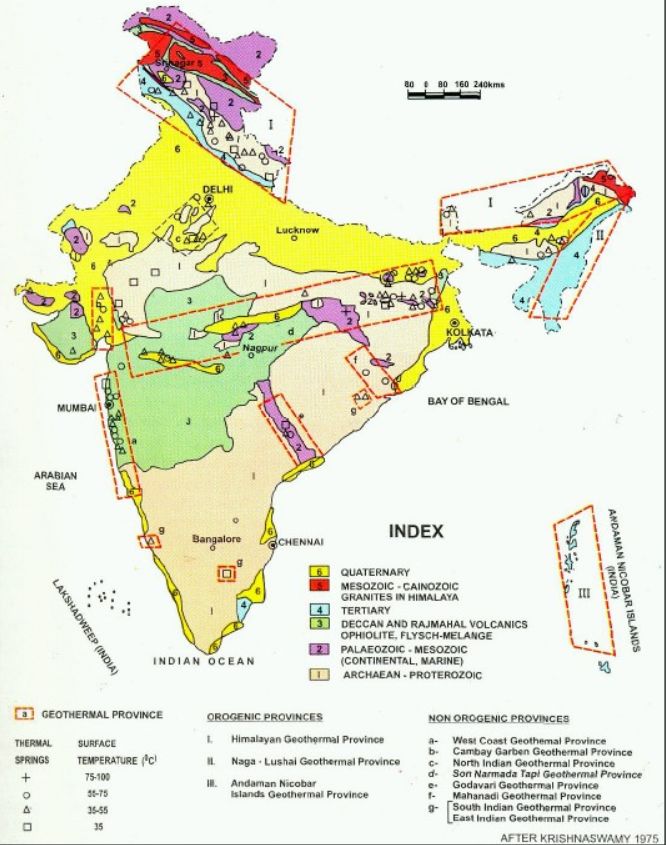
Types of Geothermal Electricity
     Generation
                                      TYPES OF ELECTRICITY GENERATION

       ►   Geothermal power plants utilize hydrothermal resources that contain both heat (thermal) and
           water (hydro)
       ►   Geothermal power generation is valued for its high reliability, independence from short term
           weather fluctuations, and long operating life
       ►   Individual plants, such as Wairakei (NZL), the Geysers (USA), Larderello (ITA), Bulalo (PHL)
           and Oita (JPN) have reliably generated electricity for over 40 to 50 years*
       ►   The diagram below illustrates three types of geothermal power plants: dry steam, flash, and
           binary

                          THREE TYPES OF GEOTHERMAL POWER PLANTS

                                                                                           Dry Steam Power Plants

            Production of Geothermal Energy                                               Flash steam power Plants

                                                                                          Binary Cycle Power Plants

     Page 4                 26 September
                            2018
*https://www.worldenergy.org/wp-content/uploads/2017/03/WEResources_Geothermal_2016.pdf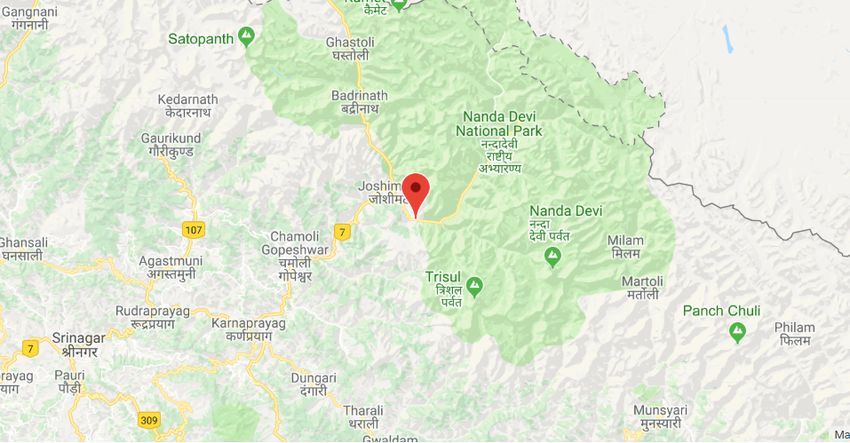
Types of Geothermal Electricity
      Generation (1/3)
                                            TYPES OF ELECTRICITY GENERATION

        Dry Steam Power                                ►   Dry steam power plants were the first type of geothermal plants
        Plants                                             and was named dry steam since steam is extracted from the
                                                           underground reservoirs in place of hot water
                                                       ►   Dry steam reservoirs use the water in the earth's crust, which is
                                                           heated by the mantle and released through vents in the form of
                                                           steam
                                                       ►   The dry steam power plant is suitable where the geothermal steam
                                                           is not mixed with water
                                                       ►   Production wells are drilled down to the aquifer and the
                                                           superheated, pressurised steam (180°-350°C) is brought to the
                                                           surface at high speeds, and passed through a steam turbine to
                                                           generate electricity*
                                                       ►   The steam is passed through a condenser to convert it to water
                                                       ►   This improves the efficiency of the turbine and avoids the
                                                           environmental problems caused from the direct release of steam
                                                           into the atmosphere

                      SCHEMATIC DIAGRAM OF A DRY STEAM POWER PLANT

      Page 5                      26 September
                                  2018
*https://hub.globalccsinstitute.com/publications/geothermal-electricity-and-combined-heat-power/dry-steam-and-
flash-power-plants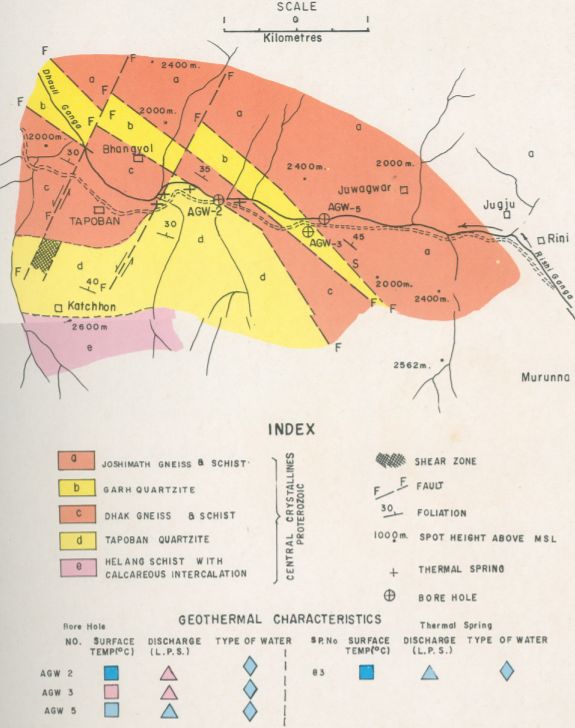
Types of Geothermal Electricity
     Generation (2/3)
                                       TYPES OF ELECTRICITY GENERATION

       Flash steam power                         ►   Flash steam is today’s most common power plant type
       Plants                                    ►   The first geothermal power plant that used flash steam technology
                                                     was the Wairakei Power station in New Zealand, which was built in
                                                     1958
                                                 ►   Geothermal flash steam power plants use water at temperatures of
                                                     at least 182°C (360°F)*
                                                 ►   Fluid is sprayed into a tank held at a much lower pressure than the
                                                     fluid, causing some of the fluid to rapidly vaporize, or "flash”
                                                 ►   The vapor then drives a turbine, which drives a generator
                                                 ►   If any liquid remains in the tank, it can be flashed again in a second
                                                     tank (double flash) to extract even more energy
                                                 ►   The only by-products of this process are excess steam and trace
                                                     gases

          SCHEMATIC DIAGRAM OF FLASH STEAM GEOTHERMAL POWER
                                 PLANT

     Page 6                26 September
                           2018
*https://www.energy.ca.gov/almanac/renewables_data/geothermal/types.html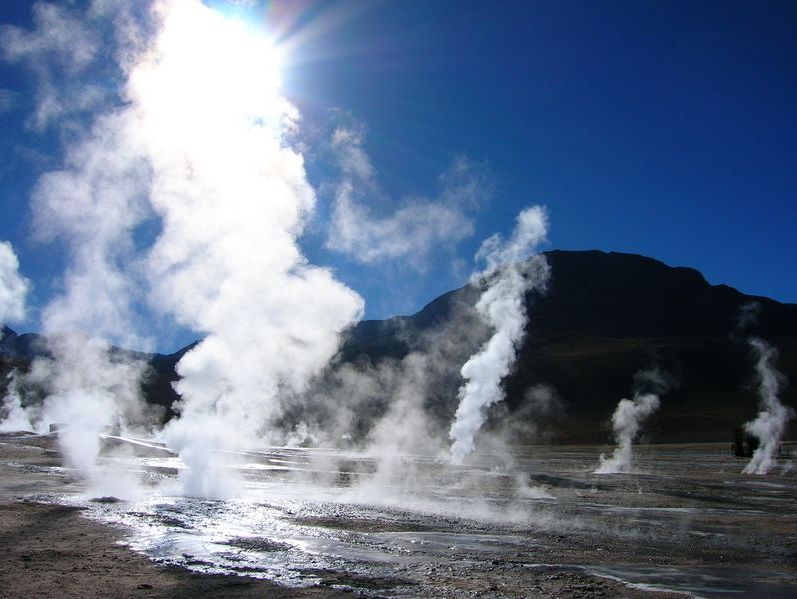
Types of Geothermal Electricity
     Generation (3/3)
                                        TYPES OF ELECTRICITY GENERATION

       Binary Cycle Power                         ►   Binary plants, like dry-steam and flash-steam plants, make use of
       Plants                                         naturally sourced hot steam generated by activity from within the
                                                      Earth's core
                                                  ►   Binary plants specifically use a second working fluid (hence,
                                                      "binary"), usually an organic fluid (typically n-pentane), that has a
                                                      low boiling point and high vapour pressure at low temperatures
                                                      when compared to steam
                                                  ►   The geothermal fluid (predominantly water vapour) and working
                                                      fluid pass through a heat exchanger, where the working fluid
                                                      flashes to vapour and drives the turbines
                                                  ►   The cooled water vapour is then released back into the
                                                      underground reservoirs, so the cycle can begin anew
                                                  ►   No gas is emitted to the atmosphere, as the binary cycle is a
                                                      closed system
                                                  ►   Since water in underground reservoirs usually has moderate
                                                      temperatures, binary-cycle power plants will likely be the main
                                                      geothermal technology in the future

          SCHEMATIC DIAGRAM OF BINARY CYCLE GEOTHERMAL POWER
                                  PLANT

     Page 7                 26 September
                            2018
*http://large.stanford.edu/courses/2011/ph240/yan2/
Advantage India (1/3)

                                                INDIAN GEOTHERMAL SCENARIO
      ►   India has a huge potential to become a leading contributor in generating eco-friendly and cost-
          effective geothermal power
      ►   The GSI (Geological Survey of India) has identified 340 geothermal energy locations in the
          country*
      ►   Most of these locations are in the low to medium temperature range, that is, from 35–98°C
          which is suitable for direct heat applications*
      ►   On the basis of enthalpy characteristics the geothermal systems in India, are classified into
          medium (100°C-200°C) and low enthalpy (90                              260                           468         100

        Cambay                           40-90                            150-175                       80-93       70

        West Coast                       46-72                            102-137                       75-129      47-59

        Sone-Narmada-                    60-95                            105-217                       120-290     60-90
        Tapi

        Godavari                         50-60                            175-215                       93-104      50

      Page 8                  26 September
                              2018
*https://mnre.gov.in/file-manager/akshay-urja/april-2017/Images/28-33.pdf
**http://www.earthscienceindia.info/pdfupload/tech_pdf-1255.pdf
***http://www.indiaenvironmentportal.org.in/files/file/Draft-National-Policy-on-Geothermal-Energy.pdf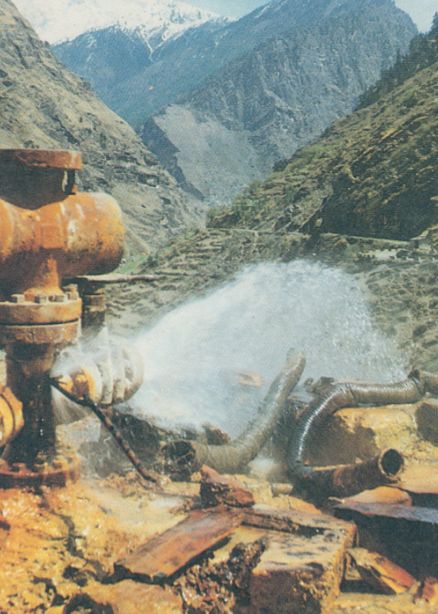
Advantage India (1/3)

                      MAJOR GEOTHERMAL ENERGY RESOURCES IN INDIA

                                                                                  TAPOBAN

      ►   The diagram map above depicts prominent geothermal sites in India
      ►   The 340 springs are grouped into seven geothermal provinces
          ► Himalayan (Puga, Chhumathang), Sohana belt in Haryana, Cambay Graben basin, Son-
            Narmada-Tapi (SONATA) lineament belt, West Coast, Godavari basin and Mahanadi basin
      ►   Some of the prominent geothermal resources include the Puga valley and Chhumathang in
          Jammu and Kashmir, Manikaran in Himachal Pradesh, Ratnagiri in Maharashtra, Tattapani in
          Chhattisgarh and Tapoban in Uttarakhand
     Page 9                 26 September
                            2018
*http://suvratk.blogspot.com/2010/09/engineered-geothermal-energy-projects.html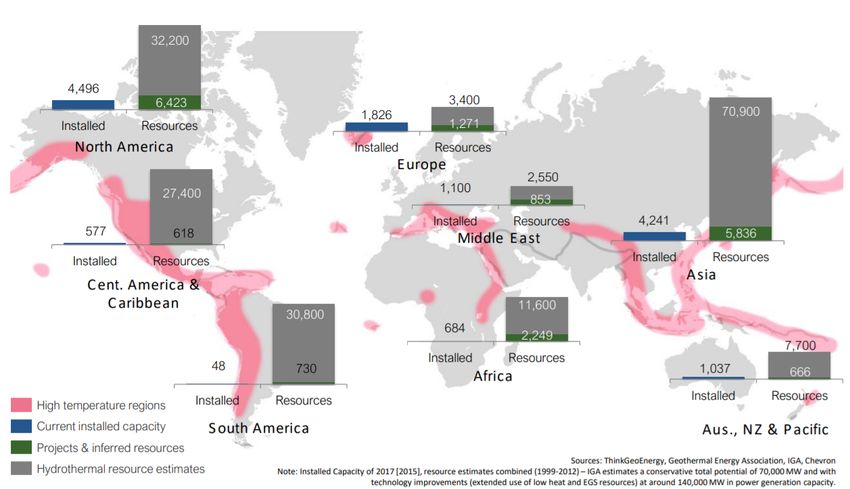
Advantage India (1/3)

                                         INDIAN GEOTHERMAL SCENARIO

                   The Status of Important Geothermal Regions in India
        Geothermal Field                     Estimated (min.) reservoir   Status
                                             Temp (Approx.)

        Tapoban Chamoli                      100oC at 430 meter           Magneto-telluric study done
                                                                          by NGRI
        (Uttarakhand)

        Tattapani Sarguja                    120oC - 150oC at 500 meter   Magneto-telluric study done
                                                                          by NGRI
        (Chhattisgarh)                       and 200o C at 2000 meter

        Puga geothermal                      240oC at 2000 meter          From geochemical and deep

        field                                                             geophysical studies (MT)

        Cambay Garben                        160oC at 1900 meter (From    Steam discharge was
                                                                          estimated 3000 cu
        (Gujrat)                             Oil exploration borehole)
                                                                          meter/ day with high
                                                                          temperature
                                                                          gradient

        Badrinath Chamoli                    150oC estimated              Magneto-telluric study was
                                                                          done by NGRI
        (Uttarakhand)
                                                                          Deep drilling required to
                                                                          ascertain
                                                                          geothermal field

        Surajkund,                           110oC                        Magneto-telluric study done
        Hazaribagh                                                        by NGRI (National Geophysical
                                                                          Research Institute)
        (Jharkhand)
                                                                          Heat rate 128.6 MW/m

        Manikaran                            100oC                        Magneto-telluric study done
                                                                          by NGRI Heat flow rate 130
        Kullu (H P)
                                                                          MW/m2

        Kasol                                110oC                        Magneto-telluric study done
                                                                          by NGRI
        Kullu (H P)
      Page 10                26 September
                             2018
*http://www.eai.in/ref/ae/geo/geo.html
Sector Advantages (1/2)
SECTOR ADVANTAGES (1/2)
► Geothermal power plants use a renewable resource that is not
Cost Advantages susceptible to price fluctuations
► New geothermal plants currently are generating electricity from
0.05$ to 0.08$ per kilowatt hour (kwh)*
► Once the capital costs have been recovered, the price of power can
decrease below 0.05$ per kwh
► Thus the price of geothermal is within range of other electricity
choices available today when the costs of the lifetime of the plant
are considered
Reliable Source of ► Geothermal energy has many advantages as compared to other
Renewable Energy renewable sources such as solar, wind or biomass
► It is an exceptionally constant source of energy that is not
dependent on either wind or sun, and available all year long
► Geothermal energy is extracted from the earth without burning
Eco Friendly fossil fuels, and geothermal fields produce almost no emissions
High Efficiency of ► Geothermal heat pump systems use 25% to 50% less electricity
Geothermal Systems than conventional systems for heating or cooling, and with their
flexible design they can be adjusted to different situations,
requiring less space for hardware as opposed to conventional
systems**
Little to No ► Geothermal heat pumps are advantageous since the pipes come
Geothermal System along with impressive warranty of up to 25 years, keeping in mind
Maintenance that the system can last for up to 20 years
► This is, essentially, a lifetime warranty
Page 11 26 September
2018
**https://www.conserve-energy-future.com/advantages_geothermalenergy.phpUttarakhand –
Key Credentials (1/2)
UTTARAKHAND STATE OVERVIEW
► There are 62 thermal spring localities in Uttrakhand, all of them are confined to the Himalayan
terrain, which lie in the altitude range of 1000m- 4000m above mean sea level and occupy 10-
40 km wide zone along all the major valleys, viz., Kali, Alaknanda, Mandakini, Bhilangua,
Bhagirathi, Yamuna and Tons
► Of the 62 thermal spring localities, 37 occur in the Central Crystalline (Proterozoic) and 22 in
the Garhwal Group of rocks (Precambrian) on either side of the Main Central Thrust (MCT)*
► The remaining three localities occur in the Tethyan Himalaya
► The thermal springs occurring within the Central Crystalline show high temperatures of 55°C to
94°C, while a majority of the manifestations (16 out of 22), in the Garhwals show low
temperatures of 38°C to 22°C*
► Most of the thermal springs emerge through joints and or are controlled by the interfaces of the
lithological units
► Secondary deposits associated with the thermal manifestation comprise mainly thin carbonate
encrustations/ layers
► The chemistry of the thermal water indicates that a majority of the thermal discharges are
either of Ca Mg HC03, or of Na HC03 type with exceptions are the Gangnani and Jamnotri*
GEOLOGICAL MAP OF UTTARAKHAND SHOWING THE DISTRIBUTION
OF HOT SPRINGS
Page 12 26 September
2018
https://mnre.gov.in/sites/default/files/uploads/GeothermalResorcesofIndia.pdfUttarakhand –
Key Credentials (2/2)
UTTARAKHAND SNAPSHOT
GSDP Increased at Installed Power Capacity FDI inflows (Apr - Dec Operational PPP
CAGR of 11.17% (MW) as of 2017-18 2017), stood at projects ( 129 No)
(2011-18*) 3333.35** around US$ 652 (April 2018)***
mn***
PROJECT SITE – TAPOBAN
TAPOBAN
Chamoli District Joshimath Tehsil Uttarakhand State
30.557894 Latitude 79.5592589 Longitude
Page 13 26 September
2018
*https://www.ibef.org/states/uttarakhand-presentation
**Central Electricity Authority, as of Feb 2018
***Department of industrial Policy & Promotion, Apr 2000-Dec 2017Uttarakhand –
Competitive Advantage
ADVANTAGE: UTTARAKHAND
Uttarakhand is being Under its ‘Ease of Doing
Renewable Ease of Doing Business’ initiative, the State
developed as an ‘energy Business
state’ to tap the Energy Potential has implemented a web
hydropower electric based Single Window
potential of over 25,000 Clearance System, allowing
investors to avail the
MW necessary State Government
approvals
The state has a stable The state has abundant
political environment with Stable Political Favorable
natural resources due to hills
successive Governments Environment Location &
and forests and vast water
that have been committed Abundant
resources favouring
towards creating a Resources
Hydropower and Geothermal
progressive business Power Generation
environment.
The Industrial electricity Uttarakhand is one of the
tariff in Uttarakhand is Low Industrial Evolving
industrialisation fastest growing states in
one of the lowest across Electricity Tariff
India. The state’s GSDP
the States. The electricity facilitating
growth increased at a compound
supply is reliable. annual growth rate of
11.17% (2011-18*)
Page 14 26 September
2018
https://mnre.gov.in/sites/default/files/uploads/GeothermalResorcesofIndia.pdfProject Information
PROJECT AT A GLANCE
Project Name Geothermal Power Plant
Location Tapoban in Chamoli district, Uttrakhand
Unit Capacity Approx. 20 MW
Focus Sector Geothermal
Project Timelines 8 years
Highest temperature 65°C
Discharge from Springs Varies between 0.83-9.22 lit/sec*
Elevation 1920 m*
Thermal Efficiency Rate 10-23%
Proposed Land Area Tapoban, Chamoli district
TAPOBAN GEOTHERMAL AREA, DISTRICT CHAMOLI
Page 15 26 September
2018
*https://mnre.gov.in/sites/default/files/uploads/GeothermalResorcesofIndia.pdfProject Information
PROJECT AT A GLANCE
► There are a dozen of thermal springs clustered around four locations in Tapoban area
► These are distributed in a linear pattern in a kilometre long section along the left flank of the
Dhauli river
► The rocks in the Tapoban area belong to the Central Crystalline
► The area is traversed by two tear faults
► The thermal springs of Tapoban area appear through Tapoban quartzite member
► This quartzite and the underlying schist of Helang formation, in all probability, form the shallow
reservoir in the area
► The highest temperature recorded is 65°C
► The discharge from these springs varies between 9.22-0.83 lit/sec
► Secondary deposition around them is negligible
► Only one spring has gaseous emanations
► The gas sample collected comprises 78.6% CO2, 18.96%N2and 2.4%~
► The geophysical surveys done in the area indicated comparatively low resistivity (100 ohm m)
zone down to 165 m depth only, while the deeper horizons indicate very high resistivity (5500
ohm m)
► Encouraged by the high geothermal gradient ofO.16-0.58°C/m met with in the two 50 m holes
drilled at Tapoban, exploratory drilling of deeper holes was launched in the area
Geothermal Borehole at Tapoban with ArtesioN discharge of hot water (63oC) Under High Pressure (7 Kg/cm2)
Page 16 26 September
2018
*https://mnre.gov.in/sites/default/files/uploads/GeothermalResorcesofIndia.pdfProject Information
TENTATIVE OVERALL PROGRAM OF GEOTHERMAL DEVELOPMENT
IN TAPOBAN FIELD
Geothermal Investigation By NTPC/NGRI
Phase I
Propose the following study program
Supplemental Surface Study
► Geology, Geochemistry, Geophysics
► Surface Study Integration, geothermal conceptual Model
► Selection of drilling targets of exploratory wells
Exploratory Well Study
► Exploratory Well Drilling
► Well geology and geochemistry
► Well logging
► Completion test
► Production test, injection test
Phase II
Update Geothermal Conceptual Model
Environmental Assessment
Feasibility Study
► Geothermal resource assessment and its characteristics
► Conceptual design and cost estimation of the project
► Implementation plan
► Environmental consideration
► Financial analysis etc.
Selection of owner’s consultant
and EPC Contractor
Detailed design of steam field development, power plant facilities
and transmission line
Phase III
Well drilling, piping for FCRS (Fluid Collection and Reinjection
System), construction of power plant and transmission line
Operation and Maintenance of Geothermal Power Plant
Page 17 26 September
2018
Uttarakhand Renewable Energy Development AgencyInfrastructure Availability
Connectivity of Tapoban with the major towns
► The following shows railway stations and their distance from Tapoban
► Rishikesh railway station - 115.8 KM
Rail
► Harrawala railway station - 117.6 KM
► Dehradun railway station - 119.3 KM
► Virbhadra railway station - 120.8 KM
► Doiwala railway station - 121.7 KM
► Tapoban‘s nearest airport is Jolly Grant Airport situated at 116.5 KM
distance. Few more airports around Tapoban are as follows
Air
► Jolly Grant Airport - 116.5 KM
► Naini Saini Airport - 182.1 KM
► Sarsawa Air Base - 188.6 KM
► It is approachable by an all weather 15 km long road from Joshimath, in
Road Chamoli district, Uttrakhand at an altitude of about 1800 m
Page 18 26 September
2018
https://mnre.gov.in/sites/default/files/uploads/GeothermalResorcesofIndia.pdfPolicies, Schemes
& Incentives (1/3)
Central Government Incentives
Project Types In-principle Subsidy
MNRE INDIAN GEOTHERMAL ENERGY DEVELOPMENT - DRAFT
► Phase-I: 50% of Deep Drilling cost and in case
of failure it will be converted into grant subject
to development of site as direct use
► R&D Projects (Power) (Demo) geothermal heating/cooling. Phase-II: On
successfully completion of Phase-I, 30% CFA
(50% for PSUs/Govt. organizations) to first five
projects of size 3 to 5 MW
► 30% of Capital Cost (Maximum support of 9
► Industrial Projects (Power)
Cr/MW) for 25 Cr. Per project
► Public Good (Direct Heat Utilization) ► 30% - 50% of Capital Cost. Case to case basis
► Subsidy of 30% of project cost in the form of
incentives with maximum support of INR
50,000 /TR for first 150 MWt capacity
► Ground Source Heat Pump(GSHP’s) (Using
(Individual plant of more than 100 TR
Close Loop)
capacity), INR 30,000/TR for next 200 MWt
and INR 10,000/TR for last 150 MWt target
capacity i.e 500 MWt.
► Subsidy of 25% of project cost in the form of
incentives with maximum support to of INR
15,000 /TR for first 150 MWt capacity
► Geo-exchange Cooling (Using Open Loop)
(Individual plant of more than 100 TR
capacity), INR 10,000/TR for next 200 MWt
and INR 5,000/TR for last 150 MWt target
capacity i.e. 500 MWt.
Page 19 26 September
2018
https://mnre.gov.in/sites/default/files/uploads/GeothermalResorcesofIndia.pdfKey Contacts
UTTARAKHAND RENEWABLE ENERGY DEVELOPMENT AGENCY
(UREDA)
Address Uttarakhand Renewable Energy Development Agency
Industrial Area, Patel Nagar, Dehradun, Uttarakhand
Nodal Person Name: A K Tyagi
Designation: Chief Project officer
Website http://ureda.uk.gov.in/
Email ID Dir.uredahq@gmail.com
Phone +91-135-2521387, 2521386
INVESTMENT FACILITATION CENTRE
Address Directorate of Industries
Industrial Area, Patel Nagar, Dehradun, Uttarakhand
Website www.investuttarakhand.com
Email ID ifc.uttarakhand@gmail.com
Toll Free 18002701213
Phone +91-135- 2559898, 2559987
Disclaimer: This project profile is based on preliminary study to facilitate prospective
entrepreneurs to assess a prima facie scope. It is, however, advisable to get a detailed
feasibility study prepared before taking a final investment decisionYou can also read


