Hill torrents potentials and spate irrigation management to support agricultural strategies in Pakistan
←
→
Page content transcription
If your browser does not render page correctly, please read the page content below
American Journal of Agriculture and Forestry
2014; 2(6): 289-295
Published online December 18, 2014 (http://www.sciencepublishinggroup.com/j/ajaf)
doi: 10.11648/j.ajaf.20140206.20
ISSN: 2330-8583 (Print); ISSN: 2330-8591 (Online)

Hill torrents potentials and spate irrigation management to
support agricultural strategies in Pakistan
Muhammad Asif1, Col Islam-ul-Haque2
1
    Scientific Officer/AAE, CAEWRI NARC/Pakistan Agricultural Research Council (PARC) Islamabad
2
    Chairman, Ecological Sustainability through Environmental Services (Eco Steps), Islamabad, Pakistan

Email address:
asifbukhari1@gmail.com (M. Asif), islamhaq3@yahoo.com (C. Islam-ul-Haque)

To cite this article:
Muhammad Asif, Col Islam-ul-Haque. Hill Torrents Potentials and Spate Irrigation Management to Support Agricultural Strategies in
Pakistan. American Journal of Agriculture and Forestry. Vol. 2, No. 6, 2014, pp. 289-295. doi: 10.11648/j.ajaf.20140206.20

Abstract: Pakistan has not only been blessed with enriched hydrological cycling phenomenon which generate abandoned
quantum of water in the northern part , but also possess 18.68 MAF Water Potential in water scarce areas of Pakistan , known
as Rod Kohi. Spate irrigation is in practice in Pakistan, where, flood water, during monsoon season, gets generated and
channelized from down-hill countered profiles (catchments area). These hill torrential are diverted to agriculture fields, by
constructing earthen embankments or related hydraulic concrete structures. Since, hill sides torrential are unpredictable,
temporally and spatially matrix, which poses numerous challenges to the farmers who in return forcibly integrate / pool up
individual resources to partially manage this scarce resource. Though the annual rainfall ( ....100...mm/year) in this area is low
and uncertain yet at the same time due to terrain lay out , substantial quantum of water gets accumulated due to downhill side
terrain profile each rainfall event. The agriculture activities, in these areas are totally dependent on such type of phenomenal
rainfalls. Unfortunately, due to lack of scientific water resource management and modern agriculture practices, major quantum
of torrential flood water is not only gets wasted , but also causes huge losses to human life and property . This catastrophic
situation arises, as there are neither successive layers of check-dams on the down-hill sides of these mountain ranges, nor any
kind of water storage facilities exist at the foot hill areas. PARC (Pakistan Agricultural Research Council) and Pakistan Poverty
Alleviation Foundation ( PPAF) did funded some localized water storage , water conveyance and water distribution system
interventions, but still there is a dire need of holistically adoption of watershed management approaches , based on resource
integration concept and practices. This un-managed water resource must be harnessed / converted into lucrative opportunities
to oxygenize the life line for millions of people residing in these areas.
Keywords: Agricultural, Spate Irrigation, Rainfall, Water Management, Storage

                                                                          and crop diversification. Water resources in Pakistan,
1. Introduction                                                           especially outside the Indus basin irrigation system are
   By enlarge Pakistan is an agro based economy which                     limited/scarce to meet the crop water requirement. The
contributes 21% towards the total GDP and 70% of the total                productivity and sustainability of agriculture in these areas
population draw their livelihood from various agricultural                are dependent on the management of scarce water resources
activities. Over the past decade, due to various reasons, the             i.e. efficient water use. Due to saturation of agricultural
agriculture industry, being the main livelihood of a sizeable             production in irrigated areas of the country, search for new
population and major economic growth indicator is on the                  areas has become inevitable in order to feed the ever-
decline. Adverse impacts of climate change, coupled with                  increasing population in the country.
bad water governance have further aggravated the problem.                 1.1. Delineation of Spate Irrigation Region
Required water availability at the right time and efficient
irrigation led technological interventions are the key drivers              The spate Irrigation region of Pakistan lies between
for increased productivity enhancement in agriculture sector.             longitude range of 60°50′ to 72° East and latitudes 24°42′ to
Efficient water management and its application results in                 34° 3′ North (Fig 1). It comprises parts of southern NWFP,
increased crop yields, more cropped area, cropping intensity              south-western Punjab, western Sindh and major part of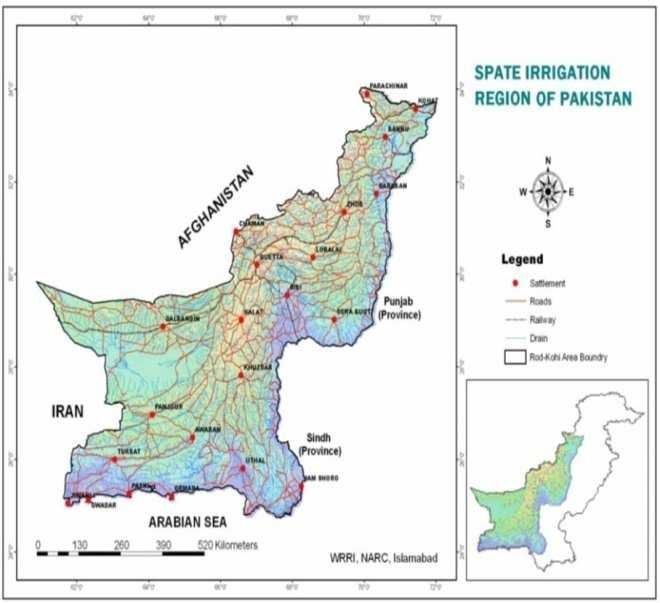
290            Muhammad Asif and Col Islam-ul-Haque: Hill Torrents Potentials and Spate Irrigation Management to Support
                                                 Agricultural Strategies in Pakistan

Baluchistan province. It is bounded in the north by KPK                      across the country, spate irrigation is also generally referred
province, west by Afghanistan and Iran, south by Arabian                     as flood irrigation. This kind of irrigation practices primarily
Sea and east by Punjab and Sindh provinces. The region                       relies on the flood water of the hill torrents, which are
covers about 41.63 million hectares of area (about 49.9% of                  diverted into a plain area, locally known as Damaan. The
the country area: 83.43 Mha) in the west of the country.                     total water potential of Rod Kohi are shown in (Table-1)
Maximum region lies in Baluchistan province (about 82%)
followed by NWFP (9.2%) and Sindh province (5%). Punjab
province contributes about 4.2% to the region (Table 2).
Highest elevation in the region is about 4680 meters above
sea level (masl). Maximum stretch of the area is in SW-NE
direction (about 1390 km). The drainage pattern is
predominantly dendritic in nature (Fig 1). The highest
elevation is about 4680 meters in the northwest of
Baluchistan (Fig 1).
   Spate irrigated areas are one of the most important option
with considerable potential for increasing agricultural
production. Spate irrigation is a type of irrigation which is
being practiced since centuries in some parts of the world. In
Pakistan, spate irrigation covers nearly 1.5 million ha, which
is about 8% of the total irrigated area, as shown below in
table 2.
   In Pakistan's local context, It is known as Rod Kohi in the
Khyber Pakhtoon Khawan (KPK) Province, and in Punjab
                                                                                               Fig 1. spate irrigation region of Pakistan
and Baluchistan province, called Bandit/Sailaba. Commonly,
                                                      Table 1. Water Potential Rod Kohi- Pakistan

 Province                     Potential Area* (MA)                Potential Water* (MAF)             Ratio of Water to Area (acre feet/acre)
 Federal                      0.67                                2.84                               4.2
 NWFP                         2.13                                4.56                               2.1
 Punjab                       1.41                                2.71                               1.9
 Sindh                        1.36                                0.72                               0.5
 Baluchistan                  11.56                               7.85                               0.7
 Total                        17.13                               18.68                              1.1

Source: Feasibility Studies for Flood Management of Hill-Torrents, NESPAK, 1998.

   In the indigenous systems, farmers divert the spate flow to                     collect water from many small ephemeral streams with
their fields by constructing breach able earthen bunds (called                     quite hilly catchments.
Gandas) across the rivers and/or stone/gravel spurs leading                     c. Diffuse supply systems utilize large sloping areas as
towards the centre of the river (FAO,1997). Spate Irrigation                       contributing catchments, where the runoff is collected
farming system of Rod-Kohi areas is a unique system of                             into shallow nullahs by the time it reaches the diversion
farming, being practiced in Piedmont plains of Dera.Ismaiel.                       point.
Khan (KPK), Dera .Ghazi. Khan (Punjab), Dadu (Sindh) and                        d. Riverine systems are designed to divert water from
in Sulaiman ranges, Kachhi plain, Kharan and Lasbela basins                        perennial streams only when a sufficient flood stage is
of Baluchistan province. Baluchistan, the largest province in                      reached for the water to flow into diversion canals
Pakistan, has about 1.2 million hector of spate or Sailaba                         (Hamilton and Muhammad, 1995).
irrigated land. These areas are often called falling flood                      Water rights on Sailaba systems in Baluchistan are entirely
irrigation areas and are located on extensive tracts of land                 controlled by the users. The government plays no role in
along the rivers and hill streams subject to annual inundation.              distributing the water or maintains records of water used by
They utilize the moisture retained in the root zone after the                the farmers. Water is distributed between the irrigation
flood subsides together with sub-irrigation due to the                       systems’ participants according to the principle of ‘first come,
capillary rise of groundwater (Ahmed, 2000).                                 first served.’ There is no formal government-sanctioned
There are four different water supply systems in the Sailaba                 entity to manage the system. The government agencies
irrigation, namely nullah, manda, diffuse and riverine                       mainly serve as Facilitators such as making available the
(Hamilton and Muhammad, 1995), like;                                         equipment necessary for the building or reconstruction of
    a. Nullah systems are based on a single nullahs                          Sailaba earthen bunds / embankments. This is unlike the
       (ephemeral stream), usually one with a mountainous                    spate irrigation systems in KPK and Punjab provinces, where
       catchment;                                                            the civil administration actively intervenes in instructing the
    b. manda systems depend on rivers or large nullahs, which                farmers to plug breaches and to connect flood canals (Van
American Journal of Agriculture and Forestry 2014; 2(6): 289-295                               291

Steenbergen, 1997). Upper portion of Dera Ismail Khan (DI           and particle densities, and porosity are the major soil
Khan), Tank and Kullachi Tehsil are the three districts in          physical properties that determine the extent of the water-
KPK province, where spate irrigation is still prevailing. The       storage capacity of the soil. A number of studies (Thomas, et
total area of the districts is about 9 million hector, out of       al., 2004 and Randall and Sharon, 2005) have shown that
which the cultivated land is 700,000 hectors. Spate irrigation      estimates of many physical and chemical characteristics of
covers nearly 250,000 hectors in KPK, minor spate flows             soils can be done if their texture is accurately assessed.
occur in spring and the major floods come in summer as a
result of monsoon rainfall on the Suleiman range and Lakai-         4.2. Distribution of Spate Flow
Marwat hills during July and August (Hamilton and                      Spate flow draining upland areas generally have little base
Muhammad, 1995)                                                     flow and rise rapidly after rainfall on the catchments area.
                                                                    Rapid runoff coupled with steep stream gradients, results in
2. Objectives                                                       high peak flows. Serious flooding results when these streams
                                                                    reach the lowlands where the hydraulic gradient is much
  The spate irrigation system study objectives are as under;        flatter. Rod Kohi system of irrigation uses earthen
  a. To discuss existing spate irrigation infrastructure            embankments, called bund or ganda, to divert flow from hill
     system and water application practices in Pakistan             torrents. When the upstream diversion has received adequate
     associated with flood damages, hazards & risks.                water, the bund is breached and the next farmer receives the
  b. To compare crop yield productivity between spate               water. Almost all the spate irrigated areas in Pakistan lie in
     irrigation / flood water & managed irrigation system,          the most marginalized and socially low-ranking districts.
     through perennial canal system & tube wells water              This had a negative impact on the decision-making at the
     application system                                             national level as far as resource allocation for the irrigation
  c. To analyze and discuss the role of all other related           sector is concerned. A review of budgetary records clearly
     government departments for effective and prudent hill          indicates that the bulk of investment in agricultural research
     torrents watershed area management.                            and physical development has gone into the perennial
                                                                    irrigated agriculture (Nawaz, 2003)
3. Methods and Material
                                                                    4.3. Flood Damages in Spate Irrigated Areas
   Secondary data/reports/studies have been consulted, as in
the past, lot of work on potentials of hill torrents has been
carried out by various organizations, including " Master
Feasibility Studies for Flood Management of Hill-Torrents,
by NESPAK, 1998". Besides this, field visits of various have
been carried out and personal interaction with the various
government departments and with on-site farmers/
communities was also carried out.

4. Results and Discussion                                                        Fig 2. Flood damages in spate irrigated areas

4.1. Climate and Geo-Technical Characteristics, Soil                   The hill torrent brings flashy flood of shorter duration but
     Texture Etc                                                    very high magnitude. High flows breach earthen diversion
                                                                    bunds and deprive the cultivators from the use of this water.
   The climate of the Rod-Kohi areas in KPK, Punjab and             The flood water thus rushes downstream and damages crops,
Sindh provinces is arid to semi-arid with precipitation             houses and other infrastructures. During the year 2004, a
ranging from less than 100 mm in South West (Dadu, Sindh)           flood of about 67,600 cusecs discharge was observed in
to 300 mm in Northwest (D.I. Khan, KPK). In Kharif season,          Sanghar Hill Torrent at Taunsa on June 6, 2004. A serious
rain is received in the months of July and August and in‘Rabi’      embayment along the left bank downstream of Indus Super
season in the months of March and April. June is the hottest        Highway Bridge partially damaged the residential area.
month with a mean maximum temperature of 44˚C while                 Sloughing of bank in a very large chunk took away a part of
January is the coldest month with a minimum temperature of          the Kacha colony whereby about 13 houses were fully taken
4˚C. In Baluchistan province, however, the climatic                 by the flood currents along with their debris. One man and a
conditions differ from the rest of hill torrent areas in the        number of animals were killed; a lot of household and food
country. Its climate is arid to semi-arid in winter and arid to     grain were taken away by the flood currents. In August 2008,
hyper-arid in summer. Rainfall is erratic and is received in        a flood of 80,000 to 100,000 cusec passed through different
monsoon as well as in winter. Due to wide variability of            parts of the Rajanpur district and more than 160 villages
temperature regime, the climate of the province varies from         were submerged due to the flooding; resulting in the
cool temperate to tropical allowing an amazing variety of           migration of over 6,000 people to safe places (Fig 2).
crops to grow economically. Soil texture and structure, bulk
292 Muhammad Asif and Col Islam-ul-Haque: Hill Torrents Potentials and Spate Irrigation Management to Support
Agricultural Strategies in Pakistan
4.4. Area under Spate Irrigation community, due highly unreliable and unpredictable flood
water occurrences. An estimate of the land coverage of spate
It is difficult to give exact figures about the area under irrigation systems in some countries compiled from different
spate irrigation because the system has never had the same sources (FAO, 2005; Ahmed, 2000; Al-Shaybani, 2003 and
amount of attention as perennial irrigation from governments, Mehari, et al., 2005a) is presented in Table 2.
non-government development institutions and the donor
Table 2. Spate irrigated versus total irrigated areas in some countries
% of total irrigated area covered by
Country Year of data collection Total irrigated area in (ha) (!) Spate-irrigated area in ha (2)
spate irrigation (2)/ (!)*100
Algeria 1997 560,000 70,000 13
Eritrea 2005 28,000 15,630 56
Kazakhstan1 1993 3,556,400 1,104,600 31
Libya 1997 470,000 53,000 11
Mongolia 1993 84,300 27,000 32
Morocco 1997 258,200 165,000 13
Pakistan 2000 17,580,000 1,450,000 8
Somalia 1984 200,000 150,000 75
Sudan 1997 1,946,000 280,000 14
Tunisia 1997 481,520 98,320 20
Yemen 2003 485,000 193,000 40
FAO, 2005; 2 Mehari, et al.,2005c; 3 Ahmed, 2000; 4Al-Shaybani,2003
4.5. Crop Production supplement irrigation during the dry period particularly
during the critical period of crop growth.
The crop production in the area is traditionally of
subsistence level in spite of the fact that farmers’ resources, 4.6. Past Spate Flow Management
fertility of land, large holdings and long planting season are
productivity oriented. The major limiting factor is the In spite of the fact that the government of Pakistan favors
unreliable source of water. Cereal crops are the most allocation of resources to perennial irrigation systems,
important crops that occupy 60% of the area. The major around 74 permanent headworks have been constructed in
crops grown during Rabi are wheat, barley and oilseed while Balochistan in the past decades (Van Steenbergen, 1997). The
millets, sorghum, mungbeans are the summer crops. Farmers failure rate of these modern structures has, however, been
have been diverting flood flows into small channels for very high for a number of reasons. The main ones include:
irrigation purposes since decades, but many have become sedimentation, discrepancy with the indigenous water rules
defunctional due to physical, technical, financial and social and water sharing arrangements, lack of flexibility of the
constraints. Yields are low, averaging about 298 kgs/acre for structures to cope with the unpredictable nature of the floods.
Sorghum, 204 kgs/acre for Oilseeds and 367 kgs per acre for An extensive evaluation of 47 modernized systems
Wheat. Lack of optimal use of water; poor management constructed in the past 30 years has revealed that only 34%
practices, inefficient flood management and improper use of still function satisfactorily, 32% have serious operational
other essential inputs are main causes for low agricultural problems and 34% are completely non-functional (Van
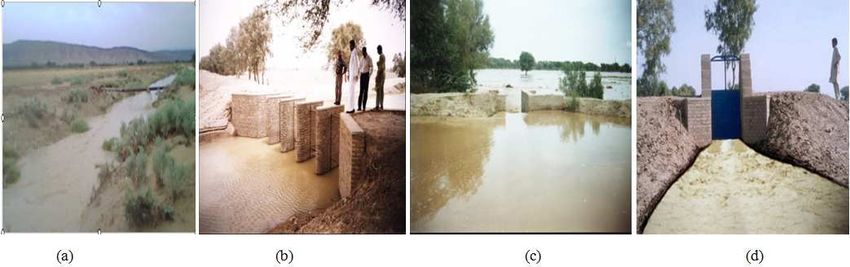
outputs in these areas. The prevailing Rod Kohi irrigation Steenbergen, 1997) (Table 2). Fig. 3 shows the unmanaged or
practices are traditional in nature and provide subsistence traditional spate irrigation system while Fig.4 shows the
based livelihood to the majority of the farmers in the area. managed and well established system. The irrigation and
Production oriented agriculture is not practiced and therefore, Power Department in Balochistan is responsible for the
crop yields are quite low. Consequently, the average yields operation and maintenance of the established spate irrigation
per unit area under Rod Kohi irrigation system are far below systems. The annual budget of the Department for the
the national average (Mumtaz, 1989). Pakistan agricultural maintenance of the structures is on the decline. The
research council (PARC) has developed many measures for maintenance work is limited to posting of linemen and
attaining reasonable crop yield. The promising ones could be: guards, and the major repair work is done on ad-hoc basis
application of optimum irrigation at the correct time; (Van Steenbergen, 1997). This has already made many of the
switching of crops from low value to high value, switching structures listed as ‘with serious operational problems’ in
from high delta of water crops to low delta of water crops, Table 3, non-functional. If these problems are not fixed, a
use of high efficient irrigation methods, etc. But this could number of the functional structures could soon become out of
only be possible when there is assured availability of flood use. Some modernized structures were not acceptable by the
water. This can be possible only when provide some kind of local people (upstream & downstream) e.g. In Anambar Plain
irrigation structures which stored water so as to provide in Balochistan, Pakistan, one of the introduced modern weirs
significantly changed the indigenous water distributionAmerican Journal of Agriculture and Forestry 2014; 2(6): 289-295 293
system (Van Steenbergen, 1997 and Mehari, etal., 2005c).
Table 3. Performance of government constructed spate schemes in Balochistan, Pakistan
Date of construction Total head works constructed Functional With serious Operational problems Non-functional
Nos. % Nos. % Nos. %
Prior to 1973 20 7 35 6 30 7 35
1974-1984 14 4 29 2 14 8 57
After 1984 13 5 38 7 54 1 8
Total 47 16 34 15 32 16 34
Source: Groundwater Consult 1991
The weir was constructed to divert spate flows to upstream farmers don’t compromise on the water distribution. So the
fields. It performed this function, but it also considerably need was to make such structures which are acceptable by
reduced the base flow to the downstream fields’ which both communities. Considering these facts PARC
caused many tensions and conflicts. As conflicts became emphasized on the improvement of water conveyance system,
unbearable, the two communities (upstream & downstream distribution, diversion and water application structure. The
farmers) reached a mutual agreement: they purposely blew local communities adopted these technologies successfully.
up the weir (Fig. 5) and returned to their indigenous
structures and water-sharing arrangement. 4.8. Remodeling of Rod-Kohi Conveyance Irrigation
Remodeling of the system improved control over water,
reduced operational losses and increased the quantity of
flood water. Silted channel not only reduces the carrying
capacity of water channel but also causes over topping of
flood water which not only damage crops but also results
devastation to property. The cost effective remodeling
conveyance system not only provided full supply level of
floodwater but also provided opportunity to increase the
irrigated area with enhanced water conveyance efficiency.
Improved/enhanced water conveyance system has increased
Fig. 3. Unmanaged Non perennial spate irrigation the reliability of flood water flow which ultimately furnished
optimum moisture level corresponding to each diversion
point. Therefore results showed in Fig-6 that after refinement
of water channel the grain wheat yield has been increased
from 1520 to 1870(19%), 1300 to 1780(27%) kg/ha at head,
1020 to 1790(43%), 700 to 1830(62%)kg/ha at middle and
from 630 to 1465(57%) and from 410 to 1280(68%) kg/ha at
tail reaches (Asif at el, 2014);
The comparison of discharge & crop yield production,
before and after remodeling is shown below in Fig-6;
Before Intervention After Intervention
Flow increased(%)
Fig. 4. Managed Non perennial spate irrigation
80 300
d is c h a rg e ( c u s
in c re a s e e d ( % )
60 200
ecs)
F lo w
40
20 100
0 0
1 2 3 4 5 6
Diversion locations
Fig 6. Frequency of receiving flood pre and post intervention
4.9. Water Distribution Structures
Fig. 5. Deliberately destroyed weir in Anambar Plain
Most critical element in managing Rod-Kohi System is
4.7. Present & Future Spate Flow Management diversion and distribution structures, which needs to perform
As mentioned above that the upstream & downstream both under low-and high flows and should provide equitable294 Muhammad Asif and Col Islam-ul-Haque: Hill Torrents Potentials and Spate Irrigation Management to Support
Agricultural Strategies in Pakistan
water according to their water rights. Such structures have different designs capacities and construction materials (pre-
been constructed in spate irrigated areas of Pakistan using casted pipe nacca structure) have been developed. The
different construction material with the participation of local structures were constructed on the basis of cost effectively,
communities. These structures helped farmers to regulate feasibility, adaptability and farmers perception.
floodwater at desired level without any extra labor and time.
Both communities (upstream & downstream) has consensus 4.11. Water Diversion Structures
on these structures which also helped to remove the conflicts Water regulating and diversion structures are used to
among them (Fig 7). regulate the flow by raising the water level for diversion of
4.10. Water Application Structures water to command area. Initially, the activities were initiated
at the farm level to improve water conveyance, distribution
The cultivated fields in Rod-Kohi irrigation System are and application systems. Cost-effective technologies for
large to the extent of 8 - 10 acres or more. The water water distribution and application have been tested and
application to the fields is crucial to control water in the introduced successfully. Local community is adopting these
flood season. Cost effective water application structures of technologies due to cost effectiveness and easy in operation.
Fig. 7. Development of hill torrent structures made by PARC
4.12. Role Sister Departments for Rod Kohi Watershed developed for adoption by the farmers. Each structure should
Management be designed based on careful research of site-specific
conditions and field experiences in construction, operation
At present, no other provincial departments or federal and maintenance. The flood control structures have to work
ministries, like forest, agriculture, fisheries, soil conservation during high floods and thus are to be durable against extreme
and environment have not undertaken any kind of tangible conditions.
interventions to manage the vast Rod Kohi watershed area.
As a matter of fact, an integrated approach should have been
adopted for downhill tree plantations, river training works in 6. Recommendations
the various drains flowing from hill tops to down wards and To attain Agricultural enhancement, employment, income
construction of series of check dams on downhill slopes and thereby to alleviate poverty and hunger in spate irrigated
areas, we need to carry out proper water management
5. Conclusion practices so that water is made available as per requirement.
For this we have to design/develop two kinds of water
Rod Kohi system of irrigation is the least known and the management practices such as
most unattended among irrigation systems in Pakistan, and i. Development of permanent diversion and distribution
therefore, remained undeveloped. The major reasons include structures by involving the local communities so that
poor resources of Rod Kohi farmers, ignorance of farmers to the water rights of the people at up/down streams could
advanced irrigation practices, excessively high flows, non- be protected. PARC is providing great services in spate
existence of control structures, lack of scientific irrigated areas with promising results but it needs to be
investigations about the farmer’s irrigation practices and enhanced on large scale because we have land potential
performance evaluation Agriculture in these areas totally to 17 M Acre and average water potential of 19MAF for
depends on hill torrent flows that are un-predictable in terms development of spate irrigation system (NESPAK-
of timing and magnitude making scheduled irrigations 1998). If this potential area is bring under irrigation
impossible. Although, the production level of these areas through proper water management practices along with
cannot be brought at par with those in irrigated areas, the use of productive oriented technology then no doubt
however, it can certainly be increased if suitable cultivars, agricultural enhancement will takes place in these areas
appropriate technologies of soil and water conservation, best and food security problems will be solved. Furthermore
suitable with the agro-climatic conditions, are evolved and the impact of these interventions will create jobAmerican Journal of Agriculture and Forestry 2014; 2(6): 289-295 295
opportunities which will ultimately stop out-migration Eritrea, Yemen and Pakistan. In: African Water Laws: Plural
to urban areas and more importantly the since of Legislative Frameworks for Rural Water Management in
Africa;
deprivation among the people of these areas will be
somehow tone down. [9] Proceedings of the International Water Management Institute
ii. As the rushing flood is unpredictable in term of timing Workshop, Johannesburg, South Africa, 26 - 28 January, 2005
and magnitude making scheduled irrigation impossible Mehari, A., Schultz, B., Depeweg, H., 2005c. Where
indigenous water management practices overcome failures of
so therefore storage facility needs to be provided at structures. Irrigation and Drainage 54.1: 1-14.
suitable location so that precious flood water could be
stored and then can be used as subsequent irrigation [10] Mumtaz, A (1989). Keynote Address, In: BARD Rod Kohi
during dry periods particularly at critical period of crop Agricultural Problems and Prospects Symposium, Nov. 27-29
1989, Islamabad, Pakistan Agriculture Research Council, 2-9.
growth.
[11] Nawaz, K., 2003. Spate irrigation in Dera Khazi Khan,
Pakistan [online]. Available at http://www spate irrigation.org
References [12] NESPAK. (1998). Master Feasibility Studies for Flood
management of Hill Torrents of Pakistan. Supporting Vol-V,
[1] Ahmed, S., 2000. Indigenous water harvesting systems in Balochistan,
Pakistan. Water Resources Research Institute (WRRI),
National Agricultural Research Centre (NARC), Islamabad, [13] Randall, J.S., Sharon, A., 2005. Soils: Genesis and
Pakistan. geomorphology. Cambridge University Press, UK, ISBN:
0521812011, 832 pp.
[2] Al-Shaybani, S.R., 2003. Overview of non-modernized spate
irrigation systems in Yemen. [14] Sithole, B., 2000. Telling it like it is: Devolution in the water
reform process in Zimbabwe. In: Constituting the Common:
[3] FAO. 1997. Modernization of irrigation schemes. In: Past Crafting Sustainable Commons in the New Millennium;
Experiences and Future Options; Proceedings of the Expert Proceedings of the 8th Biennial Conference of the
Consultation, Bangkok, November 1996 International Association for the Study of Common Property
[4] FAO, 2005. Crop water management. FAO Land and Water (IASCP), Bloomington, Indiana, USA, 31 May - 4 June 2000.
Development Division. [15] Thomas, W.L., Robert, G.S., Richard, R.T., Howard, W.N.,
[5] GROUNDWATER CONSULT (1991).Baluchistan flood water 2004. Soil water monitoring and measurement. A Pacific
irrigation systems. Islamabad: Royal Netherlands Embassy Northwest Publication, Washington State University, Oregon,
Idaho [online]. Available at
[6] Hamilton, R., Muhammad, A.K., 1995. Sailaba irrigation http://cru.cahe.wsu.edu/CEPublications
practices and practices. Arid Soil Research and Rehabilitation.
University of Idaho, ID 83844-2334, USA. [16] Van Der Zaag, P., 2006. Water’s vulnerable value in Africa.
Value of Water Research Report Series No. 22, UNESCO-IHE
[7] Mehari, A., Schultz, B., Depeweg, H., 2005a. Hydraulic Institute for Water Education, Delft, the Netherlands;
performance evaluation of the spate irrigation systems in University of Twente, Enschede, the Netherlands; Delft
Eritrea. Irrigation and Drainage 54.4: 1-18. University of Technology, Delft the Netherlands.
[8] Mehari, A., Van Steenbergen, F., Schultz, B., 2005b. Water [17] Van Steenbergen, F., 1997. Understanding the sociology of
rights and rules and management in spate irrigation systems in spate irrigation: Cases from Balochistan. Journal of Arid
Environments 35: 349-36You can also read


