Introducing the Neutral Access Network UK Fibre Connectivity Forum - 16 Sep 19 - John Francis Nolan
←
→
Page content transcription
If your browser does not render page correctly, please read the page content below
Introducing the Neutral Access Network

UK Fibre Connectivity Forum - 16 Sep 19

              John Francis Nolan
       john.nolan@firstmilenetworks.co.uk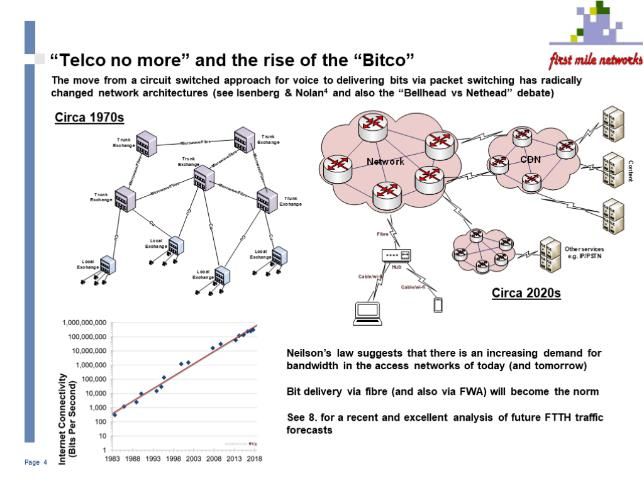
Everything must change (after Benard Ighner)

Page 1
Introductory note on models as “instruments”
               Operational (using the TM Forum eTOM)                     Financial (developed by Intercai Mondiale)

         Operations
                                                                        Tariffs                Master Params                                                                                 Head Count
          Operations   FulfillmentAssurance Billing &
          Support &                         Revenue
          Readiness                         Manageme
                                                                                  Sales                                                                               Building

          Customer Relationship Management  nt
                                                                                             Equipment                                                                                       Salaries

          Service Management & Operations                                                    Capital                                                                                                Interest

                                                                       Revenue              Expenses                                                                             Valuation
          Resource Management & Operations
          (Application, Computing and Network)

                                                                                  P&L              Cash Flow                                                                        Balance Sheet
          Supplier/Partner Relationship Management

                                                     © TM Forum                    Financial Model Outline Version 99.1                                                                          © Intercai Mondiale

                                                                                                       Tariffs                Master Params                    Head Count

                                                                                                                 Sales                  Building

                                                                                                                            Equipment                          Salaries

                                                                                                                            Capital                                   Interest

                                                                                                       Revenue             Expenses                Valuation

                                                                                                                 P&L              Cash Flow           Balance Sheet

                                                                                                                  Financial Model Outline Version 99.1

         The eTOM prescribes “processes” and in this              Initially developed to “assess” the financial position of
         example, the high level FAB components of the            a Service Provider, but can also be used for “what-
         Operations module are illustrated.                       iffing”, valuations, input to business cases, etc.

Page 2
           https://www.tmforum.org/tm-forum-frameworx-2/                              https://www.intercai.co.uk/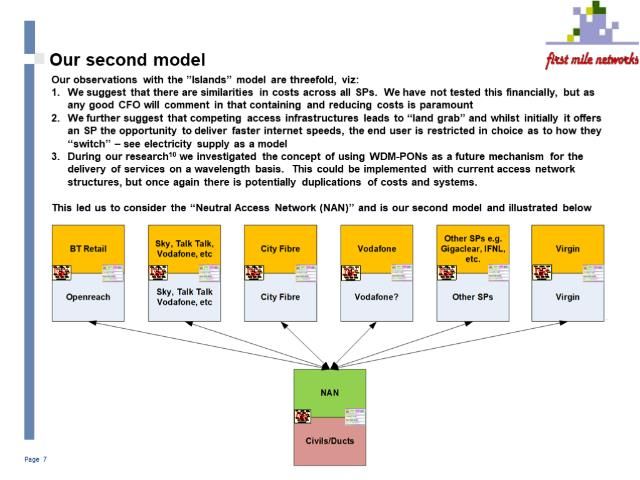
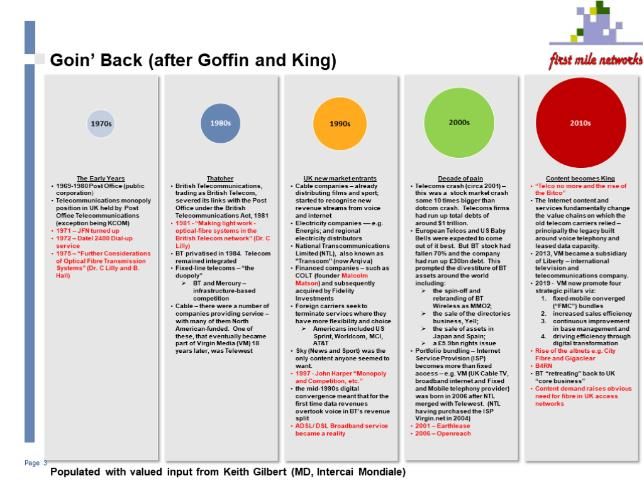
Goin’ Back (after Goffin and King)

                     1970s                               1980s                               1990s                                2000s                                2010s

                   The Early Years                        Thatcher                    UK new market entrants                    Decade of pain                  Content becomes King
         • 1969-1980 Post Office (public    • British Telecommunications,       • Cable companies – already          • Telecoms crash (circa 2001) –      • “Telco no more and the rise of
           corporation)                       trading as British Telecom,         distributing films and sport;        this was a stock market crash        the Bitco”
         • Telecommunications monopoly        severed its links with the Post     started to recognise new             some 10 times bigger than          • The Internet content and
           position in UK held by Post        Office under the British            revenue streams from voice           dotcom crash. Telecoms firms         services fundamentally change
           Office Telecommunications          Telecommunications Act, 1981        and internet                         had run up total debts of            the value chains on which the
           (exception being KCOM)           • 1981 - “Making light work -       • Electricity companies –– e.g.        around $1 trillion.                  old telecom carriers relied –
         • 1971 – JFN turned up               optical-fibre systems in the        Energis; and regional              • European Telcos and US Baby          principally the legacy built
         • 1972 – Datel 2400 Dial-up          British Telecom network” (Dr. C     electricity distributors             Bells were expected to come          around voice telephony and
           service                            Lilly)                            • National Transcommunications         out of it best. But BT stock had     leased data capacity.
         • 1975 – “Further Considerations   • BT privatised in 1984. Telecom      Limited (NTL), also known as         fallen 70% and the company         • 2013, VM became a subsidiary
           of Optical Fibre Transmission      remained integrated                 "Transcom" (now Arqiva)              had run up £30bn debt. This          of Liberty – international
           Systems” (Dr. C Lilly and B.     • Fixed-line telecoms – “the        • Financed companies – such as         prompted the divestiture of BT       television and
           Hall)                              duopoly”                            COLT (founder Malcolm                assets around the world              telecommunications company.
                                                ➢ BT and Mercury –                Matson) and subsequently             including:                         • 2019 - VM now promote four
                                                     infrastructure-based         acquired by Fidelity                   ➢ the spin-off and                 strategic pillars viz:
                                                     competition                  Investments                                 rebranding of BT                1. fixed-mobile converged
                                            • Cable – there were a number of    • Foreign carriers seek to                    Wireless as MMO2;                    (“FMC”) bundles
                                              companies providing service –       terminate services where they          ➢ the sale of the directories        2. increased sales efficiency
                                              with many of them North             have more flexibility and choice            business, Yell;                 3. continuous improvement
                                              American-funded. One of                ➢ Americans included US             ➢ the sale of assets in                   in base management and
                                              these, that eventually became               Sprint, Worldcom, MCI,              Japan and Spain;                4. driving efficiency through
                                              part of Virgin Media (VM) 18                AT&T                           ➢ a £5.9bn rights issue                   digital transformation
                                              years later, was Telewest         • Sky (News and Sport) was the       • Portfolio bundling – Internet      • Rise of the altnets e.g. City
                                                                                  only content anyone seemed to        Service Provision (ISP)              Fibre and Gigaclear
                                                                                  want.                                becomes more than fixed            • B4RN
                                                                                • 1997 - John Harper “Monopoly         access – e.g. VM (UK Cable TV,     • BT “retreating” back to UK
                                                                                  and Competition, etc.”               broadband internet and Fixed         “core business”
                                                                                • the mid-1990s digital                and Mobile telephony provider)     • Content demand raises obvious
                                                                                  convergence meant that for the       was born in 2006 after NTL           need for fibre in UK access
                                                                                  first time data revenues             merged with Telewest. (NTL           networks
                                                                                  overtook voice in BT’s revenue       having purchased the ISP
                                                                                  split                                Virgin.net in 2004)
                                                                                • ADSL/ DSL Broadband service        • 2001 – Earthlease
                                                                                  became a reality                   • 2006 – Openreach

Page 3
     Populated with valued input from Keith Gilbert (MD, Intercai Mondiale)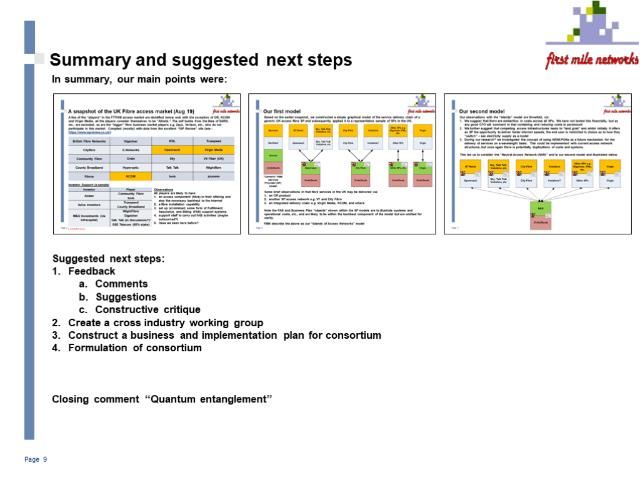
“Telco no more” and the rise of the “Bitco”
         The move from a circuit switched approach for voice to delivering bits via packet switching has radically
         changed network architectures (see Isenberg & Nolan4 and also the “Bellhead vs Nethead” debate).

         Circa 1970s
                                                                       Trunk
                               Trunk                                 Exchange
                             Exchange

                                                     Trunk
                                                                                                  Network                        CDN

                                                                                                                                                           Content
                                                   Exchange

                    Trunk
                  Exchange                                                        Trunk
                                                                                Exchange

                                          Local
                                        Exchange
                                                                     Local                                                                Other services
                                                                   Exchange                                                                e.g. IP/PSTN
                Local
              Exchange                                                                                 Hub
                                                          Local
                                                        Exchange

                                                                                                                           Circa 2020s

                                                                                  Neilson’s law suggests that there is an increasing demand for
                                                                                  bandwidth in the access networks of today (and tomorrow)

                                                                                  Bit delivery via fibre (and also via FWA) will become the norm

                                                                                  See 8. for a recent and excellent analysis of future FTTH traffic
                                                                                  forecasts

Page 4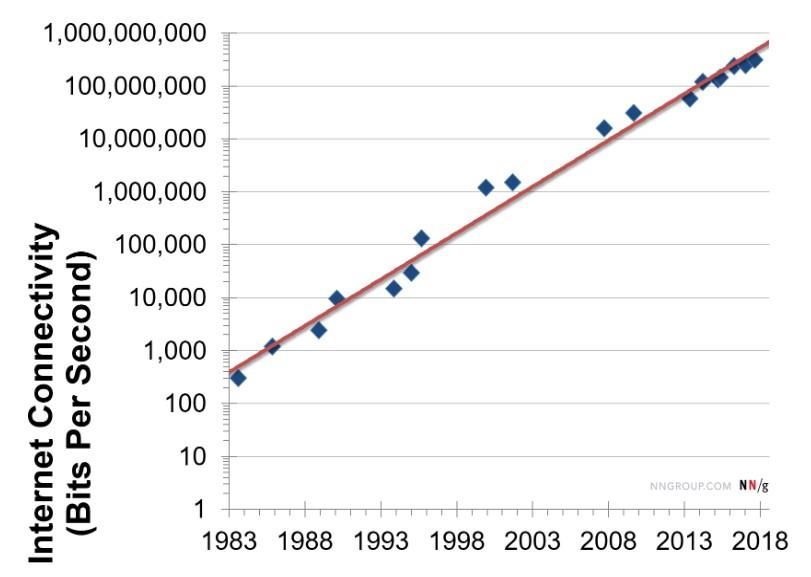
A snapshot of the UK Fibre access market (Aug 19)
        A few of the “players” in the FTTH/B access market are identified below and, with the exception of OR, KCOM
        and Virgin Media, all the players consider themselves to be “Altnets.” The self builds from the likes of B4RN,
        etc., are excluded, as are the “bigger” fibre business market players e.g. Zayo, Verizon, etc., who do not
        participate in this market. Compiled (mostly) with data from the excellent “ISP Review” site (see -
        https://www.ispreview.co.uk/)

            British Fibre Networks            Gigaclear                        IFNL                     Truespeed

                        Cityfibre            G.Networks                    Openreach                   Virgin Media

                 Community Fibre                Grain                          Sky                    VX Fiber (UK)

               County Broadband               Hyperoptic                     Talk Talk                  Wightfibre

                         Fibrus                 KCOM                           toob                      zzoomm

        Investor Support (a sample)
                        Investor                  Player             Observations
                                           Community Fibre           All players are likely to have:
                         Amber                                       1. an access component (fibre) in their offering and
                                                   toob
                                                                         also the necessary backhaul to the Internet
                                               Truespeed
                  Aviva Investors                                    2. a fibre installation capability
                                          County Broadband           3. set up (at minimal) some form of Fulfillment,
                                               WightFibre                Assurance, and Billing (FAB) support systems.
             M&G Investments (via              Gigaclear             4. support staff to carry out FAB activities (maybe
                Infracapital)         Talk Talk (in discussions?)a       outsourced?)
                                       SSE Telecom (50% stake)       5. Have we been here before?
Page 5 a. watch this space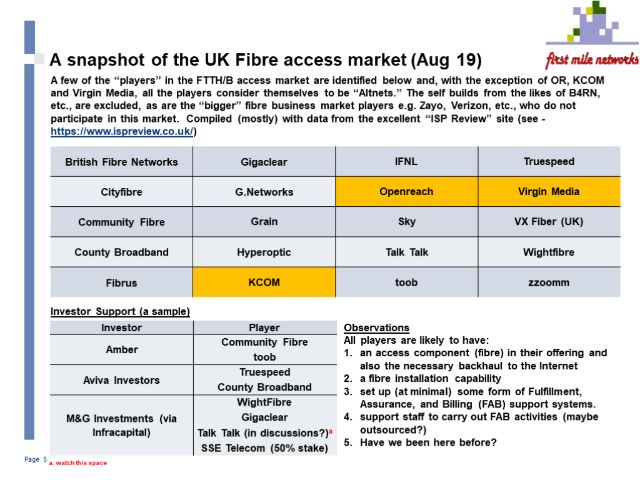
Our first model
         Based on the earlier snapshot, we constructed a simple graphical model of the service delivery chain of a
         generic UK fibre access SP and applied it to a representative sample of SPs in the UK.

                                  Tariffs                Master Params                    Head Count
                                                                                                            Tariffs                Master Params                    Head Count        Tariffs                Master Params                    Head Count        Tariffs                Master Params                    Head Count

                                            Sales                  Building
                                                                                                                      Sales                  Building                                           Sales                  Building                                           Sales                  Building

                                                       Equipment                          Salaries
                                                                                                                                 Equipment                          Salaries                               Equipment                          Salaries                               Equipment                          Salaries

                                                       Capital                                   Interest
                                                                                                                                 Capital                                   Interest                        Capital                                   Interest                        Capital                                   Interest

                                  Revenue             Expenses                Valuation
                                                                                                            Revenue             Expenses                Valuation                     Revenue             Expenses                Valuation                     Revenue             Expenses                Valuation

                                            P&L              Cash Flow           Balance Sheet
                                                                                                                      P&L              Cash Flow           Balance Sheet                        P&L              Cash Flow           Balance Sheet                        P&L              Cash Flow           Balance Sheet

                                             Financial Model Outline Version 99.1
                                                                                                                       Financial Model Outline Version 99.1                                      Financial Model Outline Version 99.1                                      Financial Model Outline Version 99.1

         “Generic” FMN
             Service
          Provider (SP)
             model

         Some brief observations in that fibre services in the UK may be delivered via:
         1. an OR product
         2. another SP access network e.g. VF and City Fibre
         3. an integrated delivery chain e.g. Virgin Media, KCOM, and others

         Note the FAB and Business Plan “objects” shown within the SP models are to illustrate systems and
         operational costs, etc., and are likely to be within the backhaul component of the model but are omitted for
         clarity.
         FMN describe the above as our “Islands of Access Networks” model.
Page 6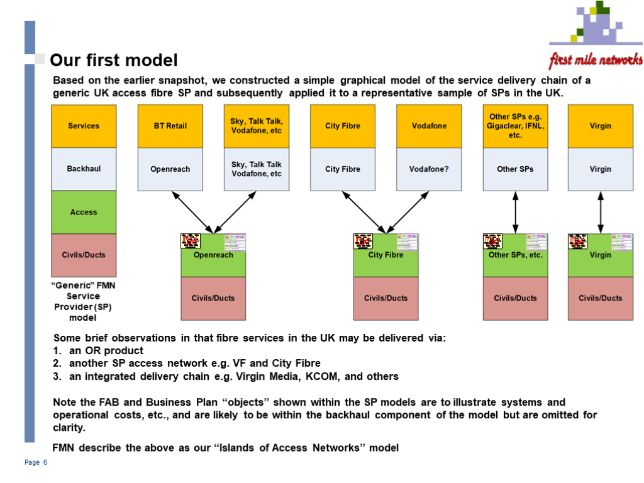
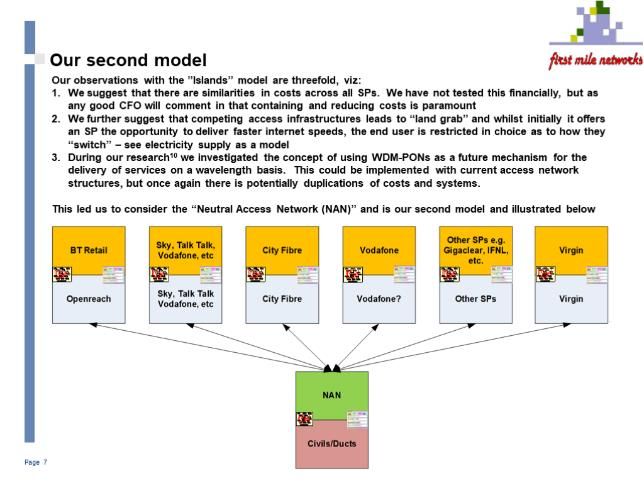
Our second model
Our observations with the ”Islands” model are threefold, viz:
1. We suggest that there are similarities in costs across all SPs. We have not tested this financially, but as
any good CFO will comment in that containing and reducing costs is paramount
2. We further suggest that competing access infrastructures leads to “land grab” and whilst initially it offers
an SP the opportunity to deliver faster internet speeds, the end user is restricted in choice as to how they
“switch” – see electricity supply as a model
3. During our research10 we investigated the concept of using WDM-PONs as a future mechanism for the
delivery of services on a wavelength basis. This could be implemented with current access network
structures, but once again there is potentially duplications of costs and systems.
This led us to consider the “Neutral Access Network (NAN)” and is our second model and illustrated below.
Tariffs Master Params Head Count Tariffs Master Params Head Count Tariffs Master Params Head Count Tariffs Master Params Head Count Tariffs Master Params Head Count
Tariffs Master Params Head Count
Sales Building Sales Building Sales Building Sales Building Sales Building
Sales Building
Equipment Salaries Equipment Salaries Equipment Salaries Equipment Salaries Equipment Salaries
Equipment Salaries
Capital Interest Capital Interest Capital Interest Capital Interest Capital Interest
Capital Interest
Revenue Expenses Valuation Revenue Expenses Valuation Revenue Expenses Valuation Revenue Expenses Valuation Revenue Expenses Valuation
Revenue Expenses Valuation
P&L Cash Flow Balance Sheet P&L Cash Flow Balance Sheet P&L Cash Flow Balance Sheet P&L Cash Flow Balance Sheet P&L Cash Flow Balance Sheet
P&L Cash Flow Balance Sheet
Financial Model Outline Version 99.1 Financial Model Outline Version 99.1 Financial Model Outline Version 99.1 Financial Model Outline Version 99.1 Financial Model Outline Version 99.1
Financial Model Outline Version 99.1
Tariffs Master Params Head Count
Sales Building
Equipment Salaries
Capital Interest
Revenue Expenses Valuation
P&L Cash Flow Balance Sheet
Financial Model Outline Version 99.1
Page 7
Our second model (cont…)
         Our brief introductory discussion of the NAN concept has not been tested with any UK SP, or any community
         of UK SPs, but we list below some further observations to support the possible introduction of such a model
         within the UK:

         1. Fundamentally, the NAN’s aim is to reduce costs for all UK SPs with a secondary benefit of enabling users
            to switch SPs (subject to contractual agreements) as required. As a precursor, the cost reductions
            suggested could be initially tested by high level financial modelling.

         2. We are suggesting that the NAN is owned by a consortium that includes all UK SPs and investors – this
            approach is based upon John Harper’s review of the UK telecoms industry in 1997 – see Reference 1., but
            a brief summary is introduced within Annex One. Most importantly, the articles of incorporation for the
            proposed consortium would not allow take over by another body (and maybe a “golden share” owned by
            the UK government is one such mechanism to ensure this). In memory of John Harper, we refer to any such
            proposed NAN consortium as the “Harper” model.

         3. Historically, our model is not new and in fact the Earthlease proposition suggested something similar to
            the NAN in the early 2000s (albeit for the copper network).

         4. Fibre “Backhaul” would continue to be a competitive market.

         5. The NAN concept has been subject to considerable research and whilst we are not aware of an actual
            implementation that mirrors the UK market, Alessandro Bogliolo2 describes an excellent introduction to the
            possible mechanics, etc. More detailed discussions and agreements would be needed to progress, etc.

         6. The regulatory regime could be “lightened” as OR and other UK SPs would be “incorporated” into one
            organisation and hence the regulatory regime would no longer be focussed on the SMP of OR.

         7. Civil work would be co-ordinated with a “one dig” mantra.

Page 8
Summary and suggested next steps
         In summary, our main points were:

         Suggested next steps:
         1. Feedback
              a. Comments
              b. Suggestions
              c. Constructive critique
         2. Create a cross industry working group
         3. Construct a business and implementation plan for consortium
         4. Formulation of consortium

         Closing comment “Quantum entanglement”

Page 9
Annex One - Some interesting characters
1. John Harper - was MD of Inland Networks for BT and, in 1997, authored a book entitled “Monopoly and
Competition in British Telecommunications, the Past, the Present, and the Future.” John was known for his
forthright opinions and as an example, in Chapter 20 - “A better model”, he identifies a structure for a future
UK telecoms industry – these being:
1. The creation and retailing of public telecommunication services, the provision and operation of the main infrastructure of the
main inland public service and the provision of private telecommunications facilities should henceforth be treated as three
completely distinct sectors of the industry.
2. In the retail public services sector unregulated companies in competition with one another should create and retail all
services. Including the provision of the final drop to connect individual customers to the network infrastructure.
3. In continental countries the public network infrastructure should remain unified. In Britain it should be progressively unified.
4. There should in future be a single organisation in each country responsible for this unified public infrastructure, which is
subject to national regulation.
5. This public network organization should be owned by a group of the principal telecommunications public service retailers on
a co-operative or consortium basis, with no provision for outside shareholders to hold equity shares in it.
6. The private services and facilities sector should be thrown open to full unregulated competition by local and international
firms.
Point 5. underpins our “Harper model.”
2. Malcolm Matson - founded COLT and subsequently sold the company to Fidelity Investments. Malcolm
argues for OPEN Public Local Access NETworks (OPLAN) and we quote “Our OPLAN business model is
firmly grounded in the principle that the maximum wealth creating opportunity comes not from
‘owning/controlling capacity’, but from using it – as with the roads.” See http://www.oplan.org/ and see
http://www.telco2.net/blog/2007/04/interview_malcolm_matson_of_op.html for an independent view.
3. David Hilliard – CEO Mentor Europe. David has authored a number of thought pieces and, more recently,
published ‘Mobile-Centric’ Fibre and ”Tackling the UK’s rural mobile coverage problem” – see
https://mentoreurope.com/
Page 10Annex Two – Reading list
1. Monopoly and Competition in British Telecommunications The Past, the Present and the Future: John Harper,
1997, Pinter.
2. Introducing Neutral Access Networks: Alessandro Bogliolo, 2009, IEEE Next Generation Internet Networks
Conf.
3. Switching and service delivery in futuristic networks: John Buckley, 2003, BT Technology Journal Vol 11 No.
4.
4. Just Deliver the Bits: David Isenberg and John Nolan, 2010, Journal of the ITP, Vol 4 Part 1.
5. Fiber to the Home White Paper: Paul Green 2003 – see http://tiny.cc/eobd9y
6. Internet Economics: McKnight and Bailey, 1997, MIT Press.
7. Regulatory Creep and Regulatory Withdrawal: Cubbin and Currie, 2002 - https://tinyurl.com/y3fc5o24
8. Meeting the Traffic Requirements of Residential Users in the Next Decade with Current FTTH Standards:
Hernandez, et al. IEEE Communications Magazine, June 2019.
9. A 10 Point Plan for a better Openreach: Sky, et al, 2016 – see https://tinyurl.com/y3h62olg
10. The potential for wavelength switching to provide virtual structured cabling across the UK: First Mile
Networks, 2010 – see https://goo.gl/drK9y7
11. Patterns in Network Architecture: John Day, 2008, Prentice Hall.
12. Andrew Odlyzko: Papers on Communication Networks and Related Topics – see
http://www.dtc.umn.edu/~odlyzko/doc/networks.html
Page 11
13. Grant: Jean Edward Smith, 2001, Simon and Schuster.You can also read


