ITC 1 & 2 Circuit Heat Trace Controller Line or Ambient Sensing - Installation & Operation Manual
←
→
Page content transcription
If your browser does not render page correctly, please read the page content below
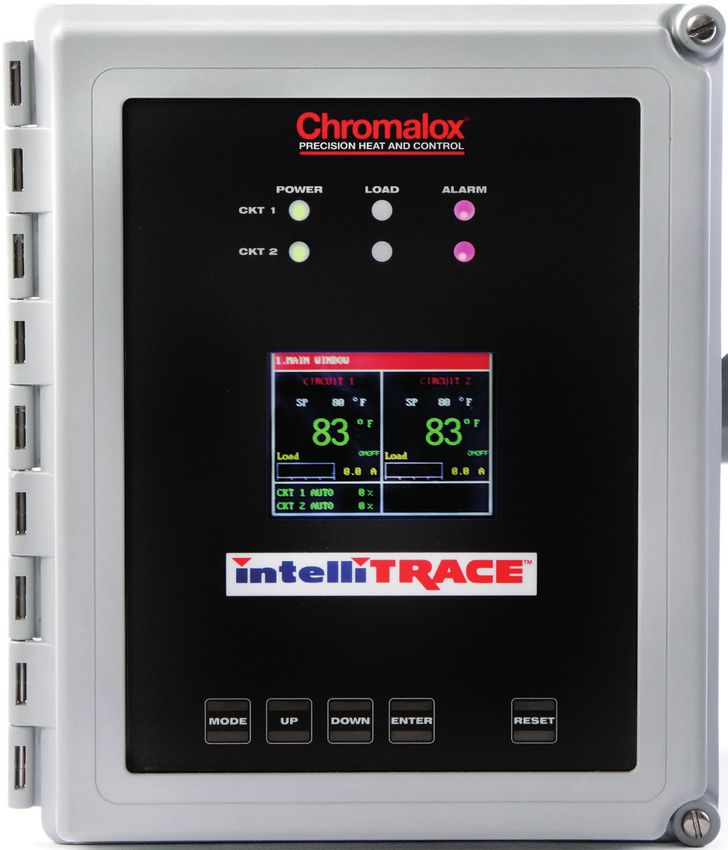
Installation & Operation Manual
                    ITC
           1 & 2 Circuit
   Heat Trace Controller
Line or Ambient Sensing

                          Ordinary Areas &
                          Class I, Division 2

                                    PK509-6
                                 0037-75516
                                   July 2014
      1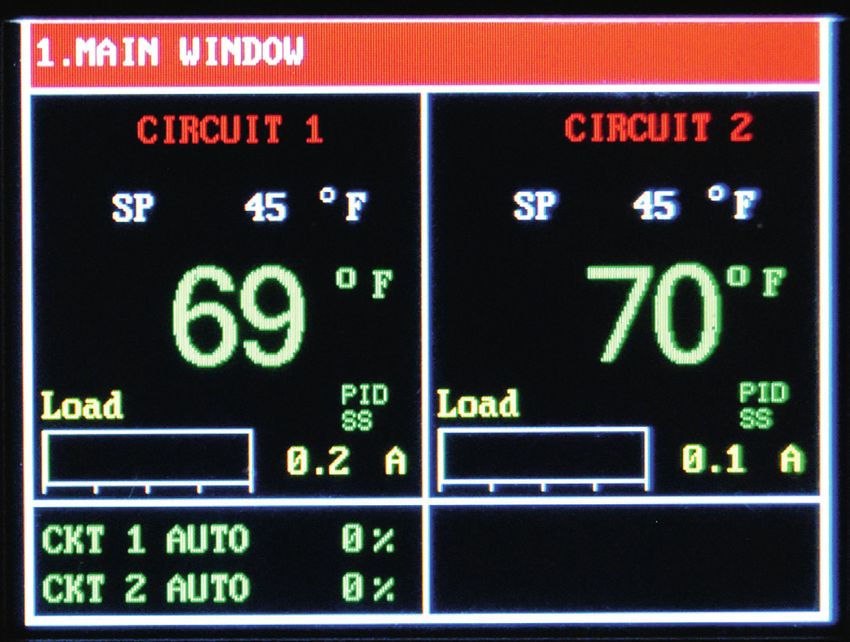
Table of Contents

Section		                                                                                                                                                         Page
Table of Contents..................................................................................................................................................... 2
Safety Precautions................................................................................................................................................... 3
Introduction.............................................................................................................................................................. 4
Model Overview........................................................................................................................................................ 5
Theory of Operation................................................................................................................................................. 6
Before Powering Up................................................................................................................................................. 6
Installation................................................................................................................................................................ 7
Operating the ITC..................................................................................................................................................... 8
   HMI (Human – Machine Interface)..................................................................................................................... 8
   Main Window.................................................................................................................................................... 8
Navigating the ITC.................................................................................................................................................... 9
    The Keypad..................................................................................................................................................... 10
Programming the ITC............................................................................................................................................. 11
    Security Levels................................................................................................................................................ 11
    The Temperature Menu................................................................................................................................... 12
    The Current Menu........................................................................................................................................... 12
    The Control Menu........................................................................................................................................... 12
    The Soft Start Function................................................................................................................................... 14
    The Comms Menu (Communications)............................................................................................................. 14
    The System Menu........................................................................................................................................... 15
Current Sampling................................................................................................................................................... 17
Alarms ................................................................................................................................................................... 17
Dimensions............................................................................................................................................................. 18
Default Settings...................................................................................................................................................... 19
Specifications......................................................................................................................................................... 21
Equipment Ratings................................................................................................................................................. 23
Field Wiring Considerations................................................................................................................................... 23
Modbus Wiring Considerations.............................................................................................................................. 23
Customer Wiring..................................................................................................................................................... 24
Modbus Serial Communications............................................................................................................................ 26
Service Contact Information................................................................................................................................... 32

                                                                                       2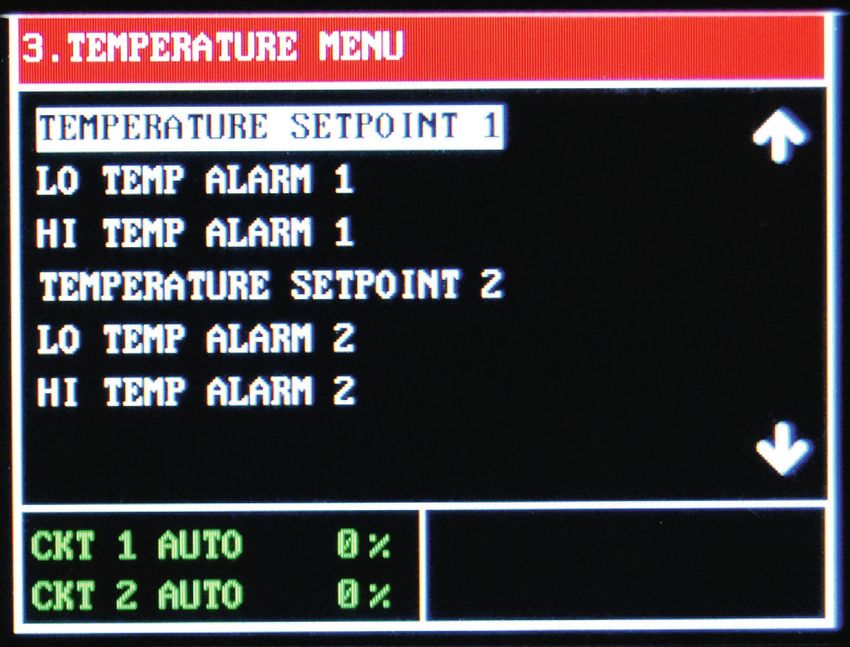
Safety Precautions
                                                                Before working inside the equipment, turn
                                                                power off and ground all points of high poten-
                                                                tial before touching them.
                                                                Users should install adequate controls and
Throughout the intelliTRACETM Setup Guide, these                safety devices with their electric heating equip-
symbols will alert you to potential hazards. Safety pre-        ment. Where the consequences of failure may
cautions should always be followed to reduce the risk           be severe, back-up controls are essential. Al-
of fire, electrical shock, injury and even death to per-        though the safety of the installation is respon-
sons. Please read all instructions before operating your        sibility of the user, Chromalox will be glad to
intelliTRACETM ITC1 or ITC2 Heat Trace Controller.              assist in making equipment recommendations.
                                                                A disconnect device and circuit breaker should
                                                                be provided in the end installation. The instal-
                                                                lation and proximity for the disconnect device
          To avoid electrical shock or injury, always re-       must satisfy the electrical Authority having ju-
move power before servicing a circuit. Personnel work-          risdiction for the installation, such as NEC.
ing with or near high voltages should be familiar with
modern methods of resuscitation. Contact an area su-            Branch circuit protection should be set for 40
pervisor, registered electrician or safety personnel for        amps or lower.
more information.

                                                                ELECTRIC SHOCK HAZARD. Any installation in-
HIGH VOLTAGE is used in the operation of this                   volving control equipment must be performed
equipment; DEATH ON CONTACT may result if                       by a qualified person and must be effective-
personnel fail to observe safety precautions.                   ly grounded in accordance with the National
Learn the areas containing high-voltage con-                    Electrical Code to eliminate shock hazard.
nections when installing or operating this
equipment.
Be careful not to contact high-voltage connec-                  Should the equipment be used in a manner not
tions when installing or operating this equipment.              specified by Chromalox, the protection provid-
                                                                ed may be impaired.

                                                            3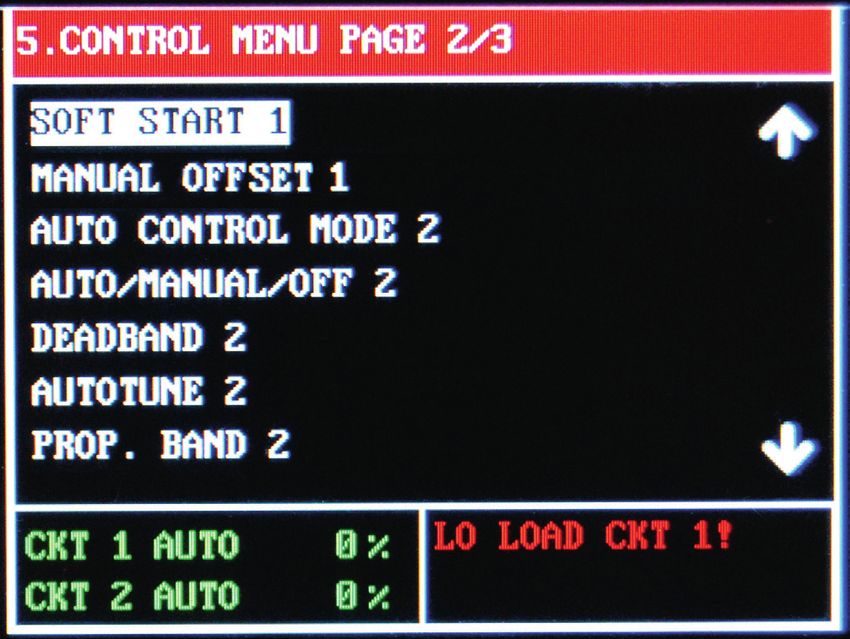
Introduction
For nearly a century, customers have relied upon Chro-             • LED Indication for Power, Load & Alarm per Circuit
malox for premiere quality and innovative solutions for            • Front Panel Capacitive Touch Switches
industrial heating applications. Chromalox manufac-
tures the world’s largest and broadest line of electric            • One or two Sensor Inputs / Circuit – Min, Max & Av-
heat and control products.                                           eraging
The intelliTRACETM family of heat tracing products                 • 2 Circuit Ambient control from a single RTD sensor
continues to expand with its latest single or two circuit          • High Resolution TFT Display:
controllers the ITC1 & ITC2. These are a complete tem-               • 2 Circuits displayed / screen (on 2 Circuit unit)
perature control and system management solutions for                 • Displayed Parameters: Process Variable, Set
electrical heat trace applications. They are designed                  Point Temperature, Control Mode, Soft Start sta-
for industrial applications in ordinary or Class I, Division           tus, Load demand, Alarm Status
2. Groups A,B,C & D hazardous locations.
                                                                   Agency Approvals:
The intelliTRACETM ITC1 & ITC2 provides the user with              • UL, cUL Ordinary Areas, Class I Division 2 areas
an easy to navigate menu system, continuous critical
parameter monitoring, application flexibility and equip-           • CE
ment safety precautions.
The ITC is an ideal solution either Freeze Protection or           Options:
Process Temperature control. Whether you have Ambi-
                                                                   • Ethernet Communications**
ent or Line Sensing or a combination of both, the ITC is
the affordable and complete system for you.                        • Wireless Communications**
                                                                   **Pending Features
intelliTRACETM ITC Features:
• 1 & 2 Circuit Models
• 100 – 277 VAC, 50/60 Hz
• SSR Control, 40 Amps per Circuit
• PID, On/Off or Manual Control Modes
• Selectable Soft Start Feature
• ModBus RTU/RS-485 (& 422) Communications
• Full Monitoring & Alarms
  • High / Low Temperature
  • High & Low Current
  • GFEP & Sensor Failure
• Programmable Duty Cycle On Sensor Failure
• Alarm Indication & Announcement
• Password Protected Security Levels
• 10” x 8” x 6” NEMA 4X FG Wall Mount Enclosure

                                                               4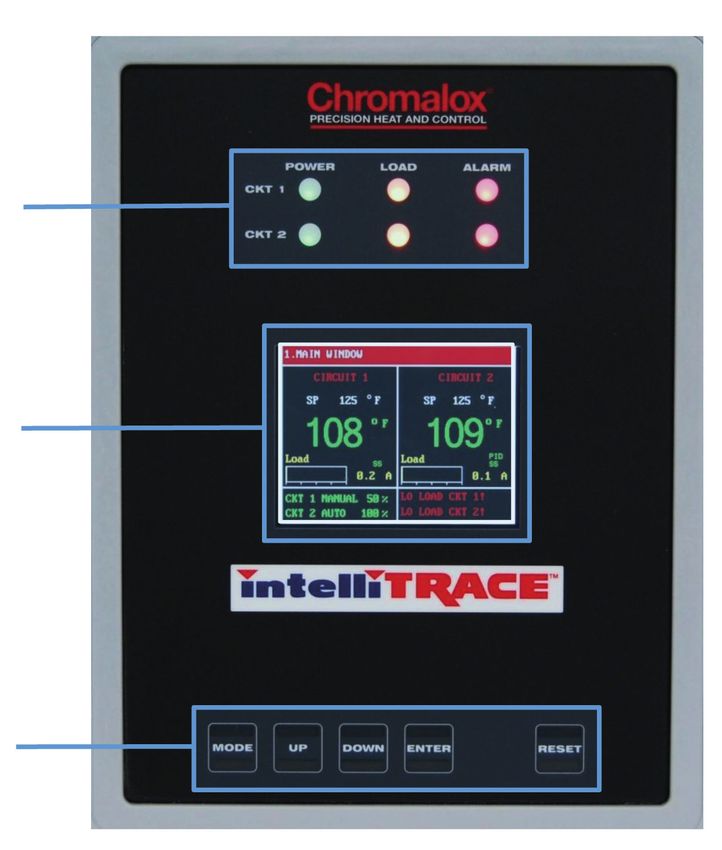
Model Overview
The ITC series IntelliTRACE Controller is designed                The ITC2 may also be used as a 2-channel ambient
for industrial Heat Trace Line and/or Ambient Sens-               sensing controller that uses only one RTD to control
ing applications in Hazardous (Class I, Division 2) or            both circuits.
Non-Hazardous areas. The ITC series controller will               Other standard features include: Alarms (1xAC & 1xDC)
control 1 or 2 circuits and is a wall mounted device              for High & Low Current, GFEP (Ground Fault Equip-
that operates at 100 to 277 VAC and offers the follow-            ment Protection), High & Low Temperature & Sensor
ing standard design features: NEMA 4X FG enclosure,               Failure, ModBus RTU/RS485 & /RS422 Communica-
3.5” High Resolution TFT Display with integral display            tions. Alarms may be set up to be normally open or
heater, front panel capacitive touch switches & LED In-           normally closed.
dication of Power, Load & Alarm.
                                                                  Future Options to Include: Ethernet Communications &
It also offers PID, ON/OFF or Manual SSR power con-               Wireless Communications.
trol, is rated at 40A per circuit in a -40˚F to 104˚F Ambi-
ent, employs a Soft Start program and accepts up to 2             Please see Table 1 below for applicable features & ca-
RTD sensors per circuit to provide Ambient and/or Line            pabilities by Model type.
Sensing type control. When 2 sensors are employed,
the minimum, maximum or average of the two sensor
temperatures may be used to control each circuit.

                                                         Table 1

                              Features / Capabilities                                     ITC1          ITC2
       40 Amps/ Loop @ 100 to 277 Volts                                                     X             X
       Number of Circuits                                                                   1             2
       SSR (Solid State Relay) Control                                                      X             X
       3.5” 320x240 RGB Full color graphic TFT module                                       X             X
       10” x 8” x 6” NEMA 4X FG Enclosure                                                   X             X
       Soft Start Feature                                                                   X             X
       PID, ON/OFF or Manual Control                                                        X             X
       RTU/RS485 & /RS422 ModBus Communications                                             X             X
       Up to Two RTD Sensors per Circuit                                                    X             X
       Temperature Monitoring and Alarms                                                    X             X
       GFEP Monitoring and Alarms                                                           X             X
       Current Load Monitoring and Alarms                                                   X             X
       Sensor Failure Monitoring and Alarms                                                 X             X
       Three Levels of Security                                                             X             X
       Optional Ethernet IP Communications**                                                X             X
            ** Pending Option

                                                              5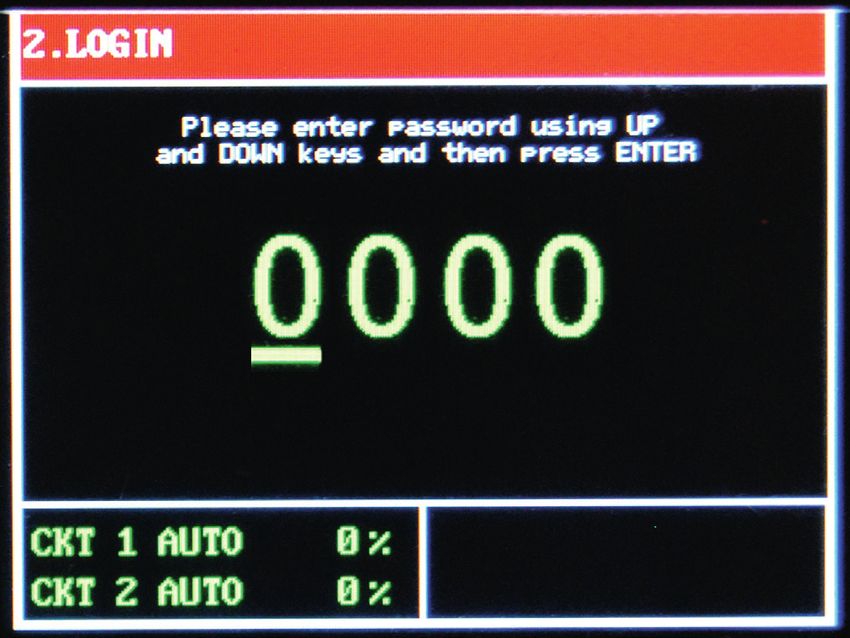
Theory of Operation
The detailed set up of the individual circuit parameters          4. Alarm & trip, latching – Output goes to 0% (off)
is explained throughout the various sections of this                 while in alarm state.
manual. This Theory of Operation overview is intended          Note (3&4): Alarm condition may only be cleared with
to give a quick summary of how it all works together.            a manual reset of the alarm
• Parameter setpoints (High/Low Temperature, High/             • Similarly, should a failed sensor condition appear,
  Low Current & GFEP), Control Modes (Auto or Man-               the ITC will go into alarm state and display a flashing
  ual) and operation modes under alarm conditions                sensor error. The ITC will automatically be switched
  (GFEP limit violation & Sensor Loss) are entered for           into Manual mode. The output % may be adjusted
  each circuit. Each circuit is designed to operate in-          by the user within the SYSTEM MENU Parameter:
  dependently.                                                   “Failed Sensor Output 1 (or 2)”. See Temperature
• Active loops are individually tested for 2 seconds             Sensing & Failed Sensor Output parameters in the
  every 2 minutes. During the test, a current load val-          System Menu definitions below.
  ue is updated on the yellow bar located on the Main          • To limit inrush current on the overall system, a pro-
  Window and a new GFEP current is automatically                 prietary Soft Start algorithm is applied during sys-
  and continuously calculated.                                   tem start-up. This will ONLY occur while the opera-
• If the Ground Fault (GFEP) limit is surpassed, the             tion mode is set to AUTO. The Soft Start program
  ITC has four options of behavior:                              will increment the output by 1% every 1 second
   1. Alarm, non-latching – No change in output.                 until the desired temperature is reached or the out-
                                                                 put % achieves 100%. After the Soft Start program
   2. Alarm and Trip, non-latching – Ouput goes to               completes its cycle, the Auto Control Mode of the
      0% (off) while in alarm state.                             system will return to either PID or ON/OFF Control
Note (1&2): Alarm will be cleared when sensed GFEP               Mode, depending what was selected by the user.
  is 5mA less than GFEP setpoint.                                The Soft Start Program will not function if the control
                                                                 mode is set to Manual.
   3. Alarm, latching – No change in output.

Before Powering Up
Chromalox takes great pride in knowing that we have            Wiring and Connections
provided to you a product of premium quality and               Check wiring and connections as follows:
workmanship. We have taken every precaution to en-             a. Inspect wiring for wear, fraying, chipping, nicks, and
sure that your equipment arrives safe and secure.                 evidence of overheating. Repair minor defects with
However, vibration and temperature changes during                 a good grade of electrical tape, or replace if needed.
shipping can cause some components to become                   b. Inspect for loose electrical and mechanical connec-
loose. Additionally, throughout the life span of this             tions. Tighten or replace defective crimp-style lugs.
product, other environmental and application condi-               Re-solder loose solder connections. Tighten or re-
tions may have affected the mechanical and electri-               place all loose or missing hardware.
cal continuity of several internal components. There-
                                                               These precautions must be adhered to when the prod-
fore, for your safety and overall product performance,
                                                               uct is received as well as before every season or on an
please take the time to familiarize yourself with the
                                                               annual basis, whichever is shortest.
MAINTENANCE, OPERATION, AND INSTALLATION
INSTRUCTIONS technical manual that was shipped
with your control product.

Since it is not uncommon for electrical wiring and me-
chanical connections to become slightly loosened dur-
ing shipment, we ask that you pay particular attention
to section 4-5.3:

                                                           6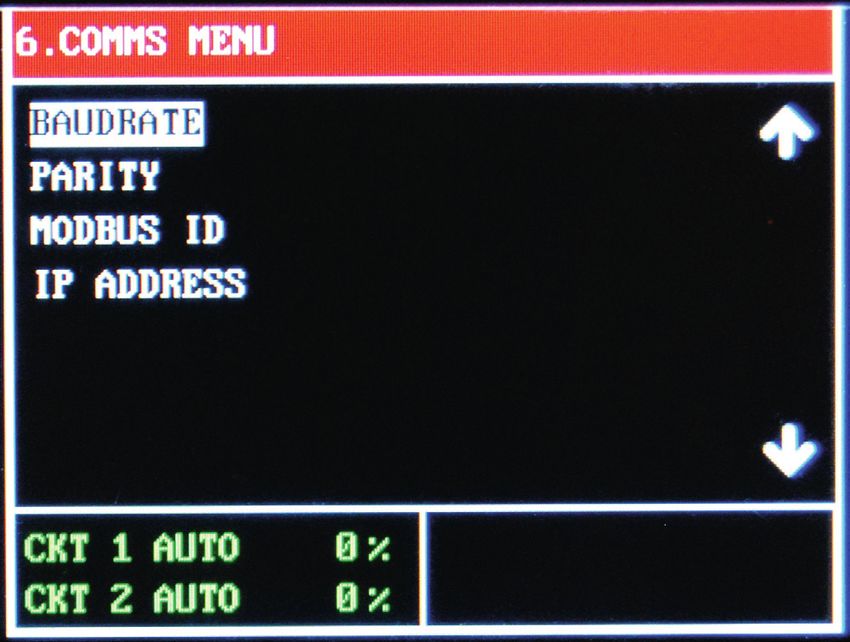
Installation
                                                                    Should the owner decide not to use the provided brack-
                                                                    ets, mounting of the ITC must incorporate all of the fol-
                                                                    lowing dimensional safeguards (Refer to Figure 2):
The ITC employs a SSR (Solid State Relay) as a
means to switch the heating load power. Inher-                      1. Maintain a minimum of 1.5” (3.8 cm) of free air space
ently, SSR’s produce heat when operating. Heat                         on either side of the heat sink (K)
is dissipated at the rear of the ITC through a                      2. Maintain a minimum of 1.8” (4.6 cm) of free air space
heat sink. By design, the ITC must be mounted                          directly behind the heat sink (C)
in a vertical orientation in order to allow the
heat sink to properly dissipate the heat from                       3. Zero air flow restriction above and below the heat
the controller. See Figure 1.                                          sink.
The ITC is shipped with one set of stainless steel                  4. The mounting surface, customer mounting bracket
mounting brackets. These brackets were specifically                    and fasteners must be of suitable structural design
designed to allow sufficient airflow in and around the                 to support four times the weight of the equipment.
heat sink. The air flow above or below this heat sink
must in no way become restricted. See Figure 1.
To maintain UL compliance, the heat sink must be
inspected every season to confirm that no debris or                 Violating any of the heat sink clearance dimen-
objects are in contact with the heat sink. All debris               sions or if the equipment is used or mounted in
must be removed from the heat sink fins. High pressure              a manner not specified by Chromalox, the pro-
blasts of clean, dry air or other means which will not              tection provided may be impaired. This could
damage the fins are to be used to dislodge all debris               result in equipment damage, personal injury or
from the fins.                                                      both.

                                                                                                                                     C
                                                           K                      K
                                                                                      C

                                                                                                                                         Mounting Surface
                                                                    Heat Sink

                                                                                                                         Heat Sink
                                                                                                 Front

                                                                    Mounting
                                                                    Brackets

                                                                     Front

                                                                Top View of ITC                      Right Side View
                                                                   Controller                        of ITC Controller

                  Figure 1                                                            Figure 2

Mounting Surface Considerations                                     Fasteners
The preferred materials of the mounting surface in-                 The fasteners shall be of 300 series (304 or 316) stain-
clude metals, concrete or wood products. If the ITC                 less steel and they shall be a #8 or #10 (or metric equiv-
is to be mounted outdoors, then the metals shall have               alent) bolt or screw configuration. If anchors are to be
corrosion resistant properties and the wood products                used, ensure that they match the fastener specifica-
shall be treated for outdoor use. If the mounting sur-              tion.
face is plaster (drywall), it shall be of the following mini-
mum construction: 1/2”, +/-1/16” (10 mm, +/-2mm) in
thickness and supported by nominal 2” x 4” (50mm
x 100mm, +/-10 mm) studs that are on 16”, +/- 1/2”                  Improper mounting may cause an unsafe con-
(400mm, +/- 10mm) centers. See Dimensions section                   dition resulting in equipment damage or failure
for wall mount layout and hole location. Mounting shall             which could cause personal injury.
be performed by experienced professionals.

                                                                7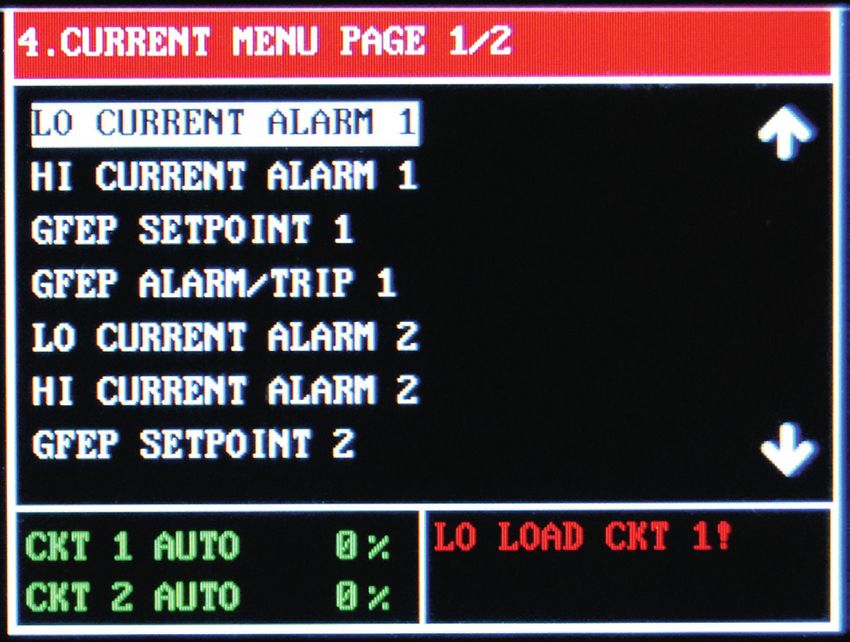
Operating the ITC
HMI (Human – Machine Interface)
There are three areas on the front panel of the ITC in
which the User may visually receive information or pro-
vide input to the controller:

                   1. LED status indication for Power,
                        Load & Alarm for each circuit

2. Hi Resolution TFT displays the parameter settings,
         alarm type, mode of operation, current load
                     demand, program menu screen
                           and menu selection items

                          3. Capacitive touch keypad

Main Window
In normal operating mode, the main window screen on
the ITC displays the circuit number, set point tempera-
ture, process temperature, current load demand, soft
start status, mode of operation, output % and alarm
type for each active circuit.

Below is the Main Window for a 2 Circuit ITC.

                     Circuit Number

              Set Point Temperature

               Process Temperature

                      Current Load,
                  Bar Graph & Value

                        Mode of Operation                                         Auto Mode Type
                        & Output % per Circuit                Soft Start Status    (PID or On/Off)

                                                          8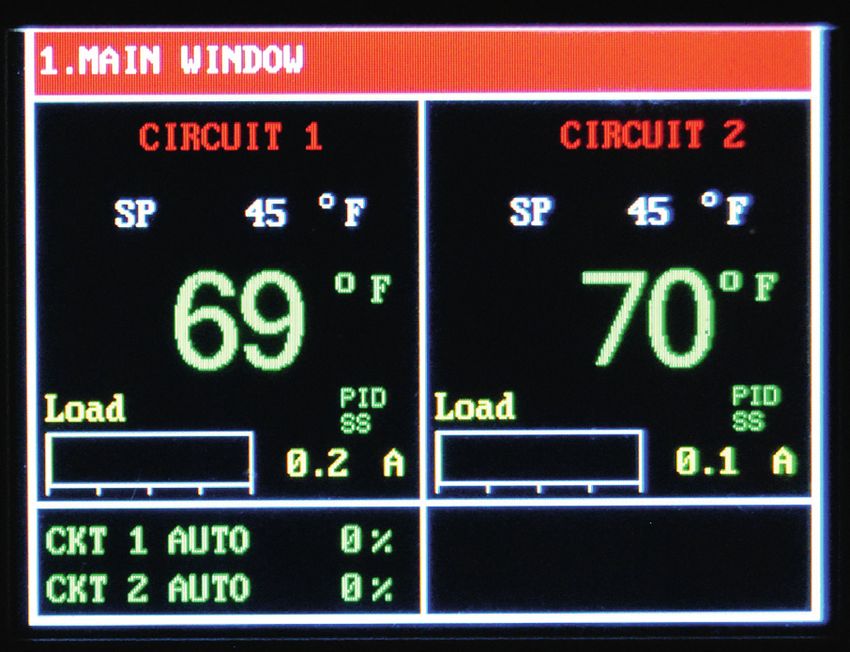
Navigating the ITC
Visually, here is how one navigates through the ITC Menus & Parameters:

Security Level 3
Security Level 2
Security Level 1

   1. Main Window

                     !
  Mode

                No
Logged?                   2. Login
Yes                  No
         Yes
               Correct?

3. Temperature Menu          Mode        4. Current Menu     Mode      5. Control Menu                Mode              6. Comms Menu            Mode   7. System Menu           Mode

   Temp Setpoint 1                      Lo Current Alarm 1            Auto Control Mode 1         Auto Control Mode 2     Baudrate                      Firmware Version

  Lo Temp Alarm 1                       Hi Current Alarm1               Auto/Man/Off 1             Auto/Man/Off 2           Parity                       Button Sound

  Hi Temp Alarm 1                        GFEP Setpoint 1                 Deadband 1                  Deadband 2           Modbus ID                          Units

   Temp Setpoint 2                      GFEP Alarm/Trip 1                 Autotune 1                 Autotune 2           IP Address                    Temp. Sensing 1

  Lo Temp Alarm 2                       Lo Current Alarm 2               Prop. Band 1               Prop. Band 2                                        Temp. Sensing 2

                                                                                                                                                         Failed Sensor
  Hi Temp Alarm 2                       Hi Current Alarm 2                Integral 1                  Integral 2
                                                                                                                                                           Output 1

                                                                                                                                Failed Sensor
                                           GFEP Spt 2                       Rate 1                      Rate 2                    Output 2

                                        GFEP Alarm/Trip 2                Soft Start 1                Soft Start 2                    Set Year               Password Level 1

                                                                       Manual Offset 1             Manual Offset 2                   Set Month              Password Level 2

                                                                                                                              Set Day of Month              Password Level 3

                                     Curved double arrow - Continuation path for Single Circuit Units Only                    Set Day of Week                 Alarm State 1

         GFEP Alarm/Trip 2           Dashed Parameter Ovals appear on 2-Circuit Units Only
                                                                                                                                     Set Hour                 Alarm State 2

                                     Dashed, Angled Connector continuation path for 2 Circuit Units Only
                                                                                                                                 Set Minutes                Restore to Default
                  Mode               Mode arrow represents pressing the MODE Key
                                                                                                  Legend

The horizontal security level bars, which are above the                                         while the operator is at the last available menu screen
ITC Menu & Parameter navigation map, illustrate the                                             within the current security level.
available menus within that security level. The Main Win-
dow is presented when the              button is selected

                                                                                            9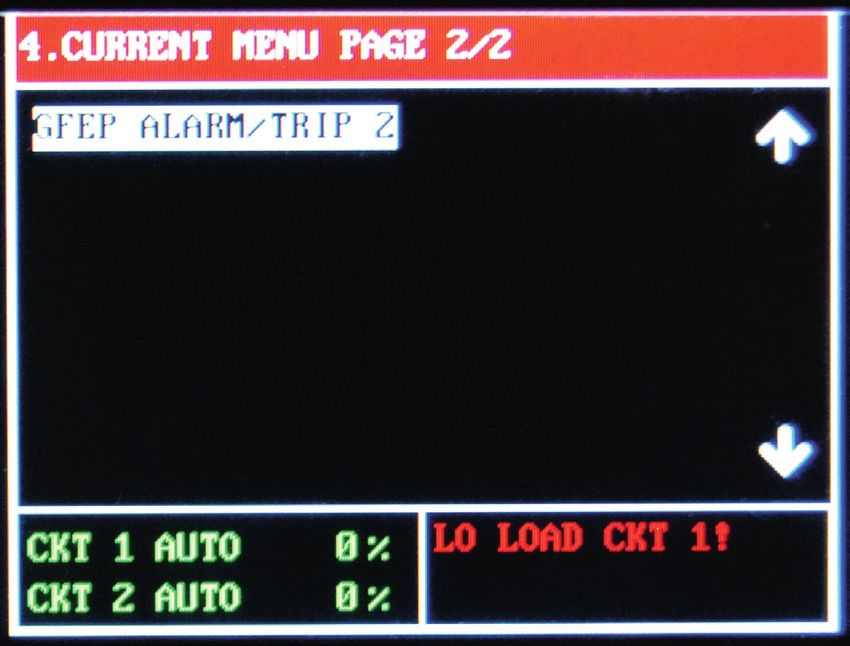
The Keypad
There are five capacitive touch keys or buttons on the              The function of each key is as follows:
front panel. The keypad allows the user to select or
change parameters & settings, clear alarms and navigate              Key      Function
throughout the ITC programming areas. See Figure 3                            Allows the user to Navigate between
shown below:                                                         MODE
                                                                              Menus & Main Window
                                                                              1. Within a Menu, Scroll UP to next Pa-
                                                                                 rameter or Setting within that Menu
                                                                              2. When viewing an adjustable parameter
  MODE        UP     DOWN      ENTER              RESET              UP
                                                                                 or setting, increments that parameter
                                                                                 UP to the next available value. For a
                                                                                 quick scroll, push and hold the key.
                         Figure 3
                                                                              1. Within a Menu, Scroll DOWN to next
                                                                                 Parameter or Setting within that Menu
                                                                              2. When viewing an adjustable parameter
                                                                     DOWN
                                                                                 or setting, increments that parameter
                                                                                 DOWN to the next available value. For a
                                                                                 quick scroll, push and hold the key.
                                                                           1. To accept a parameter or setting that
                                                                              has been entered or changed.
                                                                           2. Press to accept the change when view-
                                                                     ENTER
                                                                              ing an adjustable parameter or setting.
                                                                           3. When in LOGIN Screen, press to ad-
                                                                              vance to next security digit.
                                                                     RESET    Resets or clears all alarms

Programming the ITC
The ITC is pre-programmed with default parameters and               To access any of these menus, press the
settings that allow it to function “right out of the box”.          button on the keypad. You will be presented with the
To change any of the parameters or settings on the ITC,             Login screen:
you must access the appropriate menu(s): Temperature
Menu, Current Menu, Control Menu, Comms (commu-
nications) Menu or System Menu.

                      MODE               UP           DOWN
                                                         Press ENTER to advance to the next
                                                                                        RESET
                                                                                            digit.

                                                               10
Security Levels
You must first enter a passcode that is aligned with the You will be returned to the main screen if no buttons
menu that you wish to access. In most cases, limited are depressed within a 30 second time frame.
access to certain programming areas is desired. The
Passcodes may be reprogrammed within the Systems
most frequently used parameter settings have the low-
est level of security. Invalid passcodes will not be ac- Menu. These codes should be kept in a secure place.
cepted and you will be returned to the LOGIN Screen.
Initial factory set passcodes for the Security levels be-
low are:
Security Available
Level Passcode Programming Menus
1 0011 Temperature Menu Only
Temperature & Current
2 0034
Menus Only
Temperature, Current, Control,
3 0063
Comms & System Menus
The Temperature Menu
Security Levels 1, 2 & 3
3. Temperature Menu
Temperature
Process Temperature Variable
Setpoint
Lower limit of the Process Temperature
Low Variable at which the system goes into
Temperature alarm state. This alarm may be turned
Alarm OFF by going one increment beyond
the Lowest setting.
Upper limit of the Process Temperature
High Variable at which the system goes into
Temperature alarm state. This alarm may be turned
Alarm OFF by going one increment beyond
the Highest setting.
The Temperature Menu provides access to the Tem-
perature based parameters: Temperature Setpoint,
Low Temperature Alarm & High Temperature Alarm for
Circuits 1 and 2 (when available).
11The Current Menu
Security Levels 2 & 3
4. Current Menu
Lower limit of the Load Current Variable at
Low
which the system goes into alarm state.
Current
This alarm may be turned OFF by going
Alarm
one increment beyond the Lowest setting.
Upper limit of the Load Current Variable at
High
which the system goes into alarm state.
Current
This alarm may be turned OFF by going
Alarm
one increment beyond the Highest setting.
Upper limit of the Ground Fault Equipment
GFEP
Protection Variable at which the system
Setpoint
goes into alarm state
Action taken by controller when the GFEP
GFEP Setpoint alarm condition is achieved.
Alarm/Trip The options are:
Output remains at
selected output %.
1. Alarm Only, Alarm clears when
Non-Latching sensed GFEP cur-
rent is 5mA < GFEP
setpoint
Output goes to 0%
(off) while in alarm
2. Alarm & Trip, state. Alarm clears
Non-Latching when sensed GFEP
current is 5mAThe Control Menu provides access to the types of Automatic Control, Mode of Operation, the parameters which
influence the control algorithms and the Soft Start function: Auto Control Mode, Auto/Manual/Off Control, Dead-
band, Autotune, Proportional Band, Integral, Rate (Derivative), Soft Start function and Manual Offset.
5. Control Menu
When the ITC is in AUTO Mode (see AUTO/MANUAL/Off parameter), the choice of
Auto Control Mode
Automatic Control is either PID or ON/OFF Mode.
Determines the type of Control Operation: Automatic, Manual or Off.
Automatic Control: Select Auto. This allows PID or On/Off control.
Auto/Manual/Off
Manual Control: Select 1 – 100. This is the % power output.
(Mode of Operation) Off: Select 0. This equates to 0% output, which turns off that circuit.
NOTE: The Soft Start function will only engage when the ITC is in AUTO Mode
The ITC Autotune function establishes the individual P, I & D (Proportional Band, Integral
& Derivative) control modes. These modes help to bring the process variable to the
setpoint temperature as quickly as possible.
In order to properly calculate the P, I & D modes, the Autotune program requires a 25
degree rise in sensed temperature after initiating the program. If within 30 minutes the
temperature will not reach its setpoint, the Autotune algorithm will be canceled and old
Autotune PID values will be used.
Once the Autotune feature is activated, you must not change the menu page until the
Autotune algorithm is completed. Changing the page will cause the Autotune algorithm
to shut down.
The Autotune function is a one-time algorithm set up of the P, I & D control modes.
Should your process variables change significantly, it is suggested to that the Autotune
feature be turned off and then reinitiated.
Active ONLY when the ITC is in Auto Mode & under On/Off Control
The temperature range equally divided above & below the temperature set point, where
Deadband the controller will not take corrective action.
Example: A setting of “10” for the deadband will result in a deadband that is 5 degrees
above and below the temperature setpoint.
Active ONLY when the ITC is in Auto Mode & under PID Control
Proportional Band, P
The Proportional Band (P), the Integral (I) & Derivative (D) are modes of control that work
Integral, I in union to bring the process variable to setpoint as smoothly and quickly as possible.
(Automatic Reset) The P, I & D will be automatically established during the Autotune procedure (see above).
Additionally, the P, I & D may all be manually established by the user. Great care should
Derivative, D
be taken when manually establishing the P, I & D.
(Rate)
Proportional Band: The temperature range above and below the temperature set point.
Will only be available while the Mode of Operation is set to AUTO.
Soft Start
Options are On or Off.
Only available while the Mode of Operation is set to AUTO & under PID Control
The Manual Offset may be used in conjunction with the PID variables to assist in Tun-
ing the controller. Typically, heat trace applications will not require any Manual Offset
adjustment.
Manual Offset Manual Offset allows the user to preprogram the approximate power output (%) re-
quirement at the setpoint. This has been proven to reduce the time needed to align the
process temperature with the setpoint temperature. As a rule of thumb, relatively light
heating loads will require smaller Manual Offset values.
The Manual Offset is a percentage output with a range of 0 (0%) to 1000 (100%) and a
default of 500 (50%).
13The Soft Start Function
The Soft Start function is located within the Control
Menu page. The Soft Start function will operate inde-
pendently on each circuit.
To limit inrush current on the overall system, an inher-
ent characteristic of self-regulating/limiting heating ca-
ble, a proprietary Soft Start algorithm is applied during
system start-up. This will ONLY occur while the mode
of operation is set to AUTO and Soft Start feature is
turned ON. The Soft Start program will increment out-
put by 1% every 1 second until the desired tempera-
ture is reached or the output % achieves 100%.
After the Soft Start program completes its cycle, the
Automatic Control Mode of the system will return to
either PID or ON/OFF control, depending on what was
selected by the user. The Soft Start Program will not
function if the control mode is set to Manual.
The Comms Menu (Communications)
Security Level 3
The Comms Menu provides access to the settings for
Serial Communications, Modbus RTU/RS-485 or the
future optional Ethernet/IP Communications. These
communications settings include: Baud Rate, Parity,
Modbus ID and IP Address.
Modbus RTU requires that you know or define baud
rate, character format (Parity), and slave ID (aka slave
address, unit number, unit ID). A mismatch in any of
these will result in no communication. Likewise, an in-
correct IP address will result in no communication on
an IP Network.
Note: See Modbus Communications Addendum for
detailed register addresses and other Modbus settings.
6. Comms Menu
Data transmission speed in Serial Communications, in Hertz (Hz).
Baud Rate
The range offered by the ITC is 2.4k, 4.8k, 9.6k, 19.2k, 38.4k, 56.0k
Parity The parity bit is to be set to NONE, EVEN or ODD.
This is the Identification or Address of the ITC Unit on a RS-485 Network. The ID shall
ModBus ID
be any number from 1 to 255.
The Internet Protocol address or IP Address is the network address of a device at-
tached to an IP network. The IP address is automatically detected by the ITC. The IP
IP Address
address will be established via the customer’s DHCP over the internet. This is a Read
Only parameter.
14The Systems Menu
Security Level 3
The System Menu provides access to system information and system settings for the ITC. Items contained in the
System Menu include: Firmware Version of the ITC, Button Sound for Keypad interaction, Units (Temperature),
Temperature Sensing Type, Failed Sensor Output, Calendar settings (Year, Month, Day, Weekday, Hour & Minutes),
(Security) Password for Levels 1, 2 & 3, Alarm State (normally open or normally closed) Restore to Default (Settings
& Parameters).
7. System Menu
Firmware Version Identifies the Firmware Release of your ITC.
Button Sound The Button Sound may be kept ON or turned OFF
Units Temperature Units, Fahrenheit or Celsius
The ITC accepts up to two RTD inputs per channel. In Auto Control Mode, the output
of each circuit will function according to the Temp Sensing Setting. However, when
in Manual Mode, the Output will only consider the Output % as selected by the User.
The following settings and their respective function are available when in AUTO Mode:
1. Single – Output is based on the sensed temperature of only one RTD sensor. The
2nd RTD Sensor is not recognized.
2. Average – Output is based on the average sensed temperature of the two RTD Sen-
Temp Sensing (1,2) sors. If Average is selected and only one sensor is employed, the unit will sense
an open sensor. See Failed Sensor Operation below.
3. Low – Output is based on the lowest sensed temperature of the two RTD Sensors.
If Low is selected and only one sensor is employed, the unit will sense an open
sensor. See Failed Sensor Operation below.
4. High – Output is based on the highest sensed temperature of the two RTD Sensors.
If High is selected and only one sensor is employed, the unit will sense an open
sensor. See Failed Sensor Operation below.
5. Use RTD 1 to control both circuits - The output of circuits 1 & 2 will be governed
by the “RTD1 Input” sensor which is located on the Circuit 1 main ITC board.
Notes:
Temp Sensing (2)
a. This option is only available on 2 circuit ITC’s
b. The RTD sensor must be connected to “RTD1 Input” on Circuit 1 Main ITC
Board. See customer wiring section.
15**IMPORTANT CONSIDERATIONS**
The ITC assumes a failed sensor condition if the realized temperature is either below
-100˚F or above 1500˚F. A failed RTD sensor (shorted or open) will send a faulty sensed
temperature to the controller that exceeds these thresholds. Therefore, the user must
understand the output of the ITC when a sensor fails.
Failed Sensor Operation
1. Single – In Failed (Open or Shorted) RTD condition, the ITC will switch to Manual
Mode. Output will be per specified % by user. Failed Sensor condition will be flash-
ing on the LCD screen and alarm LED will illuminate.
2. Average (when using two RTDs per circuit)
a. Individual Failed RTD (Open or Shorted) – ITC Unit will operate in Auto Mode
with a Single Sensor. The temperature reading from the failed RTD sensor will be
ignored. Failed Sensor condition will be flashing on the LCD screen and alarm
LED will illuminate.
b. When both sensors fail, the ITC will switch to Manual Mode. Output will be per
specified % by user. Failed Sensor condition will be flashing on the LCD screen
and alarm LED will illuminate.
3. Low – Same as Average above.
4. High – Same as Average above.
When using a single RTD - The ITC will automatically switch into Manual Output Mode
when a Failed Sensor Condition is realized. The output % range is 0% to 100% in 1%
Failed Sensor Output
increments.
When using two RTDs, see Failed Sensor Operation above.
Year/Month/Day of
Month/ Day of Week/ Individual calendar settings.
Hours/Minutes
Default Security Level Passwords may be changed by the user within the System Menu.
Passwords 1, 2 & 3
See “Security Levels” above for more detail.
Select normal state of alarm. Choices include Normally Open (defaults) or Normally
Alarm State
Closed.
This operation allows the user to clear all custom settings and parameters and restore
Restore to Default
the ITC to its original factory state.
16Current Sampling
All active loops are individually tested for 2 seconds and a new GFEP current is automatically and continu-
every 2 minutes. During the test, a current load value is ously calculated. The Yellow Load LEDs will be illumi-
updated on the yellow bar located on the Main Window nated during the sampling test.
Alarms
Any alarm condition will be displayed in the bottom The table below illustrates the different types of alarm
right corner of the Main Screen. Additionally, a red LED where “#” represents circuit number and “X” repre-
will be illuminated on the front panel under “ALARM”. sents either sensor A or B
Alarm Type Display Solution
Check if your RTD is correctly connected to the unit or damaged.
Open Sensor SENS #X ERROR Alarm clears automatically. Output will switch to Default Mode. Re-
place RTD if necessary.
Check if your RTD is correctly connected to the unit or damaged.
Shorted Sensor SENS #X ERROR Alarm clears automatically. Output will switch to Default Mode. Re-
place RTD if necessary.
Sensed temperature is below Lo Temp Alarm Setpoint. Alarm will be
Low Temperature LO TEMP CKT #! cleared automatically when the sensed temperature is greater than
the Low Temperature Alarm Setpoint, + 5 deg
Sensed temperature is above High Temp Alarm Setpoint. Alarm will
High Temperature HI TEMP CKT #! be cleared automatically when the sensed temperature is less than
the High Temperature Alarm Setpoint, - 5 deg
Sensed load current is above Hi Current Alarm Setpoint. Alarm will
High Load HI LOAD CKT #! be cleared automatically when the sensed current < Current Hi Set-
point – 0.5 Amp
Sensed load current is below Current Lo Setpoint. Alarm will be
Low Load LO LOAD CKT #! cleared automatically when the sensed current > Current Hi Setpoint
+ 0.5 Amp
Sensed GFEP current is above the GFEP Hi Setpoint. Alarm will be
High GFEP HI GFEP CKT #! cleared automatically when the sensed current < Current Hi Setpoint
- 5 mA
17Dimensions
ITC Controller H W D F B M
Inch 10.3 8.5 8.0 1.2 1.8 3.0
cm 26.2 21.3 19.7 3.2 4.4 7.6
Mounting W D
Brackets
M
Heat Sink B
H
Heat Sink
F
Wall Mount Brackets
Wall Mount Bracket Dimensions are in Inches
18Default Settings
Below is the ITC parameter settings chart organized by Menu Screen. It includes the default, minimum, maximum
and / or the range of settings, where applicable.
The chart is for either 1 or 2 circuit units.
Parameter Defaults, Min., Max. & Range & User Settings
Screen Menu & Parameter
3. Temperature Menu Default Min. Max. Also User Settings
Temp Setpoint 1 45˚F -80˚F 1,100˚F
Lo Temp Alarm 1 40˚F -80˚F 1,050˚F Off
Hi Temp Alarm 1 180˚F -80˚F 1,150˚F Off
Temp Setpoint 2 45˚F -80˚F 1,100˚F
Lo Temp Alarm 2 40˚F -80˚F 1,050˚F Off
Hi Temp Alarm 2 180˚F -80˚F 1,150˚F Off
4. Current Menu Default Min. Max. Also User Settings
Low Current Alarm 1 0.1 A 0.1 A 50.0 A Off
Hi Current Alarm 1 40.0 A 0.1 A 50.0 A Off
GFEP Setpoint 1 30 mA 30 mA 150 mA
GFEP Alarm/Trip 1 Alarm Only Alarm Only, Alarm & Trip; Latching & Non Latching
Low Current Alarm 2 0.1 A 0.1 A 50.0 A Off
Hi Current Alarm 2 40.0 A 0.1 A 50.0 A Off
GFEP Setpoint 2 30 mA 30 mA 150 mA
GFEP Alarm/Trip 2 Alarm Only Alarm Only, Alarm & Trip; Latching & Non Latching
5. Control Menu Default Min. Max. Also User Settings
Auto Control Mode 1 PID On / Off PID
Auto / Manual / Off 1 Auto 0 100 Off
Deadband 1 10 2 100
Autotune 1 Off Off On
Proportional Band 1 20 1 100
Integral 1 500 0 9999
Rate 1 1 0 500
Soft Start 1 On Off On
Manual Offset 1 500 0 1000
Auto Control Mode 2 PID On / Off PID
Auto / Manual / Off 2 Auto 0 100 Off
Deadband 2 10 2 100
Autotune 2 Off Off On
Proportional Band 2 20 1 100
Integral 2 500 0 9999
Rate 2 1 0 500
Soft Start 2 On Off On
Manual Offset 2 500 0 1000
19Parameter Defaults, Min., Max. & Range & User Settings
Screen Menu & Parameter
6. Comms Menu Default Min. Max. Also User Settings
Baud Rate 9.6k 2.4k, 4.8k, 9.6k, 19.2k, 38.4k, 56.0k
Parity None Even Odd None
ModBus ID 1 1 255
IP Address Optional Feature
7. Systems Menu Default Min. Max. Range User Settings
Firmware Version Current Firmware Version
Button Sound On Off On
Units Fahrenheit Fahrenheit Celsius
Temperature Sensing 1 Single Single, Average, Low, High
Single, Average, Low, High,
Temperature Sensing 2 Single
Use 1 RTD to control both circuits
Failed Sensor Output 1 50% 0% 100%
Failed Sensor Output 2 50% 0% 100%
Set Year
Set Month
Set Day of the Month
Calendar Inputs
Set Day of the Week
Set Hour
Set Minutes
Password Level 1
Password Level 2 Password Inputs
Password Level 3
Normally Normally
Alarm State 1
Open Closed
Normally Normally
Alarm State 2
Open Closed
Restore to Default Disabled Up / Down Up / Down
20Specifications
Input
Sensor Type 3-wire RTD, 100 W PT, 0.00385 W/W/˚C, 20 W balanced lead wire
Number of Sensor Inputs 1 or 2 per Circuit
Sensing Configuration Range: Single, Low, High, Average
Output
Power Switching SSR
Number of Circuits 1 or 2
Capacity 40 Amps per Circuit (Breaker size shall be 50 Amps maximum per
circuit or 125% of anticipated load)
Control Types
PID Control mode must be set to Auto
Autotune On or Off
Proportional Band, (˚F) Range: 1 – 100
Integral (sec/repeat) Range: 0 – 9,999
Rate or Derivative, (seconds) Range: 0 – 500
Manual Offset 0 - 1000 (0% - 100%)
On/Off Control mode must be set to Auto
Dead band, (˚F) Range: 2 – 100
Manual Range: 0 – 100%
Soft Start, Current Clamping Enable or Disable
Settings
Temperature (PV) Range: -80˚F to +1100˚F
Range: -62˚C to +593˚C
Low Temperature Alarm Range: -80˚F to +1050˚F, Off
Range: -62˚C to +566˚C, Off
High Temperature Alarm Range: -80˚F to +1150˚F, Off
Range: -62˚C to +621˚C, Off
Low Current Alarm Range: 0.1 A – 50.0 A, Off
High Current Alarm Range: 0.1 A – 50.0 A, Off
GFEP Range: 30mA – 150 mA, +/-2.5% of Span or +/- 3mA
GFEP Alarm Condition Alarm Only or Alarm & Trip
Output on Sensor Failure Mode Range: 0 – 100%, Bumpless Transfer to Manual Mode
Calendar Year, Month, Day, Date, Hour & Minute
Audible button depress Range: On, Off
Security 3 Levels of password protected security
Alarm State Normal Operation: Closed (default), Open
Display, HMI, Indication
Display 3.5” 320 x 240 RGB Full color graphic TFT module
Human Interface 5 Capacitive Touch Input Buttons
LED Indication Power (Green), Load (Amber), Alarm (Red) – Per Ckt
21Alarms
Alarm Types Low & High Temperature, Low & High Current, High GFEP,
Sensor Failure
Alarm Relays 1 x DC Alarm Output, 1.8 Amp, Customer Supplied 0 - 50 VDC
1 x AC Alarm Output, 1.8 Amp, Customer Supplied 12-240 VAC
Alarm Contact State Mode Default Optional
Normal Operation Closed Open
Alarm Condition Open Closed
Power Off Open Open
Communications
ModBus RTU/RS485 (2 or 4 wire) & RTU/RS422
Baud Rate, Hz 2400, 4800, 9600, 19200, 38400, 56000
Parity Range: Even, Odd, None
ModBus ID Range: 1 – 255
Ethernet IP (Pending) Webserver over Ethernet
Operating & Environmental
Temperature -40˚F to 104˚F (-40˚C to 40˚C)
Humidity Relative Humidity 0% to 90%
Power Supply 100-277 Vac 50/60Hz (Each circuit to have separate Vac supply at all times)
Protection IEC IP66
Enclosure Rating NEMA 4X FG
Approvals UL/cUL Ordinary and Class I, Division 2, Groups A,B,C,D Hazardous loca-
tions (UL file Number: E347725), CE
Temperature Rating T4
22Equipment Ratings Field Wiring
Voltage Rating**:....................... 100-277 VAC, 50/60 Hz Considerations
Current Rating:............................... 40 amps per Circuit
Torque values for field wiring terminals:.... 11-15 in/lbs.
Number of Circuits**:............................................ 1 or 2 (1.2-1.7 N-m)
Ambient Temperature Rating:...............-40°F to +104°F Terminal Block Gauge Range:
(-40°C to +40°C) Line & Load..................................6-18 AWG, Copper
Altitude Rating:.......................Fully rated up to 6,500 Ft Alarm & Sensor.........................................12-24 AWG
(2,000 Meters)
Power Wire Rating
VA consumption rating on electronics:............... 6.0 VA Max Load Min Breaker Size (AWG, 90˚C)
The electronics are protected by a 0.5 Amp 350 VAC 40A 50A 8
2AG fuse. 30A 40A 10
20A 25A 12
Maximum RTD output................1.25 volts, 7 milliamps
15A 20A 14
Pollution Rating............................................... Degree 2
Over Voltage...............................................Category III*
* Overvoltage note: Category III is maintained only when a UL
Listed VZCA type 2 surge protector is employed between the
power source and the ITC unit. The surge protector must be
Modbus Wiring
rated at 277 Vac (min) with a maximum surge protection rating of
2500 Vpk. Otherwise the ITC is rated at overvoltage Category II.
Considerations
** 2 Circuit units shall have separate Vac supply feeds at all times. Environmental influences such as EMI/RFI can com-
Some earlier 2-circuit models will not properly function if power promise the communication signal. Properly designed
is not supplied to both circuits. cables will minimize their influences.
RS485 Max Length.............................. 2,500 ft. (800 m)
RS485 Wire Specification.......... T1/E1/DSL compatible
Example Vendor................... L-Com (www.L-com.com)
Vendor Item.....................................................TSC9928
23Customer Wiring
Power, Heater, Alarms & Sensors
These connections are facilitated via the main ITC Board(s)
RTD 1 RTD 2
SENSOR Upper board
INPUTS
applicable on 2
circuit units only
COM
Circuit 2
INPUT
RTD 1
–
Main ITC Board
+
COM
INPUT
RTD 2
–
AC HIGH
HEATER
HEATER
AC LOW
EARTH
+
Shield Ground
Shield Ground
AC INPUT
100-277 VAC
Breaker must be 125%
of max. heater load, but
not to exceed 50 amps
Must Have Separate
2-Circuit Ambient Sensing Control Note:
To control both circuits with one RTD, the Sensor LOAD
Vac Supplies
MUST be wired to RTD 1 INPUT on Circuit 1 Max 40 Amps
Main ITC Board
RTD 1 RTD 2
SENSOR
INPUTS
COM
Circuit 1
INPUT
RTD 1
–
Main ITC Board
+
Zone 1
COM
INPUT
RTD2
–
AC HIGH
HEATER
AC LOW
HEATER
EARTH
+
Shield Ground
Shield Ground
AC INPUT
100-277 VAC
Breaker must be 125%
of max. heater load, but
not to exceed 50 amps
+ –
DC AC
ALARM ALARM
LOAD ALARM LOAD
OUTPUTS
DC AC LOAD
0 – 42 VDC 12 - 240 VAC Max 40 Amps
Customer Supplied Customer Supplied
24Communications
These connections are facilitated via the Display Board.
(Pending) Modbus TCP/Web Server (when
ordered) uses the RJ45 connector
Display Modbus RTU/RS485 or /RS422 use the
Board Green Terminal Blocks (Detail Below)
RS485 2-Wire RS422 4-Wire
Must Jumper Use RX+, RX-, TX+ & TX-
(RX+/TX+) & (RX-/TX-)
RX+ RS485
RX- 2 Wire RS422
4 Wire
N/A
TX+
TX-
N/A The lowest pin on the Green terminal blocks has no use
All other Display Board connectors are for factory use
ONLY. Connection to these may damage the ITC Unit
25Modbus Addendum
Modbus Serial Communications A message for either a QUERY or RESPONSE is made
The ITC supports Modbus serial communications. For up of an inter-message gap followed by a sequence of
a complete description of the Modbus protocol refer to data characters. The inter-message gap is at least 3.5
the description provided at http://www.modicon.com/ data character times.
or http://www.modbus.org/ Data is encoded for each character as binary data,
transmitted LSB first.
Physical Layer
For a QUERY the address field contains the address
The Base address, bit rate and character format are of the slave destination. The slave address is given
configured via menu interface. together with the Function and Data fields by the Ap-
plication layer. The CRC is generated from the given
Physical layer configuration settings possible are: address, function and data characters.
Data rate: 2400, 4800, 9600 (default), 19200, For a RESPONSE the address field contains the ad-
38400, 56000 bps dress of the responding slave. The Function and Data
Parity: None (default), Even, Odd fields are generated by the slave application. The CRC
Character format: Always 8 bits per character. is generated from the address, function and data char-
The transmitter must not start transmission until 3 acters.
character times have elapsed since reception of the The standard MODBUS RTU CRC-16 calculation em-
last character in a message, and must release the ploying the polynomial 216+215+22+1 is used.
transmission line within 3 character times of the last
character in a message. Inter- CRC
Address Function Data n
message Check 2
Note: Three character times = 1.5ms at 19200, 3ms at 1 char. 1 char. char.
gap char.
9600, 6ms at 4800, 12ms at 2400
Device Addressing
Link Layer The instrument is assigned a unique device address
A Query (or command) is transmitted from the Modbus by the user in the range 1 (default) to 255. To change
Master to the Modbus Slave. The slave instrument as- Modbus address, navigate to page 6 of the ITC Menu
sembles the reply to the master. All of the instruments page and select “MODBUS ID” parameter. Use Up and
covered by this manual are slave devices, and cannot Down keys to change the value. This address is used
act as a Modbus Master. to recognize Modbus Queries intended for this instru-
ment. The instrument does not respond to Modbus
Queries that do not match the address that has been
MODBUS SLAVE assigned to it.
MASTER INSTRUMENT The instrument will also accept global Queries using
device address 0 no matter what device address is
assigned. No responses are returned for globally ad-
dressed Queries.
QUERY
RESPONSE
Figure 1. Modbus Link Layer
26Supported Modbus Functions
Modbus defines several function types; these instruments support the following types:
Function Code Modbus
Description
(decimal) Meaning
Read Coil/Input
01 / 02 Read output/input status bits at given address.
Status
Read current binary value of specified number of parameters at
04 Input registers given address. Up to 64 parameters can be accessed with one
Query.
Pre-set Single
06 Writes two bytes to a specified word address.
Register
Function Descriptions
The following is interpreted from the Modbus Protocol Description obtainable from http://www.modicon.com/ or
http://www.modbus.org/. Refer to that document if clarification is required.
In the function descriptions below, the preceding device address value is assumed, as is the correctly formed two-
byte CRC value at the end of the QUERY and RESPONSE frames.
Read Coil/Input Status (Function 01/02)
This reads the content of instruments output/input status bits at the specified bit address.
Table 2. Read Coil/Input Status (Modbus Function 01/02)
Query
Function Address of 1st Bit Number of Bits
01 / 02 Hi Lo Hi Lo
Response
Function Number of Bytes First 8 Bits Second 8 Bits
01 / 02
In the response the “Number of Bytes” indicates the number of data bytes read from the instrument. E.g. if 16 bits
of data are returned then the count will be 2. The maximum number of bits that can be read is 16 in one transac-
tion. The first bit read is returned in the least significant bit of the first 8 bits returned. The mapping of discrete
outputs for function codes 1 and 2 and summarized below:
27Discrete Output Assignments, Function Code $01
Channel outputs can be disabled through use of the discrete output register set.
Table 1: ITC Controller Discrete Output Address Map
Data Address Hex Address Description
0 $0000 AC Alarm Output for Circuit 1 (equals 0 if off and equals 1 if on)
1 $0001 DC Alarm Output for Circuit 1 (equals 0 if off and equals 1 if on)
2 $0002 AC Alarm Output for Circuit 2 (equals 0 if off and equals 1 if on)
3 $0003 DC Alarm Output for Circuit 2 (equals 0 if off and equals 1 if on)
4 $0004 Heater output for Circuit 1 (equals 0 if off and equals 1 if on)
5 -- 65535 0x0005- 0xffff Undefined, available for application assignment
Discrete Input Assignments, Function Code $02
This type of function code is used by the master to inquire as to the current state of the discrete inputs of the ITC
Controller. Discrete inputs are defined as items whose value can be expressed in one of two states (e.g., “ON-
OFF”, “TRUE-FALSE”, “ENABLED-DISABLED”)
Table 2: ITC Discrete Input Address Map
Data Address Hex Address Description
0 $0000 Sensor Error for Circuit 1 (equals 1 if sensor error detected)
1 $0001 GFEP Error for Circuit 1 (equals 1 if GFEP error detected)
Any type of alarm on circuit 1 (equals 1 if any alarm on circuit 1 is
2 $0002
detected)
3 $0003 Reserved
4 $0004 Sensor Error for Circuit 1 (equals 1 if sensor error detected)
5 $0005 GFEP Error for Circuit 1 (equals 1 if GFEP error detected)
Any type of alarm on circuit 1 (equals 1 if any alarm on circuit 1 is
6 $0006
detected)
7 $0007 reserved
… … …
8-65535 0x0008-0xffff Undefined, available for application assignment
28Read Holding / Input Registers, Function Code $04
Reads current binary value of data at the specified word addresses.
Table 3. Read Holding/Input Registers (Modbus Function 03/04)
Query
Function Address of 1st Word Number of Words
04 Hi Lo Hi Lo
Response
Function Number of Bytes First Word Last Word
04 Hi Lo Hi Lo
In the response the “Number of Bytes” indicates the number of data bytes read from the instrument. E.g. if 5 words
are read, the count will be 10 (A hex). The maximum number of words that can be read is 64. If a parameter does
not exist at one of the addresses read, then a value of 0000h is returned for that word.
Input registers are intended for read only information and functions that cannot or should not be controlled re-
motely. Much status information is mapped as holding registers so that operations can be controlled remotely.
Examples are control output commands etc.
Table 4: ITC Input Register Address Map
Data Address Hex Address Description
Control Loop Input Registers
0 0 Sensed Temperature Circuitl 1
1 1 Setpoint Circuit 1
2 2 Sensed ground fault current on circuit 1
Sensed load on circuit 1 (expressed as integer number ion tenths of
3 3
Amp e.g. 154 = 15.4 Amp)
4 4 Control Output Command on Circuit 1
5 5 Sensed Temperature on Circuit 2
6 6 Setpoint circuit 2
7 7 Sensed ground fault current on circuit 2
Sensed load on circuit 2 (expressed as integer number ion tenths of
8 8
Amp e.g. 154 = 15.4 Amp)
9 9 Control Output Command on Circuit 2
10 0x0A Sensed Ambient Temperature
11 0x0B Mode Key press counter
12 0x0C Up Key press counter
13 0x0D Down Key press counter
14 0x0E Enter Key press counter
15 0x0F Factory Key press counter
16 0x10 Reset Key press counter
17-65535 11-0xffff Undefined, available for application assignment
29Pre-set Single Register (Holding Register Assignments), Function Code $06
Writes two bytes to a specified word address.
Table 4. Pre-Set Single Register (Modbus Function 06)
Query
Function Address of Word Value to Write
06 Hi Lo Hi Lo
Response
Function Address of Word Value Written
06 Hi Lo Hi Lo
Note: The Response normally returns the same data as the Query
Table 4: ITC Holding Register Address Map
Data Hex Range
Address Address Description (Default Value) Description
Global Holding Registers
0 0 Units 0-1 0-F; 1-C
1 1 Setpoint Circuit 1 -80-11000 Expressed as an integer number
2 2 Setpoint Circuit 2 -80-11000 Expressed as an integer number
Control Mode for
3 3 0-1 0=PID; 1=ON/OFF
Circuit 1
Control Mode for
4 4 0-1 0=PID; 1=ON/OFF
Circuit 1
5 5 Deadband 1 0-10 Expressed as an integer number
6 6 Deadband 2 0-10 Expressed as an integer number
Commanded Power Expressed as an integer number
7 7 0-100 and 101
1st Channel e.g 50= 50% (101= Circuit disabled)
Commanded Power Expressed as an integer number
8 8 0-100 and 101…
2nd Channel e.g 50= 50% (101= Circuit disabled)
Hi temp Alarm for
9 9 -80 - 1150 Expressed as an integer number
Circuit 1
Hi temp Alarm for
10 0x000A -80 - 1100 Expressed as an integer number
Circuit 2
Reset Alarms on
11 0x000B 0 Expressed as an integer number
Circuit 1
Reset Alarms on
12 0x000C 0 Expressed as an integer number
Circuit 2
Proportional Band
13 0x000D 1-100 Expressed as an integer number
Circuit 1
Proportional Band
14 0x000E 0-100 Expressed as an integer number
Circuit 2
15 0x000F Integral for Circuit 1 0-100 Expressed as an integer number
16 0x0010 Integral for Circuit 2 1-100 Expressed as an integer number
17 0x0011 Derivative for Circuit 1 0-500 Expressed as an integer number
30Data Hex Range
Address Address Description (Default Value) Description
18 0x0012 Derivative for Circuit 2 0-500 Expressed as an integer number
Low Temp Alarm
19 0x0013 -80-1150 Expressed as an integer number
Threshold for Circuit 1
Low Temp Alarm
20 0x0014 -80-1150 Expressed as an integer number
Threshold for Circuit 2
0-2400
1-4800
2-9600(default)
21 0x0015 Baudrate 0-5
3-19200
4-38400
5-56000
0-NONE
22 0x0016 Parity 0-2 1-EVEN
2-ODD
Modbus Slave
23 0x0017 0-255 Expressed as an integer number
Address
24 0x0018 Reserved
GFEP HI Alarm Expressed as an integer number (in mA e.g.
25 0x0019 5-150
Threshold for Circuit 1 75 = 7mA)
Low Current Alarm for Expressed as an integer number in tenths of
26 0x001A 0 – 100.0
Circuit 1 Amp (e.g. 250 = 25.0 Amp)
HI Current alarm for Expressed as an integer number in tenths of
27 0x001B 0.0 – 100.0
Circuit 1 Amp (e.g. 250 = 25.0 Amp)
alarm and trip
28 0x001C GFEP Alarm 0-1
1-Alarm only
29 0x001D Reserved
GFEP Hi Alarm Expressed as an integer number (in mA e.g.
30 0x001E 5-150
Threshold for Circuit 2 75 = 7mA)
Low Current Alarm for Expressed as an integer number in tenths of
31 0x001F 0.0 – 100.0
Circuit 2 Amp (e.g. 250 = 25.0 Amp)
HI Current alarm for Expressed as an integer number in tenths of
32 0x0020 0.0 – 100.0
Circuit 2 Amp (e.g. 250 = 25.0 Amp)
0-off
33 0x0021 Soft Start Circuit 1 0-1
1-on
0-off
34 0x0022 Soft Start Circuit 2 0-1
1-on
0-Alarm Only, Non Latching
1-Alarm and Trip, Non Latching
35 0x0023 GFEP Alarm behavior 0-3 2-Alarm and Trip, Latching
3-Alarm Only- Latching
0-Controller will take the highest reading out
of two RTDs
1-Controller will take the lowest reading out
of two RTDs
Temperature sensing
36 0x0024 0-4 2-Controller will take the average reading
(Circuit 1)
out of two RTDs
3-Controller will use RTD # 1
4-Controller will use one RTD to control both
circuits
31You can also read


