Marathon Palladium Project Environmental Impact Statement Addendum - VOLUME 2 OF 2 6.2.1 Atmospheric Environment
←
→
Page content transcription
If your browser does not render page correctly, please read the page content below
Marathon Palladium
Project Environmental
Impact Statement
Addendum
VOLUME 2 OF 2
6.2.1 Atmospheric Environment

Prepared for:

Prepared by:

Date: April 2021
Environmental Assessment by Review Panel under CEAA 2012
Reference Number 54755
MARATHON PALLADIUM PROJECT ENVIRONMENTAL IMPACT STATEMENT ADDENDUM

Atmospheric Environment
April 2021

Table of Contents
 6.2.1 Atmospheric Environment........................................................................................... 6.11
       6.2.1.1  Summary of Original Atmospheric Environment Assessment .................... 6.11
       6.2.1.2  Approach to Update the Assessment ........................................................ 6.14
       6.2.1.3  Scope of the Assessment.......................................................................... 6.15
       6.2.1.4  Existing Conditions for Atmospheric Environment ..................................... 6.33
       6.2.1.5  Determining Project Interactions with Atmospheric Environment ............... 6.33
       6.2.1.6  Assessment of Residual Effects on Atmospheric Environment .................. 6.37
       6.2.1.7  Prediction Confidence ............................................................................... 6.53
       6.2.1.8  References................................................................................................ 6.55

LIST OF TABLES
Table 6.2.1-1: Summary of Provincial Air Quality Criteria for TSP, Metals and Metallic
                Compounds ...................................................................................................6.16
Table 6.2.1-2: Summary of Provincial Air Quality Criteria for CACs ......................................6.18
Table 6.2.1-3: Summary of Air Quality Criteria for VOCs ......................................................6.18
Table 6.2.1-4: Summary of Applicable Provincial Air Quality Standards for Selected
                PAHs .............................................................................................................6.19
Table 6.2.1-5: Summary of Applicable Provincial Air Quality Standards for Other CoPCs ....6.20
Table 6.2.1-6: Summary of Federal Air Quality Standards ....................................................6.20
Table 6.2.1-7: Summary of Emission Limits for Internal Combustion Engine Generator
                Sets for Non-Emergency Use ........................................................................6.21
Table 6.2.1-8: Potential Effects, Effects Pathways and Measurable Parameters for
                Atmospheric Environment..............................................................................6.24
Table 6.2.1-9: Characterization of Residual Effects on Atmospheric Environment................6.30
Table 6.2.1-10: Project Interactions with Atmospheric Environment .......................................6.34
Table 6.2.1-11: Summary of Dispersion Modelling Scenarios Assessed ................................6.39
Table 6.2.1-12: GHG Emissions from Fuel Combustion .........................................................6.50
Table 6.2.1-13: Production Data.............................................................................................6.50
Table 6.2.1-14: GHG Emissions from Blasting .......................................................................6.50
Table 6.2.1-15: Project Residual Effects on Atmospheric Environment ..................................6.54

LIST OF FIGURES
Figure 6.2.1-1: Local and Regional Study Areas – Air Quality ...............................................6.28
Figure 6.2.1-2: Local and Regional Study Areas - Light .........................................................6.29

                                                                  ii
MARATHON PALLADIUM PROJECT ENVIRONMENTAL IMPACT STATEMENT ADDENDUM

Atmospheric Environment
April 2021

Abbreviations

 µg/m3                    Micrograms per cubic metre

 µm                       Micrometre

 AAQC                     Ambient Air Quality Criteria

 ACB                      Air Contaminants Benchmarks

 AIRs                     Additional information requests

 CAAQS                    Canadian Ambient Air Quality Standards

 CAC                      criteria air contaminant

 CAS                      Chemicals Abstracts Service

 CEPA                     Canadian Environmental Protection Act

 CH4                      Methane

 CIAR                     Canadian Impact Assessment Registry

 CMC                      carboxymethyl cellulose

 CO                       Carbon Monoxide

 CO2                      Carbon Dioxide

 CO2e                     carbon dioxide equivalents

 CoPC                     constituent of potential concern

 ECCC                     Environment and Climate Change Canada

 EIS                      Environmental Impact Statement

 GenPGM                   Generation PGM Inc.

 GHG                      Greenhouse Gas

 GLC                      Ground-level concentration

                                           iii
MARATHON PALLADIUM PROJECT ENVIRONMENTAL IMPACT STATEMENT ADDENDUM
Atmospheric Environment
April 2021
GWP Global warming potential
HAP Hazardous Air Pollutants
Hg Mercury
HHRA Human Health Risk Assessment
HPGR high pressure grinding roll
IAA Impact Assessment Act
IR Information Request
JSL Jurisdictional Screening Level
LSA Local Study Area
MECP Ministry of the Environment, Conservation and Parks
Mn Manganese
MTO Ministry of Transportation Ontario
MWh megawatt hour
N2O Nitrous oxide
N/A Not Applicable
NAAQO National Ambient Air Quality Objective
NAPS National Air Pollution Service
Ni Nickel
NMHC Non-methane hydrocarbon
NOx Nitrogen Oxides
NO2 Nitrogen dioxide
NPRI National Pollutant Release Inventory
O. Reg. Ontario Regulation
ivMARATHON PALLADIUM PROJECT ENVIRONMENTAL IMPACT STATEMENT ADDENDUM
Atmospheric Environment
April 2021
PAHs polycyclic aromatic hydrocarbons
PM Particulate matter
PM10 Particulate matter less than 10 microns
PM2.5 Particulate matter less than 2.5 micrometres
POI point of impingement
PSMF Process Solids Management Facility
RSA Regional Study Area
SIR Supplemental Information Request
SLs Screening Levels
SO2 Sulphur Dioxide
SSA Site Study Area
tCO2e tonnes of carbon dioxide equivalent
TLRU Traditional Land and Resource Use
TOC Total Organic Carbon
TSP total suspended particulate
U Uranium
UNFCCC United Nations Framework Convention on Climate Change
URTs Upper Risk Thresholds
USEPA United States Environmental Protection Agency
VEC valued ecosystem component
VOCs volatile organic compounds
vMARATHON PALLADIUM PROJECT ENVIRONMENTAL IMPACT STATEMENT ADDENDUM
Atmospheric Environment
April 2021
6.2.1 Atmospheric Environment
6.2.1.1 Summary of Original Atmospheric Environment Assessment
6.2.1.1.1 Assessment of Residual Effects in Original EIS
Section 6.2.1 of the original EIS (2012) and subsequent responses to information requests (IRs) from the
Panel provided an assessment of the following effects to atmospheric conditions as result of the Project:
• change to air quality and dustfall
• change to greenhouse gases
• change to ambient light
Additional information on the assessment of effects on the atmospheric environment was provided in
responses to the following IRs:
• Response to IR5.1 (CIAR # 441)
• Responses to IR10.1, 10.14, Atmospheric Environment (CIAR # 401)
• Responses to IR10.2, Atmospheric Environment (CIAR # 407)
• Response to IR10.3, 10.4, 10.8.1, 10.9 (CIAR # 423)
• Response to IR10.5, 10.7, 10.8.2, 10.10.2, 10.13, 10.15,10.16 (CIAR # 373)
• Response to IR10.6, 10.8.3, 10.11, 10.12, 10.18 (CIAR #443)
• Responses to IR10.10.1, 10.19, Atmospheric Environment (CIAR # 434)
• Responses to IR10.17, Atmospheric Environment (CIAR # 473)
During site preparation and construction, particulate matter and dustfall were predicted at the Project site
through various processes such as, but not limited to, site clearing and construction activities, drilling and
blasting, motor vehicle exhaust, and fugitive emissions such as wind erosion of overburden storage piles
and movement of mobile equipment along unpaved roads. Products of combustion emissions were
predicted to be generated during various activities, including:
• Nitrogen Oxides (NOx) - produced from combustion sources such as vehicle traffic, construction
equipment exhaust, blasting and diesel power generation
• Sulphur Dioxide (SO2) emissions - produced through the combustion of sulphur-containing fuels in
on-site vehicles, heavy equipment, and diesel power generation
6.11MARATHON PALLADIUM PROJECT ENVIRONMENTAL IMPACT STATEMENT ADDENDUM
Atmospheric Environment
April 2021
• Carbon Monoxide (CO) - generated from the incomplete combustion of fuel from vehicles and
heavy equipment, detonation of blasting compounds and diesel power generation
• Carbon Dioxide (CO2) - emitted from combustion-related sources such as mobile equipment and
passenger vehicles, as well as emissions from the continuous-duty diesel generator associated
with the mobile crusher
During operations, particulate matter and dustfall were predicted at the Project site through various
activities including, but not limited to, drilling, blasting, loading mine rock, mill processing, motor vehicle
exhaust, diesel generator combustion, propane heating equipment combustion, and fugitive emissions
(i.e. Total Suspended Particulate (TSP), Particulate Matter less than 10 microns (PM10), Particulate Matter
less than 2.5 microns (PM2.5) and metals) such as wind erosion of storage piles and movement of mobile
equipment along unpaved roads. Similar to the site preparation and construction phase, combustion
sources such as vehicle traffic, mining equipment exhaust, blasting and diesel power generation were
predicted to results in emissions of NOx, SO2, CO and CO2.
With respect to air quality and dustfall, the original EIS (2012) predicted the following changes:
• Fugitive dust emissions were expected during site preparation, construction, and operation of the
Project, mainly resulting from overburden and mine rock stockpiles, open pit mining activities, and
road dust from vehicle use.
• During site preparation and construction activities, criteria air contaminant (CAC) concentrations
were predicted to remain below federal and provincial reference standards at the Project boundary
and sensitive receptor locations in the Local Study Area (LSA), with the exception of 1-hour NOx
(during site preparation and construction) and 24-hour PM10 (during construction) at the modelled
property boundary.
• During site preparation and construction, the maximum 1-hour NOx was predicted to exceed the
Ambient Air Quality Criteria (AAQC) but not the federal maximum tolerable criterion of 1,000 μg/m3
at the modelled property boundary.
• During site preparation, the maximum 24-hour PM10 of 35 μg/m3 was expected to exceed the
24-hour National Ambient Air Quality Objective (NAAQO) of 25 μg/m3, but not the provincial AAQC
of 50 μg/m3.
• During operation activities, predicted CAC concentrations were predicted to remain below AAQC
criteria at the Project boundary and receptor locations in the LSA, with the exception of NOx at the
modelled property boundary.
• Predicted air quality met all criteria at the nearest sensitive receptors on Hare Lake and
Highway 17.
• During all years of operation, the maximum 1-hour NOx at the Project boundary was predicted to
exceed the 1-hour AAQC of 400 μg/m3, but not the federal maximum tolerable criterion of
1,000 μg/m3.
6.12MARATHON PALLADIUM PROJECT ENVIRONMENTAL IMPACT STATEMENT ADDENDUM
Atmospheric Environment
April 2021
• If concentrate is transported to an off-site processing facility via a rail load-out facility in Marathon,
NOx emissions (1-hr averaging) associated with concentrate haul trucks were predicted to exceed
provincial standards but would be below the Federal maximum tolerable criterion of 1,000 μg/m3.
• During year 3 of operation, the predicted CO2 concentration at the Project boundary of
162,596 μg/m3 (0.5 hour average) and 55,000 μg/m3 (24 hour average) was expected to exceed
its Jurisdictional Screening Level (JSL) of 63,000 μg/m3 (0.5 hour average) and 21,000 μg/m3
(24 hour average).
Greenhouse Gas
With respect to greenhouse gases (GHGs), reported as carbon dioxide equivalents (CO2e) calculated by
multiplying the emission rate of each substance (CO2, methane (CH4) and nitrous oxide (N2O)) by its
global warming potential (GWP) relative to CO2, the original EIS (2012) predicted the following changes:
• Total estimated GHG contribution from site preparation was 8,790 tonnes/yr CO2e, which was
considered negligible when compared to the provincial and federal CO2e emission rates of
190 million tonnes/yr (0.0046%) and 734 million tonnes/yr (0.0012%), respectively.
• Total estimated GHG emissions during construction was 130,149 tonnes/yr, which was considered
small in comparison to provincial and federal CO2e emission rates (0.068% and 0.018%,
respectively).
• Average annual GHG emissions from the operation of the mine was estimated at 206,026 tonnes/yr
CO2e, which was considered minor compared to provincial and federal annual CO2e emission rates
(0.1% and 0.03%, respectively).
• Average annual GHG emissions from the decommissioning phase were estimated at
23,430 tonnes/yr CO2e, which were considered small compared to provincial and federal annual
CO2e emission rates (0.012% and 0.0032%, respectively).
Light
With respect to ambient light levels, in consideration that the Project is proposed in an undeveloped area
north of Highway 17, the original EIS (2012) and response to IR10.3 (CIAR #423) predicted the following
changes:
• ambient light levels would increase as a result of artificial lighting required to create a safe work
environment during 24-hour operations, most notably during operations
• lights on the mine site would not be visible from the Town of Marathon as there is no direct line of
sight
• lights from portions of the mine site (the west side of the process solids management facility
(PSMF)) may be visible from Highway 17, but the geographic extent would be limited by the forest
habitat surrounding the mine site combined with the changes in elevation (multiple ridges and
valleys) across the site
6.13MARATHON PALLADIUM PROJECT ENVIRONMENTAL IMPACT STATEMENT ADDENDUM
Atmospheric Environment
April 2021
• some sky glow was anticipated as a result of Project operations
Key mitigation measures originally proposed to avoid, reduce and/or offset potential effects of the Project
on atmospheric conditions include:
• baghouse dust controls on the primary crusher, reclaim tunnel, rail loadout, assay lab, cupel
furnace, and assay furnace
• scrubber dust controls on the secondary crusher, high pressure grinding roll (HPGR), precious
metals furnace, and base metals furnace
• water or surfactant application on unpaved haul roads
• optimization of the lighting design to reduce the total amount of lighting needed
• directional lighting with shielded fixtures to reduce glare and light levels
• fixtures will be affixed on poles or buildings at the lowest possible height
6.2.1.1.2 Determination of Significance in Original EIS
For air quality, (including dustfall and greenhouse gas), the original EIS (2012) concluded that the
residual effects on air quality would be not significant. Some air quality limits/guidelines were predicted to
be exceeded but these were associated with motor vehicle emissions and were not mine-related. The
residual effect was limited to the Site Study Area (SSA) and the immediate vicinity, was predicted to be
short-term, and was considered reversible.
For light, the original EIS (2012) predicted that mitigation measures should be sufficient to reduce artificial
light levels to the extent that no non-trivial residual effects were predicted.
6.2.1.2 Approach to Update the Assessment
The following subsections provide an update to the assessment of residual environmental effects of the
Project, including a determination of their significance based on the following:
• Updated environmental conditions within the SSA, LSA and Regional Study Area (RSA), as
appropriate
• Recognition of updated standards, criteria, guidelines, or other thresholds that inform the
determination of significance
• Consideration and recognition of project refinements, including changes to the Project components
and activities, that may affect potential Project interactions, mitigation measures and residual
effects
6.14MARATHON PALLADIUM PROJECT ENVIRONMENTAL IMPACT STATEMENT ADDENDUM
Atmospheric Environment
April 2021
Any changes to the results of the previous assessment have been highlighted and discussed below, as
appropriate. Supplementary rationale and explanation for the conclusions of the assessment have been
provided based on the previous responses to the information requests (IRs, supplemental information
requests (SIRs), additional information requests (AIRs)) and additional input from the various technical
discipline leads based on the current assessment.
6.2.1.3 Scope of the Assessment
6.2.1.3.1 Regulatory and Policy Setting
The Project may be regulated and/or influenced by a number of air quality policy mechanisms, including:
• air quality objectives and standards
• emissions limits for specific types of equipment (e.g., generators)
• emissions reporting through the National Pollutant Release Inventory (NPRI) and Ontario
Regulation (O. Reg.) 452/09
• local municipal by-laws
• provincial and federal climate change policies
Ontario Air Quality Criteria
The following point of impingement (POI) criteria published by the Ministry of the Environment,
Conservation and Parks (MECP) have been applied as part of this review:
• Ontario Regulation 419/05 standards and guidelines
• AAQC
• Screening Levels (SLs)
• Upper Risk Thresholds (URTs)
The Project will be considered a new facility under O. Reg. 419/05 and, as such, the Schedule 3
standards apply. Where no O. Reg. 419/05 Schedule 3 standards are available for a particular constituent
of potential concern (CoPC), guidelines, Ontario AAQCs, SLs or URTs were considered. Ontario’s AAQC
criteria are desirable effects-based concentrations in air with variable averaging periods. The type of
effect that a chemical may have varies, but may be based on health, odour, vegetation, soiling, visibility,
or corrosion, amongst others.
These criteria are outlined in the MECP’s “Air Contaminants Benchmarks (ACB) List – Standards,
Guidelines and Screening Levels for Assessing Point of Impingement Concentrations of Air
Contaminants” (MECP, 2018b), which includes Benchmark 1 values (Standards and Guidelines) and
Benchmark 2 values (Screening Levels). Modelled concentrations of chemicals that are below published
6.15MARATHON PALLADIUM PROJECT ENVIRONMENTAL IMPACT STATEMENT ADDENDUM
Atmospheric Environment
April 2021
screening levels are considered to be insignificant. URTs are maximum concentrations which are not to
be exceeded anywhere off-property. Similar to SL values, URTs are compared to modelled
concentrations at the claim boundary.
Criteria published in O. Reg. 419/05 are applied at a POI, most commonly a property boundary or, in the
case of a mining property, the claim boundary. The exception is when a sensitive land use, such as a
child-care facility, health care facility or educational facility, exists on site.
Summaries of the relevant provincial air quality objectives, guidelines, and standards are presented in
Table 6.2.1-1 for TSP, metals and metallic compounds; Table 6.2.1-2 for CACs; Table 6.2.1-3 for volatile
organic compounds (VOCs); Table 6.2.1-4 for polycyclic aromatic hydrocarbons (PAHs); and,
Table 6.2.1-5 for other CoPCs. Changes in air quality criteria since the 2012 air quality assessment
(TGCL, 2012a), as well as proposed future changes to criteria in O. Reg. 419/05 were also considered
and included in the tables.
Table 6.2.1-1: Summary of Provincial Air Quality Criteria for TSP, Metals and Metallic
Compounds
O. Reg. 419/05 - Schedule 3
Chemicals Standards, Guidelines, SLs and Ontario AAQC
Abstracts URTs
Parameter Services
Number 24 Hour Other time 24 Hour Other time
(CAS #) (µg/m3) period (µg/m3) (µg/m3) period (µg/m3)
Total Particulate (TSP) NA 120 - - -
Aluminum 7429-90-5 12 - - -
Antimony 7440-36-0 25 - 25 -
Arsenic 7440-38-2 0.3 - .3 -
Barium 7440-39-3 10 - 10 -
Beryllium 7440-41-7 0.01 - 0.01 -
Bismuth 7440-69-9 2.5 - - -
Boron 7440-42-8 120 - 120 -
Cadmium 7440-43-9 0.025, 0.25 (1)
- 0.025 0.005; annual
Calcium 7440-70-2 - - - -
Chromium (total) 7440-47-3 0.5, 5 (1)
- 0.5 -
Cobalt 7440-48-4 0.1 - 0.1 -
Copper 7440-50-8 50 - 50 -
Gallium 7440-55-3 - - - -
Gold 7440-57-5 1.25
Iron 15438-31-0 4 (2) - 4 -
Iron Sulphide 1317-37-9 - - - -
Lanthanum 7439-91-0 - - - -
Lanthanum Chloride 10099-58-8 25 - - -
6.16MARATHON PALLADIUM PROJECT ENVIRONMENTAL IMPACT STATEMENT ADDENDUM
Atmospheric Environment
April 2021
Table 6.2.1-1: Summary of Provincial Air Quality Criteria for TSP, Metals and Metallic
Compounds
O. Reg. 419/05 - Schedule 3
Chemicals Standards, Guidelines, SLs and Ontario AAQC
Abstracts URTs
Parameter Services
Number 24 Hour Other time 24 Hour Other time
(CAS #) (µg/m3) period (µg/m3) (µg/m3) period (µg/m3)
Lead 7439-92-1 0.5, 2(1) 0.2; 30+ day 0.5 0.2(+) 30day
Lithium 7439-93-2 20 - 20 -
Magnesium 7439-95-4 72 - - -
0.4 - 0.1 (Mn in -
PM2.5), 0.2 (Mn
Manganese (Mn) 7439-96-5
in PM10), 0.4 (Mn
in TSP)
2 - 2 (Hg), 0.5 (Hg as -
Mercury (Hg) 7439-97-6
alkyl compounds)
Molybdenum 7439-98-7 120 - 120 -
2 (1)
0.04 0.1 (Ni in PM10), 0.02 (Ni in PM10 -
Nickel (Ni) 7440-02-0 0.2 (Ni in TSP) annual), 0.04 (Ni
in TSP - annual)
Phosphorous 7723-14-0 - - - -
Platinum 7440-06-4 0.2 - 0.2 -
Potassium 7440-09-7 1 - - -
Scandium 7440-20-2 - - - -
Silicon 7440-21-3 27 - - -
Silver 7440-22-4 1 - 1 -
Sodium 7440-23-5 - - - -
Strontium 7440-24-6 120 - 120 -
Thallium 7440-28-0 0.5 - - -
Tungsten 7440-33-7 5 - - -
Titanium 7440-32-6 120 - 120 -
1.5(1) 0.03; annual 0.15 (U in PM10), 0.03 (U in PM10 -
Uranium (U) 7440-61-1 0.3 (U in TSP) annual), 0.06 (U
in TSP - annual)
Vanadium 7440-62-2 2 - 2 -
Zinc 7440-66-6 120 - 120 -
Notes:
1 – URT
2 – as metallic iron
6.17MARATHON PALLADIUM PROJECT ENVIRONMENTAL IMPACT STATEMENT ADDENDUM
Atmospheric Environment
April 2021
Table 6.2.1-2: Summary of Provincial Air Quality Criteria for CACs
O. Reg. 419/05 – Schedule 3 Standards and AAQC
Parameter CAS #
1-Hour (µg/m3) 24-Hour (µg/m3) Other time Period (µg/m3)
Sulphur dioxide 7446-09-5 690, 100 D 275, N/A D 55 A; 10,D annual
B
Nitrogen oxides 10102-44-0 400 200 -
Ozone 10028-15-6 165 - -
A, C
PM2.5 N/A - 27 8.8 A, C
PM10 N/A - 50 A, C -
6,000; ½-hour E
Carbon monoxide 630-08-0 36,200 A -
15,700; 8-hour A
Notes:
A. Ontario Ambient Air Quality Criteria
B. The Schedule 3 standards for NOX are based on health effects of Nitrogen dioxide (NO2), as NO2 has adverse
health effects at much lower concentrations than NO. Therefore, the standard was compared to NO2 in this
report.
C. AAQC for PM2.5 references CAAQS. AAQC for PM10 is an interim AAQC provided as a guide for decision
making.
D. New Schedule 3 standards for SO2 effective July 1, 2023.
E. Half-hour standard for carbon monoxide accounts for high background levels from automobiles (i.e., individual
facilities are only allowed a small fraction of the total airshed).
Table 6.2.1-3: Summary of Air Quality Criteria for VOCs
O. Reg. 419/05 - Schedule 3
Standards, Guidelines, and Ontario AAQC
SLs
Parameter CAS #
24 Hour 24 Hour Other time
Other (µg/m3)
(µg/m3) (µg/m3) period (µg/m3)
Acetaldehyde 75-07-0 500 500 (30 min) - -
Acrolein 107-02-8 0.4 4.5 (1 hour) - -
Aldehyde 75-07-0 - - - -
1,3-Butadiene 106-99-0 10 2 (annual) - -
Benzene 71-43-2 - 0.45 (Annual) - -
Bromine 7726-95-6 20 - - -
Formaldehyde 50-00-0 65 - - -
Hydrochloric acid (hcl) 7647-01-0 20
Hydrofluoric acid (hf) 7664-39-3 0.86 0.34 (30 day)
TOC - - - - -
TOC (Methane) 74-82-8 37330 - - -
Naphthalene 91-20-3 22.5 50 (10 min) 22.5 50 (10 min)
6.18MARATHON PALLADIUM PROJECT ENVIRONMENTAL IMPACT STATEMENT ADDENDUM
Atmospheric Environment
April 2021
Table 6.2.1-3: Summary of Air Quality Criteria for VOCs
O. Reg. 419/05 - Schedule 3
Standards, Guidelines, and Ontario AAQC
SLs
Parameter CAS #
24 Hour 24 Hour Other time
Other (µg/m3)
(µg/m3) (µg/m3) period (µg/m3)
Nitric Acid 7697-37-2 35 - - -
Propylene 115-07-1 4000 - - -
Sodium Carboxymethyl
9004-32-4 120 - - -
Cellulose
Toluene 108-88-3 2,000 - 2,000 -
Xylenes 1330-20-7 730 3000 (10 min)
Table 6.2.1-4: Summary of Applicable Provincial Air Quality Standards for Selected
PAHs
O. Reg. 419/05 – Schedule 3 Ontario AAQC
CAS # Standards and SLs
CoPC
Other time 24-Hour Other time
24-Hour (µg/m3)
Period (µg/m3) (µg/m3) Period (µg/m3)
Acenaphthene 83-32-9 - - - -
Acenaphthylene 208-96-8 - - - -
Anthracene 120-12-7 - - - -
Benzo(a)anthracene 56-55-3 - - - -
Chrysene 218-01-9 - - - -
Fluoranthene 206-44-0 - - - -
Fluorene 86-73-7 - - - -
Phenanthrene 85-01-8 - - - -
Pyrene 129-00-0 - - - -
Benzo(a)pyrene 50-32-8 0.00005 0.00001 0.00005 0.00001
Benzo(b) 205-99-2 - - - -
fluoranthene
Benzo(k) 208-08-0 - - - -
fluoranthene
Benzo(g,h,i)perylene 191-24-2 - - - -
Dibenz(a,h)perylene - - - -
Indeno(1,2,3- - - - -
cd)pyrene
6.19MARATHON PALLADIUM PROJECT ENVIRONMENTAL IMPACT STATEMENT ADDENDUM
Atmospheric Environment
April 2021
Table 6.2.1-5: Summary of Applicable Provincial Air Quality Standards for Other
CoPCs
Chemicals O. Reg. 419/05 – Schedule 3 Ontario AAQC
Abstracts Standards and SLs
CoPC Services
Number Other time 24-Hour Other time
24-Hour (µg/m3)
(CAS No.) Period (µg/m3) (µg/m3) Period (µg/m3)
Calcium Oxide 1305-78-8 10 - - -
Crystalline Silica 14808-60-7 5 - - -
Nitrous Oxide 10024-97-2 9000
Federal Air Quality Criteria
Federal air quality criteria are published in the Canadian Ambient Air Quality Standards (CAAQS). The
CAAQS were developed through a collaborative process involving the federal, provincial, and territorial
governments and stakeholders, as directed by the CCME (CCME 2012).
New or updated CAAQS for sulphur dioxide (SO2) and particulate matter with diameter less than 2.5 µm
(PM2.5) came into effect in 2020 and 2025 (for SO2) (CCME 2016b, 2016a). CAAQS for nitrogen dioxide
(NO2) were released on November 3, 2017 and were/will be in effect in 2020 and 2025 (CCME 2017).
The federal criteria are summarized below.
Table 6.2.1-6: Summary of Federal Air Quality Standards
Averaging 2020 CAAQS 2025 CAAQS
Parameter
Time (µg/m3) (µg/m3)
NO2 1 hour 113 a 79 b
24 hours - -
Annual 32 a 23 b
PM2.5 24 hours 27 c -
Annual 8.8 c -
SO2 1 hour 183 d 170 e
24 hours - -
Annual 13 d 10.5 e
O3 8 hours 124 -
Notes:
A. 1 Hour and Annual CAAQS for NO2, effective by 2020 (CCME 2020). The 1-hour CAAQS is referenced to
the 3-year average of the annual 98th percentile of the daily maximum 1-hour average concentrations. The
annual CAAQS is the average over a single calendar year of all 1-hour average concentrations. The
criteria were converted from ppb to µg/m3 based on standard temperature of 25 oC and pressure of 1 atm.
B. 1 Hour and Annual CAAQS for NO2, effective by 2025 (CCME 2018). The 1-hour CAAQS is referenced to
the 3-year average of the annual 98th percentile of the daily maximum 1-hour average concentrations. The
annual CAAQS is the average over a single calendar year of all 1-hour average concentrations. The
criteria were converted from ppb to µg/m3 based on a standard temperature of 25 oC and pressure of 1atm.
6.20MARATHON PALLADIUM PROJECT ENVIRONMENTAL IMPACT STATEMENT ADDENDUM
Atmospheric Environment
April 2021
Table 6.2.1-6: Summary of Federal Air Quality Standards
Averaging 2020 CAAQS 2025 CAAQS
Parameter
Time (µg/m3) (µg/m3)
C. 24 Hour and Annual CAAQS for Respirable Particulate Matter, effective by 2020 (CCME, 2012). The 24-
hour CAAQS is referenced to the 98th percentile daily average concentration averaged over 3 consecutive
years. The annual CAAQS is referenced to the 3-year average of the annual average concentrations.
D. 1 Hour and Annual CAAQS for SO2, effective by 2020 (CCME, 2018). The 1-hour CAAQS is the 3-year
average of the annual 99th percentile of the SO2 daily maximum 1-hour average concentrations. The
annual CAAQS is referenced to the average over a single calendar year of all 1-hour average
concentrations. The criteria were converted from ppb to µg/m3 based on a standard temperature of 25 oC
and pressure of 1 atm.
E. 1 Hour and Annual CAAQS for SO2, effective by 2025 (CCME, 2018). The 1 Hour CAAQS is the 3-year
average of the annual 99th percentile of the SO2 daily maximum 1-hour average concentrations. The
annual CAAQS is the average over a single calendar year of all 1-hour average concentrations. The
criteria were converted from ppb to µg/m3 based on a standard temperature of 25 oC and pressure of
1 atm.
Codes, Guidelines and Standards
Air CoPC emissions, emission controls, and equipment for specific sources from the Project may be
influenced by the following guidelines:
• The MECP Guidance Document – Emission limits and operating conditions for emergency
generator sets in non-emergency situations (MECP 2009c). This guidance document sets out the
following emission requirements (listed in Table 6.2.1-7) for internal combustion engine generator
sets used for non-emergency situations. At present, GenPGM is contemplating that the Project will
be off-grid during construction when generators would be run on a continual basis to supply
electricity for the site, so these criteria are unlikely to be applicable to the Project; however, they
were included in this report for completeness.
Table 6.2.1-7: Summary of Emission Limits for Internal Combustion Engine Generator
Sets for Non-Emergency Use
CoPC Limits Timeframe
Nitrogen oxides (NOx) 1.0 kg/MWh 2007 – 2010
(expressed as nitrogen dioxide equivalent) 0.4 kg/MWh 2011 onward
0.2 kg/MWh 2007 – 2010
Particulate Matter (PM)
0.02 kg/MWh 2011 onward
1.3 kg/MWh 2007 – 2010
Non-Methane Hydrocarbons (NMHC)
0.19 kg/MWh 2011 onward
CO 3.5 kg/MWh 2007 onward
Ultra-low sulphur diesel: 15
SO2 2007 onwards
ppm
SOURCE: MECP 2009c
6.21MARATHON PALLADIUM PROJECT ENVIRONMENTAL IMPACT STATEMENT ADDENDUM
Atmospheric Environment
April 2021
Emissions Reporting
Project emissions would be required to be reported under Environment and Climate Change Canada’s
(ECCC) NPRI program and O. Reg. 452/09 Greenhouse Gas Reporting.
Municipal Planning Policies and Bylaws
No municipal policies or bylaws applicable to the Project for atmospheric environment were identified
based on a search for the Town of Marathon by-laws (www.marathon.ca/en/town-hall/by-laws.aspx).
Federal and Provincial Greenhouse Gas and Climate Change Policy
ECCC’s document Strategic Assessment of Climate Change (ECCC, 2020a) (Strategic Assessment)
provides detailed guidance to project proponents required to assess climate change impacts within a
federal impact assessment under the Impact Assessment Act, SC 2019, c 28, s 1 (IAA). The Strategic
Assessment informs considerations under the IAA on the extent to which a designated project hinders or
contributes to the Government of Canada's ability to meet its commitments with respect to climate
change. This document replaces the Federal-Provincial-Territorial Committee on Climate Change and
Environmental Assessment (2003) that previously provided guidance on incorporating climate change
considerations in environmental assessment, including methods that can be used to obtain and evaluate
information concerning a project's GHG emissions and the impacts of climate change on a project; key
sources of information that practitioners can use to address climate change considerations in project EA;
and methodology to encourage the consistent consideration of climate change in the EA process across
federal, provincial and territorial jurisdictions and institutions of public government responsible for EA. The
Strategic Assessment is now the primary source of guidance for the incorporation of GHG and Climate
Change Impact considerations into an EA throughout Canada.
Policy initiatives have been implemented to address GHG emissions at the federal and international
level. The Paris Agreement enacted by the United Nations Framework Convention on Climate Change
(UNFCCC) is in place to strengthen the global response to climate change by limiting a global
temperature rise to 1.5 to 2 degrees Celsius above pre-industrial levels (UNFCCC, 2016). The
Government of Canada ratified the Paris Agreement in 2016 and it forms the basis for Canada’s federal
climate change policy and GHG reduction targets. The Pan-Canadian Framework on Clean Growth and
Climate Change is the national plan – developed with the provinces and territories and in consultation
with Indigenous peoples to, among other things, meet emissions reduction targets. The Pan-Canadian
Framework has four main pillars: pricing carbon pollution; complementary measures to further reduce
emissions across the economy; measures to adapt to the impacts of climate change and build resilience;
and actions to accelerate innovation, support clean technology, and create jobs. In December of 2020,
the Government of Canada introduced A Healthy Environment and a Healthy Economy – Canada’s
strengthened climate plan to create jobs and support people, communities and the planet (ECCC, 2020b).
The plan builds on the efforts that are currently underway through the Pan-Canadian Framework and
intends to exceed the 2030 Paris Agreement emissions reduction target with the goal of reaching net-zero
emissions by 2050.
6.22MARATHON PALLADIUM PROJECT ENVIRONMENTAL IMPACT STATEMENT ADDENDUM
Atmospheric Environment
April 2021
Under the federal Greenhouse Gas Reporting Program, facilities that emit greater than 10,000 tonnes of
carbon dioxide equivalent (tCO2e) must report their emissions to ECCC in accordance with the Canada
Gazette Notice published on an annual basis (Government of Canada, 2021a). Furthermore, facilities
that emit greater than 50,000 tCO2e must comply with the requirements of the federal Output-Based
Pricing System Regulations made under the Greenhouse Gas Pollution Pricing Act, which require such
facilities to provide compensation for the GHG emissions that are over a prescribed amount or to obtain
credit for GHG emissions that are under the prescribed amount (Government of Canada, 2021b). The
Greenhouse Gas Pollution Pricing Act also sets out a schedule for carbon levies on fossil fuels for
application across most jurisdictions in Canada.
GHG emissions for the Project will be reported as required to the Government of Canada’s Greenhouse
Gas Reporting Program (GHGRP), assuming emissions exceed 10 kilotonnes CO2e annually. The
information is collected under Section 46 of the Canadian Environmental Protection Act (CEPA).
O. Reg. 390/18 (Greenhouse Gas Emissions: Quantification, Reporting and Verification) made under the
Environmental Protection Act requires that facilities subject to the regulation calculate and report GHG
emissions annually if the minimum reporting threshold limit of 50,000 tCO2e is exceeded. Furthermore, an
Ontario provincial regulatory compliance program exists that is similar to the federal Output-Based Pricing
System Regulations, as described in O. Reg. 241/19 (Greenhouse Gas Emissions Performance
Standards). This regulation was put on hold until the federal government approved the basis and the
requirements of the provincial regulation. On December 23, 2020, ECCC issued a Notice of Intent to
stand down the federal Output-Based Pricing System Regulations in Ontario (Government of Canada,
2021b). The result of this Notice of Intent is that the federal Output-Based Pricing System Regulations
will no longer apply in Ontario, to be replaced by Ontario Regulation 241/19; however, the date of the
commencement of the Ontario Emissions Performance Standards program has yet to be determined and
the federal Output-Based Pricing System Regulations are still in force.
No reporting to the province will be required under O. Reg. 390/18, under the Environmental Protection
Act, as the regulation does not apply to the Project.
Lighting
The Occupational Health and Safety Act (Ontario) specifies that lighting of a workplace is to be
appropriate to the task workers are undertaking. Specific lighting requirements will be determined during
the detailed design phase of the Project so as to be consistent with the requirements of the Act and the
regulations thereunder.
6.2.1.3.2 Influence of Consultation and Engagement on the Assessment
Consultation for the Project has been ongoing since 2004 and will continue throughout the life of the
Project. Chapter 4 of the original EIS (2012) and Chapter 5 of this EIS Addendum (Vol 2) covers the
consultation process and activities undertaken by GenPGM and formerly by Stillwater. Comments and
feedback received throughout the consultation process pertaining to the atmospheric environment are
summarized below:
6.23MARATHON PALLADIUM PROJECT ENVIRONMENTAL IMPACT STATEMENT ADDENDUM
Atmospheric Environment
April 2021
• Information was requested on the selection of air quality monitoring locations.
• Traditional land and resource use (TLRU information was taken into consideration when selecting
the locations for special receptors to air quality predictions; however, given the confidentiality
associated with TLRU by various Indigenous Communities, special receptor locations were not
explicitly located at locations identified by communities. Instead, this information was used to align
TLRU receptors with other special receptors of importance (e.g., waterbodies like Pic River,
traditional gathering locations) to include consideration of TLRU sites when assessing for potential
Project interactions.
• Concerns relating to the potential effect that the Project may have on dust, including potential
impacts to traffic and the nearby airport.
• Concern relating to the potential effect that the Project may have on climate change.
Feedback related to the atmospheric environment has been addressed through updates to the EIS
Addendum and supporting materials, responses and meetings with communities and stakeholders, as
appropriate. Traditional knowledge and TLRU information that contributes to the Atmospheric
Environment was provided by Indigenous communities; however, given the confidentiality of this material,
explicit details are not included nor are communities identified. Section 6.2.12 of this EIS Addendum
(Vol 2) provides details on how TLRU and traditional knowledge have been incorporated into the
assessment.
6.2.1.3.3 Potential Effects, Pathways and Measurable Parameters
Table 6.2.1-8 summarizes the potential environmental effects of the Project on the atmospheric
environment, the effect pathway, and the measurable parameters. These potential environmental effects
and measurable parameters were selected based on professional judgment, recent EAs for mining
projects in Ontario, and comments provided during consultation.
Table 6.2.1-8: Potential Effects, Effects Pathways and Measurable Parameters for
Atmospheric Environment
Potential Effect Effect Pathway Measurable Parameter(s) and Units
of Measurement
Change in air quality (including • Emissions from the • Ambient concentration of
dustfall) operation of vehicles and suspended particulate matter
heavy equipment during site (PM10, PM2.5, and TSP) and
preparation, construction, dustfall
operation, and • Ambient concentrations of
decommissioning. nitrogen oxides NOx),
• Emissions of particulate sulphur dioxide (SO2),
matter during earth works. carbon monoxide (CO), and
carbon dioxide (CO2)
• Ambient concentrations of
Hazardous Air Pollutants
(HAPs) including Volatile
Organic Compounds
6.24MARATHON PALLADIUM PROJECT ENVIRONMENTAL IMPACT STATEMENT ADDENDUM
Atmospheric Environment
April 2021
Table 6.2.1-8: Potential Effects, Effects Pathways and Measurable Parameters for
Atmospheric Environment
Potential Effect Effect Pathway Measurable Parameter(s) and Units
of Measurement
(VOCs), Polycyclic Aromatic
Hydrocarbons (PAHs) and
metals.
• Detectable odours
Change to Greenhouse Gases • Emission of GHGs due to • Annual GHG emission rates
(climate change effects) vegetation removal, fuel measured in tonnes CO2e
combustion, electricity per year
generation and blasting.
• Creation of CO2 sinks
through site restoration
Change to ambient light • Introduction of ambient light • Light trespass – light leaving the
by site lighting and project site and brightening
vehicles/equipment during adjacent areas
site preparation/construction, • Sky glow – light leaving the
operation, and project site and brightening the
decommissioning. night sky
6.2.1.3.4 Assessment Boundaries
In general, the spatial boundaries for the assessment of environmental effects are presented in
Section 2.4 (EIS Addendum, Volume 1) (CIAR #727) while the LSA and RSA are defined based on the
extent of potential effects specific to each valued ecosystem component (VEC).
• Site Study Area: The SSA is the direct footprint of the Project and is consistent across all VECs.
The SSA has been revised from the original EIS (2012) to reflect changes and refinements to the
Project design.
• Local Study Area: The Atmospheric LSAs represent the maximum area within which effects on air
quality, dustfall, and light from Project activities and components can be predicted or measured
with a reasonable degree of accuracy and confidence. Separate LSAs have been created for air
quality and light to best reflect the extent of VEC-specific effects. These LSAs consist of the SSA
and adjacent areas where Project-related environmental effects are reasonably expected to occur
based on available information and professional judgment.
o The LSA for air quality has been updated relative to that defined in the original EIS (2012).
The original EIS defined the LSA as 10 km from all GenPGM claim areas (surface and
subsurface), which also encompassed the Town of Marathon and the Pic River First
Nation. This assessment utilizes solely the surface claim area boundary, which defines the
maximum surface extent of the mine site, as the basis for defining the 10-km zone around
the site.
6.25MARATHON PALLADIUM PROJECT ENVIRONMENTAL IMPACT STATEMENT ADDENDUM
Atmospheric Environment
April 2021
o An LSA for GHG emissions was not established; since GHG releases act cumulatively in
the atmosphere globally, the environmental effect of GHG on the environment is a global
concern. The spatial boundary is provincial and national in geographic extent.
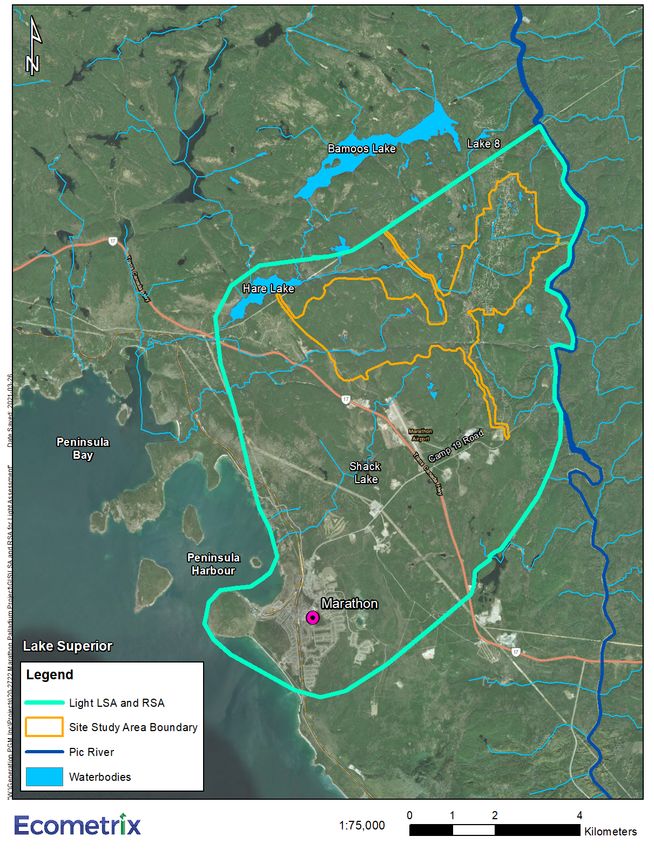
o The light LSA is roughly defined by the area west of the SSA to Lake Superior to
encompass the Town of Marathon and north to Hare Lake to include the cottages on the
lake.
• Regional Study Area: The Atmospheric RSA is the area within which residual environmental
effects from Project activities and components may interact cumulatively with the residual
environmental effects of other past, present, and future (i.e., certain or reasonably foreseeable)
physical activities. The RSA is based on the potential for interactions between the Project and other
existing or future potential projects with respect to air quality, dustfall, and light effects. These RSAs
include the SSAs, LSAs and are defined as follows:
o For air quality, the RSA is an area extending 50 km from the Site claim boundary. This
distance defines the extent that other projects within this area may have a measurable
effect on air quality in this study’s LSA based on the types of emission sources
anticipated for this Project.
o As stated above, GHG releases act cumulatively in the atmosphere globally and the
environmental concern is global. The spatial boundary is provincial and national in
geographic extent.
o For light, the RSA is coincident with the LSA since effects are expected to be restricted to
the LSA.
The Atmospheric LSA and RSA boundaries are included on Figure 6.2.1-1 and Figure 6.2.1-2 of this
report.
The temporal boundaries for the Project that have been considered in the determination of environmental
effects are described in Section 2.5 of the EIS Addendum (Volume 1) (CIAR #727).
For the air quality, GHG, and light assessment, the following scenarios were evaluated:
• Phase I – Site Preparation and Construction: Emissions from Construction Year “-1” were assessed
as this timeframe includes the most material movements and equipment operation, which will result
in the largest CoPC emissions during this phase. Initial site preparation activities (clearing,
grubbing, soil stripping, grading of the SSA, etc.) in this phase will be relatively brief with fewer
numbers of equipment than subsequent construction activities. Emissions from site preparation
activities in this phase were therefore not explicitly assessed as the construction assessment will
implicitly address site preparation emissions.
• Phase II – Operations: Project material movements (mining and ore stockpile) and ore processing
rates remain relatively constant through operating years 2 through 10, with lower rates in other
years. CoPC emission rates would therefore be expected to be highest in years 2 to 10. Using year
2 operating data to represent the entire operations phase provides a conservative estimate of air
6.26MARATHON PALLADIUM PROJECT ENVIRONMENTAL IMPACT STATEMENT ADDENDUM
Atmospheric Environment
April 2021
quality levels as the depth of the open pits will be less in year 2 versus later years, which will result
in “worst-case” impacts.
• Phase III – Decommissioning and Closure: Closure emissions are expected to be less than
construction emissions (as no pit extraction or PSMF construction would be occurring) and,
therefore, the assessment of the construction scenario implicitly addresses the decommissioning
and closure phase emissions as well.
6.27!
!
!
540000 550000 560000 570000 580000
!
!
Cirrus Lake Lineal Lake
¯
!
Martinet Lake
!
Louis Lake
Madoson Lake
(
$ $
!
Pukatawagan Legend
!
Jim Lake Lake
!
Project Boundary (MLAS, MENDM Changed
Goodchild !
2017)
Roccian Lake Lake Runnalls Lake
!
North ! Site Study Area Boundary
Skipper !
Limit of Surface Rights Controled by
Boyer Lake Lake Talus Lake
Willie Lake Alberta Lake
!
!
Generation Mining (Current or Pending)
! Local Study Area
Pan Lake
!
Regional Study Area
Skipper Lake
)
W !
M2
e(
Lin Highway
!
i on
i ss !
sm
5410000
5410000
an Major Road
Coubran Lake Tr
Pan Lake Fen
!
e
dg
u wa
Hydro Line
!
Provincial Park
n ito !
Ma
y-
!
a
c eB ! Railway
r ra
Te !
!
Watercourse
Bamoos Lake !
Lola Lake Airport
Seeley Lake !
! Municipal Boundary, Lower Tier
Regional Study Area
Black River
!
National Park
!
! Lorna Lake Provincial Park
!
Waterbody
!
!
! ! !
!
! !
Hare Lake
!
! !
Gowan Lake
! ! !
! !
! !
! !
! ! !
Revised: 2020-11-12 By: dharvey
! ! ! !
! ! ! !
! !
!
!
!
Red Sucker Point
!!
!
C
anad
Town Of Marathon
Provincial Park Harriet Lake
!
!!
ia
Manitouwadge
n Pa c
!
Marathon
!!
ific
Airport Town of
0 2.5 5
!
Marathon Landfill
5400000
5400000
Site
!
km
!
!
!
V:\01609\active\_Other_PCs_Active\296 - Manitoba\129673006 Marathon PGM\gis_cad\gis\mxds\Air\report_figures\AirQualityBaseline_2020\129673006_Fig2_LSA_RSA_AQ.mxd
!
!
1:150,000 (At original document size of 11x17)
ad
!
!
!
!
!
Ro
!
Notes
!
Neys
ul !
a
nin s
!
1. Coordinate System: NAD 1983 UTM Zone 16N
!
Provincial Pe
!
2. Base features produced under license with the Ontario Ministry of Natural
Three
!
!
Park Town Of Resources and Forestry © Queen's Printer for Ontario, 2018.
!
!
! ! !
!
! !
Finger Lake
!
Marathon
!
!
!
!
!
!
!
!
wa
!
!
ig h
!
!
!
!
Ripple
y1 7
! ! !
! !
H
!
! !
Neys
! ! !
!
Highway 17 Coldwell
!
Project
! ! !!
!
Terrace Bay
! !
!
!
Location
! !
MARATHON
! ! !
!
!
! !
!
! !
Trudeau
! ! ! !
Mobert
!
!!
!
Hemlo
! !
!
!
! !
Regan Ontario
!
Rous Heron Bay
! !
Craig's Pit
! !
!
!
!
!
Cigar Lake
!
Ea
Lake
!!
Provincial
!
Lak e
Minnesota
st
Pic River 50
-W
!
Superior
es
!
Park Canadian Pacific
tT
ig
ie
H
Pic Cache
River Lake
!
Tr
a
!
Lake Superior
ns
hw
m
!
is
si
ay 627
Michigan
on
!
Li
Handle Lake
!
Lak e
ne
Lak e Hu ro n
Wisconsin
!
5390000
5390000
Michigan Geo rg ia n
!
Campfire Lake Dalton Lake Bay
!
River
!
Ell Lake
!
Project Location 129673006 REVA
Lake Superior
!
Pic
Li ttl e Bl ac Marathon Prepared by SW on 2020-11-12
k River !
Technical Review by DH on 2020-09-17
!
! Independent Review by ABC on yyyy-mm-dd
!
! Client/Project
GENERATION PGM INC.
!
!
Pic River 50 MARATHON PALLADIUM PROJECT
!
!
Elk Lake
!
Figure No.
!
0 25 50
6.2.1-1
!
km
!
1:1,000,000 (At original document sizeMussy Lake
of 11x17) Title
Local and Regional Study Areas - Air Quality
!
Pukaskwa Herrick
!
Lake
!
National !
Park
!
!
540000 550000 560000 570000 ! 580000
!
Disclaimer: Stantec assumes no responsibility for data supplied in electronic format. The recipient accepts full responsibility for verifying the accuracy and completeness of the data. The recipient releases Stantec, its officers, employees, consultants and agents, from any and all claims arising in any way from the content or provision of the data.
!
!
!
!
!
!MARATHON PALLADIUM PROJECT ENVIRONMENTAL IMPACT STATEMENT ADDENDUM
Atmospheric Environment
April 2021
Figure 6.2.1-2: Local and Regional Study Areas - Light
6.29MARATHON PALLADIUM PROJECT ENVIRONMENTAL IMPACT STATEMENT ADDENDUM
Atmospheric Environment
April 2021
6.2.1.3.5 Residual Effects Characterization
Table 6.2.1-9 summarizes how residual environmental effects are characterized in terms of direction,
magnitude, geographic extent, timing, duration, frequency, reversibility, and ecological / societal value.
The characterization of residual effects is consistent with the original EIS (2012), which were qualitative
definitions, and have been further defined to include quantitative measures, where applicable, as part of
this EIS Addendum.
Table 6.2.1-9: Characterization of Residual Effects on Atmospheric Environment
Characterization Description Quantitative Measure or
Definition of Qualitative Categories
Direction The long-term trend of the Positive – Effect moves measurable parameters in a
residual effect direction beneficial to air quality or light relative to baseline
conditions.
Adverse – Effect moves measurable parameters in a
direction detrimental to air quality or light relative to
baseline conditions.
Magnitude The amount of change in For Air Quality:
measurable parameters of Negligible – model predicted air contaminant
the VEC relative to existing concentrations due to Project-related emissions are less
conditions than 10% of baseline conditions and do not result in
exceedances of the ambient air quality criteria
Low – a measurable change is expected but of comparable
magnitude to baseline conditions
Medium – a measurable change or effect but less than
regulatory limits or standards
High – a measurable change that causes exceedance of
objectives or standards beyond the Project boundaries.
For Greenhouse Gas:
Negligible – no measurable change in GHG emissions
Low – although a change is measurable, based on Agency
guidance (CEAA 2003 and ECCC 2020a) and professional
judgment, relatively small changes are expected in
provincial and national GHG emissions
Medium – based on Agency guidance (CEAA 2003 and
ECCC 2020a) and professional judgment, notable changes
are expected in provincial and national GHG emissions
High – based on Agency guidance (CEAA 2003 and ECCC
2020a) and professional judgment, material changes are
expected in provincial and national GHG emissions
For Lighting:
Negligible – no measurable change
Low – effect is detectable but is limited through design
mitigation
Medium – facility lighting is effectively controlled, but
navigation, security and other required lighting have a
measurable effect
6.30MARATHON PALLADIUM PROJECT ENVIRONMENTAL IMPACT STATEMENT ADDENDUM
Atmospheric Environment
April 2021
Table 6.2.1-9: Characterization of Residual Effects on Atmospheric Environment
Characterization Description Quantitative Measure or
Definition of Qualitative Categories
High – the design is uncontrolled by Project design criteria
and has a pronounced effect
Geographic Extent The geographic area in Negligible (SSA) – residual effects are limited to SSA
which a residual effect Low – residual effects are restricted to within the modelled
occurs property boundary (for air quality) or immediate
surroundings
Medium (LSA) – residual effects extend into the LSA
High (RSA) – residual effects extend into the RSA
Timing Considers when the For Air Quality and GHG
residual effect is expected No sensitivity - Timing does not affect the VEC.
to occur, where relevant to
the VEC.
For Ambient Light
Not Applicable — during the day, light is not likely to have
an effect.
Applicable — during the night, light is likely to have an
effect
Duration The time required until the Negligible – residual effect is limited to a single event
measurable parameter or Low (short-term) – the residual effect is limited to short
the VEC returns to its term events (a few years or less)
existing condition, or the
residual effect can no Medium – the residual effect is limited to the
longer be measured or operational/decommissioning phases (years to decades)
otherwise perceived High (Long-term) – the residual effect extends beyond the
life of the project (centuries)
Frequency Considers whether the Negligible (single event) – the residual environmental
residual effect is expected effect occurs only once
to occur once, at regular or Low (Multiple irregular event) – the residual
irregular intervals or environmental effect is limited to construction or active
continuously closure or for periods of less than 1 year during operation.
Medium (Multiple regular event) - the residual
environmental effect occurs on a regular basis and at
regular intervals
High (Continuous) – occurs continuously
Reversibility Considers whether the Negligible – effect ceases immediately once source or
residual effect is reversible stressor is removed
or irreversible. Low – effect ceases once source or stressor is removed
Medium – effect persists for some time after source or
stressor is removed
High (Irreversible) – the residual effect is unlikely to be
reversed
6.31MARATHON PALLADIUM PROJECT ENVIRONMENTAL IMPACT STATEMENT ADDENDUM
Atmospheric Environment
April 2021
Table 6.2.1-9: Characterization of Residual Effects on Atmospheric Environment
Characterization Description Quantitative Measure or
Definition of Qualitative Categories
Ecological/Societal Considers the magnitude Negligible – the VEC has no value from a cultural or
Value that the residual effect is societal context
expected to have on the Low – the VEC is common in the LSA and/or has little to
ecological or societal no value from a cultural or societal context. For air quality
community, as determined the existing airshed is considered good for a rural area in
through consultation and northern Ontario.
engagement.
Medium – the VEC is abundant in the RSA, though may be
less so in the LSA, and/or has moderate cultural or societal
value. For air quality the existing airshed is typical of a rural
area in northern Ontario.
High – the VEC is rare and/or of high cultural or societal
value. For air quality the existing airshed is considered
compromised or stressed and is not typical of a rural area
in northern Ontario.
Note: Timing was not included in the original EIS.
6.2.1.3.6 Significance Definition
Air Quality
A significant residual adverse effect for air quality is one where the Project predicted releases of air
contaminants to the atmosphere degrade the quality of ambient air such that the model predicted
concentrations (combined with background levels) are likely to exceed applicable objectives, guidelines or
criteria for ambient air quality outside the modelled property boundary, and are of concern relative to the
geographical extent of predicted exceedances, their frequency of occurrence, and the presence of
potentially susceptible receptors.
This significance threshold considers the characterizations described in Table 6.2.1-9 when making a
determination of significance. Direction is addressed in this significance threshold by the fact that, by
definition, a degradation of ambient air quality as a result of the Project relates to an adverse condition.
Magnitude is considered because the threshold considers whether air emissions released to the
environment exceeds the applicable criteria. Geographic extent is considered in this significance
threshold by predicting Project-related ground-level concentrations of CoPCs beyond the modelled
property boundary and considering locations relevant to each CoPC’s effect. Frequency and duration are
considered by establishing threshold levels for ground-level concentrations for the CoPCs assessed over
a specific time period (in this case, the maximum off-site 1-hour, 8-hour, 24-hour or annual average) and
predicting whether or not air quality objectives will be exceeded on a continuous basis. Ecological and
socio-economic context is addressed as the significance threshold considers local baseline conditions in
the modelling to assess air quality emissions.
6.32You can also read


