Message from the Dean - UKZN
←
→
Page content transcription
If your browser does not render page correctly, please read the page content below
July 2010
Message from the Dean
FEEL IT! They are here: the first year students arrived in big numbers. For the
first time since the merger the Faculty surpassed its enrolment target. To date the
Faculty has registered a total of 5 435 students, 22% of these being postgraduates.
As a Faculty we are three years ahead of our enrolment plan, and will certainly be
meeting our DoHET target of 5 495 in the second semester through the registration
of additional postgraduate students. The huge numbers of undergraduate students
pose a challenge to all of us, but I believe and have faith that, together, we will be
creative as usual in overcoming these challenges.
The crowning of our students at the two graduation ceremonies in April, both
officiated by the Chancellor Dr Zweli Mkize, was a big success. We graduated a
total of 970 students and remain a leading Faculty in the production of PhD
graduates, having graduated 53 at the last graduation ceremony. For the first time
we produced a Doctor of Science in Agriculture; congratulations to Professor Mike
Professor Deo Jaganyi.
Savage. We also congratulate Professors Jamshid Moori and David Ward for being
made Fellows of UKZN, and Dr Serban Proches who was awarded the 2009 Vice-Chancellors Research Award. In
addition, we netted one of the four Distinguished Teachers Awards.
I am really excited about our Faculty. The 2015 Science and Agriculture Agenda, which is our blueprint, has been finalised
and will be distributed to all staff. This document will guide us in achieving our mission over the next few years. Our
Faculty is certainly contributing in a meaningful way towards the realisation of UKZNs dream of being The Premier
University of African Scholarship. The 2015 Agenda will enhance our participation in making it a reality.
To all the staff, thank you for your contributions towards building our Faculty and UKZN. All the best in semester two
2010.
Deo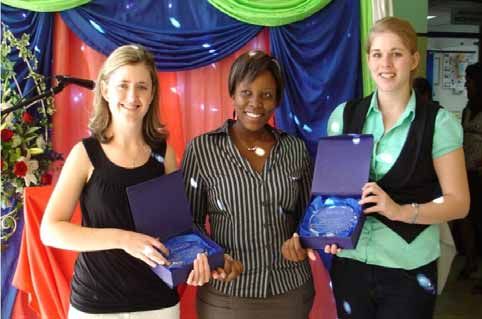
Distinguished Teachers Award for Dean
Professor Deo Jaganyi was one of four
academics awarded with a Distinguished
Teachers Award at this years graduation
ceremonies. Besides being the Dean of one
of the leading Faculties at UKZN and one
of the most productive researchers at the
Institution, Professor Jaganyi still finds
time to teach undergraduate and post-
graduade Chemistry students. His com-
mitment to teaching is apparent in the
careful and reflective planning of his
modules and his ability to adapt his
teaching methods to different levels. Most
importantly, he is student-centred in his
approach and always makes time in his
busy schedule to mentor and assist students.
(left) Professor Deo Jaganyi at the graduation ceremony where he received his
Distinguished Teachers Award.
Top students take a bow
The best students in the Faculty of Science
and Agriculture were honoured at the
Facultys annual Awards Ceremony held on
the Pietemaritzburg campus on the eve of
graduation. A total of 37 awards were
presented to students who excelled in a
variety of disciplines in 2009. Many of the
prize winners were amongst the 1 037
Science and Agriculture students who had
their degrees conferred at the UKZN
graduation ceremonies.
Representatives from sponsor companies Ms Daniella Egli, pictured with Professor Deo Jaganyi, claimed five awards at the
and past and present staff members handed Faculty of Science and Agriculture Awards Ceremony.
over the prizes to the deserving students
who attended the Awards Ceremony with
their families. Many of the awards have a
long history and have been presented by
the Faculty for many years.
Summa cum laude graduate, Ms Daniella
Egli, was the most dominant prize winner,
claiming five awards for her academic
achievements in the Biological Sciences.
One of the most prestigious awards, the AR
Saunders Medal for the Dux in the
Agricultural and Dietetics programmes,
went to Ms Ursula Wittig who graduated
cum laude with a BSc Dietetics degree.
Mr Tuki Maseatile, Director of the Valley Trust, presents Miss Maite Ramotebele
with the Valley Trust Nutrition Award.
u
2 2
Centre for Science Access
Juggling work and postgraduate studies
Mr Muvhango Rasalanavho graduated with his MSc degree at the April graduation
ceremonies. His dissertation was entitled Application of Analytical Chemistry and Waste
Minimisation Techniques in a Paint Drier Plant. I found the research project important
in the sense that it relates to what I teach my students: Chemistry and application of
Chemistry to solve problems pertaining to environmental issues, said Mr Rasalanavho.
Despite difficulties such as: finding a postgraduate supervisor, gaining trust from the
company while requesting information/data, collecting samples in the early hours of the
morning (mostly at 2 am), as well as much needed financial support, Mr Rasalanavho
said, Everything always comes to an end as long as one hangs on and becomes dedicated
even though there are obstacles on the way. Mr Rasalanavho intends to register for a
Mr Muvhango Rasalanavho. PhD in the near future.
Centre for Science Access (CSA) counsellors visit Problem-Based Learning
Australia Conference
Student counsellors, Ms Shelley Barnsley deal with the kinds of social issues that Project and problem-based learning has
and Ms Ntombekhaya Mtwentula, recently UKZN students face such as: food become increasingly popular in Higher
undertook an academic visit to Perth, insecurity, poor living conditions, financial Education contexts. However, there are a
visiting five universities in Western problems and HIV/AIDS. Ms Mtwentula broad range of contexts and diverse
Australia. The purpose of their visit was to said: Despite the fact that we are dealing applications indicating that teaching and
ascertain which models of service delivery with a very different student population in learning can take place without following
relating to student counselling and student a very different context in SA, we came traditional approaches. Three staff mem-
services at the Australian universities work, away with some innovative ideas on how bers from the CSA: Mr Muvhango
why they work, what challenges they face, to improve our practice. Ms Barnsley Rasalanavho, Ms Kristy-Lyn Barry and Dr
how they have overcome these challenges, added: Another particular useful idea is Naven Chetty attended the Project
and which organisational contexts favour to have Connect Officers, who are the first Orientated/ Problem-Based Learning Con-
which model. In addition, they wanted to point of call for students on any issue, and ference (PBL) held at Aarlborg University
explore the role of student counselling in students are then referred to the appropriate in Denmark from 4 - 6 May. This con-
access programmes and how student student support service and follow up is ference was based on utilising The
counsellors can improve access, retention made. These officers therefore do not Aalborg Model which started at Aalborg
and throughput. provide the support themselves, but provide University in 1974. Academics from
a bridge to the support. She believes this around the world were invited to discuss
Ms Barnsley and Ms Mtwentula found that idea has potential for development at visions, challenges, strategies and standards
most of the students at the Australian UKZN. on problem-based learning.
universities are funded and do not have to
Ms Barry said: I got to interact with
students and academics from various dis-
ciplines in education, science, engineering,
social sciences and medical education.
The most important highlight of the
conference was the presentation of the
proposed standards for certification on how
PBL should be implemented. Another
highlight was the paper presented by
Professor Sechaba Mahlomahalo from
North West University. He talked about the
similarities between the Aalborg PBL
Ms Shelley Barnsley. Ms Ntombekhaya Mtwentula. Continued on page 4
u 3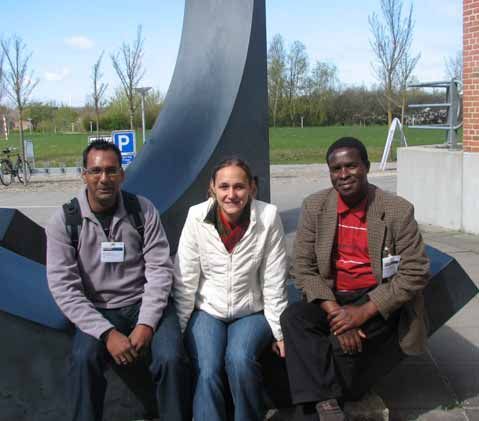
Continued from page 3
model and South Africas White Paper on
Higher Education and focused on a learner-
centered approach to education. Ms Barry
found the presentation from Australias
Swinburne University of Technology on
designing informal learning spaces within
a space-constrained campus very
enlightening. She found it applicable to
UKZN with a diverse student population
and space constraints.
Delegates were also involved in focus
group discussions on PBL and its standards.
They discovered how a PBL group work-
approach could be introduced to access
students from disadvantaged backgrounds
as opposed to a layered approach (which
is currently used) and one that encourages
independent work. Ms Barry, said This
conference was important for me to attend
as it broadened my knowledge base on
different teaching methods and I could see
what PBL is and how it is implemented in
different contexts around the globe, not (from left): Dr Naven Chetty, Ms Kristy-Lyn Barry, Mr Muvhango Rasalanavho.
only in affluent first world universities.
Science And Technology Education Centre
Holiday workshop
The Science and Technology Education followed by a build your own volcano Engineering helped them build their own
Centre, based on the Westville campus, session. Next up was an exercise in building Hero Turbine and on the last day, the
held its first holiday workshop from 28 June a bottle jet car, culminating in a bottle jet children enjoyed a secret message
to 2 July. Participants, who comprised race. This was followed by a visit to the workshop. They learned how to reveal
mostly staff members children, enjoyed a Electron Microscope Unit where the messages using an iron and grape juice and
range of different activities each morning children were shown how to prepare also decoded secret messages using the
of the week. The first morning was biological samples for different types of Vigenere and the PigPen cipher.
dedicated to a workshop on volcanoes microscopes. On the fourth morning,
which involved a volcano science show Professor Jeff Bindon from Mechanical
Workshop participants racing their bottle jets. Children enjoying the volcano building workshop.
u
4 4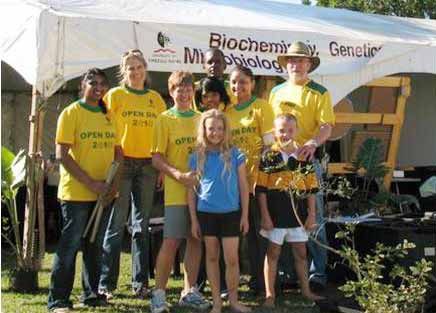
School of Agricultural Sciences and
Agribusiness
Staff News
Professor Frederick Veldman was Professor Michael Chimonyo joined the we also welcomed a new Lecturer in Plant
appointed in the discipline of Dietetics and discipline of Animal & Poultry Science on Pathology. Dr Kwasi Yobo was appointed
Human Nutrition on 1 March. He holds the 1 June. A graduate of the University of after Dr Pat Caldwell retired at the end of
following degrees: BSc Chemistry & Zimbabwe (UZ), Professor Chimonyo 2009. Originally from Ghana, Dr Yobo
Human Physiology, BSc Honours, MSc, completed his BSc Honours in Agriculture completed his university training on the
PhD (Northwest University, Potchefs- (Animal Science) in 1996, his MSc in 1998 Pietermaritzurg campus. He holds a BSc
troom), MSc Epidemiology (Columbia and graduated with a PhD in 2005. From (Hons) (former University of Natal), MSc
University, New York), and a Masters in 1999 to 2003, he held the position of Re- (Plant Pathology) (former University of
Problem-Based Learning in Science, search Fellow at the Department of Para- Natal), and PhD from UKZN. His PhD,
Mathematics and Engineering Education clinical Veterinary Studies, UZ. In July 2003 which was awarded in 2005, focused on
(University of Aalborg, Denmark). He was he was appointed as a lecturer in the same Biological control and plant growth
previously employed at the Central Department. In 2006, he was appointed as promotion by selected Trichoderma and
University of Technology in the Free State Associate Professor and Head of the Bacillus isolates.
as an Associate Professor from 1997 to Department of Livestock and Pasture
2008. From 2002 to 2003, Professor Science at the University of Fort Hare. He Dr Yobo has received recognition in the
Veldman was a fellow of the Fogarty remained in this position until he was form of various scholarships, bursaries and
International HIV/AIDS and Tuberculosis promoted to Professor in 2010 when he awards, the most notable of these being the
Training and Research Program at the decided to join UKZN. Award for Young Plant Pathologist from
Mailman School of Public Health, New the Southern African Society for Plant
York Presbyterian Hospital at Columbia Professor Chimonyo is committed to Pathology for the years 2001 and 2003. He
University in New York City. Professor teaching excellence and is currently com- has published research articles in various
Veldman has received a number of pre- pleting a post-graduate diploma in Higher peer-reviewed journals such as the African
stigious awards and recently assisted Education and Training with the University Journal of Biotechnology, the Journal of
UNICEF as an expert on a panel for the of Fort Hare. His current interests include Plant Nutrition and the South African
development of a national nutrition training pig breeding and nutrition and livestock Journal of Plant and Soil. The School
programme for people living with HIV and production at communal and commercial welcomes Dr Yobo as he brings valuable
AIDS, in collaboration with South Africas levels. He has worked extensively in the knowledge and expertise in biological
national Department of Health. (2005- area of Nguni cattle research, covering control of diseases (greenhouses and
2006). He also served as the Provincial aspects of their growth and carcass per- crops), integrated plant disease control, use
Chair of the SA HIV Clinician Society from formance, adaptation to harsh environ- of pesticides/fungicides in plant disease
2004 to 2008. His research interests include ments, tolerance to ticks and nematodes and control, storage and safety issues relating
infant nutrition, process competencies and meat quality. He has established a prolific to agrochemical usage, epidemiology of
teaching, as well as HIV and AIDS treat- publication record in a short period, with plant diseases and applied biometry. Since
ments focusing on drug and food inter- more than 70 publications in peer-reviewed achieving his PhD, Dr Yobo has been
actions. and internationally-recognised journals. awarded a Postdoctoral Research Fellow-
ship at UKZN.
Professor Chimonyo has received a number
of scholarships, awards and prestigious
assignments over his academic career. He
is currently a sub-editor for the South
African Journal of Animal Science and a
reviewer for numerous journals, such as
Meat Science, Animal Feed Science and
Technology, Tropical Animal Health and
Production, Small Ruminant Research and
Livestock Science. To-date, he has success-
fully supervised four PhD, 15 MSc and
several Honours graduates.
The month of June was a landmark in terms
Professor Frederick Veldman. of staff changes in the School. In addition Dr Kwasi Yobo.
to the appointment of Professor Chimonyo, Continued on page 6
u 5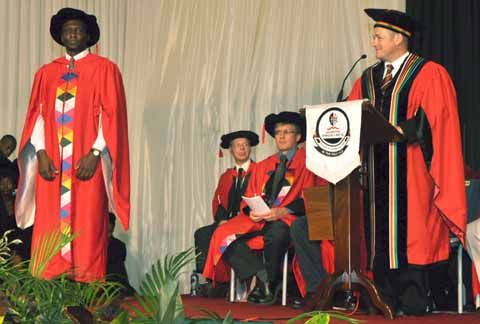
Continued from page 5
Mrs Karen Caister has completed her          another in Hospital Dietetics, a Masters in    academic co-ordinator in the School. At the
Leadership and Equity Advancement            Agriculture (Food Security) and is currently   same time we have said goodbye to
Programme (LEAP) contract and was            working towards her PhD in Social              Professor Sheryl Hendriks who has
appointed as a lecturer in Agricultural      Agronomy.                                      joined the University of Pretoria and Dr
Extension and Rural Resource Manage-                                                        Marietjie van der Merwe who has left our
ment. Mrs Caister holds a BSc (Dietetics),   Mrs Nicola Tyler from Animal and Poultry       School to join the Faculty of Education in
a Postgraduate Diploma in Missions and       Science has been appointed as a new            pursuit of her research passion.

      Obituary for Professor Janusz Zwolinski
                                             Professor Janusz Zwolinski passed away on 26 May after a long illness. He was a
                                             vauled member of the School of Agricultural Sciences and Agribusiness and his
                                             contributions will be missed.

                                             Professor Zwolinski, Associate Professor in Forestry, received his professional
                                             qualification and early work experience (1971-1982) at the European School of
                                             Forestry. He arrived in South Africa in 1983, having completed his MSc in Krakow,
                                             Poland. He received his PhD from the University of Stellenbosch (1992) and a
                                             DSc from the Agricultural University of Krakow, Poland in 2008. This was
                                             accompanied by over 25 years of involvement in commercial forestry, green-field
                                             projects, technical management, postgraduate studies, research and academic
                                             engagements, mainly in South Africa, but also in the United States and Europe.

                                             Professor Zwolinski started the forestry programme at UKZN, which by 2008 had
                                             produced 26 degrees, of which 16 were Masters and Doctorates. In addition, 142
     Professor Janusz Zwolinski.
                                             undergraduates from the Faculty of Science and Agriculture elected to take various
                                             Forestry courses

      Enhancing his professional expertise, Professor Zwolinski visited various forestry institutions (academic, research and
      commercial) in Africa, Australia, China, Canada, Europe, New Zealand as well as North and South America. He established
      collaborative agreements and professional contacts with leading institutions and specialists, particularly in the area of
      planted forests, commercial forestry and wood chain management.

      Research and development projects conducted by Professor Zwolinski have been internationally recognised and have
      been of benefit to some of the largest international forestry companies. This work has been summarised in over 180
      publications and industrial reports, and delivered in over 70 public presentations at conferences, workshops and radio
      programmes. His expertise and professional interests were broad and he remained persistent in promoting intensive
      timber production technologies for economic and environmental benefits.

      Professor Zwolinski was dedicated to his students and was eager to instill in them an interest and passion for the field of
      forestry. He provided them with the motivation and resources to succeed, enabling them to make their own mark in the
      forestry discipline. His legacy and valuable contributions to forestry will remain for many years to come.

   u
   6 6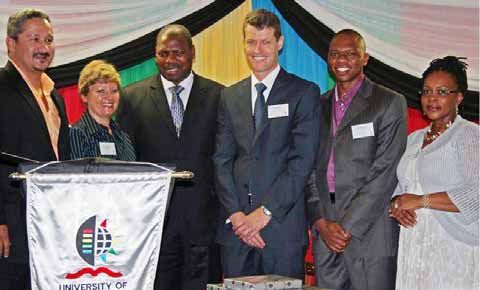
School of Biochemistry, Genetics and
Microbiology
Convocation Awards 2010: Professor Robert Neil Pike USA and the University of Cambridge, UK
he was recruited to the Department of
Professor Robert Pike who received his Convocation Award for Outstanding Biochemistry and Molecular Biology at
BSc Agriculture (Biochemistry) degree in Contribution to Agriculture, Engineering Monash University in Australia in 1997.
1987 and his PhD in 1991 from the former and Science. Following postdoctoral Here he established his most prolific
University of Natal was awarded the 2010 fellowships at the University of Georgia, research group which works on serine
proteases and their inhibitors, the serpins,
proteinase activated receptors and their
involvement in inflammation, as well as the
initiating serine proteases of the
complement system. In 2007 he was
appointed Head of Monash Universitys
Department of Biochemistry and Molecular
Biology, the largest and most successful
department of its kind in Australia.
Professor Pike has published 118 research
papers and invited reviews in the top peer-
reviewed journals in his field. He has also
published five chapters in books and is the
inventor on four patents. His work is
regularly cited by other researchers in his
field and he has an h-index (measures the
Convocation President, Mr André Young; Nominator, Professor Theresa Coetzer; scientific productivity and scientific impact
Premier of KwaZulu-Natal and UKZN Chancellor, Dr Zwelini Mkhize; Convocation of a scientist and is based on the distribution
awardee, Proessor Rob Pike; President and Chair of Convocation, Mr Sandile of citations received by a given researchers
Ngcobo and Executive Director of UKZN Corporate Relations, Ms Nomonde Mbadi.
publications) of 29. He has been the
principal investigator on some of the largest
research grants awarded in Australia and
New premises for Microbiology department was the Chair of the International
In its biggest event of this year, the Proteolysis Society. Through his out-
School of Biochemistry, Genetics and standing contribution Professor Pike is
doing his alma mater proud by
Microbiology on the Westville campus
hosted the official opening of the personifying the Universitys tradition of
disciplines of Biochemistry and Micro- excellence. He was nominated for the
award by Professor Theresa Coetzer who
biology in their new premises on 21
May. Guest speakers included: Deputy read the citation at the Convocation Awards
Vice-Chancellor and Head of College, dinner on 16 March.
Professor Rob Slotow; Dean of Science
and Agriculture, Professor Deo Jaganyi Merck awards
and Deputy Vice-President of the
The achievements of the best final-year
National Research Foundation (NRF),
Ms Shantal Dorisamy, a Biochemistry students in the disciplines of Microbiology
Professor Gansen Pillay. Professor Masters student in one of the new
Slotow did the honours by cutting the and Biochemistry at the Westville and
laboratories.
Pietermaritzburg campuses were recog-
ribbon which was followed by a guided
tour of the top-class undergraduate and explain their research to the guests. The nised in a special ceremony held on the
postgraduate research facilities of both opening celebrated many years of Westville campus on 21 May. Merck-
planning that began pre-merger. sponsored plaques as well as cash awards
disciplines. Students were on hand to
Continued on page 8
u 7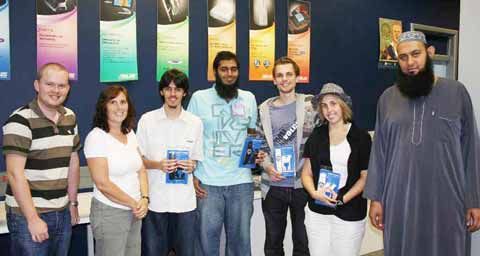
Continued from page 7
were presented to Ms Nontobeka Mvubu
(Microbiology, Westville), Ms Liesl
Hendry (Biochemistry, Westville), Ms
Nongcebo Memela (Microbiology, Pieter-
maritzburg) and Ms Lauren Eyssen (Bio-
chemistry, Pietermaritzburg). Congratu-
lations to these talented students who are
all currently pursuing Honours degrees.
The GV Quicke Book Prize, awarded to
the best Biochemistry student at level 7 was
shared by two students: Miss Kirsten
Shelley Henstra and Miss Laurelle Anne
Jackson.
The Genetics Book Prize for the best
Honours student in Genetics was awarded
to Miss Danielle Wingrove Tedder.
Merck awardees: (from left) Ms Liesl Hendry, Ms Nonobeko Mvubu and Ms Lauren
Eyssen.
Open Day
Open Day exhibitions were staged on 8 and
15 May on the Pietermaritzburg and
Westville campuses. These are important
events on our annual calendar and, as
always, terrific displays were presented on
both campuses.
Staff News
Biochemistry Professor
conferred a Knight of the
Order of the Star of Italian
Solidarity
Cavaliere dellOrdine della Stella della
Solidarietá Italiana, translated as Knight of
the Order of the Star of Italian Solidarity,
is the new official title of Emeritus
Professor Mario Ariatti from UKZNs
School of Biochemistry, Genetics and
The end of another successful open day at the SGBM stand in Pietermaritzburg.
Microbiology. He was recently knighted by
the Italian government for his work and
dedication, over 35 years, to the discipline
of Biochemistry on the Westville campus
as well as his commitment and contribution
to Italy.
Professor Ariatti, who has maintained Dr Evodia Setati leaving for greener pastures
strong links with his country of birth, Dr Evodia Setati, Lecturer in the discipline lectured both second and third-year
received the award at the annual Italian of Microbiology on the Westville campus Mycology modules as well as recombinant
Republic Day celebration on 2 June at the left us at the end of February to take up a DNA Technology. Her research focused on
Durban Country Club. Dignitaries from new position. She is currently a Senior exploring the potential of enzymes from
local society and government and the Researcher at the Wine Biotechnology extreme environments for application in
consular corps were in attendance to share Institute, University of Stellenbosch. Dr biotechnology.
in the festivities. Setati joined Microbiology in 2006 and
u
8 8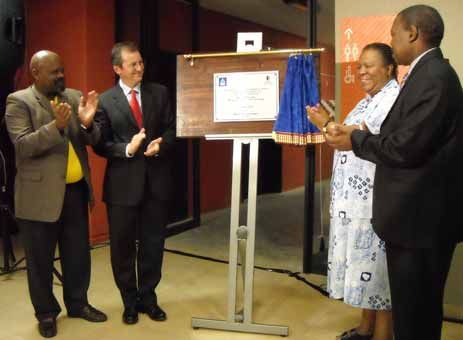
School of Biological and Conservation
Sciences
Fun Events at Pietermaritzburg University Open Days
Graduation 2010 The Administrative Staff at Pieter- The School made a substantial contribution
maritzburg continued their efforts to boost to UKZNs annual Open Days which
The School congratulates all students, in
spirit amongst staff and students by attracted more than 5 000 learners and their
particular our higher degree candidates,
successfully encouraging everyone to parents to the Pietermaritzburg campus on
who were awarded their degrees at the April
support Football Fridays and wear 8 May and the Westville campus on 15 May.
graduation ceremonies. A total of 12 PhD,
football jerseys in support of their favourite Our displays, which are manned by
21 MSc, 28 BSc (Hons) and 44 BSc candi-
teams. Following an idea of Professor Steve enthusiastic postgraduate students, are
dates, from the Westville and Pietermaritz-
Johnson, we recently hosted our second normally attractive to the learners (even
burg centres, graduated at their respective
Staff versus Students Cricket Match, which those with no particular interest in studying
ceremonies. Coinciding with the Pieter-
adopts a 15-over format and has proven to biological sciences) given their interesting
maritzburg ceremony was the Facultys
be very popular. So far, the staff lead the and interactive content this was again true
Awards Ceremony, where several top
series 2-0 and there are plans to make this this year.
students were acknowledged for their
a more regular (possibly monthly) event.
academic achievements in 2009. Repre-
senting our School, summa cum laude Postgraduates provide
graduate, Ms Daniella Egli, was the most academic support
noticeable prize winner and claimed five Throughout the first semester, the Schools
awards as a result of her impressive Academic Support Programme and the
achievements. Also making headlines First Year Experience Programme provided
following the Pietermaritzburg ceremony additional mentoring sessions and
was the long walk to success of Mr resources for augmented and first-year
Desale Yosief Okubamichael, who walked biology students on the Pietermaritzburg
and hitchhiked all the way from Eritrea, to campus. Held mostly on weekends, these
complete his MSc in Botany at UKZN. were attended by 80-150 biology students
Noteworthy from Westville was Alistair and were led by 15 senior students, mostly
McCormick who received the award for the from SBCS, which included postdoctoral,
best PhD in Botany in South Africa from PhD, MSc, Honours, and third-year
the South African Association of Botanists. students. Academic, support and
administration staff of the School greatly
Staff news and achievements facilitated this process by providing
additional teaching and practical materials
l Congratulations to Professor Paula Watt
and Ms Bulelwa Keke for their recent and arranging venues. It is indeed a healthy
promotion to the level of Professor and Avid support for Football Friday on sign when senior students are prepared to
Senior Tutor. the Pietermaritzburg campus. give up their valuable time and participate
l At the Pietermaritzburg graduation in such initiatives.
ceremony, Professor Dave Ward was
presented with the award of Fellow of Annual Day of the Tree ceremony
the University of KwaZulu-Natal in re-
cognition of his considerable contri- Continuing a 24-year old tradition of
bution to research in the field of ecology celebrating the health of trees, this annual
and his successful mentoring and ceremony was recently held at the West-
supervision of postgraduate students. ville campus. Inaugurated on the Howard
l At the 2010 Comrades Marathon, College campus by former Chief
Professor Richard Beckett achieved his Technician, Mr Darrell Smith, the move
20th medal for having completed this of the School to Westville necessitated the
arduous race over two decades; a most Celebrating the Day of the Tree at Westville. planting of a successor to the original tree,
noteworthy achievement. at Westvilles new Biology Building in 2009. A pepper-bark tree (Warburgia salutaris)
l Professor Paula Watt was elected as a was planted in the presence of Mr Smith, who sadly passed away during 2010. Besides
Faculty representative on the College his considerable biological knowledge, Mr Smith was generally regarded as the god-
Academic Affairs Board, while Mr father of scientific diving in KZN. Mr Derek Airey (of Sappi Saiccor, Umkomaas),
Martin Hampton was elected as a repre- a long-term diving associate of Mr Smiths, presented the invited address entitled:
sentative for the Pietermaritzburg Diving: pastime or sport?
Support Staff on the Faculty Board.
u 9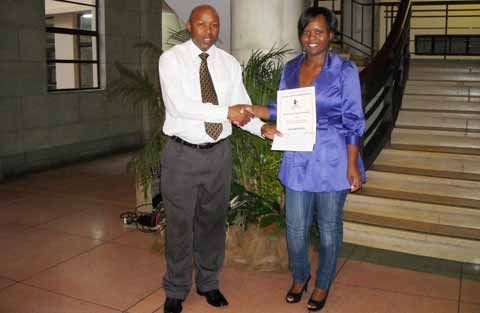
School of Bioresources Engineering
and Environmental Hydrology (BEEH)
Project focuses on impact of biofuel feedstock production on water resources
UKZNs School of Bioresources Engin- Dr Winnie Gerbens-Leens and Professor with a strong endorsement for the project,
eering and Environmental Hydrology Stefan Uhlenbrook from the University of as well as raising several issues which they
(BEEH), in collaboration with the Univer- Twente and the UNESCO-IHE Institute of can include in their work programme.
sity of Pretoria and the Council for Water Education, added value to the
Scientific and Industrial Research (CSIR), symposium through their presentations on
was recently awarded a multi-million rand the Water Footprint concept and on the
six-year research project, initiated by the gaps in knowledge regarding the water-use
Water Research Commission. of biofuels.
Titled: Water use of cropping systems Attended by a wide range of stakeholders,
adapted to bioclimatic regions in South the symposium played a key role in
Africa and suitable for biofuel production, knowledge dissemination by providing: an
the project is jointly funded by the Water overview of state-of-the-art methodology
Research Commission and the Department and technology for estimating crop/tree
of Agriculture, Forestry and Fisheries. water use; information on potential biofuel
feedstock (e.g. sweet sorghum and
The production of biofuels uses water, cassava); knowledge on water-use of
particularly for the production of the specific crops/trees (e.g. canola and
feedstock to supply biodiesel and jatropha) as well as highlighting various
bioethanol plants. Competition for water key research areas.
between agriculture and other sectors,
especially for urban needs, is intensifying On behalf of the Water Research Com-
and some South African catchments are mission, Project Manager, Dr Andrew
already over-allocated and hence water Sanewe expressed his satisfaction with the Pictured at the Faculty of Science and
Agriculture annual Awards Ceremony
stressed. workshop outcomes. Project Leader, are Professor Roland Schulze and Mr
Professor Graham Jewitt and Principal Simphiwe Ngcobo, the recipient of the
The research project will enhance the state Investigator, Mr Richard Kunz, agreed that Roland Schulze Award for the Top Third
of current knowledge regarding the the workshop had provided the project team Year Hydrology student.
potential for biofuel feedstock production
in South Africa by: identifying potential
growing areas for key biofuel feedstock in
South Africa; quantifying, through both
experimentation and modelling, the
potential water requirements of feedstock
production (and likely impacts on water
resources); estimating yield potential in
optimum and sub-optimum growing areas;
and accounting for the possible threat from
pests and diseases.
As part of this project, BEEH recently
hosted a symposium and workshop in
Pietermaritzburg focussed on the
biophysical constraints and water use of
potential biofuel feedstock in South Africa.
The symposium featured presentations by
local experts from UKZN, the University
of Pretoria, the University of Cape Town
and the CSIR. Two international experts, Participants and guest speakers at the symposium.
u
1010School of Chemistry
Two of our staff members graduated at the l Umgeni Water Prize for top 3rd year
April graduation ceremony: student in Chemical Technology: Mr T
J Theron
l Dr Desigan Reddy (PhD)
l Sasol medal for top Honours student:
l Mr Muvhango Rasalanavho (MSc)
Ms Pegah Khalili
Ms Kristy-Lyn Barry and Mr Muvhango
Rasalanavho attended the conference
Visions, Challenges and Strategies for
Problem-Based Learning at Aalborg Staff and students from Chemistry at the
University, Denmark from 4- 6 May. Open Day on the Westville campus.
Obituary for Dr John Ashley
Professor Igor Nikolaenko gave a lecture
entitled Copper (II) complexes of the Chemistry prize winners.
Nevines
oxime- and amide ligands: odd and even Dr Ashley Nevines
number defined stability at the Inter- Dr Desigan Reddy and his team of post- from the School of
national Symposium on Metal Complexes graduate students represented Chemistry at Chemistry, passed
in Bilbao, Spain from 7-11 June. Open Day on the Pietermaritzburg campus away on 2 June
where they organised a chemistry show. whilst in St Augus-
One of our third-year chemistry students, tine Hospital.
Ms Vezekile Zungu, is currently spending In February, the School of Chemistry in
two months as an exchange student at Pietermaritzburg, in collaboration with the Dr Nevines, who
James Madison University, Virginia, USA, South African Chemical Institute, held a was originally from Yorkshire in the UK,
with Professor Brian Augustine, who chemistry magic show for schools. came to South Africa to undertake his PhD
visited the School of Chemistry in Pieter- at Rhodes University under the supervision
maritzburg as a Fulbright Scholar in 2009. Staff on the Pietermaritzburg campus were of Professor Trevor Letcher. In 1992, when
in full support of Bafana Bafana during the Professor Letcher took up the headship of
recent World Cup, as can be seen in the the Chemistry Department at the former
photograph taken on one of the Football University of Natal, Dr Nevines moved to
Fridays. Durban. He settled in easily and his love
of the outdoors and nature meant that
Durban was the perfect place for him. He
was soon diving at Aliwal Shoal and
Sodwana and visiting the local game parks.
In 1995 he married Ms Elena Lakoba, a fellow
PhD student in the Chemistry Department.
After completing his PhD in 1998, Dr
Ms Vezekile Zungu and Professor Brian Nevines joined the former University of
Augustine in the laboratory at James
Madison University. The School hosted a group of Programme Durban-Westville as a lecturer in Physical
for Technological Career (PROTEC) Chemistry. He was subsequently promoted
The annual prize-giving function for learners on 17 June at the Westville campus to Senior Lecturer. He established a
Pietermaritzburg Chemistry was held on 14 laboratories. Students who have never seen collaborative research programme with
April. The following students received or worked in a chemistry laboratory were colleagues at the Technical University of
prizes: exposed to a modern laboratory, were Warsaw and was due to visit them again in
l Best beginner in 1st year Chemistry: shown some general laboratory experi- June this year.
Ms Aimee Addington ments and were given an opportunity to Dr Nevines was a warm and gentle person.
l Perkin-Elmer prize for top 1st year perform some lab experiments them-selves. He was always calm and understanding and
student continuing with Chemistry: PROTEC is a national independent non- of good cheer. He passed on his love of
Ms Rachelle de Charmoy profit educational service provider in South nature to many colleagues and friends by
l Sasol medal for top 2nd year student: Africa that specialises in Maths, Science arranging camping trips and expeditions.
Mr Nkosinathi Dlamini and Technology education. Holiday He was also a dedicated teacher and a
l Merck Prize for top 3rd year student: programmes are conducted for learners in helpful colleague. We will miss him greatly
Mr Antony Hall grades 10 to twelve. in the School.
u 11School of Computer Science
Programming team does UKZN proud at national IT challenge
The Metaraptors, a programming team
from the School of Computer Science, was
placed 2nd in the national 2010 Standard
Bank IT Challenge held recently at Standard
Banks Head Office in Johannesburg.
Comprising universities from all over the
country, the competition aimed to bring out
students programming abilities and test
their team work skills. Each team of four
students had to include at least one member
of the opposite sex, one person from a dis-
advantaged group and a team manager. The
teams were required to complete a series
of questions using one of three programming Pictured at the IT Standard Bank Challenge: (from left) Standard Bank representative and
languages Java, C++ or Python. UKZN alumnus, Mr Jonathan Dudley; Programming Competition Site Manager from the
School of Computer Science, Mrs Rosanne Els; the Metaraptors team members: Mr Nadeem
The competition was divided into two Vawda, Mr Yaseen Moolla, Mr Zane Mayo and Ms Cara Reeve; and Programming
Competition Site Assistant from the School of Computer Science, Mr Aslam Safla.
stages with the first stage taking the form
of intra-university heats conducted on competition was the on-line score board left UKZN and UCT tied on five correct
different university campuses. The winning which allowed interested parties to follow problems each but since UKZNs times
teams advanced to a final inter-university their teams progress throughout the day. were considerably better, they were
competition that also involved two According to team manager, Mrs Rosanne awarded second place.
Standard Bank staff teams. Els, the UKZN team was consistently in
the top three, and frequently in first place. The UKZN team comprising Mr Nadeem
The final was a closely contested Vawda, Mr Zane Mayo, Mr Yaseen Moolla
competition with teams racing against time In the last hour, the UKZN team was and Ms Cara Reeve all won new 22" Dell
to see who could complete the most narrowly defeated by Stellenbosch who LCD Monitors for their outstanding
problems. A highlight of this years managed to solve one more problem. This achievements.
Computer Science researchers embark on two new inter-disciplinary research initiatives
UKZN is a key partner in an international and includes Professor Fethi Ahmed and vision of the team, will kick-start the project
consortium that is working on a new Mr Yerdashin Padayachi from the School by investigating a Machine Learning
European Union Framework 7 research of Environmental Sciences, and Dr Deshen Approach to Finding Boundary Conditions
project, the EO2Heaven project. The aim Moodley from the School of Computer for Ecosystem Behaviour.
is to build an ICT platform that integrates Science. UKZN is contributing a case study
remotely sensed, in-situ, health and social application to monitor air pollution and its
data to identify and monitor conditions that impact on respiratory disease in the south
adversely impact on human health. Dr Durban area.
Moodley from the School of Computer
Science recently represented UKZN at a Professor Jules Tapamo and Dr Deshen
project meeting held in Karlsruhe, Moodley from the School of Computer
Germany from 8-10 June to finalise and Science, together with Dr Ursula Scharler
plan upcoming activities for the con- from the School of Biological and Conser-
sortium. The UKZN EO2Heaven team vation Sciences, have formed an inter-
brings together researchers from the Health disciplinary research team to investigate
Sciences, Environmental Sciences and advanced computing techniques to simulate
Computer science. The team is lead by and predict complex ecosystem behaviour. Be a Scientist for a Week participants
Professor Rajen Naidoo from the Depart- A Computer Science Masters student, Mr testing their robots which they learned
to programme as part of their session in
ment of Occupational and Public Health Guerichon Munezero, under the super- the School of Computer Science.
u
1212School of Environmental Sciences
Dr Serban Proches receives Vice-Chancellors Research Award for 2009
The Universitys most prestigious research related varieties, and cannot survive
accolade, the Vice-Chancellors Research without large populations of their host
Award, has been awarded to Dr Serban plants. Several weevil lineages survived
Proches for 2009. A Senior Lecturer in the over tens of millions of years in this region,
School of Environmental Sciences on the some ever since the break-up of
Westville campus, Dr Proches holds a Gondwanaland, but currently face threats
National Research Foundation (NRF) P- from insecticide use and unsustainable
rating (young researcher with exceptional plant collection. Finding weevils involves
leader potential). He is one of only two P- the thorough examination of plants, in
rated researchers in the country and Dr Proches searching for the elusive particular flowers and fruit.
nanophyid weevils associated with
received the NRF Presidents Award in Melastomataceae.
2008 for his contribution to knowledge Dr Proches joins a proud tradition of pre-
creation and dissemination. In particular, Dr Proches focuses on weevils vious Vice-Chancellors Research Award
(Coleoptera: Curculionidae) associated winners from the Faculty of Science and
Dr Proches has published fifty journal with plants endemic to this region as Agriculture including: Professor Orde
articles to date, primarily in the fields of indicators of plant persistence and climatic Munro (Chemistry, 2007), Professor
Biogeography and Biodiversity. His current stability. With over 10 000 species in South Richard Mace (Physics, 2005), Professor
projects address topics such as global Africa and hundreds of thousands Steve Johnson (Biological and Conser-
regionalisation, alien plant invasions, and worldwide, weevils are the most diverse vation Sciences, 2002) and Professor.Rob
the Maputaland-Pondoland-Albany region group of organisms regionally and globally. Slotow (Biological and Conservation
one of the thirty-four globally recognised They vary enormously in colour and shape Sciences, 2000). Since its inception
biodiversity hotspots, stretching from the but are severely understudied in southern researchers from the Faculty of Science and
Eastern Cape to Mozambique, with the city Africa. Most weevil species are specialists Agriculture have claimed 12 of the 21 Vice-
of Durban lying at the very heart of it. associated with one plant type or a few Chancellors Research Awards.
Productive sabbatical leave for Dr Watson
Dr Helen Watson spent most of her
sabbatical leave finalising her commit-
ments to the EU-funded COMPETE
Competence Platform on Energy Crop and
Agro-forestry Systems Africa project
www.compete-bioafrica.net. The project
ran from January 2007 to December 2009
and Dr Watson led the Current Land-Use
Patterns and Impacts Work Package. She
used Geographic Information Systems
(GIS) to interrogate numerous databases in
order to identify land in sub-Saharan Africa
where biofuels feedstock production could
potentially be sustainable. The main output Dr Watson (centre) giving the welcome address as the Africa representative at the Bioenergy
for Sustainable Development in Africa International Conference in November in Brussels.
of her work is an interactive GIS on the
COMPETE website, which allows the user periods working at Imperial College and shops organized by COMPETE partners in
to see the effect of filtering out land which Utrecht University. She participated in Lusaka and Brussels. Dr Watson also had
should not be used for biofuels because study tours to Mexico, Zimbabwe and the opportunity to share her findings as an
of a particular or combination of con- Zambia which sought to identify best invited speaker at an international confer-
straints. practices for the production of biofuels. She ence in Brussels and in Addis Abba. In
gave presentations focusing on potential addition, she was also a guest of the
As part of this project, Dr Watson traveled environmental and food security impacts Stockholm Environment Institute in Dar es
extensively during her leave. She spent of biofuels in Africa at international work- Salaam.
u 13School of Geological Sciences
Warwick wins again
Mr Warwick Hastie has been awarded
both the Corstorphine Medal and the
John Handley Award for his MSc thesis
in Geological Science. The John
Handley Award recognises Mr Hasties
thesis at the best submitted to a South
African University in 2009, while the
Corstorphine Medal affirms that, in
addition to being the best in the country,
his thesis is of international standard. It
should be noted, however, that not every
recipient of the John Handley Award
receives the Corstorphine Medal.
Mr Hasties study which is entitled
Rock fabric study of the northern
Lebombo and Rooi Rand dyke swarms-
regional and local implications
investigated the magnetic and crystalline
fabric of dolerite dykes in South Africa
and Swaziland. This is yet another
feather in his cap as he won the
Haughton award for the best Honours
dissertation in 2006. Mr Hastie will
Mr Warwick Hastie.
receive both awards at a formal
ceremony at the AGM of the Geological
Society in Johannesburg.
New equipment previous post-doctoral fellowship in the Lecturer in Marine Geology since 2007.
school from 2008-2009. She received After returning from a round-the-world
The geotechnical laboratory has
her PhD from the Indian Institute of trip, he re-joins the School as Lecturer
received a boost in the form of a brand
Technology in Kharagpur where she in Sedimentology. The School wishes
new Servo-Hydraulic Compression
focused on the metamorphism of them all a warm welcome.
Testing Machine, designed to test the
granulite facies rocks from northwest
compression strength of concrete, Last but not least, we bid a sad farewell
India. Dr Hingston takes over the role
cement and rocks. to Dr Axel Hofmann who leaves us to
of Lecturer in Engineering Geology,
having previously held positions at the take up an associate professorship at the
University of Leeds and Fourah Bay University of Johannesburg. He joined
Staff news College at the University of Sierra the School as a lecturer in 2005 where
The School welcomes the arrival of Leone. He completed his PhD in 2008 he established himself as an authority
three new staff members: Dr Lopamudra at the University of Leeds on the on Archaen Geology. We wish him all
Saha, Dr Egerton Hingston and Dr geotechnical variability of landslide the best for the future.
Andrew Green. Dr Saha joins us as a hazards. Dr Green is no stranger to the
lecturer in Mineralogy, having held a School as he has held the post of
u
1414School of Mathematical Sciences
At the Facultys graduation ceremony on assembly of the most massive galaxies moving to the University of Nottingham in
17 April, the University awarded Professor appeared in the April 2009 issue. The article September, where he will continue his
Jamshid Moori a Fellowship. A mathe- describes observations of some of the most research in galaxy formation.
matician of international repute, Professor distant known galaxy clusters, which
Moori was made a life-Fellow of the suggest that the brightest galaxies within Dr Megan Govender, a senior researcher
University for his outstanding contribution them were already almost as massive as and astrophysicist within ACRU, has taken
to the discipline. their counterparts in the local universe his science experiments to another level.
some nine billion years ago. His main passion is working with
Professor Jamshid Moori and Professor disadvantaged students by showing them
J D Key were two of the main speakers This contradicts current theories of galaxy how much fun science can be.
invited to the workshop/conference formation, and suggests that these galaxies
organised by the NATO Science for Peace grew to 90% of their final stellar mass His unusual science experiments have made
and Security Programme held at Opatija, approximately five billion years after the him extremely popular amongst children,
Croatia between 30 May and 11 June. The Big Bang. The observations were teenagers and adults and have even gotten
theme of the workshop/conference was: conducted using one of the largest optical him internationally recognised. Dr
Information Security and Related telescopes in the world the Subaru Govender says that he is a huge fan of
Combinatorics. Professor Moori delivered telescope which is located on the summit Michael Jackson as well as of talk show
lectures on Finite Groups, Designs and of Mauna Kea, Hawaii. Since this work host, Ellen DeGeneres.
Codes, while Professor Key delivered appeared in Nature, Dr Hilton has used this
lectures on Permutation Decoding for same data in combination with imaging He admits that the Ellen show has had a
Codes, Designs, Finite Geometries and from the Hubble Space Telescope and huge impact on him and he recently sent
Graphs. More information on the Spitzer, a space infrared observatory, to through an e-mail to the talk show host
workshop/conference can be found at http:/ study the galaxy population in one of these telling her how much she inspires him. The
/www.math.uniri.hr/NATO-ASI/ distant clusters in detail. His most recent e-mail was read to her live studio audience
work, to be published in The Astrophysical and she sent through her greetings to Dr
Professor Michael Henning left the Journal in July, shows that some galaxies Govender. Soon, he will be sending two
School of Mathematics (Pietermaritzburg deep within this cluster appear to be videos to her. One is a science experiment
campus) at the end of the first semester to forming stars at prodigious rates. that I am putting together, and the second
take up a research professorship at the
is a massive dance video. I want to show
University of Johannesburg. Also, Dr Dr Hilton says, In contrast, there is Ellen what her show has done for me that
Petrovious Horton moved to the Univer- virtually no star formation going on in the
it has made me push the boundaries. said
sity of Swaziland. The School is sad to lose cores of clusters in the local universe. This Dr Govender. Dr G, as he is affectionately
these fine academics and friends to other suggests that at roughly nine billion years referred to by his students, starts each
universities. ago, we may be entering the epoch where
lecture with a string of jokes as well as some
cluster galaxies formed most of their stars. funky dance moves.
In January LAMSIT (Loose Association Dr Hilton completed his undergraduate
of Mathematical Scientists and Information degree in Sheffield and his PhD at
Technologists) of UKZN-PMB introduced Liverpool John Moores University in the
a folder in its tea room for keeping records UK. He began a post doctoral fellowship
of members solutions to tea-time teasers. at UKZN in September 2007, working with
Teasers are usually posed by LAMSIT Professor Kavilan Moodley. He will be
members or their visitors to the tea room
whenever they come across them. These
teasers are some of the challenges enjoyed
by the LAMSIT members during tea
breaks.
An article co-authored by Dr Matt Hilton,
a post-doctoral fellow in the Astrophysics
and Cosmology Research Unit (ACRU)
within the School of Mathematical
Sciences, has been published in the science Dr Megan Govender interacts with high
journal Nature. The article entitled Early school learners.
Dr Matt Hilton.
u 15School of Physics
Continued on page 17
UKZN physicists publish textbook
After almost six years of intense work, was published in May by Oxford University reasoning and provide additional
Professor Owen de Lange and Dr John Press and will soon be available for interesting information. Both analytical and
Pierrus from the School of Physics in purchase. numerical (computer) techniques are used
Pietermaritzburg, have completed a to obtain and analyse solutions. The
textbook aimed at both undergraduate and Apart from an introductory chapter giving computer calculations use Mathematica
postgraduate students. The book entitled a brief summary of Newtonian and (version 7), and the relevant code is given
Solved Problems in Classical Mechanics Lagrangian Mechanics, this book consists in the text. It includes use of the interactive
entirely of questions and solutions on topics Manipulate function which enables one to
in classical mechanics that will be observe simulated motion on a computer
encountered in undergraduate and screen, and to study the effects of changing
postgraduate courses. These include one, parameters. The textbook will also prove
two, and three-dimensional motion; linear invaluable to the instructor as it provides
and nonlinear oscillations; energy, lecture, tutorial and examination material.
potentials, momentum, and angular
momentum; spherically symmetric potentials; A prominent British scientist from
multi-particle systems; rigid bodies; Cambridge University, Professor David
translation and rotation of the reference Buckingham, remarks: The writing is
frame; the relativity principle and some of succinct and clear and the comments often
its consequences. bring out the relevance of the problem to a
phenomenon of current interest as well as
From left: Dr John Pierrus and The solutions are followed by a set of points of historical importance. The
Professor Owen de Lange pose with their comments intended to stimulate inductive problems are varied and well chosen.
newly-published book.
QuantumStadium launch secures communication for the 2010 World Cup
UKZNs Centre for Quantum
Technology (CQT) and the eThekwini
Municipality joined hands to provide
unprecedented communication security
to Durbans FIFA World Cup operations.
Their QuantumStadium Project used
quantum cryptography to ensure that all
forms of communication between
Durbans Moses Mabhida Stadium and
its offsite operations centre were ultra-
secure. The 2010 World Cup was the
first public global event to use a
quantum based encryption solution.
The project was officially launched on
21 May at the Moses Mabhida Stadium
by Minister of Science and Technology,
Ms Naledi Pandor. Its prestigious nature
was highlighted by the calibre of
speakers on the programme which from left: Pictured at the Launch of the QuantumStadium Project at the Moses
included eThekwini Mayor, Councillor Mabhida Stadium: (from left) Mayor eThekwini, Councillor Obed Mlaba,
Obed Mlaba and KZN Premier, Dr UKZNs Professor Francesco Petruccione, Minister of Science and Technology,
Zweli Mkhize. Ms Naledi Pandor and KZN Premier, Dr Zweli Mkhize.
u
1616Continued from page 16
Molecular Optics flying high in Pietermaritzburg
The Molecular Optics Research group on
the Pietermarizburg campus, led by Dr
Vincent Couling, remains actively engaged
in experimental molecular optics research.
Interests include experimental, theoretical
and computational aspects of molecular
optics, including the measurement and
modelling of intermolecular interaction The Molecular Optics group: from left: Dr Vincent Couling, Dr Naven Chetty, Ms Angela
effects. Dudley and Ms Pat Govender.
graduated with an MSc degree in 2009 the School of Physics in Pietermaritzburg
The groups research projects include the based on her work on the electro-optic Kerr on 1 July.
measurement of molecular polarisabilities effect and is currently employed as a
and hyperpolarisabilities via the electro- researcher at the National Laser Centre in Ms Pat Govender is completing her MSc
optic Kerr effect, Rayleigh light-scattering, Pretoria. degree this year while also working as an
and the Cotton Mouton effect, as well as intern at the Centre for Scientific and
the measurement of electric quadrupole The measurement of electric quadrupole Industrial Researchs (CSIR) Defence,
moments via electric-field-gradient moments earned Dr Naven Chetty his Peace, Safety and Security (DPSS) group
induced birefringence. PhD in 2009. Dr Chetty, after teaching in Pretoria. Her experimental measure-
for many years on the Science Access ments of the stress-optic coefficients in
Recent group graduates have had no trouble programme on a contract appointment, ZnSe pollycrytalline material is of direct
in finding work. Ms Angela Dudley took up a permanent lectureship within interest to the DPSS.
The Italian experience at PMB knowledge to an operational level, one regarded him as a caring and outstanding
where strategic thinking, problem-solving, lecturer and supervisor. This reputation
Dr Alessandro Sergi arrived at UKZNs
time-management, and study techniques resulted in him holding temporary
Pietermaritzburg campus in 2007 after
can be emphasised. appointments in Physical Chemistry three
gaining vast experience in both Italy and
years past his retirement in 2005. Active in
North America. His research deals with the Since his arrival, Dr Sergi has published research, Professor Graham supervised six
development and application of numerical
five papers in peer-reviewed international MSc and four PhD students in the
algorithms for the computer simulation of journals and two conference proceedings. Molecular Physics Research Group and
quantum and classical systems in the
published 20 papers, all in respected
condensed phase. He holds a B3 NRF
Obituary for Professor Clive international journals.
rating, is a NITHEP associate, and
collaborates routinely with the Centre for Graham
Outside the University Professor Graham
Quantum Technology in Durban. Those who knew Professor Clive Graham was highly regarded in a range of activities:
were saddened by the news of his death on numismatics he was the Vice-Chair of the
Currently his group consists of one honours 5 June after a long illness. KZN Society where, due to his knowledge
and three masters students. In Dr Sergis
and integrity, many people sought his
view, research is a very effective way of Professor Graham was a product of the advice; philately and clivia growing he
mentoring students and helping them in the Physics Department in Pietermaritzburg was an active member of the Clivia Society.
development of their careers. He believes with outstanding results in all his degrees He also made jewelry of professional
in a bottom-up approach to teaching, where (BSc 1961, BSc Hons 1962, MSc 1965, quality and collected South African art, of
the teacher has to build bridges to lead PhD 1969). In 1969 he was awarded one which he had a small and tasteful collection.
the student from his/her initial state of of the 1851 Exhibition Scholarships which He was indeed a man of many parts and
are given to young scientists or engineers will be sadly missed.
within the Commonwealth who show
exceptional promise. This enabled him to
complete a second doctorate (1972) in
Molecular Physics under Professor AD
Buckingham FRS of Cambridge Univer-
sity. In 1972 he was appointed Lecturer in
the Physics Department in Pietermaritzburg
and progressed to Senior Lecturer in 1976
and Professor and Head of Physics in 1994.
From left: Daniel Uken (Masters Student),
Nkosinathi Dlamini (Honours Student), Professor Grahams students at both the
Emmanuel Obaga (Masters Student) and Dr
Alessandro Sergi (standing). undergraduate and postgraduate levels Professor Clive Graham.
u 17You can also read


