MONTEREY COUNTY EMS MULTIPLE CASUALTY INCIDENT (MCI) RESPONSE PLAN - July 1, 2014
←
→
Page content transcription
If your browser does not render page correctly, please read the page content below
MONTEREY COUNTY EMS
MULTIPLE CASUALTY INCIDENT
   (MCI) RESPONSE PLAN

         July 1, 2014
TABLE OF CONTENTS
                                                                    Page

TABLE OF CONTENTS                                                     ii

SECTION 1.0: MCI PLAN ADMINISTRATIVE ELEMENT                          1
     1.1 Scope                                                        1
     1.2 Objectives                                                   1
     1.3 Definitions                                                  1
     1.4 An MCI differs from a medical disaster                       3

SECTION 2.0: MCI PLAN ACTIVATION                                      3
     2.1 Pre-Arrival activation of MCI Plan                           3
     2.2 On-Scene MCI Activation                                      4

SECTION 3.0: MCI ACTIVATION RESPONSE PROCEDURES                        5
     3.1 Level 1 Incident                                              5
     3.2 Level 2 Incident                                              7
     3.3 Level 3 Incident                                              9
     3.4 Cancellation of MCI activation                               11

SECTION 4.0: COMMUNICATIONS                                           11
     4.1 Activate MCI                                                 11

SECTION 5.0: COMMAND STRUCTURE                                        11
     5.1 Incident Authority                                           11
     5.2 Command Authority Principles                                 12

SECTION 6.0: FIELD OPERATIONS                                         12
     6.1 Incident Command                                             12
     6.2 Initial Triage                                               12
     6.3 Secondary Triage                                             13
     6.4 Triage Tags                                                  13
     6.5 Ambulance Staging                                            13
     6.6 Provisions for equipment                                     13
     6.7 Monterey County EMS Non-Transport Record                     13

SECTION 7.0: TRANSPORTATION OF THE INJURED                            14
     7.1 Ambulance Request Guidelines                                 14
     7.2 Initial Calculation of the Required Number of Ambulances     14
     7.3 Requesting Ambulance and Transportation Resources            14
     7.4 Transportation Destination                                   15
     7.5 Ambulance/Hospital Communications                            15

SECTION 8.0: HOSPITAL ROLE                                            15
     8.1 Responsibilities                                             15

SECTION 9.0: LAW ENFORCEMENT ROLE                                     16
     9.1 Responsibilities                                             16

SECTION 10.0: PROCEDURES FOR HANDLING THE DECEASED                    16

SECTION 11.0: POST INCIDENT REVIEW                                    16

                                               ii
SECTION 12.0: TRAINING AND EXCERCISES                   17

SECTION 13.0: MCI PLAN REVISIONS                        17

ATTACHMENTS:

ATTACHMENT A
MONTEREY COUNTY FIRE/AMBULANCE AGENCY INDENTIFICATION   18
ATTACHMENT B        HOSPITAL DESTINATION                19
ATTACHMENT C        RECORDER WORKSHEET                  20
ATTACHMENT          ICS OVERVIEW CHART                  21
ATTACHMENT E        MONTEREY COUNTY MCI MEDICAL         22
                      BRANCH OVERVIEW
ATTACHMENT F        START TRIAGE                        23
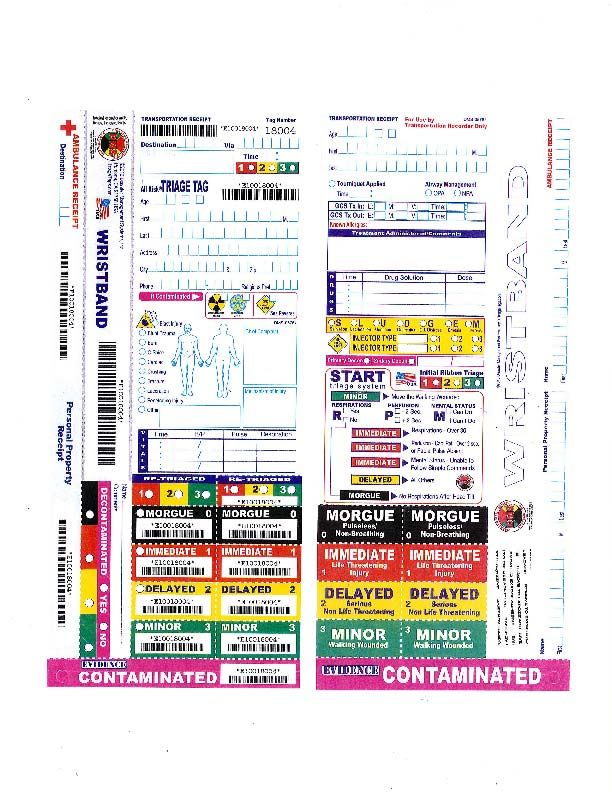
ATTACHMENT G        TRIAGE TAGS                         24

MEDICAL BRANCH CHECKLISTS:                              25

MEDICAL BRANCH DIRECTOR                                 26
TRIAGE GROUP SUPERVISOR                                 27
TRANSPORTATION GROUP SUPERVISOR                         28
AMBULANCE STAGING MANAGER                               29
MEDICAL COMMUNICATIONS COORDINATOR                      30
TREATMENT GROUP SUPERVISOR                              31
MORGUE GROUP SUPERVISOR                                 32

                                   iii
Monterey County MCI Plan
SECTION 1.0: MCI PLAN ADMINISTRATIVE ELEMENT
1.1 SCOPE
This plan is limited to Multi-Casualty Incidents within the Monterey County Operational Area.
The Monterey County Emergency Medical Services MCI Plan is an approved EMS policy. EMS
service provider organizations shall comply with the operational roles and standards as presented
in the MCI Plan. This includes EMS providers, dispatch centers, hospitals, and other allied
agencies.
1.2 OBJECTIVES
To ensure adequate and coordinated efforts to minimize loss of life and disabling injuries.
Establish a common organizational and management structure for the coordination of emergency
response to an MCI in Monterey County using the Incident Command System (ICS), California’s
Standardized Emergency Management System (SEMS), and the FIRESCOPE Field Operations
Guide (FOG).
Identify the equipment and personnel resources necessary to effectively and efficiently deal with
the patient’s resulting from an incident.
Develop strategy or strategies of care and transportation that will provide for the survival of the
greatest number of casualties.
1.3 DEFINITIONS
1.3.1 Advanced Life Support (ALS): Those medical services that may be provided
within the scope of practice of a person licensed as a paramedic (EMT-P) or RN.
1.3.2 Ambulance: Any vehicle or aircraft which is specially designed, constructed,
maintained, supplied, or equipped for transporting sick, injured, infirm or
otherwise incapacitated persons, and which is capable of supporting BLS or a
higher level of care.
1.3.3 Base Hospital: The Base Hospital is the hospital authorized by the EMS Medical
Director to provide medical control to Monterey County paramedics.
1.3.4 Basic Life Support (BLS): Those medical services that may be provided within
the scope of practice of a person certified as an EMT-1 (Basic), First Responder,
and public safety first aid.
1.3.5 Chemical, Biological, Radiation, Nuclear, and Explosive (CBRNE): Also
known as Weapons of Mass Destruction (WMD). Response to a CBRNE incident
requires specialized equipment, personnel, training, and medical treatment.
1.3.6 Disaster Medical Support Unit (DMSU): The DMSU is cargo van type vehicle
(Ford E-450 chassis) which comes fully configured and equipped with medical
supplies, emergency equipment and other items to support the initial response to
a large scale medical disaster incident. As equipped, the unit is capable of
providing necessary medical supplies to care for up to 50 patients. Supplies and
equipment include triage support equipment, basic life support and advanced life
support trauma kits, splinting/bandaging supplies, spinal immobilization
equipment, oxygen and airway management supplies, infection control and
personal protective equipment, patient litters, portable generator and flood lights,
1Monterey County MCI Plan
portable radio and communications equipment, and emergency vehicle lighting
and warning equipment.
1.3.7 Emergency: An emergency means a condition or situation in which an individual
has a need for immediate medical attention, or where emergency personnel or a
public safety agency perceives the potential for such need.
1.3.8 EMS Dispatcher: The individual(s) who dispatches ambulance resources,
provides pre-arrival instructions, and coordinates emergency response activities
with Monterey County Emergency Communications Departmennt.
1.3.9 EMS Dispatch: Is staffed and maintained by the Primary Ambulance Provider
and is co-located in the Monterey County Emergency Communications Center.
1.3.10 EMS Duty Officer: EMS Agency personnel designated as “on-call” for
emergency notifications such as the declaration of an MCI. The EMS Duty
Officer is or works under the Medical and Health Operational Area Coordinator
and coordinates local, regional, state EMS resources.
1.3.11 Flagging Tape: Plastic tape included in the MCI kit usually used to mark
boundaries of the treatment areas. There are four (4) colors: Green, Yellow,
Red, and Black.
1.3.12 Level - l MCI: Is any incident in which the volume of patients overwhelms the
initial responders, but the system has adequate resources to respond, treat, and
transport. Level – 1 activation should be initiated by an incident with 5 to 10
patients, or 3 or more critical patients, or at the request of Incident Command on
scene.
1.3.13 Level - 2 MCI: Is any incident in which the volume of patients not only
overwhelms the initial response, but where an adequate amount of ambulances
and personnel are not likely to be in close proximity to the incident. A Level 2
activation should be initiated by an incident with 10 to 25 patients, or 5 or more
critical patients, or at the request of Incident Command at scene. Ambulance
resources may need to be requested from outside of the County. The request for
outside ambulances usually will only be for one or two ambulances. These
ambulances should be geographically closer to the incident than ambulances
based in Monterey County.
1.3.14 Level - 3 MCI Activation: An incident with multiple patients where the number
of patients may overwhelm the number of available ambulances within the
County. This describes a large-scale incident, such as a large airline crash or a
building collapse. All the resources in a jurisdiction become overwhelmed, from
the responders to the receiving hospitals. This is a localized incident differing
from a Medical Disaster. However, the local disaster plan may be activated,
enabling a regional resources response. Level – 3 activation should be initiated
by an incident with 25 or more patients.
1.3.15 Medical Disaster: A widespread incident or multiple incidents with significant
numbers of casualties. The local disaster plan is likely to be activated.
Resources from outside Monterey County will likely be required to fully manage
the incident(s).
1.3.16 Medical Disaster Communications System (MDCS): The MDCS (800 MHz
Radio) allows emergency management, ambulance management, and hospitals to
coordinate emergency response efforts.
1.3.17 Medical Health Operational Area Coordinator (MHOAC). The Director of
Health and the EMS Director have jointly designated the Director of the
Monterey County Emergency Medical Services (EMS) as the Medical and Health
Operational Area Coordinator (MHOAC). Primary responsibilities of the
MHOAC are to manage disaster medical resources, including personnel,
equipment, and supplies; request mutual aid; activate hospital notifications and
communication systems; survey EMS resources (hospitals and transportation
2Monterey County MCI Plan
providers); orchestrate patient distribution; coordinate evacuation and patient
tracking; and effectively and efficiently process all medical and health
information.
1.3.18 Medical Network (MedNet) Communications: Assigned communication
frequencies for dispatch, command and control, and tactical coordination.
1.3.19 Monterey County Emergency Communications Department (MCECD): The
primary and centralized public safety answering point (9-1-1 Dispatch) for fire,
law enforcement, and EMS for Monterey County; located in Salinas.
1.3.20 Multi-Casualty Incident (MCI): An incident that produces more casualties than
can be managed by the usual EMS response of one or two ambulances.
1.3.21 START Triage: A triage system to quickly sort victims by severity in an MCI.
1.3.22 Triage Tag: A card used to identify the patient for tracking purposes, to identify
patient severity for prioritizing transport, and to record patient information when
there are multiple patients at an incident. Only triage tags from DMS and
approved by the EMS Agency are to be carried Monterey County based EMS
service providers and used within Monterey County.
1.4 AN MCI DIFFERS FROM A MEDICAL DISASTER
1.4.1 Under an MCI all casualties originate from the same scene (as opposed to a
widespread incident, such as an earthquake or flood).
1.4.2 Under an MCI medical resources have not been damaged or otherwise disabled
by the incident (except in the case of a hospital fire, explosion or similar cause).
1.4.3 During an MCI, operational management is maintained at the scene of the
incident.
1.4.4 An MCI is limited in scope. The number of casualties is generally known or can
be estimated from the onset of the incident.
SECTION 2.0: OPERATIONAL ELEMENT
2.1 PRE-ARRIVAL ACTIVATION OF MCI PLAN:
The highest ranking public safety officer responding to the incident shall determine
whether additional resources are likely to be needed and order those resources through
MCECD.
2.2 ON SCENE MCI ACTIVATION:
2.2.1 ACTIVATION GUIDELINES FOR PERSONNEL ON SCENE
Personnel arriving on-scene first will either confirm the presence of an MCI or
discover and declare an MCI.
• On Scene personnel will confirm the Level of MCI if a possible MCI
was declared by MCECD or EMS Dispatch.
• Conduct a scene size-up to include an estimate of the number of
casualties and known hazards.
• Communicate to MCECD or EMS Dispatch the estimated number of
casualties and known hazards.
• Establish the Incident Command structure.
o The Incident Commander is responsible for establishing goals
and strategies.
o Request additional resources as needed.
3Monterey County MCI Plan
oAll resources sent to the incident should be ordered through a
single source (Incident Command).
• MCECD may assign tactical radio channels as needed.
2.2.2 ACTIVATION AUTHORITY
The following have the authority to activate the MCI plan:
• First Responder, public safety officer or ambulance personnel that arrive
at the incident location first and recognize the presence of multiple
casualties.
• Incident Commander (IC).
4Monterey County MCI Plan
SECTION 3.0: MCI ACTIVATION RESPONSE PROCEDURES
3.1 LEVEL 1 INCIDENT
The number of patients is greater than can be handled by the usual initial response of one
to two ambulances. The EMS system has adequate resources to respond and transport the
patients. Duration of the incident is expected to be less than 1 hour.
3.1.1 Communications Procedure and Notifications:
• EMS Dispatch responsibilities:
o Notify the ambulance field supervisor.
o Notify all ambulances of MCI Activation and advise all units
of Level – 1 MCI including the Location.
o Dispatch an initial response of three ambulances unless
additional ambulances are requested.
o Dispatch additional ambulances as requested by the IC.
o Initial notification of all hospitals in Monterey County by
phone.
o Provide and receive follow-up reports to and from Monterey
County hospitals via 800MHz radio or phone
o Report hospital information to Transportation Group
Supervisor or other designated individual on scene.
o Notify the EMS Duty Officer.
• MCECD responsibilities:
o Dispatch Fire resources in whose jurisdiction the incident
occurred.
o Request Mutual Aid fire resources under any preplanned
response matrix or at the request of the IC.
3.1.2 Field Operations Procedure:
3.1.2.1 The first responder to arrive at scene shall assume incident command and
size up the situation by determining:
o Nature and magnitude of the incident
o Estimate the number of injured.
o Initial priorities and immediate resource requirements.
3.1.2.2 The first ALS unit on-scene shall report directly to the IC for assignment.
Potential areas for assignment include:
o The establishment of the Medical Branch.
o Transportation Group Supervisor.
o Additional resource needs.
3.1.2.3 Additional ambulance(s) shall report, as directed, to the staging area or
the IC upon arrival for assignment.
3.1.2.4 Additional personnel shall report to the IC or designated staging area as
directed.
3.1.2.5 Use of Triage Tags is recommended to ensure patient identification and
tracking.
3.1.2.6 Patient destination should be evenly distributed to as many hospitals as
practical. Distribution should be made as evenly as practical based on
severity and by total number of patients.
5Monterey County MCI Plan
3.1.2.7 The Monterey County EMS Non-Transport Record shall be used for
those people involved in the incident, have no medical need, and refuse
assessment, care, and transport.
3.1.3 Hospital Roles:
o The ED physician shall be notified.
o The hospital shall prepare to receive multiple patients from the MCI.
o The hospital shall assure staff is available to monitor the 800 MHz
radio.
o Communicate with MCECD regarding hospital impact from the MCI
and other pertinent information such as receiving multiple patients
from a separate incident.
6Monterey County MCI Plan
3.2 LEVEL 2 INCIDENT
The initial responders are overwhelmed by the patient volume. An adequate number of
additional ambulances are not likely to be immediately available, thereby creating a delay
in transporting patients. Adequate ambulance resources should be available within the
County to respond to the incident as well as other requests for service. The duration of
incident may be greater than an hour.
3.2.1 Communications Procedure and Notifications:
• EMS Dispatch responsibilities:
o Dispatch an initial response of three ambulances unless
additional ambulances are requested.
o Dispatch additional ambulances based on a request from the IC.
o Request the EMS Dispatch Supervisor to the Communication
Center to assist as needed.
o Notify all ambulances of MCI Activation and advise all units of
Level 2 MCI including the Location. Consider establishing a
separate command channel for the incident on the MedNet
system.
o Initial notification of all hospitals in Monterey County by phone.
o Communicate with the Transportation Group Supervisor
regarding destination hospitals and to obtain an estimate of the
number of patients to be transported to each hospital.
o Notify the EMS Field Supervisor.
o Provide and receive follow-up reports to and from Monterey
County hospitals via 800MHz radio or phone.
o Notify the hospitals receiving MCI patients of the expected
number of patients that they may receive.
o Initiate contact with hospitals in other counties that may receive
patients by ground ambulance.
o Report hospital information to Transportation Group Supervisor
or other designated individual on scene.
o Notify or request assistance from the EMS Duty Officer.
• MCECD responsibilities:
o Dispatch Fire resources in whose jurisdiction the incident
occurred.
o Dispatch Mutual Aid fire resources under any preplanned
response matrix or on the request of the IC.
o Notify the Fire Area Coordinator.
o Notify the OES Duty Officer depending on size and complexity
of the incident.
3.2.2 Field Operations Procedure:
3.2.2.1 The first responder to arrive at scene shall assume incident command and
size up the situation by determining:
o Nature and magnitude of the incident.
o Estimate the number of injured.
o Initial priorities and resource requirements.
3.2.2.2 The first ALS unit on-scene shall report directly to the IC for assignment
that may include:
o The establishment of the Medical Group.
7Monterey County MCI Plan
o Additional resource needs.
o Logistical concerns (i.e. Triage and treatment areas).
o Designation of Transportation Group Supervisor.
o Medical Communications Coordinator
o Communication with EMS Dispatch regarding destination
hospitals and to provide an estimate of the number of patients to
be transported to each hospital.
3.2.2.3 Additional ambulance(s) shall report to the staging area or the IC upon
arrival for assignment.
3.2.2.4 Additional personnel shall report to the IC or designated staging area as
directed.
3.2.2.5 Triage flagging tape shall be used for initial triage.
3.2.2.6 Triage Tags shall be used due to the large number of patients. Triage
tags will be placed on the patient in the Treatment Area. The patient will
receive a triage tag prior to transport with the destination strip of the
triage tag provided to the Transportation Group Supervisor for patient
tracking purposes. The Triage Tag may be used as the Patient Care
Report (PCR).
3.2.2.7 The EMS Field Supervisor should respond to the scene to support
management of the incident. The EMS Field Supervisor shall notify
EMS dispatch of intent to respond.
3.2.2.8 Patient destination should be evenly distributed to as many hospitals as
practical.
3.2.2.9 Patient distribution should be made as evenly as practical based on
patient severity and total number of patients.
3.2.2.10The Monterey County EMS Non-Transport Record shall be used for
those people involved in the incident, have no medical need, and refuse
assessment, care, and transport.
3.2.2.11Ambulances transporting patients should use an abbreviated call-in
format when advising the receiving hospital.
3.2.3 Hospital Roles:
o The ED physician shall be notified.
o The hospital shall be prepared to accept multiple patients from the
MCI.
o The hospital shall assure staff is available to monitor the 800 MHz
radio.
o Communicate with EMS Dispatch regarding hospital impact from
the MCI and other pertinent information such as receiving multiple
patients from a separate incident.
o The hospital should consider the activation of their disaster plan.
8Monterey County MCI Plan
3.3 LEVEL 3 INCIDENT
The number of casualties from this level of incident overwhelms the resources available
in Monterey County. It is likely not possible to respond with an adequate number of
ambulances to the incident and promptly respond to other requests for ambulance service.
This type of incident may result from a commercial airline crash, a building collapse or
other similar type of incident. Not only will ambulance service be inadequate but
receiving hospitals will be overwhelmed. In an incident of this size the operational area
EOC and disaster plan may be activated, enabling a regional resources response.
3.3.1 Communication Procedures and notifications:
3.3.1.1 EMS Dispatch responsibilities:
o Dispatch an initial response of three ambulances.
o Dispatch additional ambulances based on a request from Incident
Command.
o Notify the EMS Field Supervisor.
o Request the EMS Dispatch Supervisor to the Communications
Center to assist.
o Notify all ambulances of the Level 3 MCI activation, location of the
incident, and consider establishing a command channel for the
incident on the MedNet system
o Provide initial notification of all hospitals in Monterey County.
o EMS Dispatch may seek out of county ambulance resources from the
EMS Duty Officer.
o EMS Dispatch Supervisor will coordinate ambulance resources with
the EMS Field Supervisor and the EMS Duty Officer.
o Communicate with the Transportation Group Supervisor regarding
destination hospitals and to obtain an estimate of the number of
patients to be transported to each hospital.
o Initiate contact with hospitals in other counties that may receive
patients by ground ambulance.
o Provide and receive follow-up reports to and from Monterey County
hospitals via 800MHz radio or phone.
o Notify or request response from the EMS Duty Officer.
3.3.1.2 MCECD responsibilities:
o Dispatch Fire resources in whose jurisdiction the incident occurred.
o Request Mutual Aid fire resources under any preplanned response
matrix or on the request of Incident Command.
o Notify the Fire Area Coordinator.
o Notify the OES Duty Officer.
3.3.2 Field Operations Procedures
3.3.2.1 The first responder to arrive at scene shall assume incident command and
size up the situation by determining:
o Nature and magnitude of the incident.
o Estimate the number of injured. This information should be
provided to Fire Comm and EMS dispatch
o Initial priorities and immediate resource requirements.
o Consider requesting deployment of Disaster Medical Support Unit
(DMSU) or MCI trailers.
9Monterey County MCI Plan
3.3.2.2 The first ALS unit on-scene shall report to the IC for assignment. This
assignment may include:
o Triage Group Supervisor.
o Treatment Group Supervisor.
o Transportation Group Supervisor.
Ambulance Staging Coordinator.
Medical Communications Coordinator.
3.3.2.3 Additional ambulance(s) shall report to the staging area or the IC upon
arrival for assignment.
3.3.2.4 Additional personnel shall report to the IC or designated staging area as
directed.
3.3.2.5 Triage flagging tape shall be used for initial triage.
3.3.2.6 Triage Tags should be used due to the large number of patients. Triage
tags will be placed on the patient in the Treatment Area. The patient will
receive a triage tag prior to transport with the destination strip of the
triage tag provided to the Transportation Group Supervisor for patient
tracking purposes. The Triage Tag may be used as the Patient Care
Report (PCR).
3.3.2.7 Patient destination of critical patients should be evenly distributed to as
many hospitals as practical.
3.3.2.8 The Monterey County EMS Non-Transport Record shall be used for
those people involved in the incident, have no medical need, and refuse
assessment, care, and transport.
3.3.2.9 Ambulances are to use an abbreviated call in format for hospital
notifications.
3.3.3 Hospital Roles:
• The ED physician shall be notified.
• Communications between EMS Dispatch and the hospital should
continue via 800 MHz radio
• The hospital should consider activation of their disaster plan.
• The hospital should consider activation of the Hospital Incident
Command System to manage the impact of the patient load.
10Monterey County MCI Plan
3.4 TERMINATION OF AN MCI ACTIVATION
3.4.1 As soon as the condition has been mitigated and/or is under control, the Incident
Commander (IC) should terminate the MCI declaration by radio to MCECD.
3.4.2 MCECD and EMS Dispatch will broadcast cancellation of the MCI declaration
and notify all previously notified agencies of the cancellation.
3.4.3 EMS Dispatch will notify all hospitals of the MCI cancellation via the MDCS
(800 MHz Radio) or telephone.
SECTION 4.0: COMMUNICATIONS
4.1 ACTIVATE MCI
4.1.1 MCECD will coordinate with EMS Dispatch for available ambulances, current
resources, mutual aid coverage, staging, and external mutual-aid resources if
requested. External mutual-aid resources shall be coordinated in collaboration
with the Monterey County EMS Agency and/or the Medical and Health
Operational Area Coordinator (MHOAC). The EMS Director or his/her designee
acts as the Monterey County MHOAC.
4.1.2 MCECD has the responsibility for coordinating all MCI communications. All
notifications and requests to other agencies shall originate from the Monterey
County Emergency Communications Center.
SECTION 5.0: COMMAND STRUCTURE
5.1 INCIDENT AUTHORITY
Incident Organization shall be based on the Incident Command System (ICS) and comply
with the following:
For single-jurisdictional incidents, incident command will be with the responsible legal
jurisdictional agency.
For multi-jurisdictional incidents, a unified command structure may be established with
the incident command responsibilities being jointly provided by those agencies (e.g. Fire,
EMS Agency, ambulance provider, and/or law) sharing legal jurisdiction.
Incident Command, whether through individual or unified command, is responsible for:
• Determining the overall incident objectives;
• Selection of tactical strategies;
• Approving the joint-plan and tactical activities;
• Management of assigned resources;
• Processing and dissemination of information;
• Conducting integrated tactical operations; and
• Effectively and efficiently employing all assigned/available resources.
11Monterey County MCI Plan
5.2 COMMAND AUTHORITY PRINCIPLES
• The Incident Commander (IC) will be a designated representative from a Law
Enforcement, Fire Agency, or Health Department having jurisdictional,
investigative, or legal authority for the incident.
• The first arriving personnel of any agency may function as the IC implementing
the necessary actions until the role can be relinquished to the appropriate agency.
• Agencies that are assisting or providing mutual aid in support of an incident will
function under the direction of the designated IC or Unified Command.
• In multi-jurisdictional incidents, a Unified Command may be established at a
single (site) command post (location).
• Assign appropriate ICS roles to responding personnel using MCI job action
sheets, vest, and appropriate documentation forms. Only those ICS positions
required, due to the size and nature of the incident need be filled.
• Any large event (incident) may need to have several divisions and/or branches
under one director. Any incident needing more than one (1) Medical Branch
should refer to FIRESCOPE Field Operations Guide to assist with establishing
ICS Command structure.
SECTION 6.0: FIELD OPERATIONS
6.1 INCIDENT COMMAND
• The Transportation Group Supervisor is responsible for managing patient
transportation and is usually the first ambulance paramedic arriving on scene.
• All incoming personnel shall assume support roles based upon assignment/mission
designated by the Incident Commander (IC). All personnel shall report to staging
for direction unless instructed otherwise.
• During the MCI, all onsite agencies shall request additional resources through the
Incident Commander or his/her designee.
• The IC should consider personnel needs to manage triage, patient movement, and
patient management in the treatment areas when requesting resources.
• The IC or his/her designee, when requested by the Incident’s Medical Branch
Director, would order all EMS aircraft, assign the heli-spot manager and safety
officer, and designate the landing zone(s).
• The IC or his/her designee should request Critical Incident Debriefing (CID) as
soon as a need is identified.
• All personnel with an assigned ICS position should be easily identified through
the use of ICS position vests.
• Establish ambulance staging, equipment and personnel staging, treatment, and
morgue areas as needed.
6.2 INITIAL TRIAGE
• S.T.A.R.T. TRIAGE is the designated method for establishing the condition of
the patients by the extrication/triage personnel. Initial triage will be with triage
flagging tape. Patients should be triaged and tagged using the county-designated
triage tag at the treatment area. All patients should be directed to appropriate
treatment area(s) for re-triage, care, and transportation.
• Consideration should be made to reallocate personnel from the extrication and
triage areas to the treatment area as patients are triaged and moved to the
treatment areas.
12Monterey County MCI Plan
6.3 SECONDARY TRIAGE AND TREATMENT
• Within the treatment area, separate and well defined sections for each category of
patient should be established to facilitate identification of patients by severity.
• Personnel shall continue to follow Monterey County EMS policies and protocols
including trauma patient destination.
• It is important to reassess patients in the treatment area and during transport.
6.4 TRIAGE TAGS
6.4.1 Triage Tags should be utilized in an MCI. Pre-hospital care personnel shall
ensure that an adequate supply of tags is available during their shift. Engine
Companies should carry at least ten (10) tags per vehicle and ambulances should
carry at least fifteen (15) tags per unit. Triage tags may replace the PCR in
declared Level 2 and Level 3 Multi-Casualty Incidents.
6.4.2 The Receiving Hospitals shall monitor and retrieve all triage tags utilized to
identify patients brought in from the MCI. The triage tag, when used, will be
saved as the medical record of prehospital care.
6.5 AMBULANCE STAGING
The staging area for ambulances and other transport vehicles should not restrict
ingress and egress of other ambulances or patient movement.
6.6 PROVISIONS FOR EQUIPMENT
6.6.1 In certain MCIs, it will be necessary to establish treatment areas. The primary
function of treatment areas is to provide stabilization of patients until they can be
transported to receiving facilities. In such situations, it will be necessary to
establish a cache of equipment to treat these patients.
6.6.2 Equipment and supply resources can be provided to the incident through the
following resources:
• Fire units may be equipped with both ALS and BLS supplies.
• All Monterey County Ambulances are equipped with both ALS and BLS
supplies. Out of county ambulances may have only BLS supplies.
• Ambulance supervisor units should carry BLS and ALS supplies.
• Equipment cache trailers have BLS equipment to treat multiple patients.
• The DMSU has supplies to treat fifty (50) injured patients.
6.6.3 Ambulances should not provide equipment such as the heart monitor or portable
oxygen tank to a supply cache when it would make the ambulance unable to
provide patient care during transport or to another patient should that ambulance
be assigned to a separate incident.
6.7 MONTEREY COUNTY EMS NON-TRANSPORT RECORD
The Monterey County EMS Non-Transport Record shall be used for those people
involved in the incident, have no obvious medical need, and refuse assessment, care, and
transport.
13Monterey County MCI Plan
SECTION 7.0: TRANSPORTATION OF THE INJURED
7.1 AMBULANCE REQUEST GUIDELINES:
During an MCI, care must be taken to balance the required number of ambulances to
manage the MCI while maintaining county-wide ambulance coverage.
When ambulances respond into Monterey County from other counties for mutual aid
purposes, these out-of-county ambulances should normally be assigned to the MCI
incident rather than to county coverage. This is to allow Monterey County based
ambulances to respond to other requests for ambulance service due to area familiarity.
The Monterey County ambulance provider should work with the EMS Duty Officer when
a Level 2 or Level 3 MCI is declared to ensure a reasonable level of ambulance coverage
for the county.
7.2 INITIAL CALCULATION OF THE REQUIRED NUMBER OF AMBULANCES
This guideline is meant to provide general guidance on determining the initial estimate
for the number of transport ambulance units required to respond to an MCI based on the
number of immediate patients. As a determination of the number of delayed and minor
patients is made, additional ambulances or other transport vehicles, such as a bus, may be
required. The request for additional transport vehicles, such as ambulance, bus, etc.
should be made as early as possible.
A general rule-of-thumb for determining how many ambulances should initially be
requested by first-arriving personnel can be calculated using the following formula:
REQUIRED AMBULANCES = NUMBER OF IMMEDIATE PATIENTS
DIVIDED BY TWO (2) PLUS ONE (1). Example: Ten (10) Immediate Patients
will require six (6) ALS Units/Ambulances.
7.3 REQUESTING AMBULANCE AND TRANSPORTATION RESOURCES
7.3.1 All requests for ambulance and transportation resources must originate from the
IC or his/her designee. EMS resource requests shall include at a minimum:
• How many ambulances required
• Service types and mode (BLS, ALS, Air, Bus, etc.)
• Staging area location
• Radio frequency/channel (to be used for coordination with the Incident’s
Transportation Group Supervisor)
• Numbers and types of patients/casualties
(IMMEDIATE/DELAYED/MINOR)
• Factors (Trauma/HazMat/Medical) that may affect transport decisions.
7.3.2 Monterey County Emergency Communications will pass the Incident
Commander’s initial request to EMS Dispatch. The Emergency Medical
Dispatcher will identify and assign local EMS resources and, if needed,
coordinate with neighboring counties under established Mutual Aid Agreements,
and with the Medical and Health Operational Area Coordinator (EMS Duty
Officer).
14Monterey County MCI Plan
7.3.3 The number of required ambulances should be adjusted based upon the following
considerations:
• Distance from the receiving hospitals
• Number of critical patients
• Hospital “turn-around” time
• Total number of patients
• Availability of alternative transport vehicles
7.4 TRANSPORT DESTINATION
Patient destination determination shall be made by the Transportation Group
Supervisor.
• It is desirable to distribute patients as evenly as possible, in both total
numbers as well as in severity, among receiving hospitals.
• Patient distribution should be to as many hospitals as practical.
• Use of air ambulance, as available, is encouraged to transport patients
who meet major trauma patient destination criteria to trauma centers.
• Where possible, and secondary to patient care requirements, attempt
shall be made to transport family members to the same hospital.
• Patients from an MCI should be distributed as equally as possible among
all hospitals receiving patients. Equal distribution should be both in
severity (immediate, delayed, minor) and in total numbers of patients.
Considerations in patient destination decisions may include: Destination
of patients from another MCI, walk-in patients to the closest hospital(s)
from the MCI, distance, number of transport vehicles, etc.
7.5 AMBULANCE/HOSPITAL COMMUNICATIONS
7.5.1 During transport, all transporting ambulances shall provide a brief radio report to
the receiving hospital, as early as possible, to include:
• Number of patients being transported
• Age and sex of the patient
• Chief complaint/mechanism of injury and field impression
• Patient level of consciousness and respiratory status
• Code of transport and ETA
7.5.2 It is imperative that paramedics, whether or not involved in the MCI, notify
hospitals receiving MCI related patients as early as possible of any patient
transports to their facility, to allow for adequate hospital preparation for
incoming patients.
7.5.3 It is recommended that standing orders be used as much as possible during a
declared MCI. Base station contact should generally be reserved for those
situations requiring Base Station Physician orders.
SECTION 8.0: HOSPITAL ROLE
8.1 RESPONSIBILITIES
8.1.1 Upon notification of an MCI, the hospital shall prepare to receive patients from
the incident. Hospitals that are proximal to the scene of the MCI should prepare
for walk-in patients who left the scene prior to the arrival of EMS personnel.
15Monterey County MCI Plan
8.1.2 The hospital shall ensure that the 800 MHz radio is constantly monitored.
8.1.3 Hospitals are encouraged to communicate the impact of the incident to EMS
Dispatch via phone or 800MHz radio.
8.1.4 Inter-hospital communications should be by phone or through use of the 800
MHz radio.
8.1.5 The hospital shall follow their internal guidelines for managing heavy patient
volume. This may include activation of the hospital’s surge or disaster plan.
8.1.6 The hospital should consider activation of their Hospital Incident Command
System.
8.1.7 The hospital shall have a process in place to ensure the ability to track the
patients from the MCI from arrival through admission, discharge, or transfer.
The ability to track these patients shall include coordination of the MCI tag
number with hospital records.
8.1.8 The copy of the EMS triage tag shall be included in the patient’s medical record.
Both sides of the triage tag are to be copied.
SECTION 9.0: LAW ENFORCEMENT
9.1 RESPONSIBILITIES
9.1.1 Provide for Incident Command function or participate in Unified Command as
needed for the incident.
9.1.2 Ensure effective communications with responding fire, EMS, and other agencies.
9.1.3 Provide law enforcement operations such as:
• Scene/perimeter control
• Traffic control
• Crime scene identification, management, and evidence preservation
9.1.4 Morgue operations in coordination with the Coroner’s office.
9.1.5 Assist with other MCI activities such as patient movement, equipment/ambulance
staging, and other tasks as needed when available, and not otherwise assigned.
SECTION 10.0: PROCEDURES FOR HANDLING THE DECEASED
If it becomes necessary to move bodies in order to accomplish rescue/extrication and/or treatment of
casualties, protect the health and safety of others, or to prevent further damage to the bodies, the following
procedures should be followed:
• Do not remove any personal effects from the bodies;
• Tag the bodies with approved triage tags to indicate death;
• Bodies must be secured and safeguarded at all times; and,
• No variations to these procedures are authorized without the approval of the Morgue Unit
Leader, Sheriff-Coroner, or their representative.
A Sheriff/Coroner deputy or representative should direct morgue operations.
SECTION 11.0: POST INCIDENT REVIEW
All agencies involved in any MCI should plan to attend an operational debrief of the incident
response. The IC’s parent agency is designated as the agency responsible for scheduling and
16Monterey County MCI Plan
hosting the operational debrief. The elapsed time between the incident and the operational
debrief is at the discretion of the host agency, however, it is recommended that the operational
debrief be held as soon as practical after the incident, but no later than one week following the
termination of the MCI. The operational debrief will be facilitated by the EMS Agency or a
designated representative, and will follow the Monterey County EMS Agency’s Quality
Improvement Program Guidelines to ensure confidentiality, to promote positive and frank
feedback, and identify lessons learned for training improvements.
Representatives of all agencies involved in the incident should be invited to the operational
debrief, including all dispatchers who participated in the incident’s communications. It is further
recommended that, to the extent possible, all incident participants attend the operational debrief.
An “AFTER-ACTION REPORT” may be prepared by the Monterey County EMS Agency for
distribution to all involved agencies. The purpose of the report is to identify the strengths and
weaknesses of the MCI Plan, and develop a Plan of Action and Milestones to correct identified
deficiencies and improve patient care.
SECTION 12.0: TRAINING AND EXERCISES
All EMS service provider organizations shall provide annual training and updates for their staff
on the MCI Plan and participate in regular exercises of the MCI Plan with other EMS system
participants.
SECTION 13.0: MCI PLAN REVISIONS
As needed, the Multi-Casualty Incident (MCI) Plan may be revised and/or updated by the EMS
Agency; based upon current medical knowledge, technology, procedure, and trends in pre-
hospital care.
17Monterey County MCI Plan
Attachment A:
• MONTEREY COUNTY FIRE AND EMS/AMBULANCE AGENCY
IDENTIFICATION
51xx Aromas Tri-County Fire District (CALFIRE)
52xx North County Fire Protection District
53xx Salinas Fire Department
54xx Marina Fire Department
55xx Monterey County Fire Protection District
56xx Spreckels Volunteer Fire Department
58xx Monterey County Emergency Medical Services (EMS) Agency
59xx Monterey County Office of Emergency Services
61xx Presidio of Monterey (POM)
62xx Seaside Fire Department
64xx Monterey City Fire Department
66xx Pebble Beach Fire Department (CALFIRE)
71xx Carmel Fire Ambulance
72xx Cypress Fire Protection District (CALFIRE)
73xx Carmel Highlands Fire Department (CALFIRE)
74xx Mid Coast Volunteer Fire Brigade
77xx Cachagua Fire Protection District
78xx Big Sur Volunteer Brigade
81xx Gonzales Volunteer Fire Department
82xx Correctional Training Facility
83xx Soledad Fire Protection District
84xx Greenfield Fire Protection District
85xx King City Fire Department
86xx SOMOCO Fire Protection District (CALFIRE)
87xx San Ardo Volunteer Fire Company
88xx Fort Hunter Liggett Fire Department
89xx Camp Roberts Fire Department
46xx CAL FIRE-Monterey/San Benito Ranger Unit
Note: The last two-digits (xx) of the identification designate the type of unit and station
number.
Medic xx Contract Ambulance Provider.
AMR x Ambulance Supervisor
• USFS has a different numbering system.
18Monterey County MCI Plan
Attachment B:
Hospital Destination
Patients Sent
Hospital (Radio, Telephone, Address) Critical Non-Critical
SVMHS (712) 450 E Romie Lane, Salinas
MedNet 7 or 2 (831) 755-0700 Total
NMC (714) 1441 Constitution Boulevard, Salinas
MedNet 7 or 2 (831) 755-6268 Total
CHOMP (613) 23625 Holman Highway, Monterey
MedNet 6 or 2 (831) 625-4900 Total
MEE (715) 300 Canal Street, King City
MedNet 5 or 2 (831) 385-7220 Total
WCH 75 Nielson Street, Watsonville
MedNet 8 or 3 (831) 724-4741 Total
DOMINICAN 1555 Soquel Drive, Santa Cruz
MedNet 8 or 3 (831) 462-7710 Total
Saint Louise 9400 No Name Uno, Gilroy
(408) 848-2000 Total
Hazel Hawkins 911 Sunset Drive, Hollister
(831) 636-2640 Total
Kaiser Santa Teresa 250 Hospital Park Way, San Jose
(408) 972-3000
S/Clara VMC 751 South Bascom Ave, San Jose
(408) 885-5000 Total
San Jose RMC 225 N. Jackson Ave, San Jose
(408) 259-5000 Total
Good Sam 2425 Samaritan Drive, San Jose
(408) 559-2011 Total
Twin Cities 1100 Las Tables Road, Templeton
(805) 434-4550 Total
Stanford Medical Center 300 Pasteur Dr. Stanford (650) 723-5111 Total
Other Total
Other: Total
Other: Total
TOTAL
ICS-MC-308 (03/14)
19Monterey County MCI Plan
Attachment C:
RECORDER WORKSHEET
Ambulance Ambulance ID Patient Triage Patient Hospital Off Scene
Company Number Tag Number Status Destination Time
(I) (D) (M) ____:____
(I) (D) (M) ____:____
(I) (D) (M) ____:____
(I) (D) (M) ____:____
(I) (D) (M) ____:____
(I) (D) (M) ____:____
(I) (D) (M) ____:____
(I) (D) (M) ____:____
(I) (D) (M) ____:____
(I) (D) (M) ____:____
(I) (D) (M) ____:____
(I) (D) (M) ____:____
(I) (D) (M) ____:____
(I) (D) (M) ____:____
(I) (D) (M) ____:____
(I) (D) (M) ____:____
(I) (D) (M) ____:____
(I) (D) (M) ____:____
(I) (D) (M) ____:____
(I) (D) (M) ____:____
(I) (D) (M) ____:____
(I) (D) (M) ____:____
(I) (D) (M) ____:____
(I) (D) (M) ____:____
(I) (D) (M) ____:____
(I) (D) (M) ____:____
(I) (D) (M) ____:____
(I) (D) (M) ____:____
(I) (D) (M) ____:____
(I) (D) (M) ____:____
(I) (D) (M) ____:____
(I) (D) (M) ____:____
(I) (D) (M) ____:____
(I) (D) (M) ____:____
(I) (D) (M) ____:____
ICS-MC-306 (12/89)
20Monterey County MCI Plan
Attachment D:
ICS OVERVIEW CHART(Field Operations)
Incident
Commander
Information Safety
Officer Officer
Liaison
Officer
Planning Operations Logistics Finance
Section Chief Section Chief Section Chief Section Chief
Fire Medical Law Enforcement Air
Branch Director Branch Director Branch Director Branch Director
21Monterey County MCI Plan
Attachment E:
MONTEREY COUNTY MCI
MEDICAL BRANCH OVERVIEW
RE
INCIDENT COMMMANDER
AGENCY HAVING JURISDICTION
HELISPOT
STAGING OPERATIONS SECTION OPERATION
FIRE/LAW *
MEDICAL BRANCH DIRECTOR Designations * - Suggested
Discipline Assignment
FIRE/ EMS *
TRIAGE GROUP SUPERVISOR
FIRE/EMS*
TRANSPORTATION GRP SUPERVISOR
FIRE/EMS *
Medical Communications Coordinator AMBULANCE STAGING MANAGER
FIRE/EMS * FIRE/EMS/LAW *
MINOR
TREATMENT GROUP SUPERVISOR
FIRE/EMS *
Medical Supply Unit Coordinator
RE-TRIAGE & REASSESMENT
IMMEDIATE FIRE/EMS *
DELAYED
MINOR
MORGUE GROUP CORONER
FIRE /LAW * SHERIFF
22Monterey County MCI Plan
Attachment F:
23Monterey County MCI Plan
Attachment G: TRIAGE TAGS (EXAMPLE)
24Monterey County MCI Plan
MEDICAL BRANCH ICS CHECKLISTS
MEDICAL BRANCH ICS CHECKLISTS
The following pages contain checklists for
each position in the Medical Branch.
25Monterey County MCI Plan
MEDICAL BRANCH ICS CHECKLISTS
MEDICAL BRANCH DIRECTOR
Incident Commander
Date: ___/___/___ Time of Assignment: ___: ___
Operations Section
Incident Commander: _________________________
Operations Chief: ____________________________
Medical Branch
Triage: ____________________________________
Triage Group Supervisor
Transportation: ______________________________
Transportation Group Supervisor Ambulance Staging: __________________________
Ambulance Staging Manager Medical Communications: _____________________
Medical Communications
Treatment Group: ____________________________
Morgue Group: ______________________________
Treatment Group Supervisor
Air Branch: _________________________________
Morgue Group Supervisor Radio Frequency: ____________________________
Radio Identifier: "MEDICAL BRANCH"
The Medical Branch Director manages the medical tactical elements within the Incident site. The Medical Branch
Director supervises the Triage, Transportation, and Treatment Groups, and coordinates with the activities of the
Morgue Group.
Duty Checklist: READ ENTIRE DUTY CHECKLIST
Obtain a situation briefing from the Incident Commander or Operations Section Chief, depending on
the size of the incident and Command structure.
Don position identification vest and assure ability to communicate on assigned frequencies.
Identify staging, triage, treatment, transport (air and ground), and morgue locations.
Assess situation and appoint and brief staff as needed:
o Appoint Staff Assistants as Necessary;
o Extrication/Triage Group Supervisor;
o Transportation Group Supervisor;
o Treatment Group Supervisor; and/or,
o Morgue Group Supervisor.
Ensure staff is provided checklists.
Re-assess communications between self and Incident Commander (IC), self and Medical Group
Supervisors.
Maintain contact with Treatment Group to ensure that their staffing needs are met.
Maintain contact with the Morgue Group to ensure that their staffing needs (litter bearers) are met.
Request from the IC resource requirements, i.e. staffing, equipment, supplies and materials.
Request from the IC for on-site CID (Critical Incident Debriefing).
Request the IC for EMS aircraft. Only the IC or designee may request air support.
Coordinate with Air Branch Director, as required, for location of landing zone.
Demobilize the Medical Branch and forward all logs, records, and checklists to the IC or designee.
26Monterey County MCI Plan
MEDICAL BRANCH ICS CHECKLISTS
TRIAGE GROUP SUPERVISOR
Incident Commander
Date: ___/___/___ Time of Assignment: ___: ___
Operations Section
Incident Commander: ________________________
Medical Branch Operations Chief: ___________________________
Triage Group Supervisor Medical Branch: ____________________________
Transportation Group Supervisor Transportation Group: _______________________
Ambulance Staging Manager
Ambulance Staging: _________________________
Medical Communications Medical Communications: ____________________
Treatment Group: ___________________________
Treatment Group Supervisor
Morgue Group: _____________________________
Morgue Group Supervisor
Air Branch: ________________________________
Radio Frequency: ___________________________
Radio Identifier: "TRIAGE"
The Triage Group Supervisor is responsible for site safety, initial point triage, and the movement of victims/patients
to the treatment area.
Duty Checklist: READ ENTIRE DUTY CHECKLIST
Obtain a situation briefing from the Medical Branch Director.
Don position identification vest and verify your ability to communicate on assigned frequencies.
Assess the situation and request tools, supplies, triage tags, and personnel, as required.
Inform the supervisor of the number and extent of injuries (i.e. immediate, delayed, minor) and the
need for the morgue/coroner.
Collect torn triage tag numbers from triage teams.
Request medical treatment staff to provide care for accessible victims of prolonged entrapment.
Continually evaluate the mental-health status of victims, staff, and rescuers.
Assure patients are re-assessed and re-triaged at regular intervals.
Demobilize the Triage Group, forward all logs, records, checklists and triage tag numbers to the
Medical Branch Director.
27Monterey County MCI Plan
MEDICAL BRANCH ICS CHECKLISTS
TRANSPORTATION GROUP SUPERVISOR
Incident Commander
Date: ___/___/___ Time of Assignment: ___:___
Operations Section
Incident Commander: _______________________________
Medical Branch Operations Chief: __________________________________
Triage Group Supervisor
Medical Branch: ___________________________________
Transportation Group Supervisor
Triage Group: _____________________________________
Ambulance Staging: ________________________________
Ambulance Staging Manager
Medical Communications
Medical Communications: ___________________________
Treatment Group: __________________________________
Treatment Group Supervisor
Morgue Group: ____________________________________
Morgue Group Supervisor
Air Branch: _______________________________________
Radio Frequency: __________________________________
Radio Identifier: "TRANSPORTATION"
The Transportation Group Supervisor (normally the first transport paramedic arriving on-scene) is responsible for
providing and coordinating patient transportation and destination. This individual is responsible for maintaining
records regarding patient destination.
Duty Checklist: READ ENTIRE DUTY CHECKLIST
Obtain a situation briefing from Medical Branch Director and assure communications on Med-Net
radio.
Use MIC Trailers and/or Command Vehicles for a “quiet communications area.”
Don position identification vest and appoint/brief Ambulance Staging Manager and assistants.
Determine destination hospitals to distribute patients to as many hospitals as practical.
Ensure that transportation units have been summoned in sufficient quantity to handle the situation,
as known: two immediate per ambulance; add delayed and/or minor patients as room permits.
Consider using a one-way traffic pattern to facilitate access/egress from the “loading area.”
Establish a log, using the RECORDER WORKSHEET, of patient destination and unit transporting.
Commence vehicle loading (multiple units simultaneously, if possible).
Coordinate with EMS Dispatch whether transportation units should return to the incident or release
to normal operations after patients are delivered to Receiving Hospitals.
Advise the medical branch supervisor of additional resource needs.
Coordinate with Air Branch Director if victim(s) are to be transported by EMS aircraft.
Demobilize the Transportation Group after all on-site casualties/patients have reached Receiving
Hospitals.
Forward all logs, records, and checklists to the Medical Branch Director, before securing from scene.
28Monterey County MCI Plan
MEDICAL BRANCH ICS CHECKLISTS
Incident Commander
AMBULANCE STAGING MANAGER
Date: ___/___/___ Time Of Assignment: ___: ___
Operations Section
Incident Commander: ____________________________
Medical Branch Operations Section: ______________________________
Triage Group Supervisor
Medical Branch: _________________________________
Transportation Group Supervisor
Triage: _________________________________________
Transportation: __________________________________
Ambulance Staging Manager
Medical Communications
Medical Communications: _________________________
Treatment Group: ________________________________
Treatment Group Supervisor
Morgue Group: __________________________________
Morgue Group Supervisor
Air Branch: _____________________________________
Radio Frequency: ________________________________
Radio Identifier: "AMBULANCE STAGING"
The Ambulance Staging Manager is responsible to the Transportation Group Supervisor and receives ambulances
and other ground transportation resources from General Staging. The Ambulance Staging Manager will direct
appropriate equipment off-loading from arriving resources and the delivery of the equipment to the designated
treatment area. The Ambulance Staging Manager will assign resources to the Transportation Area upon the request
of the Transportation Group Supervisor or designee.
Duty Checklist: READ ENTIRE DUTY CHECKLIST
Obtain a situation briefing from Transportation Group Supervisor.
Designate an area near the Transportation/Treatment Area where resources may be received prior
to allocation to the Transportation Group Supervisor's loading site.
Establish Communications with the Transportation Group Supervisor, that will allow the use of
hand signals or other non-radio alternative (if possible) to facilitate the allocation of resources.
Facilitate allocating resource to the Treatment/Transportation Area as requested by the
Transportation Group Supervisor or the Supervisor's designee. Only the Transportation Group
Supervisor, or designee, may request resource allocation.
Ensure that the medical equipment off-loaded from arriving units is routinely moved to the
Treatment Area.
Demobilize upon direction of the Transportation Group Supervisor and forward all checklists.
29Monterey County MCI Plan
MEDICAL BRANCH ICS CHECKLISTS
Medical Communications Coordinator
Incident Commander
Date: ___/___/___ Time Of Assignment: ___: ___
Operations Section
Incident Commander: __________________________
Medical Branch
Operations Section: ____________________________
Medical Branch: _______________________________
Triage Group Supervisor
Triage: _______________________________________
Transportation Group Supervisor
Transportation: ________________________________
Ambulance Staging Manager
Ambulance Staging: ____________________________
Medical Communications
Treatment Group: ______________________________
Treatment Group Supervisor
Morgue Group: ________________________________
Morgue Group Supervisor
Air Branch: ___________________________________
Radio Frequency:_______________________________
Radio Identifier: "MEDICAL COMMUNICATIONS"
The Medical Communications Coordinator reports to the Transportation Group Coordinator. This individual assists
the Transportation Group Coordinator in coordinating patient destinations. Communications with Fire Comm, EMS
Dispatch, and receiving hospitals are the responsibility of this position.
Duty Checklist: READ ENTIRE DUTY CHECKLIST
Obtain a situation briefing from Transportation Group Supervisor.
Obtain a list of the hospitals which will receive patients from the MCI.
Establish Communications with EMS Dispatch and Fire Comm.
Provide regular updates to the receiving hospitals through EMS dispatch regarding the total number
of patients still on scene and an estimate of the number of patients each hospital may receive.
Demobilize upon direction of the Transportation Group Supervisor and forward all checklists.
30Monterey County MCI Plan
MEDICAL BRANCH ICS CHECKLISTS
TREATMENT GROUP SUPERVISOR
Incident Commander
DATE: ___/___/___ TIME OF ASSIGNMENT: ___: ___
Operations Section
Incident Commander: _____________________________
Medical Branch Operations Section: _______________________________
Triage Group Supervisor
Medical Branch: __________________________________
Triage: _________________________________________
Transportation Group Supervisor
Transportation: ___________________________________
Ambulance Staging Manager
Ambulance Staging: _______________________________
Medical Communications
Medical Communications: __________________________
Treatment Group Supervisor
Morgue Group: ___________________________________
Morgue Group Supervisor
Air Branch: ______________________________________
Radio Frequency: _________________________________
Radio Identifier: "TREATMENT"
The Treatment Group Supervisor is responsible for establishing and operating a Treatment Area at a suitable
location and is also responsible for the re-triage of extricated victims.
Duty Checklist: READ ENTIRE DUTY CHECKLIST
Obtain a situation briefing from Medical Branch Director.
Don position identification vest and appoint/brief assistants.
Establish "funneled" zone into re-triage point.
Establish treatment areas as needed: re-triage, immediate, delayed, minor.
Clearly designate treatment areas with flags or other approved means.
Provide the treatment location(s) to the Medical Branch Director.
Ensure that ALL patients entering the Treatment Area are re-triaged. Assign this duty.
Assign Paramedics, EMTs, and First Responders to the Treatment Area.
Collaborate with Transportation Group Supervisor for loading needs and appoint a loading
coordinator.
Ensure the availability of required medical supplies to Treatment Area.
Arrange for personnel and relief personnel as required.
Demobilize the Treatment Group after all on-site casualties/patients have been transported.
Forward all logs, records, and checklists to the Medical Branch Director, before securing from scene.
31You can also read


