Murdoch MacKay Collegiate 2020 - 2021 - Program of Studies - River East Transcona School ...
←
→
Page content transcription
If your browser does not render page correctly, please read the page content below
Murdoch MacKay
   Collegiate
   2020 - 2021

   Program of Studies
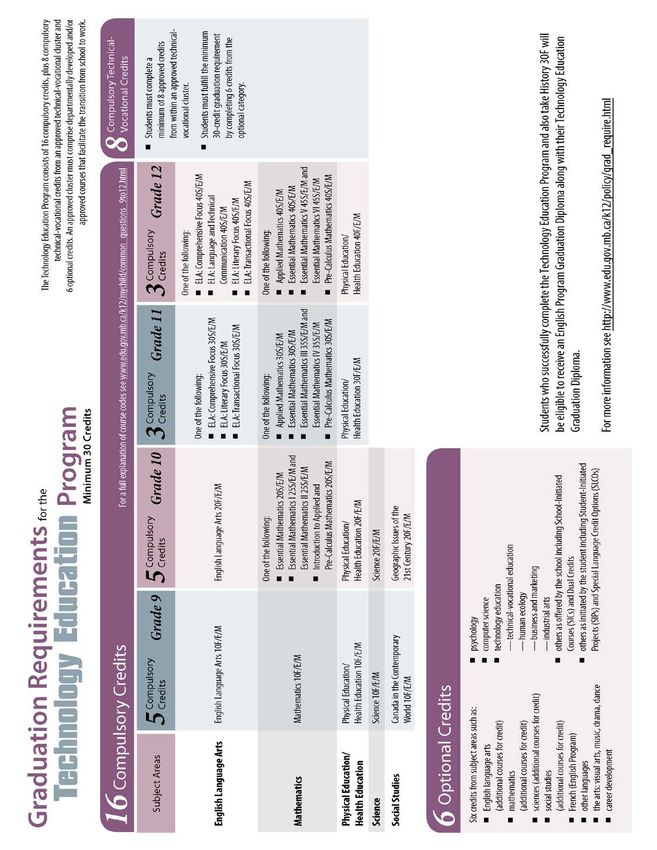
Table of Contents
     Overview                                              Page
      Semester System and Student Evaluation               2
      Credit System                                        3
      Begin Planning Your Courses for Next Year            4

DIPLOMAS and PROGRAMS OFFERED
     Manitoba High School Diploma                          5
     Manitoba Technical Education Diploma                  6
     Advanced Placement                                    7-8
     sTeam Incubator                                        9
OTHER POSSIBLE CREDITS
     Challenge for Credit                                  10
     Community Service Student Initiated Project Credits   10
     Heritage Language Credits                             10
     Online Learning                                       11

COMPULSORY COURSES
      English                                              12-14
      Mathematics                                          15-17
      Physical Education                                   18-19
      Science                                              20-23
      Social Studies                                       24-26
OPTIONAL COURSES
      Art                                                   27
      Music                                                 28
      Psychology                                            29
      Technology                                            30
      Career Development                                    31-32
      Drama                                                 33
      French: Communication and Culture                     34
      Human Ecology
          • Family Studies                                  35
          • Foods and Nutrition                             36
      Industrial Arts
          • Electronics Technology                          37
          • Graphic Arts, Photography                       38-39
          • Drafting Design Technology                      40-41
          • Woodworking                                     42-43
 TECHNICAL EDUCATION PROGRAMS
     Overview                                              44
     Automotive Technology                                 45-46
     Carpentry                                             47-48
     Fashion Technology                                    49-50
     Welding Technology/Metals & Aerospace                 51-56
HIGH SCHOOL APPRENTICESHIP PROGRAM                         57-58
Overview
      Overview
        Murdoch MacKay Collegiate requires students to complete compulsory courses in
        English, Mathematics, Science, Social Studies and Physical Education. In addition, we
        offer a large number of optional courses.

This Program Guide is intended to assist student
                                         students in planning their selection of courses as they
relate to future careers.

To graduate from Murdoch MacKay, students require a minimum of 30 credits.

Decisions about careers and the courses taken should be made after discussions with teachers,
administrators, counselors and parents. Aptitudes, interests and past performances on
classroom assessments also help to determine what courses should be selected. Students must
be aware of the entrance requirements for any post-secondary education. The counselors at
Murdoch MacKay are available to assist students throughout the school year in this important
matter.

To assist students and parents in making reasonable choices, the school will follow these
procedures:
a) Counselor presentations to review courses and the registration process.

b) Students and parents discuss and complete the Registration Form.

c) The staff reviews choices made – parents will be contacted if concerns arise.

d) The Master Timetable is prepared based on course requests.

e) Students are timetabled according to their registration form and course availability.

f) Option courses may have to be re-selected if timetable conflicts occur.

g) When all the timetables have been finalized, classes are organized and balanced for size and
composition.

h) Students are issued their actual individual timetable for the school year around the first day of
school.

School counselors will consider timetable changes during the first week of a semester.

SEMESTER SYSTEM AND STUDENT ASSESSMENT
Our school year is divided into two semesters. The first semester runs from September until the end
of January, with the second semester extending from February until the end of June. Some
courses are taken all year (non-semester).

Student assessment focuses on observations, conversations and products that highlight learning
and identify targets for improvement. Homework and independent review on a regular basis are
essential for student success. A report card will be sent home at mid and end points of each
semester.

                                                2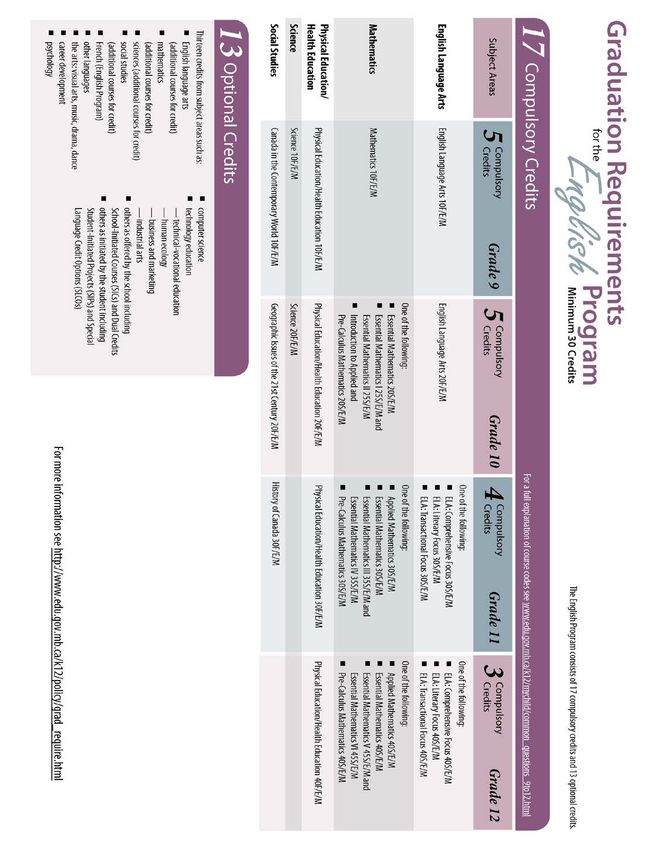
Overview

MANITOBA HIGH SCHOOL CREDIT SYSTEM

CREDITS                                          S Specialized: learning experiences/skills
                                                   could lead to further studies at the post
                                                                                        post-
The credit system begins in Grade 9.               secondary level
Most courses offered are one credit              M Modified: courses for which curriculum
each unless otherwise specified.                   has been significantly modified to take
                                                   into account students with cognitive
                                                   delays
COURSE NUMBERING                                 I  Individualized: a program designed for
                                                    students with special needs.
The numbering system is made up of
three characters, the first and second       RECOMMENDED COURSELOADS
being numerals and the third a letter.
                                             Grade 9      - minimum course load is 8 credits
First Character – represents grade level     Grade 10     - minimum course load is 8 credits
                                             Grade 11     - minimum course load is 7 credits
1 = Grade 9
                                             Grade 12     - minimum is the number of credits
2 = Grade 10                                               required to graduate totaling 30
3 = Grade 11                                               credits.
4 = Grade 12                                              Students may take more than the 30
Second Character – origin of development                  credit requirement. However,
                                                          additional credits may be taken only
  0  developed/approved by Manitoba                       if approved by the principal.
     Education and Training for 1 or more
     credits
   5 developed/approved by Manitoba              Recommended Prerequisite
     Education and Training for ½ credit
                                                 A recommended prerequisite is a
   1 developed by the School or Division
                                                 condition encouraged to be met before a
     including Self-Initiated Projects for
                                                 course is taken. e.g. Chemistry 30S is
     ½ or more credits
                                                 listed as a recommended prerequisite for
   2 developed out of province and
     recognized internationally, i.e.
                                                 Chemistry 40S.
     Advanced Placement courses.
                                                 Recommended prerequisites are not
Third Character – level of difficulty or         intended to restrict any student’s
specialization                                   educational program. They are intended
  F   Foundation: general educational            to guide the student in appropriate course
      experience for all students                selections.

  G General: general educational
    experience for all students

                                             3
Overview

BEGIN PLANNING YOUR COURSES FOR NEXT YEAR...

1   Read Murdoch MacKay Collegiate’s Program Guide.
2     Review Academic courses – ask teachers which courses you should select
     (i.e. Math, English). Check recommended prerequisites and post-secondary
    requirements. Different university/college programs may require specific courses
    for admissions.
3   Review the Optional Courses - select courses based on your interests, strengths
    & abilities.
4   Review the Technical Education section.
5    Register for compulsory courses you require or have not successfully completed.
6   Register for optional courses.
7   Discuss choices with parents/guardian and have them sign the registration form.
8   Attend a registration meeting with your teacher advisor on Friday, March 6, 2020.
    Parents are invited to attend.
9   Questions about course selection(s) or post-secondary requirements? Make an
    appointment with one of the school counselors.

                                           4
5
6
ADVANCED PLACEMENT

ADVANCED PLACEMENT AT MURDOCH MACKAY COLLEGIATE

Prepare Now To Succeed at Murdoch MacKay Collegiate

Why Murdoch MacKay?
Murdoch MacKay is the only high school in the Transcona area that offers their
students the option of accelerating their high school and university education by
offering Advanced Placement (AP) in Math (Calculus), English, Chemistry, History,
Biology, Physics and Psychology.

What are the benefits?
Students can be involved in an enriched learning environment. Students can
complete some of their first year university courses while still attending high school.
Students without post-secondary aspirations, or who are unsure of their future, can
take a course to challenge their own personal abilities, or for personal interest.
Students can opt into taking one, two or more courses in a single year.

What is the cost?
The school division will cover the cost of the exams for qualified students.

Are there financial incentives?
Depending on their AP exam score and the accepting University’s entrance
requirements, students can potentially save money by not having to take first year
courses.

Who is eligible?
Advanced placement programming begins at the Grade 10 level for any interested
students. Students who excel in Grade 10 can choose to enter the Advanced
Placement program in Grade 11. Advanced Placement exams take place for
students in Grade 12 and are administered by the College Board.

Where is it accepted?
AP course designations are accepted at all Manitoba Universities and at over 3500
Institutions worldwide.

                                               7
ADVANCED PLACEMENT

ADVANCED PLACEMENT REQUIREMENTS*

Grade 9     Cred. Grade 10        Cred.    Grade 11        Cred.   Grade 12           Cred.
English 10F 1     English 20F     1        English 30S     1       English 40S        1
                  ADV                      ADV                     ADV
Math 10F    1     Math 20F        1        Math 40S        1       English Lit. 42S   1
                  ADV                      Pre- Calculus
Science     1     Math 30S        1        Biology 42S     1       Physics 42S 1      1
10F               ADV
Social      1     Science 20F     1        Chemistry 30S   1       History 42S        1
Studies           ADV                      ADV
10F
Phys. Ed.   1     Biology 32S     1        Phys. Ed. 30F   1       Chemistry 40S      1
10F                                                                ADV
                  Geography       1        History 30F    1        Chemistry 42S      1
                  20F ADV                  ADV
Options     3     Phys. Ed. 20F   1        Physics 30S    1        Math 42S           1
                                           ADV
                   Psychology     1        Psychology 42S 1        Phys. Ed. 40F      1
                   40S

*Options listed represent all possible Advanced Options. Students may choose any
combination of courses at the AP level.

Graduation requirement: 30 Credits

                                           8
sTeam Incubator

OVERVIEW

The RETSD sTeam Incubator is a divisional program that promotes Science and
Technology, interpreted through Engineering and the Arts, all based in Mathematical
elements. The sTeam lens allows students to earn multiple credits through integrated,
project-based learning that works towards mastery of a specific area of their interest.
Students are introduced to skills and competencies in the areas of communication,
critical thinking, creativity, collaboration, character, and citizenship and continue to
develop that skill set while completing individual and group projects. Students are given
opportunities at each grade level to connect with industry partners to explore sTeam
related careers. This culminates in Grade 12 with students working in a chosen area with
an industry partner.

sTeam Grade 10

Students earn credits in the following areas: Science, English Language Arts, and one of
Visual Arts, Drama, Dance or Music. Working in one three hour block of time each day,
students identify and address issues in our community and, using the design thinking
process, choose a personal project to identify and create a solution. Contact with
industry through guest speakers, work site visits and online mentorships allow students to
make connections with the skills they are learning in class and the skills needed for life
beyond high school. Smaller class projects help students understand the curriculum to
improve their 21st century skills.

sTeam Grade 11

Students continue to identify and build the 21st Century skills through a History credit and
a second credit of either English Language Arts or Visual Arts. Working in one two hour
block of time each day, students design a project of their choice centered around the
concept of story becoming more independent in their ability to set goals and manage
their time effectively. Using the historical thinking concepts to inform their thinking about
present societal issues they will strive to create a more complete picture of history as we
know it.

sTeam Grade 12 (prerequisite Grade 11 sTeam)

In Grade 12, students create and manage their own projects, collaborating with a
sTeam teacher, a content area expert, and an industry partner who will oversee the
project. Students will build a digital portfolio highlighting the development of their
chosen skills. Students will be given the year to complete the project, meeting regularly
with their advising committee. In this final year of the program, students will complete
two ELA credits and an additional credit through consultation with the sTeam teachers.

                                          9
OTHER CREDIT OPTIONS
CHALLENGE FOR CREDIT OPTION
The educational system recognizes that students may, in exceptional
circumstances, have already acquired the knowledge, skills and attitudes of a
particular course. The Challenge for Credit Option provides a process for students to
demonstrate that they have achieved learning outcomes as defined in the Manitoba
Curriculum for a directly related course.
This option is intended to serve particular needs such as:
• students who, by virtue of special talents or private study, can be accelerated in
particular subject areas;
• students transferring into a Manitoba school from another jurisdiction whose
placement in a subject/grade would be facilitated by such a provision;
• students whose educational attendance has been interrupted through sickness or
other reasons and who may be able to successfully challenge the learning
outcomes of a particular subject area, in which they were previously unable to enrol
• students who were previously home schooled;
• students who are considered exceptional achievers in a certain area;
• students who can demonstrate that they have met course requirements through
life experiences such as independent study, world of work, volunteer activities, and
hobbies.
COMMUNITY SERVICE CREDIT STUDENT-INITIATED PROJECT (SIP)
The Community Service Student-Initiated Project (SIP) Credit Option enables students
who make a contribution to their community by volunteering for worthwhile causes or
organizations to receive recognition for the civic skills, knowledge and attitudes
obtained in the volunteer activity.
The volunteering done by students participating in this SIP is not the responsibility of the
school division or Manitoba Education but an opportunity made available to students
to obtain credit for private activity – a process similar to obtaining credit for the Private
Music Option where students provide to the school documentation on their standing
following completion of the activity.
Students who are interested in receiving a community service credit must get
approval from the principal prior to initiating the volunteer activity.
HERITAGE LANGUAGE CREDITS
Students can apply to gain up to four academic credits in a language other than
English. Students should consult with one of the counsellors to register for the
necessary exam to receive credits. These exams can be written in either autumn or
spring.
10OTHER CREDIT OPTIONS
ONLINE LEARNING Is it for me?
What is it?
Online Learning, as offered in the River Online Learning, as offered in RETSD, is a web-
East Transcona School Division (RETSD), is a based course that requires access to the
web-based course that requires access to the internet at school and/or at home. These
Internet at school and/or at home. These courses have been developed by Manitoba
courses have been developed by Manitoba Education and are delivered by teachers
Education and training and are delivered by from RETSD as well as other school divisions in
teachers from RETSD as well as other school Manitoba. How does it work? The course is
divisions in Manitoba. delivered through a web interface called
Blackboard. Each course has a homepage,
How does it work?
which allows you to access the course
The course is delivered through a web
content, the communication center and
interface called WebCT. Each course has a
tools to assist you in organizing your course
homepage, which allows you to access the
activities.
course content, the communication center
and tools to assist you in organizing your
course activities. What courses are available?
Method of Delivery
Online courses are taken via the Internet. Currently, the division has scheduled the
Students will be in contact with the teacher following courses for the upcoming school
primarily via email and bulletins the teacher year:
posts. Some courses may include some f2f Biology 40S
(face-to-face) seminars. Law 40S
Psychology 40S
English Transactional Focus 40S
Who is it for?
An online learning course is an option for you
when; How to register for an Online Course?
• Your school does not or cannot offer a
particular course. Register for online courses in spring in the
• You have a timetabling conflict. same way you register for other courses.
• You are short a credit.
• You require an alternate method of
study
• You are away from school for an
extended period of time.
Is there a cost?
There is no additional cost for online courses.
11ENGLISH
ENGLISH
OVERVIEW
The goal of the regular stream (10F, 20F, 30S, 40S) is to ensure that graduating
students possess communication skills (reading, writing, speaking, listening, viewing
and representing) beyond or at least equivalent to the level expected by Manitoba
Education.
The goal of the advanced stream (20FAdv, 30SAdv, 40SAdv & 42S AP) is to meet the
guidelines set out by Manitoba Education as well as to provide an enriched and accelerated
program based on classic and contemporary literature.
English 10F English 20F Advanced
The first year of ELA in high school focuses on This advanced course follows the 5 General
acquiring skills that facilitate comprehension Outcomes of English 20F. However, this
and use of language in a variety of course is enriched with a selection of
transactional and literary contexts. Students materials from classic and contemporary
will read and produce a wide variety of texts, literature. An analytical approach is stressed
including transactional/pragmatic and in both comprehending others’ texts and
literary/aesthetic texts. English 10F will build creating own texts.
skills in the following general outcomes:
exploring thoughts, ideas, feelings and
experiences; comprehending and
English 30S Comprehensive
responding personally and critically to texts;
managing ideas and information; enhancing Focus
the clarity and artistry of communication;
and, celebrating and building community (5 English Comprehensive Focus is aimed at
General ELA Outcomes Manitoba students who want to experience
Education). pragmatic/transactional and
English 20F aesthetic/literary texts, equally. Students will
This course continues to focus on acquiring read and produce a wide variety of texts,
skills that facilitate comprehension and use of 50% pragmatic/transactional & 50%
language in a variety of transactional and aesthetic/literary. English 30S Comprehensive
literary contexts. Students will read and Focus further builds on the skills developed in
produce a wide variety of texts, including English 20F with respect to exploring thoughts,
transactional/pragmatic and ideas, feelings and experiences;
literary/aesthetic texts. Students will explore comprehending and responding personally
thoughts, ideas, feelings and experiences; and critically to texts; managing ideas and
comprehend and respond personally and information; enhancing the clarity and artistry
critically to texts; manage ideas and of communication; and celebrating and
information; enhance the clarity and artistry of building community (5 General ELA
communication; and celebrate and build Outcomes Manitoba Education).
community (5 General ELA Outcomes
Manitoba Education).
12ENGLISH
English 30S Literary Focus GRADE 12
Literary Focus provides students with an In Grade 12, students may choose from a
opportunity to enrich their lives and their variety of ELA courses; ONE English credit is
understanding through engagement with mandatory for graduation. If students are
aesthetic texts. Literary Focus emphasizes the planning to attend post-secondary education,
aesthetic uses of language: language that it is recommended a second English credit be
enlightens, fosters understanding and taken.
empathy, reflects culture, expresses feelings
and experience and brings enjoyment. English
30S Literary Focus further builds on the skills English 40S Comprehensive Focus
developed in English 20F, with respect to
exploring thoughts, ideas, feelings and Comprehensive Focus provides students with
experiences; comprehending and responding opportunities to explore and produce a broad
personally and critically to texts; managing range of texts – pragmatic, transactional,
ideas and information; enhancing the clarity aesthetic, literary, fiction and non-fiction. This
and artistry of communication; and, course develops and refines a range of literary
celebrating and building community (5 skills that deepen engagement with and
General ELA Outcomes Manitoba Education). appreciation of a variety of texts. Students
Of the various texts students read and engage with and compose texts that inform,
produce, approximately 70% are persuade, analyze, foster understanding and
aesthetic/literary and 30% are empathy, reflect culture, express feelings and
pragmatic/transactional. All 30S ELA students experience and bring enjoyment. Students
will write the same school-designed final exam. are required to write a Provincial Standards
test worth 30% of their final grade.
English 30S Literary Focus Advanced English 40S Transactional Focus
Transactional Focus examines the non-fiction
This course builds upon the foundation world or print and visual media. This course
established in English 20F Advanced. The emphasizes the pragmatic use of language,
analytical approach to the study of literature language that informs, direct, persuades,
continues to be stressed, with an added analyzes, argues and explains. The focus of this
emphasis on the writing style of authors. A course is how language in real world situations is
major focus for this course is the study of British shaped and formed according to need or
authors throughout various periods of literary audience; students will engage with and
history. compose texts primarily for pragmatic
(practical/real world purposes. Students
planning on taking courses in university in
Humanities and Natural Sciences should
consider this course. Students are required to
write a Provincial Standards test worth 30% of
their final grade.
13ENGLISH
English 40S Literary Focus Literature Advanced Placement English 42S
The second term of AP English furthers the
Literary Focus students primarily examine
work of the first semester course, English
and compose aesthetic texts and properties
Literary 40S Advanced. A major focus is
of language to convey experience, ideas
the study of contemporary literary
and perspectives and deepen their
criticism.
appreciation of language. Students use
language effectively to respond to texts, to The AP program at the Grade 12 level
manage diverse ideas and information, to challenges students to bring their English
communicate and to learn. A higher skills and insights to the first year university
command of reading and writing skills is level. Students may choose to write the
demanded. Time outside of class is essential International AP exam in early May.
for successful completion. Students planning Students scoring 4 or 5 on the AP exam
on taking courses in university in the may receive standing in a first year
Humanities should consider this course. University English course.
Students are required to write a Provincial
Standards test worth 30% of their final grade.
English 40S Literary Advanced
This course builds on the 30S Advanced
course. It covers both Manitoba Provincial
Outcomes and provides the basis for
continuation in English 42S AP. This is the third
of four courses aimed at preparing students
for the International Advanced Placement
exam. Students enrolled in English 40S Literary
Advanced are required to write a Provincial
Standards test worth 30% of their final grade.
14MATHEMATICS
OVERVIEW
When choosing a math course, students should consider their interests, both current and
future. Students and parents are encouraged to research the admission requirements for
post-secondary programs of study as they vary by institution and by year.
Applied Mathematics
This pathway is designed to provide students with the mathematical understandings and
critical-thinking skills identified for post-secondary studies in programs that do not require the
study of theoretical calculus.
Essential Mathematics
This pathway is designed to provide students with the mathematical understandings and
critical-thinking skills identified for entry into the majority of trades and for direct entry into the
workforce.
Pre-Calculus Mathematics
This pathway is designed to provide students with the mathematical understandings and
critical-thinking skills identified for entry into post-secondary programs that require the study
of theoretical calculus.
Advanced Program:
This pathway is designed for those students who are academically advanced in their
mathematics studies. A student would follow this pathway if they are interested in gaining
an Advanced Placement (AP) credit in Grade 12. They would complete 4 advanced math
courses starting in Grade 10.
REGULAR PROGRAM PATHWAYS:
15MATHEMATICS
Math 10F
Essential Mathematics 30S
Recommended Prerequisite: Grade 8 Recommended Prerequisite: Essential
Mathematics Mathematics 20S
Topics of study for this course would include: Topics of study for this course would include:
Rational Numbers and Square Roots, Interest and Credit, 3D Geometry, Statistics,
Exponents and Powers, 3D Objects and 2D Managing Money, Relations and Patterns
Shapes, Polynomials, Algebra, Inequalities, and Trigonometry.
Linear Relations, Similarity and
Transformation, Statistics and Probability, Applied Mathematics 30S
and Circle Geometry. Recommended Prerequisite: Introduction to
Applied and Pre-Calculus Mathematics 20S
Essential Mathematics 20S
Topics of study for this course would include:
Recommended Prerequisite: Grade 9 Quadratic Functions, Scale, Statistics, Systems
Mathematics of Inequalities, Trigonometry and Properties of
Angles and Triangles.
Topics of study for this course would
include: Analysis of Games and Numbers, Pre-Calculus Mathematics 30S
Personal Finance, Measurement, 2D
Geometry, Trigonometry and Consumer Recommended Prerequisite: Introduction to
Decisions. Applied and Pre-Calculus Mathematics 20S
Topics of study for this course would include:
Quadratic Equations, Radicals, Quadratic
Introduction to Applied and Functions, Rational Expressions and Equations,
Pre-Calculus Mathematics 20S Trigonometry, Systems, Inequalities and Absolute
Value and Reciprocal Functions.
Recommended Prerequisite: Grade 9
Mathematics
Pre-Calculus Mathematics 30S
Topics of study for this course would Advanced
include Radicals and Exponents,
Polynomials and Factoring, Coordinate Recommended Prerequisite: Introduction to
Geometry, Linear Relations and Functions, Applied and Pre-Calculus Mathematics 20S
Systems of Equations and Trigonometry. Advanced
This course includes all topics from Pre-
Mathematics 20S Advanced Calculus Mathematics 30S required to be
Recommended Prerequisite: Grade 9 successful at the 40S level as well as a
Mathematics selection of enrichment topics. This course
will focus on exploring topics in depth and will
This course includes all topics from move at an accelerated pace.
Introduction to Applied and Pre-Calculus 20S
as well as a selection of enrichment topics. NOTE: Students will be required to take Pre-
This course will focus on exploring topics in Calculus Mathematics 30S Advanced in the
depth and will move at an accelerated first semester of their Grade 11 year and Pre-
pace. Calculus Mathematics 40S in the second
semester of their Grade 11 year.
16MATHEMATICS
Essential Mathematics 40S Pre-Calculus Mathematics 40S
Recommended Prerequisite: Essential Recommended Prerequisite: Pre-Calculus
Mathematics 30S Mathematics 30S or Pre-Calculus 30S
Advanced
Topics of study for this course would include:
Statistics, Precision Measurement, Home Topics of study for this course would include:
Finance, Vehicle Finance, Trigonometry and Circular Functions, Transformations,
Probability. This course concludes with a Exponents and Logarithms, Permutations and
Provincial Assessment. Combinations, Binomial Theorem, Function
Operations, Radical and Rational Functions
and Trigonometric Identities. This course
concludes with a Provincial Assessment.
Applied Mathematics 40S Calculus 42S
Recommended Prerequisite: Applied Recommended Prerequisite: Pre-Calculus
Mathematics 30S Mathematics 40S
Topics of study for this course would include: This AP Calculus course provides the
Probability, Personal Finance, Logic, opportunity for students who have a strong
Permutations and Combinations, Sinusoidal interest and ability in Mathematics to pursue
Functions, Polynomial Functions and a University-level course while still in high
Exponential and Logarithmic Functions. This school. The added goal of the course is to
course concludes with a Provincial Assessment. prepare students to write an international
examination in May. It consists of a full
academic year of work in Calculus and
related topics, covering themes such as:
Functions, Differential and Integral Calculus,
and the application of these ideas to the
solution of problems.
17
16PHYSICAL EDUCATION
COURSE DESCRIPTION: COURSE DESCRIPTION:
Grade 9 & 10 Grade 11 & 12
All students will be given the These compulsory full credit courses are
opportunity to, and be encouraged to, designed to help youth take greater
participate in a variety of physical ownership of their own physical fitness, to
activities and sports. These activities aim encourage them to seek out activities that
to provide an environment that is interest them, and to engage in active
engaging and motivating, and which can lifestyles into their futures. Students will study
help to develop a more positive self- topics related to fitness management,
image. Through the development of mental health, substance use and abuse
related social and physical skills, students prevention, and the social impact of sport.
will achieve a good foundation for a The focus of this content will be on health
healthy lifestyle in the future. The and personal planning. These topics will
integration of health topics are to help make up the core component of the
students choose and practice responsible course content. Students will be required to
behaviour conducive to maintaining and develop and implement part of the course
enhancing health. All students are on their own time in a personal physical
activity plan as part of the physical activity
expected to participate in class activities
practicum. Students will be introduced to
and complete all compulsory work in
safety and risk management planning to
order to obtain credit.
minimize the associated risks of the activities
Topics which may be covered include: they have chosen.
archery, badminton, basketball, cross- As part of earning a credit for this course,
country skiing, C.P.R., field hockey, first students will be required to: complete 5
aid, golf, power walking, low organized core computer modules, log a minimum of
games, racquetball, lacrosse, softball, 55 hours of moderate/vigorous physical
soccer, tennis, nutrition, drug & alcohol activity outside of class time, complete the
awareness, human sexuality, flag football, teacher flexible component of the course,
track and field events, ultimate frisbee, depending on the stream chosen, and
winter activities, volleyball, yoga, present an exit portfolio. Students will be
weight/resistance training, and other graded for completion of the course with
personal fitness/wellness related activities). either a Complete or Incomplete
designation.
Grade 9: NOTE: Parents/guardians will be required to
10F Physical Education - compulsory --- 1 credit review the student’s physical activity plan
and sign a Parent Declaration and Consent
Grade 10: Form acknowledging their approval of the
20F Physical Education - compulsory --- 1 credit chosen activities and acceptance of the
Prerequisite: Grade 9 (10F Physical Education) responsibility for risk management, safety,
and supervision. Parents/guardians will also
be required to verify the entries of the
student’s physical activity log through a
sign-off procedure upon request.
18PHYSICAL EDUCATION
Grade 11:
30F – Active Healthy Lifestyles Program #3 Women’s Wellness:
compulsory - 1 credit
Recommended Prerequisite: PE 20F This program caters to female students
who are interested in critically
Grade 12: examining issues in women's
40F – Active Healthy Lifestyles health. Biological, socio-cultural,
psychological, historical, and political
processes that shape and define
Program # 1 Recreational Fitness for All:
women's health and healthcare
experiences will be explored, including
This program is designed for the general
ways in which medical knowledge has
population. Students will explore a variety
been constructed and applied to
of current health issues and participate in
women's bodies. Students would have
a number of different physical activities of
the opportunity to explore and
interest to them. This highly individualized
participate in activities of interest to
stream offers core curricular outcomes
them.
and is activity based.
Program # 2 Outdoor Pursuits: Program #4 Leadership:
This program caters to those students This program caters to those students
who have an interest in outdoor pursuits interested in pursuing and developing
and excursions. Students wanting to leadership skills above and beyond a
pursue this stream will develop skills to regular PE program. Students wanting
safely experience the natural to pursue this stream will be required to
environment and greatly expands the complete a minimum of 20 volunteer
recreation opportunities available to hours. The students will be provided
you now and in the future. This stream with, or seek out on their own, approved
explores a number of diverse volunteer experiences within the school
environmental topics, issues and or community setting. Department
pursuits. We recommend this program approval is required to register for this
to students interested in developing stream.
leadership and team-building skills, as
well as the facilitation of maintaining
healthy lifestyle practices.
19SCIENCE
OVERVIEW
Grade 9 Science and 10 Science are general courses offering units in biology, chemistry
and physics. At the Grade 11 and 12 levels students may take specialized courses in Topics
in Science, Biology, Chemistry, and Physics. Students may take any number of these
specialized courses.
Science 30S
Biology 30S and 40S
OR
Science 20F Biology 32S Adv and 42S AP
Science 10F OR
Chemistry 30S and 40S
Science 20F Adv
OR
Chemistry 30S Adv, 40S Adv, and
42S AP
Physics 30S and 40S
OR
Physics 30S Adv, AP Physics 1 42S
Science 10F Science 20F
This course examines the atoms that make Recommended Prerequisite: Science 10F
up all matter on earth. Discover how
electricity has been harnessed to operate This course is a continuation of Science 10F
machinery, uncover how our body tissues in the areas of Chemistry, Physics, Biology
grow and regenerate, and explore the far- and Earth and Space Science. In Chemistry,
off stars and planets of our galaxy. Some studies continue on the topics of the
learning activities and assignments require periodic table, elements, compounds,
hands-on experiments using household formulas and chemical reactions. In Physics,
items. students study force, motion, energy,
The course is structured as follows: momentum and impulse in the context of
collisions and automobile safety. In Biology
• Module 1: Reproduction the topic of ecology is studied. The Earth
and Space Science unit explores weather
• Module 2: Atoms and Elements
including violent storms.
• Module 3: The Nature of Electricity
• Module 4: Exploring the Universe
20SCIENCE
Science 20F Advanced Biology 32S Advanced
Recommended Prerequisite: Recommended Prerequisite: Science 20F or
Science 10F Science 20F Advanced
This course provides challenge and
enrichment for students with exceptional The two main goals of AP Biology are to help
ability or interest in science. Topics include: students develop a conceptual framework
chemical structure and chemical reactions, for modern biology and an appreciation of
ecology, and the study of motion. Material science as a process. The primary emphasis in
will be covered in greater depth and at a an AP Biology course is on developing an
faster pace than in Science 20F. Students understanding of concepts rather than on
wishing to take further science courses at memorizing terms and technical details.
the Advanced or Advanced Placement There are eight underlying major themes:
level are encouraged to take Science 20F Science as a process, Evolution, Energy
Advanced. Transfer, Continuity and Change, Relationship
of Structure to Function, Regulation,
Science 30S (Topics in Science) Interdependence in Nature & Science,
Recommended Prerequisite: Science 20F Technology and Society. As we delve into
these topics, we will explore the diversity of
This course is a general science course that living things, Mendelian genetics, evolution,
looks at the practical application of science animal structure and function, and plant
in a wide range of fields that are of current anatomy, growth, & reproduction. A high
interest. Topics that may be pursued include level of commitment is expected from
space science, ecology, energy, weather, students who opt to take on the challenge of
biotechnology, agriculture, and forensics. this course. Laboratory work will include
Other topics may also be pursued as time dissections.
and interest allows.
Biology 30S Biology 40S
Recommended Prerequisite: Science 20F Recommended Prerequisite: Biology 30S
The focus of Biology 30S is Human Biology. In The two main areas of study in this course,
order to understand the complexity of Genetics and Biodiversity, will prepare
human systems, students will learn about the students for university while they develop skills
underlying mechanisms and processes in interpretation and evaluation of biological
(homeostasis) that govern their normal concepts. Students will relate scientific
functioning. The human systems to be concepts to everyday life as they explore the
studied include: Digestive, Transport and Understanding of Biological Inheritance,
Respiration, Excretory and Waste Mechanisms of Inheritance, Evolutionary
Management, Protection and Control. An Theory and the relevance of Organizing and
important goal of this course is to develop Conserving Biodiversity. Laboratory work will
student appreciation of body systems to include a common procedure used in
promote making good choices regarding Molecular Biology and Biochemistry known as
nutrition and lifestyle for improved wellness Gel Electrophoresis.
and longevity. Laboratory work will include
the dissection of a preserved fetal pig.
21SCIENCE
Biology 42S AP Chemistry 40S Advanced
Recommended Prerequisite: Biology 32S Recommended Prerequisite: Chemistry 30S
Advanced Advanced
The topics under study will be: Biochemistry,
Metabolic processes, Homeostasis, Molecular This course covers the regular Chemistry 40S
Genetics, and Population dynamics. Biology 42S is program with more depth and includes
equivalent to completing a first year university additional information. The major areas of
course. Students are expected to do a significant study are organic chemistry, reaction rates,
amount of independent study and critically chemical equilibrium, solubility equilibrium,
analyze lab objectives, theories, and procedures. acids and bases, oxidation and reduction
reactions, and electrochemistry.
Mathematical calculations will be a vital
Chemistry 30S component in this program and so excellent
math skills will be advantageous to students.
Recommended Prerequisite: Science 20F
Chemistry 42S AP
Chemistry requires excellent math skills and an
Recommended Prerequisite: Chemistry 40S
understanding of the processes of mathematics,
Advanced
problem solving, and algebra. The major areas
of study are the atom, the periodic table, The major areas of study are
physical properties of matter, chemical electrochemistry, thermodynamics,
reactions, stoichiometry, gases and solutions. molecular models, and atomic and nuclear
chemistry. Students will have the
Chemistry 40S opportunity to write an Advanced
Recommended Prerequisite: Chemistry 30S Placement Examination in May, set by the
Advanced Placement College Board.
Chemistry 40S is a prerequisite for university Students achieving a specified standing on
chemistry. Mathematical calculations will be a this exam may be granted credit or
vital component in this program and so standing for first year university chemistry,
excellent math skills will be advantageous to meaning they may be allowed to directly
students. The course consists of the following enter second year university chemistry
topics: Reaction Rates, Chemical Equilibrium, courses.
Solubility Equilibrium, Acids and Bases, Oxidation
and Reduction Reactions and Electrochemistry. Physics 30S
Recommended Prerequisite: Science 20F
Chemistry 30S Advanced
Recommended-Prerequisite: Science 20F or This is the first of two courses in the
Science 20F Advanced Regular Physics Program. This course will
The regular Chemistry 30S program is covered, develop a student’s skills in collecting
plus a few additional topics in each unit. experimental data and representing that
Chemistry requires excellent math skills and an data in graphical and algebraic forms.
understanding of the processes of The major areas of study are
mathematics, problem solving, and algebra. measurement, graphical analysis,
For students to excel in this course, they will vectors, linear motion, Newton’s Laws,
need to be prepared to do a significant waves, sound & light. Mathematical
amount of independent work and continually calculations will be a vital component in
review concepts discussed. this program. Excellent math skills will be
advantageous to students.
22SCIENCE
Physics 30S Advanced AP Physics 1 42S
Recommended Prerequisite: Science Prerequisite: Physics 30S Advanced
20F or Science 20F Advanced
This course will build upon the skills learned in
Students will develop an understanding of Physics Advanced 30S. The major areas of
basic physical concepts and develop their study are mechanics in two dimensions,
problem solving skills. The major areas of circular motion, gravitation, momentum,
study are graphical analysis, equation energy, electrostatics, direct current circuits,
development, trigonometry, vectors, and rotational motion. Strong mathematical
kinematics, dynamics, oscillations, waves, skills are of continuing importance. After the
and sound. Mathematical calculations will completion of Physics 30S Advanced and AP
be a vital component in this program. Physics 1-42S students will have the
Excellent math skills will be advantageous opportunity to write the AP Physics 1
to students. Advanced Placement Examination in May,
set by the Advanced Placement College
Board. The examination represents a half
credit course in first year university Physics.
Students achieving a specified standing on
the exam may be granted credit or standing
Physics 40S for a half year university Physics course.
Recommended Prerequisite: Physics 30S
This is the second course in the regular
Physics program. This course will develop
a student’s skills in collecting experimental
data and representing that data in
graphical and algebraic forms.
The major areas of study are mechanics in
two dimensions, momentum, energy,
projectile motion, circular motion, static
electricity, electric circuits, and
electromagnetism.
Mathematical calculations will be a vital
component in this program. Excellent
math skills will be advantageous to
students.
23SOCIAL STUDIES
OVERVIEW
• Social Studies is the study of people in relation to each other and to the world in which they live.
• Social Studies helps students acquire the skills, knowledge, and values necessary to
become active democratic citizens and contributing members of their communities,
locally, nationally, and globally.
• At Murdoch MacKay Collegiate students are invited to become involved, thoughtful,
critical, and reflective citizens via compulsory and optional course opportunities through a
variety of means. Rigorous course material, workshops, guest speakers and field trips,
challenge students to engage and interact in their community and world around them.
Canada in the Contemporary World 10F Geographic Issues of the 21st Century
20F Advanced
This course is compulsory for all Grade 9
students. Lessons will engage students in the Recommended Prerequisite: Canada in
continuing debate concerning citizenship and the Contemporary World 10F
identity in Canada and the world.
Opportunities will be provided for students to This course is an extension of Geography
acquire the skills, knowledge and values 20F, with greater emphasis on research,
required to make informed and ethical analysis and writing skills. Students
choices when faced with the challenges of wishing to take this course should have
living in a pluralistic democratic society. a keen interest in Geography and
Sustainability.
Geographic Issues of the 21st Century 20F
This advanced course evaluates
Recommended Prerequisite: Canada in the Canada’s place in the Global
Contemporary World 10F community via the examination of
topics such as national oil, food, and
This course is a compulsory Grade 10 course
water supplies juxtaposition to the
that uses a thematic approach to studying
impact of global warming. Where will
the physical and human aspects of North
our food come from in order to survive?
America’s geography. Students study
Do we have enough fresh water to
concepts related to geographic skills such
sustain our children and their families’
as mapping, geographic literacy, natural
future? What types of minerals do we
resource development, production and
have that we can mine and sell to other
distribution of food, development of industry
countries? What impact does this have
and trade, as well as urbanization. Students
on Global Warming? Students enrolled
use the methods and tools of geography to
in this course will be required to take an
examine issues of the sustainability of the
in depth examination of the topics
continent’s resources.
covered. The primary focus will be on
the physical and social environments of
North America, and how they interact
with one another.
24SOCIAL STUDIES
History of Canada 30F Global Issues Citizenship &
Recommended Prerequisite: Geographic
Sustainability 40S
Issues of the 21st Century 20F Recommended Prerequisite: History of Canada 30F
This course is a compulsory Grade 11 credit. Students in this optional course will conduct inquiry
Students will explore a broad timeline of into the social, political, environmental, and
understandings of the concept of Canada as a nation economic impact of contemporary and emerging
starting with Canada’s First Peoples; to the arrival of global issues. Through individual inquiry, students
Europeans; to the founding of a nation in 1867; and focus on questions relating to quality of life locally,
finally to its growth politically, economically, and nationally and globally via active democratic
socially up to the 21st century. Students will examine citizenship, critical media literacy, and ethical
Canadian history through the lens of historical thinking decision-making, Topics include, but are not limited
methods (using primary source evidence, identifying to: human rights, terrorism, foreign relations, poverty
cause and consequence, examining ethical and power, and the environment. There is no exam
dimensions of history, discovering continuity and but a key component of the course is the planning
change, historical perspective and significance) to and implementation of a community based action-
help discover Canada’s History. researched project. It is strongly recommended
that students registering for this course have a
genuine interest in world events, sustainability and
making a difference in the world.
History of Canada 30F Advanced
European History 42S AP
Recommended Prerequisite: Geographic Issues Recommended Prerequisite: History of Canada
of the 21st Century 20F 30F
This course follows the 30F Curriculum, but
involves a more rigorous academic approach This option course is a 700 year journey through
time that explores the history of Europe. This
with greater emphasis on reading, research,
course begins in the Middle Ages, and
analysis and writing skills, as well as an added
continues through the collapse of Communism
focus of Canada’s link to Europe. Students
into the present day. Students will learn about
enrolled in this course can expect to complete Joan of Arc, Napoleon, da Vinci, Martin Luther,
additional readings outside of class time. Henry VIII, Elizabeth I, Hitler and many more
Enrollment in this course will prepare students for important historical figures. This course is
the European History 42S AP course. incredible in its scope and demanding in its
curriculum. Students are required to do a large
amount of reading and homework. Classroom
discussions, presentations and activities will lead
to a greater understanding of European History.
25SOCIAL STUDIES
Current Topics in First Nations, Metis Law 40S
& Inuit Studies 40S
Due to our very unique history and patterns of
Recommended Prerequisite: History of settlement, our country has a legal system all its
Canada 30F own.
This optional course supports the The primary goal of this course is for students to
empowerment of students through the learn the basic laws and workings of that
exploration of the histories, traditions, system, for two main reasons:
cultures, worldviews, and contemporary
issues of Indigenous peoples in Canada 1) So that living within our nation’s borders is as
and worldwide. Students gain knowledge secure and comfortable an experience as
and develop the values, as well as the possible.
critical thinking, communication, analytical,
and inquiry skills, that will enable them to
better understand past and present realities 2) Canada’s legal system is ever changing, as
of Indigenous peoples. Additionally, our society’s values and perceptions change.
exploration of topics such as self- The people of Canada not only make the laws
determination, self-government, and of the land, but change them too. Therefore, in
language and cultural reclamation allows order to ensure the continued quality of life
students to understand and work towards that our legal system provides us, we as
the post-colonial future envisioned by Canadians should have a good sound grasp of
Indigenous peoples. that system for times when change is called for.
Cinema as a Witness to Modern
Main Areas of Study:
History 40S • History of Law
• Charter of Rights and Freedoms
Recommended Prerequisite: History of
• Criminal Law
Canada 30F
• Civil Law
• Family Law
Students will explore cinema as both an art
form and an interpreter of history. Throughout
Canadian Law will be discussed, debated and
the course, students will enrich their
analyzed. Students will learn by reading,
understanding of the past and apply the
completing case studies, role-plays, field trips,
concepts of historical thinking by analyzing
group and individual projects. Students will
key events, ideas, and people as represented
apply their knowledge by developing and
in 20th century films. Students will engage in
showcasing a Mock Criminal Trial or a Mock
guided viewing, conduct historical inquiry
Civil Trial.
using a variety of sources, view and
deconstruct films based on the major topics in
world history, and conduct historical research
to evaluate representations of history in film.
26ART
OVERVIEW
This studio-based program centers on exploring a wide variety of media; from painting
and drawing to sculpture and technology. The goal of the visual arts program is to
develop and refine ways in which students are able to communicate their thoughts and
ideas visually. There is a dual focus on the development of technical ability and conceptual
skills, allowing students to move towards expressing and interpreting both their own artwork
as well as the artwork of others across various times, places, and cultures. This program
provides students with a unique opportunity to explore and develop personal artistic
expressions and a heightened response to their visual environment.
Art 10S Art 30S
This is a studio-based program centered on Recommended Prerequisite: Art 20S
painting, drawing, design and sculpture.
Students will be given the opportunity to Art 30S will build on the Art 20S program. Both
experiment with a variety of techniques and themes and art materials will be presented as
materials. This course is not a requirement for ways to engage in visual problem solving.
the Grade 10 program. Sketchbook work will continue to be
encouraged as a place to record ideas and
explore new techniques that can be used in
Art 20S
larger art projects. Class discussions and
critiques will help students develop their work.
The Art 20S course will investigate a variety of Students will be evaluated on idea
themes and topics that will be explored development, visual communication and a
using both traditional and non-traditional art capacity to assess their own work.
media. Students will work in sketchbooks
throughout the course to develop their own
technical skills and visual interests. Major Art 40S
projects will become increasingly self-
directed as students develop an ability to
Recommended Prerequisite: Art 30S
self-assess their own artwork. Students will be
evaluated on their capacity to develop Art 40S will continue to offer a variety of
ideas, create finished artwork and opportunities for students to refine
communicate those ideas as well as technical skills and develop personal
interpret the visual world around them. themes and interests in major art projects.
Independent decision making in relation to
choice of art media and self-expression are
expected. Discussion will provide
opportunities to examine the historical and
cultural contexts of art, as well as an ability
to analyze their own work. Students will be
evaluated on idea development, visual
communication and a capacity to assess
their own artwork.
27MUSIC
OVERVIEW
At Murdoch MacKay Collegiate, we offer several opportunities to be involved in
creating exceptional music, at different levels. If you simply want to be a part of a
great Band, Choir, or Jazz Band, or are interested in pursuing university study and a
career in music, we have opportunities to help you succeed. Students should check the
post-secondary prerequisites for the program they are planning to pursue. These 40S courses
are often accepted by universities for entrance scholarships.
Band 10S, 20S, 30S, 40S Vocal Jazz 10S, 20S, 30S, 40S
Recommended Prerequisite: At least two Recommended Prerequisite: Previous Choral
years of previous experience on a single Experience and/or Audition
band instrument or on approval of the Co-requisite: All Vocal Jazz members must be in
instructor Choir.
Band is a performance-based class. The focus Murdoch Mackay’s Vocal Jazz Ensemble is a
of this group is on development of basic dynamic performance ensemble that focuses on
instrumental technique, music literacy, and the study of jazz music and use of the voice. The
the performance of quality music for Wind study of authentic jazz performance practice is
Band. Several performance opportunities are the goal of the course. Some focus will also be
offered. given to performance of contemporary pop
music and a cappella.
Choir 10S, 20S, 30S, 40S
Guitar 10S, 20S
Murdoch MacKay’s Choir is an invitation to
sing with others! It is a uniquely satisfying Our basic guitar course is designed for beginners
experience to be able to sing in the company to the guitar. Students will be introduced to the
of others who enjoy singing. We provide fingerboard, basic chord shapes, and learn
students an opportunity to develop correct hand technique. Lead and rhythm guitar
confidence in their own voice, skills in singing, skills will be developed. As this will be a
and music literacy. Students learn and semestered course, students will play every day.
perform music of different styles and time Guitars will be provided for use in class. Students
periods, and have many opportunities to may play in small ensembles, individually, or
perform throughout the year. together as a class, depending on interest.
Opportunities will be given for more advanced
students to progress at their own level.
Jazz Band 10S, 20S, 30S, 40S
Recommended Prerequisite: Previous Band
Guitar 30S
Experience and/or Audition This course is designed to be a continuation of
Co-requisite: All Jazz Band members must be the previous course, with an emphasis on group
in Band. performance. Students will perform popular,
Jazz Band is a high-level performance classical and new music, and will begin to learn
ensemble that focuses on the study of to arrange music for guitars. Guitar ensemble
different areas of Big Band Jazz music. The playing can be one of the most satisfying
study of quality literature, improvisation, jazz musical endeavors, and will lead to an
phrasing and articulation, as well as advanced knowledge of the fingerboard and
replicating the characteristic sounds of several key techniques used in lead guitar
famous bands (Duke Ellington, Count Basie, playing, as well as a much better understanding
and others), are main focuses for the of conventional music notation.
ensemble.
28You can also read


