National Inspection Plan 2018-2021 - Domestic Waste Water Treatment Systems - Environmental Protection Agency - Environmental ...
←
→
Page content transcription
If your browser does not render page correctly, please read the page content below
Environmental Protection Agency

National Inspection Plan 2018-2021

Domestic Waste Water Treatment Systems
ENVIRONMENTAL PROTECTION AGENCY                                     Monitoring, Analysing and Reporting on the
The Environmental Protection Agency (EPA) is responsible for        Environment
protecting and improving the environment as a valuable asset        • Monitoring air quality and implementing the EU Clean Air for
for the people of Ireland. We are committed to protecting people      Europe (CAFÉ) Directive.
and the environment from the harmful effects of radiation and
                                                                    • Independent reporting to inform decision making by national
pollution.
                                                                      and local government (e.g. periodic reporting on the State of
                                                                      Ireland’s Environment and Indicator Reports).
The work of the EPA can be
divided into three main areas:                                      Regulating Ireland’s Greenhouse Gas Emissions
                                                                    • Preparing Ireland’s greenhouse gas inventories and projections.
Regulation: We implement effective regulation and environmental     • Implementing the Emissions Trading Directive, for over 100 of
compliance systems to deliver good environmental outcomes and         the largest producers of carbon dioxide in Ireland.
target those who don’t comply.

Knowledge: We provide high quality, targeted and timely             Environmental Research and Development
environmental data, information and assessment to inform            • Funding environmental research to identify pressures, inform
decision making at all levels.                                        policy and provide solutions in the areas of climate, water and
                                                                      sustainability.
Advocacy: We work with others to advocate for a clean,
productive and well protected environment and for sustainable       Strategic Environmental Assessment
environmental behaviour.                                            • Assessing the impact of proposed plans and programmes on the
                                                                      Irish environment (e.g. major development plans).
Our Responsibilities
                                                                    Radiological Protection
Licensing                                                           • Monitoring radiation levels, assessing exposure of people in
We regulate the following activities so that they do not endanger     Ireland to ionising radiation.
human health or harm the environment:                               • Assisting in developing national plans for emergencies arising
• waste facilities (e.g. landfills, incinerators, waste transfer      from nuclear accidents.
  stations);                                                        • Monitoring developments abroad relating to nuclear
• large scale industrial activities (e.g. pharmaceutical, cement      installations and radiological safety.
  manufacturing, power plants);                                     • Providing, or overseeing the provision of, specialist radiation
• intensive agriculture (e.g. pigs, poultry);                         protection services.
• the contained use and controlled release of Genetically
  Modified Organisms (GMOs);                                        Guidance, Accessible Information and Education
• sources of ionising radiation (e.g. x-ray and radiotherapy        • Providing advice and guidance to industry and the public on
  equipment, industrial sources);                                     environmental and radiological protection topics.
• large petrol storage facilities;                                  • Providing timely and easily accessible environmental
• waste water discharges;                                             information to encourage public participation in environmental
• dumping at sea activities.                                          decision-making (e.g. My Local Environment, Radon Maps).
                                                                    • Advising Government on matters relating to radiological safety
National Environmental Enforcement                                    and emergency response.
• Conducting an annual programme of audits and inspections of       • Developing a National Hazardous Waste Management Plan to
  EPA licensed facilities.                                            prevent and manage hazardous waste.
• Overseeing local authorities’ environmental protection
  responsibilities.                                                 Awareness Raising and Behavioural Change
• Supervising the supply of drinking water by public water          • Generating greater environmental awareness and influencing
  suppliers.                                                          positive behavioural change by supporting businesses,
• Working with local authorities and other agencies to tackle         communities and householders to become more resource
  environmental crime by co-ordinating a national enforcement         efficient.
  network, targeting offenders and overseeing remediation.          • Promoting radon testing in homes and workplaces and
• Enforcing Regulations such as Waste Electrical and Electronic       encouraging remediation where necessary.
  Equipment (WEEE), Restriction of Hazardous Substances
  (RoHS) and substances that deplete the ozone layer.               Management and structure of the EPA
• Prosecuting those who flout environmental law and damage the      The EPA is managed by a full time Board, consisting of a Director
  environment.                                                      General and five Directors. The work is carried out across five
                                                                    Offices:
                                                                    • Office of Environmental Sustainability
Water Management
• Monitoring and reporting on the quality of rivers, lakes,         • Office of Environmental Enforcement
  transitional and coastal waters of Ireland and groundwaters;      • Office of Evidence and Assessment
  measuring water levels and river flows.                           • Office of Radiation Protection and Environmental Monitoring
• National coordination and oversight of the Water Framework        • Office of Communications and Corporate Services
  Directive.                                                        The EPA is assisted by an Advisory Committee of twelve members
• Monitoring and reporting on Bathing Water Quality.                who meet regularly to discuss issues of concern and provide
                                                                    advice to the Board.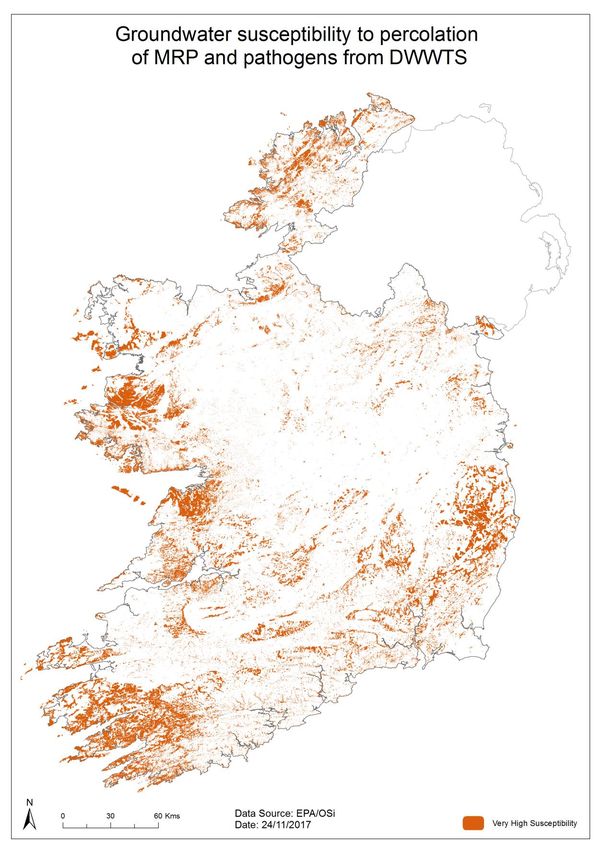
Protecting Our Water and Our Health

National Inspection Plan 2018 - 2021

 Domestic Waste Water Treatment Systems

             Environmental Protection Agency
       An Ghníomhaireacht um Chaomhnú Comhshaoil
                  Johnstown Castle Estate
                         Wexford
                         Ireland

                       www.epa.ie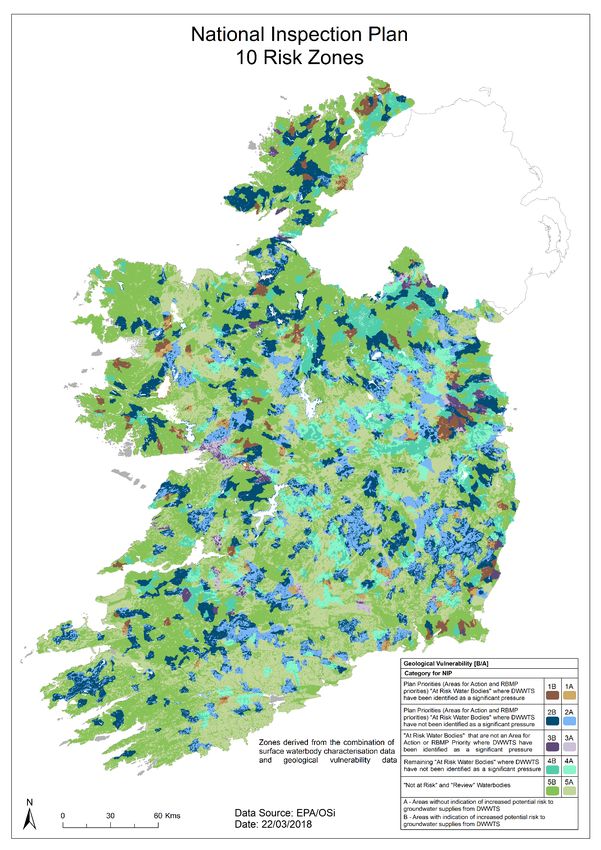
© Environmental Protection Agency 2018

                                      DISCLAIMER
  Although every effort has been made to ensure the accuracy of the material contained in
   this publication, complete accuracy cannot be guaranteed. Neither the Environmental
Protection Agency nor the author(s) accept any responsibility whatsoever for loss or damage
 occasioned or claimed to have been occasioned, in part or in full, as a consequence of any
person acting, or refraining from acting, as a result of a matter contained in this publication.
 All or part of this publication may be reproduced without further permission, provided the
                                    source is acknowledged.

                         NATIONAL INSPECTION PLAN 2018 - 2021
                         Domestic Waste Water Treatment Systems

                 Published by the Environmental Protection Agency, Ireland

                                  ISBN: 978-1-84095-769-3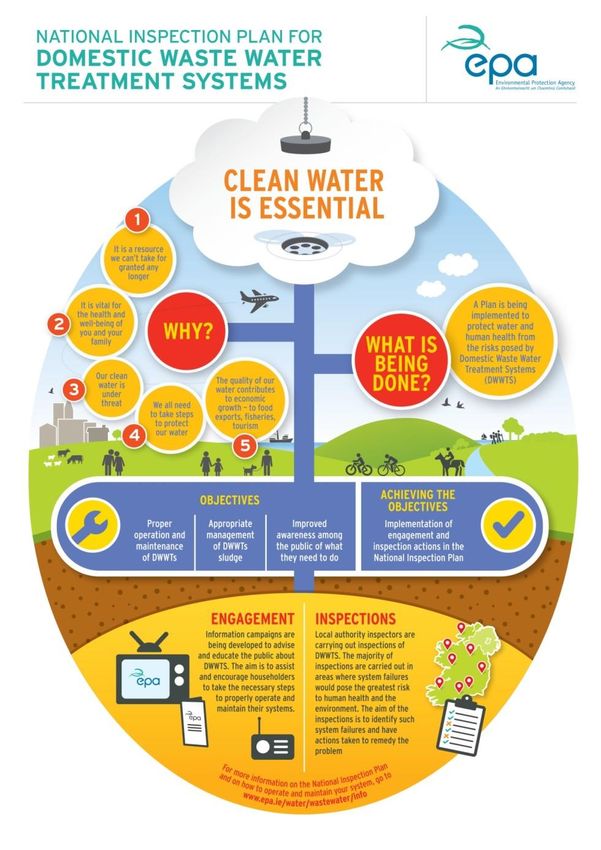
Contents
Summary of 2018 – 2021 Plan ................................................................................................................ 1
Chapter 1 Introduction ............................................................................................................................ 2
   1.1.       Background ............................................................................................................................. 2
   1.2.       Roles and responsibilities ........................................................................................................ 3
   1.3.       Review of National Inspection Plan 2015 - 2017 ..................................................................... 6
Chapter 2 Risk assessment ...................................................................................................................... 7
   2.1        Background ............................................................................................................................. 7
   2.2       River basin management plan 2018 - 2021.............................................................................. 9
   2.3        Updated risk-based methodology for 2018 – 2021 national inspection plan........................ 11
Chapter 3 Inspections............................................................................................................................ 22
   3.1       Introduction ........................................................................................................................... 22
   3.2        Inspection allocations ............................................................................................................ 22
   3.3        Inspection plan ...................................................................................................................... 23
   3.4        Complaints ............................................................................................................................ 25
   3.5        Inspection Process ................................................................................................................. 26
Chapter 4 Engagement.......................................................................................................................... 27
   4.1        Background ........................................................................................................................... 27
   4.2        Engagement activities 2015 – 2017 ...................................................................................... 27
   4.3        Proposed engagement activities 2018 – 2021 ...................................................................... 29
   4.4        Education and desludging initiative ....................................................................................... 32
Chapter 5 Implementation and review of the plan ............................................................................... 33
   5.1.       Implementation ..................................................................................................................... 33
   5.2.       Reporting and review ............................................................................................................ 35
Appendix A: Risk assessment methodology for 2018 – 2021 ................................................................ 36
Appendix B: List of publications............................................................................................................. 44
Appendix C: Information for private well owners.................................................................................. 46
Summary of 2018 – 2021 Plan

                   •The aim of the plan is to protect human health and
                    water quality from the risks posed by domestic
                    waste water treatment systems.
                   •The plan is based on a two strand approach of
                    engagement strategies linked with risk based
  Plan Overview     inspections.
                   •The plan covers the period 1st January 2018 to the
                    31st December 2021.
                   •An updated risk based methodology has been
                    developed by the EPA for the selection of sites for
                    inspection.

                   •The EPA will continue to oversee the
   Engagement       implementation of engagement and awareness
                    activities by the local authorities and other key
                    stakeholders.

                   •A minimum of a 1,000 inspections per year will be
                    carried out by local authority inspectors during
                    2018, 2019, 2020 and 2021.
                   •Inspections are carried out by local authority
    Inspections     inspectors appointed by the EPA.
                   •Inspections are allocated by taking account of the
                    risk, significant pressure and prioritisation for
                    action for each waterbody.

                    •The EPA invited submissions from all interested
                     parties on the proposals up to the 26th of January
   Consultation      2018.
                    •All 19 submissions received have been
                     considered in the finalisation of this plan.

                                 1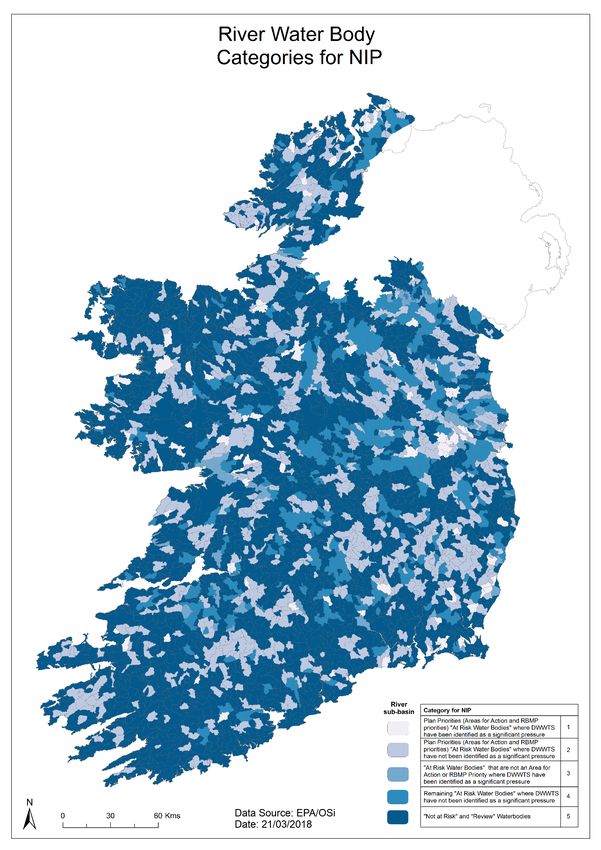
Chapter 1 Introduction
1.1.   Background

This report outlines the proposed third national inspection plan for domestic waste water
treatment systems (DWWTS) for the period 2018 to 2021. The Water Services Act 2007, as
amended by the Water Services (Amendment) Act 2012 requires the EPA to prepare a
national inspection plan for DWWTS. The purpose of the plan is to protect human health and
water quality from the risks posed by DWWTS (also known as septic tank systems).

The EPA prepared the first national inspection plan for DWWTS in 2013 covering the period
2013 to 2014. The plan required local authorities to undertake a minimum of 1,000
inspections each year across the country. The EPA developed a risk based methodology to
assist the local authorities with the selection of locations for inspections. The methodology
took into account the potential risks that DWWTS pose to both human health and water
quality.

The second national inspection plan for DWWTS in 2015 outlined the inspection process
covering the period 2015 to 2017. Some minor changes were made to the risk maps used for
site selection as additional environmental data had become available. This also resulted in a
slight change to the number of inspections in some counties.

This third plan has been prepared for the years 2018 to 2021. The risk-based methodology
has been updated to take into account additional information gathered on water quality
during the preparation of the River Basin Management Plan 2018 – 2021. Further
information on the revised methodology is provided in section 2 of this report.

The minimum number of inspections across the country remains at a 1,000 inspections per
annum. However, the minimum number of inspections required in each local authority area
has changed in response to the revised methodology and further details are provided in
section 3 of this report. The final number of inspections remains a matter for each local
authority. Additional inspections should be carried out where evidence exists that DWWTS
are causing an issue in a particular catchment.

Under the national inspection plan local authority inspectors are required to undertake a
minimum number of inspections each year. Any shortfall in the number of inspections
completed at the end of the 2015 to 2017 reporting period will be carried over and added to
the number of inspections to be undertaken in 2018.

                                               2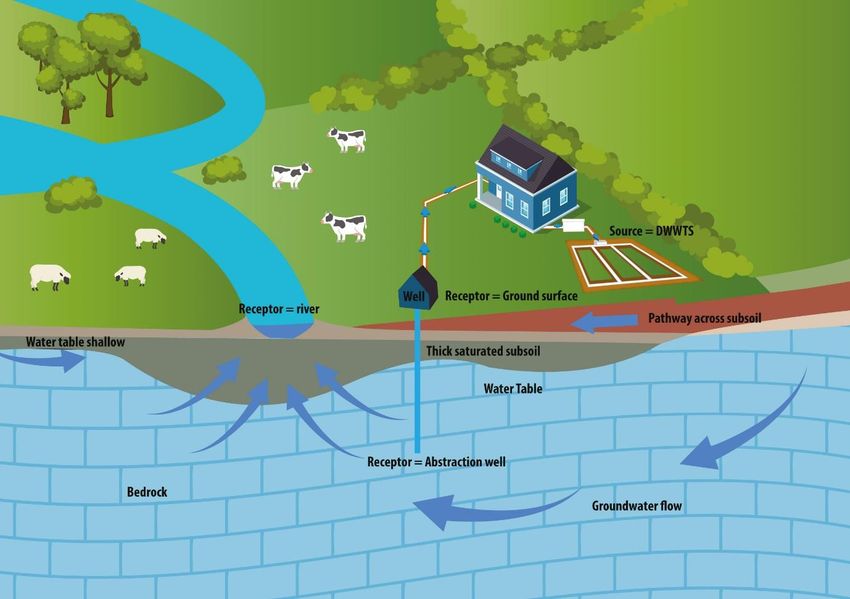
Since the national inspection plan was first developed in 2013 it has been based on a two-
strand approach of engagement strategies linked with a risk based inspection process
(Figures 1.1 and 1.2).

The purpose of strand 1, the engagement strategy, is to ensure all home owners with
domestic waste water treatment systems: (1) know what to do to ensure that their system is
correctly operated and maintained and (2) understand the risks posed to water quality and
human health from poorly maintained systems.

Strand 2 of the process is where inspections are carried out by local authority inspectors to
identify DWWTS that are not operating correctly or not being adequately maintained by
home owners. Where problems are identified home owners are issued with an advisory
notice from the local authority instructing them to carry out remedial works.

                            Figure 1.1: The building blocks of the plan

1.2.   Roles and responsibilities

Home owners

Every home owner with a DWWTS is required by law [Water Services Act 2007, as amended
by the Water Services (Amendment) Act 2012] to ensure that their treatment system is
operated and maintained properly so that it does not pose a risk to human health or the
environment. Home owners must comply with the advisory notice issued by a local authority
if their system fails an inspection.

Owners of homes that are not connected to the public sewer are required to register their
treatment system with ‘Protect Our Water’ which is the registration service operated on

                                                3
behalf of local authorities. Details on how to register are available on
www.protectourwater.ie

The 2016 data from the Central Statistics Office (CSO) indicates 489,069 households are
served by private DWWTS. Up to the 20/10/17 462,611 DWWTS have been registered across
the country (approximately 95%).

Department of Housing, Planning and Local Government (DHPLG)

The Department of Housing, Planning and Local Government sets national water policy and
strategy and prepares environmental legislation. The DHPLG website provides information on
the available financial assistance for remediation, repair, upgrade works or replacement of a
treatment system if a DWWTS fails an inspection and an advisory notice has been issued.
Further details can be obtained at http://www.housing.gov.ie/water/water-quality/domestic-
waste-water-systemsseptic-tanks/domestic-waste-water-treatment-1

Environmental Protection Agency (EPA)

The EPA is responsible for the development of the national inspection plan and co-ordination
and reporting on the implementation of the plan by the local authorities. The EPA provides
information for home owners with domestic waste water treatment systems on the EPA
website at https://www.epa.ie/water/wastewater/info/

The EPA appoints the local authority inspectors and supervises the carrying out of
inspections. The EPA monitors the engagement activities undertaken by local authorities and
provides supports in terms of advice and guidance as well as providing workshops for local
authority inspectors to share information. The EPA may also take enforcement action if it is
of the opinion that a local authority has failed to peform all or any of its functions.

The EPA funds research projects to help improve the understanding of the impact of waste
water on human health and the environment. In 2016 the EPA published Research 161 –
Assessment of disposal options for treated waste water from single houses in low permeability
subsoils; http://www.epa.ie/pubs/reports/research/water/researchreport161.html. Following
the findings of this report it is proposed to revise the Code of practice wastewater treatment
and disposal systems serving single houses (EPA, 2009).
http://www.epa.ie/pubs/advice/water/wastewater/code%20of%20practice%20for%20single
%20houses/.

Local Authorities

Local authorities are responsible for the implementation of the national inspection plan at a
local level. This includes the delivery of the engagement strategy and carrying out risk-based
inspections. Each local authority is responsible for applying the criteria outlined by the EPA to

                                                4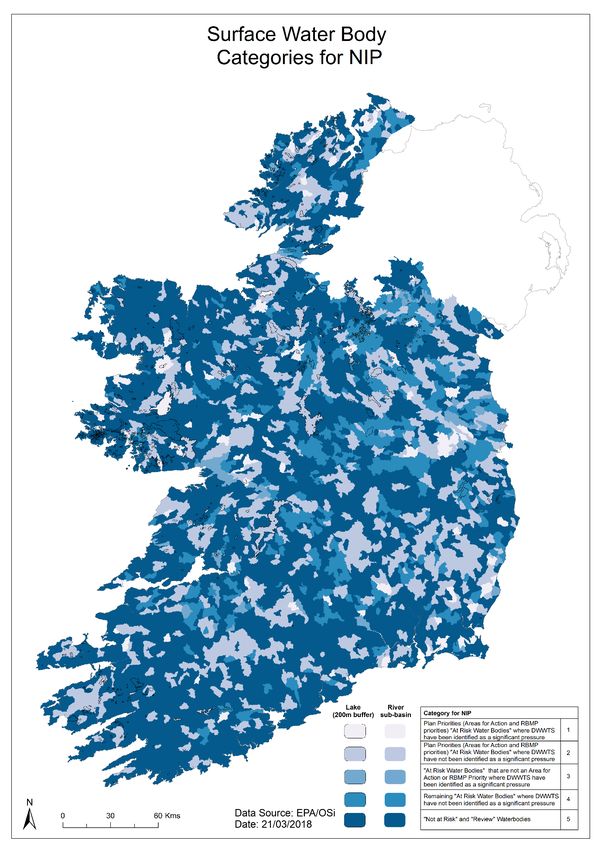
select sites for inspection; carrying out the inspections; closing out advisory notices and
undertaking follow up enforcement actions.

                          Figure 1.2: The aims and objectives of the plan

                                                5
1.3. Review of National Inspection Plan 2015 - 2017
Reviews of the 2015 and 2016 national inspection plan implementation show approximately
50% of the sites failed inspection. This figure was similar to that seen for the previous
reporting period of 2013 to 2014. Sites generally fail inspection due to operation and
maintenance issues. The results of the inspections to date indicate that there has been no
change in home owner behaviour in relation to the operation and maintenance of DWWTS.
Further details can be obtained in the 2016 implementation report
http://www.epa.ie/water/wastewater/nip/nip2016implementation/
Home owners need to be made aware through engagement that proper operation and
maintenance of DWWTS can help to reduce the potential for contamination of their private
drinking water supply and water bodies. As outlined in Section 4 of this report further focus
on engagement is required under the 2018 to 2021 plan and suggestions received during the
consultation period will be reviewed by the engagement working group.
6Chapter 2 Risk assessment
2.1 Background
In 2013 the EPA developed a risk based methodology in conjunction with the Geological
Survey of Ireland (GSI) and other external experts to assist local authorities in the selection of
properties for inspection. The methodology took into account the potential risk posed by
domestic waste water to both human health and the environment in a particular area.
Further details on how the risk based methodology was originally developed are outlined in
the EPA publication “A risk-based methodology to assist in the regulation of domestic waste
water treatment systems” (EPA, 2013).
http://www.epa.ie/pubs/reports/water/wastewater/dwwtriskranking.html
The EPA made minor adjustments to the methodology for the National Inspection Plan 2015-
2017 to take account of additional data which became available for bathing waters; high
status rivers; high status lake catchment areas and shellfish designated areas
http://www.epa.ie/pubs/reports/water/wastewater/nationalinspectionplan2015-2017.html.
DWWTS when constructed and installed in accordance with best practice provide adequate
treatment and disposal of waste water. The risks to public health and water quality are
minimised by having the correct design, suitable ground conditions and proper operation and
maintenance of the system.
The main risks associated with DWWTS are:
waste water from private houses polluting watercourses and groundwater;
waste water presenting a risk to human health through contamination of a drinking
water source (including private wells) or ponding of sewage on the ground.
The risk assessment method uses the source -pathway-receptor (S-P-R) model. The S-P-R
model is based on the concept that for a risk to exist there must be a source of potential
pollution, a receptor that may be impacted by that pollution and a pathway by which the
pollution can get from the source to the receptor.
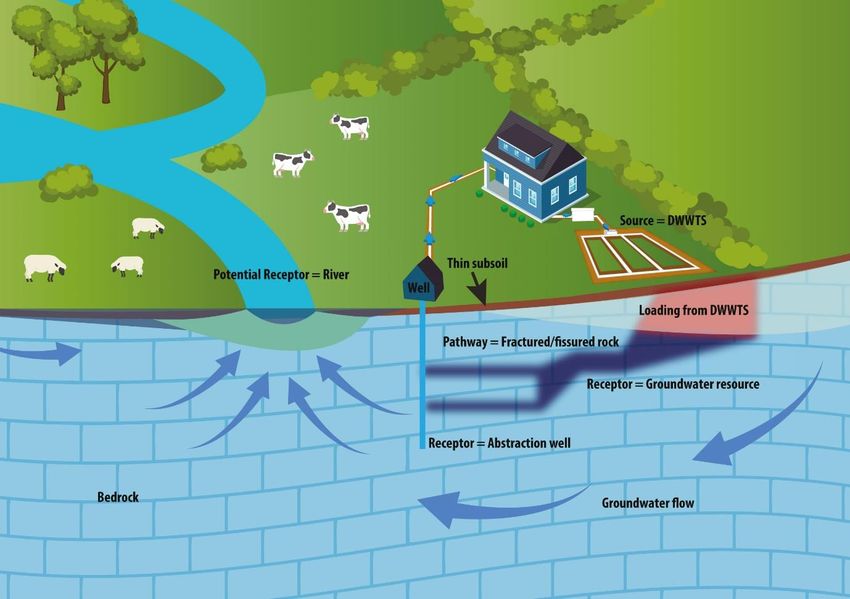
7Figures 2.1 and 2.2 show how a discharge from a DWWTS can find its way to a river or
groundwater used for drinking water. In Figure 2.1 the discharge moves through thin subsoil
and fractures in the rock to reach a drinking water well. The soil and bedrock cannot treat
the pollution and therefore it can end up in the drinking water well.
Figure 2.1: S-P-R model for domestic waste water treatment system with subsurface pathways
In Figure 2.2 the ground is not able to treat the wastewater as it cannot go down into the soil.
This can result in ponding of the wastewater from the DWWTS at the surface which can be a
potential threat to human health. There is also the potential in such a situation for the
wastewater to move over the land and enter a drinking water well by flowing down the
outside of the well casing if it has not been properly installed. This can cause contamination
of the water supply.
8Figure 2.2: S-P-R model for domestic waste water treatment system with surface pathways
2.2 River basin management plan 2018 - 2021
The aim of the River Basin Management Plan is to develop a programme of measures to
achieve the best environmental outcome by targeting the right improvement measure in the
right location.
Since 2015 a large body of work has been undertaken by the EPA in conjunction with local
authorities, Inland Fisheries Ireland (IFI), Irish Water and other stakeholders to assess the
significant pressures on water bodies. Water bodies include rivers, lakes, groundwater,
coastal and estuarine (transitional) waters. This work has been carried out as part of the
development of the River Basin Management Plan 2018-2021 to meet the requirements of
the Water Framework Directive (2000/60/EC). A copy of the River Basin Management Plan
can be found the following link http://www.housing.gov.ie/node/8762
The River Basin Management Plan was published in April 2018.
The Water Framework Directive required that all water bodies achieve “high status” or “good
status” by 2015 and that the status of any water body does not deteriorate. The EPA has
detailed information on the status of water bodies across the country.
The EPA has carried out catchment characterisation to identify the water bodies that are At
Risk of not meeting at least Good Status. These are rivers, lakes and groundwater bodies that
are likely to fail to meet the standards required unless action is taken. The EPA used over 140
9datasets in the assessment including water body status, water quality trends, information on
pressures and local knowledge. Where a water body was deemed to be At Risk the
catchment characterisation process used an evidence based approach to identify significant
pressures following the source - pathway - receptor model.
As part of the characterisation assessment the EPA used several modelling tools to help
inform the process. These included:
The Source Load Apportionment Model (SLAM) to calculate the approximate loads to
surface water from a range of sources including urban waste water treatment plants,
industrial discharges, agriculture, septic tank systems, forestry and urban areas.
Pollution Impact Potential maps (PIP) are critical source area maps for diffuse
agriculture. PIP maps are a combination of susceptibility maps and farm nutrient
loadings (phosphorus and nitrogen). These maps indicate areas that are likely to have
a relatively higher impact on a water body. This then helps to target areas for further
investigative assessment and action.
The Sanicose model was developed specifically to inform the risk assessment of
DWWTS on water bodies. It combines the susceptibility map with the estimated loads
from DWWTS and ranks into three bands of high, medium and low.
Further details on the catchment characterisation process and the identified environmental
pressures on the water environment is provided in Section 5 of the River Basin Management
Plan 2018 – 2021 http://www.housing.gov.ie/node/8762
Through the catchment characterisation process the EPA identified At Risk water bodies. The
EPA looked at the significant pressures within each water body and classified these into 14
categories. One of these categories was a significant pressure due to DWWTS.
The following information was used to assess if the DWWTS were a significant pressure for a
water body:
water quality monitoring;
landscape drainage characteristics (based on soils, subsoils and bedrock maps)
indicating percolation conditions;
the locations of houses, particularly in areas with poor drainage characteristics (this
was informed by the Sanicose model); and
local authority information from inspections and Inland Fisheries Ireland information
from stream walks.
The characterisation process carried out in advance of the publication of the plan highlighted
that approximately one third of Ireland’s water bodies are At Risk of not achieving their
objectives under the Water Framework Directive and 11% of At Risk water bodies are being
impacted by DWWTS. Ten per cent of these are where septic tanks are one of several
10pressures putting the water body at risk while 1% are where septic tanks are the only
pressure putting the water body at risk. This is relatively low in comparison to other sources
such as agricultural activities (64%) and urban waste water discharges (22%).
The water quality objectives are unlikely to be met in the At Risk water bodies unless
additional actions are taken to reduce the sources of pollution. The first step towards
identifying and implementing ‘the right measure in the right place’ is to carry out an
investigative assessment to refine the understanding of the significant pressure(s), so that
the specific measure(s) required can be identified and implemented. As it will not be possible
to carry out all the required actions during this short second cycle to 2021, a process was
developed by the EPA to help prioritise where action should commence. Actions include
mitigation and protection measures. These areas for action are available on www.lawco.ie.
2.3 Updated risk-based methodology for 2018 – 2021 national inspection
plan
The EPA has updated the risk-based methodology to focus inspections using a combination of
Water Framework Directive surface water and groundwater risk assessments.
This will allow inspections to be targeted in water bodies where there is the greatest
potential for contributing to water quality improvements. There will be a further focus within
these water bodies in the areas where there is the greatest potential for protection of human
health by undertaking a higher number of inspections in areas with increased potential risk to
groundwater supplies from DWWTS.
2.3.1 Surface water element
The EPA have set out 5 categories of river and lake waterbodies to prioritise the inspections.
The categories cover the risk, significant pressure and prioritisation for each waterbody in the
country by asking:
is the waterbody At Risk?;
have DWWTS been flagged as a significant pressure for the waterbody?;
has the waterbody been prioritised as part of an area for action in the River Basin
Management Plan (RBMP)?
These five waterbody categories have been mapped for rivers by the EPA (Figure 2.3). Lakes
across the country were also divided into the same five categories with a 200m buffer of land
being included around each lake (Figure 2.4). The two layers were intersected and the
surface water body category was assigned taking the highest priority for inspections (Figure
2.5).
112.3.2 Potential risk to groundwater supplies from DWWTS
DWWTS can be a risk to human health if they are not in the correct locations, are poorly
operated or inadequately maintained. If a DWWTS is poorly sited, maintained or operated a
private well is at a higher risk of being contaminated. Since the roll out of the national
inspection plan in 2013 figures have shown that approximately half of the properties which
had a DWWTS and were served by a private well failed the inspections.
The EPA has determined the potential risk to groundwater supplies from DWWTS by
combining elements of two maps previously produced in 2013 for the Risk based
methodology to assist in the regulation of domestic waste water treatment systems (EPA,
2013). This detail is described below.
The main risk from DWWTS to groundwater, and the private wells abstracting from
groundwater, is due to insufficient treatment. Figure 2.1 illustrates a situation where there is
not enough subsoil to treat the wastewater from a DWWTS before it reaches the
groundwater. For the 2013 risk based methodology a map was produced identifying
groundwater susceptibility to percolation of the wastewater into the groundwater of MRP
(molybdate reactive/soluble phosphorus) and pathogens (Figure 2.6). For this new risk based
assessment the areas of this map identified as very high susceptibility represent an increased
potential risk to groundwater supplies due to the fact that there is not enough subsoil to
treat the wastewater before it reaches the groundwater.
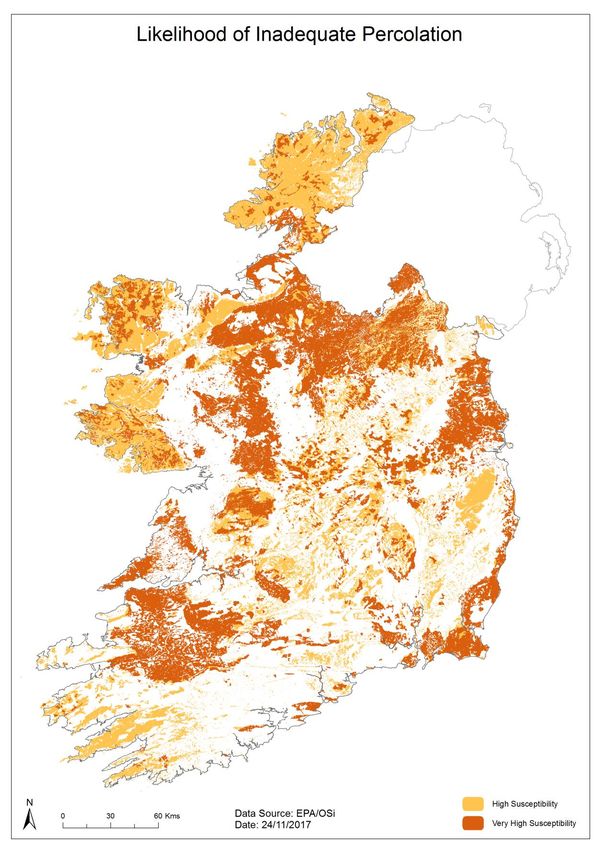
Another situation where there is a potential risk to groundwater supplies is where there is
inadequate percolation of the wastewater into the soil resulting in ponding and horizontal
flow to wells (Figure 2.2). For the 2013 risk based methodology a map was produced
identifying the likelihood of inadequate percolation (Figure 2.7). For this new risk based
assessment the areas of this map identified as high or very high susceptibility are taken to
have an increased potential risk to groundwater supplies due to this potential for inadequate
percolation.
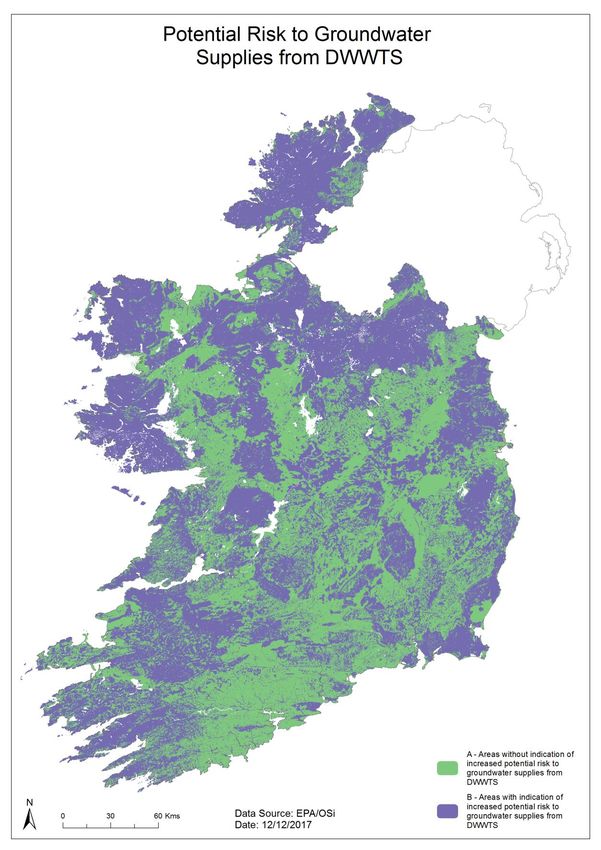
These categories selected from the two susceptibility maps have been combined to identify
the areas with an increased potential risk to groundwater from DWWTS (Figure 2.8). Private
wells located within these areas are at a higher risk of being contaminated by DWWTS.
12Figure 2.3: River water body categories
13Figure 2.4: Lake water body categories
14Figure 2.5: Surface water body categories
15Figure 2.6: Groundwater susceptibility to percolation of MRP and pathogens
16Figure 2.7: Likelihood of inadequate percolation
17Figure 2.8: Potential risk to groundwater supplies from DWWTS
18Details of the criteria which were used to subdivide the five categories into ten risk zones are
provided in Table 2.1. The surface water body category (Figure 2.5) and the potential risk to
groundwater supplies (Figure 2.8) were combined to create 10 risk zones (Figure 2.9).
The 10 risk zones and the weightings that were applied to calculate the number of
inspections per risk zone are shown in Table 2.1. The weightings decrease from the highest to
lowest priority in the water body categories (category 1 to 5). The weightings are doubled for
the areas within any risk zone where there is increased potential risk to groundwater supplies
from DWWTS (risk zones 1B to 5B in Table 2.1). The minimum 1,000 inspections per annum
have been distributed across the 10 risk zones nationally based on the weightings.
Risk zone At risk Area for DWWTS Increased Weighting National
water action 2 significant groundwater applied to number of
body 1 pressure risk potential risk zone inspection
per risk zone
1A 100 59
1B 200 243
2A 25 142
2B 50 360
3A 20 8
3B 40 22
4A 10 30
4B 20 77
5A 1 16
5b 2 43
Total no. of 1,000
inspections
Table 2.1: National minimum number of inspections per risk zone
The figures for the number of inspections within each risk zone for each local authority are
presented in section 4 this report. It should be noted that the calculation of the minimum
number of inspections per risk zone takes into account the percentage of area covered by
each risk zone. Further details on the revised risk methodology and the calculation of the
minimum number of inspections per county per risk zone are contained in Appendix A.
1
At risk water body – these are water bodies which are at risk of not meeting the requirements
of the Water Framework Directive to meet at least good status.
2
Area for action – the areas for action in the NIP include the areas for action prioritised for
further work in the 2nd cycle but also include the River Basin Management Plan priorities not
prioritised for further work. Actions include mitigation and protection measures which are to
be identified and implemented.
19Figure 2.9: National inspection plan 10 risk zones map
20The highest density of inspections (as shown in Table 2.2) will be undertaken in Category 1
waterbodies. These are the at risk water bodies in areas where action is required under the
River Basin Management Plan and DWWTS are listed as a significant pressure. A lower
density of inspections is required in Category 2 water bodies as DWWTS have not been
identified as a significant pressure in these areas.
It should be noted that the RBMP priorities in the NIP include areas for action prioritised for
further work in the 2nd cycle and At Risk waterbodies in the areas for action are included in
Category 1 and 2. Where High Status Waters and deteriorated waterbodies have been
identified as being At Risk and water bodies in Protected Areas, (for example Bathing Water,
Shellfish Waters and Freshwater Pearl Mussel Waters) have been identified as not meeting
their protected area objectives, these are also covered under the RBMP priorities in Category
1 and 2.
It should be noted that while DWWTS have been identified as a significant pressure in
Category 3 these areas are not targeted as areas for action under the River Basin
Management Plan. This results in Category 3 being a lower priority in terms of the river basin
management plan than Category 2 and on this basis a lower density of inspections has been
assigned.
Waterbody Category Description Risk Zone National Number of
category number of inspections
inspections per 1,000
per km2 of each
waterbody water body
category category
Category 1 Plan Priorities (Areas for Action 1A & 1B 302 150.8
and RBMP priorities) “At Risk
Water Bodies” where DWWTS
have been identified as a
significant pressure
Category 2 Plan Priorities (Areas for Action 2A & 2B 502 35.1
and RBMP priorities) “At Risk
Water Bodies” where DWWTS
have not been identified as a
significant pressure
Category 3 “At Risk Water Bodies “ that are 3A & 3B 30 27.8
not an Area for Action or RBMP
Priority where DWWTS have been
identified as a significant pressure
Category 4 Remaining “At Risk Water Bodies” 4A & 4B 107 14.2
where DWWTS have not been
identified as a significant pressure
Category 5 “Not at Risk” and “Review” 5A & 5B 59 1.4
Waterbodies
Table 2.2 Density of inspections per water body category
21Chapter 3 Inspections
3.1 Introduction
An inspection under the national inspection plan checks that a DWWTS is fit for purpose and
that it does not pose a risk to human health or the environment. A home owner is issued
with an advisory notice if their DWWTS fails an inspection. The advisory notice specifies the
reasons for the failure and what measures need to be taken to fix the problem. The
inspections are carried out by local authority inspectors appointed by the EPA. All inspectors
are required to have completed the training in relation to the inspection of DWWTS prior to
appointment.
The objective of the inspection strategy is to reduce the risk posed to human health and
improve water quality by directly engaging with home owners to determine if their DWWTS is
being correctly operated and maintained. The purpose of the inspection programme is not
to inspect every system in the country. The aim is that the existence of the programme will
increase awareness among home owners in a particular area because of inspections taking
place in their community. At the same time the inspection programme will also target the At
Risk water bodies where there are known water quality issues associated with DWWTS which
may be improved because of home owners undertaking remedial works.
3.2 Inspection allocations
It is proposed that the minimum number of inspections will remain unchanged at 1,000 per
annum for the period 2018 to 2021. This is in line with the risk posed by DWWTS on a
national scale compared to the number of water and waste water related inspections carried
out in other sectors regulated by local authorities. The most recent RMCEI (Recommended
Minimum Criteria for Environmental Inspections) figures for 2016 indicate 25,868 water and
waste water (routine and non routine) related inspections were planned for 2016. Based on a
minimum of 1,000 inspections per annum the DWWTS national inspection figure represents
3.9% of planned inspections.
The number of inspections outlined is the minimum number required. It is recommended
that additional inspections are carried out by individual local authorities if there is evidence
at a local level that DWWTS are causing an issue in a particular catchment. Investigative
assessments will also be taking place as part of the RBMP. These investigative assessments
are separate to the NIP for DWWTS. A breakdown of the national allocation of inspections
per local authority area is provided in Table 3.1.
The minimum 1,000 inspections per annum have been distributed across the 10 risk zones
(1A to 5A and 1B to 5B) based on the proportion of area nationally within each of the zones
and the weighting applied to each zone. The figures for the minimum number of inspections
22required under each of the risk zones per local authority area is presented in Table A.5,
Appendix A together with an explanation as to how the numbers were calculated.
3.3 Inspection plan
Each local authority is required to develop a local site selection plan, which documents the
application of the site selection methodology and outlines the justification for the selection
of priority areas and individual sites. The local authority should retain the associated
documents to facilitate future auditing by the EPA. Figure 3.1 provides an outline of the site
selection process.
If possible, priority should be given to the selection of unregistered properties for inspection
in the first instance. However it is noted that the registration rate nationally is 95% and
therefore it may not always be possible to target unregistered properties.
Since the publication of the National Inspection Plan 2015-2017 (EPA 2015) guidance has
been prepared by the local authority site selection and inspection working group. This
included a local site selection plan template and guidance documents for “gathering
evidence”; “kit for inspections” and “practical tips for carrying out an inspection”. The site
selection plan template will be updated in light of the revised methodology and circulated to
all inspections via the NIECE septic tank inspectors network.
Examine priority ranking • The EPA will
map and the number of provide access to
inspections required in maps and GIS
each categorty. datasets via DWWA
• This selection
should be based on
Select the areas for local knowledge
inspection within each such as information
category. on locations with
known water
pollution
• When choosing
sites to inspect,
Select the sites for priority should be
inspection. given to
unregistered sites, if
possible.
Figure 3.1: Site selection process
23Minimum
Number of
Local Authority Area 2018 2019 2020 2021
Inspections
2018- 2021
Carlow County Council 60 15 15 15 15
Cavan County Council 128 32 32 32 32
Clare County Council 156 39 39 39 39
Cork County Council 240 60 60 60 60
Donegal County Council 472 118 118 118 118
Dun Laoghaire / Rathdown
4 1 1 1 1
County Council
Fingal County Council 24 6 6 6 6
Galway County Council 404 101 101 101 101
Kerry County Council 208 52 52 52 52
Kildare County Council 136 34 34 34 34
Kilkenny County Council 108 27 27 27 27
Laois County Council 96 24 24 24 24
Leitrim County Council 92 23 23 23 23
Limerick City and County
132 33 33 33 33
Council
Longford County Council 36 9 9 9 9
Louth County Council 32 8 8 8 8
Mayo County Council 280 70 70 70 70
Meath County Council 252 63 63 63 63
Monaghan County Council 104 26 26 26 26
Offaly County Council 68 17 17 17 17
Roscommon County Council 140 35 35 35 35
Sligo County Council 112 28 28 28 28
South Dublin County Council 8 2 2 2 2
Tipperary County Council 164 41 41 41 41
Waterford City and County
80 20 20 20 20
Council
Westmeath County Council 80 20 20 20 20
Wexford County Council 260 65 65 65 65
Wicklow County Council 124 31 31 31 31
TOTAL 4,000 1,000 1,000 1,000 1,000
Table 3.1: Minimum number of domestic waste water treatment system inspections per local
authority area 2018 to 2021
243.4 Complaints
Local authorities must maintain a register of all complaints and other inspections, such as
water pollution incident investigations, that relate to DWWTS.
The Water Pollution Act and regulations are used by local authorities where necessary for
complaint investigations. The powers to control pollution are very similar in the Water
Pollution Act and the Water Services Act 2007 as amended by the Water Services
(Amendment) Act 2012 and associated regulations. The general provision in the Water
Pollution Act states ‘that a person shall not cause or permit any polluting matter to enter
waters’ and as such requires evidence of a discharge to waters. The Water Services Act 2007
as amended by the Water Services (Amendment) Act 2012 and the 2012 (Domestic Waste
Water Treatment Systems) Regulations (S. I. No. 223 of 2012) refer to unauthorised
discharge, leakage, ponding, entry of surface waters, operation and maintenance issues as
well as de-sludging. Where the risk is to human health and the environment irrespective of
the regulations used, tight timeframes for remediation should be applied.
Reporting Complaints
The Environmental Protection Agency (EPA) operates an iPhone and
Android App, called See it? Say it!, to help people to report
environmental pollution in their towns and villages.
Using the App you can now take a photograph of a pollution incident,
add a summary description of what you want to convey and your
contact details and this will automatically be sent to the relevant local
authority for follow up (and the app will add GPS location coordinates).
Alternatively you can ring the National Environmental Complaints
Line (NECL) 1850 365 121 or contact the relevant Local Authority
directly. More information is available on the EPA website at the
following link:
http://www.epa.ie/enforcement/report/
Further details on making an environmental complaint can be found on the EPA website at
the following link http://www.epa.ie/enforcement/report/
253.5 Inspection Process
A pre-inspection letter is sent to a home owner 10 days in advance of an inspection taking
place. A local authority inspector will check that the treatment system is fit for purpose and
is not giving rise to a risk to public health or the environment.
The home owner will be notified of the findings within 21 days of the inspection. If the
system is deemed to pose a risk to public health or the environment the local authority will
issue an advisory notice directing the owner to remedy the matters specified in the notice by
a specified date.
Additional information on what is involved in an inspection is available on the EPA website at
http://www.epa.ie/water/wastewater/info
Information is also available on the “What to expect from a septic tank inspection” leaflet
which is available for download at the following link
http://www.housing.gov.ie/sites/default/files/migrated-
files/en/Publications/Environment/Water/FileDownLoad%2C33590%2Cen.pdf
There is also a video available outlining what to expect from an inspection at the following
link http://www.epa.ie/water/wastewater/guidance/whattoexpectfromaninspection/
Useful links for private well owners are provided in Appendix C.
26Chapter 4 Engagement
4.1 Background
An essential part of the implementation of the national inspection plan is to engage and
communicate with the public. Each home owner needs to be aware of how to operate and
maintain their DWWTS and the potential health implications if the system is not being
correctly operated or maintained. Home owners need to be provided with information on
the measures that they can take to protect their health and that of their family, neighbours
and the environment.
Local authorities are responsible for on-going engagement with the public and
communication at a local level. It is the EPA’s responsibility to oversee the implementation of
the engagement campaign by the local authorities. The EPA publish details of the
engagement activities undertaken by local authorities in the annual implementation report.
The findings of the fifth implementation report for the 2016 National Inspection Plan can be
found here http://www.epa.ie/water/wastewater/nip/nip2016implementation/
Since inspections commenced in July 2013, close to half of all inspection failures have been
related to the operation, maintenance and desludging of DWWTS (53% of failures in 2016).
In most cases, these issues can be rectified easily once home owners are made aware of the
problems and provided with information on how to fix the problem.
Private wells may be at risk of contamination if the DWWTS are not sited, installed or
operated correctly. In 2016, it was found that 51% of DWWTS, with private wells on site,
failed inspection.
To address these issues there has been a focus on engagement strategies which aim to
advise, educate and assist home owners to take the necessary steps to properly operate and
maintain their DWWTS.
4.2 Engagement activities 2015 – 2017
In July 2015, the DWWTS engagement working group was established to prepare a
programme of citizen engagement activities to be carried out at a national and local authority
level in a consistent manner across all local authority areas. To date the group have published
the following leaflets to provide information to the public:
“Have you completed a septic tank system check” (2015)
https://www.catchments.ie/download/septic-tank-system-check/ ;
“Wastewater systems for building a house” (2016)
https://www.epa.ie/pubs/advice/water/wastewater/wastewatersystemsforbuildingah
ouse.html ; 20,000 leaflets print run in 2017
27 “Septic tanks and wastewater systems when buying or selling a house” (2016)
https://www.epa.ie/pubs/advice/water/wastewater/septictankswastewatersystemsw
henbuyingorsellingahouse.html ; 20,000 print run in 2017; and
“Spreading sludge from your own septic tank” (2017)
http://www.epa.ie/pubs/advice/water/wastewater/howtosafelyspreadsludgefromyou
rseptictank.html
Local authorities should provide links to the above leaflets on their website and distribute
them as part of awareness raising activities. Local authorities should also maintain a list of
permitted contactors in their area on their website and provide a list of permitted
contractors to home owners as part of the inspection.
The EPA research programme 2014-2020 included the Relay Risk Project: Examining the
communication of environmental risk through a case study of domestic wastewater treatment
systems in the republic of Ireland (2013-W-DS-12) (EPA, 2016). This project examined ways to
deliver risk based messages effectively to improve knowledge and promote a change in
behaviour. The research also investigated the best way to measure the effectiveness of the
engagement strategies. The guidelines developed as part of this research programme were
published in 2016: https://www.epa.ie/pubs/reports/research/spr/EPA%20-
%20Guidelines%20Report%20167%20FINAL%20AMENDED.pdf
The research recommended the following key messages in relation to public engagement:
“Regular maintenance of your septic tank system protects you and your family’s
health”;
“More and more people are now maintaining their septic tank system – by doing so
you too can help protect drinking water in your community”;
“Everyone has a role to play in protecting drinking water sources. Do your bit by
regularly maintaining your septic tank system”.
A summary of the main activities of the DWWTS engagement working group to date is
provided in Table 4.1.
Date Details of Activity
2015 Septic tanks classroom plan for secondary school courses – science and
technology in action
2015 Publication of leaflet “Have you completed a septic tank system check”
https://www.catchments.ie/download/septic-tank-system-check/
September EPA Webinar to local authority staff to highlight the risks posed by septic
2015 tanks to private wells and to provide practical advice that inspectors could
give to home owners during septic tank inspections
October 2015 Inspectors network workshop on engagement strategies and the reporting
on the on-line Domestic Waste Water Application (DWWA)
November EPA training for elected members on “Septic tanks, groundwater and water
282015 pollution” organised by Association of Irish Local Government (AILG)
July 2016 Publication of leaflet “Wastewater systems for building a house”
https://www.epa.ie/pubs/advice/water/wastewater/wastewatersystemsforb
uildingahouse.html ; and
“Septic tanks and wastewater systems when buying or selling a house”
https://www.epa.ie/pubs/advice/water/wastewater/septictankswastewaters
ystemswhenbuyingorsellingahouse.html ;
July 2016 EPA survey of all local authorities to obtain information on how they engage
with the public to disseminate information and to identify the most effective
engagement activities
September Survey on septic tanks on www.catchments.ie results used in development of
2016 the national engagement strategy focusing on possible health and
environmental risk from malfunctioning systems
October 2016 Septic tanks and treatment systems workshop organised by Association of
Irish Local Government (AILG)
November Inspectors network workshop to discuss site inspections and engagement
2016
September “Spreading sludge from your own septic tank” (2017)
2017 http://www.epa.ie/pubs/advice/water/wastewater/howtosafelyspreadsludge
fromyourseptictank.html
Table 4.1: Summary of engagement working group activities 2015 to 2017
4.3 Proposed engagement activities 2018 – 2021
In 2017 the engagement working group developed an engagement strategy. The purpose of
the strategy is to develop engagement activities to influence DWWTS owners to properly
operate and manage their DWWTS. The strategy is to follow a phased approach.
Step 1: coordinate and plan
Step 2: develop the engagement strategy
Step 3: implement the engagement strategy
Step 4: ongoing evaluation and monitoring progress
It is proposed that the engagement strategy will be implemented during the 2018 to 2021
national inspection plan. The main tasks identified by the engagement group for each
element of the strategy are presented in Table 4.2.
29Step 1 Co-ordinate and plan Step 3: Implement the engagement
strategy
Evaluate the risk situation & set
goals; Dissemination of resources to
Establish stakeholder local authorities and stakeholder
collaboration and coordination; groups;
Stakeholder meetings, contacts, Local authorities and
survey, collaboration with NFGWS stakeholder groups to develop
& LAWCO; roadmap for delivery.
Assess available expertise and
resources.
Step 2 Develop the engagement strategy Step 4 Ongoing evaluation and
monitoring progress
Identify audience;
Conduct exploratory research; Statutory performance
Develop and test key messages; indicators
Partner with credible
organisations.
Table 4.2: Summary of engagement strategy
The EPA will continue to oversee the implementation of the engagement campaign by the
local authorities through the collection of data for the annual national inspection plan
implementation report and RMCEI returns for the 2018 to 2021 reporting period.
The engagement activities reported by the local authorities in 2016 included:
leaflet drops;
information stands;
material on website;
school packs;
community groups;
media including social media, newspaper, radio;
undertaking pre-inspection meetings with home owners; and
contacting waste collection permit holders regarding desludging.
Metrics that could be tracked to allow the effectiveness of the engagement strategy to be
assessed include the following:
ongoing review of the DWWTS registration data and quantitative data from
inspections including number of failed inspections and reasons for failure;
monitoring of local authority and EPA website hits and emails from home owners
seeking information;
monitoring of media outputs including articles and features on TV;
30 monitoring of campaign outputs;
questions and answers during inspections to assess level of knowledge / source of
knowledge;
undertake survey to assess changes in attitude / behaviour;
water quality improvement measures;
track Local Authority effort through RMCEI and Statutory Performance Indicators;
track quantities of domestic waste water sludge quantities collected nationally.
As part of the consultation process the public were invited to provide suggestions on ways to
engage with home owners to increase awareness around issues relating to the operation and
maintenance of DWWTS.
In response to the submissions received during the consultation period it is proposed that the
following will be reviewed by the engagement working group to establish a programme for
roll out during the lifetime of the 2018 to 2021 NIP.
National media campaign.
Development of implementation plan on citizen engagement activities.
Targeted awareness campaign with groups such as NFGWS or LAWCO via local
information evenings.
The EPA will continue to assist with the provision of information leaflets on DWWTS
and private wells to local authorities. These leaflets have been developed by the
engagement working group. Local authority inspectors will be required to continue to
engage with householders during the inspection process and distribute the
information leaflets on both DWWTS and private wells. A link to the leaflet “Have you
checked your well water supply?” is provided here
http://www.epa.ie/pubs/advice/drinkingwater/SS%20Wells%20Web.pdf.
Further work to take place on the feasibility of the expansion of bundled service
contracts for desludging.
The agreement of metrics to ensure that progress with engagement can be measured
during the implementation of the 2018 – 2021 NIP.
314.4 Education and desludging initiative
A pilot scheme known as the Group Water Scheme Led Community DWWTS Education and
Desludging Initiative was undertaken by the National Federation of Group Water Schemes
(NFGWS). It commenced in 2016 and is due to conclude in 2018. The purpose of the study
was to test the capacity of group water schemes to co-ordinate and incentivise septic tank
desludging for bundles of householders.
NFGWS Group Water Scheme Led Community DWWTS Education and Desludging Initiative
The main findings of the EPA funded research of relevance to the NIP indicate:
Local authorities should provide a portal on their websites to the
relevant information including a list of registered contractors.
Farming communities need to be better informed with regard to the
proper disposal of sludge on lands.
Contractors and farmers should be monitored by the relevant statutory
agencies to ensure that sludge is being properly disposed of.
The cost of sludge collection and disposal varies significantly from
county to county based on the rate per tonne at various WWTPs and
the distance to the nearest facility.
Reduced desludging costs will incentivise people to sign up to proper
management of their DWWTS. Significant savings (up to 50%) on the
cost of desludging were achieved using the community led bundled
approach.
The bundled approach could also be applied to achieve cost savings for
the proprietary systems that require an annual service contract.
The study concluded that with financial and other incentives a group
water scheme led community approach to desludging is a viable
solution. The findings of research will be published in 2018. Further
information will be provided on the NFGWS website at
http://www.nfgws.ie/Home
32You can also read


