Ocean Rescue Aquatics Manual - Ocean Rescue Aquatics Manual Charleston County Park & Recreation Commission CAPRA Standard 4.1 Approved: January ...
←
→
Page content transcription
If your browser does not render page correctly, please read the page content below
Ocean Rescue Aquatics Manual

Ocean Rescue Aquatics Manual
Charleston County Park & Recreation Commission
CAPRA Standard 4.1                     1|Page
Approved: January 2020
Next Review: January 2021
Charleston County Park & Recreation Commission
Approved: January 2020
Next Review: January 2021

 REVIEWERS                        DUE DATE       APPROVED
 Safety Program Manager           January 2020   January 31, 2020
 Safety Program Coordinator       January 2020   January 31, 2020
 Beachwalker Park Asst. Manager   January 2020   January 31, 2020
 Isle of Palms Asst. Manager      January 2020   January 31, 2020
 Folly Beach Asst. Manager        January 2020   January 31, 2020

Ocean Rescue Aquatics Manual
Charleston County Park & Recreation Commission
CAPRA Standard 4.1                     2|Page
Approved: January 2020
Next Review: January 2021
UPDATES AND REVIEWS
       OCEAN RESCUE AQUATICS MANUAL
CAPRA Standard 4.1
Approved: January 2019
Next Review: January 2020

 REVIEWER        CHANGES                                                CHAPTER DATE
 Nikki Bowie     Corrected Life Saving to Lifesaving                     Page 8 1/31/19
 Nikki Bowie     Replaced “Ocean Access Assistant Managers” to           Page 8 1/31/19
                 “designated park staff”
 Nikki Bowie     Corrected “insuring” to “ensuring”                     Page 11   1/31/19
 Nikki Bowie     Corrected Life Saving to Lifesaving                    Page 14   1/31/19
 Nikki Bowie     Deleted “Assist with the hiring and training of all    Page 17   1/31/19
                 program related staff.”
 Nikki Bowie     Corrected Life Saving to Lifesaving                    Page 18   1/31/19
 Nikki Bowie     Changed Lifesaving to Lifeguard                        Page 18   1/31/19
 Nikki Bowie     Changed 40 to 48 hours                                 Page 20   1/31/19
 Nikki Bowie     Deleted “one half of”                                  Page 21   1/31/19
 Nikki Bowie     Deleted “Following is a list of the issued lifeguard   Page 21   1/31/19
                 uniform items and how much of the cost is
                 absorbed by CCPRC and then by the
                 employee(through payroll deduction):” and chart
                 that followed
 Nikki Bowie     Added weekly lifeguard supervision will be             Page 23   1/31/19
                 curtailed once Charleston County schools start
                 Schools go back in session
 Nikki Bowie     Changed red to yellow squares                          Page 24   1/31/19
 Nikki Bowie     Replaced “at the different areas” with “and the red    Page 24   1/31/19
                 stars indicate the boundaries of the guarded
                 swimming areas.”
 Nikki Bowie     Deleted “522 feet long” and “1500 feet long”           Page 24   1/31/19
 Nikki Bowie     Deleted “2500 feet long total”                         Page 25   1/31/19
 Nikki Bowie     Changed 835 to 850 yards                               Page 25   1/31/19
 Nikki Bowie     Changed 3rd to 2nd Street East and 4th to 3rd Street   Page 25   1/31/19
                 West
 Nikki Bowie     Deleted 333 feet long                                  Page 25   1/31/19
 Nikki Bowie     Added “Employee safety is also paramount. Once         Page 36   1/31/19
                 the water has been closed and patrons notified, all
                 employees should seek shelter at a pre-designated
                 location that meets the standards of “Safe sites”
                 listed below.”
 Nikki Bowie     Changed order of Jellyfish Treatment to have           Page 39   1/31/19
                 “remove any tentacles remaining on skin with a

Ocean Rescue Aquatics Manual
Charleston County Park & Recreation Commission
CAPRA Standard 4.1                     3|Page
Approved: January 2020
Next Review: January 2021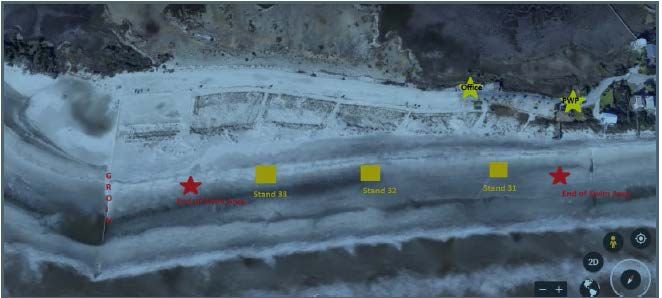
rigid object” ahead of “Apply seawater to affected
                area”
 Nikki Bowie    Changed “abc’s to ABC’s”                              Page 39    1/31/19
 Nikki Bowie    Corrected “Kristin” to “Kristen”                      Page 43    1/31/19
 Nikki Bowie    Updated calendars from 2018 to 2019                  Pages 44-   1/31/19
                                                                        47
 Nikki Bowie    Removed “to purchase, through CCPRC”                  Page 20    1/31/20
 Nikki Bowie    Added “New” and “to pay for their initial training    Page 20    1/31/20
                course, which included the United States
                Lifesaving Manual of Open Water Lifesaving,
                course completion card and initial USLA
                membership”
 Nikki Bowie    Replaced “$30 a year” with “is included in the       Page 20     1/31/20
                course training fee”
 Nikki Bowie    Added “not allowed are watches that can send         Page 21     1/31/20
                and/or receive messages or access the internet”
 Nikki Bowie    Updated Calendars from 2019 to 2020                  Pages 45-   1/31/20
                                                                        48
 Nikki Bowie    Added “*The staffing levels listed below are the      Page 24    3/4/20
                preferred minimum to operate with all lifeguard
                rotations covered under normal conditions. In
                instances of severe weather or larger than normal
                attendance, minimums can be increased. If the
                minimum can’t be met, management should contact
                Safety Staff to determine how to provide adequate
                coverage.”

Ocean Rescue Aquatics Manual
Charleston County Park & Recreation Commission
CAPRA Standard 4.1                     4|Page
Approved: January 2020
Next Review: January 2021
TABLE OF CONTENTS
   TABLE OF CONTENTS .......................................................................................................... 5
CCPRC EMPLOYEE MANUAL ACKNOWLEDGMENT FORM ....................................... 6
SECTION A - QUALIFICATIONS FOR LIFEGUARD EMPLOYMENT ........................... 7
   CHARLESTON COUNTY PARK AND RECREATION COMMISSION POSITION
   DESCRIPTION Aquatics Aide – Ocean Rescue ........................................................................ 8
   CHARLESTON COUNTY PARK AND RECREATION COMMISSION POSITION
   DESCRIPTION Ocean Rescue Lifeguard Supervisor .............................................................. 11
   CHARLESTON COUNTY PARK AND RECREATION COMMISSION POSITION
   DESCRIPTION Ocean Rescue Lifeguard ................................................................................ 14
   CHARLESTON COUNTY PARK AND RECREATION COMMISSION POSITION
   DESCRIPTION Junior Lifeguard Instructor ............................................................................ 17
   LIFEGUARDING SPECIAL EVENTS ................................................................................... 19
   UNITED STATES LIFESAVING ASSOCIATION (USLA) .................................................. 20
SECTION B - WORKING CONDITIONS .............................................................................. 21
   UNIFORMS .............................................................................................................................. 21
   LIFEGUARD DAILY ROUTINE ............................................................................................ 23
   LIFEGUARD STAFF LEVELS, ROTATIONS, AND BREAKS ........................................... 24
   SAFETY ................................................................................................................................... 29
   ENVIRONMENT ..................................................................................................................... 36
SECTION C - DAILY TRAINING AND CONDITIONING ................................................. 41
   TRAINING REQUIREMENTS ............................................................................................... 41
   COMPETITION REQUIREMENTS........................................................................................ 43
   CONTACT INFORMATION................................................................................................... 44
   IMPORTANT 2020 DATES .................................................................................................... 45
APPENDIX A .............................................................................................................................. 49

Ocean Rescue Aquatics Manual
Charleston County Park & Recreation Commission
CAPRA Standard 4.1                     5|Page
Approved: January 2020
Next Review: January 2021
CCPRC EMPLOYEE MANUAL ACKNOWLEDGMENT FORM

      EFFECTIVE JULY 01, 2004 AND UPDATED ANNUALLY THE EMPLOYEE
       HANDBOOK IS ISSUED TO ALL PART-TIME AND SEASONAL STAFF.

Nothing in this manual or in any other Commission document constitutes an employee contract.
All employees are at will and may quit at any time for any reason. All policies outlined herein are
invited only as a guide and management retains sole discretion to take a given course of action.
Examples of items addressed include schedules, uniforms, time badges, CCPRC ID Cards,
performance and evaluations, record keeping, disciplinary action, employee benefits, and customer
service expectations. The manual is distributed and must be read prior to any part-time/seasonal
staff beginning work. The staff member is required to sign a form stating he/she has read and
understands all items covered in the manual. The signed form is filed in the employee’s personnel
record.

Employee Name: ___________________________________________

Employee Signature: ______________________ Date: ____________

Facility: __________________________________________________

Ocean Rescue Aquatics Manual
Charleston County Park & Recreation Commission
CAPRA Standard 4.1                     6|Page
Approved: January 2020
Next Review: January 2021
SECTION A - QUALIFICATIONS FOR LIFEGUARD EMPLOYMENT

   1. Must complete a standard application for employment with Charleston County Park and
      Recreation Commission.
   2. Must be at least 16 years of age.
   3. Candidates must produce the signed CCPRC Physician’s Certification prior to
      participating in any training.
   4. Candidates must successfully complete a physical fitness test to include, but not limited
      to:
          a. 500 meter (550 yards) pool swim in 9 minutes or less
          b. 500 meter (550 yards) ocean swim in 10 minutes or less
          c. One mile track run in 7:45 minutes or less
          d. One mile beach run in 8:00 minutes or less
   5. Candidates must successfully complete all scheduled pre-season training sessions.
   6. Candidates will be interviewed by the Facility Management. The purpose of this
      interview is to evaluate an individual’s maturity level, related work or other experience,
      and the ability to communicate and demonstrate job-related knowledge. The interview
      will be conducted without regard to race, sex, color, creed or national origin, marital
      status, and physical or mental disability that does not relate to the ability to perform the
      duties of the position.
   7. A copy of all certifications and training course records must be on file with Charleston
      County Park and Recreation Commission prior to the first day of duty.

Ocean Rescue Aquatics Manual
Charleston County Park & Recreation Commission
CAPRA Standard 4.1                     7|Page
Approved: January 2020
Next Review: January 2021
CHARLESTON COUNTY PARK AND RECREATION COMMISSION
                            POSITION DESCRIPTION
                           Aquatics Aide – Ocean Rescue

                                    General Statement of Job

Under the direct supervision of the Safety Program Manager and Coordinator, the Aquatics Aide
(AA) organizes and directs United States Lifesaving Association (USLA) training. The AA is
responsible for an on-going water safety conditioning and drill plan and for a rescue-training
program, in conjunction with the Ocean Rescue Lifeguard Supervisors, as required by Charleston
County Park and Recreation Commission and the USLA. Performs related work as required. This
position is seasonal and requires early morning/late night, weekend, and holiday work.

                              Specific Duties and Responsibilities

The AA must have a thorough understanding of all open water lifeguard duties as well as all
training materials and educational information implemented by CCPRC. (Refer to “Ocean Rescue
Lifeguard Position Description” for a complete listing of lifeguard duties).
    • Assist the Safety Program Manager and Coordinator and designated park staff in the
        training of the Ocean Rescue Lifeguard Supervisors.
    • Assist with planning and implementing USLA training for new and returning guards.
    • Participate in all scheduled in-service training and, in some instances, lead the training.
    • Assure that all paperwork is being completed in a neat and timely manner.
    • Complete incident reports when required.
    • Conduct on-site training and auditing on a rotating basis at all ocean access parks. This
        includes assisting with observing and signing off on lifeguard’s required training.
    • Work with the Ocean Rescue Lifeguard Supervisors to assure the condition and cleanliness
        of all lifeguard and lifesaving equipment.
    • Plan and conduct in-service training drills for physical fitness and emergency procedures.
    • Submit weekly, a written report to Safety Program Managers on all training, indicating
        number of hours, subjects covered and participants.
    • Assist in and direct others in proper first aid and lifesaving procedures.
    • Act as liaison between lifeguard staff, Management and Safety Program Manager and
        Coordinator.
    • Assist full-time Management with writing disciplinary action reports on lifeguards who
        violate Charleston County Park and Recreation Commission and USLA policies and
        procedures. If a full-time supervisor is not available when the violation occurs, the AA will
        notify the acting supervisor and contact the full-time supervisor.
    • Take an active role in the planning and implementation of the Junior Lifeguard Program,
        and understand that additional working hours may be required during this time.
    • Coordinate competition trainings and selection of team.

Ocean Rescue Aquatics Manual
Charleston County Park & Recreation Commission
CAPRA Standard 4.1                     8|Page
Approved: January 2020
Next Review: January 2021
Required Knowledge, Skills, and Abilities
• Produce the signed CCPRC Physician’s certificate prior to participation in any training
• Candidates must successfully complete a physical fitness test to include, but not limited to:
500 meter (550 yards) pool swim in 9 minutes or less, 500 meter (550 yards) ocean swim
in 10 minutes or less, one mile track run in 7:45 minutes or less and one mile beach run in
8 minutes or less and maintain required fitness level throughout employment
• Satisfactorily complete in-house United States Lifesaving Association curriculum
• Ability to function outdoors in a wide range of weather conditions
• Ability to provide outstanding customer service to our visitors
• Ability to follow instructions effectively and to work with minimum supervision in a
responsible and competent manner; to readily accept directions from those in a supervisory
capacity; to be able to accept constructive criticism without resentment; and to project good
public relations
• Ability to establish and maintain an effective working relationship with fellow employees;
deal courteously and firmly with the public; demonstrate good judgment, tact and courtesy,
good physical health
• Ability to perform in high stress situations
• Ability to establish professional contact with Public Safety and Emergency personnel
• Ability to make suggestions and share observations
• Ability to pass a criminal background check and drug test
• Maintain a valid vehicle operator’s license and reliable transportation
Minimum Training and Experience
Must be 18 years of age
Successful completion of physical fitness test prior to employment and maintain required fitness
level throughout employment
Experience in open water lifeguarding. Experience at the supervisory level preferred
Working Conditions and Physical Abilities
Work is in the outdoor beach environment. Emergency, rescue or first aid situations are of a
varied nature which could result in degrees of mental and physical stress.
Must possess a clear speaking voice and the ability to communicate. This position requires a
professional demeanor and an orientation towards customer service.
Duty that demands individual to be in the “public eye” for long periods, requiring good
communication skills and a professional attitude at all times; includes scrutiny by supervisors via
videotape, interview and/or skills tests.
Ocean Rescue Aquatics Manual
Charleston County Park & Recreation Commission
CAPRA Standard 4.1 9|Page
Approved: January 2020
Next Review: January 2021While performing the duties of this job, the employee is regularly required to sit, walk, run and stand; use hands to finger, handle, or feel; reach with hands and arms; speak, hear and see. The employee is occasionally required to stoop, kneel, crouch or climb. The noise level in the work environment is usually moderate. May occasionally need to lift/move heavy weights. Ocean Rescue Aquatics Manual Charleston County Park & Recreation Commission CAPRA Standard 4.1 10 | P a g e Approved: January 2020 Next Review: January 2021
CHARLESTON COUNTY PARK AND RECREATION COMMISSION
                            POSITION DESCRIPTION
                         Ocean Rescue Lifeguard Supervisor

                                   General Statement of Job

Under the direct supervision of Facility Management, the Ocean Rescue Lifeguard Supervisor
directs beachfront lifeguarding activities, safety and maintenance of beachfront and other park
areas. This position is responsible for the direct supervision of beach lifeguards. The Ocean Rescue
Lifeguard Supervisor is responsible for an on-going water safety conditioning and drill program
and for a rescue training program as required by Charleston County Park and Recreation
Commission and United States Life Saving Association (USLA). This position is seasonal and
requires early morning/late night, weekend and holiday work.

                              Specific Duties and Responsibilities

Example of Duties:
   • Responsible for the overall safety of visitors using the facilities
   • Responsible for the conduct and performance of the lifeguards
   • Ability to conduct in-service training, physical conditioning drills, rescue and emergency
     procedure drills
   • Supervise and assist lifeguards in the performance of their duties
   • Provide first aid and emergency medical aid to visitors and respond to other emergencies
     as needed
   • Responsible for the condition, cleanliness and safety inspections of all lifeguard and
     lifesaving equipment
   • Ability to conduct first aid inventory on a weekly basis
   • Submit written or oral reports as needed to include, but not limited to: first aid reports,
     incident reports and weather condition reports
   • Responsible for ensuring accurate compiling and submitting of daily and weekly
     statistics, training reports, and equipment checks.
   • Responsible for ensuring that all lifeguards meet or exceed weekly USLA training
     requirements.
   • Ensure that all activities and operations are conducted in accordance with established
     procedures and policies
   • Enforce rules, safety regulations and general facility rules for the visitors
   • Ensure the health, safety and welfare of park visitors
   • Communicate with supervisors and coworkers on a regular basis
   • Responsible for the cleanliness and general upkeep of park facilities
   • Ability to maintain training requirements
   • Respond to special requests, complaints and suggestions from park visitors in an effective
     manner
   • Perform other duties as required

Ocean Rescue Aquatics Manual
Charleston County Park & Recreation Commission
CAPRA Standard 4.1                    11 | P a g e
Approved: January 2020
Next Review: January 2021
Required Knowledge, Skills, and Abilities
• Produce the signed CCPRC Physician’s certificate prior to participation in any training
• Candidates must successfully complete a physical fitness test to include, but not limited to:
500 meter (550 yards) pool swim in 9 minutes or less, 500 meter (550 yards) ocean swim
in 10 minutes or less, one mile track run in 7:45 minutes or less and one mile beach run in
8 minutes or less and maintain required fitness level throughout employment
• Satisfactorily complete in-house United States Lifesaving Association curriculum
• Ability to function outdoors in a wide range of weather conditions
• Ability to provide outstanding customer service to our visitors
• Ability to follow instructions effectively and to work with minimum supervision in a
responsible and competent manner; to readily accept directions from those in a supervisory
capacity; to be able to accept constructive criticism without resentment; and to project good
public relations
• Ability to establish and maintain an effective working relationship with fellow employees;
deal courteously and firmly with the public; demonstrate good judgment, tact and courtesy,
good physical health
• Ability to perform in high stress situations
• Ability to establish professional contact with Public Safety and Emergency personnel
• Ability to make suggestions and share observations
• Ability to pass a criminal background check and drug test
• Maintain a valid vehicle operator’s license and reliable transportation
Minimum Training and Experience
Must be 18 years of age
Successful completion of physical fitness test prior to employment and maintain required fitness
level throughout employment
Experience in open water lifeguarding. Experience at the supervisory level preferred
Working Conditions and Physical Abilities
Work is in the outdoor beach environment. Emergency, rescue or first aid situations are of a
varied nature which could result in degrees of mental and physical stress.
Must possess a clear speaking voice and the ability to communicate. This position requires a
professional demeanor and an orientation towards customer service.
Duty that demands individual to be in the “public eye” for long periods, requiring good
communication skills and a professional attitude at all times; includes scrutiny by supervisors via
videotape, interview and/or skills tests.
While performing the duties of this job, the employee is regularly required to sit, walk, run and
stand; use hands to finger, handle, or feel; reach with hands and arms; speak, hear and see. The
Ocean Rescue Aquatics Manual
Charleston County Park & Recreation Commission
CAPRA Standard 4.1 12 | P a g e
Approved: January 2020
Next Review: January 2021employee is occasionally required to stoop, kneel, crouch or climb. The noise level in the work environment is usually moderate. May occasionally need to lift/move heavy weights. Ocean Rescue Aquatics Manual Charleston County Park & Recreation Commission CAPRA Standard 4.1 13 | P a g e Approved: January 2020 Next Review: January 2021
CHARLESTON COUNTY PARK AND RECREATION COMMISSION
                           POSITION DESCRIPTION
                            Ocean Rescue Lifeguard

                                  General Statement of Job

Under the general supervision of the Facility Manager, Assistant Manager, or Operations Manager
and the direct supervision of the Ocean Rescue Lifeguard Supervisor, the CCPRC Ocean Rescue
Lifeguard will perform various duties at beach park facilities operated by the Charleston County
Park and Recreation Commission. This is to include, but not limited to, providing information to
the public, providing first aid and emergency medical aid, enforcing rules and customer service.
This position is seasonal and requires early morning/late night, weekend and holiday work.

                             Specific Duties and Responsibilities
Example of Duties:
   • Diligently watch the water and beachfront to prevent accidents and injuries
   • Ensure the health, safety and welfare of park visitors
   • Communicate with supervisors and coworkers on a regular basis
   • Ability to provide general park information
   • Perform required maintenance of safety checks of all lifeguard equipment
   • Provide first aid and emergency medical aid to visitors and respond to other emergencies
     as needed
   • Complete neat, concise and accurate written reports on all accidents and incidents
   • Ability to maintain training requirements
   • Respond to special requests, complaints and suggestions from park visitors in an effective
     manner
   • Responsible for the cleanliness and general upkeep of park facilities
   • Ensure that all activities and operations are conducted in accordance with established
     procedures and policies
   • Enforce rules, safety regulations and general facility rules for the visitors
   • Perform other duties as required

                           Required Knowledge, Skills, and Abilities
   •   Produce the signed CCPRC Physician’s certificate prior to participation in any training
   •   Prior to employment, candidates must successfully complete a physical fitness test to
       include, but not limited to: 500 meter (550 yards) pool swim in 9 minutes or less, 500
       meter (550 yards) ocean swim in 10 minutes or less, one mile track run in 7:45 minutes or
       less and one mile run in 8 minutes or less and maintain required fitness level throughout
       employment
   •   Satisfactorily complete in-house United States Lifesaving Association (USLA)
       curriculum and maintain certification
   •   Ability to function outdoors in a wide range of weather conditions
   •    Ability to provide outstanding customer service to our visitors

Ocean Rescue Aquatics Manual
Charleston County Park & Recreation Commission
CAPRA Standard 4.1                    14 | P a g e
Approved: January 2020
Next Review: January 2021
• Ability to follow instructions effectively and to work with minimum supervision in a
responsible and competent manner; to readily accept directions from those in a
supervisory capacity; to be able to accept constructive criticism without resentment; and
to project good public relations
• Ability to establish and maintain an effective working relationship with fellow
employees; deal courteously and firmly with the public; demonstrate good judgment, tact
and courtesy, good physical health
• Ability to perform in high stress situations
• Ability to establish professional contact with Public Safety and Emergency personnel
• Ability to make suggestions and share observations
• Ability to pass a criminal background check and drug test
• Maintain reliable transportation
Ocean Rescue Aquatics Manual
Charleston County Park & Recreation Commission
CAPRA Standard 4.1 15 | P a g e
Approved: January 2020
Next Review: January 2021Minimum Training and Experience
Must be 16 years of age
Successful completion of physical fitness test prior to employment and maintain required fitness
level throughout employment
Experience in open water lifeguarding preferred
Working Conditions and Physical Abilities
Work is in the outdoor beach environment. Emergency, rescue or first aid situations are of a
varied nature which could result in degrees of mental and physical stress.
Must possess a clear speaking voice and the ability to communicate. This position requires a
professional demeanor and an orientation towards customer service.
Duty that demands individual to be in the “public eye” for long periods, requiring good
communication skills and a professional attitude at all times; includes scrutiny by supervisors via
videotape, interview and/or skills tests.
While performing the duties of this job, the employee is regularly required to sit, walk, run and
stand; use hands to finger, handle, or feel; reach with hands and arms; speak, hear and see. The
employee is occasionally required to stoop, kneel, crouch or climb. The noise level in the work
environment is usually moderate.
May occasionally need to lift/move heavy weights.
Ocean Rescue Aquatics Manual
Charleston County Park & Recreation Commission
CAPRA Standard 4.1 16 | P a g e
Approved: January 2020
Next Review: January 2021CHARLESTON COUNTY PARK AND RECREATION COMMISSION
POSITION DESCRIPTION
Junior Lifeguard Instructor
General Statement of Job
Under the direct supervision of the Safety Program Manager, Safety Program Coordinator, and
Aquatic Aide, Junior Lifeguard Instructors (JLI) organize and direct the Junior Lifeguard
Program (JLP). JLI are responsible for planning and implementing all sessions of the JLP, in
accordance with CCPRC and the USLA. Performs related work as required. This position is
seasonal and requires early morning/late night, weekend and holiday work.
Specific Duties and Responsibilities
JLIs must have a thorough understanding of all lifeguard duties as well as educational
information implemented by CCPRC. Previous camp counselor experience is preferred. (Refer
to “Ocean Rescue Lifeguard Position Description “for a complete listing of lifeguard duties).
JLIs will be expected to:
• Produce a list of all needed program supplies.
• Assist the Safety Program Staff in producing a curriculum for all program sessions.
• Work with Ocean Access Facility Managers to determine any assistance needed with
program.
• Provide a schedule for Ocean Access Facility Managers on all times that program or staff
will be in the Park.
• Assure the safety of program participants by having all program staff in the water for any
water-related activities.
• Coordinate with Park and Program Services in assuring all proper paperwork from
participants is received and filed.
• Schedule and implement all pre-testing.
• Respond to all inquiries concerning the Junior Lifeguard Program.
Required Knowledge, Skills, and Abilities
JLIs should have training and at least 1-year working experience in lifeguarding or camp
counseling. Must have thorough knowledge and skills in the methods and practices of open-
water safety. Prefer previous working experience with children ages 10 and up. Must be honest,
mature, dependable and able to maintain effective working relationships with fellow employees,
supervisors and the general public.
Ocean Rescue Aquatics Manual
Charleston County Park & Recreation Commission
CAPRA Standard 4.1 17 | P a g e
Approved: January 2020
Next Review: January 2021• Minimum requirements: Certification with nationally recognized lifeguarding program
and CPR for the Professional Rescuer or the equivalent prior to employment
• Ability to complete and maintain training levels of the United States Lifesaving
Association (USLA) open water lifeguard training.
• Ability to supervise others effectively.
• Ability to follow instructions and to work with minimum supervision in a responsible and
competent manner; to readily accept directions from those in a supervisory capacity; to
be able to accept constructive feedback; and to project good public relations.
• Ability to prepare neat and complete reports as required.
• Ability to obtain membership with the United States Lifeguard Association (USLA).
Minimum Training and Experience
Education equivalent to a High School diploma preferred. Experience in open water lifeguarding
and camp counseling preferred.
Must be 18 years of age
Working Conditions and Physical Abilities
Work is in the outdoor beach environment. Emergency, rescue or first aid situations are of a
varied nature which could result in degrees of mental and physical stress.
Must possess a clear speaking voice and the ability to communicate. This position requires a
professional demeanor and an orientation towards customer service.
Duty that demands individual to be in the “public eye” for long periods, requiring good
communication skills and a professional attitude at all times; includes scrutiny by supervisors via
videotape, interview and/or skills tests.
While performing the duties of this job, the employee is regularly required to sit, walk, run and
stand; use hands to finger, handle, or feel; reach with hands and arms; speak, hear and see. The
employee is occasionally required to stoop, kneel, crouch or climb. The noise level in the work
environment is usually moderate.
May occasionally need to lift/move heavy weights.
Ocean Rescue Aquatics Manual
Charleston County Park & Recreation Commission
CAPRA Standard 4.1 18 | P a g e
Approved: January 2020
Next Review: January 2021LIFEGUARDING SPECIAL EVENTS CCPRC ocean rescue lifeguards, as a part of their employment, may be scheduled to lifeguard certain special events that contain a swimming or aquatic element, such as the Sprint Triathlon Series and other local aquatic events. Hours worked during these events will be monitored and added to each lifeguard’s weekly time. Lifeguards, while on duty during these events, are expected to follow all policies and procedures, rules of conduct and responsibilities contained in the Aquatics Manual. Ocean Rescue Aquatics Manual Charleston County Park & Recreation Commission CAPRA Standard 4.1 19 | P a g e Approved: January 2020 Next Review: January 2021
UNITED STATES LIFESAVING ASSOCIATION (USLA)

Training and Certification

The USLA is the governing body and authority for open water lifesaving and beach
management.

“USLA maintains the only certification program for beach lifeguard agencies. The program’s
goal is to ensure that adequate, consistent levels of beach safety are maintained at beaches
throughout the United States. Under this program, USLA has developed and published minimum
recommended training and employment standards for beach lifeguards. Beach lifeguard agencies
which conform to these minimum recommended standards may apply to USLA for certification
of their compliance. Once certified by USLA, beach lifeguard agencies may certify lifeguards
they train as having successfully completed a USLA certified course.”

Ocean rescue lifeguards are required to pay for their initial training course which includes The
United States Lifesaving Association Manual of Open Water Lifesaving, course completion card
and USLA membership. This cost is required to be paid at the employee’s initial training, at
which time a receipt will be issued making the employee eligible to participate in the required
training program.

The manual is like no other lifeguarding manual. We consider this manual to be the definitive
guide to procedures, beachfront operations and training distinct to an open water lifeguard’s
occupational environment.

Ocean rescue lifeguards are required to complete 48 hours of on-site training in USLA open
water lifesaving and first aid skills prior to officially working. Completion of this training is
mandatory and is a condition of employment. Upon successful completion of all training,
lifeguards will receive a USLA course completion card.

Any lifeguard who fails to make him/herself available for this training within a reasonable
amount of time after hire, or, who is absent for scheduled trainings will be subject to disciplinary
action or possible dismissal.

Membership

CCPRC ocean rescue lifeguards are required to obtain membership with the USLA. Membership
includes eligibility to participate in Regional and National competitions, attend Regional and
National meetings, a subscription to American Lifeguard Magazine and access to www.usla.org.
Cost for membership is included in the course fee and is required to be paid at the employee’s
initial training.

Ocean Rescue Aquatics Manual
Charleston County Park & Recreation Commission
CAPRA Standard 4.1                    20 | P a g e
Approved: January 2020
Next Review: January 2021
SECTION B - WORKING CONDITIONS
UNIFORMS

                                        Lifeguard Uniforms
Lifeguard uniforms are designed to assure easy and quick recognition by visitors. For this reason,
the lifeguard emblem must be displayed at all times. Therefore, additional clothing that obstructs
the view of lifeguards’ identification insignias will not be worn. Females have the option of
wearing CCPRC provided cover shorts. These are not mandatory, however are the only cover
shorts allowed to be worn with the uniform. Lifeguard uniforms must be worn as issued with
no alterations.

CCPRC will pay for the employee’s required base uniform. The base uniform will consist of 2
swim suits, 1 pair of cover shorts (female only), 3 t-shirts, 1 rash guard, 1 hat, 1 jacket, 1 water
cooler, 1 whistle/lanyard, 1 fanny pack, 1 seal easy mask, and one pair of fins. Any additional or
replacement items will be available for purchase to the employee at full price.

Lifeguards are required to provide a wristwatch, (not allowed are watches that can send and/or
receive messages or access the internet) and a pair of quality sunglasses. Long hair must be tied
back or otherwise secured prior to going on duty. The only acceptable jewelry is the required
watch. No other jewelry is permitted.

    WEARING LIFEGUARD UNIFORMS WHILE OFF DUTY OR AS A GUEST AT
             ANOTHER FACILITY IS STRICTLY PROHIBITED

Ocean Rescue Aquatics Manual
Charleston County Park & Recreation Commission
CAPRA Standard 4.1                    21 | P a g e
Approved: January 2020
Next Review: January 2021
Sun Protection Procedure
Skin cancer is the fastest growing form of cancer in the United States with over 3.5 million new
cases diagnosed each year. It's widely known that protection from the sun's rays could prevent
about 90% of all skin cancer cases. Youth are the most at risk for overexposure and have the
highest rates of disease due to overexposure before the age of 18. Protection includes covering
up, seeking shade, using sunscreen properly, and avoiding staying outside too long during peak
sun hours.
Lifeguards’ uniforms - tee shirt/rash guard, hat, sunglasses - along with issued sunscreen,
provide barriers to the sun and other elements. Sitting under an umbrella is another form of
protection.
Ocean rescue lifeguards will adhere to the following minimum standards for sun protection:
Required Sun Protection and Personal Lifeguard Items
Beach Rover Water Rover Training
Lifeguard Between Training
(includes (on board/kayak Break Swim/Board PWC
Stand Stands Run
shallow water) or wading) /Kayak
SPF 30
X X X X X X X X
Sunscreen
unless on
Sunglasses X X X X X
board/kayak
unless
Hat X X X X Helmet
shaded
T-Shirt/Rash unless Rash Guard unless Shirt Rash Guard Rash Guard
X X
Guard/Jacket shaded encouraged shaded encouraged encouraged encouraged
Shaded by when in
umbrella use
Whistle X X X X X X X X
Watch X X X X X X X X
Fanny Pack X X X X X
unless on
Rescue Buoy X X X X Swim X
board/kayak
anytime anytime
Radio X X
available available
Life Jacket Kayak Kayak X
Lifeguards will be required to properly wear the issued uniform and comply with the
hairstyle and jewelry policy and the sun protection policy at all times while on duty.
Any refusal, misuse or alteration without prior approval of park management will be
treated as insubordination and will result in disciplinary action.
Ocean Rescue Aquatics Manual
Charleston County Park & Recreation Commission
CAPRA Standard 4.1 22 | P a g e
Approved: January 2020
Next Review: January 2021LIFEGUARD DAILY ROUTINE
The following is a general schedule of duties that will be
monitored by the Lifeguard Supervisor and is expected to be
adhered to daily.
1. Clock in at assigned time. Be punctual.
2. Check in with Facility Management and Lifeguard
Supervisor.
3. Perform water, beachfront, rescue equipment, first aid
equipment and vehicle checks noting conditions,
currents, winds, tides, improperly working or unaccounted for equipment. Stock first aid
kit if necessary.
4. Transport to beachfront, and set up, proper signage, rescue and first aid
equipment. This includes:
a. all kayaks and PFDs, rescue boards, spinal boards, and other rescue equipment
transported daily and stationed on the beachfront at lifeguard stands for the
duration of operating hours.
b. all lifeguard stands equipped and manned by the beginning of the shift, daily. The
only exception is severe weather.
c. Guards must be at least age 18 years of age to drive PRC vehicles, including;
Gators, Club Cars, ATVs, trucks, PWCs, etc.
5. Participate in scheduled in-service training as prescribed by acting supervisor.
6. Communicate beachfront and water hazards and conditions to the Gatekeeper and
Facility Management. Update conditions and hazards throughout the day with the same
personnel.
7. Follow assigned rotation schedule to ensure coverage of the water and safety of patrons.
8. Participate in assigned/scheduled conditioning and drills.
9. At end of last shift, notify visitors of swimming area and park closing by one long air horn
or whistle blast, accompanied with waving the red flag and verbal communication to
remaining patrons. Assist Management with clearing park of remaining visitors.
10. Lifeguard Supervisor completes all required paperwork, including logbook and rescue
report. If the Lifeguard Supervisor is not present, another lifeguard will be assigned the
job. The Lifeguard Supervisor is ultimately responsible for all paperwork being completed.
11. Collect trash, lost and found articles (to Management); transport, clean and store equipment
and vehicles; move and lay down lifeguard stands well above high tide mark.
12. Perform equipment and first aid closing check. Restock first aid kits as needed and report
any broken/missing equipment.
13. Check with Management for any remaining duties.
14. Clock out.
Ocean Rescue Aquatics Manual
Charleston County Park & Recreation Commission
CAPRA Standard 4.1 23 | P a g e
Approved: January 2020
Next Review: January 2021LIFEGUARD STAFF LEVELS, ROTATIONS, AND BREAKS
Ocean Rescue Lifeguard Preferred Minimum Staffing Levels
*The staffing levels listed below are the preferred minimum to operate with all lifeguard
rotations covered under normal conditions. In instances of severe weather or larger than normal
attendance, minimums can be increased. If the minimum can’t be met, management should
contact Safety Staff to determine how to provide adequate coverage.
Beachwalker Park will a carry seasonal staff of up to 8 lifeguards. Managers should base
their schedules on the following minimum staff levels:
• May and September weekends, August weekdays: 3 lifeguards (can include lifeguard
supervisor).
• June, July weekdays and weekends, August weekends: 3 - 4 lifeguards (can include
lifeguard supervisor).
• Holidays: 4 lifeguards.
Folly Beach will carry a seasonal staff of up to 45 lifeguards. Managers should base their staff
schedules on the following minimum staff levels:
Folly Beach County Park
• May and September weekends: 3 lifeguards.
• June, July weekdays and weekends, August weekends: 5 lifeguards.
• Holidays: 5 lifeguards.
• August weekdays: 4 lifeguards
Folly Beach Pier
Memorial Day, July 4th and Labor Day weekends: 12 lifeguards
• June, July and August weekdays: 9 lifeguards; weekends:10 lifeguards
Isle of Palms County Park will carry a seasonal staff of up to 15 lifeguards. Managers
should base their staff schedules on the following minimum staff levels:
• May and September weekends: 4 lifeguards.
•June, July and August weekdays: 4 lifeguards; weekends: 5 lifeguards.
•Holidays: 5 lifeguards.
* Weekly lifeguard supervision in August will be curtailed once Charleston
County Schools go back in session.
Ocean Rescue Aquatics Manual
Charleston County Park & Recreation Commission
CAPRA Standard 4.1 24 | P a g e
Approved: January 2020
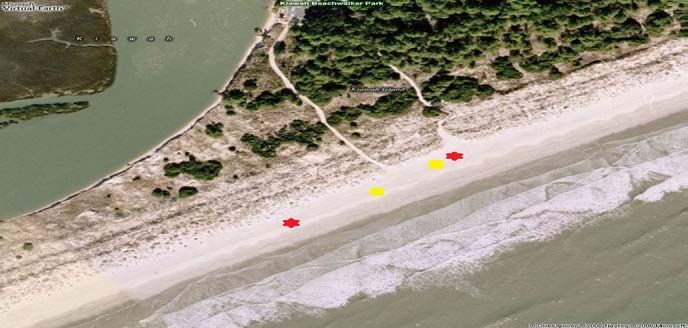
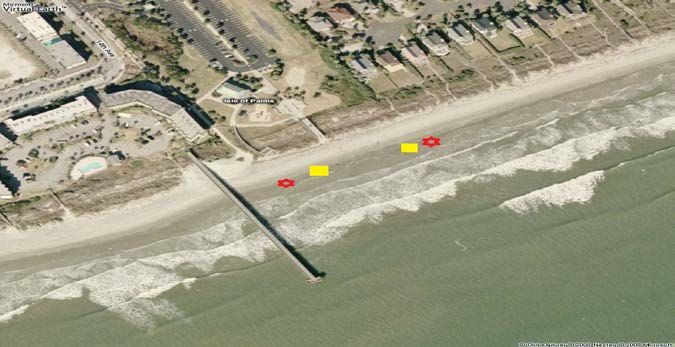
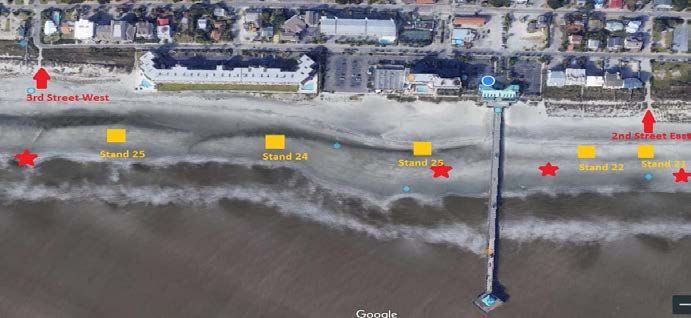
Next Review: January 2021Swimming Areas Following is a list of the swimming areas at each facility. Regardless of crowd levels, the swimming area will always remain the same and “End of Swimming Area” signs will be placed in the same position every day. Coverage may then be adjusted due to crowds, water conditions, and/or inclement weather by adding rovers. The yellow squares indicate where lifeguard stands are placed and the red stars indicate the guarded swimming areas. The Beachwalker swimming area is approximately 175 yards. The guarded area begins to the East (left) of the boardwalk. The guarded area ends to the West (right) at the “Dangerous Currents” sign. The Folly Beach County Park swim area is 500 yards. The swim area begins at the Pelican Watch Shelter to the East and ends to the West at the end of the fenced parking lot, marked by a “Dangerous Currents: No Swimming Beyond This Point” sign on the beach. The swim area ends approximately 150 yards before the groin. Ocean Rescue Aquatics Manual Charleston County Park & Recreation Commission CAPRA Standard 4.1 25 | P a g e Approved: January 2020 Next Review: January 2021
The swim area at the Folly Beach Commercial District is approximately 850 yards, with a
 break of 200 feet on either side of the pier designated as “No Swimming” zones. The guarded
 area begins at 2nd Street East and extends to 3rd Street West.

 The Isle of Palms guarded area is approximately 115 yards. This swimming zone begins at
 the handicap boardwalk (200 feet from the pier) and ends before the houses to the North.
 There is no swimming or surfing allowed between the swim area and the pier.

Ocean Rescue Aquatics Manual
Charleston County Park & Recreation Commission
CAPRA Standard 4.1                    26 | P a g e
Approved: January 2020
Next Review: January 2021
Lifeguard Rotations
 There will be no break or delay in the supervision of the areas of responsibility during
 rotations. Only changes in orders or special instructions should be exchanged between
 rotating lifeguards.

 Lifeguards will follow a 45 minute rotation at each position, as outlined by the Lifeguard
 Supervisor or Manger on Duty.

                                       Lifeguard Scanning
 When scanning, or watching the water, the lifeguard’s head should be in constant movement
 and posture should be “rescue ready.” The head should be visibly moving up and down and
 from side to side in order to ensure that all blind spots are being addressed and covered. The
 lifeguard should be sitting up or standing, with their whistle, flag, and radio (when possible)
 organized so as to be able to respond to an emergency and communicate the needs of said
 emergency at all times.

 While holding a position that monitors patrons in the water, lifeguards will utilize two
 scanning strategies – the 30/120 Rule and the 5 Minute Strategy - to ensure appropriate
 coverage. The 30/120 Rule states that a lifeguard must visually cover every part of the
 assigned water in no more than 30 seconds, and be able to reach any area of the water in under
 120 seconds (2 minutes). The 5 Minute Strategy calls for lifeguards to change their posture,
 perspectives, and scanning pattern every five minutes. The objective is to help lifeguards stay
 physically more aware by promoting a higher respiratory rate and to help them stay mentally
 more alert by changing the mental and physical process every five minutes.

Rotation Conduct
 The incoming lifeguard takes a position next to the stand, facing the water and observes the
 area of responsibility for that stand. When (s)he is aware of the ongoing activity (s)he signals
 the lifeguard in the stand who can then climb down. Once on the beach, the outgoing lifeguard
 takes a position next to the stand, facing the water and scans the water while the incoming
 lifeguard ascends the stand. Once in the stand, the new lifeguard is responsible for the area
 and signals to the outgoing lifeguard that the area is covered.

 When rotating to a roving position, the incoming lifeguard will approach the rover and while
 both are facing the water exchange equipment and any pertinent information. If it is a water
 rover position, the water rover will return to shore at the appropriate time to rotate and watch
 the water while they wait for their relief. Rovers should not approach the lifeguard stand to
 wait for their replacement.

 Relief breaks will be scheduled into the rotation and should allow for the supervision of all
 areas during relief periods. Lifeguards cannot leave the area except for training, sudden illness,
 scheduled breaks or emergencies.

Ocean Rescue Aquatics Manual
Charleston County Park & Recreation Commission
CAPRA Standard 4.1                    27 | P a g e
Approved: January 2020
Next Review: January 2021
Positions
POSITION DUTIES
LIFEGUARD STAND • Watch beach and waterfront
• Prevent accidents
• Maintain radio contact
• Administer first aid
BEACH ROVER • Be aware of hazards/conditions
• Carry radio
• Patrol edge of water
• Be aware of small children
• Monitor swimming area
• Customer relations
WATER ROVER • Keep swimmers within safe
distance to shore- chest deep
• Paddle rescue board/kayak
through swimming area-past
deepest swimmers
• Be aware of hazards/conditions
• If kayak patrol, wear PFD
TRAINING • Complete minimum weekly
training as outlined by the USLA
• Ensure that there is always
complete beach coverage prior to
leaving the park for any long-
distance training
BEACH PATROL • Patrol Beachfront
• Collect Litter, Lost/Found Items
• Promote Beach Safety
• Report Hazards
• Enforce Park Rules
• Customer Relations
LUNCH BREAK • Guards receive 1 lunch break
where they must clock out for at
least 30 minutes but no more
than 45 minutes.
All designated positions will be equipped and manned at the beginning of the shift daily, the only
exception being severe weather.
A rotation cycle includes all positions, giving each lifeguard a variety of duties and
responsibilities, contributing to higher levels of alertness and attentiveness. The position
rotation and break schedule will be determined by the Lifeguard Supervisor or Park
Management.
There will be no more than one lifeguard assigned per stand unless management deems it
necessary. All attempts will be made to provide maximum coverage of the swimming area.
Ocean Rescue Aquatics Manual
Charleston County Park & Recreation Commission
CAPRA Standard 4.1 28 | P a g e
Approved: January 2020
Next Review: January 2021The following chart details equipment requirements for each station:
Flags Binoculars First Aid Clip Radio Rescue Rescue Buoy Umbrella Kayak Backboard
Kit/Water Boards Cans Board Equipment
w/reports
Main X X X X X X X X X X X
Stand
Other X X X X X X X X
Stands
SAFETY
Safety is expected to be a prime objective of all personnel. Responsibility for the
welfare of facility guests cannot be delegated or evaded. It is the responsibility of Park
Management, lifeguard supervisors and other supervisory personnel to assure that public
safety is upheld through efficient assigning of lifeguard personnel.
Rule Enforcement
A lifeguard’s prime responsibility with Charleston County Park and Recreation
Commission is water safety, not law enforcement. The following steps will be taken to
effectively coordinate safety regulations by the lifeguard and law enforcement by local
police departments:
-politely inform visitor of the rule being violated. Explain why the rule exists.
-if he/she persists in the violation, request assistance from Park Management
who will in turn request police assistance if necessary.
Lifeguards must avoid considering themselves to be law enforcement agents. Not only
does it extend well beyond the scope of assigned duties, but it also draws the lifeguard’s
attention away from her/his primary area of responsibility - the water.
Communications Systems
Flag System:
A flag system has been incorporated at CCPRC guarded beach facilities in order to serve
as a means of communication between visitors and the lifeguard staff. The flags, which
are color-coded, are prominently displayed on each lifeguard stand and at boardwalks to
the beach to indicate whether safe or unsafe swimming and oceanfront conditions exist.
The color code is as follows:
Ocean Rescue Aquatics Manual
Charleston County Park & Recreation Commission
CAPRA Standard 4.1 29 | P a g e
Approved: January 2020
Next Review: January 2021The Lifeguard Supervisor or Facility Manager will determine the condition of the beach and swimming area daily and indicate what color flag will be displayed. Should conditions change during the day, the color flag will be changed if the situation warrants. Flag changes will be made with approval of Lifeguard Supervisor or Facility Manager. Lifeguards will notify Gatekeeper and Facility Management of any flag and/or condition changes due to weather, water conditions or accident so guests may be informed. Radios: The beach facilities are equipped with a fleet of walkie-talkie style radios. Each lifeguard stand, rover and guard on break should have a radio or be within earshot of radio transmissions. In the event of a rescue, drill or other emergency, Managers and guards on rove or break will be alerted to a “Rescue” call and respond to the area in need immediately. Gate Attendant can be alerted to call for Police, Fire or EMS backup, if needed. In the event of National Weather Service severe weather alerts, the Gate Attendant should notify lifeguard staff via radio, and vice versa - lifeguards will regularly update the Gate Attendant as to current beachfront conditions. Ocean Rescue Aquatics Manual Charleston County Park & Recreation Commission CAPRA Standard 4.1 30 | P a g e Approved: January 2020 Next Review: January 2021
Lifeguard-assigned radios should always be kept in waterproof radio bags during
 operating hours, then taken out of the bags at the end of the day, turned off and returned
 to their respective charging bases.

 Any radios not transmitting or receiving properly should be immediately reported to
 Facility Management and Lifeguard Supervisor. Any charging bases not working should
 also be reported.

 All radios must be kept on assigned facility talk group at all times. Scanning or monitoring
 any talk group other than the facility’s assigned talk group is prohibited.

         (Refer to Seasonal Employee Handbook for Additional Radio Procedures)
Airhorn and Whistle Signals:

Lifeguards’ whistles are not only part of the required uniform and, therefore, to be worn at all
times while on duty, but, they are also an integral part of the park’s communication system.
Whistles are the lifeguards’ primary method of communication with patrons at the park. In
the event that a whistle cannot be heard, an airhorn will serve the same purpose with louder
results.

The following signals are integrated into CCPRC ocean rescue emergency action plans:
ONE SHORT BLAST                            Gets Attention Of A Guest
TWO SHORT BLASTS                           Attention Of A Staff Member
THREE SHORT BLASTS                         Activate Emergency Action Plan
ONE LONG BLAST                             Clears The Water

Equipment Signals:
Lifeguards will always have their rescue tube/buoy with them while on duty and should know
the following equipment signals:

                                                                         Situation Under Control
 RESCUE TUBE HELD HORIZONTALLY OVER HEAD
                                                                             Need Assistance
  RESCUE TUBE HELD VERTICALLY OVER HEAD
                                                                              Emergency –
         RESCUE TUBE TWISTING SIDE TO SIDE                                Possible Spinal Injury
                                                                      Or Resuscitation Case Neede

Ocean Rescue Aquatics Manual
Charleston County Park & Recreation Commission
CAPRA Standard 4.1                    31 | P a g e
Approved: January 2020
Next Review: January 2021
Arm Signals:
The following arm signals are USLA Approved and will be used, as needed, as a part of
CCPRC Ocean rescue emergency action plan:
FINGERS TOUCHING OVERHEAD SITUATION UNDER CONTROL
FORMING A LARGE CIRCLE W/THE ARMS
ONE ARM RAISED STRAIGHT UP ASSISTANCE NEEDED
ONE ARM WAVING SIDE TO SIDE RESUSCITATION CASE
NEEDED
OR POSSIBLE SPINAL INJURY
ARMS CROSSED OVER HEAD SUBMERGED SWIMMER
Ocean Rescue Aquatics Manual
Charleston County Park & Recreation Commission
CAPRA Standard 4.1 32 | P a g e
Approved: January 2020
Next Review: January 2021Emergency Procedures for CCPRC - Ocean Access Parks
The following is meant to be a general outline in an emergency situation. On-site drills at
facilities will be conducted on a regular basis in order to allow all staff the opportunity to
become accustomed to responding in emergency situations. Through this training,
employees will also become familiar with all forms of the facility’s communication system
and understand the peculiarities of each situation.
Lifeguard sighting victim radios their current location,
SWIMMER SIGHTED IN the phrase “rescue, rescue,” and the location of the
DIFFICULTY swimmer. If no radio is available, the guard will utilize
a whistle.
Guard closest to victim attempts to rescue, aided by
Rover. Another guard should immediately move to
cover that stand. (Main stand remains manned at all
LIFEGUARD STAFF ALERTED times to maintain visual contact with victim and radio
contact with Management and Gate Attendant.
Management will call for EMS if needed.)
The guard in the main stand will maintain visual
contact with the victim and will show their location by
MAIN STAND MAINTAINS VISUAL pointing with a flag or rescue tube. An additional
CONTACT guard and/or member of management staff should
continue scanning the swimming area to ensure the
safety of other swimmers.
Upon reaching the victim, the rescuing guard will
signal to main stand if the situation is under control or
VICTIM IS CONTACTED if (s)he needs back-up. The guard on main stand will
motion back, mirroring the rescuer’s arm signal, to
show message received, and act accordingly.
Treated accordingly until EMS arrives. BLS
VICTIM REMOVED FROM WATER administered using Universal Precautions.
If BLS is necessary or there is another major
emergency which prohibits lifeguards from returning
to their position, the water must be closed via one
SEVERITY OF SITUATION long whistle blast and red flags displayed. Gate
Attendant alerted to closure. Remaining guards keep
water clear and exercise crowd control.
All serious accidents will immediately be reported to
Safety Program Staff, Assistant Director and/or
Director of Parks at their office, home or cell phone,
without exception. Management will complete
REPORTING INCIDENT Incident/Accident reports as soon as possible.
Staff will refrain from talking to the media, referring
all questions to the Manager.
Ocean Rescue Aquatics Manual
Charleston County Park & Recreation Commission
CAPRA Standard 4.1 33 | P a g e
Approved: January 2020
Next Review: January 2021You can also read


