Online Decision Support Tool That Explains Temporal Prediction of Activities of Daily Living (ADL)
←
→
Page content transcription
If your browser does not render page correctly, please read the page content below
This paper has been presented at HEALTHINF 2021
HEALTHINF21-RP-80

                Online Decision Support Tool That Explains
            Temporal Prediction of Activities of Daily Living (ADL)

    Janusz Wojtusiak1, Negin Asadzaehzanjani1, Cari Levy2, Farrokh Alemi1 and Allison E. Williams3
             1
              Department of Health Administration and Policy, George Mason University, Fairfax, VA, USA
                                  2
                                    Department of Veterans Affairs, Denver, CO, USA
                                     3
                                       Department of Veterans Affairs, Bay Pines, FL

Keywords:        Machine Learning, Clinical Decision Support, Prediction Explanation, Activities of Daily Living

Abstract:        This paper presents an online decision support tool that can be used to assess and predict functional abilities
                 in terms of nine Activities of Daily Living (ADLs) up to one year ahead. The tool is based on previously
                 developed Computational Barthel Index (CBIT) and has been rebuilt using Gradient Boost (GB) models with
                 average Area under ROC (AUC) of 0.79 (0.77-0.80), accuracy of 0.74 (0.70-0.79), recall of 0.78 (0.58-0.93),
                 and precision of 0.75 (0.67-0.82) when evaluating ADLs for new patients. When re-evaluating patients, the
                 models achieved AUC 0.95 (0.94-0.96), accuracy of 0.91 (0.90-0.92), recall of 0.91 (0.86-0.95), and precision
                 of 0.92 (0.88-0.94). The decision support tool has been equipped with a prediction explanation module that
                 calculates and visualizes influence of patient characteristics on the predicted values. The explanation approach
                 focuses on patient characteristics present in the data, rather than all attributes used to construct models. The
                 tool has been implemented in Python programming language using Flask Web framework and is accessible
                 through a website or an Application Programming Interface (API).

1     INTRODUCTION                                                  However, similar data are not routinely collected for
                                                                    elderly patients outside of nursing homes.
The presented work addresses assessment and                             Assessing and predicting patients’ functional
prediction of functional abilities and their                        status has several important uses in clinical work and
improvement or decline over time as an important                    research. It also allows for an informed discussion
factor in making decision regarding care provided to                between clinicians and patients or caregivers and may
elderly patients. According to Fried et al. (2002),                 help in planning care. This paper presents an online
patients who were aware that they were unlikely to                  decision support tool based on the previously
return to their baseline functional status were less                developed Computational Barthel Index, CBIT
likely to proceed with hospital treatment. Quality of               (Wojtusiak et al. 2020). All models in the original
life (QOL), including functional independence, is                   CBIT have been rebuilt to improve the tool’s
often more important than survival time for many                    performance. The tool allows for automatically
patients (McCarthy et al., 2000). QOL depends on                    assessing current functional status and predicting
many factors, one of which is patients’ functional                  functional status up to one year ahead in terms of the
independence, including the ability to perform basic                ability to perform the ADLs. The system name is
Activities of Daily Living (ADLs) and more complex                  inspired by the Barthel index (scale) which is
Instrumental Activities of Daily Living (iADLs).                    standardized instrument for evaluating ADLs
Often, functional ability of nursing home patients is               (Mahoney and Barthel, 1965; Bouwstra et al., 2019).
assessed by direct observation of skilled nurses,                   Specifically, the system considers the ability to assess
which is a time consuming and costly process. In the                and predict independence in bathing, eating,
United States, the assessments are often reported                   grooming, bladder, bowels, dressing, transferring,
using the Minimum Data Set (MDS). It is a                           toileting and walking. The tenth item from the
standardized patient evaluation instrument collected
                                                                    original Barthel scale, stairs, is not included as it is
by nurses through observing patients in consultation
                                                                    impossible to assess in nursing home population.
with other care team members. The assessment data
are collected by nursing homes and entered in MDS                       The problem of assessing and predicting ADLs is
Section G (MDS 3.0 Technical Information, n.d.).                    not new. It is the focus of several works using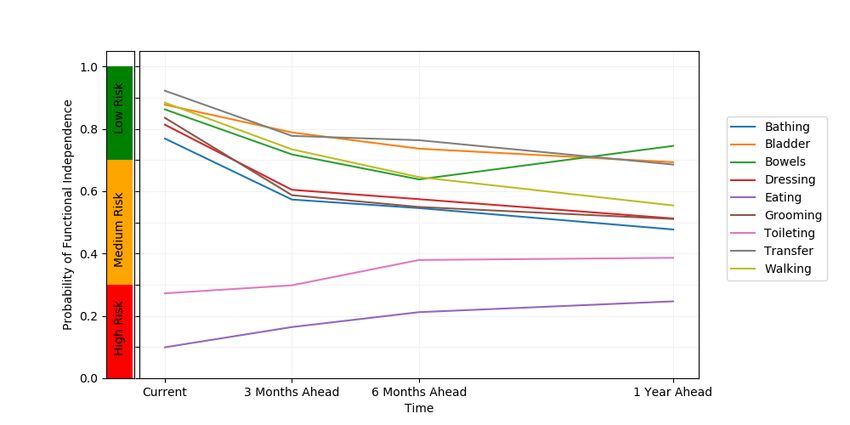
physical and physiological predictors (Gobbens &              explanation is part of prediction. This approach to
van Assen, 2014), activity recognition through                providing explanations is implemented in the
wearable sensors (Stikic et al., 2008), surveys (Min et       presented work and discussed further in Section 4.
al., 2017) and diagnoses (Faurot et al., 2014).                   There are several contributions of the presented
     Clinical Decision Support Systems (CDSS) are a           work. The online tool is based on a set of models that
key component of health information systems and               have been rebuilt from the original CBIT to improve
integral part of clinical workflows (Wasylewicz et al.,       efficiency. The models have good properties in terms
2019). While most commercially available CDSS are             of accuracy and calibration. The tool is accessible
rule-based with sets of rules manually implemented            through the Web as well as an Application
to support guidelines, there is a growing interest in         Programming Interface (API). Finally, the tool
integrating models created by machine learning (ML)           attempts to provide explanations of the predictions.
methods as part of CDSS (Peiffer-Smadja et al.,
2019). Along with triggering alerts, ML-based
models are also used to predict likely outcomes and           2     MODEL CONSTRUCTION
help with diagnosing patients (Belard et al., 2017).
     One important feature of ML-based CDSS is their
ability to provide evidence in supporting predictions
                                                              2.1     Data
(alerts, reminders, recommendations). Such evidence
                                                              Data and model construction followed the process
is typically referred to as prediction explanation and
                                                              used previously to construct the original CBIT
is considered as one of criteria for overall model
                                                              models (Wojtusiak et al., 2020). The data consisted of
transparency. The idea of constructing transparent
                                                              1,901,354 MDS evaluations completed between 2000
machine learning-based models that can explain
                                                              and 2011 with 1,151,222 evaluations for 295,491
predictions is not new and goes back to early machine
                                                              patients. MDS data were mapped to nine Barthel
learning systems in the 1970s and 1980s (Michalski,
                                                              Index categories using a procedure described by
1983). One can consider many reasons for providing
                                                              Wojtusiak et al. (2016). The data were then linked to
explanations and evidence in supporting predictions.
                                                              demographics and history of diagnoses extracted
Most importantly, one needs to gain trust of CDSS
                                                              from medical records. The data consisted of inpatient
users in the predictions. Users are most likely to act
                                                              and outpatient diagnoses coded using the
upon recommendations from CDSS if the system
                                                              International Classification of Diseases, ninth edition
provides an explanation. Khairat et al. (2018) stated
                                                              (ICD-9) standard, and were transformed into 281
that “Physicians must be able to support their decision
                                                              distinct categories using Clinical Classification
and are skeptical of recommendations or claims that
                                                              Software (HCUP CCS, 2017). Only patients with at
lack supporting evidence or transparency.” However,
                                                              least two MDS evaluations were included (to access
it is incorrect to assume that the goal of providing
                                                              “previous status”), resulting in a final dataset of
explanations is only to make users trust the
                                                              855,731 evaluations for 181,213 patients. The final
predictions. Since no machine learning-based model
                                                              data consisted of 578 attributes. The patient cohort
(or any other CDSS) is free of prediction errors
                                                              was split into training (90%) and testing (10%)
(accuracy < 1.0), one should consider explanations an
                                                              datasets. The data were shifted in time by 30, 90, 180
integral part of prediction. The decision makers
                                                              and 360 days to move the prediction horizon for
consider both prediction and provided evidence in
                                                              constructing models that predict future ADLs (Figure
making their final judgement. After reviewing the
                                                              1). It simulates situation in which outcomes (ADLs)
evidence, users may be convinced that the prediction
                                                              are assessed after certain number of days. These
is correct and act accordingly, or that it is not correct
                                                              timepoints were selected based on clinical judgement.
and act in an opposite way. In other words,

                  Figure 1: Preprocessing of data to allow for modeling of future outcomes (ADLs).
In the original CBIT as well as here, diagnoses 1GB and 2GB, totaling about 100GB for all models.
were coded to include the number of days between The size of models made them infeasible for use as
the first as well as the last occurrence of diagnosis to part of the online decision support tool. The server
evaluation time. This simple yet effective temporal running the tool would need to have 128GB+ of RAM
coding system is shown to significantly outperform if all the models were all loaded at the same time.
standard binary (one-hot) coding in which 0/1 Alternatively, the models could be loaded
variables are used to indicate the presence or absence sequentially as the predictions are made.
of a condition. More specifically, each diagnosis code Unfortunately, the latter approach is extremely slow,
CCSi is transformed into two attributes CCSimax (the and prediction of a single case took more than 10
number of days between when the diagnosis was minutes making it unusable as a decision support tool.
present in patient’s record for the first time and the To address this issue, Gradient Boost (GB)
prediction time) and CCSimin (the number of days models were created for the use within the decision
between when the diagnosis was present in patient’s support tool. The GB models are significantly smaller
record most recently and the prediction time). in size and can be easily incorporated in the online
tool. Experimental results show that RF ad GB
2.2 Supervised learning provide comparable results with an overall R2 =0.92
and Kappa=0.86 across all 72 models. This is also
Supervised machine learning was applied to construct illustrated in terms of one model (evaluation of
a total of 72 models for predicting functional status: Bathing) scatterplot from 1000 randomly selected
four time points, nine ADLs, Evaluation/Re- testing patients in Figure 2. Colors are used to
Evaluation models. Specifically, there are 36 output indicate true class, thus green points in the upper right
attributes (dependent variables) for which models are portion of the plot are correctly classified by both
constructed: {Bathing0, Bathing90, … Walking180, models functionally independent patients. Red points
Walking360}. Evaluation models are intended to be in the bottom left part of the plot indicates correctly
used for patients for whom previous functional status evaluated by both models as disabled patients.
is unknown. The models use demographics and Scatterplots for other models show similarly high
diagnoses for assessment and prediction. Re- correlation between models. This shows an overall
Evaluation models are intended for patients for whom very high level of agreement between the models.
previous functional status is known, and it is included
as nine previous ADL attributes along with other
variables.
When constructing the original CBIT, several ML
methods were investigated, including Logistic
Regression, Decision Trees, Naïve Bayes, and
Random Forest, leading to the selection of Random
Forest (RF) as the top performing algorithm.
Hyperparameters were tuned within 10-fold cross-
validation and models were calibrated using 5-fold
cross-validated isotonic regression. These models
were based on the full set of 578 input attributes.
Further, a set of limited models was constructed based
on top 50 patient characteristics as ranked by feature Figure 2: Comparison on outputs from RF and GB models
importance of RF models. These models do not on a subset of testing data.
perform statistically significantly worse than the
original full models. 2.2 GB Model Evaluation
2.3 Random Forest vs. Gradient Boost Both Evaluation and Re-Evaluation GB models
achieved high accuracy. The Evaluation models for
The initial model selection resulted in Random Forest assessing current status achieved average AUC of
(RF) achieving the best performance. The 72 0.79 (0.77-0.80), accuracy of 0.74 (0.70-0.79), recall
constructed models achieved good accuracy, were of 0.78 (0.58-0.93), and precision of 0.75 (0.67-0.82).
well calibrated and ready for deployment in the The Re-Evaluation models achieved average AUC of
decision support tool. The downside of using RF was 0.95 (0.94-0.96), accuracy of 0.91 (0.90-0.92), recall
model size with each single model being between of 0.91 (0.86-0.95), and precision of 0.92 (0.88-0.94).Table 1: Evaluation results of Gradient Boost models. The numbers are average for nine ADSs.
Re-Evaluation Models Evaluation Models
Prediction Accuracy AUC Precision Recall Accuracy AUC Precision Recall
Time
Current .91±.01 .95±.01 .92±.02 .91±.03 .74±.03 .79±.01 .75±.05 .78±.13
3 Months .82±.02 .88±.01 .87±.02 .80±.08 .72±.04 .76±.01 .74±.05 .77±.16
6 Months .76±.03 .81±.01 .80±.03 .72±.16 .72±.04 .74±.01 .71±.06 .72±.22
12 Months .74±.03 .78±.02 .75±.05 .70±.2 .72±.04 .73±.02 .70±.08 .69±.27
It is also clear that predicting some ADLs is easier
(i.e. bathing) than others (i.e. eating). For example,
current evaluation of bathing achieved AUC of 0.80,
while it was 0.77 for eating. Further, the accuracy of
the models decreases with time. When evaluating
patients for the first time, the average AUC (over nine
ADLs) is about 0.79 and drops to about 0.73 when
predicting a year ahead. Similarly, when re-
evaluating patients, the average AUC is 0.95 that
drops down to 0.78 when predicting a year ahead.
The developed models also have good properties.
They are well-calibrated, which allows for probability
interpretation of model outputs. Consequently, users
can interpret results as likelihood of independence.
This also increases prediction transparency as
discussed in Section 4. An example of calibration plot
for one of the 72 models is shown in Figure 3.
Figure 4: Average learning curves for Evaluation and Re-
Evaluation models.
3 ONLINE DECISION SUPPORT
The 72 constructed CBIT models are part of a
publicly available online decision support system.
The system is accessible at https://hi.gmu.edu/cbit.
The general design of the system is depicted in Figure
5. It provides Web interface as well as Application
Programming Interface (API). Requests to both are
passed through Apache web server (Apache HTTP
Server Project, n.d.) that acts as a proxy to Flask Web
Figure 3: Example calibration plot for one of 72 models Framework, thus providing additional security by not
used in the decision support tool. exposing Flask to the world. Web requests are
submitted from an HTML form, while API requests
The models are constructed using sufficient are submitted as JSON (JavaScript Object Notation).
amount of data, as shown in two aggregate learning The CBIT models are created using Scikit-learn
curves in Figure 4. The curves represent average library (Pedregosa et al., 2011) which is also used to
values for Evaluation (top) and Re-Evaluation models execute them within the tool. The explanation
(bottom). The complete set of all calibration curves generation is a custom code written in Python that
and learning curves along with details of all uses sensitivity analysis and a set of templates to
experimental results are available on the tool website. generate results. Similarly, the final result formattingis a combination of Python code with HTML form of JSON message. JSON format is the same as
templates. The results of Web requests are formatted the dictionary data structure in Python, which makes
as an HTML page and displayed to the user, while the parsing easy. The message consists of all or selected
results of API requests are returned as JSON. patient characteristics as exemplified below:
The Web form (available at the tool website: {'pre_eating':5,'pre_bladdercontrol':10,
https://hi.gmu.edu/cbit) used to insert data is split into 'pre_walking':0, 'pre_bathing':5,'ccs653_min':40,
two sections that correspond to Evaluation and Re- 'age':92.0, 'ccs159_min':53, 'ccs199_max':450,
Evaluation models. Previous known functional status 'ccs45_min':10, 'ccs657_max':670, 'ccs111_min':20}
is pre-set as fully independent. Age is pre-set to 71,
which is the mean value in the data. Time from ML-based models produce results regardless of
diagnosis can be entered as a number of days or consistency of inputs, as long as the library (here
selected from pre-populated list (last week, last two Scikit-learn) is able to handle them. For example, one
weeks, last month, last three months, last six months, may run models on negative patient’s age, time of
last year, last three years, and more than three years). diagnosis prior to any data being possible, etc. A
Such increasing in time interval size corresponds to simple set of rules can prevent user from inserting
how people think about continuous values with higher such data. However, this is not sufficient. Data may
precision closer to zero. seem to be reasonable but be significantly different
from what was used to train models. While ML-based
models are expected to generalize training data, it is
impossible to tell how the models behave for data that
is very different from training examples. The
presented tool implements a simple method to check
the input against training data, and provides warnings
when input is outside of the training data range, as
well as outside of 90th and 95th percentile of values. It
is being extended by an approach that checks for
combinations of attributes through calculating
distance from clusters of data.
The results of prediction are presented in a
graphical form as one in Figure 6 for a hypothetical
patient. On the plot, the prediction results are shown
as the probabilities of full functional independence
Figure 5: General architecture of the online vs. any level of disability. The higher the value is, the
decision support tool. more likely the patient is to be independent. The
Application Programming Interface (API) probability interpretation of results is reasonable
requests are made by passing model input data in the because of the model calibration previously discussed
Figure 6: Visualization of the predicted ADL independence trajectories for a hypothetical patient.in Section 2.2. However, the probability of full 4 PREDICTION EXPLANATION
independence should not be confused with the level
of independence, which is not calculated by the tool. The presented tool attempts to explain the results by
Providing probabilities of the patients being linking them to the information provided on the Web
independent rather than the definitive predictions is form. Such explanation can be viewed as presentation
intended to make the tool more transparent and allow of prediction results in the context of patient
clinicians have meaningful discussion with patients diagnoses. More specifically, the method assesses
and their families about what is likely to happen. For and depicts strength of the influence of diagnoses on
example, the hypothetical patient in Figure 6: is the predicted probabilities.
predicted to have a high risk of not being independent There is broad literature on model transparency,
in toileting (low probability < 0.3 of full interpretability, trust and prediction explanations. It is
independence). The probability of full independence important to distinguish between model
slightly increases with time, but the risk remains interpretability and explanation, and prediction
high/medium. In terms of all other ADLs, the patient explanation. A good framework for distinguishing
is predicted to have low risk of disability (high between different types of explanations has been
probability > 0.7 of independence) with the risk proposed by Guidotti et al. (2018). The authors
slowly increasing with time. consider three distinct problems: model explanation
In addition to the graphical form, textual that aims at explaining model globally, typically
description of the plot is presented. The descriptions through mapping it to a transparent form; outcome
follow a template that states the current status and explanation (prediction explanation) in which
describes its change over time. The current status is a explanation is provided for prediction result of one
simple mapping of probability of independence on specific instance (focus of this work); and model
risk levels. The change over time is calculated by inspection that allows for investigating specific
fitting a linear model: properties of the model.
pt = αt+β (1) There are numerous existing approaches for
explaining predictions available in the literature. In
where pt is the predicted probability of independence
most cases these are considered as “reverse
at the time t. The coefficient α > 0.1 indicates that the engineering” approaches because a model is treated
patient is likely to improve over time, α < -0.1 as a black box and the explanation is based on how
indicates that the patient is likely to decline over time changes in inputs affect outputs. Among the most
and αÎ[-0.1, 0.1] means that the patient’s overall frequently used local explanation methods are LIME
chance of being independent does not change. The (Local Interpretable Model-agnostic Explanations),
intercept β is not used in the description. Further, the LORE (Local Rule-based Explanations), and SHAP
approach detects a temporary change in the predicted (Shapley Additive exPlanations). While based on
probability if values change by more than 0.1 and different theoretical bases, all three methods are
then return to be closer to the original value. The similar in the way they locally sample models and
method for generating descriptions is exemplified by construct surrogate models. LIME generates random
three ADLs as shown below. Toileting and Bathing synthetic data in the neighborhood of the instance
are predicted to permanently change, while Bowels being explained and fits a linear model to that data
are predicted to have only a temporary change. (Ribeiro et al., 2016). Coefficients of that model are
Toileting: The currently assessed risk of functional used to explain the local prediction. Similarly, LORE
disability is high based on probability of full independence generates synthetic data in the neighborhood of the
estimated as 27%. There is an overall increase trend in the instance being explained (through genetic algorithm
predicted probability of full independence within one year rather than randomly) and constructs a decision tree
by about 12% (lower risk). from that data. The tree is consequently converted to
Bathing: The currently assessed risk of functional a set of rules given as an explanation. SHAP uses
disability is low based on probability of full independence
Shapley values that estimate individual contributions
estimated as 76%. There is an overall decrease trend in the
predicted probability of full independence within one year of attributes through game theory (Lundenberg and
by about 25% (higher risk). Lee, 2016). Further, many prediction explanation
Bowels: The currently assessed risk of functional approaches have been developed to work specifically
disability is low based on probability of full independence with certain types of models. Recent literature mainly
estimated as 86%. The chance of disability temporarily covers neural networks and specific types of data,
drops to 63% at 180 days. such as images (Du et al., 2019). Finally, a number of
Box 1: Example text that describes prediction results. . authors claim the need for causality in explainingpredictions (Pearl, 2019; Richens et al., 2020), the original instance and the synthetic one. This
specifically important in medical domain such as method creates a 3-dimensional tensor that includes
differential diagnosis. change of probabilities of nine ADLs over time for all
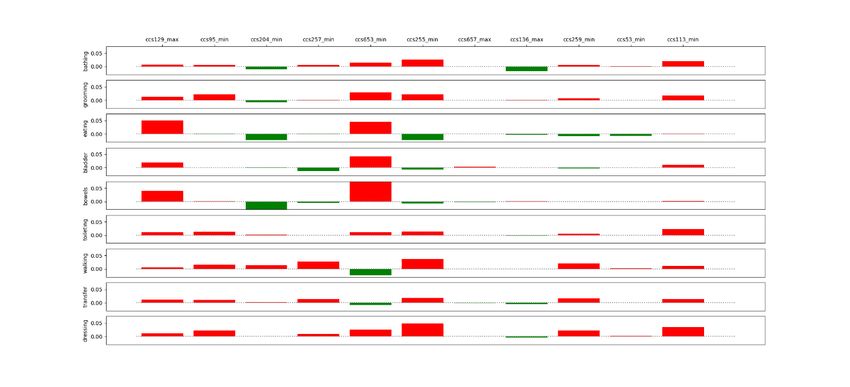
In the presented work, a simple approach similar present diagnoses. To visualize this 3-dimensoinal
to LIMIE is used, but which does not rely on result, the influence of the diagnoses is (1) averaged
construction of a secondary model. Instead, it over time for a given ADL (depicted in Figure 7), and
calculates direct change in probability based on (2) averaged over ADLs at a given time.
present patient diagnoses. The key observation for
this method is that the explanation problem is not
symmetric with respect to diagnoses, i.e., one should 5 CONCLUSIONS
consider explanation based on diagnosis present in a
given patient, and not simulate what would happen if Once fully developed and tested, the presented online
the patient had more conditions. Such an approach is decision support tool is ultimately intended for the
reasonable, because it grounds explanation in what is clinical use to support clinicians in decision making
known about the patient. For example, consider a and having informed discussions with patients, their
model that predicts that a patient is fully independent caregivers, family members, and other care team
in terms of walking, and justifies the prediction with members. The current version of the tool is available
the strongest predictor as not having a leg fracture. for research and education purposes. Deployment of
This is not a reasonable way of providing explanation. the tool in clinical care would need further clinical
The leg fracture is one of many possible causes of testing and regulatory approvals for ML or AI-based
walking impairment. In contrast, it is reasonable to software, which vary across countries (FDA, n.d.).
explain prediction of not being independent by listing The presented tool has been originally developed
fractured leg as a reason. One exception, used in the as a set of Random Forest models, and later changed
proposed tool, is based on lack of any patient to Gradient Boost models. These models provided the
characteristics that could justify patient being not highest accuracy as well as desired properties in terms
independent. Further, the influence of diagnoses on of sensitivity and calibration. In the future, one may
ADLs can be positive or negative as the presence of a investigate the possibility of using recurrent neural
diagnosis can increase or decrease the probability of networks (RNNs) in order to create models that
functional independence. The influence is typically incorporate more detailed temporal relationships
different for different ADLs and changes with time. between diagnoses. However, our initial work with
In the presented tool, new synthetic cases are the data indicated that neural networks did not
generated through single-parameter (a.k.a. first- perform well for the problem, yet further
order) sensitivity analysis which simulates changes to investigation of reasons is needed.
the models’ outputs based on changes in one input at One potential limitation of the presented work is
a time. Changes are made by iteratively removing that the patient cohort may not generalize to other
patient characteristics or diagnoses present in the settings/institutions. This is known as cross-hospital
model input. Strength of a predictor is estimated as a generalization, which is a significant problem in the
difference between the probability of independence in application of ML methods in healthcare settings (Nie
Figure 7: Visualization of the influence of patient diagnoses on the predicted independence in performing ADLs.et al., 2018). The tool also requires rigorous usability rehabilitation of the chronically ill. Maryland state
evaluation and testing in clinical settings. medical journal.
The decision support tool presented here is a McCarthy, E. P., Phillips, R. S., Zhong, Z., Drews, R. E., &
working laboratory for our team and it is constantly Lynn, J. (2000). Dying with cancer: patients' function,
symptoms, and care preferences as death
being updated and extended with new features. approaches. Journal of the American Geriatrics
Society, 48(S1), S110-S121.
REFERENCES MDS 3.0 Technical Information. (n.d.). Retrieved October
26, 2020, from https://www.cms.gov/
Apache HTTP Server Project. (n.d.). The Apache Michalski, R. S. (1983). A theory and methodology of
Software Foundation. https://httpd.apache.org/ inductive learning. In Machine learning (pp. 83-134).
Belard, A., Buchman, T., Forsberg, J., Potter, B. K., Dente, Springer, Berlin, Heidelberg.
C. J., Kirk, A., & Elster, E. (2017). Precision diagnosis: Min, H., Mobahi, H., Irvin, K., Avramovic, S., &
a view of the clinical decision support systems (CDSS) Wojtusiak, J. (2017). Predicting activities of daily
landscape through the lens of critical care. Journal of living for cancer patients using an ontology-guided
clinical monitoring and computing, 31(2), 261-271. machine learning methodology. Journal of biomedical
Bouwstra, H., Smit, E. B., Wattel, E. M., van der Wouden, semantics, 8(1), 39.
J. C., Hertogh, C. M., Terluin, B., & Terwee, C. B. Nie, A., Zehnder, A., Page, R. L., Zhang, Y., Pineda, A. L.,
(2019). Measurement properties of the Barthel Index in Rivas, M. A., ... & Zou, J. (2018). DeepTag: inferring
geriatric rehabilitation. Journal of the American diagnoses from veterinary clinical notes. NPJ digital
Medical Directors Association, 20(4), 420-425. medicine, 1(1), 1-8.
Du, M., Liu, N., & Hu, X. (2019). Techniques for Pearl, J. (2019). The seven tools of causal inference, with
interpretable machine learning. Communications of the reflections on machine learning. Communications of
ACM, 63(1), 68-77. the ACM, 62(3), 54-60.
FDA, Proposed Regulatory Framework for Modifications Pedregosa, F., Varoquaux, G., Gramfort, A., Michel, V.,
to Artificial Intelligence/Machine Learning (AI/ML)- Thirion, B., Grisel, O., ... & Vanderplas, J. (2011).
Based Software as a Medical Device (SaMD)- Scikit-learn: Machine learning in Python. the Journal
Discussion Paper and Request for Feedback. (n.d.). of machine Learning research, 12, 2825-2830.
Fried, T. R., Bradley, E. H., Towle, V. R., & Allore, H. Peiffer-Smadja, N., Rawson, T. M., Ahmad, R., Buchard,
(2002). Understanding the treatment preferences of A., Pantelis, G., Lescure, F. X., ... & Holmes, A. H.
seriously ill patients. New England Journal of (2019). Machine learning for clinical decision support
Medicine, 346(14), 1061-1066. in infectious diseases: a narrative review of current
Gobbens, R. J., & van Assen, M. A. (2014). The applications. Clinical Microbiology and Infection.
prediction of ADL and IADL disability using six Ribeiro, M. T., Singh, S., & Guestrin, C. (2016, August). "
physical indicators of frailty: a longitudinal study in Why should I trust you?" Explaining the predictions of
the Netherlands. Current gerontology and geriatrics any classifier. In Proceedings of the 22nd ACM
research, 2014. SIGKDD international conference on knowledge
Guidotti, R., Monreale, A., Ruggieri, S., Turini, F., discovery and data mining (pp. 1135-1144).
Giannotti, F., & Pedreschi, D. (2018). A survey of Richens, J. G., Lee, C. M., & Johri, S. (2020). Improving
methods for explaining black box models. ACM the accuracy of medical diagnosis with causal machine
computing surveys (CSUR), 51(5), 1-42. learning. Nature communications, 11(1), 1-9.
Faurot, K. R., Jonsson Funk, M., Pate, V., Brookhart, M. Stikic, M., Huynh, T., Van Laerhoven, K., & Schiele, B.
A., Patrick, A., Hanson, L. C., ... & Stürmer, T. (2015). (2008, January). ADL recognition based on the
Using claims data to predict dependency in activities of combination of RFID and accelerometer sensing. In
daily living as a proxy for frailty. 2008 second international conference on pervasive
Pharmacoepidemiology and drug safety, 24(1), 59-66. computing technologies for healthcare (pp. 258-263).
HCUP CCS. Healthcare Cost and Utilization Project Wasylewicz, A. T. M., & Scheepers-Hoeks, A. M. J. W.
(HCUP). March 2017. Agency for Healthcare Research (2019). Clinical decision support systems.
and Quality, Rockville, MD. www.hcup- In Fundamentals of Clinical Data Science (pp. 153-
us.ahrq.gov/toolssoftware/ccs/ccs.jsp. 169). Springer, Cham.
Khairat, S., Marc, D., Crosby, W., & Al Sanousi, A. (2018). Wojtusiak, J., Levy, C. R., Williams, A. E., & Alemi, F.
Reasons for physicians not adopting clinical decision (2016). Predicting functional decline and recovery for
support systems: critical analysis. JMIR medical residents in veterans affairs nursing homes. The
informatics, 6(2), e24. Gerontologist, 56(1), 42-51.
Lundberg, S. M., & Lee, S. I. (2017). A unified approach to Wojtusiak, J., Asadzadehzanjani, N., Levy, C., Alemi, F.,
interpreting model predictions. In Advances in neural Williams, A., Computational Barthel Index: An
information processing systems (pp. 4765-4774). Automated Tool for Assessing and Predicting
Mahoney, F. I., & Barthel, D. W. (1965). Functional Activities of Daily Living Among Nursing Home
evaluation: the Barthel Index: a simple index of Patients, BMC Medical Informatics and Decision
independence useful in scoring improvement in the Making, 2020 (in press).You can also read


