Organic Food Purchases in an Emerging Market: The Influence of Consumers' Personal Factors and Green Marketing Practices of Food Stores - MDPI
←
→
Page content transcription
If your browser does not render page correctly, please read the page content below
International Journal of
           Environmental Research
           and Public Health

Article
Organic Food Purchases in an Emerging Market: The
Influence of Consumers’ Personal Factors and Green
Marketing Practices of Food Stores
Hoang Viet Nguyen 1,2 , Ninh Nguyen 3, *, Bach Khoa Nguyen 4 , Antonio Lobo 5 and
Phuong Anh Vu 4
 1    Department of Research Administration, Thuongmai University, Hanoi 100000, Vietnam;
      nhviet@tmu.edu.vn
 2    Business Sustainability Research Group, Thuongmai University, Hanoi 100000, Vietnam
 3    Department of Entrepreneurship, Innovation and Marketing, La Trobe Business School, La Trobe University,
      Melbourne, VIC 3086, Australia
 4    Faculty of Marketing, Thuongmai University, Hanoi 100000, Vietnam; nbkhoa@tmu.edu.vn (B.K.N.);
      vphuonganh@gmail.com (P.A.V.)
 5    Department of Management and Marketing, Swinburne Business School, Swinburne University of
      Technology, Melbourne, VIC 3122, Australia; alobo@swin.edu.au
 *    Correspondence: ninh.nguyen@latrobe.edu.au; Tel.: +61-3-9479-2015

 Received: 27 February 2019; Accepted: 21 March 2019; Published: 22 March 2019

 Abstract: The consumption of food has a significant impact on the environment, individuals and
 public health. This study aims to investigate the integrative effects of consumers’ personal and
 situational factors on their attitude and purchase behavior of organic meat. The consumption of this
 product has been widely regarded as contributing towards sustainable food practices. The study was
 conducted in an emerging market economy, i.e., Vietnam. Data were collected using a customized
 and validated survey instrument from a sample of 609 organic meat consumers at four food outlets
 in Hanoi. The findings suggested that consumers’ concerns regarding the environment, health,
 food safety and their knowledge of organic food, all significantly impacted their attitude towards
 the purchase behavior of organic meat. Interestingly, their positive attitude did not necessarily
 translate into their actual purchase of organic meat. Additionally, food stores’ green marketing
 practices significantly enhanced consumers’ actual purchase behavior. Conversely, premium prices of
 organic meat were certainly a deterrent for the actual purchase of organic meat. The findings of this
 study have several important implications for organic food producers, retailers, policy makers and
 socio-environmental organizations that seek to develop intervention strategies aimed at increasing
 organic meat consumption in Vietnam.

 Keywords: organic food; green marketing; food stores; personal factors; contextual factors;
 environmental influences; price barriers; emerging market; Vietnam

1. Introduction
     It is well known that the consumption of food has a significant impact on the environment,
individuals and public health [1–3]. Notably, food consumption is associated with environmental
issues such as increased greenhouse gas emissions, water scarcity and pollution [2]. For example,
the consumption of beef has a substantial impact on the ecosystem. This is owing to the fact that
the production of protein generates a relatively high amount of carbon dioxide, e.g., an equivalent
of 221.63 g of carbon dioxide is generated per gram of protein [4,5]. Consuming food containing
undesirable residues and microorganisms causes severe individual health problems, e.g., pain,

Int. J. Environ. Res. Public Health 2019, 16, 1037; doi:10.3390/ijerph16061037    www.mdpi.com/journal/ijerph
Int. J. Environ. Res. Public Health 2019, 16, 1037 2 of 17
illness and death [6,7]. In addition, food-borne diseases result in medical costs and losses to the
public health sector [8]. Hence, promoting and accelerating the adoption of more sustainable
food behaviors is of the utmost importance for enhancing environmental sustainability as well as
individual and public well-being. Sustainable food behaviors include activities such as purchasing
and consuming organic food, eating less unhealthy food, eating local food and preparing food that has
less wastage [9,10]. Importantly, the promotion of these behaviors should be prioritized in developing
and emerging countries which are facing serious environmental problems and a colossal increase in
food consumption [9,11]. The growth in population and income has driven consumer demand for food
products, and this is especially true in developing and emerging countries, particularly for healthy
and environmentally friendly food [12].
Organic food purchase and consumption has been widely regarded as contributing towards
sustainable behavior [13,14]. This is partly driven by consumers’ socio-environmental responsibility in
addition to their personal interest and choice [10]. Although there exist various definitions of organic
food, it can be broadly defined as products which are “grown without the use of pesticides, synthetic
fertilizers, sewage sludge, genetically modified organisms, or ionizing radiation” as well as products
produced “free of antibiotics or growth hormones” [15] (p. 195). The majority of consumers believe
that organic food is eco-friendly, healthier, safer, cleaner, more nutritious, tastier and safer as compared
to conventional food [13,16–18].
A considerable number of studies on organic food have focused on consumers’ personal factors
that motivate attitude and purchase behavior associated with organic food [19]. Key personal factors
include values, environmental concern, knowledge, perceived quality, emotions, health consciousness,
concerns with respect to nutrition, food taste and food safety [20–22]. Interestingly, there exists
mixed findings regarding the relationship between consumers’ attitudes and their purchase of
organic food [23]. While various studies demonstrate that consumers’ attitudes towards organic
food significantly enhance their purchase intention and behavior, several authors report that many
consumers do not actually buy organic food despite displaying positive attitudes towards them [24,25].
Aschemann-Witzel and Niebuhr Aagaard [23] note that young consumers hold highly favorable
attitudes about organic food, but their actual purchases remain low. According to Padel and Foster [26],
such an anomaly can be explained by the complexity of the consumer decision-making process and the
varied motives and barriers associated with different types of organic food. This finding is extended by
Vermeir and Verbeke [10] who suggest that marketing factors such as price, product quality, convenient
distribution and brand familiarity remain the most important criteria in the consumer decision-making
process. These factors along with consumer habits of buying conventional produce may dilute the
impact of attitudes toward organic food on actual purchase behavior. Hence, although consumers
might believe that organic food offers environmental and health benefits and that the purchase of
organic food is beneficial, they may be unable to buy, or they may decide not to buy the product owing
to its high price, lack of availability, poor labelling and mediocre point-of-purchase display. Several
authors assert that organic food retailers need to develop and implement effective green marketing
practices to support consumers’ decision-making process [17,27]. Green marketing practices may
include the production and distribution of environmentally friendly products (e.g., organic food),
marketing communications for green products (e.g., advertising, sales promotion, public relations
and publicity), eco-labelling and branding [17,28]. Nevertheless, these situational and environmental
factors, unlike personal determinants, have been largely unexplored.
This study seeks to contribute to the literature on environmentally sustainable behavior and
organic food consumption by investigating the integrative effects of consumers’ personal factors
and their situational context on their attitude and purchase behavior associated with organic food.
The situational context comprises of both motivators and hindrances in the development of organic
food behavior [23]. The situational factors also represent the external environment’s impact on the
opportunity to perform the behavior [29]. Hence, particular emphasis is placed on how food stores’
green marketing practices and price barriers enhance or impede a consumer’s purchase of organic foodInt. J. Environ. Res. Public Health 2019, 16, 1037 3 of 17
products. Green marketing practices have been emphasized because they include various activities
associated with distributing, communicating and promoting eco-friendly products. Krystallis and
Chryssohoidis [30] assert that price is the most important criterion considered by consumers when
purchasing food. The high price of organic food has been identified as the most relevant barrier to
organic food purchase and consumption in previous studies [16,22]
This study also aims to enrich the literature on organic food behavior in developing and emerging
markets, which have received less attention from scholars [11]. By focusing on an emerging market, the
study examines whether or not the attitude-behavior gap previously identified in developed countries
is relevant in the new research context, i.e., Vietnam. This Southeast Asian country is a typical emerging
market with a population exceeding 95 million and an annual average gross domestic product growth
of 6% in the past decade [31]. Data from the Vietnam Household Living Standards Survey demonstrates
that Vietnamese people spend approximately half of their income on food and beverage products [32].
Promoting sustainable food consumption has been among the country’s top priorities, aimed at
addressing growing concerns about its environmental problems, health and food safety issues [9,33].
Many Vietnamese consumers associate sustainability with healthy food [9]. They also believe that
unsafe food practices put the health of the public at risk [34]. Despite their concerns about the high price
and poor labelling of safe and healthy foods like organic products, a number of Vietnamese consumers
are willing to purchase and consume more organic food [9]. The government has implemented several
initiatives such as the Decree 109/2018/ND-CP on organic culture and food safety standards to foster
the development of the organic food industry. Manufacturers and retailers have put great efforts in
offering diversified organic food products (e.g., vegetables, grains and meat) as well as expanding
their distribution network [35,36].
The remainder of this paper is organized as follows. A detailed literature review comprising
of the theoretical background and hypotheses development are initially presented. Thereafter, the
research methodology is described, followed by the data analysis and reporting of key findings.
A comprehensive discussion of the findings and their implications is then provided. Finally,
conclusions, limitations and future research directions are presented.
2. Literature Review and Research Hypotheses
2.1. Theoretical Background
In general, consumers who hold favorable attitudes towards the purchasing of green products
including organic food tend to make actual purchases [37]. The widely-accepted association between
attitude and behavior has been explained by several theories such as the knowledge-attitude-behavior
theory, the Alphabet theory and extended models of the Theory of Planned Behavior (TPB).
The knowledge-attitude-behavior model postulates that environmental-related knowledge leads
to environmental attitudes, and that this in turn motivates pro-environmental behavior [38].
Several researchers extending the TPB suggest that attitude affects actual behavior directly and
indirectly via behavioral intention [37,39–41]. Zepeda and Li [42] develop the Alphabet theory by
explaining consumers’ motivations for organic food consumption by integrating key elements of the
value-belief-norm (VBN) model and the attitude-behavior-context (ABC) theory with knowledge
and habit. Importantly, this theory emphasizes the role of context and habit in explaining the
attitude-behavior relationship.
Given the important role of attitudes in enacting behavior, several authors stress the need for
a better understanding of antecedents to organic food attitudes [21,43]. On the other hand, another
research strand questioning the importance of attitudes, emphasizes the necessity to explain why
consumers’ attitudes are not translated into their actual purchase of organic products [23]. In an
effort to address the attitude-behavior gap and extend prior research on the antecedents to organic
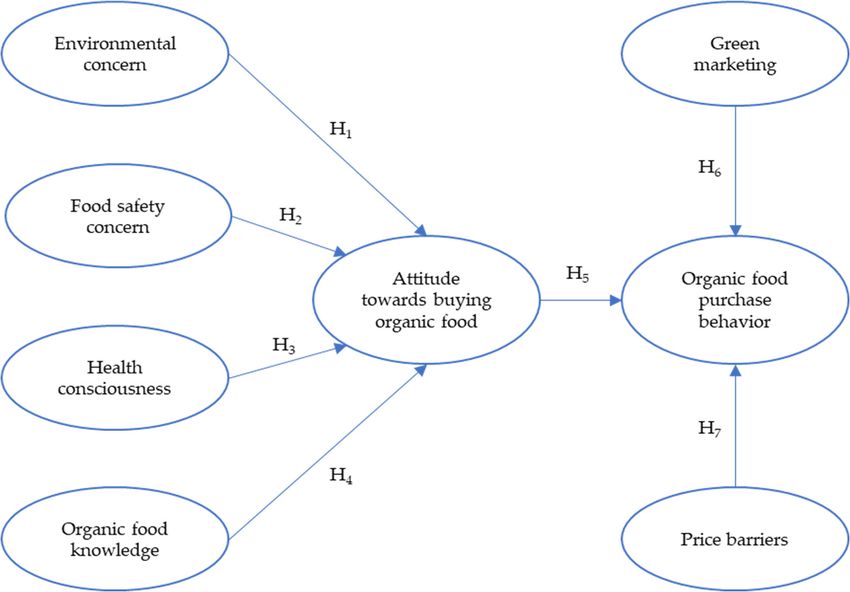
attitude, this study develops a unique model explaining organic food purchase as illustrated in
Figure 1. This model combines the antecedent-attitude-behavior hierarchy with situational contextInt. J. Environ. Res. Public Health 2019, 16, 1037 4 of 17
factors including food stores’ green marketing practices and price barriers. The three antecedents of
environmental concern, food safety concern and health consciousness have been identified as the most
Int. J. Environ. Res. Public Health 2019, 16, x 4 of 16
important determinants of organic food attitudes [21]. Organic food knowledge is also examined to
provide
examined further insight
to provide into the
further knowledge-attitude
insight relationship,relationship,
into the knowledge-attitude previously identified
previouslyasidentified
a gap in
the literature [44]. The hypothetical relationships between these constructs depicted
as a gap in the literature [44]. The hypothetical relationships between these constructs depicted in Figure 1 are
in
discussed
Figure 1 are in discussed
the subsequentin thesections.
subsequent sections.
Figure 1. The proposed research model.
2.2. Development of
2.2. Development of Hypotheses
Hypotheses
2.2.1. Environmental Concern
2.2.1. Environmental Concern
According
According to Dunlapand
to Dunlap andJones
Jones[45], environmental
[45], environmental concern denotes
concern “the degree
denotes to which
“the degree to people
which
are aware
people areofaware
problems regarding
of problems the environment
regarding and support
the environment efforts toefforts
and support solve tothem or them
solve indicate
or
the willingness
indicate to contribute
the willingness personally
to contribute to their solution”
personally (p. 482). In
to their solution” (p.general,
482). In consumers who are
general, consumers
concerned about theabout
who are concerned environment tend to develop
the environment tend topositive
develop environmental attitudes, express
positive environmental willingness
attitudes, express
to pay more for eco-friendly products and exhibit pro-environmental behavior
willingness to pay more for eco-friendly products and exhibit pro-environmental behavior [46,47]. [46,47].
It
It is
is widely
widely acknowledged
acknowledged that that the
the production
production and and consumption
consumption of of food
food products,
products, especially
especially
meat
meat such
such asas beef
beefand
andpork,
pork,contribute
contributetotoair airpollution,
pollution,landlandandandwater
water scarcity,
scarcity,and domestic
and domesticwaste to
waste
the ecosystem, leading to environmental degradation [48]. Environmental
to the ecosystem, leading to environmental degradation [48]. Environmental concern therefore concern therefore appears
to be a driving
appears to be afactor
drivingof factor
organicof food purchase
organic behavior,behavior,
food purchase and this has
andbeen largely
this has beenattributed to being
largely attributed
environmentally friendly [17].
to being environmentally Squires
friendly [17].etSquires
al. [49] et
suggest
al. [49]that organic
suggest food
that buyers
organic express
food interest
buyers in
express
protecting the ecology and natural production process. Empirical studies conclude
interest in protecting the ecology and natural production process. Empirical studies conclude that that environmental
concern exerts aconcern
environmental positiveexerts
influence on attitude
a positive towards
influence organictowards
on attitude food purchases in both
organic food developed
purchases and
in both
developing countries such as Australia [13], Taiwan [50] and India [11]. Based
developed and developing countries such as Australia [13], Taiwan [50] and India [11]. Based on theon the above discussion,
the following
above hypothesis
discussion, has been
the following developed:
hypothesis has been developed:
Hypothesis 1. 1. Consumers’ environmental concern has a positive impact on their attitudes
attitudes towards buying
organic food.
2.2.2. Food Safety Concern
Given the continuous occurrences of food safety incidents and food-related diseases [7], food
safety has been identified as the top concern among consumers [51]. Food safety concern, in its
broadest sense, indicates the degree to which people are worried about pesticide residues contained
in food as well as about food scares [52] (p. 4). Essentially, consumers often associate food safety
issues with the use of pesticides, fertilizers, antibiotics, artificial additives and preservatives in theInt. J. Environ. Res. Public Health 2019, 16, 1037 5 of 17
2.2.2. Food Safety Concern
Given the continuous occurrences of food safety incidents and food-related diseases [7], food
safety has been identified as the top concern among consumers [51]. Food safety concern, in its
broadest sense, indicates the degree to which people are worried about pesticide residues contained
in food as well as about food scares [52] (p. 4). Essentially, consumers often associate food safety
issues with the use of pesticides, fertilizers, antibiotics, artificial additives and preservatives in the
food production process [3,43]. Organic production methods are considered as being free of these
undesirable chemicals [21]. Van Loo et al. [53] point out that habitual buyers of organic chicken
strongly believe that such a product has fewer residues. Michaelidou and Hassan [43] assert that food
safety concern is the most relevant factor explaining consumer attitude towards organic food. Based
on the aforementioned discussion, the following has been hypothesized
Hypothesis 2. Consumers’ food safety concern has a positive impact on their attitudes towards buying
organic food.
2.2.3. Health Consciousness
Health consciousness reflects individuals’ thoughts on health issues and their readiness to
undertake actions to ensure their health [50,52]. Consumers have been increasingly concerned about
health and nutrition in food [1]. There is a general belief that organic foods are healthy to eat because
such products are rich in nutrition and are chemically free [54]. Bryła [16] asserts that Polish consumers
perceive healthiness as being the most important characteristic of organic food. A consumer survey
conducted by Tsakiridou et al. [51] demonstrates that 87.6% of respondents perceive organic products
to be healthier than conventional alternatives. Health consciousness is therefore a key determinant
of organic food consumption [21]. Although Tarkiainen and Sundqvist [55] surprisingly find that
health consciousness is not relevant in predicting attitude towards purchasing organic food, the
majority of prior studies confirm a significant and positive relationship between these variables [43,56].
Importantly, Yadav and Pathak [11] assert that health consciousness is the strongest predictor of
attitude towards organic food. Hence the following has been hypothesized:
Hypothesis 3. Consumers’ health consciousness has a positive impact on their attitudes towards buying
organic food.
2.2.4. Organic Food Knowledge
It is a common belief that consumers’ awareness and knowledge about organic food play an
important role in their organic purchasing decisions [57]. Several researchers regard the lack of
knowledge concerning organic food as a barrier to organic food purchase [58]. Organic food knowledge
entails what consumers know about organic food and their ability to judge the quality and unique
characteristics of organic food products. Two major types of organic food knowledge include subjective
and objective knowledge. While the former refers to what people perceive that they know, the latter
denotes what people actually know about organic food [44]. Aertsens et al. [44] find that both objective
and subject knowledge are positively related to attitudes towards organic vegetable consumption.
These authors also suggest a causal relationship in that objective knowledge enhances subjective
knowledge, which in turn improves one’s attitude towards organic purchase and consumption.
Likewise, de Magistris et al. [57] confirm a positive association between consumers’ self-reported
organic knowledge and their attitudes towards organic produce. Hence the following hypothesis has
been formulated:Int. J. Environ. Res. Public Health 2019, 16, 1037 6 of 17
Hypothesis 4. Consumers’ organic food knowledge has a positive impact on their attitudes towards buying
organic food.
2.2.5. Attitudes Towards Buying Organic Food
Attitudes associated with organic food and organic purchase have been central to research on
organic food purchase and consumption [18,51]. Consumers’ attitudes towards buying organic food
denotes their favorable or unfavorable evaluation towards purchasing organic food. Consumers who
hold positive attitudes towards organic food believe that purchasing organic food is important and
is a good choice [18]. Using the probit model analysis, Aertsens et al. [44] find a significant positive
relationship between consumers’ attitudes about organic food consumption and the proportion of
organic food consumed by them. Similarly, a regression analysis conducted by Dahm et al. [15]
indicates that students who hold positive attitudes toward organic food actually consume more
organic food at home, on campus and at restaurants. Additionally, a structural model developed by
von Meyer-Hofer et al. [37] demonstrates a significantly direct relationship between attitude towards
purchasing organic food and purchase behavior among German consumers. Hence, the following has
been hypothesized:
Hypothesis 5. Consumers’ attitudes towards purchasing organic food has a positive impact on their
purchase behavior.
2.2.6. Green Marketing Practices
Marketing with an environmental perspective has been referred to as ‘green marketing’
‘environmental marketing’, ‘socially responsible marketing’ and ‘sustainable marketing’ [59,60].
In general, green marketing includes “marketing activities which attempt to reduce the negative
social and environmental impacts of existing products and production systems, and which promote
less damaging products and services” [61] (p. 129). In this present study, food stores’ green marketing
practices refer to eco-labelling, providing an environmentally-friendly shopping environment,
advertising and promoting organic food using in-store promotional tools including fliers as well
as selling various brands of organic food.
It has been widely acknowledged that green marketing practices significantly affect consumers’
choice of eco-friendly products [62]. A Malaysian study conducted by Mohd Suki [27] reveals that
stores’ green marketing practices enhance consumer perception about organic food quality and image.
Verhoef [22] finds that marketing variables such as product quality and distribution positively affect
consumer purchase of organic food. Hence, the following hypothesis has been formulated:
Hypothesis 6. Food stores’ green marketing practices have a positive impact on consumer attitudes towards
buying organic food.
2.2.7. Price Barriers
Price (monetary) barriers constitute the critical hindrance to increasing consumer demand for
organic food [16,22,63]. Price barriers refer to consumers’ perception of organic food price and their
ability and willingness to buy such a product despite the high price [14]. In a consumer survey carried
out by Xie et al. [64], about 82% of the respondents indicate that high price premium is the reason
for not buying organic products. In general, the majority of consumers are not willing to pay a price
premium above 10–20% for organic food [65,66]. Van Doorn and Verhoef [67] argue that the high
price of organic food negatively affects consumer-perceived value (i.e., cost versus benefits) of suchInt. J. Environ. Res. Public Health 2019, 16, 1037 7 of 17
a product. Tanner and Kast [14] find a strong and negative correlation between price barriers and
consumer purchase of different organic food products. Hence the following has been hypothesized:
Hypothesis 7. Price barriers have a negative impact on consumer attitudes towards buying organic food.
3. Research Methodology
3.1. Researched Product Category
Determinants influencing organic food attitudes and behavior may vary across different categories
of organic food [31]. Organic meat was intentionally chosen as the researched food product category
owing to several reasons. Firstly, while a considerable number of studies have investigated specific
categories of organic food such as organic fruits and vegetables, the organic meat category has been
largely unexplored. Secondly, given that Vietnamese people’s expenditure on meat constitutes 14%
of their total food expenditure [32], meat is among the most popular food products consumed in the
country. Given that meat consumption is strongly linked to income [5], it is expected that Vietnamese
consumers will consume more meat in the coming years. This is a particularly controversial issue since
meat production and consumption is among the largest contributors to environmental problems, such
carbon dioxide emissions and excessive land use [4]. Thirdly, antibiotic and veterinary residues in
meat have received widespread attention from Vietnamese consumers and media [34]. This may be a
driving factor for organic meat consumption.
3.2. Measures
The items operationalizing the constructs in the research model were selected and adapted from
measurement scales validated in prior research. The original scales in English were translated into
Vietnamese using the back-translation suggested by Usunier [68]. Accordingly, a professional translator
performed the translation of the survey instrument from English to Vietnamese, and this Vietnamese
version was then translated back into English by another translator, who worked independently
without being informed of the first translation. As there were minor discrepancies between the
original survey and the back-translated survey, 2 bilingual marketing professors were invited to
review the translations. These professors also worked with the translators to discuss and reconcile the
discrepancies until an agreement was reached on the most suitable version of the survey instrument,
so as to ensure semantic equivalence. As most of the scales were developed for Western developed
markets, 2 focus groups were conducted to identify the potential problems of using these items in the
context of Vietnam. Participants in the first focus group included 6 organic meat consumers, whilst
the second focus group consisted of 5 marketing professors. These focus groups were facilitated and
moderated by the researchers. Following the focus groups, some items were revised and modified.
For example, the participants suggested to clarify the second item measuring food safety concern
by adding antibiotics and veterinary to the original item. In addition, a new item was suggested for
operationalizing organic food knowledge. All the items, except for purchase behavior, were measured
using a 7-point Likert scale, which ranged from 1 for ‘Strongly disagree’ to 7 for ‘Strongly agree’.
For environmental concern, 4 items were adopted from Yadav and Pathak’s [11] study. To measure
food safety concern, 3 items were taken from Michaelidou and Hassan [43]. Another 3 items
operationalizing health consciousness were adapted from Tarkiainen and Sundqvist [55]. A total
of 4 items were used to measure organic food knowledge. Of these, 3 items were adopted from
Aertsens et al. [44] and 1 item regarding the environmental and health benefits of organic meat
was suggested by the focus groups. Attitude towards buying organic food was operationalized using
4 items from prior research conducted by Arvola et al. [69] and Dean et al. [70]. Another 4 items
operationalizing green marketing practices implemented by food stores were adopted from MohdInt. J. Environ. Res. Public Health 2019, 16, 1037 8 of 17
Suki [27]. Price barriers were operationalized using 3 items from studies conducted by Tanner and
Kast [14] and Verhoef [22].
To measure the purchase behavior of organic food, 1 item seeking respondents’ purchase frequency
was adopted from Dean et al. [70] (‘How often in the last 10 times you purchased meats were [they]
organic ones?’). There were 7 response categories, anchored at 1 for ‘Never’ and 7 for ‘Always’.
3.3. Ethics Considerations
The importance of adhering to ethical standards with respect to human research activity has
been addressed in this study. The research ethics application, which is a part of the research
project application, was submitted to the Vietnam National Foundation for Science and Technology
Development (NAFOSTED) in March 2018. The application describes details of the research project,
including participant recruitment, data collection procedures, description of anticipated risks, data
storage and security, and informed consent. The project (NAFOSTED 502.02-2018.303) was reviewed
and approved on 5 September 2018.
The research project followed the approved protocol. Respondents notified the research purpose
and their informed consent by reading the cover page of the survey and by listening to the interviewers.
Participation was on a voluntary basis, in which respondents could withdraw at any time. Completion
of the survey was taken as a respondent’s ‘informed consent’ to participate in the research. The process
ensured the respondent’s anonymity, confidentially and privacy. Only anonymous and aggregated
data were captured and subsequently reported in the research report and in published conference
papers and journal articles.
3.4. Data Collection and Sample
The respondents in this study were Vietnamese citizens aged 18 and over, who had purchased
organic meat. This enables the investigation of consumers’ actual purchases of organic meat.
Paper-based surveys were used to collect data from eligible consumers at 4 food stores in the capital
city of Hanoi, which is located in the north of Vietnam. The paper-based approach has proven effective
in several research projects on pro-environmental behavior and organic food in Vietnam [33,41].
Consumers in major cities such as Hanoi have been the subject of prior relevant studies because they
have higher income and tend to pursue a sustainable lifestyle [9,47,71,72]. Furthermore, supermarkets
and food stores are the main distributors of organic food products including organic meat in big cities
like Hanoi and Ho Chi Minh [36]. Experienced and trained research assistants acted as interviewers
who were stationed at the stores to approach consumers after they had completed their purchases.
Respondents were then initially asked the screening questions (i.e., age and past organic meat purchase)
before being presented with the informed consent statement and were then requested to voluntarily
provide their responses. A US$ 2.5 (Vietnamese Dong 50,000) cash incentive was offered to them in
appreciation of their participation.
The data collection period lasted 3 months, during which time a total number of 635 surveys
were returned. Data from the returned surveys were screened to examine potential missing data,
outliers and normality of distribution. The standardized values (z scores) indicated that 4 surveys
contained univariate outliers, while the Mahalanobis distance demonstrated that 22 surveys comprised
multivariate outliers. The final effective sample therefore included 609 responses. Of these, 319 (52.4%)
were female and 290 were males (47.6%). Additionally, the majority of the respondents (54.4%) were
aged under 40 years, while 61.9% had higher education degrees. The demographic profile of the
respondents is depicted in Table 1.Int. J. Environ. Res. Public Health 2019, 16, 1037 9 of 17
Table 1. Demographic profile of the respondents.
Demographic Characteristic Frequency %
Gender
Female 319 52.4
Male 290 47.6
Age
18–29 180 29.6
30–39 151 24.8
40–49 139 22.8
50–59 87 14.3
60 and above 52 8.5
Marital status
Single/never married 172 28.3
Currently married 376 61.7
Widowed 34 5.6
Divorced/separated 27 4.4
Educational level
High school or lesser 35 5.8
Professional degree 77 12.6
College degree 120 19.7
University undergraduate 276 45.3
Postgraduate 101 16.6
Household monthly income
Under VND 10,000,000 181 29.7
VND 10,000,001–20,000,000 237 38.9
VND 20,000,001–30,000,000 83 13.6
VND 30,000,001–40,000,000 46 7.6
VND 40,000,001–50,000,000 41 6.7
Over VND 50,000,000 21 3.5
Note: US$ 1 = Vietnamese Dong (VND) 23,390 at the time of the survey.
According to the latest data published by the General Statistic Office of Vietnam—GSO [73],
the ratio of male to female was 49:51, which is quite similar to that of our sample. The Vietnam
Intercensal Population and Housing Survey conducted by GSO [74] demonstrates that the percentage
of persons aged 20–29, 30–39, 40–49, 50–59 and 60 and above was 18.9%, 15.8%, 13.4%, 10.3% and 10.1%
respectively. Given that our study only focused on people aged 18 and above, it can be argued that our
sample fairly resembles the percentages of the different age groups in the population. Furthermore,
the marriage incidence of the respondents in our sample was 62%, which is slightly lower than that
of people aged 18 and over in the population (i.e., 67%). Additionally, the educational levels and
household monthly income of our sample are similar to those reported in earlier pro-environmental
studies in Vietnam [41,75]. Notably, a majority of the respondents (38.9%) reported that their household
incomes was VND 10,000,001–20,000,000 per month, which can be classified as being middle-high
income earners [76]. Overall, it is reasonable to argue that our sample fairly represents the entire
population of Vietnam.
4. Data Analysis
4.1. Statistical Approaches
Following the guidelines recommended by Hair et al. [77], confirmatory factor analysis (CFA)
and reliability analysis using Cronbach’s alpha (α) were performed to assess construct validity and
reliability. The CFA was also used to evaluate the validity of the measurement model. The hypotheses
were then tested using structural equation modelling (SEM). Please note that as purchase behaviorInt. J. Environ. Res. Public Health 2019, 16, 1037 10 of 17
was measured by one item, this variable is not applicable to CFA. Two application software were used
to perform the data analysis, i.e., SPSS and AMOS version 24 (IBM Corporation, New York, NY, USA).
The goodness-of-fit (GOF) of the measurement and structural models was examined using
commonly-applied fit indices including χ2 /df (chi-square to degree-of-freedom ratio), GFI
(goodness-of-fit index), AGFI (adjusted goodness-of-fit index), CFI (comparative fit index), TLI (Tucker
and Lewis index) and RMSEA (root mean square error of approximation). According to prominent
studies such as those of Hu and Bentler [78] and Hair et al. [77], it is reasonable to conclude that the
model fit is good when χ2 /df < 3, the values of GFI, CFI, TLI ≥ 0.90 and RMSEA ≤ 0.08.
4.2. Measurement Model, Construct Reliability and Validity
To assess the measurement model fit, all constructs in the research model, except purchase
behavior, were subjected to CFA using maximum likelihood estimation. The resultant statistics were
all above the suggested level (χ2 (254) = 337.933, p < 0.001; χ2 /df = 1.330; GFI = 0.958; AGFI = 0.946;
CFI = 0.986; TLI = 0.983; RMSEA = 0.023). These GOF indices revealed a good model approximation to
the sample data.
Table 2. Items, reliability and convergent validity.
Variables and Items FLs α CR AVE
Environmental concern 0.848 0.850 0.586
The balance of nature is very delicate and can be easily upset 0.769
Human beings are severely abusing the environment 0.797
Humans must maintain the balance with nature in order to survive 0.800
Human interferences with nature often produce disastrous consequences 0.692
Food safety concern 0.802 0.805 0.580
Nowadays most foods contain residues from chemical sprays and
0.754
fertilizers
I am very concerned about the number of antibiotics, veterinary residues
0.819
and preservatives in meat
The quality and safety of meat nowadays concerns me 0.708
Health consciousness/concern 0.794 0.795 0.564
I choose meat carefully to ensure good health 0.775
I think of myself as a health-conscious consumer 0.779
I think often about health issues 0.697
Organic food knowledge 0.822 0.822 0.536
In comparison with an average person I know a lot about organic meat 0.782
I know a lot about how to judge the quality of organic meat 0.720
I know a lot about the environmental and health benefits of organic meat 0.722
People who know me, consider me as an expert in the field of organic meat 0.701
Attitude towards buying organic food 0.828 0.829 0.548
Buying organic meat instead of conventional meat is beneficial 0.787
Buying organic meat instead of conventional meat is a wise choice 0.716
Buying organic meat instead of conventional meat make me feel good 0.743
Buying organic meat instead of conventional meat make me feel pleased 0.713
Green marketing practices 0.845 0.845 0.577
This store distributes published fliers of organic meat 0.769
This store deals with organic meat with certified labels 0.731
There is environmentally-friendly shopping space in this store 0.789
This store increases sales of brands of organic meat 0.749
Perceived monetary barriers 0.777 0.778 0.538
Organic meat is still too expensive 0.727
The price of organic meat is a barrier to purchase it 0.729
People should buy organic meat, even though they are more expensive
0.745
than conventional meat (reverse in coding)
Note: FLs: factor loadings; α: Cronbach’s alpha; CR: composite reliability; AVE: average variance extracted.
As recommended by Byrne [79] and Hair et al. [77], construct validity was examined using
convergent and discriminant validity. Specifically, convergent validity was assessed based on three
conditions, i.e., (1) standardized factor loadings values were above 0.5; (2) composite reliability (CR)
was higher than the average variance extracted (AVE), and CR was above 0.7; and (3) AVE was aboveInt. J. Environ. Res. Public Health 2019, 16, 1037 11 of 17
0.5. As depicted in Table 1, the relevant data demonstrated strong convergent validity. Additionally,
Table 2 shows that the square root of the AVE of each measure (0.732–0.766) was higher than its
correlation coefficients with other constructs, indicating that discriminant validity is ensured [80].
Furthermore, all bivariate correlations between constructs were less than 0.5, hence possible problems
of multi-collinearity were non-existent [81].
In addition, reliability analysis, as shown in Table 3, demonstrated that α values for constructs
ranged from 0.777 to 0.848. Moreover, corrected item-to-total correlations were all greater than 0.5. It is
therefore reasonable to conclude that all the measures have good internal consistency of reliability [82].
Table 3. Descriptive statistics and discriminant validity.
Constructs Mean SD ENV SAF HEA KNO ATT GMA BAR
Environmental concern—ENV 4.665 1.226 0.766
Food safety concern—SAF 4.859 1.090 0.321 0.762
Health consciousness—HEA 4.856 1.198 0.295 0.212 0.751
Organic food knowledge—KNO 3.870 1.084 0.295 0.256 0.290 0.732
Attitude—ATT 4.644 1.207 0.420 0.368 0.354 0.274 0.740
Green marketing practices—GMA 4.586 1.147 0.342 0.278 0.224 0.334 0.448 0.760
Price barriers—BAR 3.239 1.069 −0.408 −0.418 −0.235 −0.419 −0.491 −0.393 0.734
Note: Diagonal value indicates the square root of AVE of construct; SD: standard deviation.
4.3. Hypotheses Testing
SEM was applied to test the seven proposed hypotheses. The resulting indices were χ2 (278) =
417.480, p < 0.001; χ2 /df = 1.052; GFI = 0.949; AGFI = 0.936; CFI = 0.977; TLI = 0.974; RMSEA = 0.029.
These GOF indices altogether revealed a good fitting model which explained the significant 31% of the
variation in consumer purchase of organic meat.
The results of the hypotheses testing are illustrated in Table 4. As indicated, all the relationships
between each of the variables were significant, except between attitude and purchase behavior. Hence,
H1, H2, H3, H4, H6 and H7 were accepted, while H5 was rejected. Specifically, environmental
concern (β = 0.273, p < 0.001), safety concern (β = 0.232, p < 0.001), health consciousness (β = 0.205,
p < 0.001) and organic food knowledge (β = 0.097, p < 0.05) had a significant positive impact on attitude
towards purchasing organic food. Interestingly, the relationship between attitude towards purchasing
organic food and consumer purchase behavior was positive but non-significant (β = 0.049, p > 0.05).
As expected, green marketing practices exerted a strong positive influence on consumer purchase of
organic meat (β = 0.430, p < 0.001). In contrast, price barriers were negatively associated with such
purchase (β = −0.194, p < 0.001).
Table 4. SEM (structural equation modelling) results and hypotheses testing.
Hypotheses β S.E. t-Value p-Value Findings
H1: Environmental concern → Attitude 0.273 0.053 5.480 *** Supported
H2: Food safety concern → Attitude 0.232 0.057 4.726 *** Supported
H3: Health consciousness → Attitude 0.205 0.052 4.151 *** Supported
H4: Knowledge → Attitude 0.097 0.053 2.007 0.045 Supported
H5: Attitude → Purchase behavior 0.049 0.047 1.189 0.234 Not supported
H6: Green marketing → Purchase behavior 0.430 0.058 9.416 *** Supported
H7: Price barriers → Purchase behavior −0.194 0.069 −4.156 *** Supported
Note: *** p < 0.001; S.E.: standard error.
5. Discussion, Implications and Limitations
This study has developed and validated a model combining key elements of several theories to
explain consumer purchase of a specific category of organic food, i.e., meat. The SEM findings indicate
that such an integrative model is useful in predicting consumer purchases of environmentally-friendly
products (i.e., organic meat) in the context of emerging markets such as Vietnam. The importance
of further research into organic food purchases in developing and emerging countries has beenInt. J. Environ. Res. Public Health 2019, 16, 1037 12 of 17
emphasized in the literature [21,52]. A notable finding in this study concerns the attitude-behavior gap
in the context of organic food purchase and consumption. That is, Vietnamese consumers’ attitudes
towards purchasing organic meat are not significantly translated into their actual purchase behavior.
Whilst this finding diminishes the significance of attitudes in motivating organic food purchases, which
has been found in numerous studies [15,37,44], it confirms the attitude-behavior gap in a new research
context, i.e., organic meat purchase in Vietnam. This discrepancy could be attributed to the high price
of organic food. Similar to earlier work [22], the findings reveal that price barriers negatively affect
consumer purchase frequency of organic food. Specifically, consumers perceive that organic meat is
too expensive and such a high price represents an obstacle to their purchase behavior. This can be
explained by the widespread financial constraints of consumers in emerging markets [83].
Another key finding is that food stores’ green marketing practices significantly motivate consumer
purchase behavior of organic meat. This extends the findings of prior studies in both developing and
developed countries. While the Malaysian study conducted by Mohd Suki [27] demonstrates that
green marketing practices enhance product image and corporate social responsibility, Dutch research
carried out by Verhoef [22] finds that marketing variables (e.g., quality and distribution) positively
influence consumer choice and the purchase frequency of organic meat. The finding emphasizes the
effectiveness of green marketing [84] and the important role of retailers in enhancing organic meat
purchase and consumption. Furthermore, the significant findings regarding green marketing practices
and perceived barriers highlight the need for investigating contextual and environmental factors in
explaining consumer purchase of organic food.
This study has also extended the findings of prior studies by comprehensively examining various
determinants of attitudes towards organic food purchase. The findings echo the extant literature that
suggest that environmental concern [13,50], health consciousness [11,56], food safety concern [43]
and organic food knowledge [44,58] significantly strengthen attitudes towards purchasing organic
food. Notably, among the determinants, organic food knowledge has the weakest impact on attitudes.
This finding may be due to the low level of knowledge about organic food demonstrated by the
respondents in this study (Mean = 3.87). As such, the respondents did not comprehensively understand
the unique benefits and characteristics of organic food, which might have adversely affected their
attitudes towards buying the product. It is also interesting to note that environmental concern has
the strongest influence on attitudes. Several authors suggest that consumers in poorer countries, like
developing and emerging markets (e.g., Vietnam), are less likely to take environmental quality into
account when making a purchase decision [38,60]. This finding can be partly explained by the fact that
the respondents were urban consumers, the majority of who were middle and high income earners.
These consumers are likely to care more about the environment. Hence, generalizing this finding to
Vietnam as a whole should be undertaken with caution. The finding may also suggest that Vietnamese
consumers have increasingly expressed environmental concerns through their purchase decisions
associated with eco-friendly products, such as organic meat.
This study’s findings suggest several important implications for marketers, policy makers, organic
food associations and socio-environmental organizations that seek to develop intervention strategies
aimed at fostering organic food purchases among Vietnamese consumers. Firstly, the demand for
organic meat might be encouraged by making such products less costly in terms of value for money.
In this regard, organic food producers should make every effort to increase their efficiencies, which
would result in lower prices, whilst distributors should consider discounting the price of organic
meat whenever possible. Secondly, food stores need to improve the effectiveness of their green
marketing practices. It is vital that organic meat becomes more widely available and that in-store
communications utilizing fliers, signages and staff are better implemented. Policy makers should
facilitate the development and implementation of the national organic labelling program. Thirdly,
these initiatives should be supported by intervention strategies aimed at enhancing consumer attitude
towards purchasing organic food. This might be desirable in the long run because of two main
reasons. The first reason is that although the relationship between attitude and purchase behavior isInt. J. Environ. Res. Public Health 2019, 16, 1037 13 of 17
insignificant, attitude still has a (weak) positive effect on purchase behavior. The second reason is that,
improved and strengthened attitudes could be gradually translated into actual consumer purchase
of organic meat. Hence, education and communication programs should be jointly developed by the
stakeholders to increase consumers’ knowledge about organic meat as well as their awareness about
the safety, environmental and health benefits of organic meat.
However, this study is not without its limitations, which can be classified into four broad areas.
First, although the sample size is relatively large, the generalizability of the current study is still limited
owing to the fact that the sample consisted of urban consumers in only one city, i.e., Hanoi. Second,
whilst beyond the scope of this study, interrelationships may exist between the model’s independent
variables (e.g., between environmental concern and price barriers). Third, hindrances to organic
meat purchase were represented only by price barriers. Finally, this study obtained data during one
particular time period, an issue which underestimates the dynamics of variables such as environmental
concern, attitude and behavior.
6. Conclusions and Future Research
This study is among the first of its kinds that comprehensively investigated factors influencing
consumer attitude and purchase of organic meat in the context of Vietnam. The findings highlighted
the attitude-behavior gap associated with pro-environmental behavior and organic food consumption.
This gap can be partially explained by the negative impact of price barriers on consumer purchase
behavior. The findings also concluded that whilst environmental concern has the greatest influence on
attitudes towards purchasing organic food, knowledge about organic food has the weakest impact
on such attitudes. These recent findings extended current knowledge about organic food purchase in
emerging markets as well as provided governmental organizations, marketers and socio-environmental
organizations with valid suggestions on how to foster and enhance consumer attitudes and behavior
towards organic food products, including organic meat.
The validated research model in this study combined personal factors (i.e., environmental
concern, health consciousness, food safety concern and organic food knowledge) with contextual and
environmental factors (i.e., food stores’ green marketing and price barriers) to better explain consumers’
decisions relating to organic food. It therefore can serve as a framework for future research in other
emerging market economies. Furthermore, to address the limitation of this study’s sample, future
research should obtain data from respondents located in other major cities such as Hai Phong, Da
Nang and Ho Chi Minh city. It might be desirable to collect data from consumers in rural areas, which
enables a comparative analysis between rural (lower income) and urban (higher income) consumers.
Future research could also examine different barriers to organic food purchases, such as habits,
skepticism on organic food labels, lack of knowledge and availability. This will certainly provide a
more comprehensive understanding of the influence of situational factors and the attitude-behavior
gap. In addition, it would be beneficial to investigate the interrelationships between the determinants
of consumer attitudes about organic food to further address the motivational complexity of organic
food consumption. Finally, future research could investigate changes in organic food attitudes and
behavior over time by conducting a longitudinal study.
Author Contributions: Conceptualization, H.V.N., N.N., A.L., B.K.N. and P.A.V.; methodology, H.V.N., N.N. and
A.L.; formal analysis, H.V.N., N.N., A.L. and P.A.V.; investigation, H.V.N., B.K.N. and P.A.V.; writing—original
draft preparation, H.V.N., N.N., B.K.N., A.L. and P.A.V.; writing—review and editing, N.N. and A.L.; supervision,
H.V.N., B.K.N. and N.N.; funding acquisition, N.H.V. and B.K.N.
Funding: This research is funded by the Vietnam National Foundation for Science and Technology Development
(NAFOSTED) under Grant Number 502.02-2018.303.
Acknowledgments: The authors are thankful to the research assistants who helped collect data for this study.
Conflicts of Interest: The authors declare no conflict of interest.Int. J. Environ. Res. Public Health 2019, 16, 1037 14 of 17
References
1. Dubé, L.; Labban, A.; Moubarac, J.-C.; Heslop, G.; Ma, Y.; Paquet, C. A nutrition/health mindset on
commercial big data and drivers of food demand in modern and traditional systems. Ann. N. Y. Acad. Sci.
2014, 1331, 278–295. [CrossRef] [PubMed]
2. Reisch, L.; Eberle, U.; Lorek, S. Sustainable food consumption: An overview of contemporary issues and
policies. Sustain. Sci. Pract. Policy 2013, 9, 7–25. [CrossRef]
3. Wilcock, A.; Pun, M.; Khanona, J.; Aung, M. Consumer attitudes, knowledge and behaviour: A review of
food safety issues. Trends Food Sci. Technol. 2004, 15, 56–66. [CrossRef]
4. Clark, M.; Tilman, D. Comparative analysis of environmental impacts of agricultural production systems,
agricultural input efficiency, and food choice. Environ. Res. Lett. 2017, 12, 111002. [CrossRef]
5. Ritchie, H.; Roser, M. Meat and Seafood Production & Consumption. 2017. Available online: https://
ourworldindata.org/meat-and-seafood-production-consumption (accessed on 15 March 2019).
6. Tent, H. Research on food safety in the 21st century. Food Control 1999, 10, 239–241. [CrossRef]
7. Wang, J.; Shen, M.; Gao, Z. Research on the irrational behavior of consumers’ safe consumption and its
influencing factors. Int. J. Environ. Res. Public Health 2018, 15, 2764. [CrossRef] [PubMed]
8. Harris, L. Hamburger hell: Better risk communication for better health. In Mad Cows and Mothers Milk: The
Perils of Poor Risk Communication; Powell, D., Leiss, W., Eds.; McGill-Queen’s University Press: Quebec City,
QC, Canada, 1997; pp. 77–98.
9. de Koning, J.I.J.C.; Crul, M.R.M.; Wever, R.; Brezet, J.C. Sustainable consumption in vietnam: An explorative
study among the urban middle class. Int. J. Consum. Stud. 2015, 39, 608–618. [CrossRef]
10. Vermeir, I.; Verbeke, W. Sustainable Food Consumption: Exploring the Consumer “Attitude—Behavioral
Intention” Gap. J. Agric. Environ. Ethics 2006, 19, 169–194. [CrossRef]
11. Yadav, R.; Pathak, G.S. Intention to purchase organic food among young consumers: Evidences from a
developing nation. Appetite 2016, 96, 122–128. [CrossRef]
12. Mottaleb, K.A.; Rahut, D.B.; Kruseman, G.; Erenstein, O. Evolving food consumption patterns of rural and
urban households in developing countries: A bangladesh case. Br. Food J. 2018, 120, 392–408. [CrossRef]
13. Smith, S.; Paladino, A. Eating clean and green? Investigating consumer motivations towards the purchase of
organic food. Australas. Mark. J. 2010, 18, 93–104. [CrossRef]
14. Tanner, C.; Kast, S.W. Promoting sustainable consumption: Determinants of green purchases by Swiss
consumers. Psychol. Mark. 2003, 20, 883–902. [CrossRef]
15. Dahm, M.J.; Samonte, A.V.; Shows, A.R. Organic foods: Do eco-friendly attitudes predict eco-friendly
behaviors? J. Am. Coll. Health 2009, 58, 195–202. [CrossRef] [PubMed]
16. Bryła, P. Organic food consumption in poland: Motives and barriers. Appetite 2016, 105, 737–746. [CrossRef]
[PubMed]
17. Hughner, R.S.; McDonagh, P.; Prothero, A.; Shultz, C.J.; Stanton, J. Who are organic food consumers?
A compilation and review of why people purchase organic food. J. Consum. Behav. 2007, 6, 94–110.
[CrossRef]
18. Magnusson, M.K.; Arvola, A.; Hursti, U.K.K.; Åberg, L.; Sjödén, P.O. Attitudes towards organic foods among
swedish consumers. Br. Food J. 2001, 103, 209–227. [CrossRef]
19. Aertsens, J.; Verbeke, W.; Mondelaers, K.; Van Huylenbroeck, G. Personal determinants of organic food
consumption: A review. Br. Food J. 2009, 111, 1140–1167. [CrossRef]
20. Grunert, S.C.; Juhl, H.J. Values, environmental attitudes, and buying of organic foods. J. Econ. Psychol. 1995,
16, 39–62. [CrossRef]
21. Rana, J.; Paul, J. Consumer behavior and purchase intention for organic food: A review and research agenda.
J. Retail. Consum. Serv. 2017, 38, 157–165. [CrossRef]
22. Verhoef, P.C. Explaining purchases of organic meat by dutch consumers. Eur. Rev. Agric. Econ. 2005, 32,
245–267. [CrossRef]
23. Aschemann-Witzel, J.; Niebuhr Aagaard, E.M. Elaborating on the attitude–behaviour gap regarding organic
products: Young danish consumers and in-store food choice. Int. J. Consum. Stud. 2014, 38, 550–558.
[CrossRef]
24. Pearson, D.; Henryks, J.; Jones, H. Organic food: What we know (and do not know) about consumers.
Renew. Agric. Food Syst. 2011, 26, 171–177. [CrossRef]You can also read


