Outlook Spain Real Estate - BBVA Research
←
→
Page content transcription
If your browser does not render page correctly, please read the page content below
Spain Real Estate
Outlook
MARCH 2017 | SPAIN AND PORTUGAL UNIT & REAL ESTATE UNIT

01                   02                     3                        04
The housing market   Madrid, the            The growth in sales is   Positive expectations
recovery is          Mediterranean axis     driving prices and       for 2017 with a more
consolidated         and the islands are    building                 moderate tone
                     leading the recovery
Spain Real Estate Outlook
March 2017
Contents
1. Editorial 3
2. The economy continues to recover more moderately
and with more risks 4
3. The housing market recovery is consolidated in 2016 7
4. Prospects 26
Closing date: 17 March 2017
SEE IMPORTANT INFORMATION ON PAGE ¡Error! Marcador no definido. OF THIS DOCUMENT 2 / 29 www.bbvaresearch.comSpain Real Estate Outlook
March 2017
1. Editorial
The real estate market consolidated its recovery in 2016, but its evolution shows a large geographic
heterogeneity. The recovery is clearly being led by Madrid, much of the Mediterranean axis and the two
island communities. As the recovery of the economy continues, more territories will be joining the recovery
of the housing market.
The evolution of the economy has been accompanied by favourable financial conditions. The growth of
household income and new progress in the households’ deleveraging process has given them greater
solvency which has resulted in an increase in new home purchase loan transactions. All this is occurring in
an environment of positive expectations in which housing remains an attractive investment alternative.
In this context, 2016 ended with the sale of nearly 460,000 homes, 13.5% more than in the previous year.
Throughout the year, the evolution of sales started to fall away and in the last part of the year a slowdown in
its growth was observed. Positive expectations of appreciation, albeit still incipient, could explain this. As
could the slowdown in foreign demand which, despite showing good signs, grew slightly less than in the
previous year due in part to the effects that Brexit might be having on British demand.
The industry again responded to the boost in demand. Building permits for new homes rose nearly 30% in
2016, rising to more than 64,000. However, the growth seen in building permits in the last three years has
not yet materialised in finished works, which remain stuck at minimal levels. As a result, the inventory level
continues to fall, which also confirms the evolution of housing prices.
The increase in sales in a context of inventory reduction has resulted in a new rise in housing prices.
Although the moderation in sales has also been reflected in the evolution of prices, the year ended with a
new appreciation of 1.9% as a year-on-year average, somewhat more pronounced among new homes,
which would underscore the shortage in the supply of new construction in some areas of the country.
Expectations are positive for 2017. With a more moderate economic growth of around 2.7% and some
positive, albeit contained, expectations of appreciation, it is expected that residential sales will grow about
7%. Prices will continue to recover and an annual average increase of 2.5% is expected. In turn, building will
continue to respond positively to developments in demand and prices. Thus, in 2017 the real estate industry
will bring growth to the economy, with expectations of an annual increase in housing investment of 3.2%.
Despite everything, the scenario is not without risks A possible bringing forward of the interest rate hike by
the ECB, an increase in uncertainty about economic policy resulting from unexpected regulatory changes or
multiple geopolitical risks could affect the evolution of the property market.
SEE IMPORTANT INFORMATION ON PAGE ¡Error! Marcador no definido. OF THIS DOCUMENT 3 / 29 www.bbvaresearch.comSpain Real Estate Outlook
March 2017
2. The economy continues to recover
more moderately and with more risks
The Spanish economy will continue to recover strongly, albeit less so than in previous years, and will be
exposed to risks with potentially negative consequences if they materialise. Both the trend in recent activity
indicators and the expected continuation of most of the different measures that have supported the recovery
so far point to GDP growth remaining at around 2.7% in 2017 and 2018. This will be in spite of the
deterioration observed in some of the key factors behind the improvement in private sector domestic
demand over the past two years, and in spite of the heightened worldwide uncertainty about economic
policy.
The global economy is improving in an environment of high
uncertainty
Despite the acceleration experienced by the global economy in the latter part of 2016, the outlook for 2017
and 2018 is fraught with uncertainty. This is principally related with the economic policy of the new US
administration, the direction of which remains largely to be seen.
The magnitude of inflationary pressures is another unknown factor
opening up at a global level. The rising prices of raw materials
The rise in inflation is
along with the base effects of energy prices are pushing up
putting pressure on
expectations of inflation in the long term. This, oupled with monetary policy
quantitative easing programme and the prospects of fiscal stimulus,
means that the deflation risks of a few quarters ago have been replaced by inflationary pressures, raising
questions about monetary policy.
In principle, the Federal Reserve is maintaining a cautious attitude and is continuing to aim at a relatively
slow normalisation of rates, forecasting two rate hikes this year and another two in 2018. Furthermore, the
pressures by the ECB to bring forward the normalisation of monetary policy have already begun with
increasing prices in Germany, and may well intensify in the coming months when inflation in the Eurozone
approaches 2% owing to the effects of energy prices. Given the above, the ECB is expected to decide on
the first interest rate hike at the end of that year.
Overall, growth projections for 2017 are subject to greater uncertainty than
The global scenario usual. The base effect of increased growth at the end of 2016 and its
is not without risks inertial effect, together with the fiscal stimulus packages expected in the
US, mean we need to revise the forecasts moderately upward for the US
and Europe, and slightly more so for China, while the forecasts for Latin-American countries are being
revised downward, principally due to idiosyncratic factors. The risks are mainly on the downside and are
dominated by the aforementioned uncertainty associated with US economic policy. Also, an unexpected rise
SEE IMPORTANT INFORMATION ON PAGE ¡Error! Marcador no definido. OF THIS DOCUMENT 4 / 29 www.bbvaresearch.comSpain Real Estate Outlook
March 2017
in inflation could lead to the tightening of monetary policy by the main central banks, with global
consequences. In the long term, the risks of the accumulation of imbalances in China, together with the lack
of structural reforms, could have an impact on its capital flows and currency and lead to a sudden slow-down
in growth. Europe is subject to substantial political risks, in a year that is packed with elections , and where
certain increasingly popular parties propose rolling back on structural reforms or measures to quit the euro
zone or the European Union. And for their part, geopolitical risks remain significant.
Continued growth of the Spanish economy but at more moderate
rates
In the next biennium, growth is expected to remain at around 2.7%.
The trend in the latest data points to GDP growth in the first quarter The Spanish economy will
of this year coming in at around 0.8% QoQ. This, together with the grow by 2.7% in 2017.
continuation of a positive environment for the Spanish economy,
means there is even a warning of a moderate upward bias in this figure. In particular, the uptick in worldwide
activity, oil prices still below the average for the last three years, the expansive tone of monetary policy, the
cyclical impulse we are seeing, and the effects of the reforms carried out in the past few years should be
sufficient to continue reducing the imbalances that still remain in the Spanish economy. Even so, thi s
increase in activity will be sufficient to create nearly 920,000 jobs over the two-year period and reduce the
unemployment rate to around 15.8% in 2018. However, the expected dynamism in the labour market will not
be enough to return to pre-crisis levels (Figure 2.1).
Nonetheless, the past few months have seen the accumulation of a number of risk factors that could be
limiting the extent and speed of the recovery. In the first place, uncertainty persists regarding the final
outcome of Brexit and its effect on the various sectors and regions exposed to changes in UK demand.
Added to this is the possible effect of the change of administration in the US on public policies, particularly
on trade. Secondly, the cost of energy has risen considerably in the past few months, and this could have a
negative effect on the evolution of household and business spending. Thirdly, although part of the increase
in inflation is temporary and explained by increased energy costs, the next few months will give som e idea of
the extent to which price setting in the Spanish economy still reflects the evolution of the general index as
opposed to the particular situation of businesses, consumers or the labour market.
The increase in inflation in the EMU may lead to a turning point in
No rate hikes are monetary policy, which would be of particular significance for an economy
expected until 2018 such as Spain’s, which still has high levels of external and public sector
indebtedness. The ECB is expected to continue its ass et purchase
programme during 2017, but from the beginning of 2018 the stimulus measures will be tapered off, and this
could lead to an increase in interest rates in the last quarter of 2018. The increase in the cost of financing
may be particularly negative for the Spanish economy. For example the ECB’s asset purchase programme
is estimated to have reduced the risk premium on Spain’s ten-year sovereign bonds by between 50 and 70
bps approximately. In the past, prolonged increases of this kind have reduced S pain’s GDP in the same
proportion (between 0.5 and 0.7 pp). On the other hand, fiscal policy will go from expansive to neutral, and
attaining objectives will depend on what impact the announced measures have on revenues. Thus, given the
SEE IMPORTANT INFORMATION ON PAGE ¡Error! Marcador no definido. OF THIS DOCUMENT 5 / 29 www.bbvaresearch.comSpain Real Estate Outlook
March 2017
policies announced so far, the deficit would be reduced to around 3.1% of GDP in 2017 and 2.2% of GDP in
2018, in line with the stability objectives required by the European Commission.
External and internal risks remain. On the external front,
uncertainty remains about the possible protectionist measures that The scenario is not
could curtail the incipient recovery in world trade. In this regard, we without risks
still do not know what shape US foreign trade policy will take or
how the negotiations on the UK leaving the EU will progress and what the end result will be. Apart from this,
upcoming elections in some of the euro zone’s main economies (France in April and Germany in
September) are additional unknown factors in the foreign panorama.
Uncertainty regarding economic policy remains high, and geopolitical events only add to this uncertainty
(Figure 2.2). Moreover, in Spain, recent tax changes (based on corporation tax), legal uncertainty that could
arise from different legal decisions, doubts about the approval of the State’s 2017 Budget and on the path of
reforms provide sources of economic insecurity that could adversely affect investment and job creation. The
reforms carried out in the past few years seem to have increased the Spanish economy’s capacity for
growth. Maintaining this evolution will require a continued process of improvements that help to raise
productivity and reduce unemployment.
Figure 2.1 Figure 2.2
Spain: level of em ploym ent and unem ploym ent Spain: Uncertainty of Econom ic Policy (SM12 of
rate the idiosyncratic com ponent in standard
(1Q08 = 100. SWDA data) deviations)
120
4
115 3
110 2
1
105 0
100 -1
-2
95 -3
90 -4
-5
85 -6
Jan-08
Jan-17
Jan-09
Jan-10
Jan-11
Jan-12
Jan-13
Jan-14
Jan-15
Jan-16
Jul-08
Jul-09
Jul-10
Jul-11
Jul-12
Jul-13
Jul-14
Jul-15
Jul-16
80
08 09 10 11 12 13 14 15 16 17(f) 18(f)
Employed Unemployment rate General elections
Source: BBVA Research based on INE f igures Source: BBVA Research
SEE IMPORTANT INFORMATION ON PAGE ¡Error! Marcador no definido. OF THIS DOCUMENT 6 / 29 www.bbvaresearch.comSpain Real Estate Outlook
March 2017
3. The housing market recovery is
consolidated in 2016
The performance of the property market in 2016 shows that is already in a full growth phase, consolidating
the recovery that began modestly in 2014. From a standpoint of the economic cycle, the sector is
progressing through the expansion phase, which will continue to experience relatively high rates of growth.
Moreover, forecasts indicate that there is still room for upward movement in this phase, especially
considering the significant correction suffered in the years of the crisis. During that period, the price of
housing shrank about 38% in real terms, according to the appraisal values of the Ministry of Public Works;
home sales fell from 955,186 in 2006 to just over 300,000 in 2013; and the new housing starts contracted
more than 96% between 2006 and 2013. This was a global correction that had never been seen in the
recent history of the property market. Thus, following the severity of the correction, the sector is at very low
levels, which means that small increases can lead to very significant growth rates. Still, the recovery is being
somewhat slower than was initially expected. With the advancement of the cycle, and the gradual
normalisation of the construction industry, growth rates will moderate in line with the macroeconomic
scenario.
Housing sales in 2016 recorded better-than-expected growth earlier
in the year
Residential transactions grew for the third consecutive year. The tone of the demand fundamentals has
supported the completion of housing purchases as part of a level of demand that is increasingly more
confident that the change in the residential cycle is a reality. Employment growth and the consequent
increase in household income, the reduction in the level of household debt, the greater optimism of
households regarding the future evolution of the economy in the coming quarters and low financing costs
underpinned the strong performance by the residential market in 2016.
According to data from the Notarial Statistical Information Centre
(CIEN), there was an upward trend in housing sales in 2016. After Housing sales increased
the significant increase shown by sales in the first months of the by 13.5% year-on-year in
year, by the end they showed certain stability. Thus, in the first 2016
half, transactions grew at a month-on-month rate of 2.6% once the
series was seasonally adjusted, well above the 0.4% average monthly increase recorded in the second half
of the year (Figure 3.1). Nevertheless, housing sales in 2016 exceeded those of 2015 by 13.5%, reaching
the figure of 458,781 transactions (Figure 3.2). This is higher growth than the previous year (9.9%) and
slightly higher than was expected at the beginning of the year, when an increase in sales of around 10% was
predicted. This difference could be explained partly by the improved performance finally shown by the
Spanish economy.
SEE IMPORTANT INFORMATION ON PAGE ¡Error! Marcador no definido. OF THIS DOCUMENT 7 / 29 www.bbvaresearch.comSpain Real Estate Outlook
March 2017
Figure 3.1 Figure 3.2
Spain: housing sales (SWDA) Spain: housing sales (cum ulative 12 m onths)
45,000 600,000
40,000
500,000
35,000
30,000 400,000
25,000
300,000
20,000
15,000 200,000
10,000
100,000
5,000
0 0
Dec-08
Dec-09
Dec-10
Dec-11
Dec-12
Dec-13
Dec-14
Dec-15
Dec-16
Jun-09
Jun-10
Jun-11
Jun-12
Jun-13
Jun-14
Jun-15
Jun-16
Dec-13
Sep-14
Dec-14
Sep-15
Dec-15
Sep-16
Dec-16
Jun-14
Jun-15
Jun-16
Mar-14
Mar-15
Mar-16
Source: BBVA RE Research based on CIEN data Source: BBVA RE Research based on CIEN data
By regions, housing sales showed a highly differentiated trend, although all of them saw an increase in
residential sales. The trend in Catalonia and the Balearic Islands stands out above the rest, with an increase
of 23.0% and 22.3% respectively. Madrid and Asturias were next, with a similar increase of around 17.1%.
By contrast, in La Rioja and Aragon housing sales in 2016 grew by 4.3% and 3.4%, respectively (see Figure
3.3).
Figure 3.3 Figure 3.4
Spain: housing purchases by Spanish citizens
Spain: housing sales in 2016 (%, YoY) in 2016 (%, YoY)
25 30
25
20
20
15
15
10
10
5
5
0 0
MAD
BAL
AST
VAL
EXT
CLM
PVA
MUR
CAT
ESP
CYL
ARA
CNT
CAN
NAV
AND
RIO
GAL
ESP
PVA
MAD
BAL
AST
VAL
EXT
CLM
MUR
CAT
GAL
ARA
CNT
CAN
CYM
NAV
AND
RIO
Source: BBVA RE Research based on MFOM data Source: BBVA RE Research based on MFOM data
SEE IMPORTANT INFORMATION ON PAGE ¡Error! Marcador no definido. OF THIS DOCUMENT 8 / 29 www.bbvaresearch.comSpain Real Estate Outlook
March 2017
Domestic demand is supported by increased job creation
Domestic demand, defined as homes purchased by Spanish citizens, gained momentum over the previous
year. Thus, while in 2015 it grew by 9.4%, in 2016 it grew at a rate of 14.1%. Further disaggregation
indicates that the transactions carried out by those buying a home in their region of res idence grew by
16.2% compared to 11.0% in 2015. For their part, those who bought a home in a region other than their
region of residence rose by 0.6% after falling by 0.9% in 2015. By regions, those which showed significant
domestic demand were the Balearic Islands, Catalonia and Madrid; conversely La Rioja, Murcia and Aragon
were those which recorded slower growth (see Figure 3.4). The positive evolution of employment, household
confidence, favourable financing conditions and good expectations for the sect or are some of the
determining factors causing this evolution.
Employment in Spain grew more than expected at the beginning of the year. In early 2016, growth of 2.7%
was expected for the economy as a whole. The smooth running of the national economy, the greater traction
of exports resulting from the recovery of the global economy, lower oil prices, the expansionary stance of
fiscal policy and the fruit of some of the reforms carried out previously caused an upward revision in the
growth forecast to 3.2%, a rate that in the end came to pass. This further growth led to an upward revision of
employment in Spain. Finally, in 2016 the number of people in employment increased by more than 413,000,
2.3% more than in 2015. Thus, since the low point was reached in late 2013, the number of people in
employment has grown by nearly 1.5 million, according to figures from the Economically Active Population
Survey (Figure 3.5).
With more people in employment, there has been a recovery in disposable
With improving household income. While remuneration per employee is virtually stagnant,
employment there the increase in the average number of employed persons per household
has been increased has allowed household income to recover in 2016. The latest figures
household income available, from 3Q16, indicate that gross household income grew in the
YTD by 1.9% year-on-year. In turn, the net wealth of households stood at
827.6% of the gross disposable income in 3Q16. All this in a context where households are reducing their
debt at relatively high rates; in particular in 3Q16 household debt was 103.2% of gross disposable income, a
level similar to the first quarter of 2005 (Figure 3.6).
In turn, the financial restructuring of households favours, for
solvent investment projects, the expansion in the volume of new The mortgage rate has
loans for housing purchases, all in a favourable financial remained at levels around
environment. The expansionary stance of monetary policy and high 2.3% in 2016
competition among financial institutions have managed to keep
mortgage rate at low levels throughout the year of around 2.3%. This low cost of financing is supporting the
growth of mortgage lending with significant momentum in fixed rate mortgages.
The employment recovery is positively affecting household confidence, which remains at relatively high
levels which are comparable to the situation prior to the crisis. However, in recent months there has been a
moderation derived from internal factors: the worsening expectations on savings and on the financial
SEE IMPORTANT INFORMATION ON PAGE ¡Error! Marcador no definido. OF THIS DOCUMENT 9 / 29 www.bbvaresearch.comSpain Real Estate Outlook
March 2017
situation was partly offset by improved expectations of the general economic situation and the positive
developments in the labour market.
Figure 3.5 Figure 3.6
Spain: debt and total net household w ealth (%
Spain: em ployed people (SWDA data) gross disposable incom e)
20,500
140 1,200
20,000
19,500
130
19,000 1,000
18,500
120
18,000
17,500 800
110
17,000
16,500
100 600
16,000
Sep-08
Sep-09
Sep-10
Sep-11
Sep-12
Sep-13
Sep-14
Sep-15
Sep-16
Mar-08
Mar-09
Mar-10
Mar-11
Mar-12
Mar-13
Mar-14
Mar-15
Mar-16
15,500
Dec-16
Dec-08
Dec-09
Dec-10
Dec-11
Dec-12
Dec-13
Dec-14
Dec-15
Jun-15
Jun-09
Jun-10
Jun-11
Jun-12
Jun-13
Jun-14
Jun-16
Debt (left) Net Wealth (right)
Source: BBVA Research based on EPA (INE) Source: BBVA Research RE based on Banco de España data
Finally, as discussed in the previous issue of this publication, household
Expectations of expectations about the evolution in the sector remain positive. This can
appreciation remain still be observed in three ways. The first, based on the Bank Lending
positive Survey of the Banco de España, reveals a slight improvement in demand
for bank lending for house purchases, increased competition between
financial institutions and a better perspective for the behaviour of the residential market. The second is
through the evolution of residential construction: as discussed below, approval of new building permits
continued to rise in the second half of the year, suggesting that developers are expecting to have demand
for the housing under construction and also to have a profit margin. Finally, considering the extrapolated
expectations, which indicate that the past performance of housing prices is a good predictor of future
expectations, the growth of prices in the last two quarters of 2016 extends the time window for the
turnaround in house prices: this trend changed 17 quarters ago, of which in the last seven positive annual
growth has been recorded (see Figure 3.7).
Amid rising price expectations in the coming quarters, housing
remains an attractive investment alternative. In fact, Banco de
The rental yield in Spain
España indicates that the rental yield stood at around 4.5%
stood at 4.5% in 2016
throughout 2016, well above that associated with 10 year
government bonds (about 1.2%), term deposits (0.2%) or the return on the Ibex 35 stock index (-2%). In
addition, all this at a time when the rental market seems to be growing: according to the Survey of Living
Conditions (INE), the proportion of residents’ main dwellings rented in 2015 rose to 15. 6% of the total, up
from 14.9% the previous year.
SEE IMPORTANT INFORMATION ON PAGE ¡Error! Marcador no definido. OF THIS DOCUMENT 10 / 29 www.bbvaresearch.comSpain Real Estate Outlook
March 2017
Looking forward, the “buying a house” index in Google Trends 1 anticipates a slowdown in sales in the first
quarter of 2017. The coexistence of positive but still moderate expectations for the evolution of housing
prices along with lower economic growth in 2017 than that obtained in 2016 could be reasons for this trend
in sales (see Figure 3.8).
Figure 3.7 Figure 3.8
Spain: evolution of extrapolated expectations Spain: “buying a house” index from Google
(% change in the price of housing) Trends
20 60
15
50
10
40
5
30
0
20
-5
10
-10
0
-15 mar-12
jun-12
sep-12
dic-12
mar-13
jun-13
sep-13
dic-13
mar-14
jun-14
sep-14
dic-14
mar-15
jun-15
sep-15
dic-15
mar-16
jun-16
sep-16
dic-16
mar-17 (f)
Dec-92
Dec-95
Dec-98
Dec-01
Dec-04
Dec-07
Dec-10
Dec-13
Dec-16
Jun-94
Jun-06
Jun-97
Jun-00
Jun-03
Jun-09
Jun-12
Jun-15
Expectations (-1Y) Expectations (-2Y) Google Trends Trend Google Trends
Expectations (-4Y)
Source: BBVA RE Research based on MFOM data Source: BBVA RE Research, based on Google
Foreign demand remains a key segment in the evolution of the
property market in Spain
Contrary to what happened with domestic demand, foreign demand in
In 2016, purchases 2016 was somewhat less dynamic than in the previous year, yet the
by foreigners made weight of this segment of demand is still highly significant for the Spanish
up 17.2% of the total market. Data from the Ministry of Public Works indicate that 78,382
foreigners bought homes in Spain in 2016, representing an annual growth
of 13.0%, 0.4 pp less than the increase achieved in 2015. Even so, foreign purchases accounted for 17.2%
of the total, a very similar proportion to the figure of 17.3% recorded the previous year.
The relevance of foreign demand in each of the regions was very uneven in 2016. Thus, while in Canarias,
Baleares and Comunidad Valenciana, foreign purchases account for more than 30% of the total, in others
such as Extremadura, Galicia and País Vasco it does not even reach 3%. Thus, although in some regions
the growth of foreign purchases was very significant, the small size of this segment of demand meant that its
transfer to overall growth was limited. Such is the case of Extremadura, where purchases by foreigners grew
by 39.5% to 159 operations throughout the year, an increase that only amounted to 0.7 pp of the 13.9%
growth in sales in the region in 2016. This is the case in other regions such as Cantabria, Castilla y Leon
and Asturias, among others. By contrast, in Islas Canarias and Murcia foreign demand accounted for more
1: For more inf ormation on the development of this indicator see page 26 in the Real Estate Outlook magazine for the second half of 2016 (October 2016).
https://www.bbvaresearch.com/wp-content/uploads/2016/10/Situacion_Inmo_oct16.pdf
SEE IMPORTANT INFORMATION ON PAGE ¡Error! Marcador no definido. OF THIS DOCUMENT 11 / 29 www.bbvaresearch.comSpain Real Estate Outlook
March 2017
than half of the sales growth in 2016, in Baleares and Valencia the contribution to the market by foreigners
was also significant (see Table 3.1).
By nationality, the British were again the foreigners who most bought homes in Spain during 2016. Thus, in
the year as a whole, 18.9% of the purchases by foreigners were made by British buyers, a high percentage
but one which declined throughout the year: while in 1Q16 it reached a weight of 21.9%, by 4Q16 was
16.4%. This reduction could be due to two circumstances related to Brexit: the depreciation of the pound
experienced in the aftermath of the referendum result and the uncertainty associated with the process as a
whole, which may have conditioned the completion of some transactions. In second place is France, which
brought together 8.1% of purchases by foreigners, followed by Germany, with a weight of 7.7% (see Table
3.2).
Table 3.1 Table 3.2
Nationality of foreign purchasers of housing in
Spain: housing sales to foreigners in 2016 Spain (% total foreigners)
Weight Contribution 1Q16 2Q16 3Q16 4Q16
YoY grow th (%total to total Total sales
UK 21.9 19.7 17.7 16.4
(%) sales) grow th (pp) grow th (%)
France 7.9 7.1 8.9 8.5
CNT 42.9 3.8 1.3 12.8
Germany 6.9 7.4 7.3 9.2
EXT 39.5 2.2 0.7 13.9
Russia 2.8 3.0 2.7 2.9
CYL 34.7 3.2 0.9 11.9
Italy 4.5 6.0 5.4 5.7
CLM 27.4 6.7 1.7 13.9
Sw eeden 6.3 7.0 7.1 6.4
ARA 24.8 9.0 1.8 3.4
Norw ay 2.4 2.3 2.2 2.4
NAV 23.5 6.2 1.3 6.7
Belgium 6.1 5.6 6.2 6.3
AST 19.7 3.3 0.6 16.9
China 4.2 3.9 4.3 4.2
CAN 18.5 39.4 6.9 12.1
Netherlands 2.4 2.3 2.4 2.7
PVA 17.9 2.9 0.5 12.5
Rumania 4.2 4.8 4.6 4.5
MUR 17.4 25.5 4.0 6.8
Morocco 3.0 3.5 3.1 3.4
MAD 17.3 8.7 1.5 17.2
Sw itzerland 1.4 1.2 1.1 1.5
CAT 16.0 15.8 2.7 23.0
Denmark 1.1 1.0
BAL 14.8 37.0 5.9 22.3
Argelia 1.6 1.5 1.3 1.4
ESP 13.0 17.2 2.2 14.0
Findland 1.0 1.0
VAL 12.3 33.5 4.2 14.0
Irleand 1.3 1.0 1.3 1.3
GAL 9.7 2.5 0.2 6.4
Ukrania 1.8 1.7 1.8 1.5
AND 3.1 17.8 0.6 9.0
Others 20.4 21.1 21.4 20.8
RIO -7.6 7.1 -0.6 4.3
Source: BBVA Research based on MFOM Source: BBVA RE Research based on Association of Registrars data
Mortgages close a good year despite the moderation in recent
months
The continuity of the expansionary monetary policy of the
European Central Bank, along with the gradual deleveraging of Financing costs remain at
families and the improved prospects for the mortgage market, historically low levels
continue to allow mortgage financing costs to remain at historically
low levels. In this regard, during the last quarter of 2016 financing costs were further reduced and interest
rates on loans for house purchases stood at 2.19% in December (see Figure 3.9). Disaggregating the
mortgage rate between one benchmark, the Euribor 12 months, and an interest rate differential, it can be
seen that the reduction in financing costs is channelled through ECB policy. Thus, the Euribor 12 months in
December stood at -0.08%, while the spread between the benchmark rate and the mortgage rate stood at
SEE IMPORTANT INFORMATION ON PAGE ¡Error! Marcador no definido. OF THIS DOCUMENT 12 / 29 www.bbvaresearch.comSpain Real Estate Outlook
March 2017
227 basis points, a level that remains relatively high since the sovereign risk crisis broke out early in the
decade. This lower resistance of the differential in an environment of higher economic growth and lower
risks may be caused by two factors: one would be the significant increase in fixed-rate mortgages in the past
year (see Figure 3.10). At the end of 2016, the percentage of fixed-rate mortgages over the total was 31%,
while in late 2015 it only accounted for 9%. The other could be derived from the current environment of very
low interest rates, which makes the net interest income per unit of assets in the Spanish financial sector to
be positioned near historic lows.
Figure 3.9 Figure 3.10
Spain: interest rates associated w ith the Spain: new fixed-rate m ortgage loans (% total
m ortgage m arket new credit)
7 300 35
6
250 30
5
200 25
4
3 150 20
2
100
15
1
50
0 10
-1 0
5
Dec-07
Sep-08
Dec-10
Sep-11
Dec-13
Sep-14
Dec-16
Jun-15
Jun-09
Jun-12
Mar-07
Mar-10
Mar-13
Mar-16
0
Dec-10
Dec-13
Dec-16
Sep-11
Sep-14
Jun-12
Jun-15
Mar-10
Mar-13
Mar-16
Spread (bps, right) Mortgage rate (%, left
Euribor12M (%, left)
Source: BBVA Research RE based on Banco de España data Source: BBVA RE Research based on Association of Registrars data
The revival of mortgage lending in recent years is helping the growth in
Low interest rates, residential demand (see Figure 3.11). In this regard, the amount of new
stimulus for mortgage credit operations to households for home purchases increased again in
lending 2016, reaching €37.5 billion, which represented an increase of 5% over
the previous year. The increase is less than that of 2015, when new loans
increased by 32%. This is due to the great impact that floor clauses had on mortgage refinancing during
2015. In that year, mortgages amounting to €9.25 billion were refinanced, while in 2016 the value of
refinancing was €6.4 billion, 31% less. Thus, if this effect is removed, new mortgage lending operations grew
by 17.4% in 2016. This increase is in line w ith the data provided by the General Council of Notaries indicating that
the number of new loans for home purchases in 2016 amounted to about 198,000, w hich represented an increase of
20% over the previous year.
The data also show s that during 4Q16, the rate of grow th of new In January 2017, new
mortgage lending slow ed. Data from both the General Council of Notaries mortgage loans rose by 34.4%
and the Banco de España show that the average annual rate of new
credit grow th moderated to 7.0% and 5.2%, respectively. Moderation is also reflected in the latest Bank
Lending Survey of January 2017. According to the institutions surveyed, the demand for financing for house
purchases hardly changed in the last quarter of the year, although this is expected to change in the first
quarter of 2017 with further increases in demand for financing. This is in line with data published in January
SEE IMPORTANT INFORMATION ON PAGE ¡Error! Marcador no definido. OF THIS DOCUMENT 13 / 29 www.bbvaresearch.comSpain Real Estate Outlook
March 2017
by the Banco de España which show that new home loans, excluding renegotiations, increased by 34.4%
compared to the same month last year (see Figure 3.12). The survey also notes that in the last quarter of
2016 the approval criteria for loans to households for home purchases tightened slightly, and this trend is
expected to continue in the first quarter of 2017. This fact, if it materialises, could counterbalance the
expected growth in new mortgage lending.
Figure 3.11 Figure 3.12
Spain: relationship betw een sales and new
m ortgage lending per 1,000 habitants. (quarterly Spain: granting of credit for new hom e purchase
data 2009-2016) transactions
30 6.000 120
Home sales growth (YoY) per 1.000
100
20 5.000
80
10 4.000
60
habitants (%)
3.000 40
0
20
2.000
-10
0
1.000
-20 -20
0 -40
-30
Apr-14
Oct-14
Apr-15
Oct-15
Apr-16
Oct-16
Jan-16
Jan-14
Jan-15
Jan-17
Jul-14
Jul-15
Jul-16
-40
-80 -60 -40 -20 0 20 40 60 80
YoY (right) New credit (mill €) (left)
Mortgage rate growth (YoY) per 1.000 habitants
(%) Trend (left)
Source: BBVA RE Research based on Banco de España and CIEN Source: BBVA RE Research based on Banco de España data
data
Meanwhile, the affordability-risk2 ratio continues at record highs and in the last quarter of 2016, the average
capacity of a family to buy a home stood 30% above the average price of housing in the same period.
Growth in housing prices in 2016 was offset by lower financing costs and improved gross disposable income
of Spanish households (see Figure 3.13). By region the situation is similar: all show affordability ratios which
are at record highs or very close to them, but there is a lot of heterogeneity between regions. The regions
with lower ratios are Baleares, País Vasco and Madrid, precisely those where either the price of housing has
recovered more strongly, or where the price correction during the crisis was much lower, as is the case in
País Vasco. Meanwhile, the regions with a higher affordability-risk ratio would be Aragón, Castilla-La
Mancha and Extremadura (see Table 3.3).
2: The af f ordability-risk ratio by BBVA is calculated as the ratio of the financial capacity of an average family and the price of an average home of 100 m2.
The f inancial capacity is calculated from the gross disposable income of households, mortgage market rates and a repay ment term of 30 y ears. The
mortgage pay ment is 33% of household income.
SEE IMPORTANT INFORMATION ON PAGE ¡Error! Marcador no definido. OF THIS DOCUMENT 14 / 29 www.bbvaresearch.comSpain Real Estate Outlook
March 2017
Figure 3.13
Spain: contributions to the variation of the BBVA affordability-risk ratio
40%
30%
20%
10%
0%
-10%
-20%
-30%
2013
2008
2009
2010
2011
2012
2014
2015
2016
Price Rent Rates Change (YoY)
Source: BBVA Research based on INE and Banco de España data
Table 3.3
BBVA affordability-risk ratio Aut. Com . (%)
2016 Average Min Max
4Q2013 4Q2014 4Q2015 4Q2016 2003-2016 Ratio Year Ratio Year
España 119 121 129 131 104 66 2008 131 2016
Andalucía 121 119 125 130 105 67 2008 130 2016
Aragón 163 168 186 192 128 74 2008 192 2016
Asturias 125 136 148 155 117 78 2008 155 2016
Baleares 92 95 100 100 89 56 2008 102 2012
Canarias 113 113 124 123 101 65 2008 124 2016
Cantabria 109 108 129 132 102 70 2008 132 2016
Castilla y León 154 159 170 179 131 84 2008 179 2016
Castilla-La Mancha 160 171 181 189 137 83 2007 189 2016
Cataluña 119 123 131 130 100 62 2008 132 2015
Comunidad Valenciana 134 133 142 146 118 73 2008 146 2016
Extremadura 161 153 178 185 147 98 2008 185 2016
Galicia 140 149 159 164 125 79 2008 164 2016
Madrid 105 105 109 108 88 55 2007 112 2012
Murcia 149 144 159 169 129 80 2007 169 2016
Navarra 164 171 182 193 148 94 2008 193 2016
País Vasco 92 96 102 107 85 58 2008 107 2016
La Rioja 153 170 179 184 131 84 2008 187 2016
Source: BBVA RE Research, INE and Banco de España
Residential construction continues to progress at high rates
The boost in demand and positive expectations for the sector continue to
In 2016, 64,000 be felt in construction activity. Thus, in 2016 more than 64,000 new
homes were given housing construction permits were signed, 28.9% more than in 2015,
building permits... marking the third consecutive year of recovery. The dynamics of building
permits throughout the year was marked by the strong performance in
SEE IMPORTANT INFORMATION ON PAGE ¡Error! Marcador no definido. OF THIS DOCUMENT 15 / 29 www.bbvaresearch.comSpain Real Estate Outlook
March 2017
1Q16, the decline in 2Q16 and recovery in the latter part of the year (see Figure 3.14). In terms of growth
since 2013, when the lowest number of building permits in history were issued (34,288), building permit
approval has recovered by 86.8%. A notable rate of growth consistent with a recovery following a correction
as significant as that undergone by the construction industry between 2006 and 2013, when the approval of
building permits fell by 96%. However, the level has still remained at minimal levels: the permits approved in
2016 represent only 20% of those approved in the 1990s, or 12% of those approved between 2000 and
2009.
However, the growth in building permits in the last two years is not yet
being translated into an increase in finished homes. In fact, during 2016 ...and 40,100 homes
the number of certificates of completion of works fell by 11.2% annually, to were completed
just over 40,100 homes. This is the lowest level in the historical series
(see Figure 3.15), and the number of new homes being incorporated into the housing stock accounted for
only 16% of those which, on average, were incorporated in the 1990s or just over 8% of those which did so
in the first decade of the present century. Thus, in an environment of increasing demand in which the
completion of homes continues to fall, the process of digestion of oversupply of new housing construction
continues. In fact, there are more and more autonomous communities in which the volume of unsold new
homes approaches frictional stock 3 and even some in which it is lower.
Figure 3.14 Figure 3.15
Spain: new housing construction perm its Spain: End of w ork certificates (num ber of
(SWDA data) hom es)
7.000 50,0 700,000
6.000 40,0 600,000
5.000 30,0
500,000
4.000 20,0
400,000
3.000 10,0
300,000
2.000 0,0
200,000
1.000 -10,0
0 -20,0 100,000
May-16
May-15
Nov-16
Apr-15
Oct-15
Nov-15
Dec-15
Apr-16
Oct-16
Dec-16
Aug-15
Sep-15
Aug-16
Sep-16
Jan-15
Jun-15
Jan-16
Jun-16
Feb-15
Mar-15
Jul-15
Feb-16
Mar-16
Jul-16
0
1992
1994
1996
1998
2000
2002
2004
2006
2008
2010
2012
2014
2016
homes (right) %, q/q (left)
Source: BBVA RE Research based on MFOM data Source: BBVA RE Research based on MFOM data
But it is not only building permits that indicate that building activity is trending upward. Thus, in a scenario
where the bidding for public works has had two consecutive years of decline (-28.3% in 2015 and -0.8% in
2016), employment in construction grew by 2.0% in 2016 according to EPA data. With this, from when the
lowest point was reached in 1Q14, the number of people employed in the sector increased by 14.6% up to
4Q16, above the increase of 9.2% in total employment.
3: Frictional stock is that volume of housing required by the market so that it can function properly. The consensus is around 1.5% of the housing stock
SEE IMPORTANT INFORMATION ON PAGE ¡Error! Marcador no definido. OF THIS DOCUMENT 16 / 29 www.bbvaresearch.comSpain Real Estate Outlook
March 2017
In turn, the land market is gradually gaining traction. According to CIEN
Urban land surface data, transactions in urban land grew by 14.9% compared to those made
sold in 2016 grew by in 2015. However, this increase entailed a much higher figure of the total
33% gross land area sold, which grew by 33.0% in 2016 (see Figure 3.16).
Furthermore, it is appreciated that the significance of the transactions
performed by corporations is steadily gaining ground on those undertook by natural persons: between
January and September 2016, 31.1% of the transacted area was acquired by natural persons and 68.9% by
corporations, while in 2010 these percentages were 73.5% and 23.5%, respectively. This means that,
increasingly, companies are the main stakeholders in the land market. In addition, the price of land
continues to show an upward trend. According to the Ministry of Development, in 2016, the average price of
urban land increased by 5.3%, equivalent to an increase in the price of land for the second consecutive year
(see Figure 3.17).
Figure 3.16 Figure 3.17
Spain: num ber of transactions and urban land
2
area sold Spain: average price of urban land (€/m )
50,000 140
250
45,000
120
40,000
200
35,000 100
30,000
80 150
25,000
60
20,000 100
15,000 40
10,000 50
20
5,000
0 0 0
Jun-15
Jun-11
Jun-12
Jun-13
Jun-14
Jun-16
Dec-14
Dec-10
Dec-11
Dec-12
Dec-13
Dec-15
Dec-16
Dec-10
Dec-11
Dec-12
Dec-13
Dec-14
Dec-15
Dec-16
Sep-11
Sep-12
Sep-13
Sep-14
Jun-15
Sep-15
Sep-16
Jun-11
Jun-12
Jun-13
Jun-14
Jun-16
Mar-11
Mar-12
Mar-13
Mar-14
Mar-15
Mar-16
Transactions (left) Surface (Mil m2, right)
Source: BBVA RE Research based on CIEN data Source: BBVA RE Research based on MFOM data
The increased activity in the land market is acting, to a certain degree, as a guarantee for construction
activity in the coming quarters, especially when there is evidence that new product is beginning to dwindle in
the areas with the greatest economic activity.
New appreciation of prices in the residential sector in 2016
The good performance of demand with a progressive reduction of
inventory during 2016 is continuing to be transferred to housing prices, and The growth in
the various sources that compile the evolution of housing prices have demand is translated
observed an appreciation in 2016. According to data compiled by the into price increases
Ministry of Public Works from real estate appraisals, in December 2016 the
price of housing in Spain appreciated by 1.5% over the same month in the previous year (see Figure 3.18),
and stood at €1,512/m 2. With these data, the annual average growth reached 1.9%, 0.1 pp below forecasts
SEE IMPORTANT INFORMATION ON PAGE ¡Error! Marcador no definido. OF THIS DOCUMENT 17 / 29 www.bbvaresearch.comSpain Real Estate Outlook
March 2017
for 2016 by BBVA RE Research. Meanwhile, the Housing Price Index (IPV), prepared by the INE from
notarised housing sales data, also closed 2016 with an increase of 4.5% and confirms the positive trend
from Ministry of Public Works data.
Both sources show similar trends in the evolution of housing prices, and from mid-2015 show that growth
rates have stabilised. They are at about 4.5% in the case of INE, and 2% in that of the Ministry of Public
Works. Several reasons could explain this moderation. On the one hand, despite industry expectations being
positive, these are still moderate and forecast mild rates of appreciation. On the other, the demand for
housing on the existing supply is still not high enough to make prices to grow at a fas ter pace. For example,
in 2007, a year in which, according to Ministry of Public Works data, housing prices grew about 6%, the
volume of demand was around 840,000 units while the frictional supply stood at 365,000 homes, resulting in
a ratio of 2.3 applicants per home. In 2016, that same ratio was 1.1.
By type of housing, according to INE data, new construction closed 2016 with an annual gain of 4.3% while
used homes rose by 4.5% (see Figure 3.19). Although both types ended the year with a similar appreciation,
the growth rate of new housing is becoming more intense. During 2016, the price of new housing grew each
quarter by a year-on-year average of 6.5%, while for used housing the figure was 4.4%. This difference in
the rate of growth could be caused by a lower supply of new build homes.
Figure 3.18 Figure 3.19
Spain: YoY change in the housing price index Spain: YoY change in the housing price index
(%) by type
10 10
5 5
0 0
-5 -5
-10 -10
-15 -15
-20 -20
Dec-08
Dec-09
Dec-10
Dec-11
Dec-12
Dec-13
Dec-14
Dec-15
Dec-16
Jun-09
Jun-10
Jun-11
Jun-12
Jun-13
Jun-14
Jun-15
Jun-16
Jun-11
Jun-09
Jun-10
Jun-12
Jun-13
Jun-14
Jun-15
Jun-16
Dec-16
Dec-08
Dec-09
Dec-10
Dec-11
Dec-12
Dec-13
Dec-14
Dec-15
MFOM INE New "Used"
Source: BBVA RE Research based on MFOM and INE data Source: BBVA RE Research based on INE data
By region, prices rose in 2016 in all regions with the exception of Castilla-
Prices rose in all La Mancha, although growth rates in each region were very diverse.
regions except in According to the INE, the regions that grew above the national average
Castilla-La Mancha were Madrid, Catalonia and Baleares, with year-on-year rates of change in
4Q16 of 9%, 7.5% and 5.7% respectively. Meanwhile the regions with the
lowest appreciations were Castilla-La Mancha and La Rioja with year-on-year growth rates of 0% and 0.4%
respectively (see Figure 3.20).
SEE IMPORTANT INFORMATION ON PAGE ¡Error! Marcador no definido. OF THIS DOCUMENT 18 / 29 www.bbvaresearch.comSpain Real Estate Outlook
March 2017
The disparity in price growth was also observed within the regions themselves. Thus, for example, in
Catalonia, where prices grew above average, a wide disparity was observed at provincial level (see Figure
3.21). According to data provided by the Ministry of Public Works at the end of 2016, prices in the province
of Barcelona have appreciated by nearly 11%, while the figure for Tarragona is only 1%. These same
regional disparities could also be observed at municipal level, and while prices in Barcelona have
appreciated by 13.8% from their lowest point in early 2014, those in Lleida have yet to sh ow any
appreciation. Therefore, it is generally observed that it is in those regions or municipalities where there is
greater economic dynamism (capital cities and areas with high exposure to the tourism sector) and an
oversupply of housing where prices tend to grow at a faster pace.
Figure 3.20 Figure 3.21
Appreciation in house prices in the period 2014-
Spain: housing prices in 4Q16 (% YoY) 2016 in the provinces of Catalonia
12
MAD
CAT
BAL 10
ESP
CAN
CNT 8
ARA
AND
GAL 6
AST
NAV
VAL 4
PVA
EXT
CYL
2
MUR
RIO
CLM
0
0 2 4 6 8 10 Barcelona Girona Lleida Tarragona
Source: BBVA RE Research based on INE data Source: BBVA RE Research based on MFOM data
The recovery of the sector shows a high geographical disparity
The aggregate figures clearly indicate that the recovery in the housing sector in Spain is a reality. However,
when it comes down to regional or provincial level it can be seen that, while in some areas the recovery is
advanced and consolidated, in others it is only just starting or has not yet begun.
At regional scale, home sales grew in all regions over the past three
years. Only Castilla-La Mancha recorded a small decline in 2015.
Sales are recovering
However, not all the regions joined equally in the average annual increase
in all the regions
of 15.1% between 2014 and 2016. Catalonia, Madrid, Andalusia and
Valencia are the four regions that have contributed the most to the recovery of sales, being responsible for
64.8% of the recovery. Conversely, Cantabria, Extremadura, Navarra and La Rioja have made the smallest
contribution to the increase in sales in the past three years (4.3%, i.e. 0.7 pp of the average annual increase
of 15.1%). However, even within each region the market shows deferential behaviour that in some cases,
may be marked.
SEE IMPORTANT INFORMATION ON PAGE ¡Error! Marcador no definido. OF THIS DOCUMENT 19 / 29 www.bbvaresearch.comSpain Real Estate Outlook
March 2017
The recovery in residential demand is very closely linked to economic
The recovery of growth and job creation. Thus, the provinces where the highest number
demand is very of people registered their employment saw greater buoyancy in their
closely linked to housing sales. Such is the case of Baleares, Alicante, Málaga,
employment Barcelona, Madrid, Tenerife and Las Palmas, the provinces which mostly
led job creation in the early years of economic recovery, largely based on
the momentum of tourism. By contrast, in provinces where employment hardly rose, such as Jaén, Huelva
and León, sales did not take off either (see Figure 3.22).
Figure 3.22
Spain: housing sales and evolution of registered w orkers per 1,000 inhabitants (2013 -2016)
7
Baleares
6
Alicante
5
Var. housing slaes (%)
4 Guadalajara Málaga
Tenerife Las Palmas
3 Girona
Castellón Palencia
Almería Tarragona Barcelona
Soria Huesca Murcia Madrid
Zaragoza
2 Cuenca Valladolid
Teruel Albacete
Lleida La Valencia
Rioja
Segovia
Toledo Ourense
Badajoz Ávila Granada
Ciudad
Cáceres Real ANavarra
Zamora
Coruña
Cantabria
Pontevedra Burgos Cádiz
1 Salamanca Lugo
Guipúzcoa
Sevilla Vizcaya
Álava AsturiasJaén Córdoba
0
Huelva León
-1
-2
-20 -15 -10 -5 0 5 10 15 20
Job creation (%)
Source: BBVA RE Research based on MFOM and INE data
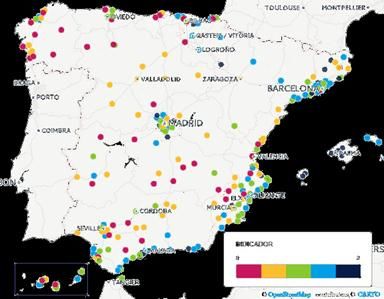
The provinces with the highest contribution to the recovery of home sales
Exposure to tourism were Madrid, Barcelona, Málaga, Valencia, Alicante, Baleares, Vizcaya,
accelerates housing Cádiz, Las Palmas and Murcia, to which we can attribute 65.3% of the
sales increase in total sales between 2014 and 2016. On the opposite end of
the scale are Zamora, Ciudad Real, Lugo, Teruel and Soria, provinces
with low sales growth which barely contributed to the national growth (see Map 3.1). The growth in sales, in
terms of population, was more intense in the provinces with high exposure to the tourism sector (which led to
a growth of the housing stock without a growth in population) and those which include the largest Spanish
cities –Madrid and Barcelona– which are poles of attraction for population via job creation and the search for
opportunities (see Figure 3.23).
SEE IMPORTANT INFORMATION ON PAGE ¡Error! Marcador no definido. OF THIS DOCUMENT 20 / 29 www.bbvaresearch.comSpain Real Estate Outlook
March 2017
Map 3.1 Figure 3.23
Spain: contribution to the grow th of housing Spain: variation in sales per 1,000 inhabitants.
sales (annual average 2013-2016) (annual average 2014-2106)*
2.5
2.0
1.5
1.0
0.5
0.0
-0.5
Tarragona
Tenerife
Cáceres
Valencia
Zamora
Cuenca
Álava
Girona
Las Palmas
Málaga
Toledo
Soria
Madrid
Castellón
Alicante
Baleares
A Coruña
Ciudad Real
Lugo
Barcelona
0,012 2,638
Source: BBVA RE Research based on MFOM data *Note: Averages adjusted f or v olatility of the period. Top ten and
bottom ten municipalities.
Source: BBVA RE Research based on MFOM and INE data
From the point of view of construction, Madrid and the
Mediterranean communities are also perceived as those that have
Madrid and the
shown greater activity. The number of new housing construction
Mediterranean regions
permits has been growing since 2014 at national aggregate level, lead in new housing starts
and from then until 2016 grew at an annual average of 24.3%.
Above this average are Catalonia, Madrid, Valencia, Baleares (thanks to the extraordinary increase in 2015),
La Rioja, Asturias and Extremadura. In the three year period, a negative trend in building permits can only
be seen in Murcia, while in Cantabria they were practically stagnant (see Figure 3.24).
Figure 3.24
Spain: evolution of new housing building perm its (annual average 2014-2016)
50
40
30
20
10
0
-10
CAT MAD RIO VAL BAL AST EXT ESP AND CAN CLM ARA CYL NAV PVA GAL CNT MUR
Source: BBVA RE Research based on MFOM data
SEE IMPORTANT INFORMATION ON PAGE ¡Error! Marcador no definido. OF THIS DOCUMENT 21 / 29 www.bbvaresearch.comSpain Real Estate Outlook
March 2017
The provinces that contributed most to the national increase in building permits were Madrid, Barcelona,
Alicante, Malaga and Vizcaya. These five account for 71.9% of the increase in building permits in the last
three years (see Table 3.4). These are all provinces that, as discussed above, are showing a relatively
strong recovery in demand. However, the ones which experienced the most growth in building permits
between 2014 and 2016 were not those that have contributed most to national growth.
The provinces that recorded the highest growth in building permits between 2014 and 2016 were
Guadalajara, Valladolid and Las Palmas. It is surprising that the high growth in some of them barely
contributed to national growth. This is because the huge correction suffered during the crisis has placed
housing starts at an extremely low level, resulting in an important base effect which results in large shifts in
the rates of change from small variations in their levels. For example, Guadalajara, where building permits
during the crisis suffered more than the average, falling by 98% in that period, was the Spanish province
where building permits grew the most between 2014 and 2016 (65.3%), but despite this only it contributed
0.3 pp to the average growth in Spain. This can also be seen in the province of Castellón where building
permits grew at an annual average of 42.0% in the last three years, but where there were just 0.8 housing
starts per 1,000 households, the result of the reduction of 99.3% undergone by building permits between
2006 and 2015. At the other end of the scale are the provinces of Avila, Murcia, Santa Cruz de Tenerife,
Zamora and Teruel, where the approval of building permits fell in annual average terms between 2013 and
2016.
Table 3.4
Spain: contribution to national grow th of housing construction permits by provinces (2013 -2016)
Building Building Building
permits permits Contrib. permits Contrib.
Var. per Contrib. to Var. per to var. in Var. per to var. in
annual 1,000 var. in annual 1,000 annual annual 1,000 annual
average homes annual average homes average average homes average
2014- from the average 2014- from the 2014- 2014- from the 2014-
2016 housing 2014-2016 2016 housing 2016 2016 housing 2016
(%) stock (pp) (%) stock (pp) (%) stock (pp)
TOTAL 24.3 1.9 24.3 Granada 23.0 1.4 0.3 Pontevedra 14.4 0.7 0.1
Madrid 39.2 4.0 8.4 Navarra 14.3 3.5 0.3 Álava 22.2 2.0 0.1
Barcelona 55.8 1.6 3.6 Cáceres 32.0 1.6 0.3 Soria 14.1 2.5 0.1
Alicante 35.5 3.0 2.5 Tarragona 31.8 0.7 0.2 Salamanca 13.9 1.4 0.1
Málaga 54.8 3.0 2.2 Guipúzcoa 15.2 4.9 0.2 Cuenca 9.0 1.7 0.0
Vizcaya 20.5 3.8 0.8 Jaén 17.1 1.6 0.2 Segovia 13.7 2.6 0.0
Baleares 28.5 2.3 0.6 C. Real 15.5 1.9 0.2 Lugo 14.3 1.3 0.0
Zaragoza 28.5 2.3 0.6 Burgos 20.6 1.7 0.2 Palencia 7.9 1.0 0.0
Las Palmas 60.9 1.1 0.5 Castellón 42.0 0.8 0.2 Ávila -0.1 1.2 0.0
Cádiz 41.2 1.2 0.5 Badajoz 22.4 1.4 0.2 Albacete 6.2 1.8 0.0
Valencia 31.5 0.6 0.4 A Coruña 13.9 1.4 0.2 Zamora -8.0 1.0 0.0
Asturias 27.0 1.4 0.4 Huesca 46.7 2.2 0.2 Cantabria 0.5 1.3 -0.1
Córdoba 40.1 1.7 0.4 León 24.1 1.0 0.2 Murcia -4.9 1.4 -0.2
Valladolid 62.3 1.7 0.4 Lleida 37.0 1.4 0.1 Teruel -13.5 1.6 -0.2
Toledo 26.0 1.9 0.4 La Rioja 36.3 1.7 0.1 Almería 39.3 1.7 -0.2
Girona 27.9 1.3 0.3 Huelva 20.7 1.1 0.1 Tenerife -6.2 1.0 -0.3
Guadalajara 65.3 2.3 0.3 Ourense 40.1 0.8 0.1 Sevilla 0.4 1.3 -0.5
Source: BBVA RE Research based on MFOM data
SEE IMPORTANT INFORMATION ON PAGE ¡Error! Marcador no definido. OF THIS DOCUMENT 22 / 29 www.bbvaresearch.comSpain Real Estate Outlook
March 2017
In terms of housing prices, data from the Ministry of Public Works, which
Baleares, Barcelona provides provincial data, shows that many of the provinces with the most
y Málaga, those dynamic demand registered the highest growth in prices. Thus, Baleares,
which appreciated Barcelona, Malaga, Madrid and Las Palmas recorded growth in prices
the most above the national average in the period 2014-2016 (see Table 3.5).
However, in other provinces where demand performed well in the same
period, the evolution of prices was more modest than the average. Such is the case of Almeria, where
between 2014 and 2016 the ratio of homes sold per 1,000 homes from the housing stock stood at 19.3,
above the national average (15.8). Despite the greater impetus of demand, the price of housing in the
province fell by an annual average of 0.4% over the same three years, a trend that could be caused by a
high level of inventory. By contrast, there are provinces where housing prices have been corrected in the last
three years and which have an underactive demand. This can be observed in Soria and Cuenca where the
decline in prices was accompanied by weak demand, as is revealed by the ratio of transactions per 1,000
homes from the housing stock and the evolution of purchases in the last three years which, although they
showed a slight recovery in both cases, were much lower than the national average.
Another notable case comes from the Basque provinces of Guipuzcoa and Vizcaya. In both, certain
robustness in demand can be seen. The ratio of housing sales over housing stock is situated in the first
quartile of the distribution, higher than the national average, while sales between 2014 and 2016 grew faster
than the Spanish average in an environment where excess supply does not seem to be a problem. However,
housing prices show a significant correction, according to the Ministry of Public Works. This is something
which is not observed in the INE, where the Housing Price Index shows a significant increase in the price of
housing in the Basque Country for the same period.
Also significant is the case of Asturias and Burgos. These are two of the ten provinc es where the price has
fallen over the last three years. Nevertheless, the growth in sales has been significant, 19% and 19.5%
annually on average, respectively. However, this increase comes at a rock bottom level, where the ratio of
sales per 1,000 homes from the housing stock was 10.7 and 12.8, in each case, well below the national
average (15.8).
Finally, as long as the economy keeps growing and creating jobs, the
recovery in real estate will continue seeping into more parts of the
The recovery will be
territory. In provinces like La Rioja, where demand has momentum and extended further with
sales are beginning to reach a significant volume relative to the housing job creation
stock in an environment of rising prices, the recovery of the sector could
be settling in. In Cádiz, demand shows certain momentum but prices are not responding. To the extent the
inventory is absorbed, the market could be close to recovery, largely as a result of foreign demand (see
Table 3.5).
SEE IMPORTANT INFORMATION ON PAGE ¡Error! Marcador no definido. OF THIS DOCUMENT 23 / 29 www.bbvaresearch.comYou can also read


