PILOT'S FAMILIARIZATION BRIEFING - Bolzano AIRPORT (LIPB/BZO) - Document Provided by the - Aeroporto Bolzano
←
→
Page content transcription
If your browser does not render page correctly, please read the page content below
Aerodrome Manual – Appendix I – Part 1
                                          Rev. 1                 d.d. 15.07.2021

Bolzano AIRPORT (LIPB/BZO)
PILOT'S FAMILIARIZATION BRIEFING

             Document Provided by the

             Aerodrome Flight Operation
                    Department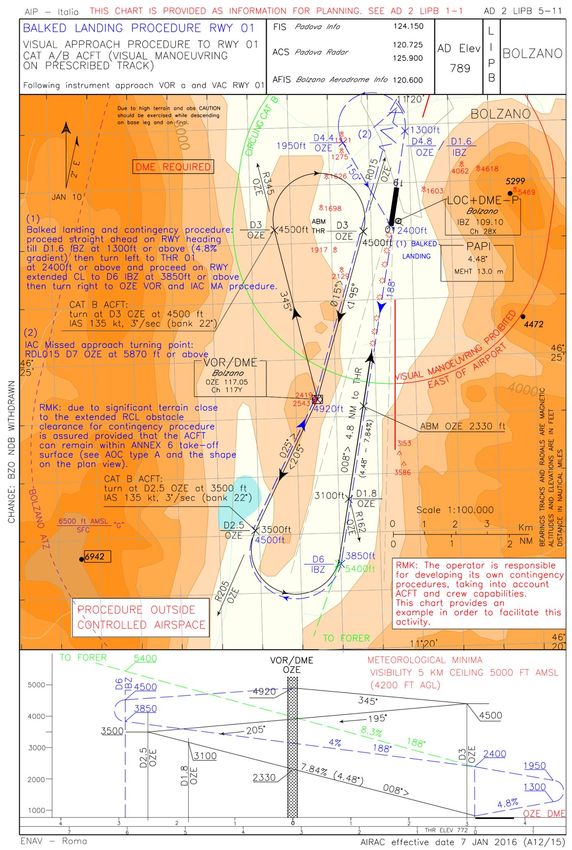
1 Index

1                FAMILIARIZATION BRIEFING ............................................................................... 5
1.1              BRIEFING RELEASE ....................................................................................................... 6
1.2              LEGAL DISCLAIMER...................................................................................................... 8
1.3              ABBREVIATIONS .......................................................................................................... 9
2                GENERAL INFORMATION .................................................................................. 12
2.1              LOCATION OF BOLZANO AERODROME ..................................................................... 12
2.2              AERODROME OPERATOR & HANDLING SERVICE PROVIDER .................................... 12
2.3              ATS PROVIDER ........................................................................................................... 12
2.4              AERODROME OPERATING HOURS ............................................................................ 12
2.5              AERODROME CATEGORY FOR RESCUE AND FIREFIGHTING...................................... 13
2.6              AERODROME PICTURES ............................................................................................ 13
2.7              RUNWAY PHYSICAL CHARACTERISTICS ..................................................................... 16
2.8              AERODROME LIGHTING FACILITIES ........................................................................... 17
2.9              AERODROME SURROUNDINGS – OBSTACLE LIGHTS ................................................ 19
2.10             AIR TRAFFIC SERVICES & AIRSPACE ........................................................................... 20
2.11             LOCAL TRAFFIC RULES & NOISE ABATEMENT ........................................................... 22
2.12             FLIGHT PROCEDURES – IFR – Aircraft and Pilot Authorization ................................. 23
2.13             APPROACH PROCEDURES .......................................................................................... 25
2.13.1           VOR-a CAT A/B/C....................................................................................................... 25
2.13.2           LOC+DME Instrument Guided Cloud Break Procedure RWY01 ................................ 26
2.13.3           RNP APCH Instrument Guided Cloud Break Procedure RWY01 ................................ 28
2.14             Departure Procedures ............................................................................................... 30
2.14.1           ICP (VISUAL) RWY01/19 (AIP AD 2 LIPB 6-5,6-7) ....................................................... 30
2.14.2           ICP RWY01 Cat A/B/C (AIP AD 2 LIPB 6-1,6-3) .......................................................... 30
2.15             FLIGHT PROCEDURES – VFR ...................................................................................... 31
2.16             AERODROME CHART ................................................................................................. 32
2.17             AIRSPACE AND AIR TRAFFIC SERVICES ...................................................................... 33
2.18             LOCAL TRAFFIC RESTRICTIONS .................................................................................. 33
2.19             PROCEDURES FOR VFR FLIGHTS ................................................................................ 34
2.20             WEATHER and WEATHERMINIMA ............................................................................ 34
3                OPERATIONAL INFORMATION, REQUIREMENTS, NOTES .................................... 36
3.1              PILOTS, OPERATORS and AIRCRAFT .......................................................................... 36

Bolzano – LIPB/BZO – Pilot’s Familiarization Briefing                           2021-07-15                             [page 2 / 70]
4                PILOT AUTHORIZATION and RENEWAL .............................................................. 37
4.1              PILOT AUTHORIZATION ............................................................................................. 37
4.2              Authorization level required for PIC / Commander (CAT, NCC)................................ 37
4.3              Authorization level required for PIC / Commander (NCO) ....................................... 37
4.4              Authorization level required for Co-Pilots / First Officers ........................................ 37
4.5              Renewal of authorization .......................................................................................... 38
5                INSTRUMENT APPROACH PROCEDURES – DESCRIPTION .................................... 39
5.1              LOC/DME RWY 01 (CLOUD BREAK) – General Information ...................................... 39
5.1.1            LOC DME RWY 01 Cloud Break – Initial Approach .................................................... 39
5.1.2            Intermediate Approach ............................................................................................. 39
5.1.3            Final Part to MDA ...................................................................................................... 40
5.1.4            Missed Approach....................................................................................................... 40
5.1.5            Visual Part after LOC+DME Instrument Guided Cloud Break Procedure .................. 42
5.1.6            Straight-In Visual RWY 01.......................................................................................... 43
5.1.7            Right Hand Circuit RWY 19 (Day only)....................................................................... 43
5.1.8            Proposed Balked Landing Procedure - RWY 01......................................................... 45
5.1.9            Proposed Balked Landing Procedure - RWY 19......................................................... 45
5.1.10           WEATHER MINIMA.................................................................................................... 45
5.2              RNP APCH Procedure RWY 01 – General Information .............................................. 45
5.2.1            RNP APCH RWY 01 Cloud Break – Initial Approach................................................... 47
5.2.2            Intermediate Approach ............................................................................................. 47
5.2.3            Final Part to MDA ...................................................................................................... 47
5.2.4            Missed Approach....................................................................................................... 47
5.2.5            Visual Part after RNP APCH Instrument Guided Cloud Break Procedure ................. 48
5.2.6            Straight-In Visual RWY 01.......................................................................................... 48
5.2.7            Right Hand Circuit RWY 19 (Day only)....................................................................... 49
5.2.8            Proposed Balked Landing Procedure - RWY 01......................................................... 49
5.2.9            Proposed Balked Landing Procedure - RWY 19......................................................... 50
5.2.10           WEATHER MINIMA.................................................................................................... 50
5.2.10.1         Straight in landing RWY 01 ........................................................................................ 50
5.2.10.2         Visual Part – right Circuit RWY 19 ............................................................................. 50
5.3              VOR-A (VOR/DME) Approach Procedure followed by Visual (or VFR) approach ..... 50
5.3.1            VOR-A (VOR/DME) – Initial Approach ....................................................................... 50
5.3.2            Intermediate Approach ............................................................................................. 50
5.3.3            Final Approach to MDA ............................................................................................. 51
5.3.4            Missed Approach....................................................................................................... 51
5.3.5            Proposed Visual (or VFR) Part of the Procedure ....................................................... 53

Bolzano – LIPB/BZO – Pilot’s Familiarization Briefing                           2021-07-15                             [page 3 / 70]
5.3.6            Proposed Straight in (Visual or VFR) Approach RWY 01 ........................................... 53
5.3.7            Proposed Right Hand Traffic Circuit (Visual or VFR) RWY 19 .................................... 53
5.3.8            Weather Minima for Visual Part / VFR to RWY 01 and RWY 19 ............................... 53
5.3.9            Proposal for Balked Landing...................................................................................... 54
5.3.10           Sample for proposed Balked Landing RWY 01 .......................................................... 55
5.3.11           Sample for proposed generic Balked Landing RWY 19 ............................................. 55
6                DEPARTURE PROCEDURES ................................................................................ 57
6.1              ICP RWY 01/19 .......................................................................................................... 57
6.1.1            WEATHER MINIMA for Take Off ICP RWY 19 + RWY 01............................................ 57
6.1.2            Sample for proposed all engine initial departure RWY01 (same as Balked Landing) 59
6.1.3            Sample for proposed all engine initial departure RWY 19 ........................................ 60
6.2              ICP RWY 01 Aircraft category A/B/C ......................................................................... 63
6.2.1            WEATHER MINIMA for Take Off ICP RWY 01 Cat A/B/C ........................................... 63
6.3              COMMUNICATION .................................................................................................... 64
7                EMERGENCY AND CONTINGENCY PROCEDURES ................................................ 65
7.1              EMERGENCY PROCEDURES ....................................................................................... 65
7.2              CONTIGENCY PROCEDURES ...................................................................................... 65
7.2.1            Sample for proposed take off contingency RWY01 (same as Balked Landing)......... 65
7.2.2            Sample for proposed take off contingency RWY 19 (same as Balked Landing) ........ 66
8                OPERATOR REQUIREMENTS (CAT & NCC & NCO) ............................................... 68
9                TRAINING PROGRAM........................................................................................ 69
9.1              FTD (or FFS) OR “ON-SITE FLIGHT TRAINING” ........................................................... 69
10               FINAL NOTE: ..................................................................................................... 70

Bolzano – LIPB/BZO – Pilot’s Familiarization Briefing                           2021-07-15                             [page 4 / 70]
1 FAMILIARIZATION BRIEFING
The familiarization Briefing has the main objective to support operators and pilots in preparing the
flight operations to/from Bolzano. The briefing will provide general information concerning the main
operational issues of Bolzano Aerodrome such as:
    ▪   Aerodrome general information;
    ▪   General operational requirements;
    ▪   Local Weather;
    ▪   Orography;
    ▪   Approach and departure procedures;
    ▪   Communication procedure;
    ▪   Emergency and contingency procedures.
The personal flight preparation of pilots intending to operate into Bolzano aerodrome shall include the
information contained in this document, and shall be based on current official documents (i.e. AIP Italy,
NOTAM, etc.).
NOTE: For IFR approach/departures to/from Bolzano aerodrome, the pilot/pilots is/are obliged to
      enter the Authorization Number in the box 18 of the Flight Plan and carry along a copy of the
      “Authorization” issued by the Aerodrome Operator, either in electronic or printed form,
      presentable at any time on demand to official representatives of responsible authorities.
        CAT and NCC operator should enter in the FPL box 18 the Authorization number of the
        Company. There Pilots should carry along the Authorization record issued by the company. It’s
        the Operators responsibility to train their crews according EU Reg. 965/12 so as to schedule
        only authorized and current crews for the intended operations to/from Bolzano.

NOTE: Pilots operating to/from Bolzano according IFR without the appropriate approval may be
      reported to the responsible department of the Italian Civil Aviation Authority ENAC.

Bolzano – LIPB/BZO – Pilot’s Familiarization Briefing          2021-07-15                 [page 5 / 70]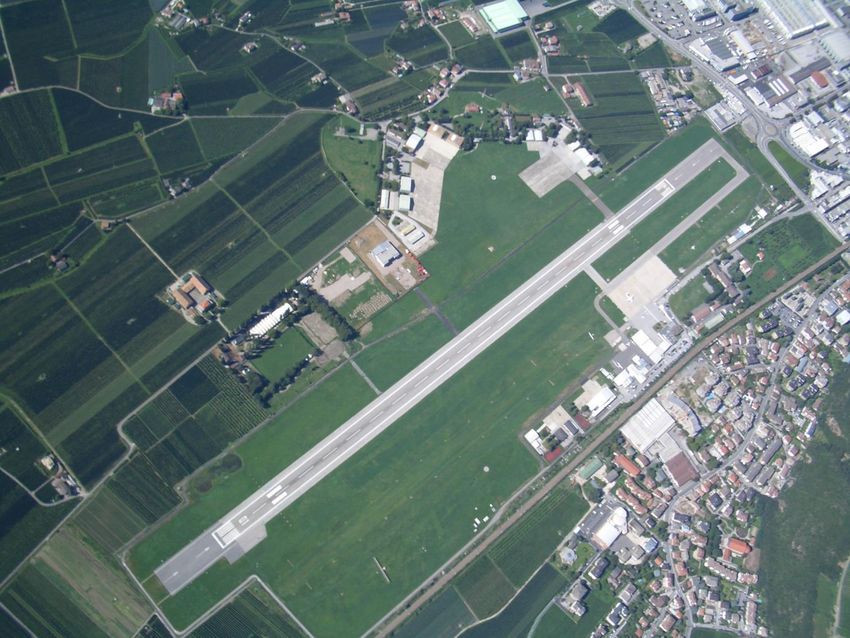
1.1 BRIEFING RELEASE

 Chap.    Par.     Poi.     Input date     Release data   Ed.    Rev.            Changes
 1                          15.02.2020      15.02.2020    1       0              First issue
         1.1                15.02.2020      15.02.2020    1       0              First issue
         1.2                15.02.2020      15.02.2020    1       0              First issue
         1.3                25.06.2021      15.07.2021    1       1         New abbrevations
 2                          15.02.2020      15.02.2020    1       0              First issue
         2.1                15.02.2020      15.02.2020    1       0              First issue
         2.2                15.02.2020      15.02.2020    1       0              First issue
         2.3                15.02.2020      15.02.2020    1       0              First issue
         2.4                15.02.2020      15.02.2020    1       0              First issue
         2.5                15.02.2020      15.02.2020    1       0              First issue
         2.6                15.02.2020      15.02.2020    1       0              First issue
         2.7                15.02.2020      15.02.2020    1       0              First issue
         2.8                25.06.2021      15.07.2021    1       1     Detailed specifications PAPI
         2.9                25.06.2021      15.07.2021    1       1     Obstacle lights nord of LIPB
         2.10               25.06.2021      15.07.2021    1       1     Update VFR Chart “Adige”
         2.11               25.06.2021      15.07.2021    1       1          Change Apron ID
         2.12               25.06.2021      15.07.2021    1       1       Update Ops req. table
         2.13               15.02.2020      15.02.2020    1       0              First issue
         2.14               25.06.2021      15.07.2021    1       1     New ICP Rwy 01 Cat A/B/C
         2.15               15.02.2020      15.02.2020    1       0              First issue
         2.16               25.06.2021      15.07.2021    1       1          Update AD Chart
         2.17               15.02.2020      15.02.2020    1       0              First issue
         2.18               15.02.2020      15.02.2020    1       0              First issue
         2.19               15.02.2020      15.02.2020    1       0              First issue
         2.20               25.06.2021      15.07.2021    1       1     Upd. wheater minima table
         2.21               15.02.2020      15.02.2020    1       0              First issue
         2.22               15.02.2020      15.02.2020    1       0              First issue
         2.23               15.02.2020      15.02.2020    1       0              First issue
 3                          15.02.2020      15.02.2020    1       0              First issue
         3.1                15.02.2020      15.02.2020    1       0              First issue
 4                          15.02.2020      15.02.2020    1       0              First issue
         4.1                15.02.2020      15.02.2020    1       0              First issue
         4.2                15.02.2020      15.02.2020    1       0              First issue
         4.3                15.02.2020      15.02.2020    1       0              First issue
         4.4                15.02.2020      15.02.2020    1       0              First issue
 5                          15.02.2020      15.02.2020    1       0              First issue
         5.1                15.02.2020      15.02.2020    1       0              First issue
                 5.1.1      15.02.2020      15.02.2020    1       0              First issue
                 5.1.2      15.02.2020      15.02.2020    1       0              First issue
                 5.1.3      15.02.2020      15.02.2020    1       0              First issue
                 5.1.4      15.02.2020      15.02.2020    1       0              First issue
                 5.1.5      15.02.2020      15.02.2020    1       0              First issue
                 5.1.6      15.02.2020      15.02.2020    1       0              First issue
                 5.1.7      15.02.2020      15.02.2020    1       0              First issue

Bolzano – LIPB/BZO – Pilot’s Familiarization Briefing         2021-07-15               [page 6 / 70]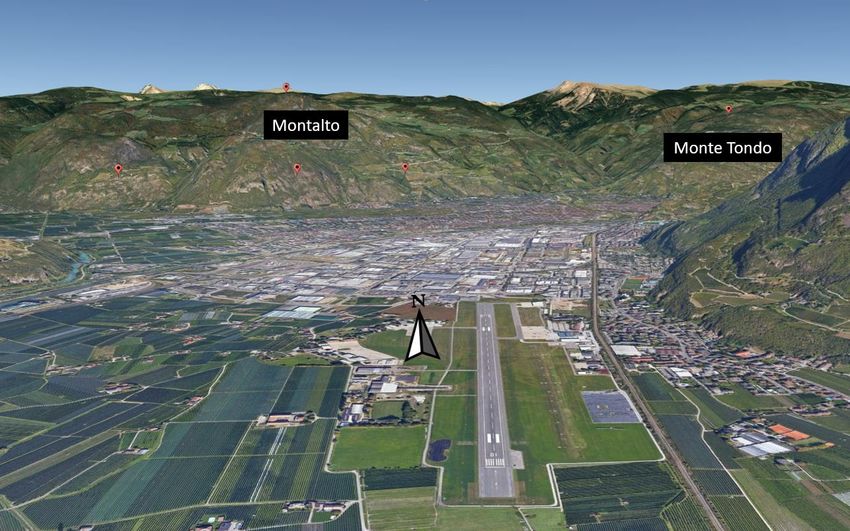
Chap.    Par.     Poi.     Input date     Release data   Ed.    Rev.              Changes
                 5.1.8.     15.02.2020      15.02.2020    1       0                 First issue
                 5.1.9      15.02.2020      15.02.2020    1       0                 First issue
                 5.1.10     15.02.2020      15.02.2020    1       0                 First issue
                 5.1.11     15.02.2020      15.02.2020    1       0                 First issue
                 5.1.12     15.02.2020      15.02.2020    1       0                 First issue
         5.2                15.02.2020      15.02.2020    1       0                 First issue
                 5.2.1      15.02.2020      15.02.2020    1       0                 First issue
                 5.2.2      15.02.2020      15.02.2020    1       0                 First issue
                 5.2.3      15.02.2020      15.02.2020    1       0                 First issue
                 5.2.4      15.02.2020      15.02.2020    1       0                 First issue
                 5.2.5      15.02.2020      15.02.2020    1       0                 First issue
                 5.2.6      15.02.2020      15.02.2020    1       0                 First issue
                 5.2.7      15.02.2020      15.02.2020    1       0                 First issue
                 5.2.8      15.02.2020      15.02.2020    1       0                 First issue
                 5.2.9      15.02.2020      15.02.2020    1       0                 First issue
                 5.2.10     15.02.2020      15.02.2020    1       0                 First issue
                 5.2.11     15.02.2020      15.02.2020    1       0                 First issue
                 5.2.12     15.02.2020      15.02.2020    1       0                 First issue
         5.3                15.02.2020      15.02.2020    1       0                 First issue
                 5.3.1      15.02.2020      15.02.2020    1       0                 First issue
                 5.3.2      15.02.2020      15.02.2020    1       0                 First issue
                 5.3.3      15.02.2020      15.02.2020    1       0                 First issue
                 5.3.4      15.02.2020      15.02.2020    1       0                 First issue
                 5.3.5      15.02.2020      15.02.2020    1       0                 First issue
                 5.3.6      15.02.2020      15.02.2020    1       0                 First issue
                 5.3.7      15.02.2020      15.02.2020    1       0                 First issue
                 5.3.8      15.02.2020      15.02.2020    1       0                 First issue
                 5.3.9      15.02.2020      15.02.2020    1       0                 First issue
                 5.3.10     15.02.2020      15.02.2020    1       0                 First issue
                 5.3.11     15.02.2020      15.02.2020    1       0                 First issue
 6                          25.06.2021      15.07.2021    1       1            Two different ICP
         6.1                25.06.2021      15.07.2021    1       1         Obst. Lights nord of LIPB
         6.2                25.06.2021      15.07.2021    1       1        New ICP RWY 01 Cat A/B/C
                 6.2.1.1    15.02.2020      15.02.2020    1       0                 First issue
                 6.2.1.2    15.02.2020      15.02.2020    1       0                 First issue
         6.3                15.02.2020      15.02.2020    1       0                 First issue
 7                          15.02.2020      15.02.2020    1       0                 First issue
         7.1                15.02.2020      15.02.2020    1       0                 First issue
         7.2                15.02.2020      15.02.2020    1       0                 First issue
                 7.2.1.1    15.02.2020      15.02.2020    1       0                 First issue
                 7.2.1.2    15.02.2020      15.02.2020    1       0                 First issue
 8                          15.02.2020      15.02.2020    1       0                 First issue
 9                          15.02.2020      15.02.2020    1       0                 First issue
         9.1                15.02.2020      15.02.2020    1       0                 First issue
 10                         15.02.2020      15.02.2020    1       0                 First issue

Bolzano – LIPB/BZO – Pilot’s Familiarization Briefing         2021-07-15                 [page 7 / 70]
1.2 LEGAL DISCLAIMER

The aerodrome operator of Bolzano Aerodrome publishes this Briefing on the website
https://www.bolzanoairport.it/en/pilots-corner-en.htm.

The information’s and data herein are accepted by ENAC (Italian Civil Aviation Authority) and are
therefore official publications like those published by ENAC and ENAV (Italian ANSP – Air Navigation
Service Provider).

Bolzano aerodrome may modify the content of the https://www.bolzanoairport.it/en/pilots-corner-
en.htm web site content at any time without prior information. Bolzano aerodrome is not liable
towards web sites linking to www.bolzanoairport.it. All information’s published on
www.bolzanoairport.it are property of ABD AIRPORT SPA. All rights are reserved.

                                              ATTENTION:
    The use of this Familiarization Briefing does not substitute the priority given to the required
  knowledge of other official documentation for the intended flight such as NOTAMs and AIP Italia.

ATTENTION: The operators/Commanders shall make use of procedures contained in this Pilot’s
Familiarization Briefing under their full and exclusive responsibility and shall keep the ASOM entirely
indemnified and held harmless from any liabilities or negative consequences connected to accidental
events that may occur with respect to the use or misuse of such procedures.

NOTE: The familiarization briefing has been developed in order to assist operators and pilots in
      planning the operation under IFR according to the procedures intended to be used.

A tailored Airport Briefing covering operational aspect for specific aircraft types and operations will be
available on request (info@bolzanoairport.it)

Bolzano – LIPB/BZO – Pilot’s Familiarization Briefing          2021-07-15                  [page 8 / 70]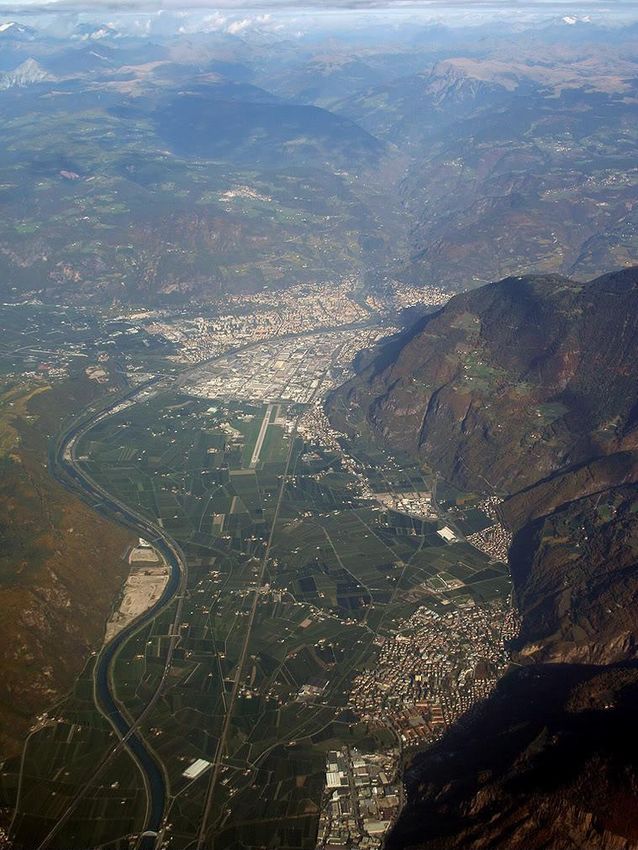
1.3 ABBREVIATIONS
Abbreviation                 Meaning
01 or 19 (RWY)               QFU (magnetic orientation of the runway)
AAL                          Above Aerodrome Level
ABD AIRPORT SPA              Bolzano Aerodrome Operator
ACC                          Airway Control Centre
AD                           Aerodrome
AFIU (AFIS)                  Aerodrome Flight Information Unit (AFI Service)
AFM                          Airplane/Aircraft Flight Manual
AGM                          Administrative Guide Material
AIP                          Aeronautical Information Publication
AMSL                         Above Mean Sea Level (altitude based on local QNH)
ANSP                         Air Navigation Service Provider
AOC                          Aircraft Operators Certificate (commercial operations)
APU                          Auxiliary Power Unit
ARO                          Aeronautical Reporting Office (Milano +39 02 70143209)
ATC                          Air Traffic Control
ATS                          Air Traffic Services
ATIS                         Aerodrome Terminal Information Service
ATZ                          Aerodrome Traffic Zone
AVBL O/R                     Available on Request
AWO                          All Weather Operations
CAT (ICAO) III, IV, V, VI    ICAO Fire Fighting and Rescue Category of Aerodrome
CAT (A/B/C)                  Speed Category of Aircraft for Procedures
CAT (kind of operation)      Commercial Air Transport (operation within an AOC)
CBO                          Central Briefing Office (Milano +39 02 70143209)
CEIL                         Ceiling
CFIT                         Controlled Flight into Terrain
CMV                          Converted Meteorological Visibility
COM                          Communication
COV                          Coverage (of radio signal)
CWY                          Clearway
DME (Navigational Aid)       Distance Measuring Equipment collocated to Nav Aids
DOC                          Document
ENAC                         Italian Civil Aviation Authority (Ente Nazionale per l’Aviazione Civile)
ENAV                         Italian Air Navigation Service Provider
FAF                          Final Approach Fix
FIC                          Flight Information Centre
FL                           Flight Level
FMS / FMC                    Flight Management System / Flight Management Computer
FORER                        Name of Reporting Point
ft                           Feet (e.g. altitude/elevation)
H24                          24 Hours / All Day
HDG                          Heading
HJ                           Sunrise to Sunset
HOL                          Holidays
HR                           Hours
KIAS                         Knots Indicated Air Speed
km                           Kilometre
IAF                          Initial Approach Fix

Bolzano – LIPB/BZO – Pilot’s Familiarization Briefing             2021-07-15                     [page 9 / 70]
Abbreviation                 Meaning
IBZ                          Identification Radio Aid
ICAO                         International Civil Aviation Organization
IAS                          Indicated Air Speed
ICP                          Initial Climb Procedure
IFR                          Instrument Flight Rules
IGS                          Instrumental Guidance System
IMC                          Instrument Meteorological Conditions
ISA                          International Standard Atmosphere
Kts                          Knots (speed)
LOC IBZ (Navigational Aid)   Localizer IBZ
MAPt                         Missed Approach Point
MDA                          Minimum descending altitude
MSL                          Mean Sea Level
MTOW (MTOM)                  Maximum Take Off Mass (weight)
MLW (MLM)                    Maximum Landing Mass (weight)
NCC (kind of operation)      non-commercial flights in complex motor-powered aircraft
NCO (kind of operation)      non-commercial flights in other than complex aircraft
NM                           Nautical Miles
NOTAM                        Notice to Airmen
OAT                          Outside Air Temperature
OPS                          Operation
OZE                          See IBZ
PAPI                         Precision Approach Path Indicator (Visual Glide path)
PDG                          Procedure Design Gradient
PFB                          Pilot’s Familiarization Briefing
PIC                          Pilot in Command
AFO                          Aerodrome Flight Operation Manager of the airport operator
QNH                          Local Air Pressure based on hectopascal
R or RDL                     Radial (VOR)
RESA                         Runway End Safety Area
RPM                          Revolutions per Minute
RWY                          Runway
SID                          Standard Instrument Departure
SOP                          Standard Operating Procedure
STAR                         Standard Arriving Procedures
SWY                          Stop Way
TGL                          Temporary Guidance Leaflet
THR                          Threshold
TL                           Transition Level
TP                           Turning Point
VAC                          Visual Approach Chart
VGA                          Velocity Go Around
VHF NAV                      Very High Frequency Navigation
VIS                          Visual
VMC                          Visual Meteorological Conditions

Bolzano – LIPB/BZO – Pilot’s Familiarization Briefing          2021-07-15               [page 10 / 70]
Abbreviation                 Meaning
VOR-a                        VOR/DME procedure for aircraft cat. A, B, C, over VOR “OZE”
VOR OZE (Navigational Aid)   BOLZANO Very High Frequency Omni Directional Radio Range
VFR                          Visual Flight Rules
e.g. 04:30 (03:30)           04:30 = Greenwich mean time; (03:30 = Central European Summer Time)

Bolzano – LIPB/BZO – Pilot’s Familiarization Briefing        2021-07-15                 [page 11 / 70]
2 GENERAL INFORMATION

2.1 LOCATION OF BOLZANO AERODROME
Bolzano Aerodrome is located about 5 km south of the City of Bolzano at an elevation of 782 feet
AMSL. The aerodrome is located in the bottom of the valley, surrounded by hills up to 2544 feet AMSL
in the west, and mountainous terrain further to the west, in the east and in the north, with available
valley exits in direction to northwest (Merano), in direction to northeast (Valle Isarco / Brennero) and
to the south (Trento/Verona). For detailed elevations of the highest terrain, refer to the approach
charts published and in use.

2.2 AERODROME OPERATOR & HANDLING SERVICE PROVIDER
The aerodrome is open to IFR and VFR flights, to private, commercial and to scheduled traffic. The
Aerodrome Operator and Handling agent is:
    ▪   ABD AIRPORT SPA
        -       Tel                +39 0471 255 255, fax +39 0471 255 222
        -       E-mail:            info@bolzanoairport.it, generalaviation@bolzanoairport.it

2.3 ATS PROVIDER
Air Traffic Service Provider is:
    ▪   ENAV S.p.A.:               Centro Aeroportuale Bolzano
        - Tel:                     + 39 0471 255 311; fax: +39 0471 255 302
        - E-mail:                  NAAV_Bolzano@enav.it
        - AIP Italy                https://www.enav.it/sites/private/en/ServiziOnline/AIP.html
                                   (registration required; access free of charge)

2.4 AERODROME OPERATING HOURS
    ▪   Aerodrome Administration 04:30-22:00 (03:30-21:00)
    ▪   Customs and immigration
            -   MON-FRI 06:30-19:00 (05:30-18:00)
            -   SAT, SUN and HOL 05:00-20:00 (04:00-19:00) AVBL O/R contacting via e-mail
                coordinator@bolzanoairport.it or by phone +39 047 1255 204
    ▪   AIS Briefing Office        H24 ARO CBO MILANO
    ▪   ARO                        H24 ARO CBO MILANO
    ▪   METEO Briefing Office H24 ARO CBO MILANO
    ▪   ATS                        04:30-22:30 (03:30-21:30)

Bolzano – LIPB/BZO – Pilot’s Familiarization Briefing          2021-07-15                [page 12 / 70]
▪ Fueling
- JET A1 HR 05:00-22:00 (04:00-21:00) https://www.bolzanoairport.it/en/fuel-en.htm
- AVGAS / MOGAS - NOT available
▪ Handling 04:30-22:00 (03:30-21:00)
▪ Security H24
▪ De-icing and any other operational services O/R (“on request”) see aerodrome operator “ABD
Airport SPA” https://www.bolzanoairport.it/en/handling-fee-s-and-services-en.htm
2.5 AERODROME CATEGORY FOR RESCUE AND FIREFIGHTING
▪ CAT 5 ICAO
1) CAT 6 ICAO available on request
2) Firefighting service available HR 05:30-22:00 (04:30-21:00).
NOTE: For details refer to AIP ITALIA AD LIPB 1-1 etc., respectively to actual NOTAMs in force.
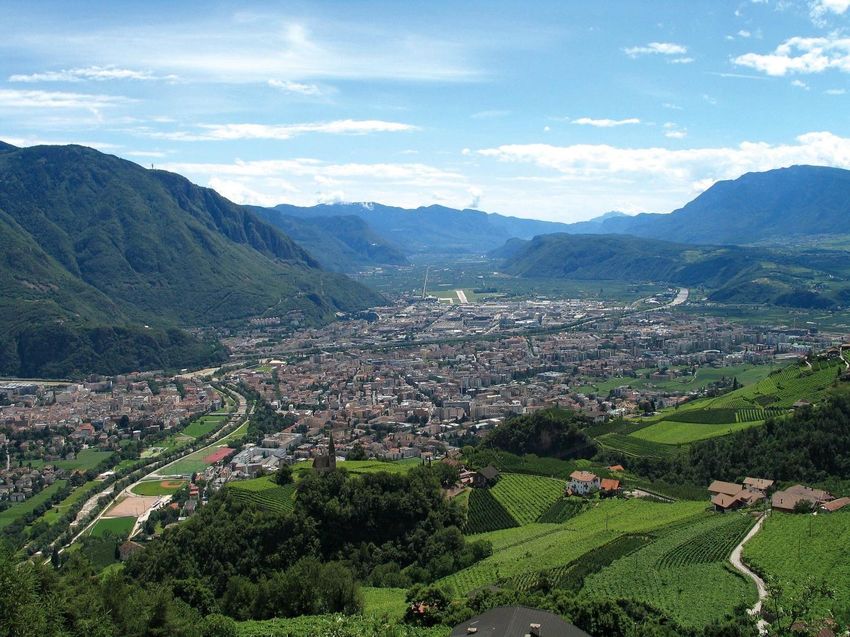
2.6 AERODROME PICTURES
BZO / LIPB airport
Figure 1: view form north of Bolzano City to the south
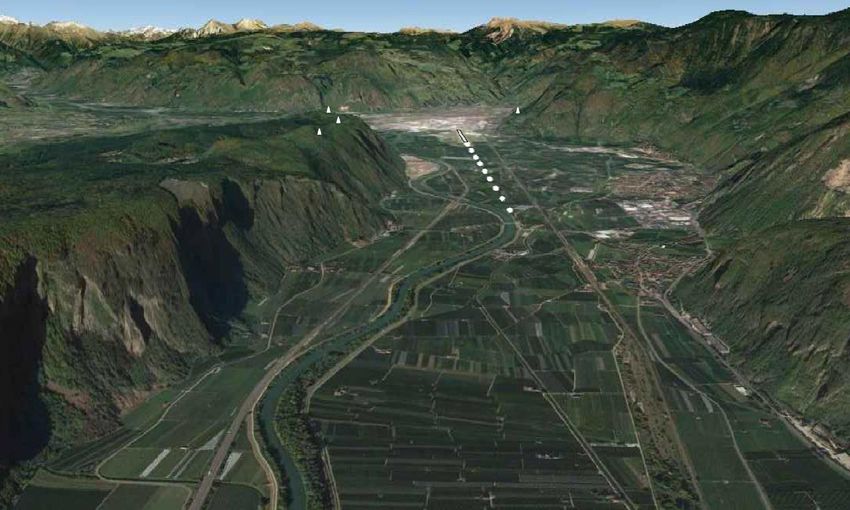
Bolzano – LIPB/BZO – Pilot’s Familiarization Briefing 2021-07-15 [page 13 / 70]Figure 2: view from south of the aerodrome to the north Bolzano – LIPB/BZO – Pilot’s Familiarization Briefing 2021-07-15 [page 14 / 70]
BOLZANO

        MERANO / MERAN

  Figure SEQ Figure \* ARABIC 3: View from the north-west at FL 330 (A/D is the yellow rectangle)

                               Figure 4: view from overhead the aerodrome

Bolzano – LIPB/BZO – Pilot’s Familiarization Briefing         2021-07-15             [page 15 / 70]
2.7 RUNWAY PHYSICAL CHARACTERISTICS
Note: Check the latest AIP edition (online free of charge available) and NOTAMs.
12 RUNWAY PHYSICAL CHARACTERISTICS
RWY QFU Dimension Strength and THR coordinates THR ELEV, MAX TDZ
Designation of RWY surface of --- ELEV
(M) RWY RWY END of precision APCH
Coordinates RWY
---
THR Geoid
Undulation
1 2 3 4 5 6
46°27'15.77''N
011°19'29.51''E
-----------------------
PCN 84/F/A/X/T
01 009° 1293 x 32 46°27'57.00''N 772.1 FT / NIL
ASPH
011°19'40.29''E
-----------------------
161.5 FT
46°27'54.97''N
011°19'39.76''E
-----------------------
PCN 84/F/A/X/T
19 189° 1293 x 32 46°27'15.77''N 788.6 FT / NIL
ASPH
011°19'29.51''E
-----------------------
161.8 FT
46°27'17.89''N
011°19'36.50''E
NIL ----------------------
01GLD 009° 652 x 20 771.8 FT / NIL
Grass NIL
-----------------------
NIL
46°27'31.81''N
011°19'40.10''E
NIL -----------------------
19GLD 189° 652 x 20 776.4 FT / NIL
Grass NIL
-----------------------
NIL
EXCERPT FROM THE “AIP Italia” (Italian text omitted)
RWY RWY-SWY SWY CWY STRIP RESA
Designation Slope dimension dimension dimension dimension
(M) (M) (M) (M)
1 7 8 9 10 11
Longitudinal /
01 Trasversal: see NIL 150 x 150 1413 x 140 90 x 90
AOC in force
Longitudinal /
19 Trasversal: see NIL 155 x 150 1413 x 140 95 x 90
AOC in force
01GLD NIL NIL NIL 712 x 60 NIL
19GLD NIL NIL 75 x 60 712 x 60 NIL
Bolzano – LIPB/BZO – Pilot’s Familiarization Briefing 2021-07-15 [page 16 / 70]RWY OFZ Remarks
Designation Obstacle free zone
1 12 13
01 NIL NIL
19 NIL 1) DTHR 63 m
1) The grass RWY is marked by white flat rectangular markers,
01GLD NIL
RWY end is marked by white-yellow flat rectangular markers
1) DTHR: 251 m
2) Displaced THR is marked by white-red rectangular markers
19GLD NIL
3) The grass RWY is marked by white flat rectangular markers,
RWY end is marked by white-red rectangular markers
EXCERPT FROM THE “AIP Italia” (Italian text omitted)
13 DECLARED DISTANCES
RWY designator TORA TODA ASDA LDA
(M) (M) (M) (M)
1 2 3 4 5
01 1293 1443 1293 1293
START POINT 01 PROP 1413 1563 1413 -
START POINT 01 JET 1388 1538 1388 -
19 1293 1448 1293 1230
START POINT 19 PROP 1413 1568 1413 -
START POINT 19 JET 1383 1538 1383 -
01GLD 652 652 652 652
19GLD 652 727 652 401
REMARK
START POINT 01/19 PROP/JET: on pilot’s request it is allowed for TKOF the use of
pavement, included RESA | Runway grooved
EXCERPT FROM THE “AIP Italia” (Italian text omitted)
2.8 AERODROME LIGHTING FACILITIES
14 APPROACH AND RUNWAY LIGHTING
RWY APPROACH THR VASIS PAP MEHT (M) TDZ
ID
Type Length Intensity Colour Length
(M) (M)
1 2.1 2.2 2.3 3 4.1 4.2 4.3 5
4.48°
LEAD- THR
01 4500 LIH NIL both 9.4 NIL
IN G
sides
THR 4.48°
19 NIL NIL NIL NIL 12.4 NIL
G left side
01GLD NIL NIL NIL NIL NIL NIL NIL NIL
19GLD NIL NIL NIL NIL NIL NIL NIL NIL
EXCERPT FROM THE “AIP Italia” (Italian text omitted)
Bolzano – LIPB/BZO – Pilot’s Familiarization Briefing 2021-07-15 [page 17 / 70]RWY RCL RWY EDGE
ID
Length Spacing Colour Int Length Spacing Colour Intensity
(M) (M) Intensity (M) (M)
1 6.1 6.2 6.3 6.4 7.1 7.2 7.3 7.4
89 56 R LIH
01 NIL NIL NIL NIL 728 56 W LIH
448 56 Y LIH
112 56 R LIH
19 NIL NIL NIL NIL 784 56 W LIH
392 56 Y LIH
01GLD NIL NIL NIL NIL NIL NIL NIL NIL
19GLD NIL NIL NIL NIL NIL NIL NIL NIL
EXCERPT FROM THE “AIP Italia” (Italian text omitted)
RWY RWY END SWY RTIL CGL
ID Colour Length Colour
(M)
1 8 9.1 9.2 10 11
01 R NIL NIL NIL NIL
19 R NIL NIL NIL NIL
01GLD NIL NIL NIL NIL NIL
19GLD NIL NIL NIL NIL NIL
EXCERPT FROM THE “AIP Italia” (Italian text omitted)
▪ PAPI 01:
Two sets operative as follows:
- PAPI OPS instrument: RWY code NR 2;
- The PAPI is set at 4,48° and has a vertical differential setting angle of 30’
- Right COV reduced to 5°;
- Left COV reduced to 8°;
- Right wing normally operative;
- Left wing will be switched on only in case of failure of the right wing.
▪ PAPI 19:
Two sets both on the left side of the runway operative as follows:
- PAPI OPS non instrument: RWY code NR 2;
- The PAPI is set at 4,48° and has a vertical differential setting angle of 20’
- PAPI OPS affected by OBST beyond 4.9 km from the RWY THR;
- PAPI usable only by day and only within 4.9 km from the RWY THR;
- One set normally operative, the second one will be switched on only in case of failure of
the first.
Bolzano – LIPB/BZO – Pilot’s Familiarization Briefing 2021-07-15 [page 18 / 70]15 OTHER LIGHTING, SECONDARY POWER SUPPLY
1 ABN/IBN location, characteristics and hours of operation
ABN Coordinates: NIL
Characteristics: NIL
Hours: NIL
2 LDI location and lights
Anemometer location and lights
LDI: NIL
Anemometers:
1) 270 m after THR RWY 01, 210 m right side RCL
2) 275 m after THR RWY 01, 240 m right side RCL
3) 110 m after THR RWY 19, 70 m right side RCL
3 TWY edge and centre line lighting
See AD chart in force
4 Secondary power supply/Switch over time
GEIA / 10 seconds
5 Remarks
NIL
EXCERPT FROM THE “AIP Italia” (Italian text omitted)
2.9 AERODROME SURROUNDINGS – OBSTACLE LIGHTS
The Obstacles surrounding the aerodrome, where penetrating the protection surfaces, are marked as
prescribed and illuminated for night operations. In particular, the powerline west of the aerodrome
and a significant obstacle northeast of the aerodrome are illuminated during night. For detailed study
check the individual charts as well as the screenshots visualizing the lighting systems.
In addition to the obstacle marking and lighting within the obstacle protection surfaces, due to the
mountainous terrain, the aerodrome operator in accordance with ENAC provided the installations of
obstacle lights on the orographic reliefs north of the airport.
Overall, the following obstacle lights were installed:
▪ 4 obstacle lights (flashing red lights) on the "Montalto" mountain, three of which are at half
mountain elevation and one at the top;
▪ 1 back-up obstacle light in addition to the night lighting (fixed white) of the mountain "Monte
Tondo" cross.
As mentioned before the obstacle lights are located outside the obstacle protection surfaces of the
airport and are useful for identifying the position of the orographic reliefs during night time take-off
for runway 01.
Bolzano – LIPB/BZO – Pilot’s Familiarization Briefing 2021-07-15 [page 19 / 70]Figure 5: location of the obstacle lights outside the obstacle limitation surfaces (red circle with black dot)
2.10 AIR TRAFFIC SERVICES & AIRSPACE
17 ATS AIRSPACE
Designation and Vertical Airspace ATS unit Transition Remarks
lateral limits limits classification call sign altitude
Language
1 2 3 4 5 6
Bolzano ATZ Bolzano 1) WI Milano FIR
line joining 6500 FT Aerodrome 2) Radio mandatory
G 10000 FT
following points: AMSL INFO zone. See ENR 2.2
[OMITTED] EN / IT (RMZ)
EXCERPT FROM THE “AIP Italia” (Italian text omitted)
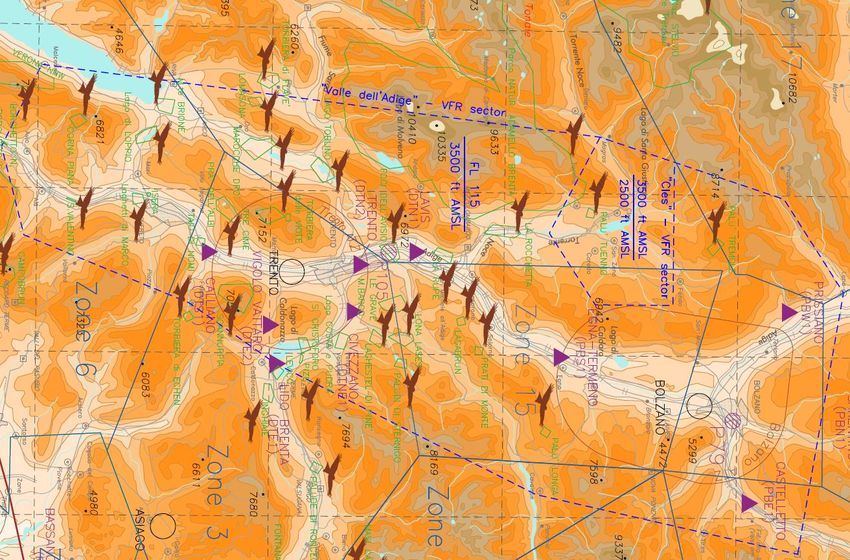
Bolzano – LIPB/BZO – Pilot’s Familiarization Briefing 2021-07-15 [page 20 / 70]Figure 6: ATZ BOLZANO and “Valle dell’Adige” VFR sector – EXCERPT AIP ENR 6.3-5 (A4/2021)
18 ATS COMMUNICATION FACILITIES
Service Call sign Frequency Operational hours Remarks
MHZ
1 2 3 4 5
Emergency NIL 121.500 MHZ 0530-2200 (0430-2100) NIL
AFIU Bolzano Aerodrome INFO 120.600 MHZ 0530-2200 (0430-2100) NIL
Bolzano – LIPB/BZO – Pilot’s Familiarization Briefing 2021-07-15 [page 21 / 70]19 RADIO NAVIGATION AND LANDING AIDS
Type of ID FREQ Operational Antenna Elevation Designated Remarks
aid hours site of DME operational
CAT of coordinates antenna coverage
ILS (WGS84) Limitations
(VAR
ILS/VOR)
1 2 3 4 5 6 7 8
1) COV:
Within 10 NM
RWY 01 horizontal COV
limitations at
LOC 46°27'20.5''N reduced to ± 10°,
IBZ 109.10 MHZ H24 NIL 30 NM MRA
(2° E- 011°19'41.5''E beyond 10 NM
12000 FT
2010.0) within 30 NM
horizontal COV
reduced to ±5°
1) COV:
Within 30 NM
horizontal COV
30 NM/25000 reduced ± 5° from
FT LOC associated
46°27'20.6''N 245 M
DME-P IBZ CH 28X H24 limitations at course
011°19'41.1''E AMSL
30 NM MRA 2) Final approach
12000 FT mode not usable.
For more
information see
GEN 3.4, item 3.1
1) MAINT:
VOR: first WED of
the month: 1000-
VOR
1100 (0900-1000)
46°24'18.7''N
VOR 2) COV:
VOR/DME 011°17'32.3''E
117.05 MHZ H24 651 M 40 NM/25000 reduced to 25 NM
(2° E- OZE
CH 117Y DME AMSL FT 3) Sector
2010.0) DME
H24 210°/320°: COV
46°24'18.9''N
reduced to FL 250
011°17'32.9''E
4) Sector
320°/210°: COV
reduced to FL 190
EXCERPT FROM THE “AIP Italia” (Italian text omitted)
2.11 LOCAL TRAFFIC RULES & NOISE ABATEMENT
LOCAL TRAFFIC REGULATIONS / RESTRICTIONS
1) Simultaneous use of Main-RWY and Grass-RWY not allowed
2) Apron
▪ Apron 200 (Stand 201-208): the main apron is reserved to aircraft with MTOW more than
5000 kg.
▪ Minimum handling is mandatory.
Bolzano – LIPB/BZO – Pilot’s Familiarization Briefing 2021-07-15 [page 22 / 70]▪ Whenever Marshaller signs are received, the ground markings are no more valid. In this case
the responsibility about separation is with the Marshaller.
3) Local flight restrictions
▪ IFR operations can be performed by authorized operators/pilots (as applicable) only. Details
about authorization requirements are included in this briefing and of course in the AIP.
▪ Local glider activity.
4) Provisions for general aviation aircraft
▪ For further information, it is suggested to visit the section “General Aviation” of the aerodrome
operator website: https://www.bolzanoairport.it/en/airport-technical-data-en.htm.
NOISE ABATEMENT PROCEDURES
1) Ground restrictions
▪ APU Limited use suggested between 22:00-06:00 (21:00-05:00).
▪ Engine run-ups (maintenance purposes): prior coordination with the Aerodrome Operator
(ABD AIRPORT SPA: +39 0471 255 204).
2.12 FLIGHT PROCEDURES – IFR – Aircraft and Pilot Authorization
PROCEDURES FOR IFR FLIGHTS – General Information
IFR operations are limited to one aircraft at a time to/from Bolzano and to/from Trento/Mattarello for
any instrument arrival and/or departure. Other aircraft shall wait on the ground or hold over the
designated holding path until the preceding aircraft has completed the instrument procedure.
During night time, instrument arrival and departure procedures may be performed only by CAT
operators authorized by Italian CAA (ENAC) and by Operators conducting Italian State flights as
outlined in AIP.
NCC & NCO Operators may perform operations during night time with prior authorization by Italian
CAA (ENAC), when using multi engine aircraft only. Landing during night is limited to RWY 01.
Note: Application and authorization on behalf of the Italian CAA via the aerodrome operator ABD
E-mail: info@bolzanoairport.it, generalaviation@bolzanoairport.it
Bolzano – LIPB/BZO – Pilot’s Familiarization Briefing 2021-07-15 [page 23 / 70]Besides the details for requirements in the prescription of the individual procedure, the following table
includes a simplified summary of the requirements for aircraft and Commander.
ARRIVAL PROCEDURES - Requirements for Aircraft and Commander
Operation RWY Day/Night CAT NCC+NCO
Day -
VFR RWY 01/19
Night not allowed
RWY01/ Day -
VOR + DME
Visual RWY19 on
Cloud break Night not allowed
prescribed track
Day Approval required
RWY 01 Approval Approval required +
Night
LOC+DME required Multiengine a/c only
IGS cloud break RWY 19 Day Approval required
Right hand traffic
Night not allowed
circuit
Day Approval required
RWY 01 Approval Approval required +
Night
RNP APCH required Multiengine a/c only
IGS cloud break RWY 19 Day not allowed
Right hand traffic
Night not allowed
circuit
DEPARTURE PROCEDURES - Requirements for Aircraft and Commander
Operation RWY Day/Night CAT NCC+NCO
Day -
ICP (Visual) RWY01/19
Night Approval required
Day Approval required
ICP RWY 01
Night Approval required
aircraft
Day Not available
cat A/B/C RWY 19
Night Not available
Bolzano – LIPB/BZO – Pilot’s Familiarization Briefing 2021-07-15 [page 24 / 70]2.13 APPROACH PROCEDURES
Arrivals
1) Entry procedures: See published STAR
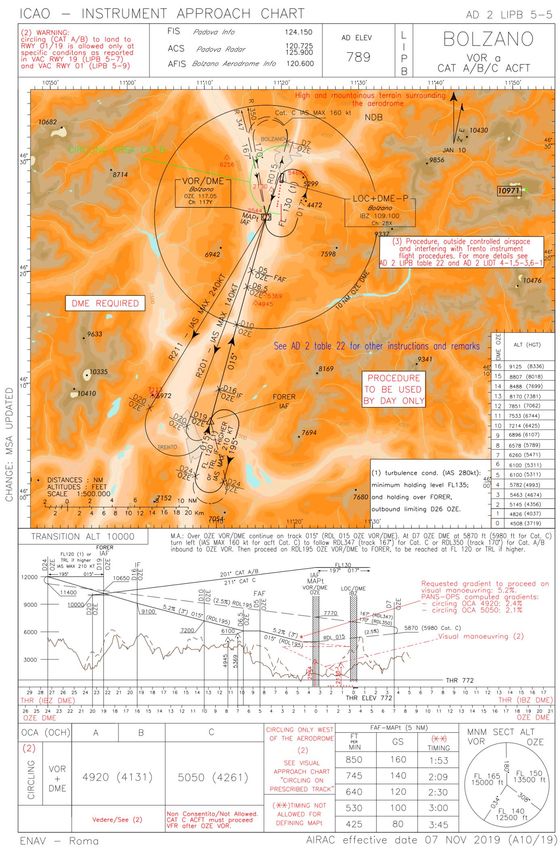
2.13.1 VOR-a CAT A/B/C
2) Holding/approach/missed approach procedures “VOR-a CAT A/B/C” including visual part
The VOR procedure and the connected visual procedures described in “VAC Bolzano RWY 01”,
“VAC Bolzano RWY 19” and “Balked Landing Procedure RWY 01” may be performed
● only by CAT operators,
● only during daylight,
● without any specific authorization;
● the aerodrome has to be classified as “cat. C” according AMC1 ORO.FC105(b)(2);(c).
Operations according to what is described below:
a) CAT A/B/C aircraft:
● Landing for RWY 01 after completing the VOR-a procedure described in chart
“VAC Bolzano RWY 01”.
● Landing for RWY 19 after completing the circling maneuvers. The chart “VAC
Bolzano RWY 19” is published in order to provide information for planning the
visual maneuvers for landing RWY 19.
● Visibility and ceiling limitations are published on charts (AD 2 LIPB 5-7 and 5-9).
b) Visual final segment from MAPt to the field is allowed only under the following
conditions:
▪ During daylight:
- visibility not less than 5 km (the inflight visibility declared by the pilot in approach
for landing or the VIS reported by AFIU).
- ceiling not below the applicable MDA and in no case below 2700 ft AAL (3500 ft
MSL)
- in any case the field shall be in sight at 2 NM IBZ DME.
▪ During night-time:
- At the time being the VOR-a CAT A/B/C is not allowed during darkness.
c) Visual final segment instructions for RWY 01 after VOR-a approach
▪ During daylight only (no night operations as prescribed above)
- At MAPt, with the visual cues in sight for the continuation of the approach,
continue visually maintaining own terrain clearance or follow the visual tracks as
proposed and charted in the VAC Bolzano RWY 01. PAPI, RWY lead-in flash light
indications and RWY lights may serve as an added aid.
d) Visual final segment instructions for RWY 19 after VOR-a approach:
▪ During daylight only (no night operations as prescribed above)
Bolzano – LIPB/BZO – Pilot’s Familiarization Briefing 2021-07-15 [page 25 / 70]▪ At MAPt, with the visual cues in sight for the continuation of the approach,
continue visually maintaining own terrain clearance or follow the visual tracks as
charted or proposed in the VAC Bolzano RWY 19. Obstacle markings on the right
downwind, Threshold identification light, PAPI and RWY light indications may
serve as an added aid.
▪ Note: CAT C aircraft are considered to complete the procedures according VFR as
prescribed on the charts.
e) The descent gradients (4,48°) on visual approach path to final and RWY01 and RWY19
are considered to be not yet steep according regulations but are considered higher
than on standard IFR runways. The required gradient for missed approach (for lower
MDA) respectively for a balked landing exceeds the recommended values (2,5% for
missed approaches) as standard according PANS-OPS DOC 8168 and may require
better climb performance. In addition to the above, due to orography surrounding the
procedure, a strict adherence to published requirements for the missed approach,
respectively strict adherence to the proposed balked landing or a specific design for
the balked landing is required for safety.
f) Due to orography, the efficiency of the individual navigational aids (VOR/DME OZE,
or LOC/DME IBZ is considered essential, unless the RNP procedures are used.. In this
regard, the conventional navigational equipment (VOR/DME and LOC/DME) are dual,
with the back-up equipment in warm stand-by. Bolzano AFIU can monitor the
efficiency of all the equipment. The failure of the operative equipment or of the
auxiliary one (both IBZ LOC/DME), as well as lights failure, will be promptly notified
to the pilot, to whom remains the responsibility to decide the execution of the missed
approach.
g) The procedure can be performed only if all the following radio and visual aids are
operative: OZE VOR and DME, PAPI and RWY lights.
It’s the Operator’s (for NCO the pilots) responsibility to provide contingency
procedures for sudden failures of any of the above aids.
Following indicative guidelines should be considered:
- OZE VOR or OZE DME failure during missed approach:
o timing to define MAPt and TP (7 DME) is not allowed.
o FIX positioning should be provided by FMS equipment.
o DME IBZ may serve as conventional backup for defining the turning point.
o The LOC OBZ may serve as backup for guidance during the missed
approach south of the aerodrome.
2.13.2 LOC+DME Instrument Guided Cloud Break Procedure RWY01
1) Holding/approach/missed approach procedures “LOC+DME Instrument Guided Cloud Break
Procedure RWY 01 CAT A/B/C” aircraft, including visual part
The LOC+DME IGS RWY 01 procedure and the connected visual procedures described in “VAC
Bolzano RWY 01”, “VAC Bolzano RWY 19” and “Balked Landing Procedure RWY 01” may be
performed
▪ during day and night, but only by NCC & NCO
Bolzano – LIPB/BZO – Pilot’s Familiarization Briefing 2021-07-15 [page 26 / 70]▪ during night only with multiengine aircraft
▪ Crews specifically authorized by the AFO of the airport operator
Operations according to what is described below:
a) CAT A/B/C aircraft: landing for RWY 01 after completing the procedure described in
chart “VAC Bolzano RWY 01”. Landing for RWY 19 after completing the circling
manoeuvres. The chart “VAC Bolzano RWY 19” is published in order to provide
information for planning the visual manoeuvres for landing RWY 19. Visibility and
ceiling limitations are published on charts (AD 2 LIPB 5-7 and 5-9).
b) Visual final segment from MAPt to the field is allowed only under the following
conditions:
▪ During daylight:
- visibility not less than 5 km (the inflight visibility declared by the pilot in approach
for landing or the VIS reported by AFIU).
- ceiling not below the applicable MDA and in no case below 2700 ft AAL (3500 ft
MSL)
- in any case the field shall be in sight at 2 NM IBZ DME.
▪ During night-time:
- visibility not less than 8 km (the inflight visibility declared by the pilot in approach
for landing or the VIS reported by AFIU).
- ceiling not below the applicable MDA and in no case below 2700 ft AAL (3500 ft
MSL)
c) Visual final segment instructions for RWY 01 after LOC+DME approach
▪ During daylight
- At MAPt, with the visual cues in sight for the continuation of the approach,
continue visually maintaining own terrain clearance or follow the visual
tracks as charted or described in the VAC Bolzano RWY 01. PAPI, RWY lead-
in flash light indications and RWY lights may serve as an added aid.
Note: PAPI is set at 4,48°. At the applicable MDA and on the desired descent
path the aircraft will be within the PAPI limits, showing 3 white and 1
red PAPI light.
d) Visual final segment instructions for RWY 19 after LOC+DME approach:
▪ During daylight only (no night operations as prescribed above)
- At MAPt, with the visual cues in sight for the continuation of the approach,
continue visually maintaining own terrain clearance or follow the visual
tracks as charted or described in the VAC Bolzano RWY 19. Obstacle markings
on the right downwind, abeam threshold identification light, PAPI and RWY
light indications may serve as an added aid.
e) The descent gradients (4,48°) on visual approach path to final RWY 01 and RWY 19 are
considered to be not yet steep according regulations but are considered higher than
on standard IFR runways. The required gradient for missed approach (for lower MDA)
respectively for a balked landing exceeds the recommended values (2,5% for missed
approaches) as standard according PANS-OPS DOC 8168 and may require better climb
Bolzano – LIPB/BZO – Pilot’s Familiarization Briefing 2021-07-15 [page 27 / 70]performance. In addition to the above, due to orography surrounding the procedure,
a strict adherence to published requirements for the missed approach, respectively
strict adherence to the proposed balked landing or a specific design for the balked
landing is required for safety.
f) Due to orography, the efficiency of the individual navigational aids (VOR / DME OZE,
and/or LOC / DME IBZ is considered essential, unless the RNP procedures are used.
In this regard, the conventional navigational equipment (VOR/DME and LOC/DME) are
dual, with the back-up equipment in warm stand-by. Bolzano AFIU can monitor the
efficiency of all the equipment. The failure of the operative equipment or of the
auxiliary one (both IBZ LOC/DME), as well as lights failure, will be promptly notified
to the pilot, to whom remains the responsibility to decide the performance of the
missed approach.
g) The procedure can be performed only if all the following radio and visual aids are
operative: OZE VOR and DME, PAPI and RWY lights.
It’s the Operator’s (for NCO the pilots) responsibility to provide contingency
procedures for sudden failures of any of the above aids.
Following indicative guidelines should be considered:
- OZE VOR or OZE DME failure during missed approach:
o timing to define MAPt and TP is not allowed.
o FIX positioning should be provided by FMS equipment.
o DME IBZ may serve as conventional backup for defining the turning point.
o The LOC IBZ may serve as backup for guidance during the missed approach
south of the aerodrome.
2.13.3 RNP APCH Instrument Guided Cloud Break Procedure RWY01
1. Holding/approach/missed approach procedures “RNP Instrument Guided Cloud Break
Procedure RWY 01 CAT A/B/C” aircraft, including visual part
The above RNP APCH procedure and the connected visual procedures described in “VAC
Bolzano RWY 01”, “VAC Bolzano RWY 19” and “Balked Landing Procedure RWY 01” may be
performed
- during day and night, but only by Operators approved by the AFO of the airport
operator;
- during night only with multiengine aircraft.
Pilots are responsible to assure that RAIM prediction check has to be satisfactory as per the
own company or operator procedure. Operations according to what is described below:
a) CAT A/B/C aircraft:
● Landing for RWY 01 after completing the procedure described in chart “VAC
Bolzano RWY 01”.
● Landing for RWY 19 after completing the right traffic circuit. The chart “VAC
Bolzano RWY 19” is published in order to provide information for planning the
visual manoeuvres for landing RWY 19.
Bolzano – LIPB/BZO – Pilot’s Familiarization Briefing 2021-07-15 [page 28 / 70]● Visibility and ceiling limitations are published on charts (AD 2 LIPB 5-7 and 5-
9).
b) Visual final segment from MAPt to the field is allowed only under the following
conditions:
▪ During daylight:
- visibility not less than 5 km (the inflight visibility declared by the pilot in approach
for landing or the VIS reported by AFIU).
- ceiling not below the applicable MDA and in no case below 2700 ft AAL (3500 ft
MSL)
- in any case the field shall be in sight at 2 NM IBZ DME.
▪ During night-time:
- visibility not less than 8 km (the inflight visibility declared by the pilot in approach
for landing or the VIS reported by AFIU).
- ceiling not below the applicable MDA and in no case below 2700 ft AAL (3500 ft
MSL)
c) Visual final segment instructions for RWY 01 after RNP APCH approach
▪ During daylight
- At MAPt, with the visual cues in sight for the continuation of the approach,
continue visually maintaining own terrain clearance or follow the visual tracks
as charted or described in the VAC Bolzano RWY 01. PAPI, RWY lead-in flash
light indications and RWY lights may serve as an added aid.
Note: PAPI is set at 4,48°. At the applicable MDA and on the desired descent
path the aircraft will be at the nominal PAPI path of 4,48°, showing 2
white and 2 red PAPI light.
d) Visual final segment instructions for RWY 19 after RNP APCH approach:
▪ During daylight only (no night operations as prescribed above)
▪ At MAPt, with the visual cues in sight for the continuation of the approach,
continue visually maintaining own terrain clearance on the right traffic circuit or
follow the visual tracks as charted or described in the VAC Bolzano RWY 19.
Obstacle markings on the right downwind, abeam threshold identification light,
PAPI and RWY light indications may serve as an added aid.
e) The descent gradients (PAPI 4,48°) on visual approach path to final RWY01 and RWY19
are considered to be not yet steep according regulations but are considered higher
than on standard IFR runways. The required gradient for missed approach (for lower
MDA) respectively for a balked landing exceeds the recommended values (2,5% for
missed approaches) as standard according PANS-OPS DOC 8168 and may require
better climb performance. In addition to the above, due to orography surrounding the
procedure, a strict adherence to published requirements for the missed approach,
respectively strict adherence to the proposed balked landing or a specific design for
the balked landing is required for safety.
Bolzano – LIPB/BZO – Pilot’s Familiarization Briefing 2021-07-15 [page 29 / 70]f) Due to orography, the efficiency of the FMC fulfills the requirements for the kind of
approach as prescribed and charted. Furthermore, the efficiency of part of the
individual navigational aids (VOR / DME OZE, and/or LOC / DME IBZ) is considered
essential, as the mentioned navigational aids may serve as backup during RNP
operations in case of missed approach guidance due to negative RNAV capability. In
this regard, the conventional navigational equipment (VOR/DME and LOC/DME) are
dual, with the back-up equipment in warm stand-by. Bolzano AFIU can monitor the
efficiency of all the equipment. The failure of the operative equipment or of the
auxiliary one (both IBZ LOC/DME), as well as lights failure, will be promptly notified
to the pilot, to whom remains the responsibility to decide the performance of the
missed approach.
g) The procedure can be performed only if all the following visual aids are operative:
PAPI, flashing lead-in and RWY lights.
It’s the Operator’s (for NCO the pilots) responsibility to provide contingency
procedures for sudden failures of the equipment.
Following indicative guidelines should be considered:
- FMC failure during approach and missed approach:
o timing to define MAPt and TP is not allowed.
o DME IBZ or OZE may serve as conventional backup for defining the turning
point.
o The LOC IBZ or VOR OZE may serve as backup for guidance during the
missed approach south of the aerodrome.
2.14 Departure Procedures
2.14.1 ICP (VISUAL) RWY01/19 (AIP AD 2 LIPB 6-5,6-7)
▪ Day time operations
Published departure procedures can be performed during day time by all operators
without any authorization, provided the operational and pilot requirements as
outlined in the AIP and hereinafter are fulfilled.
▪ Night time operations
Published departure procedures can be performed during night time
● only by Operators authorized by the AFO of the aerodrome operator
Note: It is the responsibility of the operator (or commander) to establish contingency procedures
respectively the visual part of the initial departure.
Note: Refer to weather minima during day and night operations from LIPB.
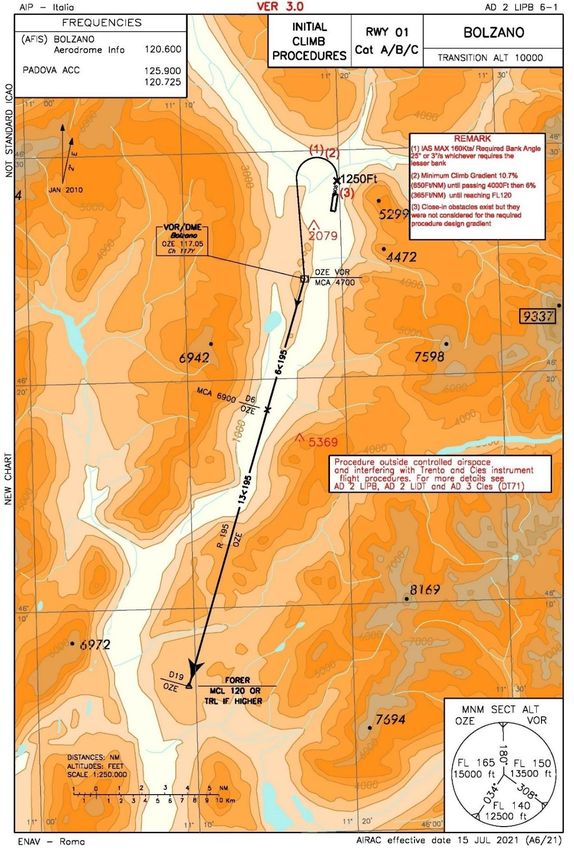
2.14.2 ICP RWY01 Cat A/B/C (AIP AD 2 LIPB 6-1,6-3)
The Initial Climb Procedure aircraft CAT A/B/C may be performed during day and night for departures
on RWY 01, but only by operators approved by the AFO of the Aerodrome Operator.
Bolzano – LIPB/BZO – Pilot’s Familiarization Briefing 2021-07-15 [page 30 / 70]Due to significant obstacles affecting the initial climb procedure, required climb gradient exceeds
PANS-OPS DOC 8168 recommended values requiring aircraft with particular performances.
Published ICP and PANS-OPS climb gradient are:
▪ Due to minimum obstacle clearance the minimum climb gradient is 10,7% (or 650 ft/NM);
▪ After passing 4000 feet the PDG is reduced to 6% (365 ft/NM) until reaching FL120.
Due to the orography surrounding the initial climb procedure envelope, pilots are required to strictly
adhere to the published prescriptions and to aircraft performances.
2.15 FLIGHT PROCEDURES – VFR
1. GENERAL
Traffic Circuit:
a) RWY 01: left turn at 2500 ft QNH
b) RWY 19: right turn at 2000 ft QNH
2. PROCEDURES FOR VFR FLIGHTS
▪ General information
1) VFR for CAT operations are allowed only with visibility not less than 5 km.
2) Due to the limitations in establishing radio contact with the competent ATS Unit, resulting
from the particular orographic characteristics of geographical area between Bolzano and
Trento, in order to facilitate VFR traffic operations, a VFR sector, named “Valle dell ’Adige”,
is defined with characteristics promulgated in AIP Italy, ENR 2.1.1 and shown in ENR 6.3.5.
The “Valle dell’Adige VFR sector” includes the path of the instrument flight procedures with
the own protection areas between 3500 ft AMSL and FL 115 identifying the area within
which a VFR flight could interfere with an IFR flight to/from Bolzano / Trento.
3) A VFR flight could operate within “Valle dell ‘Adige” VFR sector avoiding the path of the
published IFR approach and missed approach as well as the initial climb procedures. Before
entering into or to operate in the “Valle dell ‘Adige” VFR sector, VFR flights shall establish
radio contact with Padova FIC/ACC or Bolzano AFIU or Trento AFIU in order to obtain
information about IFR traffic performing instrument procedures.
3. Circuit activity
Glider traffic circuit for both QFU: limited to the East side of runways at 1800 ft QNH
4. VFR/N
Night VFR is not allowed
Bolzano – LIPB/BZO – Pilot’s Familiarization Briefing 2021-07-15 [page 31 / 70]2.16 AERODROME CHART
Figure 7: EXCERPT FROM THE “AIP Italia”
Bolzano – LIPB/BZO – Pilot’s Familiarization Briefing 2021-07-15 [page 32 / 70]2.17 AIRSPACE AND AIR TRAFFIC SERVICES The Aerodrome and the Procedures are located within Airspace class “G”, the final and visual (VFR) part of the approach, the initial part of the missed approach as well as the initial part of the departure procedures are within the ATZ, which is larger than ICAO standard. The service provided in airspace Class “G” is Flight Information Service. A specific clearance, even for IMC operation, is not required, respectively not intended in all circumstances by the responsible ANSP. In case of departure from LIPB, IFR start-up clearance is being required as per the normal regulations and IFR clearance will be provided via landline by Padova ACC throughout the designated Bolzano’s AFIU operator. Within the ATZ, all flights have to report and there are special regulations in force for VFR flights in case that the ATZ is intended to be crossed by such flights. During Departure the frequency Change from LIPB AFIU to LIPP ACC should take place immediately when so advised by LIPB AFIU and not later than passing 7000 ft MSL .For details, refer to the extract of the AIP and the published chart in AIP Italia. In case of arrival, Padua ACC will normally clear all flights to FORER or OZE, from there the Instrument Approach may be commenced without specific clearance. Inform Padua when commencing the procedure and when switching your COM to Bolzano AFIU. For traffic information and due to the limitations in establishing radio contact with the competent ATS Unit, resulting from the particular orographic characteristics of geographical area, the frequency Change should take place immediately after LIPP ACC informs the flight to contact LIPB AFIU but in no case later then passing 7000 ft MSL Transition level is normally FL120. All the time when in VMC, a continuous look out is mandatory during the whole procedure, as the crew is responsible for spacing to other aircraft. Padua ACC / Bolzano AFIU will provide traffic information about all known traffic, especially within the ATZ and ± 2NM left/right of the approach path, where all VFR flights have to report according AIP Italy. Remember: the crew remains responsible for the spacing to other aircraft (see and avoid concept). VFR traffic in the vicinity of the aerodrome and the procedures may be expected especially in good weather conditions, as the valley is one of the major North-South axis for VFR transit through the Alps. IFR Take off and departures are under the responsibility of the Commander concerning separation to other traffic. Simultaneous use of bituminous RWY and grass RWY are not allowed and will be avoided by advises issued by AFIU Bolzano. When using full RWY dimensions in Take Off (s. chapter 2.7 - red box), AFIU Bolzano should be informed via Radio. The responsible ATS unit is Bolzano AFIU: Call sign “Bolzano Aerodrome INFO” – Frequency 120,600 MHz – for details refer to the relevant AIP entry. 2.18 LOCAL TRAFFIC RESTRICTIONS Due to the surrounding terrain around the aerodrome and in order to avoid interference between IFR flights as well as between IFR and VFR flights, only one aircraft is allowed to operate according IFR to/from Bolzano or Trento-Mattarello at the same time. VFR traffic will not be allowed within the IFR Corridor as mentioned above at the time of IFR approaches or departures. For details, refer to the relevant information in the AIP or in NOTAMs. Bolzano – LIPB/BZO – Pilot’s Familiarization Briefing 2021-07-15 [page 33 / 70]
You can also read


