Policing in the UK BRIEFING PAPER - Number 8582, 3 July 2021 - UK Parliament
←
→
Page content transcription
If your browser does not render page correctly, please read the page content below
BRIEFING PAPER
        Number 8582, 3 July 2021

        Policing in the UK                                                              By Jennifer Brown

                                                                                        Contents:
                                                                                        1. Key concepts
                                                                                        2. Key actors
                                                                                        3. Police forces
                                                                                        4. Performance

www.parliament.uk/commons-library | intranet.parliament.uk/commons-library | papers@parliament.uk | @commonslibrary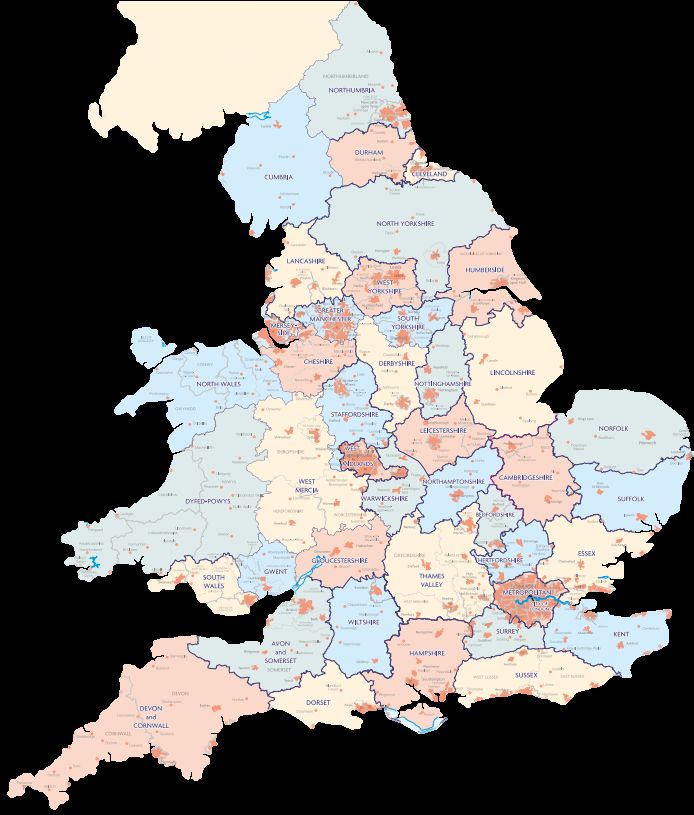
2   Policing in the UK

    Contents
    Summary                                                         3
    1.    Key concepts                                              4
    1.1   The ‘Office of Constable’                                 4
    1.2   Operational independence                                  4
    1.3   Policing by consent                                       5
    2.    Key actors                                                7
    2.1   Home Office                                               7
    2.2   Local policing bodies (Police and Crime Commissioners)    9
    2.3   The NPCC                                                 11
    2.4   College of policing                                      11
    2.5   The IOPC                                                 13
    2.6   HMICFRS                                                  13
    2.7   Scotland and Northern Ireland                            14
    3.    Police forces                                            15
    3.1   Territorial police forces                                15
    3.2   National police forces                                   16
    3.3   Specialist police forces                                 16
    3.4   The 43-force structure                                   16
    3.5   Collaboration                                            17
    4.    Performance                                              20
    4.1   Inspections                                              20
    4.2   Public confidence                                        21
    4.3   Targets                                                  23

      Cover page image by Ashley Harkness via Unsplash.
3 Commons Library Briefing, 3 July 2021
Summary
Police services in the UK are organised around two legal entities: the ‘Office of
Constable’ and the police force.
Police officers (no matter their rank) each individually hold the Office of Constable. The
Office of Constable grants them powers to detect, prevent and investigate crime.
Every police officer is a member of a police force. The police force organises and
coordinates their crime fighting. As members of police forces, officers (and other police
personnel) are under the “direction and control” of their chief officer. Chief officers are
ultimately responsible for the operation of their force.
There are 48 civilian police forces in the UK: 43 territorial police forces in England and
Wales, a national police force in both Scotland and Northern Ireland and three specialist
police forces (the British Transport Police, the Civil Nuclear Constabulary and the Ministry
of Defence Police).
Policing is (by and large) a devolved matter in Scotland and Northern Ireland. The Scottish
Government and the Northern Ireland Executive are responsible for deciding how most
police services are organised and managed in their countries. Policing culture is very similar
throughout the UK and Police Scotland and the Police Service Northern Ireland share many
of the characteristics of English and Welsh forces.
The term British model of policing is sometimes used to describe policing culture in the
UK. There is no formal definition of the British model, but it is typically understood though
three interlinked concepts: The Office of Constable, operational independence and
policing by consent.
Force performance
Data from the Crime Survey for England and Wales (CSEW) suggests that around 55% of
people think their police force is doing a “good” or “excellent” job. This figure is often
known as the confidence level. The confidence level has fallen over the last two years
(from around 62% in 2017/18 to 55% in 2019/20).
Her Majesty’s Chief Inspector of Constabulary and Fire & Rescue Services maintains an
online dashboard displaying each force’s score against each of their three assessment
pillars (effectiveness, efficiency and legitimacy). Forces receive one of four ‘judgements’ for
each pillar: outstanding, good, requires improvement and inadequate. HMICFRS also
provide a detail written assessment of each force which can be found by navigating
through HMICFRS’ online dashboard.
HMICFRS tends to judge forces better on effectiveness and legitimacy, giving slightly lower
scores on efficiency. Overall, most forces are judged to be performing well by the
Inspectorate across all three measures. However, there is growing divergence between the
performance of forces. The inspectorate says this is the result of some forces rising to the
twin challenges of rising demand and falling resources better than others.4 Policing in the UK
1. Key concepts
1.1 The ‘Office of Constable’
All police officers (no matter their rank) each individually hold the
‘Office of Constable’. The Office of Constable is a common law concept
and as such there is no single piece of legislation which defines its
duties and responsibilities. 1
The ‘Office of Constable’ grants police officers an array of powers they
can use to prevent, detect and investigate crime and disorder. 2 Most
police officers in England and Wales have jurisdiction to use their
powers anywhere in both nations. 3
Police officers are expected to use their powers “without fear or favour”
or “improper political interference” and “faithfully according to law”. 4
Police officers receive training and guidance on the lawful and effective
use of their powers and authority, but ultimately, they have discretion to
make decisions. 5 As ‘office holders’ they are personally responsible for
their decision making. 6
Police forces are responsible for providing officers with appropriate
support and resources. The police force is also responsible for
challenging officers who misuse their powers or abuse their position.
1.2 Operational independence
Governance arrangements for UK police services are built on the
principal of operational independence. Those who work in police
forces are under the “direction and control” of their chief constable. 7
Chief constables are independently responsible for all operational
matters concerning their force.
Operational independence is fundamental to the British model of
policing but has no agreed or legal definition. 8 In fact, the opposite is
true, paragraph 35 of The Policing Protocol Order 2011 states that
operational independence is “not defined in statute, and… by its
nature, is fluid and context-driven.”
Operational independence describes the matters that are under the
“direction and control” of chief constables. Chief constables are
expected to be able to make independent decisions, free from political
interference, about these matters. What is under a chief constable’s
1
Halsbury’s Laws, Vol 84 (Police and Investigatory Powers), para 1 and 40; Rice v
Connolly [1966] 2 Q.B. 414.
2
See: House of Commons Library, Police powers; an introduction, April 2020
3
Note: British Transport Police officers have limited jurisdiction outside the railways.
See section 1.1 of the Library briefing British Transport Police for details.
4
Police Federation, The Office of Constable: The bedrock of modern day British
policing, undated, p3 [last accessed 7 May 2020]; Schedule 1, The Policing Protocol
2011, para 12
5
College of Policing, Code of Ethics, July 2014, para 5.5
6
Police Federation, The Office of Constable: The bedrock of modern day British
policing, undated, p2 [last accessed 7 May 2020]
7
para 21, The Policing Protocol Order 2011
8
Schedule 1, The Policing Protocol Order 2011, para 305 Commons Library Briefing, 3 July 2021
direction and control is “fluid and context-driven” because politicians
have statutory responsibilities to scrutinise these decisions and powers
to make strategic decisions regarding police services. So, whilst chief
constables are expected to be able to make some decisions free from
political interference, there isn’t an expectation that they are exempt
from political scrutiny or completely free from pollical influence.
The policing protocol goes some way to defining boundaries between
matters subject to political scrutiny / influence and “direction and
control” matters. It provides a list of examples of things that are
definitely operational. The list includes “decisions concerning the
configuration and organisation of policing resources…” and “total
discretion to investigate or require an investigation into crimes”. 9
However, it also says that this list is “not exhaustive and is by way of
illustration only”. 10 A “grey area” exists between matters subject to
political scrutiny / influence and “direction and control” matters. 11
Some have argued that operational independence is a misleading and
insufficient term. The Patten Report (a UK Government commissioned
report which provided a blueprint for Northern Irish policing following
the Good Friday Agreement) recommended the term be dropped in
favour of “operational responsibility”. The Patten Report argued that
“operational responsibility” better reflects that chief constables are
“both free to exercise [their] responsibilities but also capable of being
held account afterwards for the manner in which [they] exercise
them“. 12
1.3 Policing by consent
The concept of ‘policing by consent’ is derived from the nine ‘general
instructions’ given to the first officers of the Metropolitan Police Service
(MPS) in 1829. 13 The general instructions are better known as the
Peelian Principles of Policing, named for Sir Robert Peel, the Home
Secretary when the MPS was founded. 14
According to the Peelian Principles the police’s authority is dependent
on public consent. 15 The police lose their authority when they lose the
consent of the public. The public’s consent is maintained “not by
pandering to public opinion” but by applying the law fairly, impartially
and by using minimal force. 16
In order to demonstrate they are applying the law fairly police forces
should operate with transparency. 17 They must provide certain
9
Schedule 1, The Policing Protocol Order 2011, para 32
10
Ibid, para 33
11
HC Deb, Police Reform and Social Responsibility Bill, 27 January 2011, cc 242
12
Independent Commission on Policing for Northern Ireland, A new beginning:
policing in Northern Ireland, September 1999, paras 6.19- 6.22
13
Home Office, Definition of policing by consent, 10 December 2012
14
Oxford Dictionary of National Biography, Peel, Sir Robert, second baronet [intranet
only link]
15
Home Office, Definition of policing by consent, 10 December 2012, principle 2
16
Ibid, principle 5
17
College of Policing, Transparency, [last accessed 7 May 2020]; College of Policing,
Code of Ethics, July 2014, para 1.4.36 Policing in the UK
information about the use of their powers to the Home Office. 18 Forces
must make arrangements for people to receive information about, and
comment on, policing in their area. 19 Most forces do this by conducting
beat meetings where residents can engage with local policing teams
and by operating Independent Advisory Groups where local people,
often those from underrepresented groups, advise forces on how their
policing is affecting them. 20
In England and Wales, the public can also influence policing in their area
by voting in their Police and Crime Commissioner (PCCs) / Mayoral
election. PCCs/ Deputy Mayors have two dual roles related to policing
by consent. A governance role in which they set local priorities for their
chief constable and an accountability role in which they monitor their
force’s performance.
18
Home Office, Annual data requirement from police forces in England and Wales, 11
March 2019
19
s34, Police Reform and Social Responsibility Act 2011
20
College of Policing, Engagement and communication APP: communication, 30
January 20207 Commons Library Briefing, 3 July 2021
2. Key actors
2.1 Home Office
The Home Office is responsible for policing policy for England and
Wales. It is responsible for:
• publishing a statutory document called the Strategic
Policing Requirement (SPR). The SPR sets out the most pressing
national crime threats and how police force should be responding
to them. The current SPR was published in March 2015.
• managing Government legislation concerning policing.
• maintaining some statutory guidance documents relating to
police powers. The College of Policing (see below) is now
responsible for most police guidance but the Home Office still
maintains some key statutory documents on police powers
(notably the PACE and IPA codes). The Library has explained more
about police guidance in the paper police powers: an
introduction.
• presenting the annual Police Grant Report to Parliament for
approval. The Police Grant Report sets out the annual grants
available to Police and Crime Commissioners (PCCs) to allocate to
their police chiefs for the day-to-day management of their police
forces and specific activities and the funding available for national
priorities. Alongside the Police Grant Report the Home Office
announces the annual council tax policing precept limit. The
Home Office also has powers to set the minimum budget a PCC
can set. 21 The Library briefing police funding explains how forces
are funded in more detail.
• providing political leadership of national policing bodies.
The Home Office oversees the National Crime Agency (NCA), the
College of Policing and the Independent Office of Police Conduct
(each have a different governance relationship with the Home
Office). The Home Secretary is also (either directly or indirectly)
responsible for key policing appointments including the
Commissioner of the Metropolitan Police Service (the most senior
police officer in the UK), the Director General of the NCA and the
IOPC, the Chair of the College of Policing and Her Majesty’s Chief
Inspector of Constabulary.
• ensuring the policing system is working effectively. It largely
uses informal powers to do this, but it does have statutory powers
to issue directions to ineffective forces/ PCCs (see below). The
Home Office convenes the National Policing Board (NPB) which
brings together senior policing leaders and Home Office ministers
and officials to discuss the “long term strategic direction of
policing” and “hold the policing sector to account for the delivery
of the Government’s key policing commitments”. The NPB aims to
meet four times a year, meeting agendas and minutes can be
found on the NPB’s website. 22 The Home Office also publishes
21
s41, Police Act 1996
22
Home Office, Prime Minister opens first meeting of National Policing Board, 31 July
20198 Policing in the UK
ad-hoc strategy documents on crime fighting and convenes ad-
hoc task forces on specific types of crime. Recent examples
include the Serious Violence Strategy, which set out an ambition
to combine targeted enforcement with early interventions to
combat serious violence, and the Burglary taskforce, which
brought together police and industry stakeholders to explore what
more could be done to combat “intrusive crime”. 23
The Strategic Policing Requirement
Section 77 of the Police Reform and Social Responsibility Act 2011
requires the Home Office “from time to time” to publish a ‘Strategic
Policing Requirement’ (SPR) document. This document must set out
what the Home Secretary believes to be most pressing national threats
and how police services should work to counter them. Police chiefs are
required to have regard to the SPR in their duties. 24
So far the Government has published two SPRs The first SPR was
published in 2012 (shortly after the commencement of the 2011 Act).
The latest SPR document was published in 2015. It set out seven
‘national threats’:
• Terrorism
• Serious and organised crime
• A national cyber security incident
• Threats to public order and safety which cannot be managed by a
single police force
• Civil emergencies that require an aggregated response across
police force boundaries
• Child sexual abuse
• Child exploitation that is attributed to serious and organised
crime. 25
The SPR describes how chief officers and PCCs should work to combat
these national threats (based on the ‘five Cs’). The SPR says forces
should ensure:
• they have capacity to combat the national threats. This in turn
ensures they contribute to national crime fighting.
• They have the capability to combat the national threats.
• That there is consistency in approach across the country.
• That they take a joined up connected approach. 26
Power to issue directions to forces
Under sections 40, 40A and 40B of the Police Act 1996 (as amended) 27
the Home Secretary can issue directions requiring local policing bodies
23
Home Office, Serious Violence Strategy, April 2018
24
s77(2), Police Reform and Social Responsibility Act 2011
25
Home Office, The Strategic Policing Requirement, March 2015, Part A, p7 and 8
26
Ibid, Part B, p9-14
27
Note: The version of the 1996 Act on www.legislation.gov.uk is not up to date with
latest amendments and therefore weblinks to the 1996 Act have been omitted9 Commons Library Briefing, 3 July 2021
take specified measures to address their own failure (or potential) to
execute their functions efficiently and effectively or the failure (potential
failure) of their force to execute its functions efficiently and effectively.
These directions can be used be used to require PCCs submit an “action
plan” to the Home Secretary detailing how they will address their
force’s failings.
The Home Secretary must follow statutory rules when issuing directions
which give local policing bodies the opportunity to present their own
proposals for remedial measures to mitigate the Home Secretaries
concerns.
2.2 Local policing bodies (Police and Crime
Commissioners)
Local policing bodies (sometimes known as just “policing bodies”) is a
legal term used to collectively describe Police and Crime Commissioners
(PCCs) and their equivalents for the four territorial police forces that do
not have PCCs. Local policing bodies are responsible for securing an
“effective and efficient” police force for their area. 28 In most areas the
local policing body is a directly elected politician (either a PCC or a
Combined Authority Mayor).
There are 39 PCCs in England and Wales. Four of them, the PCCs for
Essex, Staffordshire, West Mercia and Northamptonshire, also hold
responsibilities relating to their local Fire & Rescue Service. 29 These PCCs
are technically known as Police, Fire & Crime Commissioners (PFCCs).
The Library uses the term PCC inclusively of PFCCs.
There are four territorial police forces that do not have PCCs.
Police forces that do not have PCCs
Police force Equivalent to PCC
The Mayor’s Office for Policing
Metropolitan Police Service (MPS)
and Crime (MOPAC)
Greater Manchester Combined
Greater Manchester Police (GMP)
Authority
West Yorkshire Combined
West Yorkshire Police
Authority
Common Council of the City of
City of London Police (CoLP)
London
throughout this briefing. MPs and their staff can access an updated version of the
1996 Act via Library resources.
28
s1(6), Police Reform and Social Responsibility Act 2011.
29
Choose My PCC, About police and crime commissioners and police, fire and crime
commissioners, undated10 Policing in the UK
Functions
Local policing bodies have three core functions:
• Police governance: They set an annual budget and a five-year
police and crime plan for their force. 30 As part of their budgetary
responsibilities they set the council tax precept for their police
force area. Most are also responsible for appointing a chief officer
to lead their force (MOPAC is not responsible for appointing the
Commissioner of the Metropolitan Police Service). 31
• Police oversight: They are responsible for scrutinising their
force’s performance and holding their chief officer accountable
for the delivery of their police and crime plan. 32 They also play a
role delivering the local police complaints system. 33
• Commissioning criminal justice services: They are responsible
for commissioning victims’ services and some crime prevention
programmes in their police force area. 34
Holding PCCs to account
PCCs are held accountable in three ways:
• via the ballot box. PCCs are directly elected politicians. The
electorate has the power to vote them out if they are dissatisfied
with their performance. PCC elections take place every four
years. The last PCC elections took place 6 May 2021. The
election was due to take place in May 2020 but was postponed
due to the coronavirus pandemic. 35 The election results are set
out in the Library’s briefing PCC elections 2021.
• by local councillors sitting on Police and Crime Panels
(PCPs). PCPs provide formal scrutiny of their PCC between
elections. They are supposed to provide a similar function to
parliamentary select committees which scrutinise the work of
government between General Elections.
• by the Home Secretary through their power to issue directions
to “ineffective” PCCs described above.
Like all politicians PCCs are also held accountable by public opinion.
PCCs can voluntarily resign and some have done so.
Further reading: PCCs
The Library briefing Police and Crime Commissioners describes the role and functions of Police and
Crime Commissioners (PCCs). It explains how they work with police chiefs and how they are held
accountable. It also discusses current Government plans to reform the “PCC model”.
30
s41, Police Act 1996 & s5, Police Reform and Social Responsibility Act 2011.
31
s38, Police Reform and Social Responsibility Act 2011
32
s1(7-8), Police Reform and Social Responsibility Act 2011
33
See: House of Commons Library, Police complaints and discipline, 4 September 2020
34
s143, Anti-social Behaviour, Crime and Policing Act 2014
35
Cabinet Office, Postponement of May 2020 elections, 13 March 202011 Commons Library Briefing, 3 July 2021
2.3 The NPCC
The National Police Chiefs Council (NPCC) is a co-ordinating body for
all police forces in the UK. The NPCC co-ordinates national police
operations and the implementation of College of Policing guidance.
The chief officer of each UK police force, the Director General of the
National Crime Agency and Chief Executive of the College of Policing
are all represented at the NPCC. They make decisions collectively via the
Chief Constables’ Council.
The NPCC sets a ten-year plan for policing in a ‘policing vision’. The
latest vision is the Policing Vision 2025. This was published jointly with
the Association of Police and Crime Commissioners. The vision has five
core strands:
• Local policing: local policing will be aligned, and where
appropriate integrated, with other local public services to improve
outcomes for citizens and protect the vulnerable.
• Workforce: Policing will be a profession with a more
representative workforce that will align the right skills, powers
and experience to meet challenging requirements.
• Specialist capabilities: To better protect the public, police will
enhance our response to new and complex threats, develop their
network and the way they deliver specialist capabilities by
reinforcing and connecting policing locally, nationally and beyond.
• Digital policing: Digital policing will make it easier and more
consistent for the public to make digital contact, improve our use
of digital intelligence and evidence and ensure we can transfer all
material in a digital format to the criminal justice system.
• Enabling business delivery: Police business support functions
will be delivered in a more consistent manner to deliver efficiency
and enhance interoperability across the police service. 36
The NPCC convenes two sets of committees. Twelve ‘reform and
transformation’ committees, where senior leaders in policing agree
changes to service delivery (including how to implement the policing
vision), and eleven ‘coordination committees’, where forces agree
standards for operational duties and business management.
In addition to their ‘day jobs’ leading individual police forces some
police chiefs take on responsibility for being a ‘policing lead’ on specific
crimes and issues for the NPCC. These officers help shape a national
approach to these issues.
2.4 College of policing
The College of Policing (the College) is a professional body for policing
in England and Wales. It is a limited company, owned entirely by the
Home Secretary, operating as an arm’s length body of the Home
Office. 37
36
NPCC, Policing Vison 2025, [last accessed 3/06/19]
37
College of Policing, Annual Report and Accounts for the year ended 31 March 2020,
December 2020, p912 Policing in the UK
The College has three complementary functions. It:
• Shares knowledge and good practice within the policing
community.
• Sets service standards for policing.
• Supports the professional development of police personnel. It
delivers its own training programmes and quality assures training
delivered by others. 38
The College has statutory responsibilities related to its functions. It is
responsible for issuing ‘Codes of Practice’ to chief constables on the
exercise of their duties. 39 It also has powers to instruct the Home Office
to make regulations relating to police officer ranks, police recruitment
and training. 40 The Home Office has “veto powers” relating to both
these responsibilities, but has yet to use them. 41
Income
The College is part-funded by the Home Office, primarily through grant
in-aid. 42 In 2019/20 it received £41m via grant in-aid and around
£11.8m in other Home Office grants. 43
The College also generates its own income by selling professional
services to police (and related) services throughout the world. It has six
“income streams”:
• Training delivery: The College delivers training to UK and
overseas police services.
• Selection and assessment centres: The College provides
policing related assessment and recruitment to English and Welsh
police services.
• Licence fees: The College provides three-year licences of their
training programmes to others.
• Royalties: Licences holders must pay the College royalties when
they deliver their training programmes to organisations/
individuals other than Home Office police forces.
• Events: The College runs conferences and other vocational
training events.
• Board and accommodation: The College’s estate can be hired
by commercial clients. 44
38
Ibid
39
s39A, Police Act 1996 (as amended). See: s123- s130, Anti-social Behaviour, Crime
and Policing Act 2014
40
s50A, Police Act 1996 (as amended). See: s123- s130, Anti-social Behaviour, Crime
and Policing Act 2014
41
s123- s130, Anti-social Behaviour, Crime and Policing Act 2014
42
Home Office, Protocol between the Home Office and the College of Policing
Limited, July 2019, para 13.6
43
College of Policing, Annual Report and Accounts for the year ended 31 March 2020,
December 2020, p104 & p101
44
Ibid, p84-8513 Commons Library Briefing, 3 July 2021
The College generated just over £11.6m from these income streams in
2019/20. 45
2.5 The IOPC
The IOPC is the independent body responsible for maintaining public
confidence in the English and Welsh police complaints system. 46 It’s run
by a Director General (currently Michael Lockwood) appointed by the
Queen (on advice by the Home Secretary). 47
The IOPC maintains statutory guidance on the police complaints system
which assists those working with complaints to achieve high standards
and meet their legal obligations. 48 It publishes statistics on police
complaints and monitors the performance of the system. It conducts
research designed to understand and improve the system.
The IOPC also plays a role in handling some complaints and conduct
matters. It conducts independent investigations into some complaint,
conduct and death and serious injury matters. 49
The IOPC also makes recommendations for improvements in police
practice based on learnings from complaint and misconduct matters. 50 It
publishes regular learning the lessons magazines and makes learning
recommendations as part of the outcomes of its investigations. 51
Further reading: police complaints
The Library has published further briefing papers discussing the complaints system in more detail. It has
published a short guide to police complaints which assists MPs and their staff handling casework
involving dissatisfaction with the police and a detailed paper discussing police complaints and discipline.
2.6 HMICFRS
HMICFRS is responsible for inspecting the police in England, Wales and
Northern Ireland. They issue an annual assessment of each police force
which provides a score for forces for their three “pillars”:
• Effectiveness: how effective a force is as reducing crime and
keeping people safe.
• Efficiency: how sustainable a force’s services are to the public.
• Legitimacy: how the force treats the public and its workforce.
HMICFRS identify ‘areas for improvement’ or ‘causes for concern’ in
forces whose performance has fallen below expected standards. ‘Causes
45
Ibid, p101
46
s10(1)(d), Police Reform Act 2002
47
HCWS187, Appointment of the Director General of the Independent Office for
Police Conduct (IOPC), 20 October 2017
48
IOPC, Statutory guidance on the police complaints system, February 2020, para 1.2;
s22, Police Reform Act 2002
49
s10(2), Police Reform Act 2002
50
s10(1)(e), Police Reform Act 2002
51
IOPC, Learning strategy 2018-22: Improving policing by identifying and sharing
learning from our work, undated, p514 Policing in the UK
for concern’ are accompanied by recommendations to help the force
improve. 52
PCCs/ Deputy Mayors must respond to HMICFRS inspection reports of
their force. However, it’s the Home Office (not HMICFRS) that has the
power to issue directions to the PCC/ Deputy Mayor requiring them to
address their force’s failings. 53
HMICFRS also undertake thematic inspections of the police service
commissioned by the Home Office. These inspections usually respond to
an area of concern with policing across the country. HMICFRS use their
thematic inspection reports to identify areas for system wide
improvement. In these reports they make recommendations to the
Home Office and others in the policing system.
Certain charities and public bodies designated by the Home Office have
the power to ask HMICFRS to conduct a thematic inspection by making
a super complaint. 54
HMICFRS use the findings from their inspections to publish an annual
report on the state of policing in England and Wales.
2.7 Scotland and Northern Ireland
Scotland
The Scottish Police Authority (SPA) provides governance and oversight
of the police in Scotland. It provides a similar function to local policing
bodies in England and Wales. The SPA also provides forensic services in
Scotland.
Police Investigations & Review Commissioner (pirc) oversees the Scottish
police complaints system and conducts independent investigations of
some incidents involving Scottish police. It is a similar body to the IOPC.
Her Majesty’s Inspectorate of Constabulary Scotland (HMICS) inspects
Scottish police and scrutinises the SPA.
Northern Ireland
The Northern Ireland Policing Board provides governance and oversight
for the Police Service Northern Ireland (PSNI).
The Police Ombudsman for Northern Ireland handles all complaints
about the PSNI.
52
HMICFRS, How we inspect [last accessed 11 December 2020]
53
s55, s40, s40A & s40B, Police Act 1996
54
s29A-s29C, Police Reform Act 2002; The Police Super-complaints (Designation and
Procedure) Regulations 201815 Commons Library Briefing, 3 July 2021
3. Police forces
3.1 Territorial police forces
Under section 2, Police Act 1996 there must be a single police force for
each of the 41 police areas listed in its Schedule 1, the “metropolitan
police district” and the City of London police area.
Outside of London
Outside of London, territorial police forces serve “police force areas”
that largely mirror county and metropolitan district boundaries. 55 Police
force areas cover varying geographies and
Image credit: Justice Inspectorates,
populations. For example, West Midlands and Police force map (PDF), undated
Greater Manchester Police (the two largest
forces outside of London) each serve a
population of around 2 million. They police
densely populated urban areas. Cumbria
Police serves just half a million people who live in a
sparsely populated rural county.
The Metropolitan Police Service
The Metropolitan Police Service (MPS) serves the “metropolitan
police district”, an area covering most of London.
The MPS is considered the most important and
influential police force in the UK. Its job policing
most of London (the political, cultural and
financial centre of the UK) places it at the heart of
national life in Britain. The MPS also undertakes
some specific national policing functions
(for example, special persons protection)
that other forces do not.
The MPS is by far the largest police force in England
and Wales, serving eight million people and
comprising around 130,000 officers (four times
as many as the next biggest force). 56
Established in 1829, it is also one of the
oldest police forces in the world.
City of London Police
The City of London Police (CoLP) serves the City of London, one of
London’s financial districts, the “square mile”. The CoLP is a unique
force, it has two distinct roles: it is the local police force for the square
mile but it is also is a national force lead for economic crime. 57 CoLP’s
role as the national lead for economic crime policing is discussed in the
Library briefing paper banking fraud.
55
Schedule 1, Police Act 1996
56
Home Office, Police workforce, England and Wales: 31 March 2020 second edition,
August 2020, table H1
57
City of London Police, City of London policing plan: 2020-2023, undated, p216 Policing in the UK
3.2 National police forces
There is a single national police force in both Scotland and Northern
Ireland (where policing is a devolved policy area). Operationally, Police
Scotland and the Police Service for Northern Ireland (PSNI) are similar to
their territorial counterparts in England and Wales.
3.3 Specialist police forces
There are three specialist civilian police forces in the UK: the British
Transport Police (BTP), the Civil Nuclear Constabulary (CNC) and the
Ministry of Defence Police (MDP). These forces fall outside the
departmental responsibility of the Home Office.
British Transport Police
The BTP polices the British railway network. The Department for
Transport has departmental responsibility for the BTP. The governance
and operation of the BTP is discussed a separate Library briefing.
Civil Nuclear Constabulary
The CNC is an armed police force that protects civil nuclear sites and
nuclear materials in Britain. The Department for Business, Energy and
Industrial Strategy holds departmental responsibility for the CNC.
Ministry of Defence Police
The MDP protects the Ministry of Defence’s nuclear sites and other
defence assets in the UK. The Ministry of Defence holds departmental
responsibility for the MPD. 58
3.4 The 43-force structure
There have long been calls for the 43-force structure of English and
Welsh police forces to be reformed. It is often argued that the number
of territorial forces outside of London should be reduced so forces
police larger areas and enjoy more commensurate resources.
The last serious attempt to change the territorial boundaries of English
and Welsh police forces occurred in 2006. The then Labour Government
proposed to reduce the number of forces by merging neighbouring
forces outside of London. At the time the plans were strongly opposed
by police leaders and Cleveland Police mounted a legal challenge to the
proposals. 59 In the face of this police opposition the Labour Government
abandoned its plans before they were finalised. It agreed to pay almost
£4 million to forces for the preparatory work they had carried out for
the mergers. 60
More recently the idea of force mergers has gained traction. Her
Majesty’s Inspectorate of Constabulary and Fire & Rescue Services, the
58
Note: There are three separate military police forces which provide policing services
to the UK’s armed forces. They are known collectively as the Service Police. The
Library’s briefing Service Police Review discusses them.
59
The Guardian, Police mergers face legal challenge, May 2006
60
HC Deb, 30 October 2006, c3WS17 Commons Library Briefing, 3 July 2021
Home Affairs Select Committee and even some senior police officers
(like the former Chief Constable of Greater Manchester Police) have
supported the idea. 61
HMICFRS says “in some important respects” the 43-force structure is
“no longer fit for purpose”. 62 It argues that modern day crimes like
online banking fraud, county lines drug dealing and online child sexual
exploitation cannot be effectively policed by forces with hard
geographic boundaries. It says the Government and police leaders
should “work out what capabilities and capacity [policing] needs…
[and] reorganise accordingly, defining what should be done locally,
regionally and nationally”. 63
Comprehensive reform of the 43-force structure would require primary
legislation. The Home Office has the power to amend police force areas
outside of London by order, but it can only exercise this power when
requested by the local policing leaders concerned. 64 Using this power to
enact wholesale change of police force boundaries would therefore be
very difficult.
The Home Office says it welcomes local proposals for force mergers. But
has shown little appetite for fundamental reform of the 43-force
structure of English and Welsh policing. 65
3.5 Collaboration
Police forces in England and Wales collaborate and share resources in
several ways. The Home Office has issued statutory guidance to chief
constables on police collaboration. 66 This guidance explains how police
forces can collaborate and when it might be most appropriate to do so.
Collaboration agreements
PCCs have a legal duty to facilitate collaboration between forces in the
interests of “efficiency” or “effectiveness”. 67 Section 22A of the Police
Act 1996 (inserted via section 89 of the Police Reform and Social
Responsibility Act 2011) allows police forces to enter into formal
collaboration agreements.
There is no central database of police collaboration agreements and so
we do not have an accurate picture of police collaboration. However,
collaboration agreements have been used in different ways facilitating
both national and regional collaboration. Nationally a collaboration
61
HMICFRS, State of Policing – The Annual Assessment of Policing in England and
Wales 2019, June 2020, p37; House of Commons Home Affairs Committee, Policing
for the future, Tenth Report of Session 2017–19, October 2018, para 236;
Manchester Evening News, Chief Constable backs calls for merging of police forces
in England and Wales, January 2020;
62
HMICFRS, State of Policing – The Annual Assessment of Policing in England and
Wales 2019, June 2020, p35
63
Ibid, p37
64
s32, Police Act 1996
65
Home Office, The Government response to the tenth report from the Home Affairs
Select Committee: Session 2017-19 (HC 5115): Policing for the future, March 2019,
paragraph 166
66
Home Office, Statutory guidance for police collaboration, October 2012
67
s1(8)(d), Police Reform and Social Responsibility Act 201118 Policing in the UK
agreement was used to set up the NPCC. This created a collective
decision-making body and national policing units focused on specialist
types of crime. Regionally, collaboration agreements have been used to
allow for both front line policing and administration to be delivered
jointly by neighbouring police forces. For example, forces in the South
West of England have collaboration agreements which has created
multi-force policing units for organised crime, major crimes and
forensics (amongst other things). 68 Kent and Essex police forces have a
collaboration agreement which sees them share “business areas” for
serious crime, IT and procurement. 69
Collaboration agreements are time limited and must be kept under
review. 70 This means that forces can allow them to lapse and then seek
either a new collaboration agreement with the same or different force
or return to providing services without an agreement.
The end of the Warwickshire and West Mercia “strategic alliance” in
February 2020 highlighted the risks involved in short term collaboration
agreements. 71 In July 2020 HMICFRS published a thematic inspection of
collaboration agreements and found that 72:
• too many collaborations do not have a clear purpose or
objective that is understood by all involved;
• some forces are not tracking the benefits of collaboration
and fail to think beyond financial savings;
• complicated and bureaucratic decision-making undermines
the effectiveness of many collaborations; and
• some forces are failing to put people with the right skills in
their collaborations and are not effectively sharing learning.
The Inspectorate recommended that by March 2021 73:
• the NPCC, the College of Policing and the Home Office should
work together to establish a central repository for police
collaborations.
• the NPCC, the College of Policing and the Home Office should
identify a methodology that supports forces in tracking benefits
for police collaborations and help forces implement it.
Mutual aid
Section 24 of the Police Act 1996 allows police chiefs to deploy officers
or offer other assistance to another force to enable them to meet
‘special demand’. This is known as mutual aid. Police forces use mutual
68
Avon and Somerset Police Force, Collaboration with other police forces, December
2016
69
Kent Police and Essex Police, Kent and Essex Police Force and Police Authority
Collaboration Agreements, undated [agreement runs to 2025]
70
s22B, Police Act 1996 (as inserted by s89 Police Reform and Social Responsibility Act
2011)
71
PCC for Warwickshire, Former Alliance with West Mercia, [last accessed 11
December 2020]
72
HMICFRS, Failing police collaborations cost forces money, time and effort, 23 July
2020
73
HMICFRS, PEEL spotlight report: The Hard Yards: Police-to-police collaboration, July
2020, p10-1119 Commons Library Briefing, 3 July 2021
aid in special circumstance, such as emergencies, planned events (like
large-scale public gatherings) or to facilitate specialist staff deployments
to other forces. 74 When police forces provide mutual aid they charge
the receiving force for the cost of the police services provided. The
NPCC has published guidelines on mutual aid cost recovery to assist
police forces in setting the value to charge at.
74
NPCC, National Policing Guidelines on Charging for Police Services: Mutual Aid Cost
Recovery, 2016, paragraph 3.220 Policing in the UK
4. Performance
The information in this section relates to England and Wales only
4.1 Inspections
Her Majesty’s Chief Inspector of Constabulary and Fire & Rescue
Services maintains an online dashboard displaying each force’s score
against each of their three assessment pillars (effectiveness, efficiency
and legitimacy). Forces receive one of four ‘judgements’ for each pillar:
outstanding, good, requires improvement and inadequate. HMICFRS
also provide a detail written assessment of each force which can be
found by navigating through HMICFRS’ online dashboard.
HMICFRS tends to judge forces better on effectiveness and legitimacy,
giving slightly lower scores on efficiency. Overall, most forces are judged
to be performing well by the inspectorate across all three measures. 75
However, there is growing divergence between the performance of
forces. The inspectorate says this is the result of some forces rising to
the twin challenges of rising demand and falling resources better than
others. 76
HMICFRS PEEL inspection
2019/20 scores
Legitimacy 1 35 6 1
Efficiency 6 25 10 2
Effectiveness 1 35 6 1
0 10 20 30 40
Outstanding Good Requires improvement Inadequate
75
HMICFRS, State of Policing The Annual Assessment of Policing in England and Wales
Her Majesty’s Chief Inspector of Constabulary 2019, June 2020.
76
Ibid21 Commons Library Briefing, 3 July 2021
HMICFRS PEEL inspection
Change from 2017 inspection
Legitimacy 2 37 4
Efficiency 12 21 10
Effectiveness 8 32 3
0 10 20 30 40
Improved No change Declined
The state of policing
The HMICFRS provides a detailed assessment of the “state of policing”
in an annual report presented to Parliament. The 2019 state of policing
report was published in July 2020. It provides an annual assessment of
policing in England and Wales for the 2018/19 financial year. It also sets
out an initial assessment of the police response to the coronavirus
pandemic.
4.2 Public confidence
Public confidence is often used as a performance measure for police
forces because forces in England and Wales police “by consent”.
Data from the Crime Survey for England and Wales (CSEW) suggests
that around 55% of people think their police force is doing a “good” or
“excellent” job. This figure is often known as the confidence level.
The confidence level has fallen over the last two years (from around
62% in 2017/18 to 55% in 2019/20). 77
Confidence level
Percentage of people who think the local police do a "good" or "excellent" job
70 Data prior to 2011/12
not directly comparable
60
62 62 63 62 63 62 62
59 58
50 56 55
53 53
50 51
40 47 49
30
20
10
0
2003/04 2006/07 2009/10 2012/13 2015/16 2018/19
77
ONS, Crime in England and Wales: Annual supplementary tables, 17 July 2020, table
s122 Policing in the UK
The confidence level varies between forces. Around half of forces
perform in line or better than those in their “most similar group”
(MSG). 78 West Midlands Police scores the lowest on this measure, at
42%, its score is around 11 percentage points below its MSG average. 79
Confidence level by force in 2019/20
Grey lines in the background show the range of the 'most similar group' of forces
70 Cheshire
65
60
National average= 55
55
50
45 West
Midlands
40
Victims of crime
46% of people who have experienced crime in the last 12 months said
the police were doing a good or excellent job, compared to 58% of
those who were not recent victims. 80
HMICFRS have raised concerns that the level of service the police are
providing is not meeting the public’s expectation. They say a focus on
tackling serious criminality (including terrorism) has left police forces
stretched. They say victims of “less serious crimes” are suffering poorer
outcomes.
In the words of one chief constable: “victims of ‘less serious’
crimes receive a limited service, if any service at all”. Some of our
inspections bear out this downbeat observation. And it applies to
many forces – even those that perform comparatively well. For
example, in 2018/19, Durham Constabulary, a force with an
outstanding HMICFRS grade for effectiveness, assigned a positive
outcome to only 13 percent of burglaries and 14 percent of
vehicle crimes recorded in 2018/19, compared to 23 percent of
violent crimes. While positive outcome rates were higher
in Durham than in England and Wales as a whole (6 percent, 3
percent and 13 percent respectively), it still supports
the suggestion that victims of ‘less serious’ crimes are unlikely to
see their offenders brought to justice. 81
78
House of Commons Library analysis of ONS, Crime in England and Wales: Annual
supplementary tables, 17 July 2020, table s18
79
Note: London forces (the MPS and the CoLP) are excluded from this analysis.
80
ONS, Crime in England and Wales: Annual supplementary tables, 17 July 2020, table
s2.
81
HMICFRS, State of Policing The Annual Assessment of Policing in England and Wales
Her Majesty’s Chief Inspector of Constabulary 2019, June 2020. p5223 Commons Library Briefing, 3 July 2021
Black people
Black people are less likely to have confidence in the police than those
from other ethnic backgrounds. 53% of Black people said the police
were doing a good or excellent job. Confidence was particularly low
amongst people from a Caribbean background, 39% of whom said the
police were doing a good or excellent job. 82
There have long been concerns that the police service treats those from
black and minority ethnic (BME) backgrounds differently. In 1999, in his
inquiry into the police investigation into the murder of black teenager
Stephen Lawrence, Sir William Macpherson concluded that the police
service in England and Wales was institutionally racist. 83 Since the
Macpherson inquiry there has been considerable scrutiny of how the
police treat BME people. The Library paper race and ethnic disparities
discusses recent reviews of police treatment of black people.
4.3 Targets
The Home Office did not set national targets for the police between July
2010 and February 2020. In June 2010, (then) Home Secretary Theresa
May scrapped all centralised targets for the police arguing that “targets
don’t fight crime; targets hinder the fight against crime”. 84
In February 2020, the current Home Secretary Priti Patel reintroduced
performance measures for police forces saying the Home Office is now
expecting “improved outcomes” following investment in police officer
recruitment.
The Home Office will measure police performance against the trend in
certain recorded crime types and victim satisfaction. Priti Patel said:
Through the National Policing Board and the new Crime and
Policing Performance Board, I will set expectations so that we can
get the accountability in policing but also so we can drive national
policing outcomes that are focused on reducing crime and
delivering for the public.
…
But these new outcomes provide national accountability and
collective responsibility so that all our communities feel safe.
We’re setting out quite a challenge to start with: to reduce
murder, serious violence and neighbourhood crime.
…
Also to improve victim satisfaction, to help those whose
lives are torn apart by domestic abuse, and the relentless
focus to roll up county lines.
This is an ambitious list, yes, but no more than the public expect –
and I’m pleased to have your support on this.
…
82
ONS, Crime in England and Wales: Annual supplementary tables, 17 July 2020, table
s2.
83
Cm 4262-I, The Stephen Lawrence Inquiry, February 1999
84
Home Office, Police reform: Theresa May's speech to the National Policing
Conference, 29 June 201024 Policing in the UK
So, these outcomes will be non-negotiable, and I will be
unapologetic about holding you to account. 85
It is not clear what indicators the Home Office will use to measure
“serious violence and neighbourhood crime”. Neither are counted as
part of Home Office counting rules for crime recording. 86 Nor are they
directly measured by the Crime Survey for England and Wales. 87
How have targets been used in the past?
The PPAF
Between 2004 and 2008 police forces were assessed using the Policing
Performance Assessment Framework (PPAF). The PPAF measured forces
against several “performance indicators” including specific recorded
crime rates. 88
The PPAF was criticised for creating “perverse” incentives for police.
There were concerns that officers were “gaming” the
system by focusing their efforts on offences that were easy The policing pledge
to resolve in order to improve their PPAF scores. 89 Respect the public, ensuring fair access to all.
The PPAF was scrapped in 2008 in favour of targets based Give name and contact details for
neighbourhood teams.
on public confidence. This was supposed to incentivise the
Make sure the teams are ‘visible’, in
police to focus on activity which had the greatest impact neighbourhoods, at least 80% of their time.
on the public and victims of crime. Neighbourhood teams to respond
meaningfully to messages within 24 hours.
Confidence target and the policing pledge Answer 999 calls in 10 seconds and get there
Between 2008 and 2010 the police performance was safely within 15 minutes in urban areas and
monitored against the “policing pledge” and the 20 minutes in rural areas.
Answer non-999 calls promptly. Get to
“confidence target”
‘vulnerable’ and ‘upset’ callers, or those
The confidence target was the only target centrally complaining about agreed local crime
monitored by the Home Office. It was for the confidence priorities, in an hour – or make
appointments, which you keep, with other
level to be at 60% or higher. callers.
The policing pledge set out ten policing commitments. Arrange some form of public meeting at least
once a month, to agree local priorities.
All forces were expected to implement the pledge by the Provide monthly local updates on what police
end of 2008 and monitor their performance against it and other agencies are doing on crime and
locally. 90 disorder.
Ask victims how they want to be updated
Her Majesty’s Inspectorate of Constabulary published a and do it at least once a month.
strategic assessment of the police’s delivery of the pledge Deal with dissatisfaction effectively,
in October 2009. It rated only eight forces as “good” at acknowledging within 24 hours.
meeting the pledge commitments. Most forces (35) were
failing to meet “many” or “most” elements of the pledge. 91
85
Home Office, Home Secretary at the APCC and NPCC Partnership Summit, 26
February 2020
86
Home Office, Counting rules for recorded crime, 19 October 2020
87
ONS, Crime in England and Wales: year ending June 2020, 28 October 2020
88
HMIC & Home Office, Police performance assessments 2006/07, 2007, Annex A:
National Performance Indicator Data
89
Public Administration Select Committee, Caught red-handed: Why we can’t count
on Police Recorded Crime statistics, April 2014
90
HMIC, Responsive policing, delivering the policing pledge: Strategic Overview,
October 2009
91
HMIC, Responsive policing, delivering the policing pledge: Strategic Overview,
October 2009About the Library
The House of Commons Library research service provides MPs and their staff
with the impartial briefing and evidence base they need to do their work in
scrutinising Government, proposing legislation, and supporting constituents.
As well as providing MPs with a confidential service we publish open briefing
papers, which are available on the Parliament website.
Every effort is made to ensure that the information contained in these publicly
available research briefings is correct at the time of publication. Readers should
be aware however that briefings are not necessarily updated or otherwise
amended to reflect subsequent changes.
If you have any comments on our briefings please email papers@parliament.uk.
Authors are available to discuss the content of this briefing only with Members
and their staff.
If you have any general questions about the work of the House of Commons
you can email hcenquiries@parliament.uk.
Disclaimer
This information is provided to Members of Parliament in support of their
parliamentary duties. It is a general briefing only and should not be relied on as
a substitute for specific advice. The House of Commons or the author(s) shall
not be liable for any errors or omissions, or for any loss or damage of any kind
arising from its use, and may remove, vary or amend any information at any
time without prior notice.
The House of Commons accepts no responsibility for any references or links to,
BRIEFING PAPER or the content of, information maintained by third parties. This information is
Number 8582
provided subject to the conditions of the Open Parliament Licence.
3 July 2021You can also read


