Policy Guide Professional Practice Policy #66 Methadone Maintenance Treatment (2013) - College of Pharmacists of British Columbia
←
→
Page content transcription
If your browser does not render page correctly, please read the page content below

Professional Practice Policy #66

                                        Policy Guide
                Methadone Maintenance Treatment (2013)

1029-PPP66_Policy_Guide_MMT v2019.2.1 Revised: May 13, 2019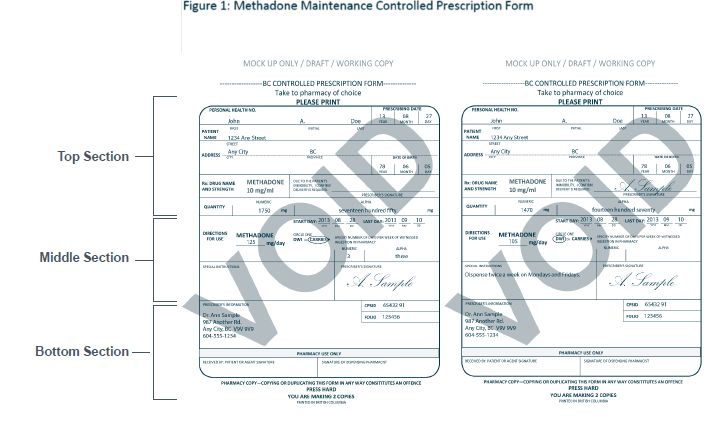
Policy Guide – Methadone Maintenance Treatment (2013)                                               P2

Forward
                        Opioid dependence is a health concern with implications for the individual
                        patient as well as the public. Methadone maintenance treatment is
                        recognized internationally as among the most effective treatments for
                        opioid use disorder (OUD). Addiction treatment experts recommend that
                        methadone treatment for OUD be delivered with a maintenance-oriented,
                        rather than abstinence-oriented, philosophy. This approach acknowledges
                        OUD as a chronic disease.

                        Many studies, conducted over several decades in different countries, have
                        clearly demonstrated that the effective delivery of methadone maintenance
                        treatment reduces non-medical opioid use, other problematic substance
                        use, criminal activity, mortality, injection-related risks and transmission of
                        blood-borne disease. Additional positive results are improvement in physical
                        and mental health, social functioning, quality of living and pregnancy
                        outcomes.

                        Methadone, a long-acting, orally effective opioid, is used as a substitute for
                        heroin or other narcotics when treating opioid dependence. Methadone
                        eliminates withdrawal from and reduces cravings for, opioids. Methadone
                        does not produce euphoria, and it blocks the euphoric effects of other
                        opioids. When used in the treatment of opioid dependence, a single oral
                        dose of methadone is effective for at least 24 hours. Eventual withdrawal
                        from methadone is not necessarily the goal of the program, although some
                        individuals may work with their physician and pharmacist to decrease their
                        dose and eventually stop using methadone.

                        Methadone prescribing is controlled by both federal and provincial
                        legislation, as well as administrative procedures and guidelines.

                        Registered pharmacists are permitted to purchase and dispense methadone
                        without federal exemption. However, the College of Pharmacists of BC
                        (CPBC) Professional Practice Policy (PPP-66) – Opioid Agonist Treatment
                        requires that the pharmacy manager and all staff pharmacists employed in a
                        community pharmacy that provides services related to methadone
                        maintenance treatment complete the CPBC Methadone Maintenance
                        Treatment (MMT) or the British Columbia Pharmacy Association’s (BCPhA)
                        Opioid Agonist Treatment Compliance and Management Program for
                        Pharmacy (OAT-CAMPP) training program, and any subsequent updates.
                        You must log into eServices to complete the “Declaration of Completion and
                        Understanding” prior to providing methadone maintenance treatment
                        services.

1029-PPP66_Policy_Guide_MMT v2019.2.1 Revised: May 13, 2019
Policy Guide – Methadone Maintenance Treatment (2013) P3
How to Use This Guide
This Policy Guide (the Guide) is a companion to Professional Practice Policy
(PPP-66) –Opioid Agonist Treatment (Appendix 1). The intention of the
Guide is to provide pharmacists with further detail and clarity (including
practical examples) to assist in the implementation of the policy into
practice to ensure consistency in the safe and effective delivery of
methadone maintenance treatment services.
As always the expectation is that pharmacists will practice in compliance
with their legislative requirements, including the principles outlined in this
Guide. It is understood however that pharmacy practice is not always ‘black
and white’ and when navigating the ‘grey’ pharmacists must use sound
professional judgment, ensuring that their decisions are made in the best
interest of the patient and with appropriate collaboration, notification and
most importantly, documentation.
The Guide is to be read in conjunction with completion of the mandatory
training session. Information regarding the mandatory sessions can be
found on the CPBC website at www. bcpharmacists.org.
Note:
This document is not intended to cover all possible practice scenarios.
Declaration
After completing the mandatory training program, and subsequently
reading this Guide, pharmacists must log into eServices to complete the
‘Declaration of Completion and Understanding’.
Acknowledgement
The development of this Guide involved a collaborative and consultative
process with input and feedback gathered from a volunteer group of
dedicated community pharmacists currently engaged, in varying capacities,
in the delivery of methadone maintenance treatment services.
The group was comprised of both frontline pharmacists and pharmacy
managers and represented a cross-section of practice types (independent to
large chain retailers) and practice settings including pharmacies located in
Vancouver’s Downtown Eastside whose primary focus is on the provision of
methadone maintenance treatment.
1029-PPP66_Policy_Guide_MMT v2019.2.1 Revised: May 13, 2019Policy Guide – Methadone Maintenance Treatment (2013) P4
Feedback was also solicited from other stakeholder groups including; the
Ministry of Health Services, the College of Physicians and Surgeons of BC,
the BCPhA, the City of Vancouver, patient advocacy groups Vancouver Area
Network of Drug Users (VANDU), and the BC Association for People on
Methadone (BCAPOM).
The College of Pharmacists of BC would like to sincerely thank each of these
individuals and organizations for their invaluable feedback in the creation of
this significant resource for pharmacists.
Feedback
Questions and comments about this Guide are welcome and can be sent to:
College of Pharmacists of British Columbia Telephone: 604-733-2440 or 800-
663-1940
200 – 1765 West 8th Avenue Facsimile: 604-733-2493 or 800-377-8129
Vancouver, BC V6J 5C6 E-mail: practicesupport@bcpharmacists.org
Web site: www.bcpharmacists.org
1029-PPP66_Policy_Guide_MMT v2019.2.1 Revised: May 13, 2019Policy Guide – Methadone Maintenance Treatment (2013) P5
Methadone Maintenance Treatment Policy
Guide
In accordance with Professional Practice Policy (PPP-66) – Opioid Agonist Treatment (Appendix
1), all pharmacy managers, staff pharmacists, relief pharmacists and pharmacy technicians
employed in a community pharmacy that provides pharmacy services related to methadone
maintenance treatment must know and apply the principles and guidelines outlined here in the
CPBC Methadone Maintenance Treatment Policy Guide (2013) and all subsequent revisions. The
responsibility of pharmacy technicians in the dispensing of MMT is consistent with their scope
of practice outlined in the Health Professions Act (HPA) Bylaws Schedule F Part 1 section 4.
Administration
1.1 Pharmacy Operating Hours
Principle 1.1.1 Patients must attend the pharmacy unless exceptional circumstances are
provided for under Professional Practice Policy (PPP-71) – Delivery of
Methadone Maintenance Treatment. The pharmacy hours of service must
be consistent with the supervised dosing requirements of your patient.
Guideline: When a pharmacy accepts a patient who requires daily witness
ingestion (i.e., 7 days per week) the pharmacy hours of service must
accommodate this dosing requirement. A pharmacist does not have the
independent authority to adapt a prescription for methadone maintenance
treatment from ‘daily witness’ to a ‘take-home’ dose.
1.2 Privacy and Confidentiality – Premise
Principle 1.2.1 All pharmacies offering methadone maintenance treatment must be in
compliance with all relevant legislation pertaining to the structure of the
licensed premise with particular attention given to ensuring there is
sufficient space to accommodate patients waiting for witnessed ingestion
and/or take home methadone doses while simultaneously maintaining
privacy for pharmacist-patient consultation.
Guideline: It may be appropriate to establish a staggered schedule for
regular patients requiring witnessed ingestion to ensure that there is
1029-PPP66_Policy_Guide_MMT v2019.2.1 Revised: May 13, 2019Policy Guide – Methadone Maintenance Treatment (2013) P6
adequate space within the pharmacy to accommodate patients who are
waiting and ensure privacy of pharmacist-patient consultation.
1.3 Security – Premise
Principle 1.3.1 All pharmacies offering methadone maintenance treatment must ensure
that their pharmacy is in compliance with all relevant legislation pertaining
to pharmacy security requirements including those outlined in Professional
Practice Policy (PPP-74) – Community Pharmacy Security.
Receiving Methadone Prescriptions
2.1 Methadone Maintenance Controlled Prescription
Forms – Overview
Principle 2.1.1 Methadone maintenance prescriptions can only be accepted when written
using an original Methadone Maintenance Controlled Prescription form.
Guideline: When accepting a methadone maintenance prescription a
pharmacist must ensure that the Methadone Maintenance Controlled
Prescription form is completed by the prescriber as outlined in the
Methadone Maintenance Controlled Prescription Form Guidelines (Appendix
3).
Principle 2.1.2 The pharmacist must ensure that the patient, as well as themselves, sign the
form, in the space indicated on the bottom of the form.
Principle 2.1.3 Faxed Methadone Maintenance Controlled Prescription forms are not
acceptable unless under extenuating circumstances where the prescriber
has determined, following consultation with the pharmacist, that the
urgency of the situation warrants it.
Guideline: In such cases the pharmacy, prior to dispensing the medication,
must receive, in addition to a fax of the Methadone Maintenance Controlled
Prescription form, written confirmation (fax acceptable) signed by the
1029-PPP66_Policy_Guide_MMT v2019.2.1 Revised: May 13, 2019Policy Guide – Methadone Maintenance Treatment (2013) P7
prescriber that briefly describes the emergency situation and guarantees
the delivery of the original Methadone Maintenance Controlled Prescription
form to the pharmacy the next business day or as soon as possible when the
prescriber is not available.
The faxed Methadone Maintenance Controlled Prescription form and
related documentation, as described in Appendix 4, must be attached to the
original Methadone Maintenance Controlled Prescription form once
received.
Note: The Emergency Fax Controlled Prescription Program Form
Documentation (Appendix 4) can be used for this purpose.
Principle 2.1.4 In an effort to maximize the effectiveness of the methadone maintenance
treatment program, the pharmacist may find it beneficial to engage in a
specific dialogue with the patient, either when they initiate treatment or at
various times throughout treatment, that clearly outlines the expectations
of both the patient and the pharmacist.
Guideline: The Methadone Maintenance Treatment Expectation Form
(Appendix 5) can be used for this purpose.
Principle 2.1.5 In the rare circumstance (disruptive or threatening behavior or verbal or
physical abuse) where a pharmacist finds that they must terminate the
pharmacist-patient relationship, reasonable notice must be provided to the
patient to ensure their continuity of care.
Guideline: It is important to remember that the decision to terminate a
pharmacist-patient relationship is a serious one and must be made with due
consideration and based on appropriate rationale. It is unethical for a
pharmacist to terminate the pharmacist-patient relationship or refuse to
treat a patient on morally irrelevant grounds. The pharmacist’s decision
should be documented and retained in the patient record.
1029-PPP66_Policy_Guide_MMT v2019.2.1 Revised: May 13, 2019Policy Guide – Methadone Maintenance Treatment (2013) P8
2.2 Methadone Maintenance Controlled Prescription
Forms – Alterations
Principle 2.2.1 Alterations to the Methadone Maintenance Controlled Prescription form are
the exception to the rule and should not be normal practice as they increase
the likelihood of errors and drug diversion and put the public at risk. In the
rare circumstance when an alteration is necessary to ensure the continuity
of care pharmacists must always use due diligence to ensure authenticity
and accuracy of the prescription.
Guideline:
Alterations completed at the prescriber’s office: Alterations are only
permitted on the sections of the form that the prescriber completes
provided that the prescriber has initialed the alteration. Alterations are not
permitted to the pre-printed sections of the form.
Alterations completed at the pharmacy: Pharmacists do not have
independent authority to make any alterations or changes to a Methadone
Maintenance Controlled Prescription form. Any required or requested
change(s) must be patient-specific and authorized by the patient’s
prescriber through direct consultation with the pharmacist. Any prescriber-
authorized changes must be confirmed in writing, signed by the prescriber,
received by the pharmacy (fax is acceptable) prior to dispensing the
medication whenever possible and attached and filed with the original
prescription.
Note: The Pharmacist-Prescriber Communication Form (Appendix 4) can be
used for this purpose.
2.3 Out-of-Province Prescriptions
Principle 2.3.1 Pharmacists are permitted to dispense methadone prescriptions from
prescribers in provinces other than BC.
Guideline: If there are any doubts regarding the authenticity of the out-of-
province prescription, the pharmacist must contact the out-of-province
prescriber to confirm the legitimacy of the prescription. When satisfied that
the prescription is authentic, the pharmacist can dispense and process the
1029-PPP66_Policy_Guide_MMT v2019.2.1 Revised: May 13, 2019Policy Guide – Methadone Maintenance Treatment (2013) P9
prescription in the same manner as other prescriptions from out-of-
province prescribers.
Note: It’s important to realize that not all provinces are required to use
Controlled Prescription Program forms.
Processing (Dispensing) Methadone
Prescriptions
3.1 Accepting a Prescription
Principle 3.1.1 Methadone for maintenance must be dispensed to patients in a
concentration of 10 mg/ ml.
Guideline: Only commercially available 10 mg/ml oral preparations are
permitted for use.
Principle 3.1.2 Positive identification is required for all patients presenting a prescription
for the first time, and reasonable steps to positively identify the patient
must be taken prior to dispensing any subsequent prescriptions.
Guideline: The CPBC Professional Practice Policy (PPP-54) – Identifying
Patients for PharmaNet Purposes requires the pharmacist to view one piece
of “primary identification” or two pieces of “secondary identification” as
verification of a positive identification. If a patient cannot provide the
required identification, the prescriber may be contacted to assist with
verifying the patient’s identity.
Principle 3.1.3 Pharmacists and pharmacy technicians must review the prescription to
ensure that it is completed by the prescriber as outlined in the Methadone
Maintenance Controlled Prescription Form Guidelines (Appendix 3) and that
the directions for use appropriately meet the specific needs of the patient
and can be accommodated by the pharmacy.
1029-PPP66_Policy_Guide_MMT v2019.2.1 Revised: May 13, 2019Policy Guide – Methadone Maintenance Treatment (2013) P10
Guideline: Each prescription must be reviewed in detail in consultation with,
and consideration given to the specific needs of, the patient. The following
list is a sample only:
• Evaluate the end date of the prescription to ensure that the
authorization for dispensing does not end on a weekend when the
patient will not be able to see a prescriber for a new prescription.
• Review the prescription directions to determine the dosing schedule
(daily witnessed ingestion, divided dose, take-home doses), including
the specific days of the week for each witnessed dose or take-home
doses, to confirm that the pharmacy operating hours match the dosing
schedule.
• Confirm that stamped or preprinted sticker directions do not conflict
with written directions.
Any ambiguous or conflicting information identified must be clarified with
the prescriber. Should an alteration or change to the prescription be
required, it must be done in compliance with the Principles and Guidelines
outlined in section 2.2.
3.2 Assessment of a Prescription
Principle 3.2.1 Pharmacists and pharmacy technicians must correctly identify the product
as prescribed ‘for pain’ or ‘for opioid use disorder’ by using the appropriate
Drug Identification Number (DIN) or Product Identification Number (PIN) to
ensure patient safety and accurate PharmaNet patient records.
Principle 3.2.2 As with all medications a pharmacist must review each individual
PharmaNet patient record, as stated in HPA Bylaws (Schedule F Part 1), and
resolve any drug-related problems prior to dispensing any methadone
prescription. This step is particularly critical for methadone prescriptions as
the automated drug usage evaluation (DUE) built into the PharmaNet
system does not include methadone. Pharmacists providing methadone
maintenance treatment must therefore ensure they maintain their
knowledge with respect to potential drug interactions related to
methadone. General information in this regard can be found in Appendix 7.
Guideline: A PharmaNet patient record review must be completed for all
prescriptions, including those patients obtaining their prescription on a daily
basis or those long-term patients whom the pharmacist may know well.
1029-PPP66_Policy_Guide_MMT v2019.2.1 Revised: May 13, 2019Policy Guide – Methadone Maintenance Treatment (2013) P11
Principle 3.2.3 Mood altering drugs, including benzodiazepines and narcotics, are not
generally prescribed to patients on the methadone maintenance program.
Should a patient present a prescription for a mood altering drug or if the
pharmacist discovers that a mood altering drug is also being prescribed to
the patient in their review of the PharmaNet patient record, they must
contact both the prescriber of methadone and, if different, the prescriber of
the mood altering drug, prior to dispensing the medication. The purpose of
the consultation is to ensure the prescriber(s) are aware that the patient is
currently on the methadone maintenance program.
Guideline: The pharmacist should document the outcome of the
consultation(s) with the prescriber(s) and attach it to the original
prescription.
Principle 3.2.4 The ‘sig field’ on the prescription label must include the start and end dates
of the original current prescription.
Principle 3.2.5 As required by HPA Bylaws Schedule F Part 1 the ‘dispensing date’ on the
prescription label must accurately reflect the actual date dispensed on the
PharmaNet system.
3.3 Preparing Methadone Prescriptions
Principle 3.3.1 Methadone doses must be accurately measured in a calibrated device that
minimizes the error rate to no greater than 0.1 ml.
Guideline: All devices used to measure the methadone 10 mg/ml solutions
should be distinctive and recognizable and must be used only to measure
methadone solutions. Devices must be labeled with a ‘methadone only’
label and a ‘poison’ auxiliary label with the international symbol of the skull
and cross bones.
1029-PPP66_Policy_Guide_MMT v2019.2.1 Revised: May 13, 2019Policy Guide – Methadone Maintenance Treatment (2013) P12
Principle 3.3.2 Reconciliation procedures must be conducted in accordance with
Professional Practice Policy (PPP-65) – Narcotic Counts and Reconciliations.
Guideline: As per PPP-65, the pharmacy manager must ensure that narcotic
counts and reconciliations, which include methadone, are completed:
• At a minimum of every 3 months,
• After a change of manager, and
• After a break-in or robbery.
Reconciliation means the quantity of methadone on hand must equal the
quantity received minus the quantity dispensed over a specific period of
time.
3.4 Loss or Theft and Disposal of Methadone
Principle 3.4.1 The Narcotic Control Regulations require that pharmacists report the loss or
theft of controlled drugs and substances to the Office of Controlled
Substances, Health Canada within 10 days of the discovery of the loss or
theft. In the event of a loss or theft the pharmacy should also notify the
CPBC as soon as possible.
Guideline: The form for reporting loss or theft of narcotics can be found on
the CPBC website www.bcpharmcists.org under Resources.
Principle 3.4.2 Methadone, like any other narcotic or controlled drug, can only be disposed
of with authorization from Health Canada and after being rendered
unusable.
Guideline: To receive authorization to dispose of methadone the pharmacist
must submit a written Authorization to Destroy for Expired Narcotic and
Controlled Drugs to the Office of Controlled Substances, Health Canada.
An acceptable method of rendering methadone unusable is to place the
product in a leak-proof container or plastic bag and add kitty litter until the
mixture is almost solid.
Once the required authorization is received from Health Canada the
pharmacist must record the amount of product to be disposed of, having a
second healthcare professional sign for the disposal, and place the now
rendered unusable product in the pharmacy’s medication return container.
1029-PPP66_Policy_Guide_MMT v2019.2.1 Revised: May 13, 2019Policy Guide – Methadone Maintenance Treatment (2013) P13
3.5 Methadone in Tablet Form for Air Travel
Principle 3.5.1 Hand luggage restrictions governing the transportation of fluids in air travel
may be problematic for patients and in certain circumstances may
necessitate the prescription of methadone in tablet form. Only
commercially available methadone in tablet form may be dispensed.
Pharmacists need to be aware that the prescription of methadone in tablet
form may result in increased risk for both patients and the public. Note:
Dispensing of methadone powder by way of sachet, capsule, or other
format is never acceptable due to the increased potential for diversion and
misuse.
Guideline: Long-term methadone maintenance treatment clearly limits
patients’ ability to travel because of the need for regular follow-up as well
as the restrictions associated with the dispensing of methadone. If patients
receiving MMT wish to travel for a period of time that exceeds their regular
carry period, the usual standard of care should not be compromised,
particularly if the patient is not stable and still requires daily supervised
ingestion.
Patients are significantly limited in their ability to transport methadone
across international borders but it is possible to arrange for methadone
dispensing in some jurisdictions. The CPSBC advises physicians to research
each case to ensure decisions do not compromise patient safety. In some
cases, patients may require documentation for the purpose of crossing
international borders or to assist in accessing temporary care from a
methadone program at their destination. The physician is responsible to
provide the required travel documentation.
Releasing Methadone Prescriptions
4.1 Releasing a Prescription
Principle 4.1.1 A pharmacist must be present and witness the release of a methadone
prescription to a patient. This function cannot be delegated to a pharmacy
technician or any other pharmacy support staff.
1029-PPP66_Policy_Guide_MMT v2019.2.1 Revised: May 13, 2019Policy Guide – Methadone Maintenance Treatment (2013) P14
Principle 4.1.2 Prior to releasing a methadone prescription the pharmacist must assess the
competence of the patient (i.e. ensure that the patient is not currently
intoxicated or otherwise mentally impaired) to ensure that it is safe to
release the medication to them.
Guideline: Pharmacists must assess patients for symptoms such as slurred
speech, ataxia, drowsiness, alcohol smell or unusual behaviour. It is
important for the pharmacist to be familiar with each patient’s ‘normal’
behaviour in order to be able to detect significant deviations from normal.
If the pharmacist believes that it is not safe for the patient to receive their
prescription they must consult with the prescriber and document the
outcome of the dialogue and attach it to the original prescription.
Principle 4.1.3 Prior to releasing a methadone prescription the patient and pharmacist
must acknowledge receipt by signing a patient/prescription-specific log (the
sample Methadone Part-Fill Accountability Log (Appendix 9) can be used for
this purpose).
Guideline: Every part-fill dispensed must be accounted for. The pharmacist
must be able to review every part-fill dispensed as a complete history on
one document.
The pharmacist releasing and the patient receiving the part-fill of the
prescription must sign for each witnessed ingestion dose and each take-
home dose. Neither the pharmacist nor the patient is permitted to pre-sign
for future doses or backdate signing.
The patient/prescription specific log (the sample Methadone Part-Fill
Accountability Log (Appendix 9) can be used for this purpose) must be
attached to the original Controlled Prescription Program form and once
complete filed sequentially by the first prescription or transaction number
assigned to the prescription.
Principle 4.1.4 As with all prescriptions, prior to releasing a methadone prescription, the
pharmacist must counsel the patient on the risks (including common side
effects) and benefits of taking their medication as per HPA Bylaws Schedule
F Part 1 section 12.
1029-PPP66_Policy_Guide_MMT v2019.2.1 Revised: May 13, 2019Policy Guide – Methadone Maintenance Treatment (2013) P15
Guideline: The most common adverse reactions with methadone include;
sweating, constipation, sexual dysfunction, change in menstruation,
drowsiness, sleep disturbances, muscle and bone aches, weight changes
(usually gain), skin rash, gastrointestinal upset, headaches and edema.
Patients will benefit from information about the non-drug approaches, non-
prescription products and prescription items that can provide relief from
these side effects.
Principle 4.1.5 With respect to witnessed ingestion doses, the pharmacist must directly
observe the patient ingesting the medication and be assured that the entire
dose has been swallowed.
Guideline: Given the concentrated solution of 10mg/ml, it may be helpful to
provide a glass of water to the patient to enable rinsing out of the
dispensing container to ensure full dose administration.
Immediately following observing the patient’s ingestion of the medication
the pharmacist should engage the patient in a short conversation to ensure
that the entire dose has been swallowed.
Principle 4.1.6 With respect to take-home doses the first dose (whether it is stated on the
prescription or not) must be a witnessed ingestion with all subsequent take-
home doses dispensed in child-resistant containers with an explicit warning
label indicating that the amount of drug in the container could cause serious
harm or toxicity if taken by someone other than the patient.
Guideline: Each dose must be dispensed in an individual, appropriately
sized, child-resistant container.
Each container must be individually labeled.
If a pharmacist determines that due to a specific patient circumstance a
non-child-resistant container will be used for take-home doses it must be
documented on the patient record.
Patients should be reminded that methadone should be stored out of the
reach of children, preferably in a locked cupboard or small lock box if stored
in the refrigerator.
Note: The decision to authorize take-home doses can only be made by the
prescriber. However, should a pharmacist believe that a patient is or is not
1029-PPP66_Policy_Guide_MMT v2019.2.1 Revised: May 13, 2019Policy Guide – Methadone Maintenance Treatment (2013) P16
ready to manage take-home doses they should discuss their
recommendations or concerns with the prescriber.
Principle 4.1.7 In extraordinary situations, when a patient cannot attend the pharmacy, the
patient’s representative may pick up and sign for their authorized take-
home dose(s) if confirmed in writing by the prescriber.
Guideline: This authorization must be date specific, and the representative
and circumstances must be clearly defined. The written and signed
authorization from the prescriber (fax acceptable) must be attached to the
original Methadone Maintenance Controlled Prescription form.
Note: Patient representative is defined in HPA Bylaws.
Principle 4.1.8 Delivery of methadone is prohibited under federal legislation except as
provided for in extraordinary circumstances according to Professional
Practice Policy (PPP-71) – Delivery of Methadone Maintenance Treatment.
Guideline: The pharmacist must read and understand Professional Practice
Policy (PPP- 71) – Delivery of Methadone Maintenance Treatment.
Responding to Methadone Dosing
Issues
5.1 Divided (Split) Doses
Principle 5.1.1 Only the prescriber, by stating this on the original Methadone Maintenance
Controlled Prescription form, can authorize a divided (split) dose of a
prescription. Unless otherwise specified by the prescriber, the first portion
of the daily dose must be by witnessed ingestion.
Guideline: The decision to authorize a divided dose can only be made by the
prescriber, however, should a pharmacist believe that a patient would
benefit from this they should discuss this option with the prescriber.
1029-PPP66_Policy_Guide_MMT v2019.2.1 Revised: May 13, 2019Policy Guide – Methadone Maintenance Treatment (2013) P17
5.2 Missed Doses
Principle 5.2.1 Any methadone prescription that has been processed and prepared but is
not consumed or picked up by the patient on the prescribed day is
considered cancelled and must be reversed on PharmaNet before the end of
the business day.
Guideline: It is imperative that the PharmaNet patient record reflects
accurate and current information in terms of consumed and picked-up
methadone doses as other healthcare practitioners rely on this information
in making treatment decisions.
Principle 5.2.2 If a patient misses a dose, they cannot receive the missed dose at a later
date.
Principle 5.2.3 The pharmacist must notify the prescriber of any missed doses (unless a
specified number of missed doses has been indicated by the prescriber)
before the next scheduled release of medication.
Guideline: The notification document must be retained and filed with the
prescription consistent with filing retention requirements. The Pharmacist-
Prescriber Communication Form (Appendix 6) can be used for this purpose.
5.3 Partial Consumption of Doses
Principle 5.3.1 If a patient refuses to consume their full dose, the pharmacist must not
insist that they ingest the total amount. The unconsumed portion however
cannot be given as a take-home dose.
Guideline: The patient’s partial consumption of a dose and their reason(s)
for it must be documented and reported to the prescriber. The Pharmacist-
Prescriber Communication Form (Appendix 6) can be used for this purpose.
All patient documentation including the Methadone Part-Fill Accountability
Log (Appendix 9) and PharmaNet record must accurately reflect the actual
dose consumed by the patient.
1029-PPP66_Policy_Guide_MMT v2019.2.1 Revised: May 13, 2019Policy Guide – Methadone Maintenance Treatment (2013) P18
5.4 Vomited Doses
Principle 5.4.1 If a patient reports that they vomited their dose, a replacement dose cannot
be provided without authorization from the patient’s prescriber.
Guideline: The pharmacist must contact the prescriber and provide them
with information about the incident (time the dose was taken, time of
vomiting, and other relevant points). Should the prescriber authorize a
replacement dose, it must be confirmed in writing, signed by the prescriber,
received by the pharmacy (fax is acceptable) prior to dispensing the
medication and attached and filed with the original prescription.
5.5 Lost or Stolen Doses
Principle 5.5.1 If a patient reports that their take-home dose(s) have been lost, stolen or
misplaced, a replacement dose(s) cannot be provided without authorization
from the patient’s prescriber.
Guideline: The pharmacist must contact the prescriber and discuss the
situation with them. Should the prescriber determine that the situation
warrants it they may authorize the acceptance of a new Methadone
Maintenance Controlled Prescription form by fax (refer to Principle 2.1.3) or
the prescriber may advise the pharmacy that they must wait until the
patient presents a new original Methadone Maintenance Controlled
Prescription form.
5.6 Tapering
Principle 5.6.1 If a patient has decided to initiate a self-tapering regimen by decreasing
their daily dose consumption, the pharmacist must record the dose
consumed on the patient/ prescription specific log (refer to Principle 4.1.3),
record the actual dose consumed on the patient’s PharmaNet record and
notify the prescriber.
Guideline: The Pharmacist-Prescriber Communication Form (Appendix 6)
can be used for the purpose of notifying the prescriber.
1029-PPP66_Policy_Guide_MMT v2019.2.1 Revised: May 13, 2019Policy Guide – Methadone Maintenance Treatment (2013) P19
5.7 Emergency Dosing
Principle 5.7.1 Emergency dosing is not recommended. If however a pharmacist feels in
their professional judgement that an emergency dose is required to ensure
continuity of patient treatment the pharmacist may provide an emergency
dose. The pharmacist must counsel the patient to obtain a new prescription
as soon as possible. This practice is the exception to the rule and not the
normal practice, refer to Professional Practice Policy (PPP-31) – Emergency
Prescription Refills.
Guideline: Pharmacists need to document, as per PPP-31, the attempt to
reach the prescriber with information about the situation. The prolonged
half-life of methadone ensures that a patient maintains a single dose for at
least 36 hours. Although the patient may feel uncomfortable an emergency
dose may not be necessary. Emergency doses may hinder treatment success
and health outcomes. It is a patient’s responsibility to make sure they have
a valid prescription.
Continuity of Care
6.1 Transfer of Pharmacy
Principle 6.1.1 When a patient chooses to move from one pharmacy to another to receive
their methadone prescription it is the responsibility of the new pharmacy to
contact the previous pharmacy and prescriber (if applicable) to discuss the
exact transfer date and any other pertinent concerns. The previous
pharmacy must cooperate fully with the request from the new pharmacy.
Guideline: Communication between the previous and new pharmacy is
critical to ensure the patient’s continuity of care and to avoid duplicate or
missed methadone doses. A review of the patient’s PharmaNet patient
record can be of assistance in determining the previous pharmacy and
prescriber.
1029-PPP66_Policy_Guide_MMT v2019.2.1 Revised: May 13, 2019Policy Guide – Methadone Maintenance Treatment (2013) P20
6.2 Hospitalization or Incarceration
Principle 6.2.1 When a patient is discharged or released to the community from a hospital
or correctional facility it is the responsibility of the community pharmacist
receiving the patient to verify the date and amount of the last dose
administered.
Guideline: Effective communication sharing among those who provide the
patient’s methadone maintenance treatment (hospital or correctional
facility and pharmacy) is essential to ensure the patient’s continuity of care
and to avoid duplicate or missed methadone doses.
6.3 Compounding in Exceptional Circumstances
Principle 6.3.1 The only situation that would constitute consideration of exceptional
circumstances is when a commercially available 10 mg/ml oral preparation
is not available.
Principle 6.3.2 Methadone for maintenance must be at the strength of 10 mg/ml to ensure
minimization of errors.
Principle 6.3.3 A compounding log must be established to record when methadone
solutions are prepared, how much was prepared, and who prepared the
product. The Compounding Log (Appendix 8) can be used for this purpose.
Guideline: The compounding log must incorporate the following elements:
• Preparation date,
• Methadone powder and/or liquid concentrate manufacturer’s lot
number and expiry date,
• Methadone powder and/or liquid concentrate quantity used and
quantity prepared,
• Batch number and use-by date assigned by the pharmacy, and
• Preparer’s and pharmacist’s identification.
A separate compounding log must be maintained for each strength of stock
solution
1029-PPP66_Policy_Guide_MMT v2019.2.1 Revised: May 13, 2019Policy Guide – Methadone Maintenance Treatment (2013) P21
Principle 6.3.4 All concentrated solution containers must be clearly labeled with the drug
name, strength, use-by date and appropriate warning labels.
Guideline: If different concentrations are prepared for pain management,
they must be easily identifiable with clear labeling. A best practice would be
to use different styles of storage container for each concentration or use
food grade dyes to differentiate between the different concentrations
prepared.
In order to help ensure liquid methadone preparations remain stable for up
to 30 days from the date of pharmacy dispensing and to minimize the
growth of bacteria, mold and fungus the American Association for the
Treatment of Opioid Dependence recommends that pharmacists should:
• Use distilled water for the dilution of methadone products,
• Use new, clean, light-resistant containers for dispensing,
• Refrigerate take-home containers as soon as possible and keep
refrigerated until used.
Principle 6.3.5 Methadone for maintenance solutions must be made with full-strength
Tang™ or similar full-strength beverage crystals with daily doses (witnessed
ingestion or take-home). Plain water is never an acceptable vehicle for
dispensing to patients in the methadone maintenance treatment program.
Guideline: The beverage crystals are full-strength when made according to
the manufacturer’s directions found on the product’s packaging.
Dispensing as a standard volume (e.g., all doses dispensed as a volume of
100 mL) is not acceptable.
1029-PPP66_Policy_Guide_MMT v2019.2.1 Revised: May 13, 2019Policy Guide – Methadone Maintenance Treatment (2013) P22
Appendix 1
CPBC Professional Practice Policy PPP-66 – Opioid Agonist
Treatment
This policy provides guidance to registrants employed in a community pharmacy that provides
pharmacy services related to opioid agonist treatment.
Policy statements:
Effective January 1, 2019:
1. All pharmacy managers, staff pharmacists, and relief pharmacists employed in a
community pharmacy that provides pharmacy services related to
buprenorphine/naloxone maintenance treatment, methadone maintenance treatment
or slow release oral morphine maintenance treatment must:
a. successfully complete the College of Pharmacists of BC (CPBC) Methadone
Maintenance Treatment (MMT) training program (2013), or
b. successfully complete the British Columbia Pharmacy Association (BCPhA) Opioid
Agonist Treatment Compliance and Management Program for Pharmacy (OAT-
CAMPP) training program, and
c. record self-declaration of training completion in eServices.
2. All pharmacy technicians employed in a community pharmacy that provides pharmacy
services related to buprenorphine/naloxone maintenance treatment, methadone
maintenance treatment or slow release oral morphine maintenance treatment must:
a. successfully complete the CPBC MMT training program (2013), or
b. successfully complete the online component of the BCPhA OAT-CAMPP training
program, and
c. record self-declaration of training completion in eServices.
3. Pharmacy managers must:
a. educate all non-pharmacist staff regarding their role in the provision of
community pharmacy services related to opioid agonist treatment, and
b. document the completion of the education of individual non-pharmacist staff
members on a form signed and dated by the pharmacy manager and the non-
pharmacist staff member, and retain the completed forms in the pharmacy’s
files.
Effective March 31, 2021:
The CPBC MMT training program (2013) will not be available beyond March 31, 2021.
Registrants will no longer be able to fulfill the College’s training requirements by completing
that program, and must complete any applicable component(s) of the BCPhA OAT-CAMPP by
March 31, 2021. The above-noted Policy Statements 1a and 2a will be repealed and all other
requirements will continue to be in effect.
1029-PPP66_Policy_Guide_MMT v2019.2.1 Revised: May 13, 2019Policy Guide – Methadone Maintenance Treatment (2013) P23
During the period between January 1, 2019 and March 31, 2021, registrants employed in a
community pharmacy that provides pharmacy services related to opioid agonist treatment are
strongly encouraged to complete the OAT-CAMPP program as soon as practicable.
1. BUPRENORPHINE/NALOXONE POLICY STATEMENTS:
1. Buprenorphine/naloxone maintenance treatment must only be dispensed as an
approved, commercially available formulation.
2. The CPBC Buprenorphine/Naloxone Maintenance Treatment Policy Guide (2018) is in
force.
3. All pharmacy managers, staff pharmacists, relief pharmacists and pharmacy technicians
employed in a community pharmacy that provides pharmacy services related to
buprenorphine/naloxone maintenance treatment must:
a) know and apply the principles and guidelines outlined in the CPBC
Buprenorphine/Naloxone Maintenance Treatment Policy Guide (2018) and all
subsequent revisions,
b) be familiar with the information included in the most recent version of the
British Columbia Centre on Substance Use (BCCSU) A Guideline for the
Clinical Management of Opioid Use Disorder, and
c) be familiar with the information included in the product monographs of
approved, commercially available formulations.
2. Methadone Maintenance Policy statements:
1. Methadone maintenance treatment (MMT) must only be dispensed as the commercially
available 10mg/ml methadone oral preparation.
2. The CPBC Methadone Maintenance Treatment Policy Guide (2013) is in force.
3. All pharmacy managers, staff pharmacists, relief pharmacists and pharmacy technicians
employed in a community pharmacy that provides pharmacy services related to
methadone maintenance treatment must:
a) know and apply the principles and guidelines outlined in the CPBC
Methadone Maintenance Treatment Policy Guide (2013) and all subsequent
revisions,
b) be familiar with the information included in the most recent version of the
BCCSU A Guideline for the Clinical Management of Opioid Use Disorder, and
c) be familiar with the information included in the commercially available
10mg/ml methadone oral preparation product monographs.
The Methadone Maintenance Policy Statements must be read in conjunction with PPP-71 Delivery of
Methadone Maintenance Treatment.
1029-PPP66_Policy_Guide_MMT v2019.2.1 Revised: May 13, 2019Policy Guide – Methadone Maintenance Treatment (2013) P24
Required References
In addition to the currently required pharmacy reference materials (PPP-3), pharmacies
providing methadone maintenance treatment services must also maintain as required
references the following:
CPBC Methadone Maintenance Treatment Policy Guide (2013) and subsequent revisions.
The most recent version of the BCCSU A Guideline for the Clinical Management of Opioid
Use Disorder.
The most current version of the Centre for Addiction and Mental Health Opioid Agonist
Maintenance Treatment: A Pharmacist’s Guide to Methadone and Buprenorphine for
Opioid Use Disorders.
Product monographs for the commercially available 10mg/ml methadone oral
preparations.
3. SLOW RELEASE ORAL MORPHINE POLICY STATEMENTS:
1. Slow release oral morphine maintenance treatment must only be dispensed in
approved, commercially available strengths and formulations.
2. The CPBC Slow Release Oral Morphine Maintenance Treatment Policy Guide (2018) is in
force.
3. All pharmacy managers, staff pharmacists, relief pharmacists and pharmacy technicians
employed in a community pharmacy that provides pharmacy services related to slow
release oral morphine maintenance treatment must:
a) know and apply the principles and guidelines outlined in the CPBC Slow
Release Oral Morphine Maintenance Treatment Policy Guide (2018) and all
subsequent revisions,
b) be familiar with the information included in the most recent version of the
BCCSU A Guideline for the Clinical Management of Opioid Use Disorder, and
c) be familiar with the information included in the product monographs of
approved, commercially available strengths and formulations.
1029-PPP66_Policy_Guide_MMT v2019.2.1 Revised: May 13, 2019Appendix 2
CPBC Professional Practice Policy PPP-71 – Delivery of
Methadone Maintenance Treatment
POLICY STATEMENT(S):
Under extraordinary circumstances, if the patient has restrictions in mobility and if the prescribing
physician has provided written authorization on the prescription by signing the declaration,
pharmacists may provide home delivery of methadone for maintenance. This practice is the
exception to the rule and not normal practice.
Neither the pharmacy manager nor the staff pharmacist may authorize the provision of home
delivery for methadone in the absence of the prescriber’s authorization on the prescription.
Delivery Standards:
1. Prescribing Physician Authorization of Home Delivery
a. Should the prescribing physician determine that, due to the patient’s immobility, delivery
is required; the physician may authorize delivery by signing the declaration on the
Methadone Maintenance Program, Controlled Prescription Program form.
i. If the pharmacist or pharmacy technician has concerns regarding the authenticity
of the prescriber’s signature they must contact the prescriber for verification.
ii. Physicians will not authorize delivery unless patient safety is assured and
restrictions in mobility have been identified.
iii. Distance between patient home and pharmacy does not qualify as a restriction in
mobility.
2. Home Delivery Schedule and Location
If delivery is authorized as noted in section 1 above, the pharmacist must meet the following
delivery requirements:
a. The pharmacist must determine whether home delivery is feasible within the services
and resources the pharmacy provides. If the pharmacy does not provide delivery service
– it may be appropriate to refer the patient to a pharmacy that can provide the delivery.
b. If the pharmacy is able to provide home delivery the pharmacist must work with the
patient to make appropriate arrangements for delivery. Arrangements must include:
i. Address for delivery - methadone may only be delivered to a patient’s home with
a valid street address; delivery to a public location is not permitted.
ii. Time for delivery.
iii. Procedure if patient not available at address to receive methadone delivery
including communication of appropriate alternate arrangements for the patient to
obtain their prescription.
Note: It is not acceptable for the pharmacist to deliver the methadone to
an alternate person or location or to leave the methadone
unattended.
3. Secure Transportation and Storage
a. The dispensing pharmacist is responsible for securely transporting and appropriately
storing methadone.
b. Methadone must be transported directly from the dispensing pharmacy to the patient’s
home address; methadone may not be stored outside of the pharmacy under any
circumstances.
1029-PPP66_Policy_Guide_MMT v2019.2.1 Revised: May 13, 2019Policy Guide – Methadone Maintenance Treatment (2013) P26
4. Release of Methadone for Maintenance
The pharmacist must be present to:
a. Confirm the identity of the patient.
b. Assess the competence of the patient.
c. Witness the release and ingestion of methadone to the patient, this responsibility cannot
be delegated to a pharmacy technician or any other pharmacy support staff.
d. Provide appropriate patient counseling.
e. If carries are provided, the pharmacist must always witness first dose of the take-home
prescription; all subsequent doses must be dispensed in child-resistant containers with
explicit warning label(s).
5. Documentation
The pharmacist must:
a. At the time of release of a methadone prescription the patient and pharmacist must
acknowledge receipt by signing a patient/prescription-specific part-fill accountability log.
Neither party may ‘pre-sign’ for future doses.
b. Document any and all home deliveries of methadone in the patient’s record.
c. Log the home delivery with the address where the delivery was made on the methadone
part-fill accountability log.
d. Document any appropriate follow-up plan in the patient’s record.
e. File the methadone part-fill accountability log with original methadone prescription form.
BACKGROUND:
Legislation
Federal legislation does not support delivery of narcotics. The Controlled Drugs and Substances Act
(CDSA) defines the transport or delivery of narcotics as trafficking, the Narcotic Control Regulations
(NCR) limit the transport of narcotics to licensed dealers only.
Controlled Drugs and Substances Act
“Section 2 - Interpretation, Definitions1
“traffic” means, in respect of a substance included in any of Schedules I to IV,
(a) to sell, administer, give, transfer, transport, send or deliver the substance”
Narcotic Control Regulations
“Section 2 - Interpretation, Definitions2
“licensed dealer” means the holder of a licence issued under section 9.2.
Dealers’ Licenses and Licensed Dealers3
8. (1) Subject to these Regulations, no person except a licensed dealer shall
produce, make, assemble, import, export, sell, provide, transport, send or deliver a
narcotic.”
Pharmacists are required to adhere to the CDSA and its regulations as well as the Health
Professions Act, Pharmacy Operations and Drug Scheduling Act and their Bylaws. The College of
Pharmacists and the College of Physicians and Surgeons recognize that there are extraordinary
circumstances where due to temporary or permanent restrictions in mobility patients would require
delivery of their methadone for maintenance to ensure best patient health outcomes and continuity
of care.
1 http://laws-lois.justice.gc.ca/eng/acts/C-38.8/page-1.html#h-2
2 http://laws-lois.justice.gc.ca/eng/regulations/C.R.C.,_c._1041/page-1.html#docCont
3 http://laws-lois.justice.gc.ca/eng/regulations/C.R.C.,_c._1041/page-3.html#docCont
College of Pharmacists of British Columbia
1029-PPP66_Policy_Guide_MMT v2019.2.1 Revised: May 13, 2019Policy Guide – Methadone Maintenance Treatment (2013) P27
Appendix 3
Methadone for Maintenance Controlled Prescription Form
Guidelines
Methadone prescriptions can only be accepted when written using an
original Methadone Maintenance Controlled Prescription form. When
accepting a Methadone Maintenance Controlled Prescription form a
pharmacist must ensure that the form is completed by the prescriber as
outlined in these guidelines.
Methadone Maintenance Controlled Prescription Form
(Example; Figure 1):
These duplicate copy prescriptions are pre-printed with the following
information; drug name and strength, prescriber’s name, address (optional),
College ID number and prescription folio number. These prescription forms
are used only for prescribing methadone for maintenance.
Top Section of Form:
The prescriber must complete in full, the patient information including;
personal health number (PHN), name, address and date of birth. The
‘prescribing date’ indicates the date that the prescriber saw the patient. The
‘Drug Name and Strength’ section is preprinted and the prescriber must
complete the ‘Quantity’ section by stating the total quantity of the
prescription in numeric and alpha forms.
Under extraordinary circumstances, if the patient has severe restrictions in
mobility and if the prescribing physician has provided written authorization
on the prescription by signing the declaration, pharmacists may provide
home delivery of Methadone Maintenance Treatment (MMT). This practice
is the exception to the rule and not normal practice. Refer to Professional
Practice Policy (PPP-71) – Delivery of Methadone Maintenance Treatment.
Note: If no ‘start day’ is indicated in the ‘Directions for Use’ section of the
form the ‘prescribing date’ becomes the ‘start day’.
Middle Section of Form:
The prescriber must complete the ‘Directions for Use’ section as follows:
• State the daily dose:
o the daily dose multiplied by the number of days must equal the
total quantity indicated on the prescription, if there is a
College of Pharmacists of British Columbia
1029-PPP66_Policy_Guide_MMT v2019.2.1 Revised: May 13, 2019Policy Guide – Methadone Maintenance Treatment (2013) P28
discrepancy the pharmacist should seek clarification from the
prescriber
• Indicate the ‘start day’ and ‘last day’:
o if no ‘start day’ is indicated, the ‘prescribing date’ becomes the
‘start day’
o should the ‘start day’ overlap with, or leave gaps from, an
existing prescription the pharmacist should seek clarification
from the prescribe
• Indicate any special instructions:
o may be used to provide special instructions to the pharmacist for
example split doses, or special situations for carries.
• Indicate either DWI or CARRIES, if carries are indicated the prescriber
must indicate both in numeric and alpha the required number of days
per week of witnessed ingestion:
o if neither of these options are circled the pharmacist is to assume
that all doses are DWI
o if CARRIES has been circled but the specific witnessed ingestion
days (ex; Monday and Thursday) have not been noted by the
prescriber the pharmacist can determine the days in consultation
with the patient. However, the first dose of the prescription and
the dose before any carries must be witnessed ingestion.
Additionally, the witnessed ingestion doses must be spread
evenly throughout the week
o if CARRIES has been circled but the number of days per week of
witnessed ingestion has been left blank the pharmacist must
seek clarification from the prescriber
Note: “DWI except when pharmacy closed” is not an acceptable prescription
instruction.
• Authorize the prescription by signing their name in the ‘prescriber’s
signature’ box
Bottom Section of Form:
As a minimum the prescriber’s name, College ID number and prescription
folio number will be pre-printed on the form. If the prescribers address is
not pre-printed it must be completed by the pharmacist prior to dispensing
the prescription. Both the patient and the pharmacist must sign the
prescription in the appropriate box.
Note: A patient’s representative signature is only acceptable with prior
written authorization from the prescriber.
College of Pharmacists of British Columbia
1029-PPP66_Policy_Guide_MMT v2019.2.1 Revised: May 13, 2019Policy Guide – Methadone Maintenance Treatment (2013) P29
College of Pharmacists of British Columbia
1029-PPP66_Policy_Guide_MMT v2019.2.1 Revised: May 13, 2019Policy Guide – Methadone Maintenance Treatment (2013) P30
Appendix 4
Emergency Fax Methadone Maintenance Controlled
Prescription Form Documentation
College of Pharmacists of British Columbia
1029-PPP66_Policy_Guide_MMT v2019.2.1 Revised: May 13, 2019Policy Guide – Methadone Maintenance Treatment (2013) P31
Appendix 5
Methadone Maintenance Treatment Expectation Form
As your pharmacists, we believe in the principles of the methadone
maintenance treatment program, and the valuable role it can play in
improving people’s lives and their health. We are committed to being an
active member of your healthcare team and understand that the success of
the program is dependent on ongoing collaboration and communication
between yourself, ourselves and your prescriber.
To help you succeed in the program it is important that we both clearly
understand the commitment and expectations of each other.
As your pharmacists, you can expect that we will:
• Treat you professionally and respectfully at all times.
• Make ourselves available to discuss any questions or concerns that you
may have regarding the program.
• Provide methadone to you exactly as your prescriber has prescribed it
and will ensure that they are made aware of any of the following:
Missed dose(s) for any reason (ie; failure to pick up, vomited, lost
or stolen)
Less than full dose consumed (ie; tolerance, self-initiated
tapering)
Presenting at the pharmacy while intoxicated
Prescribing of contraindicated medications (ie; mood-altering
drugs)
• Not dispense your methadone (unless directed by your prescriber) to
anyone other than you.
• Respect your choice (unless directed by your prescriber) of the
pharmacy you wish to have dispense your medication.
As our patient, we can expect that you will:
• Treat all pharmacy staff and other patients respectfully at all times.
• Do your utmost to adhere to the methadone maintenance treatment
program as prescribed to you.
• Discuss any concerns you may have regarding your methadone
maintenance treatment with us or your prescriber prior to making any
adjustments to treatment independently.
• Ensure that any take-home doses of methadone are stored safely and
securely.
• Respect the pharmacy’s greater community by refraining from loitering
or littering.
College of Pharmacists of British Columbia
1029-PPP66_Policy_Guide_MMT v2019.2.1 Revised: May 13, 2019You can also read


