Postal development report 2018 - Benchmarking a critical infrastructure for sustainable development - Universal Postal Union
←
→
Page content transcription
If your browser does not render page correctly, please read the page content below

Postal
development report
2018
Benchmarking a critical infrastructure
for sustainable development

Berne, Switzerland – April 2018

Postal development report 2018
Benchmarking a critical infrastructure for sustainable development

DIRCAB.STRAT
April 2018
Copyright © 2018 Universal Postal Union – All rights reserved

Except as otherwise indicated, the copyright in this publication is owned by the Universal Postal Union.
Reproduction is authorized for non-commercial purposes, subject to proper acknowledgement of the source.
This authorization does not extend to any material identified in this publication as being the copyright of a
third party. Authorization to reproduce such third-party materials must be obtained from the copyright holders
concerned.

DISCLAIMER: This publication by the UPU constitutes research in progress of an informational character for
which no guarantees or assurances are provided; in this regard, it shall not be deemed to represent the
official position or opinions of the UPU or its staff members, or of UPU member countries. Moreover, the
depiction and use of boundaries, geographic names and related data shown on maps and included in lists,
tables, documents and databases are not warranted to be error-free nor do they necessarily imply official
endorsement or acceptance by the UPU.

Authors: Mauro Boffa, Fernão De Borba and Lukasz Piotrowski

3

Table of contents
                                                             Page

EXECUTIVE SUMMARY                                               5

INTRODUCTION                                                    7

POSTAL DEVELOPMENT: DEFINITIONS AND TOOLS                       7
INTEGRATED INDEX FOR POSTAL DEVELOPMENT                         7

I. GLOBAL AND REGIONAL PERFORMANCE                             11

OVERVIEW                                                       11
TOP 3 PERFORMERS                                               15
INDUSTRIALIZED COUNTRIES                                       16
EASTERN EUROPE AND CIS                                         16
ASIA-PACIFIC                                                   16
ARAB REGION                                                    17
LATIN AMERICA AND THE CARIBBEAN                                17
AFRICA                                                         17

II. FROM POSTAL DEVELOPMENT TO THE ACHIEVEMENT OF THE SDGS     18

BACKGROUND                                                     18
MEASUREMENT FRAMEWORK                                          19
DECENT WORK AND ECONOMIC GROWTH (GOAL 8)                       20
INDUSTRY, INNOVATION AND INFRASTRUCTURE (GOAL 9)               22
SUSTAINABLE CITIES AND COMMUNITIES (GOAL 11)                   24
PARTNERSHIPS FOR THE GOALS (GOAL 17)                           25

CONCLUDING REMARKS                                             28

ANNEX                                                          29

ADDITIONAL TABLES                                              29

NOTES                                                          32
4

Figures and tables

Figure 1 – Distribution of 2IPD scores by region                                                14
Figure 2 – Postal sector performance compared with other infrastructure                         14
Figure 3 – Postal revenues vs GDP growth (PPP, 1996 = 100)                                      15
Figure 4 – The 17 Sustainable Development Goals                                                 18
Figure 5 – Correlation between SDG indicator 8.10.2 and 2IPD score                              20
Figure 6 – Contribution of different 2IPD sub-indices to SDG indicator 8.10.2                   21
Figure 7 – Correlation between SDG indicator 9.B.1 and 2IPD score                               23
Figure 8 – Contribution of different 2IPD sub-indices to SDG indicator 9.B.1                    23
Figure 9 – Correlation between SDG indicator 11.5.2.b, 2IPD and LPI                             24
Figure 10 – Correlation between SDG indicator 17.8.1 and 2IPD score                             26
Figure 11 – Contribution of different 2IPD sub-indices to SDG indicator 17.8.1                  26

Table 1 – Integrated Index for Postal Development (2IPD) – 2018 global ranking                  12
Table 2 – Global and regional average scores across the four dimensions of postal development   15
Table 3 – SDGs linked to postal development                                                     19
Table 4 – Goal 8 indicators and postal development                                              29
Table 5 – Goal 9 indicators and postal development                                              30
Table 6 – Goal 11 indicators and postal development                                             30
Table 7 – Goal 17 indicators and postal development                                             31

5

                         Executive summary
The postal sector is     The rise of digitalization coupled with other long-term social and
changing                 macroeconomic transformations has prompted Posts to expand their services
                         well beyond the mere delivery of letters. In this context, the meaning of postal
                         development needs to be refined and further aligned with the United Nations’
                         2030 Agenda, embodied by the Sustainable Development Goals (SDGs).
                         Examining postal development through the lens of sustainable development
                         matters for both the prosperity of the postal sector and the well-being of
                         societies around the world. Indeed, with a global network of over 677,000 post
                         offices, 5.3 million staff and physical infrastructure covering 192 countries,
                         Posts play a critical socio-economic role.

                         Yet, measuring the multiple facets of development is no small task. To
                         overcome this challenge, the UPU has been leveraging a wealth of big data in
                         order to analyze the performance of national postal services around the world.
                         One of the outcomes of these efforts was the creation of the Integrated Index
                         for Postal Development, or 2IPD. A composite index, the 2IPD measures the
                         performance of countries across four key dimensions of postal development:
                         reliability, reach, relevance and resilience.

Consolidating big data   The 2IPD draws on three main types of UPU data: postal big data, statistics
and traditional          and surveys. Postal big data is used mainly to compute indicators associated
statistics, the 2IPD     with quality of service, transactions, volumes and connectivity. Statistics are
captures the multiple    applied to the measurement of revenue streams and economies of scale.
facets of postal         Surveys feed into more qualitative considerations, namely, inclusiveness and
development              integration.

                         A total of 173 countries were assessed for the production of the 2018 global
                         ranking (which is based on full-year data for 2017). Switzerland, the
                         Netherlands and Japan top the list, followed by Germany and France. These
                         countries owe their high scores to a consistently balanced performance across
                         the four dimensions of the 2IPD: they have all managed to build reliable, well-
                         connected, relevant and resilient postal services.

                         However, the situation of the top 5 does not reflect the global trend for the
                         sector, which is being affected by growing gaps in postal development between
                         and within regions. Moreover, comparable benchmarks tend to indicate that
                         Posts are underperforming in comparison with other elements of national
                         infrastructure.

                         In spite of these challenges, within the various regions, some countries have
                         achieved encouraging results, for example, Poland (score of 78.3, ranked 6th
                         worldwide), Singapore (score of 78.2, ranked 7th), Nigeria (score of 50.9,
                         ranked 51st), Brazil (score of 54.0, ranked 44th), and Tunisia (score of 51.9,
                         ranked 49th).

The 2IPD sheds light     The quantitative nature of the 2IPD makes it an ideal tool to study the postal
on the synergies         sector’s contribution to the achievement of the UN SDGs. Using an innovative
between postal           measurement framework, UPU research has revealed that the sector has a
development and          potentially high impact on Goals 8, 9, 11 and 17 of the SDGs.
sustainable
development              The postal sector contributes to the achievement of Goal 8 through the
                         promotion of financial inclusion. For Goal 9, the impact is achieved through the
                         promotion of more robust global value chains. For both of these goals, postal
                         interconnectedness (reach) is the key underlying factor. When it comes to
                         Goal 11, the contribution is expressed through the sector’s greater resilience to
                         natural disasters, when compared with other elements of the wider logistical
                         infrastructure. For Goal 17, Posts work as promoters of greater Internet
                         connectivity, leveraging all underlying dimensions (reliability, reach, relevance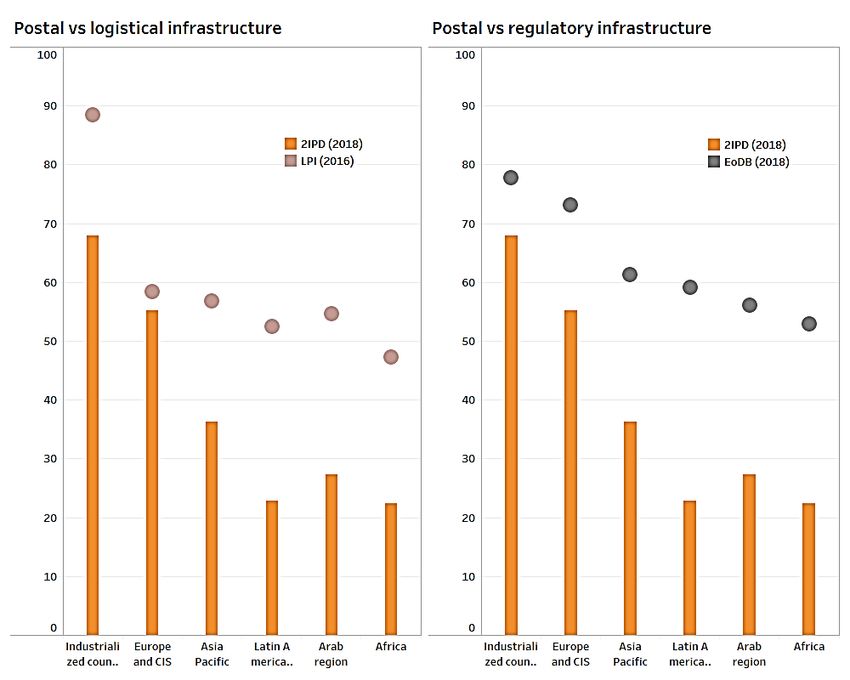
6

and resilience). The statistical findings that lead to these conclusions are all
corroborated by studies and examples of projects in the field.

The main takeaway from this report is that the postal sector continues to be a
key vehicle of socio-economic development. This should encourage
governments, regulators and any other players with a stake in the sector to
step up investments and draft level-playing-field regulations and policies to
boost this critical element of national infrastructure.
7

                          Introduction
                          Postal development: definitions and tools

The activities of Posts   Although the general public may instinctively link Posts to letters and stamps,
have been expanding       their span of activities is in fact much wider. Beyond the mere delivery of
beyond the mere           letters, many postal operators throughout the world have been building
delivery of letters       substantial business capabilities in areas as diverse as parcels and logistics,
                          financial services, and even e-government, healthcare and other public
                          services.

                          In its traditional form, the postal sector has been driven on the supply side by
                          three main stakeholders: governments, regulators and designated postal
                          operators. The first two define the basic policies and rules governing postal
                          services, while the third have the legal obligation of ensuring the delivery of
                          basic postal services to all citizens within a given territory – the so-called
                          “universal service obligation”.

Hence the need to         In this context, the concept of postal development needs to be defined in a
redefine postal           comprehensive manner. It must encompass more than purely operational
development               aspects associated with delivery; it must also cover the need to ensure
                          (international) connectivity, to offer products and services which are deemed
                          relevant by the population, and to respond to changes in citizen needs and
                          demands from society as a whole.

                          With a wide network of over 677,000 post offices around the world, 5.32 million
                          staff and physical infrastructure covering 192 countries, the postal sector does
                          indeed play a critical socio-economic role. That is why postal development
                          matters. 1

                          The vision adopted by the Universal Postal Union (UPU) for its 2017–2020
                          strategy is fully geared towards postal development, seeking to ensure that the
                          postal sector is seen as an enabler of inclusive development and an essential
                          component of the global economy. In the same vein, the mission of the
                          organization, enshrined in its Constitution, stipulates that the UPU is to
                          “stimulate the lasting development of efficient and accessible universal postal
                          services of quality in order to facilitate communication between the inhabitants
                          of the world”.

                          Yet, measuring postal development is not an easy task. The UPU has a key
                          role to play in addressing this major challenge, leveraging its position as the
                          sole intergovernmental agency of the United Nations system in charge of
                          overseeing the postal sector. Drawing on a wide range of information, such as
                          official postal statistics, surveys and tracking data, the UPU can show how
                          countries around the world are faring in maintaining the critical part of national
                          infrastructure that the postal sector represents.

                          The UPU has also begun publishing the Integrated Index for Postal
                          Development, or 2IPD – the greatest data integration ever conducted to
                          measure the development of postal services on a global scale. This work gave
                          new impetus to a series of research materials released by the organization in
                          recent years.

                          Integrated Index for Postal Development

History and purpose       The Integrated Index for Postal Development originated in 2013 as an attempt
                          to produce indicators for cooperation and development purposes. As part of
8
the work conducted by the UPU Council of Administration, a methodology for
the index was developed and approved in 2014. The following year, the first
application of this methodology was launched. The 2016 Istanbul Congress
then gave a mandate to update and release the 2IPD results on a regular
basis.
The corresponding report is now being officially published for the second year
in a row. In spite of its young existence, this index has already drawn
considerable attention from a wide range of key stakeholders in the postal
sector and beyond.
Indeed, governments can draw on the 2IPD results in developing strategies to
enhance the contribution of postal services to the economic and social
infrastructure of their countries. Regulators can use the 2IPD to better identify
the development challenges that postal services are facing and benefit from
meaningful international comparisons. Postal operators can leverage the data
to benchmark their relative operational and business model strengths and
weaknesses across different levels of economic development and
geographies, so as to improve their performance.
Moreover, in an age of rapid digitalization, the need for accurate data to
measure the various facets of e-commerce has never been greater. Other
international organizations have therefore been stepping up their interest in the
data collected and processed by the UPU. For instance, UNCTAD uses one of
the components of the 2IPD to compute its own B2C e-commerce index.
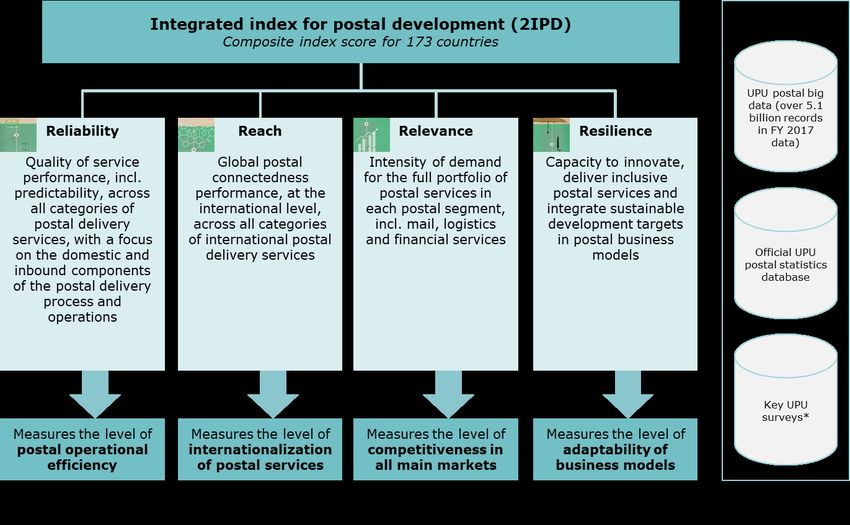
Key components and As a composite index, the 2IPD flows from sub-indices, which reflect more
data sources detailed performance in specific areas. On the basis of this sub-index input, an
algorithm is then used to generate an overall score of between 0 and 100 for
each assessed country.
The four sub-indices that flow into the general score are:
– the reliability score, which reflects performance in terms of speed and
predictability of delivery, across all the key segments of physical postal
services;
– the reach score, which synthesizes global connectivity as indicated by
the number of partner networks and the volumes of international
exchanges, again across all the key segments of physical postal
services;
– the relevance score, which measures the intensity of demand for the full
portfolio of postal services relative to the best performers in each
category of postal activity, also taking into account elements such as the
number of international transactions;
– the resilience score, which indicates the level of diversification of
revenue streams and the capacity to innovate, deliver inclusive postal
services and integrate sustainable development targets into postal
business operations.
The purpose of the reliability score is to measure operational efficiency of
postal services, while reach captures the level of internationalization of these
operations. When it comes to relevance, the key goal is to evaluate the
competitiveness of postal services in all key segments, and in particular the
potential to generate higher volumes. Regarding the resilience score, the intent
is to assess the ability of postal services to withstand external shocks through
adaptable business models.
Overall, these four pillars are aimed at providing a balanced view of postal
development, without solely focusing on operational (e.g. delivery), strategic
(e.g. business portfolio management) or societal (e.g. financial inclusion)
matters. This enables the final general score to comprehensively reflect (while
succinctly expressing) the situation of postal services in any given geography.9
The 2IPD draws on three main types of UPU data:
– UPU postal big data (over 5.1 billion records in 2017);
– Official UPU postal statistics (more than 100 indicators available in
2016);
– Key UPU surveys.
The first type is used mainly to compute indicators associated with quality of
service, transactions, volumes and connectivity. The second is applied to the
measurement of revenue streams and economies of scale. The third feeds into
more qualitative considerations, namely, inclusiveness and integration.
How to read the results The best postal development performer obtains a normalized score of 100,
while the worst gets a minimum of 0 and the intermediate 50. Thus, all
normalized scores can be read as the distance of any given country compared
with the best (score of 100), intermediate (score of 50) or worst (score of 0)
global performer. This enables a country to assess whether it is closer to the
best, intermediate or worst absolute performer.
Overall, scores can be interpreted as follows:
– A score above 75 shows that a country’s postal development is relatively
closer to the best absolute performer than to the intermediate one;
– A score between 50 and 75 shows a more intermediate level of
performance in the high range, or “upper middle performers”;
– A score between 25 and 50 shows a more intermediate level of
performance in the low range, or “lower middle performers”;
– A score below 25 shows that a country’s postal development is relatively
closer to the worst absolute performer than to the intermediate one.
When reading the scores, it is also necessary to consider two main elements.
First, the scores are always the reflection of a relative position in the entire
span of countries covered by the analysis. If a given country makes absolute
progress on a specific dimension of the 2IPD, this will only translate into a
higher rank if others do not make even greater gains in performance. Second,
the position of a country in the global ranking should preferably be considered
in conjunction with the regional standing of the same country, for this brings
further contextualization into the analysis.
Figure 1 – Overview of the key components and data sources of the 2IPD10
Two main sections This report is structured in two main sections. The first presents an analysis of
focusing on postal and the key 2IPD results across the world, with explanations for standout
sustainable performance in the latest ranking. The second section puts postal development
development in perspective by expanding on the role of the sector in contributing to the
achievement of the UN Sustainable Development Goals. In the general
conclusion, a number of key takeaways and recommendations are put forward.11
I. Global and regional performance
Overview
The latest ranking The 2018 ranking of the Integrated Index for Postal Development covers a total
spans more than 170 of 173 countries (see table 1 below). The global average score in the index
countries stands at 37.24 (against 39 in 2017). 2
Switzerland, the Netherlands and Japan top the list, followed by Germany and
France. These countries owe their high scores to a consistently balanced
performance across the four dimensions of the 2IPD: they have all managed to
build reliable, well-connected, relevant and resilient postal services.
There are many However, the situation of the top 5 does not reflect the global trend for the
disparities between sector, which is being affected by growing gaps in postal development between
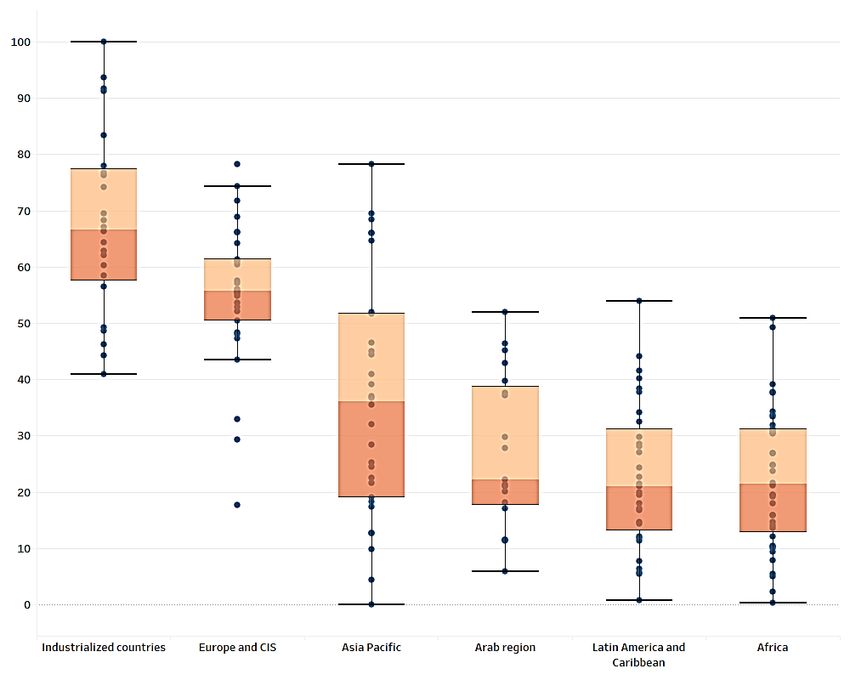
and within regions and within regions. As shown in figure 1 below, industrialized countries have
the highest average 2IPD score (67.92), followed by countries in Eastern
Europe and the CIS (55.22), Asia-Pacific (36.34), the Arab region (27.29), Latin
America and the Caribbean (22.81), and Africa (22.37).
Moreover, comparable benchmarks tend to indicate that Posts are
underperforming compared with other elements of national infrastructure (see
figure 2). For instance, in the World Bank’s Logistics Performance Index (LPI)
and Ease of Doing Business Index (EoDB), the global average scores stand at
59.05 and 62.74 respectively, 3 against 37.24 in the 2IPD.
This underperformance compared with benchmarks is perceptible across all
regions, thus corroborating the phenomenon of “postal–GDP decoupling”
already highlighted in past UPU research. 4 Indeed, figure 3 below shows that
postal revenues have been growing at a much lower rate than global gross
domestic product (GDP).
Disparities between regions would tend to indicate that postal development is a
function of wider socio-economic factors. However, the wide spread of scores
within regions suggests that other factors are at play; hence the need to also
analyze the results through the perspective of the four key dimensions of
postal development, i.e. reliability, reach, relevance and resilience (the four
Rs).
Table 2 below shows the average global and regional scores across these four
dimensions. Reliability, reach and resilience remain at an intermediate level for
the postal sector worldwide, with scores between 41 and 51. However,
relevance is very low, averaging less than 10 points globally.
Yet, there are also In spite of these challenges, within the various regions, some countries have
numerous success achieved encouraging results, for example, Poland (score of 78.3, ranked 6th
stories worldwide); Singapore (score of 78.2, ranked 7th), Nigeria (score of 50.9,
ranked 51st), Brazil (score of 54.0, ranked 44th), and Tunisia (score of 51.9,
ranked 49th).
The examples of these regional champions show that gaps in postal
development are by no means insurmountable. By pursuing balanced and
diversified strategies, it is possible to raise the performance of national Posts.12 Table 1 – Integrated Index for Postal Development (2IPD) – 2018 global ranking Rank Country 2IPD score Change Rank Country 2IPD score Change 1 Switzerland 100.0 +0.00 45 Georgia 53.56 +9.75 2 Netherlands 93.7 -0.14 46 Kazakhstan 52.86 -10.58 3 Japan 91.6 -2.48 47 Malta 52.17 -2.87 4 Germany 91.3 -0.61 48 Iran (Islamic Rep.) 51.92 +0.59 5 France 83.3 -11.41 49 Tunisia 51.90 +5.93 6 Poland 78.3 -6.66 50 Viet Nam 51.73 +3.88 7 Singapore 78.2 -5.57 51 Nigeria 50.86 -1.36 8 United States of America 77.9 +3.71 52 Azerbaijan 50.50 +3.61 9 United Kingdom 76.8 -9.68 53 Spain 49.25 -5.73 10 Austria 76.3 -0.69 54 Mauritius 49.17 -10.93 11 Slovenia 74.3 +0.81 55 Iceland 48.60 -0.74 12 New Zealand 74.2 -0.08 56 Armenia 48.32 +6.72 13 Estonia 71.7 +1.03 57 Romania 48.01 -2.32 14 Canada 69.5 -4.61 58 FYR of Macedonia 47.35 15 China (People's Rep.) 69.5 -9.26 59 Indonesia 46.47 -2.93 16 Slovakia 68.9 +0.11 60 United Arab Emirates 46.36 -4.22 17 Thailand 68.4 +2.33 61 Luxembourg 46.25 -18.87 18 Ireland 68.3 -1.87 62 Morocco 45.10 +0.22 19 Sweden 67.1 +8.05 63 Lao People's Dem. Rep. 45.06 +3.67 20 Finland 66.3 -6.28 64 Philippines 44.35 +10.46 21 Czech Rep. 66.2 -4.39 65 Denmark 44.19 -4.29 22 Lithuania 66.1 +3.30 66 Colombia 44.11 -0.08 23 India 66.1 -5.99 67 Albania 43.50 +1.96 24 Korea (Rep.) 65.9 -9.49 68 Lebanon 42.96 +2.76 25 Malaysia 64.6 -1.37 69 Jamaica 41.49 +1.76 26 Australia 64.4 +0.91 70 Mongolia 40.89 +1.47 27 Moldova 64.2 +7.27 71 Portugal 40.87 -6.98 28 Italy 62.9 -2.44 72 Chile 40.21 -3.93 29 Belgium 62.1 +0.61 73 Saudi Arabia 39.66 -1.23 30 Hungary 61.3 +1.92 74 Ghana 39.14 +7.22 31 Croatia 61.1 -0.21 75 Pakistan 39.12 +9.51 32 Belarus 60.9 +0.09 76 Mexico 38.45 +8.94 33 Ukraine 60.4 +2.38 77 Cameroon 37.72 -4.46 34 Norway 60.3 -0.48 78 El Salvador 37.71 -5.96 35 Israel 58.5 +0.63 79 Uganda 37.64 -3.47 36 Cyprus 57.6 -0.58 80 Qatar 37.64 +11.36 37 Russian Federation 57.0 -1.80 81 Jordan 37.23 +2.37 38 Greece 56.5 -2.49 82 Tonga 36.95 39 Bulgaria (Rep.) 56.1 +5.76 83 Sri Lanka 36.67 -2.70 40 Bosnia and Herzegovina 55.8 -1.98 84 Bangladesh 35.54 -3.93 41 Serbia 55.5 -3.90 85 Togo 34.25 -7.49 42 Turkey 55.2 +1.58 86 Barbados 34.22 +1.35 43 Latvia 54.8 -3.09 87 Kenya 33.71 -1.94 44 Brazil 54.0 -1.00 88 South Africa 33.34 -9.65
13

Rank   Country                  2IPD score Change        Rank   Country                       2IPD score Change
89     Uzbekistan               32.95     +8.91          133    Mali                          17.96     -1.21

90     Costa Rica               32.47     -4.84          134    Cuba                          17.92     -1.34

91     Myanmar                  31.96     +11.55
                                                         135    Kyrgyzstan                    17.72     -2.18

92     Tanzania (United Rep.)   31.81     +2.91
                                                         136    Brunei Darussalam             17.45     -6.27

93     Namibia                  31.28     -10.02
                                                         137    Antigua and Barbuda           17.10     +2.00
94     Madagascar               30.96     -7.10
                                                         138    Kuwait                        17.09     +1.99
95     Seychelles               30.68     -1.77
                                                         139    Aruba, Curaçao & St Maarten   16.81     -11.53
96     Cape Verde               30.59     -6.12
                                                         140    Congo (Rep.)                  15.89     -3.75
97     Senegal                  30.44     -6.01
                                                         141    Dem. Republic of the Congo    15.87
98     Sudan                    29.82     +9.65
                                                         142    Sierra Leone                  14.63     -5.62
99     Peru                     29.78     +1.54

100    Montenegro               29.33     -3.41          143    Suriname                      14.62     -0.97

101    Argentina                28.52     +3.69          144    Bahamas                       14.31     -8.83

102    Maldives                 28.35     -0.57          145    Lesotho                       14.09     -0.29

103    Trinidad and Tobago      28.13     -11.92         146    Gambia                        13.61     -3.31

104    Egypt                    27.81     +0.15          147    Solomon Islands               12.75     -0.23

105    Dominican Republic       27.02     +3.90
                                                         148    Kiribati                      12.71     +2.85

106    Rwanda                   26.91     -7.65
                                                         149    Guyana                        12.12     -1.40

107    Ethiopia                 26.85     -1.92
                                                         150    Côte d'Ivoire (Rep.)          12.07     -12.33
108    Fiji                     25.31     -1.44
                                                         151    Venezuela (Bolivarian Rep.)   11.84     -0.90
109    Malawi                   24.78     +2.34
                                                         152    Syrian Arab Rep.              11.51     -3.34
110    Swaziland                24.73     +3.89
                                                         153    Libya (State Of)              11.46     -6.76
111    Vanuatu                  24.43     -2.76
                                                         154    St Kitts and Nevis            11.31     -14.70
112    Belize                   24.29     +2.35
                                                         155    Comoros                       11.29     -3.73
113    Botswana                 23.72     -0.98

                                                         156    Eritrea                       10.46     -3.39
114    Honduras (Rep.)          22.68     -6.18

115    Bhutan                   22.52     +9.40          157    Gabon                         10.35     +1.15

116    Djibouti                 22.15     +5.41          158    Niger                         9.91      -0.13

117    Burkina Faso             21.59     -0.22          159    Papua New Guinea              9.81      -5.45

118    Afghanistan              21.58     +10.42         160    Chad                          9.33      +0.33

119    Panama (Rep.)            21.48     +4.19          161    Zambia                        7.83      -0.10

120    Oman                     21.38     -2.31
                                                         162    Saint Lucia                   7.73      -3.65

121    Angola                   21.22     -5.68
                                                         163    Nicaragua                     6.43      +0.33

122    Mauritania               21.04     +2.99
                                                         164    Iraq                          5.84      -9.65
123    Paraguay                 21.00     +1.40
                                                         165    Dominica                      5.73      -1.85
124    Algeria                  20.06     -6.60
                                                         166    Guinea                        5.52      -4.13
125    Uruguay                  19.93     -10.55
                                                         167    St Vincent & the Grenadines   5.45      -0.43
126    Zimbabwe                 19.53     -4.45
                                                         168    Mozambique                    4.95      -2.48
127    Ecuador                  19.51     -6.83
                                                         169    Samoa                         4.41      -2.68
128    Benin                    19.43     -2.22

                                                         170    Liberia                       2.25      -0.98
129    Burundi                  19.21     +2.28

130    Cambodia                 19.11     -0.62          171    Haiti                         0.74      -7.32

131    Nepal                    18.25     -9.93          172    Sao Tome and Principe         0.36      +0.36

132    Bahrain (Kingdom Of)     18.19                    173    Tuvalu                        0.00
14
Regional disparities in Figure 1 – Distribution of 2IPD scores by region
all regions
Source: UPU
Postal sector Figure 2 – Postal sector performance compared with other infrastructure
underperforming
compared with other
components of
national infrastructure
Source: UPU, World Bank15
Postal–GDP Figure 3 – Postal revenues vs GDP growth (PPP, 1996 = 100)
decoupling has been
widening for some
years
Source: UPU calculations and statistics, International Monetary Fund and World Bank
Relevance is the pillar Table 2 – Global and regional average scores across the four dimensions
where the sector of postal development
struggles the most
2IPD scores (max. 100) 5
2018 ranking
2IPD score
Reliability
Reach
Relevance
Resilience
2017 ranking
2IPD score
Global average score 37.2 44.6 41.0 9.0 51.0 38.6
Africa 22.4 22.5 23.2 1.0 45.9 25.4
Latin America and Caribbean 22.8 20.1 30.0 2.2 41.9 24.5
Asia-Pacific 36.3 48.0 43.7 6.1 44.6 38.9
Eastern Europe and CIS 55.2 75.6 55.7 10.0 68.6 55.1
Arab region 27.3 34.3 31.9 1.1 42.9 27.5
Industrialized countries 67.9 79.8 71.2 39.9 64.3 67.4
Source: UPU 2IPD
Top 3 performers
Switzerland has the top spot globally for the second year in a row, once again
achieving the most balanced performance across all four dimensions of the
2IPD. It has obtained scores of 100 for both relevance and resilience, thanks to
a substantial volume per capita and a well-diversified portfolio across all postal
segments. Although it does not have the highest score for reliability, the quality
of its delivery services stands at an impressive 93.9.
The Netherlands has moved up by two places in the ranking compared with the
previous release. The country’s national Post also shows a very balanced
performance, scoring more than 83 in all 2IPD sub-indices. Its speed of
delivery and the volumes it generates with international partners place it
among the most reliable and interconnected Posts in the world.16
Japan has retained the third place. In spite of a drop in the reliability score over
the previous ranking (84.2 against 96.8 in 2017), it still outperforms many of its
regional peers in terms of quality of service. The demand for its services,
especially financial, also remains strong, enabling it to obtain a score of 100 in
relevance, on a par with Switzerland.
Industrialized countries
Switzerland, With an average score of 67.92, industrialized countries represent the bulk of
Netherlands and Japan the best performers worldwide (80% of the top 10 and over 50% of the top 30
at the top 3 globally belong to this regional grouping). As a result, the champions in this region are
and in the region all global leaders in postal development. The reasons for their success are as
outlined above.
Sweden is the country that has registered the greatest relative improvement in
this region, moving up by 8.05 points, mainly owing to improved resilience.
This was made possible by a diversified business model that includes a
relatively strong position in the parcels segment, which represents over 40% of
total revenues.
Eastern Europe and CIS
Poland as a champion The region has a rather intermediate average score of 55.22, but the countries
in Eastern Europe tend to be relatively homogeneous in terms of postal development. With the
exception of a few outliers, scores range between 43 and 74. Regional
champions include Poland, Slovenia and Estonia, which are all among the
global top 15.
The performance of the regional leader, Poland (6th worldwide with a score of
78.3), is attributable to its outstanding connectivity, with 183 active country
destinations at export. Over the past year, the country has also registered an
increase in letter-mail traffic, thus boosting its resilience score (from 78.1 to
92.09, the fifth highest worldwide).
The greatest improvement in the region is to be found in Georgia, whose
overall score jumped up 9.75 points compared with 2017, reaching 53.6 and
enabling the country to be ranked 45th (up from 64th in the previous ranking).
The significant improvement in reliability (with a sub-index score of 95.9) was
the key driver behind this development.
Asia-Pacific
Singapore As figure 1 above shows, Asia-Pacific displays a very high variability in
outperforming in Asia performance within the region. Although the average stands at 36.34,
countries’ scores range between 78.2 for the best performer and 0 for those
with the most acute challenges. Regional champions include Singapore, China
and Thailand.
As one of the global top 10, Singapore’s achievement (score of 78.2, ranked
7th worldwide) can be explained through its balanced performance across the
four dimensions of postal development. Its greatest strength, however, lies in a
shrewd combination of outstanding reliability (99.8 – the 3rd highest globally)
and reach (85.1).
Myanmar is the country with the biggest relative improvement both in the
region and worldwide (+11.55 points, +35 positions, ranked 91st globally).
Efforts related to quality of service and significant increases in volumes were
the two main reasons for this improvement.17
Arab region
Tunisia ahead of its Like Asia-Pacific, the Arab region displays an average performance (27.29)
peers in the Arab which is closer to the global mean score. The variation between countries,
region however, is much lower, ranging between 5.8 and 51.9. Tunisia, the United
Arab Emirates and Morocco are the best performing Posts in the region.
Tunisia (score of 51.9, ranked 49th worldwide) has reached the top spot by
sustaining its position in all key drivers of postal development. Indeed, letter-
post volumes have not decreased since 2012, indicating the resilience of the
business model adopted by the country. Moreover, with a network of 169
active country destinations at export, it achieves a good level of global
connectivity.
Qatar has made the greatest relative progress in the region, with a score that
increased by 11.36 points, enabling it to rank 80th worldwide (against 109th in
the previous 2IPD release). This progress was mainly due to significant
improvements in quality of service, thus boosting the reliability score (+22.24
points).
Latin America and the Caribbean
Brazil is first in Latin With an average score of 22.81, this region has achieved a level of
America performance that is comparable to the Arab region, but with greater variability
between countries. The lowest scores are barely above zero, whereas the best
performers are at an intermediate level of global performance. Brazil, Colombia
and Jamaica top the region’s ranking.
Brazil has managed to keep the regional lead (at 54.0, ranked 44th globally) in
spite of a drop in reliability. The explanation for the country’s performance
remains the same as in the last 2IPD release: better postal connectedness,
with a network of 191 active country destinations (6th largest worldwide), as
well as a strong demand for its diversified portfolio of services, compared with
other Posts in the region.
The greatest relative improvement in the region is to be found in Mexico (+8.94
points). This improvement is attributable to better quality of service and
especially a significant increase in the share of parcels (currently representing
50% of total revenues) over the past four years.
Africa
Nigeria holds top spot Africa’s average score (22.37) technically puts it on a par with Latin America
in the region for the and the Caribbean. Indeed, as figure 1 shows, the distribution of scores for the
first time two regions is very similar, in terms of both mean scores and variability.
Nigeria, Mauritius and Ghana are the best performers in this geographical
area.
Nigeria has achieved the top spot in the region thanks to sustained
performance in terms of reliability and connectivity, in spite of a drop in
resilience. Indeed, with a score of 85.12, Nigeria’s reliability is among the 25
highest in the sample. This is corroborated by relatively good average delivery
times of 3.6, 4.4 and 2.0 days for letters, parcels and express mail respectively.
Ghana has made significant improvements in the same area, enabling it to
improve its overall score by 7.22 points and to progress in the global ranking
from 92nd to 74th place. For instance, the average delivery time for parcels
and express mail stands at 2.9 and 2.0 days respectively.18
II. From postal development to the
achievement of the SDGs
Background
The achievement of The United Nations Sustainable Development Goals have become a core
the SDGs is the driver for targeted action within the UN system. Approved in January 2016, the
ultimate goal of the SDGs are the embodiment of the 2030 Agenda for Sustainable Development,
2030 UN Agenda adopted by world leaders in September 2015 at a historic UN summit.
Building on the success of the Millennium Development Goals, the SDGs
constitute a framework "to mobilize efforts to end all forms of poverty, fight
inequalities and tackle climate change, while ensuring that no one is left
behind".
The 2030 Agenda for Sustainable Development is not legally binding, but
governments are expected to take ownership, establish national frameworks,
and follow up on and review progress made in implementing the SDGs.
Figure 4 – The 17 Sustainable Development Goals
Source: United Nations SDGs
The 17 UN SDGs (see figure 4) are further broken down into 169 targets and
244 indicators. 6 The targets lay the groundwork for the tasks that contribute to
the achievement of the goal. For instance, Goal 9 (Build resilient infrastructure,
promote inclusive and sustainable industrialization and foster innovation)
comprises 8 targets to be measured by 12 indicators.
Assessing progress on achieving the UN SDGs is therefore a considerable
undertaking, which requires resources, good data and effective measurement
mechanisms in order to be meaningful – an area in which intergovernmental
organizations such as the UPU have a key role to play in supporting govern-
ments.
Indeed, as a specialized agency of the UN system, the UPU is expected to
support its member countries in efforts to implement the SDGs. It does so,
among other things, by analyzing the contributions made by the postal sector
to the achievement of the goals. 719
Measurement framework
From establishing Thanks to their data-oriented design, the SDG indicators provide a concrete
principles to statistical measure on the progress of the 2030 Agenda. They can thus be
measuring impacts used to estimate the contributions of the postal sector to the achievement of
this agenda. 8
Past research by the UPU and other peers has already shown that postal
indicators can constitute very reliable proxies for national well-being, 9 but does
postal development actually facilitate progress in any of the SDGs? In order to
provide answers to this question, the UPU’s research team followed a four-step
approach.
First, a qualitative analysis was made of all 244 SDG indicators, in order to
single out those that could reasonably be impacted, at least indirectly, by the
activities of the postal sector.
Second, a statistical analysis of the 2IPD and the selected SDG indicators was
performed, so as to identify high correlations, which would in turn signal areas
of high potential impact. Any relationships that were not statistically significant
were discarded.
Third, each of the four pillars of the 2IPD was compared to the selected SDG
indicators, thus revealing the relative contribution of each factor of postal
development to wider socio-economic welfare.
Fourth, in order to support findings from the previous steps, concrete SDG-
relevant projects undertaken by postal operators worldwide were reviewed and
reported upon.
The postal sector has The preliminary screening of indicators (first and second steps highlighted
a potentially high above) yielded high correlations for four indicators, each associated with a
impact on Goals 8, 9, different goal (depicted in table 3 below).
11 and 17
Table 3 – SDGs linked to postal development
Selected goals Description of the goal
Promote sustained, inclusive and sustainable
economic growth, full and productive employment
and decent work for all.
Build resilient infrastructure, promote inclusive
and sustainable industrialization and foster
innovation.
Make cities and human settlements inclusive,
safe, resilient and sustainable.
Strengthen the means of implementation and
revitalize the global partnership for sustainable
development.
Source: United Nations SDGs20
Decent work and economic growth (Goal 8)
The postal sector Goal 8 of the SDGs seeks to promote inclusive growth and productive
contributes to the employment. The direct and indirect contribution of the postal sector to this
achievement of Goal 8 goal is twofold.
through the promotion
of financial inclusion First, in 2016, designated postal operators employed around 5.32 million staff
members worldwide, a number that is comparable to the population of
Norway. 10 By fulfilling their mission, these operators are therefore supporting
inclusion and well-being in societies across the globe.
Second, by serving more than 10,000 people per post office, they provide
businesses and consumers alike with access to a vast logistical, financial and
communication network. The use of the network translates into positive
spillover effects, thus revealing the role of the postal sector as a growth
facilitator for businesses. 11
To test the correlation between postal development and the targets of Goal 8,
the 2IPD results were compared to a selection of SDG indicators, 12 using a
multivariate regression analysis. 13
The highest potential impact on Goal 8 is in relation to indicator 8.10.2:
Proportion of adults (15 years and older) with an account at a bank or other
financial institution or with a mobile-money-service provider. This indicator falls
under target 8.10 (Strengthen the capacity of domestic financial institutions to
encourage and expand access to banking, insurance and financial services for
all) and is associated with the imperative of financial inclusion.
As shown in figure 5, there is indeed a strong positive relationship between the
2IPD and SDG indicator 8.10.2. 14 In other words, countries with a high level of
postal development have, on average, a large percentage of adults possessing
a bank account, which is a proxy for financial inclusion. 15
Figure 5 – Correlation between SDG indicator 8.10.2 and 2IPD score
Source: UPU and SDG Indicators Global Database
The figure also shows how countries compare to the trend. The scattered dots
above the trend line represent countries that are performing above the average
given their level of postal development. In turn, dots below the trend line
represent countries for which there is potential for higher performance in the
postal sector.21
The lower-left quadrant of the diagram shows countries in which both postal
development and financial inclusion are low. In such an environment, there is
high potential for postal operators to contribute to the SDG target of financial
inclusion – for two reasons.
First, with a large proportion of adults with no bank account, the competition in
the sector consists in providing the first service to the client – taking advantage
of the large market share available. Second, many postal operators in the
lower-left quadrant appear to be below the trend, suggesting that
improvements in their level of postal development would be sufficiently
sustainable to support a rapid expansion in financial services.
Reach appears to be In addition to recognizing a positive relationship between these variables, it is
the factor of postal useful to determine which of the four Rs (reliability, reach, relevance and
development that has resilience) has the greatest impact on financial inclusion.
the greatest impact on
financial inclusion As shown in figure 6 below, 16 reach appears to be the factor of postal
development that has the greatest impact on financial inclusion. This is not
surprising as financial inclusion is often eased by the existence of large
international networks. By contrast, reliability and relevance are half as
important, and resilience does not have a statistically significant impact.
Figure 6 – Contribution of different 2IPD sub-indices to SDG indicator
8.10.2
Source: UPU and SDG Indicators Global Database
The statistical findings The statistical findings are corroborated by a number of studies conducted by
are corroborated by the UPU in recent years, which have highlighted the key role that the postal
many studies and sector plays in promoting financial inclusion. 17
examples of projects
in the field Indeed, substantial qualitative evidence shows that postal operators have an
essential role to play in this area. Their mandate to provide universal service
potentially positions them to offer financial services in remote, scarcely
populated and rural areas that private banks might disregard for profitability
reasons. Around the globe, there are examples of postal operators in action.
The Bangladesh Post Office has been contributing to the country's Vision 2021
to lift millions of Bangladeshis out of poverty. In particular, it has issued over 11
million mobile money orders, worth 7 million USD, and the Postal Cash Card
service has built a customer base of 52,000 cardholders, many of whom live in
rural areas.
India, which has the largest postal network in the world, covers around 90% of
post offices in rural areas. In addition to existing insurance, remittance and
savings solutions, India Post established the India Post Payments Bank in
2016. The goal is to have 650 unique branches to drive financial inclusion in
155,000 villages, and to train 300,000 postal workers to take on the additional22
payment bank correspondent role. India Post has been providing insurance
services since 1884 and currently insures more than 23.5 million citizens in
rural areas.
Indonesia's 245 million inhabitants are scattered across 17,000 islands, and
the financial inclusion rate stands at 36% compared with the regional average
of 69%. The national operator, PT Pos Indonesia, has taken a number of steps
to boost its contributions in this area. Indeed, although it has less than 5,000
self-operated post offices to serve the entire territory, it has built a large
network of 30,000 agents to distribute its products and services. This allows it
to have a much larger presence throughout the country, and at a lower cost
than if it were operating its own network of post offices. This solution also leads
to shorter queues, and agents’ branches have more flexible opening hours
than regular post offices.
In Morocco, Al Barid Bank (ABB), which is fully owned by Poste Maroc, was
officially launched as a bank in 2010. The primary mandate of this entity was to
improve financial inclusion, particularly in rural areas. This has led to an
increase in the percentage of Moroccan citizens with access to banking
services: from 34% in 2010 to around 70% in 2016. Starting from a base of
some 4 million customers in 2010, ABB has opened around 500,000 new
accounts each year and now has more than 6.4 million accounts, meaning that
around 18% of the population banks with ABB.
Industry, innovation and infrastructure (Goal 9)
The postal sector Goal 9 of the SDGs focuses on building resilient infrastructure and promoting
contributes to the sustainable industrialization. It encompasses a variety of targets focusing
achievement of Goal 9 mainly on upgrading the existing infrastructure and promoting manufacturing,
through the promotion industrialization and connectivity in a sustainable manner. The role of the
of more robust global postal sector in achieving this goal is rooted in its ability to increase
value chains… connectivity and allow the flow of business-to-consumer (B2C) products.
As the sector itself transitions into higher-value-added activities, the
contribution of postal operators to Goal 9 might occur on several levels.
First, Goal 9 contains indicators on freight and passenger traffic by mode of
transit (air, rail and road), which is indeed correlated with postal volumes as
they share infrastructure.
Second, by focusing on high-tech manufacturing value added, Goal 9 is
strongly linked to improvements in global value chains. Owing to its
international network, the postal sector can reinforce global value chains, by
enabling the timely delivery of documents and goods.
In this context, the strongest correlation was found under indicator 9.B.1
(Proportion of medium and high-tech industry value added in total value
added), which is geared towards promoting technological development as a
means of increasing economic value added. 18
Figure 7 offers a visual representation of the findings. There is a positive
relationship between indicator 9.B.1 and the 2IPD. In other words, as the level
of postal development increases, it correlates with a higher share of medium
and high-tech industry value added in total value added. 1923
Figure 7 – Correlation between SDG indicator 9.B.1 and 2IPD score
Source: UPU and SDG Indicators Global Database
…and postal The increasing slope of this figure might suggest that a highly developed postal
interconnectedness is network is one of the pre-conditions for having more robust global value
the key factor in this chains. Indeed, by decomposing the impact of postal development along the
regard four pillars (figure 8), reach appears to be the most important component,
followed by relevance. Therefore, the role of postal development in promoting
international connectedness might support the development of global value
chains.
Figure 8 – Contribution of different 2IPD sub-indices to SDG indicator
9.B.1
Source: UPU and SDG Indicators Global Database
Examples abound of Specific examples of how postal operators have been promoting the
countries that have sustainable development of infrastructure and industrial projects support the
reaped the benefits of above findings.
such postal
connectivity In Botswana, the local designated operator has reported that the provision of
Internet access and various communication services in post offices through
knowledge centres has increased the revenue of the connected post offices by
an average of 25% and provided local communities with a full range of
electronic services. In addition, the national operator provides a mobile
application through which customers can pay utility bills. This allows both
postal operators and their customers to focus their resources on higher-value-
added activities.24
In Brazil, the national postal operator has implemented an easy export
programme, helping 10,000 MSMEs to internationalize their activities and thus
potentially connect to global value chains. The initiative promotes industrial
diversification and the valorization of domestic products in international
markets.
Concrete examples of initiatives that corroborate the use of postal
development to promote the use of new technologies include the partnership
between Japan Post Group, IBM and Apple. This initiative was aimed at
improving the quality of life of Japanese senior citizens by delivering iPads with
IBM-developed apps and analytics to connect millions of senior citizens to
services, healthcare, community and their families. Japan Post Group is
expanding the service in stages, with the target of 4 to 5 million customers in
Japan by 2020.
In another interesting example, Poste Maroc is allowed to use its physical
network of post offices to issue electronic identities on behalf of national
authorities (Barid e-Gov service). A similar approach has been adopted in
Lebanon, where the Post has become a one-stop shop for government
services throughout the country, with over 1 million unique visitors in 2014.
Sustainable cities and communities (Goal 11)
As a critical element of Goal 11, which aims to increase the safety of infrastructure and make cities
national infrastructure, more sustainable, is strongly linked to postal development. In fact, the
the postal sector is resilience of the postal sector is often higher than with other types of
impacted by natural infrastructure. Because postal services are labour intensive, they are highly
disasters adaptable to changing conditions and unexpected natural disasters. A strongly
developed postal sector might thus help a country react to a natural disaster
(for instance, by providing information and delivering humanitarian help
through its network). It can also increase national resilience thanks to the
modularity of tasks performed by postal operators.
In this context, SDG indicator 11.5.2 was the one that showed the highest level
of correlation with postal development, as shown in figure 9. In addition, the
figure plots the disaster economic loss against the Logistics Performance
Index, which reflects the infrastructure capabilities of a country. 20
However, it shows These figures (and the underlying regressions shown in table 6 of the annex)
greater resilience than show that the postal sector’s infrastructure and the other components of
the wider logistical national physical infrastructure are highly exposed to losses associated with
infrastructure, thus natural disasters. However, the lower slope in the 2IPD graph in figure 9
contributing to the indicates that the postal infrastructure is relatively more resilient than the
achievement of Goal traditional physical infrastructure. Indeed, following a natural disaster, the
11 postal network might be able to reboot faster than electricity grids or
telecommunication towers.
Figure 9 – Correlation between SDG indicator 11.5.2.b, 2IPD and LPI
Source: UPU and SDG Indicators Global Database25
In a number of In 2010 an 8.8-magnitude earthquake devastated Chile, affecting 80% of its
countries, the postal population and taking 524 lives. Despite the extent of the world's fifth biggest
sector has enabled a earthquake in modern times, CorreosChile was able to resume 100% of its
quicker recovery in the business operations just one week after the event. The Post played a key role
aftermath of natural in the recovery phase alongside other government entities, and in the
disasters awareness/preparedness phase for educating the population, with a campaign
titled "Yo me preparo; Chile se prepara" (I am prepared; Chile is prepared).
The evidence extends to other countries such as Cuba, where Correos de
Cuba is a part of the Cuban civil defence system against disasters. In 2017, it
cooperated with other governmental councils to ensure restoration of vital
systems after Hurricane Irma. It also took measures to ensure the provision of
basic postal services to citizens. Furthermore, it prioritized the distribution of
newspapers to remote territories lacking electricity (and therefore without
access to other media, such as television or radio). For example, 700,000
copies of a national newspaper were circulated (200,000 more than its
traditional circulation) as part of the effort to bring updated information to
affected areas.
Typhoon Haiyan, which hit the Philippines in late 2013, severely affected 37
post offices as well as the islands of Samar and Leyte. Buildings were
damaged and many were destroyed, with material losses in terms of postal
vehicles. In order to overcome this major disaster, PHLPost partnered with the
national Department of Social Welfare and Development through Land Bank of
the Philippines to bring cash grants to about 18,000 beneficiaries of the United
Nations World Food Programme in Leyte and Samar. PHLPost also served
areas where Land Bank automated teller machines were unavailable.
Japan has shown its ability to leverage the postal infrastructure in a context of
major disasters. The 9.0-magnitude earthquake that hit the country in 2011 is a
case in point. Close to 16,000 lives were lost and 1.2 million properties were
severely damaged. Sixty-two postal employees were among the dead; 583
post offices were forced to close temporarily. In the immediate aftermath of the
disaster, Japan Post ensured continuity in mail services (including setting up
mobile and temporary post offices, alternative delivery points and temporary
post office boxes for affected families). This highlighted the importance of
establishing and maintaining collaboration with local and national entities
during and after a disaster.
The United States of America also displays outstanding performance in the
area of resilience. A concrete example is the work of the United States Postal
Service (USPS) in the aftermath of Hurricane Katrina, which severely affected
a very large area of the country in 2005. The top priority was to account for all
employees and determine the operating capability of the postal and local civil
infrastructure. Steps were taken to ensure that the displaced population
received their postal items through mobile post offices, arrangements with
shelters, and special change-of-address procedures processed for more than
520,000 households. Additionally, USPS participated in the overall response
by delivering flyers from the civil protection agency to citizens and providing
other support.
Partnerships for the goals (Goal 17)
The postal sector Goal 17, which aims to “strengthen the means of implementation and revitalize
contributes to Goal 17 the global partnership for sustainable development”, is arguably the goal that
by acting as a most intuitively correlates with postal development. At their core, postal
promoter of greater operators act as universal service providers for communication services and,
Internet connectivity more and more often, for a wide range of multi-layer services.26
Among the five indicators for which there is comparable data, the one that has
the strongest link is the percentage of individuals using the Internet (indicator
17.8.1). 21 At first, the link might appear spurious, as the development of the
Internet also triggers mail substitution, eroding revenues in the letter-post
segment of traditional operators. However, as the Internet boosts the demand
for new products and services through e-commerce, the need for a trusted and
reliable intermediary to deliver orders also increases.
The relationship between the percentage of individuals using the Internet and
the 2IPD index is presented in figure 10. While the variability of the relationship
is large, there is a clear positive correlation between the two variables. Thus,
Internet connectivity might act as a complement of postal development, with
the factors reinforcing each other. The emergence of the Internet forces
innovation in the postal sector, which in turn contributes to expanding
e-commerce, by making hitherto impractical transactions finally possible.
Figure 10 – Correlation between SDG indicator 17.8.1 and 2IPD score
Source: UPU and SDG Indicators Global Database
All factors of postal For this SDG indicator, the four pillars of postal development all positively
development are at contribute to the overall effect (figure 11). Most significant is reach, followed by
work in this area reliability, relevance and resilience, with the latter three more or less tied. The
result suggests that, in order to adapt to pervasive digitalization, the postal
sector has to evolve in all its dimensions.
Figure 11 – Contribution of different 2IPD sub-indices to SDG indicator
17.8.1
Source: UPU and SDG Indicators Global Database
Indeed, this postal transformation appears to happen on many fronts. For
example, Tanzania Post Corporation has 36 Internet cafés, which may well27 promote Internet connectivity. As part of its service offering, the operator also has six post offices featuring Community Information Centres, as well as e-learning services. Similarly, Poste Maroc has branched out into e-government, acting for instance as a certification authority to issue electronic identities on behalf of national authorities (Barid e-Gov service).
28

Concluding remarks
Although the rise of digitalization has brought unprecedented challenges to the
sector, it has also yielded new opportunities.

True, postal services need to become more agile, responsive and proactive in
adapting to the burgeoning demand for delivery capacity in the age of
e-commerce. Organizations that have struggled to transform have been paying
a high price, as revealed by the results of the 2IPD, and in particular the
reliability scores.

As this report has shown, the sector is more than just a channel for delivering
letters. It underpins every nation’s physical infrastructure, serving citizens,
businesses and authorities across territories, in both urban and rural areas. It
provides previously excluded populations with access to financial services,
helping to build more cohesive and wealthy societies. It strengthens global
value chains and helps boost physical and digital connectivity, thus fulfilling a
150-year-old mission of fostering communication between the inhabitants of
the world. It provides a critical mass of infrastructure, allowing societies to
recover more rapidly from disasters – a vital role in this age of climate change.

In other words, the postal sector continues to be a key vehicle of socio-
economic development. As such, it is an important instrument for the
achievement of the UN Sustainable Development Goals. Yet, as any element
of physical infrastructure, it cannot thrive without a comprehensive and
coherent framework that is fully linked to a nation’s global agenda.

Therefore, governments, regulators and market players would gain from
stepping up investments and drafting level-playing-field regulations and
policies to boost this critical element of national infrastructure. In this journey,
as the sole intergovernmental agency of the United Nations system in charge
of overseeing the postal sector, the UPU is ready to support countries in their
future transformations.
You can also read


