Precision Vascular Robotics - Corindus Vascular Robotics (CVRS) January 2019
←
→
Page content transcription
If your browser does not render page correctly, please read the page content below
Precision Vascular Robotics

Corindus Vascular Robotics (CVRS)
January 2019
Forward Looking Statements
This presentation contains “forward-looking statements” (as such term is defined in Section 27A of the Securities Act of 1933, as amended, and Section 21E of the Securities
Exchange Act of 1934, as amended), and information relating to the company, that are based on the current beliefs of, and assumptions made by our management and the
information currently available to our management. Forward-looking statements relate to expectations concerning matters that are not historical facts. Words such as "anticipate,"
"believe," "estimate," "expect," "intend," "plan," "predict," "opinion," "will" and similar expressions and their variants, are intended to identify forward-looking statements. These
forward-looking statements include, but are not limited to statements related to our expected business, products and adoption of robotic medical procedures, including
AI/automation, telestenting and remote procedures, and expanding our technology platform for use in the neurovascular market, results of operations, future financial condition,
ability to increase our revenues, and similar matters. These forward-looking statements should be considered in light of various important factors, including, without limitation, our
ability to expand our technology platform and achieve the advances necessary for telestenting and remote procedures, including in humans; our ability to expand our technology
platform for use in other segments of the vascular intervention market, including neurointerventional and other more complex cardiac interventions, obtaining necessary
regulatory approvals for the use on humans and marketing of our products in the United States and in other countries, the rate of adoption of our CorPath System and the rate of
use of our cassettes; risks associated with market acceptance, including pricing and reimbursement; our ability to enforce our intellectual property rights; our need for additional
funds to support our operations; our ability to manage expenses and cash flow; factors relating to engineering, regulatory, manufacturing, sales and customer service challenges;
potential safety and regulatory issues that could slow or suspend our sales; the effect of credit, financial and economic conditions on capital spending by our potential customers;
the impact of global and regional economic and credit market conditions on health care spending; health care reform legislation in the United States and its impact on hospital
spending, reimbursement and fees which will be levied on certain medical device revenues, decreases in hospital admissions and actions by payers to limit or manage surgical
procedures timing and success of product development and market acceptance of developed products, procedure counts; regulatory approvals, clearances and restrictions;
guidelines and recommendations in the health care and patient communities, intellectual property positions and litigation, competition in the medical device industry and in the
specific markets of surgery in which we operate, the inability to meet demand for products, the results of legal proceedings to which we are or may become a party, product
liability and other litigation claims, adverse publicity regarding our company and safety of our products and the adequacy of training; our ability to expand in foreign markets; and
other risk factors. Readers are cautioned not to place undue reliance on these forward-looking statements, which are based on current expectation and are subject to risks,
uncertainties; and assumptions that are difficult to predict, including those risk factors described in the Company’s Annual Report on Form 10-K for the fiscal year ended on
December 31, 2017. Our actual results may differ materially and adversely from those expressed in any forward-looking statements. We undertake no obligation to publicly
update or release any revisions to these forward-looking statements except as required by law.

                                                                                                                                                                                   2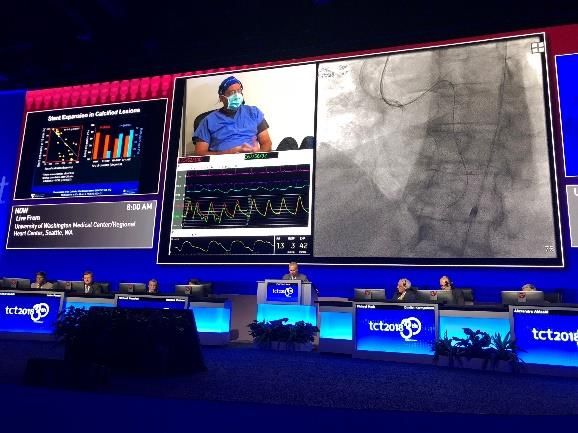
Corindus: An Overview
      A Global Leader in Robotic-assisted Vascular Interventions

                                                                                 Commercialization of CorPath GRX in 2017 was a Key Inflection Point,
                                                                                                  Accelerating Physician Adoption

                                                                                                                                                                            PMDA Approval in Japan
                                                                                                                                            FDA Clears 1st Automated            commercializing with
                                                                                                                                                 Robotic Move (RoR)                distributor (JMC)
                                                                                                                             FDA Clears           first step towards full
                                                                                              Mayo Telestenting           CorPath GRX           procedural automation
                                                                         Record Robots               Partnership           for use in PVI
                                                     FDA Clears           Placed in 2017    established to explore                                                                   2018
                                                   CorPath GRX      28 systems placed in        remote treatment
                                                   2nd generation       first year of GRX                                                                  2018
                                               technology for use
                                                           in PCI
                                                                       commercialization                                        2018
                       Company Goes Public
                          trading on NYSE as                                                         2018
                                       CVRS                                                                                                                 Total Physicians Trained w/
FDA Clears CorPath 200                                 Q4                    2017                                                                            Second Generation GRX
          for use in PCI
                                                      2016                                                                                               150
                                2014                                                                                    Room to Grow:
         2012                                                                                                                                            100
                                                                                                                     YTD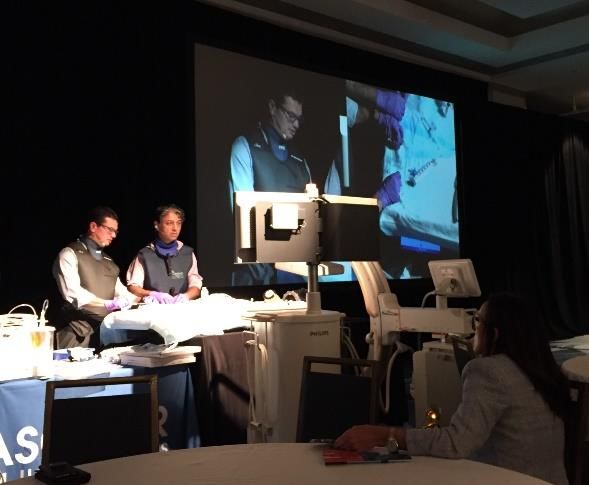
Corindus’ Robotic Technology
      Potential to be First Disruptive Treatment Option in Vascular Medicine in 40+
      years

                                                            PCI           PERIPHERAL                                  NEURO1
                                     • CorPath GRX cleared in late 2016   • CorPath GRX cleared in 2018
                                     • Launched in 2017

                                     • ~2,000 robotic CorPath GRX
                                       cassettes sold globally

                                                                                                              • Ongoing clinical trials
                                                                                                              • Steering committee established
                                                                                                                in 2018
                                                                                                              • Potential disruptor to stroke
                                                                                                                therapy

                                                                            Evolution of Robot Capabilities

                                    Corindus’ Goal is to be the First Robotics System for All Major Vascular Markets

1 CorPath Systems are not indicated for use in neuro interventions.                                                                              4
Adding Value in PCI & Peripheral Across Key Stakeholders
         Paradigm Shift in Place Will Drive Adoption                                                                                                                                          Hospital
                                                                                                                                                                      •      Grow Patient Volume – 1/mo.
                                                                                                                                                                      •      Safe Work Environment
                                                                                                                                                                      •      Patient Satisfaction
                                                                                                                                                                      •      Telerobotics Expansion

                                        Patient
       • Less Radiation Exposure1
       • More Precise Treatment2
       • Faster & More Comfortable
         Recovery                                                                                                                                                                                   Physician
       • Treated Locally
                                                                                                                                                                                        •   Reduces Burnout
                                                                                                                                                                                        •   Extends Career
                                                                                                                                                                                        •   Attracts Physician Talent
                                                                                                                                                                                        •   Extends Physician Reach

1 Smilowitz N, et al. Robotic-Enhanced PCI Compared to the Traditional Manual Approach. J Invasive Cardiol, 2014;26(7):318-321.
2 Campbell PT, et al. The Impact of Precise Robotic Lesion Length Measurement on Stent Length Selection: Ramification for stent savings. Cardiovasc Revasc Med. 2015;piii:S1553-8389.                                   5
Substantial Market Opportunity
Targeting Subsets Where Technology Platform Adds Value
                                 PCI                                                       PERIPHERAL                        NEURO
          3+ M Procedures WW1                                                          Over 2+ M Procedures WW1   ~900K Stroke Incidence US3
            (~900K US / ~2.2M OUS)                                                       (~875K US / ~1.3M OUS)
                                                                                                                                  Increase Treated
                                                                                                                                      Patients
                                                                                                    11%            Treated
                                                                                                                                                 Increase
                                                                                                      11%
                                                                                                      CLI
                                                                                                    (BTK)2
                                                                                                                             4% ~33%            Salvageable
                                          US                                                           CLI
                                                                                                      (BTK)
                                                                                                                                                 Patients
                                         ~900K

                                          India
                                         ~600K
                            Japan
                            ~260K

          Target Market:                                                                     Target Market:                Target Market:
US (Complex) / OUS (Simple / Complex)                                                          CLI (BTK)            Expand TAM with remote access

1 Millennium Research Group. Reduced OUS market size to reflect target markets only.
2 Decision Resources Group                                                                                                                           6
3 Company estimates based on third party report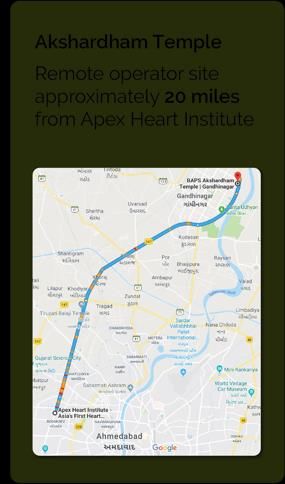
Growing Interest Among Clinicians
    Major activity in all vascular markets

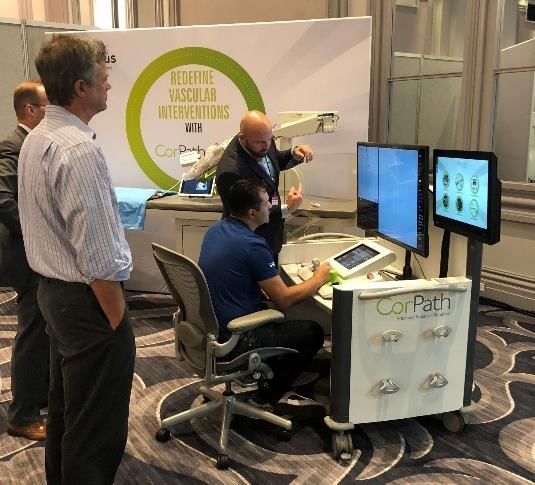
•    Largest ever presence of robotics at   •   Executive and R&D attendance         •   Launch event for robotic CLI
     TCT                                    •   Engaged with large number of neuro   •   Premier suite with 2 simulators and
•    Strong positive response to multiple       physicians generating tremendous         R&D tech showcase
     live cases marked shift in sentiment       excitement for remote stroke         •   Taped case presentation by course
•    Performed the first live remote PCI        application                              director Dr. Jihad Mustapha
     “telestenting” procedure at a
     conference in a porcine model

                                                                                                                          7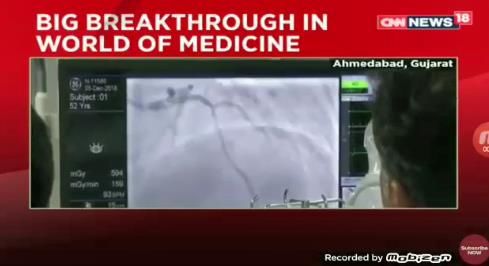
Robotics Integrates Into High Tech Care Models
Allow Procedures to be Performed

 Devices       Artificial Intelligence

               Imaging                   Navigation   Robotics

               Remote

                                                                 8
Procedural Automation

                                                            Problem                                                                                                                                              Strategy
                                    •      High percentage of procedure                                                                                                            •      Create algorithms based on
                                           time is dedicated to wire                                                                                                                      techniques of highly skilled operators
                                           manipulation                                                                                                                            •      Reduced procedure time may
                                    •      Varying skill levels among                                                                                                                     positively impact patient outcomes
                                           operators

                                                                                                                                                                                                  Continued development of
                                                                                                                                                                                                      technIQ™ Series

                                                                                                                                                                                                           New automated
                                                                                                                                                                                                         movements aimed at
                                                                                                                                                                                                      reducing navigation time,
                                                                                                                                                                                                        increasing success of
                                                                                                                                                                                                            lesion crossing

Madder, R. et al. Impact of a Novel Advanced Robotic Wiring Algorithm on Time to Wire a Coronary Artery Bifurcation in a Porcine Model. Journal of the American College of Cardiology Oct 2017, 70 (18 Supplement) B223; DOI: 10.1016/j.jacc.2017.09.712   9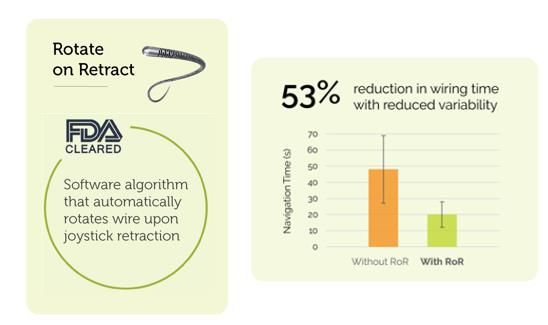
Addressing Unmet Needs with Telerobotics

The Problem                                      Our Strategy

                                                        Reduce time to treatment for emergent
   !   Emergent procedures: Time to treatment
       is critical                                      procedures such as STEMI and stroke

       Access to expertise & treatment is               Increase access to care globally
       geographically limited

                                                        Expand intervention- &
       Shortage of skilled specialists
                                                        thrombectomy-capable facilities

       Incidence of STEMI & stroke on the rise          Enable tele-proctoring & scale tele-
       due to aging patient population                  diagnostic capabilities to tele-treatment

                                                                                                10
Remote Technology Development
Achievements & Milestones
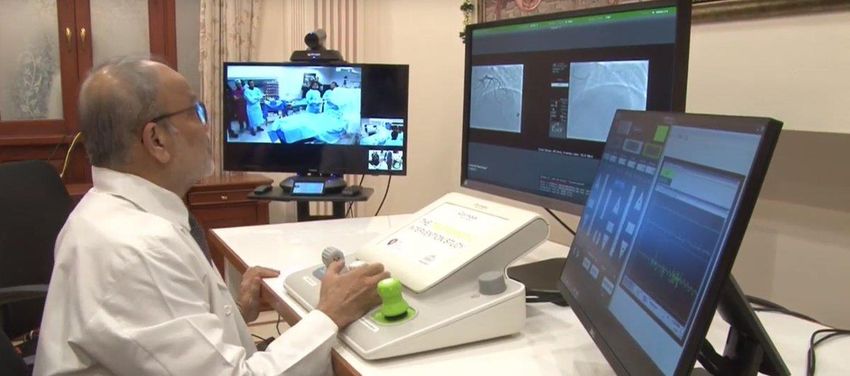
11The Telerobotic Intervention Study
First-in-human remote coronary intervention
December 4th and 5th, 2018
5 patients received successful PCI procedures
with remote operator, Dr. Tejas Patel, at a
distance of ~20 mi (32km) away
12Neurovascular Steering Committee / Milestones
Product Optimization for Remote Stroke Underway
Steering Committee
CMO, Neuro
Ricardo A. Hanel, M.D. PhD Tudor G. Jovin, M.D. J. Mocco, M.D. Raul G. Nogueria, M.D.
Baptist Health System University of Pittsburgh Mt. Sinai Hospital Grady Memorial Hospital
Medical Center
Aquilla S. Turk, D.O.
Greenville Health System
Vitor Mendes Pereria, M.D. Adnan Siddiqui, M.D. Satoshi Tateshima, M.D. Raymond D. Turner, M.D.
Toronto Western Hospital Toshiba Stroke & Vascular Ronald Reagan UCLA Greenville Health System
Research Center Medical Center
2018 2019
Steering Multiple
KOL Neuro Neuro CorPath GRX Neuro Neuro Remote
Committee
Summit Animal Lab GRX FDA Product Robotic
Formed Launch1
Studies Submission1 Development1
1 Expected timing 13Stroke: Time to Treatment is Key
~2 million
1 minute =
lost neurons
7+ million stroke survivors1
5th Leading cause of death in the US (1 in 19 deaths)1
2/3 With a moderate-to-severe disability1
1 second Ages a patient by 9 hours1
1 American Heart Association. Heart Disease and Stroke Statistics 2012 Update At-a-Glance
14Remote Access Capabilities May Significantly Increase TAM
• Treatment within 24 hours is critical U.S. Stroke
~900K Incidence1
• Yet only a fraction of patients (~35K) are treated due to:
– Lack of proximity to facilities Ischemic
~775K Strokes
– Limited number of specialists
• Rapidly expanding market expected to grow from $1B today to Large
$2.6B by 20262
~335K Vessel
Occlusion
• Remote Access Capabilities: Multiple Growth Opportunities
Salvageable
~160K Tissue
Increase patients treated with remote access
Expand market further with next generation robot
Patients
~35K Treated
Potential to Significantly Expand Treatable Patients: More Procedures in a Growing Market
1 Company estimates based on third party report
2 Millennium Research Group
15Financials Snapshot
Revenue GRX Installed Base Cassette Sales
4.5 50 600
$4.2M 45 524
4 45
41 500
40 455
3.5 37
$3.0M 35 33 390
3 400 370
353
30
2.5 $2.3M $2.4M 284
303
25 23 300
2 $1.7M
$1.5M 20
16
1.5 200
15
1 $0.8M 9
10
100
0.5 5
0 0 0
Q1 Q2 Q3 Q4 Q1 Q2 Q3 Q1 Q2 Q3 Q4 Q1 Q2 Q3 Q1 Q2 Q3 Q4 Q1 Q2 Q3
2017 2017 2017 2017 2018 2018 2018 2017 2017 2017 2017 2018 2018 2018 2017 2017 2017 2017 2018 2018 2018
~Cash balance of $29.6M, Debt of $11.7M, 191.2M
Sites that upgraded from a CorPath 200 to a CorPath GRX have, on average, nearly doubled the
shares outstanding and 1M preferred (convertible to
percentage of PCI procedures performed robotically
20.8M common shares) as of September 30, 2018
16Clinical Catalysts: Next 12-24 Months
Key Expected Milestones for Clinical Development
Remote
✓ Completed live remote PCI at TCT in Q3 2018
✓ First-in-human completed in December 2018 in India
• First U.S. in-human remote case in 2019
• Approval of the next series of automated movements in the technIQ Series
Neuro
• FDA submission for neuro indication by early 2019
• Proof of principle for a remote stroke robotic system in 2019
• Partnership for commercialization and co-development
• FDA clearance and launch of CorPath GRX for neuro in 2019
17Corindus Summary / Key Investment Thesis
• Significant progress in technology development and clinical expansion is creating a burning
platform for hospitals to build a robotic program
• AI / automation and remote access have the potential to add significant value to hospitals,
patients, and doctors in the interventionalist market
• Remote capabilities have the ability to increase TAM of the stroke market with opportunity to
further expand the addressable market post launch of the next generation robot
• Strong intellectual property portfolio / first mover advantage
Corindus is a Leading Vascular Robotics Company with Opportunities in
Coronary, Peripheral, and Neurovascular Markets
18Precision Vascular Robotics Corindus Vascular Robotics (CVRS) January 2019
You can also read


