Public Art Strategy Animating WOLLONGONG - guidelines 2016 2021 - Our Wollongong
←
→
Page content transcription
If your browser does not render page correctly, please read the page content below
Animating WOLLONGONG

   Public Art
    Strategy
   & guidelines 2016 - 2021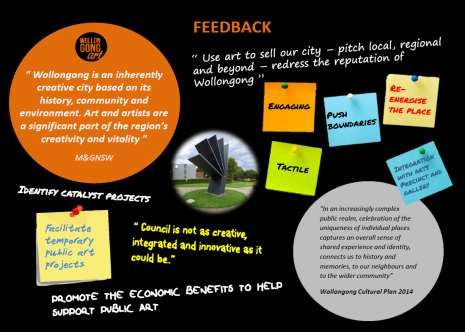
Credits

                                                                                                Animating
                                                                                               WOLLONGONG
                                                                                                   Public Art
                                                                                                    Strategy
                                                                                              & guidelines               2016-2021

                                                                                                                 Wollongong City Council would
                                                                                                                 like to show their respect and
                                                                                                                 acknowledge the Traditional
                                                                                                                 Owners of the Land, Elders past
                                                                                                                 and present, and extend that
                                                                                                                 respect to other Aboriginal and
                                                                                                                 Torres Strait Islander people.

 JANUARY 2016 ©
 Phone: (02) 4227 7111
 Fax: (02) 4227 7277
 Email: council@wollongong.nsw.gov.au
 Mail: Wollongong City Council. Locked Bag 8821, Wollongong DC NSW 2500

               Developed with the assistance of Overton Creative Consulting - www.overtoncreative.com

The contents of this strategy are subject to STCA (Subject to Council Approval). While reasonable efforts have been made in good faith to ensure the
contents of this strategy are factually correct, Overton Creative Consulting Pty Ltd and Wollongong City Council does not guarantee and accepts no
responsibility or legal liability whatsoever arising from or connected to the accuracy, reliability, currency or completeness of any information provided.

Please note: Images have been largely taken from Wollongong’s Public Art Collection library, however some images used in this document are found from
different sources all over the Internet, and are assumed to be in creative commons/and or public domain and are displayed for illustrative example purposes
only under the fair use principle. Nevertheless, information on the image's source artist/author is listed whenever possible in the reference section,

         ‘ANIMATING WOLLONGONG’ Draft Wollongong Public Art Strategy & Guidelines 2016-2021                                                   Page 2 of 92
Table of
 Contents

                  ‘ANIMATING WOLLONGONG’ PUBLIC ART STRATEGY 2016 – 2021

PART ONE                                                                                   Page/s
Strategic Context                                                                                    4
Introduction                                                                                         5
Executive Summary                                                                                    6-8
Background                                                                                           9-10
Strategic Intent                                                                                     11
Strategic Scope                                                                                      12
Strategic Setting                                                                                    13-14
Relationship to Key Planning Documents                                                               15-21
Aims & Objectives                                                                                    22
Existing and Future Directions                                                                       24
Guiding Vision                                                                                       25
Measuring Value and Success                                                                          26-31
PART TWO
Defining Public Art                                                                                  33
Key Principles                                                                                       34-47
New Directions                                                                                       48
Change:          Subject to Change                                                                   51-54
                Embracing Flux                                                                       55-57
                Reframing the Everyday                                                               58-60

Cultivate:      Harnessing New Energy                                                                61-64
                Respecting Essence                                                                   65-67
                An Enduring Ecology                                                                  68-70

Reclaim:        Redefining Centre                                                                    71-77
                Restoring Sight                                                                      78-80
                Reusing Sites                                                                        81-83
PART THREE
Funding Opportunities                                                                                85
Summary of Guidelines & Process                                                                      88
Roles & Responsibilities                                                                             89
Selected Definitions                                                                                 90
Selected References                                                                                  91

PART FOUR
Appendix 4a - Developer Guidelines & Process - Introduction
Appendix 4b - Developer Guidelines & Process - Implementation
Appendix 4c - Council Guidelines & Process

      ‘ANIMATING WOLLONGONG’ Draft Wollongong Public Art Strategy & Guidelines 2016-2021            Page 3 of 92
“In an increasingly complex
        public realm, celebration of the
        uniqueness of individual places
        captures an overall sense of
        shared experience and identity,
        connects us to history and
        memories, to our neighbours and
        to the wider community”

        Wollongong Cultural Plan 2014

                                                             Part
                                                             One
                                                          Strategic context

                                                                1
‘ANIMATING WOLLONGONG’ Draft Wollongong Public Art Strategy & Guidelines 2016-2021   Page 4 of 92
Intro INTRODUCTION
‘ANIMATING WOLLONGONG’: PUBLIC ART STRATEGY 2016 - 2021
A clear vision and a well thought out public art strategy is one way to ensure public art projects are
delivered in a strategic manner which will provide maximum community benefit.
The need to prepare a new Public Art Strategy has been identified as a key action within the Council’s
Cultural Plan 2014 “to facilitate a regular program of temporary and permanent public art for the City
which is integrated with the area’s rich urban and rural character and cultural heritage”.
The aim has been to bring clarity and cohesion. This Public Art Strategy has been prepared to provide a
framework for the Council’s planning and decision making in relation to the commissioning and acquisition
of public art, as well as its ongoing care and maintenance. Public Art Strategy works in conjunction with a
suite of strategic and operational documents that guide both the direction and the implementation of
public art within the city.
The Public Art Strategy reflects key themes, which are central to the future direction for not only arts but
social, economic and environmental development across Wollongong and the Illawarra.
Guiding principles along with new themes/narratives underpin the core principles and benefits of this
Strategy in the context of Wollongong’s community vision by:
Cultivating, embracing and showcasing Wollongong and region’s unique strengths and characteristics.
Promoting a diverse, dynamic, creative culture across the LGA
Strengthening partnerships and collaboration with key stakeholders and funding bodies
Embedding integration:
Adopting more robust public art controls in the Wollongong DCP and other strategic plans
Redefining the role and approach to the delivery of public art as an integral part of Council’s
annual capital works program
The preferred approach to public art commissioning is to include artists in project development
teams at the outset of planning and delivery. Artists working in this context can create meaningful
work that has a direct relationship to the local environment and project objectives.
Developing a stronger commitment to greater flexibility and better quality control in the
commissioning of public art. An emphasis on user-friendly processes will ensure that commissioning
decisions are transparent will provide greater flexibility in how, when and where public art is included
into projects.
Adding public art to the cultural animation and cultural programming, including festivals and public
events.
‘ANIMATING WOLLONGONG’ Draft Wollongong Public Art Strategy & Guidelines 2016-2021 Page 5 of 92
Summary        EXECUTIVE SUMMARY

‘ANIMATING WOLLONGONG’: PUBLIC ART STRATEGY 2016 - 2021

The role of public art is to establish a dialogue, mediated by an artist, between a community and its
environment. As the most visible and accessible art form, public art plays a role of unprecedented importance
in contributing to the poetic dimension of the city. Thriving art and culture are the great indicators of a city’s
pulse and should have a palpable presence throughout the city.

For well over 35 years public art has enriched the public domain of Wollongong and artists have contributed
strongly to the shaping and transforming of the urban realm in ways which reflect, accentuate and give
meaning to Wollongong’s unique environment, history and community. Importantly, Wollongong City Council
recognises the social, cultural, economic and environmental benefits that flow from integrating public art into
the urban fabric - benefits not just for new developments, but for the whole city. The public environment
comprises land, buildings, institutions and open spaces that are effectively in collective ownership. The
centres of large cities and villages offer a broad range of experiences and opportunities; intensity and variety
contribute greatly to the texture of city life. It has the ability to effectively sustain business and commercial
functions as well as underpinning the social and cultural life of the city.

Public art has the intrinsic ability to embrace both these physical and the social/cultural dimensions by
encouraging people to engage in these spaces and extend their knowledge and familiarity with their locality.
It is about making the connections between people and places, between public and private space, between
the natural and built environment, between pedestrian movement and urban form, and between the social
and economic purposes for which urban space is used.

The need to prepare a new Public Art Strategy was identified as a key action within the Council’s Cultural Plan
2014 “to facilitate a regular program of temporary and permanent public art for the City which is integrated
with the area’s rich urban and rural character and cultural heritage”. As with all other plans, strategies and
policies developed by Council , this Strategy and Guidelines have been informed by best practice research and
sets a framework for collaboration across Council – in this case on directions concerning the design and
management of public/private space, quality and sustainable building design and processes, and engagement
in the cultural life of the city.

The Strategy and Guidelines do not therefore aim to duplicate information contained within these other
policy frameworks, but rather offers a complementary set of objectives, directions and opportunities for
communities, artists, designers; developers, their design teams, to work in the city.

This strategy has been developed to clearly articulate why and how the council is involved in public art, what
the council seeks to achieve from supporting and investing in public art, the principles that guide the council’s
actions, the various roles the council plays and the context within which decision-making for public art takes
place, and importantly lays down a strategic and curatorial framework for the future.

Clearly, future strategic drivers such as continued population growth, an altering of the demographic profile,
changes in economics and investment in the city, changed patterns of climate and other shifting
environmental factors, along with proposed council boundary changes and amalgamations will all present
both opportunities and challenges for the City.

      ‘ANIMATING WOLLONGONG’ Draft Wollongong Public Art Strategy & Guidelines 2016-2021           Page 6 of 92
Summary       EXECUTIVE SUMMARY

Wollongong, being the third largest city in New South Wales continues to grow with a population now over
206,000 people. This has come from a marked increase of the past 5 years of the number and value of
residential and non-residential building approvals across the City. This new development has bought altered
patterns access and activity that often blur the boundaries between public and private ownership.

Within the CBD, the facades of private buildings that frame public space, and associated landscape and
design treatments, also private places that are physically inaccessible yet remain visibly accessible bring a
heightened level of not only interest and but also ambiguity to the urban environment.

Furthermore, Council has also in place a long term strategy that integrates new urban development and the
timely implementation of infrastructure that aims to deliver sustainable and new high quality suburbs.
‘Green field’ residential development in areas such as West Dapto has altered the landscape noticeably,
however their remains a strong desire to reflect elements, with links to the past through pastoralism and
mining, and to the history of Aboriginal presence in the coastal hinterland.

A key feature of this strategy has been to recognise and capitalise on these growth opportunities by
providing a robust framework which further defines and encourages collaboration between artists and
architects to produce the effective delivery of public art outcomes in new development across the City. The
aim is to promote a range and scope of opportunities and projects to promote the role of artists as ‘visual
engineers’ and conceptual thinkers, not simply makers of objects.

Exploring the fluidity of change of Wollongong, has also bought about another distinctive feature of this
new Strategy; that is to embrace the changing parameters of ‘public art’. Contemporary public art practice
has evolved from not only marking significant sites and concepts through permanent artworks, but to
further experiment with new artforms or redefine other more participative approaches to art in public
places that gives form to the complete variety of ideas and perceptions about a connection to place
whether past or future.

This also includes a stronger association to urban design principles and “good city making” outcomes and
concepts like “tactical urbanism”; of which is also explored in Council’s recent City for People Strategy 2016
that highlights the value of creativity and spontaneity in building dynamic places. Public Art is now being
deployed as an innovative and creative means of helping to solve particular urban design challenges and
problems and its ability to contribute to transforming the appearance and experience of places making
them more attractive and vibrant.

Wollongong is currently on the edge of this transformation, both physically through renewal and
transformation, but also whereby recent public art activity has been defined by its ability to be more
temporary, flexible, participative and enquiring.

Effectively it has helped to create a distinctive place in creating forms that people recognise as their own
and which reflect strongly back to them their character, stories, sense of place and culture. Such regular
programs and events as ‘Wonderwalls’ enable the Wollongong communities to imagine, grow, succeed,
understand and empathise through creativity.

    ‘ANIMATING WOLLONGONG’ Draft Wollongong Public Art Strategy & Guidelines 2016-2021           Page 7 of 92
Summary EXECUTIVE SUMMARY
Council’s definition of public art is now broad and inclusive; and addresses the ever-evolving nature of public
art from three key perspectives:
The creative processes and art forms that comprise public art;
The characteristics of permanent public art;
The characteristics of temporary public art.
These perspectives effectively promote the collaboration of arts practitioners with communities to achieve
artistic and social outcomes in the public realm, the processes and the results of participation by artists on
design teams that develop public places, as well as the practices of the creation of temporary public art
activities, including, but not restricted to performance, ephemeral and time-based sculptural installations etc.
The Strategy’s framework is also a mechanism to create, discover, interact and participate in new and
creative experiences throughout the City and to increasingly use public art is as a vehicle for revitalising urban
spaces and engaging with communities.
As well as broadening Council’s outlook on contemporary approaches to public art practice, this new strategy
has also set out to deliver best practice in all areas of public art activity, from the selection of opportunities
and the conception of projects through to the delivery, care and maintenance of Wollongong’s public art
within a setting of continuous improvement. Integration is vital to the success of the Public Art Strategy, in
delivering demonstrable community benefit across the entire City.
Developing a contemporary interpretation of the contribution of public art to the urban spaces and landscape
of a city requires careful consideration of the specific context, the studying of a range of appropriate artistic
options, teamwork among contributing professionals, and carefully planned strategies and staging. The
Council’s aspiration is for the best artistic results across all art genres and types.
This importantly will ensure effective leadership and collaboration across Council in place-making through
public art by fostering and supporting the enthusiasm, ideas, talents and resources of organisations and
individuals to help plan and deliver public art activity including seeking to influence the character and high
quality of public art developed by others across the City.
A further guiding principle in the development of this Strategy has been the importance of acknowledging
and capturing the values and expectations of the full range of stakeholders that public art projects engage
with. Evaluation is not simply a process to determine numeric ‘value’. There will always be economic
circumstances and conditions that a public art project will need to take account of, but it is often the intrinsic
artistic experience and social and environmental impacts that are more important to the artists, and the
community.
This Strategy and associated guidelines encourage a more holistic return and measure to value. Some of the
goals highlight instances of not only a commitment to further developing and exploring the margins of public
art practice, but also to rebuilding local cultural and social capacity; and contributing to economic and
environmental outcomes.
‘ANIMATING WOLLONGONG’ Draft Wollongong Public Art Strategy & Guidelines 2016-2021 Page 8 of 92
“Ultimately, public art embraces its
                             environment, and helps create places that
                             inspire investigation and interaction, and
                             are enjoyable and meaningful in their own
                             right. Public art can provide enduring
                             strength and pride for communities, and
                             also challenge our assumptions in forms
                             limited only by our imagination”

                             Art + Place, QLD Public Art Program 2012

‘ANIMATING WOLLONGONG’ Draft Wollongong Public Art Strategy & Guidelines 2016-2021   Page 9 of 92
Part        STRATEGIC CONTEXT
  One

BACKGROUND

Cities across the world have long embraced the values art in the public domain for its capacity to create a
unique sense of culture, place and identity. The underlying objectives recognise that artworks experienced
in public space are visible and accessible to all, and serve as important markers reflective of a city’s cultural
identity.

These objectives are reinforced by recent cultural policy research undertaken throughout large cities in the
United States, UK, Europe and other countries. It demonstrates the greatest level of economic activity,
growth and development occurs in places that are tolerant, diverse and open to creativity.

These ‘creative centres’ are succeeding largely because creative people want to live there, and therefore
they yield tangible creative economic dividends. Their diversity allows them to sustain a great variety of art
forms, while their dynamism – their constantly changing populations and their international connections –
make these cities hubs of new cultural ideas and knowledge.

There is a depth of comprehensive public art policies and strategies developed by cities across the globe. All
have common aspirations to bring a meaningful cultural dimension to their fabric and how people
experience their city, to valuing the role of artists in their communities.

Increasingly policies now include strategies to assist architects, curators and artists to understand the
environment in which they are working and to understand both the physical requirements and cultural
dimensions of public art.

Wollongong is an inherently creative city based on its history, community and environment. Art and
artists are a significant part of the region’s creativity and vitality. This strategy and guidelines acknowledge
Wollongong’s unique heritage in this respect and also provide a new and robust rationale for the private
sector to contribute to this valuable arts and cultural legacy.

This strategy also reflects the council’s long-term commitment to developing and supporting public art
activities, and caring for the city’s collection of public art assets. Wollongong’s Public Art Collection provides
an insight into the city’s vibrant social life, history, and environments. The collection showcases exciting and
innovative artworks created by contemporary local and national artists, and offers an exciting way to
discover the Illawarra.

The history of public art in the City predominantly stems from work undertaken by Council’s Community &
Cultural Services Unit. It has nurtured the local arts and cultural sector through their commitment to various
cultural programs, projects and events over many years. This work has encouraged broad participation and
increased access to local arts and culture.

This has provided a very strong foundation for the actions outlined in this new Strategy. The Public Art
Strategy builds on the legacy of the past, while responding to new ideas about contemporary art,
storytelling, interpretation and cultural expression.

    ‘ANIMATING WOLLONGONG’ Draft Wollongong Public Art Strategy & Guidelines 2016-2021            Page 10 of 92
Part
STRATEGIC INTENT
One
PRINCPLES AND APPROACHES
The Strategy outlines planning and delivery an ongoing portfolio of public art activities, both temporary
and permanent, in support of Wollongong 2022 Community Strategic Plan and other key plans and
development priorities of City of Wollongong.
The Strategy aims to further accentuate Wollongong’s unique and distinctive context via the following
guiding principles and approaches:
INTEGRATE AND FOSTER: Be a Leader, Resource and Collaborator for Public Art
Council will be an effective leader in place-making through public art. Fostering and supporting the
enthusiasm, ideas, talents and resources of organisations and individuals to help plan and deliver
public art activity including seeking to influence the character and high quality of public art developed
by others; this includes working collaboratively across Council.
EXPLORE AND REFLECT: Wollongong’s distinctive natural and built environments
Public art activity will respond to the uniqueness of Wollongong’s distinctive natural environment and
built character. Wollongong has a natural environment that few other cities can match: beaches,
harbours, escarpment, rainforests all provide for an outstanding location of natural diversity.
Additionally, Wollongong’s changing built environment, the redefining of the Wollongong CBD, to
other areas that retains the feel of a collection of villages and town centres each with its own
distinctive characteristics, tells of the city’s unique heritage and neighbourhood identities.
CAPTURE AND RESPECT: The diversity, history and character of Wollongong’s population
Cultural, ethnic, and indigenous along with demographic diversity help define Wollongong today.
Public art activities will give expression to, make visible and meet the place-making aspirations of the
City’s diverse ethnic communities, rich history of indigenous peoples, and strong youth culture. There
is a strong connection between the work of art and its site, neighbourhood and its community or
context. Give visibility to, and celebrating, Wollongong’s distinctive Aboriginal identity and culture
ENGAGE AND CHALLENGE: The people of Wollongong into creative dialogue
Play a role in challenging people’s ideas, feelings and values. Public art may confront what we know,
think and feel; it may create mystery or intrigue; it may engage and provoke thought and inspire
debate. It is memorable for its impact as a talking point and its power to stimulate the imagination.
INVEST AND SUSTAIN: In cultural/entrepreneurial capacity, ideas and innovation
Council will invest in the right capability and expertise: public art curation, management, planning,
delivery, care etc. Engage independent expert advice in the form of an advisory panel. Investing in
local and regional artists, cultural workers and creative entrepreneurs; sustaining a local cultural
ecosystem.
‘ANIMATING WOLLONGONG’ Draft Wollongong Public Art Strategy & Guidelines 2016-2021 Page 11 of 92Strategic
Planning STRATEGIC SCOPE
The Public Art Strategy covers the following scope of activity:
PUBLIC ART IN CAPITAL WORKS
Council’s Capital works, but not limited to such projects as:
Capital works place-making projects such as village and town centre masterplans, major waterfront
and regional infrastructure precinct developments, City Centre Masterplan and open space
developments
New local, regional and national facility projects (including, but not limited to, community centres,
libraries, recreational facilities, swimming pools, service centres, art centres, art galleries, theatres
and stadiums)
Neighbourhood and village centres and major street upgrade and development projects
Infrastructure projects funded by partly/jointly Council (including, but not limited to, pedestrian
and transport bridges, train stations, transport hubs, wharfs and coastal walkways)
Architectural projects where public space objectives and public art outcomes can be achieved
through collaborations between artists and architects
Park and landscaping developments where public space objectives and public art outcomes can be
achieved through collaborations between artists and landscape architects
Greenfield and brownfield precinct developments under the control of Council or where Council is
a development partner, including suburban and rural locations.
TEMPORARY PUBLIC ART PROJECTS
Council will also continue to develop and deliver its own temporary public art program and will seek to
encourage third parties who wish to devise and present temporary public art as well.
PUBLIC ART IN DEVELOPMENT
The strategic intent and methods of project delivery outlined in this Strategy and guidelines are the
processes of Wollongong Council and are also recommended for developers. Guidelines for Public Art in
Development are provided separately to developers.
PARTNERSHIPS
The Public Art Strategy and Guidelines provide a clear framework for Council to enter partnerships to
deliver public art in the City.
‘ANIMATING WOLLONGONG’ Draft Wollongong Public Art Strategy & Guidelines 2016-2021 Page 12 of 92Strategic
WHY DO WE NEED A STRATEGY?
Planning
A clear vision and a well thought out public art strategy is one way to ensure public art projects are
delivered in a strategic manner which will provide maximum community benefit.
The need to prepare a new Public Art Strategy has been identified as a key action within the Council’s
Cultural Plan 2014 “to facilitate a regular program of temporary and permanent public art for the City
which is integrated with the area’s rich urban and rural character and cultural heritage”.
The aim has been to bring clarity and cohesion. This Public Art Strategy has been prepared to provide a
framework for the Council’s planning and decision making in relation to the commissioning and acquisition
of public art, as well as its ongoing care and maintenance. Public Art Strategy works in conjunction with a
suite of strategic and operational documents that guide both the direction and the implementation of
public art within the city.
The Strategy and Guidelines aim is to deliver best practice in all areas of public art activity, from the
selection of opportunities and the conception of projects through to the delivery, care and maintenance
of Wollongong’s public art within a setting of continuous improvement. The Council’s aspiration is for
the best artistic results across all art genres and types.
Public art is an integral part within any flourishing and liveable city to boost and support culture and
artistic endeavour. Council's new Public Art Strategy is aimed at:
Respecting and enhancing the cultural heritage of the City of Wollongong
Setting directions which encourages the integration of art(s) at all levels of Council
Developing a set guiding principles for the future of public art in the City of Wollongong
Providing opportunities for artists in creative place activation projects using ephemeral, temporary
and permanent public art
Encouraging activation of artistic, creative and innovative endeavours throughout the City
Increasing awareness among key stakeholders of the value and role of public art - Creates an art(s)
culture which welcomes critical and stimulating thinking, new ideas, challenging concepts and
development
Celebrating the diverse cultural history and strong community identity of the City of Wollongong
Creating a process for educating, promoting, evaluating Public Art Policy, Strategy and Action Plan
Defining key terms relating to public art and art in public space, and the scope of the Council’s
work in public art.
Providing a framework for evaluating the success of the Strategy using measures.
‘ANIMATING WOLLONGONG’ Draft Wollongong Public Art Strategy & Guidelines 2016-2021 Page 13 of 92Strategic
STRATEGIC SETTING
Planning
HOW WE’VE DEVELOPED THIS STRATEGY
In preparing this document, Council has referred to a number of relevant policies and guidelines for the
commissioning of public art at a regional, state, national and international level.
The development of the Strategy also included a review of key strategic planning documents, strategies and
reports relating to Wollongong and the Illawarra region.
A broad consultation process was also undertaken to inform and consult participants and selected
organisations relevant to the development of the Public Art Strategy. The views, issues and interests of all of
the participants have contributed to this Strategy. A brief synopsis of the methodology includes;
Briefing meetings with relevant Wollongong City Council staff and Councillors
Articles posted and published online: www.illawarramercury.com.au/story/3317524/have-your-say-on-
public-art/, www.youtube.com/watch?v=gXlxwn0Pw0I
Online Community Survey at http://haveyoursaywollongong.com.au/public-art-strategy
Site visits across the Wollongong LGA
1:1 interviews with key stakeholders from Council, the arts and cultural sectors including, Wollongong
Art Gallery and M&GNSW etc.
Regular engagement with Council’s Community and Cultural Services Unit
A sample of scheduled consultation sessions have included:
10 June 2015 1pm: Cross-sectional/departmental workshop with Council staff
24 June 2015 6pm: Wollongong City Council’s Cultural Reference Group Meeting
1-30 September 2015: Community Survey
1 September 2015 11:00am & 5:30pm: General Community Information Session
9 September 2015 11:00am & 5:30pm: Artist/Creative Community Information Session
10 September 2015 11:00am: Business Sector Information Session
14 October 2015 7pm: Dapto Neighbourhood Forum
6 November 2015 11:00am: Council staff workshop on guidelines & implementation
15 February 2016 5pm: Councillor Briefing
‘ANIMATING WOLLONGONG’ Draft Wollongong Public Art Strategy & Guidelines 2016-2021 Page 14 of 92Strategic
RELATIONSHIP TO NATIONAL STRATEGIC PLANNING POLICY & DOCUMENTS
Planning
Recent policy directions by the Australian Government and other peak design professional
associations has set down a framework of documents that advocates for good place-making and
recognises the wider value of arts and creativity that benefits our society and the economy:
A CULTURALLY AMBITIOUS NATION – THE AUSTRALIA COUNCIL’S STRATEGIC PLAN 2014 -2019
This document sets out a vision for the arts in Australia. It also
defines the goals and strategies that will guide the Council’s work
over the next five years. It responds to new legislation and is
informed by sector and nationwide consultation.
The Strategic Plan articulates The Australia Council’s leadership role in
building vibrant arts ecology by fostering excellence and increasing
national and international engagement with Australian art and
artists.
AMBITION ENGAGEMENT PROTOCOLS CONTRIBUTION
CREATING PLACES FOR PEOPLE - AUSTRALIAN INSTITUTE AUSTRALIAN INSTITUTE OF
AN URBAN DESIGN PROTOCOL OF ARCHITECTS PUBLIC LANDSCAPE ARCHITECTS PUBLIC
FOR AUSTRALIAN CITIES (2011) ART POLICY (2009) ART & LANDSCAPE POLICY (2010)
The Australian Government’s Encourages the inclusion of art The policy recognises the
‘Creating Places for People’ is a to enhance the public dimension valuable contribution that
collective commitment to best of any project by inviting artists artists can make through the
practice urban design in Australia. to take part in the design process integration of art with
as early as possible landscape architectural practice.
‘ANIMATING WOLLONGONG’ Draft Wollongong Public Art Strategy & Guidelines 2016-2021 Page 15 of 92Strategic
RELATIONSHIP TO THE STATE’S STRATEGIC PLANNING POLICY & DOCUMENTS
Planning
The Recent policy directions by the NSW Government have centred on strategic planning in regard to
reinvigorating the state’s cultural policy position and the identification of new major infrastructure:
CREATE IN NSW – NSW ARTS AND CULTURAL POLICY FRAMEWORK 2015
It supports vibrant arts and cultural activity across NSW. Built on
three mutually reinforcing ambitions – excellence, access and
strength – Create in NSW guides future strategy, investment and
partnerships to grow a thriving, globally connected arts and
cultural sector with and for the people of NSW.
Create in NSW sets a vision for a future in which arts and culture are
central to the life of NSW. Arts and culture enable lifelong learning,
bring communities together, support the visitor economy and
activate our civic spaces.
Arts NSW play a strategic leadership role in implementing the policy
framework and ongoing engagement with the sector.
INVEST RENEWAL GROWTH STRATEGIC
ILLAWARRA REGIONAL GROWTH AND INFRASTRUCTURE PLAN (DRAFT) 2014
The draft Illawarra Regional Growth and Infrastructure Plan sets
out the regional planning framework and direction for urban growth
and infrastructure provision within the region.
Considers a urban renewal strategy for the Wollongong Centre to
examine the feasibility of existing development controls, review how
the different precincts of the Centre operate, how these precincts
integrate through public and private transport networks, as well as
identify specific infrastructure and public domain projects that may
be necessary to activate new development in the area
Identifying the potential for new visitor assets or activities for the
tourism industry
Implement neighbourhood planning principles in Local Plans,
Development Control Plans, and other council based mechanisms
‘ANIMATING WOLLONGONG’ Draft Wollongong Public Art Strategy & Guidelines 2016-2021 Page 16 of 92Strategic
RELATIONSHIP TO COUNCIL’S STRATEGIC PLANNING DOCUMENTS
Planning
The Public Art Strategy is strategically linked locally to the following:
WOLLONONG 2022 – COMMUNITY STRATEGIC PLAN
• Strategic Direction - Wollongong is a creative, vibrant city
• To be leaders in building an educated, creative and
connected community
• Area needs a revamp and revitalisation
• Better/upgraded infrastructure
• Community awareness and appreciation of cultural
diversity and heritage is increased.
• The profile of Wollongong as the regional city of the
Illawarra is expanded and improved.
• The sustainability of our urban environment is improved
• Our residents feel an increased sense of community
Creativity Places Identity Vibrant
WOLLONGONG CULTURAL PLAN 2014 - 2018
Recognition of Council’s potential to be a visionary, leader and
a custodian in arts and cultural activity and resources.
Our public places, spaces and natural/outdoor environments
provide a focus for permanent and ephemeral artistic and
cultural expression
Urban design and master planning processes provide
experiential, intuitive, functional places, which nurture a
sense of identity. People-friendly spaces can encourage and
stimulate business activity and improve social capital and
safety
Arts and cultural input are provided in the CBD, villages and
neighbourhoods to enhance and celebrate local cultural
identity, our history and heritage.
‘ANIMATING WOLLONGONG’ Draft Wollongong Public Art Strategy & Guidelines 2016-2021 Page 17 of 92Strategic
RELATIONSHIP TO COUNCIL’S STRATEGIC PLANNING DOCUMENTS
Planning
The Public Art Strategy is strategically linked locally to the following:
WOLLONGONG PUBLIC SPACE, PUBLIC LIFE STUDY (DRAFT) 2015
• PSPL study complements the revitalisation of the city centre
and provides a sound evidence base for decision-making.
• Offers a snapshot of the community’s impression of the city
centre, during the day and at night, and various city attributes
(streets, sense of place, atmosphere, sense of belonging,
business)
• Measures how the city functions from the perspective of the
people who use them
• Interesting themes emerging about Wollongong that artists
and designers can tap into to help improve the legibility and
appearance of the city.
Revitalise Confidence Sustain Belonging
SHAPING WOLLONGONG – PROPERTY COUNCIL OF AUSTRALIA 2013
• The Plan aims to be a catalyst for action, harnessing the
determination of the city, mobilising and galvanising local
entrepreneurship, confidence, community, creativity and
investment in the region
• Findings describe Wollongong a growing up into an urban city
that no longer wants to be defined just by its industrial past or
its relationship to Sydney. A city that is re-telling its story as
one of change, innovation, dynamism, learning and creativity.
• Wollongong is a place with stories to tell. Of migrants forging
a new life, along with tales of inventors, chancers,
collaborators and exuberant experimenters
• Recurring themes; harnessing the power of ideas, technology,
creativity, & embedding innovation in the culture. Nurturing
vitality, authenticity & soulfulness, the roles that food & arts
can play to bring people together and define a new identity
for this city.
‘ANIMATING WOLLONGONG’ Draft Wollongong Public Art Strategy & Guidelines 2016-2021 Page 18 of 92Strategic RELATIONSHIP TO COUNCIL’S STRATEGIC PLANNING DOCUMENTS
Planning
The Public Art Strategy is strategically linked locally to the following:
DESTINATION WOLLONGONG DEVELOPMENT PLAN 2014
Destination Wollongong recognises tourism as a major
economic driver of change within the region
The visitor economy is worth $700 million per annum including
10,000 day visitors per day and 280,000 overnight visitor nights
per month on average.
Wollongong is ideally placed to capture the opportunities
presented by a range of global trends such as cultural and
heritage tourism.
Tourism Research Australia (TRA) considers Australia’s cultural
assets as a major drawcard for international and domestic
visitors. TRA identifies that more than 60% of international
visitors seek out cultural attractions.
The Plan recommends investing in Art, culture and heritage
product development.
INVIGORATE PRODUCT ENERGY EXPERIENCE
WOLLONGONG CREATIVE SPACES STRATEGY 2014
Wollongong Creative Spaces is a strategy to support and increase
Wollongong’s creative and commercial economies and add life
to the city centre through innovation and creativity
The strategy focuses on creating partnerships between property
owners and artists / creative projects for the occupation of vacant
shops for a short period of time in the city centre.
This initiative aims to invigorate and add life to the city, and
foster creative engagement by the use of exciting and evocative
art spaces that embrace the energy of urban life
It also aims is to provide opportunities for emerging and
professional artists to showcase a wide variety of unique,
innovative and creative responses to art in the public domain,
and further the public’s access to and experience of the arts
‘ANIMATING WOLLONGONG’ Draft Wollongong Public Art Strategy & Guidelines 2016-2021 Page 19 of 92Strategic RELATIONSHIP TO COUNCIL’S STRATEGIC PLANNING
Planning The Public Art Strategy is strategically linked locally to the following: INVEST
WOLLONGONG DEVELOPMENT CONTROL PLAN (DCP) 2009
Local government is progressively more involved in implementing specific requirements to ensure major
development, including commercial, public administration and retail development contributes to the variety
of public art work in the public domain. As major development can include significant portions of public
domain this type of development has the potential to integrate public art into its design and effectively
amalgamate development into the environment in which it is situated.
The Wollongong Local Environmental Plans (LEP) and Development Control Plan (DCP) regulate development
through land use zones and development standards throughout Wollongong, and key objectives that are
consistent to the Public Art Strategy include:
To encourage development that contributes to the quality of the public domain.
To ensure future development responds positively to the qualities of the site and the character of the
surrounding locality.
To ensure development is of a high design standard and energy efficient.
To ensure new development is consistent with the desired future character for the area.
Ensure that buildings for retail and business development are of a high urban design standard and
make a positive contribution to the streetscape and street activity;
These also include direct conditions/requirements relating to public art including:
Industrial Buildings: Public art works on the building and in front of the building.
Public Art and the Innovation Campus: To facilitate and incorporate the creation of artworks
throughout the site as a component of the landscape development of the lnnovation Campus;
The development of site specific public art can also be delivered through the following:
A Site and Context Analysis Plan - A Site and Context Analysis preparation prior to inform the design process.
It enables the applicant, and Council to appreciate the site’s natural and contextual features, attributes etc.
Aboriginal Heritage: The development of a Aboriginal Archaeological and Cultural Heritage
Assessment Report: interpretation opportunities.
Character Statements - The concept of character primarily focuses on physical planning outcomes and
the design of the built environment in the public realm across all of Wollongong’s suburbs/villages.
Design Excellence – A Design Review Panel considers whether the development exhibits design
excellence
Events Management - Council’s requirements for the carrying out of a cultural based event.
Crime Prevention Through Environmental Design (CPTED) - Ensure that plans for new or redeveloped
public spaces consider areas that will be utilised at night. To construct, sturdy, attractive,
environmentally sensitive buildings to reduce temptations for vandalism and graffiti
Construction Hoardings: To minimise the impact that hoardings have on pedestrian amenity and
pedestrian spaces within the city; and to improve standards of external finishes and colours of
hoardings.
Proposed future opportunities under this Strategy will include potential changes to the DCP:
To involve public art as an integral part of the development process for major development, and encourage
communication between proponents, artists and design professionals in order to achieve a multi-disciplinary
team based approach to the provision of public art.
‘ANIMATING WOLLONGONG’ Draft Wollongong Public Art Strategy & Guidelines 2016-2021 Page 20 of 92Strategic
RELATIONSHIP TO COUNCIL’S STRATEGIC PLANNING
Planning
Wollongong 2022 Community Strategic Plan
Wollongong is a creative, vibrant city
Cultural Plan 2014 -18
Celebrating Our Places
Wollongong Wollongong
Development Pubic Art
Control Plan Policy
ANIMATING
WOLLONGONG
PUBLIC ART STRATEGY
Key Guiding Principles
INTEGRATE
ENGAGE
SUSTAIN
Narrative 1 Narrative 3
CHANGE Narrative 2
CULTIVATE
RECLAIM
Authentic
Socially Engaged Site Specific Sustainable
‘ANIMATING WOLLONGONG’ Draft Wollongong Public Art Strategy & Guidelines 2016-2021 Page 21 of 92Strategic
AIMS AND OBJECTIVES
Planning
The Public Art Strategy aims to engage and inspire artists and diverse audiences in innovative and
enchanting creative endeavours and to encourage meaningful and lively celebration of the City’s culture
and environments. Whilst honouring its cultural heritage, the public art program will also convey or help
to define perceptions of the City’s identity now and into the future.
Integration is vital to the success of the Public Art Strategy, in delivering demonstrable community benefit
across the entire City, therefore the Strategy is also strategically liked to create a robust, flexible and
strategic framework for the City’s Public Art Program through:
Broadening public art definitions
Emphasising integrated public art opportunities
Producing a document that builds on previous strategies that emphasise the qualities and
characteristics of Wollongong ‘s physical setting and that reflects the cultural lifestyle of the city;
Not only investing in the creation of public artwork but also by raising community awareness of
the value of public art.
A mechanism to create, discover, interact and participate in new and creative experiences
throughout the City
Increasingly using public art is as a vehicle for revitalising urban spaces and engaging with
communities.
Setting out priorities that will be achieved in conjunction with future capital works, development
opportunities and partnerships
Encouraging the earlier entry of artists into public art projects.
• Clarifying roles & responsibilities - engender best practice processes
• Recommending of commissioning and installation procedures.
• Providing a cost benefit analysis for public art. (Value, Evaluation & Measures)
• Developing maintenance plans and models, including a decommissioning process.
‘ANIMATING WOLLONGONG’ Draft Wollongong Public Art Strategy & Guidelines 2016-2021 Page 22 of 92Strategic
ENGAGEMENT AND COMMUNICATIONS
Planning
The Wollongong Public Art Strategy is underpinned by the results of consultation and commissioned research
undertaken across a number of key strategic documents that drive the key outcomes of Wollongong’s Strategic
Community Plan.
Many of these plans including the recently adopted Cultural Plan 2014 emphasised the importance of culture and
creativity in the City to our lifestyle, to community building, to the creative economy and to the identity of
Wollongong and region. Ongoing engagement with residents through consultations, art programs, events and
cultural activities have reinforced that a flourishing cultural life is dependent on the interaction and connection of
creative people and on a stimulating environment.
‘ANIMATING WOLLONGONG’ Draft Wollongong Public Art Strategy & Guidelines 2016-2021 Page 23 of 92Directions EXISTING AND FUTURE DIRECTIONS
‘LOCALLY INSPIRED, GLOBALLY INFORMED – NEW DIRECTIONS’
The Draft Wollongong Public Art Masterplan 2008 has partly guided Council’s delivery of public art for the
last 7 years. This new Public Art Strategy has been reimagined to be more a flexible, cohesive and
importantly an integrated framework for its delivery, to bring it in line with Council’s recent strategic
planning including Community Strategic Plan adopted in 2012, and the Cultural Plan adopted in 2014, also to
identify new options and facilitate connections to key external organisations and businesses for the
development and support of the creative industry sector across Wollongong and region.
This Public Art Strategy sets out to guide the future direction of public art in Wollongong and is supported by
the City’s Public Art Policy. The Public Art Policy and the Public Art Strategy have been designed to work
closely with all areas of Council and to complement other strategies being implemented like the Wollongong
Public Space Public Life Study 2015.
The recently adopted Wollongong Cultural Plan 2014 also provides an overarching framework for future
directions, priorities and commitments for supporting cultural activity and creative enterprise across
Wollongong and the Illawarra. The Cultural Plan also seeks to build on our cultural strength, to identify new
options for cultural service delivery that enable the prioritisation of cultural resources, and to celebrate
Wollongong cultural heritage, public spaces and identity. Like culture itself, the strategies and actions that
arise from the City’s cultural plan are fluid and responsive to changes in our cultural and creative sectors, the
changing ways the community engages and participates in cultural activity and future opportunities.
Importantly, the Cultural Plan presents a viable context for the Public Art Strategy to continue to provide a
vital and sustainable public art program for Wollongong. The key feature this strategy is the development of
both key guiding principles and narratives that inform Wollongong’s Public Art Policy position to integrate art
into the fabric of the city.
The Public Art Strategy reflects key themes, which are central to the future direction for not only arts but
social, economic and environmental development across Wollongong and the Illawarra. Guiding principles
along with new themes/narratives underpin the core principles and benefits of this Strategy in the context of
Wollongong’s community vision by:
Cultivating, embracing and showcasing Wollongong and region’s unique strengths and characteristics.
Promoting a diverse, dynamic, creative culture across the LGA
Strengthening partnerships and collaboration with key stakeholders and funding bodies
Embedding integration:
Adopting more robust public art controls in the Wollongong DCP and other strategic plans
Redefining the role and approach to the delivery of public art as an integral part of Council’s annual
capital works program
The preferred approach to public art commissioning is to include artists in project development
teams at the outset of planning and delivery. Artists working in this context can create meaningful
work that has a direct relationship to the local environment and project objectives.
Developing a stronger commitment to greater flexibility and better quality control in the commissioning
of public art. An emphasis on user-friendly processes will ensure that commissioning decisions are
transparent will provide greater flexibility in how, when and where public art is included into projects.
Adding public art to the cultural animation and cultural programming, including festivals and public
events.
‘ANIMATING WOLLONGONG’ Draft Wollongong Public Art Strategy & Guidelines 2016-2021 Page 24 of 92Vision GUIDING VISION
Redefining the role and
approach to the delivery of
public art as an integral
part of Council’s operations
Clarity of Process
“Public art will be contemporary, innovative and
of the highest quality. Wollongong will be
recognised for its integrated site-specific
integrated public art and engaging, dynamic
cultural programs”
VISION
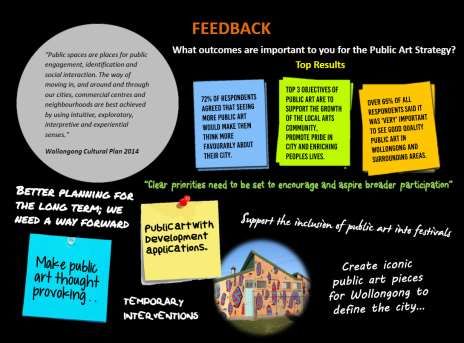
“Public spaces are places for pubic
engagement, identification and
social interaction. The way of
moving in, and around and through
Conceptual Strength
our cities, commercial centres and
neighbourhoods are best achieved
by using intuitive, exploratory,
interpretive and experiential
senses.”
Wollongong Cultural Plan 2014
‘ANIMATING WOLLONGONG’ Draft Wollongong Public Art Strategy & Guidelines 2016-2021 Page 25 of 92Value MEASURING VALUE, ADD PUBLIC ART!
While a Supporting Document may have no immediate costs to implement, it may incur
Literally defined,
significant costs value is a measure
for Council of the
in future worthPotential
years. of something to its
future owner
costs or any
need other
to be personas
outlined who
derives benefit from it.
part of Council’s consideration of Draft Supporting Documents. This includes estimated
capital,
There is operational
internationaland
and maintenance costs
national research that
that wouldboth
suggests result from
public artthe
andapproval of aadds value
good design
Supporting
by increasingDocument.
the economic Theviability
following impact statement
of development is a high level
and by delivering summary
social, of the
cultural and
estimated
environmentalimpact if each action in the Supporting Document was to be funded and
benefits.
implemented.
It is generally recognised that innovative, creative and animated public spaces have a competitive
economic edge and enhance community capacity building, social interaction and quality of life. Public art
enriches and enhances our lives in a number of ways as it can:
• create a sense of place;
• create a receptive, healing, social environment;
enhance our experience of being in a public space;
• assist in way-finding;
• give meaning to a place by representing local history and recalling memories;
• celebrate community values, diversity and build civic pride through visual means;
• increase amenity and activate usage of a site;
• educate and draw attention to significant issues
There is also evidence that public art has also been used by the private sector to enhance their
commercial aspirations and deliver enhanced profitability. These benefits can be significant when a
public art plan is well thought out, adequately funded, robustly delivered, sensitive and relevant to site,
and well maintained. Furthermore, the inclusion of art to a new development will bring inherent value.
In the short term, good design & public art for the Developer largely contributes towards ‘product
differentiation’ to their site and therefore gives the development an edge. In the long term, this might
mean better investment performance and better re-sale prices.
Though this maybe apparent ,the value of public art cannot be derived solely from an assessment of
completed works, but must include its collaborative and complementary value as a component of public
spaces, and its social value as a means through which to express, reflect and enjoy our city.
This Strategy and guidelines encourage a more holistic return and measure to value. An important
means by which arts and culture contributes to urban regeneration is through a strong attachment to
community. Some of the goals highlight instances of not only a commitment to further developing and
exploring the margins of public art practice, but also to rebuilding local cultural and social capacity.
‘ANIMATING WOLLONGONG’ Draft Wollongong Public Art Strategy & Guidelines 2016-2021 Page 26 of 92Value MEASURING VALUE, ADD PUBLIC ART!
MEASURING
While a Supporting Document may have no immediate costs to implement, it may incur
significant costs for Council in future years. Potential future costs need to be outlined as
INTRINSIC VALUE:
PUBLIC
part of Council’s consideration of Draft Supporting Documents. This includes estimated
capital, operational and maintenance costs that would result from the approval of a
Supporting Document. The following impacttostatement is a high level summary of the
Relates to the value of culture
individuals, centred on how
VALUE
estimated impact if each action in the Supporting Document was to be funded and
experiencing arts and culture affects us
implemented. in an emotional sense. How individuals’
value culture is subjective and involves
making judgements about quality based
on how it makes us feel. This can include
our feelings of connection to the
artwork and our own personal
subjective opinions of its quality based
on the way it makes us feel.
INSTRUMENTAL VALUE:
Is a more objective measurement and
relates to the contribution that culture
makes to specific economic and social
outcomes or policy goals, such as
creating employment, attracting
tourism, increasing educational
outcomes, benefiting health and
wellbeing, etc. Instrumental value can
be seen as delivering both direct and
indirect value.
INSTITUTIONAL VALUE:
Relates to the value that society
collectively places on culture, for now
and for future generations. Institutional
value ids described as the contribution
of culture to producing a democratic
and well-functioning society. This value
area includes both use and non-use Source:
Public Value Measurement
value, often captured through
Framework: Measuring the
contingent valuation and social return
Quality of the Arts
on investment approaches. Department of Culture and
the Arts WA (2014)
‘ANIMATING WOLLONGONG’ Draft Wollongong Public Art Strategy & Guidelines 2016-2021 Page 27 of 92Impact MEASURING SUCCESS
A guiding principle in the development of this Strategy and Guidelines has been the importance of
acknowledging and capturing the values and expectations of the full range of stakeholders that public
art projects engage with. Evaluation is not simply a process to determine numeric ‘value’.
There will always be economic circumstances and conditions that a public art project will need to take
account of, but it is often the intrinsic artistic experience and social and environmental impacts that are
more important to the artists, and the community.
Furthermore, the notion of art museum ‘artistic excellence’ is not explicitly transferable to the public
domain, and rather that artistic excellence in public art is subject to values additional to aesthetic value,
such as relevance to place, or resonance within community and conceptual integration.
This document sets out to indicate where Public Art can have an impact across all areas of sustainability
in the following key areas:
Cultural/Artistic Values - How the value of the work is measured in terms of aesthetic
Cultural experience, contribution to the aesthetic of the place or, in the case of performances, by
the enjoyment it provides.
Social Social Values -Projects may aim to promote identity, or increase aspects of interpersonal
development such as intergenerational or intercultural relationships.
Economic Values - The project creates direct employment opportunities through
Economic
participation in the project. Would the project attract investment in the form of new
businesses, an economically active population? – Marketing opportunities etc.
Environmental Values - Physical improvements may relate to functional or aesthetic
Enviro aspects of place, such as accessibility or appearance. The project raises awareness of
issues such as climate change and energy conservation
‘ANIMATING WOLLONGONG’ Draft Wollongong Public Art Strategy & Guidelines 2016-2021 Page 28 of 92You can also read


