Recent Approaches for Trend Detection from Text Documents and Real Time Streams-A Study - IJERT
←
→
Page content transcription
If your browser does not render page correctly, please read the page content below
Special Issue - 2015                                               International Journal of Engineering Research & Technology (IJERT)
                                                                                                                      ISSN: 2278-0181
                                                                                                 TITCON-2015 Conference Proceedings

  Recent Approaches for Trend Detection from
 Text Documents and Real Time Streams-A Study
                            1
                                Swaraj K P , Dr. Manjula D, Adhithyan V, Hemnath K B, Manish Kumar L
                                            Department of Computer Science and Engineering,
                                                College of Engineering, Anna University
                                                      Chennai, TamilNadu, India

Abstract -Growth of unstructured data or semi-structured                 number of techniques in order to find a suitable one for the
data in different formats is astounding and it is forecasted             job within a short amount of time.
that the number will be touching 40 Zettabytes (ZB) by                   Large amount of text are published in internet in the form
2020.Unstructured data are basically data that does not fit              of web pages, documents, research articles and other type
easily into traditional relational type data base systems. This
                                                                         of text. Manually classifying all this text, detecting topics,
type of Data comprises of emails, word processing documents,
messaging content, PDF files, spread sheets, multimedia,                 segregating them into corresponding areas and finding the
video, digital pictures and graphics, mobile phone GPS                   emerging subtopics from each topic is a tiresome and time
records, and social media content which combines all the                 consuming task for an average person. Even if one seeks
other elements on a gigantic scale. Among this, unstructured             the help of an expert it takes a lot of man-hours to finish
data in the form of text is utmost important and it is the               the job. Hence automatic topic extraction and trend
major content in text documents and social networking                    detection systems are of high importance especially for
websites. As the volume and diversity of unstructured text               those who are newly diving into research arena.
data grows, trending topic detection and analysis have become                      Interestingly in the recent years a lot of focus was
much more important issues in order to timely utilize
                                                                         on online social networks, in which the social network is
information from unstructured data in the form of text. Much
headway has been made towards automating the process of                  empowered as an internet application. Some examples of
trend detection in the recent years but still there is lot to be         such online networks are Twitter, Facebook, LinkedIn and
done to address the big data issue. This paper traces the                MySpace. These social networks have rapidly grown in
different methods and systems that are being currently                   popularity, because they are no longer constrained by the
utilized for detecting trends from textual data and social               geographical limitations. Among those, Twitter is a very
streams.                                                                 prevalent online social networking and micro-blogging
                                                                         service that allows its users to post and share text-based
Keywords—Text Mining, Text Classification, Topic Detection,              messages which are commonly called as tweets. There are
Trend Detection, ETD, Twitter
                                                                         huge numbers of active users in twitter and daily tweets
                       I.        INTRODUCTION                            generated by them are enormous .Hence they collectively
                                                                         can be effectively used to provide solutions to several
Topic detection and Trend analysis have been one of the                  interesting problems such as public sentiment analysis and
longing areas of research where expertise is short [1], [4],             hot topics trend detection. Detection of popular keywords
[5], [6], [7], [8], [9], [10]. Monitoring research trends has            is very important particularly to find out hot issues and
always been a concern of industries and policy makers of                 trends from tweets. Several methods have been proposed
science and technology, since it helps in efficient allocation           recently to provide new approaches for detecting trend and
of resources and forecasting the future technology. A topic              bursty keywords from Unstructured Text, Twitter stream
becomes trending when people began to show more and                      data and other social networking websites. In this paper
more interest in that topic for a particular time period.                some of the existing approaches are reviewed to support the
Considering the case of a research journal, when a topic is              future research in the area of topic trend detection.
trending for a particular time, more and more articles are
                                                                              II.    REVIEW OF EXISTING METHODS
published related to that topic. Similarly when something
becomes trending in social media, more and more messages
tends to appear related to that event. Identifying topics and            A. A Survey of Emerging Trend Detection in Textual Data
trends are given high priority by policy makers and these                Mining
topics have also been termed as hot topics, upward trends                          April Kontostathis et al. have published their
or emerging trends. As depicted by their literal connotation,            detailed survey paper on emerging trend detection in
they seem to highly correlate with the strength of attention             Textual Data Mining [1]. This literature review clearly
received over time .Many researchers have put their effort               indicates that a lot of effort has been put into research in
on automatic topic detection and trend analysis and have                 this area and hence much progress has been made towards
come up with various techniques and methods. But due to                  automating the process of detecting emerging trends. All of
the problem of big data, this area requires much more                    the projects which were reviewed rely on a human domain
                                                                         expert to segregate the emerging trends from noise in the

Volume 3, Issue 16                                     Published by, www.ijert.org                                                   1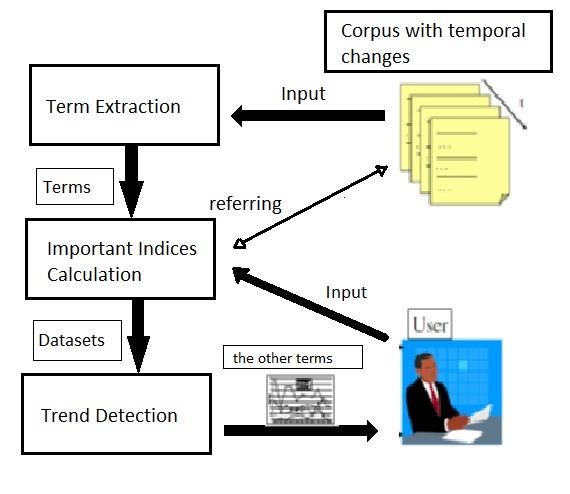
Special Issue - 2015                                              International Journal of Engineering Research & Technology (IJERT)
                                                                                                                     ISSN: 2278-0181
                                                                                                TITCON-2015 Conference Proceedings

system.         Survey mentions about several systems that              the most relevant topics in a given time frame. Only the
detect emerging trends in textual data. Some of the systems             most significant and important information as determined
are semi-automatic, requiring user input to begin                       by the program is presented to the user. TimeMines begins
processing; others are fully automatic producing output                 processing with a default model that assumes the
from the input corpus without guidance. For each                        distribution of a feature depends only on a base rate of
Emerging Trend Detection- ETD system, detailed                          occurrence that does not vary with time. Each feature in a
descriptions are provided for components including                      document is compared to the default model. A statistical
linguistic and statistical features, learning algorithms,               test is used to determine if the feature being tested is
training and test set generation, visualization and                     significantly different than what the model would expect. If
evaluation. Literature also provides a brief overview of                so the feature is kept for future processing, otherwise it is
several commercial products with capabilities for detecting             ignored. Finally a threshold is used to determine which
trends in textual data followed by an in industrial view                topics are most important and these are displayed via the
point which describes the relevance of trend detection tools            timeline interface
.Survey also delivers an overview of how such tools can be
used .                                                                  THEME RIVER - Theme River is yet another trend
An emerging trend is considered as a topic area that is                 detection tool that summarizes the main topics in a corpus.
growing in interest and utility over time. For example,                 Then it presents a summary of the importance of each topic
Extensible Mark-up Language (XML) emerged as a trend                    via a graphical user interface. The topical changes over
in the mid-1990s.An Emerging Trend Detection, ETD                       time are shown as a river of information. The river is made
application takes as input, a collection of textual data and            up of multiple streams. Each stream represents a topic and
identifies topic areas that are either novel or are                     each topic is represented by a color and maintains its place
exceptionally growing in importance within the corpus.                  in the river relative to other topics. Like TOA and Time
Current applications in ETD have been classified into two               Mines, Theme River does not presume to indicate which
categories, fully automatic and semi-automatic. The fully               topics are emergent. The visualization is intended to
automatic systems take in a corpus and output a list of                 provide the user with information about the corpus.
emerging topics. A human reviewer then scrutinises these
topics along with the supporting evidence found by the                  PATENT MINER - The Patent Miner system was
system to determine which the truly emerging trends are.                developed to discover trends in patent data using a
These systems often include a visual component that allows              dynamically generated SQL query based upon selection
the user to track the topic in an intuitive manner. A detailed          criteria input by the user. The system is connected to an
description of several semi-automatic and fully automatic               IBM DB2 database containing all granted United States
ETD systems used for research purposes or educational                   (US) patents. There are two major components to the
purposes is elaborated in the survey. Some of them are                  system. They are Phrase identification using sequential
mentioned below.                                                        pattern mining and trend detection using shape queries.

TOA (Technology Opportunities Analysis) - TOA is a                      HDDI- A new method is proposed called the Hierarchical
semi-automatic trend detection system for technology                    Distributed Dynamic Indexing (HDDI) system .The HDDI
opportunities analysis. Abstracts from technical database               system supports core text processing including information
such as INSPEC, COMPENDEX, US patents are input to                      feature extraction, feature subset selection , unsupervised
the system. Potential keywords from the abstracts are                   and supervised text mining machine learning as well as
extracted manually by domain experts. These keywords are                evaluation for many applications including ETD. They
then combined into queries using appropriate Boolean                    describe their approach for the detection of emerging trends
operators to generate comprehensive and accurate searches.              in text collections based on semantically determined
The queries are then input to the Technology Opportunities              clusters of terms. The HDDI system is used to extract
Analysis Knowbot (TOAK), a custom software package                      linguistic features from a repository of textual data and to
also referred to as TOAS Technology Opportunities                       generate clusters based on the semantic similarity of these
Analysis System. TOAK extracts the relevant document                    features. The algorithm takes a snapshot of the statistical
abstracts and provides analysis of the data by using                    state of a collection at multiple points in time. The rate of
information such as word counts, date information, word                 change in the size of the clusters and in the frequency and
co-occurrence information, citation information and                     association of features is used as input to a neural network
publication information to track activity in a subject area. It         that classifies topics as emerging or non-emerging.
is the responsibility of users to detect trends from this semi-
automatic method.                                                       Detailed information relating to linguistic and statistical
                                                                        features, training and test set generation, learning
The TimeMines system -It takes free text data with                      algorithms of several semi-automatic and fully automatic
explicit date tags and develops an overview timeline of                 ETD systems has been discussed above. But disadvantage
statistically significant topics covered by the corpus.                 is that all of the systems rely on human domain expertise to
TimeMines relies on Information Extraction and Natural                  separate emerging trends from noise in the system. Hence
Language Processing techniques to gather the data. The                  there is still a large scope for improvement even if much
system employs hypothesis testing techniques to determine

Volume 3, Issue 16                                    Published by, www.ijert.org                                                  2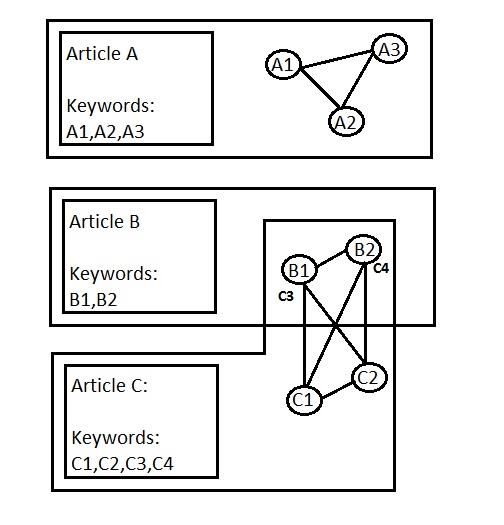
Special Issue - 2015                                               International Journal of Engineering Research & Technology (IJERT)
                                                                                                                      ISSN: 2278-0181
                                                                                                 TITCON-2015 Conference Proceedings

progress has been made towards automating the process of
detecting emerging trends.
B. Network Analysis of Keywords
         An interesting novel network approach is proposed
by Arjun Duvvuru et al. for uncovering trends in an area of
research by analysing keywords appearing in research
articles [2]. In this network approach, keywords are
represented as nodes. A pair of keywords is linked if they
appear in the same article as in Figure 1. Each link is
assigned a weight which represents the number of co-
occurrences of the pair in different articles. A statistical and
visual analysis of the network’s structural and temporal
characteristics is then performed to provide a broad
understanding of how keywords are organized and research
areas evolved over time. Accordingly keywords organize
themselves into three categories: topical keywords,
complimentary keywords and diverse keywords. Networks
are built corresponding to articles published for a particular
time window. Networks built from articles published in
two successive time windows are then compared .Through
this comparative analysis it is possible to detect some
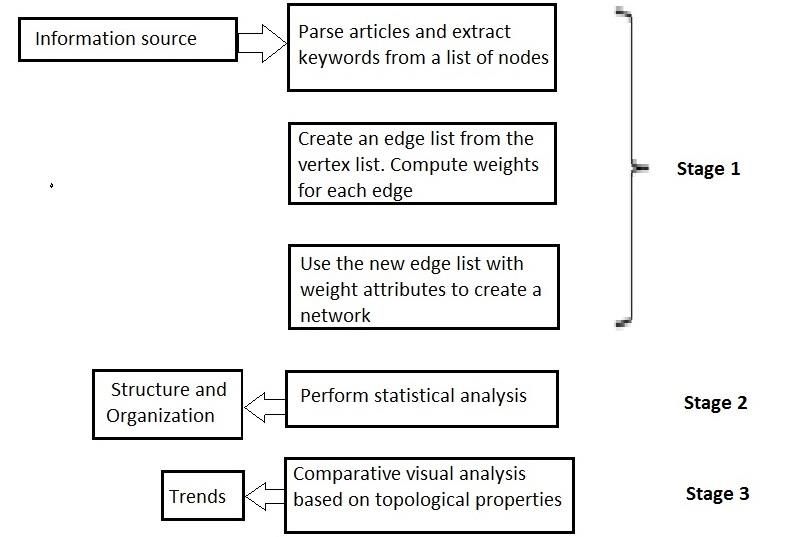
interesting keyword patterns and keyword node strength.                           Fig.2. 3-staged method for identifying trends
Emerging research areas are identified from this analysis.
Results can be used for updating academic programs and                   Degree is the number of links or connections incident on a
course curricula.                                                        node and is denoted by k. The greater a node’s degree, the
The idea of this approach is based on the findings from                  more central it is relative to the others. Strength of a node
networks analysis of various systems that most complex                   is similar to the degree but the former takes into
systems are characterized by three topological features: (1)             consideration the weights of the links incident on the node.
the statistical abundance of hubs or nodes with a high                   The strength s of a node is the sum of the weights of all
number of links compared to the average degree of the                    links incident on that node. In a weighted network, strength
network  and (2) the presence of scale-free node degree               is considered a better measure of centrality than degree.
distributions P(k), where the probability P of finding a node            Clustering coefficient C1of a node is the ratio of the actual
of degree k follows a power-law P(k)~k-γ (3) Topological                 number of connections between all neighbours of the node
properties such as node degree and clustering coefficient                to all possible connections between the neighbours. Thus
can extract patterns from the information. Based on these                the clustering coefficient is a measure of cohesiveness of a
observations, research is performed on network analysis of               set of nodes or a network (average clustering coefficient).
keywords that appear in scholarly articles. The objective is             The weighted clustering coefficient Cw accounts for the
to understand the structural organization of keywords and                weighted connections. Flow diagram as in Fig.2. depicts
identify trends in keywords by detecting changes in                      the 3 staged method used for identifying trends. In stage 2,
topological properties such as node strength and link                    the weighted network created in stage 1 is subjected to
weight distribution. The findings can be used in academia                statistical analysis. The primary objective of this analysis is
to identify emerging research areas.                                     to determine if the nature of weights on links between
                                                                         keywords is random or systematic. The rationale behind
                                                                         this is to unearth the underlying mechanism, if any, that is
                                                                         responsible for weights between keywords. The secondary
                                                                         objective of the statistical analysis is to provide a clear
                                                                         picture on how keywords (nodes) are organized in the
                                                                         journal. This method of analysis determines if the network
                                                                         characteristics such as degree or strength create a hierarchy
                                                                         of keywords. For instance, the organization of keywords by
                                                                         topical areas can be ascertained from this analysis.
                                                                         Additionally, keywords can be classified into different
                                                                         categories based on how they connect to each other. Finally
                                                                         in stage 3, visual maps are created for the networks from
                                                                         different time periods. These maps are color coded to show
                                                                         variations in different network characteristics such as
                                                                         strength and weights. This aids in picturing different
                                                                         characteristics and patterns in the network, which in turn
                                                                         facilitates the comparative analysis through which trends in
                Fig.1. Network of keywords                               research areas are detected

Volume 3, Issue 16                                     Published by, www.ijert.org                                                    3
Special Issue - 2015 International Journal of Engineering Research & Technology (IJERT)
ISSN: 2278-0181
TITCON-2015 Conference Proceedings
given corpus, the system calculates multiple importance
C. Detecting Temporal Trends of Phrases in Research indices of the terms for the documents of each period.
Documents Some well-known indices are TF-IDF and Jaccard’s
Conventional methods take into consideration only coefficient.
frequency of word and do not consider the nature of terms In the following experiments, the threshold for FLR is set
or the importance indices separately. In this paper, Hidenao up as FLR >1.0 to extract terms from the whole set of
abe et al. proposed an improved method for detecting documents. Then, the linear regression analysis technique
trends of phrases by combining term extraction methods, is applied in order to detect the degree of existing trends
importance indices of the terms and trend analysis methods based on the two importance indices.
[3]. Although importance indices of the technical terms Degree of term is calculated as follows
M
play a key role in finding valuable patterns from various ( yi y )( xi x)
documents, temporal changes of them are not explicitly Deg (t ) i 1
M
treated by conventional methods. Since those methods
i 1
( xi x) 2
depend on particular index in each method, they are not
robust in changes of terms. In order to robustly detect Where x is the average of the M time points and y is the
remarkable temporal trends of technical terms in given average of each importance index for the period.
textual datasets, a method is proposed based on temporal Simultaneously we calculate the intercept Int(t) of each
changes in several importance indices by assuming the term t as follows
importance indices of the terms to be a dataset. After
detecting the temporal trends, comparison is done between Int(t)= y -Deg(t) x
the emergent trends of the technical phrases to some Results for automatically extracted terms are calculated by
emergent phrases given by a domain expert for checking using the degree and the intercept of each term. The
match. following two trends are determined
• Emerging
The main steps in this approach are – sorting the degree in ascending order
1) Technical term extraction in a corpus – sorting the intercept in descending order
2) Importance indices calculation • Subsiding
3) Trend detection – sorting the degree in descending order
– sorting the intercept in ascending order
An overview of the proposed method is illustrated below
D. Sensing Trending Topics in Twitter
Rich and timely information about real-world events of all
kinds is generated by Online social and news media.
However, due to the huge breadth of user base and the
large amount of data available it requires a substantial
effort of information filtering to successfully drill down to
relevant topics and events. Trending topic detection is
therefore a fundamental building block to monitor and
summarize information originating from social sources.
The paper presented by Luca Maria Aiello et al. compares
six topic detection methods on three Twitter datasets
related to major events [11]. One of the novel topic
detection methods proposed based on n-grams co-
occurrence and df-idft topic ranking consistently achieves
the best performance compared to the conventional state of
the art techniques. The methods tested in this paper cover
Fig.3. Architecture of trend detection from corpus three different classes: probabilistic models (Latent
Drichlet Allocation), classical Topic Detection and
Term extraction method is based on the adjacent frequency Tracking (a common document-pivot approach) and
of compound nouns CN. This method involves the feature-pivot methods. Along this series of methods, four
detection of technical terms by using the following values novel approaches are developed; including methods that
for each candidate CN: use the concept of frequent item set mining. In particular, it
L 1 is showed that a method that leverages n-gram co-
FLR(CN ) f (CN ) ( ( FL ( N i ) 1)( FR ( N i ) 1)) L occurrences (instead of uni-grams) and df-idft topic ranking
i 1 is consistently the best per-forming method among the ones
tested. The proposed df-idft is a score for burstiness
Where f(CN)means frequency of the candidates CN, and detection that can significantly assist in determining the
FL(Ni) and FR(Ni)indicate the frequencies of the right and most rapidly emerging topics. The 3 selected datasets cover
the left of each noun Ni. After determining terms in the the domains of politics (the US Super Tuesday primaries of
Volume 3, Issue 16 Published by, www.ijert.org 4Special Issue - 2015 International Journal of Engineering Research & Technology (IJERT)
ISSN: 2278-0181
TITCON-2015 Conference Proceedings
March 2012 and the US Presidential elections of November process, a ranking of n-grams is created based on their df-
2012) and sports (the English FA Cup Final). idft scores. A single n-gram is often not very informative,
but a group of them often offers interesting details of a
The significant contributions can be summarized as story. Therefore, a clustering algorithm is used to group the
follows: most representative n-grams into clusters, each representing
• A comparative study of a wide range of topic detection a single topic. The clustering is based on distances between
methods across three large Twitter datasets on a real-world n-grams or clusters of n-grams. From the set of distances,
event sensing scenario is presented. The main idea of using those not exceeding a distance threshold are assumed to
different datasets is to compare the performance of the represent the same topic. Similarity between two –grams is
algorithms in different domains which have their own defined as the fraction of posts that contain both of them.
special features. Initially every n-gram is assigned to its own singleton
• Analysis is done on how factors such as the type of input cluster and then follow a standard “group average”
data (e.g. time span, topic breadth) and pre-processing hierarchical clustering algorithm to iteratively find and
techniques can affect the quality of topic detection results. merge the closest pair of clusters. When an n-gram cluster
• Among the tested methods, the proposed novel algorithm is joined to another, the similarities of the new cluster to
combining n-grams with df-idft ranking performs best, the other clusters are computed as the average of the
outperforming other state-of-the-art techniques. similarities of the combined clusters. The clustering is
repeated until the similarity between the nearest un-merged
The six methods compared are clusters falls below a fixed threshold, producing the final
1) Latent Dirichlet Allocation (LDA) set of topic clusters for the corresponding time slot. In the
2) Document-Pivot Topic Detection (Doc-p) experiments, a similarity threshold of .5 is used, which
3) Graph-Based Feature-Pivot Topic Detection (GFeat-p) means that two n-grams must appear in more than 50%of
4) Frequent Pattern Mining (FPM) the same tweets in order to belong to the same topic. This
5) Soft Frequent Pattern Mining (SFPM) and assumption is stronger in this case because only the post for
6) BNgram a specific time slot is considered. So it is more likely that
the n-gram clusters whose similarities are higher than the
threshold represent the same topic. Finally, the clusters are
Using n-grams makes particular sense for Twitter, since a
ranked according to the highest score of the n-grams
large number of status updates are just copies or retweets of
contained in the cluster. This ranking criterion is based on
previous messages, so important n-grams tend to be
the assumption that each cluster score should be associated
frequent. A new feature selection method is used in which
with the score of the most representative n-gram in the
changing frequency of terms is taken into account over
cluster, as the cluster is mainly composed of posts
time as a useful source of information to detect emerging
containing it.
topics. The main goal of this approach is to find emerging
topics in post streams by comparing the term frequencies
from the current time slot with those of preceding time E. Early detection of twitter trends-A Non parametric
slots. A new metric is proposed which introduces time to approach
the classic score. Historical data is used to penalize those
topics that began in the past and are still popular in the Trend detection in twitter is done mostly based on
present, and that therefore do not define new topics. This time series analysis. In the parametric approach, a
approach indexes all keywords from the posts of the jumpiness parameter say ‘p’ is estimated from a window of
collection. The keyword indices, implemented using activity and trend detection is based on whether p exceeds a
Lucene are organized into different time slots. In addition threshold. Here a model is created for the type of activity
to single keywords, the index also considers bigrams and say a pattern that can occur before a topic is declared as
trigrams. Once the index is created, the df-idft score is trending.Ths type of method is called parametric because it
computed for each n-gram of the current time slot i based estimates a parameter ‘p’ from data. But such a model often
on its document frequency for this time slot and penalized fails to capture all the type of patterns that can precede
by the logarithm of the average of its document frequencies before the topic becomes trending. Sometimes the
in the previous t time slots. preceding pattern can be a gradual rise, sometimes constant
and a big jump and it may also be a series of small jumps
which leads to a big jump. So in these cases different
df i 1
df idf t t
models are to be built for each expected trend causing
df
pattern which is an infeasible solution.
i j A Novel efficient non parametric data driven
j i
log( 1) 1 method is proposed by Snikolov and Shah for the early
t detection of twitter trends [12].This method is based on the
assumption that people acting in social network are
In addition, a factor is considered to raise the importance of predictable. Usually in a social networking site, if a person
proper nouns (persons, locations and organizations, using a ’x’ has friends which are all friends of a person ‘y’ then
standard named entity recognizer, as they are essential there is a chance that ‘y’ is friend of ‘x’. If many of a
keywords in most discussed stories. As a result of this person x’s friends are talking about some event then there
Volume 3, Issue 16 Published by, www.ijert.org 5Special Issue - 2015 International Journal of Engineering Research & Technology (IJERT)
ISSN: 2278-0181
TITCON-2015 Conference Proceedings
is high chance that the person ‘x’ also may talk about the number of sentences in a post is approximately 1.4. At the
same. So here it is assumed that there can be only a few same time, the average number of words is approximately
frequent patterns that can occur before a topic becomes 18, a bit higher compared to the 16 words in a tweet.
trending. In this method, data defines the model .Data is However, looking at the full dataset, while the average post
learned about the patterns that precede trends and patterns length in character didn’t significantly differ from our
that don’t. Then instead of creating a model from data, data results (108), the maximum length was found to be 754
itself is used to determine whether it is going to be a trend characters, which on average corresponds to approximately
or not. 10 sentences and 122 words. Trend detection is commonly
First of all the activity of a new topic is tracked. based on (1) topic identification, and (2) cluster
An observed pattern ‘s’ is found out for a time period and it detection.TF-IDF formula is not applicable for the content
is compared with example activity patterns ‘r’ from topics shared on Facebook because of the limited length of the
that became trending in the past and which didn’t. This Facebook posts, which would reduce the value of the term
means r can be set R- and set R+ consisting of say 500 frequency component in the equation. Hence the concept of
trending and non-trending patterns each. The comparison is a hybrid document was used in this method. The notion of
based on a voting scheme. Each of the example activity a hybrid document represents a collection of posts P = {p1,
patterns ‘r’ vote for the observed pattern ‘s’ based on a p2, …, pK}, obtained within a timeframe T, which
voting function. Weight of each vote depends upon the corresponds to the interval for fetching posts from
Euclidian distance between r and s. Finally all the trending Facebook in a near real-time system. Each time frame T
and non-trending votes are summed up and ratios of these represents a separate dataset described by a separate
are calculated. If the ratio is greater than ‘1’ the topic is weighted list.TF-IDF calculation is modified to suit for this
trending and if it is less than ‘1’, it’s not. type of hybrid document approach.
The advantages of this method are Post topic identification results in an ordered list of the
a) Computations are simple since only distance needs to be most significant terms in the corpus. The next step is to
calculated cluster together terms that belong to the same topic. Post
b) Distance Computations can be parallelised clustering is performed in two steps (1) clustering by
c) No model is used for detection. This algorithm was able distribution, and (2) clustering by co-occurrence.
to detect Twitter trends ahead of Trending algorithm Clustering by distribution is a combination of the
provided by twitter almost 79% of the time with an error comparison of the term weight and the intersection of the
rate of 95% (95 % true positive rate and 4% false positive related documents. The goal is to eliminate the multiple
rate). occurrences of the similar n-grams with different lengths
belonging to the same posts. Once the grouping is done, we
F. Trend detection from Facebook replace the groups with the n-gram with the maximal
length since it contains maximum information regarding
At present Facebook is the largest online social the topic. Clustering by co-occurrence is based on the
networking site with more than 800 million active users assumption that terms that appear frequently in similar
followed by twitter with an estimated 280 million users. posts belong to the same topic. This step is used to further
Lot of contents are shared online in different formats. Real group the terms that are not semantically similar and
time news, opinions and statuses are shared online through belong to different posts, but still refer to the same topic.
Facebook. Public nature of these status messages from Evaluation was done based on precision and
Facebook is used in the technique proposed by Irena recall. 10 experiments were conducted, each collecting and
Pletikosa Cvijikj et al. for trend detection from Facebook processing 1000 posts from different time intervals and
which is claimed to be the first of its kind [13]. With the review of the results were obtained. Approach tried to
help of a novel algorithm they categorise trending topics identify differences in terms of distribution through the
into a) disruptive events b) popular topics and c) daily shape and volume of the shared information. Approach also
routines. Finally the characteristics of the proposed used measuring the speed and scale of information
categories are analysed and compared in terms of distribution on Facebook as an indicator of the possibility
distribution and information diffusion in order to increase to use Facebook as a news media. The distribution in terms
the understanding of emerging trends on Facebook. of the volume of the posts shared on Facebook regarding a
Facebook GRAPH API provides access to the certain topic is a clear indicator of a level of interest of
Facebook social graph via a uniform representation of users for the related topic. In addition, the shape of the
objects in the graph (e.g., people, posts, pages, etc.). In this distribution is an indicator of a topic belonging to the
study the Post objects were of interest. Each Post object category of ‘daily routines’ that is always present in the
contains the following information: (1) content details for conversation at some relatively equalized level, or if it
the post (message, name, caption, description), (2) relates to an event occurring at a particular point in time.
Facebook user who posted the message, (3)Type of the Understanding the differences between distributions that
message as defined by Facebook, i.e. status, photo, link, relate to the ‘daily routines’ and ‘popular topics’ on one
etc., (4) Time of creation, (5) Application used for sharing side, and the distributions related to ‘disruptive events’ on
the post, etc. All of these elements were stored in a the other, gives us the possibility to train the systems for
relational database for further investigation. Linguistic automatic trend detection in order to distinguish between
analysis was done on extracted 3 sets of posts. The average these different types of trends.
Volume 3, Issue 16 Published by, www.ijert.org 6Special Issue - 2015 International Journal of Engineering Research & Technology (IJERT)
ISSN: 2278-0181
TITCON-2015 Conference Proceedings
Comparison to the cumulative distribution of posts over REFERENCES
time of day shows that the peaks on the ‘popular topics’
correspond with the peaks on the daily post distribution [1] April Kontostathis,Leon M Galitsky,William M Pottenger, SomaRoy,
graph, while peaks for ‘daily routine’ are the opposite. On a Daniel J Phelps, “A survey of emerging trend detection in textual
Data Mining ”
more general level, daily routines are usually related to a [2] Arjun Duvvuru , Sagar Kamarthi , Sivarit Sultornsanee, “Under
certain period of time in a day, for example, “good night” covering research trends: Network analysis of keywords in scholarly
appears as a trending topic only in the evenings. articles .” Ninth International Joint Conference on Computer Science
Furthermore, these two topics are present and trending and Software Engineering (JCSSE) 2012.
[3] Hidenao Abe,Shusaku Tsumoto “Detecting Temporal Patterns of
during the whole time interval, indicating a popular topic, Technical Phrases by using Importance Indices in a Research
but not something new. Documents” ,Proceedings of the IEEE International Conference on
Systems, Man, and Cybernetics San Antonio, TX, USA - October
III. CONCLUSION AND FUTURE WORK 2009.
[4] Masahiro Terachi, Ryosuke Saga and Hiroshi Tsuji, “Trends
Recognition in Journal Papers by Text Mining ”, IEEE International
Trend detection techniques are regularly Conference on Systems, Man, and Cybernetics October 8-11, 2006,
performed on static text data and real time stream data. Taipei, Taiwan
This paper has presented a study on recent methods for [5] Daehoon Kim, Daeyong Kim, Seungmin Rho and Eenjun Hwang,
trend detection in text data and real time streams. First an “Detecting Trend and Bursty Keywords Using Characteristics of
Twitter Stream Data ” International Journal of Smart Home Vol. 7,
overview of an existing survey was presented providing a No. 1, January, 2013
larger glimpse of existing ETD methods. Two recent [6] Levent Bolelli,Şeyda Ertekin,C. Lee Giles “Topic and Trend
methods for detecting trend from unstructured text are Detection in Text Collections Using Latent Dirichlet Allocation” ,
described in detail. The network method creates a keyword Proceedings of the 31th European Conference on IR Research on
Advances in Information Retrieval Springer-Verlag Berlin,
network to detect trends whereas the other method Heidelberg ,2009 pp 776 - 780
calculates trends based on important indices. 3 methods for [7] Xiaodong Wang , Juan Wang, “A Method of Hot Topic Detection in
trend detection from social media data were also discussed. Blogs Using N-gram Model ” JOURNAL OF SOFTWARE, VOL.
These methods detect trends of live streaming data from 8, NO. 1, JANUARY 2013
[8] Teng-Kaifan ,Chia-Huichang , “Exploring Evolutionary Technical
online social networks such as Twitter and Facebook. Here Trends From Academic Research Papers ” Journal of information
the techniques differ from that of static text because mostly science and engineering 26, 2010, pp 97-117
trends are based on events in social networks. The concepts [9] Manish Gupta ,Jing Gao,ChengXiang Zhai,Jiawei Han “Predicting
provided by different methods were concisely described Future Popularity Trend of Events in Microblogging Platforms”
,Proc of ASIST, , Baltimore, MD, USA. October 28-31, 2012
along with the relevancy of each method. The important [10] Aleksandre Lobzhanidze, Wenjun Zeng, Paige Gentry and Angelique
contribution is that the survey focussed on enlisting Taylor, “Mainstream Media vs. Social Media for Trending Topic
existing methods used for trend detection under the Prediction – An Experimental Study ” The 10th Annual IEEE
categories of both static documents and real time streams. CCNC
[11] Luca Maria Aiello, Georgios Petkos, Carlos Martin, David Corney,
This paper also provides an efficient and quick reference Symeon Papadopoulos, Ryan Skraba,Ayse Göker, Ioannis
for those who are interested to do research in the field of Kompatsiaris, Senior Member, IEEE, and Alejandro Jaimes,
trend detection in texts. Future work is to present a “Sensing Trending Topics in Twitter.” IEEE TRANSACTIONS
complete study for ETD in real time streaming data and ON MULTIMEDIA, VOL. 15, NO. 6, OCTOBER 2013
[12] http://snikolov.wordpress.com/2012/11/14/early-detection-of-twitter-
proposing an integrated framework. trend
[13] Irena Pletikosa Cvijikj, Florian Michahelles , “Monitoring Trends
on Facebook ” Ninth IEEE International Conference on
Dependable, Autonomic and Secure Computing, 2011
Volume 3, Issue 16 Published by, www.ijert.org 7You can also read


