Reference Manual for Skills Development Facilitators - MICT Seta
←
→
Page content transcription
If your browser does not render page correctly, please read the page content below
Reference Manual for Skills Development
             Facilitators

                                          2019

Our Vision:
To be recognised as the leader in the development of a highly skilled knowledge-based
information society.

Our Mission:
The MICT SETA generates, facilitates and accelerates the processes of quality skills
development at all levels in the MICT sector.

The MICT SETA SDF Reference Manual 2019
Table of Contents
Introduction and Background Information                                                   5
References to Skills Development Facilitators (SDFs) and Independent Skills Development
     Facilitators (ISDFs)                                                                 5
Purpose of the SDF Reference Manual                                                       5
Layout of the Reference Manual                                                            5
Important References                                                                      6
Acronyms and Definitions                                                                  6
Process Information                                                                       7
Legislative Considerations                                                                7
Training Committee                                                                        9
Introduction                                                                               9
Composition of the Training Committee                                                     9
Responsibilities of the Training Committee                                                10
The Role and Responsibilities of the SDF                                                  11
Use of an ISDF                                                                            12
Submission Criteria for Mandatory Grant Payments                                          12
WSP/ATR/PTP/PTR Approval                                                                  14
Use of the Mandatory Grant                                                                14
Suggested ATR/WSP Submission Project Plan                                                 15
The Organising Framework for Occupations (OFO)                                            15
                 Overview of the Structure of the OFO codes                               15
                 NQF Levels versus Secondary and Tertiary Education System                16
                 Classification of Personnel into OFO Occupations                         17
                 Description of the OFO and Scarce and Critical Skills                    18
The MICT SETA CV Database                                                                 19
Types of Training Interventions                                                           20
Definition of a Learnership                                                               20
                 Definition of an Internship                                              20
                 Definition of a Skills Programme                                         20
                 Definition of a Short Course                                             20
Expenses that may be included in the ATR/PTR and WSP/PTP                                  23
                 Introduction                                                             23
                 B-BBEE Considerations                                                    23
                 The MICT SETA Perspective                                                24
MICT SETA SSP Staff Support                                                               26
                 Communication with the MICT SETA                                         26
                 The MICT SETA SSP Division Service Levels                                26

The MICT SETA SDF Reference Manual 2019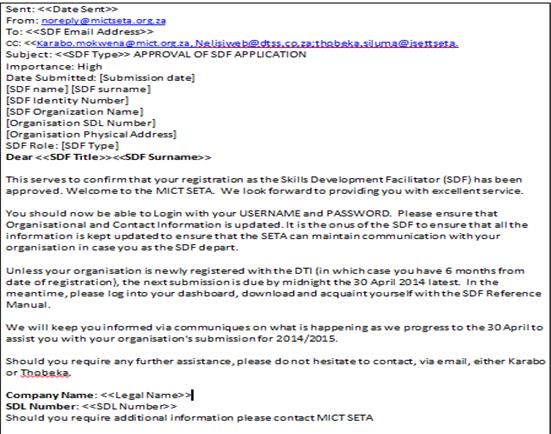
Inter-SETA Transfers                                                  26
Implications on the Payment of Mandatory Grants                                       27
Submission of the Inter seta transfer companies                                       27
                Newly Registered Organisations                                        28
                Registered Organisations not allocated to a SETA                      28
                Companies that have skipped a year in submitting                      28
                Listing yourself as an approved MICT SETA ISDF                        28
                Registering SDF Associates                                            29
                Technical Queries Regarding the Online Grant System                   29
                Participation Confirmation Letters                                    29
                Grant Payment Queries                                                 29
                SDF Telephonic and/or Person-to-Person Training                       29
                Linking of Organisations                                              29
                SDF Training Workshops                                                30
                Accredited Training Providers                                         30
Mandatory Grants and Mandatory Grant Payment Schedule                                 30
Information on MICT SETA Scarce and Critical Skills                                   30
Applying for Discretionary Grant Funding                                              31
                Introduction                                                          31
                The 2013/18 Strategy of the MICT SETA                                 31
                The Discretionary Grant Evaluation Committee and Process              31
                Criteria for Applying for a Discretionary Grant                       32
                Applying for Discretionary Grant                                      32
                Discretionary Grant Amounts                                           33
                Discretionary Grant Disbursements                                     33
Training Layoff Scheme                                                                34
Registering with the MICT SETA as an SDF                                              35
Seta Management Systems: Skills Module                                                36
1.       SDF Registration                                                             36
2.       Logging on                                                                   43
3.       SDF/ISDF Dashboard                                                           44
4.       The “Organisation Info” Tab                                                  46
6.       The “Org Contacts” Tab                                                       48
7.       The “Org Bank Details” Tab                                                   49
8.       The “Training Committee” Tab                                                 49
9.       The “WSP/ATR and PTP/PTR Forms” Tab                                          50
10.      Creating WSP                                                                 51
                .        Creating a New WSP for a New Year                            51
                .        Printing a WSP/PTP/ATR/PTR Report (Must show current year)   51
                .        WSP (Workplace Skills Plan) Forms                            52

The MICT SETA SDF Reference Manual 2019
.        WSP/PTP Current Employment Profile                      53
                .        WSP/PTP Training Budget                                 55
                .        WSP/PTP Scarce Skills                                   56
                .        Critical Skills                                         57
                .        Annual Payroll                                          58
                .        WSP Planned Training                                    59
                .        Planned - Pivotal Training                              60
                .        ATR Actual Training                                     62
                .        PTR Actual Training                                     63
                .        ATR /PTR Training Budget Spent                          65
                .        ATR /PTR Variance Report                                66
                .        Organisation Survey on Workforce Dynamics               66
                .        ATR /PTR Impact Assessment                              67
10       The WSP/ PTP and ATR/PTR Document Uploads Tab                           67
11       Submission of WSP/ PTP and ATR/PTR                                      68
12       Approval Criteria for WSP/ATR, Authorisation Form and Banking Details   69
13       The “Grants and Levies” Tab                                             70
14       The “Associate SDF” Tab                                                 71
15.      MICT SETA Contacts                                                      72

The MICT SETA SDF Reference Manual 2019
Introduction and Background Information
References to Skills Development Facilitators (SDFs) and
Independent Skills Development Facilitators (ISDFs)
          –   SDFs are employees of organisations, their responsibility is to collect and
              submit to SETAs data relating to past and planned training in the
              organisation.
          –   ISDFs perform the same roles as SDFs, but are sub-contracted by the
              organisation to perform this function.
      For the purposes of this document, unless otherwise stated, all references to SDFs
      must be interpreted as including ISDFs.

Purpose of the SDF Reference Manual
      As published on the 3rd December 2012 in Government Gazette Notice No 35940,
      there are two types of grants that the MICT SETA can/may provide to the MICT
      SETA employers/ stakeholders, namely:
          –   Mandatory Grants: This grant is paid to the MICT SETA employers on the
              basis of the submission and approval of the Annual Training Reports
              (ATRs), Workplace Skills Plans (WSPs) (including PIVOTAL Training
              Plans (PTPs and PIVOTAL Training Reports (PTRs) where applicable).
          –   Discretionary Grants: This is funding awarded to the MICT SETA
              employers who are providing training that addresses respective
              workplaces’ scarce and critical skills needs and assists in the achievement
              of the MICT SETA commitments to the Department of Higher Education
              and Training (DHET).
       This Reference Manual primarily addresses the requirements for Mandatory
Grants and
      summarises the processes around Discretionary Grants. The purpose of this SDF
Reference
      Manual is to inform the SDFs and employers of:
          –   The legislative requirements
          –   The Mandatory Grants Payment Processes
          –   The MICT SETA Online Grant System
          –   The Discretionary Grants Processes
      Various sources have been used to compile this Reference Manual. This Manual
      is intended to be a comprehensive reference document that will assist SDFs with
      all aspects of the Mandatory and Discretionary Grants Payment Processes, and is
      intended to alleviate queries from SDFs.

Layout of the Reference Manual
      This Manual is segmented as follows:
      Chapter 1:    Provides an introduction, important references and a list of the
                    acronyms used.

                                             5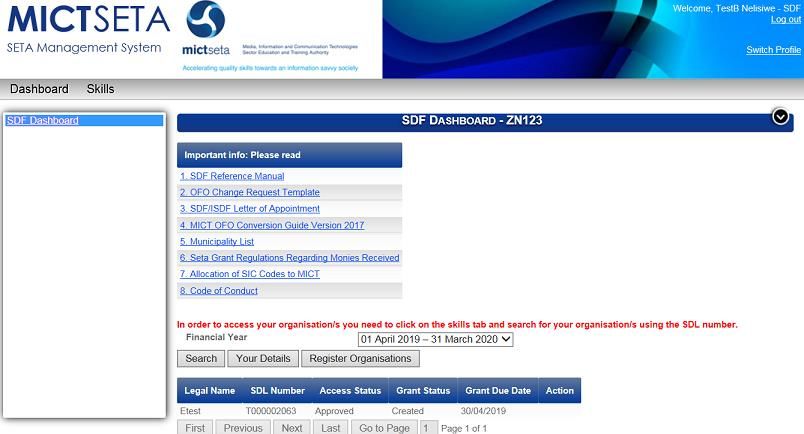
Chapter 2:       Provides all the information needed by organisations and SDFs prior
                       to accessing the MICT SETA Online Grant System where the
                       ATR/WSP (including PTPs/PTRs where applicable) data is captured
                       and submitted. The chapter also presents information on the
                       support services provided by MICT SETA SSP staff.
      Chapter 3:       Outlines the process of registering on the Online Grant System,
                       capturing and submitting the ATR and WSP (including PTP/PTR
                       where applicable) data, and presents the Online Grant System
                       Utilities that are available to the SDF.
      Chapter 4:       Provides the contact details of the MICT SETA SSP staff members
                       who can assist organisations and SDFs.
       Appendix 1: Provides a template of a typical Letter of Appointment to be used
                   when an SDF has to register on the Online Grant System.
Important References
              The following documents are also available on the MICT SETA website,
              www.mict.org.za
                   –   Skills Development Act (No. 97 of 1998) as amended
                   –   Skills Development Levies Act (No. 9 of 1999) (SDLA)
                   –   Regulations published in the Government Gazette, No. 27801, 18
                       July 2005
                   –   Regulations published in the Government Gazette, No 35940, 3
                       December 2012
                   –   MICT SETA Criteria and Guidelines for PIVOTAL Grants.

Acronyms and Definitions
The following acronyms are used within this Reference Manual:
Abbreviation Description
AET          Adult Education and Training (replaced the old ABET)
ATR          Annual Training Report; reflects the actual training data for the past year starting 1st April
             of the past year to the 31st March of the current year.
B-BBEE       Broad-Based Black Economic Empowerment.
BEE          Black Economic Empowerment
Disability   Employment Equity Act of 1998 defines people with disabilities as “people who have a
             long-term or recurring physical or mental impairment that substantially limits their
             prospects of entry into or advancement in employment’. Physical impairments include
             hearing and visual impairments, paralysis, amputations and problems with internal
             organs. Mental impairment includes clinically defined mental and emotional illnesses
             and learning disabilities.
DHET         Department of Higher Education and Training.
ICT          Information and Communications Technology.
ISDF         Independent Skills Development Facilitator; has the same responsibilities as an SDF but
             works as a consultant, i.e. an ISDF is not an employee of the organisation.
IT           Information Technology.
L Number     Levy Number, same as SDL Number, unique identifier for each company, found on EMP
             201 and EMP 103 forms in the organisation’s Finance Department.

                                             6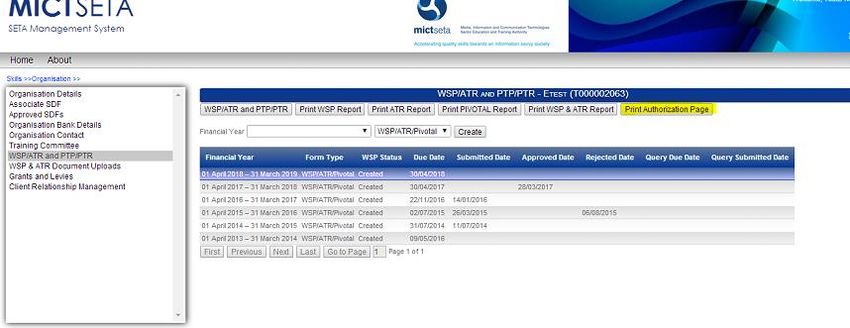
Abbreviation Description
 MICT SETA Media, Information and Communication Technologies Sector Education and Training
              Authority.
 NQF          National Qualifications Framework.
 NSDS         National Skills Development Strategy.
 NSF          National Skills Fund.
 OFO          Organising Framework of Occupations.
 OGS          Online Grant System.
 PIVOTAL      Professional, vocational, technical and academic learning programmes; result in
              qualifications or part qualifications registered on the National Qualifications Framework.
 PTP          Pivotal Training Plan.
 PTR          Pivotal Training Report.
 SARS         South African Revenue Services.
 SAQA         South African Qualifications Authority.
 SDA          Skills Development Act (No. 97 of 1998 ) as amended.
 SDF          Skills Development Facilitator; someone appointed within the organisation to assume
              responsibility of gathering and submitting the ATR and WSP data to a SETA.
 SDL          Skills Development Levy.
 SDL Number Skills Development Levy Number; unique identifier for each company, found on EMP
              201 and EMP 103 forms in the organisation’s Finance Department.
 SDLA         Skills Development Levies Act (No. 9 of 1999).
 SETA         Sector Education Training Authority.
 SIC          Standard Industrial Classification.
 SME          Small and Micro Enterprise. Organisations having 49 and less employees.
 SSP          Sector Skills Plan; a document outlining the sector’s scarce and critical skills needs.
 DTI          Department of Trade and Industry.
 TLS          Training Layoff Scheme.
 WSP          Workplace Skills Plan; a training plan (forward looking) covering the period 1st April of
              the current year to 31st March of the next year.

Process Information
Confidentiality
NB: All data collected by the MICT SETA through this process is treated with
confidentiality. Data received is aggregated for the purposes of research and planning.
Legislative Considerations
Organisations are allocated to SETAs based on the Standard Industrial Classification
(SIC) code. This code is usually decided upon by the owners of an organisation at the
time of registering the organisation with the Companies and Intellectual Property
Commission (CIPC), previously known as the Companies and Intellectual Property
Registration Office (CIPRO). The SIC code can be found on the organisation registration
documents, as well as in the Online Grant System. For a full list of the gazetted SIC
codes allocated to each SETA, please visit the following link:
http://www.mict.org.za/inner.aspx?section=10&page=110
Each month, organisations with a total annual payroll of R500, 000.00 and more
contribute 1% of the payroll in the form of a Skills Development Levy (SDL) to the South
African Revenue Services (SARS) in accordance with legislation. This contribution is
reflected on the organisation’s monthly EMP 201 form, which also reflects PAYE and UIF
paid, the EMP 201 form can be accessed from the Finance Department.
In order to receive its Mandatory Grant, as well as to access Discretionary Grants,
organisations that contribute the skills development levies are required to submit an

                                            7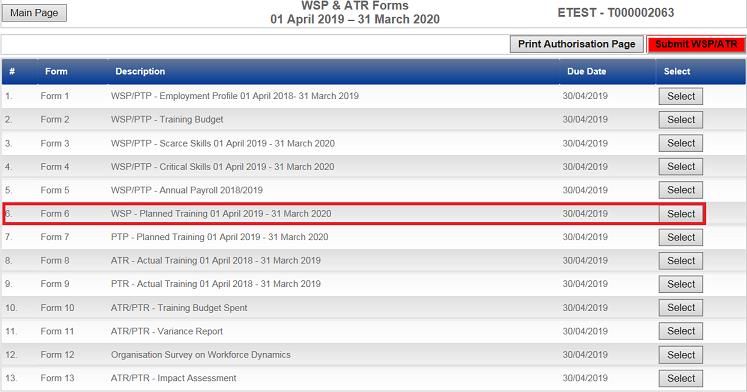
Annual Training Report (ATR), Workplace Skills Plan (WSP) and/or the PIVOTAL
Training Plan (PTP) and the PIVOTAL Training Report (PTR) to the MICT SETA. The
ATR and/or the PTR provide data relating to the training that was implemented during the
previous year while the WSP and/or the PTP provide data relating to the training that is
intended to be implemented during the forthcoming year.

Upon submission of the ATR/PTR and WSP/PTP, and provided that they are approved by
the MICT SETA, the organisation will receive its Mandatory Grants from the MICT
SETA on a quarterly basis.
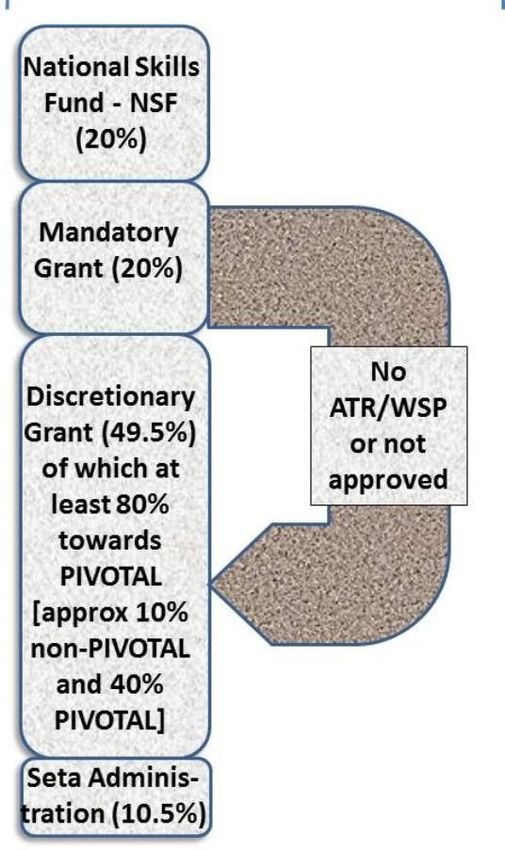
Government Gazette No 35940, 3rd December 2012, asserts that:
       –   Employers are entitled to a Mandatory Grants amounting to 20% of their Skills
           Development Levy contributions.
       –   Discretionary Grants will amount to 49.5% of the SDL, of which at least 80%
           must be allocated to PIVOTAL programmes that address scarce and critical
           skills.
       –   The ATR/PTR and WSP/PTP must be submitted by 30 April each year.
       –   An employer who has a recognition agreement with a trade union/s must
           provide evidence that the ATR/PTR and WSP/PTP have been subject to
           consultation with the recognised trade union/s and the ATR/PTR and
           WSP/PTP must be signed off by the labour representative appointed by the
           recognised trade union.

Skills Development Levy Model

The full gazette can be downloaded from the MICT SETA website at the following link:
http://www.mict.org.za/inner.aspx?section=10&page=110

                                           8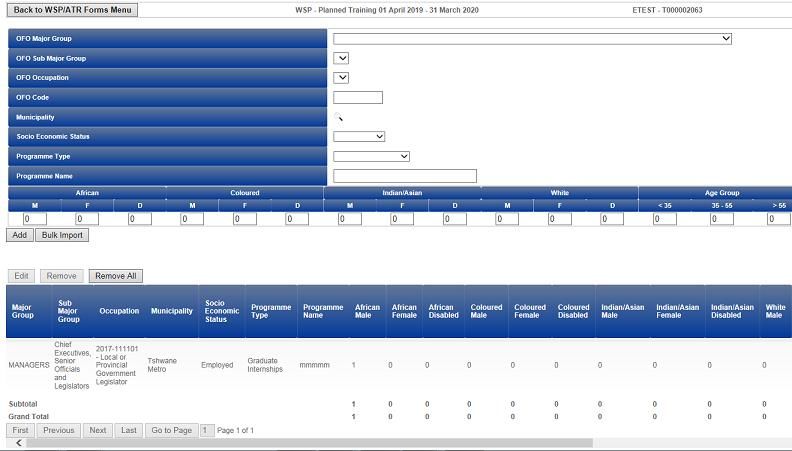
As stated in this Government Gazette, ‘PIVOTAL’ is an acronym which means
professional, vocational, technical and academic learning programmes that result in
qualifications or part qualifications registered on the National Qualifications Framework.
The National Skills Development Strategy (NSDS) III provides more insight into what
PIVOTAL programmes are (page 6):
“These are programmes which provide a full-occupationally-directed qualification. Such
courses will normally begin in a college or university and would include supervised
practical learning in a workplace as part of their requirement. The courses – especially
for workers – could in some cases start in the workplace and then move to a college or
university. The courses would culminate in an occupational qualification. PIVOTAL
courses will normally be offered by arrangement between a SETA, an education
institution, an employer and a learner.” Further insight is gained on page 13 of
Government Gazette No 35940, 3rd December 2012, in the section entitled “PIVOTAL
Grant”.
According to NSDS III, many of the professional areas of study combine coursework at
universities, universities of technology and FET institutions with structured learning at the
workplace. This is achieved by means of professional placements, work-integrated
learning, apprenticeships, learnerships, skills programmes, and work experience
placements. The MICT SETA will fund these programmes through the PIVOTAL Grant.
PIVOTAL learning programmes can be accessed by both employed and unemployed
people.

In summary, if the ATR/PTR and WSP/PTP are approved, the organisation will receive
20% of their 1% levy contribution back as a Mandatory Grant, and can apply for a
PIVOTAL Grant to implement PIVOTAL learning programmes.                  Because not all
organisations submit their ATR/PTR and WSP/PTP, unpaid Mandatory Grants are moved
to Discretionary Grants, and because not all organisations apply for Discretionary Grants,
organisations that do participate in this process can actually apply for and receive more
than what their total levy contribution was.

Training Committee
Introduction
       An employer with 50 or more employees has to establish a Training
       Committee and ensure its active participation with regards to skills
       development matters within an organisation. As stated above, in the case of
       an employer who has a recognition agreement with a trade union/s, evidence
       must be provided that the ATR/PTR and WSP/PTP have been subjected to
       consultation with the recognised trade union/s and the ATR/PTR and WSP/PTP
       must be signed off by the labour representative appointed by the recognised trade
       union.
Composition of the Training Committee
       The Training Committee must comprise three constituent parties: the employer
       representative, the employee representative and union representative (where
       applicable). The SDF remains a critical member of the Training Committee at all
       times. The number of employees and employer representatives must be equal.
       No employee representative shall be a manager. At least one employee
       representative must represent each of the Major OFO categories below, unless if
       there are no employees in some of the categories.
           –     Managers
           –     Professionals

                                             9
–     Technicians and Associate Professionals
               –     Clerical Support Workers
               –     Service and Sales Workers
               –     Skilled Agricultural, Forestry, Fishery, Craft and Related Trades Workers
               –     Plant and Machine Operators and Assemblers
               –     Elementary Occupations
            The employee representative must be an employee of the organisation who is
            nominated by fellow employees, and must not be in a management position.
            The employee representatives must discuss the training and development needs
            with their fellow employees and present them to the Training Committee for
            discussion and/or implementation. The SDF can neither be the employee nor
            the employer representative.

Responsibilities of the Training Committee
            Using The South African Labour Market Guide1 as a guide, the MICT SETA
            adopted the following as the responsibilities of the Training Committee. It should
            be noted that it is at the discretion of the Training Committee to place some of
            these responsibilities partially or wholly on the SDF. The Training Committee
            must:
               –   Ensure that the organisation has a Training Policy and that it is in line with
                   the regulations as laid down by the Skills Development Act
               –   Ensure that the development and implementation of the WSP/PTP is
                   aligned to the strategic Mission and Vision of the organisation
               –   Keep the envisaged training and development of employees in the
                   organisation abreast with the long-term transformation objectives of the
                   organisation
               –   Ensure that the WSP/PTP is aligned to the Employment Equity Plan and
                   Business Plan of the organisation
               –   Take cognisance of B-BBEE requirements
               –   Establish training priorities for the organisation based on its short and long
                   term needs
               –   Align training to the MICT Sector Skills Plan, learnerships, career
                   pathways, accredited national qualifications, etc.
               –   Communicate the completed WSP/PTP to other employees in the
                   organisation
               –   Monitor the implementation of the Workplace Skills Plan.
               –   Annually develop the WSP/PTP
               –   Ensure fair and equitable development of employees in the organisation
               –   Acquire requisite resources to evaluate training development within the
                   organisation.
               –   Identify the skills development needs within the organisation and
                   continually evaluate the implementation
               –   Develop and implement external and internal skills development strategies
               –   Monitor the progress of the skills development within the organisation.
               –   Monitor the implementation of the WSP/PTP
               –   Develop and implement correctional actions where required
               –   Ensure that the skills needs of the organisation are identified
               –   Ensure that all staff has been classified according to the OFO codes

1
    Ibid.

                                                 10
– If required, ensure that that there is a skills performance system in the
organisation
– If and where required, ensure that there is an individual development
pathway for all employees, as well as the skills requirement and learning
pathway
– Where applicable, ensure that a portfolio of evidence has been developed
for all employees that receive training in the organisation
– Ensure that Mandatory Grants are spent on skills development.
The Role and Responsibilities of the SDF
The SDF is someone appointed by the organisation to assume responsibility for
gathering and submitting the ATR/PTR and WSP/PTP data to a SETA, prior to
midnight 30th April each year as per legislation.
Only one SDF is allowed per organisation. If more than one SDF is required in an
organisation, the organisation must decide who the main SDF is and that person
will take responsibility of capturing data on the SETA’s Online Grants System.
Some of the following responsibilities of the SDF have been borrowed from The
South African Labour Market Guide2. While this guide presents a large number of
responsibilities, the MICT SETA has adopted the following as the responsibilities
of the SDF:
– Chair the Training Committee
– Be a non-voting member of the Training Committee
– Be a training committed leader and lead the process of organisational skills
development and employee development
– Ensure that there is equal employer – employee representation on the
Training Committee and at Training Committee meetings
– Ensure that at least four (quarterly) Training Committee meetings are held
each year
– Facilitate the development of employees in the organisation
– Advise the organisation on the implementation of the WSP/PTP
– Ensure adherence to quality assurance requirements of the relevant SETA
by the organisation
– Serve as liaison and contact person between the organisation and the
SETA
– Complete the ATR/PTR and WSP/PTP accurately and submit it to the
SETA before the deadline
– Ensure that the non- ATR/PTR and WSP/PTP data (organisation contact
details, SDF details, etc.) on the Online Grant System is kept up to date at
all times.
– Monitor the Grants and Levies form in the MICT SETA Online Grant
System every month to ensure that the organisation’s levies are being
shown in the system, and that the MICT SETA is paying the organisation
its Mandatory Grant every quarter.
The MICT SETA does not provide a sponsored external (Independent) SDF for an
organisation that does not have a “qualified” SDF. The organisation should
appoint the ISDF as outlined below. The MICT SETA does not sponsor SDF
training.
2
The South African Labour Market Guide, “Skills development: A Comprehensive Guide“, Stephan du Toit,
Managing Director of Stephan du Toit and Associates, http://www.labourguide.co.za/general/skills-
development-a-comprehensive-guide-603
11Use of an ISDF
If the organisation prefers to use the services of an ISDF instead of having its own
internal SDF, a downloadable list of MICT SETA approved ISDFs will be found on
the MICT SETA website at the following link:
http://www.mict.org.za/inner.aspx?section=3&page=106
Submission Criteria for Mandatory Grant Payments
Mandatory Grant payment process does not involve claiming expenses for training
from a SETA. Employers who meet the set criteria will qualify for the SETA
Mandatory Grant payments. The MICT SETA may not pay a Mandatory Grant to
an employer who is liable to pay the skills development levy in terms of Section
3(1) of the Skills Development Act, unless the levy paying employer:
– Has registered with the Commissioner [of SARS] in terms of section 3(1) of
the Skills Development Levies Act (SDLA);
– Has paid the levies directly to the Commissioner in the manner and within
the time period determined in section 6 of the Skills Development Levies
Act;
– Is up to date with levy payments to the Commissioner at the time of
approval and in respect of the period for which an application is made;
– Has submitted the ATR/PTR and WSP/PTP as contemplated in section
4(1) that contributes to the relevant SETA SSP within the timeframes
prescribed in section 4(2) and 4(3) of the Skills Development Levies Act
(SDLA).
– Has received the approval for the submitted ATR/WSP.
Other important submission considerations:
– In the case of an employer who has a recognition agreement with a trade
union/s, there must be evidence provided that the recognised trade union
has actively participated in the development of the ATR/PTR and
WSP/PTP and must be signed off by the labour representative appointed
by the recognised trade union. In a case where there is no recognised
trade union, the employee representative assumes this role.
– Where a newly registered organisation with SARS joins the MICT
SETA, this organisation has six months, from date of registration
with SARS, to submit its WSP/PTP to the MICT SETA in accordance
with the MICT SETA Criteria
– For the 2019/20 WSP/PTP and ATR/PTR submissions, Version 2017 of the OFO
codes will be used. It is highly recommended that SDFs ensure that the
occupations of all existing employees are coded as soon as possible. In instances
where employers are not able to find the most appropriate OFO codes, they are
advised to use the OFO codes similar and/or closest to the occupations the
organisation seeks to address.
– The ATR/PTR and WSP/PTP data must be submitted onto the Online
Grant System before midnight 30 April 2019.
– No hard-copy submissions shall be accepted.
– There will be no extensions provided for late submissions.
– The only exception to this is where the ATR/PTR and WSP/PTP are
submitted by a newly registered organisation, in which case the
submission must be concluded within 6 months of organisation registration
12as indicated on the CIPC Organisation Registration Form, and only the
WSP is submitted in the first year.
– The WSP must contain training interventions to (at least) the value of the
Mandatory Grants paid.
– If the organisation is new to the MICT SETA or has changed the banking
details, the original banking details must be submitted to the MICT SETA
before 4pm on Friday, 29th April 2019. The provision of banking details
can be one of the following:
. An original cancelled cheque. (Not a copy). This is a cheque
torn out of the organisation’s chequebook, two diagonal lines are
drawn across the cheque and “Cancelled” is written between the
two lines. Note that the organisation name on this cheque must be
the same as the organisation name shown in the Organisation
Details form. If the organisation’s registration number appears on
the cheque, this number must also be the same as the number
shown in the Online Grant System. Note that the MICT SETA
cannot change the data presented under the Department of Higher
Education and Training Data column.
. An original letter from the bank or a copy thereof that has
been certified by a Commissioner of Oaths. This letter must be
on the letterhead of the bank, must be stamped by the bank, and
must reflect the organisation’s name and registration number.
Once again, the organisation name on this letter must be the same
as the organisation name shown in the Organisation Details form,
and the organisation’s registration number must also be the same
as the number shown in the Online Grant System. Note that the
MICT SETA cannot change the data presented under the
Department of Higher Education and Training Data column.
If the name/registration number of the organisation on the original cancelled
cheque or original bank letter is not the same as the organisation name shown in
the Online Grant System, the Change of Name certificate (or certificates) which
relates the organisation name shown in the Online Grant System to the
organisation name on the cheque or bank letter must be provided. The L Number
must be clearly stated on the documentation as well as the contact details of
organisation’s representative. The documentation must be sent by registered mail,
courier or hand deliver for the attention of:
Mr. Sphesihle Hlongwane
Block 2, Level 3 West
Gallagher Estate,
19 Richards Drive,
Midrand
– If the name of the organisation is not the same as the name of the
organisation shown in the Online Grant System, the Change of Name
certificate (or certificates) which relates the name of the organisation
shown in the Online Grant System to the name of the organisation on the
cheque or bank letter must also be uploaded into the Upload Documents”
section of the Online Grant System.
– The fully completed and signed Authorisation Form (available from the link
http://www.mict.org.za/inner.aspx?section=3&page=122) must be
13uploaded on the SETA’s Online Grant System before the 30th April 2019.
In particular:
. The name of the organisation on the Authorisation Form must
match the name of the organisation shown in the Online Grant
System. If the name of the organisation has changed and the
organisation wishes to place the new name on the Authorisation
Form, the Change of Name certificate (or certificates) which
relates the name of the organisation shown in the Online Grant to
the new name of the organisation must be uploaded with the
Authorisation Form into the ATR/PTR and WSP/PTP Forms.
Note that the MICT SETA cannot change the data presented
under the Department of Higher Education and Training Data
column.
. The L Number of the organisation on the Authorisation Form must
be the same as the one the Online Grant System.
. The “Organisation Contacts”, that is, the Name, ID Number and
Position of the Authorised Signatory must be the details of
management authorised to sign on behalf of the organisation.
The SDF cannot be the Authorised Signatory.
. For organisations with 50 or more employees, the Name, ID
Number and Position of the Employee Representative must be
the details of one of the Training Committee members captured
under the “Training Committee” form in the Online Grant System.
This is not a requirement for organisations with 49 or less
employees. In the instance where there is Union representation,
the Union Representative shall be the Employee Representative
signatory. Where there is more than one Union within the
organisation, this form must be modified to accommodate all
Union members as signatories. Should this modification extend
to more than one page, all signatories shall initial all pages.
. The Name and ID Number of the SDF must be reflected under the
“SDF” form in the Online Grant System.
. All parties shall sign their full signature and date the Authorisation
Form.
Failure to comply with these criteria will result in the non-approval of the
organisation’s submission and the organisation losing its Mandatory Grants.
NB: All documentation must be filed safely for Monitoring and Evaluation
purposes by the SETA.
WSP/ATR/PTP/PTR Approval
SDFs will be informed by a system generated e-mail of their ATR/PTR and
WSP/PTP submission approval. The SDF can also check the status on the Online
Grant System. Approval implies that the MICT SETA is satisfied with the
documents submitted, and will Mandatory Grants back to the organisation on a
quarterly basis. The MICT SETA will also consider funding the organisation
through Discretionary Grants.
Use of the Mandatory Grant
MICT SETA employers are expected to use Mandatory Grants for skills
development purposes as per legislation.
14Suggested ATR/WSP Submission Project Plan
Many SDFs leave the data capturing to the last minute. Inevitably, each year,
about two-thirds of all submissions happen in the last week of the submission
deadline. This is difficult for the SSP staff members who are trying so hard to
assist SDFs who require support. Furthermore, there are many SDFs using the
system towards the submission deadline, and this causes the system to slow
down.
SDFs must ensure that things are not left until is too late, SDFs are
encouraged to submit their ATR/PTR and WSP/PTP at least by mid-April.
The Organising Framework for Occupations (OFO)
Overview of the Structure of the OFO codes
The OFO has been introduced to simplify and standardise the categorisation of
occupations. The OFO is a skill-based coded classification system, which encompasses
all occupations in the South African context. The structure of the OFO is presented in the
figure below.
With reference to the figure above, note that occupations are categorised according to
Major Group (one digit code), Sub-Major Group (two digit code), Minor Group (three digit
code), and Unit Group (four digit code). Occupations (six digit code) are subdivisions of
the unit groups and can further be broken down into specialisations or jobs.
An example of this structure is shown in the figure below.
15No other Minor Groups in this instance
As will be noted from both figures above, occupations are further segmented into “Jobs”
or “Specialisations”. Hence, it is important to note that a ‘job/specialisation’ and
‘occupation’ are not the same. The following definitions are applied:
– “Occupation” is seen as a set of jobs or specialisations whose main tasks
are characterised by a high degree of similarity.
– “Job/Specialisation” is seen as a set of roles and tasks designed to be
performed by one individual for an employer (including self-employment)
in return for payment or profit.
The occupations identified in the OFO therefore represent a category that could
encompass a number of jobs or specialisations.
Occupations are further classified according to skill level, used in the context of
competency. The four skill levels adopted by the MICT SETA are Learner/Trainee,
Junior/Novice, Intermediate and Senior/Expert.
NQF Levels versus Secondary and Tertiary Education System
The following table will assist in providing a cross-reference between NQF Levels and
academic qualifications.
16NQF Level Band Qualification Type
10 Post-doctoral research degrees
9 Doctorates
8 Masters degrees
7 Professional Qualifications
Higher Education and
Honours degrees
Training Band
6 National first degrees
Higher diplomas
5 National diplomas
National certificates
Further Education and Training Certificate (FETC)
4 Grade 12 (Matric), National certificates
Further Education and
3 Grade 11, National certificates
Training Band
2 Grade 10, National certificates
General Education and Training Certificate (GETC)
General Education and
1 Grade 9 AET Level 4
Training Band
Professional qualifications include qualifications that are not formally obtained through
the DoE or DHET educational system, e.g. CISCO certification.
Classification of Personnel into OFO Occupations
In 2018/19, we are using OFO Version 2017 for the ATR/PTR and WSP/PTP.
The starting point is to first classify all personnel into the various OFO
occupations. There are two approaches that can be used. Organizations’ job
titles should not be used when determining respective occupations. OFO
classifications are available in the form of an excel file available under the link:
http://www.mict.org.za/inner.aspx?section=3&page=122.
As an example where job titles can be misleading, when looking at a Chartered
Accountant, an Accountant, an Assistant Accountant and an Accountant Assistant,
the first three would be classified under Accountant, but an Accountant Assistant
is actually a clerk.
Another example relates to Managers. The question to ask is “How much
management does this person actually do”. We think this question probably
applies more to BBBEE than to the ATR/WSP, because when the BBBEE inputs
and the WSP/ATR inputs from employers are compared, large discrepancies are
being found.
Where a person has a wide range of tasks, making it difficult to allocate an OFO
code, the SDF needs to decide which the more dominant/important role is, and
allocate an OFO accordingly.
Regarding learners or trainees, an OFO code must be allocated because these
people must be viewed as studying towards an occupation.
Where a person is promoted or changes occupation (particularly when classifying
learners), it is important to review and change the OFO classification.
The two approaches that can be used are:
– Using a top-down approach to find the relevant OFO occupation. Starting
at OFO Level 1, decide which category the person is positioned in, and
then work down through the structure.
17– Using the Excel OFO file on your dashboard to find the relevant OFO
occupation. When using this file, make use of Excel's "Find" function to
search on keywords (or parts of keywords) to find the most suitable OFO
code. Also think of alternative titles because the file may not have all titles.
For example, if you are looking for a procurement officer, search on
“procure” and also search for “buyer”.
If you cannot find an appropriate OFO code for a person in your organisation,
please email the job description, with an indication of who the person reports to
and who reports to this person, to the appropriate MICT SETA staff member.
Description of the OFO and Scarce and Critical Skills
Definition of Scarce and Critical Skills
The following definitions of Scarce and Critical Skills apply:
SCARCE SKILLS refer to those occupations (positions in the organisation) in
which there are a scarcity of qualified and experienced people, currently or
anticipated in the future, either (a) because such skilled people are not available
or (b) they are available but do not meet employment criteria. This scarcity can
arise from one or a combination of the following, grouped as relative or absolute:
Absolute scarcity: suitably skilled people are not available, for example:
– A new or emerging occupation, i.e. there are few, if any, people in the
country with the requisite skills (qualification and experience) and
education and training providers have yet to develop learning programmes
to meet the skills requirements.
– Firms, sectors and even the country are unable to implement planned
growth strategies and experiencing productivity, service delivery and
quality problems directly attributable to a lack of skilled people.
– Replacement demand would reflect an absolute scarcity where there are
no people enrolled or engaged in the process of acquiring the skills that
need to be replaced.
Relative scarcity: suitably skilled people available but do not meet other
employment criteria, for example:
– Geographical location, i.e. people unwilling to work outside of urban areas.
– Equity considerations, i.e. there are few if any candidates with the requisite
skills (qualifications and experience) from specific groups available to meet
the skills requirements of firms and enterprises.
– Replacement demand would reflect a relative scarcity if there are people in
education and training (formal and work-place) who are in the process of
acquiring the necessary skills (qualification and experience) but where the
lead time will mean that they are not available in the short term to meet
replacement demand.
CRITICAL SKILLS, on the other hand, refer to specific key or generic skills within
an occupation. In the South African context there are two groups of critical skills:
– Key or generic skills, including (in SAQA-NQF terminology) critical cross-
field outcomes. These would include cognitive skills (problem solving,
learning to learn), language and literacy skills, mathematical skills, ICT
skills and working in teams.
18– Particular occupationally specific skills required for performance within that
occupation to fill a “skills gap” that might have arisen as a result of
changing technology or new forms of work organisation.
Both scarce and critical skills must be identified at the occupational level, with
scarce skills being considered against the occupation itself and critical skills being
reflected as specific skills within the occupation.
Identifying Scarce Skills against Current Occupations
Scarce and critical skill shortages are identified by gathering and analysing
information in respect of:
– Hard-to-fill vacancies or long-term vacancies: The South African
average across occupations is around 56 days from advertisement to
appointment. This is in sharp contrast to the USA norm, which is
around 30 days, differences in labour legislation and practices
notwithstanding. Organisations must report possible scarcity when they
have been unable to fill a position and that position has been
advertised as vacant for more than 3 months or 60 working days and
where the reasons for not being able to fill the position reflect or are
related to one of the following:
. No appropriately qualified people available, e.g. new
occupation, new qualification required.
. No appropriately experienced people available, e.g.
qualification available but experience and application in the
work place is a key employer requirement.
. No appropriately qualified and/or experienced people
available from target groups e.g. women mining engineers.
– Sourcing skills from outside of the country: Where there is hard or
anecdotal evidence that key employers in the sector are recruiting
skilled workers outside of the country to fill specific occupations.
– Higher wages: Where there is hard or anecdotal evidence that the lack
of skilled people has resulted in skilled workers demanding higher
wages or employers paying a premium for skill.
– Lower productivity levels: Where enterprises or sub-sectors are
reporting that scarce or critical skills shortages are being reflected in
lower quality, productivity or service delivery measures. For example,
there is greater wastage, more machines down time, more mistakes,
greater need for supervision, more work having to be done over to
correct mistakes.
– Lower productivity growth: Where within enterprises, sub-sectors,
sectors and even nationally there is less expenditure on innovation,
R&D, less product or service value added.
The MICT SETA CV Database
With regards to organisation requiring skilled people, the MICT SETA has a
database of unemployed persons. Constituent employers are encouraged use
this database for recruitment purposes.
19To access the database, all Learning Programmes Administrators can be
contacted at: 011 207 2600/03.
Types of Training Interventions
There is often confusion over the definition of the different types of learning
programmes that the SETA has traditionally been involved with. The following
definitions are provided.
Definition of a Learnership
A Learnership is an occupationally directed learning programme comprising both
structured practical workplace (on-the-job) experience (70% of the content) and
structured theoretical learning (30% of the content) conducted against registered
Unit Standards at an accredited Training Institution. A Learnership results in a
qualification, its duration is approximately twelve months.
Definition of an Internship
An Internship is a programme designed to give tertiary graduates and University of
Technology learners an opportunity to extend/obtain their academic qualifications
with structured workplace exposure and specialised training. Participants are
placed on a full-time basis, generally for a period of six to twelve months, in
stakeholder companies and government organisations, the purpose of which is to
provide the learner with workplace experience that builds on the qualification or
assists in completing the qualification. Either employed or unemployed persons
can get involved in an Internship. The Internship usually involves just the learner,
who is a potential employee to a company, and the potential employer. Taking
note of the learner’s level of education, capabilities and experience, the employer
or training provider defines the workplace programme that must be completed for
the learner to obtain the required skills for the work to be performed.
Definition of a Skills Programme
A Skills Programme is a short learning intervention conducted against registered
Unit Standards at an accredited Training Institution, and the training programme
must include a workplace component. It does not result in a full qualification, but
the accumulation of credit-bearing Skills Programmes may lead to or contribute
towards a full qualification.
Definition of a Short Course
A Short Course is any learning or development programme that is not credit-
bearing towards an NQF registered qualification”. Short Courses are not aligned to
unit standards. Likely examples include:
– Courses on soft skills such as performing presentations, conflict
management, negotiation, etc.
– Internal training hosted by one of your staff.
– Internal training hosted by an external trainer.
– e-Learning courses.
– Driver’s license.
– Product Specific Training.
– Organisation Specific Training.
Note that evidence must be kept to confirm that this training took place. Evidence
would include the agenda for the training, the signed attendance register reflecting
start and end times, credits against registered unit standards (in some instances),
etc.
20Below are the previous frequently asked questions by SDFs:
– Can the training intervention and associated costs of a sibling of an
employee be included? Yes, but make a note of this in the “Comments”
field. The sibling should also be listed as “Unemployed” by the submitting
organisation.
– Can teambuilding be reported as a learning intervention? No. The
employees may come away from such an event with a greater sense of
team camaraderie and willingness to work better together, but it is unlikely
that they learn new skills that would be beneficial to their occupation.
– We have an employee who is studying his diploma in Electrical
Engineering. He works for us for 6 months and then studies for 6
months. Would this be considered a learnership or internship? The
6 months he works for you would be viewed as workplace experience in
support of his studies. This should be viewed as internship.
– What would our assisted study employees be considered as? Many
of them are studying towards a higher diploma or degree. Allocate
these costs to bursaries, as long you are not claiming the bursaries back
from the learner.
– Can vac students be included? No.
– How do we factor online training in? With regard to the cost of the
software and hardware, talk to your finance department to find out how
much has been written off in the past year, or will be written off in the next
year, and use that as the cost. We suggest that this training belongs in
(DTI, BBBEE) Category F (Occupationally-directed instructional
programmes), and in terms of the DHET definitions it would be a short
course, the description being “Any learning or development programme
that may or may not lead to credits towards an NQF registered
qualification”, classroom or simulated or classroom and simulated. No
workplace component.
The table below provides a detailed definition of the various learning programmes as per
the DTI Learning Programme Matrix and the DHET Appropriate Learning Strategies.
Table 1: Types of Training Interventions
DHET Type of DHET DTI Type of
NQF
Learning Abbrev Learning Description Learning Site Learning Achievement
Level
Programme iation Programme
Post-Doctoral
Ed 10
Research Degree
Doctorate Ed 9
Masters Degree Ed 8
Professional
Ed 7
Qualification
National First
Degree (4 years)
Ed 7
(No Workplace
Recognised theoretical
Experience) A. Institution-based Classroom based theoretical
knowledge resulting in the
Honours Degree theoretical instruction knowledge provided by an
Classroom achievement of the
(No Workplace Ed 7 alone – formally institutional provider, such as
based qualification issued by an
Experience) assessed by the universities and colleges,
accredited or registered
National First institution schools, ABET providers
formal institution of learning
Degree (3 years)
Ed 6
(No Workplace
Experience)
Higher Diploma (No
Workplace Ed 6
Experience)
National Diploma
(No Workplace Ed 5
Experience)
21DHET Type of DHET DTI Type of
NQF
Learning Abbrev Learning Description Learning Site Learning Achievement
Level
Programme iation Programme
National Certificate
(No Workplace Ed 5
Experience)
ABET (No
Workplace Ed 1-4
Experience)
Higher Diploma Mixed mode delivery.
B. Institution-based
(With Workplace TQ, TP 6 General theoretical Mainly Recognised theoretical
theoretical instruction
Experience) knowledge provided by an classroom knowledge and workplace
as well as some
National Diploma institutional provider, such based but experience with set
practical learning with
(With Workplace TQ, TP 5 as universities and colleges, includes requirements resulting in the
an employer or in a
Experience) schools, ABET providers, simulation and achievement of the
simulated work
and supervised experiential may include qualification issued by an
National Certificate environment –
learning with an appropriate workplace accredited or registered
(With Workplace TQ, TP 5 formally assessed
employer or simulated work learning formal institution of learning
Experience) through the institution
environment
Structured learning in the
A compulsory Occupational or professional
C. Recognised or workplace with mentoring
workplace knowledge and experience
Internship I 5+ registered structured or coaching. A workplace
component formally recognised by the
experiential learning or practical component is
SETA
in the workplace that required.
is required after the A workplace or practical Occupational or professional
achievement of a component is required in A compulsory or knowledge and experience
Articles A
qualification – addition to a general statutory formally recognised through
formally assessed by theoretical knowledge based workplace registration
a statutory qualification (institutional component of a Occupational or professional
Licensing occupational or provider) in order to obtain qualification knowledge and experience
L
requirements professional body registration as a professional formally recognised through
or licensed to practise licensing
Learnerships Theoretical knowledge and
Ls 1-8 Institutional instruction
D. Occupationally- workplace learning, resulting
together with structured,
directed instructional Mainly in the achievement of a
supervised experiential
and work-based workplace SAQA registered
learning in the workplace. An
learning programme based but qualification, a certificate or
occupationally directed
Apprenticeships that requires a formal includes other similar occupational or
Ap programme resulting in a
(Section 13) contract – formally classroom professional qualification
registered qualification and
assessed by an learning issued by an accredited or
that requires an agreement
accredited body registered formal institution of
and/or contract
learning
Structured, supervised
experiential learning in the
workplace which may include
E. Occupationally-
some institutional instruction.
directed instructional
An occupationally directed
and work-based
programme, which is
learning programme Workplace and Credits awarded for
Skills Programmes SP presented by an accredited
that does not require classroom registered unit standards
provider and when completed
a formal contract –
will constitute a credit towards
formally assessed by
an NQF registered
an accredited body
qualification. Workplace and
some institutional as well as
AET providers.
Classroom or
Any learning or development simulated or
programme that may or may classroom and
Short Courses SC Continuing professional
not lead to credits towards an simulated. No
development, completion or
F. Occupationally- NQF registered qualification workplace
attendance certificates and
directed instructional component.
credits against registered unit
Workshop CPD programmes Formal venue
standards (in some
Seminar CPD with programme
Structured information sharing instances)
or agenda. No
or direct instruction
Conference CPD workplace
component.
Work experience Informal training. Work Increased understanding of
for unemployed G. Work-based experience provided by a job and work context or
WE Workplace only
graduates (in informal programmes workplace for unemployed improved performance or
scarce skills) graduates (in scarce skills) skills
22Expenses that may be included in the ATR/PTR and WSP/PTP
Introduction
Prior to obtaining and completing the details for the training interventions, it is
important that SDFs have an understanding of what costs can be included.
B-BBEE Considerations
In defining the costs that can be included in the ATR/WSP/PTP, the MICT SETA
has decided to adopt the DTI definition of costs associated with Broad-Based
Black Economic Empowerment (B-BBEE) measurement of the Skills Development
Element. The following is extracted from Gazette No 38765 of 6 May 2015, “B-
BBEE Codes of Good Practice”, in particular, “Code Series 300”. Please refer to
the full gazette at: https://www.thedti.gov.za/gazzettes/BEE38766.pdf
The skills development scorecard under statement 300:
.
Amendments:
• Main target doubled from 3% to 6% of “leviable amount” (annual payroll);
• Now points available for training black unemployed people;
• 5 points available for absorbing registered learners as permanent staff in own
company or another company;
• Must meet SETA requirements to qualify - submission of Workplace Skills Plan
and Pivotal Report and priority skills only as recommended by SETA
• Category F (uncertified) and Category G (in-house) training both capped at 15%
of Total skills spend;
• Legitimate training expenses such as accommodation, catering and travel
expense also capped at 15% of total skills spend;
• Mandatory sector training no longer qualifies;
• International training must meet SAQA requirements;
23The MICT SETA Perspective
SDFs are to adopt the following principles and practices:
Only actual or planned direct costs are to be provided in the ATR/PTR and
WSP/PTP. Therefore:
– Opportunity costs are excluded.
– All funds that are acquired from sources external to the organisation
(e.g. MICT SETA, Job Fund, etc.) are excluded.
– If the organisation recovers any portion of the expenses from the
employee (e.g. loan to learner), the recovered portion of expenses are
excluded.
If the funding grant to the learner is conditional, these expenses are excluded,
except:
– Where the learner completes his/her studies within the allocated
period, these expenses are included. (Conversely, if the learner
fails and has to pay these costs back to the organisation, these
expenses are excluded).
– If the learner must work for the organisation for the same period
equivalent to the period of study, these expenses are included.
– Where the organisation funds a learner and the learner fails,
without the learner having to reimburse the organisation, this
cost is included.
– Where the organisation funds a learner and the learner fails and
the organisation funds the learner rewriting, without the learner
having to reimburse the organisation, this cost is included.
All actual and planned costs are to include VAT.
Legitimate training expenses (as above) are:
– Costs of training materials
– Costs of trainers
– Costs of training facilities including costs of catering
– Scholarships and bursaries
– Course fees
– Accommodation and travel and
– Administration costs such as the organisation of training
including where appropriate the cost to the organisation of
employing a skills development facilitator or a training manager.
The expenses of an organisation on AET or End-User Computing programmes
must be included at a multiple of 1.25 to the actual value. Training expenses of
training done outside of South Africa are included. Only expenses that can be
supported with evidence (e.g. an invoice, appropriate internal accounting record,
verifiable calculation of internal trainer’s hourly rate) are to be included. Despite
BBBEE requiring that expenses from Uncertified Learning Programmes or from
Category G Learning programmes in the Learning Programmes Matrix (Work
experience for unemployed graduates) should not represent more than 15% of the
total value of expenses, your ATR/WSP must include the full 100%. No salaries
and wages of learners are to be included except:
– If the Learning Programme is a Learnership.
– If the Learning Programme falls within category B, C or D of the
Learning Programme Matrix, i.e.:
. Higher Diploma (With/requiring Workplace
Experience)
24. National Diploma (With/requiring Workplace
Experience)
. National Certificate (With/requiring Workplace
Experience)
. Internship
. Articles
. Licensing requirements
. Apprenticeships (Section 13)
Include your organisation’s actual costs in the ATR for training learners against
whom your organisation is contributing SDL levies. Include your organisation’s
budgeted costs in the WSP for training learners against whom your organisation is
contributing or intends contributing SDL levies. The costs of the SDF’s time
involved in the skills development process (and ISDF expenses) are included. If
not split across all training interventions, this cost can be included in the “Total
Actual Expenses” and “Total Budgeted Cost”. See Section Where internal training
is performed; use the trainer’s hourly rate multiplied by the number of hours of
training for the course to determine the cost.
If you are reporting a learning programme that spans on the 1st April/31st March
point in time, the question is “What belongs to the ATR/PTR and what to check on
the WSP/PTP”. Look at this in terms of what the organisation has paid for or is
committed to. “Paid for” obviously belongs in the ATR/PTR. If the organisation
has committed up front to funding a training intervention, part of which must be
paid in the “New Year”, be it to the learner or through agreement with the training
provider or internal HR/accounting policy, these costs belong in the ATR/PTR.
This is likely to be the case for learnerships, internships, skills programmes, and
University of Technology and University qualifications and bursaries. Note
though, regarding degrees, diplomas and bursaries that span more than one year,
these should be treated on a year-by-year basis. So, for example, if your
organisation decides to sponsor a student to do a three-year degree, and
assuming that this commitment was made in September last year, the first-year
costs would go into the ATR/PTR, and only the estimated second –year costs
would go into the WSP. If not “committed”, you need to pro-rata the costs,
allocating a portion to the ATR/PTR and a portion to the WSP/PTP. In this case,
you would declare the same training intervention in both the ATR/PTR and in the
WSP/PTP, but the sum of the actual cost and budgeted cost would equal the total
cost of the training intervention.
This is more likely to happen with one person going on say three courses, one or
two being conducted in the “New Year”.
– E-Learning. In this case, if there were/will be costs associated with the
purchase of any specialised software and hardware specifically to be
used for the purposes of training, contact your Finance Department
and ask them to inform you what the value of these costs will be written
off for the year, and use that amount.
– Some international organisation use guidelines on how to calculate the
cost of training, based on their own research and experience, and
apply this across all their international branches/partners. As long as
the relevant evidence can be provided, this approach is acceptable.
If there are other costs not included above that you are unsure of, please contact
the appropriate MICT SETA staff member.
Please retain records of your cost determinations in case the MICT SETA audits
your organisation or requires them for verification with the Auditor General.
25You can also read


