RESTAURANT SERVICE TECHNICAL DESCRIPTION
←
→
Page content transcription
If your browser does not render page correctly, please read the page content below
TECHNICAL DESCRIPTION
restaurant service

                        © WorldSkills International
                            TD35 v4.0 – WSC2013
WorldSkills International, by a resolution of the Technical Committee and in accordance with the
Constitution, the Standing Orders and the Competition Rules, has adopted the following minimum
requirements for this skill for the WorldSkills Competition.

The Technical Description consists of the following:

1.              INTRODUCTION ............................................................................................... 2
2.              COMPETENCY AND SCOPE OF WORK ......................................................... 2
3.              THE TEST PROJECT ........................................................................................ 5
4.              SKILL MANAGEMENT AND COMMUNICATION ............................................. 9
5.              ASSESSMENT .................................................................................................. 9
6.              SKILL-SPECIFIC SAFETY REQUIREMENTS ................................................ 12
7.              MATERIALS & EQUIPMENT .......................................................................... 13
8.              MARKETING THE SKILL TO VISITORS AND MEDIA ................................... 15

Effective 11.10.11

 John Shiel                                                       Stefan Praschl
 Chair Technical Committee                                        Vice Chair Technical Committee

© WorldSkills International (WSI) reserves all rights in documents developed for or on behalf of WSI, including translation and electronic
 distribution. This material may be reproduced for non-commercial vocational and educational purposes provided that the WorldSkills
                                         International logo and copyright notice are left in place.

WSC2013_TD35_EN                            Copyright © WorldSkills International. All rights reserved.
Date: 11.10.11 – v4.0                                       Restaurant Service                                                     1 of 15
1. INTRODUCTION
1.1 Name and description of skill
1.1.1 The name of the skill is
Restaurant Service
1.1.2 Description of skill
It is the purpose of WorldSkills to ensure that this skill reflects current and future practices of the
Restaurant Service Industry.
Restaurant Service demands an extensive knowledge of International cuisine, of beverages and
bar service. The waiter is the most important contact person in attending to the guests. It is
therefore necessary to have a complete command of serving rules and to know the preparation of
special dishes and drinks at the guest’s table or in the bar. Basic requirements are skill and
resourcefulness, good manners, good interaction with guests, aplomb and practical ability.
1.2 Scope of application
1.2.1 Every Expert and Competitor must know this Technical Description.
1.2.2 In the event of any conflict within the different languages of the Technical Descriptions, the English
version takes precedence.
1.3 Associated documents
1.3.1 As this Technical Description contains only skill-specific information it must be used in association
with the following:
WSI - Competition Rules
WSI - Online resources as indicated in this document
Host Country - Health and Safety regulations
2. COMPETENCY AND SCOPE OF WORK
The Competition is a demonstration and assessment of the competencies associated with this skill.
The Test Project consists of practical work only.
2.1 Competency specification
Competitors should have the skills and underpinning knowledge required to provide quality food
and beverage service for a range of different service styles:
Prepare for service
Knowledge and understanding of preparing for service:
Knowledge of the different types of food service establishments
Identify a range of standard restaurant materials, equipment including cutlery, crockery and
glassware, furniture and linen
Competitors shall be able to:
Present themselves to the guest in a professional manner
Prepare table dressings, table settings and napkin folds for different settings, occasions and
styles including fine dining, bistro dining, banqueting and bar
Organise tasks, plan work flow and demonstrate hygienic and safe work practices
WSC2013_TD35_EN Copyright © WorldSkills International. All rights reserved.
Date: 11.10.11 – v4.0 Restaurant Service 2 of 15
Communication skills (verbal and/or non verbally)
Knowledge and understanding of colleague and customer requirements:
Understand the importance of the meal experience for customers
Competitors shall be able to:
Greet and seat guests appropriate to service area
Take orders from guests
Advise guests of menu information for food and beverages
Liaise with kitchen staff
Farewell guests
Note: Guests are sponsors and invited guests and officials from all countries participating in
WorldSkills. Competitors may not serve guests from their own country, and guests must be
instructed as to the expected behaviour and ordering at the Event.
Service of food and beverages
Knowledge and understanding of preparing for service of food and beverages:
Food and beverage service techniques appropriate to the service
Legislative and regulatory requirements including health and safety, hygiene and service of
alcohol for own country and 'host country/region'
Competitors shall be able to:
Serve and clear food for different styles of service
Manage the service cycle for different styles of service
Serve and clear alcoholic and non alcoholic, hot and cold beverages for different styles of
service
Demonstrate assembling, portioning, carving, filleting or flambé of dishes
Demonstrate safe work practices and hygiene issues of specific relevance to food and beverage
service
Demonstrate waste minimisation techniques and environmental considerations in relation to
food and beverage service
Coordinate close down after service
2.2 Theoretical knowledge
2.2.1 Theoretical knowledge is required but not tested explicitly.
2.2.2 Knowledge of rules and regulations is not examined.
2.3 Practical work
Prepare for service (mise-en-place)
Preparation for the service and individual tasks to include:
Clothing and boxing tables
Folding napkins
Polishing and preparation of service equipment
Set tables in different formats. e.g. fine dining, banqueting, bistro dining and bar
Organise tasks and work flow and timing
Service of food
Food service in different styles:
Plated service from the kitchen
Silver service
Gueridon service including flambé, carving, filleting and assembling
Canapé service
WSC2013_TD35_EN Copyright © WorldSkills International. All rights reserved.
Date: 11.10.11 – v4.0 Restaurant Service 3 of 15Service of Beverages
Preparation and service of beverage in different styles:
From the bar. e.g. cocktails
From a tray. e.g. pre-poured beverage
From the gueridon. e.g. decanting wine
At the table. e.g. wine from the bottle
Reception drinks service. e.g. champagne service
Service of Coffee and Tea
Preparation and service of different styles of coffee to include:
Coffee from a traditional espresso machine (www.worldbarristachampionship.com)
Loose leaf tea
Silver service and banquet service of coffee
Liqueur coffee (recipe and procedure must be used from the recommended text “Food &
Beverage Service 8th Edition by Lillicrap & Cousins)
Preparing Gueridon Dishes
Preparation and service of dishes from the gueridon to include:
Carving
Flambé
Assembling
Filleting
Preparation of Cocktails
Preparation and service of different styles of cocktails to include:
Stirred
Shaken
Built
Blended
Muddled
Non-alcoholic
A selection of 12 cocktails will be chosen 10 months prior to the competition from the
recommended website www.iba-world.com by CE and DCE and posted on the discussion forum.
Drinks identification
Recognition by sight and smell only of selection of:
Spirits
Fortified wines
Liqueurs
Recognition by sight, smell and taste of selection of:
Red wines
White wines
Reference websites and books
Competitors must use the following reference for training purposes to ensure consistency
in standards. All ingredients supplied by the Competition Organiser will come from these
references only.
Websites
o www.napkinfoldingguide.com
o www.iba-world.com (Official Cocktails)
o www.barristachampionship.com
Books
'Food and Beverage Service' 8th edition, Lillicrap, D. and Cousins, J.
Published by: Hodder Education 2010
ISBN-10: 1444112503 and ISBN-13: 978-1444112504
WSC2013_TD35_EN Copyright © WorldSkills International. All rights reserved.
Date: 11.10.11 – v4.0 Restaurant Service 4 of 153. THE TEST PROJECT
3.1 Format / structure of the Test Project
The Test Project is a series of standalone modules.
Competitors will be divided into equal teams.
Day 1 will be a rotation of tasks to familiarise the Competitors with the equipment and area.
Days 2-4 Competitors will rotate through 3 different modules
Individual Tasks will be confirmed in the modules to accommodate a daily 25% score
3.2 Test Project design requirements
Module Identification
Module 1: Professional Skills and Techniques
Module 2: Bistro Dining – Plated service
Module 3: Banquet and Bar Service
Module 4: Fine Dining – Gueridon
Module Description Notes
Professional 1. Cutting and presentation of fresh Fruit carving and presentation - on a platter or
Skills and fruit may include: individual plates for presentation.
Techniques a. Pineapple
b. Apple
All Tasks will c. Orange
attract a 15 d. Strawberry
minute time limit. e. Banana
Some tasks may f. Melon
be blind marked.
2. Table boxing and Napkin Folding To box a table (approx 2m x 75cm) on 4 sides
without the use of pins or tape.
To fold 8-10 different napkin folds from
recommended site
3. Preparation and service of A selection of 12 cocktails will be chosen 10
cocktails months prior to the competition from
www.iba.com-world
Prepare a cocktail of competitors choice
4. Preparation and service of a From the list in Module 4
flambé dish( mystery basket)
5. Preparation and service of a From the list in module 4
carved dish
6. Decant or aerate a Red Wine To decant an aged red wine or aerate a young
red wine
Bistro Dining 1. Table set up and napkin folding Tasks 1 – 2 will be completed prior to guests
(paper) to suit a bistro style arriving and will attract a time limit. Some tasks
restaurant may be blind marked.
2. Mise-en-place to suit a /bistro All tables will be offered the same menu and
style service for up to 3 tables choice of beverages – bottled beer, white and
served in the same service. red wine by glass, soft drinks and coffee from
espresso coffee machine.
WSC2013_TD35_EN Copyright © WorldSkills International. All rights reserved.
Date: 11.10.11 – v4.0 Restaurant Service 5 of 15Module Description Notes
3. Service of 3 tables with up to 4 Service of food should be plated service
guests on each table. The second
table will be seated 15 minutes
after the first.
4. Service of drinks from the bar. Drinks should be poured at the bar and taken on
a tray to the guests’ table.
5. Liqueur and Fortified wine 10 liqueurs and fortified wines will be selected
familiarisation and identification from the following list of 15:
Red Port, Madeira Sweet, Fino Sherry,
Olorosso Sherry, Dry Vermouth, Sweet
Vermouth, Marsala Sweet, Malibu, Dom
Benedictine, Drambuie, Grand Marnier,
Cointreau, Amaretto, Frangelico, Tia Maria
6. Decanting or Aeration of Wine To decant an aged red wine or aerate a white
wine for service in Module 4 Fine Dining
7. Preparation of assembled From list in Module 4, dish to be utilised as a
gueridon dishes menu choice during service
Banquet service 1. Mise-en-place appropriate for the This module is divided into 2 parts
set menu in the Test Project. 1. Banquet Bar Service
2. Set up Bar area for pre lunch 2. Banquet Table Service
drink service and lunch service Tasks 1 – 2 will be completed prior to guests
arriving and will attract a time limit, some tasks
may be blind marked.
3. Serve a banqueting lunch for 6-8 Beverage Service may include:
guests. - Cocktails or champagne for pre meal
service
There will be two (2) services and - Service of red and white wine by the
two (2) groups of competitors. bottle
One group of competitors will do bar - Dessert wine by the glass.
service in the morning and after - Beer, soft drinks and mineral water
lunch break will do table service. The
other group will do the opposite. Food Service may include:
- Entrée - Plated service
- Main Course – Silver Service
- Dessert Preparation – Cake Carving,
plating and plate decoration
- Banqueting tea & coffee service
4. Spirit Familiarisation and 10 spirits will be selected from the following list
Identification in module 3: Vodka, Gin, Rum White, Rum
Dark, Canadian Whisky, Bourbon Whiskey,
Scotch Whisky, Irish Whiskey, Tequila, William
(Pear), Cognac, Kirsch, Calvados, Armagnac,
Grappa.
Fine Dining 1. Mise-en-place appropriate for the Task 1 will be completed prior to guests arriving
3 course menu from the Test and will attract a time limit.
project
WSC2013_TD35_EN Copyright © WorldSkills International. All rights reserved.
Date: 11.10.11 – v4.0 Restaurant Service 6 of 15Module Description Notes
Serve a Fine Dining lunch for 4
Guests that may include:
2. Carving/Fillet dishes from the Carving may include the following:
Gueridon Chateaubriand, Rack of Lamb, Roast Chicken,
Roast Breast of Duckling, Smoked Salmon, Filet
Mignon and Dover Sole - ensuring portion
control
3. Assembling dishes at the Assembling dishes may include the following
Gueridon Steak Tartar, Salmon Tartar, Salad with
dressing and Soup from the terrine
4. Flambé Dishes from the Gueridon Flambé dishes may include the following:
Steak Diane, Pepper Steak, Crepes Suzette,
Pineapple Flambé, Banana Flambé and Cherry
Jubilee
5. Silver Service of dishes Silver service of dishes may include some of the
above Gueridon dishes as per recommended
text and accompaniments.
6. Opening and Service of White Opening and service of wine in front of the
and red Wine customer. This service should include decanted
or aerated in module 2 (to avoid wastage)
7. Coffee Service from the Gueridon Service can include: Silver service of coffee or
preparation and service of Liqueur Coffee as
per TD
8. Service of Spirit and liqueurs Service of liqueurs may include the following:
Cognac, Irish Mist, Drambuie, Cointreau, Grand
Marnier and Calvados
9. Wine familiarisation and Six wines will be selected from the following list
Identification of 10 wines
Red wine - French Merlot, South African
Pinotage, Chilean Cabernet Sauvignon,
Italian Nebbiolo, French Syrah (shiraz)
White wine – New Zealand Sauvignon Blanc,
German Riesling, Australian Chardonnay,
French Viognier, French Semillon
3.3 Test Project development
The Test Project MUST be submitted using the templates provided by WorldSkills International
(http://www.worldskills.org/competitionpreparation). Use the Word template for text documents and
DWG template for drawings.
3.3.1 Who develops the Test Project / modules
The Test Project / modules are developed by:
The Test Project / modules are developed by all Experts.
The Experts are divided into teams to work on a selected module by the SMT.
WSC2013_TD35_EN Copyright © WorldSkills International. All rights reserved.
Date: 11.10.11 – v4.0 Restaurant Service 7 of 153.3.2 How and where is the Test Project / modules developed
The Test Project modules are developed jointly at the previous Competition. Each module is
presented to the group of Experts for approval or changes.
3.3.3 When is the Test Project developed
The Test Project is developed according to the following timeline.
Time Activity
At the previous Competition The Test Project modules are developed jointly by the
Experts.
The Test Project modules are selected by vote of the
Experts.
At the Competition 30% change is decided by all Experts and agreed by vote.
Additional information/updates are jointly decided on the forum in the lead-up to the Competition.
3.4 Test Project marking scheme
Each Test Project must be accompanied by a marking scheme proposal based on the assessment
criteria defined in Section 5.
3.4.1 The marking scheme proposal is developed by the person(s) developing the Test Project. The
detailed and final marking scheme is developed and agreed by all Experts at the Competition.
3.4.2 Marking schemes should be entered into the CIS prior to the Competition.
3.5 Test Project validation
Test Project modules are designed in line with previous skill competition, equipment, knowledge
and timings.
3.6 Test Project selection
The Test Project is selected as follows:
The Test Project is selected by vote of Experts at the previous Competition.
3.7 Test Project circulation
The Test Project is circulated via WorldSkills International website as follows:
The Test Project is circulated on the WorldSkills International website immediately after the
previous Competition.
3.8 Test Project coordination (preparation for Competition)
Coordination of the Test Project will be undertaken by:
The coordination of the Test Project will be undertaken by the Chief Expert, Deputy Chief Expert
and Workshop Supervisor.
3.9 Test Project change at the Competition
The 30% change is decided by all Experts at the current competition. Experts will be divided into
equal teams to manage a project/module and present 30% changes to all Experts, who vote on
agreement.
3.10 Material or manufacturer specifications
Not applicable
WSC2013_TD35_EN Copyright © WorldSkills International. All rights reserved.
Date: 11.10.11 – v4.0 Restaurant Service 8 of 154. SKILL MANAGEMENT AND COMMUNICATION
4.1 Discussion Forum
Prior to the Competition, all discussion, communication, collaboration and decision making
regarding the skill must take place on the skill-specific Discussion Forum
(http://www.worldskills.org/forums). All skill-related decisions and communication are only valid if
they take place on the forum. The Chief Expert (or an Expert nominated by the Chief Expert) will be
moderator for this forum. Refer to Competition Rules for the timeline of communication and
competition development requirements.
4.2 Competitor information
All information for registered Competitors is available from the Competitor Centre
(http://www.worldskills.org/competitorcentre).
This information includes:
Competition Rules
Technical Descriptions
Test Projects
Other Competition-related information
4.3 Test Projects
Circulated Test Projects will be available from worldskills.org
(http://www.worldskills.org/testprojects) and the Competitor Centre
(http://www.worldskills.org/competitorcentre).
4.4 Day-to-day management
The day-to-day management is defined in the Skill Management Plan that is created by the Skill
Management Team led by the Chief Expert. The Skill Management Team comprises the Jury
President, Chief Expert and Deputy Chief Expert. The Skill Management Plan is progressively
developed in the six months prior to the Competition and finalised at the Competition by agreement
of the Experts. The Skill Management Plan can be viewed in the Expert Centre
(http://www.worldskills.org/expertcentre).
5. ASSESSMENT
This section describes how the Experts will assess the Test Project / modules. It also specifies the
assessment specifications and procedures and requirements for marking.
5.1 Assessment criteria
This section defines the assessment criteria and the number of marks (subjective and objective)
awarded. The total number of marks for all assessment criteria must be 100.
Section Criterion Marks
Subjective Objective Total
(approximate) (approximate)
A Module 1 15 10 25
Professional Skills and
Techniques
B Module 2 15 10 25
Bistro Dining
C Module 3 20 5 25
Banquet Dining and Bar
D Module 4 20 5 25
Fining Dining
Total = 70 30 100
WSC2013_TD35_EN Copyright © WorldSkills International. All rights reserved.
Date: 11.10.11 – v4.0 Restaurant Service 9 of 155.2 Subjective marking
At most 70% of the assessment will be marked subjectively.
Scores are awarded on a scale of 1 to 10.
Performance Level Scores Guide Description
Perfect 10 Very confident, very good knowledge of task, very good level
Very Good 9 of skills
Good 8 Confident, good knowledge of task, good level of skills
Fairly Good 7
Sufficient 6 Fairly confident, some limitation in knowledge of task, some
Average 5 limitation in skills
Poor 4 Not fully confident, variable limitations in knowledge of task,
Unsatisfactory 3 variable limitations in skills
Very Bad 2 Not confident, considerable limitations in knowledge of task,
Nothing 1 considerable limitations in skills
These descriptions are intended to assist in developing consistent marking across all Experts and
across all tasks. The descriptions are indicators of the type of criteria Experts should be looking for
to give a subjective score out of ten in accordance with the WorldSkills International marking
system.
5.3 Skill assessment specification
Marking by the Experts will be at minimum 30% objective assessment and at most 70% subjective
assessment.
Marking guides will be designed and agreed on prior to the Competition.
Experts would discuss and agree on standards at the Competition in line with the marking guides.
Example of Subjective Marking:
Competitor Number 1 2 3 4 5
Module 1
Task 1a - Uniform
- uniform suitable for task
- uniform of good presentation
- shoes appropriate for task
Total Task 1a 10 8 9
In the above example of subjective marking – the expert uses the criteria as a guideline to decide
on a score out of 10. For example – uniform may suitable for the task, however trousers may be
too long – competitor then has one mark deducted – and receives a score of 9.
WSC2013_TD35_EN Copyright © WorldSkills International. All rights reserved.
Date: 11.10.11 – v4.0 Restaurant Service 10 of 15Example of Objective Marking:
Competitor Number 1 2 3 4 5
Module 1
Task 1b Decanting Wine Yes No
- correct mise en place 1 0 1 0
- presentation of wine 1 0 1 1
- opening procedure 2 0 2 0
- checking wine quality 1 0 0 1
- decanting technique 2 0 2 2
- no spillage 2 0 2 0
- timing 1 0 1 1
Total Task 1a 10 0 9 5
In the above example of objective marking – the expert can allocate only the mark awarded for the
specific criteria if they have achieved it – if an error has been made – they receive no mark.
For example – No spillage – whether the competitor may have a large or small amount of spillage
they will receive 0 marks. 2 marks would only be awarded if there were no spillage.
Proposed Guidelines for allocation of criteria for all 4 modules
A. Professional Skills and Techniques may include:
Personal presentation
Communication skills
Table boxing and napkin folding
Gueridon skills - carving and flambé
Decanting or aeration of wine
Cocktails – with or without alcohol
B. Bistro Dining may include:
Personal presentation
Social and communication skills with guests
Mise en place
A la carte service – plated food
Service of wine, beer, juices and soft drinks from the bar
Espresso coffee styles from Espresso machine
Gueridon skills including assembled dishes
Decanting or aeration of wine
Liqueur and Fortified wine familiarisation and identification
C. Banquet and Bar may include:
Personal presentation
Social and communication skills with guests
Mise en place
Banquet food service - plated and silver service
Gueridon skills - cake carving, plating and plate decoration
Banquet tea and coffee service
Service of wine and beverages
Cocktails with and without alcohol
Spirit familiarisation and identification
WSC2013_TD35_EN Copyright © WorldSkills International. All rights reserved.
Date: 11.10.11 – v4.0 Restaurant Service 11 of 15D. Fine Dining may include:
Mise en place
Personal presentation
Social and communication skills with guests
Fine dining service skills
Gueridon skills - assembling, carving, filleting and flambé
Silver service
Service of wine
Coffee Service – silver service or liqueur coffee
Spirit and Liqueur Service
Wine familiarisation and identification
Underlying skills such as hygiene, occupational health and safety, waste minimisation and
environmentally responsible work practices, flair, technique, organisational skills and methodology
will be incorporated in all Criteria.
5.4 Skill assessment procedures
Experts are placed into marking teams and remain in the same module for the 4 days of the
Competition, to ensure consistency in marking. Teams will have a range of Experts from different
countries/regions and should also be a mix of returning experts and new experts. Each team will be
allocated a team leader to conduct the daily Competitor briefings. The CE and DCE decide the
team leaders and their teams.
Competitors will be placed into teams by the CE and DCE which will have a range of different
countries/regions. Competitor teams will rotate through the modules over the 4 days of
Competition. Competitors will draw their allocation daily.
Separate mark sheets will break down each module into tasks (or sub criteria) and are used by the
experts to mark the Competitors. The mark sheets are shown to Competitors at the start of each
day for the specific module they will be working on for a time of 15 minutes.
At the end of each day of Competition, final marks are recorded onto the Subjective or Objective
mark sheets and then entered into CIS by the CE and DCE or Skill Assistant.
All 4 modules will be where possible and appropriate, evenly weighted across all assessment
criteria and have approximately the same amount of overall weighting towards the final total.
Competitors will be asked to perform a variety of practical tasks, which test theoretical, product
knowledge, practical skills, personal presentation, social skills and ‘green’ practices. Tasks will
attract a time restriction, some will be performed for invited guests and some will be ‘blind marked’.
6. SKILL-SPECIFIC SAFETY REQUIREMENTS
Refer to Host Country Health & Safety documentation for Host Country regulations.
Refer to Host Country Health & Safety documentation for Host Country regulations.
No skill-specific safety requirements.
WSC2013_TD35_EN Copyright © WorldSkills International. All rights reserved.
Date: 11.10.11 – v4.0 Restaurant Service 12 of 157. MATERIALS & EQUIPMENT
7.1 Infrastructure List
The Infrastructure List details all equipment, materials and facilities provided by the Host Country.
The Infrastructure List is online (http://www.worldskills.org/infrastructure/).
The Infrastructure List specifies the items & quantities requested by the Experts for the next
Competition. The Competition Organiser will progressively update the Infrastructure List specifying
the actual quantity, type, brand/model of the items. Items supplied by the Competition Organiser
are shown in a separate column.
At each Competition, the Experts must review and update the Infrastructure List in preparation for
the next Competition. Experts must advise the Technical Director of any increases in space and/or
equipment.
At each Competition, the Technical Observer must audit the Infrastructure List that was used at
that Competition.
The Infrastructure List does not include items that Competitors and/or Experts are required to bring
and items that Competitors are not allowed to bring – they are specified below.
7.2 Materials, equipment and tools supplied by Competitors in their toolbox
To minimise costs associated with the transportation of tools and equipment for Member
countries/regions, to minimise storage required and to be environmentally responsible –
Competitors do not require and should not bring a large tool box – suggested size should
be approximately – L 65cm, W 40cm and H 45cm.
General requirements
Pen
Notebook
Box of matches or lighter
Knife kit suitable for gueridon and bar skills
Service gloves
Waiter’s friend/wine opener
Crumber
Four spirit measures
Own cocktail shaker x 2
No other equipment will be accepted at the Competition
Uniform requirements
For Module 1 – Professional Skills and Techniques and Module 2 – Bistro Dining
Competitors must wear black trousers or black skirt, white long-sleeved shirt suitable for
wearing a tie. The organisers will supply the tie and black long apron.
No other uniform will be accepted for these modules.
For Module 3 Banqueting and Bar and Module 4 Fine Dining
Competitors are to bring uniform appropriate for the tasks.
WSC2013_TD35_EN Copyright © WorldSkills International. All rights reserved.
Date: 11.10.11 – v4.0 Restaurant Service 13 of 157.3 Materials, equipment and tools supplied by Experts
Experts and interpreters must present at the Competition in appropriate attire that reflects
managerial standard in the hospitality industry (suit and tie).
No cell phones and cameras will be permitted during Competition times.
The giving of gifts to fellow Experts is not compulsory however if Experts wish to bring gifts please
limit to one gift and Member pin per Expert and Competitor.
7.4 Materials & equipment prohibited in the skill area
No other equipment or material is allowed.
Bistro
Bistro Dinning will be served on attractive table tops no Linen
Bistro Napkins should be colour and paper
Fine dining must be on a fine table cloth covered table
Colour coordinated differentiation of each area
Table and cloth size to be determined by host nation and communicated 3 months prior to
Competition –all measurement to be in cm.
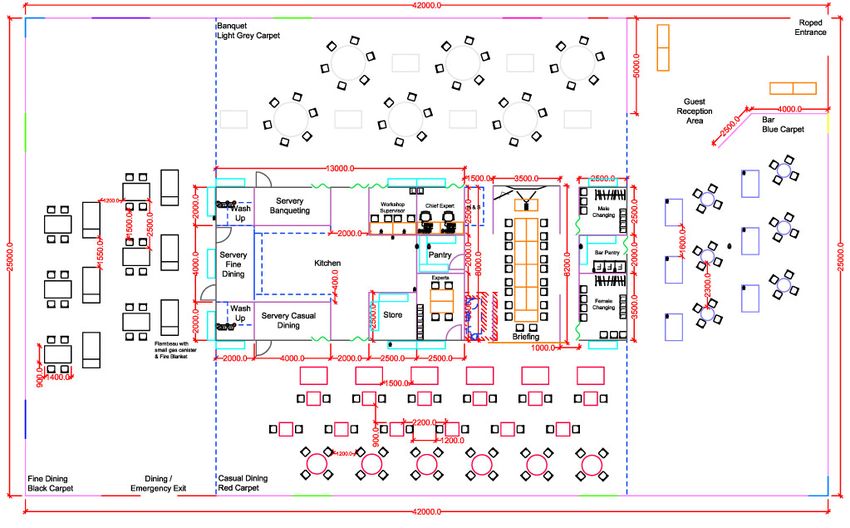
7.5 Proposed workshop and workstation layouts
Workshop layouts from London are available at:
http://www.worldskills.org/index.php?option=com_halls&Itemid=540
Workshop layout:
WSC2013_TD35_EN Copyright © WorldSkills International. All rights reserved.
Date: 11.10.11 – v4.0 Restaurant Service 14 of 158. MARKETING THE SKILL TO VISITORS AND MEDIA
8.1 Maximising visitor and media engagement
Following is a list of possible ideas to maximise visitor and media engagement:
Test Project descriptions
Career opportunities
Invitation for media/sponsors for meal service
Try-a-trade (Competition Organiser)
Display screen (Competition Organiser)
8.2 Sustainability
Recycling – paper, cardboard, glass, plastic, food waste
Use of green materials where possible
Service of food and beverages to customers to avoid wastage
Competitors marked on their ‘green’ practices
Small toolboxes
WSC2013_TD35_EN Copyright © WorldSkills International. All rights reserved.
Date: 11.10.11 – v4.0 Restaurant Service 15 of 15You can also read


