Saskatchewan Influenza Immunization Policy 2020-2021 - September 2020
←
→
Page content transcription
If your browser does not render page correctly, please read the page content below
Saskatchewan Influenza
Immunization Policy 2020-2021

        September 2020
DISCLAIMER
Content within the Saskatchewan Influenza Immunization Policy (‘SIIP’) is presented for health sector
purposes only. The SIIP is subject to change and the Government of Saskatchewan reserves the right to
update the content. It is important that the most current annual version of the SIIP is being used by
immunizers administering publicly funded influenza (flu) vaccines. The most current version of SIIP can
be accessed at https://www.ehealthsask.ca/services/Manuals/Pages/default.aspx
The SIIP is presented with the intent that it is readily available for non-commercial, informational use by
health care providers involved in the distribution and administration of publicly funded flu vaccine and is
not intended for the general public. Except where prohibited, the SIIP may be reproduced, in part or in
whole and by any means without charge or further permission from the Government of Saskatchewan,
provided that users exercise due diligence in identifying the SIIP and the Government of Saskatchewan
as the source.
SUMMARY OF UPDATES AND RECOMMENDATIONS
A process to document staff and attendees (including location, names, contact information and
in/out times) at the location on a daily basis must be developed and implemented in order to
facilitate contact tracing should a COVID-19 positive client attend the location. This documentation
must be made available, upon request by public health, whether the vaccine is administered at the
pharmacy or in an alternate location separate from the pharmacy, or at a public health clinic.
There is a new process to approve pharmacy requests for flu vaccine that includes an application
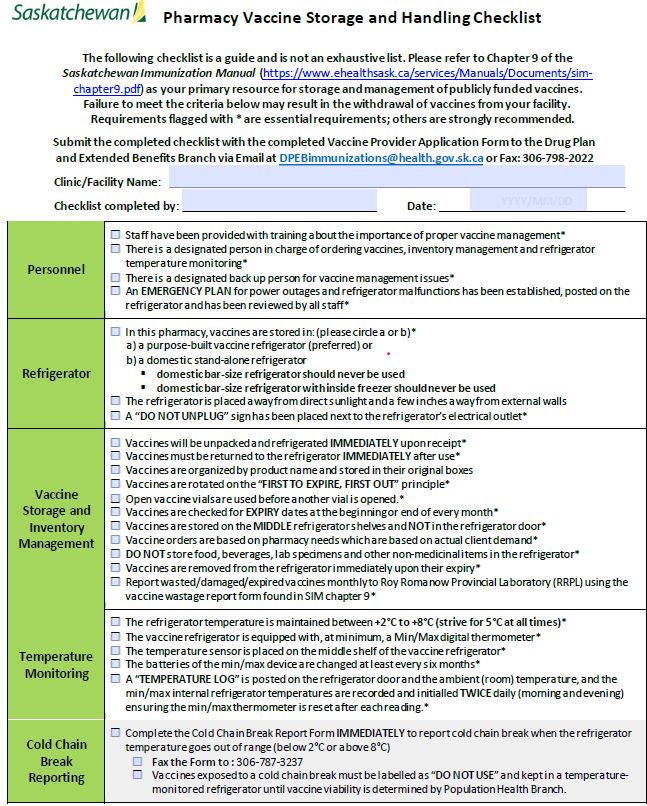
form and a vaccine storage and handling checklist found in Appendices 16 and 17. The application
form and checklist are reviewed by the Ministry of Health for approval. A corresponding policy
which outlines the process for pharmacists is available from the Ministry of Health upon request.
Physical distancing and infection control guidelines and recommendations are included.
A suggested mass flu immunization clinic supply list is noted in the appendices.
Providers should prepare their mass flu immunization clinics for high client volumes pending vaccine
availability. The Ministry is recommending booked appointments to assist in managing vaccine and
immunization supplies, and staffing requirements. Public health is best positioned to respond to the
needs of their communities in making flu vaccine accessible to clients.
Wallet cards from 2019-20 can continue to be used in 2020-21. A revised wallet card will be shipped
upon the Government’s Publication Centre’s deletion of 2019-20 stock. A reference to the
MySaskHealthRecord is noted on side 2 of the revised wallet card.
The Saskatchewan Health Authority (SHA) is to use program promotion materials as developed by
the SHA.
Personal care home residents who are 65 years and older are eligible to receive Fluzone High Dose
flu vaccine.
Influenza immunization is a critical public health service. There are no limitations regarding the
number of people that can attend a mass immunization clinic at any given time.
The immunization needs of socially vulnerable populations, such as those in shelters (i.e., homeless,
men’s, women’s), those who are street involved, and those in self-isolation, etc. is imperative to
accommodate increased vaccine coverage.
2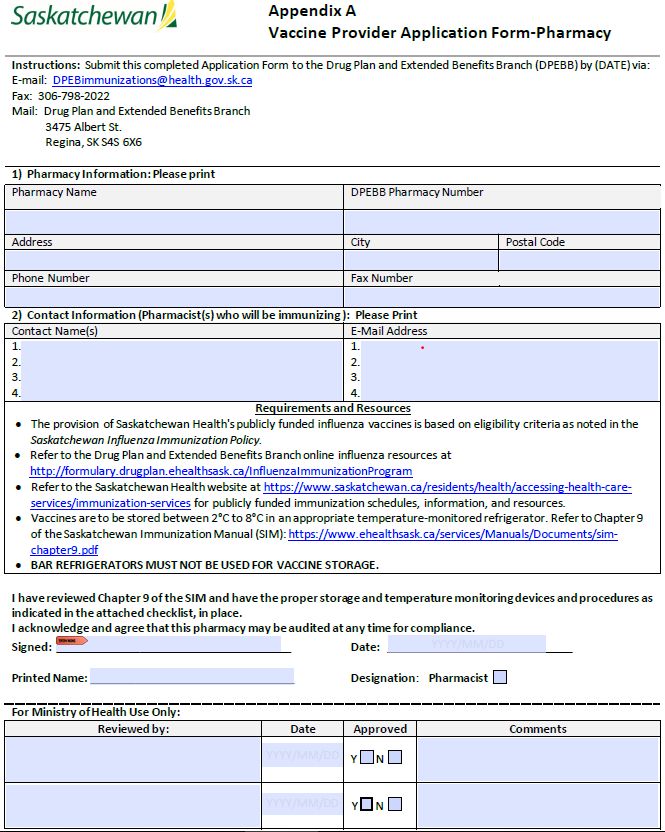
Table of Contents

Acronyms and Definitions .............................................................................................. 4
Overview of 2020-2021 Influenza Season ................................................................. 6
1.         Purpose....................................................................................................................... 7
2.         Legislative Authority ................................................................................................... 7
3.         National Recommendations ....................................................................................... 7
4.         Influenza Program Dates ............................................................................................ 7
5.         Client Eligibility ........................................................................................................... 7
6.         Education/Training ..................................................................................................... 9
7.         Vaccine Supply, Distribution and Inventory ............................................................. 11
8.         Administration of Vaccine ........................................................................................ 11
9.         Cold Chain Break Management ................................................................................ 12
10.        Influenza Vaccine Wastage ...................................................................................... 12
11.        Adverse Events Following Immunization ................................................................. 13
12.        Recording Requirements (Client Record Documentation) ...................................... 14
13.        Reporting Requirements (Administration Statistics) ............................................... 16
14.        Charges/Billing.......................................................................................................... 17
15.        Communications....................................................................................................... 17

Appendices ....................................................................................................................... 18
      Appendix 1: 2020-21 Publicly Funded Influenza Vaccines ............................................. 18
      Appendix 2: Community Pharmacist Delivery of Publicly Funded
         Influenza Vaccine...................................................................................................... 19
      Appendix 3: Cold Chain Break Report ............................................................................ 20
      Appendix 4: How to Complete the Cold Chain Break Report ........................................ 22
      Appendix 5: Product Wastage Report ............................................................................ 23
      Appendix 6: Vaccine Supply Problem Report................................................................. 24
      Appendix 7: Adverse Events Following Immunization for Publicly
         Funded Influenza Vaccines ....................................................................................... 25
      Appendix 8: Sample Notification of Administration of Influenza Vaccine..................... 26
      Appendix 9: SHA, AHA, and FNJ Public Health Office Contact
         Information for Notification and AEFI Report Submission ...................................... 27
      Appendix 10: Data Collection and Submission Processes for SHA, AHA and FNJ
         2021-21..................................................................................................................... 28
      Appendix 11: Influenza Statistical Collection Form 2020-21 ......................................... 31
      Appendix 12: Resources available from the Publication Centre ................................... 32
      Appendix 13: Recording Historical Immunization – Influenza Vaccines for Children
         Younger than 9 Years of Age ................................................................................... .33
      Appendix 14: Mass Clinic Infection Control Recommendations .................................... 34
      Appendix 15: Public Health Immunization Supply List Recommendation ..................... 35
      Appendix 16: Vaccine Provider Application Form………………………………………………………37
      Appendix 17: Pharmacy Vaccine Storage and Handling Checklist………………………………38

                                                                                                                                              3
ACRONYMS
AHA         Athabasca Health Authority                        PHB       Population Health Branch
AEFI        Adverse Events Following Immunization             PIP       Pharmaceutical Information Program
CCB         Cold Chain Break                                  POS       Point of Service (documentation)
CMHO        Chief Medical Health Officer                      PVD       Provincial Vaccine Depot
DPEBB       Drug Plan and Extended Benefits Branch            PWD       Pharmacy Wholesale Distributor
FNJ         First Nations Jurisdiction                        PSPC      Public Services and Procurement Canada
GBS         Guillain-Barré Syndrome                           QIV       Quadrivalent influenza vaccine
HSN         Health Services Number                            RRPL      Roy Romanow Provincial Laboratory
HCW         Healthcare Worker                                 SHA       Saskatchewan Health Authority
LTC         Long-term Care                                    SIIP      Saskatchewan Influenza Immunization Policy
MHO         Medical Health Officer                            SIM       Saskatchewan Immunization Manual
NACI        National Advisory Committee on Immunization       TIV       Trivalent influenza vaccine
ORS         Oculorespiratory Syndrome                         VSWG      Vaccine Supply Working Group

   DEFINITIONS
   Client                         Individuals six months of age and older who are eligible for publicly funded flu vaccine.
   Cold Chain Management         The process that maintains optimal temperature and light conditions during the transport,
                                 storage, and handling of vaccines. This starts at the manufacturer and ends with the
                                 administration of the vaccine to the client.
   Congregate Living Settings    In SIIP, Congregate Living Settings are defined as for profit or not-for-profit public or privately
                                 owned buildings (e.g., which house residents who may have mobility, accessibility and/or
                                 cognitive challenges). They may or may not be licensed by the Government of Saskatchewan.
                                 These settings do not receive contracted or ongoing services from public health or other
                                 Athabasca Health Authority (AHA), Saskatchewan Health Authority (SHA), or First Nations
                                 Jurisdictions (FNJs) health practitioners, and have no operational affiliation to the AHA, SHA, or
                                 FNJ (i.e. are not an AHA, SHA, FNJ or Affiliate facility). Examples of congregate living settings
                                 include assisted living/seniors independent housing and group homes.
   Group homes                   Residences where staff ensure that the physical, emotional, and social needs of people with
                                 intellectual disabilities are met and that they are able to live as independently as possible within
                                 their own communities. Personal care, supervision, and support for adults is provided. They are
                                 located in residential neighbourhoods throughout the province.
   First Nations Jurisdictions   Includes the communities and organizations affiliated with First Nations and Inuit Health Branch
                                 and the Northern Inter-Tribal Health Authority.
   Healthcare worker             Healthcare workers (HCWs) are those employed by the SHA, AHA, and FNJ facilities or
                                 affiliated facilities and does not include volunteers, students or physicians.
   Health Services Number        The unique identifier assigned by Saskatchewan Health for identification within
                                 Saskatchewan’s health system. A Health Services Number (HSN) is assigned to a person
                                 upon registration and presumes eligibility for basic health services as defined by
                                 Saskatchewan Health.
   Home visits                   The intent of off-site home visits by community pharmacists, home care or public and
                                 community health is to provide enhanced accessibility to those patients at high-risk of
                                 influenza-related complications and who may have mobility issues or cognitive deficits.
   Long-term care facility       A facility that provides long-term care (LTC) services to meet the needs of individuals, usually
                                 with heavy care needs (level three and four), that cannot be met through home-
                                 based/community services. The SHA may operate a special-care home directly or through
                                 affiliation/contract. LTC services may include adult day programs, night programs, respite, and
                                 rehabilitative, convalescent and palliative care.
   Mass Immunization Clinic      Mass immunization involves delivering immunizations to a large number of people at one or
                                 more locations in a short interval of time. Good mass immunization programs apply planning and
                                 quality standards that maximize return on resources invested and provide the greatest individual
                                 benefits when immunizing many people in a short period of time. These programs can be used to
                                 counter contagious outbreaks, adopted as a repeated means of sustained healthcare delivery, or
                                                                                                                          4
applied where many people move through a specific place in a short interval of time. Relevant
quality standards address appropriate facilities and supplies, training of professional and
paraprofessional staff, education of potential vaccinees and methods to screen them for
contraindications to immunization, safeguards against anaphylaxis and syncope, documentation,
safety surveillance, and a quality-improvement program. Successful mass immunization
programs require early planning that builds on existing competencies. These clinics may be drop-
in or by appointment only.
Panorama The electronic integrated public health information system utilized by AHA and SHA public
health providers and community nursing providers in some FNJs.
Panorama Immunization A module within Panorama that provides a record of all immunizations administered by public
Module health. It serves as the electronic registry for immunization in Saskatchewan.
Panorama Inventory A module within Panorama that tracks publicly funded vaccine use and availability. It
Module supports management of vaccine ordering, shipping, receiving, and reconciliation.
Personal care homes (PCH) Privately owned and operated facilities that offer accommodation, meals and supervision
or assistance with personal care to people who generally do not need or do not want the
level of health services provided in publicly subsidized special-care homes. It is the
combination of providing both accommodation and care that makes a facility a PCH.
Pharmacy Association of The association that represents pharmacists and pharmacies in Saskatchewan.
Saskatchewan
Pharmaceutical Information The Pharmaceutical Information Program (PIP) is a secure computer application that provides
Program health care providers with information regarding prescriptions dispensed in Saskatchewan
community pharmacies.
Pharmacy Wholesale A pharmacy wholesale distributor that has an agreement with the Saskatchewan Ministry of
Distributors Health for the distribution of publicly funded flu vaccine to pharmacists.
Privately Purchased Flu vaccine purchased by pharmacies or prescribed by a pharmacist, physician,
Influenza Vaccine registered nurse (RN), or nurse practitioner (RN(NP)) and paid for by the client.
Provincial Vaccine Depot The provincial vaccine depot is housed in the Roy Romanow Provincial Laboratory (RRPL).
Publicly funded flu vaccine is received through the RRPL Provincial Vaccine Depot for
further distribution across Saskatchewan.
Saskatchewan College of The self-governing body for the profession of pharmacy in Saskatchewan that regulates
Pharmacy Professionals pharmacists, pharmacies, pharmacy technicians, and drugs.
Saskatchewan Influenza The publicly funded seasonal flu program delivered via the SIIP from October to March 31.
Immunization Program
Saskatchewan The primary immunization resource for public health personnel, the Saskatchewan
Immunization Manual Immunization Manual (SIM) provides evidence-based and standardized immunization-related
information.
Vaccine Management The processes used to maintain optimal temperature and light conditions during the transport,
storage, and handling of vaccines.
Vaccine Provider A licensed healthcare provider to whom provision of vaccine is permitted by legislation
governing that provider, is in compliance with the SIIP, and meets one of the following
criteria:
designated by the SHA, AHA and FNJs, and their affiliates, to provide flu vaccine services;
a physician;
a nurse practitioner; or
a community pharmacist.
5UPDATES FOR THE 2020-2021 INFLUENZA SEASON
Public Launch:
October 19, 2020, is the start date for all providers and mass public health clinics, providing that
vaccine is available. First Nations Jurisdictions and northern communities may immunize as soon
as flu vaccine is received.
Publicly Funded Vaccine Products (refer to Appendix 1):
FLUZONE® Quadrivalent and FluLaval Tetra® (quadrivalent) multidose vials for all immunizers.
FLUZONE® Quadrivalent thimerosal-free pre-filled syringes available to public health within the
SHA, the AHA and FNJs.
FLUZONE® High Dose (trivalent) prefilled syringes for LTC and PCH residents 65 years and older.
Mass Clinic Guidelines
Immunizers must ensure that infection and crowd control measures are in place to reduce the risk of
COVID-19 transmission at mass clinics. Refer to Appendix 14 and the Public Health Agency of Canada’s
"Guidance for Influenza Vaccine Delivery in the Presence of COVID-19”
(https://www.canada.ca/en/public-health/services/immunization/national-advisory-committee-on-
immunization-naci/guidance-influenza-vaccine-delivery-covid-19.html) for recommendations.
Documentation Requirements:
When possible, all immunizations administered at a public health clinic should be entered into
Panorama at point of service or within one business day.
All pharmacists are required to report immunization details for children younger than nine years of age
to the Drug Plan and Extended Benefits Branch (DPEBB) for entry into Panorama; see Section 12:
Client Record Documentation Requirements for specific details.
All other non-public health vaccine providers are required to report immunization details for children
younger than nine years of age and residents of Personal Care Homes to public health for entry into
Panorama; see Section 12: Client Record Documentation Requirements for specific details.
Publicly funded influenza vaccines entered into Panorama must identify the provider type (e.g. public
health, physician, RN/NP) (see Appendix 13).
Vaccine Inventory
SHA, AHA and FNJs
For the SHA, the Athabasca Health Authority (AHA) and the First Nations Jurisdictions (FNJs):
from October 19, 2020, to December 31, 2020, weekly flu vaccine counts for the previous
Sunday to Saturday period are required to be reconciled in the Panorama Inventory Module by
noon the following Tuesday. The first inventory count is due on Tuesday October 27, 2020.
From January 1, 2021, to March 31, 2021, monthly vaccine counts are required.
Timelines and frequency for vaccine inventory monitoring are subject to change by the Ministry of
Health. More frequent inventory monitoring may be required.
Inventory information must be accurate. The SHA, AHA and FNJs must ensure that staff members
are appropriately trained and compliant with ensuring the Panorama Inventory Module is up-to-
date as per timelines outlined above.
The ‘pick/pack/ship’ function of Panorama is utilized to move vaccines in/out of vaccine
inventories so that vaccine counts remain accurate.
Pharmacists
The inventory reporting process is coordinated by the Drug Plan and Extended Benefits Branch
(DPEBB) using weekly reports from the Pharmacy Wholesale Distributor (PWD) for the quantity of
vaccine ordered and shipped to pharmacies, and from the DPEBB claims database for the number
of vaccine doses administered by pharmacists.
61. PURPOSE
Influenza is a vaccine-preventable disease. The provincial goal is to protect targeted populations such
as the elderly, the very young, pregnant women and those living with chronic or immune-
compromising conditions who are particularly vulnerable to influenza and related complications.
Objectives:
1. Provide access to publicly funded flu vaccine for Saskatchewan residents.
2. Reduce the incidence and impact of influenza disease in Saskatchewan.
All vaccine providers must work together to implement the SIIP. Collaboration, coordination, and
communication among immunizers during all phases of the program (from vaccine distribution to front
line administration to reporting of wastage) strengthen Saskatchewan’s capacity to reduce the impact of
influenza disease and contribute to the health and well-being of Saskatchewan residents.
2. LEGISLATIVE AUTHORITY
The SIIP is an established immunization policy of the Saskatchewan Ministry of Health.
3. NATIONAL RECOMMENDATIONS
The National Advisory Committee on Immunization (NACI) produces an annual influenza statement that
contains specific information and recommendations regarding the licensed vaccines for the forthcoming
season https://www.canada.ca/en/public-health/services/publications/vaccines-
immunization/canadian-immunization-guide-statement-seasonal-influenza-vaccine-2020-
2021.html?hq_e=el&hq_m=2003412&hq_l=1&hq_v=91d220e044. The Ministry of Health references the
NACI recommendations to inform annual planning and makes final policy recommendations with
consideration to Saskatchewan’s context.
4. INFLUENZA PROGRAM DATES
The provincial publicly funded influenza program is scheduled to begin on October 19, 2020, and
end on March 31, 2021. Children younger than age nine requiring a second dose of vaccine can
receive immunization until April 30, 2021.
To ensure coordinated access to publicly funded flu vaccine in Saskatchewan, all vaccine providers
are required to comply with the provincial start date unless otherwise approved by the Ministry of
Health.
Consultation with the Chief Medical Health Officer (CMHO) is required if requests are received for
earlier start dates than those stated. For example, during an outbreak in a licensed facility,
immunization may be permitted to start earlier in that facility pending discussion with the CMHO.
FNJs and northern communities are prioritized for vaccine distribution in the province and can start
immunizing (by public/community health only) as soon as they receive vaccine.
Vaccine providers should schedule the administration of influenza vaccine as of October 19, 2020,
onwards with the priority groups being those at high-risk of influenza-related complications.
An extension to the flu vaccine administration season may be established by the CMHO in the event
of increased disease presence or severe morbidity with influenza disease.
5. CLIENT ELIGIBILITY
Individuals six months of age and older who do not have contraindications are eligible to receive publicly
funded flu vaccine. Particular groups are highly recommended to receive QIV or High Dose Flu vaccine to
reduce the incidence and burden of influenza disease and related health complications (see Table 1). As
the program aims to reach priority populations most at risk of complications from influenza, publicly
funded flu vaccine is provided to the SHA, AHA, FNJs, as well as physicians, community pharmacists and
select facilities providing health care services to these target populations. Publicly funded vaccines are
not provided for private company/business employee health programs. Exceptions may be considered in
consultation with the Saskatchewan Ministry of Health in the event of possible increased disease
presence or severe morbidity related to influenza.
It is expected that vaccine providers confirm client eligibility to receive vaccine prior to administration.
7Confirmation may be obtained by interviewing the client, reviewing the client’s paper documentation
and/or record within Panorama, the PIP and the eHR Viewer.
Table 1: Populations for Whom Influenza Vaccination is Particularly Recommended
Publicly funded flu vaccine may be administered to people who are six months of age and older who do not
have vaccine contraindications. High dose flu vaccine is available for LTC and personal care home residents
who are 65 years and older. In particular, the following people are highly recommended to receive the flu
vaccine to reduce the incidence and burden of influenza disease and related health complications:
All HCWs, health care students, emergency response workers, visitors, and volunteers who, through their
activities, are capable of transmitting influenza to those at high-risk of influenza complications in
independent practices, facilities, residences, and community settings.
Adults (including pregnant women) and children ≥6 months with a chronic health condition, including but
not limited to:
Cardiac or pulmonary disorders (including bronchopulmonary dysplasia, cystic fibrosis, and asthma);
Diabetes mellitus and other metabolic diseases;
Cancer and other immune-compromising conditions (due to underlying disease, therapy or both);
Renal disease;
Anemia or hemoglobinopathies;
Neurologic or neurodevelopmental disorders and seizure disorders (and for children include febrile
seizures and isolated developmental delay) but excludes migraine and psychiatric conditions without
neurological conditions;
Morbid obesity (adults BMI ≥ 40, child BMI assessed as ≥ 95th percentile adjusted for sex and age).
Children and adolescents with the following conditions:
Those undergoing treatment for long periods with acetylsalicylic acid because of the potential
increase of Reye syndrome associated with influenza.
People of any age who are residents of nursing homes, long-term care facilities and other chronic care
facilities.
People ≥ 65 years of age.
All children six to 59 months of age (younger then five years old).
Indigenous peoples.
Shelter residents and those who are street involved.
Visitors to health care facilities and other patient care locations.
Household and close contacts of individuals at high-risk of influenza-related complications whether or not
the individual at high-risk has been immunized.
Household and close contacts of infants less than six months of age.
Members of households who are expecting a newborn during the influenza season.
Those providing regular childcare to children ≤ 59 months of age, whether in or out of the home.
Those who provide services within closed or relatively closed settings to persons at high-risk.
People who provide essential community services (e.g. provincial corrections staff who have direct
contact with inmates).
People in direct contact during culling operations with poultry infected with avian influenza.
People working with live or dead poultry or swine.
Health sciences students (human and animal health).
Travellers – influenza occurs year-round in the tropics. In temperate northern and southern countries,
influenza activity peaks generally during the winter season (November to March in the Northern
Hemisphere and April to October in the Southern Hemisphere).
86. EDUCATION/TRAINING
Vaccine Information
FLUZONE® Quadrivalent (QIV) and FluLaval® Tetra (quadrivalent multidose vials for all immunizers)
and FLUZONE® Quadrivalent thimerosal free pre-filled syringes (SHA, AHA and FNJ public health
only) are publicly funded for those six months of age and older and contain the following viral
strains:
an A/Guangdong-Maonan/SWL1536/2019 (H1N1)pdm09-like virus;
an A/Hong Kong/2671/2019 (H3N2)-like virus;
a B/Washington/02/2019 (B/Victoria lineage)-like virus; and
a B/Phuket/3073/2013 (B/Yamagata lineage)-like virus.
FLUZONE® High Dose (trivalent thimerosal-free pre-filled syringes) is publicly funded for LTC and
PCH residents 65 years and older and contains the following viral strains:
an A/Guangdong-Maonan/SWL1536/2019 (H1N1)pdm09-like virus;
an A/Hong Kong/2671/2019 (H3N2)-like virus; and
a B/Washington/02/2019 (B/Victoria lineage)-like virus.
These vaccines are safe for use in persons with latex allergy.
Fluzone® Quadrivalent thimerosal-free pre-filled syringes are prioritized for people who self-identify
as having a diagnosed thimerosal allergy (documentation is not required). It may be administered to
others who request it. It is only available to public health; other vaccine providers should refer
clients requesting thimerosal-free vaccine to public health for administration.
These vaccines may be given concomitantly with, or at any time before or after, live attenuated
vaccines or inactivated vaccines.
The Ministry of Health does not reimburse the cost of privately-purchased flu vaccines.
See Appendix 1: 2020-21 Publicly Funded Influenza Vaccines for vaccine specific information.
The doses required per age are noted in Table 2.
All providers of publicly funded flu vaccine are responsible for reviewing the SIIP and other influenza-
related materials prior to the start of the flu vaccine administration season. This may include completion
of an employer-mandated education session.
With the support of the Ministry of Health, the Saskatchewan College of Pharmacy Professionals and the
Continuing Professional Development for Pharmacy Professionals, the College of Pharmacy and
Nutrition, University of Saskatchewan, developed the Advanced Method Certification Requirements –
Injection certification for pharmacists. Pharmacists are required to complete the injection certification
training prior to administering vaccine:
https://www.usask.ca/cpdpp/continuing-education-/imtraining.php#ImmunizationandInjections
Additional flu vaccine resources include (but are not limited to):
Saskatchewan Immunization Manual:
https://www.ehealthsask.ca/services/Manuals/Pages/SIM.aspx
Saskatchewan Influenza Fact Sheets: http://www.saskatchewan.ca/residents/health/accessing-
health-care- services/immunization-services#immunization-forms-and-fact-sheets
The NACI 2020-21 influenza vaccine statement available https://www.canada.ca/en/public-
health/services/publications/vaccines-immunization/canadian-immunization-guide-statement-
seasonal-influenza-vaccine-2020-2021.html?hq_e=el&hq_m=2003412&hq_l=1&hq_v=91d220e044.
Screening, Precautions and Contraindications
Persons who had an anaphylactic reaction to a previous flu vaccine dose or to any of the
components in a specific vaccine (with the exception of egg), or who developed Guillain-Barré
Syndrome (GBS) within six weeks of a live or inactivated influenza vaccination, should not receive
further doses of any flu vaccines.
9 Vaccine administration should be postponed when possible in persons who have a minor or acute
illness, with or without a temperature based on current COVID-19 screening criteria, until their
symptoms have abated.
As with all vaccine administration, immunizers must have the necessary equipment and medications
to be prepared to respond to a vaccine emergency at all times.
Egg-allergic individuals can receive a full dose of an injectable flu vaccine without prior flu vaccine
skin testing, including those who have experienced anaphylaxis due to egg ingestion, as a routine
practice that is supported by NACI.
Oculorespiratory syndrome (ORS) is defined as the presence of bilateral red eyes plus one or more
respiratory symptoms (cough, wheeze, chest tightness, difficulty breathing, difficulty swallowing,
hoarseness or sore throat) with or without facial edema, that start within 24 hours of vaccination.
ORS is not considered to be an allergic response. Persons who experienced ORS with lower
respiratory tract symptoms should have an expert review. Health care providers who are unsure
whether an individual previously experienced ORS versus an IgE-mediated hypersensitivity immune
response should seek advice. Although the pathophysiologic mechanism underlying ORS remains
unknown, it is considered distinct from an IgE-mediated allergic response.
Persons who have a recurrence of ORS upon revaccination do not necessarily experience further
episodes with future vaccinations. Data on clinically significant adverse events do not support the
preference of one vaccine product over another when revaccinating those who have previously
experienced ORS.
Consent for Immunization
All immunizations in Saskatchewan are voluntary and immunization fact sheets must be made
available to clients. The English influenza fact sheets can be ordered from
http://publications.saskatchewan.ca/#/categories/473. All English and French influenza fact sheets
are posted at: http://www.saskatchewan.ca/residents/health/accessing-health-care-
services/immunization-services#immunization-forms-and-fact-sheets.
Post-immunization, providers can provide clients with a Ministry of Health Record of Influenza
Immunization Wallet Card bearing the client’s name and date of immunization (Picture 1: Ministry
of Health Record of Influenza Immunization Wallet Card)
Picture 1: Ministry of Health Record of Influenza Immunization Wallet Card
Record of Influenza Immunization wallet cards may be provided by the SHA, AHA and FNJ public
health to other vaccine providers who obtain their vaccine supply from public health. Community
pharmacies can order these wallets cards free of charge through the Ministry of Health’s Publication
Centre website at http://publications.gov.sk.ca/deplist.cfm?d=13&c=1073.
Advise those individuals whose immunizations are entered in Panorama, that they will be able to
view their immunization record in MySaskHealthRecord.
All individuals must be screened and assessed for contraindications and precautions prior to
immunization.
Flu vaccine is safe and well-tolerated. Immunization providers should discuss with clients:
The risks and benefits of the flu vaccine, as well as the risks of not being immunized.
10 Vaccination is the most effective way to prevent influenza and the spread of influenza
viruses.
Each year there are new flu vaccine formulations to protect against the influenza virus strains
that are expected in the coming influenza season. Even if the strains have not changed, getting
the flu vaccine every year is necessary to maximize protection.
7. VACCINE SUPPLY, DISTRIBUTION AND INVENTORY
The Ministry of Health purchases flu vaccine through a national procurement process. The majority of
flu vaccine is received by the Provincial Vaccine Depot (PVD) located at the RRPL from vaccine
manufacturers over several months. The PVD distributes vaccine throughout the influenza season,
balancing immunization provider demand for vaccine with vaccine supply and availability. Access to flu
vaccine supply is closely monitored. The PVD ships flu vaccine to:
1. The SHA, FNJ and AHA vaccine depots for further distribution to all public program vaccine
providers, excluding community pharmacists. Vaccine orders are placed using the Panorama
Inventory Module.
2. The PWDs (e.g. McKesson Canada, Kohl & Frisch Ltd.) for distribution to community pharmacies.
Allocation for Vaccine Providers
The Ministry of Health has allocated vaccine quantity for the SHA, AHA, FNJs and community pharmacies
based on the latest covered population statistics and doses administered in the previous year. The
Vaccine Provider Application Form and the Vaccine Storage and Handling Checklist must be completed
by each pharmacy and submitted to the Ministry for reviews before they can receive publicly funded flu
vaccine.
The provincial allocation plan supports vaccine providers in planning for the influenza season with a
focus on early uptake in the season. The Ministry of Health will have an unallocated reserve to provide
additional support to areas where significant uptake and/or need occurs. The Ministry may also
reallocate vaccine from the original provincial allocation as of December 1, 2020, depending on
immunization provider supply needs throughout the influenza season.
For pharmacists, the pre-order quantity of QIV is 20 units (200 doses) and the daily order quantity is
seven units (70 doses). Fluzone® High Dose is in packages of five pre-filled syringes and is to be only
ordered for the number of PCH residents to be immunized per pharmacy. Order quantities are subject
to change based on flu vaccine availability at the wholesalers. Requests for exceptions to the ordering
thresholds may be considered by contacting the Saskatchewan Ministry of Health DPEBB at 306-787-
6970. Pharmacies are not permitted to share/provide/receive flu vaccine to/from other
pharmacies/pharmacists or other provider such as physicians without permission from the DPEBB.
8. ADMINISTRATION OF VACCINE
Table 2: Influenza Vaccine by Age and Dosage
Age Vaccine Dosage (mL) Number of doses
required per season
6 months to 8 years QIV 0.5 mL IM 1 or 2 *
≥9 years (excluding LTC QIV 0.5 mL IM 1
residents ≥65 years)
LTC/PCH residents ≥65 years FLUZONE® High Dose TIV 0.5 mL IM 1
(or QIV 0.5 mL if unavailable)
* Children six months to eight years of age ( QIV flu vaccines will be available until April 30, 2021 to allow children who received their first dose
on or prior to the March 31, 2021 program end date to receive their second dose.
Prior to vaccinating all clients but particularly children five to eight years of age, non-public health
providers will ask each client about their immunization history before reviewing PIP and the client’s
immunization record in the eHealthViewer .
Off-site delivery of flu vaccine by pharmacists is intended to address barriers to flu immunization for
target populations (e.g., frail seniors, immobile persons) and must be coordinated with local public
health offices in the SHA, AHA and FNJs by August 31, 2020. Should local public health confirm that
public health (or home care) services will be delivered in the site under consideration, community
pharmacists are not permitted to proceed with delivery of flu vaccine at that site unless the transfer of
responsibility is agreed to by public health. Delivery to congregate living settings must further be
coordinated with the facility by the community pharmacy. For further information regarding off-site flu
vaccine immunization service delivery, including contact information for local public health offices; see
Appendix 2: Community Pharmacists Delivery of Publicly Funded Influenza Vaccine.
9. COLD CHAIN BREAK MANAGEMENT
Appropriate storage and handling of vaccine is essential to provide safe and effective product to the
public. Detailed requirements are outlined in the SIM, Chapter 9 – Management of Biological Products
http://www.ehealthsask.ca/services/manuals/Documents/sim-chapter9.pdf. All known exposures of flu
vaccine to temperatures outside of +2.0 – 8.0 degrees Celsius must be reported as soon as possible and
within one business day of the occurrence. See Appendix 3: Cold Chain Break Report form. Following
review of the reported cold chain break (CCB), the Ministry will provide confirmation of whether the
vaccine remains viable or should be wasted by the vaccine provider as outlined in section 10.
Report all CCBs as follows:
A. Community pharmacists:
Refer to Appendix 3 How to Complete the Cold Chain Break Report Form. Complete the Cold
Chain Break Report in Appendix 4
(http://www.ehealthsask.ca/services/manuals/Documents/sim-chapter9.pdf) and fax directly to
the Ministry of Health at 306-787-3237.
B. All other vaccine providers:
Refer to Appendix 3 How to Complete the Cold Chain Break Report Form. Complete the Cold
Chain Break Report in Appendix 4
(http://www.ehealthsask.ca/services/manuals/Documents/sim-chapter9.pdf) and fax directly to
the SHA, AHA or FNJ local area Immunization Coordinator or designate for review (noted in
Appendix 9).
10. INFLUENZA VACCINE WASTAGE
In order to mitigate wastage at the end of the influenza season, a judicious approach to flu vaccine
ordering is required.
Ongoing Wastage Reporting for the SHA, AHA, FNJs, and Community Pharmacists:
All flu vaccine that is wasted must be recorded on the Product Wastage Report form
http://www.ehealthsask.ca/services/manuals/Documents/sim-chapter9.pdf (see Appendix 5) on a
monthly basis and faxed by the 5th day of the following month to the RRPL at 306-798-0071. Wasted flu
vaccines must be disposed of locally according to regional bio-medical waste policy and procedures.
Ongoing Wastage Reporting for all other Vaccine Providers:
All flu vaccine that is wasted by other providers (e.g. physicians, nurse practitioners, other nursing
offices) must be recorded on the Product Wastage Report form
http://www.ehealthsask.ca/services/manuals/Documents/sim-chapter9.pdf (see Appendix 5) on a
12monthly basis and provided to your local public health office on monthly basis.
Vaccine Problem Reporting for all Vaccine Providers:
If the vaccine wastage is due to a defective product, a Vaccine Supply Problem Report
http://www.ehealthsask.ca/services/manuals/Documents/sim-chapter9.pdf (see Appendix 6) must also
accompany the Product Wastage Report form as outlined above.
End of Season Wastage Reporting for the SHA, AHA, FNJs, and Community Pharmacists:
The Ministry of Health will send direction to the SHA, AHA, FNJs, community pharmacies and pharmacy
wholesale distributors as to the management of any remaining flu vaccine stock at the end of the
influenza season. If vaccine providers are directed to return vaccine to the PVD at the RRPL, they are
responsible to ship the returned vaccine following PVD instructions. Further information regarding flu
vaccine wastage, including vaccine problem reporting (See Appendix 6: Vaccine Supply Problem Report)
and vaccine returns, can be found in the SIM, Chapter 9 – Management of Biological Products
http://www.ehealthsask.ca/services/manuals/Documents/sim-chapter9.pdf.
11. ADVERSE EVENTS FOLLOWING IMMUNIZATION
Monitoring the health and safety of those people to whom flu vaccine is administered is paramount.
Immunizers must have protocols in place for the management and reporting of anaphylaxis and other
serious adverse events. In Saskatchewan, the reporting of all adverse events following immunization
(AEFIs) is mandatory under The Public Health Act, 1994.
To ensure patient safety, all immunizers shall immediately report any unusual, severe, serious or
unexpected adverse events assessed to be temporally related to publicly funded flu immunization utilizing
the Public Health Agency of Canada (PHAC) Report of Adverse Event Following Immunization form. Non-
public health vaccine providers must fax this form to their SHA, AHA or FNJ local public health office as
noted in Appendix 7: Adverse Events Following Immunization (AEFI) for Publicly Funded Influenza
Vaccine. All publicly funded flu AEFI reports will be reviewed by a SHA, AHA or FNJ Medical Health Officer
(MHO). Only a MHO is qualified to make recommendations following a reported client AEFI.
MHO recommendations will guide future flu immunizations for the client. These recommendations will
be communicated to the client by the reporter or other designates (e.g. the vaccine provider). See
Appendix 7: Adverse Events Following Immunization (AEFI) for Publicly Funded Influenza Vaccine.
Vaccine providers must report, using the above process, all AEFIs temporally related to flu vaccine
administered in a previous season but only communicated by the client upon presentation for vaccine
this season. Administration of flu vaccine should be delayed until receipt of the MHO recommendation.
An unexpected AEFI is an event that is not listed in the product monograph yet may be due to the
immunization, or a change in the frequency of a known AEFI. GBS within six weeks following
immunization and ORS within 24 hours of immunization are of particular interest for flu vaccines.
Public health offices must immediately notify the Ministry of Health by fax at 306-787-9576 regarding
any unusual, severe, serious or unexpected AEFIs in addition to submitting an AEFI report for the client.
Publicly funded flu vaccine AEFI reports that meet reporting criteria as outlined in the PHAC’s User
Guide: Report of Adverse Events Following Immunization (AEFI) available at http://www.phac-
aspc.gc.ca/im/aefi- essi_guide/page1-eng.php, will be recorded in the client’s electronic immunization
record in Panorama by the SHA, AHA and FNJ as applicable (the client record may need to be created to
enable historical immunization information to be documented and indicate the AEFI); refer to the
Panorama User Guide Immunization: Administer Immunizations
https://collaboration.web.ehealthsask.ca/sites/panorama/community/Panorama%20V3%20Documents
/SK%20Panorama%20Administer%20Immunization%20User%20Guide%20v3.2.pdf.
As well, the SHA, AHA and FNJ will document complete AEFI reports for publicly funded flu vaccines into
the Panorama client record (if they have access) as a client warning (refer to SIM Appendix 4.2 Where do
I document? https://www.ehealthsask.ca/services/Manuals/Documents/sim-chapter4.pdf).
13NOTE: AEFI reports for all privately purchased vaccines, including influenza, must be submitted directly
to Health Canada by the immunizer: http://www.phac-aspc.gc.ca/im/pdf/raefi-dmcisi-eng.pdf. They
are not to be submitted to public health offices in the SHA, AHA and FNJs or the Saskatchewan Ministry
of Health.
12. RECORDING REQUIREMENTS - CLIENT RECORD DOCUMENTATION
A. Community Pharmacies:
Flu vaccine administration to all clients, regardless of age, must be entered into the PIP. The client may
also receive a Record of Influenza Immunization Wallet Card to serve as the client’s record of vaccine
administration.
In addition, it is required that flu vaccine immunization administered to children five to eight years of age
be entered into their client record within the Panorama Immunization Module. The Notification of
Administration of Influenza Vaccine form (see Appendix 8) must be completed, by the vaccine provider,
and forwarded, within three business day of administering the vaccine, to the DPEBB (see Appendix 9).
B. All Other Non-Public Health Vaccine Providers
It is expected that flu vaccine administration to all clients, regardless of age, be entered into the client
service record maintained by the provider. In addition, the client must receive a Record of Influenza
Immunization Wallet Card to serve as the client’s record of vaccine administration.
Flu immunization administered to children six months to eight years of age and residents of Personal
Care Homes must be entered into their client record within the Panorama Immunization Module. The
Notification of Administration of Influenza Vaccine form (see Appendix 8) must be completed, by the
provider, and forwarded, within one business day of administering the vaccine, to the local public health
office (see Appendix 9). Local public health will provide non-public health vaccine providers (excluding
community pharmacies) with line lists for use in documenting vaccine administration to clients 18 years
and older (except residents of Personal Care Homes), which are submitted to public health for data
collection.
SHA, AHA and FNJ Public Health:
Flu vaccine administered by Public Health Nurses (PHNs) to any person under 18 years old must be
entered into the client’s record within the Panorama Immunization Module. When possible, flu vaccine
administered to any person attending public health flu clinics will be entered into the client’s record
within the Panorama Immunization Module at point of service or within three business days. The client
may also receive a Record of Influenza Immunization Wallet Card to serve as the client’s record.
Immunizations provided to PCH residents by public health will be entered in Panorama. In addition to
the entry of flu vaccine provided by public health, the SHA will be responsible for back-entry into
Panorama flu vaccine provided to children younger than nine years of age by non-public health
providers (excluding pharmacists) within seven business days of receiving notification. Refer to
Appendix 13 to review standard work for historical entry. At minimum, their name, date of birth and
agent need to be entered (see Table 3 for summary).
14Table 3: Summary of Documentation Requirement by Client Age and Vaccine Provider
Age of SHA/AHA/FNJ Public Health Community Pharmacist All other Non-Public Health
client providers
6 months to 59 Consent form/line lists N/A Client record maintained by
months
Entered into provider
Panorama at POS Notification of Administration
or within 1 of Influenza Vaccine form
business day completed and submitted to
Record of Influenza public health within one
Immunization Wallet Card business day
may be provided to client Back entered by public
health into Panorama within
7 business days
Record of Influenza
Immunization Wallet Card
may be provided to client
5 to 8 years Consent form/line lists Recorded in PIP at POS Client record maintained by
Entered into Consent form provider
Panorama at POS Complete form and fax Notification of Administration
or within 1 to DEBB within 3 of Influenza Vaccine form
business day business days for data completed and submitted to
Record of Influenza entry public health within one
business day
Immunization Wallet Card Record of Influenza
may be provided to client Immunization Wallet Back entered by public
Card may be provided health into Panorama within
to client 7 business days
Record of Influenza
Immunization Wallet Card
may be provided to client
9 years to 17 Consent form/line lists Consent form Client record
years
Entered into Recorded in PIP at POS maintained by
provider.
Panorama at POS Record of Influenza
or within 1 Immunization Wallet Record of Influenza
business day Card may be provided Immunization Wallet Card
Record of Influenza to client may be provided to client
Immunization Wallet Card
may be provided to client
18 to 64 years Consent form/line lists Consent form Client record maintained by
If possible, entered into Recorded in PIP at POS provider and/or Consent
Panorama at POS or within 3 form/lists
Record of Influenza
business days. Immunization Wallet Record of Influenza
Record of Influenza Card may be provided Immunization Wallet Card
Immunization Wallet Card to client may be provided to client
provided to client
65 years and Consent form/line lists Consent form Client record maintained by
older
If possible, entered into Recorded in PIP at POS provider and/or Consent
form /lists
Panorama at POS or within 3 Record of Influenza
business days. Immunization Wallet Record of Influenza
Record of Influenza Card may be provided Immunization Wallet Card
Immunization Wallet Card to client may be provided to client
provided to client
1513. REPORTING REQUIREMENTS - ADMINISTRATION STATISTICS
The following statistical information is required by the Ministry of Health and is to be provided
to the Population Health Branch (PHB) (refer to Appendix 10: Data Collection and Submission
Processes for SHA, AHA and FNJs 2020-21):
Number of doses provided to residents in LTC facilities (include number of residents as of
November 30, 2020);
Number of doses provided to residents in PCHs;
Number of doses provided by Public Health (includes non-PHNs working in PH flu clinics) to
those six months to eight years;
Number of doses provided by non-Public Health Providers to those six months to eight
years;
Number of doses provided by Public Health (includes non-PHNs working in PH flu clinics),
non-Public Health Providers and Community Pharmacists to those five to eight years;
Number of doses provided by Public Health (includes non-PHNs working in PH flu clinics) to
those nine to 17 years;
Number of doses provided by non-Public Health Providers and Community Pharmacists to
those nine to 17 years;
Number of doses provided to individuals 18 years to 64 years of age (by all providers);
Number of doses provided to individuals ≥ 65 years of age (by all providers); and,
Number of doses provided to HCWs (by March 31, 2021) as well as the number of HCWs in
the organization (as of March 31, 2021).
The SHA, AHA, and FNJS are responsible for submitting administration statistics to the Ministry
of Health to support statistical reporting. Children six months and up to and including 17 years
of age whose immunizations are recorded into the provincial immunization registry (Panorama)
will be extracted by the Ministry of Health. When possible, persons 18 years of age or older who
received immunization at a public health mass flu immunization clinic, will have their
immunization entered in Panorama at point of service, or back entered in Panorama within
three business days. Those entered into the provincial immunization registry (Panorama) will be
extracted by the Ministry of Health. Those not entered in Panorama will be counted and
submitted manually to the Ministry of Health.
Immunizations provided in PCHs by public health and other providers who receive vaccine from
Public Health, will be entered in Panorama at point of service or within three business days.
The SHA, AHA and FNJs will be required to submit General Public immunization
stats for the previous Sunday to Saturday period by noon the following
Tuesday using the section of the SHA, AHA and FNJ Influenza Immunization
Statistical Collection Form 2020-21 (refer to Appendix 11: Influenza Statistical
Collection Form 2020-21).
The spreadsheet will be included as an email attachment when this document is distributed to
SHA, AHA and FNJs. Following December 31, 2020, January through April immunization stats are
to be submitted as indicated in Appendix 10: Data Collection and Submission Processes for
AHA/SHA AND FNJs 2020-21.
General Public stats are to be submitted to the following email address:
PopHealth@health.gov.sk.ca with the subject line: (your SHA, AHA or FNJ name) Influenza
vaccine administered report as of week (see week submission chart in Appendix 10: Table 2).
Immunization stats not submitted on time will be recorded as data not submitted.
FNJs not using Panorama are required to submit manually the number of children six months up
to and including 17 years of age who were immunized according to age breakdown (refer to
Appendix 10).
The age of a client at presentation for immunization is to be noted, and recorded appropriately.
For example, a 64 year old who presents in November 2020 for immunization must be recorded
in the 18 to 64 years category, even if the person is turning 65 in January of 2021.
16 Numbers immunized should only be recorded one time in one place. For example, if
immunizations are entered into Panorama the numbers should not be counted manually as
these numbers will be extracted from Panorama.
The SHA, AHA and FNJs are responsible for the retrieval of administration stats from
practitioners and facilities who have received publicly funded flu vaccines from them. Frequent
retrieval is preferred and the SHA, AHA and FNJS are strongly encouraged to obtain stats before
releasing further vaccines to the requesting practitioners/facilities.
The Ministry of Health will be collecting vaccine administration data, including from PCHs, from
community pharmacists via the DPEBB claims system except for those individuals five to eight
years of age, which will be collected via Panorama.
SHA, AHA, and FNJs must submit their final statistics to the Ministry by May 7, 2021, to
PopHealth@health.gov.sk.ca.
For organizations not using Panorama, second doses of flu vaccine administered April 1 - 30,
2021 will be reported by May 14, 2021.
14. CHARGES/BILLING
In order to administer flu vaccines as part of the SIIP, any immunizer or their employer:
Must not charge a client who has a valid HSN for the administration of the publicly funded flu
vaccine, or for the flu vaccine itself; and
Persons without a valid HSN, are from out of province, or from out of country, should be directed to
a public health office for publicly funded flu vaccine. See Appendix 9: SHA, AHA, and FNJ Public
Health Office Contact Information for Notification and AEFI Report Submission for support in
locating a public health office.
15. COMMUNICATIONS
The DPEBB is responsible to issue communication to provincial pharmacists.
The Saskatchewan Ministry of Health’s Communications Branch will coordinate with AHA/SHA
communications staff to develop consistent public messaging, including eligibility criteria and risk
groups, and approaches.
For provincial media interviews, Saskatchewan’s CMHO/Deputy CMHO and the SHA, AHA and FNJs’
MHOs are the main spokespersons.
AHA/SHA/FNJs will ensure clinic details are posted online at the www.4flu.ca website.
The Influenza Vaccine English and French fact sheets and related documents will be posted on the
Ministry website by September at http://www.saskatchewan.ca/residents/health/accessing-health-
care-services/immunization-services#immunization-forms-and-fact-sheets. Refer to Appendix 12:
Resources available from the Publication Centre for more information about downloadable and
orderable resources.
17APPENDIX 1: 2020-21 Publicly Funded Influenza Vaccines
FluLaval® Tetra (GSK) FLUZONE® Quadrivalent (SP) FLUZONE® High Dose (SP)
QIV split virion QIV split virion TIV split virion
Population Everyone ≥ 6 months Everyone ≥ 6 months LTC and PCH residents ≥ 65 years
Dose 0.5 mL IM 0.5 mL IM 0.5 mL IM
Components Latex and antibiotic free and contains both Latex, antibiotic and gelatin free and contains all Latex, antibiotic, thimerosal and gelatin free
influenza A strains and B viral strains, surface antigens of this year’s influenza A and B and contains all surface antigens of this year’s
sodium chloride, potassium chloride, viral strains, formaldehyde, sodium phosphate- influenza A strains and one B viral strain,
disodium hydrogen phosphate buffered, isotonic sodium chloride solution, and formaldehyde, sodium phosphate-buffered,
heptahydrate, potassium dihydrogen Triton® X-100, and may contain traces of egg isotonic sodium chloride solution, and Triton®
phosphate, α-tocopheryl hydrogen protein and sucrose. X-100, and may contain traces of egg protein.
succinate, and polysorbate 80, and may
contain traces of egg proteins (ovalbumin),
sodium deoxycholate, ethanol,
formaldehyde and sucrose.
Preservative Thimerosal in multidose vials. Thimerosal in multidose vials. No preservatives
Normal and Pain (60%), redness (2%), and swelling The most common reactions occurring after The most common reactions occurring after
Expected (3%)at the injection site. vaccine administration are injection site pain vaccine administration are injection site pain
Reactions Headache (22%), fever (2%), tiredness (11%-57%), erythema (7%-30%) and edema (36%), erythema (15%) and edema (9%).
Mild to (22%), muscle aches (26%), and (6%-21%). The most common systemic reactions
moderate shivering (9%). The most common systemic reactions observed after vaccine administration
reactions Loss of appetite (9%) observed after vaccine administration are includes myalgia (21%), malaise (18%) and
generally last 1- asthenia (2%-18%), headache (2%-10%) and (2%-18%), headache (17%).
4 days. myalgia (2%-9%).
Presentation 5 mL multidose vial containing 10 doses 5 mL multidose vial containing 10 doses of 0.5 0.5 mL prefilled syringes (thimerosal free)
of 0.5 mL mL
0.5 mL prefilled syringes (thimerosal free)
Contra- Persons with a history of a severe allergic or anaphylactic reaction to a previous flu vaccine dose or any component of a flu vaccine should
indications discuss their situation with a public health nurse (PHN) or their physician.
Persons who developed GBS within six weeks of a previous flu vaccine.
Instructions for Do not administer vaccine from a vial Vaccine may be administered from a MDV Nothing specific for this vaccine.
Administration that has been opened for ≥28 days or that has been opened up to the expiry date
has expired. indicated on the vial.
To get 10 doses out of a vial, GSK
recommends that each 0.5 mL dose is
withdrawn into a 1 mL syringe
equipped with a needle gauge not
larger than a 23G.
Special Gently shake pre-filled syringes or vials before administration ● Date vials when opened. ● Store at 2°C-8°C.
Instructions – Do not freeze or use if vaccine has been frozen. ● Protect from light. ● Pre-drawing is not recommended.
The Ministry recommends that vaccines be administered directly from the fridge or cooler and not warmed to room temperature prior
to administration.
18You can also read


