Speaking TV programme guides - Would they help people with visual impairments, and are they feasible?
←
→
Page content transcription
If your browser does not render page correctly, please read the page content below
Speaking TV guides: would they help people with visual impairments and are they feasible?

Speaking TV programme guides
 Would they help people with visual impairments, and
                                   are they feasible?

                                                                  Call for inputs

                      Publication date:                            10 July 2014

  Closing Date for Responses:                             8 September 2014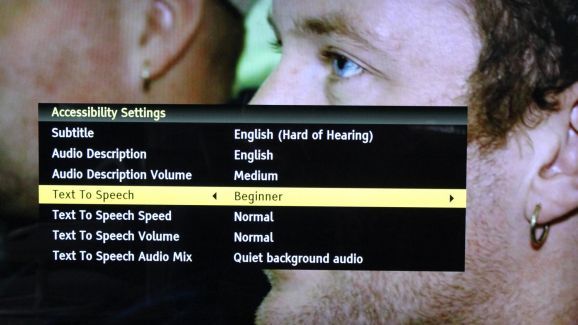
Speaking TV guides: would they help people with visual impairments and are they feasible?

About this document
This document is a ‘call for inputs’ on speaking TV guides. Ofcom is seeking views on
whether these guides could help blind or visually impaired people, and if it would be feasible
to introduce them across the UK’s TV services.

Around two million people have visual impairments that make it difficult or impossible for
them to use on-screen TV programme guides, though watching TV remains important to
them. We are seeking views from interested parties, particularly visually impaired viewers
and TV service providers.

In particular, we would like to know whether TVs and set top boxes that allow people to hear
information in on-screen TV programme guides could make it easier for blind or visually
impaired viewers to choose what they want to watch.

Ofcom would also like to hear whether other forms of assistance – such as mobile apps –
currently offered by TV providers could be a suitable alternative to speaking EPGs.

We will consider carefully what respondents say, before deciding whether or not changes to
our guidance to EPG providers may be appropriate.

                                                                                                               1
Speaking TV guides: would they help people with visual impairments and are they feasible?
Contents
Section Page
1 Summary 3
2 Legal framework and background 6
3 EPG accessibility features 14
4 What are the barriers to speaking EPGs? 26
Annex Page
1 Responding to this call for inputs 28Speaking TV guides: would they help people with visual impairments and are they feasible?
Section 1
1 Summary
Call for inputs
1.1 In this call for inputs, Ofcom is seeking the views of interested parties, in particular
of visually-impaired viewers and TV service providers, on the benefits of and
scope for on-screen programme guides (often known as Electronic Programme
Guides or EPGs) that can read out programme information. Please send us your
response by 8 September. Annex 1 explains how this can be done.
Many people who are blind or visually impaired can find EPGs on
television difficult or impossible to use
1.2 Most TV viewers are familiar with the on-screen programme guides or EPGs that
come with our digital TV services, whether provided by Freeview, Freesat, Sky,
Virgin Media (Virgin), BT or TalkTalk. On average, people watch just over 4 hours
of TV a day 1, and these guides play an important part in helping viewers choose
live programmes, make recordings and select catch-up or other on demand
content to view.
1.3 Most of us take these EPGs for granted. However, as we explain in section 2, an
estimated 1.8 million blind or visually-impaired people in the UK can find it difficult
or impossible to use EPGs, even though they watch just as much TV as everyone
else. The number of people with sight problems is projected to increase, as the
UK population ages.
1.4 Those who find it difficult or impossible to use EPGs are unlikely to benefit fully
from the wide range of broadcast programming now available, even though much
of it is audio described. As EPGs become an important gateway to online content,
such as live-streamed TV channels and on-demand films, the gap between the
benefits available to those with and without visual impairments is likely to widen
significantly.
Ofcom has a duty to require EPG providers to make their EPGs
accessible
1.5 Recognising the importance of EPGs to consumers, Parliament gave Ofcom a
duty (explained in section 2) to provide guidance on the practices to be followed in
the provision of EPGs. These practices must include the incorporation of such
features as Ofcom considers appropriate for ensuring that people with disabilities
1
The Communications Market Report: United Kingdom, Ofcom, August 2013
http://stakeholders.ofcom.org.uk/market-data-research/market-data/communications-market-
reports/cmr13/uk/
3Speaking TV guides: would they help people with visual impairments and are they feasible?
affecting their sight or hearing (or both) may use EPGs for the same purposes as
other people, so far as practicable.
1.6 To this end, Ofcom’s Code of practice on electronic programme guides requires
EPG providers, amongst other things, to ‘make such adjustments to their EPGs as
are practicable to secure that they can be used by people with disabilities affecting
their sight or hearing for all the same purposes as they are used by other people’.
1.7 The practices we can require extend only to the use of EPGs in relation to the
listing or promotion of programmes included in programmes services (TV
channels), not to programmes included in catch-up or other on-demand services.
However, given our other duties (also summarised in section 2), we want to
encourage relevant parties to ensure that those parts of EPGs that provide a
gateway to catch-up and other on demand services are also accessible to people
with visual impairments.
We think ‘speaking EPGs’ could be the best way of helping people
with visual impairments to make better of use programme guides
1.8 EPG providers have already incorporated a variety of accessibility features in their
EPGs, including features that allow high contrast displays, a choice of colours for
backgrounds and text, the ability to magnify text, and audible cues for
programmes with audio description. Some have also developed apps that can be
used with mobile devices (such as phones or tablets) to voice information about
TV programmes, and control some aspects of the TV. We summarise these in
section 3. Ofcom’s understanding is that these features are helpful to some people
with visual impairments, but do not meet the needs of all, particularly those with no
useful vision, and those with restricted vision who may struggle to afford or use
unfamiliar devices.
1.9 Ofcom has considered whether there may be scope for EPG providers to do more
to improve the usability of their EPGs. In particular, we have sought to assess the
potential for speaking EPGs, having regard to commercial and technological
developments, and to the discussions we have had with several of the leading
EPG providers. We have also considered representations from the Royal National
Institute of Blind People (RNIB).
1.10 On the basis of information gathered so far, Ofcom considers that:
a) including features in EPGs that allow text to be voiced (so-called text- to-speech,
or TTS) may make it much easier for people with visual impairments to use EPGs
for more of the same purposes as sighted people;
b) it may now be practicable for providers to incorporate such features in future
versions of their EPGs; and
c) ancillary devices and applications that some EPG providers are offering as an
alternative are likely to be helpful to some visually-impaired TV viewers, but maySpeaking TV guides: would they help people with visual impairments and are they feasible?
be difficult to use and expensive to afford for many visually-impaired viewers, so
may not be adequate substitutes.
1.11 We now wish to seek evidence and comments in relation to these propositions.
We would welcome your views and any evidence you can provide
1.12 Ofcom would welcome responses from any people or organisations with an
interest in this issue, in particular from visually-impaired TV viewers and EPG
providers. We have asked some specific questions in this document, but would
also welcome any other comments in relation to the issues considered in this
document. Annex 1 explains how you can respond to this document, including by
phone if you would find that more convenient.
1.13 This document is available on Ofcom’s website in a PDF version which is
compatible with most screen-readers. We have also prepared an audio version of
this document, which can be found on Ofcom’s website
at http://www.ofcom.org.uk/static/consultations/7940-speaking-tv/speaking-tv.mp3
Please note that the audio version may take some time to load.
1.14 If you would like this document in an alternative format or another languages, you
can call our Advisory Team from Monday to Friday between 09:00 and 17:00 on
020 7981 3040 or 0300 123 3333. If you are deaf or speech-impaired, you can
use our textphone numbers, which are 020 7981 3043 or 0300 123 2024. We will
consider all reasonable requests.
1.15 We explain in Annex 1 how you can respond to this document, including by phone
if you would find that more convenient.
5Speaking TV guides: would they help people with visual impairments and are they feasible?
Section 2
2 Legal framework and background
Introduction
2.16 In this section, we set out some context for the call for inputs, including:
d) the duties placed upon Ofcom and requirements imposed on EPG providers in
relation to the accessibility and usability of EPGs;
e) the estimated number and circumstances of people with visual impairments, and
the range of conditions leading to sight loss; and
f) the particular circumstances of older people, who account for the majority of
those with visual impairments.
Duties of Ofcom and requirements imposed on EPG providers
Statutory provisions
2.17 Ofcom has specific duties in relation to the accessibility of EPGs, set out in section
310 of the Communications Act 2003 (‘the Act’). In particular, these are to draw
up, and from time to time review and revise, a code giving guidance as to the
practices to be followed in the provision of electronic programme guides (section
310(1)).
2.18 Section 310(3) provides that the practices to be required by the code must include
the incorporation of such features in electronic programme guides as Ofcom
consider appropriate for securing that persons with disabilities affecting their sight
or hearing or both –
g) are able, so far as practicable, to make use of such guides for all the same
purposes as persons without such disabilities; and
h) are informed about, and are able to make use of, whatever assistance for
disabled people is provided in relation to the programmes listed or promoted.
2.19 Ofcom’s duties under section 310 do not extend to improving the usability of EPGs
in relation to non-broadcast content. However, section 10 of the Act gives Ofcom a
duty to take such steps and to enter into such arrangements as appears to it
calculated to encourage others to secure -
i) that domestic electronic communications apparatus is developed which is
capable of being used with ease, and without modification, by the widest possible
range of individuals (including those with disabilities); and
j) that domestic electronic communications apparatus which is capable of being so
used is as widely available as possible for acquisition by those wishing to use it.Speaking TV guides: would they help people with visual impairments and are they feasible?
2.20 Section 10 also says that Ofcom has a duty from time to time to review whether
further steps are needed, or further arrangements should be entered into, for the
purpose of performing the duty summarised above.
2.21 In carrying out its duties, Ofcom must have regard to a range of factors set out in
section 3 of the Act, including the needs of persons with disabilities, of the elderly
and of those on low incomes (section 3(4)(i)). Further, under section 3(5), in
furthering the interests of consumers, Ofcom must have regard, in particular, to
the interests of those consumers in respect of choice, price, quality of service and
value for money.
Ofcom’s Code on Electronic Programme Guides
2.22 Paragraph 6 of Ofcom’s Code on Electronic Programme Guides (‘the Code’) 2
sets out general principles with which EPG providers must comply. Amongst these
is a requirement, in particular, to make such adjustments to their EPGs as are
practicable to secure that they can be used by people with disabilities affecting
their sight or hearing for all the same purposes as they are used by other people.
2.23 Paragraph 7 of the Code says that ‘Ofcom expects EPG providers to consult
disability groups about the way they meet their obligations under the code’.
2.24 Paragraph 8 of the Code notes that ‘much of the functionality of EPGs is
dependent upon set top box hardware and software, as well as the data made
available by broadcasters’, but makes clear that ‘Ofcom expects the needs of
people with disabilities affecting their sight or hearing to be an integral part of
planning for the future development of EPGs’.
2.25 In section 4, we discuss the accessibility features that are already incorporated in
EPGs, including some with text to speech.
People with visual impairments
The number of people with visual impairments is significant, and expected to grow
2.26 Research undertaken by Access Economics estimated the prevalence of visual
impairment in the UK population, by age, gender and ethnicity in 2008. 3 On this
basis, it was estimated that 1.8 million people had partial sight or blindness in
2008, of whom 1.13 million (63%) were female and 664,000 (37%) were male.
About 218,000 people were estimated to have no sight, of whom 140,000 (64.3%)
were female and 78,000 (35.7%) were male.
2.27 The research found that there are people of all ages with visual impairments, but
that the group is skewed heavily towards older people. The research suggested
2
Code on Electronic Programme Guides, Ofcom
(http://stakeholders.ofcom.org.uk/broadcasting/broadcast-codes/epg-code/)
3
The economic impact of partial sight and blindness in the UK adult population, July 2009, Access
Economics (http://www.rnib.org.uk/aboutus/Research/reports/otherresearch/Pages/fsluk1.aspx)
7Speaking TV guides: would they help people with visual impairments and are they feasible?
that, of the estimated 1.8 million blind and partially-sighted people in the UK in
2008, just under a quarter (418,810) were under 65 years old, and more than
three quarters (1,378,178) were 65 or older. These numbers excluded the many
more people who can see reasonably well with prescription lenses but who may
struggle when reading an EPG.
2.28 Applying these prevalence rates to future population projections, the research also
estimated how the numbers of people might change over the next few decades.
On this basis, the total of those with partial sight and blindness in the UK was
projected to grow to 2,262,124 by 2020, and to over 4 million by 2050 4. Much of
this would be driven by the UK’s ageing population, leading to an increase in the
number of people with age-related macular degeneration and cataracts.
Visual impairment has many causes
2.29 The five main causes of visual impairment are age-related macular degeneration,
cataracts, diabetic retinopathy, glaucoma, and refractive errors:
k) age-related macular degeneration (AMD) is an incurable eye disease and a
leading cause of blindness in older people. AMD occurs with degeneration of the
macula, which is the part of the retina that enables central vision and seeing fine
detail. Damage to the macula results in central vision loss. According to the
Access Economics research, people with AMD accounted for 16.7% of all those
who are blind or partially sighted (and a higher proportion of those who are blind,
rather than partially sighted);
l) cataracts, formed from clumps of protein on the surface of the eye’s lens that
have the effect of scattering light, can result in clouding of a small area of the
lens. Over time, the cataract may grow larger and cloud more of the lens, making
it hard to see. They often occur in older people. People with cataracts comprise
13.7% of the blind and partially sighted;
m) glaucoma is a group of diseases that can lead to damage to the eye's optic nerve
and result in blindness. Glaucoma accounts for 5.3% of those who are blind or
partially sighted;
n) diabetes retinopathy (DR) is a complication that can arise from diabetes, a group
of metabolic diseases in which a person has high blood sugar. DR can result in
micro-aneurysms on the tiny blood vessels inside the retina. As the disease
progresses, some blood vessels that nourish the retina are blocked, causing
vision loss. People with DR account for 3.5% of those who are blind or partially
sighted; and
o) in their more extreme forms, irreversible refractive errors (e.g. short or long
sightedness) can result in profound sight loss (including blindness) that cannot be
4
The economic impact of partial sight and blindness in the UK adult population, July 2009, Access
Economics, p. 45 (http://www.rnib.org.uk/sites/default/files/FSUK_Report.pdf)Speaking TV guides: would they help people with visual impairments and are they feasible?
corrected with refractive lenses. People with refractive errors account for 53.5%
of those who are blind or partially sighted.
2.30 Less common conditions such as neuro-ophthalmic disorders (main disorders in
children), retinitis pigmentosa and other retinal conditions account for the
remaining prevalence of partial sight and blindness. These account for 7.4% of
those who are blind or partially sighted.
TV is important to blind and visually-impaired people
“Contrary to what people might think, blind and partially sighted people do watch a lot
of TV and I would certainly put myself in that category…’ Male TV viewer 5
2.31 A survey commissioned by Ofcom in 2006 found that blind and visually-impaired
people watched more television than those without sight impairments. 6 For a
number of reasons, this is hardly surprising:
p) many will have watched television regularly before their sight became impaired,
and will not want to give up a familiar and enjoyable pastime;
q) many will live in a household with sighted people, and will want to share in the
same activities;
r) many television programmes have a significant audio component (e.g. news) and
can be followed without vision; some are accompanied by audio description, a
narrative fitted in within the dialogue, explaining what is happening on screen;
s) people with visual impairments are likely to have more leisure time than those
without. Many are of retirement age; others may be unemployed. Older people in
particular are likely to have more leisure time than people of working age, but
have less money to spend on leisure activities, and be less able to engage in
physically demanding activities; and
t) television helps people to cope with social isolation, to which older people are
prone. Between 30% to 40% of older people in the UK live alone 7; 14% of them
have no living children 8, rising to 23% among the very old. 9 Some older people
are effectively housebound for much of the day.
5
An introduction to Voice Guidance on Panasonic talking TVs (YouTube)
(http://www.youtube.com/watch?v=FCMg5XQhXGc)
6
At a time when, on average, UK residents were watching around 3.46 hours a day, those with visual
impairments were watching 3.8 hours of television a day. Provision of access services: research study
conducted for Ofcom, Ofcom, March 2006
(http://stakeholders.ofcom.org.uk/binaries/consultations/accessservs/annexes/provision.pdf)
7
Eurostat: The social situation in the European Union 2005-2006 (Edition: April 2006)
(http://ec.europa.eu/employment_social/social_situation/docs/ssr2005_2006_en.pdf).
8
Young, Harriet and Grundy, Emily (2008) Longitudinal perspectives on caregiving, employment
history and marital status in midlife in England and Wales. Health and Social Care in the Community,
16 (4). pp. 388-399. ISSN 1365-2524 (http://eprints.lse.ac.uk/53809/).
9Speaking TV guides: would they help people with visual impairments and are they feasible?
Despite this, most people who are blind or visually-impaired are likely to find using a
conventional EPG difficult or impossible
How different levels of sight loss affect vision
2.32 The extent of sight loss amongst those who are visually impaired varies
considerably. Those with profound sight loss cannot tell by the light where the
windows are. Those with severe sight loss (12%) cannot see well enough to
recognise a friend close to his or her face. Those with ‘moderate’ visual
impairments (25%) cannot see well enough to recognise a friend across the room,
or to read a large print book. Most people who are blind or visually impaired are
categorised as having ‘mild’ sight loss (63%), but as this cannot be corrected by
lenses, even they may not recognise a friend across the road, and will face
difficulty seeing buttons on a remote control or seeing the picture on a TV screen.
2.33 Thus, even those with mild visual impairments would face considerable difficulties
in using a conventional EPG. In effect, they must work much harder than viewers
without sight impairments to decipher and use on-screen information. Depending
on the amount and type of vision they have, they may have to:
u) sit very close to the screen and use magnification to be able to read information
in an EPG;
v) spend longer scanning the screen because of their limited field of vision; and
w) concentrate much harder to work out what they need to know based on the
limited amount of information they can glean.
Ofcom’s roundtable
2.34 To improve our understanding of how visual impairment affects people’s use of
EPGs, Ofcom convened a roundtable with visually-impaired people in April 2014.
The roundtable was also attended by the major EPG providers – Sky, Virgin,
YouView, Freesat and Digital UK (which manages the Freeview EPG) – and by
groups representing the interests of blind and visually-impaired people – the
RNIB, the Macular Society and the Royal Blind / Scottish War Blinded charity.
2.35 The visually-impaired people at the roundtable talked about their experience of
using (or not using) EPGs to find out about TV programmes, as well as other
means of finding out what was on TV.
2.36 All found using conventional EPGs either difficult or impossible. One participant
reported that his peripheral vision meant that he had to scan and rescan the EPG
in order to decipher the information it provided. Figure 1 below gives an
impression of what someone with peripheral vision might see.
9
Office for National Statistics: Social Trends – Full Report (Edition No 37: 2007)
(http://www.ons.gov.uk/ons/rel/social-trends-rd/social-trends/no--37-2007-edition/social-trends-full-
report.pdf ).Speaking TV guides: would they help people with visual impairments and are they feasible?
Figure 1: How a screen might appear to someone with central vision loss
Source: RNIB
2.37 Another participant explained that, although she was able with difficulty to see
portions of the EPG, she found the whole process too onerous, and instead used
her laptop computer to find and view films and TV programmes, even though she
would have preferred to watch programmes on a larger TV screen.
2.38 The use of ‘speaking’ mobile phone apps to find out about TV programmes was
also demonstrated. Those who were ‘tech-savvy’ found them a useful tool.
However, they also felt that the complexity of the layered menus, which were not
always intuitive, would make them difficult for some people to use.
2.39 A few participants had used ‘speaking’ EPGs (explained in more detail in section
3), and those who had not encountered them hoped that they could be become
more generally available.
2.40 Industry representatives at the roundtable explained some of the measures that
had been taken to help people with some sight to use EPGs, and the work that
was planned to make EPG apps for mobile devices easier to use. However, it was
recognised that these would not be suitable for everybody, and that many would
find speaking EPGs helpful. Technology did not pose a particular constraint to the
introduction of speaking EPGs, although some existing platforms might be subject
to technical constraints, at least in the short term. However, the main barrier was
commercial – the incentives on manufacturers and service providers to enable
speaking EPGs were quite weak, as other features would produce a better
commercial return.
2.41 It is clear that the difficulties encountered by some people with partial sight are
enough to discourage some people from attempting to use conventional EPGs. A
11Speaking TV guides: would they help people with visual impairments and are they feasible?
study in 2002 on how blind and partially-sighted viewers used EPGs found that
most participants relied on family or friends to tell them what was on TV, or on
their memory of when certain programmes (e.g. soaps) were on TV. Alternatively,
they might browse through different channels. 10
2.42 However, some blind or visually-impaired people must cope by themselves –
research suggests that there are some 123,000 households in the UK including
people with severe, mild or moderate sight loss that do not include a sighted
adult. 11
2.43 The net result is likely to be that many viewers with visual impairments face a
restricted choice of viewing. Indeed, a survey carried out in 2008 found that
people with visual impairments who could not see the EPG tended to watch a
more limited repertoire of channels than others. They relied heavily on memorising
channel numbers, and had to relearn them when channels were re-ordered. 12
This was echoed in the discussion at Ofcom’s roundtable.
Some people can find other ways of substituting for conventional EPGs, but older
viewers face additional barriers to coping with sight loss
2.44 The impact of visual impairment will also vary according to the personal
circumstances of each person. Some people who were born with visual
impairments or acquire them early on in life, have grown up with the use of
assistive devices. As a result, they may be adept at making use of the text to
speech facilities offered by computers equipped with screen reading software, and
a variety of other devices (including some smartphones). At Ofcom’s roundtable, a
blind person demonstrated how a smartphone app could be used to find out
information about TV programmes, but also how complex and non-intuitive this
process might be for most people.
2.45 Older people, who comprise the large majority of those with visual impairments,
can face additional barriers to coping with sight loss:
x) those who have retired and rely upon pensions may be unable to afford devices
incorporating assistive technology 13, or reluctant to risk the expenditure because
they are unsure how much it will help; and
10
Mark David Rice. A Study of Television and Visual Impairment: Prospects for the Accessibility of
Interactive Television (2002).
(http://homepages.abdn.ac.uk/j.masthoff/pages/EuroITV03/Posters/Poster3.pdf)
11
Study on Access to Smart Meter Benefits for Blind and Partially Sighted Consumers, SQW in
partnership with i2 media research and Astutim, March 2013
(https://www.gov.uk/government/uploads/system/uploads/attachment_data/file/175653/access_to_sm
art_meter_benefits_for_bps_consumers.pdf )
12
People with visual impairments and communications services , July 2008, Ofcom
(http://stakeholders.ofcom.org.uk/market-data-research/other/tv-research/visual/)
13
A recent report suggests that the average pension pot is under £37,000, and that this would
generate a retirement income of just £1,340 a year, resulting in a very modest supplement to the state
pension. Help to save – defusing the pensions timebomb, Policy Exchange, January 2014
(http://www.policyexchange.org.uk/images/publications/help%20to%20save.pdf)Speaking TV guides: would they help people with visual impairments and are they feasible?
y) while some remain in full possession of other faculties 14, older people often
experience a decline in some of their abilities, including visual and auditory
perception, attention span, memory, motor functions and touch, and speech
production. 15
2.46 There are other, less obvious, barriers. For example, it is not unusual for people of
all generations to take time to confront the reality of permanent sight impairment,
and to adopt coping strategies. One younger participant in Ofcom’s roundtable
explained that it took a long time to come to terms with sight loss. Older people
may lack confidence in their ability to master unfamiliar technology, and may even
be unwilling to try it out, either because they fear wasted expenditure, or because
they do not want to risk failure.
14
Research suggests that the impact of conditions and impairments associated with very old age and
particular types of disability vary widely among those who experience them. Key factors affecting this
include the availability or otherwise of family support, the socio-economic background of the people
concerned, and attitudes towards technology. Consumer research with ‘older old’ consumers and
those living with cognitive, physical and sensory disabilities, Toynbee Hall, September 2012
(http://www.paymentscouncil.org.uk/files/payments_council/payments_council_-
_policis_and_toynbee_hall_older_old_and_disability_report_24.10.12_final.pdf)
15
Schaie, K. W. (1990). Intellectual development in adulthood. In J. E. Birren & K. W. Schaie (Eds.),
Handbook of the psychology of aging, 3rd ed., (pp. 291-309). New York: Academic Press.
(http://www.uwpsychiatry.org/sls/Intell%20Dev%20in%20Adulthood.pdf)
13Speaking TV guides: would they help people with visual impairments and are they feasible?
Section 3
3 EPG accessibility features
Introduction
3.47 Many EPGs already incorporate features for people with visual impairments. In
this section we summarise:
z) the relevant accessibility features in EPGs offered by the most popular TV
services, both subscription and free-to-air;
aa) EPGs and TV programme guides that use text to speech, whether integrated into
TV receivers (both TVs and set top boxes) or made available through secondary
devices, such as the Sky Talker, or apps for smartphones and tablets.
Accessibility features of EPGs on most popular TV platforms16
3.48 The table below identifies the main accessibility features on the most popular TV
platforms – both subscription and free to air.
Figure 2: EPG accessibility features in the most popular TV services
Platform Sky 17 Virgin TiVo BT TV YouView Freeview Freesat
Box & Youview+ (including
V+HD for BT TV Freetime)
18
High No No No Yes – Some Some,
contrast Accessibility including
EPG Settings Freetime
boxes, which
allow
changes to
transparency
of dialogue
19
boxes.
16
As of April 2014
17
Based on: Sky Digibox; Sky+; SkyHD; Sky+HD (Thomson box); Sky+HD (BSkyB, Pace and
Samsung boxes)
18
For example, the Goodman’s ‘Smart Talk’ set top box.
19
Source: Humax Foxsat HDR User Manual (http://www.humaxfoxsathdr.co.uk/leaflets/Humax-
Foxsat-HDR-User-Manual.pdf).Speaking TV guides: would they help people with visual impairments and are they feasible?
Access to AD setting AD setting in AD settings AD All Freeview All Freesat
AD in menu; menu; AD in menu; AD activation HD products products
20
AD activation button on from have AD have access
21
activation from remote information to AD
from information control bar; AD
information bar (TiVo) button on
bar/”Help” remote
button on control
remote
control
Change AD No No Yes – Yes – Only on No
volume Accessibility Accessibility products
Settings Settings capable of
22
pre-mix AD
Can Yes No No No No No
highlight
AD content
in EPG
Other Audio “Audio No “Zoom”
features signal Cues”: button on
(beep) on Sounds that remote
AD content show actions control to
and make menus
reactions to and guides
button bigger
presses on
the remote
control
(TiVo)
Speaking EPGs
3.49 Both Panasonic and Samsung now offer televisions equipped with speaking
EPGs. These allow viewers to use the ‘up’ and ‘down’ and ‘ok’ buttons on their
remote controls to navigate EPG menus. When an item is selected (see example
in Figure 3 below) the text is read out. The same applies to menus including
channel listings, programme details, and accessibility settings.
20
Does Freeview provide audio description for the visually impaired? Freeview
(http://www.freeview.co.uk/articles/faq/more-about-freeview/accessibility/does-freeview-provide-audio-
description-for-the-visually-impaired.html)
21
Accessibility, Freesat (http://www.freesat.co.uk/get-freesat/accessibility)
22
Access Services for Digital Television, Frans De Jong, October 2004
(https://tech.ebu.ch/docs/techreview/trev_300-de_jong.pdf)
15Speaking TV guides: would they help people with visual impairments and are they feasible?
Figure 3: Screen shot of a Panasonic television, showing an on-screen menu of text to
speech options
3.50 Speaking EPGs are also available in set top boxes manufactured under the
TVOnics and Goodman 23 brands in the UK, and the Bush 24 and Hills 25 brands in
Australia, which were made available to eligible households at the time of digital
switchover in Australia.
3.51 Each of the set top boxes has similar features. The TVOnics box, for example,
offers a fully accessible EPG, enabling visually-impaired viewers to find out what’s
on, and to record and playback programmes. It also enables access to settings
menus, e.g. to set parental controls and re-tune the receiver. The box uses
natural-sounding synthesised speech, which can be adjusted to five different
speeds, and can also be set to cut down the amount of information read out once
users are familiar with it.
3.52 None of the set top boxes currently available with pay TV services in the UK are
equipped with speaking EPGs.
User feedback
3.53 A blind television viewer demonstrated at Ofcom’s roundtable how he was able to
use TTS to navigate different levels of the EPG on his Panasonic television. He
had been unable to use conventional EPGs, but was now able to use the TTS-
enabled EPG to find out what was on, and to turn on audio description. He
particularly valued the independence that a speaking EPG provided.
23
Goodmans Smart Talk Freeview box, Which?, November 2010
(http://www.which.co.uk/technology/tv-and-dvd/reviews-ns/goodmans-smart-talk-freeview-box/)
24
Source: Bush BHAS03 set top box (http://www.bushaustralia.com.au/details.aspx?pid=229&stid=9)
25
Source: Hills Talking set top box. (http://www.hillsantenna.com.au/talkingstb)Speaking TV guides: would they help people with visual impairments and are they feasible?
3.54 Similar sentiments were expressed by a blind TV viewer reviewing the Panasonic
for RNIB’s website:
“The text-to-speech is really important because again I don't have enough sight to be
able to see the text on screen, so if I don't have speech in the television to tell me
what channel I'm watching, or what's coming up next on the electronic programme
guide I'm really kind of fumbling around in the dark.” - Male TV viewer 26
3.55 A viewer with partial vision also found this feature useful:
“I have central vision loss and I am reviewing my new Panasonic TV with Voice
Guidance ... I am by no means a techy type, but I did find the setting up
straightforward… Once the voice guidance is set up you use your TV like any other.
The difference is you have far more control, information and choice. … It is
absolutely brilliant to be able to surf the channels and hear what channel you are on,
what programme is showing and what programmes are coming up…” 27 - Female TV
viewer with central vision loss
3.56 The same viewer welcomed ‘the fact that the software is built into the mainstream
product and is no additional expense or hassle’. Participants in Ofcom’s
roundtable hoped that speaking EPGs would be incorporated in consumer
receivers, and a pay TV operator told the roundtable that this view had been
echoed by a focus group of visually-impaired viewers that it had convened. They
preferred the EPG to be accessible through the TV, rather than through secondary
devices.
3.57 The Australian Government commissioned a trial involving customers who were
blind or had a vision impairment living in the Regional Victoria switchover area, as
well as a small control group of ‘sighted’ scheme customers. Among other things,
the research found that:
bb) the survey showed nine out of ten respondents (88%) had adopted the 'talking'
remote control as their main remote control, and nearly three quarters of trialists
(71%) rated it as excellent or very good;
cc) the two most useful functions of the 'talking' set top boxes were the 'talking'
menus (70% rate these as very or quite useful), and the 'talking' programme
guides (62%), particularly amongst people with a sight impairment and even
more so amongst those participants in the research that were blind; and
dd) two thirds of visually impaired, blind or seeing respondents (67%) said that their
enjoyment of watching TV had increased ‘a lot’ or ‘a bit’ as a result of receiving
26
Get the Picture - making television easier for people with sight loss, RNIB
(http://live.rnib.precedenthost.co.uk/sites/default/files/video-transcript-accessible-tv.doc)
27
Panasonic Television with Voice Guidance, Steph Cutler, September 2012
http://www.rnib.org.uk/livingwithsightloss/tvradiofilm/productreviews/Pages/panasonic_tv_userreview.
aspx
17Speaking TV guides: would they help people with visual impairments and are they feasible?
the 'talking' STB; amongst visually-impaired viewers the figure was 63%, blind
viewers 75% and seeing viewers 71%.
3.58 Although this research was conducted in Australia, we see no reason why the
findings should not be equally applicable in the UK.
Initial assessment of speaking EPGs
3.59 In the light of feedback from users and lobby groups, Ofcom has identified a
number of potential advantages and disadvantages of speaking EPGs
incorporated into televisions or set top boxes.
Potential advantages
3.60 Setting up a TTS-enabled EPG may be easier when it is integrated into the TV
receiver (whether a set top box or digital television), than if it requires the user (or
someone on their behalf) to pair a third party device using wi-fi.
3.61 A broader range of visually-impaired people may find it easier to use integrated
TTS, as it can be activated by the remote control, which many will find simpler to
use than, say, a touch-screen device such as a smart phone or tablet. In any
case, some alternatives (e.g. Sky Talker, YouView app) still require the user to
operate the remote control.
3.62 Speaking EPGs integrated into televisions and set top boxes may be less
susceptible to unplanned software changes that may conflict with the speaking
EPG, particularly where the EPG provider controls software changes.
3.63 Within the last two years, TV manufacturers have begun to make integrated
speaking EPGs on their mid-range TVs, as well as those at the higher end, and
one now makes integrated speaking EPGs in all new TVs.
Potential disadvantages
3.64 TV receivers with integrated TTS-enabled EPGs remain relatively expensive. 28
Although some TVOnics and Goodmans-branded set top boxes equipped with
speaking EPGs remain, Ofcom understands that they are no longer being
manufactured.
3.65 Most speaking EPGs do not have easily accessible instructions, and require help
from a sighted person to set up.
28
This may change over time if more manufacturers make use of the same chipsets, securing
economies of scale (as happened when manufacturers of TV receivers and set top boxes adopted
chipsets that enabled audio description, now standard in most TV equipment).Speaking TV guides: would they help people with visual impairments and are they feasible?
Secondary devices
Sky Talker
3.66 In 2011, Sky launched the Sky Talker, which was developed in association with
the RNIB. When connected to a Sky box, the Sky Talker can be controlled by the
usual remote control. As viewers move through channels, the Sky Talker will
announce the channel number, channel name and programme name
automatically. The Sky Talker also provides verbal feedback when the
Sky+ Pause , Play and Rewind buttons on the remote control are used. However,
the remote control does not vocalise the EPG, so it does not enable users to hear
information about programmes in the future.
Figure 4: Sky Talker with connection cables
3.67 Nonetheless, some visually-impaired viewers clearly value the Sky Talker device:
"It allows me to mooch around and find something I want to watch. That's a simple
pleasure I haven't been able to experience since I lost my sight more than a decade
ago. It feels good." 29
Mobile devices
3.68 Freesat, Freeview, Sky, Virgin, YouView have developed apps for installation on
devices on certain (but not all) mobile devices such as smart phones and tablets.
Most work with iOS or Android operating systems, but not with other systems.
3.69 The apps are aimed primarily at people without visual impairments, and are
intended to allow users to:
ee) find out what programmes are available to watch (in all cases);
ff) set recordings (in several cases); and
gg) act as a remote control when paired with the TV or set top box (in a few cases).
3.70 The apps are compatible to a greater or lesser extent with the TTS facility made
available by the mobile device manufacturer - Voiceover for Apple devices using
29
[AI] televisions available with talking menu guide, Access India
(http://accessindia.org.in/pipermail/accessindia_accessindia.org.in/2014q1/088342.html)
19Speaking TV guides: would they help people with visual impairments and are they feasible?
iOS, Talkback for devices using the Android operating system. The precise
capabilities of the apps, and the extent to which they have been adapted for use
by people with visual impairments vary from one app to another, and over time.
The summary in Figure 5 below explains the capabilities offered by the main apps
in April 2014, since when some may have changed.
Figure 5: Text to speech capabilities in mobile device apps 30
App Sky+HD (no Virgin TV Freeview TV Freesat (only YouView (Talk
app for older Anywhere Guide works with HD Talk, BT TV,
boxes) (TiVo boxes) / and Freetime Youview retail
Virgin TV boxes) boxes))
Guide
Compatibility iOS, some iOS, some iOS, some iOS only iOS, some
(n/a with Android Android Android Android
Blackberry,
Windows or
Nokia)
Functionality Read listings, Read listings, Read listings, Read listings. Read listings,
make make make With Freetime, make
recordings. recordings. recordings allows recordings
Can be used Can be used recordings,
as a remote as remote can be used
control, with control with as remote
some Sky HD Tivo boxes control
boxes
Optimised for No; Yes; reads out Content is Most on- In most views,
text to programme most arranged in screen programme
speech? grid not information in columns, so buttons do not start time and
supported. most views. not intuitive. include labels finish, channel
Reads out But cannot that can be title but not
abbreviations prompt users read by TTS, number
as words, and to insert PIN so app is
times as when required largely
numbers. inaccessible
Programme In most views In most views, All info in In grid and No; viewers
information (except grid programme single channel single channel must dive
spoken and prog. title and view, in and view, channel down to
synopsis), channel programme number and programme
channel number synopsis. programme synopsis to
number and Most in ‘Top title, start and find out
programme Picks’, none in finish time. whether AD is
title. ‘Favourites’ available. No
access to ‘On
Demand’
content
Identifies Only in prog. No No No Only in prog.
whether AD synopsis synopsis
30
As of April 2014Speaking TV guides: would they help people with visual impairments and are they feasible?
available?
3.71 It appears that none of the apps are fully optimised for use with text to speech. For
example, most potential users of the Freesat app would be thwarted by the
absence of TTS-readable labels for the ‘buttons’ on the home screen of the app.
These buttons allow users to switch to different features of the app. When a
button with TTS-readable labelling is selected, the TTS facility will explain what
features the button provides access to. Without these labels, users would not
know what the buttons were for, so would be unable to make progress. Similarly,
the Virgin Media apps do not prompt users to insert a PIN when this is required,
which would bring the process to a halt.
3.72 It should be noted that performance and capabilities are subject to change, as
new versions of the apps are developed, and as new devices come on to the
market.
User feedback
3.73 Virgin Media’s app, regarded by RNIB was one of the more accessible, received
some positive feedback from blind users.
“For a blind person, this app is priceless. For a long time, some of us have
had #Tivo boxes, but no way to use them … Now that's all changed. I give a thumbs
up to #VirginMedia for their efforts … I can now access the features of a box I've
been paying for that until recently, only my sighted wife was able to benefit from
properly.”31
“The TV guide was quite accessible, I really liked the simplicity of the layout. I was
able to find my way around the TV guide with no difficulty. … However, one thing I
did note was the inconsistency in button labelling ... The absence of button labelling
is very important, in particular for less confident VoiceOver users. If I had not double
tapped the programme, I wouldn't have known that this was the way in which
programmes can be set to record. 32
Initial assessment of secondary devices
3.74 In the light of feedback from users and lobby groups, Ofcom has identified a
number of potential advantages and disadvantages of TTS-enabled secondary
devices.
31
Andre Louis, an i-Phone 4S user, whose views were sought by Virgin Media
(https://www.actionforblindpeople.org.uk/your-community/blogs/andre-louis/virgin-media-tv-anywhere-
app-for-ios-podcast-review/)
32
Sonali Rai, visually-impaired staff member of RNIB
http://www.rnib.org.uk/livingwithsightloss/computersphones/updates/techknowmore/Lists/Posts/Post.a
spx?id=167
21Speaking TV guides: would they help people with visual impairments and are they feasible?
Potential advantages
3.75 Youview points out that enabling the EPG to be controlled by a broad range of
mobile devices (e.g. smartphones and tablets) and assistive equipment (e.g. ‘sip-
and-puff’ devices for people with people with disabilities affecting the use of their
upper limbs) means that it has the potential to benefit a wide range of people with
disabilities than an EPG that simply incorporated TTS.
3.76 Virgin suggested in 2011 that the development of apps that can be used with text
to speech features on mobile devices (such as VoiceOver on an Apple device, or
TalkBack on an Android device) would allow for speedier provision of accessibility
than would incorporating text to speech in a set top box, which could take three
years or so. 33
3.77 As Sky Talker is supplied by Sky, it is more likely that Sky will ensure that it
remains compatible with its set top boxes. Although the Sky Talker is reported to
be easily installed with the help of a sighted person, Sky will make an engineer
available to install and demonstrate the unit if necessary.
3.78 EPG providers can externalise some of the costs of providing TTS by using apps
for mobile devices, as TTS functionality is provided by the device manufacturer,
and the consumer is responsible for purchasing the device. Incorporating TTS in
future set top boxes would require EPG providers to undertake additional
development work, with little or no prospect of commercial payback.
Potential disadvantages
3.79 Visually-impaired people must pay for any secondary devices they want, but these
may not be affordable to all. Many are likely to be of pensionable age (see section
3), on modest incomes. People of working age may have relatively small incomes,
because their visual impairments make it difficult to find well-paid employment or,
indeed, any job. Compatible mobile devices may not be cheap. 34 Unsurprisingly,
fewer people in lower socio-economic groups own smart phones and tablets than
those in higher groups (see Figure 6 below).
33
Ian Mecklenburgh, Virgin Media, speaking at Streaming Media 2011, in October 2011
(http://www.streamingmediaglobal.com/Articles/Editorial/Featured-Articles/Viewers-Moving-Beyond-
EPG-Says-Virgin-Streaming-Media-Europe-78349.aspx)
34
For example, Youview notes that “the Youview app for Android … has been optimised for the
following smartphones – Samsung Galaxy S3, Samsung Galaxy S2, LG Nexus 4, HTC One S, and
Samsung Galaxy Ace”. Contract-free prices for these smartphones vary from £200 to more than £400
(https://play.google.com/store/apps/details?id=com.youview)Speaking TV guides: would they help people with visual impairments and are they feasible?
Figure 6: take-up of mobile devices, by socio-economic group35 (2012)
Take-up (%)
AB C1 C2 DE
80
60 58
60
46
38 36
40
27
20
20 13 12
8 6 3
0
Smart-phone Tablet Smart TV
3.80 Possibly for similar reasons, older people are much less likely to own a
smartphone; a recent survey found that while only 11% of those aged 65-74 and
2% of those aged 75+ owned smartphones, compared to over three-quarters of
16-24 year olds. A report published late last year 36 cited similar findings, indicating
that 13% of those aged 65 or more owned smart phones, and 5% owned tablets.
This suggests that those most likely to have visual impairments are least likely to
own a mobile phone or tablet.
3.81 Even those with a smartphone may not have one compatible with relevant apps.
At the time of writing, none worked with Blackberry, Windows or Nokia mobile
devices. Indeed, not all Android devices are compatible. Given the wide and
continually changing range of mobile devices, ensuring that TTS-enabled apps
work with all of these is, in practice, almost impossible. For example, Virgin
Media’s app only works on selected devices 37, though the company says that it is
continuing to work on making it compatible with a wider range 38.
3.82 One of the reasons why this is a time-consuming process is that manufacturers of
Android devices often choose to customise the Android software. Customisation
can interfere with the ability to load Android apps from Google’s Play store and
also with accessibility features built into Android. For example, says the RNIB, a
35
Extracted from table 4.23, Communications Market Review 2013, Ofcom, August 2013
(http://stakeholders.ofcom.org.uk/market-data-research/market-data/communications-market-
reports/cmr13/uk/)
36
UK Mobile Insights Report 2013 Q4 - An overview of recent research and data on smartphone and
tablet ownership in the UK, November 2013 (http://weareapps.com/MobileInsightsReport.pdf)
37
Virgin TV Anywhere on Android devices
(http://store.virginmedia.com/content/dam/eSales/Downloads/tva_android_devices.pdf)
38
TV Anywhere Android - Device Support Requests, Virgin Media
http://community.virginmedia.com/t5/TV-Anywhere/TV-Anywhere-Android-Device-Support-
Requests/td-p/2097328
23Speaking TV guides: would they help people with visual impairments and are they feasible?
number of e-readers are so heavily customised that Android's accessibility is
effectively neutered.
3.83 Of the visually-impaired who may have a suitable mobile device, many may not be
aware that relevant TTS-enabled apps are available. Research suggests that,
amongst older people, there is ‘very little understanding of the range of
applications available’. 39 Many have virtually no experience of mobile applications,
and many were not comfortable even with texting.
“I don’t understand apps and things like this on phones. I’m afraid I think the more
technology they introduce the more complicated it becomes, rather than easier.
Again, you know, using these apps as an example, I mean they’re beyond me.”40
3.84 Most EPGs with integrated text to speech can be operated using a limited number
of buttons on a remote control; in some cases this can be done by voice
commands. By contrast, most secondary devices (smartphones and tablets) use
touch screens. Ofcom’s understanding is that they can be particularly difficult for
older people, who constitute the majority of people with visual impairments.
3.85 Some research suggests that older adults face obstacles to using information
technology appliances, for two main reasons: firstly, declining memory and/or
cognitive control functions which make learning difficult 41; secondly, prejudicial
attitudes towards information technology systems that may make them feel they
cannot learn how to use them. 42 Indeed, it is clear from some blogs used by
technically literate blind users that even they find some ancillary devices too
complex to use easily. 43
3.86 Secondary devices often have more limited functionality than conventional EPGs,
and do not provide access to all the information that would be provided in an EPG
(see Figure 5 above). The Sky Talker, for example, does not read out text from
39
Consumer research with ‘older old’ consumers and those living with cognitive, physical and sensory
disabilities, September 2012, Payments Council, p. 25
(http://www.paymentscouncil.org.uk/files/payments_council/payments_council_-
_policis_and_toynbee_hall_older_old_and_disability_report_24.10.12_final.pdf)
40
Ibid.
41
Hedden, Trey & Gabrieli, John D. E. Insights into the ageing mind: a view from cognitive
neuroscience. Nature Reviews Neuroscience 5, 87-96 (February 2004).
(http://www.nature.com/nrn/journal/v5/n2/abs/nrn1323.html)
42
How Can We Make IT Appliances Easy for Older Adults?: Usability Studies of Electronic Program
Guide System, Noriyo Hara, Toshiya Naka and Etsuko T. Harada, December 2009
http://www.intechopen.com/books/human-computer-interaction/how-can-we-make-it-appliances-easy-
for-older-adults-usability-studies-of-electronic-program-guide-sy
43
“Any time you start talking about the android OS as it relates to the visually impaired community the
same thing always comes up… The complexity of it all… "This phone works really well, this phone
doesn't, this one doesn't at first but if you add this and take this away… Install this… You're going to
have to uninstall this preloaded software" honestly… It's all quite ridiculous”. Blogger:
#12 AnonyMouse “I have to agree completely”, source: My experience with an Android product, and
my return to the iPhone, applevis.com, 24 October 2013
(http://applevis.com/forum/ios-ios-app-discussion/my-experience-android-product-and-my-return-
iphone)Speaking TV guides: would they help people with visual impairments and are they feasible?
most of the EPG, nor does it replace the need to use a remote control to operate
the EPG.
Input sought
3.87 Ofcom would welcome views from respondents on any of the issues raised in this
paper or pertinent to the issue of accessibility to EPGs for people with visual
impairments. Ofcom would particularly welcome the views of people with visual
impairments (and groups representing their interests) on the issues raised below:
Q1. Do respondents agree with Ofcom’s initial assessment that apps for mobile
devices have the potential to be useful for those people with visual impairments who
feel confident using touch-screen technology and can afford a suitable mobile
device? If not, why not?
Q2. Do respondents agree with Ofcom’s initial assessment that apps for mobile
devices are less likely to meet the needs of the majority of visually-impaired people
who are 65 or older, both because they are less likely either to own a suitable mobile
phone and because touch-screen apps present a number of actual and perceived
barriers to use. If not, why not?
Q3. Do respondents consider that it would be reasonable for visually-impaired
viewers to pay more than sighted viewers for the ability to use EPGs or substitutes
for the same purposes as sighted viewers? If so, why?
Q4. Do respondents agree with Ofcom’s initial assessment that the speaking
EPGs integrated into TVs and set top boxes may be easier for people with visual
impairments to use than touch-screen apps? If not, why not?
25Speaking TV guides: would they help people with visual impairments and are they feasible?
Section 4
4 What are the barriers to speaking EPGs?
Introduction
4.88 In this section, we consider the progress that has been made towards overcoming
the barriers to adopting text to speech for EPGs. We also invite views on
remaining barriers to implementation, and how these might be overcome.
Progress towards facilitating text to speech capability in EPGs
4.89 Ofcom’s understanding is that many of the barriers to the adoption of text to
speech for EPGs have now been surmounted. In particular, Ofcom notes that:
hh) there are now widely accepted technical standards. The Digital TV Group, which
comprises manufacturers, broadcasters and organisations representing sensory-
impaired viewers, has completed a technical specification for Text to Speech,
which was later adopted by DigitalEurope and taken to the International
Electrotechnical Commission (IEC). This led to the IEC setting up a project group
and creating International Standard IEC 62731:2013: Text-to-speech for
television - General requirements. IEC 62731:2013 specifies the text-to-speech
functionality for digital television receivers such as set top boxes, integrated
digital TVs, recorders and other products whose primary function is to receive TV
content; 44
ii) the underlying technology is now widely available, and can be licensed as
middleware applications from a number of suppliers, such as Ocean Blue,
Nuance and Wizzard, or developed from readily-available open source software
available from the web. The technology can be embodied in middleware on a
range of chipsets, obtainable from a variety of suppliers, including
STMicroelectronics, RC Systems and Toshiba;
jj) the technology is not expensive. AT&T researchers have demonstrated the ability
to provide an EPG with voice recognition and text to speech using ‘commodity
hardware and software to reduce barriers to entry’. 45 Industry sources have told
Ofcom that chipsets incorporating text to speech are available at a modest
premium to chipsets without this capability. Ofcom notes that text to speech
technology has been incorporated in a wide range of modestly priced consumer
devices, often as an ancillary rather than mainstream feature; and
44
Text-to-speech for television - General requirement, International Electrotechnical Commission
(http://webstore.iec.ch/Webstore/webstore.nsf/Artnum_PK/47506)
45
EPG: Speech Access to Program Guides for People with
Disabilities, Michael Johnston & Amanda Stent, October 2010
(http://www.research.att.com/export/sites/att_labs/people/Johnston_Michael_J/library/publications/ass
ets_paper_2010.pdf)You can also read


