Suppressing Energetic Disorder Enables Efficient Indoor Organic Photovoltaic Cells With a PTV Derivative
←
→
Page content transcription
If your browser does not render page correctly, please read the page content below
ORIGINAL RESEARCH
                                                                                                                                                 published: 12 May 2021
                                                                                                                                       doi: 10.3389/fchem.2021.684241

                                               Suppressing Energetic Disorder
                                               Enables Efficient Indoor Organic
                                               Photovoltaic Cells With a PTV
                                               Derivative
                                               Pengqing Bi 1,2 , Junzhen Ren 1,2 , Shaoqing Zhang 1*, Tao Zhang 2 , Ye Xu 2,3 , Yong Cui 2 ,
                                               Jinzhao Qin 2,3 and Jianhui Hou 1,2,3
                                               1
                                                School of Chemistry and Biology Engineering, University of Science and Technology Beijing, Beijing, China, 2 State Key
                                               Laboratory of Polymer Physics and Chemistry, Beijing National Laboratory for Molecular, Institute of Chemistry Chinese
                                               Academy of Sciences, Beijing, China, 3 School of Chemical Sciences, University of Chinese Academy of Sciences, Beijing,
                                               China

                                               Indoor organic photovoltaics (IOPVs) cells have attracted considerable attention in the
                                               past few years. Herein, two PTV-derivatives, PTVT-V and PTVT-T, were used as donor
                                               materials to fabricate IOPV cells with ITCC as the acceptor. The preferred orientation
                                               of the crystals changed from edge-on to face-on after replacing the ethylene in the
                                               backbones of PTVT-V by the thiophene in that of PTVT-T. Besides, it was found that,
                                               the energetic disorder of the PTVT-T:ITCC based system is 58 meV, which is much
                         Edited by:            lower than that of PTVT-V:ITCC-based system (70 meV). The lower energetic disorder
                           Kui Zhao,
     Shaanxi Normal University, China          in PTVT-T:ITCC leads to an efficient charge transfer, charge transport, and thus the weak
                        Reviewed by:           charge recombination. As a result, a PCE of 9.60% under AM 1.5 G and a PCE of 24.27%
                         Zhipeng Kan,          under 1,000 lux (LED 2,700 K) with a low non-radiative energy loss of 0.210 eV were
     Chongqing Institute of Green and
                                               obtained based on PTVT-T:ITCC blend. The results indicate that to improve the PTV-
   Intelligent Technology (CAS), China
                            Liyang Yu,         derivatives photovoltaic properties by suppressing the energetic disorder is a promising
              Sichuan University, China        way to realize low-cost IOPV cells.
                  *Correspondence:
                     Shaoqing Zhang            Keywords: organic photovoltaics, indoor applications, energetic disorder, PTV, simple chemical structure
               shaoqingz@iccas.ac.cn

                   Specialty section:          INTRODUCTION
         This article was submitted to
     Physical Chemistry and Chemical           The advantages of light weight, flexibility, and roll-to-roll large scale production method enable
                              Physics,         organic photovoltaic (OPV) technique becomes one of the promising clean energy candidates in the
               a section of the journal        future (Yu et al., 1995; Kaltenbrunner et al., 2012; Li et al., 2018). The OPV cells have experienced
                Frontiers in Chemistry
                                               rapid development during the past few decades due to the multi-disciplinary efforts, including the
           Received: 23 March 2021             design of new materials, the device physics, and the device engineering (Clarke and Durrant, 2010;
            Accepted: 12 April 2021            Meng et al., 2018; Menke et al., 2018; Qian et al., 2018; Yan et al., 2018; Yuan et al., 2019; Cui
            Published: 12 May 2021
                                               et al., 2020b), as a result, the record power conversion efficiency (PCE) of single-junction OPV
                              Citation:        cell has exceeded 18% (Liu et al., 2020a; Wang, 2020; Zhang et al., 2021). Besides the outdoor
  Bi P, Ren J, Zhang S, Zhang T, Xu Y,         applications, OPV cells under dim light or indoor light conditions also show great potential in
         Cui Y, Qin J and Hou J (2021)
                                               the application of off-grid energy sources (Cui et al., 2019; Singh et al., 2020; Zhang et al., 2020).
       Suppressing Energetic Disorder
       Enables Efficient Indoor Organic
                                               Indoor OPV (IOPV) cells can convert the energy emitted from the household lighting facilities or
         Photovoltaic Cells With a PTV         ambient dim-light sources into the energy at the scale of megawatt to microwatt, showing great
   Derivative. Front. Chem. 9:684241.          potential in supplying the power to wireless electronics such as smart housing sensors and sensors
    doi: 10.3389/fchem.2021.684241             for the “Internet of Things.”

Frontiers in Chemistry | www.frontiersin.org                                         1                                             May 2021 | Volume 9 | Article 684241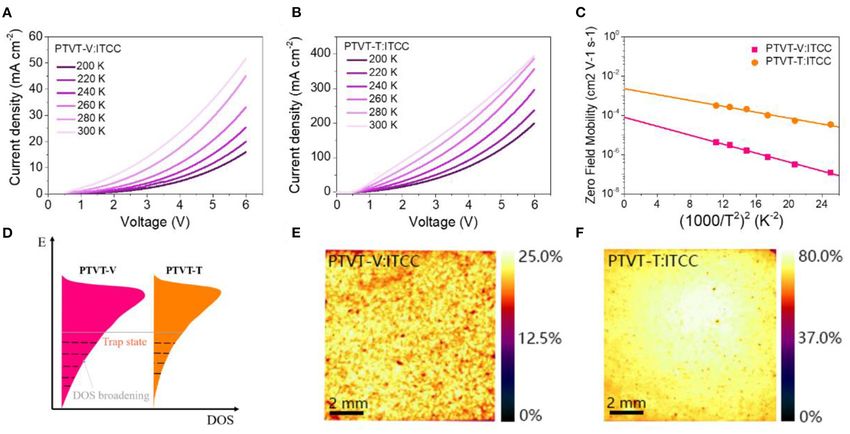
Bi et al.                                                                                                 Organic Photovoltaics for Indoor Application

    To rationally design photoactive materials for the application         importantly, the PTVT-T based devices demonstrate much lower
of IOPV cells, first of all, the photoresponse spectrum of the             energetic disorder than that of PTVT-V. The lower energetic
light-harvesting materials should match that of the indoor light           disorder significantly decreased the charge recombination. As a
sources. Since the illumination spectra of fluorescence lamps and          result, a PCE of 24.27%, under the light source of LED 2,700 K,
light-emitting diodes (LEDs) is mainly in range from 400 to                1,000 lux, was obtained based on the blend of PTVT-T:ITCC,
700 nm, in comparison of inorganic photoactive materials such              which is much higher than the device based on PTVT-V:ITCC
as silicon, the advantages of highly tunable absorption spectra            (5.10%). The results indicate that suppressing the energetic order
and relatively high coefficient of OPV materials enable IOPV               via optimizing the molecular structure is an effective way to
becomes a promising candidate for the application of indoor                achieve high performance IOPV cells.
energy. The IOPV cells have received considerable attention
in recent years and the PCEs were improved rapidly (Cui                    RESULTS AND DISCUSSION
et al., 2020a; Ma et al., 2020b). However, it still faces some
critical challenges in molecular design of photovoltaic materials.         The chemical structures of TVT monomer, PTVT-V, PTVT-T,
For instance, the charge carrier densities of the OPV cells                and ITCC are shown in Figure 1A. Density functional theory
under room light sources are significantly lower than that of              (DFT) with a level of B3LYP/6-31G (d, p) was used to calculate
the cells under 1 sun irradiation due to the low illumination              the molecular properties, including the highest occupied
intensities. As recombination centers, trap-state plays a key role         molecular orbital (HOMO) and the lowest unoccupied molecular
in determining the performance of IOPV cell. For the application           orbital (LUMO) levels, the molecular geometries, and the surface
of OPV cells under the illumination of one sun, the trap-state             electrostatic potential (ESP) distribution of both PTVT-V and
density, ca. 10−15 cm−3 , is negligible compared to the density of         PTVT-T. The calculated HOMO/LUMO levels of PTVT-V and
photogenerated charge carriers (Ma et al., 2020a). In contrast, for        PTVT-T are −4.97/−2.96 and −4.94/−2.87 eV, respectively,
the device under dim light sources, the density of photogenerated          all of which are delocalized over the molecular backbones,
charge carriers is relatively low, which is even comparable to that        as shown in Supplementary Figure 1. Besides, the optimized
of the trap-state density (Cui et al., 2020a). A large proportion          molecular geometries of both PTVT-V and PTVT-T are shown
of photogenerated charge carriers are caught in the “traps”                in Figures 1B,C. The optimized molecular structures of both
and do not attributed to photocurrent generation. Therefore,               PTVT-V and PTVT-T demonstrate planar configuration, which
the performance of OPV cells under dim light sources is very               are favor to the formation of the ordered molecular packing
sensitive to the trap-state.                                               and thus the efficient charge transport. The ESP distributions of
    For the OPV materials, the trap-states can be mainly divided           the two molecular models are mapped in Figures 1D,E. PTVT-
into two categories, i.e., intrinsic and extrinsic traps (Kotadiya         T shows more negative ESP values on the molecular backbone,
et al., 2018, 2019; Haneef et al., 2020). Considerable research            which indicates that the PTVT-T has stronger electron-donating
efforts have been devoted to control the extrinsic traps, resulting        feature than PTVT-V (Yao et al., 2019).
in the obvious performance enhancement in the corresponding                   The differences between OPV cells under sun light and indoor
systems (Zuo et al., 2017; Song et al., 2018; He et al., 2019;             light sources are mainly due to the difference of the radiation
Yan et al., 2019). The intrinsic traps are directly related to             spectra, as shown in Figure 2A. Unlike the spectrum of AM
the energetic disorder of a certain material system. Compared              1.5 G, the spectra of the indoor light sources are mainly in
to the inorganic counterparts, organic molecules demonstrate               the range of 400–700 nm. As mentioned before, the photoactive
relatively high energetic disorder due to the presence of structural       materials should have matched absorption spectra with the
inhomogeneities (Liu et al., 2020b). Thus, it is of great importance       indoor light sources to obtain high performance. The absorption
to explore the relationship among the chemical structures of               spectra of neat PTVT-V, PTVT-T and ITCC as well as the
photoactive materials, the trap-state density, and the photovoltaic        corresponding blend films are shown in Figures 2B,C. It can
properties under indoor light applications. Besides of the                 be clearly observed that the donors/acceptor materials show
improvement of PCEs, cost is also a significant consideration in           absorption spectrum covering the visible range of 450–700 nm,
estimating the application of OPV devices (Xue et al., 2018; Al-           which could meet the requirements of the absorption capability
Ahmad et al., 2020). In the current period, the cost for fabricating       for IOPV application. Compared to the absorption spectrum of
efficient large scale OPV cells is still contrary to the principle         PTVT-V, PTVT-T exhibits a ca. 50 nm blue shifted absorption
of low-cost of OPV technique, because the chemical structures              spectrum, which is more suitable to fabricate an IOPV cell when
of the efficient materials are relatively complex. In our previous         blending with ITCC. The cyclic voltammograms (CV) curves
reports, we found that the PTV-derivatives, which have simple              and the corresponding calculated energy levels are shown in
structure molecules and exhibit low-cost feature, can work well            Supplementary Figure 2 and Figure 2D. The donors and the
with the widely used non-fullerene-based acceptors (Bi et al.,             acceptor show well matched energy levels and the HOMO levels
2020; Ren et al., 2021), and they may become potential candidates          of PTVT-V and PTVT-T are on the same level, which is −5.36
in the application of IOPV.                                                and −5.38 eV, respectively.
    In this work, IOPV cells with two PTV-derivatives, named                  OPV cells based on PTVT-V:ITCC and PTVT-T:ITCC were
PTVT-V and PTVT-T, as the donors, and a wide bandgap                       fabricated in parallel. The current density vs. voltage (J-V) curves
acceptor, ITCC, as the acceptor were fabricated, respectively.             under the illumination of AM 1.5 G and the corresponding
For the two donors, PTVT-V prefers edge-on orientation                     device parameters are shown in Figure 2E and Table 1. The
and PTVT-T shows face-on dominated orientation. More                       OPV cell based on PTVT-V:ITCC shows a poor PCE of 1.81%

Frontiers in Chemistry | www.frontiersin.org                           2                                        May 2021 | Volume 9 | Article 684241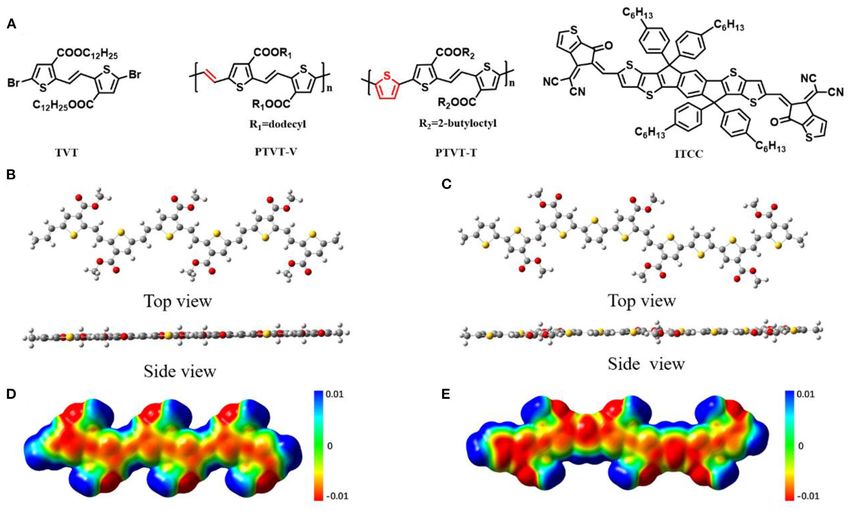
Bi et al.                                                                                                              Organic Photovoltaics for Indoor Application

  FIGURE 1 | (A) Molecular structures of the TVT monomer, PTVT-V, and PTVT-T. The top-view and side-view of optimized geometries of (B) PTVT-V and (C) PTVT-T.
  ESP distributions of (D) PTVT-V and (E) PTVT-T.

with an open-circuit voltage (V OC ) of 1.04 V, a short-circuit                     with a V OC of 0.859 V, a J SC of 41.08 µA cm−2 and FF of 45.54%,
current density (J SC ) of 4.76 mA cm−2 and a FF of 36.85%.                         which corresponds to a PCE of 5.10%. While, the OPV cells based
However, the device based on PTVT-T:ITCC demonstrates a                             on PTVT-T:ITCC shows much higher device performance than
much higher PCE of 9.60% with a V OC of 1.08 V, a J SC of                           that based on PTVT-V:ITCC. Under LED 2,700 K 1,000 lux, the
14.30 mA cm−2 and an FF of 62.06%. The external quantum                             cell based on PTVT-T:ITCC exhibits a MPD of 76.72 µW cm−2
efficiency (EQE) profiles are shown in Figure 2F. The OPV cell                      and a PCE of 24.27%, with a V OC of 0.967 V, a J SC of 103.06
based on PTVT-T:ITCC possesses high EQE values in the range                         µA cm−2 and FF of 76.72%. The device performance under LED
of 350–700 nm, which is much higher than the device based on                        6,500 K, FL 2,700 K, FL 6,500 K with intensity of 500 lux were also
PTVT-V:ITCC. More importantly, the corresponding integrated                         measured. All of the devices show similar PCEs, which suggests
J SC of both OPV cells from the EQE spectra are consistent                          the device can work very well under various illuminations. It
with the J SC that obtained from the J-V measurements. The                          should be noted that, the J SC values that integrated from the EQE
performance of the OPV cells under the indoor light sources                         under the indoor light sources are slight difference with the J SC
were then measured to investigate the effect of the variation in                    values obtained via the J-V measurements, which is within the
the molecular structures on their device performance. The J-                        estimated error for the indoor J-V measurements, the results are
V curves of cells under four light sources, LED 2,700 K, LED                        shown in Supplementary Figure 3.
6,500 K, FL 2,700 K, and FL 6,500 K, are shown in Figure 3. The                         Atomic force microscope (AFM) was used to investigate
corresponding device parameters were summarized in Table 2                          the surface morphology of the neat and blend films. The
and Supplementary Table 1. The intensities of the indoor light                      corresponding height and phase images are shown in
sources were measured and calculated following the similar                          Supplementary Figure 4. Obvious granular substance can
procedure with the previous studies (Cui et al., 2019). Under LED                   be seen in the neat PTVT-V film, resulting a relatively high
2,700 K, obvious enhancement in J SC and V OC can be obtained                       root mean square (RMS) roughness of 6.49 nm. For the neat
with the increase of the light intensity from 200 to 1,000 lux,                     film of PTVT-T, the large granular substances are absent. It
which may be attributed to the increased ratios of photogenerated                   exhibits smooth and ordered aggregation characteristics, which
charge carrier density to trap-state density. For the device based                  can be attributed to the relatively strong aggregation effect of
on PTVT-V:ITCC under LED 2700 K 1,000 lux, it demonstrates                          PTVT-T (Ren et al., 2021). Similar trend was observed in the
a highest maximum power density (MPD) of 16.07 µW cm−2 ,                            blend films. The granular substances of PTVT-V still existed

Frontiers in Chemistry | www.frontiersin.org                                    3                                            May 2021 | Volume 9 | Article 684241
Bi et al.                                                                                                                       Organic Photovoltaics for Indoor Application

  FIGURE 2 | (A) The spectra of AM 1.5 G and various indoor light sources. (B) The absorption spectra of neat films of PTVT-V, PTVT-V, and ITCC. (C) The absorption
  spectra of blend films of PTVT-V:ITCC and PTVT-T:ITCC. (D) Energy level diagrams of the materials used in this work. (E) J-V curves of the OPV devices based on
  PTVT-V:ITCC and PTVT-T:ITCC under the illumination of AM 1.5 G, 100 mW cm−2 . (F) The corresponding EQE spectra of the devices.

in the PTVT-V:ITCC blend, and there is no phase separation                            TABLE 1 | Photovoltaic parameters of the OPV cells based on PTVT-V:ITCC and
effect can be observed in the blend film, which may be caused                         PTVT-T:ITCC under the illumination of AM 1.5 G, 100 mW cm−2 .

by the excessive miscibility between the PTVT-V and ITCC. For                         Active layer       V OC (V)    JSC (mA     Cal. JSC (mA      FF (%)          PCE (%)a
the blend film of PTVT-T:ITCC, obvious phase separation can                                                           cm−2 )        cm−2 )
be observed.
    Grazing incidence wide-angle X-ray scattering (GIWAXS)                            PTVT-T:ITCC         1.08        14.30          14.00          62.06             9.60
                                                                                                                                                                  (9.46 ± 0.06)
was performed to further investigate the packing properties
of the photoactive molecules. The 2D GIWAXS patterns and                              PTVT-V:ITCC         1.04         4.76           4.43          36.85             1.81
                                                                                                                                                                  (1.74 ± 0.03)
corresponding 1D profiles obtained along in-plane (IP) and
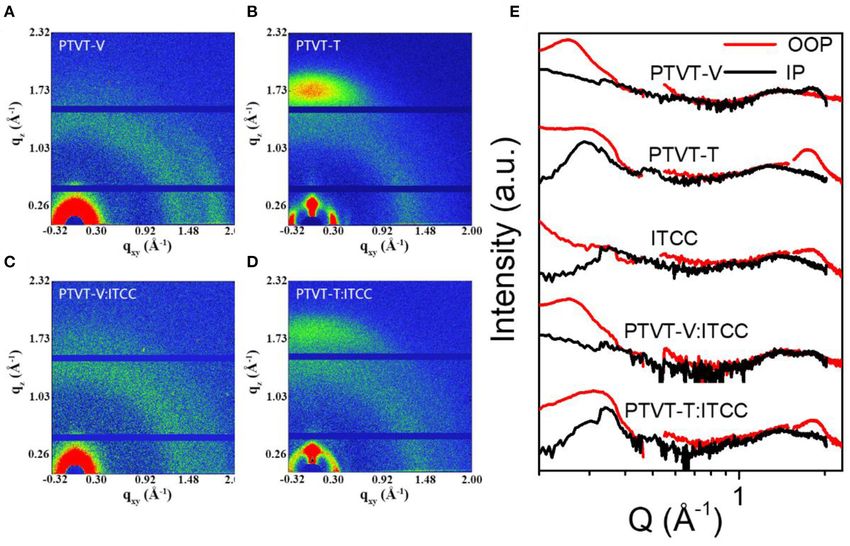
out-of-plane (OOP) directions are shown in Figure 4 and                               a Average   values with standard deviation were obtained from 10 devices.
Supplementary Figure 5a. For the neat film of PTVT-T, it
demonstrates a strong (010) π-π stacking peak in the OOP
direction without any signals in the IP direction, which means                        that of PTVT-V:ITCC blend film is more favorable for efficient
PTVT-T has a face-on dominated orientation (Bi et al., 2018).                         charge transport.
For the pristine PTVT-V, compared to PTVT-T, weaker (010) π-                             In order to investigate the origin of the differences in device
π stacking peak can be found in the IP direction and no obvious                       performance, space-charge limited current (SCLC) method was
(010) peak in the OOP direction, indicating that PTVT-V prefers                       used to measure the hole mobilities of these two systems
an edge-on orientation. The face-on molecular orientation in                          at various temperatures. The hole mobilities of these two
PTVT-T is more favorable for the charge transport in the vertical                     systems can be obtained via fitting the J-V curves as shown
structure devices compared to the edge-on orientation in PTVT-                        in Figures 5A,B. At room temperature (T = 300 K), the hole
V. However, the blend film based on PTVT-V:ITCC shows no                              mobility of the OPV cell based on PTVT-T:ITCC is 2.61 ×
obvious crystal orientation. In the blend films, it can be seen that                  10−4 cm−2 v−1 s−1 , which is much higher than that of PTVT-
the face-on molecular orientation of PTVT-T can be maintained                         V:ITCC (3.00 × 10⁻⁶ cm−2 v−1 s−1 ). It can be reasonable
in the PTVT-T:ITCC blend. Furthermore, the locations of the                           speculated that the higher FF of PTVT-T:ITCC-based device than
π-π stacking peaks of PTVT-V:ITCC and PTVT-T:ITCC are                                 that of PTVT-V:ITCC-based one can ascribe to the higher hole
1.79 and 1.84 Å−1 , corresponding to the d-spacing of 3.53 and                        mobilities of PTVT-T:ITCC. Gaussian disorder model (GDM)
3.41 Å, respectively. The stronger molecular packing property                         was further used to reveal the electronic states of hole transport
and smaller d-spacing in the PTVT-T:ITCC blend film than                              in the both PTVT-V:ITCC and PTVT-T:ITCC systems. The

Frontiers in Chemistry | www.frontiersin.org                                      4                                                   May 2021 | Volume 9 | Article 684241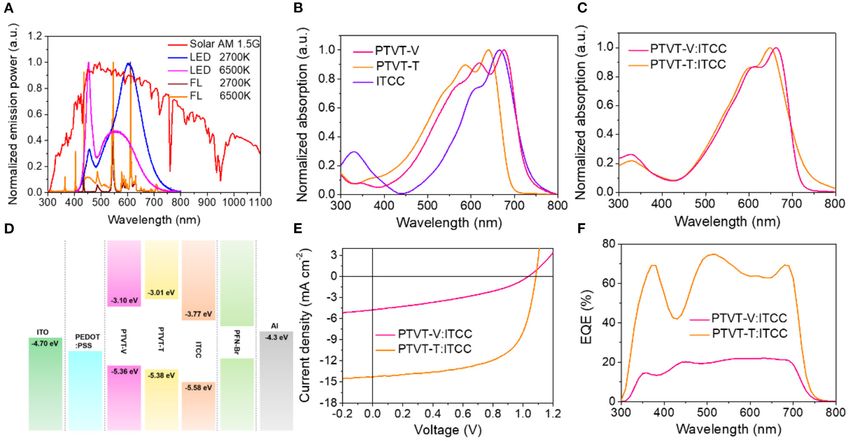
Bi et al.                                                                                                                  Organic Photovoltaics for Indoor Application

  FIGURE 3 | J-V curves of the devices based on PTVT-V:ITCC and PTVT-T:ITCC under various light sources with different light intensities of (A) LED 2,700 K, 200 lux.
  (B) LED 2,700 K, 500 lux. (C) LED 2,700 K, 1,000 lux. (D) LED 6,500 K, 500 lux. (E) FL 6,500 K, 500 lux. (F) FL 2,700 K, 500 lux.

TABLE 2 | Photovoltaic parameters of the devices based on PTVT-V:ITCC and PTVT-T:ITCC under various light sources with different light intensities.

Light sources     Active layer     Intensity(lux)       Pin (µW         V OC (V)   JSC (µA    Cal. JSC (µA cm−2 )     FF (%)    Pout (µW cm−2 )           PCEa (%)
                                                        cm−2 )                     cm−2 )

2,700 K LED       PTVT-V:ITCC           200                60           0.762       7.69              7.28            44.37          2.60             4.3 (4.24 ± 0.05)
                                        500               156           0.830      19.87             18.62            44.93          7.41             4.75 (4.67 ± 0.08)
                                       1,000              315           0.859      41.08             39.86            45.54          16.07            5.10 (4.94 ± 0.09)
                  PTVT-T:ITCC           200                60           0.910      20.46             19.56            72.23          13.45        22.42 (21.87 ± 0.29)
                                        500               156           0.936      52.16             50.01            74.40          36.26         23.24 (22.84±0.33)
                                       1,000              315           0.967      103.06            98.26            76.72          76.46        24.27 (23.89 ± 0.37)

Average values with standard deviation were obtained from 10 devices.

relation between zero-field hole mobility and temperature can be                        states existed in the tailed states of PTVT-V:ITCC than that
expressed as follows:                                                                   of PTVT-T:ITCC system, as shown in diagram of Figure 5D.
                                                                                        The free charge carriers can be captured by the trap sates and
                                    2σ 2
                                "       #
                                                                                        recombined with the electrons, which is a huge energy loss for
                     µ0 = µ∞ exp −
                                    3kT                                                 the real working OPV cells under dim light sources. In order
                                                                                        to clearly show the effect of trap states on charge generation
Where µ∞ is the hole mobility at infinite temperature, k is                             and transport, we further measured the EQE distribution (1
the Boltzmann constant, and σ is the energetic disorder. The                            cm2 ) with an excitation light of 520 nm laser. As displayed
plots of zero-field mobilities of holes as a function of T12 are                        in Figures 5E,F. The EQE distribution for the device based
shown in the Figure 5C. It was shown that, σ can be used                                on PTVT-T:ITCC is much more uniform than that of PTVT-
to describe the energetic spreading of the HOMO sites, i.e.,                            V:ITCC, which suggests that PTVT-T:ITCC-based device has
the energetic disorder (Liu et al., 2020b; Lv et al., 2020). The                        higher efficient charge generation and collection than the PTVT-
smaller value of σ means fewer trap states near the HOMO                                V:ITCC-based device.
levels. The calculated values of σ of PTVT-V:ITCC and PTVT-                                The charge transfer dynamics in both systems were further
T:ITCC systems are 70 and 58 meV, respectively, as shown                                characterized by time resolved photoluminescence (TRPL).
in Supplementary Table 2. The results show that more trap                               According to the absorption spectra, an excitation light at 500 nm

Frontiers in Chemistry | www.frontiersin.org                                        5                                             May 2021 | Volume 9 | Article 684241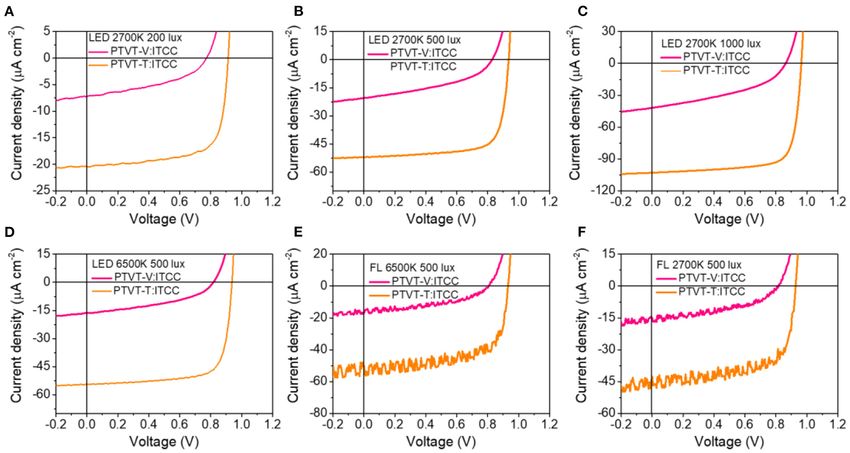
Bi et al.                                                                                                                 Organic Photovoltaics for Indoor Application

  FIGURE 4 | The 2D scattering patterns of (A) PTVT-V, (B) PTVT-T, (C) PTVT-V:ITCC and (D) PTVT-T:ITCC. (E) The corresponding OOP and IP GIWAXS profiles of both
  neat and blend films.

  FIGURE 5 | SCLC plots under different temperatures for the devices based on (A) PTVT-V:ITCC and (B) PTVT-T:ITCC. (C) The plots of hole mobilities of the devices
  as a function of 1/T2 using SCLC derived data. (D) The diagram of the density of the state (DOS) of HOMO levels of PTVT-V and PTVT-T. The EQE mapping of the
  blend devices of (E) PTVT-V:ITCC and (F) PTVT-T:ITCC.

Frontiers in Chemistry | www.frontiersin.org                                      6                                             May 2021 | Volume 9 | Article 684241
Bi et al.                                                                                                               Organic Photovoltaics for Indoor Application

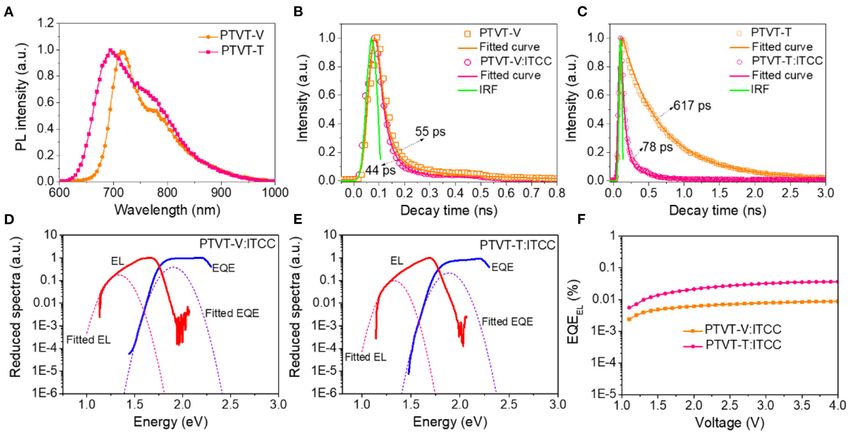
  FIGURE 6 | (A) The steady-state PL spectra of PTVT-V and PTVT-T neat films with an excitation wavelength of 500 nm. The PL decay kinetics of (B) PTVT-V based
  systems and (C) PTVT-T based systems. The determination of E CTs by EL and s-EQE spectra of (D) PTVT-V:ITCC and (E) PTVT-T:ITCC. (F) EQE EL of the devices
  based on PTVT-V:ITCC and PTVT-T:ITCC.

was used to mainly excite the donors of PTVT-V and PTVT-                             TABLE 3 | Detailed energy loss parameters of the OSCs based on PTVT-V and
T. The PL and TRPL spectra are shown in Figure 6. The                                PTVT-T.

fluorescence lifetime of PTVT-V and PTVT-T neat films are                            Blends        1Eg (eV)   E (eV)    VSQ
                                                                                                                         OG (V)    1E1 (eV)    1E2 (eV)    1E3 (eV)
55 and 617 ps, respectively. The longer fluorescence lifetime
of PTVT-T indicates the relative weak charge recombination                           PTVT-V:ITCC     1.78      0.74     1.494        0.286      0.208       0.246
processes in the system of PTVT-T:ITCC. After blending with                          PTVT-T:ITCC     1.78      0.70     1.494        0.286      0.204       0.210
ITCC, the fluorescence lifetimes of PTVT-V:ITCC and PTVT-
T:ITCC decay to 44 and 78 ps, respectively. The faster decay
time means that the charge transfer between donor and acceptor                       the EQEEL of these two devices are ca. 3 × 10⁻⁴ and 7 ×
in PTVT-T:ITCC is more efficient than the system of PTVT-                            10−5 , corresponding to a E3 of 0.246 and 0.210 eV for PTVT-
V:ITCC, resulting in smaller charge recombination in the system                      V:ITCC- and PTVT-T:ITCC-based device, respectively. The
of PTVT-T:ITCC (Bi et al., 2019).                                                    relative larger non-radiative energy loss in PTVT-V:ITCC-based
   As discussed before, the energetic disorder plays a key                           cell should be resulted from the increased energetic disorder
role in determining the intrinsic traps, as well as the V OC                         that causes the free charge carriers to be easily trapped by the
loss, of photovoltaic materials with certain chemical structures.                    trap states.
Compared to the OPV cells using the incident light of one                               Unlike the high-performance photovoltaic materials, the
sun, the V OC loss is much more important to the OPV cells                           PTV derivatives possess very simple molecular structures
working under dim light. Here, the V OC loss was measured                            without fused ring and expensive substituent functional groups.
carefully by using highly sensitive external quantum efficiency                      As reported in our previous work, PTVT-T can be easily
(HEQE) spectrum and electroluminescence (EL). The sEQE and                           obtained in five steps. The plot of PCEs of IOPV cells as a
EL spectra of these two systems are shown in Figures 6D,E.                           function of the steps that required for material synthesis are
The detailed energy loss parameters are shown in Table 3.                            shown in Supplementary Figure 6a. The chemical structures
The blend systems of PTVT-V:ITCC and PTVT-T:ITCC have                                and detailed parameters of the IOPV cells are shown in
the same calculated optical bandgap of 1.78 eV, as shown in                          Supplementary Figure 6c and Supplementary Table 3. It can
Supplementary Figure 5. The radiative energy loss of PTVT-                           be easily found that PTVT-T has the highest PCE for the
V:ITCC and PTVT-T:ITCC are 0.208 and 0.204 eV, respectively.                         IOPV cell application with the minimum synthesis steps.
However, the non-radiative, which is closely related to the                          Besides, the IOPV device with a relatively large area (4
charge recombination, can be quantitively calculated via the                         cm2 ) was fabricated, the cell shows a PCE of 22.34%, with
results of EQEEL (Hou et al., 2018). As shown in Figure 6F,                          a V OC of 0.927 V, a J SC 50.87 µA cm−2 of and a FF of

Frontiers in Chemistry | www.frontiersin.org                                     7                                              May 2021 | Volume 9 | Article 684241
Bi et al. Organic Photovoltaics for Indoor Application
73.93%. The photograph of the device and its J-V characteristic DATA AVAILABILITY STATEMENT
are shown in Supplementary Figure 6b. Despite the relatively
large device area, the device still exhibits a PCE of 24% The original contributions generated for the study are included
under the light source of LED 2,700 K with an intensity of in the article/Supplementary Material, further inquiries can be
500 lux. directed to the corresponding author.
CONCLUSION AUTHOR CONTRIBUTIONS
PTVT-V and PTVT-T are synthesized based on TVT monomer PB, SZ, and JH conceived the idea. PB carried out the materials
and both show very simple chemical structures. PTVT-V selection, cells fabrication, and characterizations. JR synthesized
prefers an edge-on orientation, whereas PTVT-T prefers face- the donor materials. The IOPV performance was measured
on orientation, which is more favorable for the charge transport. with the help of YX and YC. TZ and JQ conducted the AFM
More importantly, PTVT-T was found has much lower energetic characterizations. All authors discussed and commented on the
disorder (58 meV) in compression to that of PTVT-V (70 key scientific issues in the work.
meV). The smaller energetic disorder can enable the blend of
PTVT-T:ITCC has low trap-state density, which can effectively FUNDING
suppress the charge recombination processes. For the real
devices, the small energetic disorder leads a relatively small This work was supported by the financial support from National
non-radiative energy loss in the OPV cell based on PTVT- Natural Science Foundation of China (21835006 and 21734008),
T:TCC. Finally, the OPV cells based on PTVT-V:ITCC and the Fundamental Research Funds for the Central Universities,
PTVT-T:ITCC demonstrate the MPDs (PCEs) of 7.41 µW cm−2 China (FRF-TP-19-047A2), and China Postdoctoral Science
(4.75%) and 36.26 µW cm−2 (23.24%) under the illumination Foundation (2019M660799).
of LED 2,700 K, 500 lux, respectively. A PCE of 24.27% can be
realized in PTVT-T:ITCC-based IOPV cell under 1,000 lux (LED SUPPLEMENTARY MATERIAL
2,700 K). This work demonstrates that conjugated polymers with
simple molecular structures and low energetic disorder is with The Supplementary Material for this article can be found
great importance for the future indoor light applications of online at: https://www.frontiersin.org/articles/10.3389/fchem.
OPV cells. 2021.684241/full#supplementary-material
REFERENCES solar cells with inherently built-in microstructure. Adv. Energy Mater.
9:1900409. doi: 10.1002/aenm.201900409
Al-Ahmad, A. Y., Almayhi, F., Al-Mudhaffer, M. F., Griffith, M. J., Liu, W., Li, S., Hou, J., Inganäs, O., Friend, R. H., and Gao, F. (2018). Organic solar cells based on
et al. (2020). A nuanced approach for assessing OPV materials for large scale non-fullerene acceptors. Nat. Mater. 17, 119–128. doi: 10.1038/nmat5063
applications. Sustain. Energy Fuels 4, 940–949. doi: 10.1039/C9SE01149H Kaltenbrunner, M., White, M. S., Głowacki, E. D., Sekitani, T., Someya, T.,
Bi, P., Ren, J., Zhang, S., Wang, J., and Hou, J. (2020). PTV-based p-type organic Sariciftci, N. S., et al. (2012). Ultrathin and lightweight organic solar cells with
semiconductors: candidates for low-cost photovoltaic donors with simple high flexibility. Nat. Commun. 3:770. doi: 10.1038/ncomms1772
synthetic routes. Polymer 209:122900. doi: 10.1016/j.polymer.2020.122900 Kotadiya, N. B., Lu, H., Mondal, A., Ie, Y., Andrienko, D., Blom, P. W.
Bi, P., Xiao, T., Yang, X., Niu, M., Wen, Z., Zhang, K., et al. (2018). Regulating the M., et al. (2018). Universal strategy for Ohmic hole injection into organic
vertical phase distribution by fullerene-derivative in high performance ternary semiconductors with high ionization energies. Nat. Mater. 17, 329–334.
organic solar cells. Nano Energy 46, 81–90. doi: 10.1016/j.nanoen.2018.01.040 doi: 10.1038/s41563-018-0022-8
Bi, P. Q., Hall, C. R., Yin, H., So, S. K., Smith, T. A., Ghiggino, K. P., et al. (2019). Kotadiya, N. B., Mondal, A., Blom, P. W. M., Andrienko, D., and
Resolving the mechanisms of photocurrent improvement in ternary organic Wetzelaer, G.-J. A. H. (2019). A window to trap-free charge transport
solar cells. J. Phys. Chem. C 123, 18294–18302. doi: 10.1021/acs.jpcc.9b06267 in organic semiconducting thin films. Nat. Mater. 18, 1182–1186.
Clarke, T. M., and Durrant, J. R. (2010). Charge photogeneration in organic solar doi: 10.1038/s41563-019-0473-6
cells. Chem. Rev. 110, 6736–6767. doi: 10.1021/cr900271s Li, Y., Xu, G., Cui, C., and Li, Y. (2018). Flexible and semitransparent organic solar
Cui, Y., Hong, L., and Hou, J. (2020a). Organic photovoltaic cells for indoor cells. Adv. Energy Mater. 8:1701791. doi: 10.1002/aenm.201701791
applications: opportunities and challenges. ACS Appl. Mater. Inter. 12, Liu, Q., Jiang, Y., Jin, K., Qin, J., Xu, J., Li, W., et al. (2020a). 18% Efficiency organic
38815–38828. doi: 10.1021/acsami.0c10444 solar cells. Sci. Bull. 65:272. doi: 10.1016/j.scib.2020.01.001
Cui, Y., Wang, Y., Bergqvist, J., Yao, H., Xu, Y., Gao, B., et al. (2019). Wide-gap non- Liu, S., Yuan, J., Deng, W., Luo, M., Xie, Y., Liang, Q., et al. (2020b). High-efficiency
fullerene acceptor enabling high-performance organic photovoltaic cells for organic solar cells with low non-radiative recombination loss and low energetic
indoor applications. Nat. Energy 4, 768–775. doi: 10.1038/s41560-019-0448-5 disorder. Nat. Photon. 14, 300–305. doi: 10.1038/s41566-019-0573-5
Cui, Y., Yao, H., Hong, L., Zhang, T., Tang, Y., Lin, B., et al. (2020b). Organic Lv, J., Feng, Y., Fu, J., Gao, J., Singh, R., Kumar, M., et al. (2020). Energetic
photovoltaic cell with 17% efficiency and superior processability. Natl. Sci. Rev. disorder and activation energy in efficient ternary organic solar cells with
7, 1239–1246. doi: 10.1093/nsr/nwz200 nonfullerene acceptor Eh-IDTBR as the third component. Solar RRL 4:1900403.
Haneef, H. F., Zeidell, A. M., and Jurchescu, O. D. (2020). Charge carrier traps doi: 10.1002/solr.201900403
in organic semiconductors: a review on the underlying physics and impact on Ma, L., Zhang, S., Yao, H., Xu, Y., Wang, J., Zu, Y., et al. (2020a). High-
electronic devices. J. Mater. Chem. C 8, 759–787. doi: 10.1039/C9TC05695E efficiency nonfullerene organic solar cells enabled by 1000 nm thick active
He, Y., Heumüller, T., Lai, W., Feng, G., Classen, A., Du, X., et al. (2019). layers with a low trap-state density. ACS Appl. Mater. Inter. 12, 18777–18784.
Evidencing excellent thermal- and photostability for single-component organic doi: 10.1021/acsami.0c05172
Frontiers in Chemistry | www.frontiersin.org 8 May 2021 | Volume 9 | Article 684241Bi et al. Organic Photovoltaics for Indoor Application Ma, L.-K., Chen, Y., Chow, P. C. Y., Zhang, G., Huang, J., Ma, C., et al. (2020b). Yao, H., Cui, Y., Qian, D., Ponseca, C. S., Jr., Honarfar, A., Xu, Y., et al. (2019). High-efficiency indoor organic photovoltaics with a band-aligned interlayer. 14.7% efficiency organic photovoltaic cells enabled by active materials with Joule 4, 1486–1500. doi: 10.1016/j.joule.2020.05.010 a large electrostatic potential difference. J. Am. Chem. Soc. 141, 7743–7750. Meng, L., Zhang, Y., Wan, X., Li, C., Zhang, X., Wang, Y., et al. (2018). Organic and doi: 10.1021/jacs.8b12937 solution-processed tandem solar cells with 17.3% efficiency. Science 361:1094. Yu, G., Gao, J., Hummelen, J. C., Wudl, F., and Heeger, A. J. (1995). Polymer doi: 10.1126/science.aat2612 photovoltaic cells: enhanced efficiencies via a network of internal donor- Menke, S. M., Ran, N. A., Bazan, G. C., and Friend, R. H. (2018). Understanding acceptor heterojunctions. Science 270:1789. doi: 10.1126/science.270.5243.1789 energy loss in organic solar cells: toward a new efficiency regime. Joule 2, 25–35. Yuan, J., Zhang, Y., Zhou, L., Zhang, G., Yip, H.-L., Lau, T.-K., et al. doi: 10.1016/j.joule.2017.09.020 (2019). Single-junction organic solar cell with over 15% efficiency using Qian, D., Zheng, Z., Yao, H., Tress, W., Hopper, T. R., Chen, S., et al. (2018). Design fused-ring acceptor with electron-deficient core. Joule 3, 1140–1151. rules for minimizing voltage losses in high-efficiency organic solar cells. Nat. doi: 10.1016/j.joule.2019.01.004 Mater. 17, 703–709. doi: 10.1038/s41563-018-0128-z Zhang, M., Zhu, L., Zhou, G., Hao, T., Qiu, C., Zhao, Z., et al. (2021). Single-layered Ren, J., Bi, P., Zhang, J., Liu, J., Wang, J., Xu, Y., et al. (2021). Molecular design organic photovoltaics with double cascading charge transport pathways: 18% revitalizes the low-cost PTV-polymer for highly efficient organic solar cells. efficiencies. Nat. Commun. 12:309. doi: 10.1038/s41467-020-20580-8 Natl. Sci. Rev. 2021:nwab031. doi: 10.1093/nsr/nwab031 Zhang, Y., Duan, C., and Ding, L. (2020). Indoor organic photovoltaics. Sci. Bull. Singh, R., Duan, T., Kan, Z., Chochos, C. L., Kini, G. P., Kumar, M., et al. (2020). 65:2040. doi: 10.1016/j.scib.2020.08.030 Revealing the structural effects of non-fullerene acceptors on the performances Zuo, G., Li, Z., Andersson, O., Abdalla, H., Wang, E., and Kemerink, M. of ternary organic photovoltaics under indoor light conditions. Nano Energy (2017). Molecular doping and trap filling in organic semiconductor host–guest 75:104934. doi: 10.1016/j.nanoen.2020.104934 systems. J. Phys. Chem. C 121, 7767–7775. doi: 10.1021/acs.jpcc.7b01758 Song, X., Gasparini, N., Ye, L., Yao, H., Hou, J., Ade, H., et al. (2018). Controlling blend morphology for ultrahigh current density in nonfullerene Conflict of Interest: The authors declare that the research was conducted in the acceptor-based organic solar cells. ACS Energy Lett. 3, 669–676. absence of any commercial or financial relationships that could be construed as a doi: 10.1021/acsenergylett.7b01266 potential conflict of interest. Wang, Z. (2020). Cesium lead inorganic solar cell with efficiency beyond 18% via reduced charge recombination. J. Semicon. 41:010201. The reviewer ZK declared a shared affiliation, with no collaboration, with doi: 10.1088/1674-4926/41/1/010201 the authors PB, JR, TZ, YX, YC, JQ, JH to the handling editor at the time of Xue, R., Zhang, J., Li, Y., and Li, Y. (2018). Organic solar cell materials the review. toward commercialization. Small 14:1801793. doi: 10.1002/smll.2018 01793 Copyright © 2021 Bi, Ren, Zhang, Zhang, Xu, Cui, Qin and Hou. This is an open- Yan, C., Barlow, S., Wang, Z., Yan, H., Jen, A. K. Y., Marder, S. R., et al. (2018). access article distributed under the terms of the Creative Commons Attribution Non-fullerene acceptors for organic solar cells. Nat. Rev. Mater. 3:18003. License (CC BY). The use, distribution or reproduction in other forums is permitted, doi: 10.1038/natrevmats.2018.3 provided the original author(s) and the copyright owner(s) are credited and that the Yan, T., Song, W., Huang, J., Peng, R., Huang, L., and Ge, Z. (2019). 16.67% original publication in this journal is cited, in accordance with accepted academic rigid and 14.06% flexible organic solar cells enabled by ternary heterojunction practice. No use, distribution or reproduction is permitted which does not comply strategy. Adv. Mater. 31:1902210. doi: 10.1002/adma.201902210 with these terms. Frontiers in Chemistry | www.frontiersin.org 9 May 2021 | Volume 9 | Article 684241
You can also read


