The COVID 19 lab score: an accurate dynamic tool to predict in hospital outcomes in COVID 19 patients
←
→
Page content transcription
If your browser does not render page correctly, please read the page content below
www.nature.com/scientificreports
OPEN The COVID‑19 lab score:
an accurate dynamic tool to predict
in‑hospital outcomes in COVID‑19
patients
Pablo Jose Antunez Muiños1,3, Diego López Otero1,3*, Ignacio J. Amat‑Santos2,
Javier López País1,3, Alvaro Aparisi2, Carla E. Cacho Antonio1,3, Pablo Catalá2,
Teba González Ferrero1,3, Gonzalo Cabezón2, Oscar Otero García1,3, José Francisco Gil2,
Marta Pérez Poza1,3, Jordi Candela2, Gino Rojas2, Víctor Jiménez Ramos1,3, Carlos Veras2,
J. Alberto San Román2 & José R. González‑Juanatey1,3
Deterioration is sometimes unexpected in SARS-CoV2 infection. The aim of our study is to establish
laboratory predictors of mortality in COVID-19 disease which can help to identify high risk patients.
All patients admitted to hospital due to Covid-19 disease were included. Laboratory biomarkers
that contributed with significant predictive value for predicting mortality to the clinical model were
included. Cut-off points were established, and finally a risk score was built. 893 patients were included.
Median age was 68.2 ± 15.2 years. 87(9.7%) were admitted to Intensive Care Unit (ICU) and 72(8.1%)
needed mechanical ventilation support. 171(19.1%) patients died. A Covid-19 Lab score ranging from
0 to 30 points was calculated on the basis of a multivariate logistic regression model in order to predict
mortality with a weighted score that included haemoglobin, erythrocytes, leukocytes, neutrophils,
lymphocytes, creatinine, C-reactive protein, interleukin-6, procalcitonin, lactate dehydrogenase
(LDH), and D-dimer. Three groups were established. Low mortality risk group under 12 points, 12 to
18 were included as moderate risk, and high risk group were those with 19 or more points. Low risk
group as reference, moderate and high patients showed mortality OR 4.75(CI95% 2.60–8.68) and
23.86(CI 95% 13.61–41.84), respectively. C-statistic was 0–85(0.82–0.88) and Hosmer–Lemeshow
p-value 0.63. Covid-19 Lab score can very easily predict mortality in patients at any moment during
admission secondary to SARS-CoV2 infection. It is a simple and dynamic score, and it can be very
easily replicated. It could help physicians to identify high risk patients to foresee clinical deterioration.
In December 2019, an outbreak of a new syndrome emerged in the Chinese province of Hubei. A new betacoro-
navirus was described, called SARS-CoV-21. By April 18th, the World Health Organization reported more than
2 million of confirmed cases of COVID-19 disease (Coronavirus Disease 2019), affecting 200 different countries
all around the world2. Deaths rose to almost 140 thousand people.
One of the most encouraging characteristic of Covid-19 disease, is the huge differences in the clinical manifes-
tations depending of each p atient3–5. It is suspected that some of them are paucisymptomatic, or even completely
asymptomatic. On the other hand, in some patients SARS-CoV-2 could trigger a big inflammation response,
causing a severe disease. Severe Acute Respiratory Syndrome is one of the most common and severe complica-
tions, due to its predisposition for the respiratory system, requiring sometimes admission in Intensive Care
Units (ICU) or mechanical ventilation and with an elevated death r ate6. Three different phases are d escribed7.
First one is the early infection, and secondary there is the pulmonary involvement, causing bilateral infiltrates.
Finally, a stage of hyperinflammation is described, affecting extrapulmonary organs and triggering a systemic
cytokine storm. Elevated levels of some biomarkers5 such as Interleukin (IL)-2, -6, -7, TNFα, IFNγ, C-reactive
protein, ferritin, D-Dimer, procalcitonin, troponin are described in this severe patients. At this stage, mechani-
cal ventilation and admission at ICU are frequently needed, because of hypoxemia, respiratory failure, or even
shock secondary to vasoplegia.
1
Cardiology Department, Hospital Universitario de Santiago de Compostela, Choupana S/N, C.P. 15706, A Coruña,
Spain. 2Cardiology Department, Hospital Clínico Universitario de Valladolid, Valladolid, Spain. 3CIBERCV, Madrid,
Spain. *email: birihh@yahoo.es
Scientific Reports | (2021) 11:9361 | https://doi.org/10.1038/s41598-021-88679-6 1
Vol.:(0123456789)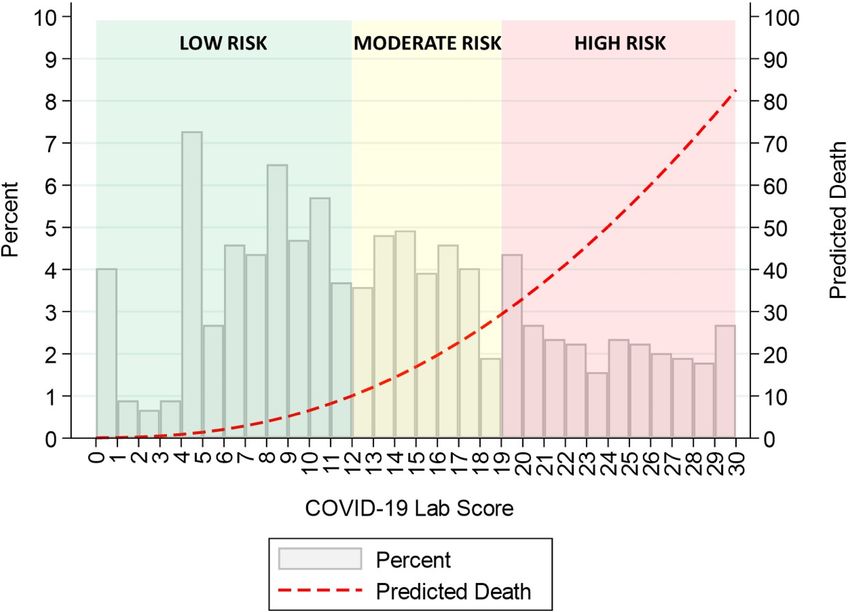
www.nature.com/scientificreports/
The aim of the study was to identify high risk patients affected with COVID-19, those with a poor outcome,
depending on laboratory biomarkers. Mortality was selected as the primary endpoint of interest. Risk factors
and comorbidities such as obesity and diabetes have been described with a poorer o utcome8,9. Moreover, a
dynamic, objective and very easily score could help physicians to anticipate clinical deterioration. Our goal is
to stratify the risk of death for patients with Covid-19 at any moment during the admission, using a very simple
and reproducible analytic tool, developed only with laboratory parameters.
Methods
This is a multicentre, retrospective, observational study performed at three university hospitals from the North-
West region of Spain, covering a population of more than one million of inhabitants. In our registry we included
all the confirmed cases for SARS-CoV-2 infection from our health areas (n = 1779). Patients were recorded during
the first two months since the first case in our areas was diagnosed. For the purpose of this study, we only ana-
lysed those patients admitted to hospital with available information about laboratory data (n = 893). Follow-up
continued for 3 months. This study was approved by the Ethical Committee of Investigation of Santiago and
Lugo (registry code 2020/187) with an approval number UNH-ARA-2020-01, and it fulfils the Declaration of
Helsinki of 1975.
We selected laboratory parameters were previously associated with SARS-CoV2 infection in recent
literature5,10–14 and with a poorer outcome similar viral severe i nfections15–18. Moreover, haemoglobin and eryth-
rocyte levels, or serum creatinin were evaluated because of their relation with outcomes in severe ill patients, The
most deviant from normal results of the laboratory tests for each biomarker during the admission were selected
for the score (they were mostly the higher ones, except for the haemoglobin and erythrocytes).
Normal ranges for the different parameters were: procalcitonin < 0.05 ng/mL; Haemoglobin 13.5–17.5 g/dL
for men and 12.2–16.1 g/dL for women; erythrocytes 4.5–5.5 per 1 06/mm3 ; leukocytes 4.09–10.8 per 1 03/mm3 ;
neutrophils 1.7–7.33 per103/mm3 ; creatinine 0.4–1.3 mg/dL for men and 0.4–1.1 mg/dL for women; C-reactive
protein 0–0.5 mg/L; interleukin-6 0–5.0 pg/mL; lactate dehydrogenase (LDH) 200–446 UI/L; D-dimer 0–500 ng/
mL.
Outcomes. This work is conducted to develop an easily replicable, objective and dynamic score to help phy-
sicians to assess the risk of adverse outcomes at any moment during the admission due to COVID-19.
All the information about the clinical evolution and the complications developed was recollected along the
admission and continued also when discharged, thanks to remote monitoring. Mortality for any cause during the
hospitalization was selected as the main outcome, and was recollected from clinical records. Secondary endpoints
were non-cardiovascular outcomes such as ICU admission, necessity of mechanical ventilation or pulmonary
embolism. Acute myocardial infarct, heart failure and stroke were established as cardiovascular outcomes.
Data collection. Standardized forms were used for the setting-up of the database, including demographic
information, epidemiological data, previous comorbidities and chronic treatments, the clinical data available at
the moment when they were admitted to hospital (symptoms, fever and peripheral O2 saturation (SpO2), the
results of all laboratory tests done during the admission and the treatment received. All these information was
collected from medical records. Laboratory test and clinical decisions were taking according to physician´s cri-
teria. Informed consent was obtained for study participation of each patient when admitted to hospital. The data
in source documents was confirmed independently by at least two physicians.
Statistical analysis. Continuous variables are presented as mean (SD), whereas discrete variables are pre-
sented as percentages. Comparisons between discrete variables were performed using the χ2 test or Fisher exact
test as required, and comparisons between continuous variables using the Student t-test (Table 1).
Backward stepwise logistic regression analysis was performed to determine the predictive factors for mortal-
ity. Variables that were significantly associated with mortality in the univariate analysis (Supplementary Table 1)
were included in the multivariate model (Table 2). The multivariate adjustment was performed according these
variables, in addition to biomarkers: age, comorbidities (hypertension, dyslipidemia, diabetes mellitus, peripheral
artery disease, heart disease, Chronic Obstructive Pulmonary Disease (COPD)/asthma), days of symptoms, res-
piratory insufficiency (defined as PaO2 < 60 mmHg), and in-hospital drugs (antiviral, chloroquine, ceftriaxone,
corticosteroids, anticoagulation, antiplatelet). The incremental value of each significant biomarker, when it was
added to a clinical base model, was assessed with the change in the c-index (Table 3).
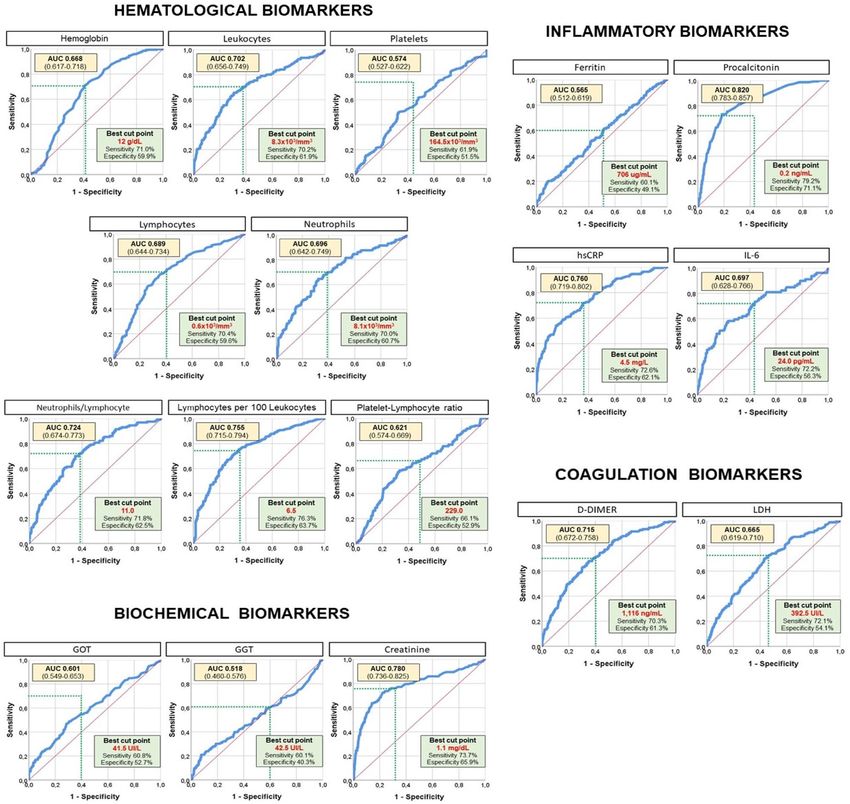
The optimal cut-point definition for different biomarkers was defined based on the receiver operating char-
acteristic (ROC) curve, using the Youden index (Fig. 1). Sensitivity and specificity were reported for cut-points.
After categorizing the biomarkers according to their cut-points, those resulting as independent predictors
of mortality by the multivariate logistic regression analysis were incorporated into a risk score (Table 4). The
scores assigned to each biomarker were determined according to the value of the odds ratio (OR). The predicted
probability of death based on the risk score was graphically represented after modelling by fractional polynomials
(Fig. 2). The performance of this risk score was tested by assessing its discrimination and calibration capacity
(Table 5), for all-cause death. Discrimination was evaluated by calculating the C statistic, and calibration was
assessed by the Hosmer–Lemeshow test.
All p values were two-sided and values < 0.05 were considered as significant. All statistical analyses were per-
formed using STATA software, version 15.1 (Stata Corp, College Station, Texas, USA), and IBM SPSS software,
version 24.0 (IBM, Armonk, New York, USA).
Scientific Reports | (2021) 11:9361 | https://doi.org/10.1038/s41598-021-88679-6 2
Vol:.(1234567890)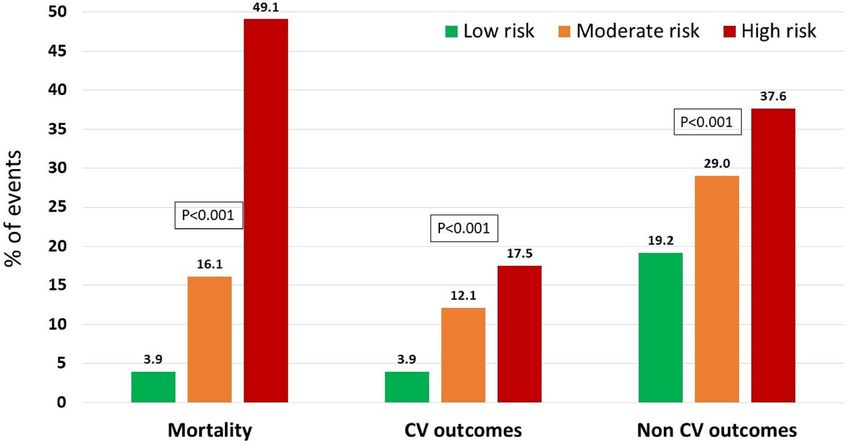
www.nature.com/scientificreports/

                                   Baseline characteristic                 Value
                                   Age                                     68.2 ± 15.2
                                   Female sex                              453 (50.7%)
                                   Obesity                                 110 (12.3%)
                                   Institutionalized person                15 (1.7%)
                                   Dementia                                17 (1.9%)
                                   Dependency                              43 (4.8%)
                                   Health worker                           13 (1.5%)
                                   Active smoking                          40 (4.5%)
                                   Hypertension                            444 (49.7%)
                                   Diabetes mellitus                       174 (19.5%)
                                   Dyslipidemia                            362 (40.5%)
                                   Peripheral artery disease               21 (2.4%)
                                   Heart disease                           149 (16.7%)
                                   Ischemic heart disease                  75 (8.4%)
                                   Myocardiopathy or depressed LVEF        49 (5.5%)
                                   Valvular heart disease                  12 (1.3%)
                                   Atrial fibrillation                     20 (2.2%)
                                   Pulmonary disease                       55 (6.2%)
                                   COPD or asthma                          84 (9.4%)
                                   Prior stroke                            19 (2.1%)
                                   Prior cancer                            12 (1.3%)
                                   Hypothyroidism                          13 (1.5%)
                                   Autoimmune disease                      18 (2.0%)
                                   Anticoagulation                         201 (11.4%)
                                   Antiplatelet therapy                    144 (16.1%)
                                   ACEI/ARB                                333 (37.3%)
                                   Antialdosteronic drug                   21 (2.4%)
                                   B-blockers                              158 (17.7%)
                                   Calcium channel blocker                 65 (7.3%)
                                   Diuretic drugs                          113 (12.7%)
                                   Statin                                  294 (32.9%)
                                   Corticosteroid                          24 (2.7%)
                                   Inmunosupression                        12 (1.3%)
                                   Days of symptoms                        7.3 ± 5.1
                                   Fever                                   562 (62.9%)
                                   Respiratory insufficiency               350 (39.2%)
                                   Antiviral                               751 (84.1%)
                                   Chloroquine                             772 (86.5%)
                                   Interferon                              33 (3.7%)
                                   Tocilizumab                             91 (10.2%)
                                   Azithromycin                            619 (69.3%))
                                   Ceftriaxone                             450 (50.4%)
                                   Corticosteroids                         223 (25.0%)
                                   Anticoagulation                         347 (38.9%)
                                   Antiplatelets                           542 (60.7%)

                                  Table 1.  Baseline characteristics of total population (n = 893). Categorical variables in n (%) and quantitative
                                  variables in mean ± standard deviation. LVEF left ventricle ejection fraction.

                                  Results
                                  From all cases diagnosed in our health areas (n: 1799), a total of 893 patients were admitted to hospital due to
                                  COVID-19. Baseline characteristics are described in Table 1. Median age was 68.2 ± 15.2 years, and 453 were
                                  female (50.7%). Considering these 893 patients admitted to hospital, 87 (9.7%) patients were admitted to Inten-
                                  sive Care Unit (ICU), 72 cases (8.1%) needed mechanical ventilation support and 171 (19.1%) died. Mean length
                                  of hospital stay was 10.6 days, but few patients were not discharged at the end of the follow-up.

Scientific Reports |   (2021) 11:9361 |                        https://doi.org/10.1038/s41598-021-88679-6                                             3

                                                                                                                                              Vol.:(0123456789)
www.nature.com/scientificreports/
Univariate Multivariate
Laboratory data OR 95% CI p OR 95% CI p
Hemoglobin, per g/dL 0.74 0.68–0.80 < 0.001 0.82 0.75–0.91 < 0.001
Leukocytes, per 103/mm3 1.11 1.08–1.14 < 0.001 1.08 1.05–1.11 < 0.001
Neutrophils, per 103/mm3 1.10 1.06–1.14 < 0.001 1.07 1.03–1.12 0.001
Lymphocytes, per 103/mm3 0.31 0.21–0.48 < 0.001 0.72 0.50–1.04 0.083
Platelets, per 105/mm3 0.80 0.68–0.95 0.010 1.00 0.99–1.01 0.903
Neutrophil–lymphocyte ratio 1.04 1.02–1.05 < 0.001 1.02 1.01–1.03 0.012
Lymphocytes per 100 leukocytes 0.88 0.86–0.91 < 0.001 0.93 0.90–0.96 < 0.001
Platelet–lymphocyte ratio 1.84 1.19–2.86 0.006 1.14 0.63–2.08 0.665
GOT, per 10 UI/L 1.05 1.02–1.08 < 0.001 1.05 1.01–1.08 0.009
GGT, per 10 UI/L 1.01 1.00–1.02 0.005 1.02 1.00–1.03 0.019
Creatinine, per mg/dL 2.79 2.19–3.57 < 0.001 1.97 1.58–2.47 < 0.001
CRP, per 10 mg/L 1.10 1.08–1.12 < 0.001 1.09 1.06–1.12 < 0.001
IL-6, per 10 pg/mL 1.01 1.00–1.02 0.017 1.01 1.00–1.02 0.014
Ferritin, per 1000 ug/mL 1.25 1.09–1.44 0.002 1.19 0.98–1.43 0.079
Procalcitonin, per ng/mL 1.05 1.02–1.08 0.002 1.05 1.02–1.08 0.001
LDH, per 100 UI/L 1.19 1.12–1.26 < 0.001 1.34 1.21–1.49 < 0.001
D-Dimer, per 1000 ng/mL 1.05 1.03–1.07 < 0.001 1.03 1.01–1.05 0.001
Table 2. Univariate and multivariate analysis for biomarkers to predict mortality. Multivariate adjustment:
Age, comorbidities (hypertension, dyslipemia, diabetes mellitus, peripheral artery disease, heart disease,
COPD/asthma), days of symptoms, respiratory insufficiency, in-hospital drugs (antiviral, chloroquine,
ceftriaxone, corticosteroids, anticoagulation, antiplatelet).
Model C-statistic 95% CI P-value
Base model (as reference) 0.891 0.866–0.916 ref
Base model + hemoglobin 0.900 0.877–0.923 0.012
Base model + leukocytes 0.907 0.884–0.929 0.001
Base model + neutrophils 0.934 0.914–0.955 < 0.001
Base model + neu-lymph ratio 0.934 0.914–0.955 < 0.001
Base model + lymph × 100 leu 0.905 0.884–0.927 0.015
Base model + GOT 0.915 0.892–0.938 0.002
Base model + GGT 0.906 0.881–0.931 0.014
Base model + creatinine 0.910 0.887–0.933 < 0.001
Base model + CRP 0.915 0.892–0.937 0.001
Base model + IL-6 0.916 0.883–0.949 0.021
Base model + procalcitonin 0.916 0.877–0.926 0.026
Base model + LDH 0.925 0.905–0.946 < 0.001
Base model + D-dimer 0.903 0.879–0.926 0.036
Table 3. Model performance to predict mortality basing on the addition of biomarkers. Model performance
after the addition of different biomarker to the base model [age, comorbidities (hypertension, dyslipidemia,
diabetes mellitus, peripheral artery disease, heart disease, COPD/asthma), days of symptoms, respiratory
insufficiency, in-hospital drugs (antiviral, chloroquine, ceftriaxone, corticosteroids, anticoagulation,
antiplatelet)].
In relation with cardiovascular outcomes, heart failure was the most common complication (61cases, 6.8%).
Acute myocardial infarction, myocarditis and pericarditis were also described (3 (0.3%); 2 (0.2%); 3 (0.3%),
respectively). Pulmonary embolism was diagnosed in 8 patients (0.9%).
Univariate analysis with clinical characteristics and treatment to predict mortality was made (Supplementary
Table 1). Those that were found to have significant difference (p < 0.05) (age, comorbidities (hypertension, dys-
lipemia, diabetes mellitus, peripheral artery disease, heart disease, COPD/asthma), days of symptoms, respiratory
insufficiency, in-hospital drugs (antiviral, chloroquine, ceftriaxone, corticosteroids, anticoagulation, antiplatelet))
were included in the multivariate analysis.
After multivariate adjustment, most laboratory parameters were significantly associated with mortality (hae-
moglobin, leukocytes, neutrophils, neutrophils/lymphocytes ratio, lymphocytesx100leucocyte, GOT, GGT, cre-
atinine, CRP, IL-6, procalcitonin, LDH and D-dimer), only lymphocytes, platelets and ferritin values were not
Scientific Reports | (2021) 11:9361 | https://doi.org/10.1038/s41598-021-88679-6 4
Vol:.(1234567890)www.nature.com/scientificreports/
Figure 1. Discrimination of biomarkers. AUCarea under the curve for each different biomarker.
associated with high mortality (Table 2). The incremental value of each of these significant biomarkers, when it
was added to a clinical base model, was assessed with the change in the c-index, achieving all of them significant
difference regarding the reference (Table 3).
In order to convert these variables to categorical ones, the optimal cut-off point definition for each different
biomarker was established based on ROC curves, as is represented in Fig. 1.
After categorizing the biomarkers according to their cut-off points, those resulting as independent predic-
tors of mortality by the multivariate logistic regression analysis were incorporated into a risk score (Table 4).
The scores assigned to each biomarker were determined according to the value of the odds ratio (OR). For OR
between 1.00 and 1.50, 1 point was assigned. For OR between 1.76 and 2.50, 2 points were assigned. For OR
between 2.51 and 3.50, 3 points were assigned. For OR between 3.51 and 4.50, 4 points were assigned. And for
OR > 4.50, 5 points were assigned.The one with an individual higher score was procalcitonin < 0.2 ng/mL with
5 points (OR 5.72, CI 95% 3.35–9.76, p < 0.001), in relation with the severity of bacterial coinfection. Hemo-
glogin < 12 g/dL (OR 1.07, CI 95% 1.05–1.09, p < 0.001; 1 point), erythrocytes < 4.1 per 1 06/mm3 (OR 2.14,
CI 95% 1.19–3.84, p 0.011;2 points), leukocytes > 8.3 per 103/mm3 (OR 2.51, CI 95% 1.56–4.03, p < 0.001; 3
points), neutrophils > 8.1 per103/mm3 (OR 2.13, CI 95% 1.14–3.95, p 0.017; 2 points), lymphocytes < 6.5 per 100
leukocytes (OR 2.85, CI 95% 1.82–4.46, p < 0.001; 3 points), creatinine (OR 4.10, CI 95% 2.56–6.55, p < 0.001;
4 points), C-reactive protein > 4.5 mg/L (OR 3.05, CI 95% 1.08–8.58, p 0.035; 4 points), interleukin-6 > 24 pg/
mL (OR 1.83, CI 95% 1.17–2.88, p 0.009; 2 points), lactate dehydrogenase (LDH) ≥ 393 UI/L (OR 4.29, CI 95%
2.49–7.39, p < 0.001; 4 points), and D-dimer > 1116 ng/mL (OR 1.92, CI 95% 1.22–3.02, 2 points).
Scientific Reports | (2021) 11:9361 | https://doi.org/10.1038/s41598-021-88679-6 5
Vol.:(0123456789)www.nature.com/scientificreports/
Multivariate
Laboratory data OR 95% CI p-value Points
Hemoglobin < 12 g/dL 1.07 1.05–1.09 < 0.001 1
Erythrocytes < 4.1 per 106/mm3 2.14 1.19–3.84 0.011 2
Leukocytes > 8.3 per 103/mm3 2.51 1.56–4.03 < 0.001 3
Neutrophils > 8.1 per 103/mm3 2.13 1.14–3.95 0.017 2
Lymphocytes < 6.5 per 100 leukocytes 2.85 1.82–4.46 < 0.001 3
Creatinine > 1.1 mg/dL 4.10 2.56–6.55 < 0.001 4
CRP > 4.5 mg/L 4.05 1.08–8.58 0.035 4
IL-6 > 24 pg/mL 1.83 1.17–2.88 0.009 2
Procalcitonin > 0.2 ng/mL 5.72 3.35–9.76 < 0.001 5
LDH ≥ 393 100 UI/L 4.29 2.49–7.39 < 0.001 4
D-Dimer > 1116 ng/mL 1.92 1.22–3.02 0.005 2
Table 4. Multivariate analysis for biomarkers to predict mortality basing on cut-off points (as categorial
variables). Multivariate adjustment: age, comorbidities (hypertension, dyslipemia, diabetes mellitus, peripheral
artery disease, heart disease, COPD/asthma), days of symptoms, respiratory insufficiency, in-hospital drugs
(antiviral, chloroquine, ceftriaxone, corticosteroids, anticoagulation, antiplatelet).
Figure 2. COVID-19 lab score: histogram and predicted mortality. Represents the risk of mortality depending
on the score, divided in three different groups.
With these individual scores, the COVID-19 Lab score is performed, ranging from 0 to 30 points. The pre-
dicted probability of death based on the risk score was graphically represented after modelling by fractional
polynomials (Fig. 2).
Depending on the COVID-19 Lab score, mortality varies as shown in Figs. 2 and 3, the higher the score,
the poorer the outcome. Three groups were set, dividing patients in low (< 12 points), moderate (12–18 points)
Scientific Reports | (2021) 11:9361 | https://doi.org/10.1038/s41598-021-88679-6 6
Vol:.(1234567890)www.nature.com/scientificreports/
COVID-19 lab score Mortality
Continuous 1.23 (1.19–1.26)
Low risk Ref
Odds ratio
Categorical Moderate risk 4.75 (2.60–8.68)
High risk 23.86 (13.61–41.84)
Discrimination C-statistics 0.85 (0.82–0.88)
Hosmer–Lemeshow p-value 0.63
Calibration
Chi2 6.11
Table 5. Predictive ability of COVID-19 lab score for mortality.
Figure 3. Outcomes by risk groups of COVID-19 lab score. CV cardiovascular (myocardial infarction,
hospitalizations due to heart failure, stroke).
and high (19 or higher points) risk of death, with significant mortality differences between them (3.9%, 16.1%,
49.1% respectively, p > 0.001).
The performance of this risk score was tested by assessing its discrimination and calibration capacity for all-
cause death. Discrimination was evaluated by calculating the C statistic, 0.85 (0.82–0.88), and calibration was
assessed by the Hosmer–Lemeshow test, p-value 0.63 (Table 5).
Discussion
We constructed a simple score in a cohort of occidental population with COVID-19, which can stratify patients
who was admitted to the hospital depending on the risk of death. The most remarkable characteristics of our
score are the good performance for mortality risk stratification, that it can be easily obtained. This is because it
includes only objective laboratory parameters and due to its dynamic nature, allowing a continuous mortality
risk assessment that may help physicians to support clinical decisions in this group of patients. Above all it has
to be stated that the experienced clinician and his clinical examination and estimation of the patient´s condition
remain indispensable.
On account of this, Covid-19 Lab score could have important implications in the future as COVID-19 disease
has very different clinical manifestations depending on the patient, and also depending on the stage of the dis-
ease. Because of the inflammation and cytokine storm reported in previous studies, patient´s status can rapidly
change from one day to another or even in a shorter period of time7,10. Patients with mild or no symptoms can
develop acute respiratory insufficiency in a few hours. That is the main reason why not only identifying those
cases with higher risk of death, but trying to foresee a clinical deterioration will be mandatory to implement a
close monitoring and to use a more aggressive treatment.
Hyperinflammation and cytokine storm are previously described as the most important reasons of bad out-
comes in different retrospective studies about SARS-CoV2 i nfection5,11. This uncontrolled immunity response
is the main reason why acute respiratory syndrome emerges in this patients, causing clinical deterioration and
the need of mechanical respiratory support. Inflammation biomarkers are known to be elevated in COVID-
19 disease, such as interleukins (IL), TNFα, ferritin, D-dimer, C-reactive protein (CRP) or p rocalcitonin10,12.
Although procalcitonin in COVID-19 is controversially discussed in literature, it has a high correlation with
bacterial superinfection, which increases risk of poor outcomes. Akbarshakh et al., showed that some biomark-
ers like IL-6, ferritin, CRP and troponin were associated with higher mortality. Furthermore, also patients with
Scientific Reports | (2021) 11:9361 | https://doi.org/10.1038/s41598-021-88679-6 7
Vol.:(0123456789)www.nature.com/scientificreports/
elevated D-Dimer levels and lymphocytopenia were assessed to have worse outcomes, probably in relation with
a procoagulability and immunodeficiency s tatus3,13,14.
It is not the first time these types of biomarkers are evaluated in viral infections. Inflammatory reaction and
elevated plasma levels were also describe in other viral infections due to other coronavirus like SARS-CoV and
MERS-CoV15–17. Other study conducted by Bautista et al.18 showed that inflammatory biomarkers were associ-
ated with higher risk of death in patients with severe acute respiratory syndrome (SARS), secondary to Influenza
A H1N1 infection,.
There are also clinical features associated with higher mortality rate in SARS-Cov2 infection. An older age,
comorbidities, previous cardiovascular disease, the presence of fever or respiratory insufficiency are associated
with poorer outcomes12–14,19.
Others scores like CURB-65 and MuLBTSA were previously assessed for predicting mortality in bacterial and
viral pneumonias respectively. Although Lingxi et al.20 proposed this MuLTBSA score for predicting mortality
better than CURB6521 in viral pneumonia, it is a static score. This characteristic makes it incapable of showing
changes in the risk of death from day to another depending on the progression of the infection and it does not
include inflammatory parameters. Furthermore, the main difference with our score is that ours can be replicated
very easily only with blood test because all variables are laboratory biomarkers.
Cut-off points for each biomarker were selected depending on the ROC curve in order to achieve the most
accurate score. Nevertheless, assuming other cut-off values would change the accuracy of the predicting model.
The clinical manifestations of COVID-19 disease change rapidly in relation with this hyperinflammation
reaction, and patients develop acute respiratory insufficiency needing ventilator mechanical support. Having a
score like ours, that is not static, it is very simple, and that predicts a hard outcome like mortality will help not
only for identifying those patients with high risk of death, but also for anticipating the clinical deterioration.
This could be necessary to implement a more aggressive treatment and to keep a close patient monitoring. On
the other hand, should be remarked that the experienced clinician and his clinical examination and estimation
of the patient´s condition remain indispensable.
Finally, a mobile app that will be available worldwide is being developed to help to calculate quickly the
Covid-19 Lab score in order simplify even more the physician’s decisions.
Our study had some limitations. This is a retrospective and observational study, even when this score com-
posed of laboratory biomarkers adjusted by other clinical characteristics emerges to predict mortality in COVID-
19 disease in an excellent way, other cofounders might be underestimated. Secondly, antiviral treatment was not
the same in all patients, because of the lack of evidence of them at the time of the study. Furthermore, follow up
is still ongoing, and some complications or events could be missed. Due to the low sample size, the score was
derived and validated in the same cohort with the total study population. Despite these limitations, it is a strong
study, including all patients admitted to hospital from three different centres, based on objective parameters.
Finally, for a more reliable assessment of our score performance, it must be validated in other cohorts of patients
from different centres and geographic areas.
Conclusion
Covid-19 Lab score is a dynamic simple score only using laboratory biomarkers that can be easily obtained. It
can predict in an excellent and dynamic way mortality risk in patients admitted to hospital due to SARS-CoV2
infection in different occasions during the hospital stay. The higher score, the higher mortality risk. Lower
hemoglobin o lymphocytes, higher creatitnin levels, higher coagulation and inflammatory biomarkers, were
associated with a poorer outcome.
Received: 2 October 2020; Accepted: 17 March 2021
References
1. Zhu, N. et al. A novel coronavirus from patients with pneumonia in China. N. Engl. J. Med. 382, 8 (2019).
2. Situation Report WHO: Confirmados >2M, Mortalidad Global 6,7 Y Europea 8,9, 212 Países/Territorios. https://www.who.int/docs/
defaul t-s ource/c orona virus e/s ituat ion-r eport s/2 02004 17-s itrep-8 8-c ovid-1 91b6c ccd94 f8b4f 21937 7bff5 5719a 6ed.p
df?s fvrsn=e be78
315_6.
3. Chen, N. et al. Epidemiological and clinical characteristics of 99 cases of 2019 novel coronavirus pneumonia in Wuhan, China: A
descriptive study. Lancet 395, 507–513 (2020).
4. Guan, W. et al. Clinical characteristics of coronavirus disease 2019 in China. NEJM https://doi.org/10.1056/NEJMoa2002032
(2021).
5. Huang, C. et al. Clinical features of patients infected with 2019 novel coronavirus in Wuhan, China. Lancet 395, 497–506 (2020).
6. Wang, D. et al. Clinical characteristics of 138 hospitalized patients with 2019 novel coronavirus-infected pneumonia in Wuhan,
China. JAMA https://doi.org/10.1001/jama.2020.1585 (2020).
7. Siddiqi, H. K. & Mehra, M. R. COVID-19 illness in native and immunosuppressed states: A clinical-therapeutic staging proposal.
J. Heart Lung Transplant. https://doi.org/10.1016/j.healun.2020.03.012 (2020).
8. Hussain, A., Mahawar, K., Xia, Z., Yang, W. & El-Hasani, S. Obesity and mortality of COVID-19. Meta-analysis. Obes. Res. Clin.
Pract. 14(4), 295–300. https://doi.org/10.1016/j.orcp.2020.07.002 (2020).
9. Singh, A. K., Gupta, R., Gosh, A. & Misra, A. Diabetes in COVID-19: Prevalence, pathophysiology, prognosis and practical con-
siderations. Diabetes Metab. Syndr. 14(4), 303–310. https://doi.org/10.1016/j.dsx.2020.04.004 (2020).
10. Akhmerov, A. & Marbán, E. COVID-19 and the heart. Circ. Res. 126, 1443–1455 (2020).
11. Mehta, P. et al. COVID-19: Consider cytokine storm syndromes and immunosuppression. Lancet 395, 28 (2020).
12. Ruan, Q., Yang, K., Wang, W., Jiang, L. & Song, J. Clinical predictors of mortality due to COVID-19 based on an analysis of data
of 150 patients from Wuhan, China. Intensive Care Med. https://doi.org/10.1007/s00134-020-06028-z (2020).
Scientific Reports | (2021) 11:9361 | https://doi.org/10.1038/s41598-021-88679-6 8
Vol:.(1234567890)www.nature.com/scientificreports/
13. Zhou, F. et al. Clinical course and risk factors for mortality of adult inpatients with COVID-19 in Wuhan, China: A retrospective
cohort study. Lancet 395, 1054–1062 (2020).
14. Wang, L., He, W., Xiaomei, Yu., Dalong, Hu. & Bao, M. Coronavirus disease 2019 in elderly patients: Characteristics and prognostic
factors based on 4-week follow-up. J. Infect. 80(6), 639–645 (2020).
15. Wong, C. K. et al. Plasma inflammatory cytokines and chemokines in severe acute respiratory syndrome. Clin. Exp. Immunol. 136,
95–103 (2004).
16. Mahallawia, W. H., Khabourad, O. F., Zhangb, Q., Makhdouma, H. M. & Sulimana, B. A. MERS-CoV infection in humans is
associated with a pro-inflammatory Th1 and Th17 cytokine profile. Cytokine 104, 8–13 (2018).
17. Kim, E. S. et al. Clinical progression and cytokine profiles of middle east respiratory syndrome coronavirus infection. J. Korean
Med. Sci. 31, 1717–1725 (2016).
18. Bautista, E. et al. Angiogenic and inflammatory markers in acute respiratory distress syndrome and renal injury associated to A/
H1N1 virus infection. Exp. Mol. Pathol. 94, 486–492 (2013).
19. Onder, G., Rezza, G., Brusaferro, S. Case-fatality rate and characteristics of patients dying in relation to COVID-19 in Italy. JAMA
(2020)
20. Lingxi, G. et al. Clinical features predicting mortality risk in patients with viral pneumonia: The MuLBSTA score. Front. Microbiol.
10, 1 (2019).
21. Lim, W. S. et al. Defining community acquired pneumonia severity on presentation to hospital: An international derivation and
validation study. Thorax 58, 377–382 (2003).
Author contributions
P.J.A.M. and D.L.O. wrote the main manuscript text and prepared Figs. 1–3 and tables. All authors reviewed
the manuscript.
Competing interests
The authors declare no competing interests.
Additional information
Supplementary Information The online version contains supplementary material available at https://doi.org/
10.1038/s41598-021-88679-6.
Correspondence and requests for materials should be addressed to D.L.O.
Reprints and permissions information is available at www.nature.com/reprints.
Publisher’s note Springer Nature remains neutral with regard to jurisdictional claims in published maps and
institutional affiliations.
Open Access This article is licensed under a Creative Commons Attribution 4.0 International
License, which permits use, sharing, adaptation, distribution and reproduction in any medium or
format, as long as you give appropriate credit to the original author(s) and the source, provide a link to the
Creative Commons licence, and indicate if changes were made. The images or other third party material in this
article are included in the article’s Creative Commons licence, unless indicated otherwise in a credit line to the
material. If material is not included in the article’s Creative Commons licence and your intended use is not
permitted by statutory regulation or exceeds the permitted use, you will need to obtain permission directly from
the copyright holder. To view a copy of this licence, visit http://creativecommons.org/licenses/by/4.0/.
© The Author(s) 2021
Scientific Reports | (2021) 11:9361 | https://doi.org/10.1038/s41598-021-88679-6 9
Vol.:(0123456789)You can also read


