The Effects of Network Latency on Competitive First-Person Shooter Game Players
←
→
Page content transcription
If your browser does not render page correctly, please read the page content below
2021 Thirteenth International Conference on Quality of Multimedia Experience (QoMEX)

     The Effects of Network Latency on Competitive
           First-Person Shooter Game Players
            Shengmei Liu, Mark Claypool                       Atsuo Kuwahara, James Scovell, Jamie Sherman
              Worcester Polytechnic Institute                                  Intel Corporation
                   Worcester, MA, USA                                         Hillsboro, OR, USA
                sliu7, claypool@wpi.edu                     atsuo.kuwahara, james.j.scovell, jamie.sherman@intel.com

   Abstract—Esports gamers, and competitive gamers more              clear the extent to which such results pertain to commercial
broadly, want low network latency to maximize their chances of       games which have rich interactions and often employ software
winning – in general, the lower the network latency, the less time   techniques to mitigate network latency [16]. In general, there
between a player’s action and the intended outcome. But how
much small reductions in network latency benefit competitive         have been few studies of competitive gamers playing complete
players is not known. This paper presents results from a 25-         games over low-end (less than 150 milliseconds) network
person user study that evaluates the impact of network latency       latency. Competitive game players are of particular interest
on experienced Counter-strike: Global Offensive players. Analysis    since they motivate innovations in reducing low-end network
of the results shows pronounced benefits to player performance       latency through hardware or software solutions.
(accuracy and score) for even small reductions in network
latency, with subjective opinions on Quality of Experience (QoE)        This paper presents the results from a user study that
following suit. Latency compensation – a software technique to       measures the impact of network latency on experienced first-
mitigate the effects of latency – significantly improves player      person shooter game players. Users were screened for their
performance and QoE.                                                 skill at the esports FPS game Counter-strike: Global Offensive
   Index Terms—Quality of Experience (QoE), esports, FPS
                                                                     (CS:GO) [17], obtaining a pool of 25 qualified participants.
                                                                     Users played rounds of CS:GO with controlled amounts of
                       I. I NTRODUCTION                              network latency, both with and without latency compensation
                                                                     techniques provided by the game.
   Computer games are one of the world’s most popular forms
                                                                        Analysis of the results shows reducing network latency by
of entertainment, with global sales increasing at an annual rate
                                                                     100 milliseconds results in a 2 percent better accuracy and 2
of 10% or more [1]. The largest esport prize pools are about
                                                                     more points per minute. The latter translates to about an extra
$25 million USD [2], and by 2023, there are expected to be
                                                                     kill per minute – significant since a single kill can create a
about 300 million frequent viewers of esports worldwide, an
                                                                     huge advantage in a competitive game. In addition, this same
increase from 173 million in 2018 [3].
                                                                     latency reduction results in an improvement in the quality
   Network latency between a player’s computer and the
                                                                     of experience (QoE) for the game, reducing frustration and
server managing the game state can impact the responsiveness
                                                                     annoyance and improving responsiveness by about 0.7 on a
and consistency of an online game, hurting performance and
                                                                     5-point scale.
degrading quality of experience. Competitive gamers typically
                                                                        The rest of this paper is organized as follows: Section II
try to reduce network latency or seek out technologies to
                                                                     describes previous work on network latency and games related
mitigate its effect. However, despite the conventional wisdom
                                                                     to this paper; Section III describes our methodology, including
that “faster is better”, the degree to which reduced network
                                                                     CS:GO setup and user study design and execution; Section IV
latency improves player performance and quality of experience
                                                                     analyzes the results from the user study; Section V mentions
for competitive game players is not well-known.
                                                                     some limitations of our methods; and Section VI summarizes
   There have been studies on network latency and commercial
                                                                     our conclusions and presents possible future work.
games [4]–[6], especially latency and first-person shooter
(FPS) games [7]–[11] owing to the sensitivity of FPS games
to network latency and the prevalence of FPS games in the                                II. R ELATED WORK
competitive and esports scenes. However, such studies often             Counter-strike Global Offensive’s (CS:GO) [17] is
evaluate non-expert gamers or high-end latencies (e.g., above        frequently used in computer game research. Frostling-
150 ms) that are not typically seen by competitive gamers.           Henningsson [18] finds Counter-strike players are foremost
Other latency and games research has studied custom games,           motivated by social reasons, even for gamers that are also
usually a subset of a full game with the focus on a particular       motivated by competition and challenge. Lux et al. [19]
game action [12]–[15]. While valuable for understanding la-          use opponent kills to anchor CS:GO match summaries and
tency and games and even latency and user interaction, it is not     Makarov et al. [20] find ranking CS:GO players based on
978-1-6654-3589-5/21/$31.00 ©2021 IEEE                               their team impact is useful for predicting winners.
For network latency and FPS games, Armitage et al. [9]
estimate the latency tolerance threshold for Quake 3 to be
about 150-180 ms. Dick et al. [21] show players find 150
ms acceptable for Counter-strike and Unreal Tournament 2003
(UT2003). Quax et al. [8] find UT2003 players suffer with la-
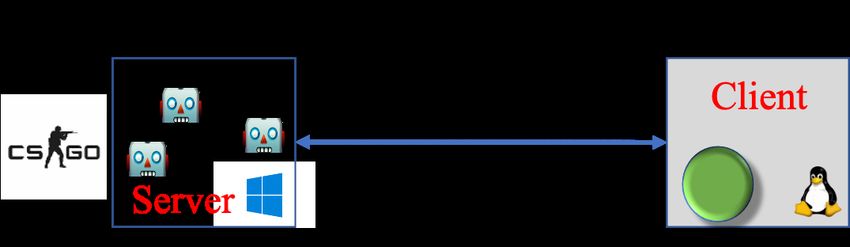
tency and jitter as low as 100 ms. Amin et al. [10] demonstrate Fig. 1. CS:GO computer configuration
player experience determines latency sensitivity for Call of
Duty, with competitive gamers more adept at compensating for
impaired network conditions. For other game genres, Fritsch time when the mouse is clicked is subtracted from the frame
et al. [5] find players of the role-playing game Everquest time the result is visible, giving the base system latency. This
2 can tolerate hundreds of milliseconds of network latency. measurement method was done 10 times on our client, yielding
Hoßfeld et al. [6] show players of the casual game Minecraft an average base latency of 24.6 milliseconds, with a standard
are insensitive to network latencies of up to 1 second. Sheldon deviation of 3.4 milliseconds.
et al. [4] find some aspects of play in the real-time strategy In order to test the effects of network latencies, additional
game Warcraft 3 are not affected by up to a second of network latency was added equally to the server uplink and downlink
latency. While beneficial, these works typically studied higher using Clumsy,1 a network filtering tool based on the WinDivert
latencies than those in our paper (and higher than usually library. The total network latency added to the client was
experienced by competitive game players), and do not identify one of 25, 50, 100, or 150 milliseconds. The added network
nor isolate the game’s latency compensation techniques as latency is in addition to the base system latency. Thus, the user
does our work. always experiences 24.6 milliseconds of base system latency
Latency compensation techniques seek to mitigate the ef- from the client computer and actions sent to the server have
fects of latency on players [16]. Savery et al. [22] find that the the additional network latency added to them. For example,
lack of latency compensation degrades both score and shooting the minimum network condition we test is 25 milliseconds.
accuracy in an FPS game. Le finds that synchronization can With this condition, the player has a base latency of 24.6
significantly improve game fairness in deadline-based network milliseconds at the client and an additional 25 milliseconds
games [23]. Lee and Chang et al. [13] show time warp in of network latency for messages sent to the server. We do not
CS:GO can improve accuracy by 2-4%. While such works are have results with 0 ms network latency – such a condition is
helpful in understanding the effects of latency compensation only for LAN games, not a typical network game over the
techniques, they do not necessarily fit competitive player Internet.
performance, where skill, latency sensitivity and a desire to During our experiments, we gathered ping times from the
win may impact the effects of latency. client collected 5 times every second for every player for
every round of game play. The network latency observed
III. M ETHODOLOGY by these ping values closely matches the intended added
To investigate how network latency affects competitive latency (over 99% of values are within 1 millisecond of
First-Person Shooter (FPS) players, we configured a client- what is intended). Variations to this are within normal system
server system with a competitive FPS game, added controlled variations observed by ping with no added network latency
amounts of network latency, recruited players for a user study, and are indistinguishable from the latency variation caused by
and measured player performance and quality of experience. the LAN itself. The LAN latency was less than 1 ms.
Our user study was conducted in a dedicated, on-campus
computer lab using a client-server architecture shown in Fig- TABLE I
W EAPON ATTRIBUTES
ure 1. The server hosts the game and is connected via high-
speed LAN to the client. The client and server are Alienware Weapon Mode Fire rate Clip Reload Damage Accuracy
PCs with Intel i7-4790K CPUs @4 GHz with 16 GB RAM AK-47 Automatic 600 per min 30 2.43 s 36 21.74 m
and an Intel(R) HD 4600 graphics card. The client is equipped
with a gaming mouse and high-refresh rate monitor so as to
While CS:GO matches often include team strategy, the focus
minimize local system latency. The client has a 24.5” Lenovo
of this study is on the effects of network latency on individual
LCD monitor with 1920x1080 pixels at 240 Hz and a G502
player tactics. As such, a death match free-for-all game mode
laser mouse with 12k DPI, 300 IPS, and a 1 KHz polling
(no teams) was chosen. Thus, each round had open combat
rate. The client runs Ubuntu 20.04 LTS, with Linux kernel
for the user and 20 AI-controlled bots, where everyone fought
version 5.4 and the server runs Windows 10. Both server and
everyone and the goal was to kill as many opponents as
client run Counter-strike Global Offensive (CS:GO) (version
possible. The bot difficulty level was set to 3 (hard) out of
10.15.2020). Users were given wired Apple airpods for audio.
4.
The base system latency was measured with a 1000 frame/s
There was no upper limit on player score – the game
camera (a Casio EX-ZR100) setup to capture the moment
terminated after a 3.5 minutes.
a user presses the mouse button and the resulting screen
output. By manually examining the video frames, the frame 1 https://jagt.github.io/clumsy/TABLE II TABLE III
S UBJECTIVE QUESTIONS PER ROUND D EMOGRAPHICS
Rate: Source Users Age (yrs) Gender
Q1 The quality of the round Stadia [24] 25 20.8 (3.0) 25 male, 0 female
Q2 The responsiveness of the round Long [15]
Q3 Your annoyance with the unresponsiveness GEQ [25]
Q4 The inconsistency of the round Custom FPS CS:GO FPS CS:GO Reaction-
Q5 Your annoyance with the inconsistency GEQ [25] Self-rating Self-rating Hours Hours time (ms)
Q6 How capable and effective you felt PENS [26] 4.4 (0.7) 4.6 (0.5) 2436 (3866) 832 (703) 205 (24)
Q7 How fun the round was GEQ [25]
Q8 Your frustration in the round iGEQ [25]
Q9 How much your performance was due to you Attribution [27]
answers are available on our website.2
After completing the survey, the next round would com-
Players were equipped with only one weapon at a time mence when the user was ready.
– the AK-47 (the most popular automatic rifle) [28], with After completing all the game rounds, users were given a
specifications as in Table I, and unlimited ammunition. questionnaire with additional demographics questions.
To maximize combat time compared to wandering, the third Study participants were solicited via University email lists.
smallest [29], and most popular [30] map “Mirage” was used. Interested participants first filled out a screener questionnaire
The user and the bots spawned at random locations on the to ensure appropriate CS:GO experience (at least 100 hours).
map that were not currently in view of anyone else. Users were rewarded with a $10 USD Amazon gift card upon
completion of the study.
CS:GO includes a server configuration option for the time
warp latency compensation technique [16]. With time warp,
the server resolves a shot based on the timestamp when the IV. A NALYSIS
player fires instead of when the server receives the event. Time This section first summarizes participant demographics
warp is enabled by default, but can be disabled. CS:GO has (Section IV-A), then the effects of network latency: on player
another latency compensation technique called interpolation performance (Section IV-B), with and without latency com-
– where the player position is smoothed out based on past pensation (Section IV-C), and Quality of Experience (Sec-
positions – that cannot be disabled. tion IV-D).
The CS:GO settings were pre-configured at the server with
the experiment controlled by scripts on the client – this meant A. Demographics
when starting the study, users immediately joined and launched
into the game, bypassing normal game lobbies and weapon Twenty-Five (25) users were screened to participate in the
selection phases. user study out of 128 initial responses. Table III summarizes
The IRB-approved user study was conducted during the the participant demographics. FPS self-rating and CS:GO self-
COVID pandemic, so everyone wore masks and respected rating are on a five-point scale, 1 (low) to 5 (high). For
social distancing requirements. Upon completion of each age, FPS self-rating, CS:GO self-rating, CS:GO hours played,
user’s study, we carefully sanitized the keyboard, mouse and and reaction times, the mean values are given with standard
earphones. deviations in parentheses. Ages ranged from 17-29 years old,
typical of a University subject pool. All participants were
A user study proctor was available for questions and trouble-
male – while disappointed there were no female participants,
shooting during the experiment.
we note esports players are mostly males, especially for FPS
Users first did a custom reaction-time test written in games [31]. User self-ratings as FPS and CS:GO gamers
Javascript and launched via a Chrome Web browser. In the both skewed towards “high” (mean 4.4 and 4.6 out of 5,
test, users waited for a screen color change then clicked the respectively). Half of the users played 10 or more hours of
mouse as quickly as possible, doing this 10 times. computer games per week.
Users played a practice round without any added network Figures 2, 3 and 4 depict boxplot distributions for FPS hours
latency to get familiar with the map and game mode. This played, CS:GO hours played and reaction times, respectively.
data was not analyzed. Users then played additional 3.5 Each box depicts quartiles and median for the distribution. The
minute rounds of CS:GO, each round with a different network whiskers span from the minimum to the maximum. The black
latency (25, 50, 100, or 150 milliseconds) and with latency pluses shows the mean values. Most users played from 500-
compensation either on or off, randomly shuffled. 2250 hours of FPS games and from 100-1100 hours of CS:GO.
After each round, users filled out a subjective survey consist- Reaction times were mostly fast – most between 195 and 220
ing of nine questions on a discrete 5-point Likert scale about ms – typical of experienced computer game players [32] and
the game experience in the preceding round. The abbreviated about 80 ms faster than the average reaction time collected by
questions are shown in Table II. The complete questions and the human benchmark site [33].TABLE IV
S IGNIFICANCE AND C OHEN ’ S D E FFECT S IZE ( COMPARED TO 25 MS )
Accuracy Score
Latency (ms) t(22) p Effect t(22) p Effect
50 0.750 .460 0.15 0.515 .611 0.10
100 1.196 .244 0.24 2.353 .027 0.47
150 4.623Fig. 5. Accuracy (means with 95% confidence intervals) Fig. 6. Score (means with 95% confidence intervals)
Fig. 7. Accuracy – latency compensation (means with 95% ci) Fig. 8. Score – latency compensation (means with 95% ci)
four conditions, F(3, 96) = 5.85, p < .001. As a take-away,
a decrease in latency by 100 ms improves QoE by 0.7 points
on a 5-point scale.
V. L IMITATIONS
Our user study intentionally focuses on the effects of
latency on individual player performance. However, as noted
in Section III, CS:GO is often a team game, where groups
of players (typically 5 per team in esports) work together to
defeat the opposing team.
As noted in Section IV-A, our study is skewed towards
Fig. 9. QoE – combined questions (means with 95% ci) males (no females participated). While this may reflect the
gender breakdown of FPS games today, the results may not be
indicative of female performance in competitive FPS games.
Our study intentionally isolated CS:GO play to a single
All values are statistically significant except for question 6
weapon type only – the most popular [28] AK-47 rifle
(capable and effective).
– whereas players typically can choose from a variety of
For an overall measure of QoE, we compute the overall
weapons with different firing rates, magazine capacities and
mean rating (i.e., weighting all questions equally). Figure 9
damages inflicted.
depicts the results. The x axis is the network latency in
Most CS:GO games use only human players and not AI-
milliseconds and the y axis is the rating. The circles are the
controlled bots, as in our study. However, the relative effects
means for all users for that latency condition, bounded by 95%
should be similar since latency affects aiming and shooting.
confidence intervals. The dashed line is a linear regression
fit through the mean values. The linear regression fits the
VI. C ONCLUSIONS
means well, with R2 0.99 and p = .003. A one-way between
subjects ANOVA shows a significant effect of latency on Many gamers seek faster network connections, but how
combined QoE rating at the 0.05 significance level for the much low-end network latencies benefit competitive players isnot well-known. Understanding the impact of network laten- [9] G. Armitage, “An Experimental Estimation of Latency Sensitivity in
cies may help better inform gamers about network connections Multiplayer Quake 3,” in Proceedings of IEEE ICON, Sydney, Australia,
Sep. 2003.
and motivate developers and researchers to devise systems to [10] R. Amin, F. Jackson, J. E. Gilbert, J. Martin, and T. Shaw, “Assessing
mitigate latency for games and game-like applications. the Impact of Latency and Jitter on the Perceived Quality of Call of
We study the effects of latency on competitive First-Person Duty Modern Warfare 2,” in Proceedings of HCI – Users and Contexts
of Use. Berlin, Heidelberg: Springer-Verlag, 2013, pp. 97–106.
Shooter (FPS) game players. We setup a testbed for Counter- [11] S. Liu, A. Kuwahara, J. Scovell, J. Sherman, and M. Claypool, “Lower
strike: Global Offensive (CS:GO) [17] – a popular FPS is Better? The Effects of Local Latencies on Competitive First-Person
game used in esports – with four levels of network latency Shooter Game Players,” in Proceedings of ACM CHI, Virtual, 2021.
[12] Z. Ivkovic, I. Stavness, C. Gutwin, and S. Sutcliffe, “Quantifying and
(25, 50, 100 and 150 milliseconds). Twenty-five (25) highly- Mitigating the Negative Effects of Local Latencies on Aiming in 3d
experienced CS:GO players participated in a user study, each Shooter Games,” in Proceedings of ACM CHI, Seoul, Korea, Apr. 2015.
playing 8 rounds of CS:GO with 4 different latency conditions [13] W.-K. Lee and R. Chang, “Evaluation of Lag-Related Configurations
in First-Person Shooter Games,” in Proceedings of ACM NetGames,
both with and without latency compensation. In total, the study Zagreb, Croatia, Dec. 2015.
provides over 10 hours of gameplay with objective player [14] M. Long and C. Gutwin, “Characterizing and Modeling the Effects of
performance data (accuracy and score) via logs and subjective Local Latency on Game Performance and Experience,” in Proceedings
of ACM CHI Play, Melbourne, Australia, 2018.
opinion data (Quality of Experience – QoE) via surveys. [15] ——, “Effects of Local Latency on Game Pointing Devices and Game
Analysis of the results shows that across the range of Pointing Tasks,” in Proceedings of ACM CHI, Glasgow, Scotland, 2019.
network latencies studied, player performance and quality of [16] Y. Bernier, “Latency Compensating Methods in Client/Server In-game
Protocol Design and Optimization,” in Proceedings of the GDC, San
experience both improve linearly as latencies decrease from Francisco, CA, USA, Feb. 2001.
150 ms to 25 ms. Specifically, player accuracy at 25 ms is [17] Valve Corporation, “Counter Strike: Global Offensive,” Game. 2012.
about 3% higher than player accuracy at 150 ms, and scores [18] M. Frostling-Henningsson, “First-person Shooter Games as a Way
of Connecting to People: ’Brothers in Blood’,” CyberPsychology &
are 17% higher over the same range, an equivalent of about 1 Behavior, 2009.
additional kill or 2 additional assists per minute of gameplay. [19] M. Lux, P. Halvorsen, D.-T. Dang-Nguyen, H. Stensland, M. Kesavulu,
Over this same range, latency compensation improves player M. Potthast, and M. Riegler, “Summarizing E-sports Matches and
Tournaments: the Example of Counter-strike: Global Offensive,” in
accuracy by about 3-4% and score per minute by about 1.5 Proceedings of ACM MMVE, Amherst, MA, USA, 2019.
points. From 150 ms to 25 ms, Quality of Experience (QoE) [20] I. Makarov, D. Savostyanov, B. Litvyakov, and D. I. Ignatov, “Predicting
increases by about 25%, with the QoE at 150 ms being about Winning Team and Probabilistic Ratings in “Dota 2” and “Counter-
Strike: Global Offensive” Video Games,” in Proceedings of Springer
3.3 (on a 5 point scale) and the QoE at 25 ms being about a AIST, Moscow, Russia, 2017.
point better at 4.2. [21] M. Dick, O. Wellnitz, and L. Wolf, “Analysis of Factors Affecting Play-
Future work may investigate additional aspects of latency ers’ Performance and Perception in Multiplayer Games,” in Proceedings
of ACM NetGames, Hawthorn, NY, USA, 2005.
and FPS games, including a broader range of player skills [22] C. Savery, N. Graham, C. Gutwin, and M. Brown, “The Effects of Con-
(i.e., non-expert gamers), player versus player (rather than sistency Maintenance Methods on Player Experience and Performance
versus bots), and other weapon types (e.g., shotguns). Possible in Networked Games,” in Proceedings of ACM CSCW, Baltimore, MD,
USA, 2014.
extensions also include more latency compensation techniques [23] A. Le and Y. E. Liu, “Fairness in Multi-Player Online Games on
and different input and output devices – e.g., game controllers, Deadline-Based Networks,” in Proceedings of IEEE CCNC, Las Vegas,
TVs, touchscreens, and virtual reality. NV, USA, Jan. 2007.
[24] Google, “Google Stadia Post-game Survey,” 2020, (Accessed Oct 15,
R EFERENCES 2021). [Online]. Available: https://stadia.google.com/
[25] K. Poels, Y. de Kort, and W. IJsselsteijn, D3.3 : Game Experience
[1] Reuters.com, “Investing in the Soaring Popularity of Gaming,” Questionnaire: Development of a Self-report Measure to Assess the
Jun. 2018, (Accessed September 17, 2020). [Online]. Available: Psychological Impact of Digital Games. Technische Universiteit
https://www.reuters.com/sponsored/article/popularity-of-gaming Eindhoven, 2007.
[2] E. Earning, “Prize Money, Results, History, Statistics,” Online: https: [26] R. Ryan, C. S. Rigby, and A. Przybylski, “The Motivational Pull of
//www.esportsearnings.com/, 2019, (Accessed January 5, 2021). Video Games: A Self-Determination Theory Approach,” Motivation and
[3] C. Gough, “eSports Audience Size Worldwide from 2018 to 2023,” Emotion, vol. 30, no. 4, pp. 344–360, 2006.
Statista. Online: https://tinyurl.com/y3tffxzo, Apr. 2020, (Accessed [27] A. Depping and R. Mandryk, “Why is This Happening to Me?: How
September 17, 2020). Player Attribution Can Broaden Our Understanding of Player Experi-
[4] N. Sheldon, E. Girard, S. Borg, M. Claypool, and E. Agu, “The Effect of ence,” in Proceedings of ACM CHI, Denver, CO, USA, May 2017.
Latency on User Performance in Warcraft III,” in Proceedings of ACM [28] HLTV, “CS:GO Statistics Database – Top Weapons,” hltv.org,
NetGames, Redwood City, CA, USA, May 2003. 2020, (Accessed September 17, 2020). [Online]. Available: https:
[5] T. Fritsch, H. Ritter, and J. H. Schiller, “The Effect of Latency and //www.hltv.org/stats?startDate=all
Network Limitations on MMORPGs: a Field Study of Everquest 2,” in [29] u/khaniage, “Counter-strike: Global Offensive – Map Sizes,” Reddit,
Proceedings of ACM NetGames, Hawthorne, NY, USA, Oct. 2005. 2019, (Accessed September 17, 2020). [Online]. Available: https:
[6] O. Hohlfeld, H. Fiedler, E. Pujol, and D. Guse, “Insensitivity to Network //www.reddit.com/r/GlobalOffensive/comments/a94jba/map sizes/
Delay: Minecraft Gaming Experience of Casual Gamers,” in Proceedings [30] HLTV, “CS:GO Statistics Database – Distribution of Maps Played,”
of the ITC. Würzburg, Germany: IEEE, Sep. 2016, pp. 31–33. hltv.org, 2020, (Accessed September 17, 2020). [Online]. Available:
[7] T. Beigbeder, R. Coughlan, C. Lusher, J. Plunkett, E. Agu, and M. Clay- https://www.hltv.org/stats/maps
pool, “The Effects of Loss and Latency on User Performance in Unreal [31] Statista, “Distribution of Gamers Playing Selected Game Genres World-
Tournament 2003,” in Proceedings of ACM NetGames, Portland, OG, wide as of January 2017, by Gender,” Online: https://tinyurl.com/
USA, Sep. 2004. yytrbj4d, 2020, (Accessed September 17, 2020).
[8] P. Quax, P. Monsieurs, W. Lamotte, D. De Vleeschauwer, and N. De- [32] M. Dye, C. S. Green, and D. Bavelier, “Increasing Speed of Processing
grande, “Objective and Subjective Evaluation of the Influence of Small with Action Video Games,” Current Directions in Psychological Science,
Amounts of Delay and Jitter on a Recent First Person Shooter Game,” vol. 18, no. 6, pp. 321–326, Dec. 2009.
in Proceedings of ACM NetGames, Portland, OG, USA, 2004. [33] Human Benchmark, “Reaction Time Test,” (Accessed April 13, 2021).
[Online]. Available: https://humanbenchmark.com/tests/reactiontimeYou can also read


