Open-set Adversarial Defense
←
→
Page content transcription
If your browser does not render page correctly, please read the page content below

Open-set Adversarial Defense

                                          Rui Shao1[0000−0003−0090−9604] , Pramuditha Perera2[0000−0003−2821−6367]? ,
                                        Pong C. Yuen1[0000−0002−9343−2202] , and Vishal M. Patel3[0000−0002−5239−692X]
                                            1
                                            Department of Computer Science, Hong Kong Baptist University, Hong Kong
                                                                       2
                                                                         AWS AI Labs, USA
                                         3
                                           Department of Electrical and Computer Engineering, Johns Hopkins University,
arXiv:2009.00814v1 [cs.CV] 2 Sep 2020

                                                                              USA
                                        {ruishao, pcyuen}@comp.hkbu.edu.hk, pramudi@amazon.com, vpatel36@jhu.edu

                                                 Abstract. Open-set recognition and adversarial defense study two key
                                                 aspects of deep learning that are vital for real-world deployment. The
                                                 objective of open-set recognition is to identify samples from open-set
                                                 classes during testing, while adversarial defense aims to defend the
                                                 network against images with imperceptible adversarial perturbations.
                                                 In this paper, we show that open-set recognition systems are vulnerable
                                                 to adversarial attacks. Furthermore, we show that adversarial defense
                                                 mechanisms trained on known classes do not generalize well to open-set
                                                 samples. Motivated by this observation, we emphasize the need of an
                                                 Open-Set Adversarial Defense (OSAD) mechanism. This paper
                                                 proposes an Open-Set Defense Network (OSDN) as a solution to the
                                                 OSAD problem. The proposed network uses an encoder with
                                                 feature-denoising layers coupled with a classifier to learn a noise-free
                                                 latent feature representation. Two techniques are employed to obtain
                                                 an informative latent feature space with the objective of improving
                                                 open-set performance. First, a decoder is used to ensure that clean
                                                 images can be reconstructed from the obtained latent features. Then,
                                                 self-supervision is used to ensure that the latent features are
                                                 informative enough to carry out an auxiliary task. We introduce a
                                                 testing protocol to evaluate OSAD performance and show the
                                                 effectiveness of the proposed method in multiple object classification
                                                 datasets. The implementation code of the proposed method is available
                                                 at: https://github.com/rshaojimmy/ECCV2020-OSAD.

                                                 Keywords: Adversarial Defense, Open-set Recognition

                                        1       Introduction
                                        A significant improvement has been achieved in the image classification task
                                        since the advent of deep convolutional neural networks (CNNs) [14]. The
                                        promising performance in classification has contributed to many real-world
                                        computer vision applications [41,37,40,38,39,36,42,45,47,20,2,46]. However,
                                        ?
                                            This work was conducted prior to joining AWS AI Labs when the author was
                                            affiliated with Johns Hopkins University.
2 Rui Shao, Pramuditha Perera, Pong C. Yuen, Vishal M. Patel
Real World
CNN Open-set Adversarial
Known Classes Ours
CNN Defense
Ca
O
Do
Lio
pe
Ca
Do
t
Do
Lio
g
Ca
n
Do
Ca
Op
n-s
Lio
Lio
g
t
g
n
t
g
t
en
et
n
n
-s
et
CNN Open-set Adversarial
Defense Ours
Ca
O
CNN
Do
Lio
Do
pe
Ca
Ca
Do
Lio
t
Do
Lio
g
Ca
n
Op
Lio
g
n-s
t
t
g
g
n
n
t
en
et
n
-s
Open-set Classes
et
CNN Open-set Adversarial
Defense Ours
Lio
Ca
Do
Ca
O
CNN
Do
Lio
pe
Ca
t
Do
g
Lio
t
n
Ca
g
Op
Do
Lio
n
n-s
t
g
n
t
g
en
n
et
-s
et
Open-set
CNN CNN Adversarial
Do Ours
Defense
Ca
Op
Ca
Do
Lio
O
Do
Lio
Ca
Lio
g
pe
t
Ca
t
Do
g
en
g
Lio
t
n
n
n-s
n
t
-s
g
n
et
et
(a) Traditional CNN (b) Open-set Recognition Method (c) Adversarial Defense Method (d) Ours
Fig. 1. Challenges in classification. (a) Conventional CNN classifiers fail in the presence
of both open-set and adversarial images. (b) Open-set recognition methods can
successfully identify open-set samples, but fail on adversarial samples. (c) Adversarial
defense methods are unable to identify open-set samples. (d) Proposed method can
identify open-set images and it is robust to adversarial images.
Table 1. Importance of an Open-set Adversarial Defense (OSAD) mechanism.
Clean Images Adversarial Images
Original Network Original Network Proposed Method
Closed Set Accuracy 96.0 31.8 88.2
Open-set Detection (AUC-ROC) 81.2 51.5 79.1
there exist several limitations of conventional CNNs that have an impact in
real-world applications. In particular, open-set
recognition [3,10,25,30,48,32,31,33,50] and adversarial attacks [12,24,5,19,44]
have received a lot of interest in the computer vision community in the last few
years.
A classifier is conventionally trained assuming that classes encountered
during testing will be identical to classes observed during training. But in a
real-world scenario, a trained classifier is likely to encounter open-set samples
from classes unseen during training. When this is the case, the classifier will
erroneously associate a known-set class identity to an open-set sample.
Consider a CNN trained on animals classes. Given an input that is from an
animal class (such as a cat), the network is able to produce the correct
prediction as shown in Figure 1(a-First Row). However, when the network is
presented with a non-animal image, such as an Airplane image, the classifier
wrongly classifies it as one of the known classes as shown in Figure 1(a-Second
Row). On the other hand, it is a well known fact that adding carefully designed
imperceptible perturbations to clean images can alter model prediction in a
classifier [12]. These types of adversarial attacks are easy to deploy and may be
encountered in real-world applications [9]. In Figure 1(a-Third Row) and
Figure 1(a-Fourth Row), we show how such adversarial attacks can affect
model prediction for known and open-set images, respectively.
Computer vision community has developed several open-set recognition
algorithms [3,10,25,30,48] to combat against the former challenge. These
algorithms convert the c-class classification problem into a c + 1 class problem
Open-set Adversarial Defense      3

by considering open-set classes as an additional class. These algorithms provide
correct classification decisions for both known and open-set classes as shown in
Figure 1(b-First and Second rows). However, in the presence of adversarial
attacks, these models fail to produce correct predictions as illustrated in
Figure 1(b-Third and Fourth rows). On the other hand, there exist several
defense strategies [19,44,22,17] that are proposed to counter the latter
challenge. These defense mechanisms are designed with the assumption of
closed-set testing. Therefore, although they work well when this assumption
holds (Figure 1(c-First and third rows)), they fail to generalize well in the
presence of open-set samples as shown in Figure 1(c-Second and Fourth rows).
    Based on this discussion, it is evident that existing solutions in the open-
set recognition paradigm does not necessarily complement well with adversarial
defense and vise versa. This observation motivates us to introduce a new research
problem – Open-Set Adversarial Defense (OSAD), where the objective is to
simultaneously detect open-set samples and classify known classes in the presence
of adversarial noise. In order to demonstrate the significance of the proposed
problem, we conducted an experiment on the CIFAR10 dataset by considering
only 6 classes to be known to the classifier. In Table 1 we tabulate both open-
set detection performance (expressed in terms of area under the curve of the
ROC curve) and closed-set classification accuracy for this experiment. When the
network is presented with clean images, it produces a performance better than
0.8 in both open-set detection and closed set classification. However, as evident
from Table 1, when images are attacked, open-set detection performance drops
along with the closed set accuracy by a significant margin. It should be noted
that, open-set detection performance in this case is close to random guessing
(0.5).
    This paper proposes an Open-Set Defense Network (OSDN) that learns a
noise-free, informative latent feature space with the aim of detecting open-set
samples while being robust to adversarial images. We use an autoencoder
network with a classifier branch attached to its latent space as the backbone of
our solution. The encoder network is equipped with feature-denoising
layers [44] with the aim of removing adversarial noise. We use self-supervision
and decoder reconstruction processes to make sure that the learned feature
space is informative enough to detect open-set samples. The reconstruction
process uses the decoder to generate noise-free images based on the obtained
latent features. Self-supervision is carried out by forcing the network to
perform an auxiliary classification task based on the obtained features. The
proposed method is able to provide robustness against adversarial attacks in
terms of classification as well as open-set detection as shown in Table 1. Main
contributions of our paper can be summarized as follows:
1. This paper proposes a new research problem named Open-Set Adversarial
Defense (OSAD) where adversarial attacks are studied under an open-set setting.
2. We propose an Open-Set Defense Network (OSDN) that learns a latent feature
space that is robust to adversarial attacks and informative to identify open-set
samples.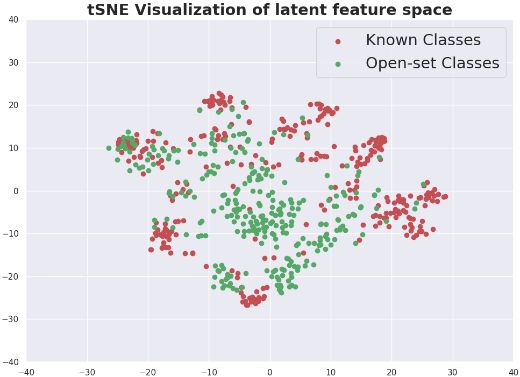
4      Rui Shao, Pramuditha Perera, Pong C. Yuen, Vishal M. Patel

3. A test protocol is defined to the OSAD problem. Extensive experiments are
conducted on three publicly available image classification datasets to
demonstrate the effectiveness of the proposed method.

2   Related Work

Adversarial Attack and Defense Methods. Szegedy et al. [43] reported
that carefully crafted imperceptible perturbations can be used to fool a CNN
to make incorrect predictions. Since then, various adversarial attacks have been
proposed in the literature. Fast Gradient Sign Method (FGSM) [12] was
proposed to consider the sign of a gradient update from the classifier to
generate adversarial images. Basic Iteration Method (BIM) [19] and Projected
Gradient Descent (PGD) [24] extended FGSM to stronger attacks using
iterative gradient descent. Different from the above gradient-based adversarial
attacks, Carlini and Wagner [5] proposed the C&W attack to generate
adversarial samples by taking a direct optimization approach. Adversarial
training [24] is one of the most widely-used adversarial defense mechanisms. It
provides defense against adversarial attacks by training the network on
adversarially perturbed images generated on-the-fly based on model’s current
parameters. Several recent works have proposed denoising-based operations to
further improve adversarial training. Pixel denoising [22] was proposed to
exploit the high-level features to guide the denoising process. The most
influential local parts to conduct the pixel-level denoising is found in [13] based
on class activation map responses. Adversarial noise removal is carried out in
the feature-level using denoising filters in [44]. Effectiveness of this process is
demonstrated using a selection of different filters.
Open-set Recognition. Possibility for open-set samples to generate very
high probability scores in a closed-set classifier was first brought to attention
in [35]. It was later shown that deep learning models are also affected by the
same phenomena [3]. Authors in [3] proposed a statistical solution, called
OpenMax, for this problem. They converted the c-class classification problem
into a c + 1 problem by considering the extra class to be the open-set class.
They apportioned logits of known classes to the open-set class considering
spatial positioning of a query sample in an intermediate feature space. This
formulation was later adopted by [10] and [25] by using a generative model to
produce logits of the open-set class. Authors in [48] argued that a generative
feature contain information that can benefit open-set recognition. On these
grounds they considered a concatenation of a generative feature and a classifier
feature when building the OpenMax layer. A generative approach was used
in [30] where a class conditioned decoder was used to detect open-set samples.
Works of both [30] and [48] show that incorporating generative features can
benefit open-set recognition. Note that open-set recognition is more challenging
than the novelty detection [27,28,31,34,29] which only aims to determine
whether an observed image during inference belongs to one of the known
classes.
Open-set Adversarial Defense    5

Self-Supervision. Self-supervision is an unsupervised machine learning
technique where the data itself is used to provide supervision. Recent works in
self-supervision introduced several techniques to improve the performance in
classification and detection tasks. For example, in [7], given an anchor image
patch, self-supervision was carried out by asking the network to predict the
relative position of a second image patch. In [8], a multi-task prediction
framework extended this formulation, forcing the network to predict a
combination of relative order and pixel color. In [11], the image was randomly
rotated by a factor of 90 degrees and the network was forced to predict the
angle of the transformed image.

3   Background
Adversarial Attacks. Consider a trained network parameterized by
parameters θ. Given a data and label pair (x, y), an adversarial image xadv ,
can be produced using xadv = x + δ, where δ can be determined by a given
white-box attack based on the models parameters. In this paper, we consider
two types of adversarial attacks.
   The first attack considered is the Fast Gradient Signed Method (FGSM) [12]
where the adversarial images are formed as follows,

                       xadv = Projχ (x + sign(5x L(x, y; θ))),                 (1)

where L(·) is a classification loss. Projχ denotes the projection of its element to
a valid pixel value range, and  denotes the size of l∞ -ball. The second attack
considered is Projective Gradient Descent (PGD) attacks [24]. Adversarial
images are generated in this method as follows,
               (t+1)                (t)                     (t)
             xadv      = Projζ∩χ (xadv + step sign(5x L(xadv , y; θ))),        (2)

where Projζ∩χ (·) denotes the projection of its element to l∞ -ball ζ and a valid
pixel value range, and step denotes a step size smaller than . We use the
                                                  (T )
adversarial samples of the final step T : xadv = xadv .

OpenMax Classifier. A SoftMax classifier trained for a c-class problem
typically has c probability predictions. OpenMax is an extension where the
probability scores of c + 1 classes are produced. The probability of the final
class corresponds to the open-set class. Given c known classes
K = {C1 , C2 , ..., Cc }, OpenMax is designed to identify open-set samples by
calibrating the final hidden layer of a classifier as follows:
             (
              l iw i                (i ≤ c)
       l̂ i = Pc                                , OpenMaxi (x) = SoftMaxi (l̂ ) (3)
                 i=1 l i (1 − w i ) (i = c + 1)

where l denotes the logit vector obtained prior to the SoftMax operation in
a classifier, w i represents the belief that xadv belongs to the known class Ci .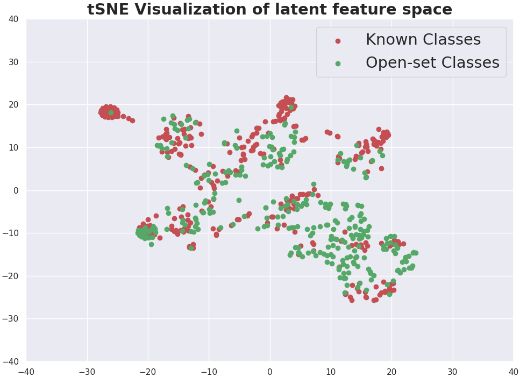
6       Rui Shao, Pramuditha Perera, Pong C. Yuen, Vishal M. Patel

Here, the class CN +1 corresponds to the open-set class. Belief w i is calculated
considering the distance of a given sample to it’s class mean µ in an intermediate
feature space. During training, distance of all training image samples from a
given class to its corresponding class mean µ is evaluated to form a matched
score distribution. Then, a Weibull distribution is fitted to the tail of the matched
distribution. If the feature representation of the input in the same feature space
is v(x), w i is calculated as
                                            |v(x) − µ | mi
                                                       i 2
                           σ − rank(i)  −                                      (4)
             w i = 1 − max 0,            e         ηi           ,
                                 σ
where mi , ηi are parameters of the Weibull distribution that corresponding to
class Ci . σ is hyperparameter and rank(i) is the index in the logits sorted in the
descending order.

4   Proposed Method
The proposed network consists of four CNNs: encoder, decoder, open-set
classifier and transformation classifier. In Figure 2, we illustrate the network
structure of the proposed method and denote computation flow. The encoder
network consists of several feature-denoising layers [44] between the
convolutional layers. Open-set classifier has no structural difference from a
regular classifier. However, an OpenMax layer is added to the end of the
classifier during inference. We denote this by indicating an OpenMax layer in
Figure 2.
    Given an input image, first the network generates an adversarial image
based on the current network parameters. This image is passed through the
encoder network to obtain the latent feature. This feature is passed through
the open-set classifier via path (1) to evaluate the cross entropy loss Lcls .
Then, the image corresponding to the obtained latent feature is generated by
passing the feature through the decoder following path (2). The decoded image
is used to calculate its difference to the corresponding clean image based on the
reconstruction loss Lrec . Finally, the input image is subjected to a geometric
transform. An adversarial image corresponding to the transformed image is
obtained. This image is passed through path (3) to arrive at the
transformation classifier. Output of the classifier is used to calculate the cross
entropy loss Lssd considering the transform applied to the image. The network
is trained end-to-end using the following loss function

                          LOSDN = Lcls + Lrec + Lssd .                           (5)

   In the following subsections, we describe various components and
computation involved in all three paths in detail.

Noise-free Feature Encoding. The proposed network uses an encoder
network to produce noise-free features. Then, the open-set classifier operating
Open-set Adversarial Defense 7
Open-set Classifier
(1) Classification
Loss Conv/Deconv Layer
Random Adversarial
Transformation Attacks
(2)
Denoising Layer
Reconstruction
Loss
Adversarial
Attacks
Latent Fully-connected Layer
Encoder Space Decoder
(3) Self-supervision
Loss
OpenMax Layer
Transformation Classifier
Fig. 2. Network structure of the proposed Open-Set Defense Network (OSDN). It
consists of four components: encoder, decoder, open-set classifier and transformation
classifier.
on the learned feature is used to perform classification. During training, there
is no structural difference in the open-set classifier from a standard classifier.
Inspired by [44], we embed denoising layers after the convolutional layer blocks
in the encoder so that feature denoising can be explicitly carried out on
adversarial samples. We adopt the Gaussian (softmax) based non-local means
filter [4] as the denoising layer. Given an input feature map m, non-local
means [4] takes a weighted mean of features in the spatial region R to compute
a denoised feature map g as follows
1 X
gi = f (mi , mj ) · mj , (6)
N (m)
∀j∼R
where f (mi , mj ) is a feature-dependent weighting function.
√
For the Gaussian
α(mi )T β(mj )/ d
(softmax) based version, f (mi , mj ) = e . α and β are two 1 × 1
convolutional layers as embedding functions and d corresponds P to the number
of channels. N (m) is a normalization function and N (m) = ∀j∼R f (mi , mj ).
Formally, we denote the encoder embedded with denoising layers as F
parameterized by θF , and the classifier as H parameterized by θH . Given the
labeled clean data (x, y) ∼ I from the data distribution of known classes, we
can generate the corresponding adversarial images xadv on-the-fly using either
FGSM or PGD attacks based on the current parameters θF , θH using the true
label y. Obtained adversarial image xadv is passed through encoder and
classifier (via path (1)) to arrive at the cross-entropy loss defined as
Lcls = min E(xadv ,y)∼I LCE (xadv , y; θF , θH ). (7)
θF ,θH
By minimizing the above adversarial training loss, the trained encoder
embedded with the denoising layers is able to learn a noise-free latent feature8 Rui Shao, Pramuditha Perera, Pong C. Yuen, Vishal M. Patel
space. During inference, an OpenMax layer is added on top of the classifier.
With this formulation, open-set classifier operating on the noise-free latent
feature learns to predict the correct class, for both known and open-set
samples, even when the input is contaminated with adversarial noise.
Clean Image Generation. In this section, we introduce the image generation
branch proposed in our method. The objective of the image generation branch
is to generate noise-free images from adversarial images by taking advantage of
the decoder network. This is motivated by two factors.
First, autoencoders are widely used in the literature for image denoising
applications. By forcing the autoencoder network to produce noise-free images,
we are providing additional supervision to remove noise in the latent feature
space. Secondly, it is a well known fact that open-set recognition becomes more
effective in the presence of more descriptive features [48]. When a classifier is
trained, it models the boundary of each class. Therefore, a feature produced
by a classification network only contains information that is necessary to model
class boundaries. However, when the network is asked to generate noise-free
images based on the latent representations, it ends up with learning generative
features. As a result, features become more descriptive than in the case of a pure
classifier. In fact, such generative features are used in [48] and [30] to boost the
open-set recognition performance. Therefore, we argue that adding the decoder
as an image generation branch can mutually benefit both open-set recognition
and adversarial defense.
We pass adversarial images through path (2) as illustrated in Figure 2 to
generate the decoded images. The decoder network denoted as G parameterized
by θG and the encoder network F are jointly optimized to minimize the
distance between the decoded images and the corresponding clean images using
the following loss
Lrec = min E(x,xadv )∼I kx − G(F(xadv ))k22 . (8)
θF ,θG
Self-supervised Denoising. Finally, we propose to use self-supervision as a
means to further increase the informativeness and robustness of the latent feature
space. Self-supervision is a machine learning technique that is used to learn
representations in the absence of labeled data. In our work we adopt rotation-
based self-supervision proposed in [11]. In [11], first, a random rotation from a
finite set of possible rotations is applied to an image. Then, a classifier is trained
on top of a latent feature vector to automatically recognize the applied rotation.
In our approach, similar to [11], we first generate a random number r ∈
{0, 1, 2, 3} as the rotation ground-truth and transform the input clean image
x by rotating it with 90◦ r degrees. Then, based on the rotated clean image,
we generate a rotated adversarial image xTadv on-the-fly using either FGSM or
PGD attack based on the current network parameters and rotation ground-truth
r, which is passed through the transformation classifier to generate the cross-
entropy loss with respect to the ground-truth r. We denote the transformation
classifier as T parameterized by θT and formulate the adversarial training lossOpen-set Adversarial Defense 9
function for self-supervised denoising as follows
Lssd = min ExTadv ∼I LCE (xTadv , r; θF , θT ). (9)
θF ,θT
There are multiple reasons why we use self-supervision in our method.
When a classifier learns to differentiate between different rotations, it learns to
pay attention to object structures and orientations of known classes. As a
result, when self-supervision is carried out in addition to classification, the
underlying feature space learns to represent additional information that was
not considered in the case of a pure classifier. Therefore, self-supervision
enhances the informativeness of the latent feature space which would directly
benefit the open-set recognition process. On the other hand, since we use
adversarial images for self-supervision, this operation directly contributes
towards learning the denoising operator in the encoder. It should also be noted
that recent work [16] has found that self-supervised learning contributes
towards robustness against adversarial samples. Therefore, we believe that
addition of self-supervision benefits both open-set detection and adversarial
defense processes.
Implementation Details. We adopt the structure of Resnet-18 [14], which
has four main blocks, for the encoder network. Denoising layers are embedded
after each main blocks in the encoder. For the decoder, we use the decoder
network proposed in [25] with three transpose-convolution layers for conducting
experiments with the SVHN and CIFAR10 dataset. Four transpose-convolution
layers are used for conducting experiments with the TinyImageNet dataset. For
both open-set classifier and transformation classifier, we use a single fully
connected layers. We use the Adam optimizer [18] for the optimization with a
learning rate of 1e-3. We carried out model selection considering the trained
model that has produced the best closed-set accuracy on the validation set. We
use the iteration = 5 for the PGD attacks and = 0.3 for the FGSM attacks in
both adversarial training and testing.
5 Experimental Results
In order to assess the effectiveness of the proposed method, we carry out
experiments on three multiple-class classification datasets. In this section, we
first describe datasets, baseline methods and the protocol used in our
experiments. We evaluate our method and baselines in the task of open-set
recognition under adversarial attacks. To further validate the effectiveness of
our method, additional experiments in the task of out-of-distribution detection
under adversarial attacks are conducted. We conclude the section by presenting
an ablation study and various visualizations with a brief analysis of the results.
5.1 Datasets
The evaluation of our method and other state-of-the-arts are conducted on three
standard images classification datasets for open-set recognition:10 Rui Shao, Pramuditha Perera, Pong C. Yuen, Vishal M. Patel
SVHN and CIFAR10. Both CIFAR10 [1] and SVHN [26] are classification
datasets with 10 classes with images of size 32×32. Street-View House Number
dataset (SVHN) contains house number signs extracted from Google Street View.
CIFAR10 contains images from four vehicle classes and six animal classes. We
randomly split 10 classes into 6 known classes and 4 open-set classes to simulate
open-set recognition scenario. We consider three randomly selected splits for
testing1 .
TinyImageNet. TinyImageNet contains a sub-set of 200 classes selected from
the ImageNet dataset [6] with image size of 64×64. 20 classes are randomly
selected to be known and the remaining 180 classes are chosen to be open-set
classes. We consider three randomly chosen splits for evaluation.
5.2 Baseline Methods.
We consider the following two recently proposed adversarial defense methods as
baselines: Adversarial Training [24] and Feature Denoising [44]. We add
an OpenMax layer in the last hidden layer during testing for both baselines to
facilitate a fair comparison in open-set recognition. Moreover, to evaluate the
performance of a classifier without a defense mechanism, we train a Resnet-
18 network on clean images obtained from known classes and add an OpenMax
layer during testing. We test this network using clean images for inference and we
denote this test case by clean. Furthermore, we test this model with adversarial
images, which is denoted as adv on clean.
5.3 Quantitative Results
Table 2. Adversarial Defense: Closed-set accuracy.
SVHN CIFAR-10 TinyImageNet
Method
FGSM PGD FGSM PGD FGSM PGD
clean 96.0±0.6 96.0±0.6 93.1±1.8 93.1±1.8 56.8±3.6 56.8±3.6
adv on clean 41.6±3.2 39.3±1.8 31.8±4.5 13.0±4.0 11.2±2.6 4.4±0.8
adversarial training 88.5±2.7 75.8±2.5 87.3±1.1 72.4±4.6 66.6±1.2 40.3±2.3
feature denoising 86.9±3.7 75.5±2.6 87.4±2.3 72.5±4.5 64.5±1.3 39.3±3.0
ours 89.3±0.7 77.9±1.6 88.2±2.9 74.2±4.3 75.1±7.9 41.6±2.2
Open-set Recognition. In conventional open-set recognition, the model is
required to perform two tasks. First, it should be able to detect open-set samples
effectively. Secondly, it should be able to perform correct classification on closed
set samples. In order to evaluate the open-set defense performance, we take these
two factors into account. In particular, following previous open-set works [25],
we use area under the ROC curve (AUC-ROC) to evaluate the performance on
identifying open-set samples under adversarial attacks. In order to evaluate the
1
Details about known classes present in each split can be found in supplementary
materials.Open-set Adversarial Defense 11
closed-set accuracy, we calculate prediction accuracy by only considering known-
set samples in the test set. In our experiments, both known and open-set samples
were subjected to adversarial attacks prior to testing. During our experiments we
consider FGSM and PGD attacks to attack the model. We generated adversarial
samples from known classes using the ground-truth labels, while we generated
the adversarial samples from open-set classes based on model’s prediction.
We tabulate the obtained performance for closed-set accuracy and open-
set detection in Tables 2 and 3, respectively. We note that, networks trained
on clean images produce very high recognition performance for clean images
under both scenarios. However, when the adversarial noise is present, both open-
set detection and closed-set classification performance drops significantly. This
validates that current adversarial attacks can easily fool an open-set recognition
method such as OpenMax, and thus OSAD is a critical research problem. Both
baseline defense mechanisms considered are able to improve the recognition on
both known and open-set samples. It can be observed from Tables 2 and 3,
that the proposed method obtains the best open-set detection performance and
closed-set accuracy compared to all considered baselines across all three datasets.
In particular, the proposed method has achieved about 7% improvement in open-
set detection on the SVHN dataset compared to the other baselines. On other
datasets, this improvement varies between 1 − 5%. The proposed method is also
able to perform better in terms of closed-set accuracy compared to the baselines
consistently across datasets.
It is interesting to note that methods involving adversarial training perform
better than the baseline of clean image classification under FGSM attacks on the
TinyImageNet dataset. This is because only 20 classes from the TinyImageNet
dataset are selected for training and each class has only 500 images. When a small
dataset is used to train a model with large number of parameters, it is easier
for the network to overfit to the training set. Such network observes variety of
data in the presence of adversarial training. Therefore model reaches a more
generalizable optimization solution during training.
Table 3. Open Set Classification: Area under the ROC curve.
SVHN CIFAR-10 TinyImageNet
Method
FGSM PGD FGSM PGD FGSM PGD
clean 91.3±2.4 91.3±2.4 81.2±2.9 81.2±2.9 59.5±0.8 59.5±0.8
adv on clean 56.4±1.2 54.1±2.9 51.5±2.8 45.5±0.5 47.9±2.7 48.6±1.3
adversarial training 61.4±8.0 65.2±4.0 75.2±1.2 68.7±3.2 65.1±8.1 56.5±0.9
feature denoising 64.5±14.7 64.9±4.2 76.9±3.7 69.8±2.4 65.3±5.1 56.1±1.6
ours 71.4±4.2 71.6±2.6 79.1±1.0 70.6±1.7 70.8±5.1 58.2±1.9
Out-of-distribution detection. In this sub-section, we evaluate the
performance of the proposed method on the out-of-distribution detection
(OOD) [15] problem on CIFAR10 using the protocol described in [48]. We
considered all classes in CIFAR10 as known-classes and consider test images
from ImageNet and LSUN dataset [49] (both cropped and resized) as
out-of-distribution images [21]. We tested the performance of adversarial12 Rui Shao, Pramuditha Perera, Pong C. Yuen, Vishal M. Patel
images by creating adversarial images using the PGD attacks for both known
and OOD data. We generated adversarial samples from the known classes using
the ground-truth labels, while we generated adversarial samples from the OOD
class based on model’s prediction. We evaluated the performance of the model
on adversarial samples based on macro-averaged F1 score. We used OpenMax
layer with threshold 0.95 when assigning open-set labels to the query images,
In Table 4, we tabulate the OOD detection performance across all four cases
considered for both baselines as well as the proposed method. As evident from
Table 4, the proposed method outperforms baseline methods in all test cases in
the ODD task. This experiment further verifies the effectiveness of our method
to identify samples from open-set classes even under the adversarial attacks.
Table 4. Performance of out-of-distribution object detection on the CIFAR10 dataset.
Detector ImageNet-Crop ImageNet-Resize LSUN-Crop LSUN-Resize
clean 78.9 76.2 82.1 78.7
adv on clean 4.7 4.4 7.3 3.8
adversarial training 35.2 34.5 35.0 34.7
feature denoising 43.2 41.0 43.5 41.2
ours 46.5 44.8 47.1 44.2
5.4 Ablation Study
The proposed network consists of four CNN components. In this sub-section we
investigate the impact of each network component to the overall performance
of the system. To validate the effectiveness of various parts integrated in our
proposed network, this section conducts the ablation study in our network
using the CIFAR10 dataset for the task of open-set recognition. Considered
cases and the corresponding results obtained for each case are tabulated
Table 5 (C-accuracy means closed-set accuracy). From Table 5, it can be seen
that compared to normal adversarial training with an encoder, embedding the
denoising layers helps to improve the open-set classification performance.
Moreover, as evident from Table 5, adding a denoising layer to perform feature
denoising and adding self-supervision both have resulted in improved
performance. The proposed method that integrates all these components has
the best performance, which shows that added components complement each
other to produce better performance for both adversarial defense and open-set
recognition.
5.5 Qualitative Results
In this section, we visualize the results of the denoising operation and obtained
features in a 2D plane to qualitatively analyze the performance of the proposed
method. For this purpose, we first consider the SVHN dataset. Figure 3 shows a
set of clean images, corresponding PGD attacks adversarial images and imagesOpen-set Adversarial Defense 13
Table 5. Results corresponding to the ablation study.
CIFAR-10
Method
AUC-ROC C-accuracy
clean 83.7 92.7
adv on clean 45.9 8.6
Encoder 66.1 69.9
Encoder+Denoising Layer 68.5 70.4
Encoder+Decoder 67.3 68.8
Encoder+Decoder+Denoising Layer 68.2 70.6
Encoder+Decoder+self-supervised Denoising 68.5 71.9
ours 69.6 72.8
Known Classes Open-set Classes Clean Adversarial
Input Ours
Images Images
Clean Adversarial Reconstruction Clean Adversarial Reconstruction
Images Images Images Images Images Images
Known Classes
Open-set Classes
Fig. 3. Visualization of input clean Fig. 4. Feature map
images, corresponding adversarial visualization in the res2
images, and the reconstructed images block of Resnet-18 and the
from the decoder. encoder of proposed network.
obtained when the latent feature is decoded under the proposed method. We have
indicated known and open-set sample visualizations in two columns. From the
image samples shown in Figure 3, it can be observed that image noise has been
removed in both open-set and known-class images. However, the reconstruction
quality is superior for the known-class samples compared to the open-set images.
Reconstructions of open-set samples look blurry and structurally different. For
example, the image of digit 2 shown in the first row, looks similar to the digit 9
once reconstructed.
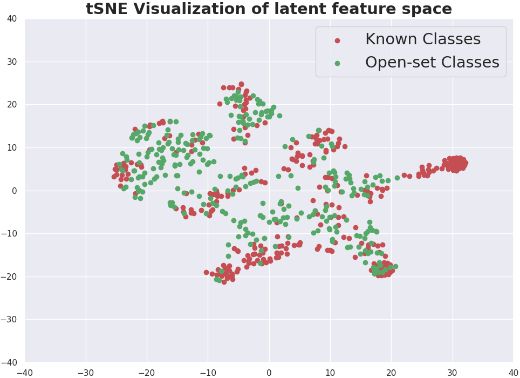
In Figure 5 we visualize latent features obtained in the proposed method
along with two other baselines using tSNE visualization [23] . As shown in
Figure 5, most of open-set features lie away from the known-set feature
distribution based on our method. This is why the proposed method is able to
obtain good open-set detection performance. On the other hand, it can be
observed from Figure 5 that there is more overlap between the two types of
features in all baseline methods. When open-set features lie away from the data
manifold of known set classes, the reconstruction obtained through the decoder
network tends to be poor. Therefore, the tSNE plot justifies why the14 Rui Shao, Pramuditha Perera, Pong C. Yuen, Vishal M. Patel
Adversarial Training Feature Denoising Ours
Fig. 5. tSNE visualization of the latent feature space corresponding to our method and
two baselines.
reconstruction of our method was poor for open-set samples in Figure 3. As
such, Figure 3 and Figure 5 mutually verify the effectiveness of our method for
defending adversarial samples and identifying open-set samples simultaneously.
Moreover, we visualize randomly selected feature maps of the second residual
block from the trained Resnet-18 [14] and the encoder of the proposed OSDN
network applied on clean images and on its adversarially perturbed counterpart
in the CIFAR10 dataset. From Figure 4, it can be observed that compared to
Resnet-18, the proposed network is able to reduce adversarial noise significantly
in feature maps of adversarial images in both known and open-set classes. This
further demonstrates that the proposed network indeed carries out the feature
denoising through the embedded feature denoising layers.
6 Conclusion
In this paper, we studied a novel research problem – Open-set Adversarial
Defense (OSAD). We first showed that existing adversarial defense mechanisms
do not generalize well to open-set samples. Furthermore, we showed that even
open-set classifiers can be easily attacked using the existing attack
mechanisms. We proposed an Open-Set Defense Network (OSDN) with the
objective of producing a model that can detect open-set samples while being
robust against adversarial attacks. The proposed network consisted of feature
denoising operation, self-supervision operation and a denoised image
generation function. We demonstrated the effectiveness of the proposed
method under both open-set and adversarial attack settings on three publicly
available classification datasets. Finally, we showed that proposed method can
be deployed for out-of-distribution detection task as well.
Acknowledgments
This work is partially supported by Research Grants Council
(RGC/HKBU12200518), Hong Kong. Vishal M. Patel was supported by the
DARPA GARD Program HR001119S0026-GARD-FP-052.Open-set Adversarial Defense 15
References
1. Alex Krizhevsky, V.N., Hinton, G.: Cifar-10(canadian institute for advanced
research)
2. Baweja, Y., Oza, P., Perera, P., Patel, V.M.: Anomaly detection-based unknown
face pre- sentation attack detection. In: IJCB (2020)
3. Bendale, A., Boult, T.E.: Towards open set deep networks. In: CVPR (2016)
4. Buades, A., Coll, B., Morel, J.M.: A non-local algorithm for image denoising. In:
CVPR (2005)
5. Carlini, N., Wagner, D.: Towards evaluating the robustness of neural networks. In:
SP (2017)
6. Deng, J., Dong, W., Socher, R., Li, L.J., Li, K., Fei-Fei, L.: Imagenet: A large-scale
hierarchical image database. In: CVPR (2009)
7. Doersch, C., Gupta, A., Efros, A.A.: Unsupervised visual representation learning
by context prediction. In: ICCV (2015)
8. Doersch, C., Zisserman, A.: Multi-task self-supervised visual learning. In: ICCV
(2017)
9. Evtimov, I., Eykholt, K., Fernandes, E., Kohno, T., Li, B., Prakash, A., Rahmati,
A., Song, D.: Robust physical-world attacks on deep learning models. In: CVPR
(2018)
10. Ge, Z., Demyanov, S., Chen, Z., Garnavi, R.: Generative openmax for multi-class
open set classification. BMVC (2017)
11. Gidaris, S., Singh, P., Komodakis, N.: Unsupervised representation learning by
predicting image rotations. ICLR (2018)
12. Goodfellow, I.J., Shlens, J., Szegedy, C.: Explaining and harnessing adversarial
examples. ICLR (2014)
13. Gupta, P., Rahtu, E.: Ciidefence: Defeating adversarial attacks by fusing class-
specific image inpainting and image denoising. In: CVPR (2019)
14. He, K., Zhang, X., Ren, S., Sun, J.: Deep residual learning for image recognition.
In: CVPR (2016)
15. Hendrycks, D., Gimpel, K.: A baseline for detecting misclassified and out-of-
distribution examples in neural networks. ICLR (2017)
16. Hendrycks, D., Mazeika, M., Kadavath, S., Song, D.: Using self-supervised learning
can improve model robustness and uncertainty. In: NIPS (2019)
17. Jang, Y., Zhao, T., Hong, S., Lee, H.: Adversarial defense via learning to generate
diverse attacks. In: ICCV (2019)
18. Kingma, D.P., Ba, J.: Adam: A method for stochastic optimization. arXiv preprint
arXiv:1412.6980 (2014)
19. Kurakin, A., Goodfellow, I., Bengio, S.: Adversarial machine learning at scale.
ICLR (2017)
20. Lan, X., Ye, M., Shao, R., Zhong, B., Yuen, P.C., Zhou, H.: Learning modality-
consistency feature templates: A robust rgb-infrared tracking system. In: IEEE
Trans. Industrial Electronics, 66(12), 9887–9897 (2019)
21. Liang, S., Li, Y., Srikant, R.: Enhancing the reliability of out-of-distribution image
detection in neural networks. ICLR (2018)
22. Liao, F., Liang, M., Dong, Y., Pang, T., Hu, X., Zhu, J.: Defense against adversarial
attacks using high-level representation guided denoiser. In: CVPR (2018)
23. Maaten, L.v.d., Hinton, G.: Visualizing data using t-sne. Journal of machine
learning research 9(Nov), 2579–2605 (2008)16 Rui Shao, Pramuditha Perera, Pong C. Yuen, Vishal M. Patel
24. Madry, A., Makelov, A., Schmidt, L., Tsipras, D., Vladu, A.: Towards deep learning
models resistant to adversarial attacks. ICLR (2018)
25. Neal, L., Olson, M., Fern, X., Wong, W.K., Li, F.: Open set learning with
counterfactual images. In: ECCV (2018)
26. Netzer, Y., Wang, T., Coates, A., Bissacco, A., Wu, B., Ng, A.Y.: Reading digits
in natural images with unsupervised feature learning (2011)
27. Oza, P., Nguyen, H.V., Patel, V.M.: Multiple class novelty detection under data
distribution shift. In: ECCV (2020)
28. Oza, P., Patel, V.M.: Utilizing patch-level activity patterns for multiple class
novelty detection. In: ECCV (2020)
29. Oza, P., Patel, V.M.: One-class convolutional neural network. IEEE Signal
Processing Letters 26(2), 277–281 (2018)
30. Oza, P., Patel, V.M.: C2ae: Class conditioned auto-encoder for open-set
recognition. In: CVPR (2019)
31. Perera, P., Patel, V.M.: Deep transfer learning for multiple class novelty detection.
In: CVPR (2019)
32. Perera, P., Morariu, V.I., Jain, R., Manjunatha, V., Wigington, C., Ordonez,
V., Patel, V.M.: Generative-discriminative feature representations for open-set
recognition. In: CVPR (2020)
33. Perera, P., Nallapati, R., Xiang, B.: OCGAN: One-class novelty detection using
gans with constrained latent representations. In: CVPR (2019)
34. Perera, P., Patel, V.M.: Learning deep features for one-class classification. IEEE
Transactions on Image Processing 28(11), 5450–5463 (2019)
35. Scheirer, W.J., Rocha, A., Sapkota, A., Boult, T.E.: Towards open set recognition.
IEEE Transactions on Pattern Analysis and Machine Intelligence (T-PAMI) 35
(July 2013)
36. Shao, R., Lan, X.: Adversarial auto-encoder for unsupervised deep domain
adaptation. In: IET Image Processing (2019)
37. Shao, R., Lan, X., Li, J., Yuen, P.C.: Multi-adversarial discriminative deep domain
generalization for face presentation attack detection. In: CVPR (2019)
38. Shao, R., Lan, X., Yuen, P.C.: Deep convolutional dynamic texture learning with
adaptive channel-discriminability for 3D mask face anti-spoofing. In: IJCB (2017)
39. Shao, R., Lan, X., Yuen, P.C.: Feature constrained by pixel: Hierarchical
adversarial deep domain adaptation. In: ACM MM (2018)
40. Shao, R., Lan, X., Yuen, P.C.: Joint discriminative learning of deep dynamic
textures for 3D mask face anti-spoofing. In: IEEE Trans. Inf. Forens. Security,
14(4): 923-938 (2019)
41. Shao, R., Lan, X., Yuen, P.C.: Regularized fine-grained meta face anti-spoofing.
In: AAAI (2020)
42. Shao, R., Perera, P., Yuen, P.C., Patel, V.M.: Federated face anti-spoofing. arXiv
preprint arXiv:2005.14638 (2020)
43. Szegedy, C., Zaremba, W., Sutskever, I., Bruna, J., Erhan, D., Goodfellow, I.,
Fergus, R.: Intriguing properties of neural networks. ICLR (2014)
44. Xie, C., Wu, Y., Maaten, L.v.d., Yuille, A.L., He, K.: Feature denoising for
improving adversarial robustness. In: CVPR (2019)
45. Ye, M., Shen, J., Lin, G., Xiang, T., Shao, L., Hoi, S.C.H.: Deep learning for person
re-identification: A survey and outlook. arXiv preprint arXiv:2001.04193 (2020)
46. Ye, M., Shen, J., Zhang, X., Yuen, P.C., Chang, S.F.: Augmentation invariant and
instance spreading feature for softmax embedding. IEEE transactions on pattern
analysis and machine intelligence (2020)Open-set Adversarial Defense 17
47. Ye, M., Zhang, X., Yuen, P.C., Chang, S.F.: Unsupervised embedding learning via
invariant and spreading instance feature. In: CVPR (2019)
48. Yoshihashi, R., Shao, W., Kawakami, R., You, S., Iida, M., Naemura, T.:
Classification-reconstruction learning for open-set recognition. In: CVPR (2019)
49. Yu, F., Seff, A., Zhang, Y., Song, S., Funkhouser, T., Xiao, J.: Lsun: Construction
of a large-scale image dataset using deep learning with humans in the loop. arXiv
preprint arXiv:1506.03365 (2015)
50. Zhang, H., Patel, V.M.: Sparse representation-based open set recognition. IEEE
transactions on pattern analysis and machine intelligence 39(8), 1690–1696 (2016)You can also read


