Martha Cove Village Centre - Economic impact assessment April 2016 - Mornington Peninsula Shire
←
→
Page content transcription
If your browser does not render page correctly, please read the page content below
Attachment 6

Martha Cove Village Centre
    Economic impact assessment

                     April 2016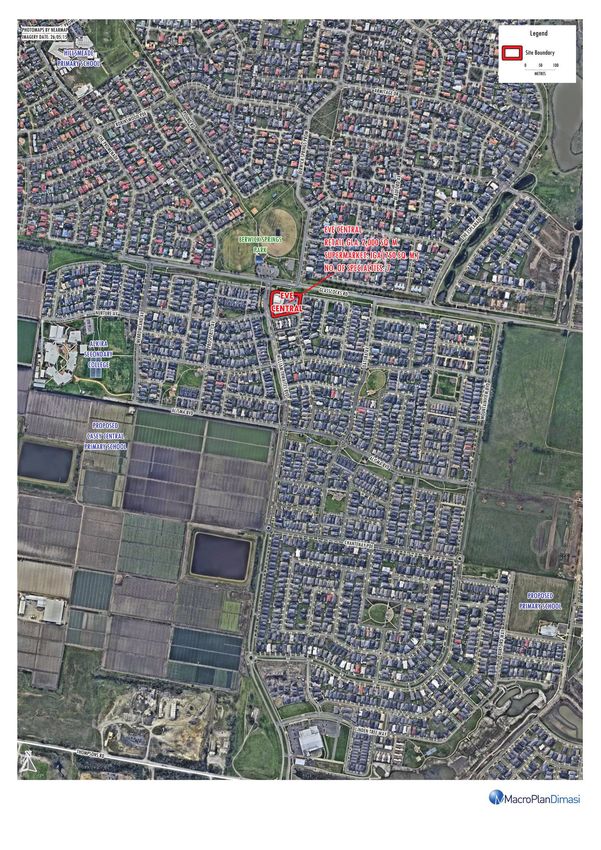
Attachment 6

MacroPlan Dimasi

MELBOURNE                                  SYDNEY
Level 4                                    Level 6
356 Collins Street                         39 Martin Place
Melbourne VIC 3000                         Sydney NSW 2000
(03) 9600 0500                             (02) 9221 5211
BRISBANE                                   GOLD COAST
Level 15                                   Level 2
111 Eagle Street                           89 -91 Surf Parade
Brisbane QLD 4000                          Broadbeach QLD 4218
(07) 3221 8166                             (07) 3221 8166
ADELAIDE                                   PERTH
Ground Floor                               Level 1
89 King William Street                     89 St Georges Terrace
Adelaide SA 5000                           Perth WA 6000
(08) 8221 6332                             (08) 9225 7200

Prepared for: Denarke Pty Ltd

MacroPlan Dimasi staff responsible for this report:

Tony Dimasi, Managing Director – Retail
Ziggy Gelman, Consultant
Attachment 6

Table of contents

Executive summary                                                      i

Introduction                                                          v

Section 1:     Site location and proposed development                 1

Section 2:     Competitive context                                    4

Section 3:     Trade area analysis                                    7

      3.1    Trade area definition                                    7

      3.2    Trade area population                                   10

      3.3    Socio-demographic profile                               11

      3.4    Trade area spending                                     15

      3.5    Additional business from tourists and visitors          19

Section 4:     Case study comparisons                                20

Section 5:     Martha Cove retail development opportunity            27

      5.1    Retail floorspace demand                                27

      5.2    Supermarket potential                                   29

      5.3    Retail specialty floorspace                             30

      5.4    Total centre estimated retail sales potential           31

Section 6:     Economic benefits and impacts                         33

      6.1    Purpose of assessing trading impacts                    33

      6.2    Potential trading impacts                               34

      6.3    Direct economic benefits                                36

      6.4    Other economic/social benefits                          38

      6.5    Net community benefit                                   39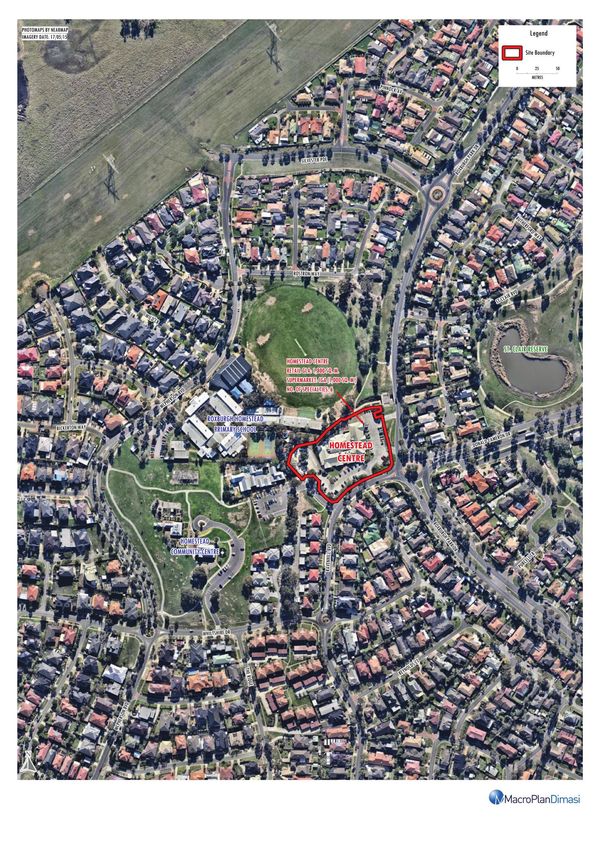
Attachment 6

Executive summary

Site location and proposed development

· The Martha Cove Village Centre will be located within the masterplanned Martha Cove

  residential estate, an exclusive waterfront residential estate focussed around a marina at
  Safety Beach, some 80 km south of the Melbourne CBD.

· Martha Cove is planned to accommodate approximately 1,200 residential lots, of which

  700 have already been completed. The Martha Cove Village Centre currently has approval
  for 2,000 sq.m of retail floorspace, which is likely to include a small supermarket, together
  with a small amount of food and beverage facilities.

Competition

· A number of independent supermarkets are located in the region surrounding

  Martha Cove. A small boutique foodstore, Provincia, is located on Marine Drive, some
  3 km south-west of the subject site, while the Dromana Town Centre, located 6.5 km
  south-west of the subject site, includes Dromana Hub SC (anchored by a Supa IGA
  supermarket of around 2,600 sq.m) and a small Foodworks supermarket. Mount Martha
  Village is located around 8 km north of the subject site and includes a Supa IGA
  supermarket of approximately 1,000 sq.m. Bentons Square, anchored by a 4,200 sq.m
  Woolworths supermarket, is located around 10 km north of the subject site.

· A 1,200 sq.m Aldi supermarket is proposed in Dromana on Nepean Highway, located

  some 8.8 km south of the subject site, and is expected in late 2016.

Trade area population and spending

· The potential catchment or trade area for Martha Cove Village Centre is defined to

  include a primary sector and a secondary sector. The available trade area population is
  estimated at some 5,130 people at June 2015, including 2,590 residents in the primary
  sector. The population of the main trade area is expected to reach around 7,500 people
  over the forecast period to 2026, mainly reflecting the residential development
  Martha Cove and residential infill in the area.

                                                                    Martha Cove Village Centre
                                                                                                   i
                                                                      Economic impact assessment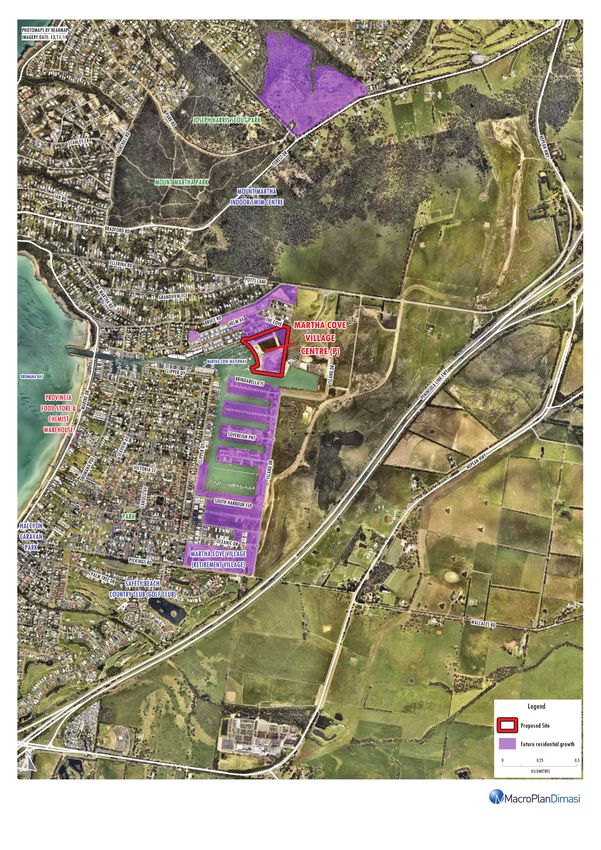
Attachment 6
                                                                                Executive summary

· Income levels of residents of Martha Cove and the secondary sector are well above

   benchmarks for metropolitan Melbourne, which translates to retail spending levels by
   trade area residents are relatively high compared with benchmarks for Melbourne and
   Australia. Total retail spending by the trade area population is projected to increase from
   $76.1 million in 2015 to $124 million at 2026, presented in constant 2014/15 dollars
   (i.e. excluding retail inflation).

· In addition to the business that will be attracted from the main trade area population, the

   village centre facilities at Martha Cove will also draw business from other sources, namely
   tourists and visitors to the locality. This additional business, together with an element of
   ‘passing traffic’ will in our view add in the order of 15% – 20%, depending on the retail
   category, to the business which the village centre at Martha Cove will draw from the main
   trade area residents.

Retail case studies

· A number of case studies of existing centres were undertaken to assist in determining the

   appropriate amount of retail floorspace supportable at the proposed Martha Cove Village
   Centre. The case studies all include supermarkets of around 1,000 sq.m, situated in outer
   metropolitan locations in relatively internal locations within residential areas and in close
   proximity to other supermarkets. The centres are provided over around 2,000 sq.m of
   retail floorspace and typically serve primary catchments with a population of 6,000 or
   greater.

Centre retail potential

· Given the location of the proposed Martha Cove Village Centre, the subject site is

   assessed to be able to support a small supermarket and some specialty shops. The
   analysis presented in this report shows that the site could possibly support around
   1,900 sq.m of retail floorspace. This could potentially include a small supermarket of
   around 1,000 sq.m of floorspace and around 10-12 retail specialty stores, such as food
   specialty stores (e.g. bakery/butcher/deli/grocer), take-away food stores, a newsagency
   and other convenience retail facilities.

                                                                     Martha Cove Village Centre
                                                                                                    ii
                                                                       Economic impact assessment
Attachment 6
                                                                                Executive summary

· In addition to retail specialty stores, non-retail tenants, which are destinational in nature,

   are generally provided at supermarket based centres. Potential non-retail tenants at the
   proposed centre could include a fitness centre, medical centre and a travel agent, as well
   as a previously approved bar/restaurant.

· Total retail sales potential at Martha Cove Village Centre is estimated at $14.1 million in

   2020/21. This includes $7.8 million in supermarket sales and $6.3 million of specialty sales
   ($5.2 million food and $1.1 million non-food).

· Supportable rents for the retail specialty floorspace would range from $450 – $1,000 per

   sq.m; while rents for non-retail tenants would range from $200 – $700 per sq.m.
   Supermarket rents will typically be in the order of $300 - $400 per sq.m gross.

· The proposed Martha Cove Village Centre is likely to result in a range of economic

   impacts, with the key positive impacts including:

      - Addressing the underprovision of supermarket floorspace in the trade area;

      - Creating a focal point for local residents;

      - Substantially improving shopping choice, convenience and amenity for local
         residents; and

      - Creation of additional employment opportunities.

· Against these benefits, some impacts are projected on centres in the surrounding area.

   The potential trading impacts arising from the proposed Martha Cove Village Centre
   would be dispersed across a range of retail centres. The potential impacts are not
   expected to threaten the ongoing viability of any existing retail centre or retail shop.
   Therefore, it can be concluded that a net community benefit will result from the
   proposed development, particularly as the development will provide greatly increased
   shopping choice for local residents while also creating job opportunities for the local
   community.

                                                                     Martha Cove Village Centre
                                                                                                    iii
                                                                       Economic impact assessment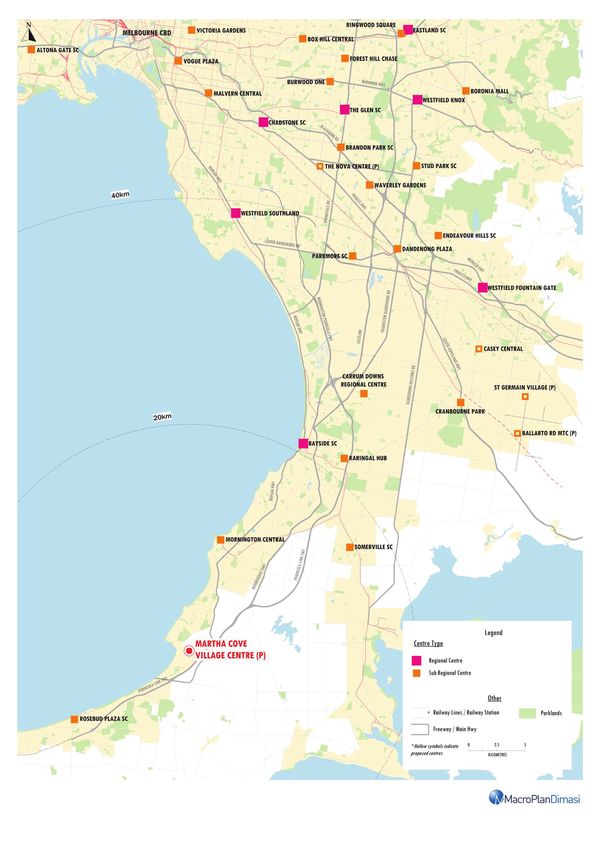
Attachment 6
          Executive summary

Martha Cove Village Centre
                              iv
 Economic impact assessment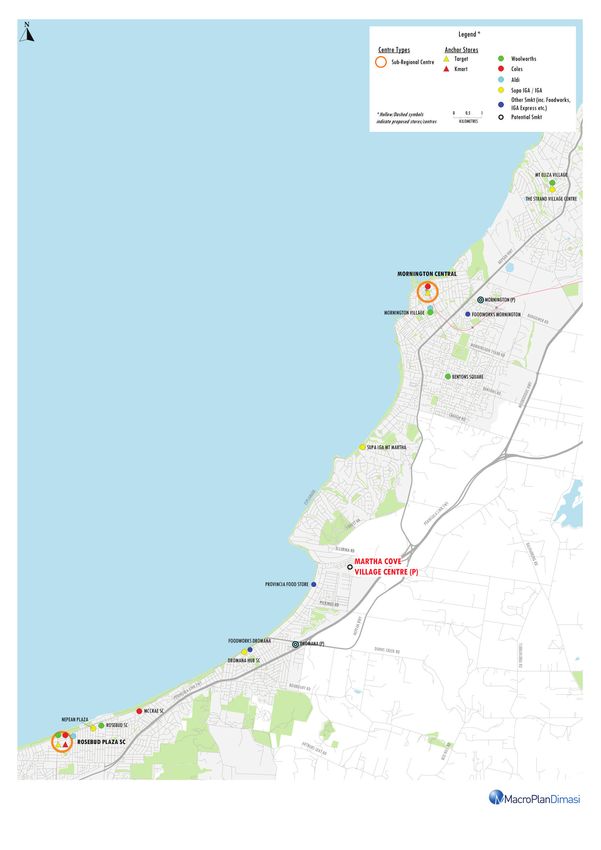
Attachment 6

Introduction

This report presents an independent assessment of the market potential for development of
the proposed Martha Cove Village Centre in Safety Beach. The report has been prepared in
accordance with instructions received from Denarke Pty Ltd and is structured as follows:

· Section 1 reviews the site location and the surrounding context, as well as the scale and

   nature of the proposed development.

· Section 2 examines the competitive environment surrounding Martha Cove.

· Section 3 examines the potential trade area for the village centre, including current and

   projected population levels; the socio-demographic profile of the trade area population;
   and the retail expenditure volumes which the population will generate, both now and in
   the future.

· Section 4 provides a number of case studies of comparatively sized retail centres located

   within residential areas in Melbourne.

· Section 5 assesses the likely sales potential and market shares for the proposed centre.

· Section 6 outlines the potential economic and social benefits, and also assesses the

   impacts that can be anticipated from the proposed development.

                                                                   Martha Cove Village Centre
                                                                                                 v
                                                                    Economic impact assessment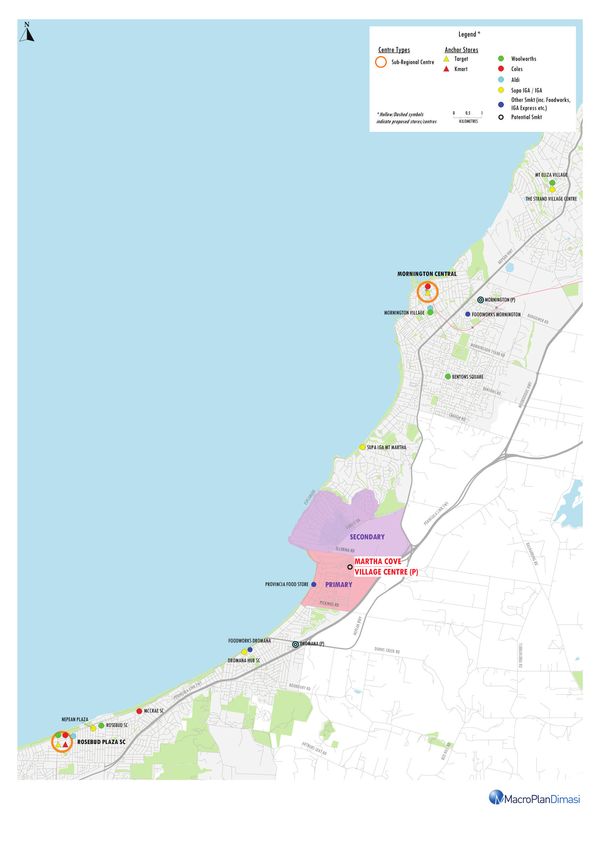
Attachment 6

Section 1: Site location and proposed development

The Martha Cove Village Centre will be located within the masterplanned Martha Cove
residential estate, a high quality waterfront residential estate focussed around a marina at
Safety Beach. Safety Beach is located on the Mornington Peninsula, some 80 km south of the
Melbourne CBD (refer Map 1.1).

The Mornington Peninsula is a diverse region and comprises urban development along the
coastal areas, together with a range of popular tourist attractions including wineries,
beaches, golf courses, craft markets and art galleries. Access to the Mornington Peninsula
from the rest of Melbourne has improved greatly over recent years with the opening of the
Mornington Peninsula Freeway.

Martha Cove is planned to accommodate approximately 1,200 residential lots, of which 700
have already been completed.

The Martha Cove Village Centre currently has approval for 2,000 sq.m of retail floorspace,
which is likely to include a small supermarket, together with a small amount of food and
beverage facilities. The subject site is centrally located within the estate (refer Map 1.2), and
is well positioned to serve both existing and future residents of the estate.

The site can also serve residents of the surrounding region, being located only a short
distance west of the Mornington Peninsula Freeway and Nepean Highway and a short
distance east of Marine Drive, with access via Bruce Road and Martha Cove Boulevard.

                                                                      Martha Cove Village Centre
                                                                                                    1
                                                                       Economic impact assessment
Attachment 6

Map 1.1: Martha Cove
Regional context
Attachment 6

Map 1.2: Martha Cove Village Centre
Site location
Attachment 6

Section 2: Competitive context

This section of the report reviews the main competitive supermarket facilities operating
around Martha Cove, as well as proposed retail developments within the area. Table 2.1
provides a summary of these various facilities, while Map 2.1 illustrates their locations
relative to the subject site.

                                                            Table 2.1
                        Martha Cove Village Centre - schedule of competing retail facilities

                                      Retail                                                   Dist. by road from
  Centre                              GLA          Major traders                                 Martha Cove
                                     (sq.m)                                                          (km)

  Safety Beach                           800       Provincia, Chemist Warehouse                        3.0
  Dromana                             12,000                                                           6.5
  • Dromana Hub SC                     5,700       Supa IGA
  • Other                              6,300       Foodworks
  Mount Martha Village                 3,000       Supa IGA                                            8.0
  Bentons Square                       8,500       Woolworths                                        10.0

  Future retail facilities
  Aldi Dromana                         1,200       Aldi                                                8.8

  Source: Property Council of Australia; MacroPlan Dimasi

Provincia, a small boutique foodstore of around 250 sq.m, is located on the corner of
Marine Drive and Victoria Street in Safety Beach, some 3 km (by road) south-west of the
subject site. The store offers a limited provision of fresh food and groceries as well as a small
café. Adjoining the store are a Chemist Warehouse and pizza take-away restaurant.

Apart from Provincia, the Dromana retail strip is the closest convenience based shopping
facility, but is located around 6.5 km south-west of Martha Cove on Nepean Highway/Point
Nepean Road. Dromana Hub Shopping Centre is located at the western end of the strip and
includes a Ritchies Supa IGA of approximately 2,600 sq.m, along with a number of supporting
specialty stores. A small Foodworks foodstore of approximately 300 sq.m is located a short
distance east along the main shopping strip, which also contains some 40 – 50 specialty
stores.

                                                                                   Martha Cove Village Centre
                                                                                                                    4
                                                                                     Economic impact assessment
Attachment 6 Map 2.1: Martha Cove Village Centre Competitive context
Attachment 6
                                                                   Section 2: Competitive context

A Supa IGA supermarket of approximately 1,000 sq.m anchors the small Mount Martha
Village centre, around 8 km north of Martha Cove, which also contains around 30 retail and
non-retail specialty stores, including a number of cafés.

The Mornington Town Centre and Rosebud Town Centre are the closest higher order
centres, but located much further away, some 12 km north and 20 km south of Martha Cove
respectively. Both centres contain around 30,000 – 35,000 sq.m of retail floorspace and offer
all major supermarkets, discount department store(s) and main street retailing with a range
of retail and non-retail facilities.

A 1,200 sq.m Aldi supermarket is proposed to be built in Dromana on Nepean Highway, on a
site located some 8.8 km south of the subject site. The supermarket is proposed to be
developed within an existing commercial park a short distance east of the main Dromana
retail strip and is expected to be completed in late 2016.

                                                                   Martha Cove Village Centre
                                                                                                    6
                                                                    Economic impact assessment
Attachment 6
Section 3: Trade area analysis
This section of the report details the potential trade area available to the proposed retail
centre at Martha Cove. It includes an analysis of current and forecast population levels and
the socio-demographic profiles of trade area residents, as well as assessing the current and
future retail expenditure capacity of this population.
3.1 Trade area definition
The extent of the trade area or catchment for any shopping centre or retail precinct is
shaped by a number of key factors, as follows:
· The most important factor impacting on the trade area of any particular centre is the
scale and composition of the centre, and particularly the major trader (or traders) that
are included within it. The layout and ambience/atmosphere of the centre, as well as the
amount and quality of carparking, also determine the strength and attraction of a
particular retail facility.
· The available road network and public transport system are also important factors
impacting on the relative attractiveness of any retail facility, as they affect the ease of
access to the centre.
· The proximity and attraction of competitive retail facilities also have an influence on a
particular centre’s trade area. The locations, compositions, quality and scale of
competitive centres in the region therefore impact on the extent of the trade area which
a shopping centre is effectively able to serve.
· Significant physical barriers (e.g. freeways, rivers and railways) which are difficult to
negotiate or which take considerable time to cross can often act to delineate the
boundaries of the trade areas that are able to be served by specific centres.
Martha Cove Village Centre
7
Economic impact assessmentAttachment 6
Section 3: Trade area analysis
Taking the above into account, the trade area for Martha Cove Village Centre is influenced in
particular by the following:
i. A central location within the Martha Cove residential estate;
ii. A surrounding road network which provides reasonable access to the site, however,
the quality of access is constrained due to the internal nature of the site and the
circuitous access routes from both north and south;
iii. The general scale and role of the proposed centre, which will be small in nature,
playing a local/neighbourhood role;
iv. The provision of alternative supermarket based facilities within the surrounding area,
as discussed in the previous section, with the closest supermarket, located at Dromana
Hub SC, being some 6.5 km south-west of the subject site; and
v. The network of proposed retail developments in the surrounding area, namely a
proposed Aldi supermarket in Dromana on Nepean Highway.
Map 3.1 illustrates the trade area defined for Martha Cove Village Centre. The trade area has
been defined to include a primary sector and a secondary sector as follows:
· The primary sector contains the Martha Cove residential estate and encompasses part of
the suburb of Safety Beach, being bounded by Bruce Road and Ellerina Road to the north,
the Mornington Peninsula Freeway to the east and Pickings Road to the south.
· The secondary sector generally extends around 2 km north of the primary sector and
encompasses part of the suburb of Mount Martha.
The northern extent of the trade area is limited by the location of Supa IGA at Mount Martha
and Bentons Square in Mornington, a large supermarket based centre anchored by a
Woolworths supermarket, as well as the Mornington Town Centre; while the southern
extent is limited by the existence of the Dromana retail strip along Nepean Highway/Point
Nepean Road and the proposed Aldi supermarket on Nepean Highway, as well as the
Rosebud Town Centre further south.
The localised trade area, as defined above, reflects the anticipated scale and role of the
proposed centre.
Martha Cove Village Centre
8
Economic impact assessmentAttachment 6 Map 3.1: Martha Cove Village Centre Trade area and competition
Attachment 6
                                                                                        Section 3: Trade area analysis

3.2     Trade area population

Table 3.1 details the current and projected population levels within the Martha Cove Village
Centre main trade area. At 2015, the main trade area population is estimated at
5,130 people, including around 2,600 residents within the primary sector.

                                                         Table 3.1
                           Martha Cove Village Centre trade area population, 2006-2026*

                                      Estimated population                         Forecast population
  Trade area sector              2006            2011             2015        2018          2021           2026

  Primary                       1,800            2,190           2,590        3,190        3,790           4,290
  Secondary                     1,860            2,300           2,540        2,720        2,900           3,200

  Main trade area               3,660            4,490           5,130        5,910        6,690           7,490

                                                                  Average annual growth (no.)
  Trade area sector                           2006-11         2011-15       2015-18      2018-21         2021-26

  Primary                                           78             100          200             200         100
  Secondary                                         88               60          60              60          60

  Main trade area                                  166             160          260             260         160

                                                                   Average annual growth (%)
  Trade area sector                           2006-11         2011-15       2015-18      2018-21         2021-26

  Primary                                        4.0%            4.3%         7.2%          5.9%           2.5%
  Secondary                                      4.3%            2.5%         2.3%          2.2%           2.0%

  Main trade area                                4.2%            3.4%         4.8%          4.2%           2.3%

  *As at June
  Source: ABS Census 2011; Victoria In Future, May 2014; MacroPlan Dimasi

The key driver of population growth within the main trade area is the Martha Cove
masterplanned estate, which will provide some 1,200 residential lots, and a population in the
order of approximately 2,900, when completed. Development of the residential estate has
resumed following its sale in May 2015, and to this point a total of 700 dwellings have been
constructed. Residential infill development is also expected to occur throughout the trade
area.

                                                                                      Martha Cove Village Centre
                                                                                                                         10
                                                                                        Economic impact assessment
Attachment 6
Section 3: Trade area analysis
Taking the above into account, population growth in the main trade area is projected to
continue throughout the entire area, with solid growth estimated within the primary sector.
The main trade area population is projected at around 7,500 in 2026, reflecting average
annual growth of 3.5% over the forecast period. The primary sector is projected to contain
around 4,300 residents at that time.
3.3 Socio-demographic profile
Table 3.2 and Chart 3.1 illustrate the socio-demographic profile of the Martha Cove Village
Centre main trade area population, including residents of Martha Cove, compared with the
respective metropolitan Melbourne and Australian averages. This information is sourced
from the 2011 ABS Census of Population and Housing.
The key features of the trade area population are summarised below:
· The average age of the main trade area population is well above average, reflecting the
very high proportion of residents aged 60 years and over in the trade area.
· Income levels earned by Martha Cove and secondary sector residents are well above
average, however residents in the balance of the primary sector earn below average
incomes.
· Home ownership levels within the trade area are well above average, and this is
particularly evident within the secondary sector.
· Trade area residents are predominantly Australian-born, and there is a well below
average proportion of Asian-born residents within the trade area.
· Traditional family households, i.e. couples with children, are the most common
household type in the trade area. The main trade area also contains an above average
proportion of couples without children, reflecting the older age profile of the area.
In summary, the trade area includes a large provision of residents earning above average
incomes who typically own their own home and were born in Australia. While income levels
are slightly below average in the balance of the primary sector, discretionary spending would
Martha Cove Village Centre
11
Economic impact assessmentAttachment 6
Section 3: Trade area analysis
be above average, reflecting the high proportion of retirees who own their own home within
the trade area.
At the time of the 2011 ABS Census, there were some 280 residents living in Martha Cove.
The current socio-demographic profile of the population within the estate might well differ
slightly from these estimates; however, we do not expect that any such differences would
result in significant changes to the conclusions and recommendations presented in this
report. In any case, we expect that the current socio-demographic profile of the area would
most likely reflect a more affluent population within Martha Cove, with a greater retail
expenditure capacity per person/household, than that which was presented at 2011.
Martha Cove Village Centre
12
Economic impact assessmentAttachment 6
Section 3: Trade area analysis
Table 3.2
Martha Cove Village Centre main trade area - socio-demographic profile, 2011
Martha Primary Primary Secondary Main Melb Metro
Census item Cove Balance sector sector TA avg.
Per capita income $42,222 $29,832 $31,423 $41,435 $36,561 $35,169
Var. from Melb Metro benchmark 20.1% -15.2% -10.7% 17.8% 4.0%
Avg. household income $102,412 $73,041 $76,842 $116,421 $95,782 $91,440
Var. from Melb Metro benchmark 12.0% -20.1% -16.0% 27.3% 4.7%
Avg. household size 2.4 2.4 2.4 2.8 2.6 2.6
Age distribution (% of population)
Aged 0-14 14.9% 18.7% 18.2% 19.7% 18.9% 18.5%
Aged 15-19 8.0% 5.3% 5.7% 7.1% 6.4% 6.3%
Aged 20-29 8.7% 7.0% 7.2% 5.6% 6.4% 15.4%
Aged 30-39 13.4% 10.7% 11.0% 10.3% 10.7% 15.0%
Aged 40-49 14.1% 14.1% 14.1% 16.2% 15.2% 14.5%
Aged 50-59 14.5% 11.2% 11.6% 15.0% 13.3% 12.1%
Aged 60+ 26.4% 33.1% 32.3% 26.2% 29.2% 18.2%
Average age 41.6 43.5 43.2 41.1 42.1 37.3
Housing status (% of households)
Owner (total) 75.2% 72.5% 72.9% 93.0% 83.2% 71.3%
• Owner (outright) 39.0% 42.6% 42.1% 41.5% 41.8% 33.5%
• Owner (with mortgage) 36.2% 29.9% 30.7% 51.5% 41.4% 37.7%
Renter 24.8% 27.1% 26.7% 7.0% 16.6% 28.0%
Other 0.0% 0.4% 0.4% 0.0% 0.2% 0.8%
Birthplace (% of population)
Australian born 77.7% 76.2% 76.4% 75.5% 75.9% 66.7%
Overseas born 22.3% 23.8% 23.6% 24.5% 24.1% 33.3%
• Asia 2.7% 0.6% 0.9% 1.3% 1.1% 13.4%
• Europe 14.2% 18.4% 17.9% 18.9% 18.4% 12.7%
• Other 5.4% 4.7% 4.8% 4.2% 4.5% 7.2%
Family type (% of households)
Couple with dep't children 47.6% 41.4% 42.2% 52.5% 47.1% 47.4%
Couple with non-dep't child. 3.9% 5.7% 5.5% 7.6% 6.5% 8.7%
Couple without children 29.3% 34.2% 33.6% 29.7% 31.7% 21.0%
One parent with dep't child. 10.9% 6.4% 7.0% 3.5% 5.3% 8.2%
One parent w non-dep't child. 0.0% 2.6% 2.3% 0.9% 1.6% 3.8%
Other family 0.0% 0.7% 0.6% 0.3% 0.5% 1.3%
Lone person 8.3% 9.0% 8.9% 5.5% 7.2% 9.6%
Source: ABS Census of Population & Housing, 2011; MacroPlan Dimasi
Martha Cove Village Centre
13
Economic impact assessmentAttachment 6
Section 3: Trade area analysis
Chart 3.1
Martha Cove Village Centre main trade area - socio-demographic profile, 2011
Age distribution
40%
Martha Cove Village Centre MTA Melb Metro Aust. Avg.
29%
30%
19% 19% 20%
18% 18%
20% 15%14%
15% 14% 15% 14% 14% 13% 13%
11% 12%
10% 6% 7% 6%
6%
0%
Aged 0-14 Aged 15-19 Aged 20-29 Aged 30-39 Aged 40-49 Aged 50-59 Aged 60+
$120,000
Income levels
$95,782
$100,000 Martha Cove Village Centre MTA Melb Metro Aust. Avg. $91,440 $88,205
$80,000
$60,000
$36,561 $34,467
$40,000 $35,169
$20,000
$0
Per capita income Avg. household income
76% Country of birth
80% 74%
67% Martha Cove Village Centre MTA Melb Metro Aust. Avg.
60%
40% 33%
24% 26%
20%
0%
Australian Born Overseas Born
47% 47% Family type
50% 45%
Martha Cove Village Centre MTA Melb Metro Aust. Avg.
40% 32%
30% 23%
21%
20%
10%
6% 9% 8% 8% 9% 7% 10%
10% 5%
2% 4% 4%
0%
Couple with Couple with non- Couple without One parent with One parent with Lone person
dependent children dependent children children dependent children non-dependent
children
Source: ABS Census of Population & Housing, 2011; MacroPlan Dimasi
Martha Cove Village Centre
14
Economic impact assessmentAttachment 6
Section 3: Trade area analysis
3.4 Trade area spending
Chart 3.2 illustrates the estimated per capita retail expenditure levels for the main trade area
population, benchmarked against the respective metropolitan Melbourne and Australian
national averages. All spending figures in this report include GST.
Chart 3.2
Martha Cove Village Centre trade area - retail spending per person, 2014/15*
Total retail 15,078
$16,000
Martha Cove Village Centre MTA Melb Metro Aust. Avg. 13,751 13,591
$14,000
$12,000
$10,000 8,318
7,787 7,748
$8,000 6,760
5,963 5,844
$6,000
$4,000
$2,000
$0
Total Food Total Non-food Total Retail
Food
$3,500 3,198
3,134 Martha Cove Village Centre MTA Melb Metro Aust. Avg.
3,058
$3,000
2,425
$2,500 2,135
2,146
$2,000 1,788 1,822
1,710
$1,500
906
$1,000 762 769
$500
$0
Fresh Food Other Food & Groceries Packaged Liquor Food Catering
Non-food
$3,500
2,968
Martha Cove Village Centre MTA Melb Metro Aust. Avg.
$3,000
2,431 2,407
$2,500
$2,000
1,497
1,467 1,343
$1,500 1,143
1,000 1,043
$1,000 716
665 655
436 400 395
$500
$0
Apparel Household Goods Leisure General Retail Retail Services
*Including GST
Source: MarketInfo; MacroPlan Dimasi
Martha Cove Village Centre
15
Economic impact assessmentAttachment 6
Section 3: Trade area analysis
Retail expenditure levels per capita of main trade area residents are above the respective
metropolitan Melbourne averages, reflecting the above average per capita income levels of
residents within Martha Cove and the secondary sector. Total per capita retail expenditure
for main trade area residents is estimated at $15,078 for 2014/15, which is 9.7% above the
metropolitan Melbourne average.
Table 3.3 below details the total estimated retail expenditure generated by the main trade
area population across food and non-food retail categories, for the period from 2015 to
2026. All spending forecasts in this report are presented in constant 2014/15 dollars
(i.e. excluding retail inflation) and including GST.
Total expenditure on retail items by the main trade area population is estimated at
$76.1 million at 2015, and is projected to increase to $124 million by 2026, including
$67 million in the primary sector, reflecting an average annual rate of 4.5% per annum.
Table 3.4 details the retail expenditure capacity of the main trade area population by
category over the forecast period, as well as the category definitions. Spending on take-
home food, liquor and groceries (FLG) accounts for the highest proportion of total retail
expenditure, at around 43%.
Martha Cove Village Centre
16
Economic impact assessmentAttachment 6
Section 3: Trade area analysis
Table 3.3
Martha Cove Village Centre main trade area - retail expenditure ($M), 2015-2026*
Year ending Primary Secondary Main
June sector sector TA
2015 35.7 40.4 76.1
2016 38.1 41.7 79.8
2017 41.2 43.0 84.3
2018 44.6 44.4 89.0
2019 48.0 45.8 93.8
2020 51.3 47.3 98.6
2021 54.9 48.8 103.7
2022 57.8 50.4 108.2
2023 60.0 52.0 111.9
2024 62.1 53.6 115.7
2025 64.4 55.2 119.7
2026 66.8 57.0 123.7
Average annual growth ($M)
2015-2021 3.2 1.4 4.6
2021-2026 2.4 1.6 4.0
2015-2026 2.8 1.5 4.3
Average annual growth (%)
2015-2021 7.4% 3.2% 5.3%
2021-2026 4.0% 3.1% 3.6%
2015-2026 5.9% 3.2% 4.5%
*Constant 2014/15 dollars & including GST
Source: MarketInfo; MacroPlan Dimasi
Martha Cove Village Centre
17
Economic impact assessmentAttachment 6
Section 3: Trade area analysis
Table 3.4
Martha Cove Village Centre main trade area - retail expenditure by category ($M), 2015-2026*
Year ending FLG Food Apparel Household Leisure General Retail Total
June catering goods retail services retail
2015 32.9 9.0 7.5 15.0 3.6 5.8 2.2 76.1
2016 34.6 9.5 7.9 15.7 3.8 6.0 2.3 79.8
2017 36.6 10.1 8.3 16.5 4.0 6.3 2.4 84.3
2018 38.8 10.7 8.7 17.4 4.2 6.7 2.6 89.0
2019 41.0 11.4 9.1 18.3 4.4 7.0 2.7 93.8
2020 43.1 12.0 9.5 19.2 4.6 7.3 2.9 98.6
2021 45.5 12.7 10.0 20.1 4.8 7.7 3.0 103.7
2022 47.5 13.3 10.3 20.9 5.0 8.0 3.1 108.2
2023 49.2 13.9 10.6 21.6 5.2 8.2 3.2 111.9
2024 50.9 14.4 11.0 22.3 5.3 8.4 3.4 115.7
2025 52.7 15.0 11.3 23.0 5.5 8.7 3.5 119.7
2026 54.6 15.6 11.6 23.8 5.6 9.0 3.6 123.7
Average annual growth ($M)
2015-2026 2.0 0.6 0.4 0.8 0.2 0.3 0.1 4.3
Average annual growth (%)
2015-2026 4.7% 5.1% 4.0% 4.3% 4.1% 4.1% 4.6% 4.5%
*Constant 2014/15 dollars & including GST
Source: MarketInfo; MacroPlan Dimasi
Retail expenditure category definitions:
· FLG: take-home food and groceries, as well as packaged liquor.
· Food catering: expenditure at cafes, take-away food outlets and restaurants.
· Apparel: clothing, footwear, fashion accessories and jewellery.
· Household goods: giftware, electrical, computers, furniture, homewares and hardware goods.
· Leisure: sporting goods, music, DVDs, computer games, books, newspapers & magazines, stationery and
photography equipment.
· General retail: pharmaceutical goods, cosmetics, toys, florists, mobile phones and pets.
· Retail services: hair & beauty, optical goods, dry cleaning, key cutting and shoe repairs.
Martha Cove Village Centre
18
Economic impact assessmentAttachment 6
Section 3: Trade area analysis
3.5 Additional business from tourists and visitors
In addition to the business that will be attracted from the main trade area population, the
village centre facilities at Martha Cove will also draw business from other sources, namely
tourists and visitors to the locality.
As shown previously on Map 1.2, the planned Martha Cove Village Centre will be able to be
accessed off Nepean Highway (approximately 14,000 vehicles per day) via Bruce Road, thus
for visitors traveling to the Safety Beach area, the Martha Cove Village Centre will represent
an attractive location to undertake convenience shopping and/or to stop for take-away
food/café purchases.
Data from Tourism Victoria shows that the Mornington Peninsula attracted 1.3 million
visitors in 2013, a figure which was 14.5% higher than the 2012 level. The Martha Cove
locality provides in excess of 750 marina berths, all of which can potentially be occupied on a
freehold/leasehold basis. While some of these berths will be occupied by residents of the
trade area, we expect that at least half, if not more, will be utilised by non-residents,
i.e. visitors to the locality.
The provision of an attractive village centre adjoining the marina and with water views can
therefore draw a significant element of visitor traffic.
This additional business, together with an element of ‘passing traffic’ will in our view add in
the order of 15% – 20%, depending on the retail category, to the business which the village
centre at Martha Cove will draw from the main trade area residents.
Martha Cove Village Centre
19
Economic impact assessmentAttachment 6
Section 4: Case study comparisons
This section provides a number of case studies to assist in determining the appropriate
amount of retail floorspace supportable at the proposed Martha Cove Village Centre. The
case studies all include supermarkets of around 1,000 sq.m, situated in outer metropolitan
locations in relatively internal locations within residential areas and in close proximity to
other supermarkets. The centres typically serve primary catchments with a population of
6,000 or greater. These case studies are outlined as follows:
· Mount Martha Village is located around 8 km north of Martha Cove and includes a
Supa IGA supermarket of around 1,000 sq.m with a separate liquor store (refer Map 4.1).
The centre comprises around 30 retail and non-retail specialty stores, including a large
number of food specialty stores and retail and non-retail service tenants. The centre is
located approximately 5 km south-west of Bentons Square (anchored by a full-scale
Woolworths supermarket) and serves a catchment of around 6,000 residents, however
does benefit from passing trade along the Esplanade. The centre totals around 3,000 sq.m
of retail floorspace.
· Eve Central is located in the south-eastern growth area of Cranbourne North and
occupies a relatively internal location, albeit on an east-west thoroughfare (refer
Map 4.2). The centre is approximately 2,000 sq.m and includes a small IGA supermarket
of around 750 sq.m and seven retail specialty stores, including a bakery, a fish and chips
store, a chicken take-away store, a noodle take-away store, a pizza restaurant and a hair
and beauty salon, with a Chemist Warehouse located opposite the main centre. The
centre is located approximately 3 km south-east of Casey Central SC (anchored by a full-
scale Coles supermarket) and serves a catchment of around 7,000 residents.
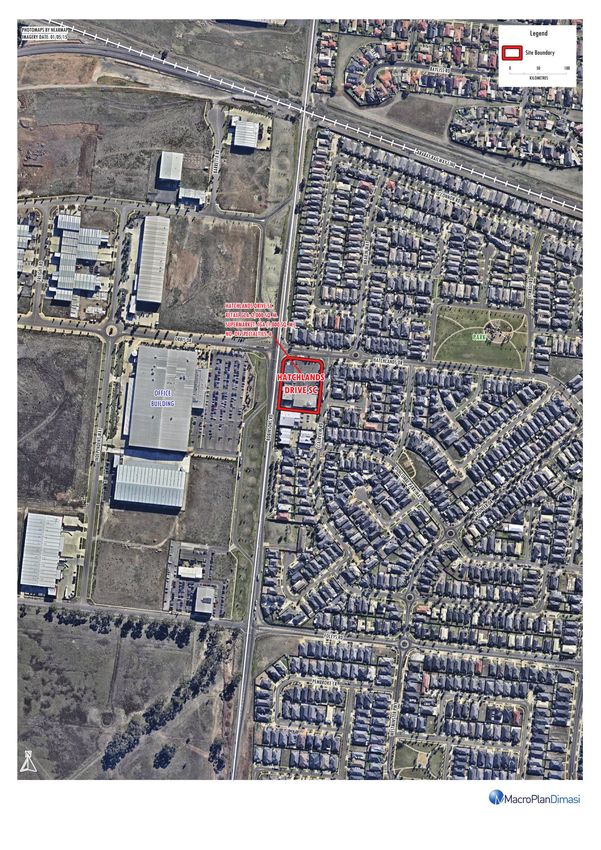
· Hatchlands Drive SC occupies an internal location in Deer Park, a short distance east of
Robinsons Road (refer Map 4.3). The centre contains a 1,000 sq.m IGA supermarket along
with an Asian grocery store, a bakery/café, a pizza and pasta take-away restaurant, a
burger bar, a chemist and a medical centre. The centre totals around 2,000 sq.m of retail
floorspace and serves a catchment of around 6,000 people, being located 2 km west of
Derrimut Village (anchored by a full-scale Coles supermarket).
Martha Cove Village Centre
20
Economic impact assessmentAttachment 6
Section 4: Case study comparisons
· Homestead Centre occupies an internal location in Roxburgh Park, however is located on
Roxburgh Park Drive, a main north-south route through the residential area (refer
Map 4.4). The centre is provided over around 1,800 sq.m of retail floorspace and
comprises an IGA supermarket of some 1,000 sq.m and around 5 retail tenancies
including a hairdresser, a beauty salon, a bakery, a pizza shop and a fish & chips shop, as
well as a medical clinic. The centre is located only 1.8 km north-west of Roxburgh Park SC,
anchored by the three major supermarkets, and serves a primary catchment of
approximately 6,500 residents.
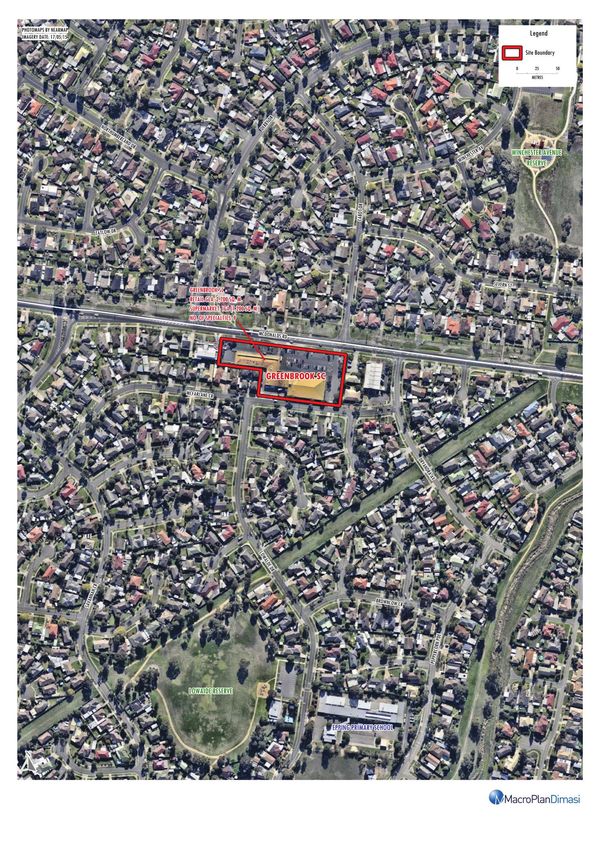
· Greenbrook SC is located in Epping in the shadows of two large sub-regional centres –
Westfield Plenty Valley, anchored by Kmart, Target, Woolworths, Coles and Aldi, Epping
Plaza, anchored by Big W, Target, Woolworths, Coles and Aldi – located around 3 km east
and west of the centre respectively. The centre provides a 1,200 sq.m IGA supermarket
and around nine supporting tenancies including a deli, a bakery, four food catering
tenants, a newsagency, a pharmacy and a hairdresser, serving a catchment population of
approximately 9,000 residents. The centre totals around 2,700 sq.m of retail floorspace
(refer Map 4.5).
Table 4.1 provides a summary of the centres presented in this section.
Table 4.1
Case study centres
Retail
Centre GLA Supermarket Specialties
(sq.m) (sq.m)
Bakery, butcher, deli, liquor, Indian restaurant, ice cream, café (4),
Mount Supa
fish and chips, pizza restaurant, Chinese restaurant, apparel,
Martha 3,000 IGA
fashion/giftware (2), newsagency, pharmacy, hairdresser (3),
Village (1,000)
optometrist, travel agent, real estate agent (4), bank, antiques, gallery
Bakery, fish and chips, chicken take-away, noodle take-away, pizza
Eve Central 2,000 IGA (750)
restaurant, hair and beauty salon, Chemist Warehouse
Hatchlands Asian grocery store, bakery/café, pizza and pasta take-away, burger
2,000 IGA (1,000)
Drive SC bar, chemist, medical centre
Homestead
1,800 IGA (1,000) Bakery, pizza, fish & chips, hairdresser, beauty salon, medical clinic
Centre
Greenbrook
2,700 IGA (1,200) Deli, bakery, food catering (4), newsagency, pharmacy, hairdresser
SC
Source: MacroPlan Dimasi
Martha Cove Village Centre
21
Economic impact assessmentAttachment 6 Map 4.1: Mount Martha Village, Mount Martha Site location
Attachment 6

Map 4.2: Eve Central, Cranbourne North
Site location
Attachment 6

Map 4.3: Hatchlands Drive SC, Deer Park
Site location
Attachment 6

Map 4.4: Homestead Centre, Roxburgh Park
Site location
Attachment 6

Map 4.5: Greenbrook SC, Epping
Site location
Attachment 6

Section 5: Martha                      Cove           retail           development
opportunity

5.1    Retail floorspace demand

This sub-section provides an indicative estimate of the amount of retail floorspace
considered supportable on the Martha Cove Village Centre site. Modelling retail demand for
a given area is a complex task, and a number of assumptions need to be made. Nevertheless,
it does provide an indicative amount of supportable floorspace based on the population of
the area.

The analysis set out in the previous four sections of this report highlights the following key
findings/conclusions:

· There is a sizeable potential catchment available to be serviced at Martha Cove, with an

   estimated 2015 population in excess of 5,000 people, expected to grow to around 7,500
   by 2026. Normally this factor would be sufficient to support a strong small
   neighbourhood centre, at least of comparable scale to Mount Martha Village.

· However, the site proposed for the Martha Cove Village Centre is not ideally situated to

   optimise the market share which can be achieved from this available catchment. The site
   is internalised within the Martha Cove estate, and access to it is somewhat constrained,
   both from the north and from the south.

Table 5.1 details the amount of retail expenditure by category which could be reasonably
retained at Martha Cove assuming an attractive village centre. Given the internal nature of
the site and the surrounding competitive context, we estimate that around 35% of the
available FLG expenditure of the primary sector could be retained at Martha Cove, as well as
around 25% of the available retail services expenditure, 20% of food catering spend and 10%
of leisure spending. These retention rates are considered appropriate particularly given the
accessibility issues of the site.

                                                                    Martha Cove Village Centre
                                                                                                  27
                                                                     Economic impact assessment
Attachment 6
Section 5: Martha Cove retail development opportunity
A provision for demand from beyond the main trade area is also considered, at around 20%
for FLG and food catering, 15% for retail services and 10% for leisure.
To translate this estimated retail expenditure pool into an estimate of retail floorspace
demand, we have applied appropriate industry standard retail turnover densities (RTDs).
On the basis of this retail expenditure methodology, the indicative amount of retail
floorspace which could potentially be supported at the subject site is estimated at
approximately 1,920 sq.m, including around 1,370 sq.m of FLG floorspace (i.e. take-home
food, groceries and packaged liquor), which covers foodstores as well as food specialty
stores.
Table 5.1
Martha Cove Village Centre main trade area - supportable retail floorspace (sq.m) by category, 2021*
Item FLG Food Apparel H'hold Leisure General Retail Total
catering goods retail services retail
MTA retail expenditure ($M) 45.5 12.7 10.0 20.1 4.8 7.7 3.0 103.7
Est. % retained at Martha Cove 24% 12% 0% 0% 8% 0% 18% 13%
• Primary sector 35% 20% 0% 0% 10% 0% 25% 20%
• Secondary sector 10% 5% 0% 0% 5% 0% 10% 5%
Retained expenditure ($M) 10.8 1.6 0.0 0.0 0.4 0.0 0.5 13.3
Est. % sales from beyond MTA** 20% 20% 0% 0% 10% 0% 15% 20%
Available expenditure ($M) 13.0 1.9 0.0 0.0 0.4 0.0 0.6 15.9
RTD ($ per sq.m) 9,500 5,500 4,500 4,000 5,500 6,500 4,500 6,910
Supportable retail f'space (sq.m) 1,367 340 0 0 76 0 138 1,921
*Constant 2014/15 dollars & including GST
**Includes visitors and non-residents plus a small amount of passing traffic, as discussed in Section 3.5
Source: MarketInfo; MacroPlan Dimasi
Martha Cove Village Centre
28
Economic impact assessmentAttachment 6
Section 5: Martha Cove retail development opportunity
5.2 Supermarket potential
On the basis of the preceding analysis, it is our view that a small supermarket of 1,000 sq.m
(including liquor) could be supported at the Martha Cove Village Centre by 2021. We
consider that this supermarket could potentially be an IGA or a small Woolworths store,
though the site’s accessibility may serve to limit Woolworths’ interest. Table 5.2 presents the
projected sales that a supermarket of 1,000 sq.m at Martha Cove Village Centre could be
expected to achieve in 2020/21. All figures presented in this report are presented in constant
2014/15 dollars (i.e. excluding retail inflation) and include GST.
Table 5.2
Martha Cove Village Centre supermarket sales potential, 2021-2026*
Year ending Estimated sales
June ($M)
2021 7.8
2022 8.1
2023 8.4
2024 8.7
2025 9.1
2026 9.4
Avg. ann. growth, 2021-26 3.9%
*Constant 2014/15 dollars & including GST
Source: MacroPlan Dimasi
Martha Cove Village Centre
29
Economic impact assessmentAttachment 6
Section 5: Martha Cove retail development opportunity
5.3 Retail specialty floorspace
The key principle in the success of any shopping centre is the major tenants
(i.e. supermarkets), which act as key customer generators. The supporting specialty shops
feed off the customer flows generated by these major traders.
In our view, retail specialty floorspace at the proposed Martha Cove Village Centre is likely to
be oriented towards food catering and convenience based retailers, with a limited provision
of leisure retailers. Following are recommendations of the possible tenancy mix by category:
· Food Retail – This category includes tenants such as a baker, a butcher, a fresh produce
store, a delicatessen, a patisserie and a liquor store. Most of these tenants are typically
provided in supermarket based shopping centres. Around 4 tenants (350 sq.m) in this
category are suggested for Martha Cove Village Centre, however it is expected that liquor
will be included with the supermarket anchor.
· Food Catering – This category includes takeaway food stores and cafes. We expect
approximately 320 sq.m (3 – 4 tenants) could be supportable at the centre.
· Leisure – Key tenants in these categories include a newsagent and a pharmacy. A small
provision of 80 sq.m is recommended for the centre, likely to be a newsagency given the
location of a Chemist Warehouse only 3 km south-west of the subject site on
Marine Drive. However, a pharmacy might be possible at Martha Cove if co-located with a
substantial medical centre.
· Retail Services – This category includes convenience based tenants such as dry cleaners,
hairdressers and beauty salons. Around 150 sq.m (2 tenants) could be provided in this
category at the centre.
· Non-retail – In addition to retail specialty stores, non-retail tenants, which are
destinational in nature, are generally provided at supermarket based centres. Potential
non-retail tenants at the proposed centre could include a tavern, fitness centre, medical
centre and a travel agent.
Martha Cove Village Centre
30
Economic impact assessmentAttachment 6
Section 5: Martha Cove retail development opportunity
Table 5.3 provides a list of potential specialty tenants which could be supportable at
Martha Cove Village Centre.
Table 5.3
Martha Cove Village Centre - Suggested tenants
Category Suggested tenants
Food & liquor Bakery, deli, patisserie, butcher, fresh produce
Food catering Subway, Boost, burgers, fish and chips, pizza take-away, café
Leisure Newsagency
Retail services Hairdresser, beauty salon, dry cleaner
Non-retail Tavern, fitness centre, medical centre, travel agent
Source: MacroPlan Dimasi
5.4 Total centre estimated retail sales potential
Table 5.4 provides estimates of total retail sales potential for Martha Cove Village Centre,
which is estimated at $14.1 million in 2020/21. This includes $7.8 million in supermarket
sales and $6.3 million of specialty sales ($5.2 million food and $1.1 million non-food).
Table 5.4
Martha Cove Village Centre - Indicative composition and centre sales potential by retail category, 2020/21
Martha Cove Village Centre
Category GLA Est. sales*
(sq.m) ($'000) ($/sq.m)
Supermarket 1,000 7,752 7,752
Retail specialties
Food & liquor 350 3,150 9,000
Food catering** 320 2,040 6,375
Leisure 80 400 5,000
Retail services 150 750 5,000
Total retail spec. 900 6,340 7,044
Total centre - retail 1,900 14,092 7,417
Non-retail
Bar/restaurant 570
Fitness centre 300
Medical centre 200
Travel agency 30
Total non-retail 1,100
Total centre 3,000
*Constant 2014/15 dollars & including GST
**Does not include restaurant seating entitlement under current permit
Source: MacroPlan Dimasi
Martha Cove Village Centre
31
Economic impact assessmentAttachment 6
Section 5: Martha Cove retail development opportunity
Estimates of sales potential outlined in Table 5.4 have had regard to the following:
· the scale and mix of centre as recommended;
· the available trade area population and retail expenditure levels as previously detailed;
· the surrounding competitive network; and
· the expected market shares of available trade area retail expenditure which a centre of
the nature and scale recommended for Martha Cove Village could reasonably be
expected to achieve.
Martha Cove Village Centre
32
Economic impact assessmentAttachment 6
Section 6: Economic benefits and impacts
This section of the report analyses the likely trading impacts on the surrounding
retail/centres hierarchy; and then examines the net community benefits associated with the
proposed development, including employment generation and other economic and social
benefits.
6.1 Purpose of assessing trading impacts
The purpose of an impact assessment is to provide guidance as to whether or not there is
likely to be a net community benefit or disbenefit from any proposed development. In
particular, if there is a real possibility of some existing facilities potentially being impacted to
such a degree that they may be lost to the community and if the service or services provided
by those facilities are not at the very least replaced by the proposed new facilities, then a
community disbenefit could result.
In order to understand whether any particular centre may be impacted to the extent that its
continued viability may be in question, we have estimated specific retail impacts that we
expect across the surrounding competitive network if the proposed centre were to proceed
as planned. The estimated sales potential for the centre are assessed in Section 5 previously.
These estimated inputs provide indications as to whether the scale of the proposed retail
development is reasonable and whether any surrounding centres are likely to be at risk to
the extent that the community would suffer a net disbenefit, attributable to the proposed
retail development.
In considering likely trading impacts on any individual centre or individual retailer, it must
first be acknowledged that such estimation can only realistically expect to provide a broad
indication of likely outcomes, since there are many factors which can change in response to
any new retail development, and which will have a bearing on the consequent outcomes.
The competitive response of each relevant centre or trader is one such factor, as are further
redevelopments/improvements which one or more of the competitive network of centres
might implement.
Martha Cove Village Centre
33
Economic Impact AssessmentAttachment 6
Section 6: Economic benefits and impacts
6.2 Potential trading impacts
The following factors are all of relevance when assessing the potential impacts of a new
supermarket based development on each existing facility or centre:
· The distance of the (impacted) centre, or retail precinct, by road, from the proposed
development.
· The size of the centre or precinct, in terms of total retail floorspace.
· The amount of major tenants floorspace, and brands of these majors.
· The role and function of the centre or precinct.
· Relative accessibility and relative convenience compared with the proposed retail
development.
· The estimated performance of the centre/precinct (in current sales) and future
performance (in the impact year), accounting for any future developments in the region
that may also impact on the future sales of existing centres.
· The share of available expenditure which the centre/precinct attracts from the identified
main trade area of the proposed development. A centre may not be situated in the
identified trade area of the proposed development but its main trade area may extend to
include parts, or all, of the trade area. For example, the trade area for large regional
shopping centre typically includes several hundred thousand persons. Such a trade area is
likely to include (partially or completely) trade areas for smaller convenience based
centres, sub-regional centres, retail strips and stand-alone supermarkets.
Martha Cove Village Centre
34
Economic impact assessmentAttachment 6
Section 6: Economic benefits and impacts
Given the analysis presented in this report, it can reasonably be concluded that the likely
trading impacts of the development of a village centre at Mount Martha, comprising the
elements recommended in Table 5.4 above, will have minimal impacts on all of the
surrounding competitive facilities. The main reasons for this outcome are the following:
· The proposed Martha Cove Village Centre will be built to cater for a proportion of the
total retail expenditure capacity of the residents of the Martha Cove residential estate. As
detailed previously in Table 3.1, within the primary trade area that would be served by
the Martha Cove Village Centre an additional 1,700 residents are expected to be
accommodated over the next decade, and this additional population will significantly
increase the total available retail expenditure for all surrounding shopping facilities.
· The proposed Village Centre will be of a modest scale, and as a consequence will attract
only a relatively small proportion of this available (and strongly growing) retail
expenditure. As detailed previously in Table 5.1, the estimated market shares of available
retail expenditure which would be achieved by the proposed Martha Cove Village Centre
are:
- 17% from the primary sector, meaning that 83% of the available expenditure of this
strongly growing population will be directed to other, surrounding retail facilities;
- Only 5% from the secondary sector, meaning that 95% of the retail expenditure of
those residents will continue to be directed to other retail facilities; and
- A combined average of 11% across the main trade area, meaning that overall 89% of
the available expenditure will continue to be directed to other retail facilities.
Within the context of a trade area population that is growing substantially as outlined in this
report, these market shares mean that impacts on surrounding retail facilities will be minor
at worst.
Martha Cove Village Centre
35
Economic impact assessmentAttachment 6
Section 6: Economic benefits and impacts
6.3 Direct economic benefits
Against the expectation of minor to minimal trading impacts on the surrounding competitive
network, the delivery of the Martha Cove Village Centre will result in a number of important
benefits for both Martha Cove Village and the surrounding area. The first such benefit can be
broadly described as the collection of direct economic benefits which will flow from the
development.
Delivery of the centre will result in additional employment created and accommodated on
site, as well as further jobs throughout the supply chain, including those in industries
servicing the retail tenants at the site, such as transport workers, wholesalers and the like.
The construction phase of the project will support construction related employment, and
additional jobs through the broader economic supply chain (i.e. multiplier impacts).
In estimating these various employment creation benefits, we have relied upon various data
sources including information from supermarket operators, the ABS, state and local
government agencies, as well as 30 years of experience in preparing assessments of this
nature.
Table 6.1 illustrates the estimated net increase in direct on-site retail employment that could
potentially be created if the proposed development were to proceed. An estimated 127 jobs
could be created on site once the expanded centre is fully operational.
Allowing for some minor impacts on employment across other retail centres in the hierarchy,
estimated to be in the order of 5%, the overall net employment that could potentially be
created is estimated to be in the order of 121 jobs.
Martha Cove Village Centre
36
Economic impact assessmentAttachment 6
Section 6: Economic benefits and impacts
Table 6.1
Martha Cove Village Centre - estimated centre employment levels
Estimated Martha Cove Village Centre
Type of use employment GLA Employment
per '000 sq.m (sq.m) (persons)
Supermarket 40 1,000 40
Specialty shops 60 900 54
Non-retail uses 30 1,100 33
Total centre 3,000 127
1
Net increase 121
1. Net increase includes an allowance for reduced employment levels at impacted centres, estimated at 5% of the total increase
Source: Balmain; MacroPlan Dimasi
Table 6.2 provides an estimate of the total additional employment that could be created as a
result of the proposed development, including both on-going direct and indirect (multiplier
induced) employment from the construction phase of the project.
Table 6.2
Martha Cove Village Centre - estimated future additional centre employment levels*
Original stimulus Direct Direct Supplier Total
employment employment employment
(long-term) (const'n period) multiplier effects
Centre employment1 121 48 169
Construction of project
($10m. est. capital 43 68 111 Job years2
costs)
Total 121 43 117 280
* Employment totals include both full-time and part-time work
1. Indicates the estimated number of net additional ongoing jobs as a result of the proposed development
2. Indicates the estimated number of jobs over the life of the construction project, for the equivalent of one year
Source: Balmain; MacroPlan Dimasi
To calculate the likely total economic stimulus that can be attributed to the proposed retail
facility, both due to the direct employment which it will create, and also due to its
construction, we have had regard to ABS Australian National Accounts Input/output
multipliers.
Martha Cove Village Centre
37
Economic impact assessmentAttachment 6
Section 6: Economic benefits and impacts
Based on an estimated construction cost of $10 million, the construction phase of the
project will create some 43 direct construction jobs, with a further 68 jobs resulting from
supplier induced multiplier effects during this phase (based on appropriate ABS Input/Output
multipliers).
6.4 Other economic/social benefits
The proposed Martha Cove Village Centre would generate a range of other economic
benefits, in particular the following:
· Increased choice and amenity for the population of the main trade area, as well as likely
increased competition for the benefit of consumers in the area.
· Reducing escape expenditure within the trade area, with shoppers no longer needing to
travel beyond the trade area for their general convenience shopping needs.
· Reduced travel distances, leading to savings on time and fuel for main trade area
residents, due to an improved provision of comparison shopping facilities at the local
level.
· More convenient access to new food and grocery shopping facilities, and other
supporting retail and non-retail services, to serve local residents.
· Providing jobs near people’s homes and consequent economic multiplier impacts, which
will boost the local economy.
Martha Cove Village Centre
38
Economic impact assessmentYou can also read


