THE RULES OF CURLING and Rules of Competition - OLYMPIC / PARALYMPIC WINTER SPORT - Amazon S3
←
→
Page content transcription
If your browser does not render page correctly, please read the page content below
OLYMPIC / PARALYMPIC WINTER SPORT

THE RULES OF CURLING
               and
  Rules of Competition

October 2021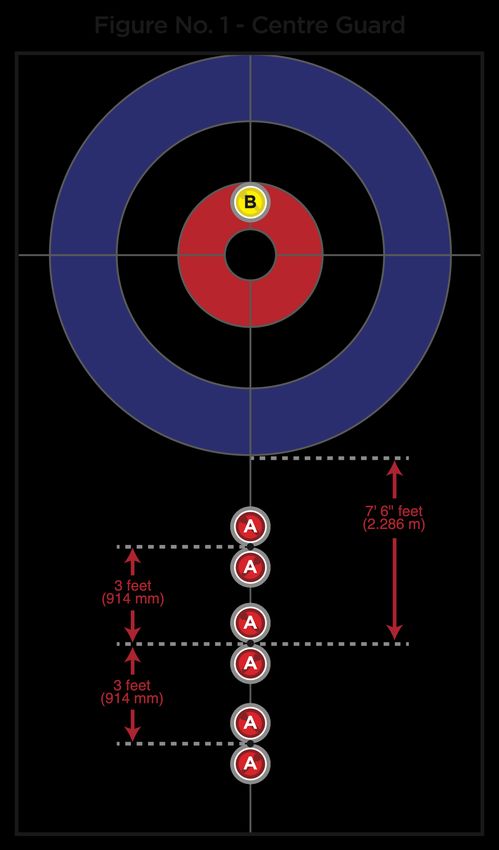
THE SPIRIT OF CURLING
Curling is a game of skill and of tradition. A shot well executed is a delight
to see and it is also a fine thing to observe the time-honoured traditions of
curling being applied in the true spirit of the game. Curlers play to win, but
never to humble their opponents. A true curler never attempts to distract
opponents, nor to prevent them from playing their best, and would prefer to
lose rather than to win unfairly.
Curlers never knowingly break a rule of the game, nor disrespect any of its
traditions. Should they become aware that this has been done inadvertently,
they will be the first to divulge the breach.
While the main object of the game of curling is to determine the relative skill
of the players, the spirit of curling demands good sportsmanship, kindly
feeling and honourable conduct.
This spirit should influence both the interpretation and the application of the
rules of the game and also the conduct of all participants on and off the ice.

REVIEW PROCESS
The Rules of Curling and the Rules of Competition will be reviewed by the
World Curling Federation (WCF) Competitions & Rules Commission on an
annual basis. Member Associations may submit in writing suggestions for this
review to the Secretariat by 15 May. The proposals will be discussed at the
WCF Annual Congress and then voted upon at the WCF Annual General
Assembly.

WCF MISSION STATEMENT
To be the world's favourite Olympic / Paralympic Winter team sport.

                        WCF SECRETARIAT
                              3 Atholl Crescent
                          Perth PH1 5NG, Scotland
               Tel: +44 1738 451 630 Fax: +44 1738 451 641
               info@worldcurling.org www.worldcurling.org

October 2021     Spirit of Curling/Review Process/WCF Mission Statement   Page 1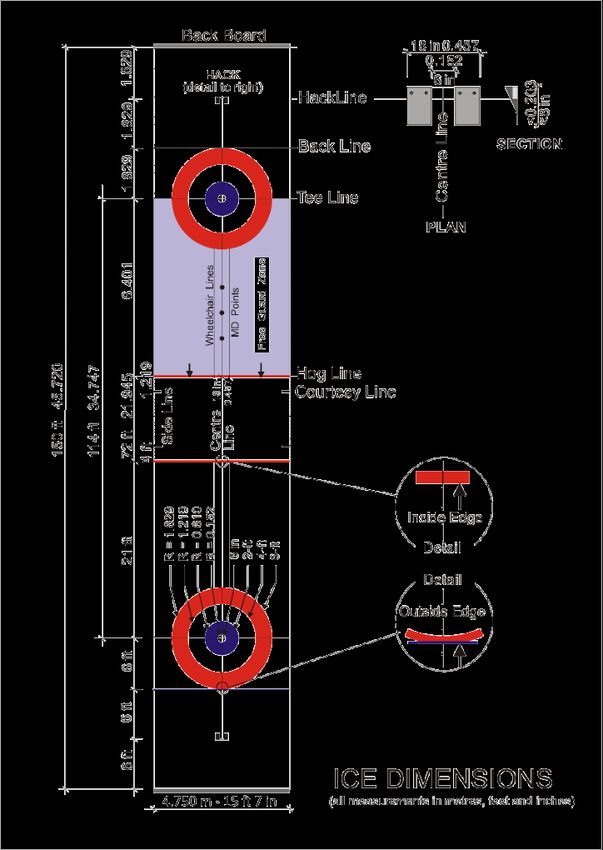
TABLE OF CONTENTS                                                                                                                    Page

The Spirit of Curling / Review Process / WCF Mission Statement ............................................. 1
Table of Contents ....................................................................................................................... 2
The Rules of Curling:                  R1. Sheet ................................................................................ 3
                                       R2. Stones ............................................................................... 5
                                       R3. Teams ............................................................................... 6
                                       R4. Position of Players ............................................................ 8
                                       R5. Delivery ............................................................................. 9
                                       R6. Free Guard Zone (FGZ) .................................................. 11
                                       R7. Sweeping ........................................................................ 12
                                       R8. Touched Moving Stones ................................................. 13
                                       R9. Displaced Stationary Stones ............................................ 14
                                       R10. Equipment ....................................................................... 16
                                       R11. Scoring ............................................................................ 17
                                       R12. Interrupted Games .......................................................... 20
                                       R13. Wheelchair Curling .......................................................... 20
                                       R14. Wheelchair Mixed Doubles Curling ................................... 21
                                       R15. Mixed Curling .................................................................... 22
                                       R16. Mixed Doubles Curling ................................................... 23
                                       R17. Prohibited Substances .................................................... 28
                                       R18. Inappropriate Behaviour .................................................. 28
Rules of Competition:                  C1. General ............................................................................ 29
                                       C2. Participating Teams ......................................................... 30
                                       C3. Uniforms / Equipment ...................................................... 32
                                       C4. Pre-Game Practice .......................................................... 34
                                       C5. Length of Games ............................................................. 35
                                       C6. Game Timing .................................................................. 35
                                       C7. Team Time-Outs / Technical Time-Outs ......................... 38
                                       C8. Stone Assignment / LSD ................................................. 39
                                       C9. Team Ranking Procedure / DSC ..................................... 43
                                       C10. Umpires .......................................................................... 47
Competitions – the Playdown Systems ................................................................................... 49
Qualification - World Championships Men & Women .............................................................. 56
Qualification - World Junior Championships (WJCC) .............................................................. 58
World Seniors & World Mixed ................................................................................................... 58
Pacific-Asia Curling Championships (PACC) ........................................................................... 58
European Curling Championships (ECC) ................................................................................. 60
Qualification System – the Americas Zone .............................................................................. 62
Minimum Standards, Eligibility ................................................................................................ 64
Play-off Systems ....................................................................................................................... 65
Dress Code ............................................................................................................................... 70
Glossary of Terms .................................................................................................................... 71

Page 2                                                   Table of Contents                                                October 2021
THE RULES OF CURLING

These rules apply to any game or competition to which they are made
applicable by the curling organisation having jurisdiction.

         SHEET

(a) The length of the ice sheet from the inside edges of the back boards is
    45.720 metres (150 feet). The width of the sheet from the inside edges
    of the side lines is a maximum of 4.750 m. (15 ft. 7 inches). This area is
    delineated by lines drawn, or by dividers placed on the perimeter. If the
    size of an existing facility will not permit these measurements, then the
    length may be reduced to a minimum of 44.501 m. (146 ft.), and the
    width to a minimum of 4.420 m. (14 ft. 6 in.).

(b) At each end of the sheet there are clearly visible parallel lines in the ice
    from side line to side line as follows:
     (i) the tee line, 13 mm. (1/2 in.) maximum width, placed so that the
         centre of the line is 17.375 m. (57 ft.) from the middle of the sheet.
     (ii) the back line, 13 mm. (1/2 in.) maximum width, placed so that the
          outside edge is 1.829 m. (6 ft.) from the centre of the tee line.
     (iii) the hog line, 102 mm. (4 in.) in width, placed so that the inside edge
           is 6.401 m. (21 ft.) from the centre of the tee line.
     (iv) the centre line, 13 mm. (1/2 in.) maximum width, joins the
          midpoints of the tee lines and extends 3.658 m. (12 ft.) beyond the
          centre of each tee line.
     (v) the hack line, 457 mm. (1 ft. 6 in.) in length and 13mm. (1/2 in.)
         maximum width, is placed parallel to the tee line, at each end of
         the centre line.
     (vi) the courtesy line, 152 mm. (6 in.) in length and 13mm. (1/2 in.)
          maximum width, is placed 1.219 m. (4 ft.) outside and parallel to
          the hog lines, on each side of the sheet.

October 2021                    WCF Rules of Curling                       Page 3
Page 4 WCF Rules of Curling October 2021
(c) For wheelchair events, at each end of the sheet, 2 thin (i.e. – wool)
    wheelchair lines are placed parallel to and on opposite sides of the
    centre line, extending from the hog line to the outermost edge of the
    nearest circle, with the outside edge of each line being 457 mm. (18 in.)
    from the centre line.

(d) A centre hole (tee) is placed at the intersection of each tee line and
    centre line. With the tee as centre, there are four concentric circles
    placed at each end of the sheet, with the outer edge of the outer circle
    having a radius of 1.829 m. (6 ft.), the next circle a radius of 1.219 m.
    (4 ft.), the next circle a radius of 610 mm. (2 ft.), and the innermost
    circle having a minimum radius of 152 mm. (6 in.).

(e) Two hacks are placed on the hack line, on opposite sides of the centre
    line, with the inside edge of each hack 76 mm. (3 in.) from the midpoint
    of the centre line. The width of each hack shall not exceed 152 mm.
    (6 in.). The hack is attached to suitable material, and the inside edge of
    that material is placed on the inside edge of the hack line so that the
    hack does not extend more than 203 mm. (8 in.) in front of the hack
    line. If the hack is recessed into the ice, this is not to be more than 38
    mm. (1.5 in.) in depth.

         STONES

(a) A curling stone is of circular shape, having a circumference no greater
    than 914 mm. (36 in.), a height no less than 114 mm. (4.5 in.), and a
    weight, including handle and bolt, no greater than 19.96 kg. (44 lbs.)
    and no less than 17.24 kg. (38 lbs.).

(b) Each team uses a set of eight stones having the same handle colour and
    individually identified by visible markings. If a stone is damaged and
    becomes unsuitable for play, a replacement stone is used. If a
    replacement stone is not available, a stone previously delivered in the
    end is redelivered.

October 2021                  WCF Rules of Curling                      Page 5
(c) If a stone is broken in play, the teams use the “Spirit of Curling” to
decide where the stone(s) should be placed. If agreement cannot be
reached, the end will be replayed.
(d) If a stone rolls over while in motion, or comes to rest on its side or top,
it is removed from play immediately.
(e) Should a handle completely separate from a stone during delivery, the
delivering player has the option of either allowing the play to stand, or
of redelivering the stone after any displaced stones have been replaced
to their positions prior to the incident taking place.
(f) A stone that does not come to rest completely beyond the inside edge
of the hog line at the playing end is removed from play immediately,
except when it strikes another stone, in which case it remains in play.
(g) A stone that completely crosses the outside edge of the back line at the
playing end is removed from play immediately.
(h) A stone that touches a divider or a side line is removed from play
immediately and is prevented from entering adjacent sheets.
(i) A stone may be measured only visually until the last stone of the end has
come to rest, except to determine if a stone is in play, or, prior to
playing the second, third, fourth or fifth stone of an end, to determine
if a stone is in the Free Guard Zone.
(j) Teams are not to make alterations to, nor place any object on or over,
their game stones.
TEAMS
(a) A team is composed of four players. Each player delivers two stones, in
consecutive order in each end, while alternating with an opponent.
Page 6 WCF Rules of Curling October 2021(b) A team declares its delivery rotation, and the skip and vice-skip
positions, prior to the start of a game and maintains that rotation and
those positions throughout that game subject to (d) (ii). A team that
deliberately changes its delivery rotation, or positions, during a game
without permission of the Chief Umpire (CU), will forfeit the game,
unless it was done when bringing in an alternate player.
(c) If a player is missing at the start of a game, the team may either:
(i) start the game with three players, the first two players delivering
three stones each, and the third player delivering two stones, in
which case the missing player may enter the game in the declared
delivery rotation and position at the start of an end; or
(ii) start the game using a qualified alternate.
(d) Where a player is unable to continue to play in a game, the team may
either:
(i) continue play with the remaining three players, in which case the
player who left the game may re-enter only at the start of an end.
A player may leave and return to a game only one time in any game;
or
(ii) bring in a qualified alternate at the beginning of an end, in which
case the delivery rotation and the skip and vice-skip positions may
be changed (the revised rotation of play applying for the remainder
of that game), and the replaced player may not re-enter the game.
(e) A team may not play with fewer than three players, all players delivering
all their allocated stones in each end.
(f) In competitions where alternates are allowed, only one alternate can be
registered and used in that competition. If there is a violation, the
offending team will forfeit the game.
(g) If a player delivers the first allocated stone of an end and is unable to
deliver the second allocated stone, the following is the procedure for
the remainder of that end. If the player is the:
(i) first player, the second player delivers the stone.
October 2021 WCF Rules of Curling Page 7(ii) second player, the first player delivers the stone.
(iii) third player, the second player delivers the stone.
(iv) fourth player, the third player delivers the stone.
(h) If a player whose turn it is to deliver is unable to deliver both of the
allocated stones during an end, the following is the procedure for the
remainder of that end. If the player is the:
(i) first player, the second player delivers three stones, then the third
player delivers three stones, then the fourth player delivers the last
two stones.
(ii) second player, the first player delivers three stones, then the third
player delivers three stones, then the fourth player delivers the last
two stones.
(iii) third player, the first player delivers the first stone of the third
player, then the second player delivers the second stone of the third
player, then the fourth player delivers the last two stones.
(iv) fourth player, the second player delivers the first stone of the fourth
player, then the third player delivers the second stone of the fourth
player.
POSITION OF PLAYERS
(a) Non-Delivering Team:
(i) During the process of delivery, the players take stationary positions
along the side lines between the courtesy lines. However:
1) the skip and/or vice-skip may take stationary positions behind
the back line at the playing end, but must not interfere with the
choice of place of the skip or vice-skip of the delivering team.
2) the player who is to deliver next may take a stationary position
to the side of the sheet, behind the hacks, at the delivery end.
Page 8 WCF Rules of Curling October 2021(ii) The non-delivering team players must not take any position, nor
cause any motion, which could obstruct, interfere with, distract or
intimidate the delivering team. If such an action occurs, or an
external force distracts a player during delivery, that player has the
option of allowing the play to stand, or of redelivering the stone
after all displaced stones have been replaced to their positions prior
to the violation taking place.
(b) Delivering Team:
(i) The skip, or the vice-skip when it is the skip's turn to deliver, or
when the skip is not on the ice, is in charge of the house.
(ii) The player in charge of the house is positioned inside the hog line,
with at least one foot/wheel on the ice surface of the playing end
of the team’s sheet, while the team is in the process of delivery.
(iii) Any improper position of players will result in the delivered stone
being removed from play, and any displaced stones shall be
replaced, by the non-offending team, to their positions prior to the
violation taking place.
DELIVERY
(a) Unless predetermined, or decided by the Last Stone Draw (LSD), the
teams opposing each other in a game shall use a coin toss to determine
which team delivers the first stone in the first end. This order of play
shall be maintained until one team scores, after which the team that
most recently scored delivers the first stone in any subsequent end.
(b) Unless predetermined, the team playing the first stone of the first end
has the choice of stone handle colour for that game.
October 2021 WCF Rules of Curling Page 9(c) Right-handed deliveries are delivered from the hack on the left of the
centre line and left-handed deliveries are delivered from the hack on
the right of the centre line. A stone delivered from the wrong hack is
removed from play, and any displaced stones are replaced, by the non-
offending team, to their positions prior to the violation taking place.
(d) The curling stone must be delivered using the handle of the stone.
(e) A stone must be clearly released from the hand before it reaches the
hog line at the delivery end. If the player fails to do so, the stone is
immediately removed from play by the delivering team.
(f) If a hog line violation stone is not immediately removed and strikes
another stone, the delivered stone is removed from play by the
delivering team, and any displaced stones are replaced, by the non-
offending team, to their positions prior to the violation taking place.
(g) A stone is in play, and considered delivered, when it reaches the tee line
(hog line for wheelchair curling) at the delivery end. A stone that has
not reached the relevant line may be returned to the player and
redelivered.
(h) All players must be ready to deliver their stones when their turns come,
and not take an unreasonable amount of time to play.
(i) If a player delivers a stone belonging to the opposing team, that stone
is allowed to come to rest, and is then replaced by a stone belonging to
the delivering team.
(j) If a player delivers a stone out of proper rotation, the end continues as
if the mistake had not occurred. The player who missed a turn delivers
the last stone for that team in that end. If it cannot be determined which
player delivered out of proper rotation, the player who delivered the
first stone in the end for that team delivers the last stone for that team
in that end.
Page 10 WCF Rules of Curling October 2021(k) If a player inadvertently delivers too many stones in one end, the end
continues as if the mistake had not occurred and the number of stones
allocated to the last player of the offending team shall be reduced
accordingly. If the player delivering the last stones of an end is the
player that inadvertently delivers too many stones, the last delivered
stone will be removed from play and any displaced stones are replaced,
by the non-offending team, to their positions prior to the violation taking
place.
(l) If a team delivers two stones in succession in the same end:
(i) the second stone is removed and any displaced stones replaced, by
the non-offending team, to their positions prior to the violation
taking place. The player who delivered the stone played by mistake,
redelivers it as the last stone for the team in that end.
(ii) should the infraction not be discovered until after the delivery of a
subsequent stone, the end is replayed.
(m) If the wrong team delivers the first stone of an end:
(i) if the error is discovered after only the first stone has been
delivered, the end shall be replayed.
(ii) if the error is discovered after the 2nd stone of the end has been
delivered, play continues as if the error had not occurred.
FREE GUARD ZONE (FGZ)
(a) A stone that comes to rest between the tee line and the hog line at the
playing end, excluding the house, is deemed to be within an area
designated as the FGZ. Also, stones that are in play, on or before the
hog line, after striking stones in the FGZ, are deemed to be in the FGZ.
October 2021 WCF Rules of Curling Page 11(b) If, prior to the delivery of the sixth stone of an end, a delivered stone
causes, either directly or indirectly, an opposition stone to be moved
from the FGZ to an out-of-play position, then the delivered stone is
removed from play, and any displaced stones are replaced, by the non-
offending team, to their positions prior to the violation taking place.
SWEEPING
(a) The sweeping motion can be in any direction (it need not cover the
entire width of the stone), must deposit no debris in front of a moving
stone, and must finish to either side of the stone.
(b) A stationary stone must be set in motion before it can be swept. A stone
set in motion by a delivered stone, either directly or indirectly, may be
swept by any one or more of the team to which it belongs anywhere in
front of the tee line at the playing end.
(c) All players may clean the playing surface prior to the delivery of the
next stone.
(d) A delivered stone may be swept by any one or more of the delivering
team anywhere in front of the tee line at the playing end.
(e) No player may ever sweep an opponent's stone except behind the tee
line at the playing end, and may not start to sweep an opponent’s stone
until it has reached the tee line at the playing end.
(f) Behind the tee line at the playing end, only one player from each team
may sweep at any one time. This may be any player of the delivering
team, but only the skip or vice-skip of the non-delivering team.
(g) Behind the tee line, a team has first privilege of sweeping its own stone,
but it must not obstruct or prevent its opponent from sweeping.
Page 12 WCF Rules of Curling October 2021(h) If a sweeping violation occurs, the non-offending team has the option of
allowing the play to stand, or of placing the stone, and all stones it would
have affected, where they would have come to rest had the violation
not occurred.
TOUCHED MOVING STONES
(a) Between the tee line at the delivery end and the hog line at the playing
end:
(i) If a moving stone is touched, or is caused to be touched, by the team
to which it belongs, or by their equipment, the touched stone is
removed from play immediately by that team. A double-touch by
the person delivering the stone, prior to the hog line at the
delivering end, is not considered a violation.
(ii) If a moving stone is touched, or is caused to be touched, by an
opposition team, or by its equipment, or is affected by an external
force:
1) If the stone was the delivered stone, it is redelivered.
2) If the stone was not the delivered stone, it is placed where the
team to which it belongs reasonably considers it would have
come to rest had it not been touched.
(b) Inside the hog line at the playing end:
(i) If a moving stone is touched, or is caused to be touched, by the team
to which it belongs, or by its equipment, all stones are allowed to
come to rest, after which the non-offending team has the option to:
1) remove the touched stone, and replace all stones that were
displaced after the infraction to their positions prior to the
violation taking place; or
2) leave all stones where they came to rest; or
3) place all stones where it reasonably considers the stones would
have come to rest had the moving stone not been touched.
October 2021 WCF Rules of Curling Page 13(ii) If a moving stone is touched, or is caused to be touched, by an
opposition team, or by its equipment, all stones are allowed to come
to rest, after which the non-offending team places the stones where
it reasonably considers the stones would have come to rest, had the
moving stone not been touched.
(iii) If a moving stone is touched, or is caused to be touched, by an
external force, all stones are allowed to come to rest, and then
placed where they would have come to rest if the incident had not
occurred. If the teams cannot agree, the stone is redelivered after
all displaced stones have been replaced to their positions prior to
the violation taking place. If agreement on those positions cannot
be reached, the end is replayed.
(c) Last Stone Draw (LSD) stones:
(i) If a member of the delivering team touches a moving stone, or
causes it to be touched, the stone will be removed and recorded as
1.996 m (6 ft. 6.5 in.).
(ii) If a member of the non-delivering team touches a moving stone, or
causes it to be touched, the stone will be redelivered.
(iii) If an external force touches a moving stone, or causes it to be
touched, the stone will be redelivered.
(d) If a moving stone is touched by a stone deflecting off the sheet dividers,
the non-delivering team shall place the stone where it reasonably
considers the stone would have come to rest had the moving stone not
been touched.
DISPLACED STATIONARY STONES
(a) If a stationary stone which would have had no effect on the outcome of
a moving stone is displaced, or caused to be displaced, by a player, it is
replaced, by the non-offending team, to their positions prior to the
violation taking place.
Page 14 WCF Rules of Curling October 2021(b) If a stationary stone which would have had no effect on the outcome of
a moving stone is displaced, or caused to be displaced, by an external
force, it is replaced, with agreement of the teams, to its position prior
to the violation taking place.
(c) If a stone which would have altered the course of a moving stone is
displaced, or caused to be displaced, by a player, all stones are allowed
to come to rest and then the non-offending team has the option to:
(i) leave all stones where they came to rest; or
(ii) remove from play the stone whose course would have been altered,
and replace any stones that were displaced after the violation to
their positions prior to the violation taking place; or
(iii) place all stones in the positions the team reasonably considers they
would have come to rest had a stone not been displaced.
(d) If a stone which would have altered the course of a moving stone is
displaced, or caused to be displaced, by an external force, all stones are
allowed to come to rest, and are then placed in the positions in which
they would have come to rest had a stone not been displaced. If the
teams cannot agree, the stone is redelivered after all displaced stones
have been replaced to their positions prior to the violation taking place.
If agreement on those positions cannot be reached, the end is replayed.
(e) If a displacement is caused by stones deflecting off the sheet dividers,
the stones are replaced, by the non-delivering team, to their positions
prior to the violation taking place.
(f) Last Stone Draw (LSD) Stones:
(i) If a member of the delivering team displaces a stationary stone, or
causes it to be displaced, before the official completes the
measurement, the stone will be removed and recorded as 1.996 m
(6 ft. 6.5 in.).
October 2021 WCF Rules of Curling Page 15(ii) If a member of the non-delivering team displaces a stationary stone,
or causes it to be displaced, before the official completes the
measurement, the stone is replaced, by the delivering team, to its
position prior to the violation taking place.
(iii) If an external force displaces a stationary stone, or causes it to be
displaced, before the official completes the measurement, the
stone is replaced, by the delivering team, to its position prior to the
violation taking place.
EQUIPMENT
(a) No player shall cause damage to the ice surface by means of
equipment, hand prints, or body prints. The procedure will be:
1st incident = 1st official on-ice warning, repair damage.
2nd incident = 2nd official on-ice warning, repair damage.
3rd incident = repair damage and remove player from the game.
(b) No equipment shall be left unattended anywhere on the ice surface.
(c) Teams must not use electronic communication equipment, or any device
to modify the voice, during a game. With the exception of stopwatches
that are limited to providing ‘time’ data only, the use of electronic
devices during the games, which provide information to players on the
field of play, are forbidden.
(d) A whistle or another signalling instrument can be used in case of medical
reason and after consultation and written approval from the World
Curling Federation (WCF).
(e) When a properly functioning electronic hog line device is being used:
(i) The handle must be properly activated so that it is functioning
during the delivery, or it will be considered a hog line violation
stone.
Page 16 WCF Rules of Curling October 2021(ii) A glove or mitt must not be worn on the delivery hand during the
delivery of a stone. If there is a violation, the delivered stone shall
be removed from play, and any displaced stones shall be replaced,
by the non-offending team, to their positions prior to the violation
taking place.
(f) The use of a delivery stick shall be restricted as follows:
(i) The delivery stick may not be used in any WCF competition or
qualifying event, except wheelchair events.
(ii) Players choosing to deliver with a delivery stick must use a delivery
stick for the delivery of all their stones during the entire game.
(iii) A delivery stick shall not convey any mechanical advantage other
than acting as an extension of the arm/hand.
(iv) All delivery sticks must conform to the Wheelchair Curling Policy.
(v) For the use of a delivery stick in non-wheelchair curling
competitions, refer to the document “WCF recommendations for
Delivery Sticks in Recreational Play”.
SCORING
(a) The result of a game is decided by a majority of points at the completion
of the scheduled ends of play, or when a team concedes victory to its
opponent, or when one team is arithmetically eliminated, provided the
minimum number of ends has been completed. A team that has been
arithmetically eliminated may finish the current end but no new end
may be started. However, if a team is arithmetically eliminated in the
last end of a game, the game should stop when this occurs and the end
will not be finished. If the score is tied at the completion of the
scheduled ends, play continues with extra end(s) and the team that
scores first wins the game.
(b) At the completion of an end (when all stones have been played), a team
scores one point for each of its own stones located in or touching the
house that are closer to the tee than any stone of the opposition.
October 2021 WCF Rules of Curling Page 17(c) The score of an end is decided when the skips or vice-skips in charge of
the house agree upon the score. If stones that may have affected the
points scored in an end are displaced prior to that decision, the non-
offending team receives the benefit that might have accrued from a
measurement.
(d) When determining the score of an end, if teams cannot visually decide
which stones are closer to the tee, or whether a stone is touching the
house, a measuring device is used. Measurements are taken from the tee
to the nearest part of the stone. Any one player on the ice from each
team is allowed to observe any measurement that is made by a
measuring device.
(e) If two or more stones are so close to the tee that it is impossible to use
a measuring device, the determination is made visually.
(f) If a decision cannot be reached, either visually or with a measuring
device, the stones are considered equal, and:
(i) If the measure was to determine which team scored in the end, the
end is blanked.
(ii) If the measure was to determine additional points, only the stones
closer to the tee are counted.
(g) Should an external force cause the displacement of stones that would
have affected the score prior to agreement of the score, the following
applies:
(i) If the displaced stones would have determined which team scored
in an end, the end is replayed.
(ii) If a team secured a point(s), and the displaced stone(s) would have
determined if an additional point(s) was scored, that team has the
option of replaying the end or of keeping the point(s) already
secured.
Page 18 WCF Rules of Curling October 2021(h) A team concedes a game only when it is the delivering team. When a
team concedes the game before the completion of an end, the score of
the end is determined at that time, in the following manner:
(i) If both teams still have stones to be delivered, “X”s are placed on
the scoreboard.
(ii) When only one team has delivered all of its stones:
1) If the team that delivered all its stones has stone(s) counting, no
points are given, “X”s are placed on the scoreboard unless the
points are required to determine the outcome.
2) If the team that did not deliver all its stones has stone(s)
counting, these points are given and placed on the scoreboard.
3) If no stones are counting, “X”s are placed on the scoreboard.
(i) If a team is not available to start a game at the designated time, the
following takes place:
(i) If the delay of the start of play is 01:00-14:59 minutes (01:00-09:59
minutes for Mixed Doubles), then the non-offending team receives
one point, and will have choice of first or second stone in the first
end of actual play; one end is considered completed.
(ii) If the delay of the start of play is 15:00-29:59 minutes (10:00-19:59
minutes for Mixed Doubles), then the non-offending team receives
one additional point, and choice of first or second stone in the first
end of actual play; two ends are considered completed.
(iii) If play has not started at 30:00 minutes (20:00 minutes for Mixed
Doubles), then the non-offending team is declared the winner by
forfeit.
(j) The final score of a forfeited game is recorded as “W – L” (win – loss).
October 2021 WCF Rules of Curling Page 19INTERRUPTED GAMES
If for any reason, a game is interrupted, the game recommences where play
was stopped. In the case that the stones need to be removed for ice
maintenance (agreement between Chief Ice Technician, Chief Umpire and
WCF Event Technical Delegate), then the end is replayed.
WHEELCHAIR CURLING
(a) Stones are delivered from a stationary wheelchair.
(b) When the stone is delivered between the hack and the outermost edge
of the top of the house at the delivery end, at the start of the delivery
the stone is positioned on the centre line. When the stone is delivered
between the outermost edge of the top of the house and the hog line at
the delivery end, the entire width of the stone must be within the
wheelchair lines at the start of the delivery.
During delivery, the feet of the player delivering the stone must not
touch the ice surface and the wheels of the chair must be in direct
contact with the ice.
The delivery of the stone is undertaken by the conventional arm/hand
release or using a delivery stick conforming to the Wheelchair Curling
Policy. Stones must be clearly released from the hand or stick before
the stone reaches the hog line at the delivery end.
(c) A stone is in play when it reaches the hog line at the delivery end. A
stone that has not reached the hog line at the delivery end may be
returned to the player and redelivered.
(d) Sweeping is not permitted.
(e) If a delivery violation occurs, the delivered stone shall be removed from
play, and any displaced stones shall be replaced, by the non-offending
team, to their positions prior to the violation taking place.
Page 20 WCF Rules of Curling October 2021(f) For WCF wheelchair competitions, each on-ice team must have four
players delivering stones and must be comprised of both genders at all
times during games. A team violating this rule will forfeit the game.
If a player leaves during an end because of illness, accident or other
extenuating circumstances (excluding ejection by an umpire):
(i) the player may return to the game, provided they deliver all their
allocated stones.
(ii) if the departing player's stone(s) need to be delivered in that end,
an alternate must be immediately brought into the game in the
position of the departing player to deliver those stone(s), and the
team still needs to be composed of both genders. Failure to do so
results in forfeiture of the game. At the start of the next end the
team may change the team line-up if desired (the revised rotation
of play will apply for the remainder of that game), and the replaced
player may not re-enter the game.
(iii) if both stones have been delivered by the departing player, at the
start of the next end the team must bring in an alternate and may
change the team line-up if desired (the revised rotation of play will
apply for the remainder of that game), and the replaced player may
not re-enter the game.
(g) All games will be scheduled for 8 ends.
WHEELCHAIR MIXED DOUBLES CURLING
(a) Wheelchair Curling Rules (R13) apply with the exception of R13(f):
In Wheelchair Mixed Doubles Curling a team is composed of two players,
one male and one female. Alternate players are not allowed. A team
must forfeit any game(s) in which it fails to have both players playing
for the entire game. One coach and one other team official will be
allowed for each team.
October 2021 WCF Rules of Curling Page 21(b) Wheelchair Mixed Doubles is played as described under Rule R16, with
the exception of R16(j) as there is no sweeping allowed at any time in
Wheelchair Mixed Doubles.
(c) The players can choose, as an option (besides a delivery with no-one
holding the chair or the team-mate doing that), to get help to hold the
chair from the Ice Player Assistant (IPA). If that option is chosen, there
can be no complaint afterwards on how the IPA secured the chair.
(d) Electric Wheelchairs are not allowed unless the athlete uses an electric
wheelchair for daily mobility.
MIXED CURLING
(a) Each team shall have two male and two female players and the male and
female players must deliver stones alternately (M, F, M, F - or - F, M, F,
M). No alternate players are permitted.
(b) If a team plays with three players, the alternate gender order of delivery
must be maintained (M, F, M - or - F, M, F). If this occurs while a game
is in progress, the delivery rotation can be changed to meet this
criterion.
(c) The skip and vice-skip can be anyone in the team, but they must be from
opposite genders.
(d) All Mixed games are scheduled for 8 ends.
(e) The team is allowed one coach and one other team official. Only those
two persons may sit on the designated coach bench.
Page 22 WCF Rules of Curling October 2021MIXED DOUBLES CURLING
(a) A team is composed of two players, one male and one female. Alternate
players are not allowed. A team must forfeit any game(s) in which it fails
to have both players playing for the entire game. One coach and one
other team official will be allowed for each team.
(b) The scoring shall be the same as in a regular game of curling. The
“positioned” stones that are placed prior to the beginning of each end
are eligible to be counted in the scoring.
(c) Each game will be scheduled for 8 ends.
(d) Each team shall deliver 5 stones per end. The player delivering the
team’s first stone of the end must also deliver the team’s last stone of
that end. The other team member shall deliver the team’s second, third
and fourth stones for that end. The player delivering the first stone can
change from end to end.
(e) If, prior to the delivery of the fourth stone of an end, a delivered stone
causes either directly or indirectly, any previous delivered or placed
stone to be moved to an out-of-play position, the delivered stone shall
be removed from play and any displaced stone(s) shall be replaced, by
the non-offending team, to their positions prior to the violation taking
place.
(f) Prior to the start of every end, one team shall place its “positioned”
stone at the playing end of the sheet in one of two positions, designated
A and B. The opponent’s “positioned” stone shall then be placed in
whichever position (A or B) remains vacant. The location of these
positions shall be as follows:
October 2021 WCF Rules of Curling Page 23(i) Position A: Placement so that the stone is bisected by the centre
line and is either immediately in front of or immediately behind one
of 3 points in the ice. The points are placed on the centre line (see
diagram):
1) at the mid-point between the hog line and the outermost edge
of the top of the house.
2) 914 mm. (3 feet) from the mid-point closer to the house.
3) 914 mm. (3 feet) from the mid-point closer to the hog line.
Based on the ice conditions, when no event official is available to
make the decision, the teams shall determine the specific
placement for each sheet for Position A to be used prior to the start
of the pre-game practice. and That same placement must be used
for the entire game.
(ii) Position B: Placement so that the stone is bisected by the centre
line and is in the back of the 4-foot circle. The back edge of the
stone is aligned with the back edge of the 4-foot circle (see
diagram).
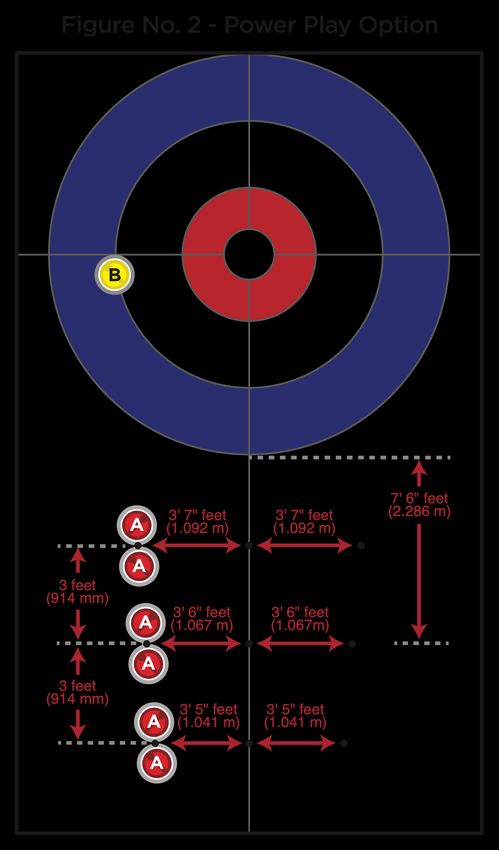
(iii) Power Play: Once per game, each team, when it has the decision on
the placement of the “positioned” stones, can use the “Power Play”
option to position those two stones. The in-house stone (B), which
belongs to the team with last stone in that end, is placed on either
side of the house with the back edge of the stone touching the tee
line, at the point where the 8-foot and 12-foot circles meet. The
guard stone (A) is positioned to the same side of the sheet, the same
distance that was determined for the centre guards (see diagram).
The “Power Play” option cannot be used in extra ends.
Page 24 WCF Rules of Curling October 2021October 2021 WCF Rules of Curling Page 25
Page 26 WCF Rules of Curling October 2021
(g) The team having the decision on the placement of the “positioned”
    stones shall be:
      (i) Teams opposing each other in the game shall use the Last Stone
          Draw (LSD) to determine which team has the decision in the first
          end. The team with the lesser LSD distance shall have the decision
          on the placement.
      (ii) Following the first end, the team that did not score shall have the
           decision on the placement.
      (iii) If neither team scores in an end, the team that delivered the first
            stone in that end shall have the decision on placement in the next
            end. In the case of a blanked end due to an equal measure, the team
            that had the decision on the placement of the “positioned” stones
            shall not change for the next end.

(h) If the “positioned” stones are placed in the wrong position:
      (i) If the error is discovered after only the first stone has been
          delivered, the end shall be replayed.
      (ii) If the error is discovered after the 2nd stone of the end has been
           delivered, play continues as if the error had not occurred.

(i)   The team whose “positioned” stone is placed in Position A (in front of
      the house) shall deliver the first stone in that end, and the team whose
      “positioned” stone is placed in Position B (in the house) shall deliver the
      second stone in that end.

(j)   While the team is in the process of delivery, the non-delivering player
      may be anywhere on the ice surface of the team’s sheet. After delivery,
      either or both players may sweep their delivered stone and any stones
      set in motion that belong to their team anywhere in front of the tee line
      at the playing end. This applies during all of the team’s delivered stones,
      including the LSD.

(k) If a delivery violation occurs, the delivered stone shall be removed from
    play, and any displaced stones shall be replaced, by the non-offending
    team, to their positions prior to the violation taking place. Should the

October 2021                    WCF Rules of Curling                      Page 27
infraction not be discovered until after the delivery of a subsequent
stone, play continues as if the infraction had not occurred,
however, the player that delivered the first stone of the end can deliver
a maximum of two stones in that end.
PROHIBITED SUBSTANCES
The use of all performance-enhancing drugs, without therapeutic
exemption, whether taken knowingly or otherwise, is unethical and
prohibited. If such use occurs the player(s) will be disqualified from the
competition, their Member Association will be notified, and it could lead
to further suspension.
INAPPROPRIATE BEHAVIOUR
Improper conduct, foul or offensive language, equipment abuse, or
wilful damage on the part of any team member is prohibited. Any
violation may result in suspension of the offending person(s) by the
curling organisation having jurisdiction.
Page 28 WCF Rules of Curling October 2021RULES OF COMPETITION
C1. GENERAL
(a) The rules of play for WCF competitions are the current rules of the World
Curling Federation (WCF). If there are any modifications, these are
explained during the Team Meeting.
(b) The dates of the WCF competitions are determined by the Executive
Board of the WCF.
(c) The playing and event schedules are determined by the WCF in
consultation with the Host Committee.
(d) Smoking, including e-smoking devices, within the confines of the
competition area at WCF competitions is prohibited.
(e) The WCF Anti-Doping rules and procedures, which meet the
requirements of the World Anti-Doping Agency are applicable, and
published in the WCF Anti-Doping Pamphlet.
(f) Any variation from the recommended sheet measurements must be
approved by the WCF.
(g) For WCF Championships, gold medals are awarded to the first placed
team, silver medals to the second placed team, and bronze medals to
the third placed team. The 5 players (2 for Mixed Doubles, 4 for Mixed)
and their coach, receive medals, if they are in attendance and fulfil
their team obligations, and are allowed on the podium. For the Olympic
Winter Games, Youth Olympic Games and the Paralympic Winter Games,
only the players receive medals and are allowed on the podium.
October 2021 WCF Rules of Competition Page 29C2. PARTICIPATING TEAMS
(a) Each team is designated by its Association/Federation.
(b) If a designated team is unable or unwilling to participate, the
Association/Federation involved nominates another team.
(c) The players and team officials for each event must be declared at least
14 days prior to the start of the competition. Any changes / additions
must be declared by the end of the team meeting.
(d) All players at a WCF competition must be bona fide members in good
standing of their Associations/Federations.
(e) To be eligible to play in the World Junior Curling Championships (WJCC)
and qualifying events, a player must be less than 21 years of age by the
end of the 30th day of June of the year immediately preceding the year
in which the championship is to take place.
(f) To be eligible to play in the World Senior Curling Championships (WSCC)
and qualifying events, a player must be not less than 50 years of age by
the end of the 30th day of June of the year immediately preceding the
year in which the championship is to take place.
(g) To be eligible to play in the World Wheelchair Curling Championships
(WWhCC & WWhMDCC) and qualifying events, a player must fulfil the
eligibility criteria as per the WCF Classification rules.
(h) To be eligible to be a team official at any WCF competition, an official
must be not less than 16 years of age by the end of the 30th day of June
of the year immediately preceding the year in which the competition is
to take place.
(i) One player and one team official must attend the Team Meeting. When
a team has no team official(s) registered, two players have to attend
the meeting. Failure to do so, without approval of the Chief Umpire,
results in the forfeit of the last stone advantage for that team in its first
Page 30 WCF Rules of Competition October 2021game. Should a team have an accredited translator, that person is
allowed to join as well. For teams in post round robin play, one or two
team members (players and/or coach) must attend the play-off
meetings, or the team will lose the choices to which they would normally
be entitled.
(j) The team delivery rotation, skip and vice-skip positions, alternate
player, and coach are listed on the original team line-up form, and
submitted to the Chief Umpire at the end of the Team Meeting. The
team leader / national coach / translator, if appropriate, are also listed.
A game team line-up form (paper or electronic) must be submitted to
the Chief Umpire at least 15 minutes prior to the pre-game practice to
either confirm the original team line-up or to indicate a change.
(k) A team must start a competition with four players (two for Mixed
Doubles) delivering stones. A team will forfeit each game at the start of
the competition, until it can start a game with four qualified players. In
extenuating circumstances, and with approval from a panel of three
persons (WCF Director of Competitions or Representative, event
Technical Delegate, event Chief Umpire) a team may be allowed to start
a competition with three players. If required, an appeal would be heard
by the WCF President or his/her representative.
(l) While a game is in progress, the coach, the alternate player, and all
other team officials are prohibited from communicating with their team
or being within the playing area except during specifically designated
breaks or a team time-out. This restriction applies to all verbal, visual,
written, and electronic communication, including any attempt to signal
for the implementation of a team time-out. The coach, the alternate
player, and one team official may participate in the pre-event and the
pre-game practices, but may not communicate with their team during
the LSD. During the game, there shall be no unauthorised
communications or broadcasts of any sort from the coach bench to
anyone who is not sitting in that designated area. Coaches and other
team personnel sitting on the coach bench cannot watch or listen to
October 2021 WCF Rules of Competition Page 31broadcasts. For any violation, the offending person will be removed from
the coach’s bench for that game.
(m) For the purpose of identification to the media and to the public, teams
are referred to by the name under which their Association/Federation
competes, and by the name of the skip.
C3. UNIFORMS / EQUIPMENT
(a) All team members wear identical uniforms and appropriate footwear
when accessing the field of play for games or practice sessions. The team
wears light-coloured shirts and playing jackets/sweaters when assigned
stones with light-coloured handles, and wears dark-coloured shirts and
playing jackets/sweaters when assigned stones with dark-coloured
handles. The colour of these garments shall be registered with the WCF
prior to the start of each competition. The team coaches/officials must
wear a team or national uniform whenever accessing the field of play.
Unless otherwise approved by the WCF, a light-coloured uniform will be
predominantly white or yellow in colour. There must be a minimum of
70% of white or yellow on both the front and the back-side of the
uniform. Approval for any alternative colour must be requested at least
8 weeks prior to an event or may be requested at the start of a season
for multiple events.
(b) Each shirt and jacket/sweater has the player's surname, in 51 mm. (2-
in.) or larger letters, across the upper back of the garment, and the
name under which their Association/Federation competes, in 51 mm. (2-
in.) or larger letters, across the back above the waist. If desired, a
national emblem may also be worn on the back, but only in addition to
the name under which the Association/Federation competes, and
displayed between that name and the player’s surname. When two or
more team members have the same surname, the first letter(s) of their
given names are also displayed.
Page 32 WCF Rules of Competition October 2021(c) Advertising is permitted on a player's clothing or equipment strictly in
accordance with the current guidelines issued by the WCF. The WCF
may, in its sole discretion, forbid the use of any clothing or equipment
that it feels is unacceptable or unsuitable for WCF competition play. The
WCF Dress Code is contained within this book.
(d) A player or coach with an improper uniform shall be denied access to
the field of play and the coach bench.
(e) Each player must declare an approved sweeping device at the start of a
game, and only that player can use that device for sweeping during the
game. Penalty: If a player sweeps with another person’s sweeping device
one of their own stones, the stone shall be removed from play. If a player
sweeps with another person’s sweeping device a stone belonging to the
opponent, the stone should be replaced by the non-offending team
where it would have come to rest, had the violation not occurred.
(f) Players may not change their brush heads during a game, unless the
Chief Umpire grants special permission. Penalty: If a change is made
without permission, the team will forfeit the game.
(g) If an alternate player comes into a game, that player must use the brush
head of the player being replaced. Penalty: If a new brush head is
brought into the game, the team will forfeit the game.
(h) All field of play equipment used at WCF competitions must meet WCF
Statement of Principles for Competition Equipment, as defined and
published on the WCF website. Reasons for equipment being considered
non-approved include, but not restricted to: damage to the ice surface,
non-conformance with existing rules or standards (i.e. - electronic
communication devices), performance testing results that give an unfair
advantage, failing to register equipment with the WCF office by the
deadline date.
(i) The penalty for using equipment in WCF competitions that does not
conform with the Statement of Principles for Competition Equipment
October 2021 WCF Rules of Competition Page 33established by the WCF:
(i) First team offence during a competition – the player is disqualified
from the competition and the team forfeits the game.
(ii) Second team offence during a competition – the team is
disqualified from the competition and all players are not permitted to
play in WCF competitions for a 12-month period.
(j) For wheelchair Curling equipment please refer to the Wheelchair Curling
Policy.
C4. PRE-GAME PRACTICE
(a) Prior to the start of every game at WCF competitions, each team is
allowed a pre-game practice on the sheet on which it will be playing.
(b) The duration of the pre-game practice is normally 7 minutes for Mixed
Doubles and 9 minutes for any other event. The start-time of the pre-
game practice will be communicated at the Team Meeting.
(c) The schedule for pre-game practices during the round robin will be
predetermined as much as possible, based on the criterion that each
team has first and second practice an equal number of times. For the
round robin games where this cannot be predetermined the winner of a
coin toss will have the choice of first or second practice.
(d) In post round robin games, when the Last Stone First End has been pre-
determined, the team delivering the last stone in the first end practices
first.
(e) If the Chief Ice Technician deems it necessary, the ice will be cleaned,
and the slide path re-pebbled, after the pre-game practice.
Page 34 WCF Rules of Competition October 2021C5. LENGTH OF GAMES
(a) In competitions in which 10 ends are scheduled, a minimum of 8 ends
must be completed in play-off games and a minimum of 6 ends must be
completed in all other games.
(b) In competitions in which 8 ends are scheduled, a minimum of 6 ends
must be completed.
C6. GAME TIMING
(a) Each team shall receive 38 minutes of thinking time for a 10-end game
and 30 minutes of thinking time for an 8-end game (38 minutes in
wheelchair curling, 30 minutes in wheelchair mixed doubles curling and
22 minutes in mixed doubles curling). This time is recorded, and visible
to the teams and coaches, throughout the game.
(b) When a team delays the start of a game, the thinking time allotted to
each team is reduced by 3 minutes 45 seconds (4 minutes 45 seconds in
wheelchair curling, 3 minutes 45 seconds in wheelchair mixed doubles
curling and 2 minutes 45 seconds in mixed doubles curling) for each end
which was considered completed (Rules of Curling R11(i) apply).
(c) When extra ends are required, the game clocks are reset and each team
receives 4 minutes 30 seconds of thinking time for each extra end
(6 minutes in wheelchair curling, 4 minutes 30 seconds in wheelchair
mixed doubles curling and 3 minutes in mixed doubles curling).
(d) The game and each end starts when the allotted break time expires. The
delivering team’s game clock will not run during the start of the
game/end unless that team is delaying the start (no forward motion from
the hack, or the stone not released from the delivery stick), then its
game clock will be started. If there is no delay, the first game clock to
start in each end will be that of the team delivering the second stone.
October 2021 WCF Rules of Competition Page 35(e) Once all of the criteria below are met, the non-delivering team becomes
the delivering team, and its game clock is started:
(i) all stones have come to rest or have crossed the back line; and
(ii) stones that are displaced due to violations by the delivering team,
and require repositioning, are returned to their positions prior to
the violation; and
(iii) the playing area has been relinquished to the other team, the person
in charge of the house has moved behind the back line and the
deliverer and sweepers have moved to the sides of the sheet.
(f) A team’s game clock stops once the stone has reached the tee line (hog
line in wheelchair curling) at the delivery end.
(g) A team delivers stones only when its game clock is running or scheduled
to be running.
(h) If stones need to be repositioned due to a violation caused by an external
force both game clocks are stopped.
(i) Game clocks are stopped at any time an umpire intervenes.
(j) After the teams have agreed on the score for an end, a break occurs,
when neither game clock is running. If a measurement is required, the
break begins at the completion of that measurement. The length of the
break between ends, which may vary due to television requirements or
to other external factors, is determined for each competition and
explained at the Team Meeting. When a break is of 3 minutes or more,
the teams are informed when 1 minute of the break remains. Teams
should not deliver the first stone of the next end before the end of a
break. If the first stone of any end is delivered within 10 seconds after
the break has elapsed, the game clock will not start. The delivering
team’s game clock will start at the conclusion of the break unless the
player is in the process of delivery. The length of the break will normally
be:
Page 36 WCF Rules of Competition October 2021You can also read


