Topological phase in plasma physics - Cambridge University ...
←
→
Page content transcription
If your browser does not render page correctly, please read the page content below
J. Plasma Phys. (2021), vol. 87, 835870202 © The Author(s), 2021.                                                                  1
          Published by Cambridge University Press
          This is an Open Access article, distributed under the terms of the Creative Commons Attribution
          licence (http://creativecommons.org/licenses/by/4.0/), which permits unrestricted re-use, distribution,
          and reproduction in any medium, provided the original work is properly cited.
          doi:10.1017/S0022377821000301

                            Topological phase in plasma physics

                                                            Jeffrey B. Parker              ,†

                       Department of Physics, University of Wisconsin–Madison, Madison, WI 53706, USA

                            (Received 11 September 2020; revised 2 March 2021; accepted 8 March 2021)

          Recent discoveries have demonstrated that matter can be distinguished on the basis of
          topological considerations, giving rise to the concept of topological phase. Introduced
          originally in condensed matter physics, the physics of topological phase can also be
          fruitfully applied to plasmas. Here, the theory of topological phase is introduced,
          including a discussion of Berry phase, Berry connection, Berry curvature and
          Chern number. One of the clear physical manifestations of topological phase is the
          bulk-boundary correspondence, the existence of localized unidirectional modes at the
          interface between topologically distinct phases. These concepts are illustrated through
          examples, including the simple magnetized cold plasma. An outlook is provided for future
          theoretical developments and possible applications.
          Key words: plasma waves

          1. Introduction
             The aim of this article is to introduce the concepts and physics of topological phase
          in the context of plasma physics. The application of topological phase in plasmas is in
          a fledgling state, although this exciting subject overlaps with active areas of research in
          other fields of physics.
             Broadly speaking, topological phase refers to the notion that a bulk system can be
          characterized by an integer-valued topological invariant. More precisely, the topological
          invariant describes a global property of an eigenfunction in wave vector space. This type
          of topology has a more abstract nature than, for instance, the standard topological property
          of the number of holes of an object in physical space. An important feature of topological
          invariants is that they are constrained by topological quantization and are generally not
          altered under smooth deformations, and so their physical consequences may be robust
          against perturbations.
             A clear physical manifestation of the topological phase arises when two topologically
          distinct materials are adjacent. The bulk-boundary correspondence principle states that
          within a common bandgap at the interface between the two materials, a spatially localized
          mode exists, referred to as an edge state, or topological wave. These edge states have
          attracted interest because of their topological robustness and potential for unidirectional,
          backscatter-resistant propagation.

                                     † Email address for correspondence: jeff.parker@wisc.edu

Downloaded from https://www.cambridge.org/core. IP address: 46.4.80.155, on 25 Sep 2021 at 06:38:41, subject to the Cambridge Core terms of use, available at
https://www.cambridge.org/core/terms. https://doi.org/10.1017/S0022377821000301
2                                                         J. B. Parker
                  The first glimpses of topological phase trace back to the quantization of the Hall
               conductance in condensed matter systems in the integer quantum Hall effect (Klitzing,
               Dorda & Pepper 1980; Laughlin 1981; Thouless et al. 1982; Avron, Seiler & Simon 1983;
               Simon 1983; Niu, Thouless & Wu 1985). The conductance of a sample was experimentally
               measured to occur in integer multiples of e2 /h, where e is the elementary charge and h
               is Planck’s constant. Eventually, it was realized that this integer multiple corresponded
               to a topological invariant called the Chern number that described the sample bulk, with
               corresponding electron edge states that allowed conduction.
                  Later it was realized that similar topological phases could be found in photonic crystals
               (Haldane & Raghu 2008; Raghu & Haldane 2008). This discovery reflects the principle
               that topological phase is not inherently dependent on quantum mechanics but is a property
               of waves. The periodic metamaterial structure of a photonic crystal gives rise to Bloch
               states and Bloch bands analogous to those in condensed matter systems. This field of
               topological photonics may offer novel disorder-robust routes to controlling light (Lu,
               Joannopoulos & Soljac̆ić 2014; Ma et al. 2015; Ozawa et al. 2019).
                  Topology in condensed matter and photonic systems are studied in systems with an
               underlying periodic lattice structure. Some mechanical and acoustic systems in which
               topological phases and edge states have been explored are also based on periodic lattices
               (Nash et al. 2015; Peano et al. 2015; Yang et al. 2015; He et al. 2016; Huber 2016).
                  In contrast, plasmas and fluids are typically described mathematically as a smooth
               continuum, coarse-grained over the length scale of individual particles. This distinction
               gives rise to a very different structure of the wave vector space. When there is a periodic
               lattice, the wave vector space is also periodic and can be limited to the first Brillouin zone.
               In an infinite continuum medium, the wave vector space extends to infinity. An important
               breakthrough was that of Delplace, Marston & Venaille (2017), who demonstrated that a
               model in geophysical fluid dynamics can be understood through topological phase and
               bulk-boundary correspondence. Other topological phenomena in fluid and continuum
               electromagnetic media have also been discovered (Silveirinha 2015; Perrot, Delplace &
               Venaille 2019; Souslov et al. 2019; Marciani & Delplace 2020).
                  The rich wave physics of plasma makes it likely they can host a variety of topological
               effects. Some recent studies have begun to scratch the surface. For instance, topological
               properties of a magnetized cold plasma have been studied (Gao et al. 2016; Fu & Qin
               2020; Parker et al. 2020b). The Alfvén continuum may also be topological in the presence
               of magnetic shear, leading to a new interpretation of the reversed-shear Alfvén eigenmode
               as a topological edge wave (Parker et al. 2020a). This work also found non-trivial topology
               in the whistler band within Hall Magnetohydrodynamics. Yet a systematic study for how
               topological phase manifests in plasmas and an understanding of the physical consequences
               and applications are at their inception.
                  The purpose of this paper is to provide an accessible introduction to these concepts
               and their applications, without requiring any background in condensed matter physics or
               differential geometry. The emphasis is on continuum models with application to plasma
               physics or geophysical or astrophysical fluids. For more complete and thorough treatment
               of topological physics, other reviews may be consulted (e.g. Hasan & Kane 2010; Bernevig
               & Hughes 2013; Asbóth, Oroszlány & Pályi 2016; Ozawa et al. 2019).
                  We review in § 2 some essential mathematical background of Berry phase and Chern
               numbers. In § 3, we first discuss the shallow-water model for its analytical simplicity,
               then consider the topological characterization of a magnetized cold plasma and describe
               a topological wave that may be found at the boundary of a magnetized plasma and
               vacuum. In § 4, we discuss some important relationships between topology and discrete
               symmetries. We provide an outlook in § 5.

Downloaded from https://www.cambridge.org/core. IP address: 46.4.80.155, on 25 Sep 2021 at 06:38:41, subject to the Cambridge Core terms of use, available at
https://www.cambridge.org/core/terms. https://doi.org/10.1017/S0022377821000301
Topological phase in plasma physics 3
(a) (b)
F IGURE 1. Discrete (a) and continuous (b) vectors for Berry phase, where c is a closed curve.
2. Mathematical background
In this section, we review the mathematical background for topological phase.
2.1. Berry phase
2.1.1. Discrete Berry phase
A Berry phase describes phase evolution of a complex vector as it changes around a
closed loop (Berry 1984; Hannay 1985; Berry & Hannay 1988). The Berry phase probes
the underlying geometric structure. A non-zero Berry phase is analogous to the situation
of a vector not returning to its original direction when it undergoes parallel transport
around a loop on a curved surface. A standard example for where a Berry phase arises
is the adiabatic evolution of a quantum mechanical wavefunction. Berry or geometrical
phases have also found numerous applications in plasma physics (Littlejohn 1988; Liu
& Qin 2011, 2012; Brizard & de Guillebon 2012; Burby & Qin 2013; Rax & Gueroult
2019). To discuss Berry phase in a general way, our setting is a Hilbert space, and we use
bra-ket notation, where the Hermitian product of two vectors |u and |v is denoted by
u|v. If a and b are constants, then au|bv = a∗ b u|v, and an asterisk denotes complex
conjugation.
As is often the case, one can first gain intuition in a discrete setting. Suppose we have N
unit vectors, |u1 , . . . , |uN , as depicted in figure 1(a). The Berry phase of this sequence
of vectors is defined as
γ = −Im ln [u1 |u2 u2 |u3 · · · uN |u1 ] , (2.1)
where γ is the Berry phase around a closed loop formed by the discrete sequence. For a
complex number z = |z| eiϕ , Im ln z = Im(ln |z| + iϕ) = ϕ, so the Im ln(·) operation yields
the complex phase and discards the magnitude. The product of the N inner products of the
vectors has some complex phase, and the negative of that phase is the Berry phase. Since
different branch choices of the complex logarithm leads to non-uniqueness of the phase
up to integer multiples of 2π, the Berry phase is defined modulo 2π.
Typically, when working with complex unit vectors, their overall phase is arbitrary such
that any physical result does not depend on the phase. The Berry phase is constructed such
that it is invariant to these phases. To see this, consider a gauge transformation induced by
phase factors βj , where a new set of N vectors is defined
|uj → e−iβj |uj . (2.2)
The Berry phase computed from the transformed vectors is exactly γ because all of
the individual phases cancel out. The Berry phase is said to be invariant to the gauge
Downloaded from https://www.cambridge.org/core. IP address: 46.4.80.155, on 25 Sep 2021 at 06:38:41, subject to the Cambridge Core terms of use, available at
https://www.cambridge.org/core/terms. https://doi.org/10.1017/S00223778210003014 J. B. Parker
transformation, or gauge invariant. The gauge invariance of Berry phase suggests it may
be connected to a physically observable phenomenon.
2.1.2. Continuous formulation of Berry phase
Let us take the continuum limit of the Berry phase. We start from the expression
N−1
γ =− Im ln uj |uj+1 . (2.3)
j=0
which is equivalent to (2.1) modulo 2π. We suppose j is an index that parameterizes some
property, and we let j pass to the continuous parameter s and |uj → |u(s) as shown
in figure 1. An additional constraint is that we impose that |u(s) be continuous and
differentiable.
In the continuum limit, the intuitive notion is to let uj |uj+1 → u(s)|u(s + ds), but we
immediately replace this by setting
|u(s + ds) = |u(s) + |u (s) ds + O(ds2 ), (2.4)
where |u (s) = d/ds |u(s) is the tangent vector to |u(s). Then,
u(s)|u(s + ds) = u(s)|u(s) + u(s)|u (s) ds + O(ds2 )
= 1 + u(s)|u (s) ds + O(ds2 ). (2.5)
Hence,
ln u(s)|u(s + ds) = u(s)|u (s) ds + O(ds2 ). (2.6)
In the continuum limit of (2.3) and taking the sum to an integral, we obtain
γ = −Im ds u(s)|u (s) , (2.7)
where the integral is over the closed loop.
An important property is that u(s)|u (s) is pure imaginary, which follows from
differentiating u(s)|u(s) = 1 with respect to s. Thus, equivalent to (2.7) is
γ =i ds u(s)|u (s) . (2.8)
2.2. Berry connection
Thus far, we have merely dealt with a parameterized loop of unit vectors, with vectors
defined only on that loop. Now, suppose there is a two-dimensional (2-D) parameter
space, with coordinates denoted by k = (kx , ky ) as in figure 2. While this parameter space
can be completely general, we will primarily be concerned with the situation where the
parameters are wave vectors in Fourier space. Furthermore, we assume one can define
vectors |u(k) which exist within some neighbourhood of c, not just c itself. Along the
Downloaded from https://www.cambridge.org/core. IP address: 46.4.80.155, on 25 Sep 2021 at 06:38:41, subject to the Cambridge Core terms of use, available at
https://www.cambridge.org/core/terms. https://doi.org/10.1017/S0022377821000301Topological phase in plasma physics 5
F IGURE 2. Parameter space k. Here, S1 and S2 denote the inside and outside of the closed loop
c.
path c, we can write |u(s) → |u(k(s)), and express
d ∂u dkj
u(k(s)) = , (2.9)
ds ∂kj ds
where a sum over repeated indices is implied. The Berry phase can be written
γ = i dk · u(k) | ∇ k u(k) . (2.10)
We define
A(k) = i u(k) | ∇ k u(k) , (2.11)
which is called the Berry connection or Berry potential. The terminology ‘connection’
comes from differential geometry, whereas the term ‘potential’ arises from an analogy
with the vector potential of electromagnetism. The Berry connection is pure real, as can
be seen by taking the gradient of u | u = 1 with respect to k.
Let us consider how the Berry connection and Berry phase transform under a gauge
transformation. Similar to the discrete case, define a gauge transformation to construct a
new set of unit vectors differing from the original by a phase
|u(k) → e−iβ(k) |u(k) , (2.12)
where the phase β(k) is real and differentiable. Using (2.11), the Berry connection
transforms as
A(k) → A(k) + ∇ k β(k), (2.13)
and therefore the Berry connection is not gauge invariant. Because the factor e−iβ(k) must
be single-valued, the Berry phase is gauge invariant modulo 2π.
2.3. Berry curvature
Define the Berry curvature
F (k) = ∇ k × A(k). (2.14)
The curvature encodes information about the local geometric structure. The curl applies
in a three-dimensional (3-D) (or 2-D restriction thereof) setting. One can formulate the
Downloaded from https://www.cambridge.org/core. IP address: 46.4.80.155, on 25 Sep 2021 at 06:38:41, subject to the Cambridge Core terms of use, available at
https://www.cambridge.org/core/terms. https://doi.org/10.1017/S00223778210003016 J. B. Parker
curvature and other concepts here in higher dimensions using differential forms, but we
have no need for that machinery at the moment. For a 2-D parameter space (kx , ky ), there
is only one component of the Berry curvature:
∂u ∂u ∂u ∂u ∂u ∂u
F(k) = i − = −2 Im . (2.15)
∂kx ∂ky ∂ky ∂kx ∂kx ∂ky
The Berry curvature is gauge invariant. This fact follows from (2.13) and that the curl
of a gradient vanishes. Thus there is a suggestive analogy with the magnetic field. The
Berry connection A is analogous to the vector potential, and is not invariant under a gauge
transformation. The Berry curvature F is analogous to the magnetic field, and is invariant
under a gauge transformation.
2.4. Chern theorem
A simple version of the Chern theorem states that the integral of the Berry curvature over
a closed 2-D manifold is
1
C= dS · F (k), (2.16)
2π
for some integer C. Here, C is called the Chern number of the surface. It is a topological
invariant associated with the manifold of states |u(k) defined on the surface. The Chern
number is a property of the collection of complex vectors over the surface, not just
the surface itself. As a topological invariant, the Chern number provides a topological
quantization.
That the Chern number must be an integer can be understood intuitively as follows.
Consider again figure 2. Let A1 be the Berry connection constructed with a gauge such
that it is smooth on S1 , and similarly for A2 on S2 . The Chern number is given by
1
C= dS · F + dS · F (2.17)
2π S1 S2
1
= dk · A1 − dk · A2 (2.18)
2π c c
1
= (γ1 − γ2 ) . (2.19)
2π
Since gauge invariance requires the Berry phases γ1 and γ2 be equal modulo 2π, the Chern
number must be an integer.
When the Chern number is non-zero, one cannot construct a smooth, continuous gauge
for |u(k) over the entire closed surface. A related concept is the hairy ball theorem, which
states that due to the topology of the sphere, any vector field on the sphere must have
singularities or vanishing points. While there is as yet no direct physical interpretation of
the Chern number in continuum systems, the physical interpretation of the Chern number
in photonic crystals has been advanced recently; it has been shown the photonic Chern
number is related to the thermal fluctuation-induced angular momentum (Silveirinha
2019a,b).
The Chern theorem relates geometry and topology. This is analogous to the
Gauss–Bonnet theorem, which relates an integral of a local geometric quantity, the
Gaussian curvature, to a global topological quantity, the Euler characteristic. Here,
the Berry curvature is a local geometric quantity, whereas the Chern number is a global
topological property. The analogy is not perfect, however, as an important distinction is
Downloaded from https://www.cambridge.org/core. IP address: 46.4.80.155, on 25 Sep 2021 at 06:38:41, subject to the Cambridge Core terms of use, available at
https://www.cambridge.org/core/terms. https://doi.org/10.1017/S0022377821000301Topological phase in plasma physics 7
that Gaussian curvature reflects a property of the base manifold while the Berry curvature
reflects a property of a vector field on the base manifold.
2.5. Alternative form of the Berry curvature
Given some unit vector as a function of two parameters k = (kx , ky ), (2.14) provides a
formula for the local Berry curvature F(k). This standard form depends on derivatives
of the vectors at different parameter values, which poses difficulties for numerical
computations because great care is required to ensure a smooth gauge. An alternative
form for the Berry curvature which is often useful can be given under the conditions that
the parameterized vector arises from a non-degenerate Hermitian eigenvalue problem. The
alternative form is manifestly gauge invariant.
Consider the eigenvalue problem:
H |n = ωn |n , (2.20)
where H is a Hermitian N × N matrix, which acts as an effective Hamiltonian. Thus the ωn
are real. Here we assume that there is no degeneracy, so that all N eigenvalues are distinct.
A discussion of the degenerate case can be found in Bernevig & Hughes (2013). Let {|n},
n = 1, . . . , N be an orthonormal eigenbasis. The Hamiltonian depends on k, and therefore
so do the eigenvalues and eigenvectors. From (2.15), the Berry curvature corresponding to
eigenvector |n is
∂n ∂n
Fn (k) = −2 Im . (2.21)
∂k ∂k x y
Apply ∂/∂ki to (2.20), obtaining
∂H ∂n ∂ω ∂n
|n + H |n + ωn
n
= . (2.22)
∂ki ∂ki ∂ki ∂ki
Act on (2.22) from the left with m|. For n = m, and assuming non-degenerate eigenvalues,
we obtain
∂H
m n
∂n
∂ki
m = . (2.23)
∂k ω −ω i n m
Use I = m |m m| in (2.21) to obtain
∂n ∂n
Fn (k) = −2 Im m m . (2.24)
m
∂k x
∂k
y
Consider the m = n term in the sum. We have previously seen that when |n is a unit
vector, n|∂n/∂ki is purely imaginary. Therefore, ∂n/∂kx |nn|∂n/∂ky is real and does
not contribute to the sum. Using (2.23) for the remaining terms, we obtain
⎡
∂H ∂H ⎤
n m m n
⎢ ∂kx ∂k ⎥
Fn (k) = −2 Im ⎢ ⎥.
y
⎣ ⎦ (2.25)
m=n
(ω n − ωm ) 2
Downloaded from https://www.cambridge.org/core. IP address: 46.4.80.155, on 25 Sep 2021 at 06:38:41, subject to the Cambridge Core terms of use, available at
https://www.cambridge.org/core/terms. https://doi.org/10.1017/S00223778210003018 J. B. Parker
This can also be written in the usual form without the explicit imaginary part:
∂H ∂H ∂H ∂H
n ∂kx m m ∂ky n − m ∂kx n n ∂ky m
Fn (k) = i . (2.26)
m=n
(ωn − ωm )2
This form of the Berry curvature is manifestly gauge invariant, because any phase on the
eigenvectors from a gauge transformation cancels out. This form can be useful in practice,
particularly for numerical computations. The original form of the Berry curvature is not
manifestly gauge invariant. It contains derivatives of the eigenfunctions. In contrast, (2.26)
places the derivative on the Hamiltonian rather than on the eigenfunction and eliminates
issues of needing to numerically constrain to a smooth gauge.
2.6. Bulk-boundary correspondence
One of the most important reasons for the widespread interest in topological phases is the
bulk-boundary correspondence, which states that the bulk properties and edge properties
of systems are connected. While our discussion so far has been purely an abstract,
mathematical discussion, we now turn to the physical manifestations of topological phase.
As already mentioned, the abstract unit vectors |u(k) discussed previously can represent
the eigenfunctions of a Hamiltonian, with dependence on wave vector k. By use of a
Fourier transform to k space, one is implicitly considering an infinite material, or that
finite-size systems are sufficiently large. Chern numbers can be computed for each band
in the bulk.
The bulk-boundary correspondence principle states that when two materials with
differing topological phases and a common gapped spectrum are brought next to
each other, modes localized to the interface and crossing the gap must appear at the
interface (Hasan & Kane 2010). The bandgap Chern number for one material is Cgap,1 =
(1)
nTopological phase in plasma physics 9
However, in continuum models that are typically used in plasmas or fluid dynamics,
non-compact wave vector manifolds arise naturally. The wave vector space extends to
infinity; |k| = ∞ can be thought of as the boundary. It is therefore important to delve
at least a little into the issue of compactness to understand whether and how the Chern
theorem is applicable. To be fully precise here, we distinguish between a Chern number,
which is an integer-valued topological invariant, and the integral of the Berry curvature.
For a compact manifold, the Chern theorem guarantees these two values are equal.
For a non-compact manifold, that is not necessarily the case, and in fact one may find
non-integer results for the integral of the Berry curvature. The effects of non-compactness
are subtle, and may or may not cause difficulties in any given problem.
For example, one of the frequency bands in the cold plasma model discussed in § 3.2
has a non-integer integral of the Berry curvature, although the other bands have integer
values (Parker et al. 2020b). Moreover, in the shallow-water model discussed in § 3.1, all
frequency bands result in integer-valued Berry curvature integrals. Interpretation in terms
of the bulk-boundary correspondence is unclear when non-integer values are present.
There are various ways of dealing with the lack of compactness in continuum models
(Silveirinha 2015; Souslov et al. 2019; Tauber, Delplace & Venaille 2019). If the problem
stems from infinite wave vectors, one method is to introduce a regularization at small
scales that enables compactification. For example, if the behaviour is regularized to decay
sufficiently rapidly at large wave vectors, the infinite k-plane can be mapped onto the
Riemann sphere, which is a compact manifold and enables the Chern theorem to apply.
Physically, such a regularization can be justified because the continuum model ceases
to be valid at the microscopic scale of the interparticle spacing and the discreteness of
the plasma becomes apparent. Regularization based on plasma discreteness for the cold
plasma model was used by Parker et al. (2020b).
Instead of regularizing based on some physically motivated reason, one might try to
tackle the lack of compactness directly. For non-compact manifolds, the index theorems
relating an analytical index and topological index can be generalized, and there are
additional boundary terms in the index formula (Eguchi, Gilkey & Hanson 1980). The
boundary data arising from infinite wave vectors can be responsible for the non-integer
integral of the Berry curvature.
3. Examples
The concepts described in the previous section are illustrated with specific examples.
The first example, in § 3.1, comes from the shallow-water equations of geophysical fluid
dynamics (Delplace et al. 2017). This example, although not directly related to plasma
physics, is discussed in detail for its analytic transparency, minimal complexity and clear
physical manifestation of the bulk-boundary correspondence principle. The mathematical
framework of wave analysis is the same as commonly used in plasma physics: linearized
equations of motion and Fourier analysis. This example also serves to highlight the
interdisciplinary nature of these topological ideas. In § 3.2, we discuss topology of a
magnetized cold plasma and describe a topological surface wave between plasma and
vacuum.
3.1. Shallow-water equations and equatorial waves
Following Delplace et al. (2017), the non-dimensionalized, linearized fluid equations of
motion of the shallow-water system are
∂t η = −∂x ux − ∂y uy , (3.1a)
Downloaded from https://www.cambridge.org/core. IP address: 46.4.80.155, on 25 Sep 2021 at 06:38:41, subject to the Cambridge Core terms of use, available at
https://www.cambridge.org/core/terms. https://doi.org/10.1017/S002237782100030110 J. B. Parker
∂t ux = −∂x η + fuy , (3.1b)
∂t uy = −∂y η − fux , (3.1c)
where ux and uy are the fluid velocities and η is the perturbation about the mean height.
The f -plane model is used here, which is a local model of a rotating sphere using a constant
value for the Coriolis parameter f at a particular latitude, and x and y are the coordinates on
the tangent plane. The sign of f changes across the equator from the northern to southern
hemisphere. To facilitate analysis, the f -plane is taken to be infinite and homogeneous.
Note that f appears in a manner similar to the cyclotron frequency of charged particles
moving in a magnetic field.
Following standard Fourier analysis, we treat all perturbation quantities as having
dependence ei(kx x+ky y−ωt) . The linearized system can then be written as the eigenvalue
equation
H |ψ = ω |ψ , (3.2)
where the frequency ω is the eigenvalue,
⎛ ⎞
η
|ψ = ⎝ux ⎠ , (3.3)
uy
and ⎡ ⎤
0 kx ky
H = ⎣kx 0 if ⎦ . (3.4)
ky −if 0
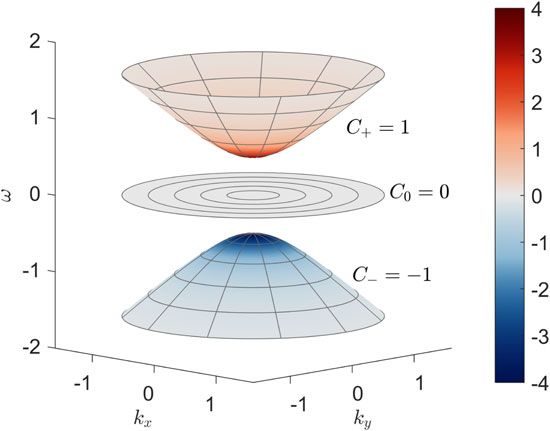
The effective Hamiltonian H is Hermitian. The eigenvalues are ω± = ± k2 + f 2 and
ω0 = 0, where k2 = kx2 + ky2 . These modes are the Poincaré waves and a degenerate
zero-frequency Rossby wave. The non-normalized eigenfunctions are
⎛ ⎞ ⎛ ⎞
k2 f
⎜ ⎟ ⎜ ⎟
|ψ± = ⎜ 2 2 ⎟
⎝±kx k + f + ifky ⎠ , |ψ0 = ⎝−iky ⎠ . (3.5a,b)
±ky k2 + f 2 − ifkx ikx
The three frequency bands are shown in figure 3.
Using the concepts developed in § 2, we are now in a position to calculate the Berry
connection, Berry curvature and Chern number of each band. We show the computation
in detail for the ω+ band; the other two bands are analogous. The standard inner product
is used.
First we compute the Berry connection for this band. An equivalent expression to (2.11)
for a non-normalized eigenfunction is
Im ψ+ | ∇ k ψ+
A+ (k) = − . (3.6)
ψ+ | ψ+
It is convenient to express ∇ k in polar coordinates, where kx = k cos ϕ and ky = k sin ϕ.
Thus,
⎛ ⎞
k2
⎜ ⎟
|ψ+ = ⎜⎝k k + f cos ϕ + ifk sin ϕ ⎠ ,
2 2 ⎟ (3.7)
k k2 + f 2 sin ϕ − ifk cos ϕ
Downloaded from https://www.cambridge.org/core. IP address: 46.4.80.155, on 25 Sep 2021 at 06:38:41, subject to the Cambridge Core terms of use, available at
https://www.cambridge.org/core/terms. https://doi.org/10.1017/S0022377821000301Topological phase in plasma physics 11
F IGURE 3. Dispersion relation for the three frequency bands in the shallow-water model.
Colour shows the value of the Berry curvature, and the Chern number of each band is indicated.
Here, f = 0.5.
and
⎛ ⎞
2k
⎛ ⎞
⎜ 2 ⎟ 0
⎜ 2k + f 2 ⎟
⎜ cos ϕ + if sin ϕ ⎟ ϕ̂ ⎜ ⎟
∇ k |ψ+ = k̂ ⎜
⎜ k +f
2 2 ⎟ + ⎜−k k2 + f 2 sin ϕ + ifk cos ϕ ⎟ .
⎟ k⎝ ⎠
⎜ 2 ⎟
⎝ 2k + f 2 ⎠ k k + f cos ϕ + ifk sin ϕ
2 2
sin ϕ − if cos ϕ
k +f
2 2
(3.8)
The k̂ component of ψ+ | ∇ k ψ+ is real and hence does not contribute to A+ . We obtain
f
A+ (k) = − ϕ̂. (3.9)
k k + f2
2
The Berry curvature is
f
F+ (k) = . (3.10)
(k2 + f 2 )3/2
The Chern number of this band is
1
C+ = d2 k F+ = sign( f ). (3.11)
2π
Topological quantization has emerged: the Chern number can only take on integer
values. The breaking of time-reversal symmetry by the rotation of the Earth results in
a topologically non-trivial bulk fluid in the f -plane model of the shallow-water system.
One can similarly show that the Chern numbers for the other bands are C0 = 0 and
C− = − sign( f ). The Chern numbers are indicated in figure 3.
Downloaded from https://www.cambridge.org/core. IP address: 46.4.80.155, on 25 Sep 2021 at 06:38:41, subject to the Cambridge Core terms of use, available at
https://www.cambridge.org/core/terms. https://doi.org/10.1017/S002237782100030112 J. B. Parker
This example offers a clear demonstration of the bulk-boundary correspondence
principle. The direct implication is that if f in (3.1) is a function of y rather than constant,
then there must be a unidirectional wave localized to the spatial region around f = 0 that
spans the frequency gap. Because the change in Chern number across such an interface is
C+ ( f > 0) − C+ ( f < 0) = 2, there are two localized waves.
The more physical case of interest is an actual spherical surface without the
Cartesian approximation. The Coriolis parameter f changes sign across the equator.
Hence, the equator forms an interface dividing the topologically distinct northern and
southern hemispheres. In fact, the two expected waves guaranteed by the bulk-boundary
correspondence principle are the well-known equatorially trapped modes, the Kelvin wave
and the Yanai wave (Delplace et al. 2017). The dispersion relation for both the Kelvin and
Yanai wave is monotonic, indicating group velocities of unidirectional, eastward travelling
waves.
Despite the fact that the Cartesian f -plane neglects spherical curvature, which is an
order-unity effect, analysis of the f -plane has yielded the key topological insight that
the northern and southern hemisphere are topologically distinct. Kelvin waves have been
clearly observed in the spectrum of fluctuations in the Earth’s atmosphere (Wheeler
& Kiladis 1999). In simulations, Delplace et al. (2017) found that equatorially trapped
Kelvin waves lying in the frequency gap experienced reduced scattering against static
perturbations compared with modes not in the frequency gap, a signature of topological
protection.
Although the infinite k-plane is not compact, the behaviour at infinite k has not in
this case spoiled the result of finding an integer Chern number by integrating the Berry
curvature. The compactness issue was handled in an alternate way by Delplace et al.
(2017), who considered a 2-D compact surface, a sphere, within the 3-D parameter space
(kx , ky , f ). The Berry curvature within the 3-D parameter space is that of a monopole at
the origin, and hence any closed surface containing the origin will yield the same Chern
number. This calculation can be reconciled with the one presented above by considering a
cylinder centred at the origin of finite height in f and very large radius in the (kx , ky )-plane.
The Berry flux through the side of the cylinder vanishes, and the flux through one end of
the cylinder is equal to the flux through the infinite k-plane at constant f above. Yet another
way of dealing with compactness is through the addition of odd viscosity (Souslov et al.
2019; Tauber et al. 2019).
3.2. Magnetized cold plasma and the gaseous plasmon polariton
In this section, we examine a simple magnetized cold plasma and show that it can
host topological phases along with related interface modes. The magnetic field breaks
time-reversal symmetry.
Consider an infinite, homogeneous, ion-electron plasma. When considering high-
frequency electromagnetic waves, it is appropriate to treat the ions as a fixed neutralizing
background and only consider electron motion. The mathematical description of a cold
plasma consists of the electron equation of motion and Maxwell’s equations:
∂v e
= − (E + v × B0 ), (3.12a)
∂t me
∂E ene
= c2 ∇ × B + v, (3.12b)
∂t 0
∂B
= −∇ × E, (3.12c)
∂t
Downloaded from https://www.cambridge.org/core. IP address: 46.4.80.155, on 25 Sep 2021 at 06:38:41, subject to the Cambridge Core terms of use, available at
https://www.cambridge.org/core/terms. https://doi.org/10.1017/S0022377821000301Topological phase in plasma physics 13
(a) (b)
3.0 3.0
2.5 2.5
2.0 2.0 C4 = −1
C4 = −1
ω/ωp 1.5 C3 = 1
C3 = 0 1.5
1.0 1.0
C2 = 2 C2 = 1
0.5 0.5 C1 = −1
C1 = −1
0.0 0.0
−2 0 2 −2 0 2
cky /ωp cky /ωp
F IGURE 4. Spectrum of a magnetized, homogeneous cold plasma as a function of ky (kx set to
zero, but the system is isotropic in the xy-plane), where only electron motion is retained. The
two cases show (a) kz < kz∗ and (b) kz > kz∗ , where kz∗ is a critical point at which a topological
transition occurs. The Chern numbers of the positive-frequency bands are shown (Parker et al.
2020b).
where v is the electron velocity, E the electric field, B0 = B0 ẑ the background magnetic
field, B the perturbation magnetic field, ne the background electron density, me the electron
mass, c the speed of light, and 0 the permittivity of free space.
We consider a fixed kz parallel to the background magnetic field and choose a
two-dimensional parameter space (kx , ky ). After proper non-dimensionalization and
Fourier analysis, one obtains the Hermitian eigenvalue problem ω |ψ = H |ψ, where
H is a 9 × 9 matrix and |ψ = [v, E, B].
Figure 4 shows the four positive-frequency bands. Non-trivial topology is found in
multiple bands, as indicated by the non-zero Chern numbers (Parker et al. 2020b; Fu &
Qin 2020). Unlike the shallow-water example, here the straightforward integration of the
Berry curvature yields a non-integer result for one of the bands. As discussed in § 2.7,
this stems from a lack of compactness. To obtain the integer Chern numbers shown in
Figure 4, a large-wavenumber cutoff of the plasma response was introduced to regularize
the small-scale behaviour, motivated by the physical fact that the continuum description
breaks down at the scales of the interparticle spacing.
When the topologically non-trivial plasma is placed next to the trivial vacuum,
bulk-boundary correspondence suggests the existence of modes at the interface. One can
consider a semi-infinite planar system, where the plasma and vacuum each occupies half of
the space (Yang et al. 2016). A more physically realizable system is a confined cylindrical
plasma with a radially decreasing density, transitioning to a low-density vacuum-like
region. Parker et al. (2020b) investigated this system and demonstrated the existence of
topological boundary waves. An important component of that study was accounting for
a finite width of the density interface. A gaseous plasma cannot sustain a discontinuous
density interface with vacuum, and the interface width is typically limited by classical
or turbulent diffusion processes. A discontinuous step in density serves as a good first
approximation but is quantitatively limited. Because the width of the density interface may
be comparable in size to the wavelength of the wave, a quantitative treatment is necessary
to accurately determine whether the wave can exist.
Figure 5 shows the surface mode at the plasma–vacuum interface. This mode is the
gaseous plasmon polariton (GPP), named for its similarity to surface plasmon polaritons
occurring at the surface of metals. The spectrum of the inhomogeneous plasma was
Downloaded from https://www.cambridge.org/core. IP address: 46.4.80.155, on 25 Sep 2021 at 06:38:41, subject to the Cambridge Core terms of use, available at
https://www.cambridge.org/core/terms. https://doi.org/10.1017/S002237782100030114 J. B. Parker
(a)
Density (1011 cm−3 )
4
10 20 30 40 50
Mode centroid r (cm)
2 (c)
1.2
1.0
0
(b)
Eigenfunction (m = −8)
0.8
ω/ωp0
1.0
Im(Er ) Re(Ez ) 0.6
0.5
0.4
0.0 GPP
0.2
Re(Eθ )
−0.5
0.0
10 20 30 40 −50 0 50
Radius r (cm) Mode number m
F IGURE 5. Spectrum of a cylindrical, inhomogeneous, magnetized plasma. The eigenvalue
differential equation in radius was solved using the plasma density as a function of radius
shown in panel (a). (b) Non-zero components of GPP electric field at azimuthal mode number
m = −8. (c) Spectrum as a function of m. The GPP dispersion relation is indicated and crosses
the frequency bandgap (Parker et al. 2020b).
computed by solving the differential eigenvalue equation in radius. In the figure, the
dispersion relation of the GPP is unidirectional and crosses the bandgap. In Parker
et al. (2020b), a typo led to the GPP being described as ‘undirectional’ rather than the
correct ‘unidirectional’. The GPP can exist in planar as well as cylindrical geometries.
This study also showed that the GPP can be realized in plasma regimes achievable
in laboratory experiments. The parameters used by Parker et al. (2020b) were directly
motivated by the plasma parameters of the Large Plasma Device (Gekelman et al. 2016).
In this case, a peak plasma density of n = 4 × 10¹¹ m−3 , magnetic field B = 0.1 T, and
density scale length of Ln ≈ 5 cm were used, and the GPP was calculated to have a
frequency of ∼2 GHz. Hence, the GPP offers a window into the experimental study of
topological phenomena in plasma systems.
4. Discrete symmetries and topology
There is a profound relation between symmetry and topology. In this context, discrete
symmetries such as parity and time play a crucial role. In recent literature, PT symmetry
analysis has been discussed (Bender 2007; Qin et al. 2019). Here, we discuss the
consequences of discrete symmetries on the topology of the system.
Parity P refers to the inversion of one or more spatial dimensions, and time reversal is
denoted by T . Mathematically, when acting on the state vector of a linear system, P is a
linear, unitary operator with P 2 = 1. The action of parity is here defined as reversing the
sign of x and then applying a unitary operator V.
In quantum mechanics, time reversal requires complex conjugation of the wavefunction.
Complex conjugation does not inherently enter in the context of classical physics described
in terms of real variables. However, in the Fourier domain, one can draw a connection
to complex conjugation by using the reality condition, which is related to particle-hole
conjugation in quantum contexts. From this perspective, for a linear system, time reversal
Downloaded from https://www.cambridge.org/core. IP address: 46.4.80.155, on 25 Sep 2021 at 06:38:41, subject to the Cambridge Core terms of use, available at
https://www.cambridge.org/core/terms. https://doi.org/10.1017/S0022377821000301Topological phase in plasma physics 15
T is an antilinear operator with T 2 = 1. Antilinear means T c |ψ = c∗ T |ψ where c
is a complex constant. The action of time reversal is here defined as mapping t → −t,
applying complex conjugation by using the reality condition, and then applying a unitary
operator U.
Let H(k̂) be the matrix differential operator corresponding to the linear problem, which
depends on the spatial derivatives, written in terms of k̂j = −i∂/∂xj . For an infinite,
homogeneous system, an eigenmode with wave vector k and eigenfrequency ω has the
form
|φ = ei(k·x−ωt) |ψ , (4.1)
where |ψ is just a constant vector that has no space or time dependence, such that
ω |φ = H(k̂) |φ = H(k̂) ei(k·x−ωt) |ψ = H(k) ei(k·x−ωt) |ψ . (4.2)
In this expression, H(k) is simply H(k̂) where k̂ has been replaced by the algebraic quantity
k, and H(k) is a matrix with no differential operators. Hence, this leads to the conventional
Fourier-space eigenvalue formulation,
H(k) |ψ = ω |ψ . (4.3)
A consequence of a parity symmetric system [H, P ] = 0 is that given one eigenmode
|φ, P |φ is also an eigenmode with the same frequency ω. The proof is simple:
H(k̂)P |φ = P H(k̂) |φ = P ω |φ = ωP |φ . (4.4)
Furthermore,
P |φ = P ei(k·x−ωt) |ψ = ei(k·P x−ωt) V |ψ
= ei(P k·x−ωt) V |ψ . (4.5)
In the last equality, we have used that if P flips the sign of one or more components of x,
then one can equally well think of it as flipping the sign of the corresponding components
of k. Therefore, P |φ is indeed an eigenmode; it has wave vector P k, frequency ω and
components V |ψ.
We can also consider the consequence of the system being symmetric under time
reversal. A consequence of [H, T ] = 0 is that T |φ is an eigenmode with frequency ω∗ .
To see this, note
H(k̂)T |φ = T H(k̂) |φ = T ω |φ = ω∗ T |φ . (4.6)
Using our convention for the action of T , we find
∗
T |φ = T ei(k·x−ωt) |ψ = ei(−k·x−ω t) U |ψ ∗ , (4.7)
where the notation |ψ ∗ means the complex conjugate of the components is taken. Hence,
T |φ has wave vector −k, frequency ω∗ and components U |ψ ∗ .
Parity symmetry has direct implications for the Berry connection. We assume a
non-degenerate situation where |φ and P |φ can be labelled as part of the same
eigenmode branch. Here, suppose P represents full inversion symmetry with P k = −k.
From (4.5), we have
|ψ(−k) = V |ψ(k) . (4.8)
To be more precise, one can slightly generalize (4.8) with a possibly k-dependent
phase factor, which amounts to a gauge transformation as discussed in § 2.2.
Downloaded from https://www.cambridge.org/core. IP address: 46.4.80.155, on 25 Sep 2021 at 06:38:41, subject to the Cambridge Core terms of use, available at
https://www.cambridge.org/core/terms. https://doi.org/10.1017/S002237782100030116 J. B. Parker
From A(k) = i ψ(k) | ∇ k ψ(k), we observe that
A(−k) = i ψ(−k) | ∇ k ψ(−k) (4.9)
= −i ψ(k)| V † V |∇ k ψ(k) (4.10)
= −A(k), (4.11)
up to a gauge transformation, where † denotes the Hermitian adjoint. Full inversion
symmetry then implies the Berry curvature F (k) = ∇ k × A is even,
F (−k) = F (k). (4.12)
Time-reversal symmetry can be analysed following a similar approach. From (4.7), we
have |ψ(−k) = U |ψ(k)∗ up to a gauge transformation. Using this result in (4.9), we
obtain
A(−k) = −i ψ(k)∗ | U † U |∇ k ψ(k)∗ (4.13)
∗ ∗
= −i ψ(k) | ∇ k ψ(k) . (4.14)
Because the Berry connection is real, we may take the complex conjugate without
changing the result, leading to
A(−k) = i ψ(k) | ∇ k ψ(k) . (4.15)
One concludes that under time-reversal symmetry, the Berry connection is even and the
Berry curvature is odd,
A(−k) = A(k), (4.16)
F (−k) = −F (k). (4.17)
Recalling the Chern number C = (2π)−1 dk F(k), we see that invariance under T
implies a vanishing Chern number. Moreover, invariance under both full inversion and
time-reversal symmetry implies the Berry curvature itself vanishes.
5. Discussion
We have introduced topological band theory in the context of plasmas. One clear
physical manifestation of non-trivial topological phase is the presence of modes occurring
at the interface between topologically distinct materials, such as a magnetized plasma
and vacuum. Topological physics, along with many generalizations and extensions not
presented here, have been systematically studied and applied in condensed matter and
photonics as well as other fields of physics. For instance, topological classifications beyond
the Chern number exist, such as the Z2 invariant of topological insulators (Kane & Mele
2005a,b).
Various important effects in plasmas can take one beyond the simple topological
band theory discussed in this article. Topological physics is most well understood in
the case of Hermitian Hamiltonians. In contrast, a non-Hermitian Hamiltonian can
occur, for instance, when a system experiences gain and/or loss. In plasmas or fluids,
non-Hermiticity might also arise from the presence of flow shear or a density gradient.
In recent years, there has been a significant effort to generalize topological band theory
to non-Hermitian Hamiltonians (Esaki et al. 2011; Hu & Hughes 2011; Leykam et al.
2017; Gong et al. 2018; Kunst et al. 2018; Martinez Alvarez et al. 2018; Shen, Zhen & Fu
Downloaded from https://www.cambridge.org/core. IP address: 46.4.80.155, on 25 Sep 2021 at 06:38:41, subject to the Cambridge Core terms of use, available at
https://www.cambridge.org/core/terms. https://doi.org/10.1017/S0022377821000301Topological phase in plasma physics 17
2018). A natural jumping off point is the space of PT -symmetric Hamiltonians, which
can under certain circumstances give real spectra like a Hermitian Hamiltonian. In the
general case with complex eigenvalues and exceptional points, topological classification,
topological protection, and the relation to bulk-boundary correspondence are still not
fully settled, although much progress has been made in specific problems. Understanding
non-Hermitian topological effects in plasmas and fluids is an open area.
Nonlinearity is another important feature of plasmas and fluid systems. The theory in
terms of an effective Hamiltonian and frequency bands is based on a linearization around
equilibrium, an assumption that may have limited validity in many situations. Effects
from nonlinearity have been studied in topological photonics (Lumer et al. 2013; Leykam
& Chong 2016; Smirnova et al. 2020). In plasmas, the interplay between topology and
nonlinearity is ripe for exploration.
Further investigations will deepen our understanding of the physics of topological
phase in plasmas and uncover the behaviour of topological modes in plasmas. Significant
theoretical development is needed to unravel the topological nature of the diversity of
plasmas at different parameter regimes and scales. Laboratory investigations are within
reach to probe experimental consequences and uses of topological physics in plasmas.
Potential applications of this emerging area include the ability to predict new interface
modes using the bulk-boundary correspondence. The presence of these modes in some
circumstances might be used to provide diagnostic information on plasma parameters, or
in other situations might provide new means of exerting control over plasmas. Topological
plasma waves may also be robust to perturbations.
Acknowledgements
Useful discussions with B. Marston and P. Delplace are acknowledged.
Editor Hong Qin thanks the referees for their advice in evaluating this article.
Funding
Support for this research was provided by the University of Wisconsin-Madison, Office
of the Vice Chancellor for Research and Graduate Education with funding from the
Wisconsin Alumni Research Foundation.
Declaration of interests
The author reports no conflict of interest.
REFERENCES
A SBÓTH , J. K., O ROSZLÁNY, L. & P ÁLYI , A. 2016 A short course on topological insulators. Lecture
Notes in Physics. Springer.
AVRON , J. E., S EILER , R. & S IMON , B. 1983 Homotopy and quantization in condensed matter physics.
Phys. Rev. Lett. 51, 51–53.
B ENDER , C. M. 2007 Making sense of non-Hermitian Hamiltonians. Rep. Prog. Phys. 70 (6), 947–1018.
B ERNEVIG , B. & H UGHES , T. 2013 Topological Insulators and Topological Superconductors. Princeton
University Press.
B ERRY, M. V. 1984 Quantal phase factors accompanying adiabatic changes. Proc. R. Soc. Lond. A 392,
45–57.
B ERRY, M. V. & H ANNAY, J. H. 1988 Classical non-adiabatic angles. J. Phys. A: Math. Gen. 21 (6),
L325–L331.
Downloaded from https://www.cambridge.org/core. IP address: 46.4.80.155, on 25 Sep 2021 at 06:38:41, subject to the Cambridge Core terms of use, available at
https://www.cambridge.org/core/terms. https://doi.org/10.1017/S002237782100030118 J. B. Parker
B RIZARD , A. J. & DE G UILLEBON , L. 2012 Comment on ‘Geometric phase of the gyromotion for charged
particles in a time-dependent magnetic field’ [Phys. Plasmas 18, 072505 (2011)]. Phys. Plasmas 19
(9), 094701.
B URBY, J. W. & Q IN , H. 2013 Toroidal precession as a geometric phase. Phys. Plasmas 20 (1), 012511.
D ELPLACE , P., M ARSTON , J. B. & V ENAILLE , A. 2017 Topological origin of equatorial waves. Science
358 (6366), 1075–1077.
E GUCHI , T., G ILKEY, P. B. & H ANSON , A. J. 1980 Gravitation, gauge theories and differential geometry.
Phys. Rep. 66 (6), 213–393.
E SAKI , K., SATO , M., H ASEBE , K. & KOHMOTO , M. 2011 Edge states and topological phases in
non-Hermitian systems. Phys. Rev. B 84, 205128.
F U, Y. & Q IN , H. 2020 Topological phases, topological phase transition, and bulk-edge correspondence of
magnetized cold plasmas, arXiv:2012.13611.
GAO , W., YANG , B., L AWRENCE , M., FANG , F., B ÉRI , B. & Z HANG , S. 2016 Photonic weyl
degeneracies in magnetized plasma. Nat. Commun. 7 (1), 12435.
G EKELMAN , W., P RIBYL , P., LUCKY, Z., D RANDELL , M., L ENEMAN , D., M AGGS , J., V INCENA , S.,
VAN C OMPERNOLLE , B., T RIPATHI , S. K. P., M ORALES , G., et al. 2016 The upgraded large
plasma device, a machine for studying frontier basic plasma physics. Rev. Sci. Instrum. 87 (2),
025105.
G ONG , Z., A SHIDA , Y., K AWABATA , K., TAKASAN , K., H IGASHIKAWA , S. & U EDA , M. 2018
Topological phases of non-Hermitian systems. Phys. Rev. X 8, 031079.
H ALDANE , F. D. M. & R AGHU, S. 2008 Possible realization of directional optical waveguides in photonic
crystals with broken time-reversal symmetry. Phys. Rev. Lett. 100, 013904.
H ANNAY, J. H. 1985 Angle variable holonomy in adiabatic excursion of an integrable hamiltonian. J. Phys.
A: Math. Gen. 18 (2), 221–230.
H ASAN , M. Z. & K ANE , C. L. 2010 Colloquium: topological insulators. Rev. Mod. Phys. 82, 3045–3067.
H ASSANI GANGARAJ , S. A. & M ONTICONE , F. 2020 Physical violations of the bulk-edge correspondence
in topological electromagnetics. Phys. Rev. Lett. 124, 153901.
H ASSANI GANGARAJ , S. A., S ILVEIRINHA , M. G. & H ANSON , G. W. 2017 Berry phase,
berry connection, and chern number for a continuum bianisotropic material from a classical
electromagnetics perspective. IEEE J. Multiscale Multiphys. Comput. Technol. 2, 3–17.
H E , C., N I , X., G E , H., S UN , X.-C., C HEN , Y.-B., LU, M.-H., L IU, X.-P. & C HEN , Y.-F. 2016 Acoustic
topological insulator and robust one-way sound transport. Nat. Phys. 12, 1124–1129.
H U, Y. C. & H UGHES , T. L. 2011 Absence of topological insulator phases in non-Hermitian PT-symmetric
Hamiltonians. Phys. Rev. B 84, 153101.
H UBER , S. D. 2016 Topological mechanics. Nat. Phys. 12 (7), 621–623.
K ANE , C. L. & M ELE , E. J. 2005a Quantum spin Hall effect in graphene. Phys. Rev. Lett. 95, 226801.
K ANE , C. L. & M ELE , E. J. 2005b Z2 topological order and the quantum spin Hall effect. Phys. Rev. Lett.
95, 146802.
K LITZING , K. V., D ORDA , G. & P EPPER , M. 1980 New method for high-accuracy determination of the
fine-structure constant based on quantized Hall resistance. Phys. Rev. Lett. 45, 494–497.
K UNST, F. K., E DVARDSSON , E., B UDICH , J. C. & B ERGHOLTZ , E. J. 2018 Biorthogonal bulk-boundary
correspondence in non-Hermitian systems. Phys. Rev. Lett. 121, 026808.
L AUGHLIN , R. B. 1981 Quantized hall conductivity in two dimensions. Phys. Rev. B 23, 5632–5633.
L EYKAM , D., B LIOKH , K. Y., H UANG , C., C HONG , Y. D. & N ORI , F. 2017 Edge modes, degeneracies,
and topological numbers in non-Hermitian systems. Phys. Rev. Lett. 118, 040401.
L EYKAM , D. & C HONG , Y. D. 2016 Edge solitons in nonlinear-photonic topological insulators. Phys. Rev.
Lett. 117, 143901.
L ITTLEJOHN , R. G. 1988 Phase anholonomy in the classical adiabatic motion of charged particles. Phys.
Rev. A 38, 6034–6045.
L IU, J. & Q IN , H. 2011 Geometric phase of the gyromotion for charged particles in a time-dependent
magnetic field. Phys. Plasmas 18 (7), 072505.
L IU, J. & Q IN , H. 2012 Geometric phases of the faraday rotation of electromagnetic waves in magnetized
plasmas. Phys. Plasmas 19 (10), 102107.
LU, L., J OANNOPOULOS , J. D. & S OLJAc̆I Ć , M. 2014 Topological photonics. Nat. Photonics 8, 821–829.
Downloaded from https://www.cambridge.org/core. IP address: 46.4.80.155, on 25 Sep 2021 at 06:38:41, subject to the Cambridge Core terms of use, available at
https://www.cambridge.org/core/terms. https://doi.org/10.1017/S0022377821000301Topological phase in plasma physics 19
LUMER , Y., P LOTNIK , Y., R ECHTSMAN , M. C. & S EGEV, M. 2013 Self-localized states in photonic
topological insulators. Phys. Rev. Lett. 111, 243905.
M A , T., K HANIKAEV, A. B., M OUSAVI , S. H. & S HVETS , G. 2015 Guiding electromagnetic waves
around sharp corners: topologically protected photonic transport in metawaveguides. Phys. Rev. Lett.
114, 127401.
M ARCIANI , M. & D ELPLACE , P. 2020 Chiral Maxwell waves in continuous media from Berry monopoles.
Phys. Rev. A 101, 023827.
M ARTINEZ A LVAREZ , V. M., BARRIOS VARGAS , J. E., B ERDAKIN , M. & F OA T ORRES , L. E. F. 2018
Topological states of non-Hermitian systems. Eur. Phys. J.: Spec. Top. 227 (12), 1295–1308.
NASH , L. M., K LECKNER , D., R EAD , A., V ITELLI , V., T URNER , A. M. & I RVINE , W. T. M.
2015 Topological mechanics of gyroscopic metamaterials. Proc. Natl Acad. Sci. USA 112 (47),
14495–14500.
N IU, Q., T HOULESS , D. J. & W U, Y.-S. 1985 Quantized Hall conductance as a topological invariant.
Phys. Rev. B 31, 3372–3377.
O ZAWA , T., P RICE , H. M., A MO , A., G OLDMAN , N., H AFEZI , M., LU, L., R ECHTSMAN , M. C.,
S CHUSTER , D., S IMON , J., Z ILBERBERG , O., et al. 2019 Topological photonics. Rev. Mod. Phys.
91, 015006.
PARKER , J. B., B URBY, J. W., M ARSTON , J. B. & T OBIAS , S. M. 2020a Nontrivial topology in the
continuous spectrum of a magnetized plasma. Phys. Rev. Res. (accepted).
PARKER , J. B., M ARSTON , J. B., T OBIAS , S. M. & Z HU, Z. 2020b Topological gaseous plasmon
polariton in realistic plasma. Phys. Rev. Lett. 124, 195001.
P EANO , V., B RENDEL , C., S CHMIDT, M. & M ARQUARDT, F. 2015 Topological phases of sound and
light. Phys. Rev. X 5 (3), 031011.
P ERROT, M., D ELPLACE , P. & V ENAILLE , A. 2019 Topological transition in stratified fluids. Nat. Phys.
15 (8), 781–784.
Q IN , H., Z HANG , R., G LASSER , A. S. & X IAO , J. 2019 Kelvin–Helmholtz instability is the result of
parity-time symmetry breaking. Phys. Plasmas 26 (3), 032102.
R AGHU, S. & H ALDANE , F. D. M. 2008 Analogs of quantum-Hall-effect edge states in photonic crystals.
Phys. Rev. A 78, 033834.
R AX , J.-M. & G UEROULT, R. 2019 Geometric phase in Brillouin flows. Phys. Plasmas 26 (12), 122111.
S HEN , H., Z HEN , B. & F U, L. 2018 Topological band theory for non-Hermitian Hamiltonians. Phys. Rev.
Lett. 120, 146402.
S ILVEIRINHA , M. G. 2015 Chern invariants for continuous media. Phys. Rev. B 92, 125153.
S ILVEIRINHA , M. G. 2019a Proof of the bulk-edge correspondence through a link between topological
photonics and fluctuation-electrodynamics. Phys. Rev. X 9, 011037.
S ILVEIRINHA , M. G. 2019b Quantized angular momentum in topological optical systems. Nat. Commun.
10 (1), 349.
S IMON , B. 1983 Holonomy, the quantum adiabatic theorem, and Berry’s phase. Phys. Rev. Lett. 51,
2167–2170.
S MIRNOVA , D., L EYKAM , D., C HONG , Y. & K IVSHAR , Y. 2020 Nonlinear topological photonics. Appl.
Phys. Rev. 7 (2), 021306.
S OUSLOV, A., DASBISWAS , K., F RUCHART, M., VAIKUNTANATHAN , S. & V ITELLI , V. 2019
Topological waves in fluids with odd viscosity. Phys. Rev. Lett. 122, 128001.
TAUBER , C., D ELPLACE , P. & V ENAILLE , A. 2019 A bulk-interface correspondence for equatorial waves.
J. Fluid Mech. 868, R2.
TAUBER , C., D ELPLACE , P. & V ENAILLE , A. 2020 Anomalous bulk-edge correspondence in continuous
media. Phys. Rev. Res. 2, 013147.
T HOULESS , D. J., KOHMOTO , M., N IGHTINGALE , M. P. & DEN N IJS , M. 1982 Quantized Hall
conductance in a two-dimensional periodic potential. Phys. Rev. Lett. 49, 405–408.
W HEELER , M. & K ILADIS , G. N. 1999 Convectively coupled equatorial waves: analysis of clouds and
temperature in the wavenumber-frequency domain. J. Atmos. Sci. 56 (3), 374–399.
YANG , B., L AWRENCE , M., GAO , W., G UO , Q. & Z HANG , S. 2016 One-way helical electromagnetic
wave propagation supported by magnetized plasma. Sci. Rep. 6, 21461.
YANG , Z., GAO , F., S HI , X., L IN , X., GAO , Z., C HONG , Y. & Z HANG , B. 2015 Topological acoustics.
Phys. Rev. Lett. 114, 114301.
Downloaded from https://www.cambridge.org/core. IP address: 46.4.80.155, on 25 Sep 2021 at 06:38:41, subject to the Cambridge Core terms of use, available at
https://www.cambridge.org/core/terms. https://doi.org/10.1017/S0022377821000301You can also read


