Video Game Streaming in Young People and Teenagers: Uptake, User Groups, Dangers, and Opportunities - MDPI
←
→
Page content transcription
If your browser does not render page correctly, please read the page content below
healthcare
Article
Video Game Streaming in Young People and Teenagers:
Uptake, User Groups, Dangers, and Opportunities
Luis Javier Cabeza-Ramírez * , Guzmán Antonio Muñoz-Fernández                                  and Luna Santos-Roldán

                                          Department of Statistics, Econometrics, Operations Research, Business Organization and Applied Economics,
                                          Faculty of Law, Business and Economic Sciences, University of Córdoba, Puerta Nueva s/n,
                                          14071 Córdoba, Spain; guzman.munoz@uco.es (G.A.M.-F.); td1sarol@uco.es (L.S.-R.)
                                          * Correspondence: r62caral@uco.es; Tel.: +34-957-212-688

                                          Abstract: In recent years, live video streaming platforms for video games have been gaining pop-
                                          ularity. These types of services, which enable anyone to broadcast and consume live content, are
                                          revolutionising the current video game landscape. Users approach the emergence of and participation
                                          in these platforms driven by a range of motivations. It is essential to characterise the different forms
                                          of participation in services such as Twitch to evaluate the phenomenon and reflect on its advantages
                                          and disadvantages. To that end, a survey was carried out of 580 young people and adolescents aged
                                          between 14 and 24. The aim of this study is thus to explore the uptake of these platforms, as well as
                                          identify user groups, distinguish between different motivations, and address the associated benefits
                                          and harms. Applying a methodology based on factor analysis and cluster analysis, user profiles were
                                          characterised according to their specific features, gaming/viewing hours, self-perception of their skill
                                level as a player, devices used, and type or genre of video game. Four subgroups of gamers/viewers

                                          were thus identified: casual, social, hobby, and problematic. The results showed that older users and
Citation: Cabeza-Ramírez, L.J.;           female users feature more prominently in the first two groups, as do those spending less time on
Muñoz-Fernández, G.A.; Santos-            video games and live streaming platforms. Conversely, in the hobby and problematic groups, we
Roldán, L. Video Game Streaming in        observe just the opposite. The existence of profiles at possible risk of addiction underlines how, at a
Young People and Teenagers: Uptake,
                                          preventive level, there is a need for more in-depth research on these types of services and greater
User Groups, Dangers, and
                                          public awareness of the dangers of uncontrolled use.
Opportunities. Healthcare 2021, 9, 192.
https://doi.org/10.3390/healthcare
                                          Keywords: digital motivation; cyber behaviour; live streaming; cluster analysis; video games; e-
9020192
                                          health; problematic online gaming and gambling
Academic Editors: Raian Ali and
John McAlaney
Received: 12 January 2021
Accepted: 6 February 2021                 1. Introduction and State of the Research
Published: 10 February 2021                    Over the course of human history, if there is one society that has championed the
                                          prioritisation of free time as a need (Art. 24 [1]), it is probably that of the current era. Leisure
Publisher’s Note: MDPI stays neutral      time fosters personal development and can take different forms. Of these, video games
with regard to jurisdictional claims in   have become one of the most commercial and most compelling types of entertainment [2].
published maps and institutional affil-        Playing video games is a common activity among young people and adolescents [3].
iations.                                  There is an ongoing debate as to people’s motivations for gaming [4], as well as the potential
                                          benefits [5,6] and disadvantages [7]. The earliest studies on motivation associate this hobby
                                          with simple fun: a way of beating boredom, facing new challenges, or sharing interests [4,8].
                                          The main benefits concern the development of social, educational, and spatial skills [9–11].
Copyright: © 2021 by the authors.         However, looking beyond their healthy or adaptive use, video games can also give rise to
Licensee MDPI, Basel, Switzerland.        abusive use or lack of control, which could affect the daily lives of millions of users if this
This article is an open access article    activity becomes predominant. Adverse effects include addictive behaviours, antisocial
distributed under the terms and           behaviours, reduced sleep, continual tiredness, a decline in academic or work performance,
conditions of the Creative Commons        and even physical problems [12,13].
Attribution (CC BY) license (https://          The world of video games is currently in the midst of a genuine revolution, ushered
creativecommons.org/licenses/by/
                                          in by two relatively recent and interconnected phenomena: the rise of e-sports and the
4.0/).

Healthcare 2021, 9, 192. https://doi.org/10.3390/healthcare9020192                                       https://www.mdpi.com/journal/healthcare
Healthcare 2021, 9, 192 2 of 16
development of activities related to the live streaming of video games. Crowdsourced
live streaming services allow anyone to broadcast and consume live content over the
internet [14]. Notable in the field of video games are platforms such as Twitch, which
surpassed 11.9 billion hours streamed in 2018, with an average of 1.25 million concurrent
viewers in the first quarter of 2019 alone [15]. Moreover, as a result of the containment
measures against COVID-19, the number of viewers and of professionals or amateurs
currently streaming content continues to rise [16]. The big companies are battling it out
over this new form of entertainment. Alongside Twitch, which is owned by Amazon,
there are other platforms such as YouTube Gaming (Google) (Google LLC., Mountain View,
CA, USA), Mixer (Microsoft) (Microsoft Corporation Albuquerque, NM, USA), Facebook
Gaming (Facebook) (Facebook, Inc., Menlo Park, CA, USA), and Caffeine (ex-executives
of Apple TV). On such platforms, users are not limited to being mere spectators, they
interact with other participants, comment on games or strategies, make donations, and
subscribe. They may also take on the role of content developers or streamers, in order to
stream events, test games, disseminate and comment on games, as well as other activities
directly or indirectly related to video games [17].
The positive and negative elements associated with video games also apply to live
streaming services [18]. The factors linked to the risk or opportunity arising from the
consumption of live video game streaming may be heterogeneous among individuals [19].
Previous research has primarily focused on the positive or negative aspects associated with
the rise of this new phenomenon [18,20–22], but no studies to date have identified user
groups or differences between them and their perceptions. As Jeong, et al. [19] point out,
the identification of homogeneous subgroups can contribute to a better understanding
of gaming and viewing behaviour. In this regard, identifying subgroups can help shed
light on the heterogeneity of the population under study. This type of analysis has been
undertaken in many different contexts and has been used in a range of research areas,
reflecting its effectiveness for exploratory data analysis [23]. It has proven especially useful
in research related to the identification of potential risk groups; for example, it has been
applied to determine the profiles of people who engage in online betting [24], to explore
behaviours related to the binge watching of television series [25], or more recently, to assess
the psychological impact of the COVID-19 pandemic [26].
In recent years, some promising lines have emerged within the research on live
streaming that point to the professional opportunities linked to streaming [21,27–30],
or the potential benefits in relation to learning [31,32]. Nevertheless, as Woodcock and
Johnson [33] warn, making the transition from a hobby to a way of earning a living requires
marathon gaming sessions or for streamers to produce content even when they are tired or
not in the mood to do so. Paradoxically, some of the most pernicious effects of video games
are associated precisely with time and usage patterns [6,34,35], neuropsychiatric deficits,
and certain types of video games [36]. Therefore, the present study aims to explore the
profiles of users (under the age of 25) of video game streaming services. The analysis seeks
to identify their motivations and establish subgroups according to their characteristics
relating to time spent gaming and viewing, self-perception of their skill level as a player,
devices used, and perception of two additional aspects—whether they believe their hobby
can be turned into a profession and whether they perceive that they derive benefits in
terms of learning on live streaming platforms.
1.1. Video Games and Live Streaming: The Rise of the Streaming Phenomenon
The success of video games, due in part to their interactive nature [37], extends to
other, related activities, with a growth in the number of users who not only spend their
time gaming, but also use streaming platforms to learn, interact with other fans, and watch
streams of their favourite pastime. In the third quarter of 2019, Twitch, YouTube Gaming,
and Mixer combined generated 3.32 billion hours watched, more than 131 million live
hours, with an average of nearly 1.6 million concurrent viewers [38]. As Lin, Bowman,
Lin, and Chen [37] point out, there are three essential components to live game streaming:Healthcare 2021, 9, 192 3 of 16
the public playing of the video game before a potential audience, the varying levels of
interaction between streamers and viewers, and the fact that such interactions can coexist
with gaming outside of streaming. Hence, some authors hold that video game streaming
offers elements of utility, such as learning strategies to apply when playing, and social
aspects, linked to the interaction between users [39].
The growing importance of this phenomenon is in little doubt. In this respect, John-
son and Woodcock [22] underline its impact on the entire video game ecosystem and
industry, explaining how it helps to create links between developers/programmers and
streamers/influencers. They claim it even changes players’ expectations regarding new
product launches, influences video game design, and boosts the lifespan and visibility
of older games or independent titles. Another decisive factor relates to the transition
from traditional broadcast media, such as television, to new, more flexible and interactive
formulas, where spectating and participation bring new life to the concepts established
in studies of audiences [40]. Furthermore, the phenomenon of live streaming places a
priority on the social component. Hamilton, Garretson, and Kerne [39] point out that these
types of platforms are meeting places for communities of players, where the emphasis is
on development and a sense of belonging, leading to the creation of intimate groupings
with a small number of spectators, or large groups, usually for the streaming of major
tournaments and events; in other words, we see the emergence of informal communities
that socialise and participate. Along the same lines, Churchill and Xu [41] identify different
subcultures dedicated to specific games.
1.2. Motivation in Video Games and Crowdsourced Platforms
Knowing the different motivations of different users is essential in order to gain
an understanding of their behaviour and to identify distinct profiles. Motivation is one
of the aspects that most strongly influences the desire to continue playing [42]. Some
of the motivational factors that play a role in the process of choosing a video game to
play or watch are the need for information about the game, its utility as a source of
escapism and fun, as well as those relating to social integration and the strengthening
of friendship networks [43,44]. However, the type of player or even their skill level is
likely to influence that motivation [45]. In this regard, Bartle [46] established a now-classic
taxonomy, distinguishing between achievers, or players focused on completing challenges,
socialisers, oriented towards social skills, creating contacts, and social interaction, explorers,
interested in understanding the details of the world set out by the video game, and killers,
for whom the competitive factor predominates.
Indeed, one of the most promising avenues of research into live streaming of video
games focuses on the analysis of motivation [43,44,47]; although watching others play
is not exactly the same as playing, they are overlapping phenomena, since both entail
consuming related content [48]. In this respect, one of the most well-established theories is
the uses and gratification theory (UGT), commonly adopted in the framework of analysis
of media consumption. Thus, Sjoblom and Hamari [43] distinguish between five types
of motivation: cognitive (acquiring information, knowledge, comprehension), affective
(seeking an emotional, pleasant, or aesthetic experience), personal integrative (enhancing
credibility, confidence, and status), social integrative (enhancing connections with family,
friends, and so forth), and tension-release (escape and diversion). They establish that
the search for information is positively associated with the hours that the users dedicate
to these types of services. In addition, they find that tension-release, social integrative,
and affective motivations are also related to the time spent, although social integrative is
considered the main predictor of subscription to these types of services. Using the same
theoretical framework, Hilvert-Bruce et al. [49] identify additional motivations that help
explain the commitment to live streaming, such as entertainment and lack of external
support in real life. Within the same framework and applied to e-sports streaming, Hamari
and Sjoblom [48] find a positive association between the frequency of watching and factors
such as escapism, the skills of the player being watched, the novelty of the video game,Healthcare 2021, 9, 192 4 of 16
and aggressive e-sports behaviour. Beyond UGT, Gandolfi [47] adds other motivations
such as the attractiveness or popularity of specific streamers, or the interest in particular
games or genres.
1.3. Positive Effects of Video Games: Opportunities Associated with Live Streaming
The literature on the utility and benefits of video games reveals enormous poten-
tial. Results have been found indicating a connection with enhanced cognitive abilities,
improved coordination of senses such as sight or touch, spatial reasoning, capacity for
attention and creativity [50,51], and the development of social, educational, and spatial
skills [9–11]. Gamification is also being explored as a means of instrumentalising learn-
ing [31]: interactivity and viewer participation in video games facilitate the acquisition of
knowledge in a natural way [52].
This set of benefits extends to live video platforms; however, an approach to such
services requires a more in-depth exploration of what they offer. Gros, Wanner, Hackenholt,
Zawadzki, and Knautz [44] point to the social component of the service, holding it to be a
new type of social network of players. On the other hand, Spilker, Ask, and Hansen [40]
emphasise its media aspect. As such, this dual nature should be taken into account. These
days, platforms such as Twitch bring together a growing number of channels grouped into
categories that mainly relate to video games, but also include sections such as IRL (in real
life), dedicated to widely varying themes: chatting, special events, talk shows and podcasts,
music and performing arts, to name just a few that have the biggest audience and most
followers outside of video games.
In line with this dual utility, the most recent studies on video games and streaming
platforms focus on the professional possibilities, where gaming stops being a hobby and
becomes an occupation [21,33], or on their contribution from an educational viewpoint.
Payne, Keith, Schuetzler, and Giboney [32] show how Twitch represents a unique learning
paradigm and provides opportunities for instructors (streamers) to educate mass audiences
in real-time, allowing teacher–student and student–student interaction, while Liao, Chen,
and Shih [31] demonstrate how the instructional use of video and collaboration influence
the achievement of learning based on digital games.
1.4. Problems and Dangers Related to Video Games and Live Streaming
Some adverse effects are related to antinormative behaviour, harassment, or dissemi-
nation of offensive or inappropriate content [53–55].
Misgivings about problematic gaming, especially in children, adolescents, and young
people, has become a focus of growing concern among parents and caregivers [56]. As
Buiza-Aguado et al. [57] point out, there is no consensus as to the clinical definition of
video game addiction, although instruments have been developed to detect harmful use,
culminating in the World Health Organisation’s recent inclusion of Gaming Disorder [58] as
a behavioural addiction [59]. As Buiza-Aguado [56] shows, poor psychosocial functioning
seems to be a key factor in the development of addictive patterns of use, patterns principally
associated with males. Other factors that play a role include online gambling, time spent
playing, and genre of game, as well as social and family factors.
In relation to the internet, as Fineberg et al. [60] point out, while its positive and adap-
tive uses are highly valued, a spectrum of uncontrolled use has also been acknowledged,
including disordered online behaviour (excessive use of online video games, uncontrolled
viewing of pornography, compulsive buying, or addiction to social networks). These are
all factors that may be associated with functional impairment, loss of productivity or poor
academic performance, and even mood disorders and anxiety [58,61]. Although there is a
growing number of analyses of their impact on young people and adolescents [62,63], the
excessive use of live streaming services has received little attention to date [18,64].Healthcare 2021, 9, 192 5 of 16
2. Materials and Methods
The methodology used is based on primary data collected through an online survey
administered via the Surveymonkey platform.
2.1. Study Design and Process
The study population is Spanish video game players and users of video game live
streaming services between the ages of 14 and 24. According to the Spanish Association
of Video Games, in 2018, around 3.4 million users in Spain were in this age group [65]. A
convenience sampling approach was employed in an effort to obtain a broad sample. We
contacted several educational and university centres, providing a link to the questionnaire,
the introduction to which stated that participation was voluntary, and that data processing
was authorised exclusively for research purposes. The questionnaire was also distributed
through social networks, video game forums, and Spanish streamers’ Twitch channels.
The study was carried out in line with the ethical recommendations proposed in previous
research in the same field [64,66], and observing the principles and recommendations of
the Declaration of Helsinki [67].
2.2. Measurement Instrument
The questionnaire design was based on previous research papers [43,44,47,68], adapted
in order to gain an understanding of the determinants of the use of these platforms, and
assess the benefits and disadvantages.
The questionnaire was divided into five blocks:
a. Sociodemographic characteristics.
b. Gamer attributes, preferred platforms for gaming/viewing, time spent weekly, and
self-perception of skill level.
c. Motivations for gaming/viewing content.
d. Potential harm.
e. Potential benefits.
The sociodemographic section included closed-ended questions, with a number of
answer choices for the respondents to choose from. Subsequent blocks included questions
assessed using a 5-point Likert scale. Before the final survey, a pre-test was performed on a
control group (n = 12), in order to correct any phrasing or inconsistencies, as necessary. To
obtain a diversity of usage habits, the selection criteria for the survey respondents were not
restrictive, that is, all participants who reported having used live streaming services in the
previous 6 months were included, giving rise to a high degree of randomness. The survey
remained open from September to November 2019. A total of 609 questionnaires were
completed, of which 580 were valid. A number of those respondents left some questions
unanswered, which is why some of the tables presented do not add up to 580 users.
The sociodemographic variables include age, gender, educational level, and employ-
ment status. The set of variables focused on player attributes were selected according to
the research objectives and include weekly hours spent gaming/viewing, self-perception
of skill level, and preferred platforms for gaming (PC, Smartphone, Tablet, PlayStation,
Xbox, Nintendo).
Regarding the motivation variables, drawing on the classification proposed by Sjoblom
and Hamari [43], they were categorised into four groups: information-seeking motivation,
with three items (to follow tournaments or events, to learn gaming strategies, to stay
up to date on video games), entertainment motivation, two items (for entertainment, as
a complement/alternative to social networks), social motivation, with three items (to
communicate with others in the chat room, to watch Twitch/platforms with friends, to
contact streamers), and social-integrative motivation, with two items (to be part of the
gaming community, to be part of today’s gaming culture). In this section, the scales used
were those employed in the questionnaires of Gros, Wanner, Hackenholt, Zawadzki, and
Knautz [44] and Gandolfi [47].Healthcare 2021, 9, 192 6 of 16
The potential benefits of live streaming platforms have not yet been established and
more research is needed in this regard; nevertheless, some benefits are understood to be
based on the unique features of these platforms, such as interactivity [40] and advantages
for learning [32]. For this reason, two items were used (to help my education, for example,
in languages, and to meet new friends). At the same time, the possibility was assessed of
including a third item related to the potential for professionalising their hobby [21,28,69].
However, this variable may not be entirely straightforward, as the consequences of not
achieving this goal could potentially be negative; as such, it was decided not to include it
in the analysis for identifying user groups but rather to study it independently.
Lastly, to determine the potential adverse effects, the scale developed by Andreassen,
Billieux, Griffiths, Kuss, Demetrovics, and Mazzoni [68] was adapted, with four items
included: I often neglect important tasks to play or watch others play, I spend more and
more time gaming or watching others play, I have felt bad when I could not play or watch,
and I play or watch others to forget about my problems. Furthermore, three specific
items related to the possible aggressive use of these services [70,71] were added: I have
made hurtful comments, I have received hurtful comments, and I use platforms to troll
other users.
2.3. Statistical Analyses
Once the data had been tabulated, a reliability analysis was performed, using Cron-
bach’s Alpha to evaluate the validity of the responses and the measurement scale. In all
cases, the value of this coefficient was greater than 0.8, indicating good internal consistency.
Given the number of variables, an exploratory/confirmatory factor analysis was then
carried out, using the Varimax orthogonal rotation method. Of the 19 variables initially
evaluated, 4 non-significant variables were eliminated: to contact streamers, to watch
Twitch/platforms with friends, to be part of the gamer community, to be part of today’s
gaming culture, and the remaining ones were reduced down to four factors.
On the basis of these factors, an analysis was carried out to identify possible patterns
according to which survey respondents could be grouped. User subgroups were deter-
mined using non-hierarchical clustering techniques. Thus, cluster analysis was applied to
determine whether there are characteristic features that can define their behaviour. The
results of the dendrogram and the icicle plot suggested an optimal solution consisting of
four clusters. To check the significance of belonging to a particular cluster of individuals, as
indicated by the evaluation of the variables, a MANOVA (Multivariate analysis of variance)
analysis was used. In addition, since this analysis cannot be used to determine where the
significant differences in means exist, Tukey’s post hoc test was applied. The statistical
analyses were carried out using IBM SPSS Statistics 25 (IBM Corp. Released 2017. IBM
SPSS Statistics for Windows, Version 25.0. IBM Corp, Armonk, NY, USA).
3. Analysis and Results
Table 1 shows the sociodemographic variables, where it can be seen that the male
gender predominates, and that notably more time each week is spent playing than view-
ing. A relationship was detected between the variable age and gaming hours (contin-
gency coefficient = 0.330; 0.00), as well as between age and viewing hours (contingency
coefficient = 0.287; 0.00), with younger respondents registering more hours. For this reason,
it was decided to divide age into two groups in the subsequent cluster analysis (19 and un-
der and 20–24 years old). In addition, a relationship was found between gender and gaming
hours (contingency coefficient = 0.468; 0.00) and gender and viewing hours (contingency
coefficient = 0.370; 0.00), with male respondents registering more hours.Healthcare 2021, 9, 192 7 of 16
Table 1. Sociodemographic profile.
Variable n %
Age
16 and under 94 16.2
17–19 years old 153 26.4
20–22 years old 219 37.8
23–24 years old 114 19.7
Weekly gaming hours
0–3 h 288 49.7
3–7 h 104 18.0
7–10 h 68 11.7
10–15 h 46 7.9
15–25 h 42 7.3
More than 25 h 31 5.4
Weekly viewing hours
0–3 h 398 69.1
3–7 h 83 14.4
7–10 h 43 7.5
10–15 h 26 4.5
15–25 h 13 2.3
More than 25 h 13 2.3
Gender
Female 237 40.9
Male 343 59.1
Educational level
Primary education 67 11.6
Secondary education 192 33.1
Upper Secondary/VET 257 44.3
University degree 56 9.6
Postgraduate/Doctorate 8 1.4
Employment status
Full-time work 20 3.5
Part-time work 10 1.7
Work and study 91 15.7
Study 451 78.0
Unemployed 6 1.0
VET, Vocational education and training.
Exploratory factor analysis (EFA) [72] was then applied, with the aim of computing the
factor scores of the identified factors in order to determine their strength in the behaviour
of users of these types of platforms. The results of the analysis (Table 2) yielded four factors,
characterised as follows:
• Recreational-informative factor: incorporates the motivations linked to utility, con-
nected to the needs they meet. This factor explains 28.9% of the total variance in
gaming/viewing on streaming platforms.
• Escapist-addictive factor: incorporates aspects considered potentially negative in the
use of video games and social networks [56,60]. This factor accounts for 18.4% of the
total variance.
• BM factor (bad manners or bad behaviour): includes potentially negative issues related
to the aggressiveness arising in relationships with third parties when interacting on
such platforms, such as making or receiving hurtful comments or trolling others, and
it explains 12.5% of the variance.
• Social factor: incorporates issues connected to social networks within these platforms,
and accounts for 12.1% of the total variance explained.Healthcare 2021, 9, 192 8 of 16
Table 2. Rotated component matrix. Gaming/viewing motivation variables.
Components
Variables Factors
1 2 3 4
For entertainment—A 0.83
To learn gaming strategies—B 0.81
To stay up to date on video games—C 0.81 Recreational-
To follow tournaments or events—D 0.78 informative
As a complement/alternative to social
0.76
networks/Tv—E
To help my education (languages)—F 0.66
I have felt bad when I could not play—G 0.81
I play to forget about my problems—H 0.74
Escapist/addictive
I spend more and more time gaming—I 0.69
I often neglect important tasks to play—J 0.68
I have made hurtful comments—K 0.84
I have received hurtful comments—L 0.70 BM *
I use platforms to troll other users—M 0.65
I use platforms to meet new friends—N 0.89
Social
I use platforms to communicate with
0.83
others in the chat room—O
Eigenvalues 4.33 2.75 1.88 1.81
% Variance 28.89 18.39 12.55 12.09
Cumulative % variance 28.89 47.28 59.84 71.94
Sampling adequacy Kaiser–Meyer–Olkin (KMO): 0.898
Bartlett’s Test of Sphericity χ2 = 5145.127;d.f: 105; p 0.000
* BM = Bad manners, d.f. = d.f = degrees of freedom, p = value.
In order to evaluate the validity and reliability of the four dimensions extracted in
the EFA, we used confirmatory factor analysis (CFA) with structural equation modelling,
applying the unweighted least squares (ULS) estimation method. Table 3 shows the
Bentler (CFI) (Compartive Fit Index), Tucker Lewis (TLI), and Root Mean Square Error
of Approximation (RMSEA) indices. All the measurements are within the range to be
considered a good fit [73].
Table 3. Fit indices, confirmatory factor analysis (CFA).
Model Incremental Global
CFI TLI GFI RMSEA (IC 90%) SRMR
Total 0.996 0.995 0.996 0.047 (0.038–0.056) 0.046
Sample 1 0.994 0.992 0.993 0.058 (0.045–0.071) 0.055
Sample 2 0.999 0.999 0.994 0.020 (0.000–0.039) 0.053
The factor scores indicated the use of a non-hierarchical clustering method, with the
aim of maximising the variance between groups and minimising it within each group. Of
all the possible solutions, the one that best met these criteria was chosen and four clusters
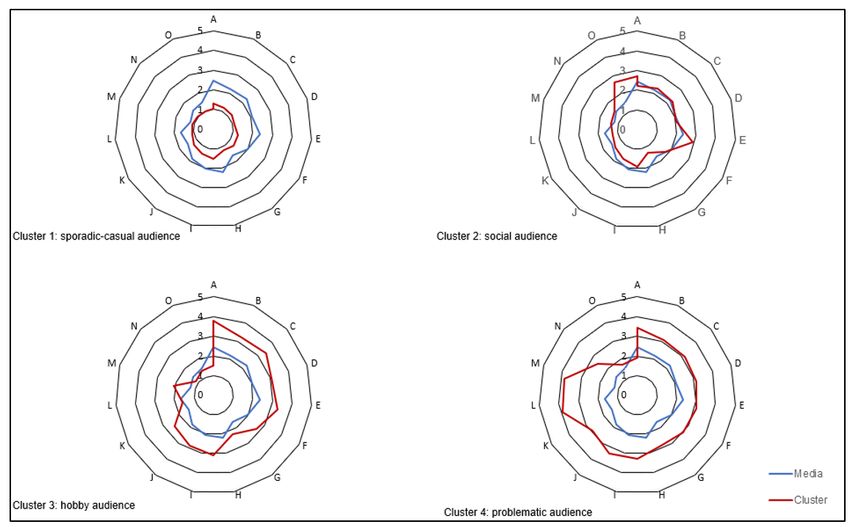
were established, and the user profiles in the detected groups are shown in Figure 1 (the
cluster is in red, the sample mean in blue).
The tests for differences between means highlighted that belonging to a particular
group has a significant relationship with the factors considered (recreational-informative,
escapist-addictive, BM, and social: significant differences at the 0.05 level between the four
measures, or at least in three), yielding four possible audience profiles:
• Cluster 1 denoted a sporadic-casual audience: the largest group with 256 respondents
or 44.1% of the sample, and this group scored the lowest in all the dimensions analysed.
• Cluster 2, or social audience: composed of 82 respondents (14.1%), it registered high
scores in social variables and moderate scores in the recreational-informative dimension.Healthcare 2021, 9, 192 9 of 16
• Cluster 3, termed a hobby audience: comprising 205 respondents (35.3%), their moti-
vation stems from aspects such as entertainment, learning strategies, staying up to
date on video games, and complementing social networks. They show medium–high
values in components related to the escapist-addictive factor, such as playing to forget
problems or spending an ever-increasing amount of time gaming.
• Cluster 4, or potentially problematic audience: composed of 37 users, only 6.4% of
the sample; however, this cluster represents the most complete spectrum, registering
very high scores in factors associated with bad behaviour in networks and notable
escapist-addictive
Healthcare 2021, 9, x elements, together with high recreational-informative
9 of 17 motivation.
Figure 1. Profiles of gamer/viewer subgroups (the cluster is in red, the sample mean in blue).
Figure 1. Profiles of gamer/viewer subgroups (the cluster is in red, the sample mean in blue).
The tests for differences between means highlighted that belonging to a particular
group has a significant relationship with the factors considered (recreational-informative,
The groups were then characterised according to factors associated with problematic
escapist-addictive, BM, and social: significant differences at the 0.05 level between the four
gaming, such as gender,
measures, orage, device,
at least in three),gaming/viewing timeprofiles:
yielding four possible audience [56], as well as other variables
• Clusterof
such as self-perception skill alevel
1 denoted as a player,
sporadic-casual orlargest
audience: the whether
group withthey identify possibilities
256 respondents
or 44.1% of the sample, and this group scored the lowest in all the dimensions ana-
for turning their videolysed. game hobby into a profession. A contingency table analysis and
• Cluster
Pearson’s χ2 test (Table 3)2,were applied
or social audience: to all ofofthem.
composed The variable
82 respondents preferred
(14.1%), it registered high type of video
scores in social variables and moderate scores in the recreational-informative dimen-
game was studied independently.
sion.
• Cluster that
The results showed young
3, termed a hobbywomen and female
audience: comprising adolescents
205 respondents feature
(35.3%), their moti- more promi-
vation stems from aspects such as entertainment, learning strategies, staying up to
nently in Clusters 1 (sporadic-casual)
date on video games, and and 2 (social).social
complementing They haveThey
networks. a smaller presence in Cluster 3
show medium–high
(hobby) and only a minimal presence
values in components intoCluster
related 4 (problematic).
the escapist-addictive factor, such asThe male
playing survey respon-
to forget
problems or spending an ever-increasing amount of time gaming.
dents are mostly found in Clusters 3 and 4, more closely related to the
• Cluster 4, or potentially problematic audience: composed of 37 users, only 6.4% of the concept of gaming
as a hobby and problematic
sample; however, gaming.
this clusterFurthermore, Clusters
represents the most complete 3 and
spectrum, 4 are very
registering made up of the
high scores in factors associated with bad behaviour in networks and notable escapist-
youngest users (under 19 years
addictive elements,of age),with
together inhigh
contrast to Clustersmotivation.
recreational-informative 1 and 2, which comprise
respondents aged between 20 and 24 years old. Weekly hours spent
The groups were then characterised according to factors associated with gaming
problematic or viewing are
gaming, such as gender, age, device, gaming/viewing time [56], as well as other variables
also related to thesuch
allocation to the different clusters: only 2% of those in Cluster 1 admit to
as self-perception of skill level as a player, or whether they identify possibilities for
playing more thanturning
15 htheira week,
video gamewhereas
hobby intothis proportion
a profession. increases
A contingency to 32.4%
table analysis in Cluster 4. A
and Pear-
similar pattern is son′s χ2 test (Table 3) were applied to all of them. The variable preferred type of video
observed with viewing.
game was studied independently.
The young people included in Clusters 3 and 4
perceive themselves as having a higher skill level as a player than those belonging to Clusters
1 and 2. Regarding devices, it can be seen that the use of PCs and PlayStations is more
widespread in Clusters 3 and 4, while no significant relationships were found for the use
of tablet. On the other hand, devices such as Xbox or Nintendo have a negligible presence
in the sample. Another noteworthy aspect is that the members of Clusters 3 (27%) and
4 (15.2%) think that their passion for video games can be turned into a profession. Lastly, it is
worth noting that action/adventure was the favourite genre in all groups: a preference for
potentially more addictive genres appeared in Clusters 3 and 4, with high percentages of
MMORPG/FPS/MOBA (Massively Multiplayer Online Role-Playing Game, First Person
Shooter, Multiplayer Online Battle Arena), which were not seen in Clusters 1 and 2.Healthcare 2021, 9, 192 10 of 16
Regarding the characterisation of the groups, Table 4 shows the mean values for the
items considered: self-perception of skill level as a player, perceptions with respect to
professionalising their video games hobby, or beliefs about the educational benefits to be
gained from streaming platforms (for example, with respect to languages). As can be seen,
Cluster 3 and particularly Cluster 4 stand out in all of these, which is to be expected as they
are the ones who devote the most time to gaming and viewing. However, the progressive
increase in the mean values across the four clusters is striking. Furthermore, the mean values
registered in Clusters 3 and 4 indicate that those users who consider themselves to be very
experienced (well above the average) are precisely those who think that viewing content is
beneficial to their learning, and to a lesser extent, see it as feasible to dedicate themselves
professionally to activities related to gaming, including video game streaming (Table 5).
Table 4. Characterisation of components.
C1 C2 C3 C4
Variable Categories n = 256 n = 82 n = 205 n = 37 n* χ2 Sig.
(44.1%) (14.1%) (35.3%) (6.4%)
Female 158 (61.7%) 38 (46.3%) 38 (18.5%) 3 (8.3%) 237
Gender 105.812Healthcare 2021, 9, 192 11 of 16
To determine the extent to which the four clusters differ from one another with
respect to these three variables, post hoc multiple comparisons tests were used, namely
the Brown-Forsythe and Welch’s t tests (Table 6). In this case, significant differences were
detected between the four clusters for the variable self-perception of skill level as a player.
The other two variables analysed showed substantial and significant differences between
Clusters 1 and 2, on the one hand, relative to Clusters 3 and 4 on the other; moreover, there
are no significant differences between Clusters 3 and 4.
Table 6. Robust tests of homogeneity of variance and equality of means for perception variables.
Variables Homogeneity of Variances (Levene) Equality of Means
Streaming is beneficial to 23.39Healthcare 2021, 9, 192 12 of 16
most time playing and watching others play, they are mostly under 19 years old, consider
themselves expert or professional players, use the platforms mainly to be informed, and
are notable for registering high values associated with bad behaviour in the networks [77].
Focusing attention on the motivation variables used in the different clusters, the uses
and gratifications theory has often been used to gain a better understanding of the emerging
phenomenon of video game live streaming [17,37,43–45,48,49,78–80]. The profiles of the
four groups presented align with the findings reported by Sjoblom and Hamari [43], in
that the most intensive users are those who attach greater importance to the search for
information [45]; this type of motivation, along with a lack of self-control and self-esteem,
is found to be a notable predictor of problematic use of live streaming services [64]. Indeed,
Cluster 3 and particularly Cluster 4 are the ones that present the highest values for the
information-seeking motivation. However, Chen and Chang [18] analysed the moderating
effects of the information-seeking motivation and escapism on problematic use, finding
no significant relationship in the profiles displaying high levels of this type of motivation.
All this highlights the enormous complexity of the uncontrolled use of these services
and the number of variables that could influence it, thus underscoring the need for more
empirical evidence.
Regarding the variables capturing users’ perceptions, their self-perception of their skill
level as a player was particularly notable for the scores registered by the four clusters, with
the younger players grouped in Clusters 3 and 4 recording the highest levels. According to
White [81] and Hopp et al. [82], motivations are driven by competitiveness and progress
towards the acquisition of skills and knowledge; indeed, it is users in the latter two clusters
that reported the highest values for how platforms improve their learning skills, and are
also the ones that see the greatest possibilities of turning their hobby into a profession.
This finding is significant given that Cluster 4—considered potentially problematic—is
particularly notable in this regard, which could imply that it is the levels of competitiveness
driving their bad behaviour in the networks.
Limitations and Future Directions
The classification established here is a reflection of some of the existing groupings for
types of players [46,83–85]. The results highlight the need to consider the player profile in
motivational analyses of live streaming platforms, since users do not stop being players
on becoming a viewer [43]: it seems that their player profile marks their behaviour as
a viewer. However, this study is not without limitations. First, the methodology used
involved a convenience sample of Spanish young people and teenagers who accessed
the questionnaire. Despite the degree of randomness in the sample and the fact that the
profile of the sample coincides with that reported by AEVI [65] (The Spanish Video Game
Association), the exact size of the reference population is not known. Applied to the
Spanish population between those ages [86], we could consider the sample universe to
be 3.4 million players; thus, the margin of error for a random sample could be around
4.07% with a confidence level of 95%. Second, this study is conceived of as an initial
approach to the phenomenon, it reveals a static snapshot of the emergence of these types of
services. It is precisely this limitation that opens up new avenues for a broader longitudinal
analysis of specific user groups. Third, the use of variables such as users’ self-perception
of their skill level as a player and their behaviour, as well as the relationships that can be
identified with other variables, merit further investigation in the future. In the present study,
these variables were based on self-reported data, which entails the standard limitations
regarding respondents having overly positive perceptions of themselves or differences in
their assessments of negative effects. Furthermore, the questions used in the measurement
instrument rely on scales used in previous studies [43,44,47,68]; thus, the application of
these scales to the field of video game live streaming needs to be validated.Healthcare 2021, 9, 192 13 of 16
5. Conclusions
Unlike previous studies such as those by Sjoblom and Hamari [43] and Wang, Tian,
Lan, Yang, and Zhang [14], the present study identified user profiles based on their motiva-
tion, perceptions about problematic use, and potential benefits. The results of our research
show that as the intensity of use increases, for both video games and streaming platforms,
there is an increase in possible problematic behaviour and self-reported perceptions about
the perceived benefits. Female and older users feature more prominently in the casual and
social groups. Conversely, in the groups that spend more time playing/watching, we see
more male and younger users (hobby/problematic). These results are in line with those re-
ported by Andreassen et al. [87] in their analysis of the relationships between the addictive
use of social networks and video games. They thus represent an initial attempt to examine
the potential positive and negative effects, thereby contributing to the limited research to
date focused on the problems arising from the use of this new type of platform [18,64].
Lastly, we believe that this research can help parents, caregivers, and guardians
identify certain profiles, offering a better understanding of a phenomenon that is here to
stay, and helping to strike the difficult balance between advantages and disadvantages.
Generally speaking, except for the problematic profile (a minority), the motivations relating
to entertainment and learning new strategies or gaming techniques are those that register
the highest scores.
Author Contributions: Conceptualization, L.J.C.-R.; methodology, G.A.M.-F.; validation, L.J.C.-R.;
investigation, L.J.C.-R. and G.A.M.-F.; data curation, L.S.-R.; writing—original draft preparation,
L.J.C.-R.; writ-ing—review and editing, G.A.M.-F.; visualization, L.S.-R.; supervision, L.S.-R. All
authors have read and agreed to the published version of the manuscript.
Funding: This research received no external funding.
Institutional Review Board Statement: The study was carried out in line with the ethical recom-
mendations proposed in previous research in the same field and observing the principles and recom-
mendations of the Declaration of Helsinki. After consulting the ethics committee of the University of
Cordoba, the study did not require ethical approval.
Informed Consent Statement: Informed consent was obtained from all subjects involved in the
study. Respondents were informed through the survey.
Data Availability Statement: The data used to support the findings of this study are available from
the corresponding author upon request.
Conflicts of Interest: The authors declare no conflict of interest.
References
1. United Nations. Universal Declaration of Human Rights; Assembly, G., Ed.; Department of State, United States of America:
Washington, DC, USA, 1948; Volume 302, pp. 14–25.
2. Buchanan-Oliver, M.; Seo, Y. Play as co-created narrative in computer game consumption: The hero’s journey in Warcraft III. J.
Consum. Behav. 2012, 11, 423–431. [CrossRef]
3. Muros, B.; Aragon, Y.; Bustos, A. Youth’s Usage of Leisure Time with Video Games and Social Networks. Comunicar 2013, 20,
31–39. [CrossRef]
4. Hellstrom, C.; Nilsson, K.W.; Leppert, J.; Aslund, C. Influences of motives to play and time spent gaming on the negative
consequences of adolescent online computer gaming. Comput. Hum. Behav. 2012, 28, 1379–1387. [CrossRef]
5. Paraskeva, F.; Mysirlaki, S.; Papagianni, A. Multiplayer online games as educational tools: Facing new challenges in learning.
Comput. Educ. 2010, 54, 498–505. [CrossRef]
6. Snodgrass, J.G.; Lacy, M.G.; Dengah, H.J.F.; Polzer, E.R.; Else, R.J.; Arevalo, J.M.G.; Cole, S.W. Positive mental well-being and
immune transcriptional profiles in highly involved videogame players. Brain Behav. Immun. 2019, 82, 84–92. [CrossRef]
7. Paulus, F.W.; Ohmann, S.; Von Gontard, A.; Popow, C. Internet gaming disorder in children and adolescents: A systematic review.
Dev. Med. Child Neurol. 2018, 60, 645. [CrossRef] [PubMed]
8. Griffiths, M.D.; Hunt, N. Computer game playing in adolescence-prevalence and demographic indicators. J. Community Appl. Soc.
Psychol. 1995, 5, 189–193. [CrossRef]Healthcare 2021, 9, 192 14 of 16
9. Jackson, L.A.; von Eye, A.; Witt, E.A.; Zhao, Y.; Fitzgerald, H.E. A longitudinal study of the effects of Internet use and videogame
playing on academic performance and the roles of gender, race and income in these relationships. Comput. Hum. Behav. 2011, 27,
228–239. [CrossRef]
10. Lager, A.; Bremberg, S. Health Effects of Video and Computer Game Playing. A Systematic Review; Swedish National Institute of Public
Health: Stockholm, Sweeden, 2005.
11. Gros Salvat, B. Certezas e interrogantes acerca del uso de los videojuegos para el aprendizaje. Rev. Int. Comun. Audiov. Public Lit.
2009, 1, 251–264.
12. Gonzálvez, M.T.; Espada, J.P.; Tejeiro, R. El uso problemático de videojuegos está relacionado con problemas emocionales en
adolescentes. Adicciones 2016, 29, 180–185. [CrossRef] [PubMed]
13. Hussain, Z.; Griffiths, M.D. Excessive use of massively multi-player online role-playing games: A pilot study. Int. J. Ment. Health
Addict. 2009, 7, 563. [CrossRef]
14. Wang, X.D.; Tian, Y.; Lan, R.H.; Yang, W.; Zhang, X.M. Beyond the Watching: Understanding Viewer Interactions in Crowdsourced
Live Video Broadcasting Services. IEEE Trans. Circuits Syst. Video Technol. 2019, 29, 3454–3468. [CrossRef]
15. Newzoo YouTube Contends with Twitch as Streamers Establish Their Audiences. Available online: https://newzoo.com/
insights/articles/youtube-contends-with-twitch-as-streamers-establish-their-audiences/ (accessed on 11 November 2020).
16. ESportcharts. The Effect of Coronavirus on Streaming in Abril; Esportscharts. Available online: https://escharts.com/blog/effect-
coronavirus-streaming-april (accessed on 11 November 2020).
17. Li, Y.; Wang, C.L.; Liu, J. A Systematic Review of Literature on User Behavior in Video Game Live Streaming. Int. J. Environ. Res.
Public Health 2020, 17, 3328. [CrossRef]
18. Chen, C.Y.; Chang, S.L. Moderating effects of information-oriented versus escapism-oriented motivations on the relationship
between psychological well-being and problematic use of video game live-streaming services. J. Behav. Addict. 2019, 8, 564–573.
[CrossRef]
19. Jeong, H.; Yim, H.W.; Jo, S.-J.; Lee, S.-Y.; Lee, H.K.; Gentile, D.A.; Son, H.J.; Han, H.-H.; Kweon, Y.-S.; Bhang, S.-Y.; et al. Gaming
patterns and related symptoms in adolescents using cluster analysis: Baseline results from the Internet User Cohort for Unbiased
Recognition of Gaming Disorder in Early Adolescence (iCURE) study. Environ. Res. 2020, 182, 109105. [CrossRef]
20. Matsui, A.; Sapienza, A.; Ferrara, E. Does Streaming Esports Affect Players’ Behavior and Performance? Games Cult. 2020, 15,
9–31. [CrossRef]
21. Johnson, M.R.; Woodcock, J. It’s like the gold rush’: The lives and careers of professional video game streamers on Twitch.tv. Info.
Commun. Soc. 2019, 22, 336–351. [CrossRef]
22. Johnson, M.; Woodcock, J. The impacts of live streaming and Twitch.tv on the video game industry. Media Cult. Soc. 2019, 41,
670–688. [CrossRef]
23. Jain, A.K.; Murty, M.N.; Flynn, P.J. Data clustering: A review. ACM Comput. Surv. 1999, 31, 264–323. [CrossRef]
24. Lloyd, J.; Doll, H.; Hawton, K.; Dutton, W.H.; Geddes, J.R.; Goodwin, G.M.; Rogers, R.D. Internet Gamblers: A Latent Class
Analysis of Their Behaviours and Health Experiences. J. Gamb. Stud. 2010, 26, 387–399. [CrossRef]
25. Flayelle, M.; Maurage, P.; Karila, L.; Vogele, C.; Billieux, J. Overcoming the unitary exploration of binge-watching: A cluster
analytical approach. J. Behav. Addict. 2019, 8, 586–602. [CrossRef]
26. Cao, W.J.; Fang, Z.W.; Hou, G.Q.; Han, M.; Xu, X.R.; Dong, J.X.; Zheng, J.Z. The psychological impact of the COVID-19 epidemic
on college students in China. Psychiatry Res. 2020, 287, 5. [CrossRef] [PubMed]
27. Kempe-Cook, L.; Sher, S.T.H.; Su, N.M.; Assoc Comp, M. Behind the Voices: The Practice and Challenges of Esports Casters; Assoc
Computing Machinery: New York, NY, USA, 2019.
28. Johnson, M.R.; Woodcock, J. “And Today’s Top Donator is”: How Live Streamers on Twitch.tv Monetize and Gamify Their
Broadcasts. Soc. Med. Soc. 2019, 5, 11. [CrossRef]
29. Bingham, C.M. Talking about Twitch: Dropped Frames and a normative theory of new media production. Convergence 2020, 26,
269–286. [CrossRef]
30. Woodcock, J.; Johnson, M.R. Live streamers on Twitch. tv as social media influencers: Chances and challenges for strategic
communication. Int. J. Strateg. Commun. 2019, 13, 321–335. [CrossRef]
31. Liao, C.W.; Chen, C.H.; Shih, S.J. The interactivity of video and collaboration for learning achievement, intrinsic motivation,
cognitive load, and behavior patterns in a digital game-based learning environment. Comput. Educ. 2019, 133, 43–55. [CrossRef]
32. Payne, K.; Keith, M.J.; Schuetzler, R.M.; Giboney, J.S. Examining the learning effects of live streaming video game instruction over
Twitch. Comput. Hum. Behav. 2017, 77, 95–109. [CrossRef]
33. Woodcock, J.; Johnson, M.R. The Affective Labor and Performance of Live Streaming on Twitch.tv. Telev. New Media 2019, 20,
813–823. [CrossRef]
34. Kuss, D.J.; Griffiths, M.D. Online Social Networking and Addiction-A Review of the Psychological Literature. Int. J. Environ. Res.
Public Health 2011, 8, 3528–3552. [CrossRef] [PubMed]
35. Castro-Sánchez, M.; Rojas-Jiménez, M.; Zurita-Ortega, F.; Chacón-Cuberos, R. Multidimensional Self-Concept and Its Association
with Problematic Use of Video Games in Spanish College Students. Educ. Sci. 2019, 9, 206. [CrossRef]
36. Buiza-Aguado, C.; Alonso-Canovas, A.; Conde-Mateos, C.; Buiza-Navarrete, J.J.; Gentile, D. Problematic video gaming in a young
Spanish population: Association with psychosocial health. Cyberpsychol. Behav. Soc. Netw. 2018, 21, 388–394. [CrossRef] [PubMed]Healthcare 2021, 9, 192 15 of 16
37. Lin, J.H.T.; Bowman, N.; Lin, S.F.; Chen, Y.S. Setting the digital stage: Defining game streaming as an entertainment experience.
Entertain. Comput. 2019, 31, 8.
38. Newzoo Streamlabs and Newzoo Q3 2019 Game Streaming Report: How Has Ninja’s Move Impacted Mixer and Twitch? Available
online: https://newzoo.com/insights/articles/q3-game-streaming-insights-how-has-ninjas-move-impacted-mixer-and-twitch/
(accessed on 11 November 2020).
39. Hamilton, W.A.; Garretson, O.; Kerne, A. Streaming on twitch: Fostering participatory communities of play within live mixed
media. In Proceedings of the 32nd Annual ACM Conference on Human Factors in Computing Systems, Toronto, ON, Canada, 26
April–1 May 2014; ACM: Toronto, ON, Canada, 2014; pp. 1315–1324.
40. Spilker, H.S.; Ask, K.; Hansen, M. The new practices and infrastructures of participation: How the popularity of Twitch. tv
challenges old and new ideas about television viewing. Inf. Commun. Soc. 2018, 23, 605–620. [CrossRef]
41. Churchill, B.C.B.; Xu, W. The Modem Nation: A First Study on Twitch.TV Social Structure and Player/Game Relationships; IEEE: New
York, NY, USA, 2016; pp. 223–228.
42. Stankevicius, D.; Jady, H.A.; Drachen, A.; Schoenau-Fog, H. A Factor-Based Exploration of Player’s Continuation Desire in Free-
to-Play Mobile Games. In Proceedings of the Eleventh Artificial Intelligence and Interactive Digital Entertainment Conference,
Santa Cruz, CA, USA, 14–18 November 2005.
43. Sjoblom, M.; Hamari, J. Why do people watch others play video games? An empirical study on the motivations of Twitch users.
Comput. Hum. Behav. 2017, 75, 985–996. [CrossRef]
44. Gros, D.; Wanner, B.; Hackenholt, A.; Zawadzki, P.; Knautz, K. World of Streaming. Motivation and Gratification on Twitch.
In Social Computing and Social Media: Human Behavior, Pt I; Meiselwitz, G., Ed.; Springer International Publishing Ag: Cham,
Switzerland, 2017; Volume 10282, pp. 44–57.
45. Cabeza-Ramirez, L.J.; Sanchez-Canizares, S.M.; Fuentes-Garcia, F.J. Motivations for the Use of Video Game Streaming Platforms:
The Moderating Effect of Sex, Age and Self-Perception of Level as a Player. Int. J. Environ. Res. Public Health 2020, 17, 7019.
[CrossRef]
46. Bartle, R. Hearts, clubs, diamonds, spades: Players who suit MUDs. J. MUD Res. 1996, 1, 19.
47. Gandolfi, E. To watch or to play, it is in the game: The game culture on Twitch.tv among performers, plays and audiences. J.
Gaming Virtual Worlds 2016, 8, 63–82. [CrossRef]
48. Hamari, J.; Sjoblom, M. What is eSports and why do people watch it? Internet Res. 2017, 27, 211–232. [CrossRef]
49. Hilvert-Bruce, Z.; Neill, J.T.; Sjoblom, M.; Hamari, J. Social motivations of live-streaming viewer engagement on Twitch. Comput.
Hum. Behav. 2018, 84, 58–67. [CrossRef]
50. Gozli, D.G.; Bavelier, D.; Pratt, J. The effect of action video game playing on sensorimotor learning: Evidence from a movement
tracking task. Hum. Mov. Sci. 2014, 38, 152–162. [CrossRef]
51. Jackson, L.A.; Witt, E.A.; Games, A.I.; Fitzgerald, H.E.; von Eye, A.; Zhao, Y. Information technology use and creativity: Findings
from the Children and Technology Project. Comput. Hum. Behav. 2012, 28, 370–376. [CrossRef]
52. Bavelier, D.; Green, C.S.; Pouget, A.; Schrater, P. Brain Plasticity Through the Life Span: Learning to Learn and Action Video
Games. In Annual Review of Neuroscience; Hyman, S.E., Ed.; Annual Reviews: Palo Alto, CA, USA, 2012; Volume 35, pp. 391–416.
53. Zolides, A. Gender moderation and moderating gender: Sexual content policies in Twitch’s community guidelines. New Media
Soc. 2020. [CrossRef]
54. Seering, J.; Wang, T.; Yoon, J.; Kaufman, G. Moderator engagement and community development in the age of algorithms. New
Media Soc. 2019, 21, 1417–1443. [CrossRef]
55. Ruberg, B. Obscene, pornographic, or otherwise objectionable: Biased definitions of sexual content in video game live streaming.
New Media Soc. 2020. [CrossRef]
56. Buiza-Aguado, C. Videojuegos, Uso Problemático y Factores Asociados; Focad. General Council of Psychology of Spain. Available
online: https://psicosol.es/wp-content/uploads/2018/11/FACTORES-ASOCIADOS.pdf (accessed on 11 November 2020).
57. Buiza-Aguado, C.; García-Calero, A.; Alonso-Cánovas, A.; Ortiz-Soto, P.; Guerrero-Díaz, M.; González-Molinier, M.; Hernández-
Medrano, I. Los videojuegos: Una afición con implicaciones neuropsiquiátricas. Psicol. Educ. 2017, 23, 129–136. [CrossRef]
58. Dieris-Hirche, J.; Pape, M.; te Wildt, B.T.; Kehyayan, A.; Esch, M.; Aicha, S.; Herpertz, S.; Bottel, L. Problematic gaming behavior
and the personality traits of video gamers: A cross-sectional survey. Comput. Hum. Behav. 2020, 106, 106272. [CrossRef]
59. Montag, C.; Schivinski, B.; Sariyska, R.; Kannen, C.; Demetrovics, Z.; Pontes, H.M. Psychopathological Symptoms and Gaming
Motives in Disordered Gaming-A Psychometric Comparison between the WHO and APA Diagnostic Frameworks. J. Clin. Med.
2019, 8, 1691. [CrossRef] [PubMed]
60. Fineberg, N.A.; Demetrovics, Z.; Stein, D.J.; Ioannidis, K.; Potenza, M.N.; Grunblatt, E.; Brand, M.; Billieux, J.; Carmi, L.; King,
D.L.; et al. Manifesto for a European research network into Problematic Usage of the Internet. Eur. Neuropsychopharmacol. 2018,
28, 1232–1246. [CrossRef] [PubMed]
61. Fumero, A.; Marrero, R.J.; Bethencourt, J.M.; Peñate, W. Risk factors of internet gaming disorder symptoms in Spanish adolescents.
Comput. Hum. Behav. 2020, 111, 106416. [CrossRef]
62. Busalim, A.H.; Masrom, M.; Zakaria, W. The impact of Facebook Addiction and self-esteem on students’ academic performance:
A multi-group analysis. Comput. Educ. 2019, 142, 14. [CrossRef]
63. Bozzola, E.; Spina, G.; Ruggiero, M.; Vecchio, D.; Caruso, C.; Bozzola, M.; Staiano, A.M.; Agostiniani, R.; Del Vecchio, A.; Banderali,
G.; et al. Media use during adolescence: The recommendations of the Italian Pediatric Society. Ital. J. Pediatr. 2019, 45, 9. [CrossRef]You can also read


