Weeds NOXIOUS Field Guide to - Invasive Species Council of BC
←
→
Page content transcription
If your browser does not render page correctly, please read the page content below
Field Guide to
 NOXIOUS

WEEDS                     AND
                          OTHER
                          SELECTED
INVASIVE PLANTS
 of British Columbia

Orange Hawkweed    leafy spurge

Canada thistle     Tansy ragwort

                       Eleventh Edition 2021
                                         1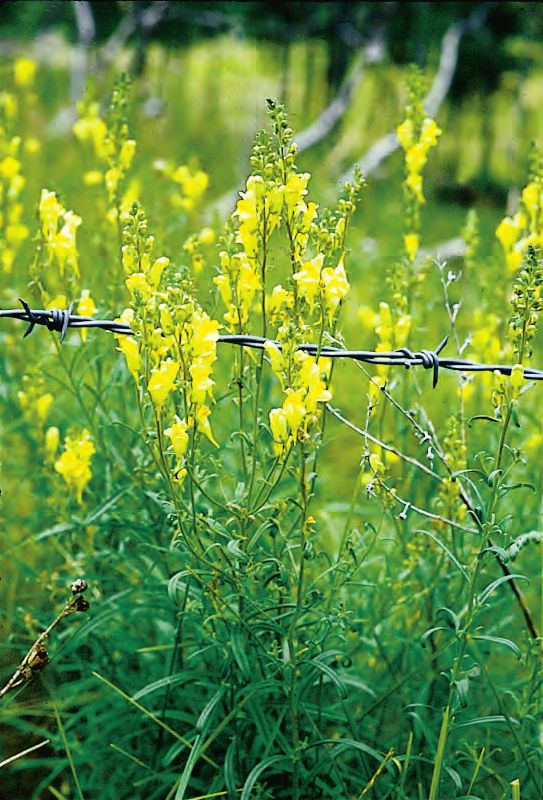
First Printing 1996
                   Reprinted 1998
           Updated and Reprinted 2000
           Updated and Reprinted 2002
           Updated and Reprinted 2005
           Updated and Reprinted 2007
                   Reprinted 2010
           Updated and Reprinted 2014
           Updated and Reprinted 2016
           Updated and Reprinted 2019
           Updated and Reprinted 2021

    1-888-933-3722                    Inter-Ministry Invasive
     bcinvasives.ca                  Species Working Group
  info@bcinvasives.ca         https://www2.gov.bc.ca/gov/content/
                                  environment/plants-animals-
                               ecosystems/invasive-species/imiswg

This field guide is a Province of BC publication that is
 updated and reprinted in collaboration with ISCBC.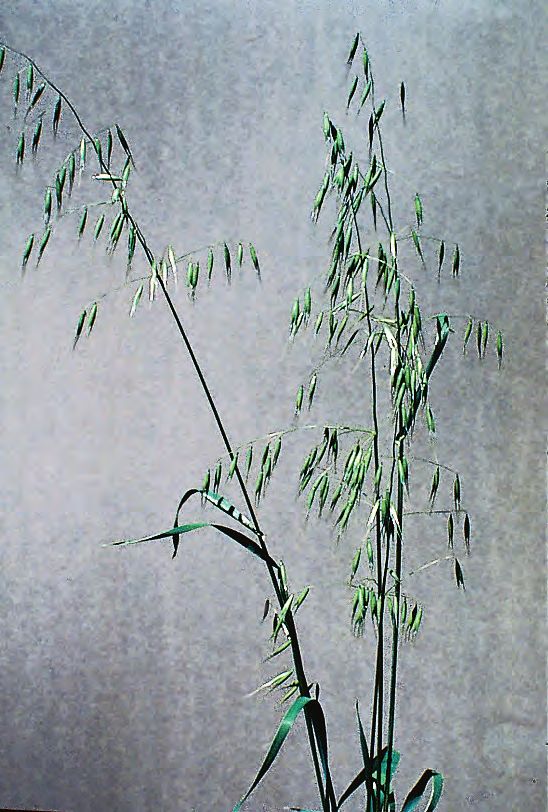
FIELD GUIDE TO NOXIOUS AND OTHER SELECTED
    INVASIVE PLANTS OF BRITISH COLUMBIA

Thanks to all of the following for their contribution
and expertise:

David Ralph and Staff, Invasive Species Council of BC
and Val Miller, Invasive Plant Program, Range Branch,
B.C. Ministry of Forests, Lands and Natural Resource
Operations

Past Contributors:

Dr. Brian Wikeem, previously with Silviculture Branch,
B.C. Ministry of Forests

Roy Cranston, previously with Food Safety and
Quality Branch, B.C. Ministry of Agriculture, Food and
Fisheries

Dwaine Brook (retired) and Susan Turner, B.C. Ministry
of Forests, Lands and Natural Resource Operations, and
the Southern Interior Weed Management Committee.

Acknowledgements:

The information contained in this guide has been
obtained from a number of sources including: E-Flora
BC: Electronic Atlas of the Flora of British Columbia;
The Invasive Species Strategy for British Columbia;
B.C. Weed Control Act; Weeds of Canada; Weeds
of the West; The Arable Weeds of Europe; Vascular
Plants of the Pacific Northwest; Vascular Plants of
British Columbia; The Thistles of Canada; and The
Biology of Canadian Weeds.

                                                         i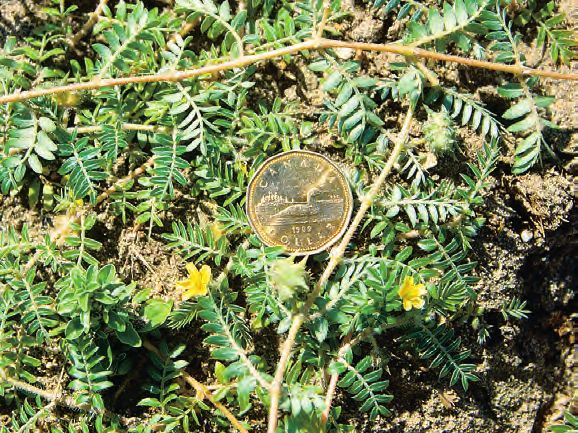
Photo Acknowledgements:

Organizations: B.C. Ministry of Agriculture; B.C.
Ministry of Forests, Lands and Natural Resource
Operations; Washington State University; Washington
State Noxious Weed Control Board; University
of Idaho; University of Arizona; Mountainview
Ecological Services; Invasive Species Council of Metro
Vancouver; USDA Forest Service; Oregon Department
of Agriculture; USDA APHIS PPQ; and Invasive Species
Council of B.C.

Individuals: Michael Betts; Don Blumenauer; Bruce
Brolley; Roy Cranston; Jack Freeman; Vippen Joshi;
Bill McCloskey; Alistair McLean; Robert Needham;
Rosamund Pojar; George Powell; David Ralph; Dave
Riendeau; Ben Roche; Dean Swan; Loal Vance;
Brian Wikeem; John Woods; Leslie Mehrhoff; Rob
Routedge; Victoria Nuzzo; Lisa Scott; Rhoda Mueller;
Juliet Craig; Barb Stewart; and Jeff Hallworth.
From bugwood.org: William Tyrrell; Nick Page;
Steve Dewey; Howard Schwartz; Matt Lavin; Lynn
Sosnoskie; Todd Pfeiffer; Cindy Roche; K. Maitland;
Linda Haugen; Eric Coombs; Dan Tenaglia; Joseph
DiTomaso; and Linda Wilson.

ii
PREFACE
Invasive plants, also known as weeds, are responsible
for reducing crop yield and quality and often lead to
environmental degradation, resulting in loss of native plant
and animal habitat. Some invasive plants also harbour
crop diseases, reduce property values, spoil aesthetics of
natural landscapes and many can be harmful to humans,
livestock and wildlife. This field guide has been prepared to
help farmers, ranchers, resource managers and the public
identify British Columbia’s legislated noxious weeds and
other invasive plants. Proper identification of problem
weeds is the first step in gaining knowledge about these
troublesome plants and will enable the development of a
proper management strategy.

As an aid in separating noxious species, all weeds
legislated under the B.C. Weed Control Act are organized
alphabetically, by common name, at the beginning of the
guide. Weeds classified as noxious throughout the entire
province are arranged first, followed by weeds classified
noxious within regional districts. Following this, other
selected invasive plants are arranged alphabetically. For
more information on weeds in B.C., refer to:
  https://bcinvasives.ca/resources/publications/field-
  guide-to-noxious-weeds-and-other-selected-invasive-
  plants-of-BC
  www.gov.bc.ca/invasive-species
  https://www2.gov.bc.ca/gov/content/environment/
  plants-animals-ecosystems/invasive-species/priority-
  species/priority-plants
  bcinvasives.ca
  ibis.geog.ubc.ca/biodiversity/eflora
To report an invasive plant or weed of concern:

  • SMARTPHONE APP: Use the Report-A-Weed app:
    www.reportaweedbc.ca
  • ONLINE: Report to a provincial Invasive Plant
    Specialist: www.gov.bc.ca/invasive-species
  • CALL 1-888-933-3722

                                                            iii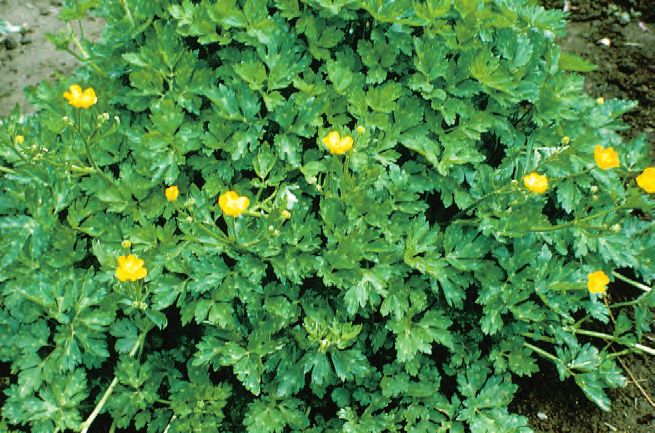
BC Weed Control Act
NOXIOUS WEEDS ARE EVERYONE’S PROBLEM

Non-native, or alien invasive plants have been
introduced to British Columbia without the insect
predators and plant pathogens that help keep them
in check in their native habitats. For this reason
and because of their aggressive growth, these alien
plants can be highly destructive, competitive and
difficult to control. Noxious weeds are those invasive
alien plant species that are regulated under law.

The B.C. Weed Control Act imposes a duty on all
land occupiers to control designated noxious plants.

The purpose for the Act is to protect the province’s
economy, natural resources, and society from the
negative impacts of foreign weeds.

The Act is administered by the Ministry of Forests,
Lands and Natural Resource Operations.

The following weeds are classified as noxious
within all regions of British Columbia:

               PROVINCIALLY NOXIOUS                   PAGE
Bur Chervil (Anthriscus caucalis)                      8
Canada Thistle (Cirsium arvense)                       9
Common Reed (Phragmites australis subsp. australis)    10
Cordgrass, Dense-flowered (Spartina densiflora)        11
Cordgrass, English (Spartina anglica)                  12
Cordgrass, Saltmeadow (Spartina patens)                13
Cordgrass, Smooth (Spartina alterniflora)              14
Crupina (Crupina vulgaris)                             15
Dodder (Cuscuta spp.)                                  16
Flowering Rush (Butomus umbellatus)                    17

1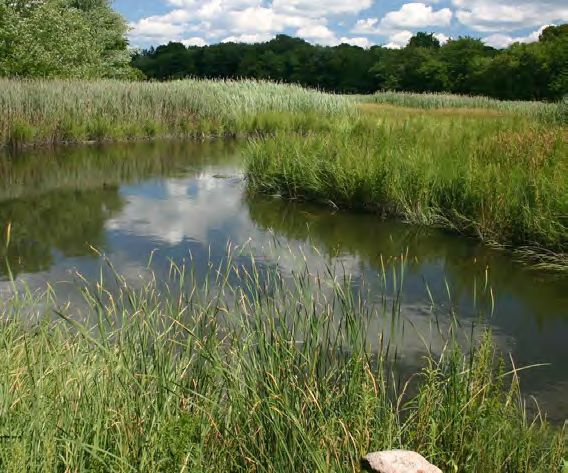
Garlic Mustard (Alliaria petiolata)                  18
Giant Hogweed (Heracleum mantegazzianum)             19
Giant Mannagrass/Reed Sweetgrass (Glyceria maxima)   20
Gorse (Ulex europaeus)                               21
Hound’s-tongue (Cynoglossum officinale)              22
Jointed Goatgrass (Aegilops cylindrica)              23
Knapweed, Diffuse (Centaurea diffusa)                24
Knapweed, Spotted (Centaurea stoebe)                 25
Knotweed, Bohemian (Fallopia x bohemica)             26
Knotweed, Giant (Fallopia sachalinensis)             27
Knotweed, Himalayan (Polygonum polystachyum)         28
Knotweed, Japanese (Fallopia japonica)               29
Leafy Spurge (Euphorbia esula)                       30
Milk Thistle (Silybum marianum)                      31
North Africa Grass (Ventenata dubia)                 32
Nutsedge, Purple (Cyperus rotundus)                  33
Nutsedge, Yellow (Cyperus esculentus)                34
Purple Loosestrife (Lythrum salicaria)               35
Rush Skeletonweed (Chondrilla juncea)                36
Scentless Chamomile (Matricaria maritima)            37
Sow-thistle, Annual (Sonchus oleraceus)              38
Sow-thistle, Perennial (Sonchus arvensis)            38
Tansy Ragwort (Senecio jacobaea)                     39
Toadflax, Common / Yellow (Linaria vulgaris)         40
Toadflax, Dalmatian (Linaria genistifolia)           41
Velvetleaf (Abutilon theophrasti)                    42
Wild Oats (Avena fatua)                              43
Yellow Flag Iris (Iris pseudacorus)                  44
Yellow Starthistle (Centaurea solstitialis)          45

                                                          2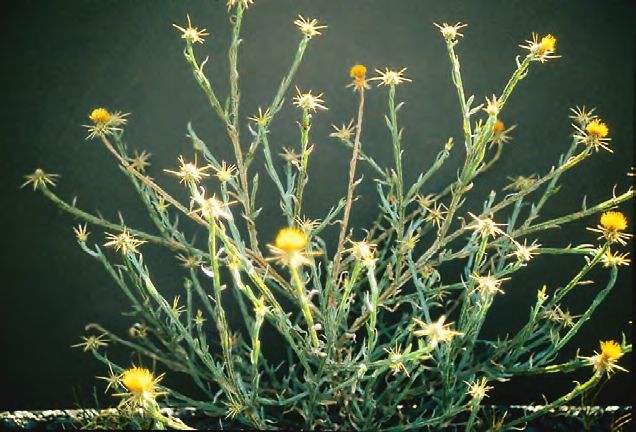
The following weeds are classified as noxious
within the boundaries of the corresponding regional
districts:

                REGIONALLY NOXIOUS                     PAGE
                         Cariboo, Central Kootenay,
                         Columbia-Shuswap, East
Blueweed (Echium
                         Kootenay, Okanagan-            47
vulgare)
                         Similkameen, Thompson-
                         Nicola
                       Bulkley-Nechako, Cariboo,
                       Columbia-Shuswap, Fraser-
                       Fort George, Kitimat-Stikine,
Burdock (Arctium spp.)                                  48
                       North Okanagan, Okanagan-
                       Similkameen, Peace River,
                       Thompson-Nicola
Cleavers (Galium
                         Peace River                    49
aparine)
Common Bugloss
                         Kootenay-Boundary              50
(Anchusa officinalis)
                         Bulkley-Nechako, Central
Common Tansy             Kootenay, Columbia-
                                                        51
(Tanacetum vulgare)      Shuswap, East Kootenay,
                         North Okanagan
Field Scabious (Knautia Bulkley-Nechako, Kootenay-
                                                        52
arvensis)               Boundary, Thompson-Nicola
Green Foxtail (Setaria
                         Peace River                    53
viridis)
                         Bulkley-Nechako, Cariboo,
Hawkweed,
                         Central Kootenay, Columbia-
Orange (Hieracium                                       54
                         Shuswap, East Kootenay,
aurantiacum)
                         Thompson-Nicola
Hoary Alyssum
                         Kootenay-Boundary              55
(Berteroa incana)
Hoary Cress (Cardaria    Columbia-Shuswap, North
                                                        56
spp.)                    Okanagan, Thompson-Nicola
Knapweed, Meadow
                         Columbia-Shuswap               57
(Centaurea pratensis)
Knapweed, Russian
                         North Okanagan                 58
(Acroptilon repens)

3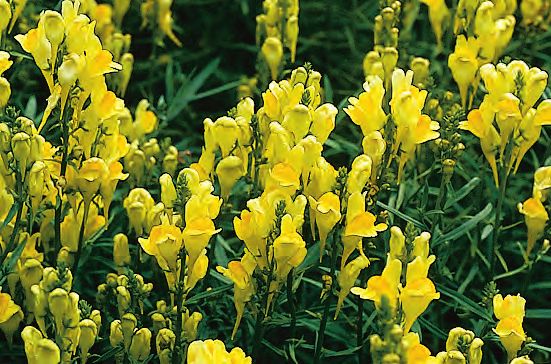
Kochia
                          Peace River                    59
(Kochia scoparia)
Marsh Plume Thistle       Bulkley-Nechako, Fraser-Fort
                                                         60
(Cirsium palustre)        George
Night-Flowering
Catchfly (Silene          Peace River                    61
noctiflora)
Oxeye Daisy               Cariboo, North Okanagan,
(Chrysanthemum            Peace River, Thompson-         62
leucanthemum)             Nicola
Perennial Pepperweed      East Kootenay, Thompson-
                                                         63
(Lepidium latifolium)     Nicola
Puncturevine (Tribulus
                          Okanagan-Similkameen           64
terrestris)
Quackgrass
                          Peace River                    65
(Agropyron repens)
                          Columbia-Shuswap, North-
Sulphur Cinquefoil        Okanagan, Okanagan-
                                                         66
(Potentilla recta)        Similkameen, Thompson-
                          Nicola
Thistle, Plumeless
                          Central Kootenay               67
(Carduus acanthoides)
Thistle, Russian
                          Peace River                    68
(Salsola kali)
Thistle, Scotch
(Onopordum                North Okanagan                 69
acanthium)
Wild Chervil
                          Fraser Valley                  70
(Anthriscus sylvestris)
Wild Mustard (Sinapsis
                          Peace River                    71
arvensis)

                                                              4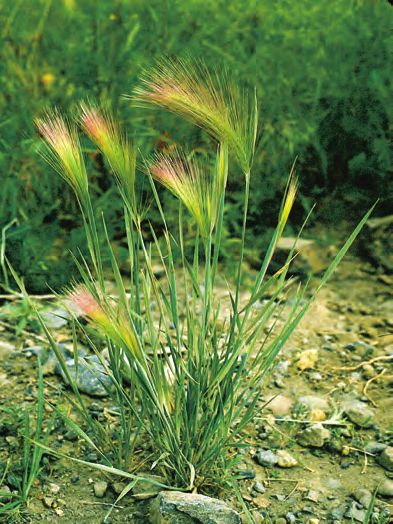
The following are additional invasive plants of
concern in B.C.:

          INVASIVE PLANTS OF CONCERN          PAGE
Baby’s Breath (Gypsophila paniculata)             73
Bladder Campion (Silene cucubalus)                74
Bull Thistle (Cirsium vulgare)                    75
Chicory (Cichorium intybus)                       76
Cluster Tarweed (Madia glomerata)                 77
Common Mallow (Malva neglecta)                    78
Creeping Buttercup (Ranunculus repens)            79
Curled Dock (Rumex crispus)                       80
Field Bindweed (Convolvulus arvensis)             81
Foxtail Barley (Hordeum jubatum)                  82
Goatsbeard - Western (Tragopogon dublus)          83
Himalayan Balsam (Impatiens glandulifera)         84
Knapweed, Brown (Centaurea jacea)                 85
Nightshade (Solanum spp.)                         86
Nodding Thistle (Carduus nutans)                  87
Scotch Broom (Cytisus scoparius)                  88
St. John’s-Wort (Hypericum perforatum)            89
Teasel (Dipsacus fullonum)                        90
Water Hemlock (Cicuta douglasii)                  91

5
PROVINCIALLY
REGULATED
NOXIOUS WEEDS
Common Reed
(Phragmites australis
subsp. australis)REPORTING
Report the following invasive plants or weeds of
concern to:
4 TOLL FREE 1-888-933-3722
4 Report online / use the Report Invasives app:
www.gov.bc.ca/invasive-species
NOTES
7PROVINCIAL NOXIOUS
Bur Chervil
(Anthriscus caucalis)
• Annual or biennial herb from a taproot;
40 cm to 90 cm tall; hollow, branched stems
that are hairy near the base; basal and stem
leaves are fern-like and alternate along stem;
leaves are coarse-hairy and reduce towards the
top of the stem; small white flowers with
5 petals are borne in umbrella-like clusters at
the top of stems
• Found in moist fields, ditches, disturbed sites
and waste places
• Reproduce by seed only
• Introduced from Eurasia
8PROVINCIAL NOXIOUS
CANADA THISTLE
(Cirsium arvense)
Flowerheads with spineless bracts
Seedling
Young rosette
• Creeping rooted perennial growing erect to
1.2 m; stalkless dark green leaves with irregular
spiny lobes; flowerheads spineless and small
compared to other thistles; flowers variable in
colour from rose-purple to pink to white
• Only thistle with male and female flowers on
separate plants
9PROVINCIAL NOXIOUS
Common Reed
(Phragmites australis subsp. australis)
• Perennial grass; 1 m to 3 m tall; stiff, smooth,
round, hollow, un-branched, purplish erect
stems; leaves are 20 cm to 40 cm long,
alternating up the stems and often twisting at
the base so that they appear flag-like on one
side; plume-like clusters of purplish flowers
arranged densely along the branches
• Very limited distribution in B.C.; found in
marshes, ponds, lakeshores and ditches
• Reproduces by rhizomes and seeds
• Introduced from Europe through ballast water
10PROVINCIAL NOXIOUS
CORDGRASS, DENSE-FLOWERED
(Spartina densiflora)
• Perennial aquatic grass; up to 1.5 m tall; hollow
stems; grayish leaf blades that are narrow
(0.6 cm wide), long, tough and in-rolled; dense,
compact, colorless flowers that form a spike
that is 6 cm to 30 cm long
• Salt tolerant and can establish in ecosystems
that range from intertidal marshes to terrestrial
ecosystems
• Reproduces by rhizomes and seed
• Introduced from South America
11PROVINCIAL NOXIOUS
Cordgrass, ENGLISH
(Spartina anglica)
• Deep rooting perennial salt marsh grass; up
to 1.3 m tall; erect reddish brown stem; bright
green leaf blades grow at distinctive 45-90
degree angle to the stems; flower heads
resemble that of wheat
• Reproduces mainly by rhizomes
• Introduced from England
12PROVINCIAL NOXIOUS
Cordgrass, Saltmeadow
(Spartina patens)
• Perennial grass from rhizomes; 30 cm to
100 cm tall; stem are slender, stiff and
numerous; narrow bright green leaves,
10 cm to 50 cm long, with the edges in-rolled
and prominent veins on the lower surface;
inflorescence emerge at the end of the stem,
which is composed of 2 to 10, 5 cm-long
spikelet’s.
• Typically found in intertidal wetlands
• Reproduces by rhizomes
• Native to the east coast of North America
13PROVINCIAL NOXIOUS
Cordgrass, SMOOTH
(Spartina alterniflora)
• Herbaceous perennial grass; 0.6 m to 2 m tall;
stems have an unpleasant sulfur aroma when
fresh; leaves flat, 10 mm to 25 mm wide, up to
60 cm long, with the tips in-rolled and tapering
to a slender point and the uppermost leaves
gracefully drooping; flowers are borne in
multiple, slender upright racemes, 5 cm to
20 cm long
• Commonly forms dense colonies in intertidal
wetlands
• Reproduces by seeds and rhizomes
• Introduced from England for shoreline erosion
control
14PROVINCIAL NOXIOUS
Crupina
(Crupina vulgaris)
Stiff dark bristles on seed
Narrow flowerhead with pink to
purple flowers
• Annual growing from 0.3 m to 0.9 m tall; short,
stiff hairs on leaf margins make the plant
prickly feeling; 1 to 5 flowerheads per branch;
pink to purple flowers
NOTE: Crupina currently invading rangelands in
northern Idaho and Oregon. Not known to B.C.
PLEASE REPORT SIGHTINGS
15PROVINCIAL NOXIOUS
Dodder
(Cuscuta spp.)
Dodder parasitizing alfalfa
• Annual parasitic plant having no leaves or
green parts
• Also called strangleweed for the thread-like
yellow to orange twining stems that coil
around and attach to host plants with wart-like
suckers
• A particular concern in vegetable and forage
crops and ornamentals
• Can produce over 16,000 seeds per plant that
can remain viable for over 60 years
16PROVINCIAL NOXIOUS
Flowering Rush
(Butomus umbellatus)
• Perennial aquatic herb; up to 1.5 m tall; green
stem that resemble bulrush; thin sword-shaped
leaves that extend up to 1 m in length; pink
flowers that form umbrella-like clusters
• Can grow as an emergent plant along
shorelines and as a submersed plant in lakes
and rivers
• Reproduces mainly by rhizomes
• Introduced from Europe as an ornamental
plant for water gardens
• Very limited distribution in B.C.
PLEASE REPORT SIGHTINGS
17PROVINCIAL NOXIOUS
Garlic Mustard
(Alliaria petiolata)
• Biennial herb with a taproot; 20 cm to 120 cm
tall; dark green basal leaves are kidney shaped
while stem leaves are heart shaped; white
flowers that grow in clusters
• Roots and crushed leaves emit a garlic smell
• Reproduces by seed
• Introduced from Eurasia for cooking and
medicinal purposes
18PROVINCIAL NOXIOUS
Giant Hogweed
(Heracleum mantegazzianum)
• Perennial herb; 1.5 m to 5 m tall; stout hollow
green stems covered in purple spots; dark
green leaves that are coarsely toothed with
stiff underside hairs; numerous small white
flowers that cluster to form larger umbrella-
shaped heads
• Reproduces by seed; 50,000 seeds per plant
• Introduced from Asia as an ornamental plant
WARNING: Phototoxic stems and leaves contain a
poisonous sap that causes serious burns and painful
blisters when handled without protective gear.
19PROVINCIAL NOXIOUS
Giant Mannagrass/ Reed
Sweetgrass (Glyceria maxima)
• Perennial grass; 0.6 m to 2.5 m tall; hollow
erect stems; bright green leaves with a
prominent mid rib; short, stiff hairs along the
leaf margin; leaf sheaths are rough in texture
and have a reddish-brown band at the junction
with the leaf; each spikelet has 4-9 flowers
• Found in brackish tidal marshes, lakeshores and
wet meadows
• Reproduces by rhizomes
• Introduced from Eurasia for livestock forage
20PROVINCIAL NOXIOUS
Gorse
(Ulex europaeus)
• Spiny, perennial, evergreen shrub in the Pea
Family growing to over 2 m; small leaves
terminate in rigid spines; bright yellow flowers
surrounded by a velvety calyx develop into
black seedpods with dark hairs
• Currently limited in distribution in B.C. to
coastal areas, primarily southern Vancouver
Island and Gulf Islands
21PROVINCIAL NOXIOUS
Hound’s-tongue
(Cynoglossum officinale)
Rosette
Each flower produces 4 burred seeds
Seeds easily attach to passing animals
• Biennial taprooted weed growing 0.5 m to
1.2 m tall; soft, hairy rosette leaves (7 cm to
30 cm long) produced in first year resemble
the shape of a dog’s tongue; stem leaves
are shorter and stalkless; dull reddish-purple
flowers bear 4 rounded triangular nutlets
(seeds) that are covered with hooked prickles
• Easily spread by seeds that cling to clothes/animals
• Contains toxic alkaloids that can cause liver
damage in grazing animals
• Well adapted to forested areas, roadsides and
meadows
22PROVINCIAL NOXIOUS
Jointed Goatgrass
(Aegilops cylindrica)
Hairy auricles and evenly spaced
hairs on leaf edges
• Winter annual grass with erect stems growing
0.4 m to 0.8 m tall
• Seeds are produced in joint-like structures on
the cylindrical flowering spike
• Not known to B.C.
PLEASE REPORT SIGHTINGS
23PROVINCIAL NOXIOUS
Knapweed, DIFFUSE
(Centaurea diffusa)
Rigid spines on tips of flower bracts
Bolting plant
• Biennial to short-lived taprooted, perennial,
heavily branched, growing from 0.6 m to 1 m in
height; divided leaves grayish-green in colour,
hairy; very bitter to the taste
• White, occasionally purple flowers; bracts of
the flowerheads with small, sharp, rigid spines
• One of 13 “knapweed” species in B.C.
24PROVINCIAL NOXIOUS
Knapweed, SPOTTED
(Centaurea stoebe)
• Biennial to short-lived taprooted perennial
with branched stems growing to 1.5 m in
height; deeply cut hairy leaves; very bitter
to taste; purple, occasionally white flowers;
flowerhead bracts with black-tipped fringe
giving head the “spotted” appearance
• One of 13 “knapweed” species in B.C.
25PROVINCIAL NOXIOUS
Knotweed, Bohemian
(Fallopia x bohemica)
• Rhizomatous perennial herb; up to 1.5 m to
3.5 m tall; erect, profusely branched stems;
large pointed leaves that have a squared off
to heart-shape base; flower clusters located
at stem and branch tips; sepals are white to
pinkish white in color
• A hybrid of the Japanese and Giant knotweeds
and is reliably distinguished from these by the
soft, short hairs along the veins on the lower
surface of new leaf growth in the spring
• Reproduces primarily by spreading rhizomes,
root and stem fragments
• Introduced from Asia
26PROVINCIAL NOXIOUS
Knotweed, GIANT
(Fallopia sachalinensis)
• Perennial herb; 2 m to 6 m tall; erect reddish
hollow stems that are bamboo-like; stem
leaves are 20 cm to 40 cm long, alternate and
widely egg-shaped with the base heart-shaped;
hairs on the underside of the leaves along the
mid vein; basal leaves are absent; pale green or
greenish-white flowers form in clusters along
the stem
• It is closely related to Japanese Knotweed
(Fallopia japonica), and can be distinguished
from it by its larger size; leaves have a heart-
shaped (not straight) base
• Reproduces mainly by rhizomes
• Introduced from Asia as an ornamental plant
27PROVINCIAL NOXIOUS
Knotweed, Himalayan
(Polygonum polystachyum)
• Perennial herb; 1 m to 5 m tall; bamboo-like
stems with reddish-brown speckles; alternating
leaves with the base rounded to somewhat
heart-shaped, often with 2 small lobes; leaves
have dense, grey-green soft hairs on the
undersides; small white-green flowers grow in
plume-like clusters along the stem and leaf axis
• Found in moist sites such as riparian areas
• Reproduces by rhizomes
• Introduced from Asia as an ornamental plant
28PROVINCIAL NOXIOUS
Knotweed, Japanese
(Fallopia japonica)
• Rhizomatous, semi-woody, herbaceous perennial
in the Buckwheat Family that grows to 3 m
in height; “bamboo-like” stems are green to
reddish-brown and spotted; leaves are egg-
shaped, stalked, 10 cm to 15 cm long, flattened
or rounded at the base with a pointed tip and
are dark green above and lighter green below;
greenish to creamy-white flowers are produced
in clusters from the leaf axils
• An escaped ornamental originating from
eastern Asia, Japanese knotweed forms
aggressive, dense thickets maintained by
extensive and deep, creeping rhizomes. New
shoots are known to penetrate thick asphalt
29PROVINCIAL NOXIOUS
Leafy Spurge
(Euphorbia esula)
Greenish-yellow flower clusters
and bracts
Creeping rootstocks
• Perennial with persistent vertical and
horizontal creeping roots; grows to 0.8 m
tall; leaves spirally arranged on the stem;
inconspicuous greenish-yellow flowers inserted
above 2 leaf-like yellow-green bracts
• All parts of the plant contain a white milky
latex that can irritate skin of livestock and
humans
30PROVINCIAL NOXIOUS
Milk Thistle
(Silybum marianum)
• Annual or biennial herb; 0.5 m to 1.5 m tall;
stems are grooved, sometimes with white
cottony hairs especially toward the base;
alternate shiny pale green leaves with milk-
white veins; flower heads are large and
rounded, occurring at stem tips; flowers are red
to purple thistles armed with 3 cm long spine-
tipped bracts
• Found on nutrient rich sites, such as river flats
and stock yards
• Reproduces by seed
• Introduced from Eurasia for medicinal use
31PROVINCIAL NOXIOUS
North Africa Grass
(Ventenata dubia)
• Annual grass; 30 cm to 70 cm tall; stems are
smooth to short-hairy, basally branched;
sheaths usually minutely rough but sometimes
soft-hairy; leaves fine, 2 cm to 7 cm long,
flattened at first, becoming in-rolled, with a
rounded, jagged-edged; spikelet’s are near the
branch tips and are stalked; lemmas have bent
awns arising from their backs, much like those
of wild oats
• Limited distribution in B.C.; found along dry
roadsides or cultivated fields
• Reproduces by seed
• Introduced from the Mediterranean region
32PROVINCIAL NOXIOUS
Nutsedge, PURPLE
(Cyperus rotundus)
Leaf-like flower bracts
are shorter than inflorescence
Tubers are produced in chains on
rhizomes
• Aggressive perennial in crops, landscaping and
gardens, growing from 0.3 m to 0.6 m tall;
triangular 3-sided unbranched flower stems;
grass-like leaves; purple to brown flowers; leaf-
like bracts under flower clusters are shorter
than the flowers; rough, oblong, irregularly
shaped tubers are formed in chains; tubers
have a bitter flavour
• Native to Eurasia but not currently established
in B.C.
PLEASE REPORT SIGHTINGS
33PROVINCIAL NOXIOUS
Nutsedge, YELLOW
(Cyperus esculentus)
Flower cluster above long
leaf-like bracts
Tubers
• Aggressive rhizomatous perennial in the Sedge
Family; grows from 0.3 m to 0.8 m tall with
triangular 3-sided unbranched smooth stems;
grasslike leaves; yellowish-brown flowers with
long leaf-like bracts under umbrella-like flower
clusters; smooth, round, whitish almond-
flavoured tubers produced at ends of many
rhizomes
• Increasing in berry fields in the Fraser Valley
34PROVINCIAL NOXIOUS
Purple Loosestrife
(Lythrum salicaria)
Purple flowers produced
on terminal spikes
Fireweed Seed-bearing spikes
• Wetland perennial with a woody taproot and
branching fibrous root system; 1m to 3 m in
height; stiff, four-sided stem with opposite
or sometimes whorled stalkless leaves; purple
flowers in a dense terminal spike
• Can produce over 2.5 million seeds annually
• Sometimes confused with fireweed (Epilobium
angustifolium); many infestations have resulted
from escape of ornamental varieties
35PROVINCIAL NOXIOUS
Rush Skeletonweed
(Chondrilla juncea)
Dandelion-like basal leaves with
downward pointing stiff hairs at
base of stem
Parachute-like seeds easily
spread by wind
• Taprooted perennial growing to 1.3 m in
height; much branched wiry stems covered with
stiff, reddish-brown downward pointing hairs
at the base; stems have a milky juice; very small
leaves give plant a “skeletonlike” appearance;
small yellow flowers
• Taproot can penetrate 2.5 m in the soil; new
plants arise from lateral root buds in upper
0.6 m of soil
• Can produce up to 15,000 seeds annually
36PROVINCIAL NOXIOUS
Scentless Chamomile
(Matricaria maritima)
Fern-like finely divided leaves
• Annual to short-lived perennial; white daisy-
like flowers 2 cm to 3 cm across; grows from
15 cm to over 1 m in height; fern-like, very
finely divided leaves
• Whole plant is virtually odourless (scentless)
when crushed
• Can produce 10,000 to 200,000 seeds per plant
• Often confused with stinking mayweed
(Anthemis cotula), oxeye daisy (Leucanthemum
vulgare) and pineappleweed (Matricaria
matricariodes). Stinking mayweed has a very
offensive odour when crushed as well stem
hairs below the flower heads. Oxeye daisy has
flowers to 5 cm across, rhizomatous roots and
entire, notched leaves. Pineappleweed grows
to 16 cm high, has no white ray flowers and has
a distinct pineapple odour when crushed.
37PROVINCIAL NOXIOUS
Perennial Sow-thistle
(Sonchus arvensis)
Annual Sow-thistle
(Sonchus oleraceus)
Perennial sow-thistle with
milky latex and clasping stem
Spiny annual sow-thistle
• Creeping rooted perennial growing 0.4 m to
1.5 m tall; stems branch near the top; leaves
with weak marginal prickles clasp the stem;
plants contain a bitter milky juice; upper stalks
and flower bracts usually covered in gland-
tipped hairs; yellow flowers up to 3.8 cm broad
• Often confused with annual sow-thistle
(Sonchus oleraceus) which is taprooted and
has much smaller flowers (less than 2.5 cm
across) or spiny annual sow-thistle (Sonchus
asper) which has sharp, spiny leaves and smaller
flowers
38PROVINCIAL NOXIOUS
Tansy Ragwort
(Senecio jacobaea)
Deeply divided rosette leaves
Ray flowers distinguish this plant from
common tansy (Tanacetum vulgare)
• Biennial to short-lived perennial growing
0.3 m to 1.2 m tall; leaves deeply cut into
irregular segments give plant a “ragged”
appearance; yellow flowers in a flat-topped
cluster
• Contains a toxic alkaloid which reacts with
enzymes in livestock that creates cumulative
liver damage
39PROVINCIAL NOXIOUS
Toadflax, COMMON / Yellow
(Linaria vulgaris)
Yellow snapdragon-like flowers
• Creeping rooted perennial to 0.6 metres tall;
the stalkless leaves are narrow and pointed at
both ends; bright yellow “snapdragon-like”
flowers with an orange spot on the lower lip
are 2 to 3.5 cm long
• Flowers similar to but smaller than Dalmatian
toadflax (Linaria dalmatica); likely introduced
as an ornamental.
40PROVINCIAL NOXIOUS
Toadflax, DALMATIAN
(Linaria genistifolia subsp. dalmatica)
• Creeping rooted perennial to 1.2 m tall; pale
green waxy leaves clasp the stem and are
heart-shaped with a pointed tip; bright yellow
“snapdragon-like” flowers with orange spot on
the lower lip (2.5 cm to 4 cm long)
• Likely introduced to North America as an
ornamental
41PROVINCIAL NOXIOUS
Velvetleaf
(Abutilon theophrasti)
Seedling
Showy yellow flowers and distinctive
circular seedpods
• Annual taprooted weed in the Mallow Family
growing from 0.3 to over 2.4 m in height;
entire plant covered with short, soft, velvety
hairs; large heart-shaped leaves are 7.5 cm to
20 cm wide; yellow to yellow-orange flowers;
distinctive circular cluster of 12 to 15 seedpods
• First discovered in B.C. in the Fraser Valley in
1990; seeds can remain viable in soil for over
50 years
42PROVINCIAL NOXIOUS
Wild Oats
(Avena fatua)
Heavily bearded flowers. Awns are
twisted and bent at right angles
when mature
Base of leaf blades are slightly hairy
• Annual grass with hollow erect stems from
0.3 m to 1 m tall; leaves of seedlings twist
counter-clockwise when viewed from above;
yellow to black seeds with a bent, twisted
bristle (awn); seeds with a circular scar (sucker
mouth) at the base
• Seeds can remain viable in soil for over 10 years
• Cultivated oats lack the circular scar on the
seed and either lack an awn or the awn is
straight
43PROVINCIAL NOXIOUS
Yellow Flag Iris
(Iris pseudacorus)
• Perennial herb; 1 m to 1.5 m tall; leaves are
erect, flattened and sword-like and extend
0.5 m to 1 m in length; showy yellow flowers
with three sepals
• Found in ditches, shallow ponds, marshes and
along still and slow-moving water courses.
• Reproduces by rhizomes and seeds
• Introduced from the Mediterranean region as
an ornamental plant
44PROVINCIAL NOXIOUS
Yellow Starthistle
(Centaurea solstitialis)
Flowerhead bracts end in sharp,
stiff spines
• Annual taprooted heavily branched weed
growing from 0.6 m to 1 m tall; stems are
winged and covered with fine hair; yellow
flowers are borne on ends of branches and
armed with sharp thorns up to 2 cm long
• Not currently known in B.C. but close to our
borders with Washington and Idaho
PLEASE REPORT SIGHTINGS
45REGIONALLY
REGULATED
NOXIOUS WEEDS
Burdock
(Arctium spp.)REGIONAL NOXIOUS
Blueweed
(Echium vulgare)
Flowers produced on upper side of First year rosette
short stems
• Biennial to short-lived perennial, taprooted,
growing to 1 m high; stems covered in stiff
hairs with swollen reddish to black bases where
attached to stem
• Invades rangelands, pastures, roadsides and
idle areas particularly on coarse, sandy to
gravelly soils
• Produces 500 to 2,000 seeds per plant
47REGIONAL NOXIOUS
Burdock
(Arctium spp.)
Flowerhead bracts with hooked spines
• Biennial weeds common in farmyards,
fencelines, roadsides, streambanks and idle
areas; well known for their rounded flower
heads with hooked spines that easily attach to
clothing and animals
• Common burdock (Arctium minus) grows 1 m
to 3 m in height; lower leaf stalks are hollow;
flower heads are less than 2.5 cm across and
scattered along the stems
• Great burdock, sometimes called giant burdock
(Arctium lappa) is similar in appearance but
lower leaf stalks are solid and flower heads are
over 2.5 cm across and are arranged in a flat-
topped cluster rather than along the stem
48REGIONAL NOXIOUS
CLEAVERS
(Galium aparine)
Leaves in whorl around square stem
Seed-cases produced in pairs are
covered with hooked hairs
• Native annual with square stems and short,
bristly downward pointing hooks on stem
corners; rough, hairy leaves grow in whorls of
6 to 8; burrlike seeds produced in pairs
• Commonly known as bedstraw, cleavers is
particularly damaging in cereals and canola
where it clings to and trails around these crops
49REGIONAL NOXIOUS
Common Bugloss
(Anchusa officinalis)
“Fiddleneck” flower stem uncoils as
each bud opens
• Deep taprooted perennial in the Borage Family
with hairy, angular stems growing to 0.6 m tall;
lance-shaped fleshy leaves are covered with
stiff hairs; deep purple to blue flowers with
white centres; flower stems, initially coiled like
a fiddleneck, straighten out as each bud opens;
four nut-like seeds produced per flower
• Prefers dry, sandy to gravelly soils. Average seed
production is in excess of 900 seeds per plant
• Is sometimes confused with blueweed (Echium
vulgare)
50REGIONAL NOXIOUS
Common Tansy
(Tanacetum vulgare)
Button-like yellow flowers
Seedling leaves with
serrated leaflet margins
• Aromatic perennial growing to 1.8 m tall;
deeply divided dark green leaves; yellow
“button” flowers in cluster at top of plant; no
ray flowers
• Often confused with tansy ragwort (Senecio
jacobaea) that has ray flowers
51REGIONAL NOXIOUS
Field Scabious
(Knautia arvensis)
Violet flowers
Roadside infestation
• Taprooted perennial in the Teasel Family
growing to 1.3 m in height; violet-blue flowers;
stems and leaves with short, stiff hairs
• Produces up to 2,000 seeds per plant
52REGIONAL NOXIOUS
Green Foxtail
(Setaria viridis)
Seeds produced in a “bottle-brush”
inflorescence
• Annual grass growing in tufts from 0.5 m
to 1 m in height; young leaves with upward
pointing hairs; upper leaves are hairless and
rough; seeds clustered in a dense club; 1 to
3 bristles from the base of each flower give the
head a “bottle-brush” appearance
• Can produce over 34,000 seeds per plant
• Yellow foxtail (Setaria glauca) is similar but
with long twisted hairs near the base of leaf
blades
53REGIONAL NOXIOUS
Hawkweed, Orange
(Hieracium aurantiacum)
• Fibrous-rooted perennial with milky juice and
above ground runners grows 30 cm to 60 cm
tall; leaves mostly basal; leafless flowering
stalk covered with stiff, black, glandular hairs;
vibrant orange-red flowers
• Reproduces rapidly by seed, stolons, and
rhizomes and forms dense mats
• Over 15 hawkweed species occur in B.C.
54REGIONAL NOXIOUS
Hoary Alyssum
(Berteroa incana)
Flattened seedpods held close to
the stem
• Annual to short-lived perennial in the Mustard
Family growing erect to 0.7 m tall; the whole
plant covered with star-shaped hairs; upper
leaves are elliptic and clasp the stem; white
flowers with deeply notched petals; oval
seedpods are 5 mm to 8 mm long, somewhat
flattened and held close to the stem
WARNING: Toxic to horses. Consumption may cause
fever, limb edema, and laminitis.
55REGIONAL NOXIOUS
Hoary Cress
(Cardaria spp.)
Heart-shaped seedpods
“White-top” infestation
• Creeping rooted perennial in the Mustard
Family growing from 0.1 m to 0.6 m tall; lower
leaves are stalked and hairy while upper
leaves clasp the stem and are usually hairless;
numerous white flowers produced at the top of
the plant give rise to its other common name of
“white-top”
• Heart-shaped seedpods distinquish this hoary
cress from lens-podded and globe-podded
hoary cress (Cardaria chalepensis and Cardaria
pubescens)
56REGIONAL NOXIOUS
Knapweed, MEADOW
(Centaurea pratensis)
Margins of flowerhead bracts either
thin and papery or comb-like
• Perennial from a woody root crown to
0.5 m to 1 m tall; basal leaves are up to 15 cm
long; lance-shaped stem leaves are entire or
shallowly lobed and stalkless; upper leaves
are small and not lobed; globe-shaped flower
heads are solitary at branch ends; flower bracts
consist of either a thin, torn, papery margin or
a comb-like fringe, particularly on the outer
bracts; flowers are rose-purple, sometimes
white
• Likely a hybrid between black and brown
knapweed
57REGIONAL NOXIOUS
Knapweed, Russian
(Acroptilon repens)
Purple flower with papery
margined bracts
Creeping roots produce dense
infestations
• Creeping rooted perennial with erect stems
to 1 m tall; young stems covered in soft, gray
hairs; rounded flower heads produced singly
at the ends of branches; flowers light pink to
purple; small pearly bracts with papery margins
that are slightly hairy at the tip
58REGIONAL NOXIOUS
Kochia
(Kochia scoparia)
Flower clusters Seedling
• Much branched erect annual growing from
0.3 m to 2 m in height; main stem often
tinged with red; stalkless narrow leaves with
entire margins often turn purple in autumn;
inconspicuous flowers usually surrounded by
cluster of long hairs
• An ornamental form called “burning bush” for
its reddish-purple colour sometimes escapes
cultivation
59REGIONAL NOXIOUS
Marsh Plume Thistle
(Cirsium palustre)
Flowers grouped at end of branches
Spine-tipped leaves with woody veins
• Biennial growing erect to about 1.5 m; slender
stems are strongly spiny-winged and are
usually unbranched except the upper portion
which terminates in clusters of purple flower
heads; deep segmented, spinetipped leaves
are somewhat hairy on the underside and have
prominent woody veins
• This native of Europe prefers moist woodlands,
riparian areas, roadsides and pastures on both
disturbed and undisturbed sites. It is increasing
in central B.C.
60REGIONAL NOXIOUS
Night-Flowering Catchfly
(Silene noctiflora)
Flower of night-flowering catchfly
White cockle
• Annual to winter annual growing to 1 m tall;
entire plant covered with soft, sticky hairs;
calyx with 10 prominent branching green veins;
white flowers open near dusk
• Often mistaken for white cockle (Lychnis alba)
(REGIONAL NOXIOUS), a biennial plant. Hairs
of white cockle are not glandular and the plant
is not sticky when squeezed; calyx with 20
unbranched veins
61REGIONAL NOXIOUS
Oxeye Daisy
(Leucanthemum vulgare)
Solitary flowers at the end of branches
Infestations not readily
grazed due to disagreeable taste
• Rhizomatous perennial growing erect to 1 m
in height; lower leaves spoon-shaped, coarsely
dissected and stalked; upper leaves narrower
and stalkless or clasp the stem; daisy-like
flowers borne at ends of stems; central yellow
disk flowers 10 mm to 20 mm wide; white ray
flowers are 1 cm to 2 cm long
• Often confused with the ornamental Shasta
daisy (Chrysanthemum maximum) which is a
more robust plant with larger flowers; central
yellow disk flowers 2 to 3 cm wide; white ray
flowers 2 to 3 cm long
62REGIONAL NOXIOUS
Perennial Pepperweed
(Lepidium latifolium)
Waxy leaves with distinctive white veins
Seedling
• Rhizomatous perennial in the Mustard Family
growing from 0.3 m to 1 m tall (2 or more m in
wet areas); lance-shaped leaves are waxy with
distinctive white mid-veins: lower leaves are
stalked; upper leaves are either short stalked
or stalkless but do not clasp the stem; white
flowers are borne in dense, rounded clusters at
branch tips
• 2 reddish-brown seeds are contained in each
tiny, rounded and somewhat hairy fruit (silicle)
• Very competitive weed that can form dense
colonies in riparian areas and on rangeland/
pastures
• Can produce over 6 billion seeds per acre
63REGIONAL NOXIOUS
Puncturevine
(Tribulus terrestris)
Spiny seeds break into sections
when mature
• Annual, branching from the base and
spreading along ground to form dense mats;
leaves are hairy and grow in pairs on opposite
sides of stem; leaf divided into 4 to 8 pairs of
oval leaflets; yellow flowers originate in leaf
axils; fruit with 5 sections that form tough,
sharp sometimes curving spines
• Sharp spines easily penetrate leather, and skin
and can flatten rubber tires
64REGIONAL NOXIOUS
Quackgrass
(Agropyron repens)
Sharp-pointed creeping rhizomes
Auricles clasp the stem
• Aggressive perennial grass with long slender
white rhizomes; rhizome tips are yellowish and
sharp-pointed; base of leaf blade with claw-like
appendage that clasps the stem; spikelets, up
to 15 cm long, are in 2 long rows borne flatwise
to the stem
• Easily regenerates from very small broken
rhizome fragments making mechanical control
difficult
65REGIONAL NOXIOUS
Sulphur Cinquefoil
(Potentilla recta)
Sulphur coloured flowers
Palmate leaf with 5 to 7 leaflets
• Introduced long-lived taprooted perennial in
the Rose Family with hairy stems growing from
0.3 m to 0.8 m tall; leaves divided into 5 to 7
hairy leaflets in palmate fashion; pale yellow
flowers have 5 heart-shaped petals around a
bright yellow centre
• One of over 20 cinquefoils in B.C., most of
which are native
• Can produce over 1600 seeds per plant
• Often confused with the native graceful
cinquefoil (Potentilla gracilis) which is shorter
and has white wooly hair on the undersurface
of leaves
66REGIONAL NOXIOUS
Thistle, PLUMELESS
(Carduus acanthoides)
Spiny winged stems
• Biennial taprooted thistle growing to 1.2 m
tall; stems with spiny wings extending right to
the flowerheads; purple flowers; flowerheads
small, less than 2.5 cm broad
• Can hybridize with nodding thistle (Carduus
nutans) when growing together
67REGIONAL NOXIOUS
Thistle, Russian
(Salsola kali)
Spine-tipped leaves Seedling
• Rounded, bushy, much branched annual
growing to 1.2 m in height; stem usually red
or purple striped; flowers inconspicuous, green
with 2 spiny-tipped stiff bracts; leaves tipped by
a sharp point
• Can produce over 200,000 seeds per plant
• Nicknamed “tumbleweed” when mature plants
blow on the wind
68REGIONAL NOXIOUS
Thistle, Scotch
(Onopordum acanthium)
Purple flowers with spine-tipped bracts
Stem with spiny-margined wings
• Tall, coarse, spiny biennial thistle with large
solitary flowerheads growing to 2 m or
more in height; woody, branched stems with
spinymargined wings; very large elliptic-shaped
lower leaves grow to 60 cm long by 30 cm
wide; upper leaves are smaller with irregularly
toothed margins; very white hairy on
undersurface; purple flowers are borne singly
on 3 cm to 5 cm long branches
69REGIONAL NOXIOUS
Wild Chervil
(Anthriscus sylvestris)
Fern-like leaf
Antenna-like structures at tip of
paired seeds
• Tuberous-rooted biennial to perennial in the
Parsley Family; grows from 0.3 m to over 1.8 m
tall; stems are furrowed and hollow with fringe
of hairs at stem nodes; fern-like nearly hairless
leaves; white flowers produce 2 joined seeds
with antenna-like structures at tip
• Taproot can extend over 1.8 m into the soil
• Wild chervil is not aromatic like the domestic
herb, salad chervil
70REGIONAL NOXIOUS
Wild Mustard
(Sinapsis arvensis)
Seedling
• Annual 0.3 m to 1 m tall with stiff hairs at
least near base of stem; undersurface of leaves
hairy on veins; bright yellow flowers; seedpods
produced on thick stalks less than 7 mm long;
ribbed lengthwise, up to 3.5 cm long with a
constricted beak to 13 mm
71ADDITIONAL
INVASIVE PLANTS
OF CONCERN
HIMALAYAN BALSAM
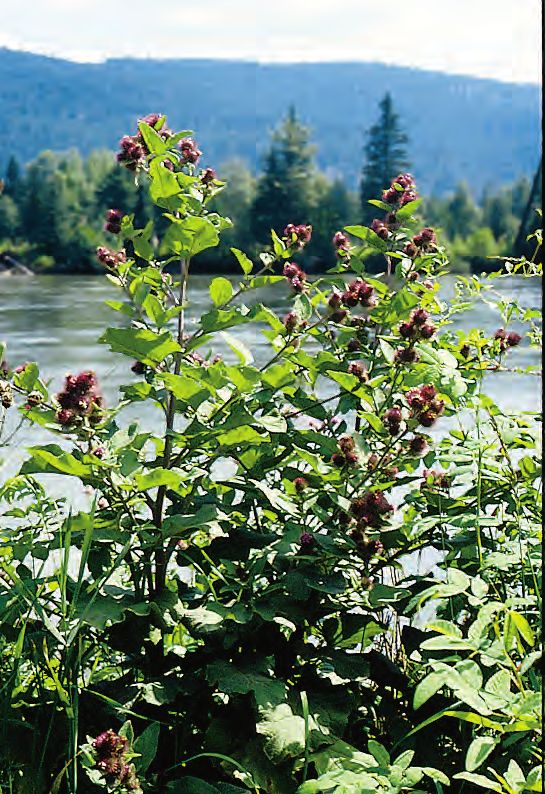
(Impatiens glandulifera)OTHER INVASIVE PLANTS
BABY’S-BREATH
(Gypsophila paniculata)
Baby’s-breath invading grassland
• Much branched perennial herb with a thick,
deep, woody rooting system; smooth stems
grow to 1 m; opposite, hairlesss, linear leaves
with a prominent mid-vein grow 2 cm to
10 cm long; small white flowers are produced
in diffusely branched clusters
• An escaped ornamental originating from
Eurasia and now used extensively in flower
arrangements
• Can produce over 13,000 seeds per plant
73OTHER INVASIVE PLANTS
BLADDER CAMPION
(Silene cucubalus)
Bladder-like calyx
• Perennial growing to 0.6 m; white taproot and
numerous deep penetrating woody branching
roots; stems and leaves light green to whitish
with a waxy bloom (fine powdery coating);
bladder-like calyx has green to purplish veins
and 5 short triangular teeth
• Sometimes confused with night-flowering
catchfly (Silene noctiflora) or white cockle
(Lychnis alba) but has no hairs and is virtually
waxy throughout
74OTHER INVASIVE PLANTS
BULL THISTLE
(Cirsium vulgare)
Spine-tipped flowerhead bracts
Stiff spines at leaf tips
• Taprooted biennial with spiny winged stems
growing 0.3 m to 1.5 m tall; leaves end in long,
sharp spines; upper surface with short prickles,
undersurface cottony; flowerhead bracts tipped
with prickles; purple flowers 4 cm to 7.5 cm
across
• Often confused with Canada thistle (Cirsium
arvense) which has creeping roots, much
smaller flowers and weak prickles, not spines
on the leaves
75OTHER INVASIVE PLANTS
CHICORY
(Cichorium intybus)
Distinctive blue flowers
• Taprooted perennial with milky juice growing
to 1.5 m in height; low growing rosette leaves
resemble dandelion but are hairy; blue flowers
(occasionally pink or white) usually close by
midday
• Leaves are used as a salad and roots when dried
are used as a coffee substitute
76OTHER INVASIVE PLANTS
clUSTER TARWEED
(Madia glomerata)
Flowerheads showing glandular hairs
• Heavy-scented (like tar) annual that grows
to 0.8 m tall; leaves are narrow with both
leaves and stems covered in sticky, glandular
hairs; inconspicuous yellow flowers in heads
produced in 1 to many compact clusters
• This native plant prefers dry, open habitats and
roadsides at low to mid-elevations
77OTHER INVASIVE PLANTS
COMMON MALLOW
(Malva neglecta)
White to pale lilac flowers 12 to 15 nutlets in button-like disk
• Annual to short-lived perennial with prostrate
to semi-erect stems, 10 cm to 60 cm long;
long-stalked rounded leaves with heart-shaped
base and 5 to 7 broad shallow-toothed lobes;
white to pale lilac flowers; seeds in round, flat
button-like disk of 12 to 15 smooth nutlets
• Similar to round-leaved mallow (Malva pusilla)
which has roughened ridges on nutlets
78OTHER INVASIVE PLANTS
CREEPING BUTTERCUP
(Ranunculus repens)
Deeply cut leaves of tall buttercup
• Perennial with slender, fibrous roots; dark
green leaves, often with white spots, are
divided into 3 leaflets and are hairy and deeply
lobed; hairy stems root at the nodes; bright
yellow waxy flowers divided into 5 petals; seeds
are smooth with a hooked apical beak
• As with most buttercup species, contains a
toxin that can result in pain and inflammation
in grazing animals; not a problem when cured
in hay
• Sometimes confused with tall buttercup
(Ranunculus acris) which has a more upright
growth habit and more deeply cut leaf lobes
79OTHER INVASIVE PLANTS
CURLED DOCK
(Rumex crispus)
Mature plant
Wavy, crisp-margined leaves
Broadleaved dock rosette
• Perennial in the Buckwheat Family growing
0.8 m to 1.5 m tall; deep penetrating yellow
taproot; dark green leaves waved and crisp
along the margins; plant turns a rusty-red
colour when mature
• Produces 3,000 to 4,000 seeds per plant
• A similar plant, broadleaved dock (Rumex
obtusifolius) is distinquished by its large leaves
which are rounded or heart-shaped at the base
80OTHER INVASIVE PLANTS
FIELD BINDWEED
(Convolvulus arvensis)
Hedge bindweed with larger leaves
and flowers
• Creeping-rooted perennial from Europe often
called morning-glory; vinelike stems trail on
the ground or twine counter-clockwise around
supports; arrow-shaped leaves with sharp-
pointed or rounded basal lobes; funnelshaped
white to light pink flowers 2.5 cm across; two
small bracts 2.5 cm below flower
• Roots can penetrate to over 5 m in soil; seeds
can remain viable for up to 50 years
• Often confused with hedge bindweed
(Convolvulus sepium) which has larger leaves
and flowers (up to 5 cm across)
81OTHER INVASIVE PLANTS
FOXTAIL BARLEY
(Hordeum jubatum)
• Perennial growing in tufts to 0.6 m tall;
flowerheads, 5 cm to 13 cm long, break into
7-bristled clusters with 3 spikelets at each joint;
green or reddish bristles (awns), 7.5 cm long,
are cream-coloured when mature
• Upward pointing barbs on the bristles can
cause mechanical injury to grazing animals
• Often found on the edges of alkaline sloughs
and salt marshes
82OTHER INVASIVE PLANTS
GOATSBEARD (WESTERN)
(Tragopogon dubius)
Bracts are longer than the
yellow flowers
• Also called salsify this taprooted biennial to
short-lived perennial grows from 0.3 m to 1 m
in height and is most common in the Kootenay,
Okanagan and Thompson-Nicola region; long
grass-like leaves with crisp margins; stems
swollen below the flower head; contains a
milky juice
• Stems of meadow goatsbeard (Tragopogon
pratensis), most common in the Cariboo-
Chilcotin region, are not swollen below the
flower head
• Oysterplant (Tragopogon porrifolius) is similar
but has purple flowers
83OTHER INVASIVE PLANTS
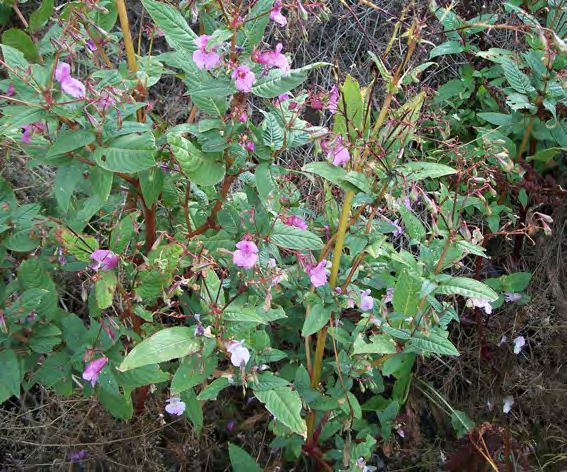
HIMALAYAN BALSAM
(a.k.a. Policeman’s Helmet)
(Impatiens glandulifera)
• Annual succulent herb with upright, hollow,
much-branched purple-tinged stems growing
0.6 m to 2.0 m tall. Opposite to whorled oblong
to eggshaped stalked leaves are saw-toothed
on the margins. Flowers vary from white to
pink to reddish and are shaped much like an
English policeman’s helmet.
• Seed capsules “explode” at maturity to release
hundreds of tiny seeds
84OTHER INVASIVE PLANTS
KNAPWEED, BROWN
(Centaurea jacea)
• Perennial herb from a taproot; 0.1 m to
1.2 m tall; erect stems that are branched and
somewhat woolly or cobweb- like; leaves are
15 cm long and 3 cm wide with stem leaves
becoming reduced and un-stalked towards the
top of the stem; single rose to purple flower
heads form at the ends of the branches; flower
head has bracts with enlarged, papery, tattered
tan to dark brown appendages at the tips
• Reproduces by seed
• Introduced from Europe
85OTHER INVASIVE PLANTS
NIGHTSHADE
(Solanum spp.)
Climbing nightshade; berries
Hairy nightshade with calyx
cupping the berry
Hairy nightshade Black nightshade. Note short calyx
• Climbing nightshade (Solanum dulcamara),
also known as bittersweet: perennial with long
branches trailing or climbing on other plants;
lanceshaped leaves lobed at the base; bluish-
purple flowers; immature green berries turning
bright red
• Hairy nightshade (Solanum sarrachoides):
annual to 0.6 m tall; white flowers; dense
covering of short hairs on leaves and stems;
yellowish-brown berries at maturity; calyx
cupped 2/3 around berry
• Black nightshade (Solanum nigrum): annual to
0.9 m tall; white flowers; smooth leaves; black
to dark purple berries at maturity; short calyx
does not cup the berry
CAUTION: Young plants and immature berries
are particularly poisonous.
86OTHER INVASIVE PLANTS
NODDING THISTLE
(a.k.a. Musk Thistle)
(Carduus nutans)
Large flowers with spine-tipped
bracts “nod” at maturity
• Biennial taprooted thistle growing to 2.5 m
tall; stems are spiny and winged except below
the flower head; leaves are deeply lobed and
spiny margined; large purple flowers (2.5 cm to
5 cm across) droop down or “nod” at maturity;
flowerhead bracts end in a strong, sharp spiny tip
• Sometimes confused with plumeless thistle
(Carduus acanthoides) which has smaller
flowers (less than 2.5 cm broad) with flower
stalks spinymargined right to the base of the
flowerhead
87OTHER INVASIVE PLANTS
SCOTCH BROOM
(Cytisus scoparius)
Flowers mature to form flattened,
brown to black hairy seedpods.
• Upright, taprooted evergreen shrub in the
Legume Family growing from 1 m to 3 m in
height; stems are ridged, woody, green to
brownish-green and prominently 5-angled;
upper leaves are simple and unstalked, lower
leaves are stalked and comprised of 3 oval
leaflets; pea-like flowers are bright yellow
(sometimes with red markings in the middle);
seedpods are flat, brown to black in colour
with fine hairs on the margins
• Escaped garden ornamental now naturalized
throughout south coastal B.C. and introduced
at a few Interior locales
88OTHER INVASIVE PLANTS
ST. JOHN’S-WORT
(Hypericum perforatum)
Showy yellow flowers
produce many stamens
Transparent dots on leaves
contain a photosensitizing pigment
• Perennial from underground runners, growing
0.3 m to 1 m in height; transparent dots are
visible over the surface of the oblong leaves
when held to light; bright yellow flowers
with 5 petals; plants turn a rusty red colour at
maturity
• Contains a toxin that causes grazing animals
to become sensitive to sunlight resulting in
intense skin irritation
89OTHER INVASIVE PLANTS
TEASEL
(Dipsacus fullonum)
• Biennial herb from a taproot; 0.5 m to
2.0 m tall; erect stems with few branches that
get increasingly prickly upwards; stem leaves
are lanceolate, simple, prickly and opposite;
flowers form in cone-shaped, spiny clusters;
individual flowers consist of white petals united
into a tube with 4 purple lobes; below each
cluster are several long, slender, stiff, bracts
that curve upward
• Reproduces by seed
• Introduced from Europe for wool production
90OTHER INVASIVE PLANTS
WATER HEMLOCK
(Cicuta douglasii)
Hollow chambered root contains an
extremely poisonous toxin (cicutoxin)
• Highly toxic native plant in the Parsley Family
• Hollow, jointed stems grow 1 m to 2 m tall; oval
leaflets with sawtoothed margins; leaflet veins
tend to end at the base of the notch on leaf
edge; enlarged taproot with horizontal hollow
chambers.
• Found throughout B.C. in sloughs, wet
meadows, streambanks and other wet areas
and increases aggressively in these habitats.
CAUTION: Although a native plant it contains
an extremely poisonous oil (cicutoxin) which is
lethal to grazing animals and humans contacting
root section.
91INDEX Abutilon theophrasti .............. 42 Chervil, wild ........................... 70 Acroptilon repens .................. 58 Chicory .................................. 76 Agropyron repens .................. 65 Chondrilla juncea ................... 36 Aegilops cylindrica ................. 23 Chrysanthemum Alliaria petiolata ..................... 18 leucanthemum ..................... 62 Alyssum, hoary ...................... 55 Chrysanthemum maximum .... 62 Anchusa officinalis ................. 50 Cichorium intybus .................. 76 Annual sow-thistle ................. 38 Cicuta douglasii ...................... 91 Anthemis cotula ..................... 37 Cinquefoil, graceful ................ 66 Anthriscus caucalis ................. 37 Cinquefoil, sulphur ................. 66 Anthriscus sylvestris ............... 70 Cirsium arvense ................... 9, 75 Arctium spp. .......................... 48 Cirsium palustre ..................... 60 Avena fatua ........................... 43 Cirsium vulgare ...................... 75 Baby’s-breath ......................... 73 Cleavers ................................. 49 Balsam, Himalayan ................. 83 Climbing nightshade .............. 86 Bamboo, Japanese ................. 29 Cluster Tarweed ..................... 77 Barley, foxtail ......................... 82 Cockle, white .................... 61, 74 Berteroa incana ...................... 55 Common bugloss ................... 50 Bindweed, field .................. 81, 96 Common burdock .................. 48 Bindweed, hedge ................... 81 Common mallow ................... 78 Black nightshade ................... 86 Common reed ........................ 10 Bladder campion .................... 74 Common tansy ...................... 51 Blueweed .......................... 47, 50 Common toadflax .................. 40 Bohemian knotweed .............. 26 Convolvulus arvensis .......... 81, 96 Broom, Scotch ....................... 88 Convolvulus sepium ............... 81 Brown knapweed ................... 85 Cordgrass, dense-flowered ..... 11 Bugloss, common ................... 50 Cordgrass, English ................. 12 Bull thistle .............................. 75 Cordgrass, saltmeadow .......... 13 Burdock ................................. 48 Cordgrass, smooth ................. 14 Bur Chervil ............................. 8 Creeping buttercup ................ 79 Butomus umbellatus .............. 17 Cress, hoary ........................... 56 Buttercup, creeping ................ 79 Crupina .................................. 15 Buttercup, tall ........................ 79 Crupina vulgaris ..................... 15 Campion, bladder .................. 74 Curled dock ........................... 80 Canada thistle ..................... 9, 75 Cuscuta spp. .......................... 16 Cardaria spp. .......................... 56 Cynoglossum officinale .......... 22 Carduus acanthoides .......... 67, 87 Cyperus esculentus ................. 34 Carduus nutans ................. 67, 87 Cyperus rotundus ................... 33 Catchfly, night-flowering .... 61, 74 Cytisus scoparius .................... 88 Centaurea diffusa ................... 24 Daisy, oxeye ........................... 62 Centaurea jacea ..................... 85 Daisy, Shasta .......................... 62 Centaurea pratensis ............... 57 Dalmatian toadflax ............. 40, 41 Centaurea solstitialis ............... 45 Diffuse knapweed .................. 24 Centaurea stoebe ................... 25 Dipsacus fullonum ................. 90 Chamomile, scentless ............. 37 Dock, curled .......................... 80 Chervil, bur ............................ 8 Dodder ................................... 16
You can also read


