Yakima County 2018 Homeless Point-in-time Count Process and Survey Results - May 2018 - Yakima Valley Conference of ...
←
→
Page content transcription
If your browser does not render page correctly, please read the page content below
Yakima County
2018 Homeless Point-in-time Count
   Process and Survey Results

                      May 2018

  Produced by ACR Business Consulting in partnership with the
          Yakima Valley Conference of Governments
Table of Contents

   The Homeless Point-in-time Count: Overview
   The Homeless Point-in-time Count: iCount Yakima County
   Yakima County 2018 PIT Count Results
   2018 PIT Count: Demographic Data from 443 Surveys Collected
   2018 PIT Count: Income and Housing Data
   2018 PIT Count: Age Specific Analysis
   2018 PIT Count: Income and Housing Data
   Factors Affecting the PIT Count
   Summary and Recommendations
   2018 PIT Count Partner Agency / Roving Locations and Surveys Collected at Each

Questions / comments:
Questions, comments or to request a digital copy of this report please contact:

Crystal Testerman, Homeless Program Manager
Yakima Valley Conference of Governments
Crystal.Testerman@yvcog.org

Aaron Rodriguez, 2018 Point-in-Time Count Project Manager
ACR Business Consulting
aaron@acrbc.com
The Homeless Point-in-time Count: Overview1
The Homeless Point-in-Time (PIT) count is a requirement by the U.S. Department of Housing and
Urban Development (HUD). HUD requires communities to submit a count of the homeless
population in their area as well as information on specific sub-populations, including chronically
homeless persons, veterans, and unaccompanied youth.

A PIT count is composed of two parts: a sheltered PIT count, which is required every year, and an
unsheltered PIT count, which is required at least every other year. Communities submit this data
annually through their Continuum of Care (CoC) applications for Homeless Assistance Grants. The
Washington State Homelessness Housing and Assistance Act (ESSHB 2163 - 2005) requires each
county to conduct an annual PIT count of sheltered and unsheltered homeless persons in
Washington State in accordance with the requirements of HUD 2. The count takes place in January
each year with the date set by HUD. For 2018, the date of the count was Thursday, January 25.

Many communities, including Yakima County, develop their sheltered count from their Homeless
Management Information System (HMIS) data. Yakima County also facilitates in-person surveys
to add additional demographic detail beyond just a number. HUD does not prescribe the survey
method to use but does provide guidance on survey techniques.

The unsheltered count is more complicated and costly to conduct than the sheltered count, and
HUD is stricter about the acceptable methodologies for performing this count. Because unsheltered
persons are not generally recorded in HMIS, communities have much more planning to do to
account for unsheltered individuals. There are 3 accepted methodologies provided by HUD to
conduct an unsheltered count:
    1. Street counts. Community volunteers visit the streets and locations where they expect to
       find homeless individuals and count them based on observation over a very specific period
       (usually between dusk and dawn on a single night). This method is relatively easy to
       organize, train volunteers to conduct, and carry out. However simple to carry out, this
       method invariably misses some people, and little information is gained beyond the total
       number of unsheltered persons.
    2. Street count with an interview. With this approach, count participants are trained to
       interview every person they encounter who appears to be unsheltered. The sample-with-
       interview approach yields a much richer level of data to the community, but tends to be
       more complicated to de-duplicate.
    3. Service-based count. The community counts people as they receive homeless services
       during the specific count period. Service-based counts can extend beyond 1 day, but
       cannot exceed 7 days after the date of the count. Communities using the service-based
       approach will often plan a specific event that is likely to attract homeless persons such as
       a special breakfast or healthcare-related offering. Although this method requires the
       community to carefully determine who has already been counted, it tends to reach a
       particular homeless population that chooses to use the supportive services available,
       including soup kitchens, drop-in centers, and street outreach teams, and who would
       otherwise be difficult to count because of where they choose to sleep.

To determine the most appropriate methodology to use, communities need to evaluate, among
many things, their climate, size, and availability of resources. The number of anticipated
participants in the count and the size of the area often drive the method that is chosen. However,
several communities use a combination of these methodologies.

1
  Office of Policy Development and Research (PD&R) U.S. Department of Housing and Urban Development:
https://www.huduser.gov/portal/periodicals/em/summer12/highlight2.html

2
  Washington State Department of Commerce:
http://www.commerce.wa.gov/Programs/housing/Homeless/Pages/Annual-Point-In-Time-Count.aspx
In addition to homeless population data, HUD requires communities to submit subpopulation data
on chronically homeless individuals and families, veterans, severely mentally ill individuals,
chronic substance users, persons with HIV/AIDS, those fleeing domestic violence, and
unaccompanied children (under 18). When the subpopulation data is incomplete, communities use
sampling and extrapolation methods to derive their counts.
The Homeless Point-in-time Count: iCount Yakima County
For the 2018 Homeless Point-in-time (PIT) Count, Yakima County partnered with ACR Business
Consulting to facilitate the PIT Count. ACR Business Consulting has facilitated prior PIT Counts
for Thurston County and worked with the City of Olympia on homeless strategy. The firm aims to
collaborate with agencies and organizations that work with homeless neighbors, and utilizes the
overarching brand “iCount” to build local community support for volunteers, donations, and
outreach efforts.
The goals for the 2018 PIT count in Yakima County were to:
1) Maximize the scope of the one-day count through county-wide outreach efforts utilizing a
thorough and cost effective approach
2) Implement tools to assist with census efforts for future years
3) Pursue high quality data collection
4) Collect and report relevant information to inform and educate local community citizens,
policy makers, and funders.
Maximize the Scope of the One-day Count
Yakima County has a strong network of homeless service agencies. Together these agencies have
typically facilitated Project Homeless Connect Events as the backbone of the annual PIT Count.
For the 2018 PIT Count, ACR Business Consulting focused on utilizing the strength of the service
network to facilitate street counts with an interview and service-based counts to connect
with both sheltered and unsheltered homeless neighbors throughout Yakima County. This
approach was designed to minimize the cost to facilitate the PIT Count and align efforts with
agencies making connections with homeless neighbors through normal service activities.
The county was divided into 3 areas – Upper Valley, Mid Valley, South Valley – and partner
agencies and community volunteers were identified within each area. Volunteers were paired with
agency leads to serve as roving teams throughout the areas, looking to connect with as many
unsheltered neighbors as possible. However, due to the sensitivity and potential safety concerns,
the PIT Count did not include going into homeless encampments or wooded areas.
Implement Tools to Assist with Census Efforts for Future Years
ACR Business Consulting efforts were designed to build off of the strong community involvement
across Yakima County already in place. The iCount brand established a Facebook presence for the
Yakima County PIT for community members to continue to post and share information on issues
related to homelessness. A dedicated webpage for PIT volunteer recruitment, sponsorship and
donations was also established. This page is intended to assist in outreach and recruitment efforts
which will help in preparing for the count in future years. Additionally, through the iCount Yakima
County platform, the team recruited over 35 community volunteers and raised over $1200 in
community donations to be used to purchase sleeping bags to handout to survey participants.Pursue High Quality Data Collection To maintain data consistency and quality, revamped surveys were utilized by iCount Yakima County volunteers and agencies for the 2018 PIT Count. As always, survey data quality relied on participants authorizing the use of their information by way of signature. This allows duplicate surveys to be identified, and it significantly reduced the likelihood of double entry into the Homeless Management Information System (HMIS) across the unsheltered and sheltered counts. For 2018 PIT Count, local agencies and the iCount Yakima County team of volunteers did a tremendous job connecting with homeless neighbors to gather complete surveys. Throughout the County, 443 surveys were collected encompassing 646 individuals. Collect and Report Information to Inform Local Community Citizens, Policy Makers, and Funders The 2018 PIT Count utilized the single census form for both sheltered and unsheltered survey participants. The form is designed to make it easier for survey collectors to gather necessary information from census participants and provide a consistent and wider sample set of data for analysis and reporting. The facilitation of the PIT count is a HUD requirement and takes real time, energy, and resources to be inclusive and impactful. Beyond the federally mandated survey questions there is relevant information that can be collected utilizing the efforts already required to facilitate the PIT Count. For the 2018 PIT Count, questions about the most critical services benefiting homeless neighbors as well as questions on housing search efforts and household income levels were incorporated. The topic of housing affordability and access is currently a major focal point across the United States and in Yakima County. With median home prices continuing to rise and accessibility for low and no income neighbors becoming more difficult, questions were added to the survey this year to gauge efforts by homeless neighbors to secure housing, and to better understand the reality of barriers these households face in finding stability. The results of this data are attached to this report as a 1 page info graphic. The following charts and graphs represent key data that was collected through the 2018 PIT census efforts. The underlying data set has been submitted to the Yakima Valley Conference of Governments and is available for additional analysis as needed. The goal of this report is to support the efforts of public agencies and nonprofit service providers in securing and expanding funding for programs assisting homeless neighbors in Yakima County. Hopefully this information can also be used as an educational tool for the community to work together to understand the reality of who is facing homelessness in Yakima County, and the efforts these neighbors pursue and barriers they face in returning to stable housing.
Yakima County 2018 PIT Count Results

                        2018 Yakima County Homeless Count
                               As Reported by WA Department of Commerce

                                  105
                                   16%

                                                                                  228
                                                       638                         36%

                               305
                                48%

                  Unsheltered               Emergency Shelter                   Transitional Housing
                                                           3

                             Yakima County PIT Count Totals: 2010 - 2018
                                       As Reported by WA Dept of Commerce
                         Unsheltered         Emergency Shelter        Transitional Housing    Total
    800
                                   703          695            701       688
           622                                                                                          638
                       610         178          132            168        150          580
    600
            115
                                                                                                572     105
                       150
                                                                                       168
                                                                                                215
    400
                                                                                                        305
            424                    472          516            486        466
                       399                                                             348
    200                                                                                         287

                                                                                                        228
             83         61             53        47            47         72            64       70
     0
            2010       2011        2012         2013           2014      2015          2016     2017    2018

3
 Total PIT Count is the result of data derived from the combination of Surveys, HMIS Emergency Shelter and
Transitional Housing entries on January 25, 2018 and de-duplicated in HMIS by the WA State Department of Commerce.
2018 PIT Count: Demographic Data from 443 Surveys Collected
The following section provides a look at key results from the surveys collected.
2018 PIT Count Census Map and Counts4
1
2
3
2018 PIT Count Key Demographic Data reported from Surveys and
Compared with HMIS Data from WA Department of Commerce
Surveys HMIS
Unaccompanied Youth2018 Yakima County PIT Count
Ethnicity Reported
Head of Household Data from 443 Surveys (321 responses)
33% Non Hispanic
Hispanic
67%
2018 Yakima County PIT Count
Race Classification
Head of Household Data from 443 Surveys (315 responses)
Other Alaska Native
8% 0%
American
Indian
20% Asian
1%
White
67%
Black/African American
3%
Native Hawaiian
1%2018 Yakima County PIT Count
Homeless Neighbors Originally from Yakima County
Head of Household Data from 443 Surveys
Yes
66%
No
30%
Not Answered
4%
2018 Yakima County PIT Count
Last Address of Those Currently Homeless in Yakima County
Head of Houshold Data from 443 Surveys
Sunnyside Other Cities in Yakima County
7% 9%
Wapato
9%
Toppenish WA (not Yakima)
3% 14%
Other Out of State
33% 9%
No info given
10%
Yakima
39%2018 Yakima County PIT Count
Gender Classification of Homeless Neighbors
Data From 646 Total Individuals Included in Surveys
4
336 197 109
0% 10% 20% 30% 40% 50% 60% 70% 80% 90% 100%
Male Female Transgender / Do not Identify No info given
2018 Yakima County PIT Count
Homeless Neighbors Citing Veteran Status / Fleeing Domestic Violence / Disability
by Sub-Grouping Head of Household Data from 443 Surveys
254
13% 5% 57%
56
23
Served in Military Currently Fleeing Domestic Violence Disabled2018 Yakima County PIT Count
A Closer Look at Disabilities Reported by Homeless Neighbors
Head of Household Data from 443 Surveys
0%
13% Chronic Substance Use - 45
20%
Permanent Physical Disability - 97
254 Developmental Disability - 43
Reporting 27%
at least 1 Mental Health - 102
disability
28% Chronic Health Problem - 73
12% HIV/AIDS - 1
2018 Yakima County PIT Count
Where Homeless Neighbors Slept the Night Prior to the Count
Totals Include Head of Household, Partner/Spouse and Dependants Data from 443 Surveys
294
Considered Homeless by HUD definition (553)
Not considered Homeless by HUD definition (93)
111
56 47 45
28 29 33
3
Emergency Covered - Uncovered - Vehicle Inadequate Hospital / Jail Transitional Hotel / Motel With Family /
Shelter outside outside Structure Housing Friends
5
5
This chart represents prior night locations identified by homeless neighbors who participated in the survey. The
Department of Commerce reported a total emergency shelter count of 305, an unsheltered count of 228, and a
transitional housing count of 105 for a total count of 638 homeless neighbors the night of the PIT Count.2018 Yakima County PIT Count
Chronically Homeless Neighbors
443 Surveys Totaling 646 Individuals
9%
Homeless for > 1 year - 184
203
individuals reported
from survey data At least 4 times in past 3 years - 19
91%
6
2018 Yakima County PIT Count
Chronically Homeless Households
by Sub-Population - Head of Household Data from 443 Surveys
16% 13%
Veteran Single - 20
2%
155 Non-veteran Single - 107
Total Households
Surveyed Veteran Family - 3
Non-veteran Family - 25
69%
6
The Department of Commerce reported 324 total individuals classified as chronically homeless the night of the 2018
PIT Count based on HMIS data. This would indicate that approximately 50% of all homeless neighbors included in the
night of the PIT Count are chronically homeless.Department of Commerce HMIS Reporting:
Chronically Homeless Neighbors: 2013 - 2018
Based on Annual PIT Count Data from HMIS Reported by Department of Commerce
Total PIT Count Chronically Homeless
800
695 701 688
638
580 572
600
400
324*
200
71 86 89 72
48
0
2013 2014 2015 2016 2017 2018
*2018 Data includes all members of a household considered to be chronically homeless by HUD definition
2018 PIT Count: Top Reasons Cited as Cause of Homelessness
(Participants could select more than one reason)
Number of Responses
1. Family Crisis 136
2. Alcohol / Substance Use 109
3. Job Loss 108
4. Economic 108
5. Lost Temporary Living Situation 97
6. Physical / Mental Disability 94
7. Mental Illness 86
8. Illness / Health Related 80
9. Eviction 74
10. Kicked Out / Left Home 6511. Personal Choice 56
12. Domestic Violence 50
13. Lacking Job Skills 48
14. Released from Jail 41
15. Medical Costs 31
16. Aged out of Foster Care 29
17. Lack of Childcare 6
18. Language Barrier 6
Trends of the Top Reasons Cited for
Becoming Homeless 2015 - 2018
2015 2016 2017 2018
0
1
2
3
4
5
Economic Job Loss Family Crisis Alcohol / Substance Use
7
The graph above shows the ranking of the top reasons cited for becoming homeless each year
since the 2015 PIT Count. A ranking of 1 is the most cited reason. There are certainly a number
of variables affecting the data validity, nonetheless, this trend analysis provides an interesting
look at the leading causes of homelessness in Yakima County over the past four years. Since
2015, “Alcohol/Substance Use”, “Economic”, “Job Loss”, and “Family Crisis” continue to be the 4
most cited reasons for the occurrence of homelessness in Yakima County.
7
Data collected from Yakima County prior year census reports. No data available for 2017 PIT Count.2018 PIT Count: Age Specific Analysis
2018 Yakima County PIT Count
Age Representation of Survey Participants
Head of Household Data from 443 Surveys
Seniors +55
25% No age given
1%
Under 18
1%
18 - 24 YR
7%
>24 - 55 YR
66%
2018 Yakima County PIT Count
% Reporting At Least 1 Disability by Age Group
Head of Household Data from 439 Surveys Providing Age
71%
55%
37%
11 162 78
0%
Under 18 (4 surveys) 18 - 24 (30) >24 - 55 (295) >55 (110)2018 Yakima County PIT Count
% Classified as Chronically Homeless by Age Group
Head of Household Data from 439 Surveys Providing Age
47%
32%
23%
7 94 52
0%
Under 18 (4 surveys) 18 - 24 (30) >24 - 55 (295) >55 (110)
The above 2 charts demonstrate that roughly 2 out of every 3 homeless neighbors
living with a disability are chronically homeless regardless of age group.
2018 Yakima County PIT Count
Top Reasons Leading to Homelessness - Cited by Age Group
Head of Household Data from 439 Surveys Providing Age
5%
23% 15% 16% 10% 8% 12%
23%
25% 16%
28%
32% 24%
24% 12%
28%
34% 23%
20% 21%
24% 37% 17%
47%
19%
20%
17%
17%
50%
50% 27% 20% 25%
25% 20% 13% 25%
25% 10%
0% 0% 0% 0% 0%
Family Crisis Alcohol / Job Loss Economic Lost Physical / Mental Illness / Eviction Kicked Out / Personal
Substance Temporary Mental Illness Health Left Home Choice
Use Living Disability Related
Situation
Under 18 (4 surveys) 18 - 24 (30) >24 - 55 (295) >55 (110)2018 PIT Count: Income and Housing Data
For the 2018 PIT Count, additional questions regarding income relative to housing search efforts
were asked to survey participants in an effort to glean further insights from the broad macro-
economic factors cited as the leading causes of homelessness over the past several years. The
following graphics illustrate profiles of homeless neighbors who are seemingly “locked-out” of
access to stable housing due to income levels. This sample size reinforces the notion that the
disparity between market rate and affordable housing is perhaps the greatest influencer in the
ability for homeless neighbors to return to stable housing in Yakima County. These survey findings
may motivate a deeper look at the prevailing perception of the profile of homeless individuals and
families in the Yakima County community and the actual support they need to maintain or return
to housing stability.
70% 1 in 2 45%
of all households households surveyed of households surveyed
surveyed reported they has been looking for reported having monthly
are actively looking for housing for 6 months or income of $500 or more
housing more
90% 2 in 3 60%
of families with children households surveyed of households surveyed
surveyed are actively identify insufficient stated they need help
looking for housing income as the main finding housing
barrier to housing
Factors Affecting the PIT Count
As with all data collection, there are challenges regarding the validity of the data collection and
reporting process. For the 2018 PIT count, gathering survey participant signatures significantly
decreased the likelihood of data duplication on reported information. However, as has been the
struggle in previous years, the following variables must be acknowledged as it relates to data
integrity:1. Known sections of homeless neighbors not surveyed. Excluding entering into camps (even
those that are known) for safety reasons decreases the population surveyed and reduces
the number of homeless that are accounted for on the day of the PIT count. The 2018 PIT
Count efforts included volunteer assistance from formerly homeless individuals currently
affiliated with Entrust. These census facilitators had knowledge of areas to go and trust
established to connect with homeless neighbors that may have been reluctant to participate
or even be identified. Event with this strategy, the total number reported is still viewed by
service providers as only about one-third of the actual number of unique individuals and
households seeking homeless services. This tends to be supported by HMIS reports that
are pulled quarterly by agencies showing total new entries into the service system.
2. Rural Communities and the Yakama Nation lacking service agencies with which to partner.
Facilitators of the 2018 PIT count worked to partner with as many agencies as were willing
across the county. Some communities had only 1 agency that served homeless neighbors,
while others did not have any agency representation. Despite the collaboration from service
providers, in most cases, survey volunteers were restricted to working within the business
hours on the day of the count. In the case of the Yakama Nation, a known overnight
shelter was not included in the PIT efforts. It is worth noting that contact was established
post PIT Count and the goal is to have the shelter staffed with survey facilitators next year.
These factors most likely reduced the reporting in those communities.
3. HUD classification of “Inadequate Structure” as homeless not necessarily aligning with
people’s own perception of their circumstance. HUD classifies those living in structures
without any of the following: heat, running water, the ability to cook hot food, the ability
to bathe, as homeless. There is a high likelihood that individuals in these circumstances do
not equate themselves as being homeless and therefore are not seeking services nor
participating in PIT count activities. There were some survey participants who identified
their own home as an inadequate structure, but a very small number relative to the likely
potential of qualified dwellings.
4. School district homeless youth reports differ from qualified HUD PIT count numbers. School
districts report the number of students living in unstable housing circumstances through
the Office of the Superintendent of Public Instruction (OSPI). However, a broader definition
of “homeless” is used including students who are living “doubled up” and “couch surfing.”
While the PIT Count may connect with some of these individuals, the number reported
through OSPI has historically been much larger than the PIT counts. According to the
report released by OSPI in 2017, school districts in Yakima County reported 2,549
students K – 12 as homeless. Of this number, approximately 7.5% (190 students)
reported living in an emergency shelter or unsheltered and would therefore qualify within
the HUD definition of homeless. The number of homeless students enrolled in Yakima
County school districts in 2018 has not been reported yet.
Summary and Recommendations
In reviewing the information that was collected, the Yakima County 2018 PIT Count follows the
historical trends for much of the demographic data reported in prior year PIT counts. One notable
exception is the increase in the number of chronically homeless identified in the survey efforts.
This may be due to increased efforts to have roving survey facilitators as well as incorporating
formerly homeless individuals as survey facilitators. The general consistency of data collected over
the past several years may be showing the Yakima County community that the profile of homelessneighbors is perhaps becoming less speculative. This allows the County and service providers to
begin to look at the efficiency and effectiveness of the homeless service system in Yakima County
as it relates to serving specific homeless subpopulations. Continued efforts are underway to evolve
the homeless service system through refinement of the Coordinated Entry process and other
initiatives as outlined in the County’s revised 5 year plan to address homelessness and affordable
housing.
The trends in the data about causes cited for homelessness is one area that may benefit from
being further explored. Within the top reasons continually cited, those of “Economic,” “Family
Crisis,” and “Job Loss” present opportunities to formulate hypothesis and target more specific data
collection. For example: 1) insights into more exact “economic” reasons that make this category
a top cited reason, 2) data regarding time between the moment of job loss or family crisis and
seeking homeless service assistance, 3) identifying particular reasons that may benefit from more
targeted prevention. Furthermore, breaking these reasons down by age provides additional insight
into causes and circumstances that may have a greater impact on certain age groups.
Of course the single greatest “reason” affecting community members at risk of or currently
experiencing homelessness continues to be the lack of affordable housing in Yakima County. The
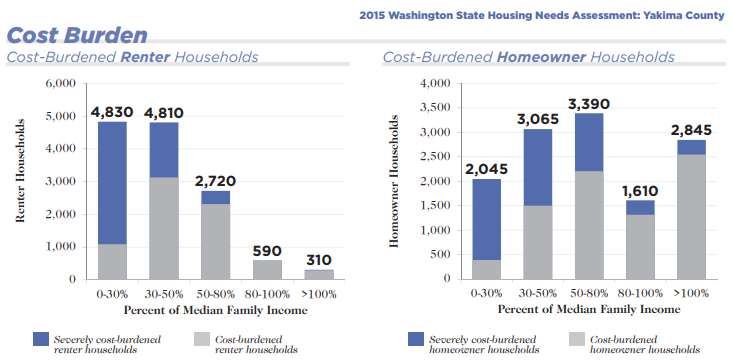
two charts below provide context for the large number of households in Yakima County
(approximately 26,000) that are classified as cost-burdened or severely cost-burdened8. This
means that these households pay more than 30% or 50% respectively of gross wages towards
housing and are considered “unstably housed.” About 33% of all households in Yakima County
are unstably housed and at risk of becoming homeless. Affordable housing inventory for
households making 50% or less of the median family income is about 40% of what is needed.
This means that 6 out of 10 low-to-no income households cannot find an affordable home in
Yakima County based on their income levels.
This profile of struggling households fundamentally redefines the perception of the circumstances
facing people at risk of becoming homeless, and supports the PIT Count trends of “Economic” and
8
Data presented is from a 2015 Affordable Housing Needs Assessment conducted by the WA Department of Commerce“Job Loss” as consistent reasons leading to homelessness. At this level of need for affordable housing, government resources available to the homeless and affordable housing service system are insufficient. Any viable strategy to address homeless and affordable housing in Yakima County will need to explore and consider solutions involving private investment and public-private partnerships in addition to funding provided by federal, state, and local governments. The results of the 2018 PIT Count continue to illustrate the pursuit of more coordinated efforts throughout the homeless service system to define both demographic data for trend analysis as well as system performance metrics that look at the effectiveness of services and prioritization of limited funding.
2018 PIT Count Partner Agency / Roving Locations and Surveys Collected at Each

 Location                                         Surveys Collected              Area
Union Gospel Mission                                      127                     1
Camp Hope                                                  63                     1
YNHS Depot (Yakima)                                        44                     1
Yakima Rovers                                              29                     1
Sunrise Outreach                                           26                     1
Rod's House                                                16                     1
Yakima DSHS                                                16                     1
Triumph Treatment Center                                    9                     1
Village of Hope (Toppenish)                                 1                     1
Noah's Ark                                                 50                     2
Toppenish Community Chest                                  17                     2
The Compound (Toppenish)                                    7                     2
Entrust (Sunnyside)                                        16                     3
YNHS (Sunnyside)                                           10                     3
The Underground (Sunnyside)                                 9                     3
South Valley Rovers                                         3                     3
Total Surveys Collected                                   443
7 in 10                                 Homeless Neighbors Surveyed in Yakima
                                        County are Currently Trying to Find Housing

          Time Spent Searching for Housing                                       Most Requested Services

                                                                        Home Search Help 263                                59%
                                                                                   Hot Shower                   224          51%
                                        15%                                          Laundry                    219          49%
                                                                                   Safe Storage                 216          49%
        56%             311                                                   Access to a Restroom              193          44%
                   Households                                                      Day Center                   178          40%
                 Currently Looking 19%                                           Job Search Help                162          37%
                                                                                   Dental Care                  158          36%
                                                                                  Medical Care                  139          31%
                                 10%
                                                                                    Counselor                   102          23%
                                                                                Utility Assistance              76           17%
           6 months
                                                                          Home Weatherization Help              33           7%

             Biggest Barriers to                                                                                     Education
             Housing Identified                                                                                      Completed
                                            Rental History            Employment                                    419 total responses
                                                24%                      42%
                                                                                                            Masters - 4
                  Income
                                                                                                              Bachelors - 18
                    66%
Eviction History                      No No ID        Criminal Record                Poor Credit             Associates - 16
      15%                               16%                20%                          29%
                                                                                                            Some College - 60

                                                                                                            HS / GED - 147
                                        77%                                                                 Some HS - 147
                                     Households
                                    surveyed with
     1 in 7                         monthly income
                                                                         3 in 4
   Households with                                                 Chronically Homeless
   monthly income                                                 Households looking for
     over $1000                                                   housing for 6 months +

Based on survey data collected during the Jan 2018Yakima County Homeless Point-in-Time Count         Created by ACR Business Consulting
You can also read


