Process Control: Theory, Practice, Data Quality and Compliance Optimization 3/11/2021
←
→
Page content transcription
If your browser does not render page correctly, please read the page content below
3/11/2021

1

    Process Control: Theory, Practice, Data
    Quality and Compliance Optimization

              Thursday, March 11, 2021

2

                                                     1
3/11/2021

             How to Participate Today
                          • Audio Modes
                             • Listen using Mic &
                               Speakers
                             • Or, select “Use
                               Telephone” and dial the
                               conference (please
                               remember long distance
                               phone charges apply).
                          • Submit your questions
                            using the Questions pane.
                          • A recording will be
                            available
                            for replay shortly after this
                            webcast.

3

                   Today’s Moderator
    John B. Copp Ph.D.
    Primodal Inc.
    Hamilton, Ontario

4

                                                                   2
3/11/2021

         Control Subtleties – Mar. 11, 2021
                An MRRDC Short Course:
                 Process Control:
         Intro, Data and Lessons Learned
    • Topics:
       • Introduction to Control Concepts
       • Real Data, Practical Issues
       • Case Studies
          • Ontario
          • DC Water

5

      Control Subtleties – Mar. 11, 2021
                An MRRDC Short Course:
                 Process Control:
         Intro, Data and Lessons Learned

     Oliver         John            Hank       Ryu
    Schraa          Copp            Andres    Suzuki
    inCTRL         Primodal         OCWA     DC Water

6

                                                               3
3/11/2021

    Our First Speaker

                                   Oliver Schraa, M.Eng.
                                   inCTRL Solutions Inc.
                                   Dundas, Ontario, Canada

7

     PROCESS CONTROL – STRATEGIES, ISSUES,
             AND ADVANCEMENTS
                     Oliver Schraa
                  CTO, inCTRL Solutions Inc.

8

                                                                    4
3/11/2021

     Outline
       1. Introduction to automatic process control
       2. Aeration control strategies
       3. Recent advancements
       4. Common control issues & solutions
       5. Summary and conclusions

9

     What is process control?

     • Process control involves maintaining a process at a desired set of conditions
       by adjusting selected variables within the system.

     • Process control requires measurements from the process which provide
       feedback. These are the controlled variables.

     • The adjustments to the system are made to the manipulated variables (or
       control handles).

     • The adjustments can be made using manual actions or automatic controllers.

10

                                                                                              5
3/11/2021

     What is an automatic controller?
                               Automatic controller: Computer
                               algorithm that continually monitors a
                               quantity within a system and automatically
                               acts to correct deviations from the desired
                               setpoint.

                               Elements of a feedback control system:
                               • Process
                               • Sensors
                               • Error calculation
             Marlin (2000)     • Controller (PID, model-based, etc.)
                               • Actuators (valves, VFD, etc.)

11

     What is an automatic controller?
                             Proportional-Integral-Derivative Controller
                             (PID): Most common automatic controller. Algorithm
                             based on 3 types of calculations that are added
                             together:

                                    Proportional action: Proportional to error

                                    Integral action: Used to achieve zero offset
                                    from setpoint. Proportional to sum of errors.
             Marlin (2000)
                                    Derivative action: Provides a correction
                                    based on the rate of change in the controlled
                                    variable.

12

                                                                                           6
3/11/2021

         What is controller tuning?
     Tuning: pick settings for controller parameters

       Methods
           Open-loop
           Closed-loop

     Build a model of the process
     being controlled and use         Open Loop Method
     model and tuning rules to
     determine tuning
     parameters.

     Poor tuning and bad data prevent ability to track set points. Well-tuned controllers perform better.

13

         What are the variables we can adjust?
        Typical Activated Sludge Plant

                                                            Mixed
                        Primary effluent         Aeration   liquor    Secondary        Secondary effluent
                                                  tanks                clarifiers

                                                    Air                                     Main Control Handles:
                                                                                            1.Wasting rate
                                           Return activated sludge (RAS)                    2.Recycle rate
                                                                                            3.Air supply rate
                                                                                            4.Chemical addition rate
                                                             Waste activated sludge (WAS)

14

                                                                                                                              7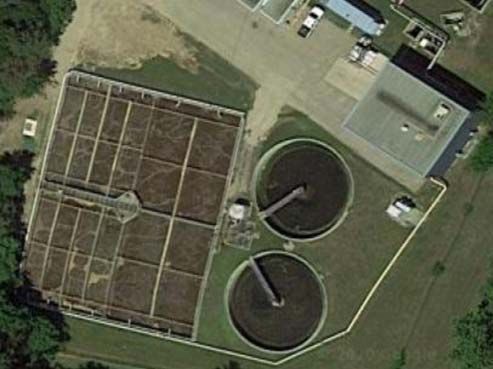
3/11/2021

     Aeration Control

     • Automatic control:
       •   Blower controller(s) used to maintain the required total air supply
       •   Use DO controller(s) to adjust airflow to each basin/pass/grid to
           keep DO near setpoint and supply air for mixing
       •   Advantages:
           • Lower cost for aeration energy
           • Ensures that biomass oxygen demand is met
           • Avoids operational problems associated with excessive (floc shear) or
             inadequate aeration (filamentous bulking)
           • Can maintain tighter control of the DO near desired setpoint

15

     Dissolved oxygen (DO) control

     Typical DO Control Loop
                                  Measured DO                     Measured Airflow

                    DO Setpoint     DO         Airflow Setpoint      Airflow
                                    Controller                       Controller

                                                                   Valve Position

16

                                                                                            8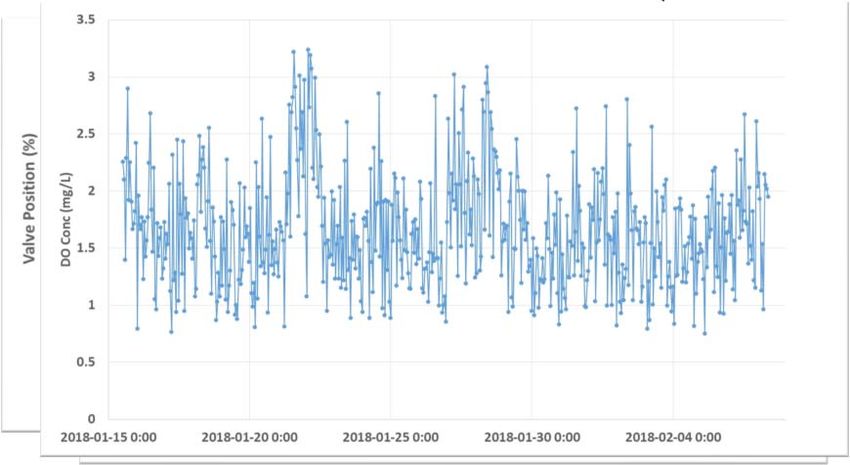
3/11/2021

     1. Low Complexity Aeration Control System (USEPA, 1989)                                           Basin 1       DO sensor
        DO Control of Total Air Demand
                                           Air demand                        DO
                   Amperage                 controller        Airflow     controller
                   setpoint                                   setpoint                                           •    Air distribution valves
                                                                                                                      adjusted manually
                                                                                                                 •    Should keep one fully
             Amperage                                                                                                 open
             controller
                        Guide vanes,
        Current         outlet diffuser
                        vanes, VFD
                                              F   Flowmeter
                                                                                                       Basin 2
              Blowers
                                                                                                       Basin 3
                                                               Select one basin
                                                               to monitor
  DO Sensor Location
  •    DO sensor should be placed about ⅓ to ½ of the
       way along the length of a plugflow tank
  •    Placing the sensor at the beginning of the tank
       leads to over-aeration
  •    Placing the sensor at the end of the tank leads
       means you will miss load changes and are prone to
       under-aeration
                                                                                                       Basin 4

17

 2. Moderate Complexity Aeration Control System (USEPA, 1989)                                          Basin 1       DO sensor
      Constant Pressure Control
                                           Pressure               Pressure
                                          controller              setpoint
                   Amperage
                   setpoint                                                                                      •    Air distribution valves
                                                                                                                      adjusted manually
                                                                                Pressure
                                                                                transmitter
             Amperage        Optional:
             controller      Linearizes                                                 P
                             relationship
                        Guide vanes,
        Current         outlet diffuser
                        vanes, VFD
                                                                                                       Basin 2
              Blowers
                                                                                                       Basin 3

                                                                             Valve
                                                                             Position

                                      DO Control                          Airflow
                                                                         controller         Measured
                   One loop for each basin                           Airflow                Airflow
                                                                     setpoint
                                                     DO                     DO
                                                   setpoint              controller
                                                                                                       Basin 4

18

                                                                                                                                                       9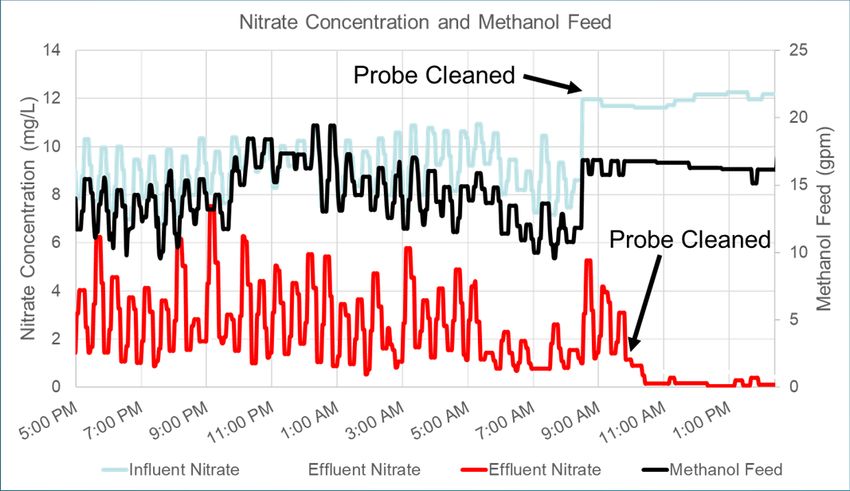
3/11/2021

     2. Moderate Complexity Aeration Control System                                                      Basin 1                         DO sensor
                                                   MOV Control Maximum    valve
        Pressure Control                                       position found
                                                         Pressure
                                            Pressure     setpoint      MOV
                    Amperage               controller                controller
                    setpoint                                                                                                         •    Air distribution valves
                                                                    Valve
                                                                    Position                                                              adjusted manually
                                                                    setpoint      Pressure
                                                                                  transmitter
              Amperage        Optional:
              controller      Linearizes                                                  P
                              relationship
                         Guide vanes,
         Current         outlet diffuser
                         vanes, VFD
                                                                                                         Basin 2
               Blowers
                                                                                                         Basin 3                    MOV Control
                                                                                                                                •   Most-open valve approach
                                                                                                                                    due to Alex et al. (2016)

                                                                               Valve
                                                                               Position

                                       DO Control                         Airflow
                                                                         controller           Measured
                    One loop for each basin                           Airflow                 Airflow
                                                                      setpoint
                                                     DO                     DO
                                                   setpoint              controller
                                                                                                         Basin 4

19

 3. High Complexity Aeration Control System (USEPA, 1989)                                                Basin 4
                                                                                                                   DO
                                                                                                                   sensor
                                                                                                                            One for each zone
                                                                                                                                        DO
        Constant Pressure Control                                                                                                    controller

                                            Pressure                Pressure                                                F
                    Amperage               controller               setpoint
                    setpoint
                                                                                                                                      Airflow
                                                                                                                                     controller
                                                                                  Pressure
              Amperage        Optional:                                           transmitter
              controller      Linearizes                                                  P                                         DO Control
                              relationship
                         Guide vanes,
         Current         outlet diffuser
                         vanes, VFD
                                                                                                         Basin 3
               Blowers
                                                                                                         Basin 2

                                                                                                         Basin 1

20

                                                                                                                                                                          10
3/11/2021
3. High Complexity Aeration Control System (USEPA, 1989) Basin 4
DO
sensor
One for each zone
DO
MOV Control Maximum valve
Pressure Control Pressure
position found controller
Pressure setpoint MOV F
Amperage controller controller
setpoint
Valve Airflow
Position controller
setpoint Pressure
Amperage Optional: transmitter
controller Linearizes P DO Control
relationship
Guide vanes,
Current outlet diffuser
vanes, VFD
Basin 3
Blowers
Basin 2 MOV Control
• Most-open valve approach
due to Alex et al. (2016)
Basin 1
21
Recent advancements - ABAC
• Ammonia-based aeration control (ABAC)
• Cascaded NH4/DO/Airflow control
Measured NHx Measured DO Measured Airflow
NHx Setpoint Ammonia DO Setpoint DO Airflow Setpoint Airflow
Controller Controller Controller
Goals:
1. Tailor aeration intensity to plant loading
2. Maintain consistent nitrification near a target that meets effluent Valve Position
limits but minimizes energy consumption
Problems:
1. May not be able to handle peak loads if SRT is too low
2. If SRT is too high we may hit minimum airflow or DO constraints
22
113/11/2021
Recent advancements – ABAC-SRT
• How do we select the SRT setpoint?
ABAC-SRT Control (Schraa et al., 2019)
Measured DO
Measured NHx DO Airflow set point
Ammonia DO set point
Controller
Controller
NHx set point
SRT set point
SRT
The two loops are often not Controller
coordinated: SRT set point Calculated
Dynamic SRT
not optimized
WAS Flow Rate
23
Recent advancements – ABAC-SRT
• How do we select the SRT setpoint?
ABAC-SRT Control (Schraa et al., 2019)
Measured DO
Measured NHx DO Airflow set point
Ammonia DO set point
Controller
Controller
NHx set point
Supervisory SRT set point
Controller SRT
Desired Controller
Average DO Calculated
Concentration Dynamic SRT
Selects optimal SRT in context WAS Flow Rate
of desired DO set point
24
123/11/2021
Common process control issues & solutions
• Issue: Poor controller tuning
• Controllers tuned too aggressively will lead to oscillations in
CV and MV
• Solution:
• Use plant tests and tuning rules to get initial tuning
• Fine-tune manually or using an automated auto-tuning algorithm
25
Common process control issues & solutions
• Issue: Valve hysteresis & deadband
• Hysteresis: Same valve input signal results in different valve positions
depending on whether the valve is opening or closing. Due to friction.
• Deadband: Change in the input signal has no effect on the valve stem
position for a certain time period. Due to friction and mechanical “play”.
• Practical implications are poor control performance and cycling –
opening and closing valves and turning blowers on and off.
• Solutions:
• Use valve positioners
• Add a deadband around the controller error so that the CV can deviate from its SP
within a certain range and no controller action is taken.
26
133/11/2021
Common process control issues & solutions
• Issue: Controller encounters a bound on its output
• A valve hits an upper or lower bound
• When valve is on a bound the DO becomes uncontrolled
• With an MOV strategy, some valves will be at their upper bounds. If
there are valves frequently at their lower bounds, it suggests a problem
with the diffuser distribution and/or valve sizing.
• Solutions:
• Change diffuser distribution to achieve better air distribution
• May need to increase blower capacity and discharge pressure if many valves are
always at their most-open position and DO setpoints are not being met.
27
Common process control issues & solutions
• Issue: Sensor measurements drift and become unreliable
• Solutions: Track sensor data against lab measurements, against sensors in other
basins, and against portable meters. Make sure to clean sensors regularly.
• Issue: Noisy data
• Solutions: Filter measurements using low-pass filters. If have regular large spikes they
could be due to auto-cleaning.
• Issue: Sensor response time is too slow
• May be issue with nutrient analyzers; can destabilize the control loops
• Solutions: Use different type of sensor with a faster response
28
143/11/2021
Summary & Conclusions
• Introduced automatic control, PID controller algorithm, and controller tuning.
• Aeration control involves providing an adequate supply and distribution of air and
maintaining desired DO concentrations and levels of mixing
• Presented low, moderate, and high complexity aeration control strategies
• Enhancements to DO control include ABAC and ABAC-SRT
• Common controller issues are:
• Poor controller tuning
• Valve hysteresis and deadband
• Physical constraints that bound the controller output
• Sensor noise and drift
• Slow sensor response time
29
Thank You
Contact Info:
Oliver Schraa| schraa@inCTRL.com
30
153/11/2021
Data, Data & More Data:
Process Understanding, Optimisation and Control
John B. Copp, Ph.D.
Primodal Inc. , Hamilton, ON, Canada
Acknowledgements: Edward Alchikha, Ed Ruswa, Prabhbir Pooni, Winfield Lai,
Xi Wang, Roman Viveros & Emil Sekerinski
WEF – MRRDC Webcast, March 11, 2021
31
Overview
Diving into the Details …
What is the Data Telling Me?
March 11, 2021
32
163/11/2021
What is Actually Happening
• Understanding the Control Behaviour
2 goals
• process objective (limit flow to the plant, nitrification, …)
• control objective (maintain a control variable at a setpoint)
Achieving one objective doesn’t guarantee the other
Implementation may make intuitive sense, but could
lead to other issues and costs (actuator wear, added
maintenance, unexpected consequences… )
March 11, 2021
33
Things Are Not As They Seem …
• Wet weather
Sequential filling & emptying of 4 storm tanks
• Logical, and
apparently
working as
intended
PrecisionNow - dDesk
March 11, 2021
34
173/11/2021
The Devil is in the Details …
• Emptying Data
Actual behaviour missed if data averaged or too infrequent
PrecisionNow - dDesk
March 11, 2021
35
The Devil is in the Details …
• Emptying Data • Flow from tank exceeds target,
triggers diversion valve to open
Conflicting control objectives
PrecisionNow - dDesk
March 11, 2021
36
183/11/2021
The Devil is in the Details …
• Pump Station Operation • Water level rises,
2nd pump ‘on’
Conflicting control objectives
• Pump rate
increases, level
drops, 2nd pump
‘off’
PrecisionNow - dDesk
March 11, 2021
37
The Devil is in the Details …
• DO Control
1hr of data, shows changes in the valve positions
• Implementation
• Valves responding to DO
• Pressure responding to
valve positions
March 11, 2021
38
193/11/2021
The Devil is in the Details …
• DO Control
1hr of data, shows changes in the DO
• Implementation
• Controller slow to
respond, DO from
3.0 in under
an hour
(over-aeration, tail
chasing)
March 11, 2021
39
The Devil is in the Details …
• DO Control
DO data over time, (>3 to3/11/2021
Control Implementation
• Analysing the Process/Control Operation
Does the control achieve the stated objectives?
Do the available control actuators (handles) have sufficient
control authority? What/Where are the sensors?
What are the optimal setpoints?
Are there any conflicting control actions?
What behaviour is expected? What is achieved?
Are the 2 control objectives satisfied?
March 11, 2021
41
Control Implementation
• Analysing the Process/Control Operation
Does the control achieve the stated objectives?
Do the available control actuators (handles) have sufficient
control authority? What/Where are the sensors?
What are the optimal setpoints?
Are there any conflicting control actions?
What behaviour is expected? What is achieved?
Are the 2 control objectives satisfied?
All solvable by analysing your data …!
March 11, 2021
42
213/11/2021
What is the Data Telling Me
• Process Model Calibration
1. Process Understanding Re-examination
of data & process
2. Data- Analysis understanding
3. Layout
- & Initial Sims
4. Initial
- Sim Results
No
- General Agreement (Yes/No)
YES Changing model
parameters is not
the solution
March 11, 2021
43
What is the Data Telling Me
• Model identified unknown delay in new aeration control response as
source of effluent ammonia issue
• Without delay, model predicted no ammonia spikes
March 11, 2021
44
223/11/2021
What is the Data Telling Me
• Model identified unknown delay in new aeration control response as
source of effluent ammonia issue
• Without delay, model predicted no ammonia spikes
• Solution:
remove hard-coded
dampening delay delay removed
Measured Effluent Ammonia
March 11, 2021
45
What is the Data Telling Me
• Calibration
Don’t mistake data fitting for calibration
model parameters
changed
- excellent fit to data
• Calibrated Parameter
• Effluent ammonium
• Parameter Changed
• Nitrifier maximum specific growth rate
March 11, 2021
46
233/11/2021
What is the Data Telling Me
• Calibration
Don’t mistake data fitting for process understanding
X model parameters
changed
- excellent fit to data
Incorporating previously
unknown control
behaviour
- same fit to data
March 11, 2021
47
What is the Data Telling Me
• If Incorrect Calibration Used
Erroneous design decisions, problem not solved
Models ‘don’t work’, so potential to lower risk never realised
A
16% larger
effluent ammonia still spiking
model parameters changed
Correcting control issue solved
B effluent ammonia issue immediately,
incorporating previously no additional tanks needed near-term
unknown control behaviour
March 11, 2021
48
243/11/2021
Data Quality
Assume The Data Is Correct …
But, A Few Things To First Consider!
March 11, 2021
49
What is the Data Telling Me – Mass Balances
• Mass balances
Solids around
clarifier don’t
match
March 11, 2021
50
253/11/2021
What is the Data Telling Me – Mass Balances
• Instrumentation Issue
• SCADA records wrong (known by operators, not admin or engineers)
• Concern over measurement accuracy
flows replaced with
flows from different meters
RAS flows from manually
recorded sheets
Mass balance
closed to 4%
March 11, 2021
51
Data Source – Grab Sampling
• Issue with Grabs
Problem exacerbated if
concentration is not
representative
Same site, daily grabs
Grab sample value taken, clearly
underestimating the dry
conc.
PrecisionNow - dDesk
March 11, 2021
52
263/11/2021
Data Source – High Frequency Sampling
PrecisionNow - dDesk
• Diurnal Ammonia
Determination of diurnal influent ammonia pattern
March 11, 2021
53
Data Source – High Frequency Sampling Benefits
• Diurnal Load
>20% difference
in peak load
Not considering diurnal
conc. can lead to significant
underestimation of load
Implications for blower
design and DO control
March 11, 2021
54
273/11/2021
Data Quality ‐ Current State‐of‐the‐Art
Real-Time dDock
Data Sources Real-Time Automated Data Analysis
Data Quality
SQL PrecisionNow Real-Time Data
SQL Analysis
Automated Real-
Modules
Time Data
Acquisition Acquisition Active Analysis
iHistorian & Storage (Real-Time)
SQL
Intermittent
Manual Visualization
Data Sources
Data Input
Automated &
Manual Externally Developed
TSV User Queries Data Analysis Models
(tensorflow, onnx, C#, …)
March 11, 2021
55
Data Quality ‐ Current State‐of‐the‐Art
• AI Predictive Fault Detection & Soft Sensors
Real-time soft
sensors running in
parallel, or alone
Sensor failure &
alarm
PrecisionNow - dDock
March 11, 2021
56
283/11/2021
Conclusion
• Data Quality
Data Quality is essential
You’ve invested in the equipment, so spending the time and money ensuring
data quality will help realise the benefit
• Analyse Your Data (real-time, where possible)
Analysing your data in detail will provide advanced process understanding
Where necessary, supplement that analysis with a model for an even deeper
understanding (and mitigation)
• Believe Your Data
It is amazing what you might learn
March 11, 2021
57
Thank-you !
John B. Copp
Primodal Inc.
Hamilton, Ontario
copp@primodal.com
March 11, 2021
58
293/11/2021
Hank Andres, P.Eng.
Ontario Clean Water Agency
Waterloo, Ontario, Canada
59
Process Control Optimization
Lessons Learned from the Field
60
303/11/2021
Outline
• Overview of Ontario Clean Water Agency
• Blower Retrofit and Aeration Control Case Study
• SRT/Solids Mass Control Case Study
• Concluding Thoughts
61
OCWA: Provincial Crown Agency that provides services to
over 500 facilities across Ontario
4.5 million people
drink Largest Water and Wastewater
OCWA-treated Operator in Canada
water 300+ WTFs
every day 200+ WWTFs
75% of Ontario’s
Over 300 Ontario Clients: outsourced water
Municipalities treatment
First Nations Communities facilities are
Business/Industry managed by
Government Institutions OCWA
62
313/11/2021
Aeration System Process Optimization and Control
63
Process Analysis and Troubleshooting
A process model was useful for evaluating the impact of influent
load variability on oxygen demand and plant performance:
• St. Marys WWTP periodically experiences wastewater
contributions from local food processing industries
• Wasaga Beach WWTP experiences elevated influent loading
during the summer season due to an increased seasonal
population
• Lakeshore West WWTP periodically wastewater contributions
from local greenhouse operations and wineries
64
323/11/2021
Process Analysis Examples
A process model was useful for evaluating the impact of influent
load variability on oxygen demand and plant performance:
• St. Marys WWTP periodically experiences wastewater
contributions from local food processing industries
• Wasaga Beach WWTP experiences elevated influent loading
during the summer season due to an increased seasonal
population
• Lakeshore West WWTP periodically wastewater contributions
from local greenhouse operations and wineries
65
Aeration System Process Control - Items to Consider
1. Blower Sizing and Turndown
2. Probe Location(s)
3. Dissolved Oxygen Control Strategy
4. Valves
5. Air Piping
66
333/11/2021
Process Analysis – Blower Sizing and Turndown
• What are the facility oxygen demands under a various loading
conditions? what is the required blower size and turndown?
• What are the expected blower operating points? now and in
the future?
67
Process Control Troubleshooting
Selecting the probe location along a plug flow tank is an important
consideration to achieve an adequate level of process control
where is the ideal location?
3-pass plug flow tank
68
343/11/2021
Process Control Troubleshooting
Selecting the probe location along a plug flow tank is an important
consideration to achieve an adequate level of process control
model can also be used to evaluate probe locations and fine
tune process control strategies
69
Wasaga Beach WWTP Blower Upgrade
600 MWh in annual energy savings
4.1 year payback period for project based on total project
cost
Better control over air flows to aeration tanks, improved
floc formation and settleability in secondary clarifiers
Existing DO monitoring system could be utilized to control
turbo blower via PID controller
70
353/11/2021
Wasaga Beach WWTP Blower Upgrade
Wasaga Beach is popular summer destination, subject to
high peak loads on long weekends (Canada Day etc.)
Existing DO probes installed at the end of plug flow tank,
PID controller response to peak loads was sluggish
Combination of old/broken diffusers and new fine bubble
diffusers made it difficult to balance air to both tanks
Solution: DO probes moved to 1/3 length of PFT for
better response, PID controller tuning was updated
Solution: Old diffusers were replaced, valves may
be upgraded in future
71
Advanced Aeration Control - Valves
• Jet/Elliptic Diaphragm Control Valves
Reduction of system pressure losses
less loss as air passes through valve
Allows for precise control of air flow (Doody, 2017)
• Less air is wasted, quicker response time to process
Has a larger stable flow/control range
Particularly useful for controlling the air flow split between aeration and sludge tanks when
using a common blower
72
363/11/2021
Existing System Air Piping and Valve Considerations
• Non-symmetrical air
piping could limit
turndown range and
energy savings
• Existing control
valves may not
provide adequate
control at lower
airflows
• Lower valve % Open
could increase
system pressure and
energy consumption
less loss as air passes through
valve
73
BNR Sequencing Batch Reactor – Solids Mass Control
74
373/11/2021
Sludge Wasting Controls
How Much Biomass?
Approaches to Sludge Wasting
• Settleability
• Constant MLSS
• Centrifuge/spin
• F/M
• Solids Retention Time
• Total Mass Target
75
The Importance of Biomass Management
Required mass to waste to
stay within the green area
depend on:
• Load
• Temperature
• Ammonia requirement
• DO concentration
• Etc.
76
383/11/2021
Target SRT
What are the
treatment
requirements?
77
Petawawa WWTP
PRIMARY/SECONDARY CONSTRUCTION
SYSTEMS Constructed in early 1960’s
Plant is rated for 8.7 MLD
Chemically enhanced primary
treatment plant until mid‐1990’s
when 4‐cell SBR secondary treatment
system was built
OPERATIONAL CHALLENGES
Has faced operational challenges in recent
years due to:
• Aging facility
OPTIMIZATION • Influent loading variations (i.e. Town vs
Garrison)
STUDY
• Inconsistent nitrification performance
An optimization study was recently • Changing seasonal variations
initiated to optimize plant performance
and process resiliancy
78
78
393/11/2021
Petawawa WWTP Process Control
• A process model was developed to analyze the impact of
implementing a higher level of process control with respect to
solids inventory and nutrient removal
79
Petawawa WWTP Process Control
ON/OFF aeration cycles provides consistent total
nitrogen/biological nutrient removal for most of the year
Significant amount of biological phosphorus removal from
default SBR cycle settings, reduced alum required for TP
removal
Energy consumption is lower on a kWh/m3 treated
compared to similar sized SBR and extended air facilities
80
403/11/2021
Petawawa WWTP Process Control
Inconsistent solids mass inventory and nitrification at cold
weather temperatures
Default cycle settings didn’t provide enough flexibility to
maintain adequate aerobic SRT in extreme cold while
meeting TSS limits
Solution: MLSS probe added to each basin for more
precise SRT control. Default SCADA/PLC
programming was modified to include Normal,
Storm and Extreme Cold Weather cycle settings
Solution: Anaerobic digester centrate recycle
schedule was modified to equalize peak
ammonia loads to biological process
81
Future SBR Control Option for Further Optimization
Current Standard SBR Cycle:
• In low loaded cycles, only first part of cycle used for treatment
• Remaining treatment time and energy is wasted and control is unstable
82
413/11/2021
SBR with Advanced Process Control
• Detect low loaded cycles and reduce aeration
• Allow for anoxic conditions and improved denitrification
• Aeration before settle phase allows for ammonia polishing before
decant
83
Concluding Thoughts
• Process control retrofit projects can provide enhanced process
resiliency and result in significant energy savings
• Probes need to be in the proper location to achieve the
desired level of process control
• Physical constraints of the system need to be taken into
account
• Control system complexity should be considered
relative to the benefits/payback
Sometimes stable and simpler control is better
• “Rome wasn’t built in a day”
Implement control strategies in phases to build confidence of staff
84
423/11/2021
Thank You
More Information?
Hank Andres, P.Eng.
handres@ocwa.com
Tel: 416-575-0092
85
Ryu Suzuki, PE
Manager, Process Engineering
86
433/11/2021
Process Control Challenges
from a Utility Point of View
Blue Plains AWWTP
87
Presentation Outline
• Treatment objectives
• Sensor maintenance
• System and physical
constraints
• Need for operator
oversight
88
443/11/2021
Treatment Objectives
• Average Flow – 300 MGD (Design – 384 MGD)
Economy of scale – large vs small plants
• Stringent total nitrogen limit
Mass load per calendar year - equivalent to 3.8 mg/L
total nitrogen at Design Flow
Flexibility in the discharge permit
• Nitrogen Treatment Target
1 mg/L NO3–N
Non-detect NH4-N ( 20 days)
NOx NOx
Supplemental
Carbon Feed
Secondary
Effluent Effluent
Nitrification Denitrification Sedimentation
Reactors Reactors Basin
Return
Activated Waste Sludge
Sludge
90
453/11/2021
Instrumentation on Reactors 3,4, 9 and 11
Aerated Non-Aerated
NH4+ NH4+
DO DO
DO
NOx
DO
NOx
Effluent
Influent 1B 2A 3B 4A 5B
DO DO DO
1A 2B 3A 4B 5A
Who is going to maintain all these sensors? – Buy in from I&C group
Certain sensors require LOTS of work – appropriate number of sensors
Reliability – certain failure modes cause more headaches
Balancing work order priority
91
DO Based Aeration Control – Cascade
Process Setpoint
DO DO
Proportional-Integral-Derivative
(PID)
Process Target
Airflow Airflow
PID
Air Valve
Positions
92
463/11/2021
Ammonia Based Aeration Control – Triple
Cascade Plant
Flow
Setpoint
3B NH4+ NH4+
Model Predictive Control (MPC)
Setpoint
DO for
Stages 1
-3
93
The controller works well when everything
else is working well….
94
473/11/2021
Challenges to Nitrification Aeration Control
• Proper air split at
wide range of flow
rates
• Fine bubble
diffuser
maintenance
• Seasonal changes
95
Looking at aeration system as a whole
• Two 4,000 Hp blowers
servicing many process
areas
Air demand for Nitrification
(40 to 60% of blower output)
OTHER
Post anoxic aeration
Channel mixing
Final effluent aeration – maintain
DO permit
96
483/11/2021
Operator oversight is always needed
97
Conclusion
• Understanding drivers
for automation
• Buy-in from staff to
maintain system
• Physical and system
constraints
• Operator oversight
still required
98
493/11/2021
Control Subtleties – Mar. 11, 2021
An MRRDC Short Course:
Process Control:
Intro, Data and Lessons Learned
• Final Q & A:
Concepts Oliver Schraa inCTRL
Data John Copp Primodal
Application Hanks Andres Ontario Clean Water
Application Ryu Suzuki DC Water
99
50You can also read


