A simulation experiment study to examine the effects of noise on miners' safety behavior in underground coal mines
←
→
Page content transcription
If your browser does not render page correctly, please read the page content below
Li et al. BMC Public Health    (2021) 21:324
https://doi.org/10.1186/s12889-021-10354-2

 RESEARCH ARTICLE                                                                                                                                 Open Access

A simulation experiment study to examine
the effects of noise on miners’ safety
behavior in underground coal mines
Jing Li, Yaru Qin* , Lei Yang, Zhen Wang, Ke Han and Cheng Guan

  Abstract
  Background: Noise pollution in coal mines is of great concern. Personal injuries directly or indirectly related to
  noise occur from time to time. Its effects impact the health and safety of coal mine workers. This study aimed to
  identify if and how the level of noise impacts miners’ safety behavior in underground coal mines.
  Methods: In order to study the influence of noise on miners in the mining industry, we built a coal mine noise
  simulation experiment system, and set the noise test level at 50 dB ~ 120 dB according to the actual working
  environment at well. We divided the noise gradient into 8 categories and conducted 93 experiments, in which we
  aim to test miners’ attention distribution, fatigue, and reaction under each level, and the experimental results were
  analyzed by SPSS22.0 software.
  Results: The results show that the increase of environmental noise level will have an impact on the attention,
  reaction, and fatigue. The noise is positively related to the fatigue, the noise is negatively related to the attention
  and reaction. In the noise environment, the sensitivity of the personnel to optic stimuli is higher than that to
  acoustic stimuli. The test indicators of attention, fatigue, and reaction will change significantly, when the noise level
  is greater than 70 ~ 80 dB.
  Conclusions: From the perspective of accident prevention, the noise level can be controlled within the range of
  less than 70 ~ 80 dB, which can control the occurrence of accidents to a certain extent.
  Keywords: Coal mine noise, Safety behavior ability, Attention distribution, Reaction, Fatigue

Background                                                                           bandwidth [4]. Relevant data [3, 4] and previous field
Coal mine production accidents occur frequently to                                   research findings revealed that the noise level in most
China. Accident statistical analysis shows that 96.5% coal                           underground mine operating environment has reached
mine accidents were caused by human errors [1]. Coal                                 more than 90 dB. This figure exceeds 85 dB (Work 5d a
mine noise is one of the important causes of human                                   week, 8 h a day, the steady-state noise limit is 85 dB (A)),
errors. It comes from industrial equipment in production                             the maximum health limit in the “Occupational Exposure
activities [2], such as shearers, tunneling machines, ventila-                       Limits for Hazardous Agents in The Workplace - Physical
tors, conveyors, rock drills, pneumatic drills, etc. [3] Also,                       Factors” (GBZ2.2–2007) [5]. Coal mine noise negative
noise from underground coal mine has multiple sound                                  impacts on miners’ psychology, physiology, and behavior,
sources, high intensity, high sound level, and frequency                             affecting coal mine safety production [4, 6, 7].
                                                                                        Psychologically, noise impacts people’s mood and is
* Correspondence: qinyaru66@126.com
                                                                                     likely to produce irritability [8].
College of emergency management and safety engineering, China University
of Mining and Technology, Beijing, China

                                      © The Author(s). 2021 Open Access This article is licensed under a Creative Commons Attribution 4.0 International License,
                                      which permits use, sharing, adaptation, distribution and reproduction in any medium or format, as long as you give
                                      appropriate credit to the original author(s) and the source, provide a link to the Creative Commons licence, and indicate if
                                      changes were made. The images or other third party material in this article are included in the article's Creative Commons
                                      licence, unless indicated otherwise in a credit line to the material. If material is not included in the article's Creative Commons
                                      licence and your intended use is not permitted by statutory regulation or exceeds the permitted use, you will need to obtain
                                      permission directly from the copyright holder. To view a copy of this licence, visit http://creativecommons.org/licenses/by/4.0/.
                                      The Creative Commons Public Domain Dedication waiver (http://creativecommons.org/publicdomain/zero/1.0/) applies to the
                                      data made available in this article, unless otherwise stated in a credit line to the data.
Li et al. BMC Public Health (2021) 21:324 Page 2 of 12 Physiologically, scholars have conducted a lot of In general, attention, reaction, and fatigue are three researches on how noise affects hearing, heart rate, and most often studied behavioral ability indicators. Atten- blood pressure. Noise affects human auditory organs, tion means the ability to focus. Attention distribution nervous system, and cardiovascular system, etc. [9–14]. ability is how accurate to conduct multiple tasks at the Basner et al. [15] studied the effects of noise on hearing, same time. In other words, it means how well one can and found hearing loss caused by noise is very common pay attention to different objects at the same time. in working environments. Studies [16–22] have also When workers operate the equipment continuously for a found that high noise levels can cause hearing loss and long time, they are often fatigue and their working effi- general health problems. Masterson et al. [23] studied ciency decrease [39]. Reaction ability means the response the hearing loss of workers exposed to noise from 2003 to stimuli signals. First, stimuli are felt by nerve system. to 2012 and found 76% mining workers are exposed to Then, it is transmitted from the nerve system to the dangerous noise. It was the highest among all industries. brain. Brain processes the stimuli and produces instruc- They suffered most from hearing impairment among all tions to the muscles via nerve system and directs muscle industries. Early researches [24, 25] found blood pres- contraction. Reaction ability is evaluated by the reaction sure and heart rate increase in long-term exposure to time to the stimuli, the time duration from the moment noise. Tian et al. [26] found subjects’ heart rate would when the external stimulus is received by the nerve sys- increase in noise environment. Scholars have also tem to the completion of reactive behavior by muscles explored the relationship between noise and blood [31]. In addition, noise is commonly believed to be pressure, and their conclusions varied about whether positively correlated with fatigue [40]. Fatigue is often and how noise affects blood pressure. Hessel et al. [27] measured by the flicker fusion frequency. And the lower found that occupational noise exposure had no effect on the flash fusion frequency is, the more fatigue the blood pressure. However, Liu et al. [28] suggests that human body are [40]. When being fatigue, people will noise in working environment contributes to hypertension slow down their thinking and movements, lose concen- and can increase systolic and diastolic blood pressure. tration. In this case, coordination and accuracy of move- Coal mine noise affects the safety behavior of miners ments decline and safety behavior ability reduces [41]. and causes safety accidents. Current researches show The above researches on the impact of noise on people that noise in the workplace has a significant impact on mainly focus on occupational hazards, and relatively the behavior of workers [4, 29–32]. Behavior refers to little researches has been conducted on the effects of the physical, psychological, and action responses to noise on human behavior. However, most of the above external stimuli. As an external stimulus, noise changes studies regard noise as an overall influencing factor, and people’s physiology, psychology, and actions, and affects they haven’t divided noise into different levels. Very few people’s behavior. Cheng et al. [6] studied how coal mine of them studied on simulation experiments of real noise noise affects physiology and psychology of miners, and environment in coal mines. Therefore, we aimed to the impact of noise on human safety behavior. They explore the relationship between noise changes and found that noise has a serious negative effect on the miners’ behavior ability changes. To do this, this paper miners’ safety behavior. Deng [33] states that noise has built an independent coal mine noise simulation experi- an impact on physiology and psychology, and then ment system, and divided the noise data collected in the affects human behavior and leads to safety accidents. Yu real coal mine into 8 levels, and studied how 8 noise et al. [34] compared the accidents in two factories, and levels influence the safety behavior of miners in terms of found accidents in a 95 dB are significantly more than in attention, reaction, and fatigue. We hope this study 80 dB; accidents in a noisy environment is 20 times could provide new ideas for underground coal mine higher than in a quiet environment. Wang et al. [35] stud- noise prevention and coal mine accident prevention. ied how noise influences miners’ behavior ability, and found the behavior ability of miners in a strong noise environment Methods of 85 dB and 95 dB is significantly lower than in lower noise In this quantitative research, attention, reaction, and environments. Some of these studies found that [36, 37] fatigue are selected as research indicators after referring noise impacts human attention, and noise above 85 dB to the relevant literature [26, 42, 43]. would have a greater negative impact on human attention. Reaction time would prolong under strong noise [38]. Experimental system design Tian et al. [29] compared two groups of workers. One The experimental system consists of a noise control group has more knowledge and better awareness about system and a safety behavior ability testing system. safety production than the other group. The study found The noise control system consists of noise source, a that noise has a greater impact on miners with a lower louder speaker box, a sound meter, and a computer. The level of knowledge and awareness about safety production. noise from the underground coal mine is collected as
Li et al. BMC Public Health              (2021) 21:324                                                                                  Page 3 of 12

the noise source. The noise levels are precisely con-                                The noise test equipment is shown in Table 1.
trolled through the louder speaker box and the sound                                 There are 8 noise levels in our tests, one control group
meter.                                                                            and seven experimental groups. The noise level of con-
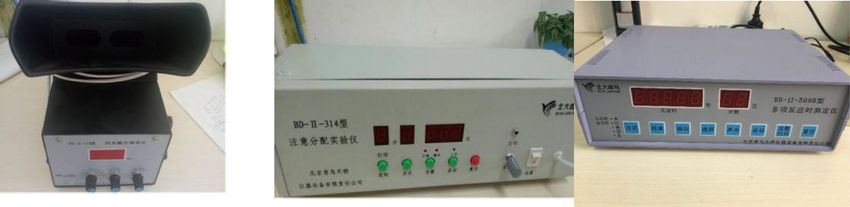
  The safety behavior ability testing system consists of                          trol group was 50 dB. The seven experimental groups
an attention distribution meter, a multiple reaction                              were 60 dB group, 70 dB group, 80 dB group, 90 dB
meter, and a flicker frequency fusion meter. They test                            group, 100 dB group, 110 dB group, and 120 dB group.
the changes in attention, reaction, and fatigue level on 8                        This is because through reviewing the literature and on-
noise levels. The specific description is as follows.                             site investigation, we found the range of underground
                                                                                  coal mine noise is mainly between 90 dB and 120 dB
Attention                                                                         [4, 6]. Also, this experiment also set 4 noise levels
The experiment selected BD-II-314 attention distribution                          below 90 dB to explore the influence of a wider range
meter, to measure the subjects’ attention distribution. The                       of noise on workers’ safety behavior ability in order
meter tested subjects’ ability to perform two tasks at the                        to improve the credibility of the experimental results.
same time. Q value of attention distribution was used to                             The subjects of this study are healthy male graduate
indicate attention distribution. It is calculated by Eq. 1:                       and undergraduate students aged from 20 to 25. During
           pffiffiffiffiffiffiffiffiffiffiffiffiffiffiffiffiffiffiffiffiffiffiffiffiffiffiffiffiffiffiffiffiffiffiffiffiffiffi                                the experiment, the subjects did not use any personal
    Q¼      ðS 2 =S 1 Þ  ð F 2 = F 1 Þ                                  ð1Þ      protective equipment. In the early stage of the experi-
                                                                                  ment, 14 subjects were selected to conduct experimental
  Note: S1 indicates the times of correct reactions to                            tests with 5 noise levels (50 dB,60 dB,70 dB,80 dB, and
acoustic stimuli; S2 indicates the total times of reactions                       90 dB). But 1 of 14 subjects had tinnitus in the 90 dB
to the acoustic stimuli; F1 indicates the times of correct                        environment. In the later stage, 8 subjects were selected
reactions to optic stimuli; F2 indicates the total times of                       from the former 14 subjects to conduct tests with 100
reactions to optic stimuli.                                                       dB,110 dB, and 120 dB to meet the consistency of the
  The meaning of Q value is as follows:                                           noise intensity of the test and the real noise environment
                                                                                  in the coal mine.
  When Q < 0.5, there is no attention distribution value;                            In this study: the fatigue level was measured by the
  When 0.5 ≤ Q < 1.0, only a part of the total attention is                       flicker fusion critical frequency; the subject’s attention
  assigned;                                                                       level was measured by their distinguishing different
  When Q = 1.0, the attention distribution value reaches                          sound and light; the reaction ability was tested by the
  the highest level. It means the efficiency of performing                        subject’s reaction time to sound and light. The safety
  multiple tasks simultaneously is equal to the efficiency                        behavioral testing system equipment is shown in Fig. 1.
  when doing a single task.
  When Q > 1.0, the attention distribution value is                               Experimental steps
  invalid.                                                                        The experiment was divided into two stages, before the
                                                                                  experiment and while experimenting.
Reaction ability                                                                    Preparation before the experiment was as follows: (a)
In our study, we used BD-II-509B multiple reaction time                           The subjects were told about the test procedure, and
tester to measure the reaction ability of the subjects to                         trained to use the instrument so that they can operate the
acousto-optic stimuli.                                                            instrument, understand the content of the questionnaire
                                                                                  and minimize any unnecessary errors; (b) Keep the envir-
Fatigue                                                                           onmental conditions in advance, including temperature,
This study used the BD-II-118 flicker frequency fusion                            humidity, and wind speed at a normal level and debugging
meter to measure the critical flicker fusion frequency of                         the equipment. During the whole test period, the subjects
the subjects.                                                                     should maintain adequate sleep (Not less than 8 h [44]).
Table 1 Noise test equipment
Experiment System                 Device Name                      Equipment Model        Manufacturer                     Certification Information
Noise Control System              Computer                         Dell- inspiron 7557
                                  Louder Speaker Box               JBL- Charge4
                                  Sound Meter                      TES1350A
Safety Working Ability            Attention Distribution Meter     BD- II-314             Beijing Qingniao Tianqiao        ISO9001: 2015 quality
Testing System                                                                            Instrument Equipment Co., Ltd.   management system
                                  Multiple Reaction Time Tester    BD- II-509B
                                                                                                                           certification
                                  Flicker Frequency Fusion Meter   BD- II-118
Li et al. BMC Public Health (2021) 21:324 Page 4 of 12
Fig. 1 Safety Behavioral Testing System Equipment
The experimental operation involved eight different on which noise level workers’ safety behavior may change
noise levels. In order to study subjects’ safety behavior significantly. To make paired-sample t-test valid, an
ability in each noise level, 14 subjects were divided into exploratory analysis of the data is required to determine
seven groups with two subjects in each group (due to whether it conforms to a normal distribution before paired-
the capacity of the experiment devices) in the 50 ~ 90 sample t-test. Regression analysis aims to research rele-
dB; 8 subjects were divided into 4 groups with two vance between independent variable (noise) and dependent
subjects in each group (due to the capacity of the experi- variable (attention, reaction, and fatigue). In short, this
ment devices) in100 dB, 110 dB, and 120 dB. The test study firstly studied whether noise affects human safety
process of one noise level was as follows: First, subjects behavior (attention, reaction, and fatigue), and if so, how
in a group entered the test environment with a certain does it affect (positively or negatively).
noise level, and adapted to the environment for 30 min.
Then, their fatigue, attention, and reaction were tested Result
for 30 min and the data were collected. When this group Attention
finished, other groups came in the test room one by one Exploratory analysis
and all the data on this noise level were collected. As is shown in Table 2, the significant p-value of the S-
Notably, the numbers of errors made and the reaction W test of the acousto-optic reaction correct times and
time of subjects were recorded synchronously. In that of the Q values were both greater than 0.05 in all 8
general, the whole process for one group of subjects noise levels. This presents a normal distribution, and
(two people) lasted for 1 h; the actual test time of seven thus paired sample t-test can be performed.
groups of subjects in the 50 ~ 90 dB (altogether 14
people) for each specific noise condition lasted for 7 h in Sample analysis of t-test
total in a day; the actual test time of four groups of sub- As is shown in Tables 3 and 4, the correct times of the
jects in the 100 ~ 120 dB (altogether 8 people) for each acoustic reactions, the optic reactions and the Q values
specific noise condition lasted for 4 h in total in a day. in the control groups were significantly different from
The eight different noise conditions were tested on 8 dif- the test values of the control group in 80 dB and above
ferent days, during generally the same period of daytime. (P < 0.05). That is, when the noise is 80 dB or above, the
attention level starts to change significantly compared
Statistical analysis methods with the control group (50 dB).
This study mainly used two statistical analysis methods:
paired-sample t-test and regression analysis. Paired- Reaction ability
sample t-test aims to compare the influence difference Exploratory analysis
of two noise levels on human’s safe behavior ability. Table 5 shows the results of the normality test of the
Specifically, seven experimental groups (60 dB, 70 dB, 80 reaction time. From the S-W test in the table, we can
dB, 90 dB, 100 dB, 110 dB, and 120 dB) were performed see p > 0.05. This indicates the reaction time of the
paired t-tests respectively with control group (50 dB) acousto-optic is normally distributed on 8 noise levels.
and to see if there is a significant difference between the Therefore, paired sample t-test can be used to analyze
experimental group and the control group, and to find the influence of different noise levels on the reaction time.Li et al. BMC Public Health (2021) 21:324 Page 5 of 12
Table 2 Exploratory analysis results of attention distribution data
Test items Shapiro-Wilk
Statistics df Significant p
Control The number of correct reaction to sound .984 14 .991
The number of correct reaction to light .961 14 .740
Q value .966 14 .802
Noise 60 dB The number of correct reaction to sound .968 14 .848
The number of correct reaction to light .945 14 .479
Q value .964 14 .799
Noise 70 dB The number of correct reaction to sound .958 14 .688
The number of correct reaction to light .977 14 .954
Q value .951 14 .525
Noise 80 dB The number of correct reaction to sound .925 14 .263
The number of correct reaction to light .949 14 .543
Q value .944 14 .509
Noise 90 dB The number of correct reaction to sound .935 13 .391
The number of correct reaction to light .947 13 .560
Q value .955 13 .591
Noise 100 dB The number of correct reaction to sound .921 8 .437
The number of correct reaction to light .979 8 .959
Q value .951 8 .525
Noise 110 dB The number of correct reaction to sound .900 8 .287
The number of correct reaction to light .914 8 .380
Q value .928 8 .440
Noise 120 dB The number of correct reaction to sound .917 8 .408
The number of correct reaction to light .977 8 .946
Q value .934 8 .505
Table 3 Paired sample t-test results of correct times to sound and light stimuli
Pairing Difference t Degree of Significant
Freedom P (Two-tailed)
Average Standard Standard 95% Confidence Interval for the Difference
value (E) Deviation Error
Lower Limit Upper Limit
Mean
Sound Control - 60 dB .785 5.146 1.375 −2.185 3.757 .571 13 .578
Sound Control - 70 dB 1.285 9.769 2.611 −4.355 6.926 .492 13 .631
Sound Control - 80 dB 7.785 11.178 2.987 1.331 14.239 2.606 13 .022
Sound Control - 90 dB 11.461 10.829 3.003 4.917 18.005 3.816 12 .002
Sound Control - 100 dB 4.750 2.764 .977 2.438 7.061 4.860 7 .002
Sound Control - 110 dB 8.125 3.270 1.156 5.390 10.859 7.027 7 .000
Sound Control - 120 dB 11.500 2.828 1.000 9.135 13.864 11.500 7 .000
Light Control - 60 dB −1.071 2.758 .737 −2.664 .521 −1.453 13 .170
Light Control - 70 dB 1.142 3.483 .930 −.868 3.153 1.228 13 .241
Light Control - 80 dB 4.928 3.852 1.029 2.704 7.152 4.787 13 .000
Light Control - 90 dB 8.153 5.096 1.413 5.074 11.233 5.768 12 .000
Light Control - 100 dB 4.250 1.281 .453 3.178 5.321 9.379 7 .000
Light Control - 110 dB 7.125 2.100 .742 5.369 8.880 9.596 7 .000
Light Control - 120 dB 10.000 2.618 .925 7.810 12.189 10.801 7 .000Li et al. BMC Public Health (2021) 21:324 Page 6 of 12
Table 4 Paired sample t-test results of attention distribution Q value
Pairing Difference t Degree of Significant
Freedom P (Two-tailed)
Average (E) Standard Standard 95% Confidence Interval for the Difference
Deviation Error
Lower Limit Upper Limit
Mean
Control - 60 dB −1.061 2.758 .737 −2.664 .521 −1.453 13 .170
Control - 70 dB 1.146 3.483 .930 −.868 3.153 1.228 13 .241
Control - 80 dB 5.029 3.852 1.029 2.704 7.152 3.989 13 .000
Control - 90 dB 6.173 5.096 1.413 5.074 11.233 4.961 12 .000
Control - 100 dB 6.665 5.709 1.595 5.369 8.850 5.134 7 .000
Control - 110 dB 7.023 6.124 1.973 7.449 12.395 5.930 7 .000
Control - 120 dB 8.235 6.802 2.023 8.349 11.044 6.395 7 .000
Sample analysis of t-test Fatigue
Table 6 shows that as the external noise level increases, Exploratory analysis
the absolute value of t gradually increases, and t always S-W analysis results show that p > 0.05. It indicates that
shows a negative value. It indicates that the test acousto- the subjects’ flicker fusion critical frequency is in normal
optic reaction time gradually increases with the increase distribution on 8 noise levels. The specific analysis
of noise level. In other words, the greater the noise level results of S-W are shown in Table 7.
is, the more significantly reaction ability decline. When
the noise level reaches 70 dB, the reaction time of the Sample analysis of t-test
subjects to the acoustic stimuli becomes significantly Table 8 shows that the t value of paired sample test
longer; after 80 dB, the reaction time to the optic stimuli increases with the increase of the noise. Flicker fusion
becomes significantly longer. These show that the critical frequency decreases as the noise increases. It can
subjects react to optic stimuli better than the acoustic be concluded that the worker’s fatigue increases with the
stimuli in the same noise level. increase of noise. Table 8 shows that there is a significant
difference between the control group and the 70 dB group
and above 70 dB groups. In other words, the external
noise has a significant impact on fatigue from 70 dB.
Table 5 Exploratory analysis results of acoustic and optical
reactions Prediction of the impact of noise levels on workers’ safety
Test items Shapiro-Wilk working ability
Statistics df Significant p As can be seen from the above analysis, noise has a
Control Light .954 14 .628 significant influence on fatigue, reaction, and attention.
Sound .905 14 .132 In order to find out the relationship between safety
60 dB Light .930 14 .302
behavioral indicators and noise, we took noise level as
independent variable and behavior indicators as the
Sound .902 14 .121
dependent variable. The experimental data was subjected
70 dB Light .946 14 .499 to regression analysis. The regression process selects
Sound .916 14 .194 linear, logarithmic, quadratic, power function, and expo-
80 dB Light .946 14 .506 nential function. The best fit models were selected based
Sound .925 14 .262 on R2. When R2 is greater than 0.9, the data fitting effect
90 dB Light .962 13 .780
becomes better.
Figures 2, 3, 4 and 5 shows the trend between noise
Sound .929 13 .331
and behavior indicators. Noise is negatively correlated
100 dB Light .875 8 .169 with the attention and reaction, and it is positively
Sound .938 8 .593 correlated with fatigue. When environmental noise level
110 dB Light .918 8 .413 exceeds 70 ~ 80 dB, noise has a significant effect on the
Sound .901 8 .297 subjects’ attention, reaction, and fatigue.
120 dB Light .927 8 .486
It can be seen from Fig. 2 that when the noise level is
between 60 and 80 dB, Q value decreases slowly with the
Sound .937 8 .586
increase of noise level. When noise level is greater thanLi et al. BMC Public Health (2021) 21:324 Page 7 of 12
Table 6 Paired sample t-test results for acoustic and optic reaction
Pairing Difference t Degree of Significant
Freedom P (Two-tailed)
Average (E) Standard Standard 95% Confidence Interval for the Difference
Deviation Error
Lower Limit Upper Limit
Mean
Sound Control - 60 dB −.009 .045 .012 −.035 .017 −.765 13 .458
Sound Control - 70 dB −.044 .054 .014 −.075 −.012 −3.052 13 .009
Sound Control - 80 dB −.077 .088 .023 −.128 −.026 −3.266 13 .006
Sound Control - 90 dB −.136 .072 .020 −.180 −.092 −6.785 12 .000
Sound Control - 100 dB −.106 .026 .009 −.129 −.084 −11.196 7 .000
Sound Control - 110 dB −.139 .030 .010 −.165 −.113 −12.914 7 .000
Sound Control - 120 dB −.198 .022 .007 −.216 −.179 −25.282 7 .000
Light Control - 60 dB −.001 .010 .003 −.007 .004 −.530 13 .605
Light Control - 70 dB −.008 .014 .004 −.016 .001 −2.337 13 .056
Light Control - 80 dB −.060 .039 .010 −.082 −.037 −5.778 13 .000
Light Control - 90 dB −.093 .035 .010 −.114 −.072 −9.524 12 .000
Light Control - 100 dB −.087 .027 .009 −.109 −.065 −9.220 7 .000
Light Control - 110 dB −.134 .029 .010 −.158 −.110 −13.255 7 .000
Light Control - 120 dB −.181 .037 .013 −.212 −.150 −13.957 7 .000
80 dB, the Q value decreases sharply. When the noise It can be seen from Fig. 5 that when noise level is
level reaches 120 dB, the subject’s Q value is 0.55, which lower than 70 dB, the change of flash fusion frequency
is close to the distraction allocation. If the noise level value is minor. When noise level reaches 70 dB or more,
continues to increase, the attention of the subjects will flash fusion frequency decreases greatly. It shows that
be seriously affected. different levels of noise have different effects on the fa-
As shown in Figs. 3 and 4, with the increase of noise tigue degree. The greater noise level is, the more fatigue
levels, the acousto-optic reaction time increases corres- the subjects are.
pondingly, the comparison between the reaction time to From the analysis of fitting effect as is seen in Table 9,
acoustic stimuli and light stimuli shows that the reaction exponential function and quadratic function are most
time to the acoustic stimuli varies from 0.40s to 0.63 s suitable for the modeling of the data in this study. The
and the reaction time to the optic stimuli varies from derivative value of the function indicates the speed of
0.37 s to 0.55 s. The reaction time to acoustic stimuli will change of the behavior indicators. According to the
be longer. Acoustic reaction time becomes significant properties of exponential functions and quadratic
when the noise is 70 dB, while optic reaction time is 80 functions, the absolute value of derivative of the two
dB. It shows that subjects are more sensitive to optic functional models continue to increase. Therefore, the
stimuli than acoustic stimuli in noisy environment. greater the noise level is, the faster attention, reaction
and fatigue will change, so workers are more prone to
accidents in high noise environment.
Table 7 Exploratory analysis results of noise group flicker fusion
frequency Discussion
Noise Shapiro-Wilk Unlike most of the previous studies [6, 9–12, 26], which
level
Statistics df Significant p studied the occupational harm of noise on human, this
Control .959 14 .701
study focused on the influence of different noise levels
on miners’ safety behavior in underground coal mines
60 dB .977 14 .952
and conducted a simulation quantitative experiment of
70 dB .956 14 .654 93 people/hours. Results of this study show that high
80 dB .980 14 .977 noise environment significantly affect fatigue, attention,
90 dB .958 13 .730 and reaction. Significance analyses reveal that fatigue is
100 dB .859 8 .118 the most sensitive to the change of noise and displays a
110 dB .853 8 .103
significant change when the noise is above 70 dB. The
sensitiveness of reaction and attention are followed by
120 dB .897 8 .273
that of fatigue and displays a significant change whenLi et al. BMC Public Health (2021) 21:324 Page 8 of 12
Table 8 Paired sample t-test results of flicker fusion frequency
Pairing Difference t Degree Significant
of Freedom P (Two-tailed)
Average (E) Standard Standard 95% Confidence Interval for the Difference
Deviation Error
Lower Limit Upper Limit
Mean
Control - 60 dB .014 .751 .200 −.419 .448 .071 13 .944
Control - 70 dB .407 .628 .167 .044 .769 2.425 13 .031
Control - 80 dB 1.657 .873 .233 1.152 2.161 7.100 13 .000
Control - 90 dB 2.107 .864 .239 1.585 2.630 8.790 12 .000
Control - 100 dB 3.050 .728 .257 2.440 3.659 11.834 7 .000
Control - 110 dB 3.450 .621 .219 2.930 3.969 15.712 7 .000
Control - 120 dB 4.125 .686 .242 3.551 4.698 17.006 7 .000
*In Table 2, 3, 4, 5, 6, 7 and 8: In order to facilitate observation, the data analysis results are marked. If Significant P (p) ≥ 0.05, gray mark is used, and Significant P
(p) < 0.05, orange mark is used
the noise is above 80 dB. In the noise environment, the As a fundamental study in the field of coal mine noise,
sensitivity of optic stimuli is more obvious than that of this paper mainly aims to measure the behavioral indica-
acoustic stimuli. In this sense, optic stimuli can be used tors of subjects affected by noise environment. To address
to improve safety systems in noisy environment. Regres- the limitations of the study, we will conduct an in-depth
sion analysis results show that noise is negatively related study on the impact of the noise environment on the
to attention and reaction, and positively related to safety behavior of miners by expanding the sample size
fatigue. and measuring noise duration.
At the same time, this study has the following short- Similar with the previous studies [35–37], this study
comings: (a) The number of subjects in this experiment also found that the safety behavior ability of miners in a
is small, and the age of the subjects is different from that high noise environment is significantly lower than that
of the actual miners. (b) Due to the limitation of our ex- in a low noise environment. However, we found a noise
perimental conditions, the experiment did not include level of 70 ~ 80 dB starts to affect the safety behavior
the influence of the time duration of the noise exposure. ability while other researches [35–37] concluded that the
Fig. 2 Relationship between attention distribution Q value and noise levelsLi et al. BMC Public Health (2021) 21:324 Page 9 of 12
0.7
Acoustic reaction time /s Significant dividing line
0.6
0.5
0.4
0.3
60 70 80 90 100 110 120 130
Noise intensity /dB
Fig. 3 Relationship between acoustic reaction time and noise levels
0.6
Significant dividing line
Optic reaction time /s
0.5
0.4
0.3
60 70 80 90 100 110 120 130
Noise intensity /dB
Fig. 4 Relationship between optic reaction time and noise levelsLi et al. BMC Public Health (2021) 21:324 Page 10 of 12
38
Significant dividing line
Flicker fusion frequency /HZ
37
36
35
34
33
60 70 80 90 100 110 120 130
Noise intensity /dB
Fig. 5 Relationship between flicker fusion frequency and noise levels
specific noise level that changes significantly is different Accordingly, the conditioned reflex activity is affected,
(85 ~ 95 dB). The reason for the difference between pre- the probability of mis operation increases, and the prob-
vious studies and this study may be different sources of ability of accident increases.
noise, different safety behavior indicators, different sub-
jects and different interests (the previous studies focused Conclusion
on physical health, while this study focused on safety be- This paper selected three safety behavior indicators: at-
havior). But certain reasons need to be studied in-depth. tention, reaction, and fatigue, and studied how coal mine
There are suggested pathways linking long-term expos- noise effects these safe working abilities. The results
ure to noise environment and human unsafe behavior. were shown as follows:Noise can affect the attention, re-
In a study by Deng [33], noise affected the physiology action, and fatigue of miners. When the environmental
and psychology, and then affected human behavior, in- noise is 80 dB or above, the attention begins to change
creasing the probability of safety accidents. Specifically, significantly compared with an environment without
in the high-noise environment, such effects are mani- noise (50 dB). When the noise is 70 dB or above, fatigue
fested as the distraction of attention, the decrease of level begins to show a significant change compared with
auditory ability. They lead to auditory and systemic fa- an environment without noise (50 dB). Notably, we
tigue. In this state, due to the development of protective found the sensitivity of optic stimuli is more obvious
inhibition, the activity of cerebral cortex cells decreases. than that of acoustic stimuli: the reaction time to acous-
tic starts to be statistically significant from 70 dB while
the reaction time to optic starts to be statistically signifi-
Table 9 Fitting equation of behavior indicators and noise levels
cant from 80 dB. In this sense, optic stimuli can be used
Behavior index Regression fitting equation R2
to improve safety systems in noisy environment. Results
Q value y = −0.0051 × 2 + 0.0163x + 0.6929 0.9813 of regression analysis show that attention and reaction is
Reaction time of sound y = 0.00003 × –0.0014x + 0.3701
2
0.9966 negatively related to noise levels, while fatigue is
Reaction time of light y = 0.2587e0.006x 0.9241 positively related to noise levels. Taking noise as the in-
Flicker fusion frequency y = −0.0007 × + 0.079x + 34.668
2
0.9969 dependent variable, attention (Q value), fatigue (flash fu-
*In formula: x is the noise level, R2 is the correlation coefficient, indicating the
sion frequency), and acoustic reaction time is best fitted
accuracy of the fitting by the mathematical model of quadratic function. OpticLi et al. BMC Public Health (2021) 21:324 Page 11 of 12
reaction time is best fitted by exponential function. And 9. Kovalchik PG, Matetic RJ, Smith AK, Bealko SB. Application of prevention
Figures 2, 3, 4 and 5 shows that compared with the no through Design for Hearing Loss in the mining industry. J Saf Res. 2008;
39(2):251–4. https://doi.org/10.1016/j.jsr.2008.02.029.
noise (50 dB), the greater the noise level increases, the 10. Vienneau D, Schindler C, Perez L, Probst-Hensch N, Roeoesli M. The
more significantly the subjects’ attention, reaction, and relationship between transportation noise exposure and ischemic heart
fatigue change. It infers that workers are safer in a low disease: a meta-analysis. Environ Res. 2015;138:372–80. https://doi.org/10.
1016/j.envres.2015.02.023.
noise environment. It is recommended that the noise 11. Münzel T, Sørensen M, Gori T, Schmidt FP, Rao X, Brook J, et al.
level in working place is controlled within 70 ~ 80 dB or Environmental stressors and cardio-metabolic disease: part I–epidemiologic
below. This way, the inclination of accidents will decrease. evidence supporting a role for noise and air pollution and effects of
mitigation strategies. Eur Heart J. 2017;38(8):550–6. https://doi.org/10.1093/
eurheartj/ehw269.
Acknowledgements
12. Rojek M, Rajzer MW, Wojciechowska W, Drożdż T, Czarnecka D. Relationship
Not Applicable.
among long-term aircraft noise exposure, blood pressure profile, and
arterial stiffness. J Hypertens. 2019. https://doi.org/10.1097/HJH.
Authors’ contributions 0000000000002060.
JL designed the study. JL and YQ written the manuscript. LY, ZW, and KH 13. Mariola S-K, Kamil Z. WHO environmental noise guidelines for the European
performed data collection and data analysis. CG performed review and region: a systematic review on environmental noise and permanent hearing
editing of manuscript. All authors read and approved the final manuscript. loss and tinnitus. Int J Env Res Pub He. 2017;14(10):1139. https://doi.org/10.
3390/ijerph14101139.
Funding 14. Shi L, Zhang X. Research progress on effects of noise on human health.
This work was supported by the Special Fund Projects for Basic Scientific China Occup Med. 2015;42(2):225–8.
Research Expenses in Central Colleges and Universities (2015QZ04). The 15. Basner M, Babisch W, Davis A, Brink M, Clark C, Janssen S, et al. Auditory and
funding body played no role in the design of the study and collection, non-auditory effects of noise on health. Lancet. 2014;383(9925):1325–32.
analysis, and interpretation of data and in writing the manuscript. https://doi.org/10.1016/S0140-6736(13)61613-X.
16. Lie A, Skogstad M, Johannessen HA, Tynes T, Mehlum IS, Nordby KC, et al.
Availability of data and materials Occupational noise exposure and hearing: a systematic review. Int Arch
The datasets used and/or analysed during the current study are available Occup Environ Health. 2016;89(3):351–72. https://doi.org/10.1007/s00420-
from the corresponding author on reasonable request. 015-1083-5.
17. van den Tillaart-Haverkate M, de Ronde-Brons I, Dreschler WA, Houben R.
The influence of noise reduction on speech intelligibility, response times to
Ethics approval and consent to participate
speech, and perceived listening effort in Normal -hearing listeners. Trends
All research procedures were approved prior to the commencement of the
Hear. 2017;21(2):2147483647. https://doi.org/10.1177/2331216517716844.
study by the China University of mining and technology (Beijing). All
18. Silva VAR, Guimarães AC, Lavinsky J, Pauna HF, Castilho AM, Crespo AN,
participants signed an informed consent form. Our research received ethics
et al. Effect of noise exposure on 1,382 metallurgical Workers in Periodic
approval from China University of Mining and Technology (Beijing) and it
Audiometric Evaluation: a cohort study. Audiol Neurotol. 2020;25(6):309–14.
conformed to the ethics guidelines of the Declaration of Helsinki.
https://doi.org/10.1159/000506894.
19. Wouters NL, Kaanen CI, Ouden PJD, Schilthuis H, Laat JAPMD. Noise
Consent for publication exposure and hearing loss among Brewery Workers in Lagos, Nigeria. Int J
Not Applicable. Env Res Pub He. 2020;17(8):2880. https://doi.org/10.3390/ijerph17082880.
20. Moroe NF. Occupational noise-induced hearing loss in the mining sector of
Competing interests South Africa: perspectives of occupational health practitioners on how
The authors declare that they have no competing interests. mineworkers are trained. South Afr J Commun Disord. 2020. https://doi.org/
10.4102/sajcd.v67i2.676.
Received: 25 February 2020 Accepted: 28 January 2021 21. Albizu EJ, Goncalves CGD, Lacerda ABMD, Zeigelboim BS, Marques JM.
Noise exposure and effects on hearing in Brazilian fishermen. Work. 2020;
65(4):881–9. https://doi.org/10.3233/WOR-203139.
References 22. Farooqi ZUR, Sabir M, Latif J, Aslam Z, Ili P. Assessment of noise pollution
1. Li L, Tian SC, Deng J, Wang L, Li TJ. Study on the coal miners’ unsafe and its effects on human health in industrial hub of Pakistan. Environ Sci
behavior: effective factors analysis and control measures. J Xi’an Univ Pollut R. 2020;27(3):1–10. https://doi.org/10.1007/s11356-019-07105-7.
Sci Technol. 2011;31(6):794–8,813. https://doi.org/10.13800/j.cnki.xakjdxxb. 23. Masterson EA, Bushnell PT, Themann CL, Morata TC. Hearing impairment
2011.06.031. among noise-exposed workers-United States, 2003–2012. Morb Mortal Wkly
2. Law of the People’s Republic of China on the Prevention and Control Rep. 2016;65(15):389–94. https://doi.org/10.15585/mmwr.mm6515a2.
of Environmental Noise Pollution. Xinjiang Farm Res Sci Technol. 2020; 24. Lundberg U, Frankenhaeuser M. Psychophysiological reactions to noise as
43(08):55–7. modified by personal control over noise intensity. Biol Psychol. 1978;6(1):51–
3. Lin BW. Talking about the prevention and control of occupational hazards 9. https://doi.org/10.1016/0301-0511(78)90006-6.
in coal mine enterprises-noise prevention. Zhong Guo Ke Ji Zong Heng. 25. Singh AP, Rai RM, Bhatia MR, Nayar HS. Effect of chronic and acute exposure
2016;005:165. to noise on physiological functions in man. Int Arch Occup Environ Health.
4. Wang H, Jiang CL, Shi LL. Analysis and countermeasures on underground 1982;50(2):169–74. https://doi.org/10.1007/BF00378078.
noise hazards of coal mine. J Saf Sci Technol. 2011;7(12):183–7. 26. Tian SC, Zhang DT. Effect of high temperature combined noise on Miner's
5. 2007 GBZ 2.2. Occupational exposure limits for hazardous agents in the unsafe behavior. Coal Mine Saf. 2019;50(02):241–4. https://doi.org/10.13347/j.
workplace. Part 2:physical agents; 2007. cnki.mkaq.2019.02.056.
6. Cheng GY, Chen SJ, Wei ZY, He F. Impact of underground noise on human 27. Hessel PA, Sluis-Cremer GK. Occupational noise exposure and blood
physiology and psychology. J Xi’an Univ Sci Technol. 2011;31(6):850–3. pressure: longitudinal and cross-sectional observations in a Group of
https://doi.org/10.13800/j.cnki.xakjdxxb.2011.06.044. Underground Miners. Arch Environ Health. 1994;49(2):128–34. https://doi.
7. Tian SC, Yang PF, Gao Y, Ma YL. Research on the relationship between noise org/10.1080/00039896.1994.9937466.
and miner emotions and intervention countermeasures. Coal Technol. 2017; 28. Liu J, Xu M, Ding L, Zhang H, Pan L, Liu Q, et al. Prevalence of hypertension
36(08):299–301. https://doi.org/10.13301/j.cnki.ct.2017.08.120. and noise-induced hearing loss in Chinese coal miners. J Thorac Dis. 2016;
8. Li B. Analysis and control measures against occupational hazards in the coal 8(3):422–9. https://doi.org/10.21037/jtd.2016.02.59.
industry. Ye Jin Gong Ye Chu Ban She: Beijing; 2005. http://niohp.chinacdc. 29. Tian SC, Liang Q, Wang L, Wu LJ, Yin LY. Research on the relationship
cn/cbw/201211/t20121129_72320.htm between the noise and miner behavior safety and prevention-controlLi et al. BMC Public Health (2021) 21:324 Page 12 of 12
countermeasures. J Xi’an Univ Sci Technol. 2015;35(05):555–60. https://doi.
org/10.13800/j.cnki.xakjdxxb.2015.0505.
30. Fan LY, Jin LZ, Huang ZL, Gao N. Experimental study on noise of mine
emergency rescue capsule. Coal Technol. 2016;35(03):210–2. https://doi.org/
10.13301/j.cnki.ct.2016.03.083.
31. You B, Tang X, Shi SL, Liu HQ, Li RQ, Luo WK. Simulated experimental study
of noise over human safety behavior. Miner Eng Res. 2017;32(04):14–9.
https://doi.org/10.13582/j.cnki.1674-5876.2017.04.003.
32. Kou M. Experimental research on the difference of miners’ safety behavior.
Min Saf Environ Prot. 2018;45(01):74–6. https://doi.org/10.3969/j.issn.1008-
4495.2018.01.017.
33. Deng CJ. Analysis of the noise hazards prevention and control underground
coal mine. Energy Energy Conserv. 2015;11:48–9. https://doi.org/10.16643/j.
cnki.14-1360/td.2015.11.023.
34. Yu GL, Wang QL, Yang ZL. Environmental psychology. People’s Educ
Press. 2000.
35. Wang JG, Fu W, Wang YQ. Study on the effects of different levels of noise
on miners’ physiological indexes and behavioral abilities. Min Saf Environ
Prot. 2019;46(01):99–103. https://doi.org/10.3969/j.issn.1008-4495.2019.01.022.
36. Mundorff JS. Effects of speech signal type and attention on acceptable
noise level in elderly, hearing-impaired listeners; 2011. https://commons.lib.
jmu.edu/diss201019/43
37. Jing GX, Lu PF, Zhao PF, Wang YS. Experimental study on the influence of
coal mine noise on people’s attention. J Saf Sci Technol. 2017;13(10):164–8.
https://doi.org/10.11731/j.issn.1673-193x.2017.10.027.
38. Xu HQ, Zhou H, Ren YL. Subjective evaluation on noise sound quality with
considerations of driver’s response time and attention. Automot Eng. 2013;
35(08):740–3. https://doi.org/10.19562/j.chinasae.qcgc.2013.08.015.
39. Li J, Wu LL, Tong YH. Research on the relationship between noise
and unsafe behaviors of employees based on SPSS. J North China
Univ Sci Technol. 2017;14(05):82–5. https://doi.org/10.3969/j.issn.1672-
7169.2017.05.015.
40. Liao B, Teng HM. Optimization of test scheme for correlation analysis of
flash fusion critical frequency and optical phase stimulation intensity.
Chin J Ergon. 2016;22(02):58–61. https://doi.org/10.13837/j.issn.1006-8309.
2016.02.0011.
41. Zhang MZ. Association between fatigue and safety performance of
construction workers. Tsinghua University; 2014.
42. Li M, Jia HQ, Li KW, Niu YW, Yao DF, Jing WX. Effect of noise level on unsafe
behavior of humans. China Saf Sci J. 2017;27(03):–19, 24. https://doi.org/10.
16265/j.cnki.issn1003-3033.2017.03.004.
43. Wang CX, Lu SL. Experimental study on influence to safety attention by
noise. J Saf Sci Technol. 2016;12(03):160–4. https://doi.org/10.11731/j.issn.
1673-193x.2016.03.029.
44. Shalini P, Brooks LJ, Carolyn D, Hall WA, Suresh K, Lloyd RM, et al.
Recommended amount of sleep for pediatric populations: a consensus
statement of the American Academy of sleep medicine. J Clin Sleep Med.
2016;12(06):785–6. https://doi.org/10.5664/jcsm.5866.
Publisher’s Note
Springer Nature remains neutral with regard to jurisdictional claims in
published maps and institutional affiliations.You can also read


