Ant Colony Optimization Task Scheduling Algorithm for SWIM Based on Load Balancing - MDPI
←
→
Page content transcription
If your browser does not render page correctly, please read the page content below
future internet

Article
Ant Colony Optimization Task Scheduling Algorithm
for SWIM Based on Load Balancing
Gang Li 1,2 and Zhijun Wu 3, *
 1    School of Electrical and Information Engineering, Tianjin University, Tianjin 300072, China;
      gangli@tju.edu.cn
 2    School of Mechanical Engineering, Baicheng Normal University, Baicheng 137000, China
 3    School of Electronic Information and Automation, Civil Aviation University of China, Tianjin 300300, China
 *    Correspondence: zjwu@cauc.edu.cn; Tel.: +86-131-1608-9897

 Received: 19 February 2019; Accepted: 30 March 2019; Published: 2 April 2019

 Abstract: This paper focuses on the load imbalance problem in System Wide Information
 Management (SWIM) task scheduling. In order to meet the quality requirements of users for task
 completion, we studied large-scale network information system task scheduling methods. Combined
 with the traditional ant colony optimization (ACO) algorithm, using the hardware performance
 quality index and load standard deviation function of SWIM resource nodes to update the pheromone,
 a SWIM ant colony task scheduling algorithm based on load balancing (ACTS-LB) is presented in
 this paper. The experimental simulation results show that the ACTS-LB algorithm performance is
 better than the traditional min-min algorithm, ACO algorithm and particle swarm optimization
 (PSO) algorithm. It not only reduces the task execution time and improves the utilization of system
 resources, but also can maintain SWIM in a more load balanced state.

 Keywords: System Wide Information Management; ant colony optimization algorithm; hardware
 performance quality index; load standard deviation function; load balancing

1. Introduction
      In 1997, EUROCONTROL proposed the System Wide Information Management (SWIM) concept
to the Federal Aviation Administration [1]. The International Civil Aviation Organization accepted this
concept in 2002 [2]. The System Wide Information Management is a large-scale network system with
high integration, which integrates and manages internal resources. SWIM, as an information sharing
platform, provides a unified data transmission and exchange mechanism for different subsystems of
civil aviation businesses. In order to achieve interoperability and consistency among the relevant units
of civil aviation, as well as reduce the difficulty of integrated dispatching, this system enables data to
be processed and integrated among independent systems. The basic idea of SWIM is to allow all air
traffic participants, such as airports, air traffic control, airlines and other related civil aviation units,
to share and exchange the latest information. Moreover, it ensures that information can be shared
safely, effectively and in a timely manner. Thus, for accurate and timely cooperative decision-making,
SWIM can greatly improve the predictability and effectiveness of decisions and meet the needs of
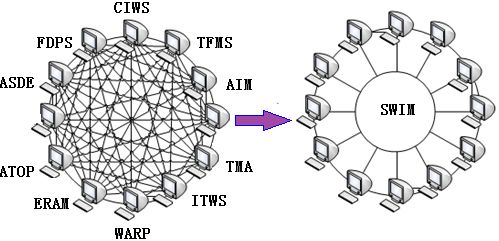
civil aviation in terms of efficient and coordinated operation. The comparison of the traditional civil
aviation mesh communication network and the SWIM bus communication structure is shown in
Figure 1 [3].

Future Internet 2019, 11, 90; doi:10.3390/fi11040090                        www.mdpi.com/journal/futureinternet
Future Internet 2019, 11, 90 2 of 18
Future Internet 2019, 11, x FOR PEER REVIEW 2 of 19
Figure1.1.Traditional
Figure Traditional mesh
mesh communication
communication structure
structure (left) and(left)
Systemand System
Wide Wide Management
Information Information
(SWIM) bus communication
Management (SWIM) busstructure (right) comparison
communication structurechart.
(right) comparison chart.
In
Inorder
ordertotoimprove
improve SWIM
SWIM resource
resourceutilization and sharing
utilization rate, itrate,
and sharing is necessary to solve the
it is necessary problem
to solve the
of
problem of system task scheduling. Because of the distribution, heterogeneity and autonomyin of
system task scheduling. Because of the distribution, heterogeneity and autonomy of resources a
SWIM
resourcesenvironment,
in a SWIM SWIM task scheduling
environment, SWIMis task
morescheduling
complex and is difficult. As an algorithm
more complex and difficult.for solving
As an
combinatorial optimization problems, the ant colony algorithm has the
algorithm for solving combinatorial optimization problems, the ant colony algorithm has the characteristics of parallelism
and strong robustness.
characteristics It canand
of parallelism quickly
strong obtain high-quality
robustness. It can solutions and ishigh-quality
quickly obtain very suitable for solving
solutions and
SWIM task scheduling problems.
is very suitable for solving SWIM task scheduling problems.
Although
Although the the existing
existing improved
improved ant ant colony
colony algorithm
algorithm can can improve
improve the the efficiency
efficiency of of task
task
scheduling, it does not significantly improve the system load imbalance.
scheduling, it does not significantly improve the system load imbalance. This paper summarizes the This paper summarizes
the existing
existing network
network tasktask scheduling
scheduling technology
technology in combination
in combination with with SWIM’s
SWIM's ownown characteristics,
characteristics, on
on
the basis of the classical ant colony algorithm, focusing on solving the problem of
the basis of the classical ant colony algorithm, focusing on solving the problem of unbalanced
unbalanced
resource
resource load
load ofofservice
servicenodes
nodes inintask
taskscheduling.
scheduling. According
According to to the
the hardware
hardware performance
performance and and load
load
situation of service node update pheromones, the SWIM ant colony task scheduling
situation of service node update pheromones, the SWIM ant colony task scheduling algorithm based algorithm based
on
on load
load balancing
balancing (ACTS-LB)
(ACTS-LB) is is proposed.
proposed. ThisThis ACTS-LB
ACTS-LB algorithm
algorithm can can reduce
reduce task
task execution
execution timetime
and improve system load balancing, thus ensuring that the user’s task scheduling
and improve system load balancing, thus ensuring that the user's task scheduling needs can be met needs can be met as
much as possible.
as much as possible.
The
The remainder
remainder of of the
the paper
paper isis structured
structured as as follows.
follows. We We give
give some
some related
related works
works in in Section
Section 2.2.
We introduce SWIM load balancing requirements and related definitions in
We introduce SWIM load balancing requirements and related definitions in Section 3. Section 4 Section 3. Section 4 presents
the detailsthe
presents of the ACTS-LB
details of thealgorithm.
ACTS-LB We give theWe
algorithm. simulation
give theresults and analysis
simulation results in
andSection 5 and
analysis in
conclude
Section 5 this
andpaper in Section
conclude 6. in Section 6.
this paper
2. Related Work
2. Related Work
At present, experts and scholars both at home and abroad have conducted much research on task
At present, experts and scholars both at home and abroad have conducted much research on
scheduling in large-scale network systems, such as cloud computing, grid and other network systems.
task scheduling in large-scale network systems, such as cloud computing, grid and other network
Among them, the min-min algorithm, max-min algorithm and other task scheduling algorithms are
systems. Among them, the min-min algorithm, max-min algorithm and other task scheduling
the early classic methods. There are also exact algorithms to solve the task scheduling problems,
algorithms are the early classic methods. There are also exact algorithms to solve the task scheduling
such as branch-and-bound algorithms, linear programming and cross-entropy methods. The heuristic
problems, such as branch-and-bound algorithms, linear programming and cross-entropy methods.
algorithms were used to solve optimization problems, such as genetic algorithm (GA), simulated
The heuristic algorithms were used to solve optimization problems, such as genetic algorithm (GA),
annealing (SA), ant colony (AC) algorithm, particle swarm optimization (PSO) and greedy algorithm.
simulated annealing (SA), ant colony (AC) algorithm, particle swarm optimization (PSO) and greedy
These algorithms have different characteristics, which are based on the idea of optimizing minimizing
algorithm. These algorithms have different characteristics, which are based on the idea of optimizing
scheduling objectives. They have been applied in the task scheduling of these network systems and
minimizing scheduling objectives. They have been applied in the task scheduling of these network
have become the reference object for subsequent research on scheduling algorithms.
systems and have become the reference object for subsequent research on scheduling algorithms.
In [4], the authors proposed a new approach for solving the shift minimization personnel task
In [4], the authors proposed a new approach for solving the shift minimization personnel task
scheduling problem. These properties are used to develop a new branch and bound scheme, which is
scheduling problem. These properties are used to develop a new branch and bound scheme, which
used in conjunction with two column generation based approaches and a heuristic algorithm to create
is used in conjunction with two column generation based approaches and a heuristic algorithm to
an efficient solution procedure. In [5], the authors presented a novel distributed implementation
create an efficient solution procedure. In [5], the authors presented a novel distributed
of multiple hypothesis tracking (MHT). Based on hash-tree distributed content storing approach to
implementation of multiple hypothesis tracking (MHT). Based on hash-tree distributed content
enable fast operations on local trees and also allow sharing of hypotheses between local and remote
storing approach to enable fast operations on local trees and also allow sharing of hypotheses
nodes. In [6], the authors proposed a general algorithm for fast estimation of probability of error
between local and remote nodes. In [6], the authors proposed a general algorithm for fast estimation
of linear block codes on BSC channels based on the importance sampling and the cross-entropy
of probability of error of linear block codes on BSC channels based on the importance sampling and
the cross-entropy method for rare-events that can be employed for any hard-decision decoder.Future Internet 2019, 11, 90 3 of 18
method for rare-events that can be employed for any hard-decision decoder. When optimal decoding
is used the algorithm reduces to a single simulation run that can estimate, with a given accuracy,
performances for a whole range of sufficiently high signal-to-noise ratios. In [7], a multi-objective task
scheduling algorithm was proposed based on the fusion of a genetic algorithm and a particle swarm
algorithm to improve the global search ability and convergence speed. In [8], this paper introduced
an optimized algorithm for task scheduling based on genetic simulated annealing algorithm in cloud
computing and its implementation. Algorithm considers the QoS requirements of different type
tasks, the QoS parameters are dealt with dimensionless. In addition, a hybrid algorithm based on
ant colony optimization (ACO) and Cuckoo was used to reduce task execution time, as proposed
by RG Babukarthik [9]. In [10], the authors proposed a new heuristic algorithm combined with
the particle swarm optimization (PSO) algorithm. It has the characteristics of strong optimization
search ability, fast convergence speed and high solving quality, providing a new direction for solving
task scheduling problems in a cloud computing environment. In [11], the authors comprehensively
considered the characteristics of tasks and virtual machine resources in the cloud environment and
proposed a task scheduling strategy that improves the greedy algorithm to improve the overall
scheduling efficiency of the system in the cloud computing environment. These algorithms have good
performance in processing task scheduling, but they seldom confer benefits from the perspective of
system load balancing.
In the research of task scheduling algorithms aimed at load balancing, Arul Xavier and others
proposed a cloud computing load balancing task aware scheduling algorithm for the task scheduling
problems in various heterogeneous virtual machines [12]. In [13], by analyzing and comparing some
cluster load balancing algorithms, a task load balancing scheduling algorithm based on ant colony
optimization (WLB-ACO) was proposed. The algorithm task completion efficiency is good, but the
task scheduling quality is difficult to guarantee. In [14], the authors presented a particle swarm
optimization with the random forest classifier algorithm, which is used to solve the load balancing
problem of virtual machines. In order to balance the utilization of virtual machine resources, the total
task working time on a virtual machine is taken as the optimization objective. However, this method
relies too much on intermediate nodes. In [15], a cloud computing resource scheduling method based
on a parallel genetic algorithm was proposed. This method can reduce the overall execution time
of scheduling tasks to a certain extent, but it easily falls into local solutions. In [16], the authors
introduced the concept of virtual machine relative fitness according to the performance of virtual
machine resources in a cloud environment, which makes it possible for virtual machine resources
with a high virtual machine relative fitness to obtain greater variation and can thus speed up the
convergence of the algorithm. The comparison of the related work references are shown in Table 1.Future Internet 2019, 11, 90 4 of 18
Table 1. The comparison of the relevant work references.
Serial Reference
Author Algorithm Name Advantages Disadvantages
Number Number
Do not confer benefits from
Proposed a new approach for solving the shift Create an efficient solution
1 [4] Baatar, D the perspective of system
minimization personnel task scheduling problem. procedure.
load balancing.
Can enable fast operations on local
Do not confer benefits from
Presented a novel distributed implementation of trees and also allow sharing of
2 [5] Domenico C the perspective of system
Multiple Hypothesis Tracking (MHT). hypotheses between local and
load balancing.
remote nodes.
Do not confer benefits from
Proposed a general algorithm for fast estimation Can reduce to a single simulation
3 [6] Romano, G the perspective of system
of probability. run that can estimate.
load balancing.
Presented a multi-objective task scheduling Do not confer benefits from
It can improve the global search
4 [7] Liu, C. algorithm based on the fusion of a genetic the perspective of system
ability and convergence speed.
algorithm and a particle swarm algorithm. load balancing.
Presented an optimized algorithm for task
Algorithm considers the QoS Do not confer benefits from
scheduling based on genetic simulated annealing
5 [8] Guoning, G requirements of different type the perspective of system
algorithm in cloud computing and its
tasks. load balancing.
implementation.
Do not confer benefits from
Proposed a hybrid algorithm based on ant colony It was used to reduce task
6 [9] Babukarthik, R.G. the perspective of system
optimization (ACO) and Cuckoo. execution time.
load balancing.
Proposed a new heuristic algorithm combined It has the characteristics of strong Do not confer benefits from
7 [10] Tong, Z. with the particle swarm optimization (PSO) optimization search ability, fast the perspective of system
algorithm convergence speed. load balancing.
Do not confer benefits from
Proposed a task scheduling strategy that improves It can improve the overall
8 [11] Wang, X. the perspective of system
the greedy algorithm. scheduling efficiency.
load balancing.
Proposed an algorithm for the task scheduling In the research of task scheduling
The task scheduling is not
9 [12] V. M, Arul Xavier. problems in various heterogeneous virtual algorithms aimed at load
efficient.
machines. balancing.Future Internet 2019, 11, 90 5 of 18
Table 1. Cont.
Serial Reference
Author Algorithm Name Advantages Disadvantages
Number Number
Proposed a task load balancing scheduling
The algorithm task completion The task scheduling quality is
10 [13] Zhao, M. algorithm based on ant colony optimization
efficiency is good. difficult to guarantee.
(WLB-ACO).
Presented a particle swarm optimization with the In order to balance the utilization This method relies too much
11 [14] Jiang, W.
random forest classifier algorithm. of virtual machine resources. on intermediate nodes.
It can reduce the overall execution
Presented a resource scheduling method based on It easily falls into local
12 [15] Chen, J. time of scheduling tasks to a
a parallel genetic algorithm. solutions.
certain extent.
Introduced the concept of virtual machine relative It speeds up the convergence
13 [16] Ren, J. It can obtain greater variation.
fitness. of the algorithm.Future Internet 2019, 11, 90 6 of 18
On the basis of the existing research results, this paper analyzes and refers to a large number of
network task scheduling algorithms in distributed and heterogeneous environments. Combined with
the characteristics of SWIM, the adopted ant colony algorithm is improved. We propose a SWIM ant
colony task scheduling algorithm based on load balancing (ACTS-LB). The simulation experiment
results show that the performance of the ACTS-LB algorithm is better than that of the traditional
min-min algorithm, ACO algorithm and PSO algorithm. The specific contributions of this study are
as follows:
(1) The ACTS-LB algorithm reduces the task scheduling completion time and improves SWIM
resource utilization;
(2) It can ensure that SWIM has better load balancing performance;
(3) It is of great significance to promote the SWIM application for civil aviation
industry development.
3. SWIM Load Balancing Requirements and Related Definitions
3.1. SWIM Load Balancing Requirements
SWIM is a large-scale network system with high integration, which integrates and manages
internal resources. In order to improve the utilization rate of system information and the sharing
rate of resources, it is necessary to solve the problem of system task scheduling load balancing and
find suitable nodes to deal with user needs. This makes SWIM load balancing and task scheduling
more complicated and difficult. The selection of a resource node with a smaller load to complete user
requirements is a very challenging task.
The SWIM infrastructure has a huge amount of computing and storage resources. Existing and
future civil aviation applications require these resources to have the ability to perform large-scale,
real-time interactions. This can result in a huge load on the data center, and it is easy to produce
load imbalance. Different from load balancing in small database systems, SWIM—as a large-scale
data center network—needs to respond to a high throughput of concurrent requests. Resource task
scheduling and allocation become key, which puts forward higher requirements for load balancing
methods [17].
(1) Large-scale information network systems have a huge amount of data resources, so a traditional
load balancer cannot meet the application requirements. It is necessary to design a new load
balancing method.
(2) Although the complex load balancing algorithm can achieve a good balancing effect, it occupies
too much of the system’s own resources. Especially in the case of a large number of system resource
nodes, there will be risks of algorithm dead-cycle or paralysis. Therefore, it is also necessary to design
a lightweight load balancing algorithm that can achieve a good load balancing effect and has low
algorithm complexity.
(3) The load balancing method must work under conditions of a large amount of data, in the form
of concurrent requests, as well as satisfy the requirement of reasonable load allocation in the case of
resource competition.
3.2. Relevant Definitions
(1) System total resource set S = s1 , s2 · · · s j · · · sm , where the system consists of m resource
nodes and s j is the system resource nodes;
(2) System total scheduling task T = {t1 , t2 · · · ti · · · tn }, including n scheduled tasks, where ti is
the system scheduling tasks;
et11 · · · et1m
.. .. , where et is the expected
(3) Expected time to compute (ETC), ETC = . · · · et · · · . ij
ij
etn1 · · · etnm
completion time of scheduling task ti on resource node s j ;Future Internet 2019, 11, 90 7 of 18
(4) Tabu is the search table.
The mathematical symbols in the formula of this paper are shown in Table 2.
Table 2. The mathematical symbols notations.
Serial Number Symbol Notation
1 Pijk (t) The transition probability value
2 τij (t) The pheromone value
3 ηij (t) The heuristic function
4 α The information heuristic factor
5 β The expect heuristic factor
6 Mip(s j ) The computing power
7 Bandwidth(s j ) The communication bandwidth
8 Per f ormance(s j ) The hardware performance
9 LBj The load balancing value
10 C (s j ) The CPU utilization rate
11 M(s j ) The memory usage
12 B(s j ) The bandwidth occupancy
13 LA The average value of the load
14 LS The load standard deviation
15 µ The information residual factor
16 ∆τij The pheromone increment value
4. Ant Colony Optimization Algorithm Based on Load Balancing
4.1. Ant Colony Optimization Algorithm Analysis
Marco Dorigo first proposed an ant colony optimization algorithm in 1991 to achieve global
optimization by simulating ant foraging behavior [18]. Suppose that Pijk (t) is the transition probability
value of ant k from resource node i to resource node j at time t, using this value to select the next task
to schedule. It is expressed by Equation (1).
n
∑ [τij (t)] ∗ [ηij (t)] , j ∈ A
[τ (t)]α ∗ [η (t)] β α β
k ij ij
Pij (t) = i =1 (1)
0, Others
In Equation (1), τij (t) is the pheromone value for transferring resource node i to resource node j
at time t; ηij (t) is the heuristic function for transferring resource node i to resource node j at time t;
α is the information heuristic factor, which represents the relative importance of scheduling order; β is
the expect heuristic factor, which represents the importance of heuristic information in ant selection
scheduling sequence. The larger the value of β, the more likely the ants are to choose the scheduling
sequence autonomously. Set A as the task that ant k can choose to perform in the next step.
According to Equation (1), the two key factors affecting the selection of resource nodes are
τij (t) and ηij (t). The improvement of these two factors is the difficulty and emphasis of the algorithm
research. The ACTS-LB algorithm proposed in this paper is based on the standard ant colony algorithm
to make corresponding improvements to τij (t), and to update pheromone rules according to the node
resource hardware performance and load balancing value.
4.2. Ant Colony Optimization Task Scheduling Algorithm Rule
In the actual SWIM, in order to achieve effective load balancing, the hardware performance of the
node resources must be considered. First, reasonably assign tasks to each node according to the node
processing capacity. The hardware performance is represented by two key indicators—computingFuture Internet 2019, 11, 90 8 of 18
power and system communication bandwidth of resource nodes. The hardware performance can be
expressed by Equation (2).
Per f ormance(s j ) = ω1 ∗ Mip(s j ) + ω2 ∗ Bandwith(s j ). (2)
In Equation (2), Mip(s j ) represents the computing power of resource node s j , Bandwidth(s j )
represents the communication bandwidth of resource node s j , and ω1 and ω2 are constants.
In SWIM, the indicators of impact on resource nodes load are mainly composed of CPU utilization,
memory utilization and system bandwidth occupancy. The load balancing value of SWIM resource
nodes can be expressed by Equation (3).
LBj = δ1 ∗ C (s j ) + δ2 ∗ M (s j ) + δ3 ∗ B(s j ). (3)
In Equation (3), LBj represents the load balancing value of resource node s j ; C (s j ) represents the
CPU utilization rate of resource node s j ; M (s j ) represents the memory usage of resource node s j ; B(s j )
represents the bandwidth occupancy of resource node s j ; the coefficients δ1 , δ2 and δ3 are constants,
representing the weights of the three items, and δ1 + δ2 + δ3 = 1.
The average value of the load of all resource nodes in SWIM is expressed by Equation (4).
,
m
LA j = ∑ LBj m. (4)
j =1
Then the resource node load standard deviation is expressed by Equation (5).
v
u m
u1
LS j = t ∑ LBj − LA j .
2
(5)
m j =1
By calculating the resource node load standard deviation LS in SWIM, it can reflect the system
load balance degree. The larger the value of LS, the more unbalanced the system load. The smaller the
value of LS, the more balanced the system load.
The ant colony algorithm pheromone update is expressed by Equation (6).
τij (t + n) = (1 − µ)τij (t) + ∆τij . (6)
In Equation (6), µ is the information residual factor, 1 − µ is the pheromone volatilization
coefficient, which is employed to avoid the pheromone infinite accumulation. The µ value range
is limited to 0 < µ < 1. τij (t + n) is the pheromone concentration value on the path (i, j) at time t + n;
∆τij is the pheromone increment value on the selected path (i, j), the initial time is ∆τ0 = 0.
This paper uses the resource node hardware performance parameters and the system average
load difference to update the pheromone τij , as expressed by Equation (7).
m
∆τij = ∑ ∆τijk (7)
k =1
∆τijk = Per f ormance(s j ) ∗ (1 − LS j ) = [ω1 ∗ Mip(s j ) + ω2 ∗ Bandwith(s j )] ∗ (1 − LS j ) (8)
The heuristic function ηij in ant colony algorithm can be expressed by Equation (9).
ηij = 1/etij (9)
In order to maximize the utility, we must also consider the completion time factor of all tasks and
try to minimize the task completion time. So, the expected completion time etij is used to calculate theFuture Internet 2019, 11, 90 9 of 18
heuristic function of the ant colony algorithm. The smaller the expected completion time, the larger the
value of ηij and the higher the value of Pijk (t). Thus, the degree of expectation that an ant will transfer
from task ti to node s j is improved.
The pheromone update calculation in Equation (6) and heuristic function calculation in
Equation (9) are substituted into Equation (1) to obtain the probability value that task ti is scheduled to
resource node s j after the optimization of the ant colony algorithm. The computational complexity of
the improved ACO algorithm presented in this paper is expressed as O( NCmax ∗ n3 ), where NCmax is
the number of cycles and n is the total number of tasks.
4.3. Ant Colony Task Scheduling Algorithm Optimization Process
The main idea is to select the best order of task scheduling through the ant colony algorithm,
in which the scheduler can be regarded as an ant and the task scheduling process is compared with the
ant foraging process. The pheromone is updated according to the hardware performance parameters of
the system resource node and the system average load difference, and the expected time to complete all
tasks is at a minimum. So, the expected completion time is used to calculate the heuristic function of the
ant colony algorithm. Finally, a resource node with high pheromone concentration (high performance
and low load) and minimum completion time is selected to handle the assigned task.
The research content of SWIM task scheduling is to map each task to resource set S in task set
T, and to improve the task scheduling performance of the system on the premise of ensuring load
balancing.
Future InternetThe
2019,specific
11, x FORsteps
PEERof the ant10colony
REVIEW of 19 optimization task scheduling algorithm for SWIM based
on load balancing are as follows. The flow chart of the algorithm is shown in Figure 2.
The initialization information
Y
NC < NC max ?
N
Initialization Tabu
Y
Traverse all tasks and ant?
N
Clear the Tabu Calculate LB and η ij (t )
Recording information
Calculate Pijk (t )
End
Information table Select the next scheduled task
Select tasks to add to the Tabu
Figure 2. The flow chart of the ant colony optimization task scheduling algorithm based on
load balancing.
Figure 2. The flow chart of the ant colony optimization task scheduling algorithm based on
load balancing.
Step 1: First, initialize the parameters in the algorithm. There are n tasks, m resources, the number
Stepis 1:q, First,
of ants the maximum number
initialize the of cycles
parameters thetmax
in is , the initial
algorithm. t isnsettasks,
timeare
There mcan
to 0 (it be assumed
resources, the
number of ants is q , the maximum number of cycles is t max , the initial time t is set to 0 (it can be
assumed that there are n air flight planning missions and m navigation information resources in
SWIM in this scenario).
Step 2: Make t = t + 1 . If t ≤ t max , after initializing the search table, all ants search the path
from the initial position and stop searching when all tasks enter the search table.Future Internet 2019, 11, 90 10 of 18
that there are n air flight planning missions and m navigation information resources in SWIM in this
scenario).
Step 2: Make t = t + 1. If t ≤ tmax , after initializing the search table, all ants search the path from
the initial position and stop searching when all tasks enter the search table.
Step 3: The hardware performance and load balance difference of the resource nodes are obtained
by calculations, and the transferred probability Pijk (t) of each resource node is calculated by Equation (1),
using Pijk (t) to select the perform task resource node.
Step 4: Update the search table and add the scheduling task to the search table. Use Tabu to
record the set of tasks that ant k is currently passing through. Do not repeatedly select the path that
has already passed as the next path.
Step 5: Update the pheromone of the ant colony algorithm according to Equation (6) and save the
selected ant information with the best scheduling result.
Step 6: Repeat the above steps until t > tmax , when the algorithm ends [19].
5. Experiment and Results Analysis
In the experiment, we referred to the SWIM structure that is already deployed by an air traffic
administration of civil aviation, and we used the network simulation tool—NS-3 to verify the algorithm
performance. The11,SWIM
Future Internet 2019, localREVIEW
x FOR PEER task scheduling
11 of 19 structure is shown in Figure 3.
Figure
Figure SWIMtask
3.3.SWIM task scheduling
scheduling structure
structurediagram.
diagram.
5.1. Experimental Environment
The simulation experiment designed a topology model with one scheduler, four routers, six
servers and eight clients. The node 1 is the scheduler, nodes 2–5 are the routers, nodes 6–11 are the
servers, and nodes 12–19 are the clients. The link bandwidth between the client and the router,
between the router and the scheduler, and between the router and the server is 150 Mbps, and the
one-way delay of 10 ms. The simulation experiment test topology is shown in Figure 4.Future Internet 2019, 11, 90 11 of 18
Figure 3. SWIM task scheduling structure diagram.
5.1. Experimental Environment
5.1. Experimental Environment
The simulation experiment designed a topology model with one scheduler, four routers, six servers
The simulation experiment designed a topology model with one scheduler, four routers, six
and eight clients. The node 1 is the scheduler, nodes 2–5 are the routers, nodes 6–11 are the servers,
servers and eight clients. The node 1 is the scheduler, nodes 2–5 are the routers, nodes 6–11 are the
and nodes 12–19 are the clients. The link bandwidth between the client and the router, between the
servers, and nodes 12–19 are the clients. The link bandwidth between the client and the router,
router and the scheduler, and between the router and the server is 150 Mbps, and the one-way delay of
between the router and the scheduler, and between the router and the server is 150 Mbps, and the
10 ms. The simulation experiment test topology is shown in Figure 4.
one-way delay of 10 ms. The simulation experiment test topology is shown in Figure 4.
Figure 4. Topology diagram of the SWIM task scheduling simulation experiment.
Figure 4. Topology diagram of the SWIM task scheduling simulation experiment.
5.2. Experimental Parameter Settings
For the selection of parameters α, β and µ in the ant colony algorithm, there is no general method
to determine their optimal combination. It should be noted that these parameters have a great impact
on the performance of the ant colony algorithm. The smaller the value of µ, the smaller the influence
of the previously searched path on the current search, making the algorithm difficult to converge.
The larger the value of µ, the greater the influence of the previous search path on the current search, but
this also increases the risk of falling into a local optimum. So, the µ value is generally set at 0.5. In the
parameter selection experiment, the α and β values were set as µ = 0.5 and µ = 0.6. The simulation
program was cycled 1000 times, the best result was selected as one experiment, taking the average
value of 100 experiments. The parameters are substituted into the algorithm for the simulation test.
The simulation experiment data are shown in Table 3.
Table 3. Parameter combination test results.
Serial Number µ α β Optimal Path Running Time (S)
1 0.5 1.0112 2.7375 568.10969 39.98
2 0.5 1.0351 2.6856 568.19446 40.37
3 0.5 1.0323 2.7685 568.19446 40.56
4 0.5 1.0289 2.7386 568.10969 40.33
5 0.5 1.0156 2.7235 568.10969 40.25
6 0.5 4.3589 1.5195 568.19446 41.79
7 0.5 5.2368 2.4978 568.10969 41.65
8 0.5 5.3646 2.5568 568.10969 41.15
9 0.5 6.3567 4.2556 568.19446 42.48
10 0.5 6.3551 4.2550 568.19446 42.68
11 0.6 1.0253 2.7526 568.10969 39.86
12 0.6 1.0362 2.6898 568.19446 40.29
13 0.6 1.0387 2.7365 568.19446 40.53Future Internet 2019, 11, 90 12 of 18
Table 3. Cont.
Serial Number µ α β Optimal Path Running Time (S)
14 0.6 1.0236 2.7472 568.10969 40.25
15 0.6 1.0187 2.7356 568.10969 40.27
16 0.6 4.3789 1.5387 568.19446 41.58
17 0.6 5.2468 2.4998 568.10969 41.31
18 0.6 5.3846 2.5368 568.10969 41.02
19 0.6 6.3985 4.2673 568.19446 42.29
20 0.6 6.3653 4.2672 568.19446 42.37
From Table 3, we can see that the optimal path is 568.10969, the running time is 39.86 s, µ = 0.6,
α = 1.0253 and β = 2.7526. After the comparative study and multiple experiments, the parameters in
this paper simulation experiment were set to α = 1.0, β = 2.7 and µ = 0.6. In the experiment, we found
that when the same parameters were used for experiments of different scales, the results obtained
were different. The weight parameters of the resource node load impact indicator in SWIM were set to
δ1 = 0.4, δ2 = 0.3 and δ3 = 0.3. The population size was 50, and the maximum number of iterations was
150. The simulation experiment test parameters are shown in Table 4.
Table 4. Simulation experiment test parameters.
Parameter Population
α β µ Bandwidth Delay δ1 δ2 δ3 NCmax
Name Size
Parameter value 1.0 2.7 0.6 150 Mbps 10 ms 0.4 0.3 0.3 50 150
5.3. Experimental Results and Analysis
In order to verify the effectiveness of the ACTS-LB algorithm designed in this paper, we tested
the method using the same parameter configuration conditions but in two different situations: (1) The
service nodes number is fixed, but scheduling tasks number is changed; (2) The scheduling tasks
number is fixed, but the resource nodes number is changed. This was compared with the classic
min-min algorithm [20], the ACO algorithm [21] and the PSO algorithm [10] in terms of transmission
delay, task execution time and system load deviation value.
Experiment 1: The transmission delay comparison.
(1) Set the number of service nodes at m = 20 and the number of scheduling tasks at 10 < n < 200.
(2) Set the number of scheduling tasks at n = 100 and the number of service nodes at 5 < m < 50.
In the above two cases, by running the simulation software NS-3, the time delay data of the
path was obtained by measuring different iterations of the ACTS-LB algorithm, min-min algorithm,
ACO algorithm and PSO algorithm in the path finding process. The trace file obtained was counted
and analyzed by the statistical analysis tool Wireshark. We obtained the total time delay value of the
path after each iteration for each of the four algorithms, and the average value of each algorithm was
obtained after each iteration was run 1000 times. The result was processed by MATLAB. The results
are shown in Figures 5 and 6.In the above two cases, by running the simulation software NS-3, the time delay data of the path
was obtained by measuring different iterations of the ACTS-LB algorithm, min-min algorithm, ACO
algorithm and PSO algorithm in the path finding process. The trace file obtained was counted and
analyzed by the statistical analysis tool Wireshark. We obtained the total time delay value of the
path after each iteration for each of the four algorithms, and the average value of each algorithm was
Future Internet 2019, 11, 90 13 of 18
obtained after each iteration was run 1000 times. The result was processed by MATLAB. The results
are shown in Figure 5 and Figure 6.
600
ACTS-LB
PSO
500 ACO
Min-Min
Transmission delay/ms
400
300
200
100
0
10 20 30 40 50 60 70 80 90 100 110 120 130140 150 160 170 180 190 200
Number of tasks
Future Internet 2019, 11, x FOR PEER REVIEW 14 of 19
Figure
Figure 5. The comparison
5. The comparison of
of transmission
transmission delay
delay under
under different
different scheduling
scheduling tasks.
tasks.
500
ACTS-LB
450 PSO
ACO
400
Min-Min
350
Transmission delay/ms
300
250
200
150
100
50
0
5 10 15 20 25 30 35 40 45 50
Number of service nodes
Figure 6. The comparison of transmission delay under different service nodes.
Figure 6. The comparison of transmission delay under different service nodes.
It can be seen from the experimental results in Figures 5 and 6 that, at the beginning of ant colony
It can be seen from the experimental results in Figure 5 and Figure 6 that, at the beginning of ant
routing, the four algorithms have large fluctuations in the total transmission delay of the path and
colony routing, the four algorithms have large fluctuations in the total transmission delay of the path
have the same performance. After 100 iterations, the ACO algorithm basically leveled off and no
and have the same performance. After 100 iterations, the ACO algorithm basically leveled off and no
longer changed, indicating that the ACO algorithm falls into premature convergence after the 100th
longer changed, indicating that the ACO algorithm falls into premature convergence after the 100th
iteration and could no longer search for a better path. When the number of tasks increased in the
later period, the transmission delay variation of the min-min algorithm and PSO algorithm were not
obvious. The ACTS-LB algorithm expanded the path space due to the optimized updating of
pheromones, and the ants disturbed other paths so that the obtained paths were evenly distributedFuture Internet 2019, 11, 90 14 of 18
iteration and could no longer search for a better path. When the number of tasks increased in the
later period, the transmission delay variation of the min-min algorithm and PSO algorithm were
not obvious. The ACTS-LB algorithm expanded the path space due to the optimized updating of
pheromones, and the ants disturbed other paths so that the obtained paths were evenly distributed
in the path space, ensuring that the ants had a stronger search ability and could find better quality
transmission paths. Thus, it can be seen that the ACTS-LB algorithm can effectively solve the premature
convergence problem of the ACO algorithm, providing ants with a stronger search ability and obtaining
a better-quality path set.
Experiment 2: The task execution time span comparison.
(1) Set the number of service nodes at m = 20 and the number of scheduling tasks at 10 < n < 200.
(2) Set the number of scheduling tasks at n = 100 and the number of service nodes at 5 < m < 50.
In the above two cases, the task execution time of the ACTS-LB algorithm, min-min algorithm,
ACO algorithm and PSO algorithm were tested in the context of task scheduling. The experimental
results were sorted according to the data in NS-3. The four algorithms were executed 1000 times and
averaged. The
Future Internet results
2019, of the
11, x FOR task
PEER execution
REVIEW time span are shown in Figures 7 and 8.
15 of 19
100
ACTS-LB
90
PSO
ACO
80
Min-Min
70
Task execution time/s
60
50
40
30
20
10
0
10 20 30 40 50 60 70 80 90 100 110 120 130140 150 160 170 180 190 200
Number of tasks
Figure 7. The
Figure 7. The comparison
comparison of
of task
task execution
execution time
time span
span under
under different
different scheduling
schedulingtasks.
tasks.
80
ACTS-LB
70 PSO
ACO
Min-Min
60
Task execution time/s
50
40
30
2010
0
10 20 30 40 50 60 70 80 90 100 110 120 130140 150 160 170 180 190 200
Number of tasks
Future Internet 2019, 11, 90 15 of 18
Figure 7. The comparison of task execution time span under different scheduling tasks.
80
ACTS-LB
70 PSO
ACO
Min-Min
60
Task execution time/s
50
40
30
20
10
0
5 10 15 20 25 30 35 40 45 50
Number of service nodes
Figure 8.
Figure The comparison
8. The comparison of
of task
task execution
execution time
time span
span under
under different
different service
service nodes.
nodes.
It can be seen from the experimental results in Figure 7 that, in the initial stage of task scheduling,
It can be seen from the experimental results in Figure 7 that, in the initial stage of task
the task execution time of the ACTS-LB algorithm, min-min algorithm, ACO algorithm and PSO
scheduling, the task execution time of the ACTS-LB algorithm, min-min algorithm, ACO algorithm
algorithm are basically the same. However, the task execution time of the ACTS-LB algorithm becomes
and PSO algorithm are basically the same. However, the task execution time of the ACTS-LB
smaller than that of the other three algorithms as the number of tasks increases. From the experimental
algorithm becomes smaller than that of the other three algorithms as the number of tasks increases.
results in Figure 8, it can also be seen that when the number service nodes increased, the ACTS-LB
algorithm execution task scheduling time was less than that of the min-min algorithm, ACO algorithm
and PSO algorithm. This shows that the method of calculating heuristic function by using expected
execution time in the ACTS-LB algorithm plays an effective role in shortening the task execution time,
and ants tend to choose the path with high pheromone concentration and minimum completion time.
It can be concluded that the ACTS-LB algorithm can improve task execution efficiency and enable ants
to have a stronger task scheduling ability.
Experiment 3: The system load deviation comparison.
(1) Set the number of service nodes at m = 20 and the number of scheduling tasks at 10 < n < 200.
(2) Set the number of scheduling tasks at n = 100 and the number of service nodes at 5 < m < 50.
In this paper, the load deviation value (LDV) of SWIM resource nodes is proposed as a reference
standard for evaluating load balancing in task scheduling. The LDV definition can be expressed by
Equation (10).
LBmax − LBmin
LDV = (10)
LA
The definition of the SWIM resource nodes load value LB is the same as in Equation (3); LBmax and
LBmin are the maximum and minimum values of LB, respectively; LA is the average of all resource node
loads. According to the experimental results, the load deviation values of the resource nodes during
the task scheduling of the four algorithms were obtained. The results are shown in Figures 9 and 10.LDV = max min (10)
LA
The definition of the SWIM resource nodes load value LB is the same as in Equation (3); LBmax
and LBmin are the maximum and minimum values of LB , respectively; LA is the average of all
resource node loads. According to the experimental results, the load deviation values of the resource
Future Internet 2019, 11, 90 16 of 18
nodes during the task scheduling of the four algorithms were obtained. The results are shown in
Figure 9 and Figure 10.
2
ACTS-LB
1.8 PSO
ACO
1.6 Min-Min
1.4
Load deviation value
1.2
1
0.8
0.6
0.4
0.2
0
10 20 30 40 50 60 70 80 90 100 110 120 130140 150 160 170 180 190 200
Number of tasks
Future Internet 2019, 11, x FOR PEER REVIEW 17 of 19
Figure9.9.The
Figure Thecomparison
comparison of
of system load deviation
system load deviationvalues
valuesunder
underdifferent
differentscheduling
scheduling tasks.
tasks.
2
1.8
1.6
1.4
Load deviation value
1.2
1
0.8
0.6
ACTS-LB
0.4
PSO
0.2 ACO
Min-Min
0
5 10 15 20 25 30 35 40 45 50
Number of service nodes
Figure 10.The
Figure10. Thecomparison
comparisonof
ofsystem
system load
load deviation values
valuesunder
underdifferent
differentservice
servicenodes.
nodes.
It It
cancanbebeseen
seenfrom
fromFigures
Figure 99and 10, the10,LDV
andFigure the value of theofACTS-LB
LDV value algorithm
the ACTS-LB is smaller
algorithm than
is smaller
that of the
than thatmin-min algorithm,
of the min-min ACO algorithm
algorithm, and PSOand
ACO algorithm algorithm, and the and
PSO algorithm, transformation becomes
the transformation
becomes
slower slower
as the numberas the number
of tasks of tasks
increases. Thisincreases. This
is because is because
in the ACTS-LB in algorithm,
the ACTS-LB algorithm,
pheromones are
pheromones are updated according to the hardware quality and the load balancing
updated according to the hardware quality and the load balancing of node resources, so ants tend of node
to resources, so antsnodes
aim for resource tend with
to aim forpheromone
high resource nodes with high(high
concentrations pheromone concentrations
performance and low load(highof
performance and low load of resource nodes) when selecting the next task processing target node. It
can be concluded that the ACTS-LB algorithm with LDV as the reference standard can achieve the
goal of load balancing and improve the overall performance of task scheduling.
5.4. ACTS-LB Algorithm ShortcomingsFuture Internet 2019, 11, 90 17 of 18
resource nodes) when selecting the next task processing target node. It can be concluded that the
ACTS-LB algorithm with LDV as the reference standard can achieve the goal of load balancing and
improve the overall performance of task scheduling.
5.4. ACTS-LB Algorithm Shortcomings
The ACTS-LB algorithm, however, can still be further improved, which requires further
optimization and in-depth study in the following aspects:
(1) Because the ant colony algorithm has a slow convergence rate in the initial stage, it can easily
fall into the local optimum. Therefore, the ACTS-LB algorithm also has some shortcomings. In the
subsequent algorithm improvement, we will draw on other heuristic algorithm advantages, such as
the simulated annealing (SA) algorithm and genetic algorithm, etc. The comprehensive application
of these algorithms’ different characteristics, and the fact that their advantages and disadvantages
complement each other, will aid us in improving the algorithm’s overall task scheduling performance.
(2) The ant colony algorithm parameter setting is very important. If it is not set properly, it will
slow down the solving speed and affect the quality of the results. In the next SWIM task scheduling
study, we will consider the task dynamics and the service quality of the system. We plan to dynamically
adjust the corresponding parameters in the algorithm and study the impact of ant colony parameters
and local search methods on the overall performance of the system, so as to continuously improve and
perfect the task scheduling strategy.
6. Conclusions
In this paper, we proposed the SWIM ant colony optimization task scheduling algorithm
based on load balancing (ACTS-LB). By improved the traditional ant colony optimization algorithm,
the hardware performance quality index and load standard deviation function of resource nodes in
SWIM were comprehensively adopted to improve the pheromone updating strategy of the algorithm.
The ACTS-LB algorithm improved the defect that pheromone updating can easily fall into the local
optimum and ensures that the system’s load balancing requirements were maximized while the
scheduling task was effectively completed. The experimental simulation using NS-3 showed that the
ACTS-LB algorithm performs better than the classic min-min algorithm, ACO algorithm and PSO
algorithm, as it can maintain SWIM in a balanced load state and improved the efficiency of system task
scheduling and execution. However, in this paper, we presented the ACTS-LB algorithm, which was
tested only in a simulated SWIM environment. The algorithm had not yet been tested in an actual
SWIM application environment and the experimental results were not convincing. Next, in order to
further verify the validity of the proposed ACTS-LB algorithm, we will try to simulate the algorithm
in a real SWIM environment.
Author Contributions: G.L. contributed to presenting the ACTS-LB algorithm, performed evaluating experiments
and was the main contributor to the manuscript; Z.W. contributed to proposing the evaluating methodology and
helped in the article processing.
Funding: This work was funded by the National Natural Science Foundation for Youth of China (61601467).
The Major Program of Natural Science Foundation of Tianjin (17JCZDJC30900) and the Fundamental Research
Funds for the Central Universities of China (3122018D007).
Conflicts of Interest: The authors declare no conflict of interest.
References
1. Stephens, B. System-Wide Information Management (SWIM) Demonstration Security Architecture.
In Proceedings of the 2006 IEEE/AIAA 25th Digital Avionics Systems Conference, Portland, OR, USA,
15–19 October 2006; pp. 1–12.
2. Crescenzo, D.D.; Strano, A.; Trausmuth, G. SWIM: A Next Generation ATM Information Bus-The SWIM-SUIT
Prototype. In Proceedings of the 2010 14th IEEE International Enterprise Distributed Object Computing
Conference Workshops, Vitoria, Brazil, 25–29 October 2010; pp. 41–46.Future Internet 2019, 11, 90 18 of 18
3. Federal Aviation Administration (FAA)-SWIM Program Overview. Available online: https://www.faa.gov/
air_traffic/technology/swim/overview/ (accessed on 16 March 2019).
4. Baatar, D.; Krishnamoorthy, M.; Ernst, A.T. A Triplet-Based exact method for the shift minimisation personnel
task scheduling problem. In Proceedings of the 23rd Annual European Symposium on Algorithms (ESA) as
Part of ALGO Conference, Patras, Greece, 14–16 September 2015; pp. 59–70.
5. Domenico, C.; Steven, H. A Hash-Tree Based Approach for a Totally Distributed Track Oriented Multi
Hypothesis Tracker. In Proceedings of the 2012 IEEE Aerospace Conference, Big Sky, MT, USA, 3–10 March
2012; pp. 1–9.
6. Romano, G.; Drago, A.; Ciuonzo, D. Sub-optimal importance sampling for fast simulation of linear
block codes over BSC channels. In Proceedings of the 2011 8th International Symposium on Wireless
Communication Systems, ISWCS, Aachen, Germany, 6–9 November 2011; pp. 141–145.
7. Liu, C.; Yang, W. A Multi-Objective Task Scheduling Based on Genetic and Particle Swarm Optimization
Algorithm for Cloud Computing. Comput. Tech. Dev. 2017, 27, 56–59. (In Chinese) [CrossRef]
8. Gan, G.N.; Huang, T.L.; Gao, S. Genetic Simulated Annealing Algorithm for Task Scheduling based on Cloud
Computing Environment. In Proceedings of the 2010 International Conference on Intelligent Computing
and Integrated Systems, Guilin, China, 22–24 October 2010; pp. 60–63.
9. Babukarthik, R.G.; Raju, R.; Dhavachelvan, P. Hybrid Algorithm for Job Scheduling: Combining the Benefits
of ACO and Cuckoo Search. Adv. Intell. Syst. Comput. 2013, 177, 479–490.
10. Tong, Z.; Chen, H.; Chen, M.; Mei, J.; Liu, H. A hybrid biogeography-based optimization algorithm for task
scheduling in cloud computing. J. Comput. Eng. Sci. 2018, 40, 765–772.
11. Wang, X.; Wang, R.; Jiang, H. Research on Cloud Task Scheduling with Improved Greedy Algorithm.
Microelectr. Comput. 2018, 35, 109–113.
12. Xavier, V.M.A.; Annadurai, S. Chaotic social spider algorithm for load balance aware task scheduling in
cloud computing. Clust. Comput. 2018, 9, 1–11.
13. Zhao, M.; Li, S. Load Balancing of Task Scheduling Based on Ant Colony Optimization in Cloud Computing
Environment. Electr. Design Eng. 2016, 24, 30–33.
14. Jiang, W.; Liu, Z.; Qiu, Q.; Huang, Q. A virtual machine load balancing algorithm in cloud environment.
J. Fuzhou Univ. (Natural Science Edition) 2018, 46, 451–457.
15. Chen, J.; Xu, J.; Hui, B. Cloud Computing Resource Scheduling based on Improved Semantic Search Engine.
In Proceedings of the 2nd International Conference on Intelligent Information Processing, Bangkok, Thailand,
17–18 July 2017; pp. 237–243.
16. Ren, J.; Huang, Y.; Zhong, X. Cloud task scheduling improved algorithm based on the genetic algorithm.
J. Jiangxi Univ. Sci. Tech. 2018, 39, 90–94.
17. Huangfu, X.P. Research on the Method of Novel Architecture and Load Balancing for Data Center Networks
in the Integrated Information Infrastructure. Ph.D. Thesis, Graduate School of National University of Defense
Technology, Changsha, China, 2014. (In Chinese)
18. Dorigo, M.; Gambardella, L.M. Ant colony system: A cooperative learning approach to the traveling salesman
problem. IEEE Trans. Evolut. Comput. 1997, 1, 53–66. [CrossRef]
19. Hua, D. Research on Grid Resources Scheduling Based on QoS-Ant Colony Optimization Algorithm.
Ph.D. Thesis, School of Computer and Software, Nanjing University of Information Science & Technology,
Nanjing, China, 2011. (In Chinese)
20. Chauhan, S.S.; Joshi, R.C. A weighted mean time Min-Min Max-Min selective scheduling strategy for
independent tasks on Grid. In Proceedings of the 2010 IEEE 2nd International Advance Computing
Conference (IACC), Patiala, India, 19–20 February 2010; pp. 4–9.
21. Lu, X.; Gu, Z. A load-adapative cloud resource scheduling model based on ant colony algorithm.
In Proceedings of the IEEE International Conference on Cloud Computing and Intelligence Systems, Beijing,
China, 15–17 September 2011; pp. 296–300.
© 2019 by the authors. Licensee MDPI, Basel, Switzerland. This article is an open access
article distributed under the terms and conditions of the Creative Commons Attribution
(CC BY) license (http://creativecommons.org/licenses/by/4.0/).You can also read


