Applied Physics of solar energy conversion - Conventional solar cells, and how lazy thinking can slow you down Some new ideas Our work on ...
←
→
Page content transcription
If your browser does not render page correctly, please read the page content below
Applied Physics of solar
       energy conversion

•   Conventional solar cells, and how lazy thinking can
    slow you down
• Some new ideas
***************************************************************
• Our work on semiconductor quantum dots

                                                                  1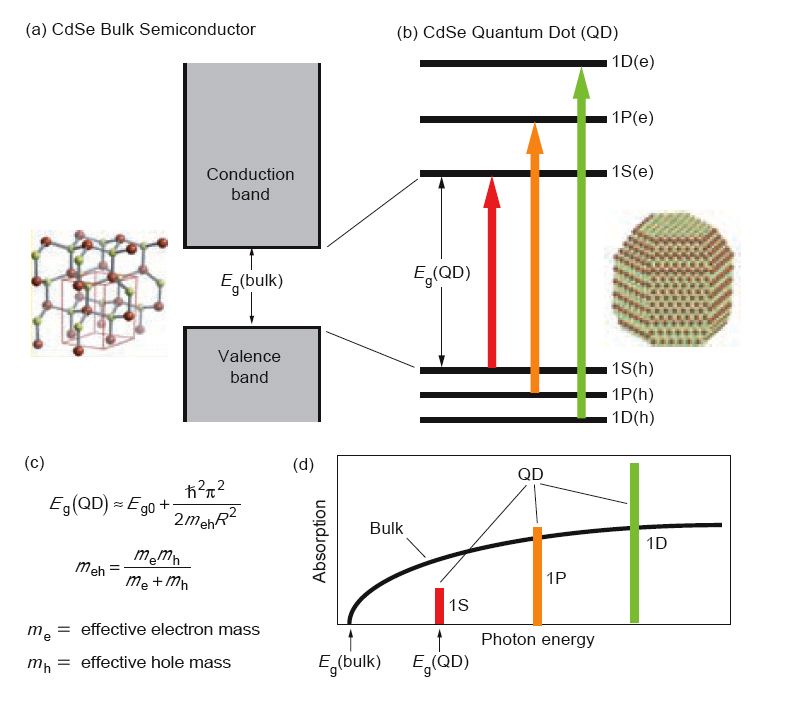
The big picture
•   ~ 13x1012 W (TW) energy production rate is currently used in
    the world.
•   ~ 3 TW energy production rate is currently needed to maintain
    our quality of life in the US.
•   Potential sources: fossil fuel, nuclear, geothermal, hydro, solar.
•   Issues
     –   hydro: we’re using it all now
     –   fossil fuel: CO2 release, limited supply, politics
     –   nuclear: limited uranium, safety, waste, thermal pollution
     –   geothermal: not enough energy
     –   solar: new technologies needed, distributed source (large areas
         needed)
          • thermal, biomass, electric

                                                                           2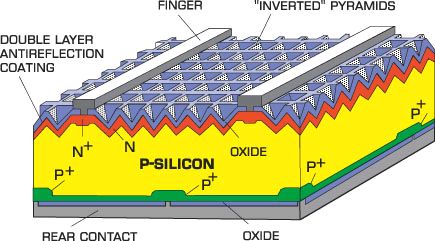
How much solar energy is there?
• In the US:
   – ~1013 m² x103W/m2x2.4hrs/24hrs=1000TW average
   – US highway area is almost 0.2% of the total land area
   – covering 0.2% of the US land area with 50% cells yields
     1 TW
       • higher efficiency is important
   – to produce this area over a period of 20 years, we must
     manufacture 2000 km2/year.
   – That’s a lot of stuff
       • PVC plastic wrap = 103m3/10-5m=108m2=100km2/year

                                                               3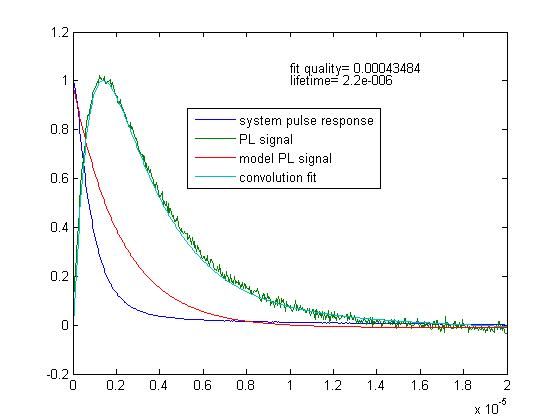
Constraints on novel solar cells/panels
1) Due to the cost of the balance of systems, a solar cell of zero
    cost must exhibit efficiency greater than about 15% to be
    financially practical.
2) It must be deployable in large area.
3) It must have a useful lifetime greater than 10 years. 20 years is
    the goal.

                                                                       4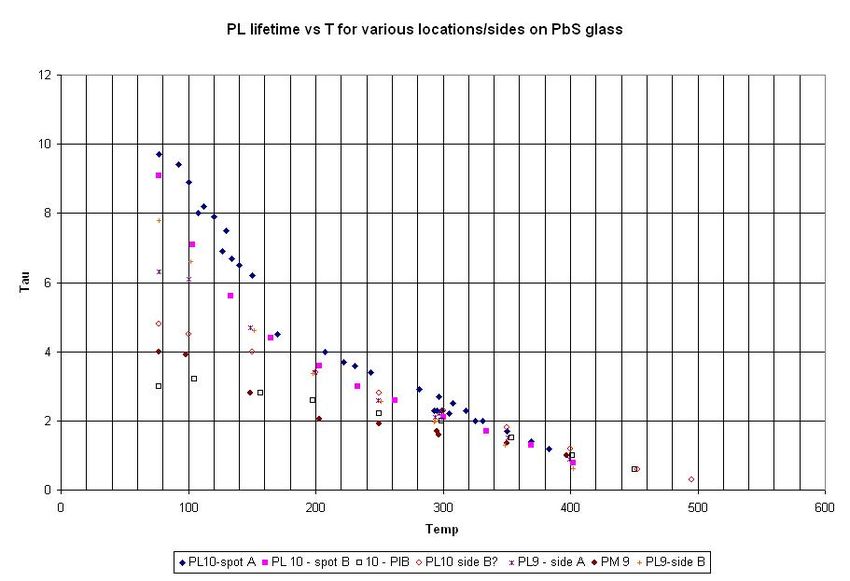
A conventional solar cell

                            5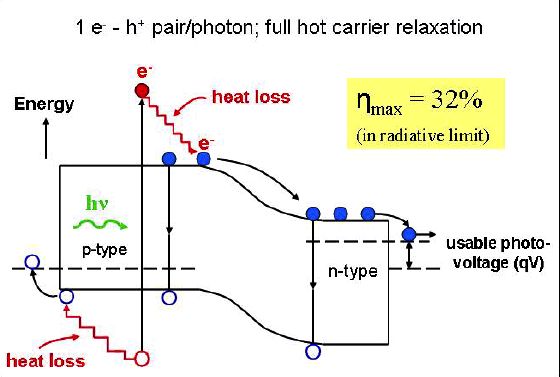
The p-n junction

• Doping a semiconductor with impurities
  produces regions with greater or lesser affinities
  for electrons.
• Touching these two types of materials together
  leads to band misalignments and different
  carrier densities on either side of the junction.

                                                       6
Photovoltaic idea
• When an electron-hole
pair are excited near a p-n
junction, they may
separate in the field.
• If they have nowhere to
go they will pile up on
either side until the
voltage opposes the built-
in voltage due to the
impurites. .
7Energy loss in a conventional p-n junction
Basic Research Needs for Solar Energy Utilization 2005
8Fundamental considerations
-The Shockley-Queisser limit
• Excess photon energy is transformed to heat during
carrier relaxation
• Both carriers must diffuse to correct electrode
– no recombination
– principle of detailed balance
• Need to absorb as much light as possible in the
active region
– optimal thickness of active region depends on optical
absorption, nonradiative processes, radiative losses,
diffusion lengths for carriers
9“Detailed Balance Limit of Efficiency of p-n
Junction Solar Cells”
W Shockley and HJ Queisser, J Appl Phys 32, pp. 510-519, (1961)
• The sun is assumed to be a blackbody at 6000K.
• The solar cell is assumed to be a blackbody at 300K. (Cell is
uniform in temperature throughout.)
• The active region is thick enough to absorb all light above the
band gap.
• One photon gives rise to one electron-hole pair
• All recombination is via radiative processes (detailed balance).
• All photoexcited carrier pairs that do not recombine radiatively
are extracted.
• All excited carriers relax to the band edge prior to extraction,
relaxation is by creating phonons.
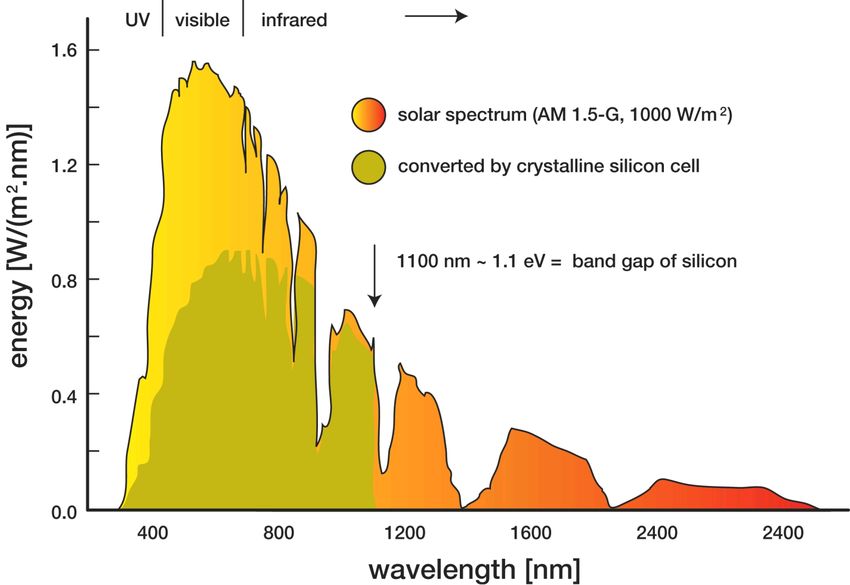
10The solar spectrum as interpreted by the S-Q
model
• The solar spectrum approximates a 6000K blackbody.
• Atmospheric absorption bands
• Carriers excited above a band edge can decay by phonon
excitation (heating the lattice). Higher energy – more heat loss.
• Carriers below the gap are not absorbed
11Detailed balance limit depends on bandgap
Shockley, Queisser (1961)
• Optimum bandgap
is ~1.2 eV.
• Highest SQ
efficiency is ~30%.
• Excitation energy above the bandgap is lost to heating.
• Excitation energy below the band gap is not absorbed.
12A high efficiency Si solar cell
http://www.pv.unsw.edu.au/
• Structured surface and multilayer coating maximize:
– coupling of light into structure by interference
– scattering of light into oblique angles for trapping weakly
absorbed wavelengths
13An obvious extension of the
Shockley-Queissser limit
14Beating the Shockley-Queisser Limit:
Stacked cells in the same detailed balance limit
Parrott, J Phys D (1979)
• Proposal - A stack of cells with decreasing band gap, each one
picking off a slice of the spectrum.
• Unconcentrated solar efficiency of ~65%.
15Making multijunction cells efficient requires
many aspects to work simultaneously
• The current density in stacked junction cells must be
matched.
• Materials compatibility
• Light of appropriate wavelength must couple in to
each cell in the stack
• Typical best ~ two or three cells
• EXPENSIVE
16History of Solar Cell Efficiency
Basic Research Needs for Solar Energy Utilization 2005 17Rethinking the Shockley-
Queisser limit
18Beating the Shockley-Queisser
limit in other ways–
let’s check the assumptions
• A single absorbed photon gives rise to one electron
hole pair.
– Inverse Auger process can give rise to more than one e-h
pair per absorbed photon.
– Impact or avalanche ionization can lead to more than one
pair per photon
• Photons below the band gap are not absorbed.
– Nonlinear two photon absorption
– “Intermediate band” absorption
19Intermediate band solar cell (Luque et al, PRL 1997)
Computed ideal conversion efficiency for
Intermediate band idea: An single gap, two gap, and intermediate band
absorbing band that can accept structures based on single photon/single
electron excitations from the exciton model. (Luque et al. 1997)
VB and then allow transitions to
the CB.
20Semiconductor Quantum Dots
21A nanoparticle or cluster is frequently just
like a piece of a larger crystal
A TEM image of a CdSe
nanocrystal
22States in a nutshell
Absorption Coefficient (cm
)
20
-1
1.6 nm
10 3 nm
1.2 nm
glass
Bulk
0
0.5 1.0 1.5 2.0
Energy (eV)
23Impact ionization in PbSe
History
• Schaller and Klimov (2004)
demonstrate that the
quantum yield of excitons per
photon is ~120%!!!
• This means that the inverse
Auger process is significant.
24Multiple exciton generation in PbSe
• Ellingson et al. (Nozik) 2005 – The yield of
excitons exceeds 100% by a lot!
25The race is on Nanoletters 6, Feb 2006
26The situation now
• Two approaches to efficient solar cells have been
proposed that “break” the Shockley-Queisser limits.
• Intermediate state cells allow two low energy photons
to addup to one exciton. - ~63% efficiency limit at one
sun.
– Cells have been demonstrated but no records have been
broken.
• Multiple exciton generation can give rise to 75%
efficient conversion.
– Only the Auger principle has been demonstrated.
27Quantum dot work at Rensselaer:
Some examples
28PbS
PbS Quantum Dots in Glass
Absorption Coefficient (cm
)
20
-1
1.6 nm
10 3 nm
1.2 nm
glass
Bulk
0
0.5 1.0 1.5 2.0
Energy (eV)
P. Rao - partially funded by Evident Technologies, Troy NY
29PbS
cw Absorption and Photoluminescence Spectra
R= 3 nm radius
Luminescence Intensity (a.u.)
0.6 0.8 1.0 1.2
Absorption Coefficient (cm
6
)
1.0 1.2
-1
Absorption
Photoluminescence Ar+ Laser
5 1.0 1550 nm Laser
0.8
Intensity (a.u.)
4 0.8
0.6
0.6 Size
3
0.4 distribution
0.4
2 broadening
0.2 0.2
1
0.0
0.0 0 0.70 0.75 0.80 0.85 0.90 0.95
0.6 0.8 1.0 1.2
Energy (eV) Energy (eV)
• 50 mW red-shift between absorption and emission – could be
trap, dark exciton, or Stokes shift
• excitation within lowest absorption peak decreases the width of
the emission band slightly
• PL efficiency ~ 4%, long lifetime~10-5 s
30PbS
The cw photomodulation spectrum
• The PM spectrum
overlaps the first OH bands
absorption peak in glass
• circles: PM spectrum at
room T with excitation at
~2.4 eV
• solid line : fit to first
absorption peak (size
distribution)
• The shape and position of
the spectrum is consistent
with bleaching by filling of
either the HOMO or the
LUMO state (or both).
31Photoluminescence measurements from last
summer
32Photoluminescence from this summer
33CdSSe
CdSSe quantum dots in glass
Absorption spectra
of CdS.5Se.5
r=1.7 nm to
r=6.3 nm
(Stokes, 1996)
•A series of glass hosts with
CdS0.5Se0.5 nanoparticles.
•The particle size is varied fromQuantum Dot Plans at Rensselaer
• Study decay pathways for highly excited carrier
pairs in PbS/PbSe quantum dots
– efficiency of multiexciton generation
– effect of surface treatments/ligands
– decay dynamics
• Study separation of carriers in PbS/PbSe
quantum dots in organic hosts
– time resolved transport (terahertz fields)
– effect of ligands
– effect of host materials
35Lots of work to be done
• (MEG) How to ensure that competing processes are
minimized?
– absorption into the wrong state, no impact ionization
– Auger recombination after decay
– phonon mediated decay
• (MEG) How do we get the excitation out of the
particles???
• Need to find appropriate host matrices.
• Have we found the best quantum dot materials?
(How did we choose these?)
36Current undergraduates in Quantum Dot
Research
• Josh Katz, Eric Hofman – modulation spectroscopy of optical
absorption in quantum dots
• Matt Weed – electromodulation spectroscopy of CuInGaSe
solar cell interfaces
• Eric Chan, Craig Hays, Alex Pickle – photoluminescence
spectroscopy of PbS quantum dots
• Tim Schiftner – quantum theory of electronic states of PbS
dots
• Nathaniel Berry*, Nick Scaptura+ – time-resolved
photoluminescence from PbS quantum dots
• *Schenendahowa HS, *Columbia HS
37Other recent collaborators and projects
• Quantum dots: Evident Technologies, Applied Nanoworks
• CuInGaSe Solar Cells: DayStar Technologies
• Photoconductivity in “black silicon”: Watervliet Arsenal
• Optics of organics formed on Titan: Prof. Ferris, Dr. B Tran
• Optical interconnects: Profs. Gutmann and J. Lu
• Optical scattering from steel corrosion layers (in reactors):
Lockheed Martin
• X-ray reflection characterization of thin films: GE
38You can also read


