Are Sparse Representation and Dictionary Learning Good for Handwritten Character Recognition?
←
→
Page content transcription
If your browser does not render page correctly, please read the page content below

Are Sparse Representation and
   Dictionary Learning Good for
Handwritten Character Recognition?

   Chi Nhan Duong, Kha Gia Quach, and Tien D. Bui
         Concordia University, Montréal, Canada
       Email: {c duon, k_q, bui}@encs.concordia.ca

 14th International Conference on Frontiers in Handwriting Recognition
           (ICFHR) September 1- 4, 2014 in Crete, Greece.
Contents
   • Motivation

   • Contributions

   • Related works

   • Sparse representation based recognition

   • Experimental results

   • Conclusions
Image
                                                 classification
                Motivation
    Image                                                                       Face
denoising and                                                                recognition
  inpainting
                                    Why Sparse
                                Representation &
                               Dictionary Learning ?
 Medical
 Imaging
                       Human vision is good at recognizing
                       different objects of the same kind, for
                       example chairs with one leg or many legs,
                       or someone we know under occlusions. So      Could these theories
                       human visual system tends to retain certain  produce good results for
                       sparse information that is common among
                                                                    handwritten character
                       objects of the same kind. And sparse
                 Handwritten
                       representation  has      Letter
                                            become   a hot topic of
                                                                    recognition as in the case of
                  character                                         other applications?
                       investigation over the last D
                                                   few years.
                 recognition
Contributions Developing a sparse representation based system for handwriting character recognition. Analyzing different factors that affect the SR based system such as: the choice of input data, the size of dictionary, and computation time of this method in three benchmark databases. Experimental results show that using this framework, the choice of feature space is less important comparing to other methods.

Related works
                                                                       Recognized
                             Feature
                                                 Classification         character
                            extraction
 Character
   image

                           Statistical [6]
                                                      K-Nearest
                        (Zoning, projections,
                           crossing,…)               Neighbor [9]
  Investigate the
representations of                                                   Investigate the
 character images                                                     classification
 that are invariant         Structural [1]
                                                                        methods
to various writing        (Topological and          Support Vector
                             geometrical             Machine [9]
       styles               information)

                       Transformation-based        Neural network,
                               [7][8]               Convolution
                      (Gabor features, Wavelet     Neural Network
                       transform coefficients)       (LeNet) [2]
Related works
Hybrid approach
◦ Combining SVM & Convolution Neural Network [10].
◦ Combining different features & different classifiers [1]
=> can exploit the strengths of features and classifiers, but
expensive to decide which architecture is good for specific data.
Zhang et al. [11]: decomposed image into three parts: low-
rank component, sparse component and error (i. e. noise)
mainly focus on handwriting recovery.
=> Testing with 240 images/digit and achieving 91.24% for
MNIST.
Wei et al. [12] took into account local information for
dictionary learning and then using the learned dictionary to
improve the performance.
Sparse representation based recognition
                       Dictionary Building
            Training
              Img.
Testing                                       Building the
                                                                             D*
  Img.                                         dictionary
                       Training images
          Dictionary
           Building

                                                                    Dictionary
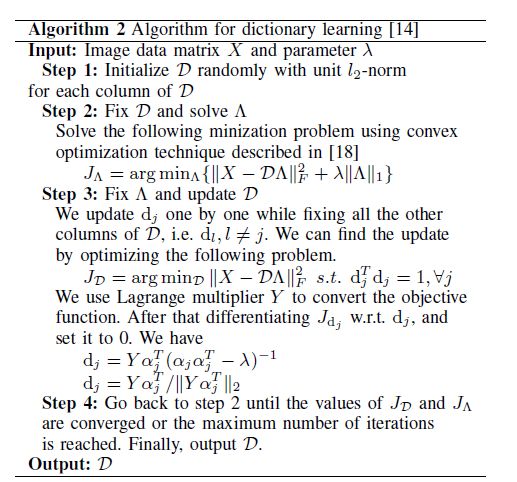
                                                                     learning
  Sparse Coding            Original dict.
                                                             Learned dict.

                                  Sparse coding
  Residual error
                                             D*                         e
                                                         a

      label
Sparse representation based recognition
Experimental results
Databases
# # Image
Database
Training Testing size
MNIST 60000 10000 28 × 28
US Portal Service (USPS) 7291 2007 16 × 16
CEDAR – upper case 11454 1367 32 × 32
CEDAR – lower case 7691 816 32 × 32Evaluations Effects of dimensional reduction and feature spaces. Dictionary learning for character recognition. Effect of dictionary sizes. Computational time. Comparison with other methods
Effects of dimensional reduction

  accuracy   dimension   Gabor feature [7] is mainly
                         designed for digits rather than
                         for character images

                         Performance of this feature:
                         - Use k-nearest neighbor
                            (k=3)
                         - MNIST: 90.45%
                         - USPS: 89.74%
                         - CEDAR:
                              - Upper case: 49.63 %
                              - Lower case: 52.38 %
Effects of dictionary learning Dictionary learning boosting the accuracy of SR based system UPPR & LWR: reduce bout 3% increasing the number of classes (26 instead of 10) insufficient training data for some characters (only ~ 5 images/characters) reduce the quality of atoms comparing with original full images.
Effect of dictionary sizes
Evaluation system:
 (1) Choose n images (per class) randomly
 (2) Classification based on dictionary conducted from these images.
   Ex:
   For USPS (10 classes)
   n = 100 => total images used for learning dictionary is N = 100 * 10 = 1000
Overall performance

[15] G. Vamvakas, B. Gatos, and S. J. Perantonis, “Handwritten character recognition
through two-stage foreground sub-sampling,” PR, 2010.
Conclusions In this paper, we have developed a sparse representation based system for handwritten character recognition. Representing the testing image as a combination of atoms in a dictionary makes the system more robust to the changes in feature spaces and the dimension of input data. Different factors that affect the performance of the system are also examined in our experiments. Although the best performance of SR based system cannot beat the state-of- the-art methods, its ability to remove the effect of feature space can help to improve its flexibility and efficiency.
References
[1] A.Rahman and B.Verma,“Effect of ensemble classifier composition on offline cursive
character recognition,” Information Processing & Management, pp. 852–864, 2013.
[2] D. Ciresan, U. Meier, and J. Schmidhuber, “Multicolumn deep neural networks for image
classification,” in CVPR. IEEE, 2012, pp. 3642–3649.
[3] J. Wright, Y. Ma, J. Mairal, G. Sapiro, T. S. Huang, and S. Yan, “Sparse representation for
computer vision and pattern recognition,” Proceedings of the IEEE, pp. 1031–1044, 2010.
[4] V. M. Patel and R. Chellappa, “Sparse representations, compressive sensing and
dictionaries for pattern recognition,” in ACPR. IEEE, 2011, pp. 325–329.
[5] J. Wright, A. Y.Yang, A. Ganesh, S. S. Sastry, and Y. Ma, “Robust face recognition via sparse
representation,” PAMI, IEEE Transactions on, pp. 210–227, 2009.
[6] D. Impedovo, G. Pirlo, and R. Modugno, “New advancements in zoning-based
recognition of handwritten characters,” in ICFHR, 2012 International Conference on. IEEE,
2012.
[7] Y. Hamamoto, S. Uchimura, M. Watanabe, T. Yasuda,Y. Mitani, and S. Tomita, “A Gabor
filter-based method for recognizing handwritten numerals,” PR, pp. 395–400, 1998.
[8] S.-W. Lee, C.-H. Kim, H. Ma, and Y.Y. Tang, “Multiresolution recognition of unconstrained
handwritten numerals with wavelet transform and multilayer cluster neural network,” PR,
1996.
References
[9] Y. LeCun, L. Jackel, L. Bottou, C. Cortes, J. S. Denker, H. Drucker, I. Guyon, U. Muller, E.
Sackinger, P. Simard et al., “Learning algorithms for classification: A comparison on
handwritten digit recognition,” Neural networks: the statistical mechanics perspective, p.
276, 1995.
[10] X.-X. Niu and C. Y. Suen, “A novel hybrid CNN–SVM classifier for recognizing
handwritten digits,” PR, pp. 1318–1325, 2012.
[11] Z. Zhang, C.-L. Liu, and M. Zhao, “Handwriting representation and recognition
through a sparse projection and low-rank recovery framework,” in IJCNN. IEEE, 2013,
pp. 1–8.
[12] C.-P. Wei,Y.-W. Chao, Y.-R.Yeh, and Y.-C. F. Wang, “Locality-sensitive dictionary
learning for sparse representation based classification,” PR, pp. 1277–1287, 2013.
[13] Y. LeCun and C. Cortes, “The MNIST database of handwritten digits,” 1998.
[14] J. J. Hull, “A database for handwritten text recognition research,” PAMI, IEEE
Transactions on, pp. 550–554, 1994.
[15] G. Vamvakas, B. Gatos, and S. J. Perantonis, “Handwritten character recognition
through two-stage foreground sub-sampling,” PR, pp. 2807–2816, 2010.
References
[16] T. Saba, A. Rehman, and G. Sulong, “Improved statistical features for cursive
character recognition,” IJICIC, 2011.
[17] M. Blumenstein, X. Y. Liu, and B. Verma, “A modified direction feature for cursive
character recognition,” in IJCNN ’04. IEEE, 2004, pp. 2983–2987
[14] M. Yang and L. Zhang, “Gabor feature based sparse representation for face recognition with gabor occlusion dictionary,”
in ECCV. Springer, 2010, pp. 448–461.

[18] K. Koh, S.-J. Kim, and S. Boyd, “An interior-point method for largescale l1-regularized logistic regression.” Journal of
Machine learning research, vol. 8, no. 7, 2007.
You can also read


