Producing electricity at estuaries using light and osmosis - Phys.org
←
→
Page content transcription
If your browser does not render page correctly, please read the page content below
Producing electricity at estuaries using light
and osmosis
23 May 2019

                                                       Researchers from EPFL's Laboratory of Nanoscale
                                                       Biology (LBEN), which is headed by Professor
                                                       Aleksandra Radenovic at the School of
                                                       Engineering, have shown that the production of
                                                       power using osmosis could be optimized using
                                                       light. Reproducing the conditions that occur at
                                                       estuaries, they shined light on a system combining
                                                       water, salt and a membrane just three atoms thick
                                                       to generate more electricity. Under the effect of
                                                       light, the system produces twice as much power as
                                                       it does in the dark. Their findings have been
                                                       published in Joule.

                                                       In a 2016 paper, a team from the LBEN showed for
                                                       the first time that 2-D membranes represented a
                                                       potential revolution in osmotic power production.
                                                       But at the time, the experiment did not use real-
                                                       world conditions.

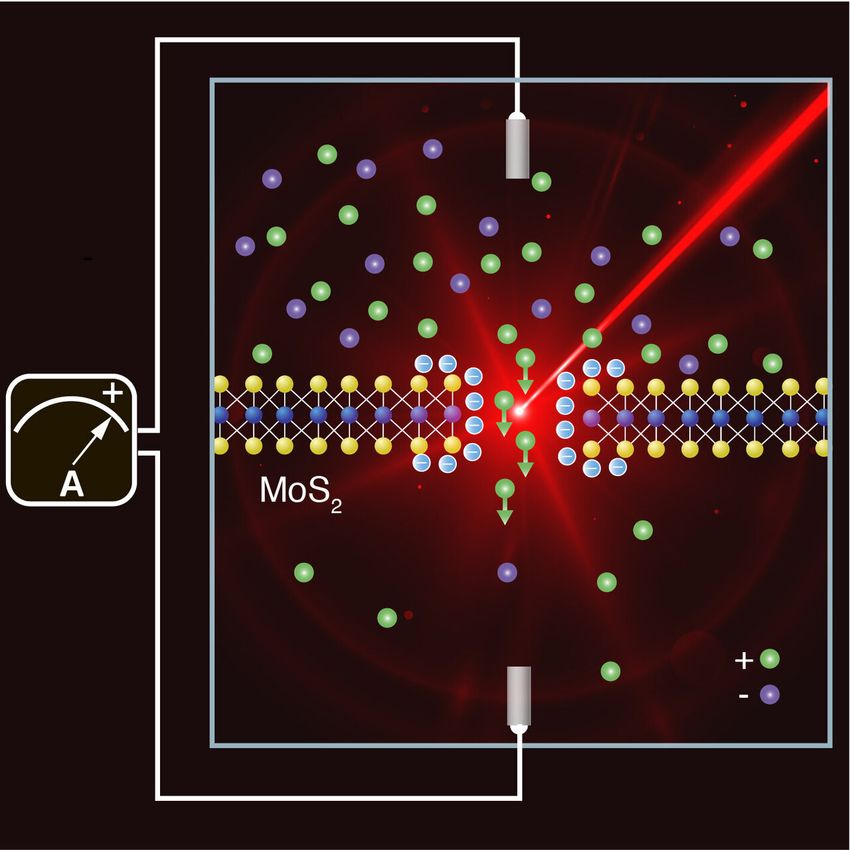
                                                       Ions passing through a nanopore

Reproducing the conditions that occur at estuaries,    The addition of light means the technology has
EPFL scientists shined light on a system combining     moved one step closer to real-world application.
water, salt and a membrane just three atoms thick to   The system involves two liquid-filled compartments,
generate more electricity. Credit: EPFL                at markedly different salt concentrations, separated
                                                       by a molybdenum disulfide (MoS2) membrane. In
                                                       the middle of the membrane is a nanopore—a tiny
                                                       hole between three and ten nanometers (one
Most renewable power technologies are weather          millionth of a millimeter) in diameter.
dependent. Wind farms can only operate when
there's a breeze, and solar power plants rely on       Every time a salt ion passes through the hole from
sunlight. Researchers at EPFL are working on a         the high- to the low-concentration solution, an
method to capture an energy source that's              electron is transferred to an electrode, which
constantly available at river estuaries: osmotic       generates an electric current.
power, also known as blue energy.
                                                       The system's power generation potential depends
Osmosis is a natural process whereby molecules         on a number of factors—not least the membrane
migrate from a concentrated to a more dilute           itself, which needs to be thin in order to generate
solution across a semi-permeable membrane in           maximum current. The nanopore also has to be
order to balance the concentrations. At river          selective to create a potential difference (a voltage)
estuaries, electrically charged salt ions move from    between the two liquids, just like in a conventional
the salty seawater to the fresh river water. The       battery. The nanopore allows positively charged
idea is to harness this phenomenon to generate         ions to pass through, while pushing away most of
power.                                                 the negatively charged ones.

                                                                                                      1/3
The system is finely balanced. The nanopore and           the membranes at river estuaries. Similar systems
the membrane have to be highly charged, and                are used in solar collectors and concentrators—a
multiple identically sized nanopores are needed,           technology already widely employed in
which is a technically challenging process.                photovoltaics. "Essentially, the system could
                                                           generate osmotic power day and night," explains
                                                           Michael Graf, the lead author of the paper. "Output
                                                           would double during daylight hours."

                                                          Next step

                                                          Researchers will now pursue their work by
                                                          exploring possibilities to scale up production of the
                                                          membrane, addressing a range of challenges such
                                                          as optimal pore density. There is still a lot of work
                                                          to do before the technology can be used for real-
                                                          world applications. For instance, the ultra-thin
                                                          membrane needs to be mechanically stabilized.
                                                          This could be done by using a silicon wafer
                                                          containing a dense array of silicon nitride
                                                          membranes, which are easy and cheap to
                                                          manufacture.

                                                          This research, led by LBEN, is being conducted as
                                                          part of a collaboration between two EPFL labs
                                                          (LANES and LBEN) and researchers at the
                                                          Department of Electrical and Computer
                                                          Engineering, University of Illinois Urbana-
Under the effect of light, the system produces twice as
much power as it does in the dark. Credit: EPFL
                                                          Champaign.

                                                    Back in 2016, researchers from the LBEN reported
                                                    that, for the first time, they had produced osmotic
Harnessing the power of sunlight                    power across 2-D membranes measuring just three
                                                    atoms thick. The experiment was an important
The researchers got around these two problems at demonstration that nanomaterials may indeed
the same time by using low-intensity laser light.   represent a revolution in this domain, with direct
Light releases embedded electrons and causes        application envisioned for renewable energy and
them to accumulate at the membrane's surface,       small, portable sources of energy.
which increases the surface charge of the material.
As a result, the nanopore is more selective and the At the time, to achieve high power generation, the
current flow increases.                             researchers had to operate in an alkaline
                                                    environment, with high pH levels that are far from
"Taken together, these two effects mean we don't the values found in estuaries. High pH was required
have to worry quite so much about the size of the to increase the surface charge of the MoS2 and to
nanopores," explains Martina Lihter, a researcher improve osmotic power output.
at the LBEN. "That's good news for large-scale
production of the technology, since the holes don't This time around, instead of using chemical
have to be perfect and uniform."                    treatments, the researchers discovered that light
                                                    could play that role, allowing them to operate in real-
According to the researchers, a system of mirrors world conditions.
and lenses could be used to direct this light onto

                                                                                                        2/3
More information: Michael Graf et al. Fabrication
                                   and practical applications of molybdenum disulfide
                                   nanopores, Nature Protocols (2019). DOI:
                                   10.1038/s41596-019-0131-0

                                    Provided by Ecole Polytechnique Federale de
                                   Lausanne
                                   APA citation: Producing electricity at estuaries using light and osmosis (2019, May 23) retrieved 20 July
                                   2019 from https://phys.org/news/2019-05-electricity-estuaries-osmosis.html

                                   This document is subject to copyright. Apart from any fair dealing for the purpose of private study or research, no
                                   part may be reproduced without the written permission. The content is provided for information purposes only.

                                                                                                                                                3/3

Powered by TCPDF (www.tcpdf.org)
You can also read


