AUDI A2 - Engine and Gearbox
←
→
Page content transcription
If your browser does not render page correctly, please read the page content below
247
                                     247
                                                 Service.

                                                               AUDI A2 - Engine and Gearbox

                                                               Design and Function

                                                                          Self-study programme 247

All rights reserved, including the
right to make technical changes.
AUDI AG
Dept. I/VK-5
D-85045 Ingolstadt
Fax 0841/89-36367
040.2810.66.20
Technical status 03/00
Printed in Germany

                                                 For internal use only.
2
Contents

                                                                                                                            Page
Overview
Engine . . . . . . . . . . . . . . . . . . . . . . . . . . . . . . . . . . . . . . . . . . . . . . . . . . . . . . . . . . . .   4
     1.4 l - TDI (55 kW) AMF . . . . . . . . . . . . . . . . . . . . . . . . . . . . . . . . . . . . . . . . . . .               4
     1.4 l - 16 V (55 kW) AUA . . . . . . . . . . . . . . . . . . . . . . . . . . . . . . . . . . . . . . . . . .                5
Gearbox . . . . . . . . . . . . . . . . . . . . . . . . . . . . . . . . . . . . . . . . . . . . . . . . . . . . . . . . . . .    6

Engine
Design and function of the 1.4 l - 16 V engine . . . . . . . . . . . . . . . . . . . . . . . . . . . .                            7
System overview . . . . . . . . . . . . . . . . . . . . . . . . . . . . . . . . . . . . . . . . . . . . . . . . . . . .          16
Lambda control of the Euro-On-Board Diagnosis . . . . . . . . . . . . . . . . . . . . . . . . .                                  21
Functional overview . . . . . . . . . . . . . . . . . . . . . . . . . . . . . . . . . . . . . . . . . . . . . . . . .            24

Gearbox
Overview . . . . . . . . . . . . . . . . . . . . . . . . . . . . . . . . . . . . . . . . . . . . . . . . . . . . . . . . . . .   26
Housing . . . . . . . . . . . . . . . . . . . . . . . . . . . . . . . . . . . . . . . . . . . . . . . . . . . . . . . . . . .    28
Gearbox design . . . . . . . . . . . . . . . . . . . . . . . . . . . . . . . . . . . . . . . . . . . . . . . . . . . . .         30
Double synchronisation . . . . . . . . . . . . . . . . . . . . . . . . . . . . . . . . . . . . . . . . . . . . . .               35
Gear shifting . . . . . . . . . . . . . . . . . . . . . . . . . . . . . . . . . . . . . . . . . . . . . . . . . . . . . . . .    39
Actuators and sensors . . . . . . . . . . . . . . . . . . . . . . . . . . . . . . . . . . . . . . . . . . . . . . .              42

                                                                                                                             Attention
                                                                                                          New
                                                                                                                             Note
The self-study programme will provide you with information on
design and functions.

It is not intended as a workshop manual!

For maintenance and repairs please refer to the current technical
literature.
                                                                                                                                         3
Overview
Engine
1.4 l - TDI (55 kW) AMF
70 200
63 180
Power output [kW]
56 160
Torque [Nm]
49 140
42 120
35 100
28 80
21 60
14 40
7 20
0 0
0 1000 2000 3000 4000 5000 6000
SSP247_072
SSP247_071
Technical data
Engine code: AMF Firing order: 1-2-3
Design: Turbocharged three- Mixture Direct injection with
cylinder in-line engine induction: pump-nozzle unit
Capacity: 1422 cm3 Turbocharger: Garrett GT 12 turbocharger
Power output: 55 kW (75 PS) with wastegate
at 4000 rpm Exhaust emissions Oxidising catalytic
Torque: 195 Nm at 2200 rpm control: converter and exhaust gas
recirculation
Bore: 79.5 mm
Exhaust emissions standard:EU 3
Stroke: 95.5 mm
Fuel: Diesel, cetane rating at
Compression: 19.5 : 1 least 49 CN, RME
Weight: 130 kg
Please refer to SSP 223 for the design
and function of the 1.4 l TDI pump-
nozzle engine.
The engine code and engine number are
located on the front engine/gearbox flange.
SSP247_026
41.4 l - 16 V (55 kW) AUA
70 200
63 180
Power output [kW]
56 160
49 140
Torque [Nm]
42 120
35 100
28 80
21 60
14 40
7 20
0 0
0 1000 2000 3000 4000 5000 6000
SSP247_001
SSP247_002
Technical data
Engine code: AUA Firing order: 1-3-4-2
Design: Four cylinder in-line engine Mixture Electronic, sequential
Petrol engine induction: multipoint injection,
Capacity: 1390 cm3 adaptive idlecontrol,
deceleration fuel cut-off
Power output: 55 kW (75 PS)
at 5000 rpm Ignition system: Distributorless ignition
system with static high-
Torque: 126 Nm at 3800 rpm voltage distribution, long-
Bore: 76.5 mm life spark plugs
Stroke: 75.6 mm Exhaust emissions
control: 3-way catalytic converter,
Compression: 10.5 : 1
2 heated lambda probes,
Weight: 90 kg activated charcoal filter
Exhaust emissions
standard: EU 4
Fuel: Petrol, unleaded, 95 RON
– Lambda control with probes
upstream and downstream of the
catalytic converter
– Electric exhaust gas recirculation
valve
– Valve actuation via rocker arms
SSP247_069
5Overview
Gearbox
02T gearbox 02J gearbox
SSP247_073 SSP247_074
The 02T gearbox is an extremely lightweight The familiar 02J gearbox is used in the A2 1.4 l
two-shaft gearbox. The parts of the housing TDI, for torques up to 250 Nm.
are made of magnesium.
It is designed to transmit torque values of up
to 200 Nm.
Both gearboxes are actuated via gear selector cables and gate
selector cables.
SSP247_075 SSP247_076
6Engine
Design and function of the
1.4 l - 16 V engine
The cylinder liners are made of cast iron. They
The cylinder block are cast into the crankcase and can be
reworked.
is made of die-cast aluminium.
The webs with the cast cylinder liners have a
The required stiffness is achieved by thickness of 5.5 mm.
pronounced ribbing, and is further reinforced
by the crankshaft bearing blocks.
G12 is the only approved coolant
additive.
As well as preventing frost damage on
the aluminium housing, it prevents the
formation of lime deposits and damage
due to corrosion in the coolant
channels.
SSP247_003
The crankshaft
is made of cast iron and is equipped with four
balancer weights. Despite this weight saving,
the crankshaft has the same running
characteristics as crankshafts with eight
balancer weights.
The bearing blocks support the internal
stiffness of the aluminium cylinder block.
SSP247_004
The crankshaft must not be loosened or If the bearing cap bolts are released
removed. then the complete crankcase with
If the bearing cap bolts are released crankshaft needs to be replaced.
then the internal structure of the It is not possible to measure the bearing
bearing blocks in the cylinder blocks clearance of the crankshaft using
slackens and causes them to warp. standard workshop equipment.
The bearing clearance is then reduced.
7Engine
Camshaft drive Toothed belt Toothed belt -
- main drive coupled drive
The two camshafts are driven by two toothed
belts.
Due to the narrow width of the cylinder head,
the toothed belt drive is divided into a main
Idler roller
drive and a coupled drive.
Tensioning roller
Coolant pump for coupled drive
belt pulley
Main drive Idler roller
The main toothed belt drive transmits the
drive from the crankshaft to the coolant pump
and the intake camshaft. An automatic
Crankshaft
tensioning roller and two idler rollers prevent
toothed belt
the toothed belt from vibrating. sprocket
Main drive
tensioning SSP247_005
Coupled drive roller
Intake camshaft
The toothed belt of the coupled drive is toothed belt
located directly behind the toothed belt of the sprocket Coupled
main drive, outside the camshaft housing. drive
Exhaust camshaft
The coupled drive transmits the drive from toothed belt sprocket
the intake camshaft via the toothed belt to the
exhaust camshaft.
Here again an automatic tensioning roller
prevents the toothed belt from vibrating.
SSP247_006
Guide holes
Guide holes are provided in the
camshaft housing and at the camshaft
toothed belt sprockets for assembly and
for adjusting the valve timing. The two
toothed belt sprockets are secured with
a special tool.
Please refer to the repair manual for
more details.
SSP247_007
8Valve gear Blanking cap
The intake camshaft and the exhaust Intake
camshaft run on bearings in the camshaft camshaft
housing.
At the same time the camshaft housing also
acts as the cylinder head cover.
The camshafts run on 3 bearings and are Exhaust
pushed into the camshaft housing. camshaft
The axial clearance is limited by the camshaft
housing and the blanking plugs.
Camshaft housing
SSP247_008
Cylinder head
Exhaust
camshaft
The liquid sealer must not be applied
too liberally, as excess material can
enter the oil bores and cause engine
damage.
Cylinder head
Valve actuation SSP247_009
In this generation of engines, the valve Camshaft
actuation and the valve clearance
compensation are provided by means of a
rocker arm with a hydraulic support element. Cam roller
Advantages Rocker arm
– reduced friction Valve
– less weight to move Hydraulic support
element
Design Roller bearing
of cam roller
The rocker arm consists of a pressed metal
lever and a cam roller with roller bearing.
It is clipped in at the support element and laid
onto the valve.
SSP247_010
9Engine
Hydraulic support element
Piston with
Design bore
The support element consists of: Cylinder
– a piston
– a cylinder and Upper
– a piston spring oil chamber
It is connected to the engine oil circuit. A Lower
small ball with a spring forms a one-way valve oil chamber
in the lower oil chamber.
Piston spring SSP247_011
Oil channel
Function during valve clearance
One-way valve
compensation
In the event of excessive valve clearance the
piston is pushed out of the cylinder by the
piston spring until the cam roller lies up Valve clearance
against the cam. While it is being pushed out
the oil pressure in the lower chamber
reduces.
The one-way valve opens and oil flows in.
Once the pressure difference between the
lower and upper oil chamber has been
equalised the one-way valve closes.
SSP247_012
Valve lift
When the cam runs onto the cam roller the
pressure in the lower oil chamber increases.
The trapped oil cannot be compressed, which
means that the piston cannot be pushed any
further into the cylinder.
The support element becomes a rigid
element which acts as a support for the
rocker arm.
The corresponding valve opens.
SSP247_013
10Lubrication
is provided via the hydraulic support element.
The rocker arm has a bore through which oil
is sprayed onto the cam roller.
Cam roller
Oil
Oil bore in the
support element
Oil channel in the SSP247_014
cylinder head
Function during valve actuation
Cam
The support element acts as a pivoting point
for the motion of the rocker arm. The cam
runs on the cam roller and presses the rocker Cam roller
arm downwards. The valve is then actuated
via the rocker arm.
Rocker arm
The lever arm between the cam roller and the
support element is shorter than between the
valve and the support element. This means
that a relatively small cam can achieve a large
valve lift.
The hydraulic support elements cannot
be checked.
SSP247_015
11Engine
Electric exhaust gas recirculation valve
EGR valve N121
Pressure equalisation
Supply line to
intake manifold
Exhaust
manifold
SSP247_016
EGR valve N121 is electrically controlled and A stainless steel pipe connects the valve with
actuated directly by engine control unit J537. the intake manifold.
The valve is flanged directly onto the cylinder The high temperatures caused by the exhaust
head and directly connected to the exhaust gases are transferred to the cylinder head and
duct of cylinder no. 4 by means of a channel cooled by the coolant flowing through.
in the cylinder head.
12Functional diagram
Air cleaner
Intake manifold
J537
N121
t
G212 °C
n
1/min
p
MPa
Supply line to Engine load
intake manifold
SSP247_017
Even in normal operation of the engine a In order to optimise the distribution of
certain amount of residual gas leaks from the recirculated exhaust gas and induced fresh
combustion chamber into the intake manifold air, the exhaust gas emerges into the fresh air
when the valves are rocking.. In the flow directly under the middle of the throttle
subsequent induction process a proportion of valve, at two holes positioned at right angles
the residual gas is then drawn in with the to the intake air flow.
fresh mixture (internal exhaust gas
recirculation). EGR valve N121 is actuated by engine control
unit J537 according to a defined map. It takes
Up to a certain degree the residual gas information such as engine speed, engine
(exhaust gas) can have a positive effect on load, air pressure and coolant temperature
reducing the amount of nitrogen oxides in the into account.
exhaust, and it can help to convert energy
more efficiently (reduced fuel consumption). EGR potentiometer G212 informs the engine
control unit of the cross-section of the
The additional exhaust gas recirculation helps opening.
to reduce NOx emissions (nitrogen oxides)
further and to lower fuel consumption. With the exhaust gas recirculation active the
amount of gas that can be recirculated is
To do this, a certain amount of exhaust gas is limited to 18 % of the intake air quantity.
taken and fed back to the intake air via EGR There is no exhaust gas recirculation in idle,
valve N121. This is called “external” exhaust in overrun or during engine warm-up up to
gas recirculation. 35 oC
13Engine
Function The EGR valve terminates (zero-current
process) the recirculation of exhaust gases to
Potentiometer
the intake manifold. It is switched on from a
coolant temperature of 35 oC.
When it is actuated, the valve is opened with
a defined duty cycle.
The input information includes
– information about the engine speed
– information about the load status of the
Anchor engine
– coolant temperature
– air pressure
Coil
A potentiometer is located in the valve head.
This potentiometer detects the opening
cross-section of the valve, which is passed
Pressure back as a return message to the engine
equalisation control unit. The opening cross-section is
Exhaust gas via air cleaner then used to control the voltage of the coil in
from engine
the valve according to the map.
A direct connection to ambient air pressure is
To intake provided via the air cleaner to allow for
Valve manifold pressure equalisation in the valve during the
different control phases.
SSP247_018
Electrical circuit
Diagnostics
The valve has diagnostic capabilities.
The following are stored in the fault memory:
– Zero point shift
– Maximum opening
– Maximum path
It is also detected if a valve is sticking.
G212 EGR potentiometer
J537 Control unit for 4LV
N121 Frequency valve for exhaust gas
recirculation
SSP247_019
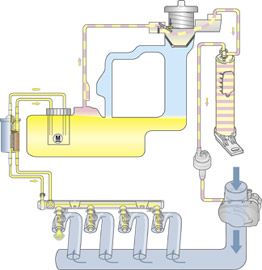
14The fuel pump located inside the fuel tank
pumps fuel through the fuel filter to the
injectors.
Gravity valve
Operating breather
container
Fuel pump G6
Activated
charcoal filter
Solenoid valve for ACF
Distribution rail
system N80
Fuel filter
Fuel pressure
regulator
Injectors N30 … N33
SSP247_020
Intake manifold
The A2 is equipped with a safety fuel shut-off
system for the event of a crash, as described
in SSP 207.
15Engine
Overview of system
Intake manifold pressure sender G71 Control unit for 4LV
with J537
Intake air temperature sender G42
Engine speed sender G28
Versions I and II
Hall sender G40
Knock sensor I G61
Lambda probe upstream of catalytic
converter G39 with
Heater for lambda probe Z19
Lambda probe downstream of
catalytic converter G130 with
Heater for lambda probe Z29
Coolant temperature sender G2/G62
Throttle valve control part J338 with
Throttle valve drive G186 (electric
throttle operation)
Angle sender 1/2 for throttle valve
drive G187/G188
Diagnostic
connection
Accelerator pedal module with accelerator
pedal position sender G79/G185
Brake light switch F/F47
Auxiliary input signals
A/C compressor
Air conditioner (engine speed increase)
Tank fill level*; crash signal; CCS switch; DF signal; vehicle
speed signal from combi-processor J218
16Ignition transformer N152
Injectors N30, N31, N32, N33
Fuel pump relay J17
Fuel pump G6
Solenoid valve I for
Control unit for ACF system N80
ESP J104
TEMP
OFF
Throttle valve drive G186
with
Air conditioner control throttle valve positioner V60
and display unit E87
EGR valve N121
Combi-processor in
dash panel insert J218
Heating resistor N79
(crankcase breather)
Sender for
steering angle
G85
Auxiliary output signals
Engine speed signal*
* discontinued as of A/C compressor
CAN compatible
combi-processor J218 SSP247_021 17Engine
Engine speed sender G28
The sender is a combined speed sender and
reference mark sender.
Engine speed
Two different sealing flange systems and
sender G28
sender versions are in use.
Crankshaft
Elastomer gasket
Sender wheel
Sealing flange
Crankshaft Sender wheel
Gasket
Sender wheel SSP247_078
Sealing flange
Sealing is provided at the crankshaft.
18J448
Engine speed
sender G28
G28 SSP247_080
Crankshaft
Sender wheel Sealing flange
Crankshaft Sender wheel
Sender wheel SSP247_079
Sealing flange
Application of the signal The effect of a signal failure
The signal from the engine speed sender is The engine control unit switches to
used to detect the engine speed and the emergency running mode if the engine speed
exact position of the crankshaft. The engine sensor fails. The control unit then calculates
control unit uses this information to the engine speed and camshaft position from
determine the timing of injection and information provided by camshaft position
ignition. sender G163.
The maximum engine speed is lowered in
order to protect the engine. It is still possible
to restart the engine.
19Engine
The Hall sender G40
is located at the camshaft housing above the
intake camshaft.
Three teeth are cast onto the intake camshaft,
where they are scanned by the Hall sender.
Application of the signal
The signal is used together with the signal
J537
from the engine speed sender to detect
ignition TDC on cylinder no. 1. This
information is required for the cylinder-
selective knock control and the sequential
fuel injection.
The effect of a signal failure
In the event of sender failure the engine
continues to run and can also be restarted. G40
The engine control unit goes into emergency
running mode. The fuel injection then SSP247_029
switches from sequential to parallel mode.
Hall sender G40
SSP247_030
Intake camshaft with
cast-on sender wheel
Blanking cover
Camshaft housing
20Lambda control of the
Euro-On-Board-Diagnosis
The new broadband lambda probe is used as Broadband lambda probe
a pre-cat probe in conjunction with the EOBD.
An almost linear current increase is used for
the output of the lambda value. As a result
the lambda value can be measured over the
entire engine speed range.
Function
With the broadband lambda probe, the
lambda value is calculated from a change in
current rather than a change in voltage.
However, the physical processes are the
same. I = current
SSP247_022
Planar lambda probe
The familiar planar lambda probe is used as
the post-cat probe.
The measuring range fluctuates erratically
around the value lambda = 1 and is sufficient
for monitoring purposes.
U = voltage
SSP247_023
Planar lambda probe
Broadband lambda probe
SSP247_083
21Engine
Broadband lambda probe
7
This probe uses two electrodes to generate a
voltage relating to the varying oxygen content
of the exhaust gas.
5
The voltage at the electrodes is kept constant. 6
8
This process is achieved by means of a 9
miniature pump (pump cell), which supplies
the electrode on the exhaust side with
enough oxygen to keep the voltage between 3
the two electrodes at a constant value of 450 2
mV. The engine control unit converts the
current consumption of the pump into a 1 4 SSP247_024
lambda value.
1 Fresh air
2 Probe voltage
3 Engine control unit
4 Electrodes
5 Exhaust gas
6 Miniature pump (pump cell)
7 Pump current
8 Measuring range
9 Diffusion channel
Exhaust gas
6
1
5
4
3
2
SSP247_025
1 Oxygen pump cell
2 Nernst cell (two-point probe)
3 Probe heater
4 Fresh air (reference air)
5 Measuring range
6 Diffusion channel
22If the fuel/air mixture becomes too rich then
the oxygen content of the exhaust gas drops.
The pump cell pumps less oxygen into the
measuring area and the voltage rises at the
electrodes.
In this case more oxygen escapes through the
diffusion channel than is pumped by the
pump cell.
SSP247_027
The pump cell has to increase its pumping
rate to make the oxygen content in the outer
air chamber rise. This regulates the electrode
voltage back to the value of 450 mV, and the
engine control unit then converts the current
consumption of the pump into a lambda
value.
If the air/fuel mixture is too lean then this
function is reversed.
SSP247_028
The pumping effect of the pump cell is a The linear lambda probe and the engine
purely physical process. A positive control unit form a system together. The
voltage at the pump cell attracts lambda probe must match the engine
negative oxygen ions through the control unit.
ceramic, which is permeable to oxygen.
23Engine
Functional diagram
Key
Colour coding
1.4 l - 16 V (55 kW) AUA
= input signal
Components
= output signal
E45 CCS switch
E227 Button for cruise control system = battery positive
F Brake light switch
F36 Clutch pedal switch = earth
F47 Brake pedal switch
G6 Fuel pump = CAN-BUS
G28 Engine speed sender
G39 Lambda probe upstream of = bi-directional
catalytic converter
G40 Hall sender = diagnostic connection
G42 Intake air temperature sender
G61 Knock sensor I
G62 Coolant temperature sender Auxiliary signals
G71 Intake manifold pressure sender
G79 Accelerator pedal position sender 1 Crash signal, airbag control unit
G130 Lambda probe downstream of
catalytic converter 2 Terminal 50 signal, ignition starter
G185 Accelerator pedal position switch
sender 2
G186 Throttle valve drive 3 Alternator terminal DF
(electric throttle operation)
G187 Angle sender 1 for throttle valve 4 Vehicle speed signal
drive (electric throttle operation) (from combi-processor J218)
G188 Angle sender 2 for throttle valve
drive (electric throttle operation) 5 A/C compressor
G212 EGR potentiometer (engine speed increase)
J17 Fuel pump relay
J218 Combi-processor in dash panel 6 Tank fill level*
insert
J338 Throttle valve control part 7 TD signal*
J537 Control unit for 4LV
M9/10 Bulb for left/right brake light 8 A/C compressor
N30 … 33 Injectors, cylinders 1 … 4
N79 Heating resistor (crankcase
breather) CAN-BUS H =
N80
N121
Solenoid valve for ACF system
Frequency valve for exhaust gas CAN-BUS L =
} Databus drive
recirculation
N152 Ignition transformer
P Spark plug connector x Connection within the functional
Q Spark plugs diagram
Z19 Heater for lambda probe
Z29 Heater for lambda probe 1, * discontinued for CAN compatible
downstream of catalytic converter combi-processor J218
24+15 +30 +30
3
S20 S31 S18 S45 S19 S30
20A 10A J17 20A 15A 20A 10A
X
X
G39 Z19 G130 Z29 F
F36 N79 G6 N30 N31 N32 N33 N80
1 2 M λ λ
M
3 4 5 6 7 8 F47
CAN - H
CAN - L
J537
X
J338
- +
M + o
N152
G185 G79
-
E45 E227 G186 G187 G188 N121 G212 G40 G42 G71 G28 G62 G61
I IV II III
X
Q
P
31
in outGearbox
Overview
The 5-speed manual gearbox 02T
SSP247_032
The 02T gearbox is an extremely lightweight This gearbox is used across the range in
two-shaft gearbox. The parts of the housing conjunction with numerous engines.
are made of magnesium. The gearbox can Therefore it was important to design the gear
transmit torques of up to 200 Nm. wheel transmission ratios and the final drive
ratio as flexibly as possible.
26Engine/gearbox combinations
Manual Ratio i = No. of teeth on driven wheel z2
5-speed gearbox
No. of teeth on driving wheel z1
Gearbox code EYX EWO
Engine allocation 1.4 l/55 kW 1.4 l/55 kW
z2 z1 i z2 z1 i
Final drive 66 17 3.882 61 18 3.389
1st gear 38 11 3.455 34 09 3.778
2nd gear 44 21 2.095 36 17 2.118
3rd gear 43 31 1.387 34 25 1.360
4th gear 40 39 1.026 34 35 0.971
5th gear 39 48 0.813 34 45 0.756
Reverse gear 35 24 36 20
3.182 3.600
24 11 18 09
Speedometer electronic
Gear oil fill capacity 1.9 litres
Gear oil specification G50 SAE 75 W 90
(synthetic oil)
Gear oil change Filled for service life
Clutch mechanism hydraulic
The code letters of the gearbox are also
given on the vehicle data plates.
27Gearbox
Housing
The gearbox housing consists of The parts of the gearbox housing are
2 magnesium parts (gearbox housing, clutch made of magnesium in support of its
housing). lightweight design principles. This
measure alone has led to a weight
A cover closes off the gearbox housing to the reduction of 2.5 kg compared to the
outside. conventional aluminium design..
Mounting points for engine/
gearbox mountings
Gearbox housing
Gearbox housing
Clutch housing
cover
SSP247_033
28The gearbox has a modular design concept.
Key assemblies:
Clutch release lever
This module contains the release lever, the
release bearing and the guide sleeve.
SSP247_034
Selector shaft with selector mechanism cover
This module contains all of the locking
elements, spring elements and guide
elements of the gearshift mechanism.
SSP247_035
Internal selector mechanism (shift
mechanism)
with the selector forks and the selector
plates.
SSP247_036
Bearing support
with the two grooved ball bearings and the
pre-assembled input and output shafts.
SSP247_056
29Gearbox
Gearbox design
Reverse idler gear
Gearbox housing
cover
1st/2nd gear are double-synchronised. All the
other forward gears are single-synchronised.
The teeth of the sliding gears and the gear
wheels are helical-cut and constantly
meshed.
Gearbox housing
All of the sliding gears run on needle roller
bearings.
The sliding gears are distributed between the
input shaft and the output shaft
1st and 2nd gear is selected on the output
shaft, 3rd, 4th and 5th gears on the input
shaft.
30The reverse gear is a straight-cut gear.
The reversal of the direction of rotation on the
output shaft is effected with a reverse idler
gear, which sits on a separate shaft in the
gearbox housing and is shifted between the
input shaft and the output shaft.
Torque is transmitted to the
differential via the output gear wheel on the
output shaft to the final drive
gear wheel.
Clutch release lever
Input shaft
Output shaft
Clutch housing
A wide range of special tools is available
Final drive gear wheel for all repair work involving the removal
and installation of bearings, bushes, oil
seals etc.
Please refer to the notes in the repair
manual.
SSP247_038
31Gearbox
Input shaft
The input shaft is designed in the classic
fixed/loose mounting style.
It runs on
– a cylindrical roller bearing (loose) in the
clutch housing and
– a grooved ball bearing (fixed) which is
seated in a bearing unit
in the gearbox housing.
The input shaft has a deep-drilled hole
in order to save weight.
SSP247_039
3rd gear sliding gear
5th gear sliding gear
1st gear 2nd gear 4th gear sliding gear
teeth teeth
Deep-drilled hole for
weight reduction
SSP247_040
Bearing unit Reverse gear teeth
with grooved Cylindrical roller
ball bearing bearing
The teeth for 1st gear, 2nd gear and reverse The synchro-hubs for the 3rd/4th gear and the
gear are permanently connected to the input 5th gear are attached via fine teeth.
shaft.
Circlips keep them in position.
The needle roller bearing for the 5th gear runs
on a sleeve on the shaft side. The needle
roller bearings of the 3rd and 4th gears run
directly on the input shaft.
The deep-drilled hole and the hollow
bore in the output shaft have resulted in
a weight reduction of approx. 1 kg.
32Output shaft
The output shaft is also designed in the
classic
fixed/loose mounting style.
Just like the input shaft it runs on
– a cylindrical roller bearing (loose) in the
clutch housing and
– a grooved ball bearing (fixed) which sits
together with the input shaft in the bea-
ring unit
in the gearbox housing.
The output shaft has a hollow bore to reduce
weight.
SSP247_041
1st gear sliding 2nd gear sliding
gear gear
5th gear wheel 3rd gear wheel 4th gear wheel
Drilled hole for
weight reduction
SSP247_042
Bearing unit
with grooved Gear teeth to final
ball bearing drive gear wheel Cylindrical roller
bearing
The gear wheels for the 3rd, 4th and 5th gears The sliding gears of the 1st and 2nd gears run
and the 1st/2nd gear synchro-hub are on needle roller bearings on the output shaft.
attached via fine teeth.
Circlips keep them in position.
The grooved ball bearings for the input
and the output shafts should only be
replaced as a joint bearing assembly.
33Gearbox
Differential
The differential (with flange shafts for the
final drive) forms an assembly with the
manual gearbox.
It runs on two frictionally optimised taper
roller bearings in the gearbox and the clutch
housing.
Sealing rings (different sizes for the left and
right hand sides) seal the housing to the
outside.
The final drive crown wheel is riveted to the
differential housing and paired with the SSP247_043
output shaft (to lower transmission noise).
The differential needs to be adjusted if
The sender wheel for the speedometer is an
any components are replaced that affect
integral part of the differential housing.
the play of the taper roller bearings. This
is done with a shim in the clutch
housing. Please refer to the repair
manual for further details.
Output shaft
Final drive gear wheel
Clutch housing
Gearbox housing
Differential housing
Shim
SSP247_044
Taper roller
bearing Flange shaft
Taper roller
Segments for
bearing
detection of rotatio-
nal speed
34Double synchronisation
1st and 2nd gear are double-synchronised. A
second synchroniser ring (inner) is used with
an outer ring for this double synchronisation.
SSP247_045
The double synchronisation improves the
smoothness of the gear change from 3rd gear
down to 2nd
and from 2nd gear down to 1st.
Thanks to the almost doubling in size of the
tapered frictional surface area, the
effectiveness of the synchronisation is
improved by approx. 50%, and the gear
change effort is reduced by roughly a half.
SSP247_046
1st gear sliding gear 2nd gear sliding gear
Locking collar with
synchro-hub for 1st
and 2nd gear
The double synchronisation consists of:
– a synchroniser ring (inner)
– an outer ring
– a synchroniser ring (outer).
Synchronisation takes place via the two
synchroniser rings and the outer ring.
SSP247_047
Sliding gear
Synchroniser
ring (inner)
Outer ring
Synchroniser
ring (outer)
35Gearbox
Power flow
SSP247_048 SSP247_049
SSP247_051
SSP247_050
36SSP247_052 SSP247_053
Power flow in the gearbox
The engine torque is transmitted to the
gearbox via the input shaft.
Depending on the selected gear, the torque is
then transmitted to the appropriate pair of
gears on the output shaft, and from here to
the final drive gear wheel and the differential.
The torque and rotational speed then act on
the drive wheels according to the settings of
the gearshift mechanism.
SSP247_054
37Gearbox
Bearing support
The grooved roller bearings are not mounted
directly onto the gearbox housing, and
instead sit in a separate bearing support.
Bearing support
Input shaft
SSP247_055
The complete package of shafts and gear
wheels for the input shaft and the output
shaft is pre-assembled outside the gearbox
housing in the bearing support, and can then
be easily inserted into the gearbox housing.
A disc shape is used to secure the grooved
roller bearings in installation position. The
SSP247_056 disc shape is welded to the bearing support.
The grooved roller bearings have their own
radial oil seals on both sides that keep any
abraded particles suspended in the gear oil
Output shaft
away from the bearings.
The bearing support is pressed into the
gearbox housing with its collar in the shape
of a pair of glasses, and is then attached to
the gearbox housing with six bolts.
The bearing support is replaced as a
complete unit with the two grooved
roller bearings after repairs.
This is done every time the unit is
dismantled.
Please also refer to the notes in the
repair manual.
38Gear selection
Internal shift mechanism
The gear selection movements come into the
gearbox from above.
The selector shaft is guided in the selector
mechanism cover.
For gate selection movements it is moved in
an axial direction.
Two spring-loaded balls prevent the selector
shaft from twisting out of the selected gear
position.
SSP247_057
Selector shaft
The bearings for the selector forks for 1st/2nd
Shift mechanism gear and
cover 3rd/4th gear are angular contact ball
Ball bearings. They help to improve the
(not visible) Selector smoothness of gear changes.
segment The selector fork for the 5th gear has a
Angular contact friction bearing.
ball bearing
The selector forks and selector plates are
loosely
coupled to each other.
Selector plate
When a gear is selected the selector shaft
moves the selector plate with its fixed
selector finger, and the selector plate in turn
moves the selector fork.
The selector segments of the selector forks sit
in the locking collar of the corresponding pair
of gear wheels.
3rd/4th gear
selector fork
SSP247_058
Reverse gear
selector fork
5th gear 1st/2nd gear
selector fork selector fork
39Gearbox
Adjusting the selector cables
Both the gearshift mechanism housing and
the gearshift mechanism cover have been
fitted with auxiliary devices that make Gate selector
adjustments to the selector cables a lot Gear selector cable
easier. cable
No measuring operations or templates for
marking positions are required.
The adjustment always begins with the
gearbox in
neutral:
– Loosen the cables:
The securing mechanism on the gear
selector cable and the gate selector cable
is pulled forwards as far as its stop and
then twisted to the left to lock it. The
length of the cables can now be adjusted,
which is performed automatically when
SSP247_059
the selector shaft and selector lever are
positioned as follows.
– Lock the selector shaft:
A bracket is attached to the gearshift
mechanism cover which can be used to
secure the selector shaft in a pre-defined
position.
To do this, press the selector shaft
downwards by hand into the 1st/2nd gear
gate, and while pressing down turn the
adjusting bracket in the direction of the
arrow and press it against the selector
shaft. It engages and locks the selector
shaft in this position. SSP247_060
Bracket
40R 1 3 5
Position of the gear lever
during the adjustment process 2 4
SSP247_061
T10027
Guide pin
Locating lug
– Lock the gear lever:
The gear lever is moved into in the 1st/2nd
gear gate with the gearbox in neutral.
The gear lever has a fixed locating lug.
Guide pin T10027 is inserted through the
hole in the lug into the bore in the
gearshift mechanism housing which lies
underneath.
SSP247_062
– Securing the cables:
Now the securing mechanism on the gate
selector cable and the gear selector cable
can be twisted back to the right.
The spring presses the securing
mechanism into the selected position and
secures it.
Now release the bracket again and take
out the guide pin.
The gear lever should now be in the 3rd/
4th gear gate when the gearbox is in
neutral.
SSP247_063
41Gearbox
Sensors and actuators
Vehicle speed display
The speedometer is driven without any
mechanical intermediate stages.
Sender for
The information required for the vehicle speedometer G22
speed is taken as a rotational speed directly
from the differential housing by vehicle speed
sender G22.
The differential housing has reference
markings for this purpose, 7 raised segments
and 7 indentations.
Reference markings on the
differential housing
SSP247_064
The sender operates in accordance with the
Hall sender principle. The PWM signal (pulse
width modulated) is sent to the combi-
processor in dash panel insert J218.
SSP247_065
J218
Electrical circuit
D +15 Ignition starter switch, terminal 15 G21
G21 Speedometer
G22 Vehicle speed sender
J218 Combi-processor in the dash panel D
+15
insert
G22
31
SSP247_066
42Reversing light switch F4
Reversing light
The reversing light switch is bolted to the side switch F4
of the gearbox housing.
When reverse gear is engaged a ramp with a
defined slope on the reverse gear selector
plate actuates the switch.
The electrical circuit to the reversing lights is
made.
Gearbox housing
Ramp
SSP247_067
Reverse gear
selector plate
Electrical circuit
D +15 Ignition starter switch, terminal 15 +15
F4 Reversing light switch
D
M16 Left reversing light bulb S7
M17 Right reversing light bulb 10A
F4
M16 M17
SSP247_068
43247
247
Service.
AUDI A2 - Engine and Gearbox
Design and Function
Self-study programme 247
All rights reserved, including the
right to make technical changes.
AUDI AG
Dept. I/VK-5
D-85045 Ingolstadt
Fax 0841/89-36367
040.2810.66.20
Technical status 03/00
Printed in Germany
For internal use only.You can also read


