BOSS CLIMA MOBILE ALUMINIUM TOWER WITH CLIMBING FRAME 1450/850 - USER GUIDE
←
→
Page content transcription
If your browser does not render page correctly, please read the page content below
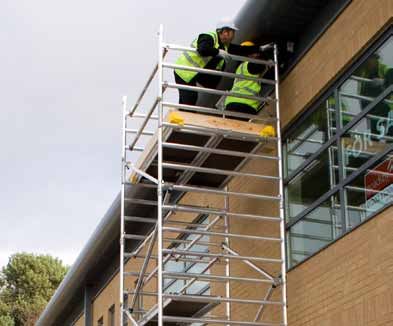
BoSS Clima
                   Mobile Aluminium Tower with
                      Climbing Frame 1450/850

               3T - Through the Trapdoor Method

USER GUIDE
   Edition April 2009
Safety First
Mobile Towers - 3T Method
INTRODUCTION
Please read this guide carefully.
Please note that diagrams are for illustrative purposes only.
User guides are also available to download from our website
at youngmangroup.com
BoSS mobile aluminium towers are light-weight scaffold towers
used throughout the building and construction industry for both
indoor and outdoor access solutions where a stable and secure
platform is required. Ideal for maintenance and installation work or
short-term access, the highly versatile towers provide a strong
working platform for a variety of heights.
This User Guide provides you with step by step instructions to
ensure your system is erected easily and safely, using the 3T
(Through The Trapdoor) method.
The law requires that personnel erecting, dismantling or altering
towers must be competent. Any person erecting a Youngman
BoSS mobile tower must have a copy of this guide. For further
information on the use of mobile access and working towers
consult the PASMA operators code of practice.
If you need further information, design advice, additional guides
or any other help with this product, please contact Youngman on
+44 (0)1621 745900 or email sales@youngmangroup.com
COMPLIANCES
Following examination by the SP
Technical Research Institute of
Sweden, the Boss Room – Mate
mobile access tower has been
issued with a Type Examination
Certificate No 249403 in
accordance with the requirements
of Ordinance AFS 1990:12
Stallningar, type examination rules
SPCR 064 for temporary structures
and SS-EN 1004:2005 including
Instruction Manual
appurtenant standards. EN 1298-IM-EN
1 BoSS Clima User GuideSafety First PREPARATION AND INSPECTION Inspect the equipment before use to ensure that it is not damaged and that it functions properly. Damaged or incorrect components shall not be used. SAFE USE Check that all components are on site, undamaged and that they are functioning correctly – (refer to Checklist and Quantity Schedules). Damaged or incorrect components shall not be used. Check if the ground on which the mobile access tower is to be erected and moved is capable of supporting the tower. The safe working load is 275 kgs (606lbs), per platform level, uniformly distributed up to a maximum of 950kgs (2100lbs), per tower (including self weight). Towers must always be climbed from the inside using the built in ladder during assembly and use. It is recommended that towers should be tied to a solid structure when left unattended. Adjustable legs should only be used for levelling. LIFTING OF EQUIPMENT Tower components should be lifted using a reliable lifting material (e.g. strong rope), employing a reliable knot (e.g. clove hitch), to ensure safe fastening and always lift within the footprint of the tower. Assembled mobile towers should not be lifted with a crane or other lifting device. youngmangroup.com 2
Safety First
    STABILISERS / BALLAST

     Stabilisers or outriggers and ballast weights shall always be
     fitted when specified.

     The Quantity Schedules show the recommended stabilisation.
     In circumstances where there is restricted ground clearance
     for stabilisers/outriggers, contact your supplier for advice.
     Ballast must be of solid materials (i.e. not water or loose sand)
     and should not be positioned to overload individual legs.
     Ballast should be secured against accidental removal where
     practicable, and be supported on the lowest rung of the
     bottom frame.

    MOVEMENT
     The tower should only be moved by manual effort, and only
     from the base.

     When moving the tower, beware of live electrical apparatus,
     particularly overhead, plus wires or moving parts of machinery.

     No person or materials should be on the tower during
     movement.

     Caution should be exercised when wheeling a tower over
     rough, uneven or sloping ground, taking care to unlock and
     lock castors. If stabilisers are fitted, they should only be lifted
     a maximum of 25mm above the ground to clear ground
     obstructions.

     The overall height of the tower when being moved, should not
     exceed 2.5 times the minimum base dimensions, or 4 metres
     overall height.

     Before use, check the tower is still correct and complete.

     After every movement of the tower use a spirit level to check
     that it is vertical and level and set the adjustable legs as
     required.

     Do not move the tower in wind speeds over 7.7 metres per
     second (17mph).

3
Safety First
DURING USE
Beware of high winds in exposed, gusty or medium breeze
conditions. We recommend that in wind speeds over 7.7 metres
per second (17 mph), cease working on the tower and do not
attempt to move it. If the wind becomes a strong breeze,
expected to reach 11.3 metres per second (25 mph), tie the
tower to a rigid structure. If the wind is likely to reach gale
force, over 18 metres per second (40 mph), the tower should be
dismantled.
Wind Beaufort Scale Beaufort Speed Speed
Description No. in m.p.h in m/sec
Raises dust and
Medium
loose paper, 4 8-12 4-6
Breeze
twigs snap off
Large branches
Strong in motion,
6 25-31 11-14
Breeze telegraph wires
whistle
Walking is
Gale Force 8 39-46 17-21
difficult
Beware of open ended buildings, which can cause funnelling
effect.
Do not abuse equipment. Damaged or incorrect components
shall not be used.
Raising and lowering components, tools, and/or materials by
rope should be conducted within the lower base. Ensure that
the safe working load of the supporting decks and the tower
structure is not exceeded.
The assembled tower is a working platform and should not be
used as a means of access or egress to other structures.
Beware of horizontal forces (e.g. power tools) which could
generate instability. Maximum horizontal force 20 kg.
The stairway towers, featuring an inclined staircase access, are
for frequent use by personnel carrying tools and/or materials.
Mobile towers are not designed to be suspended - please
refer to your supplier for advice.
Do not use boxes or stepladders or other objects on the
platform to gain extra height.
4Safety First
TIES
Ties should be used when the tower goes beyond its safe
height, beyond the limits of the stabilisers/outriggers, or if
there is a danger of instability. They should be rigid, two way
ties fastened to both uprights of the frame with load-bearing
right angled or swivel couplers. Only couplers suitable for the
50.8mm diameter tube of the tower should be used. Ideally,
ties should be secured to both faces of a solid structure by
means of anchorages.
The tie frequency may vary depending on the application, but
they should, at a minimum, be every 4 metres height.
For further information on tying-in a tower please contact your
supplier or Youngman.
MAINTENANCE - STORAGE - TRANSPORT
All components and their parts should be regularly inspected
to identify damage, particularly to joints. Lost or broken parts
should be replaced, and any tubing with indentation greater
than 5mm should not be used and put to one side for
manufacture repair. Adjustable leg threads should be cleaned
and lightly lubricated to keep them free running.
Brace claws, frame interlock clips, trapdoor latches and
platform windlocks should be regularly checked to ensure they
lock correctly.
Refer to the BoSS Inspection Manual for detailed inspection
and maintenance advice
Components should be stored with due care to prevent
damage.
Ensure components are not damaged by excessive strapping
forces when transported.
5 BoSS Clima User GuideSafety First
END TOEBOARD HORIZONTAL BRACE
SIDE
TOEBOARD
PLATFORM
(FIXED AND
TRAPDOOR
DECKS)
DIAGONAL BRACE
8 RUNG
FRAME
STABILISER
CASTOR
ADJUSTABLE LEG
4 RUNG FRAME
67
BoSS Clima 1450 to EN 1004: Available in 2 lengths - 1.8m and 2.5m
Internal/External Use - Towers under 2.5m are outside of the scope of EN 1004 Internal
Component Working height (m) 3.2 3.7 4.2 4.7 5.2 5.7 6.2 6.7 7.2 7.7 8.2 8.7 9.2 9.7 10.2 10.7 11.2 11.7 12.2 12.7 13.2 13.7 14.2
Platform height (m) 1.2 1.7 2.2 2.7 3.2 3.7 4.2 4.7 5.2 5.7 6.2 6.7 7.2 7.7 8.2 8.7 9.2 9.7 10.2 10.7 11.2 11.7 12.2
125/150/200mm Castor 4 4 4 4 4 4 4 4 4 4 4 4 4 4 4 4 4 4 4 4 4 4 4
250mm Adjustable Leg 4 4 4 4 4 4 4 4 4 4 4 4 4 4 4 4 4 4 4 4 4 4 4
1450 4 Rung Frame 2 2 2 2 2 2 2 2 2 2 2 2
1450 6 rung Frame 2 2 2 2 2 2 2 2 2 2 2
1450 Width Towers
1450 8 Rung Frame 2 2 2 4 2 4 4 6 4 6 6 8 6 8 8 10 8 10 10 12 10 12
Advanced Guard Rail 1.8m / 2.5m
1.8m / 2.5m Fixed Deck 1 1 1* 2 1 1 1 2 1 1 1 2 1 1 1 2 1 1 1 2 1 1 1
1.8m / 2.5m Trap Deck 1 1 1 1 2 2 2 2 3 3 3 3 4 4 4 4 5 5 5 5 6 6 6
1.8m / 2.5m Horizontal Brace (Red) 6 6 6 6 10 10 10 10 14 14 14 14 18 18 18 18 22 22 22 22 26 26 26
2.1m / 2.7m Diagonal Brace 2 3 3 4 5 6 7 8 9 10 11 12 13 14 15 16 17 18 19 20 21 22 23
Quantity Schedule
1.8m / 2.5m Side Toeboard 2 2 2 2 2 2 2 2 2 2 2 2 2 2 2 2 2 2 2 2 2 2 2
Important: Please ensure you also read the Quantity Schedule on page 8.
*If you are unable to position the working platform easily from the ground you may require an additional fixed platform for this tower heightBoSS Clima 1450 to EN 1004: Available in 2 lengths - 1.8m and 2.5m
Internal/External Use - Towers under 2.5m are outside of the scope of EN 1004 Internal
Component Working height (m) 3.2 3.7 4.2 4.7 5.2 5.7 6.2 6.7 7.2 7.7 8.2 8.7 9.2 9.7 10.2 10.7 11.2 11.7 12.2 12.7 13.2 13.7 14.2
Platform height (m) 1.2 1.7 2.2 2.7 3.2 3.7 4.2 4.7 5.2 5.7 6.2 6.7 7.2 7.7 8.2 8.7 9.2 9.7 10.2 10.7 11.2 11.7 12.2
1.2m End Toeboard 2 2 2 2 2 2 2 2 2 2 2 2 2 2 2 2 2 2 2 2 2 2 2
Toeboard Holder 4 4 4 4 4 4 4 4 4 4 4 4 4 4 4 4 4 4 4 4 4 4 4
SP7 Fixed Stabiliser 4 4 4 4 4 4
SP10 Telescopic Stabiliser 4 4 4 4 4 4 4 4 4 4 4 4 4
1450 Width Towers
SP15 Telescopic Stabiliser 4
Total Tower self weight (kgs) 1.8m 93 101 106 150 165 174 180 201 216 238 244 265 280 288 310 316 331 339 346 367 382 390 397
Total Tower self weight (kgs) 2.5m 110 118 123 173 190 198 206 232 249 271 278 305 322 330 352 364 381 390 397 424 441 449 456
Quantity Schedule
8Quantity Schedule
1450 Width Towers
NUMBER OF WORKING PLATFORMS ALLOWED
The MAXIMUM SAFE WORKING LOAD (the combined weight of
the users, tools and materials) that may be placed on the tower is
the total weight less the self weight of the tower. The total weight
for the towers shown in the schedule is 950kg.
Example 1:
A 1450 tower built using the 3T method with a 4.2m platform
height and a platform length of 1.8m has a self weight of 180kg.
950kg — 180kg = 770kg maximum safe working load
total weight self weight (users, tools and materials)
Example 2:
A 1450 tower built using the 3T method with a 11.7m platform
height and a platform length of 2.5m has a self weight of 449kg.
950kg — 449kg = 501kg maximum safe working load
total weight self weight (users, tools and materials)
For greater heights and loads, consult Youngman for guidance.
PLATFORM LOADING
On a 1450 tower a platform may comprise of a single deck or two
decks placed side by side. The maximum safe working load
(the combined weight of the users, tools and materials) that may
be placed on a platform is 275kg. This must be evenly distributed
over either one deck, or two decks placed side by side.
The quantities on pages 7 and 8, will enable BoSS towers to be
built safely and therefore comply with the requirements of the
Work at Height Regulations. They include double guardrails
to all platforms, and toeboards will need to be added if any levels
are used as working platforms and for storage of materials.
EN 1004 requires platforms at least every 4.2m, and these
measures will exceed that requirement.
9Quantity Schedule
1450 Width Towers
BALLAST: Internal/External Use
There is no requirement for ballast on 1450 towers if using
stabilisers as detailed in the table on page 8.
MOBILE OUTRIGGERS
MP16 outriggers can be used instead of SP15 stabilisers, as
detailed below. Mobile outrigger kits comprise:
Mobile Outrigger Kit
MP16 Mobile Outrigger 4
125/150/200mm Castor 4
(Use same diameter castors as on
tower)
250mm Adjustable leg 4
Plan Braces 4
The above components replace:
SP15 Stabiliser 4
STABILISERS
To improve rigidity, larger stabilisers can be used
at a lower level than shown in the table on page 8.
Angle of Stabiliser 1450 TOWER
X
X
90°
Double width 1450 Towers Dimension X
Platform Length 1.8m Platform Length 2.5m
SP7 X= 3351 X= 3629
SP10 X= 4789 X= 5100
SP15 X= 5520 X= 5838
youngmangroup.com 1011
BoSS Clima 850 to EN 1004: Available in 2 lengths - 1.8m and 2.5m
Internal/External Use - Towers under 2.5m are outside of the scope of EN 1004 Internal
Component Working height (m) 3.2 3.7 4.2 4.7 5.2 5.7 6.2 6.7 7.2 7.7 8.2 8.7 9.2 9.7 10.2 10.7 11.2 11.7 12.2 12.7 13.2 13.7 14.2
Platform height (m) 1.2 1.7 2.2 2.7 3.2 3.7 4.2 4.7 5.2 5.7 6.2 6.7 7.2 7.7 8.2 8.7 9.2 9.7 10.2 10.7 11.2 11.7 12.2
125/150/200mm Castor 4 4 4 4 4 4 4 4 4 4 4 4 4 4 4 4 4 4 4 4 4 4 4
250mm Adjustable Leg 4 4 4 4 4 4 4 4 4 4 4 4 4 4 4 4 4 4 4 4 4 4 4
850 4 Rung Frame 2 2 2 2 2 2 2 2 2 2 2 2
850 Width Towers
850 6 Rung Frame 2 2 2 2 2 2 2 2 2 2 2
850 8 Rung Frame 2 2 2 4 2 4 4 6 4 6 6 8 6 8 8 10 8 10 10 12 10 12
1.8m / 2.5m Trap Deck 1 1 1* 2 2 2 2 3 3 3 3 4 4 4 4 5 5 5 5 6 6 6 6
1.8m / 2.5m Horizontal Brace (Red) 6 6 6 6 10 10 10 10 14 14 14 14 18 18 18 18 22 22 22 22 26 26 26
2.1m / 2.7m Diagonal Brace 2 3 3 4 5 6 7 8 9 10 11 12 13 14 15 16 17 18 19 20 21 22 23
1.8m / 2.5m Side Toeboard 2 2 2 2 2 2 2 2 2 2 2 2 2 2 2 2 2 2 2 2 2 2 2
0.6m End Toeboard 2 2 2 2 2 2 2 2 2 2 2 2 2 2 2 2 2 2 2 2 2 2 2
Quantity Schedule
Important: Please ensure you also read the Quantity Schedule on page 12.
*If you are unable to position the working platform easily from the ground you may require an additional fixed platform for this tower heightBoSS Clima 850 to EN 1004: Available in 2 lengths - 1.8m and 2.5m
Internal/External Use - Towers under 2.5m are outside of the scope of EN 1004 Internal
Component Working height (m) 3.2 3.7 4.2 4.7 5.2 5.7 6.2 6.7 7.2 7.7 8.2 8.7 9.2 9.7 10.2 10.7 11.2 11.7 12.2 12.7 13.2 13.7 14.2
Platform height (m) 1.2 1.7 2.2 2.7 3.2 3.7 4.2 4.7 5.2 5.7 6.2 6.7 7.2 7.7 8.2 8.7 9.2 9.7 10.2 10.7 11.2 11.7 12.2
Toeboard Holder 4 4 4 4 4 4 4 4 4 4 4 4 4 4 4 4 4 4 4 4 4 4 4
SP7 Fixed Stabiliser 4 4 4 4 4
SP10 Telescopic Stabiliser 4 4 4 4 4 4 4
850 Width Towers
SP15 Telescopic Stabiliser 4 4 4 4 4 4 4 4 4
Total Tower self weight (kgs) 1.8m 72 79 105 125 139 145 151 184 197 203 209 244 257 263 269 274 288 294 314 334 347 354 359
Total Tower self weight (kgs) 2.5m 83 90 117 142 158 165 171 209 225 232 238 277 293 300 306 317 332 339 360 385 401 408 414
Quantity Schedule
12Quantity Schedule
850 Width towers
NUMBER OF WORKING PLATFORMS ALLOWED
The MAXIMUM SAFE WORKING LOAD (the combined weight of
the users, tools and materials) that may be placed on the tower is
the total weight less the self weight of the tower. The total weight
for the towers shown in the schedule is 950kg.
Example 1:
An 850 tower built using the 3T method with a 4.2m platform
height and a platform length of 1.8m has a self weight of 151kg.
950kg — 151kg = 799kg maximum safe working load
total weight self weight (users, tools and materials)
Example 2:
An 850 tower built using the 3T method with a 11.7m platform
height and a platform length of 2.5m has a self weight of 408kg.
950kg — 408kg = 542kg maximum safe working load
total weight self weight (users, tools and materials)
For greater heights and loads, consult Youngman for guidance.
PLATFORM LOADING
On an 850 tower a platform comprises of a single deck only. The
maximum safe working load (the combined weight of the users,
tools and materials) that may be placed on a platform is 275kg,
evenly distributed over the deck.
The quantities on pages 11 and 12, will enable BoSS towers to
be built safely and therefore comply with the requirements of the
Work at Height Regulations. They include double guardrails
to all platforms, and toeboards will need to be added if any levels
are used as working platforms and for storage of materials.
EN 1004 requires platforms at least every 4.2m, and these
measures will exceed that requirement.
13Quantity Schedule
850 Width Towers
BALLAST: Internal/External Use
There is no requirement for ballase on 850 towers if using stabilis-
ers as detailed in the table on page 12
MOBILE OUTRIGGERS
MP16 mobile outriggers can be used instead of SP15 telescopic
stabilisers respectively, as detailed below.
Mobile outrigger kits comprise:
Mobile Outrigger Kit
MP16 Mobile Outrigger 4
125/150/200mm Castor 4
(Use same diameter castors as on
tower)
250mm Adjustable leg 4
Plan Braces 4
The above components replace:
SP15 Stabiliser 4
STABILISERS
To improve rigidity, larger stabilisers can be used at a lower level
than shown in the table on page 12.
X
X
90°
Single Width 850 Towers Dimension X
Platform Length 1.8m Platform Length 2.5m
SP7 X= 2994 X= 3201
SP10 X= 4458 X= 4734
SP15 X= 5195 X= 5485
14Assembly Procedure
Mobile Towers - 3T Method
ASSEMBLY AND DISMANTLING PROCEDURES
When building a BoSS Tower:
To comply with the Work at Height Regulations we show
assembly procedures with platforms every 2 metres in height,
and, the locating of guardrails in advance of climbing onto a
platform to reduce the risk of a fall.
All platforms feature double guardrails on both faces of either
individual platforms or fully decked levels.
All guardrails should be 2 and 4 rungs (0.5m and 1.0m) above
platforms.
Never stand on an unguarded platform positioned above the
first rung of a tower. If your risk assessment shows it necessary,
you may also need to guardrail platforms at this level.
Always start building with the smallest height frames at
the base of the tower:
Platform Heights in Metres Frame at base
1.7, 2.2, 3.7, 4.2, 5.7, 6.2, 7.7, 8.2, 9.7, 10.2, 11.7, 12.2 4 rung
2.7, 4.7, 6.7, 8.7, 10.7 6 rung
1.2, 3.2, 5.2, 7.2, 9.2, 11.2 8 rung
Where all 3 frame heights are used in a tower, start with 4 rung
frames at the base, with the 6 rung frames next and the 8 rung
frames on the top. Refer to the quantity schedules for detail.
TO DISMANTLE A BOSS CLIMA TOWER
Remove toeboards, and pass down the tower.
Unclip farthest end of braces and immediately go to protected
trapdoor position on ladder to complete removal.
Remove upper platforms from protected platform levels below.
Pass removed components out of the tower to a colleague.
15Safety Checklist
Mobile Towers - 3T Method
CHECKLIST
Ensure all brace claws operate and lock correctly prior to erection
Inspect components prior to erection
Inspect tower prior to use
Tower upright and level
Castors locked and legs correctly adjusted
Diagonal braces fitted
Stabilisers/outriggers fitted as specified
Platforms located and windlocks on
Toeboards located
Check guardrails are fitted correctly. See illustration below.
Ensure horizontal braces and guardrails are fitted correctly.
Always fit as shown.
Refer to this checklist before using each time.
16Assembly Procedure
Mobile Towers - 1450 3T Method
ASSEMBLY FOR 1450 TOWERS
Always start building with the smallest height frames at the
base of the tower:
Platform Heights in Metres Frame at base
1.7, 2.2, 3.7, 4.2, 5.7, 6.2, 7.7, 8.2, 9.7, 10.2, 11.7, 12.2 4 rung
2.7, 4.7, 6.7, 8.7, 10.7 6 rung
1.2, 3.2, 5.2, 7.2, 9.2, 11.2 8 rung
Where all 3 frame heights are used in a tower, start with 4 rung
frames at the base, with the 6 rung frames next and the 8 rung
frames on the top. Refer to the Quantity Schedules for detail.
The procedure illustrated shows a tower starting with a 4 rung
frame.
Youngman recommend two persons are used to build BoSS
Towers. Above 4m height, it is essential that at least two
persons are used. Only climb the tower from the inside.
Push 4 castors onto 4 adjustable legs. Insert adjustable legs
1 into 2 end frames as shown. Lock castor brakes. Base plates
can be fitted to adjustable legs if it is not necessary to move the
tower.
Unlocked
Locked
17Assembly Procedure
Fit one horizontal brace (red) onto the vertical of an end
2
frame, just above the bottom rung, with the claw facing
outwards.
Note: All locking claws must be opened before fitting.
Locked
Position the second end frame as shown and fit the other
3 end of the horizontal brace on to the vertical, just above the
bottom rung. Fit a second horizontal brace between the bottom
rungs on the other side of the frames to square the tower.
18Assembly Procedure
Fit 2 additional end frames and check the frame interlock
4 clips are engaged. Fit 2 diagonal braces (blue) in opposing
directions, between the 2nd and the 6th rungs. Ensure the frames
are vertical and level by checking with a spirit level and setting the
adjustable legs as required.
IMPORTANT – Only use the adjustable legs to level the tower
and not to gain extra height.
INTERLOCK CLIP
Locked Unlocked
Fit the stabilisers. (See the notes on page 30)
19Assembly Procedure
Fit a temporary deck on the lowest rungs. Fit a trapdoor deck
5
on the 8th rung (2.0m) on one side of the tower. Ensure the
trapdoor is positioned with the hinges towards the outside of the
tower as shown. Climb the end frame below the trapdoor on the
inside of the tower, and from within the protected trapdoor posi-
tion, fit horizontal braces on the 10th and 12th rungs (in that order)
on both sides of the deck.
Do not climb onto the deck until it is fully guardrailed.
When horizontal braces are fitted as guardrails, they should be
0.5m and 1.0m (2 and 4 rungs) above the deck level.
Remove the temporary deck from the lowest rung
20Assembly Procedure
Fit the next pair of diagonal braces in opposing directions
6
between the 6th and 10th rungs add 2 additional end
frames.
Add two more diagonal braces between the 10th and 14th
7
rungs. If finishing at this height (4.2m platform), the fixed
deck should be repositioned to the 16th rung on the opposite side
of the tower to the trapdoor deck. Fit a trapdoor deck alongside it
with the hinges towards the outside of the tower and the trapdoor
in line with the one below. Climb the tower and from the protected
trapdoor position, fit the horizontal braces as guardrails on both
sides at 2 and 4 rungs (0.5 and 1.0m) above the platform level. At
the final level, a further diagonal braces should be added on one
side of the tower as shown.
21 BoSS Clima User guideAssembly Procedure
When building beyond a 4.2m platform height.
Continue to add pairs of end frames, diagonal braces and
8
fit trapdoor decks as shown in the previous steps. At every
platform level add horizontal braces as guardrails at 2 and 4
rungs above the platform. Fit these guardrail braces from the
protected trapdoor position. Do not climb onto the platform
until it is fully guardrailed.
Continue until the required height is reached. Re-position the
fixed deck to the required platform height and fit a trapdoor deck
alongside it as shown in Stage 7. Fit the guardrails as shown in
Stage 7.
youngmangroup.com 22Assembly Procedure
Fit toeboards (see Instructions on page 29).
9
The tower is now complete.
Dismantling Procedure
To take down the tower reverse the building sequence. When
10
removing guardrail braces, unlock the claws furthest from
the trapdoor and then return immediately to the protected position
within the trapdoor. You may then unlock the claws at the other
ends of the Guardrails to remove them from the tower.
23 BoSS Clima User guideAssembly Procedure
Mobile Towers - 850 3T Method
ASSEMBLY FOR 850 TOWERS
Always start with the smallest height frames at the base of the
tower:
Platform height in Metres Frame at base.
1.7, 2.2, 3.7, 4.2, 5.7, 6.2, 7.7, 8.2, 9.7, 10.2, 11.7, 12.2 4 Rung
2.7,4.7,6.7,8.7,10,7 6 Rung
1.2,3.2,5.2,7.29.2,11.2 8 Rung
Where all 3 Heights are used in a tower Start with 4 rung frames
at the base, with the 6 rung frames next and the 8 rung frames
on top. Refer to the quantity schedules for detail. The procedure
illustrated shows a tower starting with an 8 rung frame.
Insert adjustable leg/castor assemblies into end frames and
1 lock the castors, see diagram Step 1 (page 17). Base plates
can be fitted to the adjustable legs if it is not necessary to move
the tower. Fit 2 horizontal braces to the 850 end frames as shown
in steps 2 and 3 for the 1450 tower procedure (page 18). Ensure
the frames are vertical and level by checking with a spirit level and
setting the adjustable legs required.
Fit a trapdoor deck on the 4th rung. Fix the horizontal braces
2 (red) as guardrails on the 6th and 8th rungs (2 and 4 rungs
above the platform) on both sides of the tower.
24Assembly Procedure
Fit 2 diagonal braces (blue) in opposing directions between
3
the 2nd and 6th rungs. Ensure the frames are vertical and
level by checking with a spirit level and setting the adjustable legs
as necessary. Fit the next pair of end frames and check the frame
interlock clips are engaged. Fit stabilisers (see notes on page 30).
INTERLOCK CLIP
Locked Unlocked
25Assembly Procedure
Fit 2 pairs of diagonal braces in opposing directions
4
between the 6th and 10th rungs and the 10th and 14th
rungs. Locate a trapdoor deck on the 12th rung.
26Assembly Procedure
Climb up the inside of the tower and from the protected
5
position of the trapdoor, fit horizontal braces as guardrails,
on both sides, to the 14th and 16th rungs (2 and 4 rungs above
the platform, in that order).
27Assembly Procedure
Continue the procedure until the required working height is
6
reached, adding additional pairs of end frames, diagonal
braces and fitting trapdoor platforms, as shown on previous steps.
At every platform level, add horizontal braces as guardrails at 2
and 4 rungs above the platform (in that order) on both sides of the
platform. (as shown in Step 5)
Fit these guardrail braces from the protected trapdoor
position.
Do not climb onto the platform until it is fully guardrailed.
At the final level a further diagonal brace should be added on one
side of the tower as shown.
Fit the toeboards (see instruction on page 29).
The tower is now complete.
Dismantling Procedure
To take down the tower reverse the building sequence. When
7
removing guardrail braces, unlock the 4 claws furthest from
the trapdoor and return immediately to the protected position
within the trapdoor and then return immediately to the protected
position within the trapdoor. You may then unlock the claws at the
other ends of the guardrails to remove them from the tower.
28Toeboards
Mobile Towers - 3T Method
FITTING TOEBOARDS
Lock yellow plastic toeboard clips over rung and deck claw as
shown. Position as (A) on right hand deck claw. On other side of
the working platform, position the clip as (B). Place 25mm thick
toeboards into slots in toeboard clips as shown.
Side Toeboard
End
Toeboard
Toeboard Clip
(A)
Claw
(B)
Deck
Rung
29Stabilisers and Outriggers
Mobile Towers - 3T Method
STABILISERS
Attach one stabiliser to each corner of the tower as shown. Ensure
stabiliser feet are equally spaced to form a square.
SP10 and SP15 telescopic stabilisers must always be fully
extended.
Position the lower clamp so that the lower arm is as close to the
horizontal as possible. Adjust the position of the top clamp to
ensure the stabiliser foot is in firm contact with the ground. Ensure
clamps are secure.
Stabilisers are used when the tower is to be moved occasionally,
frequent movement will require mobile outriggers.
When moving the tower, adjust the top clamps to lift the four
stabiliser feet a maximum of 25mm off the ground and then
unlock the castor brakes. After moving ensure all four stabiliser
feet are repositioned in firm contact with the ground.
STABILISER DIMENSIONS
y
Ma
xE
SP7 1227
xte
SP10 2241
ns
ion
SP15 2757
y
OUTRIGGERS
For information on mobile outriggers please consult your supplier.
30For further information about
this product or any other
products and services,
please contact :
Youngman are members of: Youngman Group Ltd
The Causeway, Maldon,
Essex, CM9 4LJ,
United Kingdom
t +44 (0)1621 745900
f +44 (0)1621 859845
e sales@youngmangroup.com
youngmangroup.comYou can also read


