CAFÉ GUIDELINES 2021 - City of Toronto
←
→
Page content transcription
If your browser does not render page correctly, please read the page content below
CaféTO
 CAFÉ GUIDELINES 2021
About this
Guidebook
This Guidebook, which is authorized under §742-2.1D of City of Toronto Municipal Code
Chapter 742 (Sidewalk Cafés, Parklets and Marketing Displays), provides guidelines for
cafés on sidewalks and curb lanes for the 2021 summer café season which runs from
April 15, 2021 to November 10, 2021. Winter CaféTO guidelines will be released in Fall
2021. These guidelines include the minimum requirements that restaurants and bars
must meet to operate a café as part of the CaféTO Program.
Please review these guidelines carefully and plan ahead to ensure compliance. For
additional information, refer to Chapter 742. This Guidebook primarily focuses on cafés
located on the public right-of-way (e.g., on sidewalks and curb lanes), but there is a
section related to patios on private property on page 36.
The City of Toronto retains discretion to review installations in the right-of-way on a
case-by-case basis considering factors such as limited frontage options, past complaints
reported at the address, non-compliance with the CaféTO guidelines and conditions
imposed by Community Council in similar local circumstances.
These guidelines are subject to change at any time and cafés are only permitted in
accordance with all requirements of the Province of Ontario and the City of Toronto,
including statues, by-laws, regulations, orders and guidelines. Information will be
updated to reflect evolving public health regulations as they are released. Keep up to
date on requirements by visiting toronto.ca/CafeTO and reviewing this Guidebook regularly.

Written permission is required from the City of Toronto to
expand your café on the sidewalk or occupy a curb lane.

                                                  What’s New for CaféTO in 2021?
                                          Exciting changes have been made to the
                                          CaféTO program to:
                                          •   ensure greater accessibility so all people
                                              can enjoy access to CaféTO restaurants
                                          •   improve the look of the curb lane closure
                                              areas and increase options for cafe
                                              customization
                                          •   add permissions for temporary platforms in
                                              curb lane cafe areas
                                          Please look for other new program guidelines
                                          under the heading:
                                                        “New for 2021”

                                              2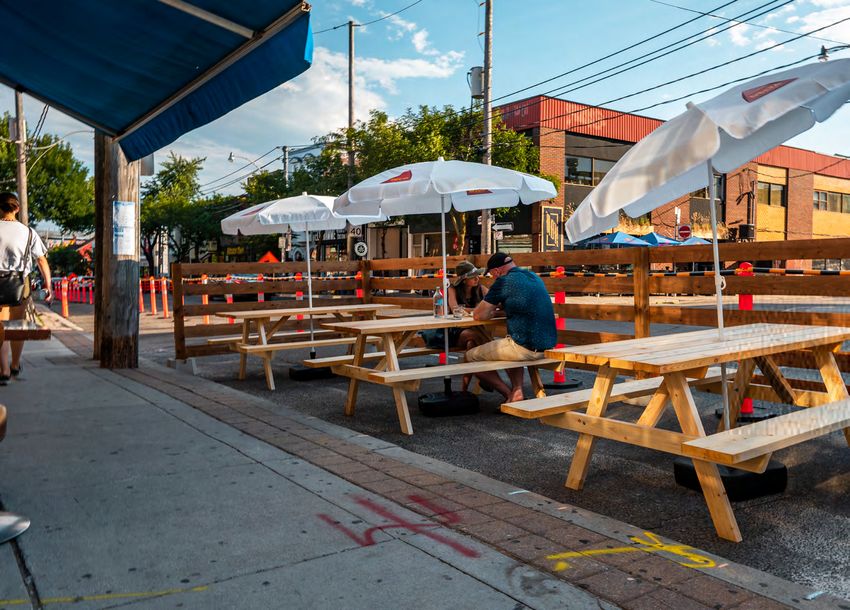
Table of
Contents
How to Participate............................................................ 4

Introduction...................................................................... 5

Temporary Outdoor Dining on
City Streets and Sidewalks............................................... 6

Types of Cafés.................................................................. 8

Designing for Accessibility............................................... 12
• Pedestrian Clearway.......................................................      13
• Entrances and Ramps....................................................         16
• Temporary Fencing and Delineation...............................                17
• Café Furniture and Facilities............................................       18

CaféTO General Requirements......................................... 19

Cafés In The Curb Lane.................................................... 24

Temporary Fencing.......................................................... 29

Temporary Platforms....................................................... 33

Patios on Private Property............................................... 36

Temporary Tents & Building Permits............................... 39

Marketing Displays........................................................... 41

Appendix........................................................................... 43

CaféTO Contact Guide....................................................... 52

                     To jump to a section, click on its title.

                                         3
How to
Participate
Restaurant and bar operators with a valid Eating Establishment licence must follow the
below steps to participate in the CaféTO Program:
1. If you wish to install or expand a café on public property, visit toronto.ca/CafeTO to
    register. You do not need to register if you wish to expand on private property.
2. Once you complete your registration, City staff will review your application and
   submitted documents for compliance with these guidelines and Chapter 742. City staff
   will also review your past compliance with other applicable by-laws (e.g.City of Toronto
   Municipal Code Chapter 591 (Noise)). You will then be provided with more information
   by email.
3. Applicants who are approved to install a new or expanded sidewalk café can begin
   operating when outdoor dining is permitted under provincial regulations in Toronto.
4. Applicants who are approved to install a curb lane café will receive more information
   about the date of installation for their curb lane closure directly from city staff, and their
   BIA if applicable.
Successful applicants will receive an official Municipal Clearance Letter to participate in
the CaféTO program, which will identify the conditions of the approval to participate in
the CaféTO Program. Applicants will only be able to use the City space identified in this
letter for the period of time specified and in accordance with any of the conditions in the
approval. At the end of the term, all café items must be removed from the approved area.

 Restaurant and bar operators that wish to expand a patio on private property
 do not need to register with CaféTO. More information on installing a patio on
 private property is available on page 36 of this Guidebook.

                                NEW FOR 2021!!
                  Registration for curb lane cafés will follow this schedule:

     Registration Window             Registration Window              Installation Window
            Opens                           Closes                      Curb Lane Café
       February 26, 2021                 March 26, 2021               May 8 - May 22, 2021

The second round of registrations will open on March 27, 2021 and will close in May
2021, exact date to be determined. Additional registration windows may open depending
on demand. Please stay up to date by visiting toronto.ca/CafeTO.
        Registration for new and expanded sidewalk cafés will continue
        throughout the program and operators will be able to access the
        sidewalk immediately after their registration is approved, written
        confirmation is provided and public health regulations allow.

                                               4
Introduction
The City of Toronto is offering local restaurant and bar operators with
an Eating Establishment licence, access to public space on city streets
and sidewalks to assist with expanding outdoor seating capacity while
maintaining physical distancing requirements. The normal café permitting
and application process is paused to provide this expedited opportunity for
café operators.
Any expanded or new cafés on the sidewalk or in the curb lane must
meet the design and operational requirements set out in this Guidebook
and Chapter 742, including but not limited to, obligations related to health
and safety, accessibility, equipment (e.g.,fencing, barriers, planters), and
insurance and indemnification requirements. Pedestrian mobility, physical
distancing and road safety requirements must be met for this program to
be successful for all members of the public.
The City of Toronto has prepared this document to summarize the
essential information required to safely install or expand sidewalk or
curb lane cafés, where possible, and to provide a suite of options to take
advantage of the 2021 café season.

Toronto Public Health Requirements
Restaurants and bars operating in Toronto must follow current public health guidelines
as developed by Toronto Public Health and the Province of Ontario. Please visit the
Province of Ontario's website to stay informed. Toronto Public Health has also published
comprehensive Guidelines for Re-Opening Your Restaurant.

Business Improvement Areas (BIA)
BIAs are an integral part of the CaféTO program. If your restaurant or bar is located
within a BIA you should speak to your BIA representative for additional information and
assistance. Please find the list of BIAs here.

Patios on Private Property
Restaurant and bar owner/operators that wish to install or expand a patio on private
property do not need to register with the CaféTO program. Toronto City Council has
approved a Temporary Use By-Law that provides additional temporary permissions for
expanded outdoor dining on private property. More information is available on page 36 of
this Guidebook.

                                           5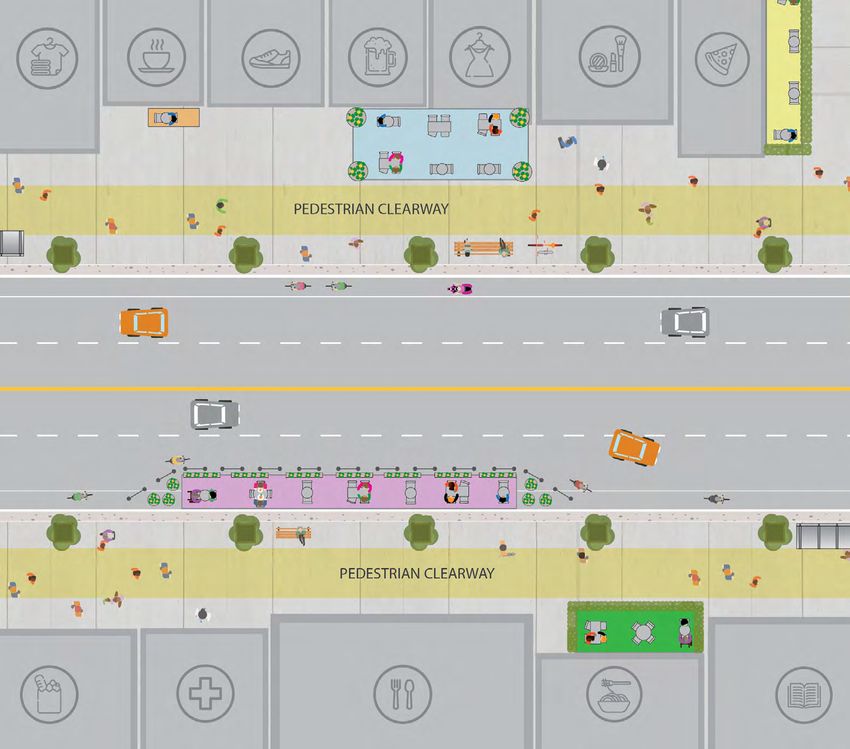
Temporary Outdoor Dining on
 City Streets and Sidewalks

            6
Temporary Outdoor Dining on
City Streets and Sidewalks
The City of Toronto is temporarily pausing certain permitting, application and fee
requirements under Municipal Code Chapter 742 (Sidewalk Cafés, Parklets, and
Marketing Displays) to allow for expedited approvals of expanded outdoor dining
opportunities, but there are still basic requirements necessary to safely operate a café on
city streets and in the public right-of-way. Please review this document carefully as it is
the operator’s responsibility to ensure that all requirements are met. City staff will ensure
that expanded cafés meet these guidelines and will be visiting establishments to ensure
compliance. Café operators that do not comply with these CaféTO and Chapter 742
requirements may be unable to continue participating in the program.

                                    REGISTRATION
If you wish to expand your existing permitted café or create a new café, you MUST
register with the City of Toronto, even if you participated in the CaféTO program in
2020. Please visit toronto.ca/CafeTO for full registration requirements, which include
providing proof of comprehensive liability insurance and identifying that you have a valid
Business Licence issued by the City of Toronto.

                                           FEES
The City of Toronto recognizes the financial hardships faced by the restaurant industry
as a result of the COVID-19 pandemic. There are no fees required to participate in the
2021 CaféTO program.

                                  ALCOHOL SERVICE
The Province of Ontario is temporarily allowing current liquor licence holders to serve
alcohol outside of their officially licensed area without a temporary extension application
to the AGCO. It is the operator’s responsibility to ensure compliance with all AGCO
regulations, available here as well as adhere to any conditions on their liquor sales
licence.
Restaurant and bar operators wishing to apply for permanent changes to liquor licences
will still need to apply for approvals through the AGCO. Further instructions on new
permanent licences are available here.

                                             7
Types of Cafés

      8
Types of
  Cafés

Curb Lane Café

  CURB LANE CAFÉS
  • Located in the curb lane of the road

  • This café type requires registration with the City of Toronto

  • More information about curb lane cafés is on page 27 of this guidebook

Sidewalk Café

  SIDEWALK CAFÉS
  • Located on the sidewalk adjacent to the frontage and expanded frontage wall of the

    building
  • Sidewalk cafés may be expanded in front of a neighbouring business if written

    permission is granted from the adjacent tenant and/or property owner
  • This café type requires registration with the City of Toronto

                                            9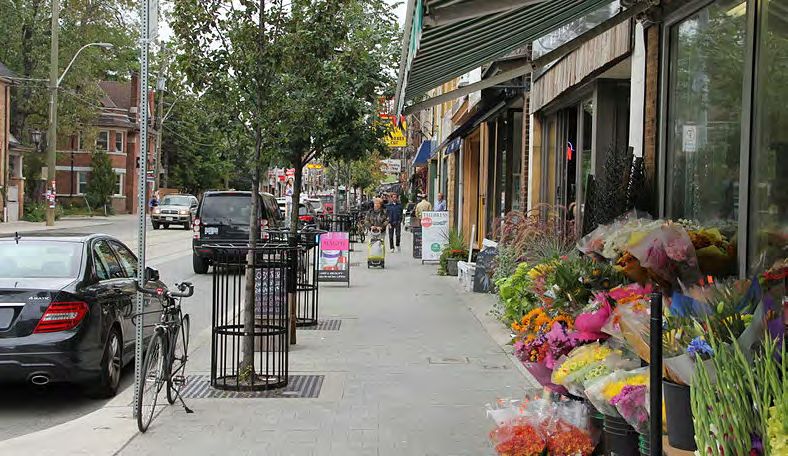
Types of
  Cafés
Small Frontage Café

  SMALL FRONTAGE CAFÉS
  • Cafés located directly against the building

  • Maximum size of a small frontage café is 0.8 metres deep by 5.5 metres wide or the

    width of the establishment frontage, whichever is less
  • Must have a planter or similar item with a solid base as a white cane navigation

    aid to make your café safe for people with low or no vision. Please see page 17 of
    this Guidebook for more information on how to ensure your café does not impede
    accessibility
  • Umbrellas, fencing and enclosures are not permitted for this café type

  • This café type does not require registration with the City of Toronto, but must comply

    with CaféTO guidelines and Article 8 of Chapter 742

  FLANKAGE CAFÉS
  • Flankage cafés are located on the sidewalk or boulevard along the side of a

    restaurant, generally on a local street. This café type requires registration with the City
    of Toronto and written support from the local Councillor’s office.

                                              10
Types of
Cafés
5
2
3
1
4
1 Install a curb lane café in the street
2 Install a new café on the sidewalk
3 Expand a café in front of an adjacent property on the sidewalk
4 Install a small frontage café on the sidewalk
5 Install a flankage café on the sidewalk
11Designing for Accessibility
12Designing for Pedestrian
Accessibility Clearway
Ensuring accessibility for CaféTO For most areas of the City, a minimum
includes meeting requirements pedestrian clearway of 2.1 metres is
from the Accessibility for Ontarians required. When installing sidewalk cafés,
with Disabilities Act (AODA), City of operators must ensure a pedestrian
Toronto accessibility requirements clearway of 2.1 metres is maintained.
and accessibility criteria specific to Maintaining a minimum pedestrian
the CaféTO program. All accessibility clearway is essential since a clear and
requirements are equally important and straight path of travel ensures that all
together they create a CaféTO program pedestrians in your neighbourhood can
that is accessible to all Torontonians. move unimpeded along the sidewalk,
The pedestrian clearway is the most particularly those using mobility devices,
important area of the sidewalk for the strollers and other similar apparatus.
safe, accessible and efficient movement If you do not maintain the minimum
of pedestrians. The sidewalk is how pedestrian clearway required, a City of
people and customers of all ages and Toronto enforcement officer will require
abilities access local shops, restaurants, you to adjust your café upon inspection.
offices, transit stops and other services, Café operators that are the subject of
and pedestrians have the first priority for repeated complaints may have café
its use. It is everyone’s responsibility to permissions removed.
protect the pedestrian clearway.
The pedestrian clearway is a continuous
straight path of sidewalk, clear of all
obstructions including utility poles, fire
hydrants, traffic signals, signs and street
furniture. The pedestrian clearway
never includes the curb edge, the street
furniture zone or a café enclosure area.
MAKING SIDEWALKS ACCESSIBLE
• D
o not use the pedestrian clearway to queue patrons
awaiting their reservation or table
• Do not place A-frame signs in the pedestrian clearway
• D
o not lay electrical wires for any appliances (e.g. heaters,
lights) across the pedestrian clearway
13Designing for Pedestrian
Accessibility Clearway
Some streets in Toronto’s downtown core have sidewalks that have very high pedestrian
volumes and require a wider pedestrian clearway of 2.5 metres. New and expanded
sidewalk café operators on streets indicated within the boundaries of the below map
where the distance from the building face to the edge of the curb is at least 5 metres
must maintain a 2.5 metre pedestrian clearway. A list of affected streets is available on
page 41 of Chapter 742.
14Designing for Pedestrian
Accessibility Clearway
HOW TO ACCURATELY MEASURE
THE PEDESTRIAN CLEARWAY
The pedestrian clearway must be a straight and unobstructed path of travel. This
determines how wide your sidewalk café should be. Ensure you start your measurement
from the edge of your café area, including planters, furniture, umbrella stands and other
café elements, and continue to the nearest obstruction in the sidewalk (e.g., street
furniture, utility pole, tree pit, bike parking). You must include the measurement of a bike
for bike rings, a person’s legs and feet at a bench, and the measurement for a person in
a wheelchair using the accessible ramp at transit stops.
It is also critically important for people with low to no vision and people with mobility
issues that a straight path of travel is maintained on the pedestrian clearway. Sharp
changes in the pedestrian clearway must be avoided. More information on accurately
measuring changes of direction on the sidewalk can be found on page 53.
The following diagram indicates the measurements you should use when determining
the width of the pedestrian clearway.
2.1m PEDESTRIAN CLEARWAY 2.1m
1.8m 20m
0.4m
1.5m 0.6m
15Designing for Entrances
Accessibility and Ramps
It is important to consider accessibility when designing all aspects of your café area.
Please ensure your establishment adheres to the following accessibility standards:
• Provide an accessible entrance to your café with a minimum width of 1 metre
• Café or customer queuing areas must not impede any existing barrier-free access or
sidewalk clearances for people using mobility devices to your establishment or that of
your neighbours
• Ensure that you maintain barrier-free access and sidewalk clearance for people using
mobility devices, especially when considering the placement of your café equipment
and customer queuing areas
It is the responsibility of the business owner to comply with the Accessibility for Ontarians
with Disabilities Act (AODA) at all times.
For temporary cafés in the curb lane where platforms are not
present, the City of Toronto will install ramps to ensure that people
using mobility devices can enter your café in the curb lane. The
ramps must be kept clear at all times, including the landing space at
the bottom of the ramp to facilitate the turning of mobility devices.
16Designing for Temporary Fencing
Accessibility and Delineation
Cane-detectable materials allow people with low vision or no vision using
a white-cane to travel more safely on the sidewalk. Cafés on the sidewalk
must have planter boxes, fencing or similar items with a solid base as
a white cane navigation aid for people with low to no vision and must
incorporate the critical accessibility requirements below.
• Planters and fencing must have a base so a white cane can be used to tap along the
bottom of the element to determine where to safely walk
• Planter boxes with a solid, detectable base must be spaced no more than 0.3 metre
apart, except for the accessible entrance which must be at least 1 metre
• Temporary stanchions should only be used to delineate your café area if they have a
solid base and they are spaced 0.3 metres apart to ensure cane-detectability
• Non-solid delineation items (e.g. fencing) must have a lower rail height between 77mm
and 150mm above the sidewalk surface
• Free-standing or self-supporting fencing/planters must not create a trip hazard or
project into the pedestrian clearway
Additional details about fencing and delineation can be found on page 29 of this
Guidebook.
Colour
Contrast
Delineation elements
like planter boxes
and fencing must be
a contrasting colour
to the sidewalk. In
most cases, where
the sidewalk is grey,
delineation items
should primarily be a
dark colour (e.g. black
or brown) to provide
adequate contrast.
Red and green can
be difficult to detect
for people living with
colour blindness and
should be avoided.
17Designing for Café Furniture and
Accessibility Facilities
Café operators can make several choices that will increase accessibility for all
Torontonians in their CaféTO areas. Please consider the following when making
decisions about your café elements:
• Consider people using mobility devices when determining what type of furniture you
will set out in your café area. For example, picnic tables significantly limit the ability for
a person using a mobility device to access a surface on which to dine and are often
the entire width of the curb lane closure therefore impeding movement.
• When determining seating arrangements in your café area, install some tables with
room underneath to accommodate people using mobility devices. Ensure that there
are clear routes and maneuvering space for people using mobility devices.
• Protruding objects with a small base are particularly harmful. Be cautious with service
stands, tables, umbrella bases and other pieces of furniture with tops that extend into
the pedestrian clearway.
• Asphalt ramps into curb lane cafés require a landing space for mobility devices to
maneuver properly. Do not place furniture in this space
• Advertise whether you have accessible washrooms on your website
Picnic tables can
limit accessability. If
your primary seating
arrangement is
picnic tables, ensure
you have another
table type available
to accommodate
people using a
mobility device.
18CaféTO
General Requirements
19CaféTO
General Requirements
UMBRELLAS
Umbrellas are a source of shade for cafe patrons and employees, and must be installed
correctly to ensure the safety of customers and passers-by.
• All umbrella parts must be at least 2.1 metres above the level of the street or sidewalk
• All umbrella parts in a curb lane café must be set back at least 0.8 metres from either
edge of the closure area
• Umbrella canopies must not protrude into the roadway or pedestrian clearway
• Umbrellas must be properly weighted down to prevent being blown over by wind
• New awning, canopy, structure or tent installations are not permitted on public
property. You may only use an awning if it is approved on your existing permanent
café permit
LIGHTING
Installing lighting elements can be an important benefit to your cafe area in the evening.
Please ensure your lighting elements comply with the following guidelines:
• Lighting features must be temporary and comply with all applicable safety standards
and codes
• Ensure no power cables or lighting elements run over the pedestrian clearway
• Lights must not cast glare for pedestrians, passing road users or nearby properties
• Lights cannot be attached to trees, utilities or other street elements
• Permission has been granted for your power source if it is not your own
NOISE
• Ensure that noise arising from the service of food and alcohol on your outdoor café
does not disturb local residents, including the conduct of your patrons
• Amplified sound is not permitted in any outdoor dining area
20CaféTO
General Requirements
ACCESS TO NEIGHBOURING BUSINESSES & HOMES
Ensure doorways and other access points to neighbouring businesses and doorways
are not blocked when positioning your sidewalk café.
WASTE COLLECTION
• Restaurants and bars that receive night time waste collection from the City of Toronto
should continue to place their bins at curbside on your regular collection night
• If a curb lane closure prevents you from placing your bins in front of your
establishment, place them communally with your neighbours 3 metres away from the
end of the closure area, away from bike lanes and preferably under a streetlight, if
possible
• Ensure your location’s address is on your bins
FIRE AND UTILITY ACCESS
• Expanded cafés must maintain unobstructed emergency access routes and existing
facilities confirming to the Ontario Building Code and the Fire Code
• You must maintain a 1.2 metre clearance from all fire hydrants or fire connections
• Fire hydrants or fire connection must be visible from the street and accessible at all
times for Fire Services
• You must allow City officials and other utility providers to access their assets for use or
maintenance, including removing café elements if required
TORONTO HYDRO
Café materials must not be placed on top of Toronto Hydro Cable Chambers or
Underground Vaults to maintain access for emergency maintenance and ensure that
materials are not damaged. More information about distance requirements to hydro
elements is available in the Appendix on page 48.
21CaféTO
General Requirements
MAINTENANCE, CLEANLINESS, ORDERLINESS
Café operators are responsible for:
• Keeping the sidewalk, the curb lane and any other street areas around their café in a
clean and sanitary condition
• Clearing debris and trip or slip hazards (e.g., cigarette butts, spilled food or liquids)
• Maintaining dining furniture in good repair
• Ensuring that patrons are not smoking or vaping in the café area, or within a nine
metre radius of the perimeter of the café area
• Ensuring no café elements are mounted on or within hard surface street tree
openings, panels or grates
!
REMOVAL AUTHORITY
The City may take enforcement action under Articles 13 and/or 14 of Chapter 742 and,
in addition, may immediately remove any café type at the expense of the operator
without reporting to Community Council where, in the opinion of the General Manager of
Transportation Services, the café does not comply with these guidelines, Chapter 742,
other applicable by-laws (e.g. City of Toronto Municipal Code Chapter 591 (Noise)) or
other municipal or provincial orders or regulations.
HOURS OF OPERATION
• Cafés in the curb lane and on the sidewalk frontage may serve alcohol until 2 a.m.,
and must be vacated by 2:45 a.m., unless the operator has a condition imposed on
their establishment from Community Council or the AGCO that requires them to close
earlier, or unless alternate hours of operation have been imposed under provincial
regulations
• Flankage cafés (along the side of your building, and/or on a local road) must be
vacated by 11 p.m., which requires the business to have their “last call for alcohol
22CaféTO
General Requirements
HEATING DEVICES
AND FIRE SAFETY
Fueled outdoor heaters may be placed within sidewalk and curb lane cafés on public
property provided manufacturer’s specifications are met and Toronto Fire Services
guidelines for placing, storing and operating them in outdoor dining spaces are followed.
Operators must ensure that all fire protection equipment is being maintained as per
Ontario Fire Code regulations. More information about the safe operation of portable
heaters is available in the Appendix on page 46.
Open air fires, fire pits or cooking devices
(including BBQs) are not allowed within the public
right-of-way.
TEMPORARY TENTS
AND STRUCTURES
For safety and accessibility reasons, tents, enclosures and other similar structures are
not permitted on City roads, sidewalks or any portion of the public right-of-way.
23Cafés In The Curb Lane
24Cafés In The
Curb Lane
It may be possible in some locations to close the curb, or parking lane to accommodate
an expanded café. Public safety is the first priority and City staff require a detailed review
and traffic plan to close the curb lane because it is next to moving traffic.
Every effort will be made to investigate the potential for a curb lane closure, but they are
not guaranteed. Curb lane closures are not possible within in the following areas:
• Commercial or Accessible loading or boarding zones
• Certain transit stop zones
• Designated Accessible Parking locations
• Designated Taxi cab zones
• Certain bike lane locations
• Areas that would conflict with active construction zones
25Cafés In The
Curb Lane
Proximity to an intersection will also limit the ability to close a curb lane to ensure traffic
safety and emergency vehicle access. Curb lane closures are not possible within:
Signalized Intersections:
• 30.5 metres of an approaching Curb lane cafés may not be possible
signalized intersection measured in other areas beyond these location
from the closest curb edge of an restrictions, if in the opinion of the
intersection General Manager, Transportation
Services, a curb lane café cannot be
• 9 metres beyond a signalized
safely installed.
intersection measured from the closest
curb edge of an intersection
CaféTO staff will make every effort to find
an alternate location for cafés that cannot
Un-signalized intersections: be placed as requested due to the above
• 15 metres of an approaching un-
restrictions, however, staff must ensure
signalized intersection measured that the café remains adjacent to your
from the closest curb edge of an business for the purpose of extending
intersection your liquor licence. In these cases, staff
• 9 metres beyond an un-signalized may rely on a ruling from the AGCO to
intersection measured from the closest determine whether the curb lane closure
curb edge of an intersection area is near enough to a liquor licensee’s
service entrance to qualify for alcohol
service adjacency. If it is determined
Pedestrian Crossovers: that any proposed café location is not
• 15 metres of a pedestrian crossover
considered adjacent, the café will not be
located prior to an intersection permitted.
• 9 metres of pedestrian crossover
located beyond the approaching
intersection The curb lane closure
guidelines in this
Driveways/Laneways: document are set up in
• 1.0 metres approaching or beyond a accordance with Book 7 of
driveway or laneway the Ontario Traffic Manual
which provides guidance
for temporary conditions
for road safety.
26Cafés In The
Curb Lane
Leave
Room For
Cyclists!
Leave room for cyclists! Café operators
must leave a 1.2 metre offset from the live
lane of traffic to provide enough space for
a cyclist to safely pass by your café. A 1.5
metre offset is required on streetcar routes.
Please ensure your café materials do not
encroach into space for cyclists. Umbrella
canopies must not protrude into the
roadway.
27Cafés In The
Curb Lane
NEW FOR 2021!!
Café operators may leave heavy materials (e.g., furniture, planter boxes, umbrella
bases) in the curb lane closure area overnight provided that:
• Materials are left within the fenced/delineated café area and not on the sidewalk/
pedestrian clearway
• Materials are stacked and secured neatly
• Items that cannot be secured or are lightweight must be brought indoors overnight
• Do not leave propane heaters in the curb lane closure area overnight
• Do not block storm drains or catch basins with any café element
The City of Toronto is not liable for any damage to or theft of café materials and
equipment.
28Temporary Fencing
29Temporary Sidewalk
Fencing Cafés
In addition to essential white cane-detectability requirements noted on page 17 of this
Guidebook, operators installing temporary delineation items (e.g. fencing, planters) in
their sidewalk café area must also meet the following guidelines:
• Temporary delineation items must be no less than 0.9 metres and no more than
1.0 metres in height. This includes any and all opaque parts of the fence or planter,
including plant material.
• Maintain a barrier-free entrance to your café area of no less than 1 metre in width.
• At least 1.2 metres from any fire hydrant or fire connection.
• Delineation elements must not be attached to street trees, sidewalk elements or
utilities. Drilling into or otherwise affixing items into the surface of the sidewalk and/or
roadway is prohibited
• Free-standing and self-supporting delineation items must have a stable base or have
self-supporting footplates. Any delineation items, including their supports, must not
create a trip hazard or project into pedestrian clearway.
• No roofs, roof supports, retractable roofing, poles, pergolas, arches, trellises, tents,
or tent-like structures are permitted, whether constructed of rigid or pliable materials,
including any decorative items
not less than 0.9 metres
and not more than 1.0
metres high
30Temporary Curb Lane
Cafés
Fencing
Curb lanes must be safely closed by the City of Toronto before installing
any items in the right-of-way.
NEW FOR 2021!!
The City of Toronto will allow café operators to replace the linear closure equipment
(candlestick pylons and connectors) provided by the City of Toronto with temporary
fencing, planter boxes or other items that provide a barrier between the café area and
the cycling lane on the street. To ensure safety and accessibility for your patrons and the
travelling public, these guidelines must be followed:
• A vertical barrier between 0.9 and 1.0 metres in height must be in place along the curb
lane closure area at all times. Opaque items (including dense plant material) must
not be greater than 1.0 metre in height, measured from the surface of the street to
preserve sight lines.
• Free-standing and self-supporting vertical barrier items must be stable planter boxes
or weighted by self-supporting footplates. Any delineation items, including their
supports, must not create a trip hazard or project into the path of travel.
• Alternatives to footplates may be used and include precast concrete blocks, sand
bags, water weights, etc.
• Fencing/planter boxes/vertical barrier items must be no less than 1.2 metres from the
travelled path of vehicular traffic (1.5 metres on streetcar routes) to provide space
for cyclists and prevent contact with moving vehicles. Your café must not take up the
entire width of the curb lane area.
• Open guardrails are encouraged to reduce the risk of a fence or other barrier shifting
or dislocating with adverse weather conditions such as high winds and rain. Fabric,
canvas, plywood, plexi-glass or similar materials are not to be used for the vertical
barrier.
• Temporary fencing, planter boxes and other vertical barrier materials must have retro-
reflective tape, or reflective flexi-posts at each end of the café area, and preferably
along the full length of the closure area. All other materials must minimize glare for
nighttime road users. Reflective items are widely available for purchase at hardware
stores.
31Temporary Curb Lane
Fencing Cafés
NEW FOR 2021!!
Temporary fencing in curb lane café areas must not have a continuous length greater
than 12 metres or extend beyond your approved café area. Should a café require a
fence longer than 12 metres, a gap of 1.8 metres in the fence must be maintained for
emergency pedestrian access from the street.
It is not safe to enter a live lane of traffic to install
fencing, planter boxes or other delineation items.
Ensure you remain within the boundaries of your
closure area during installation.
Enforcement officers will be inspecting fencing and delineation in the curb lanes and will
require operators who do not meet these requirements to make immediate corrections.
If your curb lane café installation no longer requires City of Toronto
provided equipment (candlestick pylons and connectors), please email
cafeTO@toronto.ca with your restaurant name and address and City crews
will pick them up. Ensure items are neatly placed next to your café and are
not impeding cyclists or pedestrians while waiting for collection.
32Temporary Platforms
33Temporary
Platforms
Temporary platforms are constructed or pre-fabricated structures placed in the curb
lane that provide a raised, step-free sidewalk-level walking and seating surface for café
patrons that conforms to the Ontario Building Code and the Accessibility of Ontarians
with Disabilities Act (AODA).
Temporary platforms are not permitted to be built
on sidewalks or boulevards.
Temporary platforms are only permitted in curb lane cafés. They must be removed at the
end of the café season, when your curb lane closure is removed.
When you submit your CaféTO application, there will be an opportunity to indicate
interest in building a platform for your curb lane café. You must receive written approval
from the City before constructing your platform. Certain inputs are required to confirm
that temporary platforms are built to ensure user safety, compliance with the Building
Code and AODA and that utility outlets are protected.
Before you apply for a platform, please ensure you have read and understand these
guidelines.
Please note that CaféTO is a temporary program, and permission to install a platform
in 2021 does not guarantee a curb lane café or the ability to install a platform in future
years.
APPLYING FOR A PLATFORM
If you wish to install a platform, as part of your CaféTO initial application you will be
required to submit:
Two photos showing the streetscape of the proposed location, one in each direction
(e.g., one facing east, one facing west) showing the curb lane where your deck or
platform is proposed to be located.
CaféTO staff will conduct a preliminary review to determine if a curb lane café and
platform is feasible at this location.
CaféTO staff will contact you with the results of the preliminary review. If the platform
is feasible, you will be asked to produce and submit drawings, at your own expense,
stamped by a structural engineer/architect, or signed by a BCIN (Building Code
Identification Number) licensed designer.
You can find full details about submission requirements and platform specifications in the
Appendix on page 44.
34Temporary
Platforms
The applicant is responsible for disassembly or removal of the platform, at their own
cost, in the event of planned or emergency capital or utility work, as directed by the
General Manager of Transportation Services, or their delegate.
All permitted platforms will be required to be removed at the end of the curb lane café
season, before your curb lane closure is removed.
You must wait until your curb lane closure
materials are installed before building your
platform. It is not safe to construct your platform
without the proper road closure materials in place.
35Patios on Private Property
36Patios on
Private Property
OUTDOOR PATIOS LOCATED ON PRIVATE PROPERTY
Outdoor patios associated with bars, restaurants and cafés are often located on private
property. You do not need permission from the City, if you can accommodate a patio for
your establishment entirely on private property and meet the regulations of the zoning
by-law.
Outdoor patios on private property are regulated by the City’s zoning by-laws. Many of
the zoning rules are intended to manage potential conflicts between outdoor patios and
other nearby properties. Zoning By-law 569-2013 is a harmonized zoning by-law that
applies across the entire city. There are also many properties in Toronto where the city-
wide by-law does not apply. These properties are subject to the former municipal zoning
by-laws of one of the six pre-amalgamation municipalities.
The City of Toronto has enacted temporary use zoning by-laws to permit larger outdoor
patios than would otherwise be permitted and to ease some other restrictions. These
temporary use by-laws are anticipated to be in effect until April 14, 2022.
Photo by
Hector Vasquez / BlogTO
37Patios on
Private Property
ZONING REGULATIONS Fence
FOR OUTDOOR PATIOS If your property abuts a residential
Zoning permissions for outdoor patios can vary property, a fence must be installed along
depending on the zone, unique circumstances of a the portion of the outdoor patio parallel to
property, or which zoning by-law is in force. the property line.
At this time, a restaurant, bar or café that is located These permissions will apply to most
in a mixed use, commercial or employment zone outdoor patio installations located on
can usually operate an outdoor patio without any private property. If elements of your
special zoning permission. In most cases, your patio proposal are not addressed in this
patio will need to meet the following rules: guide or you would like verification that
your specific proposal complies with
Size the zoning by-law, you may request a
You can install an outdoor patio on the ground Preliminary Project Review prior to the
that has an area up to 50% of the interior floor installation.
area of your establishment, or 50 square metres, If your outdoor patio proposal is located
whichever is greater. (If the patio is above the entirely on private property, complies
first storey – such as on a rooftop – the maximum with the zoning by-law, and does not
size is 30% of the interior floor area of your incorporate any structures that require
establishment, or 30 square metres.) a building permit, then you do not need
to obtain City permission prior to the
Setback installation. If you are a tenant of the
An outdoor patio must be set back at least 30 property, you may require permission
metres from all properties in a residential zone. from your landlord.
If the patio is located above the first storey (for
example, on a rooftop), the required distance If your property is located on both private
increases to 40 metres. property and the public right-of-way, your
outdoor patio will need to comply with the
Parking zoning by-law as well as the regulations
The outdoor patio can occupy parking spaces, in the CaféTO program.
provided those parking spaces are not accessible
parking spaces or parking spaces that are required Trees
for a residential use. This means commercial Significant trees on private property are
plazas across the City can now easily install protected under Chapter 813 (Private
outdoor patios. Tree Bylaw). If you wish to injure or
remove a protected tree you must obtain
Entertainment a permit under the Private Tree By-law
An outdoor patio may not provide entertainment,
such as performances, music or dancing.
38Temporary Tents & Building Permits
39Temporary Tents
& Building Permits
Temporary tents and structures may be possible on private property but may require a
building permit.
• To meet current public health regulations, an area that is covered by a roof, canopy,
tent, awning or other element, must have at least two full sides open to the outdoors
and cannot be blocked by other walls or physical barriers.
A building permit for a temporary tent is not required if the tent is:
• Less than 60 square metres in aggregate ground area
• Not attached to a building
• Constructed more than 3 metres from other structures (per Ontario Building Code)
Tents may not obstruct required exits from buildings nor obstruct any fire access route.
These requirements may change and operators must comply with all City and provincial
statutes, by-laws, regulations, orders and guidelines.
For more information on building permits and regulations:
Call: 416-397-5330 Monday to Friday 8:30 a.m. to 4:30 p.m.,
or by visiting the Toronto Building website.
40Marketing Displays
41Marketing
Displays
Retail businesses may display goods on the sidewalk without a permit application and
fees when the following requirements are met:
• Maximum size is 0.8m depth x 5.5 width, or the width of the associated establishment
frontage, whichever is less
• Must be located directly against the building wall
• Must have white cane-detectable planters at each end
• No umbrellas, fencing or enclosures
• Displays must be removed after business hours
• No adjacent A-frame signs on the sidewalk
• Must be portable to ensure access to utility connections
Additional pedestrian clearway measurement instructions are available on page 15 of
this Guidebook.
Marketing Display
0.8m
deep
5.5m wide
2.1m PEDESTRIAN CLEARWAY 2.1m
Businesses that wish to apply for a permit for an extended frontage Marketing
Display should complete an application here. Licence application and renewal fees
must be paid online.
42Appendix 43
Appendix
                      TEMPORARY PLATFORM SUBMISSION
                     REQUIREMENTS AND SPECIFICATIONS:

If you wish to install a platform, as part of your CaféTO initial application you will be
required to submit:

    Two photos showing the streetscape of the proposed location, one in each
    direction (e.g., one facing east, one facing west) showing the curb lane where
    your deck or platform is proposed to be located.

CaféTO staff will contact you with the results of the preliminary review. If a platform
is feasible, you will be asked to produce and submit drawings, at your own expense,
stamped by a structural engineer/architect, or signed by a BCIN (Building Code
Identification Number) licensed designer.

After the preliminary review, staff will inform you of the permitted location of your
temporary platform so that you can prepare the required materials. Your submission will
require:

a)	A dimensioned site plan or key plan, indicating the location of the platform in relation
    to:
    i. the closest intersection
    ii. fixed street elements (e.g. Hydro pole, in-ground utilities, trees, bus shelter, etc.)
    iii. sidewalk and bike lane, if applicable
    iv. overall patio footprint dimensions
b)	Fully dimensioned plan view of the platform, indicating orientation, construction
    materials.
c)	1-2 fully dimensioned platform elevations, including the guard/fence construction
    materials and details.
d)	Any additional construction details or drawings as pertinent to the design.
e)	Applicable notes to the assembly and construction of the platform should it need to be
    moved or disassembled for emergency work.
f)	If your submitted site plans show that your deck encroaches beyond the limit of
    your business’ frontage, you may be required to submit letters of approval from the
    adjacent property owner.

                                            44
Appendix
SPECIFICATIONS FOR TEMPORARY PLATFORMS
Temporary platforms must meet the following guidelines:
• The platform must be designed by an engineer, architect or BCIN licensed designer to
meet Ontario Building Code and AODA requirements
• Platforms must not exceed the café space allocated to you by the CaféTO program, and
must not be more than 12 metres in length.
• Where two platforms are located next to each other, a minimum spacing of 1.8m between
the platforms must be maintained, and kept free of obstacles or barriers
• Platforms may not be affixed to the roadway, sidewalk, or attached to any utilities, street
trees or sidewalk elements
• Platforms must be built so that the height of the walking/dining surface is flush with the
sidewalk
• In order to ensure space for cyclists, the perimeter of the platform, including the guard or
fence, must be a minimum 1.2 metres (1.5 metres on streets with streetcar service) away
from the travelling path of vehicular traffic
• Platforms may not be placed over in-ground utilities, such as storm drains, hydro vaults,
maintenance covers, hand wells etc.
• Platforms must provide clearances as noted in the hydro utilities table on page 48.
Platforms must provide a 1 metre clearance from all other in-ground and above ground
utilities and street furniture to permit maintenance activities, or any other alternative set-
back or clearance requirement as determined by city staff
• Platforms must provide a 1.2 metres clearance from any fire hydrant or fire connection
• Opaque items (including dense plant material) must not be greater than 1.0 metre in
height, measured from the surface of the street, to preserve sight lines
• No roofs, roof supports, retractable roofing, poles, pergolas, arches, trellises, tents, or tent-
like structures are permitted, whether constructed of rigid or pliable materials, including
any decorative items
• Fabric, canvas, plywood, plexi-glass or similar materials are not to be used for the vertical
barrier
• Platforms must have retro-reflective tape, or reflective flexi-posts at each end of the café
area, and preferably along the full length of the closure area. All other materials must
minimize glare for nighttime road users. Reflective items are widely available for purchase
at hardware stores.
• Approved locations must meet all curb lane closure requirements and must be installed
within the design of the closure area
45Appendix
TORONTO FIRE SERVICES
PORTABLE HEATER GUIDELINES
Your portable heating appliance must:
• Be certified by CSA/ULC
• Meet the requirements of TSSA Act 2000
• Be designed for outdoor use only
• Have an anti-tilt feature that automatically shuts off the heater
• Be free-standing, with a minimum height of 160 cm (65 inches)
• Table top heating appliances are not permitted
DO install
your portable heating appliance:
• On a non-combustible solid surface (e.g. not on grass or uneven sidewalk)
• With a minimum of 1 metre (3 feet) clearance from the base of the unit to any
combustible material
DO NOT install
your portable heating appliance:
• In windy conditions. Wind negatively impacts efficiency and can create a hazard if the
unit is blown over
• Under fire escapes
• Within a means of egress or adjacent to a sidewalk
• Near a combustible structure
• Adjacent to or otherwise obstructing firefighting equipment like fire hydrants or
connections
• Within the Tree Protection Zone of any trees. For more information or to request an
exception, please contact your district Tree Protection and Plan Review office here
• Near or attached to any utilities or other street elements
• If electrical wires need to be placed on the pedestrian clearway
46Appendix
FUELED
HEATING APPLIANCES
• If you choose to use a propane or other fueled heating appliance, please follow these
specific safety guidelines:
• Do not store the unit indoors
• Keep a maximum of one (1) day’s supply of propane on site
• Storage of additional cylinders (including cylinders in cages) is not permitted in public
thoroughfares or sidewalks)
• The maximum allowable propane tank size is a single 9 kg (20 lb) tank (approximately
10 hours of operation)
• Do not move portable heaters while the flame is still open. Ensure the gas supply is
properly shut off and the unit is cool before relocating
• Follow all manufacturer safety requirements for the safe transportation, operation and
storage of fuel
The Technical
Standards & Safety
Authority (TSSA) has
released Patio Heater
Safety Guidelines
and propane cylinder
safety information.
More information is
available here.
47Appendix
TORONTO HYDRO REQUIREMENTS
When installing cafés on the sidewalk or street, there are distance requirements that
must be maintained from Toronto Hydro structures and equipment to ensure that Toronto
Hydro staff can conduct maintenance or make emergency repairs.
FIXED TEMPORARY
Hydro Clearances
Café Elements* Café Elements*
Structure Type Minimum Clearance
In Ground Cable Chamber
(maintenance holes) 2.0 metres 0.3 metres
• measured from lid edge
In Ground Hydro Vault
(rectangular grates /steel covers , usually
1.0 metres 1.0 metres
on sidewalks)
• measured from perimeter
Padmount Transformer or Switchgear
3.0 metres 3.0 metres
(e.g. above ground green box on concrete pad)
Distribution Pole
0.6 metres 0.3 metres
(no lighting)
Street Lighting Pole 0.6 metres 0.3 metres
Guy Wire/anchor 0.6 metres 0.3 metres
* Temporary cafe elements include items like tables, chairs and umbrellas.
* Fixed cafe elements include items like platforms, fencing and planter boxes or other
elements over 20 kg.
48Appendix
TORONTO HYDRO REQUIREMENTS
Examples of Toronto Hydro structures and equipment:
Cable Chamber Hydro Vault
Padmount Transformer or Switchgear Distribution/Street Lighting Pole
Carefully review this information
and ensure that your café materials
are placed the appropriate distance
from Toronto Hydro structures and
equipment.
Notes:
• CaféTO participants will generally
need to follow the set-back guidelines
for “Temporary Café Elements” as no
equipment should be affixed to any
element in the right-of way
• Cable chambers, distribution poles and
street lighting poles are very common and
include BIA street lighting elements
Guy Wire/Anchor
49Appendix
MEASURING SIDEWALK DEVIATION
You must pay attention to the location of your café equipment in relation to other
elements on the sidewalk, including neighbouring cafés. Ensuring that the pedestrian
clearway path does not vary by more than 20 degrees is critical for accessibility for
people with low to no vision and people with mobility issues and is an important
component of Chapter 742.
To ensure your café area does not impose a change in direction of the pedestrian
clearway of more than 20 degrees, you will need a tape measure and something to mark
measurement points (a stone, a chalk mark, etc.). Then follow the steps and refer to the
diagram below to determine whether a direction change of more than 20 degrees has
been created.
• Measure A (pink line) and B (blue line)
• A begins at the start of the deviation, and in the centre of the clearway. It ends where it
meets B
• B begins at the centre of the clearway and goes across the clearway, perpendicular to
the path of travel. It ends where it meets A
• Use a calculator to divide the A by B (A ÷ B =)
• If the result is equal to or greater than 3, then no action is required
• If the result is less than 3, take action that will either reduce B (blue line) or lengthen
A (pink line). After, calculated the above measurements again to make sure the new
result is equal to or greater than 3
CaféTO staff can provide more information about sidewalk deviations
by emailing cafeTO@toronto.ca
If the deviation is pointing in the other direction, mirror the lines and make
sure A is always parallel to the path of travel and B is always perpendicular
to the path of travel.
t o or
l
e e qua n 3
tb ha
Mus reater t
g
50Appendix
ToGoToronto
Now accepting restaurant registrations
Add your restaurant to Destination Toronto's
ToGoToronto.com, a free listing of Toronto restaurants
that are open for safe takeout, delivery and patios as
public health restrictions allow. The platform was
created by Destination Toronto in partnership with the
City of Toronto to continue to support the economic
recovery of the restaurant community.
51CaféTO Contact Guide
52CaféTO
Contact Guide
If your business is located in a Business Improvement Area (BIA), you can contact your
local BIA representative for questions about CaféTO areas. A list of BIAs and individual
representative contact information is available here
Email cafeto@toronto.ca for questions about:
• The safe installation and removal of curb lane cafés
• Registration including approvals and status
• CaféTO guidelines, including accessibility concerns
Email biaoffice@toronto.ca for questions about:
• Communication with Business Improvement Areas, streetscape areas, and administering
café enhancement grants to BIAs
Email businessto@toronto.ca for questions about:
• Support for individual restaurant and bar owner/operators, including potential cultural
enhancements, winter enhancement opportunities and public consultation opportunities
Email parkbusiness@toronto.ca for questions about:
• Administration, installation and enforcement of cafés located adjacent to hard-surfaced
park space
Contact Toronto Building for questions about plans for temporary or permanent
structures on private patios or cafés (to ensure they comply with the Ontario Building
Code), local Zoning By-laws and other applicable laws and issues related to building
permits where required.
More information on building permits and regulations is available by calling 416-397-
5330 Monday to Friday 8:30 a.m. to 4:30 p.m. or by visiting the Toronto Building website.
Contact the appropriate Community Planning Manager for individual patios that need
special zoning permission on a temporary basis, beyond what is described in this
Guidebook.
Contact dinesafe@toronto.ca or 416-338-7600 for questions about provincial public
health orders, as well as food establishment and food safety inspections under the
DineSafe program.
Contact 311 Toronto for more information about the CaféTO program, or to submit Service
Requests to appropriate City divisions related to café operations, including complaints/
concerns about accessibility.
53You can also read


