Ceramic Materials for light-weight Ceramic Polymer Amor Systems
←
→
Page content transcription
If your browser does not render page correctly, please read the page content below
KMW       KMW

Ceramic Materials for
light-weight Ceramic
Polymer Amor Systems
2|3
LIGHT-WEIGHT CERAMIC ARMOR                                                                                                                     CERAMIC POLYMER ARMOR SYSTEMS

                                                                                                                                                                                                                                                                                          Splinter foil

                                                                                                                                                                                                                                                                                          Ceramic

                                                                                                                                                                                                                                                                                          Glue

                                                                                                                                                                                                                                                                                          Backing

                                                                                                                                                                                                                                                      Splinter Foil
                                                                                                                                                                                                                                                                      Ceramic
                                                                                                                                                                                                                                   Micronized Projectile

                                                                       © www.garant-protection.com
                                                                                                                                                                                                                                                                                Backing

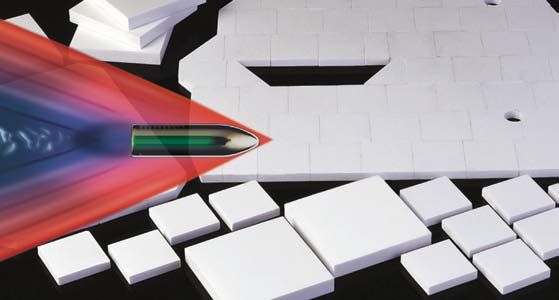
               The world has changed. Military and Security forces     Its major advantage lies in its significantly lower                     In general, the construction of light-weight compo-      Each component within the composite system has
               worldwide have been forced to adapt to new              areal weight which allows weight savings of more                        site system is based on four main components:            a specific function. The hard ceramic layer reduces
               domestic and international terror threats and to the    than 50 per cent over conventional metallic solutions.                                                                           the speed of the projectile and micronises the pro-
               increased tempo of combat deployments in hostile                                                                                •   Spall foil                                           jectile. The resulting low mass and the significantly
               territory.                                              The most important ceramic materials today for                          •   Ceramic                                              reduced speed of these residual fragments, is com-
                                                                       ballistic protection are:                                               •   Composite substrate                                  pletely absorbed by the elastic/plastic deformation
               Vehicles designed for a traditional land conflict are                                                                           •   Adhesive                                             in the composite substrate.
               often lightly or inadequately protected from asym-      • Alumina (Al2O3)
               metric threats such as Improvised Explosive Devices     • Silicon carbide (SiC)                                                 In a composite armor system, the ceramic is normally     CeramTec-ETEC does not supply complete armor
               (IED’s) and Explosively Formed Projectiles (EFP’s)      • Boron carbide (BC)                                                    placed on the strike face, preferably perpendicular      systems. Our expertise is in the manufacture of
               which are encountered with alarming frequency by                                                                                to the expected threat. Polymer fibres composed of       high-performance ceramic armor materials – cut,
               troops on operations.                                   Owing to its excellent price-efficiency ratio, alumina                  polyaramide, polyethylene or polypropylene form          drilled and machined to customer specifications,
                                                                       is the preeminent ceramic armor material for ve-                        the composite backing. The stiffening and structu-       and ready to assemble into protective modules
               National sensitivities to casualties and strained       hicular applications. Only when an extremely                            ral enhancement of the individual polymer layers is      without further work. We do not produce armor
               defence budgets force engineers to continually          low weight is required (e.g. for personal protec-                       achieved by impregnation and subsequent curing           systems for sale.
               adapt existing vehicle platforms to these constantly    tion or for helicopters), silicon and boron carbide                     of the adhesive. Proper selection of adhesives, such
               changing threats. The challenge to offer the highest    materials may be used.                                                  as rubber, polyurethane or epoxies, results in the
               level of protection with the lowest possible weight                                                                             desired shore hardness, and thereby the required
               is a constant battle of material science, integra-      Beside these qualities, other ceramic materials have                    mechanical properties which can be tailored to the
               tion technologies and physics. These systems must       also been considered and were examined intensi-                         threat requirements.
               protect from a range of threats such as direct gun      vely for the purpose of ballistic protection.
               fire, shaped charges, fragmentation and land mines.                                                                             This chemical bond between ceramic and composi-
                                                                       •                             Silicon nitride (SN)                      te substrate and/or between the individual polymer
               Once soldiers deploy from their protected vehicles      •                             Titanium boride  (TiB2)                   layers is of key significance for the performance of
               they also require lightweight body protection that      •                             Aluminium nitride (AlN)                   the entire system. In addition, spall protection is
               allows them to operate freely at elevated tempera-      •                             SIALON (Silicon aluminium oxynitride)     applied on the front side of the ceramic – glass fibre
               tures and altitudes carrying a full battle load.        •                             Fibre-reinforced ceramic (e.g. C-SiC)     laminates are preferably used for this purpose.
                                                                       •                             Ceramic-metal composite materials (CMC)
               Military vehicles have traditionally been manufactu-
               red from high strength armor plate steel. Modern        However, and in spite of high ballistic performance,
               ceramic composites have largely replaced steel as       these materials have not been established for tech-
               the non-structural armor in combat vehicles.            nical and economic reasons.
4|5
ALUMINA ARMOR MATERIALS                                                                                                      CARBIDE ARMOR MATERIALS

              ALOTEC 96 SB         20 μm            ALOTEC 98 SB      20 μm             ALOCOR 100		       2 μm              SICADUR F		          20 μm           SICADUR T		        20 μm               BOCADUR 		           5 μm

				 ALOTEC 96 SB                                                      ALOTEC 98 SB     ALOTEC 99 SB       ALOCOR 100        					 SICADUR F                                                             SICADUR T           BOCADUR
              Density                  ρ       g/cm3		 3.75		                 3.80		          3.87		           > 3.97        Density                      ρ       g/cm3		                 3.1		                3.21		2.48
              Residual Porosity        P       %		 < 2		                      < 2		            < 2		              < 0.1      Residual Porosity            P       %		                    < 2.5		              < 1.5		            0.5
              Medium Grain Size        D       μm		5		                        6		              10		 0.85                     Medium Grain Size            D       μm		                    < 5		                < 2		            < 15
              Vickers Hardness         HV(5)   GPa		12.5		                    13.5		           15		                21        Vickers Hardness             HV(5)   GPa		 26		                                   22		32
              Young‘s Modulus          E       GPa		310		                     335		            365		              405        Young‘s Modulus              E       GPa		 410		                                  420		420
              Bending Strength 4-Point σB      MPa		250		                     260		            280		              500        Bending Strength 4-Point σB          MPa		 400		                                  550		450
              Fracture Toughness       KIc     MPam1/2		   3.5		              3.5		            3.6		              4.0        Fracture Toughness           KIc     MPam1/2		 3.2		                              5.0		3.0
              Sound Velocity           vL      m/s
                                                   10000		10200		10300		11000                                                Sound Velocity               vL      m/s		12000		 12000

              Alumina Materials                                       ALOTEC 99 SB                                           Silicon Carbide and Boron Carbide Materials             SICADUR® T (LPSSiC)
              Alumina with an Al2O3 content of 96 to 98 mass          Here, sinter-reactive Bayer alumina is used for        Aside from alumina materials which are wide-            Liquid-phase-sintered SiC is a highly consolidated
              percentages is still the most important ceramic         production. Induced by the lack of glass-forming       ly in use today, silicon and boron carbide will         material with a density of ρ = 3.23 g/cm3 and a
              material in vehicular ballistic protection. It is       substances, consolidation is achieved not by liquid-   be used more frequently in the future where             fine microstructure. Sinter additives are Al2O3 and
              characterized by good processability and eco-           phase sintering but by solid-state sintering. Un-      significant weight reduction or increased mecha-        yttrium oxide in quantities of approx. 10 mass %.
              nomic volume production and possesses very              controlled grain growth is avoided by adding           nical properties are required. If carbide materials     The material has high fracture toughness and
              high mechanical properties.                             around 400 ppm of magnesium oxide. The high            are selected, it must be taken into account that        fracture strength.
                                                                      proportion of corundum enhances the mechanical         many diverse qualities are offered, distinguished by
              CeramTec-ETEC supplies the following materials          properties, thus enabling an increase in ballistic     the selection of the original powder and produc-        BOCADUR®
              for regular production:                                 efficiency.                                            tion technologies. These parameters have a strong       Hot-pressed boron carbide is the lightest, hardest,
                                                                                                                             influence on the material microstructure, its physi-    but also most expensive material being used today
                                                                      ALOCOR 100                                             cal properties and material cost.                       in series of ballistic protection. The emphasis of its
              ALOTEC 96 SB                                            The basis of this material is synthetic, ultrapure                                                             application is on personal protection as inserts for
              The basis is Bayer alumina with a low alkali content.   corundum with an Al2O3 content of above 99.95          The CeramTec-ETEC material program includes the         armor vests.
              The Al2O3 content is 96 mass percent. Glass form-       per cent. An ultrafine-grained microstructure with     following carbide materials:
              ing silicates are used as sintering additives which     grain sizes < 1 μm can be generated by applying a                                                              As compared to the above mentioned carbide
              cause a lowering of the sintering temperature and       two-step sintering process. This is the prerequisite                                                           materials, reaction-bonded silicon carbide (RBSiC) is
              regulate the grain growth.                              for the achievement of extremely high mechanical       SICADUR® F (SSiC)                                       of little use as a ballistic material. It is very brittle
                                                                      properties and increased ballistic efficiency.         SSiC is produced by solid-state-sintering. The sinter   owing to its high proportion of metallic silicium of
              ALOTEC 98 SB                                                                                                   additives, boron carbide and carbon, lie at 1 mass %.   approximately 10 mass percentages.
              Higher rigidity and hardness values are achieved        This material was developed by CeramTec-ETEC           The material is nearly nonporous; its hardness lies
              through the reduction of the glass phase. The           over several years of intensive research. Currently,   in the range of 25 GPa, though the fracture tough-
              microstructure is similar to that of ALOTEC 96 SB.      prototype production is under way, and commercial      ness is slightly lower than that of LPSSiC.
              The proportion of corundum is slightly higher.          production is planned for 2010.
6|7
CERAMIC MATERIALS
Analytical Model for Dwell Kinetic Energy vs. Time for Dwelling AP Projectiles Mass required to defeat a given threat
10 9.8 9.5 8 7.6
∆Ekin by Dwell
AP Projectile ∆Ekin by Erosion
∆Ekin by Dwell and Erosion
100
Ceramic 80
Al2O3-96 Al2O3-99 RBSiC SiC BC
Backing
60 Stopped bullet in cracked ceramic
Total cost to defeat a given threat
Partially 1 1.7 3.5 7 >10
damaged 40
Kinetic Energy (%)
20
0
5 10 15 20 25 30
Time (µs) Al2O3-96 Al2O3-99 RBSiC SiC BC
Cracked ceramic caused by fragment fire
Penetration mechanism Selection of Materials Ceramic Materials The first two strategies result in only minor weight
The mechanism of reducing the kinetic energy of The mechanical properties of the ceramic materials The aim of every system development must be to reduction – if the composite is of the same family
an armor piercing penetrator can be explained are the single greatest consideration for high find the lowest weight and most cost-effective solu- with similar density. Complete replacement of the
through analysis of flash X-ray data. ballistic efficiency. Ceramics used in armor systems tion for a specified threat. Smaller structural shapes backing material can provide significant advanta-
must demonstrate a defined microstructure with like cylinders and hexagons may be used for coun- ges, for instance by the use of functionally graded
When the projectile impacts the surface of the high grain size stability combined with high homoge- tering direct gun fire – especially for high multi- materials.
ceramic, its kinetic energy is greatly reduced neity. In spite of significant scientific investiga- hit threats. On the other hand, larger components
without penetrating the ceramic. This is caused tions, it has not yet been possible to establish an are advantageous for protection against fragments Since the ceramic component is the major player in
by the dwell effect. In that phase the projectile exact relationship between ceramic properties and IEDs. The thickness of the ceramic components system weight, the selection of a different material
experiences a highly ductile deformation. After and ballistic efficiency. However, it is indisputable depends on the specified threat level and can vary, quality is often the only solution. If, for instance,
approx. 15 to 20 μs, the projectile actually pene- that high hardness and high sonic velocity but is normally between 4 and 25 mm. Al2O3 is replaced by SiC, a reduction of system
trates the ceramic body, and in the process the are necessary for ballistic efficiency. High modulus weight is possible. However, this is associated with
kinetic energy of the projectile is reduced further of elasticity and high relative density are Weight reduction strategies: a corresponding and significant increase in cost.
by erosion. The shattered fragments of the projec- the prerequisites for high sonic velocity. It is not
tile completely penetrate the ceramic after approx. yet understood what part mechanical strength • A reduction of the ceramic thickness
30 μs. The residual energy of these fragments (pressure, bend and shear resistance) and frac- • A revised composite backing system to account
amounts to only about 15 % which can be fully ture resistance play in the overall performance of for a modified ceramic thickness
absorbed by the backing. the ceramic as compared to other properties in a • Replacement of the composite backing system
ballistic event. with a lighter or higher performance material
This means: • The use of ceramic materials with high ballistic
ΔEK due to dwell is to approximately 35 per cent The same is valid for the fluidity of ceramic at efficiency and low material density
ΔEK by erosion is approximately 50 per cent high compressive loads. This implies that extensive
ΔEK by backing is approximately 15 per cent ballistic testing by the system designer is manda-
tory to determine the correct ceramic material in
(The ΔEK values due to dwell are material- conjunction with the most appropriate backing or
specific). substrate. A comparison of different protection ma-
terials and/or of different material qualities is pos-
sible by means of the DOP (depth of penetration)*
test for the determination of ballistic mass efficiency.
The DOP* test is merely a tool to aid in the selection
of ceramic in ceramic-polymer composite systems;
rather, tests with the complete composite system
must be conducted for final determination.8|9
CERAMIC PRODUCTION TECHNOLOGY BODY PROTECTION
Raw Materials
Incoming Raw
Materials Inspection
Material
preparation
Release of the
Working Mass
Molding
Visual Inspection
Green Machining
of Green Density
Sintering
Final Statistical
Components Check | Release of
the Production Lots
© www.garant-protection.com
Packaging
Visual Inspection
Shipment
The ceramic production process is fundamentally Each process step influences the properties of the Conventional soft armor protection vests provide CeramTec-ETEC supplies a number of standard
different from other conventional technologies final ceramic component. Errors that have occurred protection from smaller calibers such as hand guns plates ranging from flat or single curved to multi
such as metals, glass and polymers. After the raw during a previous process step cannot be rectified and submachine guns; however they have inade- curved shapes. Thanks to the variety of production
material synthesis and formulation the material through subsequent processes. A stringent Quality quate protection from larger rounds fired by service technology for ceramic materials, it is also possible
is pressed into the desired shape and thickness. Assurance process is rigidly followed throughout all rifles. According to the type of construction the to produce designs according to customer’s speci-
CeramTec-ETEC presses armour tiles with multiple phases of production. vests can be upgraded by inserting rigid polyaramid fications. The multi-hit resistance can be improved
uniaxial high tonnage presses. The pressed green fiber plates as protection against hand guns, or by utilizing new composite systems.
bodies are then stacked for the sintering process or Ceramic technology permits the production of a by ceramic composites plates against rifle fire. The
transferred to the mechanical finishing area. large variety of different components. In commer- requirements of the upper protection levels can be In addition to monolithic inserts, CeramTec-ETEC
cial production, pressing tools for the most diverse met by using ceramic-composite inserts, e.g. DIN supplies inserts based on single curved ceramic tiles
Ceramic materials require sintering in high tem- shapes and dimensions are used. 52290 level 4 and 5, NIJ Standard level III and IV, with radii between 200 and 400 mm. They consist
perature kilns where the ceramic microstructure European Standard level B5, B6 and B7. of small standard tiles 50 x 50 mm, providing an im-
is formed by consolidation of the original powder. Consistent product quality is guaranteed by proved multi-hit protection. For special applications
The characteristic properties of the ceramic are cooperation with highly respected and experienced Today, ceramic monolithic plates are used as inserts it is also possible to produce customized layouts
created by the sintering process at temperatures of raw material producers, by the use of modern for armor vests. They can be shaped to accommo- and sizes.
1600° C for alumina, and more than 1900° C for production technologies and by a mature Quality date male and female body shapes by using a multi-
carbide materials. This process is associated with Assurance System (according to DIN ISO 9001.2008 curved shape which provides additional comfort to
a distinct reduction in the dimensions of the pre- standard). the wearer. Depending on the requirements of the
shaped component. The loss in general dimensions individual protection levels, the plate thickness can
is about 15 to 20 per cent and the volume loss is As an additional service to its customers, vary accordingly.
about 50 per cent. CeramTec-ETEC offers ceramic CAD engineering of
the tile matrix layout for armor panels. Furthermo-
The finishing of materials and/or components by re, preassembling of the armor panels has proved
means of remelting, post curing, reshaping – as is to be a major labor saving exercise for many of
usual in the case of metals – is not possible in the our customers. These pre-assembled panels can be
case of ceramics. directly inserted into the production process for the
composite assembly.
Mechanical finishing of the ceramic components
is expensive since only diamond cutting tools are
used for this purpose. The production of specially
shaped components (e.g. edge plates) takes place
prior to the sintering process in the so-called green
stage, by sawing, cutting, milling and drilling.10 | 11
CERAMICS FOR VEHICLE PROTECTION CERAMICS FOR SPECIAL PURPOSES
Rheinmetall Textron Renault/IBD KMW KMW KMW
Fox ASV (M 1117) VAB Faun Mungo Tanker
KMW Rheinmetall KMW KMW Scanfibre
Dingo YAK Fennek AMPV Police car Toyota
Tencate KMW KMW Tencate NH Industries
Piranha Boxer Puma T45 Container NH 90AWARDS
CERAMTEC-ETEC
CeramTec-ETEC Lohmar Germany Modern production facility
Ceramic Experience Worldwide CeramTec-ETEC employs a highly skilled team of
CeramTec-ETEC is an integral part of CeramTec ceramic material specialists and experienced tech-
Group since November 2008, and is one of the most nicians, in a production plant equipped with the
important suppliers of solutions for industrial wear latest equipment including full CAD engineering,
and corrosion protection and for armor compo- advanced quality assurance equipment and high-
nents worldwide. tech production machinery.
More than 25 years of experience in the field of In this way, it is possible to guarantee the produc-
ceramic production, modern plants and equipment tion of high-quality products to extremely tight
and a world-wide distribution network enable tolerances with en serial scale. By means of a highly
CeramTec-ETEC to produce a variety of different sophisticated quality assurance system – certified
components with high dimensional accuracy. according to ISO 9001 – it is possible to ensure the
production and supply of products with a conti-
nuously high quality, thus enabling CeramTec-ETEC
B0AB • www.wedkom.de • www.okapidesign.com • Printed in Germany
to comply with the high standards required by
Made in Germany our customers.
CeramTec-ETEC GmbH Phone: +49 2205 9200 - 0
An der Burg Sülz 17 Fax: +49 2205 9200 -144
53797 Lohmar info@etec-ceramics.de
Germany www.etec-ceramics.com
Indexes and parameters for ceramic substances: In order to profile ceramic substances certain parameters are indicated. The crystalline nature of these substances, statistical fluctuations in the composition of the
substances and in the factors that impact on the production processes indicate that the figures quoted are typically mean values and hence the substance parameters quoted in this brochure are only standard,
recommended or guide values that might differ given dissimilar dimensions and production processes.You can also read


