CONDOMINIUM REPORT BERLIN 2017/2018 - From Boom to Growth INTERVIEW WITH KNIGHT FRANK
←
→
Page content transcription
If your browser does not render page correctly, please read the page content below

CONDOMINIUM
REPORT
BERLIN 2017/2018
INTERVIEW WITH   RESIDENTIAL TOWERS –    URBAN DEVELOPMENT –
KNIGHT FRANK     BERLIN GROWING HIGHER   THE SOUTHEAST IS BOOMING
Page 16          Page 26                 Page 34

                                    From
                                    Boom to
                                    Growth
EDITORIAL

                                   Dear readers,

                                   We are pleased to present to you what is now the sixth issue of the Condominium
                                   Report Berlin. The title, FROM BOOM TO GROWTH, refers to the curve the Berlin
                                   residential market will presumably trace in the coming twelve months. This is becau-
                                   se, from population development to construction activity and the level of interest
                                   rates, all socioeconomic indicators are in place for a further upswing in Berlin’s resi-
                                   dential market. Immigration into Germany has, indeed, fallen by quite a bit, but Ber-
                                   lin – as capital of the strongest and most stable European national economy – has
                                   gained a great deal of appeal internationally. Most recently, the city has been attrac-
                                   ting more and more US and UK buyers.
                                          The decline in the number of building permits issued in the first quarter of 2017
                                   is another clear signal that the backlog in demand will persist, and that the trend
                                   towards migration to the ex-burbs will continue, one that our survey of developers
                                   has confirmed.
                                          One cause for the construction boom outside the city limits also seems to be the
                                   way Berlin deals with property developers. In his foreword, Michael Voigtländer
                                   does not mince words about this: “Nowhere else,” he says, “is there as much vehe-
                                   ment resistance to investors as in Berlin.” It is in this vein that we too would like to
                                   appeal to politicians to recognize the interest of all Berlin and finally support private
                                   residential construction. Condominiums, built and sold at a profit, also relieve Ber-
                                   lin’s housing market. ¤ 6.5 per square meter are actually possible – as a monthly inte-
                                   rest rate for threshold households in Berlin and when banks, property developers and
                                   the government of the State of Berlin pull together to make it happen.

                                   We hope you will find this an interesting read,
                                   Nikolaus Ziegert and Sven Henkes

Data, facts and comparisons
for Berlin and its neighborhoods                    Owner              Managing Director
                                               ZIEGERT – Bank- und Immobilienconsulting GmbH
BERLIN OVERVIEW
GENERAL
GERMANY
/ Brexit vote, Trump’s protectionism and
growing populism in some European coun-
tries are making future developments of the
European Union less predictable.
In an EU marked by uncertainties, the German real estate
/ Thanks to Germany’s economic prowess,
market is considered to be especially crisis-proof. investments here are, however, regarded
Berlin’s comparatively moderate prices also promise that the as particularly safe for the future. The
market will offer sustainable growth. German real estate market is therefore
rightly considered a safe harbour in Europe.
/ In addition, the federal economic structure
assures not only diversity on the German
real estate market, it also results in
a particularly high degree of stability.
/ The differences among income and
population groups in Germany are also less
striking than in a number of neighboring
countries. Socio-political protests are
CONDOMINIUMS SOLD therefore less likely than elsewhere.
With the exception of 2014 (increase in the property transfer tax),
/ The European Central Bank’s key interest
the number of units sold in Berlin has ranged around 20,000 rate has been 0 % since March 2016. No one
annually. This figure is steadily increasing. expects any drastic reversal in the near
future as the onus of higher interest pay-
ments would cause further deterioration in
7072+5967+6958+
First sales the currently weak national economies
2016 20,942 Ø 3,036 €/m²
5,300 of Greece and Italy.
2015 21,553 Ø 2,876 €/m²
BERLIN
2014 17,664 Ø 2,513 €/m²
Ø-sales price 2016 / Berlin’s economy has posted strong growth
2013 20,169 (first sale and
resale) since 2006: The economy is presently grow-
2012 20,824 ing at an average rate of 2 %, above
Germany’s national average of 1.2 % . Per-
2011 17,315 capita GDP, however, remains lower than the
national average.
Resales
ECONOMIC PERFORMANCE / 31 million overnight stays were booked by
0 5,000 10,000 15,000 20,000 25,000 Units sold 15,642 tourists in Berlin in 2016, third place among
From 2015 to 2016, real GDP in Berlin grew by 2.7 %. European destinations. Foreign guests were
Together with Saxony, Berlin posted the highest growth responsible for 46 % of all overnight stays.
Number of condominiums sold without package sales; of any German State.
Source: Gutachterausschuss für Grundstückswerte Berlin This goes hand-in-hand with the growing
(Panel of Experts for Property Appraisals Berlin) demand for serviced apartments in central
locations.
Per capita GDP 2015 Berlin Germany
35,428 € 37,127 € / Not only the cost of living, which is low in
both a German and international context,
is making Berlin a residential location in high
SUPPLY AND DEMAND FOR Price classes Offerings Searches Total GDP Berlin Germany
demand. Rich cultural offerings, a diverse
CONDOMINIUMS IN BERLIN restaurant scene and, above all, Berlin’s spirit
Comparison to
2016 VS. 2015 < 1,000 €/m2 0% 1% 120 of giving space to develop creativity
2015
freely are also appealing to visitors and
Since 2014, demand has clearly shifted into 1,001—1,500 €/m2 3% 4%
buyers alike.
higher-priced segments. In 2016, for the first time,
demand exceeded supply for units priced above 1,501—2,000 €/m2 7% 9% 90 / Berlin is becoming more and more interes-
€5,000 per square meter. Acceptance of current ting for foreign investors. This is also on
market prices can now be found among broad 2,001—2,500 €/m2 11 % 11 % clear display in ZIEGERT’s figures: In 2016,
segments of the population. 25 % of those purchasing newly built con-
2,501—3,000 €/m2 15 % 12 % 60
dominiums came from outside German, the
3,001—3,500 €/m2 18 % 12 %
2006 2008 2010 2012 2014 2016 largest
numbers coming from Switzerland, the UK,
3,501—5,000 €/m2 30 % 34 % the USA, Russia and China.
Offerings and searches for condominiums at Indexed development of GDP for Berlin and Germany: Index 2010 = 100;
ImmobilienScout24; Source: Amt für Statistik Berlin-Brandenburg, Statistisches Bundesamt
Source: ImmobilienScout24 MarktNavigator Profi > 5,001 €/m 2 16 % 17 % (Office for Statistics Berlin-Brandenburg, Federal Office for Statistics)
4 Condominium Report 2017 / 2018 Condominium Report 2017 / 2018 5
BERLIN OVERVIEW
POPULATION DEVELOPMENT
MARKET
/ The trend in Germany towards urbanization
continues uninterrupted. It is primarily the top
seven cities that are benefiting from immigra-
tion from within and outside the country.
/ In 2016, Berlin counted a population of around
3.67 million, 60,000 more than the previous
Even during an ongoing building boom, the demand for living year. The percentage growth of 1.7 % also
space keeps growing. Only a fraction of the building permits issued exceeded that of the prior year.
actually end up becoming residential projects. / Not only Berlin itself is growing, its sur-
roundings are becoming more and more
appealing too. By 2030, population growth
of 7 % is expected for the metropolitan Ber-
lin-Brandenburg area. This figure for the City
of Berlin itself will be a bit lower at 6 %.
/ Very strong growth can presently be found in
METROPOLISES COMPARED: ZIEGERT the neighborhoods of Lichtenberg and Trep-
DEVELOPMENT OF SUPPLY AND DEMAND DEMAND INDEX tow-Köpenick. A particularly large number
of new construction projects are in develop-
The conspicuously low residential ownership rate in Berlin All Berlin neighborhoods are posting a rising ment there (condominium and rental). In
harbours great potential for the condominium market. demand for condominiums. addition, acceptance of those areas as resi-
dential locations has also grown significantly
Population Construction com- Sold condominiums Prime price
in recent years.
Metro- Residents prognosis Indicator Prognosis
pletions per 1,000 per 1,000 residents Ownership segment / ZIEGERT figures show that new Berliners are
region* 2016 2015— 2030 residents 2016 2016 rate 2016 Q4 2016 in €/m² 2016
attracted to the city center. Many established
BERLIN 4,494,545 +7 % 2.412 5.702 15 %1,2 7,621² Highly dynamic demand Berliners, on the other hand, are moving from
the center to the suburbs due to the more
LONDON 8,832,400 +18 % 3.44 7.62 52 % 31,510 Growing demand affordable prices there. In 2016, almost 83 %
of new Berliner owner-occupants purchased
VIENNA 3,131,317 +13 % 1.81 1.63 23 % 17,743 Stable demand
a condominium in a central location in the
NEW YORK 20,292,520 +7 % 0.54 1.20 32 % 36,854 city.
Self-prepared indicator drawn together from a variety of sources;
MOSCOW 12,330,126 +5 % N/A 4.10 82 % 12,302 Source: ZIEGERT Research
HOUSING INVENTORY
SINGAPORE 5,619,550 +22 % 3.60 2.70 84 % 20,545
/ The number of construction completions in
MELBOURNE 4,645,327 +34 % 2.90 9.30 70 % 8,734
multi-story residential units has been rising
1
2014 2
City of Berlin rapidly since 2012. More than 8,800 residential
* A metro-region is the highly dense area around a metropolis that also extends beyond that city’s limits.
units were completed in 2016, four times the
The ex-urban area is closely interlinked with the core metropolis in functional terms.
Sources: Knight Frank Research, Amt für Statistik Berlin-Brandenburg (Office for Statistics Berlin-Brandenburg), number completed in 2012. This, however,
Douglas Elliman, Gutachterausschuss für Grundstückswerte Berlin (Panel of Experts for Property Appraisals Berlin), does not suffice to cover the ever higher
Molior, Oxford Economics, Urban Redevelopment Authority (URA), SingStat
demand.
/ Building activity is especially high in Mitte,
Treptow-Köpenick and Pankow. The enormous
demand and a sufficient number of potential
sites are both reinforcing this trend.
RESIDENTS VS. RESIDENCES / By 2030, if population inflows continue
The comparison shows: Population is still growing faster Population Residential units
unabated, almost 194,000 new residential
than the number of residential units. units will be needed in Berlin.
/ According to the regional planning office, the
Landesplanungsabteilung, for Berlin-Branden-
110
burg, potential inner city sites for subsequent
8,863
Completions 2016 densification (“brown-field up-zoning”) offer
105 room for more than 50,000 residential units.
21,119
Building Permits 2016
100
MARKET VOLUMES
95
/ In spite of lower turnover in 2016, sales for
fully and partially owned residential proper-
2005 2010 2016 2020 2025 2030 ties grew by 13 % to 5,920.7 million €.
/ A condominium in Berlin is much more afford-
Indexed development of population and housing inventory: Index 2005 = 100 able than in other metropolises. This also
Permitted and completed residential units in multi-unit construction (new residential structures with three or more units);
Source: Amt für Statistik Berlin-Brandenburg (Office for Statistics Berlin-Brandenburg), Senatsverwaltung für Stadtentwicklung und applies to the luxury segment: One square me-
Umwelt Berlin (Senate Administration for Urban Development and the Environment Berlin) ter of a high-end apartment costs four times
as much in New York as it does in Berlin.
6 Condominium Report 2017 / 2018 Condominium Report 2017 / 2018 7
BERLIN OVERVIEW
INCOME
PRICES
/ The average monthly net household
income was around € 1,775 in 2015, making
it much lower than the same figure for
other large German cities.
/ Since 2010, incomes have grown the most
in Pankow and Treptow-Köpenick, in each
Residential property sales rose by 13 % from 2015 to 2016, neighborhood by 17 %.
and this despite slightly lower figures for turnover. / At the moment, 27 % of all Berlin households
This underscores strong pricing growth. could finance a condominium costing up
to € 340,000.
/ The number of higher earners (those with
a monthly net household income above
€ 3,200) in Berlin has grown by 3.4 % since
MEAN PRICE FOR CONDOMINIUMS SOLD last year, the strongest showing being in
CONDOMINIUMS SOLD ACCORDING TO PRICE CLASSES Lichtenberg at around + 14.1 %.
Average sales prices have risen in all neighborhoods Sales figures are increasingly shifting towards
since 2012. Prices outside Berlin’s S-Bahn-Ring have higher price segments. From 2015 to 2016, PURCHASE PRICING
also started to increase significantly. the average price obtained for a first sale rose
by 6.3 %. / At 9.6 %, purchasing prices have increased
much more from 2015 to 2016 than rents
Ø-price in €/m2 0 2,000 4,000 change since
2012
did in the same period at only 5.6 %.
/ Even two years after the introduction of
Within the S-Bahn-Ring
+69 %
rent controls in Berlin, no effect has yet
+113 %
6036+6646+7946+9470+4926+6746+6235+7934+7636+0+3815+29+6442+6929+5419+4942+3725+3221+5129+3924+5725+4422+5743+5749
Charlottenburg 2,996 + 67 % 2012 been seen. Rents on offer have continued
+34 %
2013
to rise in all neighborhoods, the biggest
< 999
Friedrichshain 3,295
2014
+68 %
2015 increase being 17.1 % in Neukölln.
Kreuzberg 3,957 + 73 %
+174 %
2016
/ In 2016, almost one in every 100 condomin-
Mitte 4,693
iums sold was priced above 7,500 €/m2. This
1,000—1,999
+38 %
brings Berlin closer to the level seen in other
+24 %
2,450
+91 %
+ 86 %
+112 %
Neukölln Ø-Berlin
German cities with populations of one million
+66 %
+89 %
Prenzlauer Berg* 3,358
or more.
+73 %
+23 %
2,000—2,999 3,000—3,999 4,000—4,999 5,000—7,499
Schöneberg* 3,101
+7 %
+40 %
PURCHASING PRICE
+42 %
Tiergarten 3,948 + 131 %
+29 %
+127 %
+8 %
3,782 PROGNOSIS
+68 %
Wilmersdorf* + 111 %
Outside the S-Bahn-Ring / A further rise in square-meter prices is ex-
+26 %
+29 %
1,897
pected for the coming years. However, it will
Hellersdorf
+66 %
no longer be quite as high across all neigh-
+7 %
+25 %
+35 %
1,460
Hohenschönhausen borhoods as it has been in recent years.
Köpenick 3,219 / After offering prices have increased by
3,467 almost 10 % annually since 2010, ZIEGERT
Lichtenberg** Increase in Ø-prices
First sale
experts are reckoning with a much more
Marzahn 2,714
moderate increase until 2019: +5 % per year
2,431
4,274 €/m2 is the conservative forecast.
Pankow 2015
1,856 / Increased speculation is continuing to drive
Reinickendorf
4,542 €/m2 Ø-net household Increase in income groups building lot prices higher in Berlin.
Spandau 1,624 2016 income 2015 2005/2015
Even in central locations, this means that
2,540 2,600—3,200 € the construction of rental apartments or
7,500—9,999
Steglitz < 1,700 €
Resale condominiums is sometimes no longer
1,971 > 3,200 €
Tempelhof
2,403 €/m2 1,700—1,900 € worthwhile. In view of the higher number
Treptow 2,854
+ 128 %
2015
> 1,900 € of tourists and students, micro-apartments
2,202 2,708 €/m2 and services apartments seem to point
Wedding + 104 % a way out of this conundrum. But in such
> 10,000
2016
2,846
Weißensee cases, one should also keep up with a
Zehlendorf 2,852 INCOME DISPARTIES AND third-party use strategy.
DEVELOPMENT
€/m2
0% 10 % 20 % 30 % 40 %
2016 2012
The average income of Berlin’s households has increased
* Most of the neighborhood’s surface area lies within the S-Bahn-Ring by almost 13 % since 2010. The group of higher earners
** Unusually high pricing level in 2016 due to a large number of sales of with a net household income above € 3,200 has grown
high-priced student housing units in the Lichtenberg neighborhood and high-priced Percentage grouping of condominiums sold based on square
by a particularly large margin.
condominiums in the Friedrichsfelde neighborhood. meter pricing. Square meter prices have not been posted for all
Square meter prices have not been posted for all multi-story units sold; multi-story units sold; status of data 16 June 2017;
Source: Gutachterausschuss für Grundstückwerte Berlin Source: Gutachterausschuss für Grundstückwerte Berlin Source: Amt für Statistik Berlin-Brandenburg
(Panel of Experts for Property Appraisals Berlin) (Panel of Experts for Property Appraisals Berlin) (Office for Statistics Berlin-Brandenburg)
8 Condominium Report 2017 / 2018 Condominium Report 2017 / 2018 9
BERLIN OVERVIEW RENTER OWNER-
OCCUPANT
Ø-living space per person 36.8 m² 50.5 m²
CLIENTS
/ Only 14.9 % of all Berliners live in owner-
Ø-number of people per unit 1.8 2.1 occupied units. This is the lowest value for
any German city with a population of
Ø-size of unit 65.5 m² 106.2 m² over one million.
/ Owner households have, on average, a high-
Ø-monthly gross rent per unit 494 € —
er monthly net income than renter house-
RENTERS AND OWNERS Ø-monthly gross rent (excl. 7.67 € — holds. Still, 55.9 % of owner households
utilities) per m² of space earn less than € 3,200 a month. This shows
that even a lower average income does
not preclude the ownership of residential
In 2016, Berlin remained a city of renters once again. Living space (per unit) from ... to less than ... m2 property.
However, more than a quarter of all households could finance a condominium. / In almost 50 % of all owner households, the
Renter Owner
Such a move not only serves to prepare for retirement, it also contributes main income earner is over 60 years old.
to stabilizing and shaping each neighborhood. < 40 m2 10 % 0% This means that, in Berlin, property owners
are much older than renters. This can be
40—60 m2 33 % 7% explained, among other reasons, by the
longer time it takes to accrue assets.
60—80 m2 37 % 20 %
/ In 2014, renter households had to use an
80—100 m2 13 % 18 % average of almost one-third of their dis-
posable income to pay the rent.
100—200 m2 4% 21 %
/ For 80.6 % of ZIEGERT clients in 2016, this
> 120 m 2
3% 34 % was their first real estate purchase. Through
our consulting work, we have made a
significant contribution to asset formation in
Berlin.
Year of construction
Renter Owner
/ Among property owners, the proportion
of self-employed is more than 26 %, much
until 1918 88 % 12 %
higher than among renters.
1919—1948 81 % 19 % / The overwhelming share of single house-
holds lives in rented spaces.
1949—1978 88 % 12 %
/ Around half of renter households in Germa-
1979—1990 89 % 11 % ny are either striving to purchase property
or can imagine such a purchase. The Federal
1991—2000 51 % 49 % government is supporting this goal through
home-ownership retirement plans and credit
2001 and later NS 0 87 % union savings plans. There have been further
discussions on breaking down the barriers
to home ownership, but without any results
Monthly net household income so far.
HOUSEHOLD SIZE CAREER
Renter Owner / Continuing low interest rates are creating
The largest proportion of homeowners live in of the main income earner a good springboard for financing home
two-person households. < 1,500 € 44 % 15 % ownership. Here the buyer should make sure
Single Two-person Multi-person Self-employed Self-employed to lock in a fixed rate for as long as possible
1,500—3,200 € 43 % 41 %
15 % 26 %
57 26
households households households over the lifetime of the mortgage.
3,200—4,500 € 9% 20 %
Civil service Civil service
% 50 %
5 % 13 % 4,500—6,000 € 3% 13 %
> 6,000 € 1% 11 %
Employed Employed
%
68 % 56 %
17 %
0% Worker Worker Age of main income earner
12 % 5 %
Renter Owner
Renter
43 25
< 30 Years 17 % 0%
50 %
%
32
30—40 Years 20 % 8%
% % 40—50 Years 18 % 19 %
Results of the micro-census on the living situation in 2014,
issued in April 2017, and the micro-census on the living
situation in 2010. The rate for the rent burden on a household
50—60 Years 17 % 23 % indicates the proportion of the net household income
0% required to be applied to paying the gross rent (excl. utilities);
Source: Amt für Statistik Berlin-Brandenburg
Owner > 60 Years 28 % 50 % (Office for Statistics Berlin-Brandenburg)
10 Condominium Report 2017 / 2018 Condominium Report 2017 / 2018 11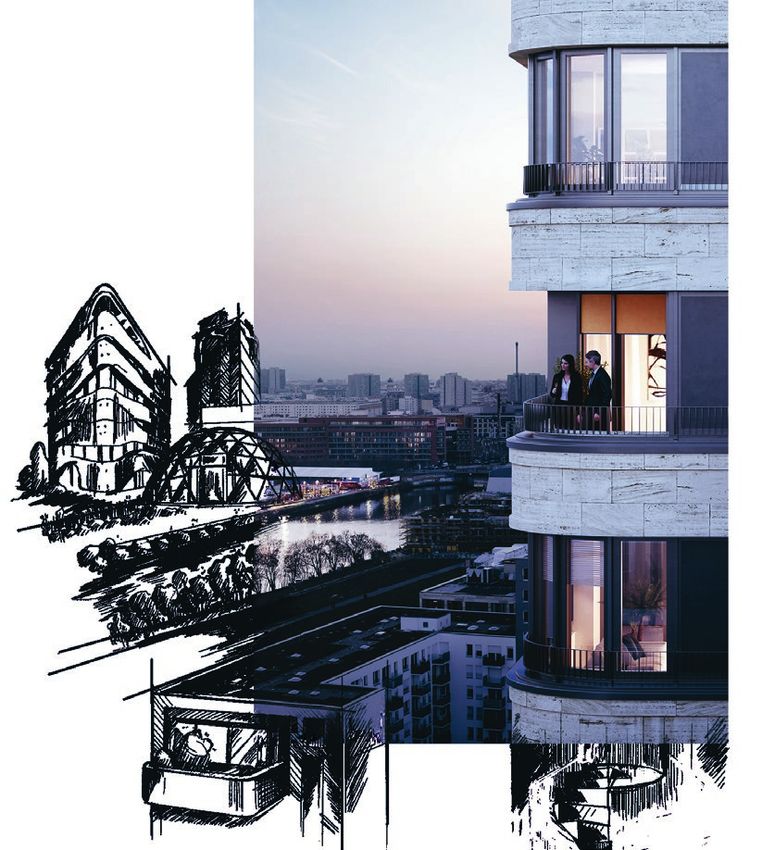
TABLE OF CONTENTS 26—27 TOWER LIVING
Some parts of Berlin are growing upwards.
Nikolaus Ziegert explains the quality of
life towers offer.
CONDOMINIUM REPORT 28—29 DENSIFICATION
Inner courtyards and rooftops offer potential for
BERLIN 2017/2018 almost 55,000 apartments — when exploiting it,
keep an eye on building codes and local neigh-
borhood interests.
30—31 STAKEHOLDER DIALOG
» In future, it will primarily be a matter
of planning properties to be socially and
ecologically sustainable, this with an
eye to the long-term interests of larger
groups of users and claimants.«
Alexander Boether, Head of Sustainability and
Responsible Investment at ZIEGERT
32 RESIDENTIAL AND COMMERCIAL
Commercial space in the ground floor of residen- 40—89 NEIGHBORHOOD PROFILES
tial properties has become much sought-after Here you will find the most important facts and
and promises good yields, even outside of the figures about Berlin’s various neighborhoods —
top locations. from sales figures through projects in planning
right down to population forecasts and portraits
33 URBAN ZONES of each of the neighborhoods and their various
DEVELOPMENT sub-neighborhoods.
SAFE HARBOUR BERLIN TOWER LIVING IN THE SOUTHEAST »This instrument is intended to give
PAGES 16—17 PAGES 26—27 PAGES 34—35 municipalities the maneuvering room
they need to make living and working 42 CHARLOTTENBURG-WILMERSDORF
coexist side-by-side.«
46 FRIEDRICHSHAIN-KREUZBERG
Prof. Angela Mensing-de Jong, Docent for
50 LICHTENBERG
Design and Urban Planning at the HTW Dresden
54 MARZAHN-HELLERSDORF
4—11 BERLIN OVERVIEW 20 DEVELOPMENT IN INTEREST RATES 34—35 DEVELOPMENT IN THE SOUTHEAST
58 MITTE
Demand, supply, prices and clients — There are no signs of any increase in mortgage Berlin is growing out into the ex-burbs, especially
Berlin’s development at a glance rates in the medium term. In spite of this, it makes to its southeast. Urban centers along rail lines are 62 NEUKÖLLN
sense to exploit the current low interest rate level. particularly appealing out there.
66 PANKOW
14—15 THE FUTURE BELONGS TO BERLIN
21 MARKET FOR RENTAL 36 HOUSE OR APARTMENT? 70 REINICKENDORF
»A strong influx of population, economic
APARTMENT BUILDINGS The pros and cons almost balance each other out.
growth and ultra-low interest rates But it’s worth it to keep tabs on future develop- 74 SPANDAU
High demand facing low supply is causing
are creating favorable overall conditions market factors to soar to new heights. ments.
78 STEGLITZ-ZEHLENDORF
for developing the Berlin property
market.« 22 INSTITUTIONAL INVESTORS 37 PROPERTY PURCHASES FOR 82 TEMPELHOF-SCHÖNEBERG
The battle to get into projects at the earliest THE SELF-EMPLOYED
Foreword by Prof. Dr. Michael Voigtländer 86 TREPTOW-KÖPENICK
possible date requires creativity — but certainty When incomes are well documented over the
remains the prerequisite. long run, financing for the self-employed is no
16—17 SAFE HARBOUR BERLIN longer an issue at all.
»Berlin is a creative and fashionable city 23 POTENTIAL FOR RENTED 90 IMPRINT
and widely accepted as the digital and APARTMENTS 38 PARENTS ARE BUYING FOR
THEIR CHILDREN
cultural heart of Germany.« Lower yields are compensated for by higher
gains on resale. Those who buy early are securing economic
Paddy Dring, Head of Residential Sales at opportunity for the coming generation.
Knight Frank in an interview with ZIEGERT 24—25 NEIGHBORHOOD PROTECTION ZONES
Neighborhoods are identifying more and 39 EXCLUSIVE MARKETING
18—19 PROJECT DEVELOPER SURVEY also areas with preservation statutes — now even Only outstanding consulting work will fulfill
The sector has an optimistic view of the future. outside the S-Bahn-Ring. the high expectations held by the buyers of
However, there are obstacles. luxury properties.
12 Condominium Report 2017 / 2018 Condominium Report 2017 / 2018 13
FOREWORD                                                                    POPULATION CHANGE IN BERLIN

                                                                                                                                    4,200,000

                       THE FUTURE                                                                                                   4,000,000

                    BELONGS TO BERLIN                                                                                               3,800,000

                                                                                                                                    3,600,000

                                            Foreword by
                                   Prof. Dr. Michael Voigtländer,                                                                   3,400,000

                                                                                                                                                        2015                2020                 2025                   2030         2035
                            Cologne Institute for Economic Research (IW)
                                                                                                                                    Change in population in Berlin acc. to the Cologne Institute population forecast;
                                                                                                                                    Source: Cologne Institute for Economic Research (IW), status December 2016

Several forecasts concerning the potentials offered by Ber-       rounding countryside. Although this does not mean that                                                                                                       OBSTACLES FOR INVESTORS
lin’s residential property market have raised fears of a          Berlin will become unattractive, it only means that the
reversal in fortunes soon. The German Bundesbank has              demand will not be met. And indeed, Berlin is making it dif-           »In Berlin, it is not only the population                                        But there is one sizable risk in Berlin: politics. Nowhere
warned about a possible overheating of regional property          ficult for itself in this respect. Between 2011 and 2015 alone,         that is growing: the economy is too.                                            else is there as much vehement resistance to investors as
markets, specifically in large cities, and in its spring real     over 100,000 apartments fewer were built than the demo-                 There still are no large corporations                                           here. Neighborhood protection zones (Milieuschutzgebie-
estate report the ZIA (German Property Federation) made           graphics would have required. By 2035, more than 30,000                                                                                                 te), pre-emptive public sector purchasing rights, urban
                                                                                                                                          here from the German DAX Index,
explicit mention of a possible reversal in prices in Berlin.      new apartments will have to be built. If fewer are built than                                                                                           construction contracts – all these and many more are
      Large institutional investors on the property market        in recent years, then the property market will respond just             but Berlin has grown enormously,                                                making the purchase of properties in the capital more diffi-
have, however, not let any such talk unsettle them. In fact, a    as any market would; if demand exceeds supply, prices will              particularly in the IT sector.«                                                 cult. The aim seems to be to preserve present structures and
majority of those surveyed as part of the IW Property Index       go up.                                                                                                                                                  hold up the city’s future development. But a change in struc-
specified Berlin as the most attractive location for property                                                                                                                                                             tures is precisely what is needed to permit economic pros-
market investment. Small private investors and owner-oc-                SUSTAINABLY DYNAMIC                                                                                                                               perity and create the freedom to invest in social infrastruc-
cupants should also keep an eye on risk, of course, but still           ECONOMIC DEVELOPMENT                                                                                                                              ture and pin-point help to households who need it most.
never lose sight of the opportunities. And there are some                                                                           Therefore, opportunities are good in the long run. In a city                          But still, the long-term investor will outlive political
out there.                                                        In Berlin, it is not only the population that is growing; the     with population and economic growth, residential and                                  cycles and can hope that rationality will also, someday,
      Berlin is a growing city. 3.5 million people now live in    economy is too. There still are no large corporations here        commercial real estate will continue to be attractive. But                            return to the federal capital. //
Berlin, and according to estimates made by the Cologne            from the German DAX Index, but Berlin has grown enor-             what about the short-term risks people are talking about
Institute for Economic Research (IW), that number will            mously, particularly in the IT sector. In the past four years     now? One thing is clear: the general framework conditions
grow to four million by 2035 (see graph). This growth will        alone, the number of tech employees has shot up by almost         are extremely favorable at the moment: strong population
suffice, but will only succeed if enough living space is made     15 %. Many new well-paid jobs have been created in the            influx, good economic growth and ultra-low interest rates.
available. Otherwise, people will move out into the sur-          capital, ones that draw in specialists from both inside and       It is well possible that these conditions could deteriorate
                                                                  outside Germany. Berliners’ purchasing power rose by              again. An abrupt up-tick in interest rates, however, seems
                                                                  more than 16 % from 2010 to 2015, and the gap with other          unlikely: The ECB will raise them only very slowly and cau-
                                                                  western German cities has continued to narrow. When               tiously at best as otherwise the public and private budgets
                                                                  incomes and population grow, rents rise too. And Berlin           in southern Europe could be negatively impacted. Further-
     »In a city with population and                               can also benefit in the long term from structural changes.        more, interest rates are so low because all over the world
      economic growth, residential and                            Across the globe, cities are developing into ever more signi-     more is being saved than invested – here too, no sudden
                                                                  ficant engines for economic growth as knowledge-inten-            shift is expected. The good economy and the influx of peo-
      commercial real estate will                                 sive services become more and more important. Cities play         ple could, however, come to a more sudden end, though                                      FOREWORD BY
      continue to be attractive.«                                 a crucial role in this change because customers and special-      this would not necessarily put a damper on the upward                                      Prof. Dr. Michael Voigtländer,
                                                                  ists come into close contact with each other in the urban         move in prices. Due to the huge lag in construction activity,                              Cologne Institute
                                                                  setting. As Germany’s largest city, Berlin can take special       no change here is expected either.                                                         for Economic Research (IW)
                                                                  advantage of this.

14                                               Condominium Report 2017 / 2018                                                                                                                     Condominium Report 2017 / 2018                                                 15
Germany with a youthful and vibrant dynamic. Today the For those seeking a more permanent move, Berlin offers
city is one of the most important centres for contempo- outstanding state education as well as a number of private
INTERVIEW rary art in continental Europe and is a true culinary international schools. It has affordable but first rate medi-
trendsetter. cal facilities. Plus, English is the city’s second language
Given my passion for real estate, I am particularly int- employed frequently across all walks of life, from business,
rigued by the fascinating blend of modern and historic to education and healthcare. This makes communication so
SAFE HARBOUR architecture. Add to this the city’s competitive property
prices, its enviable lifestyle and low cost of living and I
think there are few cities left that can compete on all
much easier than in many other places.«
Have you noticed any changes lately?
levels.«
PADDY DRING »What I have noted is that, regardless of
An interview with Paddy Dring, How do foreign buyers view Berlin’s housing market their nationality, our investors are very sensitive to price
Head of International Residential Sales at the moment? trends and the location of their potential investment is
critical, especially those who are looking to hold the asset
at Knight Frank PADDY DRING »Berlin has definitely come under the long-term.
spotlight of investors over the past two or three years. Overall, demand in Berlin is robust. Well over half of
Both buy-to-let investors and those looking for a city- the buyers originate from Berlin or elsewhere in Germany
based second home are seeking a centrally-located pro- and from an international perspective we are seeing a grow-
perty which is easily managed or maintainable. Compared ing number of enquiries from Asian buyers.
to other European gateway cities, Berlin is well-positi- Prices in Berlin have strengthened over the last five
oned in terms of pricing, and offers strong tenant demand, years from a low level. Add to this Germany’s great econo-
good market transparency and political stability. mic stability and it’s easy to see why Berlin is increasingly
deemed a safe haven, even for buyers from countries where
capital controls are in place and for buy-to-let investors.
Given the city’s homeownership rate of less than 15 %,
strong tenant demand, and the availability of cheap finan-
cing, the trend to invest in Berlin is likely to persist.«
REAL ESTATE SEARCHES IN
GERMANY — TOP 10 NATIONS How much capital are clients prepared to commit?
1 UK 6 Turkey PADDY DRING »According to our analysis, international
2 Ireland 7 Hong Kong buyers are focused on the ¤ 1 m – ¤ 5 m price bracket, with
3 Russia 8 India
a notable trend toward smaller units. Buyers are increa-
singly looking to diversify their property portfolios and
4 USA 9 Norway spread their investments across a larger number of coun-
5 Singapore 10 Austria tries and currencies than previously.
At the same time, equity stakes are getting smaller.
Source: Knight Frank Global Property Website Buyers are being shrewd in taking advantage of favourable
finance terms to leverage their investments.« //
Liam Bailey, Sven Henkes, Nikolaus Ziegert and Paddy Dring (ltr) at the announcement
of the ZIEGERT and Knight Frank partnership CITIES COMPARED
How many square metres of prime property € 1 m
buys across the world
BERLIN IN NUMBERS Berlin features prominently in the 2017 WEALTH Monaco 19
REPORT produced by our colleagues at Knight Frank. As
New York 27
19 % a result of its recent strong price growth, the city current-
ly ranks 13th in their Prime International Residential London 31
of all students in Berlin come from abroad.
Index which tracks the price of luxury residential prices Zurich 58
11 Million across 100 markets worldwide. Such growth combined
with the launch of Mediaspree, a new urban development Rome 82
tourists visit Berlin each year.
project boasting a prime waterfront position in the city, is Vancouver 92
31.1 % helping to raise the profile of the German capital in the
eyes of global investors and occupiers alike.
Berlin 97
of all German start-ups chose Berlin as
Istanbul 107
the location for their headquarters.
Mr Dring, what is your impression of Berlin? Madrid 149
Source: Knight Frank Research
PADDY DRING »Berlin is a creative and fashionable city Currency conversion based on each exchange rate dated 30. 12. 2016;
and widely accepted as the digital and cultural heart of Source: Knight Frank Research, Douglas Elliman
16 Condominium Report 2017 / 2018 Condominium Report 2017 / 2018 17
SURVEY MARKET AND COST
HOW HAS THE SUPPLY OF HOW HAVE THE COSTS
ASKING BERLIN’S BUILDING LAND CHANGED?*
* in the past five years
FOR THE FOLLOWING ITEMS
CHANGED?*
PROJECT DEVELOPERS
* in comparison to last year
much improved 0%
Land +24 %
improved 7%
Building permits take longer unchanged 6% Construction +11 %
worse 40 %
Financing +7 %
much worse 47 %
0% 5% 10 % 15 % 20 % 25 %
For this year’s Condominium Report, ZIEGERT carried POLICY AND ADMINISTRATION BUYER BEHAVIOR
out its first-ever survey of the 100 largest develop-ers in
Berlin, asking them about the current prospects and chal-
HOW HAS STAFFING AT DO BUYERS HAVE MORE WHAT AMENITIES
lenges facing residential projects in the capital. The
results reveal an industry that basically views the future
BUILDING PERMIT OFFICES SPECIAL WISHES?* HAVE BECOME MORE
with optimism, but still recognizes serious challenges CHANGED?* * in comparison to last year
IMPORTANT?
from both political and economic conditions. Almost * in recent years
three-quarters (73.8 %) of the companies surveyed are Balcony 53 %
planning further residential construction projects in Ber- improved
lin, including a number of medium-sized and large-scale 6% Rooftop terrace 20 %
projects already in preparation. By the same token, respon- Elevator 40 %
dents said that the supply of building lots is getting scar- worsened YES NO Underground parking 27 %
7% 93 %
cer, and both land and building costs have posted notice-
able increases. Furthermore, companies stated that staffing
65 % Open concept kitchen 27 %
at permitting offices, measured in terms need, has wors- Compact floor plan 80 %
unchanged
ened in recent months, also that the period needed to pro- Low-barrier floor plan 13 %
cess building permits has grown longer over the past years. 29 %
This means that politicians still have a lot to do to accel-
erate private residential construction in Berlin. //
HOW HAS THE PROCESSING MARKET AND PROSPECTS
TIME FOR BUILDING PERMITS
CHANGED?*
* in recent years
HOW DO YOU SEE THE PRICES HOW WILL DEMAND DEVELOP
AND DEMAND FOR CONDOMINIUMS IN THE FOLLOWING
shorter DEVELOPING? SEGMENTS/LOCATIONS?
0%
0% 5% 10 % 15 %
longer
Suburbs
18
88 %
unchanged
12 %
Condominium Report 2017 / 2018
2832+4456Price
Demand
In the coming 12 months
In the coming 2 years
Condominium Report 2017 / 2018
High-rises
Micro-apartments
Single-family houses
Strong rise
Unchanged
19The noticeable rise in general inflation to values approa- In addition, the rising age of the population in core Europe
ching the present limit of 2 % is not seen as sustainable by also speaks to a sustained pressure on interest rates in the
the ECB Council because the pressure on core inflation Euro-area. Namely, it entails a long-term fall in productivi-
MORTGAGES WILL REMAIN
remains restrained, and no convincing up-trend has beco- ty and the demand for goods (except in the health sector),
me visible. There is also no need for a change due to eco- investment and credit, while at the same time maintaining
nomic trends within the Euro currency area. According to a high supply of capital.
AFFORDABLE FOR
ECB estimates, the economy here has increasingly consoli-
dated in recent quarters. At the same time, the risks for a EFFECTS ON PRIVATE
slowdown in the Euro-area economy have diminished. REAL ESTATE FINANCING
THE FORESEEABLE FUTURE
In other words: With the exception of the financial
crisis rocking the public-sector budgets in the southern The question as to what these forecasts mean, for instance
Euro-area, the banking crisis in Italy and worsening eco- for private real estate buyers and borrowers, remains
nomic conditions in Italy and Greece by name, everything open. Because no one today can say when the macro-eco-
seems to be going well. nomics or the politics will change, ZIEGERT financial
consultants are presently advising clients to take advan-
tage of these low interest rates and agree upon a fixed
At these current interest rates, mortgage rate that lasts as long as possible. //
even just a few percentage points could mean a huge
increase in financing costs. But at the moment,
this does not look to be the case.
HOT GOODS:
The longer this low interest rate environment continues,
the greater the expectation that something has got to give,
PUBLIC DEBT TO
REMAIN AFFORDABLE
RENTAL APARTMENT BUILDINGS
and soon. Warnings that property buyers should not neglect
the amount of remaining principal and the risk of an inte- In the Euro area, however, base rates will in all likelihood IN BERLIN ARE IN HIGH DEMAND
rest rate hike when planning their finances are becoming remain unchanged. The prime financing rate continues to
more frequent. On the other hand, reports from the Ger- be 0 %, and is slated to remain at this level, according to the
man Bundesbank and declarations by the ECB Council are ECB, until far beyond the time horizon for the net purchas-
still not giving any signs of a reversal in the trend of mone- ing of southern European state-issued bonds. This means
INVESTMENT FOCUS ON The main thing: a building. Anyone presently on the lookout
tary policy. that as long as Italy, Greece and other Euro nations are still
Since the middle of last year, interest rate increases threatening to collapse under the burden of higher interest
LIVING IN GERMANY 2017 for an object with rental apartments in Berlin hardly has
EY survey among 135 investors:
anything to choose from. In comparison to the consistently
on long-term capital markets, especially in the US, do rates, there will be no reversal in the trend for financing
»Which German cities are especially in your very high demand, only very few apartment buildings are on
indeed indicate some anticipation of a change in the trend. costs. This will apply for as long as inflation does not signi-
investment focus for 2017?« offer. The prices are moving in lock-step. The focus of the
In the US, interest rates will rise a bit, also because the in- ficantly exceed the targeted upper limit of 2 %. But neither
offerings has shifted in recent years from 20–25 times the
frastructure program the administration has announced the ECB nor the Bundesbank see any signs of that hap-
net rent (excl. utilities) to 25–30 times that amount. In
will entail further public-sector budget deficits. pening either. Berlin 15 %
much sought-after locations such as Charlottenburg,
Dusseldorf 11 % buyers even have to reckon with 35 times that rental
Frankfurt 14 %
amount, the same for Neukölln and Schöneberg. Whereas
DEVELOPMENT IN BASE INTEREST RATES in Neukölln, the often enormous potential for rent increa-
Hamburg 10 % ses is spurring the fantasies of those offering properties, in
Cologne 10 % Schöneberg the blend of alternative culture and bourgeois
Base rate Euro-area Base rate USA (Fed)
solidity is tempting to a lot of prospective buyers. One also
6% Munich 11 %
has to add to this that the buildings are often extremely spa-
5%
Stuttgart 9% cious. “Altbau,” the older structures, are popular, and will
Leipzig / Dresden 11 % remain so for the foreseeable future, especially if the house
4% offers possibilities to build out the attic space. Rent cont-
Nuremberg region/ 8%
rols and neighborhood protection zones (Milieuschutzge-
3% Erlangen/Fürth
biete), on the other hand, have not shown any effect on pri-
2% cing so far. //
Source: EY Real Estate Trend Barometer
1% Immobilien-Investmentmarkt 2017
0%
CONTRIBUTED BY
2000 2005 2010 2015 2017
Rita Friedberg
Head of Global Sales
at ZIEGERT
Status: 27 June 2017
Source: European Central Bank (ECB), Federal Reserve System (Fed)
20 Condominium Report 2017 / 2018 Condominium Report 2017 / 2018 21GUEST ARTICLE
THE POTENTIAL OF
INSTITUTIONAL RENTED APARTMENTS
INVESTORS: ON THE Those buying today as a capital investment should not
LOOKOUT TO POSITION let themselves get scared off by low rental yields.
They should rather anticipate the future development
THEMSELVES BEST of their investment.
When it is a matter of interesting projects, even The yield generated from rented apartments in Berlin is Neukölln, Kreuzberg and Friedrichshain. And for renovated
frequently around 1.5 to 1.7 %. One reason for this is the apartments the surcharge can amount to more than 50 %.
pros are getting creative. Many are trying to assure they get increase in purchasing prices. But another is that politi- »When rent controls negatively impact your investment
into projects as early as possible in the process. cians are doing everything in their power to put a lid on results today, such measures will not necessarily lead to a
apartment rents in Berlin. For those purchasing rented lower total return,« says Josef Paffrath, responsible for the
apartments, rent controls and neighborhood protection sale of rented apartments at ZIEGERT. »However, the deci-
zoning at first mean a limitation on their initial opportuni- sive returns will not truly be realized until the apartment is
ties for revenue. In the long term, however, these measures sold, probably empty and renovated.« The financing costs in
help grow the value of condominiums already partitioned. all this should hardly lead to any taxable losses. Interest on
Neighborhood protection and the permitting requirement the purchase of rented apartments is actually tax deduct-
Residential real estate often tops the shopping list of Ger- The lack of suitable projects is leading to changes in demand for sub-partitioning it entails reduces the number of avail- ible, but usually comes under rental income today. »There-
man institutional investors. This can be seen in the portfo- behavior. More and more institutional investors are trying to able condominiums on offer, something that allows the fore, it is still worth it in Berlin to buy rented apartments with
lio analyses of specialty fund managers as well as in read- enter into new projects at the earliest possible time, for prices for occupancy-ready apartments to rise dispropor- a large proportion of it financed in the mortgage and a fixed
ing the daily news of purchases or in the letters of intent instance by employing mezzanine financing to initiate the tionately. interest rate for as long as possible.«
from the insurance sector, to name just a few. The trend is project, i.e. project financing tied to a pre-emptive right to In Berlin, the price gap between rented and unoccu- And because Wilhelmina era apartments, for instance,
towards institutional investors wanting more and more purchase, or by buying into the project before completion, pied apartments is around 20 %, much larger for older buil- cannot be reproduced, one can reckon here with dispropor-
real estate. what is called a forward deal. This trend is significant in the dings from Germany’s Wilhelmina era in such hip areas as tionally high capital appreciation. //
65 % of the companies surveyed in the annual Insur- economic hubs of Munich, Hamburg, Frankfurt and Berlin,
ance Study by EY plan to purchase residential properties in and for projects with established developers and partners
the current year. Therefore, residential, together with retail, who can reliably assure orderly completion. This means
is the second most popular type of usage, and stand alone in that institutional real estate investors are not giving up on DEMAND FOR RENTED APARTMENTS
that not one single insurer is considering sales from its resi- their requirements for security, instead they are creatively
dential portfolio. searching for the best position in each case when it comes Neukölln
HIGHLY SECURE REVENUE STREAM FROM
APARTMENTS IN LARGE GERMAN CITIES
Throughout any and all changes in population or the eco-
nomy, even with the risk of noncollectable rents – apart-
ments in large German cities will still offer a secure
revenue stream for the foreseeable future. Berlin occupies
a special position here by reason of its above-average eco-
nomic growth, its mostly young population and its increas-
ing importance as a tech hub, on the international stage as
well. The demand from investors can also be seen in the
rising prices for global projects and portfolios. If the sales
price once ranged around 20 times the annual net rent
(excl. utilities = 5 % rental yield), today this figure ranges
more and more often around 25 times that amount (= 4 %
rental yield), and this also for smaller objects costing
around 15 million Euros.
22
to asserting themselves in their competition for the best
projects. //
CONTRIBUTED BY
Michael Seeberg,
Chief Investment Officer
at ZIEGERT
Condominium Report 2017 / 2018
80+7773706766+6461585655+54535048
Wedding
Tempelhof
Schöneberg
Kreuzberg
Reinickendorf
Britz
Tiergarten
Prenzlauer Berg
Mariendorf
Treptow
Steglitz
Friedrichshain
Charlottenburg
Friedenau
Wilmersdorf
Lichtenberg
Buckow
Lankwitz
Spandau
0 10 20 30 40
Ø-number of contact inquiries for each rental apartment (by neighborhood);
Source: ImmobilienScout24 market data
50
Condominium Report 2017 / 2018
60 70 80
23There are at present around 40 areas with social conserva- At the moment, about 20 % of Berlin’s residential inventory
tion status in Berlin: all signs point to more. In these so-call- is affected, although in Friedrichshain-Kreuzberg the 50 %
ed “Milieuschutzgebiete,” many modernization measures, level has long been surpassed. This neighborhood has the
NEIGHBORHOOD
among them adding a second balcony, a guest powder-room, corresponding wish that neighborhood protection should
in-floor heating and any change in the floor plan of the be coordinated across the city so that the formal prerequi-
rooms in the apartment, require a permit and are thus sites for applying these special building codes continue to
PROTECTION IN BERLIN
effectively impossible. The same applies in those areas to be implemented. Other neighborhoods, among them Lich-
converting rental units into condominiums. The idea is to tenberg, Reinickendorf and Treptow-Köpenick, are prepar-
maintain as large an offering as possible of favorably priced ing for further neighborhood protection zones, something
rental apartments. that will in turn increase demand and designation pressure
Protection areas exist mostly in Friedrichshain- in adjoining areas.
To protect Berlin’s renters from the Kreuzberg, Pankow, Mitte and Neukölln. But neighbor-
hoods outside the S-Bahn-Ring have also been bestowing NEIGHBORHOOD PROTECTION ZONES
rising cost of living, owners’ rights are cut. such status since autumn of 2016. OUTSIDE THE S-BAHN-RING TOO
Politicians are vigorous when it comes
POLITICIANS WANT TO KEEP BERLIN As a result, this means that, in the medium term, further
to fighting re-partitioning and investments. A CITY OF RENTERS zones will be designated, even if not as many as in the first
half of 2017. Long-term forecasts are difficult. After five
The background for such steps is the enormous pressure years, there is usually a check as to whether the prerequi-
on Berlin’s rental markets, the low level of new residential sites for neighborhood protection are still being met. In
construction, the strong influx of new people and the high such cases, it can of course occur that the conditions in
rate of renters among the populace, around 85%. For the one area or another no longer exist because the social
present parties in city government (SPD/THE GREENS/ structure has continued to change. Whether this in one
PANKOW THE LEFT), Berlin is a city of renters and should remain case or the other actually leads to the designation being
KEY
so. This is why securing the interests of renters is the great- removed, that depends on the courage of the experts and
est political commandment, and available legal remedies the decision-makers. That is because, within this time frame,
Social
conservation areas have to be taken to protect renters from rising rents in city hardly anyone could expect an easing of the pressure on
S-Bahn rails centers. inner-city residential markets.
WEDDING
Autobahns One possibility they discovered in their efforts was For investors, neighborhood protection means more
PRENZLAUER Federal highways the denial of permits for modernizations and conversions complications in the processing of permits. This is be-
BERG based on the Building Code (Para. 172). Preventing nega- cause, besides the existing neighborhood protection
tive urban structural consequences caused by a change in zones, there are also areas in which the prerequisites for
population structures entitles them to limit owner rights applying neighborhood protection measures are being
in the targeted areas. The grounds for the need for conser- checked, in which building permits for modernizations
vation are usually given in the various expertises as dyna- can be put on ice for up to twelve months. This means that,
mic changes in the surroundings and the considerable in case of doubt, an investment has to be worthwhile even
Alexanderplatz FRIEDRICHSHAIN influx of high-income households (for instance with child- without modernization and individual sale of each apart-
ren or academicians) and the potential increase in value ment. On the other hand, the supply of condominiums
Brandenburger Tor they bring with them. falls so that those who can still offer condominiums in a
The word “rent” actually is not mentioned in the neighborhood protection zone suddenly have a very rare
codes from these special building rules, but in reality how- commodity at their disposal. The same also applies in a
ever, their use has the aim of keeping the offering of rental similar way to areas adjoining a neighborhood protection
CHARLOTTENBURG apartments as large as possible and at rents as reasonable as zone. //
possible, and thus the feared increase in values has to be
counteracted somehow. This means in the inverse that all
modernizations applied for are judged by the neighbor-
KREUZBERG hood authorities from the vantage point of possible rent
increases – and that is why they are usually not approved.
An exception is made for elevators. So that elderly people
are not forced from their apartments by neighborhood pro-
Tempelhofer Feld
OBERSCHÖNE- tection measures, most neighborhoods approve adding ele-
NEUKÖLLN WEIDE
vators as long as they do not substantially contribute to
living costs in the building.
SOCIAL
CONSERVATION AREAS
Fixed social conservation areas (Soziale
Erhaltungsgebiete) in Berlin (status
26 June 2017), further areas in planning
Source: ZIEGERT Research, Senatsverwaltung für Stadtentwicklung und Umwelt Berlin
(Senate Administration for Urban Development and the Environment Berlin)
24 Condominium Report 2017 / 2018 Condominium Report 2017 / 2018 25Mr. Ziegert, high-rises are one of the major topics of them take years and only move forward in very small
in Berlin, not only in terms of the residential market, steps. Furthermore, the question arises again and again as
urban planners are also entering the fray with a to where high-rises should and can be built. Indeed, there
INTERVIEW variety of proposals. What would you like to hear are tangible plans for the area around the Alexanderplatz,
from the planners? the banks of the Spree in Friedrichshain-Kreuzberg and
in the City West, but beyond them, Berlin has no idea how
LIVING WITH A VIEW:
to proceed.«
NIKOLAUS ZIEGERT »Pragmatism dominates over far-
sightedness in many plans. Where there is no room,
In your view, what is now the best location for
and more and more people want to live in the innercity,
NIKOLAUS ZIEGERT
high-rise projects?
you just have to build up. But that is not a convincing ar-
gument for anyone, certainly not in a city that has already
had its experience with high-rises in large residential NIKOLAUS ZIEGERT »Mediaspree surely is presently
ABOUT HIGH-RISES projects. What is missing at the moment is a vision and
thus a sense for a design and architectural language that
will be adequate in the future. Berlin is on the best path to
demonstrating the strongest features for growth. While
at the Alexanderplatz, no one really knows how high-rise
living is supposed to work, but to the left and the right of
IN BERLIN becoming the most important metropolis at the heart of
Europe, and that by quite a bit. What is already a fact po-
litically, is slowly gaining importance economically, and
the Spree River, the target audience is already there. This
is where the people are for whom the city is a synonym for
social exchange and long travel to work or leisure activ-
driving to express itself culturally every day: all of these ities is simply a waste of their time. They work for start-ups
changes would finally like to take shape architecturally. or companies who have set up their headquarters around
This means that I wish an architecture that expresses the the Mercedes-Benz Arena, they go to the clubs upon which
diversity and the dynamic that is Berlin, also in the height Berlin’s reputation as the party capital is based. These mod-
of buildings. That is why we need more individually de- ern big-city slickers are united in recognizing that tenant
signed high-rises in Berlin.« floors are much quicker to travel through in an elevator
than 10 km in Berlin’s city traffic. And they appreciate it
But still, high-rises are only being built slowly when saving time and living this lifestyle goes hand-in-
in Berlin. Why is there only a handful of projects hand with sustainable living and taking up less space.«
at the moment?
For you, what is the best argument for living
NIKOLAUS ZIEGERT »It certainly is not a matter of de- in a high-rise?
mand. We were able to sell the 49 apartments being cre-
ated out of a former office tower in Berlin-Wilmersdorf
NIKOLAUS ZIEGERT »The daily feeling of being above
in a few months, and we found a prospective buyer for
the daily routine with all its obstacles, and just one litt-
the penthouse in just a few weeks. The reason for the low
le bit closer to the sky, those are qualities you only find
supply is to be found in the permitting process more
in a high-rise. In addition, there is an unobstructed
than anything. There has hardly been living experience
view of a city that is constantly changing. For those
with high-rises in Berlin, and the authorities and devel-
who want to experience and celebrate the urban life-
opers are acting cautiously as a result. Therefore, the de-
style, they will feel more at home in a high-rise than
cision making processes are comparatively long, some
anywhere else.« //
»Berlin is the city of the future. As a
great metropolis it needs high density,
tall buildings that create pleasure and
perspective for its residents. Sustain-
able cities like Berlin cannot exploit
low buildings in nature but must bring
nature into its high-rise future.«
Top architect Daniel Libeskind
INTERVIEW WITH
Nikolaus Ziegert,
Owner and
Managing Director
Visualization of the project UPSIDE BERLIN
26 Condominium Report 2017 / 2018 Condominium Report 2017 / 2018 27You can also read


