Domain Specific Content Based Image Retrieval (CBIR) for Feminine Textile Designs - International ...
←
→
Page content transcription
If your browser does not render page correctly, please read the page content below
88                     IJCSNS International Journal of Computer Science and Network Security, VOL.19 No.2, February 2019

        Domain Specific Content Based Image Retrieval (CBIR) for
                        Feminine Textile Designs
                        Humera Tariq1*, Saad Sheikh2, Mohsin Ali3, Usman Amjad4, Ahsan Ali5

                        Department of Computer Science, University of Karachi, Karachi, Pakistan;

Summary                                                               performs pixel matching and did not able to find any
Parsing of color and texture into machine understandable pattern      single match for the given query image. Flickr consider
is an important step for bringing in satisfactory results in          pink color in the range of red and returns a different
response to a particular query image. The objective of the paper      traditional and popular dress called “Saari. See Figure 1(c).
is to investigate the problem of storing, indexing and retrieval of   In comparison to Flicker; Google returns with excellent
challenging eastern feminine fashion shoots on the basis of low
level visual descriptors. We introduce a novel domain specific
                                                                      responses shown in Figure 1(b) and is able to apprehend
dataset of 1500 challenging images with a large variation in pose     visual properties of textile. It is important to note that
and background from fashion and textile industry; the images are      Google Image Search handles various other attributes
heavily textured with enormous color variations. Human                including back ground, pose and hair style along with
detection is performed using HOG and Hard Negative Mining on          color. But even then the top Google responses gave least
fashion photographs. Training has been performed through              priority to motif color and pattern reflecting immense need
Multiscale and Multiclass SVM to obtain LBP features for              for domain specific image retrieval. Color ambiguity is
texture classification. Re-allocation is used to improve texture      evident from red dress retrievals in Google responses
classification. True Positive Rate (TPR) for human detection with     while texture and design ambiguity seems more critical.
skeletal images, mining on positive images and mining with
negative images are found to be 65%, 21% and 55% respectively
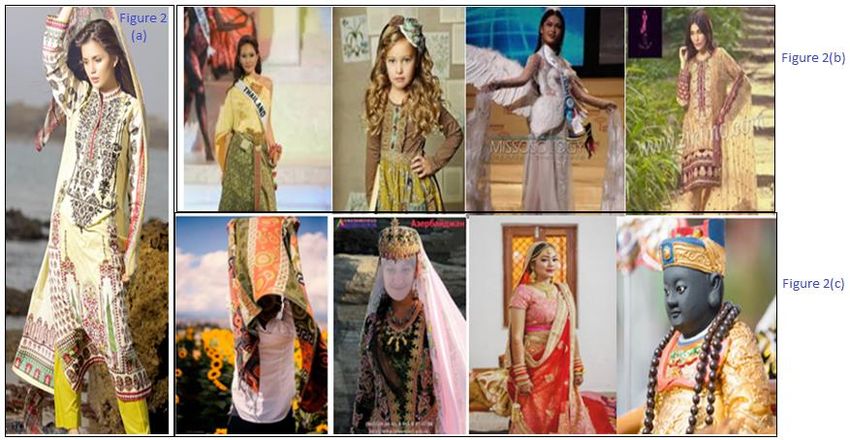
                                                                      Search results gets worse when query image comprised of
Color retrieval accuracy is greater than 90% in multidimensional      outdoor scene as shown in Figure 2. In this paper we
HSV space. Qualitative Results for texture classification are up      investigate and propose novel indexing scheme for
to the mark for gray color design retrieval.                          Content based Image retrieval system (CBIR) that enables
Key words:                                                            querying by combining Color and Pattern on challenging
Visual descriptor, Hard Negative Mining of Oriented Gradients         feminine Dataset. Our idea of using cultural fashion cloth
(HOG), Support Vector Machine (SVM), Local Binary Pattern             is supported by [4], where authors emphasize the
(LBP), Textile, Fashion Industry, Texture classification.             augmentation of clothing ontologies with cultural attribute
                                                                      using influence Network and hence proposed work will
                                                                      help in building FTC Ontology [5,6]. Motifs and Patterns
1. Introduction                                                       Symmetry, Technicality and Geometry along with its
                                                                      historical and cultural values has been given immense
In recent years, the field of computer vision (CV) and                importance in literature and is still considered as an open
Machine learning (ML) has broadened its scope to address              research area in Computer Science [7-9].
various tasks in Textile and Fashion industry [1, 2]. An              Our wok is novel in terms of Dataset, Human Detection
example of such classical task is to retrieve visually                Approach and indexing generation used for textile retrieval.
similar images from a large image database in response to             From now we prefer to write pattern instead of Texture for
a query image provided by user. The rise of visual search             our work description. Rest of the Paper is organized as
brings forth various search engines TinEye, Flickr, Google            follows: First we describe that how we separate model
including multimedia research paradigms [3,4]. For a                  from background using HOG in Section NO. 1. Then we
moment, imagine that you are looking for particular                   describe our newly created branded data set and labeling
fashion trend, color combination and pattern in clothing              taxonomy in Section No. 2. Section No. 3 explain about
with a sample query image shown in Figure 1(a). The                   usage of Positive and Negative Data Mining along with
Query Image represent a fashion shoot for an international            metric used to measure performance of retrieval. Section
Textile Brand THREDZ ; which operates mainly in Asia                  No. 4 discusses the achievements in color and texture base
and USA. The model wore traditional subcontinent dress                feature extraction along with indexing scheme. In Section
called “Shalwar Kameez” mainly in Pink and Black                      No. 5 we provide our proposed CBIR Pipeline. The
combination with fine patterned embroidery at front and               pipeline utilizes robust and popular machine learning
bottom of the top. The base of the fabric is filled with tiny         algorithms namely HOG, LBP and Multiclass SVM for
white and blue motifs. The Search Engine TinEye                       indexing and retrieval.

     Manuscript received February 5, 2019
     Manuscript revised February 20, 2019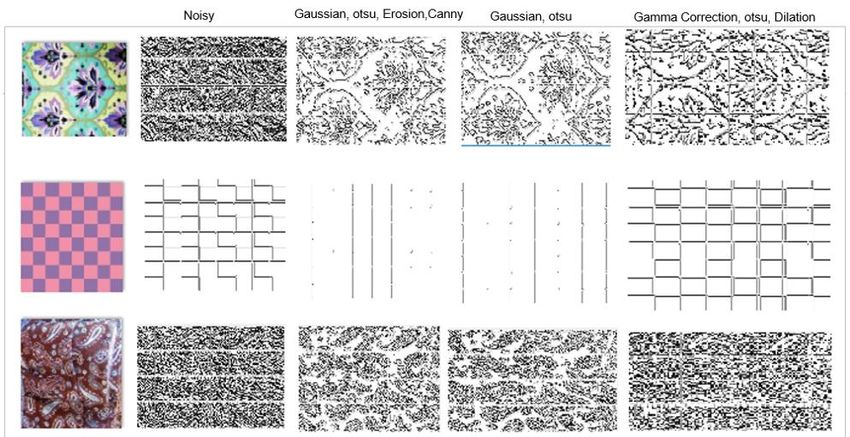
IJCSNS International Journal of Computer Science and Network Security, VOL.19 No.2, February 2019                         89

                        Fig. 1 (a) Query Image   (b) Google top Responses     (c) Flickr top Responses

                       Fig. 2 (a) Query Image    (b) Google top Responses      (c) Flickr top Responses

                                                                 Statistical Information Booster (CLOSIB) Histogram of
                                                                 Oriented Gradients (HOG) and Half Complete Local
2. Related Work                                                  Oriented Statistical Information Booster (HCLOSIB) for
                                                                 local patch description of clothing. Their dataset is
In [9] author attempted texture based image retrieval            composed of 684 images of sizes that range between
(TBIR) using machine learning algorithms and their               480x360 and 1280x720 pixels obtained from 15 videos of
combinations    including   Faster   Region     based            YouTube. According to them R-CNN achieves highest
Convolutional Neural Network (R-CNN), Adaptive Linear            accuracy of around 85%. Work has also been done for
Binary Pattern (ALBP), Complete Local Oriented                   identification of different types of dresses (such as shirt,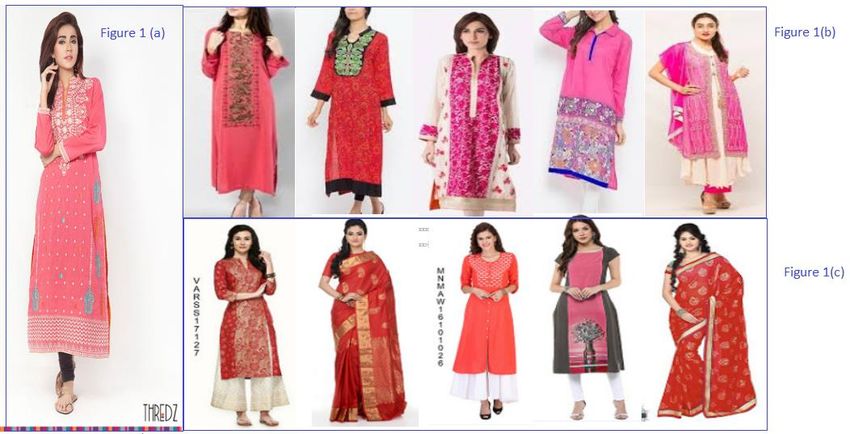
90                 IJCSNS International Journal of Computer Science and Network Security, VOL.19 No.2, February 2019

Pant, dresses etc.). Menfredi et al. [10] proposed an                  but introduces a new bit to manage the fluctuations of
approach for automatic segmentation of garments. He first              intensity.
classified garments into nine different classes (such as
shirts, dresses, skirts) by extracting the shape of a specific
garment using projection histogram. The whole image is                 3. Proposed Methodology
then divided into 117 cells (9 × 13 grid) which are further
grouped as partially overlapped blocks of 3 × 3 cells.
Multiclass linear SVM is employed for training by feeding              3.1 Human Detection with HOG and Boot Strapped
them with concatenated values of projected histogram and               SVM
HOG features. Kalantidis et al. [11] proposed an approach,
which can automatically suggest relevant clothing                      The very first task towards textile retrieval is to detect
products. They estimate pose from the query image,                     human from query images. The detection task gets difficult
segmented them and retrieve images on the basis of                     when query images represent outdoor fashion shoots and
similarity. For texture based classification, there exist              thus comprised of complex background. To address this
several well-known methods such as Wavelets transform                  problem, we decided to extend the publically available
[12], Gabor filters [13], Scale-invariant feature transform            datasets. Two widely used and publically available dataset
(SIFT) [14], HOG [15, 16], LBP [17] features. Apart from               for human detection are INRIA and MIT. INRIA [15]
sign information (as in LBP), Completed Local Binary                   dataset consist of 2478 positive (Left and Right Pose) and
Pattern (CLBP) is proposed by Zenhua et al. which                      12180 initial negative hard examples while MIT dataset
incorporate sign, magnitude and center pixel information               contains 509 training and 200 test images of pedestrians in
[18]. CLBP considers sign and magnitude both the                       city scenes but contains only front or back view of humans
information that was obtained through the differences of               with relatively limited range of poses. We augment newly
the neighboring pixels. CENTRIST [19] is based on the                  collected 1500 Positive fashion shoots to INRIA positive
concept of Census Transform (CT) proposed by R. Zabih                  set as shown in Figure 3. It is important to note that
et al. [20]. It is a non-parametric local transform technique          fashion shoots are non-customized and contains
that maps a pixel by comparison with its neighboring                   challenging background and pose variation. Our negative
pixels intensity and produces an 8-bit string (CT values).             images consist of INRIA original negative images plus
LBP also use the similar strategy. The only difference is              7000 more initial hard negatives which are gathered
that LBP performs interpolation while considering the                  through internet (e.g. Deviant art and Behance.net). Initial
corner pixels but CENTRIST considers the corner pixel                  Negative sample images are shown in Figure 4.
value as it is instead of interpolating any of them. Local
Ternary Pattern (LTP) [21], follows the same spirit of LBP

                        Fig. 3 Augmented Images with INRIA Data having challenging background and Pose Variation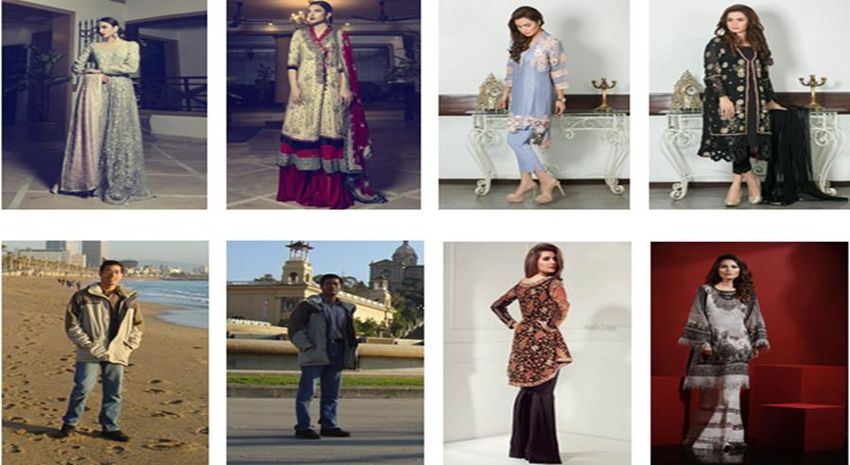
IJCSNS International Journal of Computer Science and Network Security, VOL.19 No.2, February 2019 91
Fig. 4 Initial Hard Negative Samples from Deviant art and Behance. Fig. 5 Non Maxima Suppression
Fig. 6 Obtained Hard Negatives Fig. 7 False Positive (FP) added to Original Negatives to Retrain SVM
Detection process starts with resizing of all non- which is shown with green detected window in Figure 5.
customized images to 64 x 128 followed by gradient The trainer model obtained through first iteration of SVM
computation through Sobel Filter in both x and y does not provides effective results due to human like
directions. The resultant magnitude and orientation of objects. When SVM classify objects as human, when in
pixel is an essence for forming HOG descriptor [15]. Cells fact they are not, we call them false positives (FP). Some
of size 4 x 4 are tiled over the image. Each 4 cells together False positives are shown in Figure 6 where the SVM
form a block over which detection window moves with perceive a tree or tower as a human when in fact it is not.
50% overlapping. Orientation is divided into 9-bins which Here the hard-negative mining comes into play. Hard
ranges over 0o-180o for histogram computation. For each negative mining a.k.a. boot strapping is a technique to put
cell a histogram is computed with respect to the orientation all false positives (FP) from the dataset into negative and
and each pixel is used for accumulating votes into then retrain the classifier, See Figure 7. The process goes
orientation bin. Each block computes a normalize on until True Positive Rate (TPR) improves. TPR and
histogram over its 4 cells. The 64 x 128 detection window False Positive per Image (FPPI) are performance metric to
is the resultant descriptor which is formed by moving 7 describe whether human is detected from query image or
blocks horizontally and 15 blocks vertically, for a total of not? True detection of human results in an increase of true
105 blocks. As each block contain 4 cells with a 9-bin positive rate. Let ‘t’ be the total test images and ‘TP’ be
histogram for each cell, for a total of 36 values per block. the number of images on which human is detected. Then
This brings the final vector size to 7 blocks across x 15 over all True positive rate (TPR) is formulated in Equation
blocks vertically x 4 cells per block x 9-bins per histogram (1) as follows:
= 3,780 values. This final HOG descriptor is computed for
TruePositive(TP)
all the positive dataset and as well as of negative dataset. TPR *100
Now these descriptors value are feed into SVM for Total(t ) (1)
training. While detection window was looked into query We tested HOG-SVM detector on two different
image at different scale space to detect human, it backgrounds: 100 simple background images and 100
mistakenly identifies objects which are indeed not human complex background images. Flat Directory Structure is
but are human like objects with respect to their HOG followed to store all images as database. The test set
descriptor. Non maxima suppression is applied on all comprises of humans in fashion shoots along with INRIA
possible regions in red windows to search for maxima dataset as discussed before. Now, simply dividing total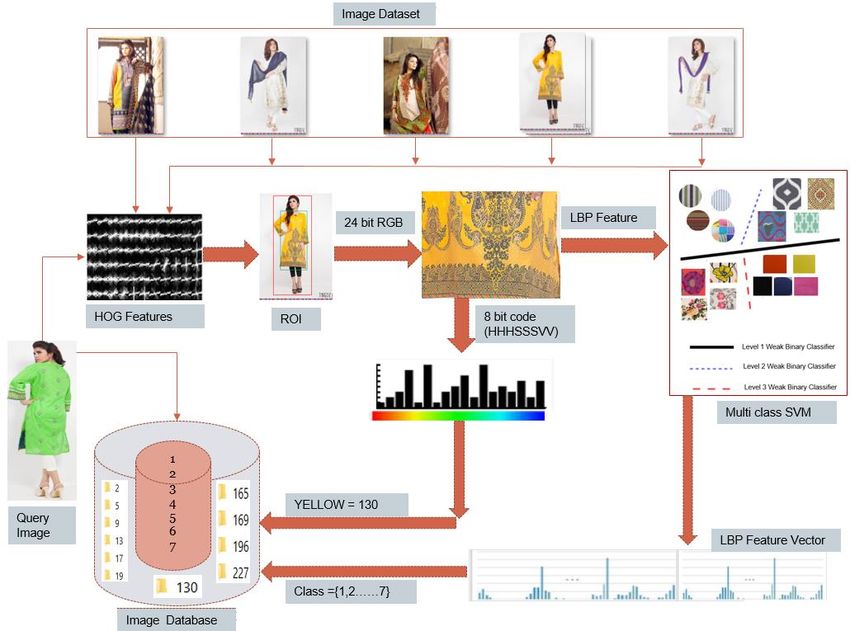
92                 IJCSNS International Journal of Computer Science and Network Security, VOL.19 No.2, February 2019

false positive obtained over test set by true positive in test
set will result in false positive per image (FPPI). If the
number of images where human is detected in test set is d,                                                              (2)
and no of false detection is represented by ‘FP’ i.e. false
positive, then FPPI is given in Equation (2) as follows:

                                     Fig. 8 Initial Hard Negative Samples from Deviant art and Behance

                      Fig. 9 Region of Interest (ROI)                Fig. 10 ROI casted as Aligned Rectangle Problem

To improve TPR we manually created 900 skeletal images                  skeletal images shows excellent True Positive rate but
for biasing. Skeletal images are binary images having                   produces enormous false positives thus size of negative
human poses and are shown in Figure 8. The purpose of                   dataset increases rapidly. We start mining with 100
using skeletal images is to provide SVM true gradient                   Positive and 2000 negative images i.e. 2100 images in all.
change so that TPR will improve. Initially we thought that              Just after 3 to 4 iterations the original negative set exceeds
providing the right gradient change in the form of skeletal             from 4900 to 40K.
images was a good idea as these skeletal images form
descriptors having unique identification of human. But                  3.2 ROI Extraction
soon we realized that such trained classifier model will
forms a small positive region, thus results in classification           When a query image is uploaded or provided by a client,
of images from positive dataset into negative region and                its graphical content will be pulled out as the region of
no detection of human seen. Hard Negative Mining with                   interest (ROI) as shown in Figure 9. The irrelevant data in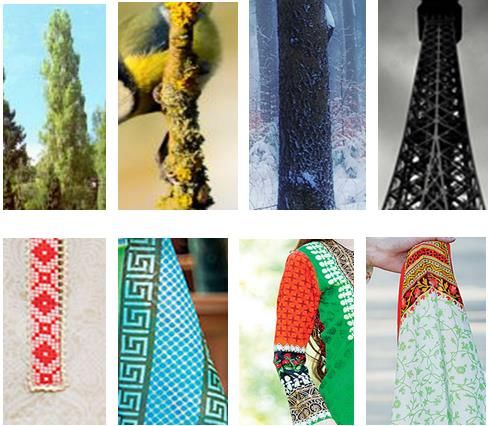
IJCSNS International Journal of Computer Science and Network Security, VOL.19 No.2, February 2019                          93

the form of human face and other contents in background        of a pixel, Saturation(S) represents the intensity of the
needs to be eliminated; where red box contains the result      color i.e. how light or dark the color is. Stated other way
of human detection. The red box need to be further             intensity represents the presence of white color in query
processed to obtain yellow top of textile inside green box.    image. The last term Value(V) corresponds to the
We cast ROI extraction problem as rectangle resizing           brightness or luminance factor present in the image. These
problem without resampling as shown in Figure 10.              three parameters constitute a 3-Dimensional space
To do this we need to specify a new inner rectangle B          represented by the cylindrical inverted Pyramid. The Hue
having same aspect ratio as A and is aligned with outer        factor is determined by the angle on the cone which is
rectangle A [22]. Rectangle B will be positioned in a way      equally divided into 6 bins representing the actual color
that it will able to cover the top clothing area of detected   space. The surface of the Cylinder determines the
human. Let width, height and aspect ratio of known             saturation of the color as its center corresponds to
rectangle A are ‘W’, ‘H’, and R respectively while it is       Saturation Value of 1. This means that Black color reaches
positioned at (L,B) in image space. Also let that the          to 0 on the edges of the cone. We decided to use 3 bits for
bottom left corner of desired rectangle B will positioned at   Hue, 3 bits for Saturation and 2 bits for brightness value
(l,b) and will have width ‘w’ and height ‘h’ as shown in       and thus our system will allow matching with 28 = 256
Fig 10. The solution lies in declaring a percentage for        colors for a given query image. To produce 8 levels, we
padding bottom left position based on the ratio we want to     need to define a suitable mapping between the range
maintain. This technique gives a plenty of space to subject    0……. 360 and 0……7 for both hue and saturation. A
of interest and a nice balance will be maintained from mid-    similar mapping principal is required for value part with
ground to background leaving subject (yellow top) in the       levels 0……4. The simplest approach to make them
middle. The commonly used ratios for aligned rectangles        proportional is illustrated below:
are: 8.5/11 for portrait orientation, 4/3 for classical TV                      h                                s
screen and 1/ø where ø = 1.618034. We chose 3/4 = 0.75                     8*                             8*
as aspect ratio for inner aligned rectangle B. The width and   L8 = round(    max h );      L8 = round(        max s ) ;
height of B in terms of A are then calculated as: w = 30%                       v
of W and h = 40% of H. To adjust the position 40% of W                     4*
is added to coordinate ‘L’ i.e. l = L + 40% of W. Similarly,   L4 = round(    max v )
30% of H is added to ‘B’ so b = B + 30% of H. Resizing A
thus comprises of two steps: (1) Adjusting coordinates of      Where L is used to represent desired mapping levels, h, s
ROI i.e. Red Rectangle (30% across X-Axis and 40%              and v are the values before mapping while maximum
across Y-Axis) (2) Image Cropping with 30% on X-Axis           values of h, s and v are 360, 1 and 1 respectively.
and 40% on Y-Axis). The Extracted Image will be utilized       Extraction of Black and White Color will not require any
for the upcoming processing to extract the color of the        Hue Factor as they can only be determined by the
Garment.                                                       Saturation and Value part of color. Beside Black and
                                                               White, Grey Color also need special attention. We have set
3.3 Colour Quantization and Encoding                           following rule based on H, S and V to improve the
                                                               accuracy of matching with these shades. Black Color:
Extraction and Parsing of color into machine                   Saturation Level is 1 & brightness value > 95%;
satisfactory results in response to a particular query mage.   Gray Color: Saturation level is 1 & Value >12.5% &
This problem can be seen as N by K mapping: N are given        Value < 95%. The univariate histogram of pure red color
color triplets with K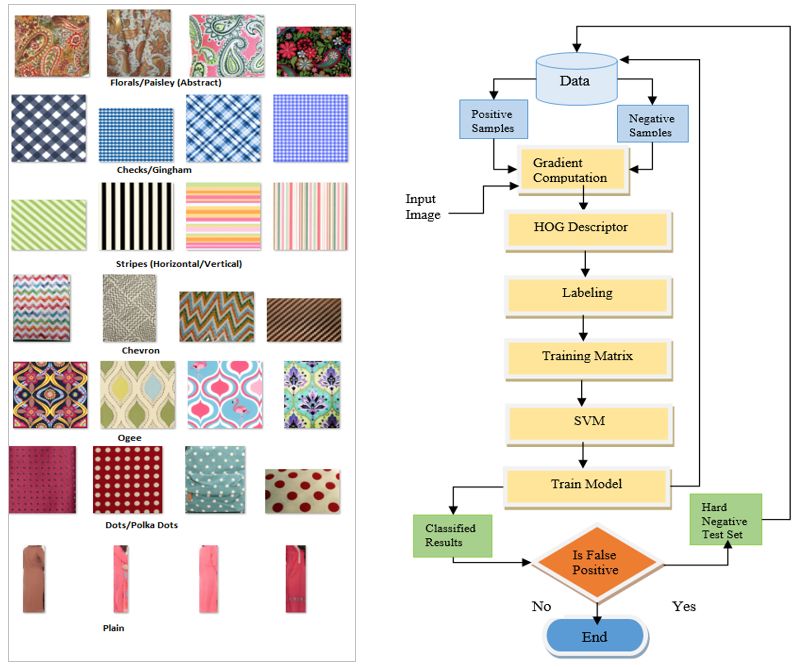
94                 IJCSNS International Journal of Computer Science and Network Security, VOL.19 No.2, February 2019

                  Fig. 11 Separate HSV histogram for Pure Red Color: 8 bins for Hue, 8 bins for Saturation and 4 bins for Value

                                  Table 1: Code Fragment for Indexing, Binning and Building Image Database

Hue = { 0,1,2,3,4,5,6,7}; Saturation = {0,1,2,3,4,5,6,7}; Value = {0,1,2,34};
for h:= 0 to 7 do
  for s := 0 to 7 do
    for v = 0 to 4 do
          Index := 32*h + 4*s + 4;
          Histogram[Index] := 32 * Hue[h] + 8* Saturation [s]+ Value[v];
          ColorDB [Index] := saveImage();

 Multiplying by 32 shifts the Hue part of binary mask over                  to their texture class for retrieval. Training images were
by 5 bits so that the hue level appears in the top 3 most                   resized to 128x256 for processing. Patch wise LBP were
significant bits of the Color Database (DB). The same is                    computed by splitting image into regions of 32x32 pixel
true for shifting Saturation value by 3 bits to fall it into                and histogram over region has computed having 256
middle of Database. The benefit of this encoding scheme                     values. Each region histogram is concatenated forming
gives feasibility for storage and retrieval of Images from                  feature vector having 4x8x256=8192 dimension; where
the dataset on the basis of similarity. As the index into the               4x8=32 represent no. of regions and 256 are histogram
database will correspond to the Hue factor of images                        value of a single region. These computed vectors of seven
contained in it, the complications faced in the retrieval of                classes are than feed into SVM for training. Region’s LBP
the data form database will be reduced.                                     is calculated as a contribution of neighborhood pixels for
                                                                            each pixel. Every Pixel is compared with its 8 neighbors
3.4 Pattern Classification                                                  and if the intensity of the pixel is greater than or equal to
                                                                            its neighbor than the value is set to be zero at that position
Fashion Dataset has been divided into seven texture                         of neighbor otherwise it will be set to one. For, 8 neighbor
classes namely Abstract, Checks, Stripes, Chevron, Ogee,                    concept there can be 2^8 =256 possible combinations.
Dots and Plain shown in Figure 12. Each class contain 100                   Starting from any position in 8 neighborhood of a pixel;
images over which multiscale SVM has been trained.                          ordering of the values has been taken either in clockwise
Multiclass SVM can be thought of series of weak binary                      or in anti-clockwise manner. This 8-bit array is converted
classifiers, each of which classify input ROI as stripes or                 into decimal, resulting into the value of the center pixel in
plain or floral etc. Abstract class includes two types of                   LBP region. This is simply windowing concept of image
textures: floral and paisley as they both form similar LBP.                 processing. Techniques that were used for improvement
Checks include “Gingham” which also forms similar LBP.                      includes Canny Edge Detection, Gaussian Blur,
All images are gathered through Internet except Plain class                 Morphology and Mining which will be discussed in
which is formed by region cropping on testing dataset.                      experiments section in detail.
Testing dataset includes region cropped from images of
fashion shoots. Folders are then filled for testing according
IJCSNS International Journal of Computer Science and Network Security, VOL.19 No.2, February 2019                         95

4. Experiment and Results                                     skeletal images in positive dataset will form only a small
                                                              positive region resulting in classification of positive image
We already describe our novel dataset and hard negative       into negative region. We thus reject the idea of using
mining approach for training SVM in Section 1. The            skeletal images as it is a kind of bias and produces
overall flow of this approach of human detection is           enormous false positives. Next we trained SVM from
presented in Figure 13 for reader convenience. Initially we   descriptors obtained from 1500 (~2K) positive images and
thought that providing the right gradient change in the       2000 (2K) negatives (original). This time we choose to
form of skeletal images was a good idea as these skeletal     mine the positive dataset, taking out false positives and
images form descriptors having unique identification of       then                                                   retrain.
human. But soon we realize that classifier based on

                     Fig. 12 Texture Classes                      Fig. 13 Hard Negative Mining with SVM

This method does not produce huge dataset of false            detection because it is trained on INRIA dataset; While our
positives; as we are getting before using skeletal image      trained classifier gives 10-20% detection on test set of
technique but still our dataset increases as mining           INRIA with not a single FPPI. Testing for human
produces 36K images after every 3 to 4 iterations. Finally,   detection comprises of applying trained model on images
the training uses 1500 (~2K) positives and 8000 (8K)          having simple and complex background. In terms of TPR,
original negatives but this time mining is done on negative   the skeletal image augmentation performs best with 85%
dataset which results in total 18500 (~19k) negatives         TPR on simple background while 44% TPR on complex
including the 8K initial negatives. The summary of these      background images but its FPPI rate is higher. Results
statistics are shown in Figure 14. When we use OpenCV         produced from mining on positive dataset are also not
trained classifier on our test set, it will provide 0%        satisfactory as only 12% of human with complex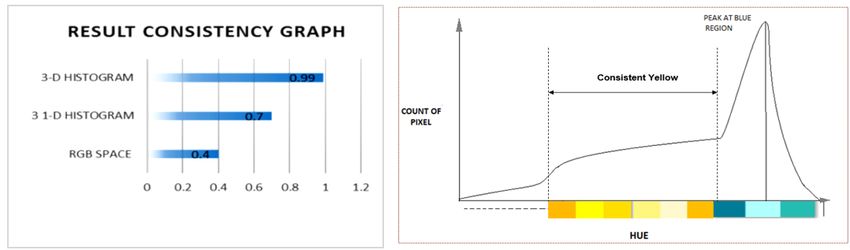
96                IJCSNS International Journal of Computer Science and Network Security, VOL.19 No.2, February 2019

background and 30% of humans with simple background                     images when background varies. This happens because
were detected but they contain no false positives. Hard                 training set containing positive images have more images
negative mining on positive images yield low TPR and                    with simple background. Table 2 summarize the results on
higher FPPI. The trainer with hard negative mining on                   simple and complex background images with all three
negative images perform 55% true detection on images                    mining techniques. Table 2 shows that FPPI will subject to
with simple background while 36% true detection on                      change and become higher due to complex variations of
images with complex background. The true detection in                   background in fashion shoot images and that overall TPR
this case is 70% on training dataset and 55% on testing                 for three mining techniques are 65%, 21% and 55% with
dataset. Although it also has a flaw of detecting only 36%              FPPI rate of 0.6, 0, 0.3 respectively as shown in Figure 15.

                                  Fig. 14 Relation between Mining strategy and size of negative dataset

                               Table 2: Overall TPR and FPPI along with simple and complex Background
                                                                FPPI      TPR       FPPI      TPR         FPPI   TPR
                    Mining      +ve      -ve     Hard -ve
                                                                   Simple             Complex              Over all
                    Skeletal    2100    4900       40000          0.4      85%       1.2      44%         0.6    65%
                    Positive    1500    2000       36000           0       30%        0       12%          0     21%
                   Negative     1500    8000       10500          0.2      55%       0.4      36%         0.3    55%

                           Fig. 15 Overall False Positive per Image (FPPI) and Accuracy of Mining Techniques
IJCSNS International Journal of Computer Science and Network Security, VOL.19 No.2, February 2019                          97

Accuracy based on RGB pattern is found up to 20-30%               instead of using separate H, S and V thresholds. Figure 18
proving that RGB is not an appropriate feature for color          (a) shows the Query image along with its accurate
information extraction. Accuracy of univariate histograms         response obtained through HSV based encoding in Figure
of Hue, Saturation and Value was found to be 50-60%. It           18(b). Experimental result of LBP Features without
has been proved that the most efficient method for color          preprocessing has been shown in Figure 19 (a), which
base information extraction is 3-D HSV Histogram whose            shows that resultant image was very sensitive to noise.
accuracy is found about 99% as shown in Figure 16. We             After training SVM with such noisy LBP features, result
also want to highlight the difference between most                was very unclear and the designs which were too small
frequent and most consistent color at this stage through a        were always classified as ABSTRACT. To improve result
sample test case. Let the query image given to the system         5x5 Gaussian Kernel, morphological operation and Canny
had majority pixels which are blue in color as shown in           with optimal thresholding (otsu) has been used. When we
graph of Figure 17. Now if univariate histograms are used         use smoothing, erosion and canny with optimal threshold,
then the system will have brought all blue color dresses          the results become insensitive to Noise as shown in Figure
and doesn’t care about any other color in the same dress.         19(b). It can be observed in Figure 19(b) that small details
But as we plot multidimensional HSV histogram; instead            of texture are now reduced and output image become very
of separate H, S and V histogram, the extracted clothing          informative but equal patterns for e.g. in checks; square
would be identified as combination of blue and yellow             pattern is not detected by Canny. This is because that
instead of only blue due to its consistent nature. That’s         Canny is bias toward vertical and horizontal edges and
why we build and prefer multidimensional color histogram          does not work with rotational symmetry.

                   Fig. 16 RGB Vs HSV Accuracy                      Fig. 17 Majority vs. Consistent Color Concept

              Fig. 18(a) Query Image                  Fig. 18(b) Response on basis of most frequent and consistent color
98 IJCSNS International Journal of Computer Science and Network Security, VOL.19 No.2, February 2019
Fig. 19 (a)(d) Extracted ROI along with its low level texture details
As a result, canny without preprocessing will not provide outcome for retrieval and results need improvement. For
efficient result for Checks and Stripes class and classify stripes design, Gray Color design is the expected outcome
them as plain when actually they are not; see Figure 19 (c). which is amazingly more close to the retrieval
The Technique is also in-effective for small Patterns as it expectations. Relocating irrelevant or misclassified sample
causes merging and make a large design. Thus False to their respective class and re-training the classifier with
Designs has been produced and mixing of Classes has newly added samples improves accuracy. Improved
been occurred. Data then is not be separable linearly. In Results after mining and re-allocation are shown in Figure
our next attempt we use Gaussian Smoothing of Kernel 20(b). The Idea Behind this technique is to generalize
5x5, erosion and thresholding i.e. canny is not applied here. Texture Classes, train a linear SVM and make data linearly
This combination almost provides with same result as separable as much as possible through Iterative learning.
shown in Figure 19(c). Noise removal works fine here too
but similar to the previous method combination, it again
failed for Checks and Stripes class. The combination that 5. Conclusion and Future Work
works for Equal and Small design uses Gamma Correction,
Thresholding and Dilation as shown in Fig 19(d). Floral We have proposed a domain specific textile design
pattern seems clumsy due to dilation. retrieval pipeline using support vector machine (SVM) as
LBP was also tested on full image resulting in fixed 256- classifier with strong intent for generalizing design
dimensional vector but the result was too bad to be families based on HOG, HSV and LBP Features. The
considered hence image is resized to a fixed size so we can summary of pipeline processing is depicted in Figure 21.
slice it accordingly to output fixed dimensional vector for Results proves that skeletal images and mining over
SVM. With these LBP features the resulting SVM positive dataset results in huge negative dataset which
classifications were less prone to misclassifications. When requires more memory and become computationally
trained multi class SVM is tested against query images for expensive. The feminine fashion data set used in this paper
texture classification, misclassification have been is novel and extremely challenging. We believe that more
encountered during initial iterations as shown in Figure data and high computing machines are needed to resolve
20(a). The two designs shown are “floral” on “white base” design generalization problem using mining on negative
and “zig zag stripes” on “white base”. For floral design, dataset approach; as with 2GB memory; only 55%
White clothes with colored flowers is the expected accuracy has been achieved for human detection. Retrieval
on the basis of color in HSV space using 256 dimensionalIJCSNS International Journal of Computer Science and Network Security, VOL.19 No.2, February 2019 99
feature vector is 99%. Noise reduction in images based on generalization and quantitative analysis of texture
gamma correction, Canny and Otsu for texture classification. Future work include presenting these LBP
classification successfully retrieve low details of texture in features to Kernel based SVM for Non-Linear
the pattern. The high dimensional LBP features with 8192 Classification or testing Deep Convolutional Networks
components produce excellent qualitative results for gray with such challenging classification.
design retrieval. More work need to done for
Fig. 20(a) Results before Mining and Relocation Fig. 20(b) Results after mining and Relocation
Fig. 21 Proposed method for retrieval of easthetic feminine fashion shoots based on both color and motif100 IJCSNS International Journal of Computer Science and Network Security, VOL.19 No.2, February 2019
Author Contributions: The Idea was originally presented [12] Selvaraj, A.; Ganesan, L.; Texture classification using
and implemented by Saad Sheikh. All the experiments are wavelet transform. Patt. Recog. Lett. 2003; 24, 1513-1521.
done by team comprises of Saad Sheikh, Mohsin Ali and [13] Selvaraj, A.; Ganesan, L.; priyal, S.P. Texture classification
Ahsan under the supervision of Humera Tariq who is using Gabor wavelets based rotation invariant features, Patt.
Recog. Lett., 2006; 27, 1976-1982.
substantially mentoring team for improved and enhanced [14] Cheung, W.; Hamarneh, G.; SIFT, G; Scale Invariant
methodology. The manuscript draft was originally Feature Transform, IEEE Trans. Img. Proc. 2009; 18, 2012-
prepared by Humera Tariq and Mohsin. Other authors 2021.
participated are involved in conceptualization, proof [15] Dalal N.; Triggs, B. Histograms of Oriented Gradients for
reading, reviewing and edition. Human Detection, in: Proceedings of the IEEE Conf. Comp.
Vis. Patt. Recog. (CVPR), San Diego, CA, USA, June
2005,25, 886–893.
Acknowledgments [16] Ludwig, O.; Delgado, D.; Goncalves, V.; Nunes, U.
Trainable classifier-fusion schemes: An application to
In this section you can acknowledge any support given pedestrian detection, in: In Proceedings of the 12th Inter.
which is not covered by the author contribution or funding IEEE Conf. Intell. Trans. Sys., St. Louis, MO, USA,
sections. This may include administrative and technical October, 2009; 432–437.
support, or donations in kind (e.g., materials used for [17] T.Ojala, M.Pietkainen and T.Maenpaa, Multiresolution
Gray-Scale and Rotation Invariant Texture Classification
experiments). with Local Binary Patterns, IEEE Trans on Patt Anal &
Conflict of Interest The authors declare no conflict of Mach Intel, 2002; 24 , 971-987.
interest. [18] Guo, Z.; Zhang, L.; Zhang, D. A completed modeling of
local binary pattern operator for texture classification, IEEE
References Trans. on Img. Proc.,2010; 19, 1657-1663.
[1] Wong, C.; Application of computer vision in fashion and [19] Wu, J. ; Rehg, J.M.; CENTRIST: A Visual Descriptor for
textile, 1st ed.; Elsevier Science, USA, 2017; ISBN: Scene Categorization, IEEE Trans. Patt. Anal. Mach.
9780081012178. Intell,2011; 33, 1489-1501.
[2] Yildrim, P.; Birant, D.; Alpyildiz, T. Data mining and [20] Zabih, R.; Woodfill, J.; Non-parametric local transforms for
machine learning in textile industry, WIREs Data Mining computing visual correspondence, in: Proc. of the Third
Knowl Discov, 2018; 8:e1228. doi: 10.1002/widm.1228,. Europ. Conf. on Comp. Vis., Stockholm, Sweden, 2–6 May,
[3] Aigrain, P.; Zhang, H.; Petkovic, D. Content-based 1994; 151–158.
representation and retrieval of visual media: A review of the [21] Tan, X.; Triggs, B.; Enhanced local texture feature sets for
state-of-the-art, Mult. Tools. App. 1996; 3 ,179–202. face recognition under difficult lighting conditions, J. of
[4] Datta, R.; Joshi, D.; Li, J; Wang, J.Z. Image Retrieval: Ideas, IEEE Trans. on Img. Proc.,2010; 19, 1635-1650.
Influences, and Trends of the New Age, ACM Comp. Surv, [22] Hill. F.S.; Computer Graphics using OpenGL, 2nd Ed;
2008; doi:10.1145/1348246.1348248. Prentice Hall, 2000;
[5] Bollacker, K.; Rodríguez, N.D.; Li, X. Beyond Clothing [23] Belongie, S.; Carson, C.; Greenspan, H; Malik, J.; Color and
Ontologies: Modeling Fashion with Subjective Influence Texture-Based Image Segmentation Using EM and Its
Networks, Machine Learning meets fashion KDD Application to Content-Based Image Retrieval, In Proc. of
Workshop, ACM 2016, 1–7. the sixth Inter. IEEE Conf. on Comp. Vision, 1998, 675–682.
[6] Aime, X.; George, S; Hornung, J. VetiVoc: A modular [24] Sajjad, M.; Amin; Ahmed J.; Abbas, N.; Rho, S.; Baik, S.W.
ontology for the fashion, textile and clothing domain, J. App. Integrating salient colors with rotational invariant texture
Ontol, 2016; 11:1–28, doi: 10.3233/AO-150149. features for image representation in retrieval systems, Mult.
[7] Johnstone, K.; Tonje. Surface patterns, spatiality and pattern Tools & App, 2018, 778, 4769-4789.
relations in textile design, Dissertation, University of Boras, [25] Manjunath, B. S.; Ohm, J.R.; Vasudevan, V.V. ; Yamada, A.
2018. Color and texture descriptors, J. IEEE Trans. on Cir. and
[8] Bier, C. Pattern Power: Textiles and the Transmission of Sys. for Vid. Tech., 2011,11, 703-715.
Knowledge, Textile Society of America Symposium
Proceedings, (2004). http://digitalcommons.unl.edu/tsaconf.
[9] Olalla, O.G.; Alegre, E.; Robles, L.F.; Fidalgo, E.; Saikia, S. Humera Tariq received B.E (Electrical)
Textile Retrieval Based on Image Content from CDC and from NED University of Engineering and
Webcam Cameras in Indoor Environments, Sensors, 2018; Technology in 1999. She joined MS
doi:10.3390/s18051329. leading to PhD program at University of
[10] Manfredi, M.; Grana, C.; Calderara, S.; Cucchiara, R. A Karachi in 2009 and completed her PhD
complete system for garment segmentation and color in 2015. Currently she is working as
classification, Mach. Vis. and App., 2014; 25, 955-969. Assistant Professor at Department of
[11] Kalantidis, Y.; Kennedy, L.; Jia. L. L.; Getting the Look: Computer Science, University of Karachi.
Clothing Recognition and Segmentation for Automatic Her research interest includes image
Product Suggestions in Everyday Photos, In Proceedings of processing, biomedical imaging,
the 3rd ACM Conference on Mult. Retr., Dallas, TX, USA, Modeling, Simulation and Machine Learning.
April 2013; 16–20.IJCSNS International Journal of Computer Science and Network Security, VOL.19 No.2, February 2019 101
Usman Amjad received BS. Degree in
Computer Science from University of
Karachi, in 2008. He recently completed
his PhD in Computer Science from
University of Karachi. His research
interests include soft computing, machine
learning, artificial intelligence and
programming languages. He was the
recipient of the HEC Indigenous 5000
scholarship in 2013. Currently, he is
working as AI solution architect at Datics.ai Solutions.
Saad Ismail Sheikh received BS. Degree
in Computer Science from University of
Karachi, in 2017. He is currently employed
at HR - SBT Pakistan SMC-Pvt Ltd as a
Team Lead. Formerly he works in Colwiz
Pvt. Ltd. His research interest includes
machine learning and pattern recognition
science especially from business modeling
and financial forecasting perspective.You can also read


