DOMAIN-SPECIFIC SERVICE DECOMPOSITION WITH MICROSERVICE API PATTERNS
←
→
Page content transcription
If your browser does not render page correctly, please read the page content below

DOMAIN-SPECIFIC
SERVICE DECOMPOSITION
WITH
MICROSERVICE API PATTERNS

Keynote,
International Conference on Microservices 2019

Dortmund, Germany
February 19, 2019
Prof. Dr. Olaf Zimmermann (ZIO)
Certified Distinguished (Chief/Lead) IT Architect
Institute für Software, HSR FHO
ozimmerm@hsr.ch
Abstract
Service orientation is a key enabler for cloud-native application development.
Microservices have emerged as a state-of-the-art implementation approach for
realizations of the Service-Oriented Architecture (SOA) style, promoting modern
software engineering and deployment practices such as containerization,
continuous delivery, and DevOps.
Designing (micro-)services interfaces to be expressive, responsive and evolvable
is challenging. For instance, deciding for suited service granularities is a
complex task resolving many conflicting forces; one size does not fit all. Domain-
Driven Design (DDD) can be applied to find initial service boundaries and cuts.
However, service designers seek concrete, actionable guidance going beyond
high-level advice such as “turn each bounded context into a microservice”.
Interface signatures and message representations need particular attention as
their structures influence the service quality characteristics.
This presentation first recapitulates prevalent SOA principles, microservices
tenets and DDD patterns. It then reports on the ongoing compilation of
complementary microservices API patterns and proposes a set of pattern-based,
tool-supported API refactorings for service decomposition. Finally, the
presentation highlights related research and development challenges.
Page 2
© Olaf Zimmermann, 2019.
Architecture of this Talk (“Micropresentations”)

                    Introduction to
 Mythbusting
                    Domain-Driven
                        Design
  SOA 101 &                                       Real-World
 Microservices                                 Service Examples
    Tenets                                      (Case Studies)
                        Service                                     Legend:
                      Granularity
                      and Loose                                          Experience

                       Coupling
Service Analysis                                  Architectural          Literature
                                                                         Analysis
   & Design                                        Refactoring
  (Modeling)                                   (to Microservices)         Patterns

                   Microservice API
                                                                         Research
                    Patterns (MAP)                                        Pbs/Qs

                                                                         Opinions

                                   Page 3
                           © Olaf Zimmermann, 2019.
Sample Project: Financial Services Provider (for Retail Banks)
Reference: IBM, ACM OOPSLA 2004
Supports – and partially automates – core banking business processes
More than 1000 of business services, each providing a single operation
One database repository, logically partitioned
Page 4
© Olaf Zimmermann, 2019.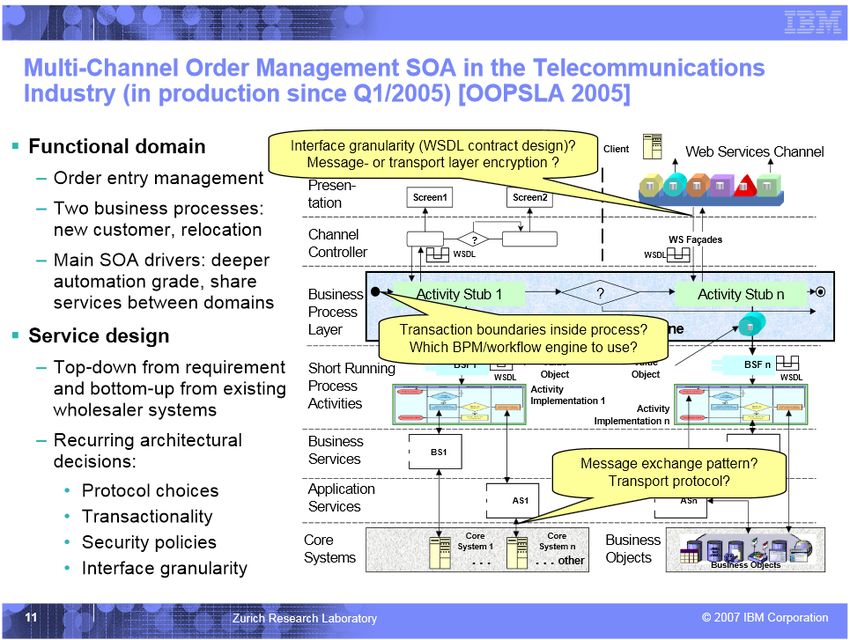
Exemplary Service Operations in Core Banking
Fine (business) Coarse (business)
Fine (technical) “Hello world” of core banking: “Big data” customer profiling (condensed):
int ActivityClassificationEnum
getAccountBalance scoreMonthlyInvestmentActivity
(CustomerId) (CustomerId, Month, Year)
Coarse (technical) Single domain entity, but complex Deep analytics («Kundengesamtübersicht»):
payload (search/filter capability): BankingProductPortfolioCollection
CustomerDTOSet prepareCustomerAnalysisForMeeting
searchCustomers (CustomerId, Timeframe)
(WildcardedCustomerName,
CustomerSegment, Region)
Business granularity:
Functional scope, domain model coverage
Business alignment/agility?
Technical granularity: Independent deployability?
Structure of message representations a.k.a. Client/server coupling?
Data Transfer Object (DTOs)
Page 5
© Olaf Zimmermann, 2019.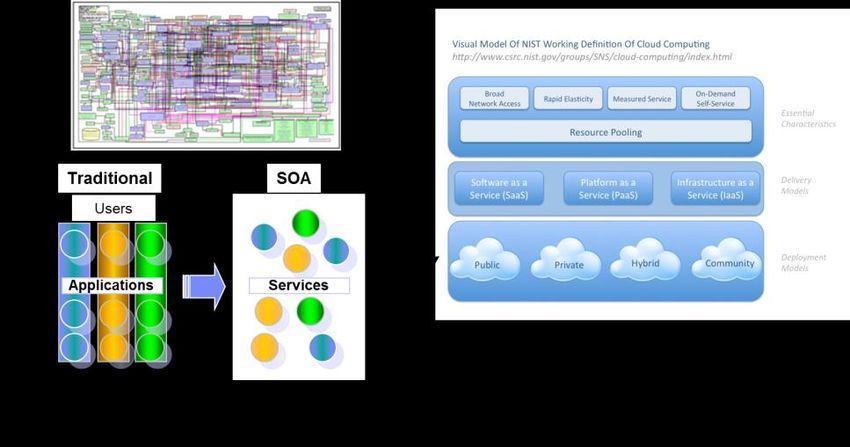
Sample Project: Order Management Application (Telecommunications)

                                                          Reference: IBM,
                                                            ECOWS 2007

                                Page 6
                        © Olaf Zimmermann, 2019.
Exemplary Services in Order Management (Telecomunications)
Computation Function: no read, no write Event Processor: write only
Retrieval Operations: read only Business Activity Processors: read-write
Endpoints play different roles in microservices architectures
– and their operations fulfill certain responsibilities):
Pre- and postconditions
Conversational state
Impact on scalability and
Data consistency vs. currentness
changeability?
Page 7
© Olaf Zimmermann, 2019.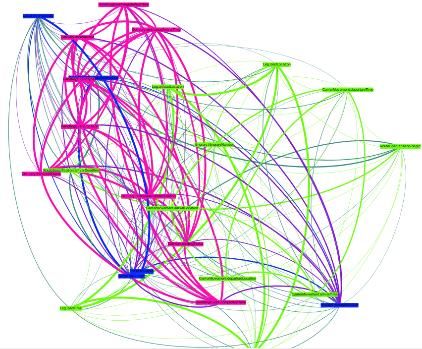
What is Service-Oriented Architecture (SOA)?
No single definition – “SOA is different things to different people”:
Business
A set of services and operations that a business wants to expose to Domain
Analyst
their customers and partners, or other portions of the organization.
• Note: no scope implied, enterprise-wide or application!
An architectural style which requires a service provider, a service
requestor (consumer) and a service contract (a.k.a. client/server). IT
Architect
• Note: this is where the “business-alignment” becomes real!
A set of architectural patterns such as service layer (with remote
facades, data transfer objects), enterprise service bus, service
composition (choreography/orchestration), and service registry,
promoting principles such as modularity, layering, and loose
coupling to achieve design goals such as reuse, and flexibility. Developer,
Administrator
• Note: not all patterns have to be used all the time!
A programming and deployment model realized by standards,
tools and technologies such as Web services (WSDL/SOAP),
RESTful HTTP, or asynchronous message queuing (AMQP etc.)
• Note: the “such as” matters (and always has)!
Based on and adapted from: IBM SOA Solution Stack, IBM developerWorks
Page 8
© Olaf Zimmermann, 2019.
"Napkin Sketch" of SOA Realizations (Adopted from G. Hohpe)

                                                     Debatable
                                                     (then and now)

    Our focus today

    Data Contracts

    No longer popular
                                             Our focus today
 (term repurposed for                                          Microservices!
 deployment context)

                                Page 9
                        © Olaf Zimmermann, 2019.
Seven Microservices Tenets (by Viewpoint)
                                                                               Legend:

                                                                                      Archi-
                    Independent-X                                                    tecture
                    (X = Deployment,
                    Scaling, Change)                                                Analysis,
                                                                                    Design &
   Business                                          Polyglot                        Coding
   Alignment                                     Programming and
  (e.g. via DDD)                                    Persistence                     Deploy-
                                                                                    ment &
                                                                                    Runtime
                    IDEAL Cloud                                      well-known
                    Architectures
                                                                     fairly recent advances
                   (e.g.12-Factor App)
Decentralization
                                                  Containerization
 & Automation
                                                   and Clustering
    (CI/CD)            Service
                      Monitoring
                    (DevOps Way)

                                      Page 10
                              © Olaf Zimmermann, 2019.
Cloud-native application architectures are API-centric
IDEAL: Isolated State, Distribution/Decomposition, Elasticity, Automation, Loose Coupling
API API
API
http://www.cloudcomputingpatterns.org
Page 11
© Olaf Zimmermann, 2019.Calls to Service Operations are EIP-style Messages
{[…]}
Sample request
message
(note: PUTs and POSTs
Payload
would look different)
Wrapper
Header Payload Envelope
{[…]}
+/-? Wrapper
Response
message Header Payload
Envelope
structure Header Payload
{[…]} -- some JSON (or other MIME type) https://www.enterpriseintegrationpatterns.com/patterns/messaging/CommandMessage.html
Page 12
© Olaf Zimmermann, 2019.How to find suited granularities and achieve loose coupling?
Context
We have decided to go the SOA and/or microservices way. We use DDD for
domain modeling and agile practices for requirements elicitation.
Problems (Industry, Academia)
How to identify an adequate number of API endpoints and operations?
How to design (command/document) message representation structures
so that API clients and API providers are loosely coupled
and meet their (non-) functional requirements IDEALy?
Which patterns, principles, and practices do you use? Do they work?
Page 13
© Olaf Zimmermann, 2019.Introducing… Microservices API Patterns (MAP)
Identification Patterns:
DDD as one practice to
find candidate endpoints
and operations
Evolution Patterns:
Work in progress
(EuroPLoP 2019?)
http://microservice-api-patterns.org
Page 14
© Olaf Zimmermann, 2019.MAP Example: Pagination (1/2)
Context
An API endpoint and its calls have been identified and specified.
Problem
How can an API provider optimize a response to an API client that should
deliver large amounts of data with the same structure?
Forces
Data set size and data access profile (user needs), especially number of
data records required to be available to a consumer
Variability of data (are all result elements identically structured? how often
do data definitions change?)
Memory available for a request (both on provider and on consumer side)
Network capabilities (server topology, intermediaries)
Security and robustness/reliability concerns
Page 15
© Olaf Zimmermann, 2019.MAP Example: Pagination (2/2)
Solution
Divide large response data sets into manageable and easy-to-transmit chunks.
Send only partial results in the first response message and inform the consumer
how additional results can be obtained/retrieved incrementally.
Process some or all partial responses on the consumer side iteratively as
needed; agree on a request correlation and intermediate/partial results
termination policy on consumer and provider side.
Variants
Cursor-based vs. offset-based
Consequences
E.g. state management required
Know Uses
Public APIs of social networks
Page 16
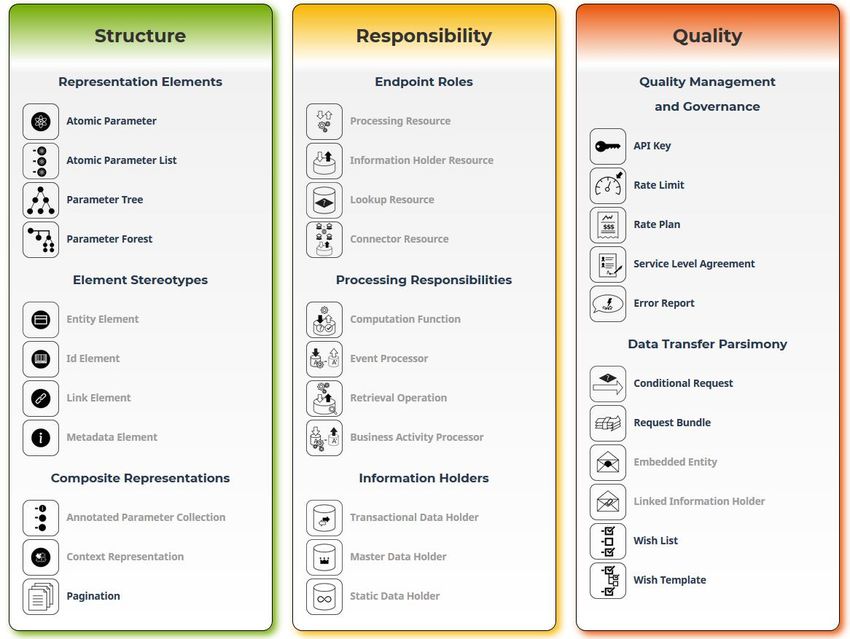
© Olaf Zimmermann, 2019.Microservices API Patterns (MAP): Pattern Index by Category
Page 17
© Olaf Zimmermann, 2019.
http://microservice-api-patterns.orgRecurring Architectural Decisions in (Micro-)Service Design
Quality-related decision model published at ICSOC 2018
More problem-pattern mappings (emerging):
MAP Cheat Sheet: https://microservice-api-patterns.org/cheatsheet
Attribute-Driven Design: https://microservice-api-patterns.org/patterns/byforce
Page 18
© Olaf Zimmermann, 2019.More Decisions that Recur in (Micro-)Service Design
https://microservice-api-
patterns.org/cheatsheet
(emerging)
Page 19
© Olaf Zimmermann, 2019.Open Problem: Service Identification/Design (“DDD 4 SOA/MSA”)
Research Questions
Which existing patterns are particularly suited to analyze and design cloud-
native applications and to modernize existing systems (monoliths/megaliths)?
How can these patterns be combined with Microservices API Patterns (MAP)
and other SOA/microservices design heuristics
to yield a service-oriented analysis and design practice?
Which patterns and practices do you apply? What are your experiences?
Page 20
© Olaf Zimmermann, 2019.Strategic DDD Context Map: Relationship Example
Insurance scenario, source: https://contextmapper.github.io/
D: Downstream, U: Upstream; ACL: Anti-Corruption Layer, OHS: Open Host Service
Page 21
© Olaf Zimmermann, 2019.Context Mapper: A DSL for Strategic DDD
Eclipse plugin Based on:
Xtext
ANTLR
Sculptor (tactic DDD DSL)
Author: S. Kapferer
Term project HSR FHO
Page 22
© Olaf Zimmermann, 2019.DDD Applied to (Micro-)Service Design
M. Ploed is one of the “go-to-guys” here (find him on Speaker Deck)
Applies and extends DDD books by E. Evans and V. Vernon
Reference: JUGS presentation, Berne, Jan 9, 2019
Page 23
© Olaf Zimmermann, 2019.Implementing Domain-Driven Design with RESTful HTTP APIs
Mentioned in DDD book by V. Vernon (and blog posts, presentations):
No 1:1 pass-through (interfaces vs. application/domain layer)
Bounded Contexts (BCs) offered by API provider, one API endpoint and
IDE project for each team/system BC (a.k.a. microservice)
Aggregates supply API resources or (responsibilities of) microservices
Services donate top-level (home) resources in BC endpoint as well
The Root Entity, the Repository and the Factory in an Aggregate suggest
top-level resources; contained entities yield sub-resources
Repository lookups as paginated queries (GET with search parameters)
Additional rules of thumb (own experience, literature):
Master data and transactional data go to different BCs/aggregates
Creation requests to Factories become POSTs
Entity modifiers become PUTs or PATCHes
Value Objects appear in the custom mime types representing resources
Page 24
© Olaf Zimmermann, 2019.Open Problem: Service Decomposition
Research Questions
How can systems be decomposed into services (in forward engineering)?
How do the applied criteria and heuristics differ
from software engineering and software architecture “classics”
such as separation of concerns and single responsibility principle?
Which methods and practices do you use? Are they effective and efficient?
Page 25
© Olaf Zimmermann, 2019.Heuristics that do not suffice (IMHO)
Two-pizza rule (team size)
Lines of code (in service implementation)
Size of service implementation in IDE editor
What is wrong with these “metrics” and “best practice”
recommendations?
Simple if-then-else rules
E.g. “If your application needs coarse-grained services, implement a SOA;
if you require fine ones, go the microservices way” (I did not make this up!)
Non-technical traits such as “products not projects”
Because context matters, as M. Fowler pointed out at Agile Australia 2018
Page 26
© Olaf Zimmermann, 2019.Agility, Consistency, State/Scalability (CAS) Tradeoffs
Business Data freshness
Agility Ability to respond to change
“Conservative” SOA
(Macroservices) Microservices
Big data requirements
Sharding, partitioning ACS
State management
Strict & eventual consistency
Dichotomy
Quick access, caching?
Audit requirements Stickiness in cluster?
Incl. backup
Resource Scalable
Consistency State Mgmt.
Modular Monolith
Page 27
© Olaf Zimmermann, 2019.Service Cutter (Proc. Of ESOCC 2016, Springer LNCS)
Advisor: Prof. Dr. Olaf Zimmermann
Bachelor Thesis Fall Term 2015 Co-Examiner: Prof. Dr. Andreas Rinkel
Software Lukas Kölbener Michael Gysel Project Partner: Zühlke Engineering AG
A Software Architect’s Dilemma….
Step 1: Analyze System
Entity-relationship model
How do I split Use cases
System characterizations
my system into Aggregates (DDD)
services?
Coupling information is
extracted from these artifacts.
Step 2: Calculate Coupling
The catalog of 16 coupling criteria
Data fields, operations and artifacts
are nodes. Step 3:
Edges are coupled data fields. Visualize Service Cuts
Scoring system calculates edge
weights. Priorities are used to
Two different graph clustering reflect the context.
algorithms calculate candidate Published Language
service cuts (=clusters). (DDD) and use case
responsibilities are
shown.
Technologies:
Java, Maven, Spring (Core,
Boot, Data, Security, MVC),
Hibernate, Jersey, JHipster,
A clustered (colors) graph. AngularJS, Bootstrap
A clustered (colors) graph. https://github.com/ServiceCutterCoupling Criteria (CC) in “Service Cutter” (Ref.: ESOCC 2016)
Full descriptions in CC card format: https://github.com/ServiceCutter/ServiceCutter/wiki/Coupling-Criteria
E.g. Semantic Proximity can be observed if:
Service candidates are accessed within same use case (read/write)
Service candidates are associated in OOAD domain model
Coupling impact (note that coupling is a relation not a property):
Change management (e.g., interface contract, DDLs)
Creation and retirement of instances (service instance lifecycle)
Page 29
© Olaf Zimmermann, 2019.Open Research Problem: Refactoring to Microservices
Research Questions
How to migrate a modular monolith to a services-based cloud application
(a.k.a. cloud migration, brownfield service design)?
Can “micro-migration/modernization” steps be called out?
Which techniques and practices do you employ? Are you content with them?
Page 30
© Olaf Zimmermann, 2019.Code Refactoring vs. Architectural Refactoring
Refactoring are “small behavior-preserving transformations”
(M. Fowler 1999)
Code refactorings, e.g. “extract method”
Operate on Abstract Syntax Tree (AST)
Based on compiler theory, so automation possible
(e.g., in Eclipse Java/C++)
Catalog and commentry: http://refactoring.com/
Architectural refactorings
Resolve one or more architectural smells, have an impact on quality attributes
Architectural smell: suspicion that architecture is no longer adequate (“good enough”)
under current requirements and constraints (which may differ form original ones)
Are carriers of reengineering knowledge (patterns?)
Can only be partially automated
Page 31
© Olaf Zimmermann, 2019.Refactoring to Microservices API Patterns
Template and cloud refactorings
First published @ SummerSoc 2016
Summary: IEEE Software, InfoQ
Architectural Refactoring: [Name]
Context (viewpoint, refinement level): Quality attributes and stories (forces):
• […] • […]
Smell (refactoring driver):
• […]
Microservices refactorings:
Architectural decision(s) to be revisited:
• […]
Future work for MAP
Refactoring (solution sketch/evolution outline):
• […]
Work in progress!
Affected components and connectors (if modelled explicitly):
• […]
Execution tasks (in agile planning tool and/or full-fledged design method):
• […]
Page 32
© Olaf Zimmermann, 2019.Open Problem: Service/Data Visualization (Modeling)
Research Questions
What is an intuitive, easy-to-sketch graphical representation for (micro-)services
and their endpoints, operations, and message representations?
Which notations and tools do you use?
Do they make communication effective and efficient?
Page 33
© Olaf Zimmermann, 2019.Visualizing Operations and Message Representations
Ports-and-adapters combined with layering (“hexagonioning”):
Inspired by https://herbertograca.com/2017/11/16/explicit-architecture-01-
ddd-hexagonal-onion-clean-cqrs-how-i-put-it-all-together/
Request
{[…]} message
representation
Adapters
Legend: Data Ports
Service Domain Logic {[…]}
Message
Response message representation
Layer
Required interface Provided interface Representation
Page 34
© Olaf Zimmermann, 2019.Example: Lakeside Mutual Microservices
Customer Self Service Application
Interface Layer
Domain Layer
Data
Layer
n/a Customer Core Microservice
Mutation
Checker
Customer Customer
myLakesideMutual Proxy Endpoint
Web Forms
Customer
Data
Use patterns to specify:
Role and responsibility of API call
Message representations
Documentation and governance
Page 35
© Olaf Zimmermann, 2019.Microservices – Summary and Opinions
Microservices have many predecessors (evolution not revolution)
Implementation approach and sub-style of SOA
More emphasis on autonomy and decentralization
(of decisions, of data ownership), less vendor-driven
Automation advances and novel target environments
One service size does not fit all
Context matters and forces at work
Size and granularity are not ends in themselves
Goal: achieve “Independent X” – but do not forget BAC and CAP (and ACS)
Architecture and architects needed more than ever
More options, higher consequences of not making adequate decisions
Microservices API Patterns; Context Mapper, Service Cutter
Public website now available
Pattern language, sample implementations, supporting tools
Service modeling, identification, decomposition, refactoring problems
Page 36
© Olaf Zimmermann, 2019.Microservices Publications
Zimmermann, O.: Microservices Tenets – Agile Approach to Service Development and Deployment
Springer Comp Sci Res Dev, 2017, http://rdcu.be/mJPz
(screen captions
are hyperlinks)
Pardon, G., Pautasso, C., Zimmermann, O.: Consistent Disaster Recovery for Microservices: the
Backup, Availability, Consistency (BAC) Theorem
In: IEEE Cloud Computing, 5(1) 2018, pp. 49-59.
Pahl, C., Jamshidi, P., Zimmermann, O.: Architectural Principles for Cloud Software
In: ACM Trans. on Internet Technology (TOIT), 18 (2) 2018, pp. 17:1-17:23.
Furda, A., Fidge, C., Zimmermann, O., Kelly, W., Barros, A.: Migrating Enterprise Legacy Source Code
to Microservices: On Multitenancy, Statefulness, and Data Consistency
In: IEEE Software, 35 (3) 2018, pp. 63-72.
Page 37
© Olaf Zimmermann, 2019.You can also read


