Engine oil specifications - Infineum Insight
←
→
Page content transcription
If your browser does not render page correctly, please read the page content below
Performance you can rely on.

                          Engine oil specifications

                               InfineumInsight.com/Learn

1       © 2020
    © 2017
      2020      Infineum
           Infineum       International
                     International      Limited.
                                   Limited.      All Rights
                                            All Rights      Reserved.
                                                       Reserved.      2017160.
                                                                 2017160.
Performance you can rely on.

    Outline
    • Main drivers for specifications

    • Industry committees and responsibilities

    • Specification overview - heavy duty diesel and passenger car engine oils

    • API Engine Oil Licensing and Certification System (EOLCS)

    • ACC code of practice

    • European specification system

2    © 2020 Infineum International Limited. All Rights Reserved. 2017160.
Performance you can rely on.

    Oil and additive industry value chain
                                                                                Product flow

                                                                                   Government/                                 Requirement
                                                                                   legislators                                   setters
                                               New environmental
                                                     legislation
                                                                                                                                Lubricant
                                                                                      Engine                                      users
                                                                                     builders
           Requirement flow

                                           New hardware requires                                                                Lubricant
                                           higher quality oil
                                                                                                                                 supply
                                                                                     Industry
                                                                                    committees

                                                                                      New oil
                                                                                   specifications

                                    Integrated                     Additive                                        Lubricant
                                                                                Additive          Lubricant                         Vehicle
                                    petroleum                     component                                          sale
                                                                               companies         companies                          owners
                                    companies                      suppliers                                       channels

                                                                                   New additives        New oils

3    © 2020 Infineum International Limited. All Rights Reserved. 2017160.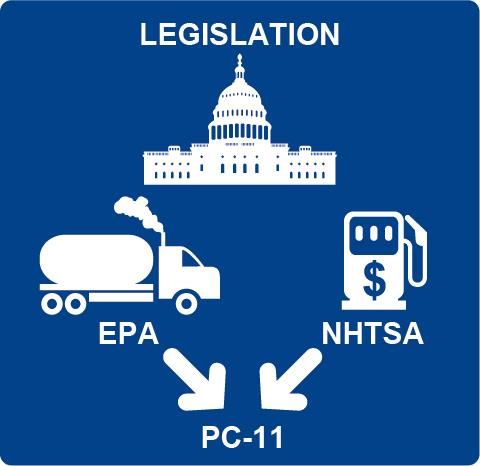
Performance you can rely on.

    Organizations classifying engine performance
    • Industry associations
        –       API → American Petroleum Institute
        –       ILSAC → International Lubricant Standardization and Approval Committee
        –       ACEA → European Automobile Manufacturers Association
        –       JASO → Japanese Standard Organization

    • Vehicle or Original Engine Manufacturers (OEMs), such as:
        –       General Motors (GM)
        –       Volkswagen (VW)
        –       Daimler
        –       Volvo
        –       Scania

4    © 2020 Infineum International Limited. All Rights Reserved. 2017160.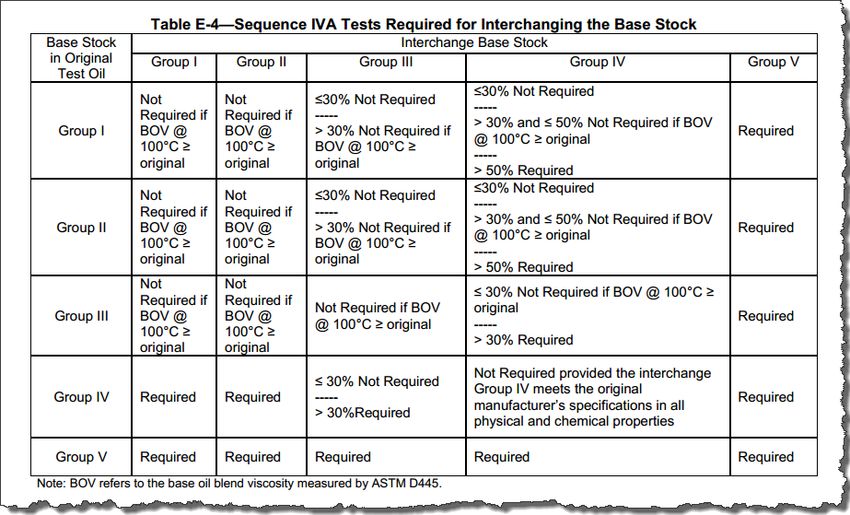
Performance you can rely on.
Industry trade organizations and responsibilities
(North America)
How to ensure oils are compatible
with engine hardware advances?
Have oils meet specifications
How to assist customers in
choosing quality oils?
Have system for licensing
and certification
How to maintain quality of
lubricant development process?
Outline acceptable practices
5 © 2020 Infineum International Limited. All Rights Reserved. 2017160.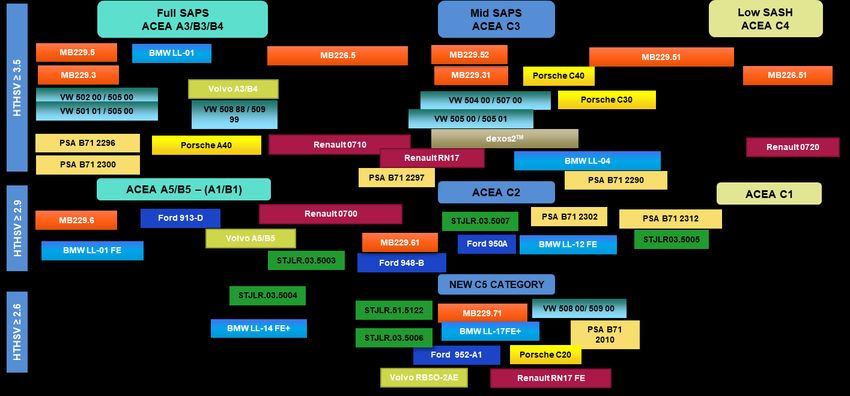
Performance you can rely on.

    Engine tests are the basis of specifications
                                                                Rig           Engine         Field
            Bench tests                                                                                  Application
                                                             simulations       tests         trials
                                                   Diminishing ability to demonstrate REAL performance

                                                          Increasing cost and time to develop/acquire data

    • Developed by individual OEMs or industry groups to target specific performance
      parameters of concern
    • Assessed relative to reference oil of known field performance
    • Development should consider:
       – parts availability and quality
       – test conditions and duration
       – parameters of interest and pass/fail limits
       – qualification of test facilities
    • Monitored continually by industry
    • Specifications derived from compilation of engine tests and limits
6    © 2020 Infineum International Limited. All Rights Reserved. 2017160.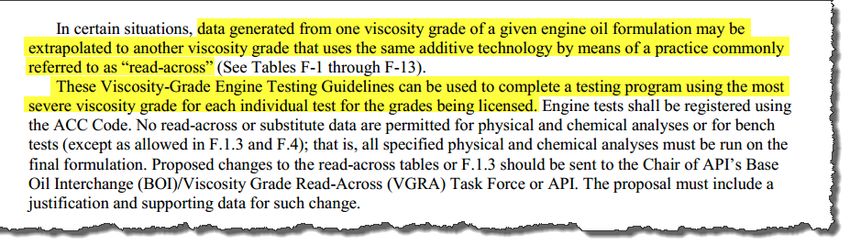
Performance you can rely on.

    Evolution of API Engine Oil Specifications

7    © 2020 Infineum International Limited. All Rights Reserved. 2017160.
Performance you can rely on.

                            Heavy-duty specifications

8   © 2017
      2020 Infineum International Limited. All Rights Reserved. 2017160.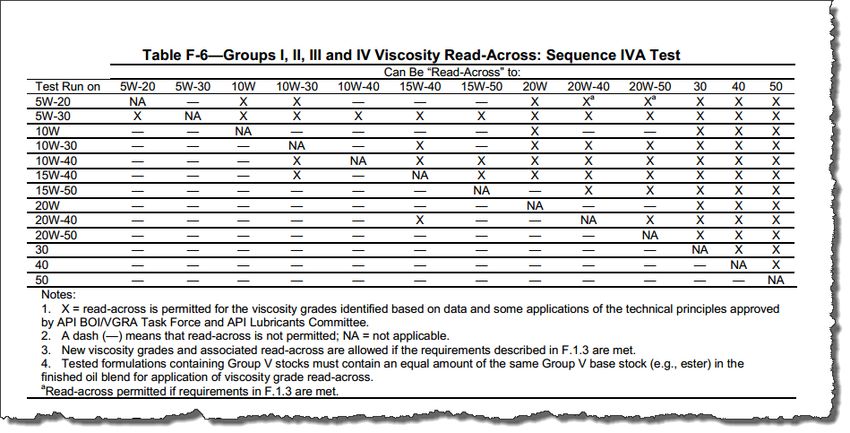
Performance you can rely on.

    API diesel specifications

      API Category                                      Status                                      API recommendations
                                                                            Introduced in 2016
                                                                            To meet 2017 model year on-highway exhaust emission standards
                                                                            Sulfur content up to 500 ppm (0.05% by weight)

                     CK-4                                 Current           > 15 ppm (0.0015% by weight) may impact exhaust aftertreatment system
                                                                            durability and/or drain interval (Consult engine manufacturer)
                                                                            Effective at sustaining durability of emission control system (particulate filters and
                                                                            other advanced aftertreatment systems)
                                                                            Can be used in CH-4, CI-4, CI-4+, CJ-4 applications
                                                                            Similar to CK-4, but for lower HTHS oils
                     FA-4                                 Current

                                                                            Introduced in 2006
                                                                            To meet 2010 model year on-highway exhaust emission standards
                                                                            Sulfur content up to 500 ppm (0.05% by weight)
                     CJ-4                                 Current
                                                                            > 15 ppm (0.0015% by weight) may impact exhaust aftertreatment system
                                                                            durability and/or drain interval (Consult engine manufacturer)
                                                                            Can be used in CF-4, CG-4, CH-4, CI-4, CI-4+ applications

9    © 2020 Infineum International Limited. All Rights Reserved. 2017160.
Performance you can rely on.
API CK-4 & FA-4: oxidation and fuel economy
• New fuel economy and greenhouse gas rules
began phased implementation in 2014 with full
effect in 2018
– Reduce CO2 by 270 million tons and save
530 million barrels of oil
• At the June 2011 ASTM meeting, the EMA issued
a formal request for a new API performance
category to help meet these new regulations
• Areas requested for improvement versus API CJ-4
– Shear stability
– Oxidation
– Aeration
– Bio-diesel compatibility (eventually dropped)
– New lower viscosity oils to help deliver fuel economy performance
• API first license date was December 1, 2016
10 © 2020 Infineum International Limited. All Rights Reserved. 2017160.Performance you can rely on.
OEM heavy-duty diesel specifications (1)
Base Industry
OEM Specification Differences
Specification
ECF-1-a CH-4 + Caterpillar 1P; SASH restrictions
Caterpillar ECF-2 CI-4/CI-4 PLUS + Caterpillar C13; SASH restrictions
ECF-3 CJ-4 None
+ Mitsubishi 4D34T4; - Mack T-9;
DFS 93K215 CH-4
+ Mack T-10; + OM501LA
DFS 93K214 CI-4 PLUS + OM501LA
Detroit Diesel DFS 93K218 CJ-4 + OM501LA; + OM646LA
DFS 93K222 CK-4 + OM501LA; + OM646LA; +DD13 Scuff
DFS 93K223 FA-4 + OM501LA; + OM646LA; +DD13 Scuff
11 © 2020 Infineum International Limited. All Rights Reserved. 2017160.Performance you can rely on.
Passenger car engine oils
specifications
12 © 2017
2020 Infineum International Limited. All Rights Reserved. 2017160.Performance you can rely on.
API and ILSAC gasoline specifications
ILSAC
Status ILSAC Service Recommendations
Category
Meant to be introduced in 2016, but has been delayed due to the introduction of 7 new and replacement
GF-6A and engine tests. Designed to provide improved Fuel Economy, LSPI protection for modern turbocharged
Current
GF-6B engines, improved deposits protection for pistons and new improved cam chain wear performance. GF-6A
designed to be backwards compatible and GF-6B to accommodate new 0W-16 viscosity grade.
Current
GF-5 Introduced in October 2010 for 2011 and older vehicles.
but older
GF-4, GF-3,
Obsolete Use GF-5 where GF-4, GF-3, GF-2 or GF-1 is recommended.
GF-2, GF-1
API Category Status API Recommendations
For 2011 and older vehicles, designed to provide improved high temperature deposit protection for pistons,
SN, SN with
more stringent sludge control and seal compatibility. API SN with Resource Conserving matches ILSAC GF-
Resource Current
5 by combining API SN performance with improved fuel economy, turbocharger protection, emission control
Conserving
system compatibility and protection of engines operating on ethanol containing fuels up to E85.
Current
SM - SJ but For older automotive engines.
older
SH, SG, SF,
SE, SD, SC, Obsolete Not recommended for modern gasoline engines.
SB, SA
13 © 2020 Infineum International Limited. All Rights Reserved. 2017160.Performance you can rely on.
ILSAC
What is ILSAC?
• International Lubricant Standardization and Approval Committee
• A committee consisting of major US vehicle manufacturers and JAMA
formed in 1992
• Chrysler, General Motors (GM), and Ford
• Honda, Isuzu, Mazda, Mitsubishi, Nissan, Subaru, and Toyota
What does ILSAC do?
• Sets complimentary specs to API passenger car specs to include fuel
efficiency and catalyst protection
• Goes beyond ‘engine protection’ which is the basis for the API specs
– Protects the catalyst system and adds a fuel efficiency measurement
• During update of ILSAC specifications the previous specification is only
valid during a one year transition period
– API specification become obsolete when no longer required
or the tests are unavailable
14 © 2020 Infineum International Limited. All Rights Reserved. 2017160.Performance you can rely on.
GF-6: An unprecedented challenge
• AC GF-6 will contain 4 replacement engine tests and 3 new engine tests
– This is a historic level of change in a category, only the Seq. VIII is unchanged
ILSAC GF-5
Sequence IIIG 1996 GM 3.8L PFI
Sequence IVB
Cam Wear Sequence IVA 1994 Nissan 2.4L PFI
Ford Chain Wear Sequence VG 2000 Ford 4.6L PFI
Chain Extension
Sequence VID 2009 GM 3.6L PFI
Sequence VIII CLR Test 0.7L
Sequence VIE/F
Fuel Economy
Ford LSPI ILSAC GF-6A/B
Pre-ignition
Sequence IIIH 2012 FCA 3.6L PFI
Sequence IVB 2010 Toyota 1.5L PFI
Sequence IIIH
Piston Cleanliness
Sequence VH 2013 Ford 4.6L PFI
Sequence VIE 2012 GM 3.6L PFI
Sequence VH
Sludge Control
Sequence VIII CLR Test 0.7L
Sequence VIII Sequence VIF 2012 GM 3.6L PFI
Bearing Corrosion
Sequence IX (Ford LSPI) 2016 Ford 2.0L GDI
Sequence X
2016 Ford 2.0L GDI
(Ford Chain Wear)
15 © 2020 Infineum International Limited. All Rights Reserved. 2017160.Performance you can rely on.
OEM PCMO specifications
Base industry
OEM Specification Key differences
specification
Enhanced elastomers;
Chrysler MS-6395T GF-5/6(?)
+ Las Vegas field trial
WSS-
GF-5
M2C945A/6A
Ford
WSS- API SN PLUS
M2C945/6/7 B1 RC
GMOD instead of IIIH, enhanced VH
Gen1: GF-5
performance; + M271SL;
GM dexos1™ Gen2: GF-5/6
+GM FE test; + GM Aeration; + GM TC
Gen 3: GF-6
test; + MTM bench wear test
Honda/Acura HTO-06 GF-5 + Hot Tube Test
16 © 2020 Infineum International Limited. All Rights Reserved. 2017160.Performance you can rely on.
EOLCS and ACC code of practice
17 © 2017
2020 Infineum International Limited. All Rights Reserved. 2017160.Performance you can rely on.
Engine oil licensing and certification system (EOLCS)
• Voluntary licensing and certification
program
• Designed to define, certify, and monitor
engine oil performance
• Assist customers in identifying products
by licensing two (2) marks:
• Ensure compliance by auditing
– Verifying physical and chemical
properties of oil with licensing data on file
at API
– Subjecting a randomized, limited number
of products to engine and bench testing
– World-wide remit
18 © 2020 Infineum International Limited. All Rights Reserved. 2017160.Performance you can rely on.
Comparison of licensing marks
API Service Symbol API Certification Mark
‘donut’ ‘starburst’
API S_ = service categories for cars, vans, and Current ILSAC performance level
light trucks with gasoline engines
API C_ = commercial category for heavy-duty
trucks and vehicles with diesel engines
19 © 2020 Infineum International Limited. All Rights Reserved. 2017160.Performance you can rely on.
ILSAC GF-6A and GF-6B symbol
API Certification Mark API Certification Mark
‘starburst’ ‘shield’
ILSAC GF-6A ILSAC GF-6 B
Future ILSAC performance level
20 © 2020 Infineum International Limited. All Rights Reserved. 2017160.Performance you can rely on.
EOLCS licensing
• All engine tests must be conducted per the American Chemistry Council
(ACC) code of practice
– Marketer is ultimately responsible for product performance, however they may
utilize the following guidelines in lieu of engine testing, when appropriate (fully
explained in API 1509 document):
– API Base Oil Interchange (BOI)
– API Viscosity Grade Read-Across (VGRA)
• Marketer must disclose:
– physical and chemical properties
– bench test data
– product traceability code
• Marketer must agree to monitoring and enforcement procedures
• Each viscosity grade and brand requires an individual license
21 © 2020 Infineum International Limited. All Rights Reserved. 2017160.Performance you can rely on.
ACC code of practice: what is it?
• Officially called the ACC ‘Petroleum Additives Product Approval Code of
Practice’
• ACC is the American Chemistry Council, which is involved in a wide
spectrum of activity affecting the chemical industry in North America
• For our purposes, the ACC represents the North American lube additive
industry
• It’s code of practice is a minimum standard covering lubricant additive
validation and reporting
• Maintains consistent quality of the lubricant development process through
guidelines for program management
• Code does not . . .
– Establish needs or develop tests; set limits; deal with labeling or licensing;
after market testing
22 © 2020 Infineum International Limited. All Rights Reserved. 2017160.Performance you can rely on.
ACC code of practice: main features
• Engine Testing:
– Test stands are calibrated, referenced & monitored with ASTM Test Monitoring
Centre (TMC)
– Scheduled tests are pre-registered with monitoring agency (TMC) and can
only be run in stands meeting acceptance criteria
– Scheduled tests can be placed at a laboratory of choice, but test stands are
randomly assigned
– Test results are severity adjusted then judged against criteria for averaging
results known as MTEP (multiple test evaluation procedures)
• Additive package formulation
– Minor formulation modifications are controlled against allowed limits and
criteria (16 detailed sets of guidelines in Appendix H and I of the ACC code)
• Presentation of results
– Results are communicated to customer via a Candidate Data Package (CDP)
• Compliance - Annual internal and external audits
23 © 2020 Infineum International Limited. All Rights Reserved. 2017160.Performance you can rely on.
Base oil interchange (BOI) guidelines
(API 1509)
• Developed to improve efficiency while maintaining confidence in engine
oil performance when interchanging base stocks
• Based on engine test data demonstrating that base stock changes within
a defined range have no significant impact on the tests/parameters of
interest
• May be quite simple (i.e. no restriction among API groups) or subject to
numerous criteria on saturates, sulfur content, viscosity index (VI) and
base oil viscosity (BOV)
24 © 2020 Infineum International Limited. All Rights Reserved. 2017160.Performance you can rely on. BOI example – Seq. IVA 25 © 2020 Infineum International Limited. All Rights Reserved. 2017160.
Performance you can rely on.

 Viscosity grade read-across (VGRA) guidelines

           (API 1509)

     • Similar to BOI, developed to improve efficiency

     • General principles of VGRA include read-across from most difficult to less-
       difficult viscosity grades
       – From high viscosity modifier (VM) treat to low VM treat
       – From high volatility base stock to low volatility base stocks

26    © 2020 Infineum International Limited. All Rights Reserved. 2017160.
Performance you can rely on. VGRA example – Seq. IVA 27 © 2020 Infineum International Limited. All Rights Reserved. 2017160.
Performance you can rely on.

 ILSAC GF-6 approval cost
                                                                      Test    Cost
                                                                  Seq. IIIH   $59k
                                                                  Seq. IVB    $57k
                                                                  Seq. VH     $63k
                                                                  Seq. VIII   $15k
                                                                  Seq. VIE    $45k
                                                                    Seq IX    $19K
                                                                     Seq X    $48K
                                                                     Bench     $9k

                                                                  TOTAL       $315k

     Total cost assumes 1st time passes for each test, and only offers limited viscosity
                               grade and base oil coverage

28   © 2020 Infineum International Limited. All Rights Reserved. 2017160.
Performance you can rely on.
API CK-4 estimated approval cost
Test Cost
Caterpillar C13 $185k
Caterpillar 1N $32k
Cummins ISB $86k
Cummins ISM $113k
Roller Follower Wear Test $13k
Mack T-11 $92k
Mack T-12 $160k
Volvo T-13 $166k
Caterpillar C13 Oil Aeration Test $23k
Seq. IIIH $59k
Bench $6k
TOTAL $935k
Similar to PCMO, total cost of assumes 1st time passes for each test
29 © 2020 Infineum International Limited. All Rights Reserved. 2017160.Performance you can rely on.
European specification system
30 © 2017
2020 Infineum International Limited. All Rights Reserved. 2017160.Performance you can rely on. European OEM specifications 31 © 2020 Infineum International Limited. All Rights Reserved. 2017160.
Performance you can rely on.

     ACEA Sequences

        PSA                                    VW                            Ford   Daimler     Volvo       Scania               Etc.

            ACEA – Industry body consisting of group of European OEMs

     ACEA Light Duty (LD) Sequences                                                   ACEA Heavy Duty (HD) Sequences
     • Covers lubricants for passenger                                                • Covers lubricants for heavy duty
       car diesel and gasoline vehicles                                                 trucks and buses

     • Define a minimum “baseline” quality level for lubricants to be used in
       ACEA members’ engines
     • Are self-certified – there is no formal approval body.
               – But oils must conform to a specified quality system (EELQMS)
               – This includes compliance with ATC and ATIEL codes

32    © 2020 Infineum International Limited. All Rights Reserved. 2017160.
Performance you can rely on.
Market segmentation for German OEM and ACEA
specifications
Full SAPS Mid SAPS Low ASH ▪ NA OEM specs are
predominately Full SAPs
BMW LL-01 BMW LL-04 (>1.0% SASH)
3.5 cP ACEA
XW-40
MB 229.5 MB 229.51 & 52
HTHS VW 502/505 VW 504/507
Min A3/B4 C3 C4 ▪ North America gasoline
quality a concern by some in
2.9 cP BMW LL-01 FE BMW LL-12 FE ACEA move to Mid- SAPS
XW-30
HTHS MB 229.6 MB 229.61
Min A5/B5 C2 C1
BMW LL-17 FE+
▪ Mid SAPS was predominantly
2.6 cP used for diesel vehicles but
XW-20
MB 229.71
HTHS BMW LL-14 FE+
VW 508/509 (blue) this is changing
Min C5
2.3 cP ▪ OEMS Future direction
XW-16
BMW LL-XX FE+
HTHS MB 229.81
towards Mid SAPS and lower
Min viscosity
▪ Enables FE goals
2.0 cP ▪ Emissions Protection (GPF)
XW-12
BMW LL-YY FE+
HTHS VW ZZZ
Min
33 © 2020 Infineum International Limited. All Rights Reserved. 2017160.Performance you can rely on.
ACEA 2016 sequences
Gasoline & Light Duty
Diesel Engine Oils A3/B3-16 A3/B4-16 A5/B5-16
Sequences
ACEA LD
A/B Categories
Catalyst & GPF compatible
Engine Oils for Gasoline &
Light Duty Diesel Engines
C1-16 C2-16 C3-16 C4-16 C5-16
C-Categories
Sequences
ACEA HD
Heavy Duty Diesel Engine
Oils E4-16 E6-16 E7-16 E9-16
E-Categories
34 © 2020 Infineum International Limited. All Rights Reserved. 2017160.Performance you can rely on.
Summary
• OEMs continue to challenge the oil and additive industries with increased
quality level requirements
• Marketers must offer oils that meet both industry and OEM specifications
• The number and complexity of industry and OEM specifications increase
as OEMs introduce new hardware and emission system solutions
• Diversity in specification requirements cause increased fragmentation of
products in the marketplace
35 © 2020 Infineum International Limited. All Rights Reserved. 2017160.Performance you can rely on.
Permissions
Permission is given for storage of one copy in electronic means for reference purposes. Further reproduction of any
material is prohibited without prior written consent of Infineum International Limited.
The information contained in this document is based upon data believed to be reliable at the time of going to press and
relates only to the matters specifically mentioned in this document. Although Infineum has used reasonable skill and
care in the preparation of this information, in the absence of any overriding obligations arising under a specific contract,
no representation, warranty (express or implied), or guarantee is made as to the suitability, accuracy, reliability or
completeness of the information; nothing in this document shall reduce the user’s responsibility to satisfy itself as to the
suitability, accuracy, reliability, and completeness of such information for its particular use; there is no warranty against
intellectual property infringement; and Infineum shall not be liable for any loss, damage or injury that may occur from the
use of this information other than death or personal injury caused by its negligence. No statement shall be construed as
an endorsement of any product or process. For greater certainty, before use of information contained in this document,
particularly if the product is used for a purpose or under conditions which are abnormal or not reasonably foreseeable,
this information must be reviewed with the supplier of such information.
Links to third party websites from this document are provided solely for your convenience. Infineum does not control
and is not responsible for the content of those third party websites. If you decide to access any of those websites, you
do so entirely at your own risk. Please also refer to our Privacy Policy.
INFINEUM, 润英联, SYNACTO and the interlocking ripple device are Trade Marks of Infineum International Limited.
© 2020 Infineum International Limited. All rights reserved.
36 © 2020 Infineum International Limited. All Rights Reserved. 2017160.You can also read


