Evaluating performance of LED based luminaires Guidance Paper - FEEI
←
→
Page content transcription
If your browser does not render page correctly, please read the page content below
Evaluating performance of
                 LED based luminaires

                 Guidance Paper

LIGHTINGEUROPE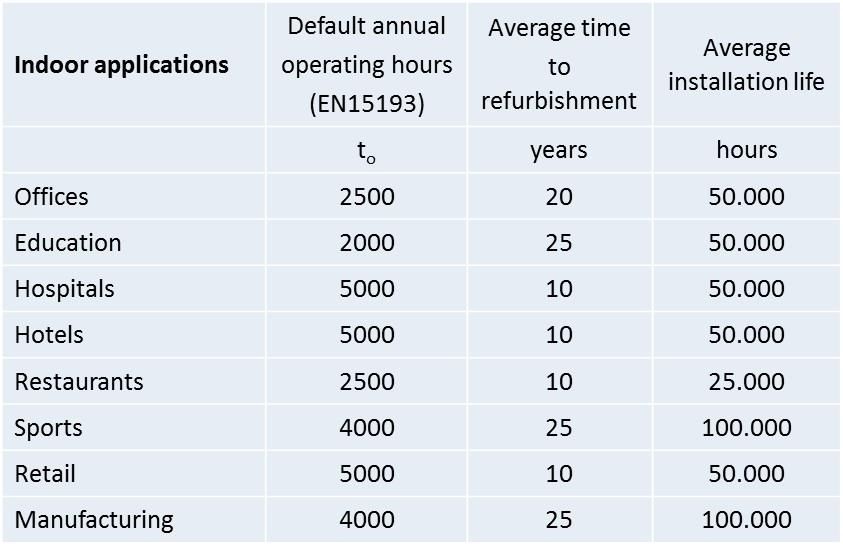
Disclaimer
     This information is for general guidance on matters of interest only. While we have made every
     attempt to ensure that the information has been obtained from reliable sources, LightingEurope is
     not responsible for any errors or omissions, or for the results obtained from the use of this
     information.
     The content of this document is a recommendation only and is not binding to any party.
     LightingEurope members are not bound to adhere to this document.
     All information is provided with no guarantee of completeness, accuracy, timeliness or of the
     results obtained from the use of this information, and without warranty of any kind, express or
     implied, including, but not limited to warranties of performance, merchantability and fitness for a
     particular purpose.
     In no event will LightingEurope, its related partnerships or corporations, or the partners, agents
     or employees thereof be liable to you or anyone else for any decision made or action taken in
     reliance on the information or for any consequential, special or similar damages, even if advised
     of the possibility of such damages.

     Executive Summary
     The intention of this paper is to provide guidance to users (like specifiers, lighting
     designers, technical engineers and policy makers) of LED based luminaires intended for
     lighting projects. It enables ‘apple-to-apple’ comparison and easy evaluation of
     manufacturers’ performance data when preparing lighting projects or tender
     specifications.

     Emphasis will be put on explaining the “useful life” (useful lifetime) performance
     requirements. The paper recommends a fixed set of performance data for LED based
     luminaires. This data set is focused on the information which is necessary for lighting
     application design.

                                                                                        January 2018

LIGHTINGEUROPE                                                                                      PAGE 2 OF 20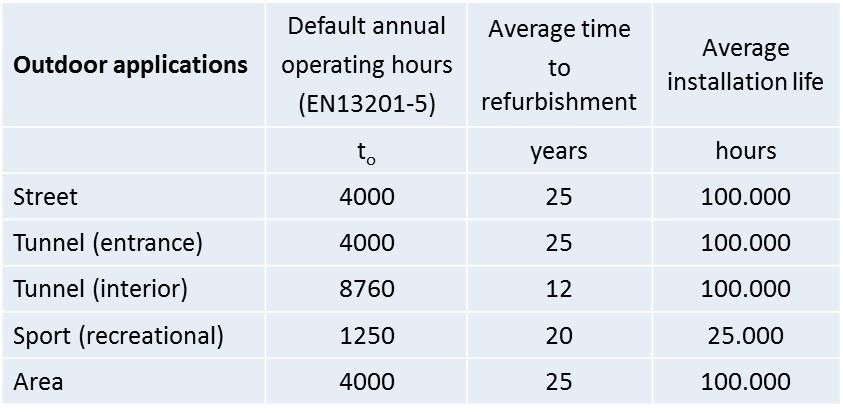
Content of the document

     1.     Introduction

     2.     Lighting requirements
     2.1    Luminaire performance parameters (following IEC)
     2.2    Lighting application requirements (following CEN)

     3.     Lifetime considerations
     3.1    Gradual light output degradation
     3.2    Abrupt light output degradation
     3.3    Why lifetime is not always a critical factor
     3.4    Maintenance factor considerations in different applications

     4.     LightingEurope recommendations
     4.1    Recommended initial performance data
     4.2    Recommended useful lifetime performance data

     Annex A: Terms, definitions and references
     Annex B: Application requirements from EN standards
     Annex C: Example data sheet – LED luminaire performance data

LIGHTINGEUROPE                                                            PAGE 3 OF 20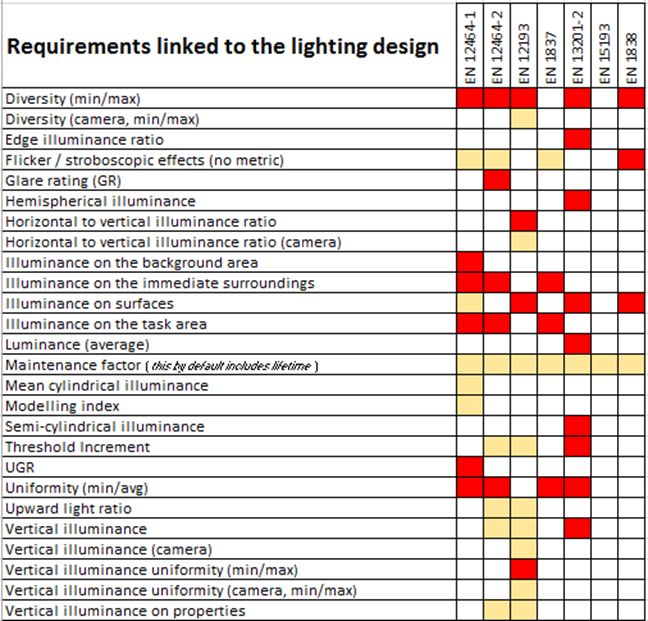
1. Introduction: evaluating performance of LED based luminaires

     In recent years, there has been a significant increase in the use of LED based luminaires.
     Initially, there were no universal standards available to measure or compare the
     performance of LED based lighting products. There is confusion among customers about
     which LED based luminaire to choose.

     However, while the quality of LED technology has rapidly improved and the application
     considerations have not changed, the product data have remained unnecessarily
     complex. In this regard, the main challenge for the professional market is to improve the
     way users of LED based luminaires evaluate the performance data of different
     manufacturers when preparing lighting projects or tender specifications. Today they often
     compare – unwittingly – apples with pears.

     Both ‘initial’ and ‘useful lifetime’ performance data have to be evaluated in order to have
     confidence in how LED based luminaires will perform and how long they will sustain their
     rated characteristics over their years of operation.

           Fig 1 – Evaluating ‘initial’ and ‘useful lifetime’ performance of LED based luminaires

     As things stand at present, evaluating LED based luminaires is complex because of two
     main reasons:

         1. The use of different technical definitions and related parameters to describe the
            performance of products, thus making them difficult to compare (for example
            incorrect use of LED module or light source data instead of luminaire data);

         2. The technical design choices made for a product can make a tremendous
            difference in terms of performance over the useful lifetime.

     LightingEurope is of the opinion that the establishment of simplified performance metrics
     that support the needs of good lighting design and allow easy product to product
     comparisons to be made will add value to the professional market.

     Confusion due to the use of different sets of definitions can be eased by following the
     latest IEC/EN standards on performance of LED based luminaires. These standards give
     guidance on ‘what’ (phenomena and metric) to publish and ‘how’ (measurement and/or
     calculation method) to arrive at a set of comparable product specifications.

LIGHTINGEUROPE                                                                                      PAGE 4 OF 20
2. Lighting requirements

     Good lighting design calculations require different technical product parameters based
     on standardised and therefore comparable data. IEC 62722-2-1 Performance
     requirements for LED based luminaires, gives an overview of the relevant ‘initial’ and
     ‘useful lifetime’ product information parameters that should be used for the planning of
     lighting designs.

     2.1 Luminaire performance parameters (following IEC/CENELEC)

     Relevant product information parameters as described in IEC 62722-2-1:

         1. Rated input power (P in W)
         2. Rated luminous flux (Φ in lm)
         3. Rated luminous efficacy (η in lm/W)
         4. Rated luminous intensity distribution (in cd or cd/klm)
         5. Rated correlated colour temperature (Tcp in K)
         6. Rated colour rendering index (CRI)
         7. Ambient temperature related to performance of the luminaire (tq in ˚C)
         8. Rated median useful life (Lx in hours with x for the associated rated luminous
            flux maintenance factor in %)
         9. Rated abrupt failure value (in %)

     In this context ‘rated’ means the value of the parameter for the LED based luminaire
     declared by the manufacturer when operated under specified conditions. It is reminded
     that the tq value for which the performance data is declared shall always be reported even
     if this is 25˚C. Where applications require tq temperatures other than 25˚C all performance
     data is required to reflect the actual performance for these specific tq temperatures.

     To enable apple-to-apple comparison LightingEurope recommends that performance
     data set should always be declared at a tq of 25˚C. Manufacturers may declare additional
     performance data sets at different tq values.

     In this section, the initial luminaire performance parameters (1-7) are described that can
     be used as input for lighting design calculations. The useful lifetime luminaire
     performance parameters (8-9) are described in section 3. Lifetime considerations. Annex
     A provides the terms and definition, including a reference to standard for measurement
     methods, which is essentially for EN 13032-4

     Common examples of misrepresentation of performance data are:
     1) Luminous flux output for LED module being stated instead of the luminous flux output
        for the complete luminaire.
     2) Data based on 25 °C operation temperature of the LED module or light source instead
        of data based on the actual operating temperature of the source inside the luminaire.
     3) Operating power being based on just that of the LED module or light source instead
        of that consumed by the complete luminaire.
     4) Incorrect comparison of power / efficiency between luminaires containing built in
        control gear and those using remote control gear.

LIGHTINGEUROPE                                                                               PAGE 5 OF 20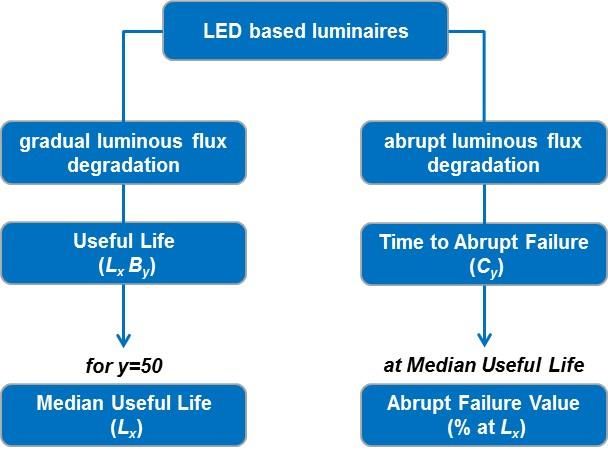
5) A combination of incorrect input power and luminous flux output values resulting in
        inflated efficacy.

     2.2 Lighting application requirements (following CEN)

     When considering if a product is the best solution for an application we need to
     understand what should be calculated to ensure that the correct lit environment is created.

     When requirements are specific to the given lighting solution within the application space,
     a lighting design needs to be performed. In that case the data requirements when
     considering a particular lighting product should be application driven and consider what
     information is required to ensure the lighting solution is correct for the application space.
     Any data that is not driven by the application requirements should be considered of
     secondary importance.

     Table 1 shows, according to European standards, which product requirements are
     relevant for each application and which of these requirements can be fulfilled wholly by
     the product data and therefore can be specified on a product datasheet.

     Annex B provides a detailed overview of application requirements specified in the
     different European (EN) application standards.

                                            EN            EN              EN             EN             EN              EN
No   IEC 62722-2-1
                                          12464-1       12464-2          15193         13201-2        13201-5          12193
 1   Input power                                                            x                             x
 2   Luminous flux                            x             x                              x                              x
 3   Luminaire efficacy                                                     x                             x
 4   Luminous intensity distribution          x             x                              x                              x
 5   Correlated Color Temperature             x             x                              x                              x
 6   Color Rendering Index                    x             x                              x                              x
 7   Ambient temperature                   This value is not directly required by the standards but the value is fundamentally
                                             necessary for a correct and comparable operation in the lighting application.
 8   Median Useful Life (depreciation)        x             x               x              x                              x
 9   Abrupt Failure Value (failures)          x             x                              x                              x

                     Table 1 – Product data directly linked to lighting application standards
     Key to the standards
     IEC 62722-2-1:2016 - Luminaire performance: Particular requirements for LED
     luminaires.
     EN 12464-1:2011 - Light and lighting: Lighting of work places Part 1: Indoor work
     places.
     EN 12464-2:2014 - Light and lighting: Lighting of work places Part 2: Outdoor work
     places.
     EN 15193:2007 - Energy performance of buildings: Energy requirements for lighting.
     EN 13201-2:2015 - Road lighting Part 2: Performance requirements
     EN 13201-5:2016 - Road lighting Part 5: Energy performance indicators
     EN 12193:2007 - Light and lighting: Sports lighting

LIGHTINGEUROPE                                                                                                       PAGE 6 OF 20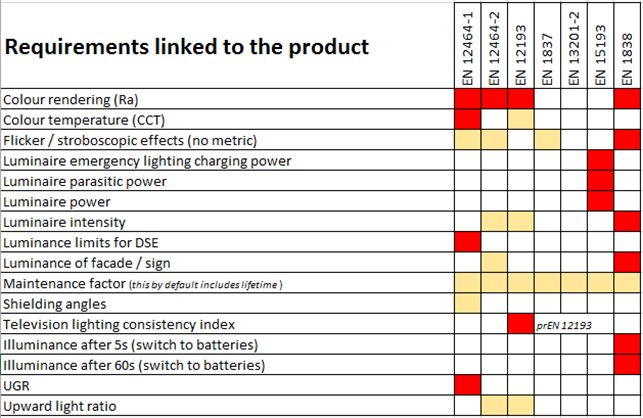
3. Lifetime considerations

     3.1 Overview

     There are two relevant useful lifetime performance values to be considered related to
     ‘gradual’ and ‘abrupt’ luminous flux output degradation of a LED based luminaire.

     Gradual luminous flux output degradation relates to the lumen maintenance of the light
     source in a luminaire. It describes how much of the initial luminous flux output of the light
     sources in the luminaire is available after a certain period of time. Luminous flux output
     depreciation can be a combination of individual LEDs giving less light and individual LEDs
     giving no light at all.

     Note: There are currently no standards available for the assessment of the degradation of additional optical
     elements.

     Abrupt luminous flux output degradation describes the situation where the LED based
     luminaire no longer gives any light at all because the system (or a critical component
     therein) has failed.

                                            Fig 2 – IEC lifetime metric

     Both ‘gradual’ and ‘abrupt’ luminous flux output degradations have been described in the
     IEC lifetime metric for LED based luminaires. IEC suggests applying a standard set of
     quantities for communication to the market: ‘Median Useful Life’ and the associated
     ‘Abrupt Failure Value’.

     As the Median Useful Life of LED based luminaires can be very long, it is important to
     understand that useful lifetime performance values are predictions rather than
     measurements. For manufacturers, it is not possible to measure the useful lifetime values
     with, for example, 50.000 h before launching new products. Instead, the manufacturers
     use shorter assessment periods and extrapolate the results to arrive at predictions.

LIGHTINGEUROPE                                                                                               PAGE 7 OF 20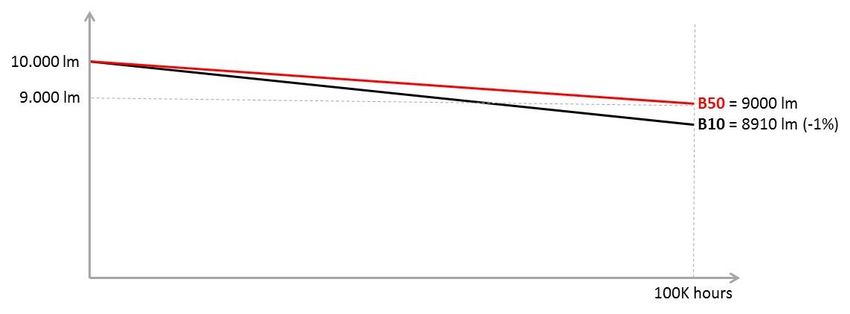
Note: Methods for accelerated lifetime assessments for LED based products are currently
     not available.
     The IEC performance standards currently describe lifetime metrics for LED based
     products but not how to measure/calculate the parameter of the lifetime metrics. As a
     consequence, the quality of the lifetime predictions varies wildly and there is a significant
     risk of apple-to-pear comparison.

     Reputable manufacturers will calculate Median Useful Life and associated Abrupt Failure
     Value based on historical design data and knowledge, component level testing and
     thermal design.
     Lifetime data are normally specified together with a specific ambient temperature (tq), the
     number of burning hours and the associated switching cycles.

     3.2 Gradual luminous flux degradation – Useful Life and Median Useful Life

     The gradual light output degradation of a population of LED based luminaires at a certain
     point in time is called Useful Life and expressed in general as LxBy. The population
     includes operating LED based luminaires only; non-operative products are excluded.

     Useful Life expresses the age at which a given percentile of LED based luminaires (y)
     cannot meet the lumen maintenance factor x. Light output lower than the required
     luminous flux maintenance factor x called flux degraded because they produce less light
     but still operate.

     In order to unambiguously compare manufacturers’ lifetime data, IEC introduced Median
     Useful Life (Lx). Median Useful Life is the time at which 50 % (B50) of a population of LED
     based luminaires are flux degraded. Median Useful Life is generally expressed as Lx so
     without the B50 notification.

     Example: Median Useful Life L90 is understood as the length of time during which 50 %
     (B50) of a population of operating LED based luminaires of the same type have flux
     degraded to less than 90 % (L90) of their initial luminous flux but are still operating.

     Besides the median value (B50), in the market an apparent demand for B10 or even B0
     rated products exists. Although By is a defined performance characteristic, the standard
     IEC 62722-2-1 does not include any technical explanation for how this parameter should
     be verified or applied.

     Also lighting application design standards give no guidance for how a By factor should be
     accounted for. Closer technical evaluation as to what this really means is required.

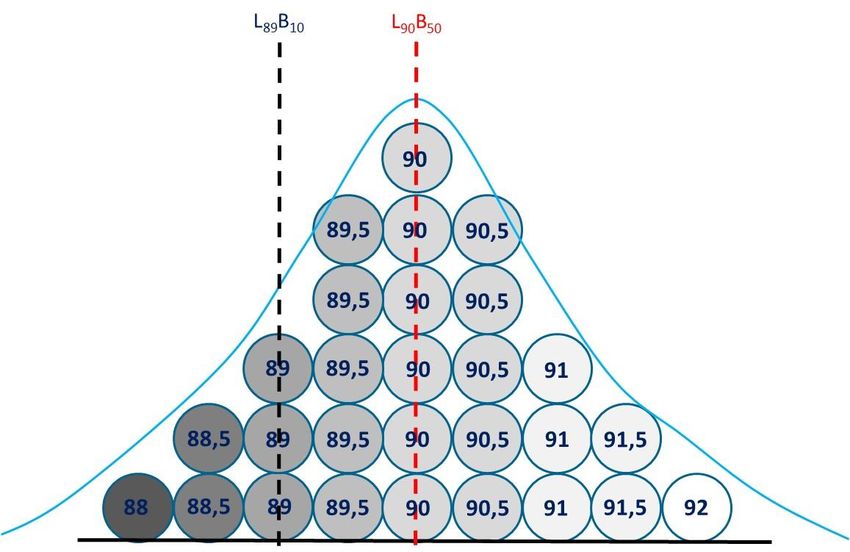
     It can be expected that around a distribution of products there will be a proportion above
     and a proportion below the rated performance value. The graph below shows an example
     of the normal distribution for a L90 rated product, illustrating the difference of a B10 or B50
     value.

LIGHTINGEUROPE                                                                                  PAGE 8 OF 20
Fig 3 – Example of normal distribution for a L90 rated product

     Detailed analysis from various manufacturers in LightingEurope of product data from
     LED based luminaires shows that, when projecting installation life up to 100.000 hours,
     the difference in flux degradation between B10 and B50 is about 1 %.

     For the L90 example at 100.000 hours this means that an initial luminous flux of 10.000
     lumen will be 9.000 lumen in the case of B50. If the same luminaire is rated as B10, the
     corresponding value would be 8910 lumen. . Bearing in mind that the rated light output
     data of both LED and traditional light sources are subject to a typical 10 % tolerance this
     practical differential can be regarded as negligible.

                 Fig 4 – Product data analysis of an example of a LED based luminaire

     As B10 and B50 are so close together, the spread due to depreciation is low and the median
     (B50) value represents with a sufficient degree of accuracy the lumen deprecation
     behavior of a number of products at the projected lifetime (in this example 100.000 hours).
     The measurement process for B50 is standardized and more widely accepted than any

LIGHTINGEUROPE                                                                              PAGE 9 OF 20
other By. Therefore, for reasons of accuracy and consistency between manufacturers the
use of any other By cannot be recommended over the use of B50.
This indicates that for the commonly used L70, L80 or L90 values the By factor is not as
significant as may be thought (or promoted) by some manufacturers and users.
Consequently, LightingEurope sees little benefit in the continued promotion of By as a
significant factor for making product to product performance comparisons. Therefore,
LightingEurope recommends promoting only the Median Useful Life generally expressed
as Lx without the B50 notification.
Statistically the median (B50) value represents with a sufficient degree of accuracy the
lumen deprecation behavior of a population of LED based luminaires at the projected
lifetime. Therefore, LightingEurope recommends promoting and expressing Median
Useful Life as Lx without B50 notification.
3.3 Abrupt luminous flux degradation – Time to Abrupt Failure and Abrupt Failure
Value
An important parameter that should be considered with expected long life is system
reliability. A LED based luminaire will last as long as the component used with the shortest
life. There are several critical components of a LED based luminaire that influence the
system reliability.
Fig 5 – Principal components of a LED based luminaire
Degradation of optical material may cause a reduction of luminous flux rather than an
abrupt degradation. Failure of one of the remaining principal components generally leads
to complete failure of the LED based luminaire. This is not taken into account when
LIGHTINGEUROPE PAGE 10 OF 20indicating the rated Median Useful Life. For that reason, abrupt failures have to be
considered separately so it can be taken into account at time of lighting engineering and
planning. This is why the IEC lifetime metric also specifies time to abrupt failure, which
takes into account failure modes of principal components in the LED based luminaire
design.
The abrupt light output degradation of a population of LED luminaires at a certain point in
time is called Time to Abrupt Failure and expressed in general as Cy. Time to Abrupt
Failure expresses the age at which a given percentage (y) of LED based luminaires have
failed abruptly.
To facilitate easy evaluation of manufacturers’ performance data, IEC introduced the
Abrupt Failure Value (AFV) of a population of LED based luminaires. Abrupt Failure Value
is the percentage of LED based luminaires failing to operate at Median Useful Life (Lx).
Example: Abrupt Failure Value of 10 % represents 10 % of the population of initially
operating LED based luminaires fail to produce any luminous flux at Median Useful Life.
The current IEC standards do not describe completely what failure modes of principal
components to include in the Abrupt Failure Value (AFV) calculations. Since most of the
abrupt failures in practice occur in relation to the LED control gear, LightingEurope
recommends specifying the expected control gear failure rate of the device as the AFV
indicated for the Median Useful Life of the LED-based luminaire.
3.4 Why lifetime is not always a critical factor
Looking at common practice, lifetime data for LED based luminaires seems to be a race
for the highest number of hours belonging to the Median Useful Life L80B50. We have to
be aware that in the professional market, requirements are specific to the lighting solution
within the application and a lighting design needs to be performed.
As input to the lighting design the average installation life is often given, so one could
argue the highest number of hours is not a relevant discriminator when selecting a LED
based luminaire.
LightingEurope believes that this justifies the question what is the best recommended
value for comparing the useful life of LED based luminaires?
1. Fixing of the ‘x’ (lumen depreciation) from Median Useful Life Lx as a comparison
value for different luminaires. In this case the ‘time’ is not fixed and can have a
variation from luminaire to luminaire.
2. Fixing of the ‘time’ value from Median Useful Life Lx as a comparison value for
different luminaires. In this case the ‘x’ from Lx (lumen depreciation) is not fixed
and can have a variation from luminaire to luminaire.
LIGHTINGEUROPE PAGE 11 OF 20To investigate the importance, the average installation life for different indoor- and
outdoor applications have been calculated, based on the annual operating hours and the
average time to refurbishment for a product in a specific application.
We also need to be aware that these values may not be realistic in all situations (e.g. in
case of the use of automatic lighting controls or application requiring 24/7 illumination).
Table 2 – Possible examples of average installation life for different indoor applications
Table 3 - Possible examples of average installation life for different outdoor applications
LIGHTINGEUROPE PAGE 12 OF 20It can be concluded that for products used in the majority of indoor applications the
average installation life will not exceed 50.000 hours. For products used in the majority
of outdoor applications the average installation life will not exceed 100.000 hours.
LightingEurope believes that ‘number of hours’ should not be a dominant discriminator
when selecting LED based luminaires for professional applications. For the lighting
design, the maintained luminous flux at the average installation life for a specific
application is much more relevant and may support energy saving through the reduction
in over-design to account for losses through life.
LightingEurope recommends not to specify or declare lifetime claims exceeding 100.000
hours, unless it is clearly required by specific lighting applications and verified by an
appropriate life test period.
To enable apple-to-apple comparison LightingEurope recommends to fix of the ‘time’
value for Median Useful Life to 35k, 50k, 75k and/or 100k and express the ‘x’ from Lx
(lumen depreciation) for time value(s) related to the applications where the product may
be used.
3.5 Maintenance factor consideration in different applications
With LEDs rapidly becoming the new standard in (functional) lighting design for both
indoor and outdoor installations, the need has arisen to provide more clarity on how the
existing CIE maintenance factor (MF) determination methods can be applied to this
technology.
Clarification is needed to prevent unsafe and uncomfortable situations during the lifetime
of the installation. Current CIE technical reports describing the MF determination
methodology contain detailed explanations with respect to conventional luminaires and
light sources, but lack detail to accommodate LED-based lighting designs. However, the
core of the CIE methodology - which is based on the same principles for both indoor and
outdoor- is still accurate.
ISO/TC 274 is currently developing a Technical Specification that will provide a
standardized way of working for determining the maintenance factor for both indoor and
outdoor installations using the methodology as described in CIE 154:2003 & CIE 97:2005.
Insights from recently published product performance standards such as IEC 62722-2-1,
will be combined with the existing determination methodology from CIE technical reports.
By using the overall MF determination methodology and the content on the impact of the
environment on luminaires in combination with the product performance metrics, a robust
way of working can be established. This will allow for the determination of the
maintenance factor of installations including the latest light source technologies. This will
create a level playing field with respect to comparison of lighting designs in the market,
provide clarity to all involved parties (from end-users to policy makers), and ensure safety
and comfort over the lifetime of the installation.
LIGHTINGEUROPE PAGE 13 OF 204. LightingEurope recommendations
LightingEurope recommends manufacturers of LED based luminaires publish apple-to-
apple comparable product information following the parameters given in 4.1 and as
described in IEC 62722-2-1.
4.1 Recommended initial performance values to be provided
1. Input power (P in W)
2. Luminous flux (Φ in lm)
3. Luminous efficacy (η in lm/W)
4. Luminous intensity distribution (in cd or cd/klm)
5. Correlated colour temperature (Tcp in K)
6. Colour rendering index (CRI)
7. Ambient temperature (tq) related to performance of the luminaire (in ˚C)
4.2 Recommended over time performance values to be provided
1. Lumen maintenance factor ‘x’ (in %) at the associated median useful life Lx (in
hours) (see 3.2)
2. Abrupt failure value (in %) at the same associated median useful life Lx (in
hours) (see 3.3)
Lumen maintenance factor groups (buckets) should be introduced to enable initial product
comparison. Separate product specific lumen maintenance factor values for input to
lighting designs may also be published.
Lumen maintenance factor groups
Group value ≥70 ≥75 ≥80 ≥85 ≥90 ≥95
Group range 70-74 75-79 80-84 85-89 90-94 95-100
Table 4 – - Lumen maintenance factor groups
LightingEurope recommends the publication of:
1. Initial performance data set as detailed in 4.1;
2. The lumen maintenance factor ‘x’ (in %) at Median Useful Life (Lx) values of 35k,
50k, 75k and/or 100k hours, related to the applications where the product may be
used;
3. The expected ‘control gear failure rate’ at the same number of hours specified in the
Median Useful Life(s).
Note:
The data and information presented in this guide should not be taken as forming a basis
of warranty conditions which are the responsibility of individual manufacturers.
LIGHTINGEUROPE PAGE 14 OF 20Annex A: Terms, definitions and references
Term Definition Standard references
Rated input input power IEC 62722-1:2014-09;
power (in W) P IEC 62722-2-1:2014-11:
electrical power from the mains supply consumed by The provisions of Clause 7 of IEC 62717 apply to the
the luminaire including the operation of all electrical LED luminaire.
components necessary for its intended functioning IEC 62717:2014-12 — Performance standard for
LED modules:
Unit : W The initial power consumed by each individual LED
module in the measured sample shall not exceed the
rated value rated power by more than 10%.
quantitative value for a characteristic of a product for
specific operating conditions specified in this
standard, or in applicable standards, or assigned by
the manufacturer or responsible vendor
Source: IEC 62722-1:2014
Rated luminous flux IEC 62722-1:2014-09;
luminous flux ΦV, Φ IEC 62722-2-1:2014-11:
(in lm) quantity derived from radiant flux, Φe, by evaluating The provisions of 8.1 of IEC 62717 apply to the LED
the radiation according to its action upon the CIE luminaire. In addition the provisions in Clause A.1,
standard photometric observer paragraph 2 of IEC 62722-2-1 apply where a rated
ambient temperature related to performance other
Unit: lm than 25 °C is advised by the manufacturer.
IEC 62717:2014-12 — Performance standard for
NOTE 1 For photopic vision LED modules:
The initial luminous flux of each individual LED
module in the measured sample shall not be less than
where the rated luminous flux by more than 10%.
is the spectral distribution of the radiant flux and V(λ )
is the spectral luminous efficiency.
NOTE 2 For the values of Km (photopic vision) and
K’m (scotopic vision), see IEC 60050-845, 845-01-56.
NOTE 3 The luminous flux of LED dies is usually
expressed in groups into which they are sorted.
Source: IEC 62504
LED luminaire Luminaire efficacy IEC 62722-1:2014-09;
efficacy (in ηV, η IEC 62722-2-1:2014-11:
lm/W) ratio of the luminaires total luminous flux versus The provisions of Clause 8.1 of IEC 62717 apply to
its rated input power at rated supply voltages, the LED luminaire.
excluding any emergency lighting charging IEC 62717:2014-12 — Performance standard for
power LED modules:
NOTE 1 Luminaire efficacy is expressed in lumen LED module (luminaire) efficacy shall be calculated
per watt. from the measured initial luminous flux of the
individual LED module (luminaire) divided by the
Unit: lm .W -1 measured initial input power of the same individual
LED module (luminaire). For measurement of
Source: IEC 62722-1:2014 luminous flux see Annex A.3.2.
LIGHTINGEUROPE PAGE 15 OF 20Term Definition Standard references
Luminous luminous intensity (of a source, in a given direction) IEC 62722-1:2014-09;
intensity IV; I IEC 62722-2-1:2014-11:
distribution quotient of the luminous flux dΦ V leaving the The provisions of Clause 8.2.3 of IEC 62717 apply to
source and propagated in the element of solid the LED luminaire.
angle dΩ containing the given direction, by the IEC 62717:2014-12 — Performance standard for
element of solid angle LED modules:
I V = dΦ V /dΩ The distribution of luminous intensity shall be in
accordance with that declared by the manufacturer.
Unit: cd=lm. sr -1 The measurement is conducted according to A.3.3.
NOTE 1 The definition holds strictly only a point of
source.
NOTE 2 The luminous intensity of LED is expressed
according to CIE 127:2007 measurement procedure.
[IEC 60050-845:1987, 845-01-31] and [CIE S
017/E:2011 ILV, 17-739 modified]
Source: IEC 62504:2014
Correlated correlated colour temperature IEC 62722-1:2014-09;
Colour Tcp IEC 62722-2-1:2014-11:
Temperature temperature of the Planckian radiator having the The provisions of Clause 9.2. of IEC 62717 apply to
(CCT in K) chromaticity nearest the chromaticity associated with the LED luminaire.
the given spectral distribution on a diagram where the IEC 62717:2014-12 — Performance standard for
(CIE 1931 standard observer based) LED modules:
Preferred values to ensure interchangeability are
coordinates of the Planckian locus and the test under consideration. The four-digit CCT value is
stimulus are depicted divided by 100 and the resulting figure is rounded off
to the next integer number, when using the
Unit: K photometric code in Annex D.
NOTE 1 The concept of correlated colour temperature
should not be used if the chromaticity of the test source
differs more than
from the Planckian radiator,
where refer to the test source,
to the Planckian radiator.
NOTE 2 Correlated colour temperature can be calculated
by a simple minimum search computer program that
searches for that Planckian temperature that provides the
smallest chromaticity difference between the test
chromaticity and the Planckian locus, or e.g. by a method
recommended by Robertson, A. R. “Computation of
correlated colour temperature and distribution temperature”,
J. Opt. Soc. Am. 58, 1528-1535, 1968.
(Note that the values in some of the tables in this reference
are not up-to-date).
Abbreviation: “CCT”
Source : ISO 11664
LIGHTINGEUROPE PAGE 16 OF 20Term Definition Standard references
Rated Colour colour rendering index IEC 62722-1:2014-09;
Rendering R IEC 62722-2-1:2014-11:
Index (CRI) measure of the degree to which the psychophysical The provisions of Clause 9.3. of IEC 62717 apply to
colour of an object illuminated by the test illuminant the LED luminaire. Where suitable component
conforms to that of the same object illuminated by the reliability data is available the test duration may be
reference illuminant, suitable allowance having been reduced from 6 000 h to 2 000 h.
made for the state of chromatic adaptation IEC 62717:2014-12 — Performance standard for
See also CIE 13 Method of Measuring and Specifying LED modules:
Colour Rendering of Light Sources The initial Colour Rendering Index (CRI) of a LED
module is measured. A second measurement is made
Abbreviation: "CRI" at an operational time as stated in 6.1. (= 6000 h /
Source : CIE 13 25% rated life)
Compliance:
For all tested items in a sample the measured CRI
values shall not have decreased by more than
- 3 points from the rated CRI value (see Table 1) for
initial CRI values and
- 5 points from the rated CRI value (see Table 1) for
maintained CRI values.
Ambient temperature, rated ambient performance (rated IEC 62722-1:2014-09;
temperature ambient performance temperature) IEC 62722-2-1:2014-11:
(tq) for a tq General
luminaire highest ambient temperature around the luminaire The provisions of Subclause A.1 of IEC 62717
related to a rated performance of the luminaire under apply to the LED luminaire.
normal operating conditions, both as declared by the Where a rated ambient performance temperature
manufacturer or responsible vendor tq other than 25 °C is advised by the
Unit: °C manufacturer a correction factor will need to be
NOTE 1 Rated ambient performance temperature is established to correct the measured luminous
expressed in °C. flux value at 25 °C to the luminous flux value at
NOTE 2 For a given life time, the tq temperature is a fixed the declared ambient. This shall be done using
value, not a variable. relative photometry in a temperature controlled
NOTE 3 There can be more than one tq temperature, cabinet.
depending on the life time data, .3.4.
Source: IEC 62722-2-1:2014
NOTE 4
Measurement:
According EN 60598-1 Annex D and K
Useful life useful life (of LED modules) IEC 62722-1:2014-09;
(of LED LxBy IEC 62722-2-1:2014-11:
modules and length of time until a percentage y of a population of General
Luminaires operating LED modules of the same type have The provisions of 10.1 of IEC 62717 apply to the
parametrically failed to provide at least percentage x LED luminaire.
of the initial luminous flux The length of time until a percentage y of a population
of operating LED modules reaches gradual light
Note 1 The useful life includes operating LED modules output degradation of a percentage x is called the
only. useful life (or “By life”) and expressed in general as
Source: 34A/1864/DC – planned as a second LxBy.
amendment to IEC 62717 Light output lower than the lumen maintenance factor
x is called a parametric failure because the product
produces less light but still operates. “B10” life is the
age at which 10 % of products have failed
parametrically. The age at which 50 % of the LED
modules parametric fail, the “B50 life”, is called median
LIGHTINGEUROPE PAGE 17 OF 20Term Definition Standard references
useful life. The population includes operating LED
modules only; non-operative modules are excluded.
Median useful median useful life (of LED modules) IEC 62722-1:2014-09;
life Lx IEC 62722-2-1:2014-11:
(of LED length of time during which 50 % (B50) of a population General
modules and of operating LED modules of the same type have The provisions of 10.1 of IEC 62717 apply to the
Luminaires) parametrically failed to provide at least percentage x LED luminaire.
of the initial luminous flux The length of time until a percentage y of a population
of operating LED modules reaches gradual light
Note The median useful life includes operating LED output degradation of a percentage x is called the
modules only. useful life (or “By life”) and expressed in general as
Note In common language the expression “life of LED LxBy.
modules” without any modifiers is understood to mean the Light output lower than the lumen maintenance factor
median useful life.
x is called a parametric failure because the product
produces less light but still operates. “B10” life is the
[SOURCE: IEC 60050-845:1987, 845-07-61, modified age at which 10 % of products have failed
– new definition] parametrically. The age at which 50 % of the LED
Source: 34A/1864/DC – planned as a second modules parametric fail, the “B50 life”, is called median
amendment to IEC 62717 useful life. The population includes operating LED
modules only; non-operative modules are excluded.
Abrupt failure abrupt failure IEC 62717:2014
fraction of failure of a LED product to operate or to produce Life time specification for abrupt light output
LED-module luminous flux degradation:
and LED- The abrupt light output degradation of a population of
Luminaire LED Luminaires at a certain point in time is called time
NOTE 1 For the purpose of this standard, the LED
product is a LED module to abrupt failure and expressed as Cy.
NOTE 2 The term “complete Failure” is commonly used The recommended life time metrics for specifying LED
for the same purpose. module life is explained in Annex C of IEC 62717 and
Source: IEC 62717:2014 appley to the LED luminaire. For compliance criteria
see 10.2 of the standard.
Time to abrupt time to abrupt failure IEC 62717:2014
failure of LED- Cy Life time specification for abrupt light output
module and length of time during which y % of a population of degradation:
LED-Luminaire initially operating LED modules of the same type fail to The abrupt light output degradation of a population of
produce any luminous flux LED Luminaires at a certain point in time is called time
Unit: h to abrupt failure and expressed as Cy.
The recommended life time metrics for specifying LED
NOTE 1 The time to abrupt failure includes inoperative module life is explained in Annex C of IEC 62717 and
LED modules only. appley to the LED luminaire. For compliance criteria
NOTE 2 CAFV = Lx. see 10.2 of the standard.
Source: IEC 62717:2014
Abrupt failure abrupt failure value IEC 62717:2014
value, AFV Life time specification for abrupt light output
corresponding percentile of LED modules failing to operate at median degradation:
to the median useful life, Lx The abrupt light output degradation of a population of
useful file of LED Luminaires at a certain point in time is called time
LED modules to abrupt failure and expressed as Cy.
Note AFV = F(Lx) × 100 %; LSF(Lx) = 1 – F(Lx)
and luminaires
Note Example: Given Lx=20 000 h and AFV = F(20 The recommended life time metrics for specifying LED
000 h) × 100 % = 7 % results in LSF(20 000 h) = 1 – 0,07 = module life is explained in Annex C of IEC 62717 and
0,93. appley to the LED luminaire. For compliance criteria
Source: IEC 62717:2014 see 10.2 of the standard.
LIGHTINGEUROPE PAGE 18 OF 20Annex B: Application requirements from EN standards
Tables B1 and B2 show application requirements as specified in European EN standards.
Country specific national standards may have additional requirements, for example the
use of the colour rendering or colour temperature in road lighting applications. In addition,
for specialist sports lighting applications additional requirements may be specified by the
sport’s governing bodies.
Note: red boxes indicate stated requirements whilst cream boxes indicate implied requirements.
Table B.1 - Key requirements linked to products
Table B.2 - Key requirements linked to lighting applications
LIGHTINGEUROPE PAGE 19 OF 20Annex C EXAMPLE DATA SHEET – LED LUMINAIRE PERFORMANCE
DATA
This example reflects the LED performance data that would be expected to be
provided by luminaire manufacturers. They should be part of the data sheet of an
LED-luminaire. The complete content and the volume of information of a luminaire
data sheet and its style will vary depending on the ‘house style’ of the manufacturer
and type/application of the particular luminaire. To allow direct comparison
between manufacturers data is normally provided based on tq = 25oC. Data sets for
other values of tq may be provided (e.g. for special applications) at the discretion of
the manufacturer.
Product data sheet xxxxxxxx 0000 xxx 01
Ambient temperature of 25oC 40oC
luminaire (tq)
Input power 48W 48W
Luminous flux 6000 lm 5600 lm
Luminous efficacy 125 lm/W 116 lm/W
Correlated colour temperature 3000 K 3000 K
(CCT)
Colour rendering index (CRI) >80 >80
Rated median useful life Lx (h) L85: 35,000 hrs L80: 35,000 hrs
and the associated rated lumen L80: 50,000 hrs L75: 50,000 hrs
maintenance factor (x)
5% @ 35,000 hrs 10% @ 35,000 hrs
Abrupt failure value (%) at 10% @ 50,000 hrs 15% @ 50,000 hrs
Median useful life
LIGHTINGEUROPE PAGE 20 OF 20You can also read


