Fixed Income Investor Presentation - June 2019 - BMO Bank of Montreal
←
→
Page content transcription
If your browser does not render page correctly, please read the page content below
Fixed Income
Investor Presentation
June 2019
Forward looking statements & non-GAAP measures
Caution Regarding Forward-Looking Statements
Bank of Montreal’s public communications often include written or oral forward-looking statements. Statements of this type are included in this document, and may be included in other filings with Canadian securities
regulators or the U.S. Securities and Exchange Commission, or in other communications. All such statements are made pursuant to the “safe harbor” provisions of, and are intended to be forward-looking statements under, the
United States Private Securities Litigation Reform Act of 1995 and any applicable Canadian securities legislation. Forward-looking statements in this document may include, but are not limited to, statements with respect to our
objectives and priorities for fiscal 2019 and beyond, our strategies or future actions, our targets, expectations for our financial condition or share price, the regulatory environment in which we operate and the results of or
outlook for our operations or for the Canadian, U.S. and international economies, and include statements of our management. Forward-looking statements are typically identified by words such as “will”, “would”, “should”,
“believe”, “expect”, “anticipate”, “project”, “intend”, “estimate”, “plan”, “goal”, “target”, “may” and “could”.
By their nature, forward-looking statements require us to make assumptions and are subject to inherent risks and uncertainties, both general and specific in nature. There is significant risk that predictions, forecasts, conclusions
or projections will not prove to be accurate, that our assumptions may not be correct, and that actual results may differ materially from such predictions, forecasts, conclusions or projections. We caution readers of this
document not to place undue reliance on our forward-looking statements, as a number of factors – many of which are beyond our control and the effects of which can be difficult to predict – could cause actual future results,
conditions, actions or events to differ materially from the targets, expectations, estimates or intentions expressed in the forward-looking statements.
The future outcomes that relate to forward-looking statements may be influenced by many factors, including but not limited to: general economic and market conditions in the countries in which we operate; the Canadian
housing market; weak, volatile or illiquid capital and/or credit markets; interest rate and currency value fluctuations; changes in monetary, fiscal, or economic policy and tax legislation and interpretation; the level of
competition in the geographic and business areas in which we operate; changes in laws or in supervisory expectations or requirements, including capital, interest rate and liquidity requirements and guidance, and the effect of
such changes on funding costs; judicial or regulatory proceedings; the accuracy and completeness of the information we obtain with respect to our customers and counterparties; failure of third parties to comply with their
obligations to us; our ability to execute our strategic plans and to complete and integrate acquisitions, including obtaining regulatory approvals; critical accounting estimates and the effect of changes to accounting standards,
rules and interpretations on these estimates; operational and infrastructure risks, including with respect to reliance on third parties; changes to our credit ratings; political conditions, including changes relating to or affecting
economic or trade matters; global capital markets activities; the possible effects on our business of war or terrorist activities; outbreaks of disease or illness that affect local, national or international economies; natural disasters
and disruptions to public infrastructure, such as transportation, communications, power or water supply; technological changes; information and cyber security, including the threat of hacking, identity theft and corporate
espionage, as well as the possibility of denial of service resulting from efforts targeted at causing system failure and service disruption; and our ability to anticipate and effectively manage risks arising from all of the foregoing
factors.
We caution that the foregoing list is not exhaustive of all possible factors. Other factors and risks could adversely affect our results. For more information, please see the discussion in the Risks That May Affect Future Results
section, and the sections related to credit and counterparty, market, insurance, liquidity and funding, operational, model, legal and regulatory, business, strategic, environmental and social, and reputation risk, in the Enterprise-
Wide Risk Management section which begin on page 78 of BMO’s 2018 Annual Report, and the Risk Management section in BMO’s Second Quarter 2019 Report to Shareholders, all of which outline certain key factors and risks
that may affect our future results. Investors and others should carefully consider these factors and risks, as well as other uncertainties and potential events, and the inherent uncertainty of forward-looking statements. We do
not undertake to update any forward-looking statements, whether written or oral, that may be made from time to time by the organization or on its behalf, except as required by law. The forward-looking information
contained in this document is presented for the purpose of assisting our shareholders in understanding our financial position as at and for the periods ended on the dates presented, as well as our strategic priorities and
objectives, and may not be appropriate for other purposes.
Material economic assumptions underlying the forward-looking statements contained in this document are set out in the 2018 Annual Report under the heading “Economic Developments and Outlook”, as updated by the
Economic Review and Outlook section set forth in BMO’s Second Quarter 2019 Report to Shareholders. Assumptions about the performance of the Canadian and U.S. economies, as well as overall market conditions and their
combined effect on our business, are material factors we consider when determining our strategic priorities, objectives and expectations for our business. In determining our expectations for economic growth, both broadly and
in the financial services sector, we primarily consider historical economic data provided by governments, historical relationships between economic and financial variables, and the risks to the domestic and global economy.
See the Economic Review and Outlook section of BMO’s Second Quarter 2019 Report to Shareholders.
Non-GAAP Measures
Bank of Montreal uses both GAAP and non-GAAP measures to assess performance. Readers are cautioned that earnings and other measures adjusted to a basis other than GAAP do not have standardized meanings
under GAAP and are unlikely to be comparable to similar measures used by other companies. Reconciliations of GAAP to non-GAAP measures as well as the rationale for their use can be found on page 4 of BMO’s
Second Quarter 2019 Report to Shareholders and on page 27 of BMO’s 2018 Annual Report, all of which are available on our website at www.bmo.com/investorrelations.
Examples of non-GAAP amounts or measures include: efficiency and leverage ratios; revenue and other measures presented on a taxable equivalent basis (teb); amounts presented net of applicable taxes; results and
measures that exclude the impact of Canadian/U.S. dollar exchange rate movements, adjusted net income, revenues, non-interest expenses, earnings per share, effective tax rate, ROE, efficiency ratio, pre-provision
pre-tax earnings, and other adjusted measures which exclude the impact of certain items such as, acquisition integration costs, amortization of acquisition-related intangible assets, decrease (increase) in collective
allowance for credit losses, restructuring costs, revaluation of U.S. net deferred tax asset as a result of U.S. tax reform and the remeasurement of an employee benefit liability as a result of an amendment to the plan.
Bank of Montreal provides supplemental information on combined business segments to facilitate comparisons to peers.
Investor Presentation June 2019 2Who We Are
Established in 1817, BMO Financial Group is a highly diversified financial services provider based in North America
8th largest $830 billion
bank in North America
in total assets
by assets1 An engaged and diverse team
of employees
Three operating groups
Personal and BMO Wealth BMO Capital
Commercial Banking Management Markets
12+ million 8+ million 2+ million
We serve: customers globally personal and commercial personal, small business
customers in Canada and commercial customers
in the United States
Committed to
#2
Sustainable Named One of the World's Most Signatory to the UN Principles Customers ranked BMO the
Ethical Companies by the
Performance: Ethisphere Institute for the
for Responsible Investment second most reputable
among U.S. banks2
second year in a row
* All amounts in this presentation in Canadian dollars unless otherwise noted
1 - source: Bloomberg, as at April 30, 2019
2 - Based on American Banker and the Reputation Institute’s customer surveys of the 40 largest U.S. banks by assets
Investor Presentation June 2019 3BMO’s Strategic Footprint
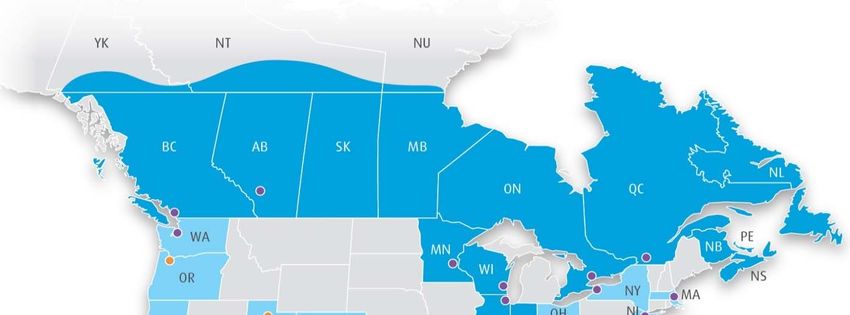
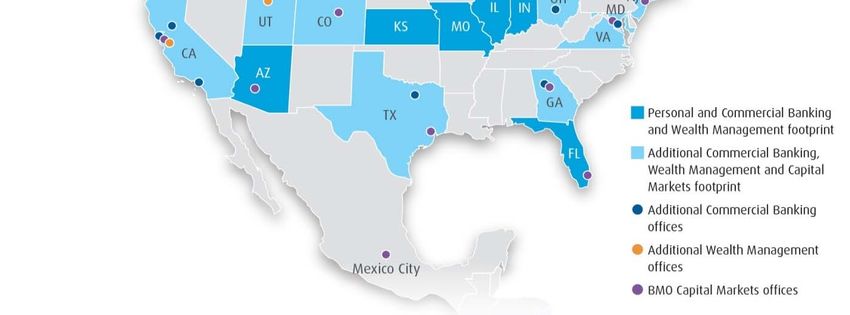
BMO’s strategic footprint spans strong regional economies. Our three operating groups – Personal and
Commercial Banking, BMO Capital Markets and BMO Wealth Management – serve individuals, businesses,
governments and corporate customers across Canada and the United States. Our significant presence in North
70% 31%
An estimated 70% of The metropolitan areas
America is bolstered by operations in select global markets in Europe, Asia, the Middle East and South corporate customers that comprise the majority
America, allowing us to provide all our customers with access to economies and markets around the world have cross-border of BMO’s strategic U.S.
needs footprint account for
approximately 31% of
overall U.S. GDP
International Offices
BMO Capital Markets BMO Wealth Management
Abu Dhabi Europe and Middle East
Beijing Abu Dhabi
Dublin Amsterdam
Guangzhou Edinburgh
Hong Kong Frankfurt
London Geneva
Melbourne Lisbon
Mumbai London
Paris Madrid
Rio de Janeiro Milan
Shanghai Munich
Singapore Paris
Taipei Stockholm
Zurich Zurich
Asia-Pacific
Beijing
Guangzhou
Hong Kong
Shanghai
Singapore
Sydney
Investor Presentation June 2019 4Q2 2019 – Financial Highlights
Adjusted1 net income up Y/Y driven by good growth in P&C businesses
• Adjusted1 EPS $2.30, up 5% Y/Y (reported up 22%) Reported Adjusted1
($MM) Q2 19 Q1 19 Q2 184 Q2 19 Q1 19 Q2 18
• Adjusted1 net income up 4% Y/Y
2
Net Revenue 5,652 5,591 5,248 5,652 5,591 5,248
– U.S. Segment adjusted1 net income up 13% Y/Y
(reported up 25%); 35% of bank income YTD Total PCL 176 137 160 176 137 160
– Reported net income4 up 20% in part reflecting prior Expenses 3,595 3,557 3,525 3,563 3,520 3,232
year restructuring charge Net Income 1,497 1,510 1,246 1,522 1,538 1,463
• Net revenue2 up 8% Y/Y, 6% excluding impact of Diluted EPS ($) 2.26 2.28 1.86 2.30 2.32 2.20
stronger U.S. dollar ROE (%) 13.6 13.6 12.6 13.9 13.9 14.9
3
• Adjusted1 expenses up 10% Y/Y, 9% excluding ROTCE (%) 16.4 16.5 15.6 16.4 16.6 18.0
impact of stronger U.S. dollar (reported up 2%) CET1 Ratio (%) 11.3 11.4 11.3
– BMO Capital Markets severance expense and
acquisition accounted for approximately half the Y/Y
increase
Net Income1 Trends
• Total PCL of $176MM, up $16MM Y/Y
1,463 1,566 1,531 1,538 1,522
– PCL on impaired loans $150MM 1,697
1,537 1,510
– PCL on performing loans $26MM 1,497
1,246
• Adjusted1 ROE 13.9% (reported 13.6%)
Q2'18 Q3'18 Q4'18 Q1'19 Q2'19
Reported Net Income ($MM) Adjusted Net Income ($MM)
1 Adjusted measures are non-GAAP measures, see slide 2 for more information. For details on adjustments refer to page 4 of BMO’s Q2’19 Report to Shareholders;
Net revenue is net of insurance claims, commissions and changes in policy benefit liabilities (CCPB). Operating leverage based on net revenue. Reported gross revenue: Q2'19 $6,213MM; Q1'19 $6,517MM; Q2'18 $5,580MM
2 Adjusted Return on Tangible Common Equity (ROTCE) = (Annualized Adjusted Net Income avail. to Common Shareholders) / (Average Common shareholders equity less Goodwill and acquisition-related intangibles net of
associated deferred tax liabilities). Numerator for Reported ROTCE is Annualized Reported Net Income avail. to Common Shareholders less after-tax amortization of acquisition-related intangibles
3 Q2’18 reported net income includes a restructuring charge of $192 million after-tax ($260 million pre-tax)
Investor Presentation June 2019 5Strong Capital Position
Strong CET1 Capital Ratio -34 bps
+27 bps
-3 bps 11.3%
1.55%
9.75% Current OSFI expectation
1.75% Domestic Stability Buffer1
1.0% D-SIB Surcharge
11.4% 2.5% Capital Conservation Buffer
4.5% Minimum CET1
Q1'19 Internal Capital Generation Higher source currency RWA Other changes in CET1 Capital Q2'19
Credit Ratings Sound Leverage and Liquidity Ratios
Moody’s S&P DBRS Fitch • Leverage Ratio 4.2%
Long term deposits / Aa2 A+ AA AA- • Liquidity Coverage Ratio 132%
legacy senior debt2
Senior debt3 A2 A- AA(low) AA-
Outlook Stable Stable Stable Stable
1 On June 4, 2019, OSFI announced that it has set the Domestic Stability Buffer at 2.00% of total risk-weighted assets, effective October 31, 2019
2 Long term deposits / legacy senior debt includes: (a) Senior debt issued prior to September 23, 2018; and (b) Senior debt issued on or after September 23, 2018 which is excluded from the Bank Recapitalization
(Bail-In) Regime
3 Subject to conversion under the Bank Recapitalization (Bail-In) Regime
Investor Presentation June 2019 6Economic Overview
Economic Outlook and Indicators1
Canada United States Eurozone
Economic Indicators (%)1, 2 20182 2019E2 2020E2 20182 2019E2 2020E2 20182 2019E2 2020E2
GDP Growth 1.9 1.4 1.7 2.9 2.5 1.7 1.9 1.2 1.2
Inflation 2.3 2.0 2.1 2.4 1.9 2.2 1.8 1.6 2.1
Interest Rate (3mth Tbills) 1.37 1.65 1.65 1.97 2.40 2.35 (0.36) (0.35) (0.35)
Unemployment Rate 5.8 5.6 5.6 3.9 3.6 3.6 8.2 7.9 8.1
Current Account Balance / GDP3 (2.6) (2.7) (2.4) (2.4) (2.3) (2.4) 3.6 3.6 3.5
Budget Surplus / GDP3 (0.7) (0.9) (0.8) (3.9) (4.2) (4.0) (0.5) (0.9) (0.8)
Canada United States
• After downshifting last year, Canada’s economy is • After strengthening on fiscal stimulus, U.S. economic
expected to moderate further to 1.4% in 2019 due to growth is projected to moderate to 2.5% in 2019 due
past increases in interest rates, oil output cuts and to higher interest rates and less fiscal support
slower global demand
• The unemployment rate is expected to remain near
• Amid recent steady job growth, the unemployment rate half-century lows
is expected to remain near current four-decade lows
• Amid low inflation, the Federal Reserve is expected to
• The Bank of Canada is expected to keep policy rates refrain from raising policy rates, and there is a strong
steady, but there is a chance of a rate cut if the global chance of a rate reduction due to escalating trade
trade war broadens tensions
1 This slide contains forward looking statements. See caution on slide 2
2 Data is annual average. Estimates as of June 7, 2019
3 Eurozone estimates provided by OECD
Investor Presentation June 2019 8Canada’s housing market is stable
• Rising interest rates, new mortgage rules and provincial policy measures have slowed the housing market, but recent signs of
stability suggest the market has digested the policy changes
• The Toronto condo market remains healthy due to steady demand from international migrants and millennials
• We expect real estate markets across the country to firm moderately this year
• Vancouver’s market is one exception, as prices continue to decline in response to poor affordability
• Mortgage arrears remain near record lows, despite some upturn in Alberta and Saskatchewan
• The household debt-to-income ratio, though elevated, has stabilized recently amid the slowest rate of borrowing in 35 years
• Debt servicing ratio has risen to all-time highs amid past increases in interest rates, weighing on consumer spending
Debt Service Ratio Mortgage Delinquencies/Unemployment
16.0 0.50 9.0
14.0 8.5
0.45
12.0 8.0
10.0 0.40 7.5
8.0 0.35 7.0
6.0 6.5
0.30
4.0 6.0
2.0 0.25 5.5
0.0 0.20 5.0
1990
1992
1994
1996
1998
2000
2002
2004
2006
2008
2010
2012
2014
2016
2018
2007
2008
2009
2010
2011
2012
2013
2014
2015
2016
2017
2018
2019
Total Percent of Arrears to Total Number of Residential Mortgages (%)
Interest only
Unemployment Rate
Source: BMO CM Economics and Canadian Bankers’ Association as of June 7, 2019
This slide contains forward looking statements. See caution on slide 2
Investor Presentation June 2019 9Structure of the Canadian residential mortgage market with
comparisons to the United States
• Conservative lending practices, strong underwriting and documentation discipline have led to low delinquency rates
— Over the last 30 years, Canada’s 90-day residential mortgage delinquency rate has never exceeded 0.7% vs. the U.S. peak rate
of 5.0% in early 2010
• Mandatory government-backed insurance for high loan to value (LTV >80%) mortgages covering the full balance
• Government regulation including progressive tightening of mortgage rules to promote a healthy housing market
• Shorter term mortgages (avg. 5 years), renewable and re-priced at maturity, compared to 30 years in the U.S. market
• No mortgage interest deductibility for income tax purposes (reduces incentive to take on higher levels of debt)
• In Canada mortgages are held on balance sheet; in the U.S. they may be sold or securitized in the U.S. market
• Recourse back to the borrower in most provinces
• Prepayment penalties borne by the borrower whereas U.S. mortgages may be prepaid without penalty
Mortgage Delinquencies Equity Ownership (%)
Arrears to Total Number of Residential Mortgages (%)
6.0 80.0
75.0
5.0
70.0
4.0 65.0
60.0
3.0
55.0
2.0 50.0
45.0
1.0
40.0
0.0 35.0
1991
1992
1993
1994
1995
1996
1997
1998
1999
2000
2001
2002
2003
2004
2005
2006
2007
2008
2009
2010
2011
2012
2013
2014
2015
2016
2017
2018
2019
1998
1999
2000
2001
2002
2003
2004
2005
2006
2007
2008
2009
2010
2011
2012
2013
2014
2015
2016
2017
2018
2019
Canada United States
Canada United States
Source: BMO CM Economics and Canadian Bankers’ Association as of June 7, 2019
This slide contains forward looking statements. See caution on slide 2
Investor Presentation June 2019 10Loan Portfolio Overview
Our loans are well-diversified by geography and industry
Gross Loans & Acceptances                                                                                                Loans by Geography3
                                                              Canada &
By Industry                                                                           U.S.          Total   % of Total
                                                               Other1
($B, as at Q2 19)
Residential Mortgages                                            108.9                11.9          120.8      28%
                                                                                                                                        35%           Canada
Consumer Instalment and Other
                                                                  54.0                10.4          64.4       15%         63%                        U.S.
Personal
Cards                                                              7.9                 0.6           8.5       1%                                     Other
                                                                                                                                                 2%
Total Consumer                                                   170.8                22.9          193.7     44%
Service Industries                                                19.8                23.5          43.3       10%
Financial                                                         15.2                22.8          38.0       9%        Loans by Product3
Commercial Real Estate                                            20.9                14.5          35.4       8%
Manufacturing                                                      7.8                19.6          27.4       6%                                     Commercial & Corporate

Retail Trade                                                      13.7                 9.4          23.1       5%          56%             28%        Residential Mortgages

Wholesale Trade                                                    5.2                11.3          16.5       4%                                     Personal Lending 4

Agriculture                                                       10.8                 2.2          13.0       3%                    16%
Transportation                                                     2.6                 9.3          11.9       3%
Oil & Gas                                                          5.5                 5.8          11.3       3%
                                                                                                                         Loans by Operating Group5
Other Business and Government2                                    13.6                 9.5          23.1       5%

Total Business and Government                                    115.1               127.9          243.0     56%                     26%              Canadian P&C
                                                                                                                                                       U.S. P&C
                                                                                                                           55%
Total Gross Loans & Acceptances3                                 285.9               150.7          436.7     100%                                     BMO Capital Markets
                                                                                                                                           14%
1   Includes ~$10.6B from Other Countries                                                                                                              BMO Wealth Management
2   Other Business and Government includes all industry segments that are each
Canadian Residential-Secured Lending
Residential-Secured Lending by Region ($141.2B)
• Total Canadian residential-secured lending
HELOC portfolio at $141.2B, representing 32% of total
$62.6 loans, below peer average of approximately 46%
Uninsured Mortgages
Insured Mortgages
24% $27.3 ─ LTV1 on uninsured of 51%
─ 90 day delinquency rate for RESL remains good at
24bps; loss rates for the trailing 4 quarter period
$21.4 24%
were 1bp
$19.1
• Residential mortgage portfolio of $108.9B
28% 17%
─ 44% of portfolio insured
47%
29%
54% ─ LTV1 on uninsured of 55%
34%
─ 70% of the mortgage portfolio has an effective
remaining amortization of 25 years or less
$6.2
14% 29% 54% $4.5 • HELOC portfolio of $32.3B outstanding of which
38%
34% 22% 17%
34% 56% is amortizing
52% 49%
• GTA and GVA portfolios demonstrate better LTV,
Atlantic Quebec Ontario Alberta British Columbia All Other Canada delinquency rates and bureau scores compared to
the national average
Avg. LTV1 British All Other Total
Atlantic Quebec Ontario Alberta
Uninsured Columbia Canada Canada
Mortgage
- Portfolio 59% 59% 55% 61% 48% 56% 55%
- Origination 73% 72% 68% 73% 64% 71% 68%
HELOC
- Portfolio 50% 55% 43% 55% 41% 49% 46%
- Origination 64% 70% 58% 63% 55% 63% 60%
1 LTV is the ratio of outstanding mortgage balance to the original property value indexed using Teranet data. Portfolio LTV is the combination of each individual mortgage LTV weighted by the mortgage balance
Investor Presentation June 2019 13Gross Impaired Loans (GIL) and Formations
Formations Gross Impaired Loans • GIL ratio 53 bps, up 5 bps Q/Q but
By Industry
($MM, as at Q2 19)
down 3 bps Y/Y
Canada & Canada &
U.S. Total U.S. Total
Other Other1
Consumer 262 51 313 496 439 935
Formations ($MM)
Agriculture 7 37 44 58 229 287
Service Industries 1 40 41 62 183 245 741
578 522 443 467
Oil & Gas 0 126 126 13 221 234
Q2'18 Q3'18 Q4'18 Q1'19 Q2'19
Transportation 1 35 36 6 141 147
Wholesale Trade 2 76 78 13 110 123 Gross Impaired Loans ($MM)
Manufacturing 9 40 49 30 78 108
Retail Trade 6 1 7 28 47 75
2,152 2,076 1,936 2,019 2,335
Commercial Real Estate 12 20 32 33 33 66
Financial 0 0 0 19 28 47 Q2'18 Q3'18 Q4'18 Q1'19 Q2'19
Construction (non-real estate) 2 0 2 18 17 35
Other Business and GIL (bps)
12 1 13 19 14 33 56
Government2
Total Business and 53 53
52 376 428 299 1,101 1,400 48 48
Government
Total Bank 314 427 741 795 1,540 2,335
Q2'18 Q3'18 Q4'18 Q1'19 Q2'19
1 Total Business and Government includes nil GIL from Other Countries
2 Other Business and Government includes industry segments that are eachProvision for Credit Losses (PCL)
PCL By Operating Group
Q2 19 Q1 19 Q2 18
($MM) PCL (bps)
Total Canadian P&C 122 114 131
Total U.S. P&C 18 15 66 19
18
17
Wealth Management (1) 2 1 16
Capital Markets 12 1 (16) 18 18 18
13
Corporate Services (1) (5) (10)
14
PCL on Impaired Loans 150 127 172
PCL on Performing Loans 26 10 (12) Q2'18 Q3'18 Q4'18 Q1'19 Q2'19
Total PCL 176 137 160 PCL on Impaired Loans Total
1.80%
PCL on Impaired Loans as a
1.60% F2018 PPPT would cover PCL rate in
1.40% excess of 200bps, higher than any time
% of Average Net Loans &
in at least 30 years, over five times
Acceptances 1.20%
average
1.00%
• BMO’s PCL loss rates have 0.80%
been lower than peer 0.53%
0.60%
average over time
0.40% 0.39%
0.34%
0.20%
0.14%
0.00%
'90 '92 '94 '96 '98 '00 '02 '04 '06 '08 '10 '12 '14 '16 '18
BMO Cdn Peers Avg.
BMO Historical Avg. (1990 - 2018) Cdn Peers Historical Avg. (1990 - 2018)
Investor Presentation June 2019 15Liquidity & Wholesale Funding Mix
Liquidity and Funding Strategy
Cash and Securities to Total Assets Ratio (%)
• BMO's Cash and Securities to Total Assets
29.9 29.3
28.1 28.2 28.2 Ratio reflects a strong and stable liquidity
position
Q2'18 Q3'18 Q4'18 Q1'19 Q2'19
Customer Deposits1 ($B)
310.0 317.8 329.2 341.7 351.3 • BMO’s large base of customer deposits,
along with our strong capital base, reduces
reliance on wholesale funding
Q2'18 Q3'18 Q4'18 Q1'19 Q2'19
1 Customer deposits are operating and savings deposits, including term investment certificates and retail structured deposits, primarily sourced through our retail, commercial, wealth and corporate banking businesses.
Investor Presentation June 2019 17Canadian Bail-in Regime
• Canadian bail-in regime became effective from September 23, 2018
(implementation date)
Canadian Approach
• Bail-in eligible senior unsecured debt that is issued after the implementation date
will be subject to conversion in a resolution scenario
Statutory / Contractual Subordination
— Bail-in eligible debt includes senior unsecured debt issued by the parent
bank with an original term >400 days and marketable (with a CUSIP/ISIN)
• Key exclusions are Covered bonds, structured notes, derivatives and consumer CDIC Insured Deposits
deposits
• Bail-in eligible debt will be issued under existing programs (US MTN, EMTN, AMTN
etc.) governed by local laws, with the exception of bail-in conversion requirements Other Deposits
Other unsecured Structured
(including legacy
which will be governed by Canadian law liabilities1 Notes1
senior debt)1
• Bail-in eligible debt has a statutory conversion feature that provides the Canada
Deposit Insurance Corporation (CDIC) the power to trigger conversion of bail-in
securities into common shares of the bank (no write-down provision)
Sr. Debt (bail-inable)1
• The statutory conversion supplements the existing Non-Viable Contingent Capital
(NVCC) regime which contractually requires the conversion of subordinated debt
and preferred equity into common equity upon the occurrence of certain trigger
events
Tier 2
• The notional amount of bail-in securities to be converted and the corresponding
number of common shares issued in a resolution scenario will be determined by
Additional Non-Common Tier 1
CDIC at the time of conversion (unlike NVCC securities, where the calculation for
the number of shares issued is already defined). Any outstanding NVCC capital
must be converted, in full, prior to conversion of bail-in securities Common Equity Tier 1
• Conversion maintains the creditor hierarchy (no creditor worse off principle is
respected)
1 Pari passu ranking in liquidation.
Investor Presentation June 2019 18Manageable TLAC Requirements and no incremental funding
• Canadian D-SIBs will be required to meet a Supervisory Target Funding Profile as at April 30, 2019
ratio by November 1, 2021
40.0%
— Risk-based TLAC ratio of 23.25% (Minimum 21.5% of 36.5%
RWA TLAC ratio plus a Domestic Stability Buffer of 37.5%
1.75% of total RWA) 35.0% 33.0%
Legacy
Unsecured
(RT < 1yr)
— Minimum TLAC Leverage ratio of 6.75% 32.5%
3.5%
Legacy
30.0%
• TLAC eligible securities will have a minimum remaining term Unsecured
(RT > 1yr) TLAC Bail-in
of 365 days
15.0%
27.5% Eligible Debt
Supervisory target risk-
25.0% based TLAC 23.25% (BID)
• No incremental funding required to meet the TLAC obligations
22.5%
• BMO will only be issuing one class of medium and long term 20.0% Existing Bail-in
Unsecured
senior debt that will over time replace the legacy senior debt 17.5%
3.0%
outstanding Tier 2 Capital,
2.3%
15.0% Tier 1 Capital,
1.4%
• Similar to US TLAC securities, Canadian bail-in securities will 12.5%
retain the clause regarding acceleration of payments, subject 10.0%
to a minimum 30-business-day cure period, in case of events
of default relating to non-payment of scheduled principal 7.5%
CET1,
and/or interest 5.0% 11.3%
2.5%
• TLAC eligible debt will be issued at the parent bank operating
company level whereas US FIs issue TLAC debt at the holding 0.0%
company level
Investor Presentation June 2019 19Diversified Wholesale Term Funding Program
• BMO's wholesale funding principles seek to match the term of assets with the term of funding. Loans for example are funded
with customer deposits and capital, with any difference funded with longer-term wholesale funding
• BMO has a well diversified wholesale funding platform across markets, products, terms, currencies and maturities
• We do not expect a significant change to BMO’s funding strategy following the implementation of the bail-in regime
Wholesale Capital Market Term Wholesale Capital Market Term
Funding Composition1 ($121B) Funding Maturity Profile1,2
as at April 30, 2019 as at April 30, 2019
24 24
21
Covered Bonds 18 18
21%
Senior Debt (Global
Issuances)
32% 8
Mortgage, Credit
Card, Auto &
HELOC
Securitization +
C$ Senior Debt
FHLB advances
19% Q3 - Q4'19 F2020 F2021 F2022 F2023 ≥ F2024
28%
Term Debt Securitization (Ex - FHLB)
1 Wholesale capital market term funding primarily includes non-structured funding for terms greater than or equal to two years and term ABS. Excludes capital issuances.
2 BMO term debt maturities includes term unsecured and Covered Bonds.
Investor Presentation June 2019 20Diversified Wholesale Funding Platform
• Programs provide BMO with diversification and cost effective funding
Canada1 U.S.1 Europe, Australia & Asia1
• Canadian MTN Shelf (C$8B) • SEC Registered U.S. Shelf (US$25B) • Note Issuance Programme (US$20B)
• Fortified Trust (C$5B) • Global Registered Covered Bond • Australian MTN Programme (A$5B)
• Other Securitization (RMBS, Canada Program (US$22B) • Global Registered Covered Bond
Mortgage Bonds, Mortgage Backed • Securitization (Credit cards, Auto) Program (US$22B)
Securities)
Recent Notable Transactions
• C$2 billion 5-yr Fixed Rate Senior Unsecured Notes at 2.85%
• C$350 million 5-yr Rate-Reset Preferred Shares at 5.10%
• C$764.829 million Fortified HELOC Securitization
• US$2.25 billion 3-yr Fixed and Floating Rate Senior Unsecured Notes
• US$476.19 million Master Credit Card Trust II Notes
• US$561.95 million CPART Auto Securitization
• EUR€1.25 billion 5-yr Fixed Rate Covered Bond at 0.25%
• GBP£0.3 billion Fixed Rate Senior Unsecured Notes at 1.625%
• CHF450 million long 4-yr Fixed Rate Senior Unsecured Notes at 0.05%
• AUD$1.55 billion 3-yr Floating and 5-yr Fixed and Floating Rate Senior Unsecured Notes
1 Indicated dollar amounts beside each wholesale funding program denotes program issuance capacity limits.
Investor Presentation June 2019 21Appendix
Diversified businesses delivering resilient and robust earnings
Adjusted Net Income Driven by diversified sources of revenue
by Operating Group – LTM1 % of Operating Groups Net Revenue - LTM
Can P&C Canadian BMO Capital
40% P&C Markets
35% 20%
BMO CM
18%
Canadian
Personal
Banking
U.S. P&C BMO WM
25% 17%
Canadian
Commercial
Banking
Adjusted Net Income
by Geography – LTM1
Other
9%
U.S.
31%
Canada
60%
U.S. P&C BMO Wealth
23% Management
1 Adjusted measures are non-GAAP measures, see slide 2 for more information.
22%
For details on adjustments refer to page 4 of BMO’s Q2’19 Report to Shareholders
Reported net income last twelve months (LTM) by operating group (excludes Corporate Services): Canadian P&C 41%, U.S. P&C 25%, BMO WM 17%, BMO CM 17%; by geography: Canada 62%, U.S. 29%, Other 9%
Investor Presentation June 2019 23Canadian Personal & Commercial Banking
Strengths and Value Drivers Q2’19 Highlights (Adjusted1)
• Highly engaged team focused on providing a personalized banking Net Income $615 million
experience, anticipating customers’ needs and finding new ways to
help Net Income Growth (Y/Y) 5%
• Top-tier commercial banking business, number two ranking in ROE 26.8%
Canadian market share for business loans up to $25 million
Efficiency Ratio 49.6%
• Strong and growing retail banking business, accelerating digital
engagement and digital sales Operating Leverage 0.2%
• Largest Mastercard® card issuer in Canada Average Net Loans and Acceptances $234 billion
• Consistently applied credit risk management practices, providing Customers ~8 million
reliable access to appropriate financing solutions
Branches 899
Net Income1 and NIM Revenue ($MM)
2.59 2.60 2.62 2.61 2.61 1,934 1,943 1,954 1,921
Reported 1,830
Net
Income 692 699 734 710
643
641 675 648 ($MM)
589 615 Commercial
Adjusted
Net Personal
588 641 674 647 615 Income 1,187 1,242 1,244 1,220 1,211
($MM)
NIM (%)
Q2'18 Q3'18 Q4'18 Q1'19 Q2'19 Q2'18 Q3'18 Q4'18 Q1'19 Q2'19
1 Adjusted measures are non-GAAP measures, see slide 2 for more information. For details on adjustments refer to page 4 of BMO's Q2'19 Report to Shareholders
On a reported basis: Net Income $615MM, Net income growth 5%, ROE: 26.8%; Efficiency ratio 49.6%, Operating leverage 0.2%
Investor Presentation June 2019 24U.S. Personal & Commercial Banking
Strengths and Value Drivers Q2’19 Highlights (Adjusted1)
• Rich Midwestern heritage dating back to 1847, with a long-standing
Net Income US$314 million
commitment to the success of our customers and communities
• Large-scale, diversified national commercial business, supported by in- Net Income Growth (Y/Y) 12%
depth industry knowledge, best-in-class customer experience, and ROE 11.9%
top-tier market share in our flagship businesses
Efficiency Ratio 57.8%
• Increasing momentum in personal banking: large and growing
customer base, extensive branch network, broad suite of products and Operating Leverage (0.2)%
services, accelerated investment in digital capabilities Average Loans and Acceptances US$84 billion
• Comprehensive, integrated control structure to actively manage risk
Customers >2 million
and regulatory compliance
Branches 568
Net Income1 and NIM Revenue (US$MM)
3.77
3.71 3.69 3.71 Reported
3.61 Net 939 976 988 1,002 990
340 Income
314 (US$MM) 325 327 340 335
279 288 294 303 Personal
Adjusted
Net Commercial
332 306
271 279 285 Income 635 651 661 662 654
(US$MM)
NIM (%)
Q2'18 Q3'18 Q4'18 Q1'19 Q2'19 Q2'18 Q3'18 Q4'18 Q1'19 Q2'19
1 Adjusted measures are non-GAAP measures, see slide 2 for more information. For details on adjustments refer to page 4 of BMO's Q2'19 Report to Shareholders
On a reported basis: Net Income $306MM, Net income growth 13%, ROE: 11.6% Efficiency ratio 58.9%, Operating leverage 0.1%
Investor Presentation June 2019 25BMO Wealth Management
Strengths and Value Drivers Q2’19 Highlights (Adjusted1)
• Planning and advice-based approach that integrates investment,
insurance, specialized wealth management and core banking Net Income $315 million
solutions, offered by a team of highly skilled professionals Net Income Growth 3%
• Diversified portfolio of solutions, from self-directed online investment ROE 20.4%
to professional money management and integrated trust/banking
services for retail and institutional clients Efficiency Ratio 67.9%
• Globally significant asset manager with broad distribution capabilities Operating Leverage (0.1)%
in North America, EMEA and Asia
AUA / AUM $862 billion
• Robust risk management framework supporting alignment with
heightened regulatory expectations Average Loans $23 billion
Average Deposits $36 billion
Net Income1 AUA / AUM ($B)
296 307 301 305 315
291
826 846 816 862
821
69 69 89 219 229 239 249 79 79
89
27 27 65 65 465
439 451 438 439
227 238 212 226 236
202 192 202 174 184
386 395 383 377 397
Reported Adjusted Reported Adjusted Reported Adjusted Reported Adjusted Reported Adjusted Q2'18 Q3'18 Q4'18 Q1'19 Q2'19
Q2’18 Q3’18 Q4’18 Q1’19 Q2’19
Traditional Wealth Insurance AUA AUM
($MM) ($MM)
1 Adjusted measures are non-GAAP measures, see slide 2 for more information. For details on adjustments refer to page 4 of BMO's Q2'19 Report to Shareholders
On a reported basis: Net Income $305MM, Net income growth 3%, ROE: 19.8% Efficiency ratio 68.8%, Operating leverage 0.0%
Investor Presentation June 2019 26BMO Capital Markets
Strengths and Value Drivers Q2’19 Highlights (Adjusted1)
Net Income2 $253 million
• Unified coverage and integrated distribution across our North
American platform and complementary global footprint, delivering Net Income Growth2 (11)%
a seamless and exceptional client experience Efficiency Ratio 71.7%
• Top-ranked Canadian equity and fixed income research with sales Operating Leverage (13.3)%
and trading capabilities and deep expertise in core sectors
Average Gross Loans and Acceptances $60 billion
• Well-diversified platform and business mix – by sector, geography,
product and currency, including a strong and scalable U.S. business Offices: 33 globally, 19 in N.A.
• Strong first-line-of-defence risk management and regulatory and Employees 2,764
compliance capabilities U.S. Revenue Contribution 44%
U.S. Equities market share3 2.02%
U.S. IB market share4 #21
Net Income1 ($MM) Revenue ($MM)
1,229
303 309 Reported Net 1,105 1,132 1,132 Investment
286 1,042
262 253 Income and
510
421 467 502 500 Corporate
Banking
286 301 298
255 249 Adjusted Net
Income 621 638 630 632 719 Trading
Products
Q2'18 Q3'18 Q4'18 Q1'19 Q2'19 Q2'18 Q3'18 Q4'18 Q1'19 Q2'19
1 Adjusted measures are non-GAAP measures, see slide 2 for more information. For details on adjustments refer to page 4 of BMO's Q2'19 Report to Shareholders;
On a reported basis: Net Income $249MM, Net income growth (13)%, Efficiency ratio 72.1%, Operating Leverage (14.1)%
2 Q2’19 results absorbed severance expense of $120MM ($90MM after-tax)
3 Source: McLagan as at March 2019
4 Source: Dealogic as at Jan 2019
Investor Presentation June 2019 27Our Commitment to Sustainability
BMO’s sustainability principles—Social Change, Community Building, Financial Resilience and Environmental Impact—align to
our strategic priorities because financial performance and corporate responsibility are inextricably connected. Our success
depends on meeting our commitments to our customers, employees, community, and our planet
Supporter of
Making a Financial Stability Board’s BMO has been carbon 40% of BMO senior
BMO is a founding member
Positive Impact Taskforce on Climate-
related Financial
neutral since 2010 leaders are women
of Project PROTECT
which works to combat
Disclosure human trafficking
In 2016, we declared
our support for the UN’s
17 Sustainable BMO holds Canadian Council for North American representative on
Development Goals. Our Aboriginal Business Gold certification Equator Principles Steering Committee;
strategic initiatives are in Progressive Aboriginal Relations. Member of Financial Industry Advisory
We also ranked on the 2018 Disability Group for the Sustainable Accounting
aligned to these goals, Equality Index from the American Standards Board; Long-time member of
focusing on areas where Association of People with Disabilities the UN Environment Programme
we believe BMO can
have the greatest
impact
BMO contributed ~$63.5MM to non-profits across North America,
with 19,500 employee volunteer hours (F2018)
Investor Presentation June 2019 28Driving Value with Sustainable Solutions
Sustainable Finance
BMO Capital Markets underwrote US$6.3B in sustainable bonds in F2018 (US$4.8B in green bonds; US$1.5B in sustainable development bonds)
BMO Global Asset Management is a Green Bond Principles signatory and has developed a Green Bond Strategy fund with €225MM AUM
Responsible Investing
For 30+ years, BMO GAM has invested responsibly, with US$2.9B in Responsible Funds range. In March 2019, BMO GAM launched a new SDG
Engagement Fund
Community Building
BMO provided US$593MM in loans to support community development in the U.S. in F2018
Climate Action
BMO participated in $6.4B of renewable energy equity and debt financing and provided $4.2B of loan commitments to renewable entities and
projects
Financial Inclusion
Our On-Reserve Housing Loan Program helped to provide $225MM in loans to Indigenous communities. We committed $3B in capital to
women-owned businesses across Canada over the next 3 years. US$33.9MM assets under management in the BMO Women in Leadership Fund
Awards and Recognition
Listed on Dow Jones One of only 5 banks, and the only Supporting Women Entrepreneurs 2 Time Catalyst Award
2019 Bloomberg Gender-
Sustainability Index (North Canadian bank, to be named to the 2019
Equality Index for fourth by extending $3B in new capital to winner for accelerating
America) for 14 World’s Most Ethical Companies
year in a row women-owned businesses diversity and inclusion
consecutive years (Ethisphere Institute)
Listed on FTSE4Good Index Series, Ethibel 2018 Thomson Awarded Lead Manager of the
BMO GAM awarded an A+ BMO Volunteer Day contributed
Sustainability Index Excellence Global, and Reuters Global Year – Sustainability Bonds – SSA
rating by the UN Principles 14,000 volunteer hours with 215
Euronext Vigeo World 120. Awarded oekom Diversity & Inclusion Category by Environmental
for Responsible Investment organizations globally
Prime status Index Finance
Investor Presentation June 2019 29Investor Relations Contact Information bmo.com/investorrelations E-mail: investor.relations@bmo.com JILL HOMENUK CHRISTINE VIAU Head, Investor Relations Director, Investor Relations 416.867.4770 416.867.6956 jill.homenuk@bmo.com christine.viau@bmo.com
You can also read


